By
Vlad Shvets
Visibility, Share of Voice, Average Rank: So What?
Three metrics. Three different questions. And the one question that matters most: what do these numbers mean for your actual revenue?
Three metrics. Three different questions. And the one question that matters most: what do these numbers mean for your actual revenue?
Three metrics. Three different questions. And the one question that matters most: what do these numbers mean for your actual revenue?
Qvery tracks three core metrics for your brand's presence in AI search: visibility, share of voice, and average rank. They sound similar. They measure completely different things. And the question marketers keep asking us isn't "what do these numbers mean?" It's "so what?"
So what if my visibility is 34%? So what if my share of voice grew 5 points? So what if my average rank improved from 3.2 to 2.1?
Fair questions. The answer involves 60 years of marketing science, a principle that has predicted market share across every industry and every medium ever tested, and the reason Qvery exists: to not just measure these numbers, but to connect them to revenue and build AI agents that grow them.
Visibility: Are You in the Conversation?
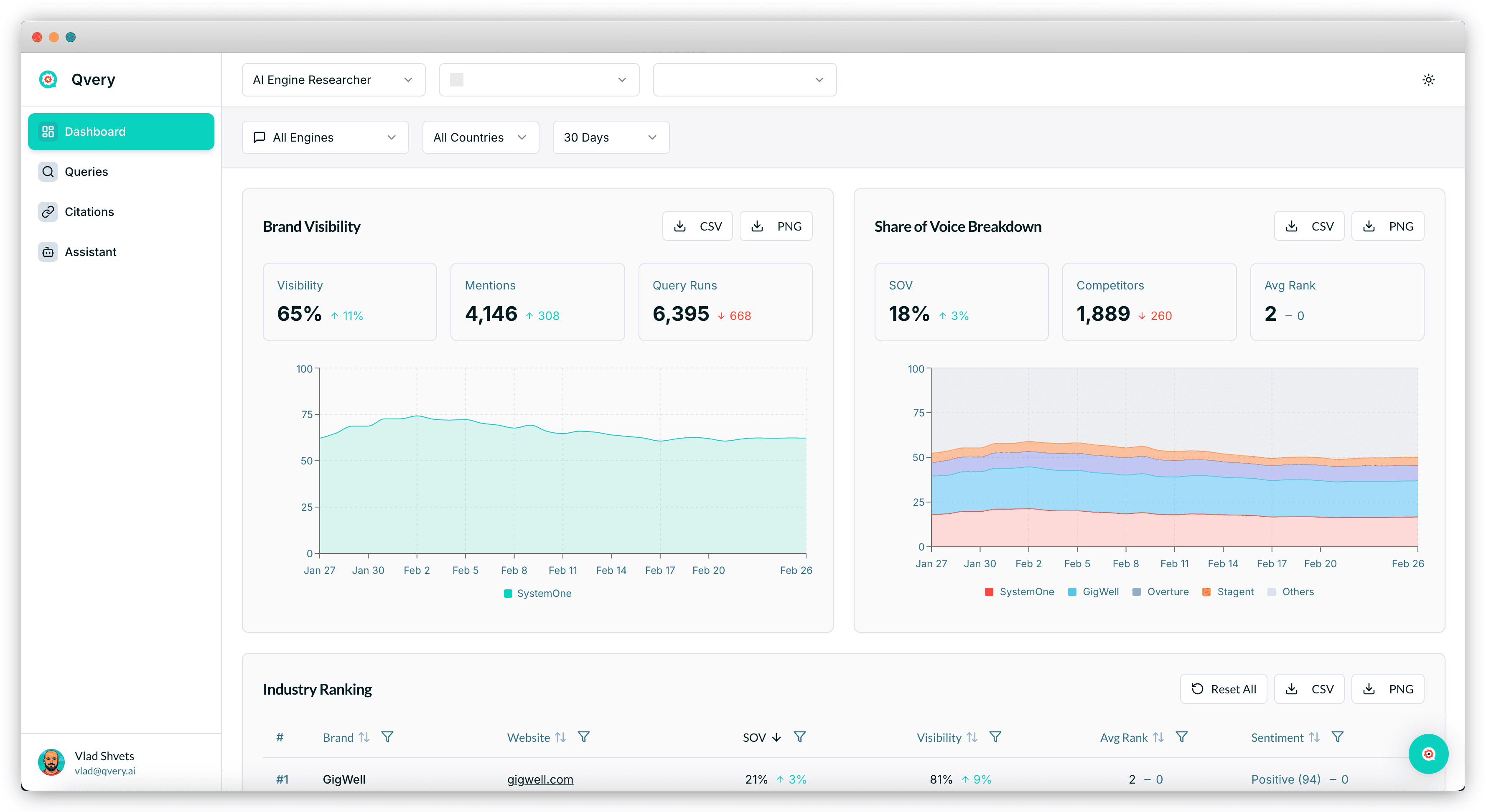
Visibility is the simplest metric. It's binary at the execution level: your brand either appears in an AI engine's response, or it doesn't.
Run that query multiple times, and you get a percentage. If your brand appears in 7 out of 10 executions, your visibility is 70%. Scale that across all your queries and you get your overall visibility rate: the percentage of the time AI engines mention your brand when someone asks a relevant question.
Visibility is a top-of-funnel metric. A brand with 80% visibility across 50 queries has strong coverage. A brand with 80% visibility across 5 queries might just be well-known for one thing. The breadth matters as much as the rate.
If your visibility is low, nothing else matters yet. You're not in the conversation. Fix that first.
Share of Voice: How Much of the Conversation Do You Own?
Visibility tells you if you're in the room. Share of voice tells you how much of the room belongs to you.
SOV in Qvery is position-weighted. It doesn't just count whether you appear. It calculates how prominently you appear relative to every other brand in the same response.
The formula uses position-based weighting:
Weight = (Total brands + 1) - Your position
So in a four-brand response at position two: (4 + 1) - 2 = 3. The brand in first position gets a weight of 4, second gets 3, third gets 2, fourth gets 1. Total weights: 10. Your share of that execution: 3/10 = 30%.
This is where it gets interesting. Being #2 out of 3 brands gives you 33% SOV. Being #2 out of 8 brands gives you 12.5%. Same position, wildly different share. SOV captures the competitive density of each response, not just your rank.
A brand can have 100% visibility and 15% share of voice. That means it appears in every response but always gets mentioned last, behind a pile of competitors.
Average Rank: Where Do You Land?
Average rank is the average position where your brand appears when it is recommended. It only counts the times you show up.
If you appear in 3 out of 5 executions at positions 1, 3, and 2, your average rank is 2.0. Lower is better. An average rank of 1.5 means AI engines consistently put you near the top. An average rank of 4.7 means you're making the list, but barely. (Still in the room, though. Visibility gives you credit for that.)
Average rank is a diagnostic tool. If your visibility is high but your SOV is low, average rank tells you why: you're appearing often, but in weak positions. If your SOV is climbing but average rank is getting worse, you might be appearing in more responses (good) but in lower positions within each one (something to investigate).
How the Three Metrics Work Together
Each metric answers a different question:
Visibility: Are we in the conversation?
Share of voice: How much of the conversation do we own?
Average rank: Where do we land when we show up?
A healthy brand in AI search has high visibility (appearing often), strong SOV (prominent positions in competitive responses), and low average rank (consistently near the top). When one of these is off, the other two tell you what to investigate.
A brand with high visibility but low SOV is present but weak. A brand with low visibility but high SOV is strong but narrow. The combination tells the full story.
The "So What?": 60 Years of Evidence That Voice Share Predicts Market Share
Here's why these numbers matter beyond a dashboard.
The relationship between share of voice and market share isn't a new idea. It's the most validated principle in marketing effectiveness research. James Peckham documented it at AC Nielsen in the 1960s. John Philip Jones formalized it in Harvard Business Review. Then Les Binet and Peter Field ran the definitive study.
Binet and Field analyzed over 800 effectiveness case studies from the IPA Databank and found a rule so consistent it's basically a law: when your share of voice exceeds your market share, your market share grows. They called it Extra Share of Voice (ESOV).
ESOV = Share of Voice - Share of Market
The multiplier: for every 10 percentage points of ESOV, market share grows by approximately 0.7 percentage points per year in B2B and 0.6% in B2C. Nielsen validated this independently across 123 brands. The relationship holds across FMCG, financial services, automotive, telecoms, and every category anyone has tested.
More recently, James Hankins and the IPA's Share of Search think tank found that share of search explains 83% of a brand's market share. Turns out the marketing professors were onto something.
The Bridge to AI Search (and Revenue)
The logic chain is short:
Share of voice predicts market share (60 years of data)
Share of search is a valid proxy for share of voice
AI search is replacing traditional search
Share of AI search visibility is the next evolution of the same principle
If the ESOV rule has held across every medium from print to television to digital to search, there's no reason to believe it stops working when the search engine starts answering in paragraphs instead of links. The mechanism is the same: mental availability drives purchase behavior. AI engines are becoming the primary driver of mental availability.
This is the "so what." When your share of voice in ChatGPT and Google AI Mode grows, your actual market share follows. Not next week. But reliably, over time. Every percentage point of SOV you gain is a leading indicator of revenue you haven't seen yet.
The brands that own the largest share of AI engine recommendations today will own the largest share of their markets tomorrow.
Measuring Is Step One. Growing Is the Point.
This is why Qvery exists. Not just to show you the numbers, but to help you move them.
AI Engine Researcher is the measurement layer. It runs your queries daily across ChatGPT and Google AI Mode, captures every brand mentioned, and calculates visibility, SOV, and average rank automatically. You see trends, breakdowns by topic, and competitor comparisons.
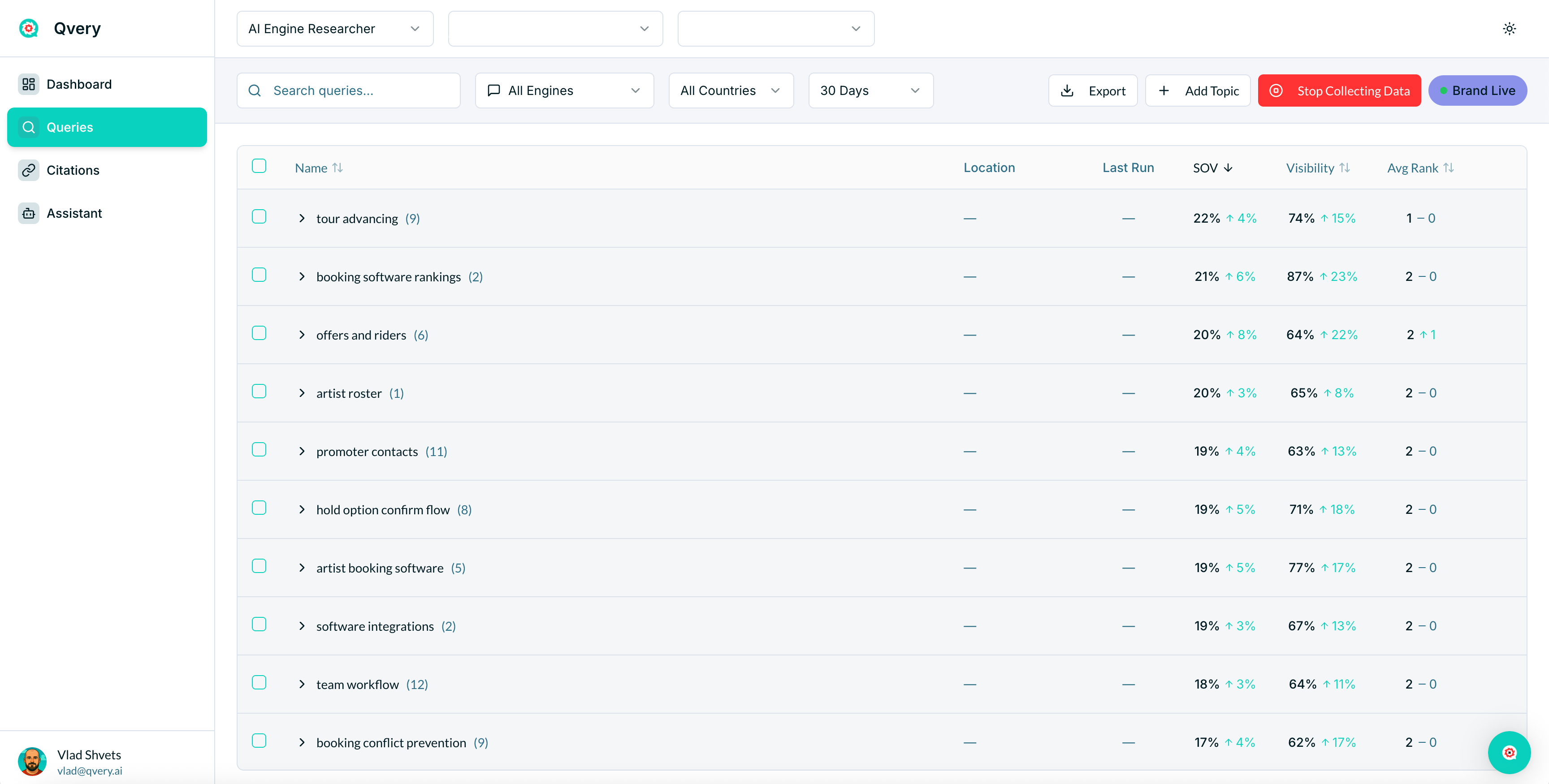
But measurement alone doesn't grow your market share. That's why at Qvery we're building AI agents that take action. Agents that identify citation gaps and help you close them. Agents that find the third-party mentions you're missing. Agents that spot the Reddit threads and listicle placements where your brand should appear but doesn't.
The vision is a system where the same platform that measures your AI visibility also grows it proactively. Not just a dashboard you check. A system that works for you.
What to Do When the Numbers Move
Three practical responses based on what your metrics tell you:
Visibility is low (under 30%): You're not in enough conversations. Focus on the three pillars of AI engine visibility: your website content, third-party mentions, and UGC. Get in the room before worrying about your seat.
Visibility is high but SOV is low: You're showing up but getting outranked. Your competitors are being recommended more prominently. Strengthen your content's authority signals, earn more and better citations, and read How to Get ChatGPT to Recommend Your Brand for the tactical playbook.
SOV is growing: You're gaining ground. This is the leading indicator. If Binet and Field's research holds for AI search (and every signal says it does), that SOV growth will translate to market share growth. Keep investing. The double jeopardy law means the advantage compounds.
The relationship between share of voice and market share has survived every media transition for 60 years. We're betting it survives this one too.
Qvery tracks three core metrics for your brand's presence in AI search: visibility, share of voice, and average rank. They sound similar. They measure completely different things. And the question marketers keep asking us isn't "what do these numbers mean?" It's "so what?"
So what if my visibility is 34%? So what if my share of voice grew 5 points? So what if my average rank improved from 3.2 to 2.1?
Fair questions. The answer involves 60 years of marketing science, a principle that has predicted market share across every industry and every medium ever tested, and the reason Qvery exists: to not just measure these numbers, but to connect them to revenue and build AI agents that grow them.
Visibility: Are You in the Conversation?
Visibility is the simplest metric. It's binary at the execution level: your brand either appears in an AI engine's response, or it doesn't.
Run that query multiple times, and you get a percentage. If your brand appears in 7 out of 10 executions, your visibility is 70%. Scale that across all your queries and you get your overall visibility rate: the percentage of the time AI engines mention your brand when someone asks a relevant question.
Visibility is a top-of-funnel metric. A brand with 80% visibility across 50 queries has strong coverage. A brand with 80% visibility across 5 queries might just be well-known for one thing. The breadth matters as much as the rate.
If your visibility is low, nothing else matters yet. You're not in the conversation. Fix that first.
Share of Voice: How Much of the Conversation Do You Own?
Visibility tells you if you're in the room. Share of voice tells you how much of the room belongs to you.
SOV in Qvery is position-weighted. It doesn't just count whether you appear. It calculates how prominently you appear relative to every other brand in the same response.
The formula uses position-based weighting:
Weight = (Total brands + 1) - Your position
So in a four-brand response at position two: (4 + 1) - 2 = 3. The brand in first position gets a weight of 4, second gets 3, third gets 2, fourth gets 1. Total weights: 10. Your share of that execution: 3/10 = 30%.
This is where it gets interesting. Being #2 out of 3 brands gives you 33% SOV. Being #2 out of 8 brands gives you 12.5%. Same position, wildly different share. SOV captures the competitive density of each response, not just your rank.
A brand can have 100% visibility and 15% share of voice. That means it appears in every response but always gets mentioned last, behind a pile of competitors.
Average Rank: Where Do You Land?
Average rank is the average position where your brand appears when it is recommended. It only counts the times you show up.
If you appear in 3 out of 5 executions at positions 1, 3, and 2, your average rank is 2.0. Lower is better. An average rank of 1.5 means AI engines consistently put you near the top. An average rank of 4.7 means you're making the list, but barely. (Still in the room, though. Visibility gives you credit for that.)
Average rank is a diagnostic tool. If your visibility is high but your SOV is low, average rank tells you why: you're appearing often, but in weak positions. If your SOV is climbing but average rank is getting worse, you might be appearing in more responses (good) but in lower positions within each one (something to investigate).
How the Three Metrics Work Together
Each metric answers a different question:
Visibility: Are we in the conversation?
Share of voice: How much of the conversation do we own?
Average rank: Where do we land when we show up?
A healthy brand in AI search has high visibility (appearing often), strong SOV (prominent positions in competitive responses), and low average rank (consistently near the top). When one of these is off, the other two tell you what to investigate.
A brand with high visibility but low SOV is present but weak. A brand with low visibility but high SOV is strong but narrow. The combination tells the full story.
The "So What?": 60 Years of Evidence That Voice Share Predicts Market Share
Here's why these numbers matter beyond a dashboard.
The relationship between share of voice and market share isn't a new idea. It's the most validated principle in marketing effectiveness research. James Peckham documented it at AC Nielsen in the 1960s. John Philip Jones formalized it in Harvard Business Review. Then Les Binet and Peter Field ran the definitive study.
Binet and Field analyzed over 800 effectiveness case studies from the IPA Databank and found a rule so consistent it's basically a law: when your share of voice exceeds your market share, your market share grows. They called it Extra Share of Voice (ESOV).
ESOV = Share of Voice - Share of Market
The multiplier: for every 10 percentage points of ESOV, market share grows by approximately 0.7 percentage points per year in B2B and 0.6% in B2C. Nielsen validated this independently across 123 brands. The relationship holds across FMCG, financial services, automotive, telecoms, and every category anyone has tested.
More recently, James Hankins and the IPA's Share of Search think tank found that share of search explains 83% of a brand's market share. Turns out the marketing professors were onto something.
The Bridge to AI Search (and Revenue)
The logic chain is short:
Share of voice predicts market share (60 years of data)
Share of search is a valid proxy for share of voice
AI search is replacing traditional search
Share of AI search visibility is the next evolution of the same principle
If the ESOV rule has held across every medium from print to television to digital to search, there's no reason to believe it stops working when the search engine starts answering in paragraphs instead of links. The mechanism is the same: mental availability drives purchase behavior. AI engines are becoming the primary driver of mental availability.
This is the "so what." When your share of voice in ChatGPT and Google AI Mode grows, your actual market share follows. Not next week. But reliably, over time. Every percentage point of SOV you gain is a leading indicator of revenue you haven't seen yet.
The brands that own the largest share of AI engine recommendations today will own the largest share of their markets tomorrow.
Measuring Is Step One. Growing Is the Point.
This is why Qvery exists. Not just to show you the numbers, but to help you move them.
AI Engine Researcher is the measurement layer. It runs your queries daily across ChatGPT and Google AI Mode, captures every brand mentioned, and calculates visibility, SOV, and average rank automatically. You see trends, breakdowns by topic, and competitor comparisons.
But measurement alone doesn't grow your market share. That's why at Qvery we're building AI agents that take action. Agents that identify citation gaps and help you close them. Agents that find the third-party mentions you're missing. Agents that spot the Reddit threads and listicle placements where your brand should appear but doesn't.
The vision is a system where the same platform that measures your AI visibility also grows it proactively. Not just a dashboard you check. A system that works for you.
What to Do When the Numbers Move
Three practical responses based on what your metrics tell you:
Visibility is low (under 30%): You're not in enough conversations. Focus on the three pillars of AI engine visibility: your website content, third-party mentions, and UGC. Get in the room before worrying about your seat.
Visibility is high but SOV is low: You're showing up but getting outranked. Your competitors are being recommended more prominently. Strengthen your content's authority signals, earn more and better citations, and read How to Get ChatGPT to Recommend Your Brand for the tactical playbook.
SOV is growing: You're gaining ground. This is the leading indicator. If Binet and Field's research holds for AI search (and every signal says it does), that SOV growth will translate to market share growth. Keep investing. The double jeopardy law means the advantage compounds.
The relationship between share of voice and market share has survived every media transition for 60 years. We're betting it survives this one too.
Qvery tracks three core metrics for your brand's presence in AI search: visibility, share of voice, and average rank. They sound similar. They measure completely different things. And the question marketers keep asking us isn't "what do these numbers mean?" It's "so what?"
So what if my visibility is 34%? So what if my share of voice grew 5 points? So what if my average rank improved from 3.2 to 2.1?
Fair questions. The answer involves 60 years of marketing science, a principle that has predicted market share across every industry and every medium ever tested, and the reason Qvery exists: to not just measure these numbers, but to connect them to revenue and build AI agents that grow them.
Visibility: Are You in the Conversation?
Visibility is the simplest metric. It's binary at the execution level: your brand either appears in an AI engine's response, or it doesn't.
Run that query multiple times, and you get a percentage. If your brand appears in 7 out of 10 executions, your visibility is 70%. Scale that across all your queries and you get your overall visibility rate: the percentage of the time AI engines mention your brand when someone asks a relevant question.
Visibility is a top-of-funnel metric. A brand with 80% visibility across 50 queries has strong coverage. A brand with 80% visibility across 5 queries might just be well-known for one thing. The breadth matters as much as the rate.
If your visibility is low, nothing else matters yet. You're not in the conversation. Fix that first.
Share of Voice: How Much of the Conversation Do You Own?
Visibility tells you if you're in the room. Share of voice tells you how much of the room belongs to you.
SOV in Qvery is position-weighted. It doesn't just count whether you appear. It calculates how prominently you appear relative to every other brand in the same response.
The formula uses position-based weighting:
Weight = (Total brands + 1) - Your position
So in a four-brand response at position two: (4 + 1) - 2 = 3. The brand in first position gets a weight of 4, second gets 3, third gets 2, fourth gets 1. Total weights: 10. Your share of that execution: 3/10 = 30%.
This is where it gets interesting. Being #2 out of 3 brands gives you 33% SOV. Being #2 out of 8 brands gives you 12.5%. Same position, wildly different share. SOV captures the competitive density of each response, not just your rank.
A brand can have 100% visibility and 15% share of voice. That means it appears in every response but always gets mentioned last, behind a pile of competitors.
Average Rank: Where Do You Land?
Average rank is the average position where your brand appears when it is recommended. It only counts the times you show up.
If you appear in 3 out of 5 executions at positions 1, 3, and 2, your average rank is 2.0. Lower is better. An average rank of 1.5 means AI engines consistently put you near the top. An average rank of 4.7 means you're making the list, but barely. (Still in the room, though. Visibility gives you credit for that.)
Average rank is a diagnostic tool. If your visibility is high but your SOV is low, average rank tells you why: you're appearing often, but in weak positions. If your SOV is climbing but average rank is getting worse, you might be appearing in more responses (good) but in lower positions within each one (something to investigate).
How the Three Metrics Work Together
Each metric answers a different question:
Visibility: Are we in the conversation?
Share of voice: How much of the conversation do we own?
Average rank: Where do we land when we show up?
A healthy brand in AI search has high visibility (appearing often), strong SOV (prominent positions in competitive responses), and low average rank (consistently near the top). When one of these is off, the other two tell you what to investigate.
A brand with high visibility but low SOV is present but weak. A brand with low visibility but high SOV is strong but narrow. The combination tells the full story.
The "So What?": 60 Years of Evidence That Voice Share Predicts Market Share
Here's why these numbers matter beyond a dashboard.
The relationship between share of voice and market share isn't a new idea. It's the most validated principle in marketing effectiveness research. James Peckham documented it at AC Nielsen in the 1960s. John Philip Jones formalized it in Harvard Business Review. Then Les Binet and Peter Field ran the definitive study.
Binet and Field analyzed over 800 effectiveness case studies from the IPA Databank and found a rule so consistent it's basically a law: when your share of voice exceeds your market share, your market share grows. They called it Extra Share of Voice (ESOV).
ESOV = Share of Voice - Share of Market
The multiplier: for every 10 percentage points of ESOV, market share grows by approximately 0.7 percentage points per year in B2B and 0.6% in B2C. Nielsen validated this independently across 123 brands. The relationship holds across FMCG, financial services, automotive, telecoms, and every category anyone has tested.
More recently, James Hankins and the IPA's Share of Search think tank found that share of search explains 83% of a brand's market share. Turns out the marketing professors were onto something.
The Bridge to AI Search (and Revenue)
The logic chain is short:
Share of voice predicts market share (60 years of data)
Share of search is a valid proxy for share of voice
AI search is replacing traditional search
Share of AI search visibility is the next evolution of the same principle
If the ESOV rule has held across every medium from print to television to digital to search, there's no reason to believe it stops working when the search engine starts answering in paragraphs instead of links. The mechanism is the same: mental availability drives purchase behavior. AI engines are becoming the primary driver of mental availability.
This is the "so what." When your share of voice in ChatGPT and Google AI Mode grows, your actual market share follows. Not next week. But reliably, over time. Every percentage point of SOV you gain is a leading indicator of revenue you haven't seen yet.
The brands that own the largest share of AI engine recommendations today will own the largest share of their markets tomorrow.
Measuring Is Step One. Growing Is the Point.
This is why Qvery exists. Not just to show you the numbers, but to help you move them.
AI Engine Researcher is the measurement layer. It runs your queries daily across ChatGPT and Google AI Mode, captures every brand mentioned, and calculates visibility, SOV, and average rank automatically. You see trends, breakdowns by topic, and competitor comparisons.
But measurement alone doesn't grow your market share. That's why at Qvery we're building AI agents that take action. Agents that identify citation gaps and help you close them. Agents that find the third-party mentions you're missing. Agents that spot the Reddit threads and listicle placements where your brand should appear but doesn't.
The vision is a system where the same platform that measures your AI visibility also grows it proactively. Not just a dashboard you check. A system that works for you.
What to Do When the Numbers Move
Three practical responses based on what your metrics tell you:
Visibility is low (under 30%): You're not in enough conversations. Focus on the three pillars of AI engine visibility: your website content, third-party mentions, and UGC. Get in the room before worrying about your seat.
Visibility is high but SOV is low: You're showing up but getting outranked. Your competitors are being recommended more prominently. Strengthen your content's authority signals, earn more and better citations, and read How to Get ChatGPT to Recommend Your Brand for the tactical playbook.
SOV is growing: You're gaining ground. This is the leading indicator. If Binet and Field's research holds for AI search (and every signal says it does), that SOV growth will translate to market share growth. Keep investing. The double jeopardy law means the advantage compounds.
The relationship between share of voice and market share has survived every media transition for 60 years. We're betting it survives this one too.
Qvery tracks three core metrics for your brand's presence in AI search: visibility, share of voice, and average rank. They sound similar. They measure completely different things. And the question marketers keep asking us isn't "what do these numbers mean?" It's "so what?"
So what if my visibility is 34%? So what if my share of voice grew 5 points? So what if my average rank improved from 3.2 to 2.1?
Fair questions. The answer involves 60 years of marketing science, a principle that has predicted market share across every industry and every medium ever tested, and the reason Qvery exists: to not just measure these numbers, but to connect them to revenue and build AI agents that grow them.
Visibility: Are You in the Conversation?
Visibility is the simplest metric. It's binary at the execution level: your brand either appears in an AI engine's response, or it doesn't.
Run that query multiple times, and you get a percentage. If your brand appears in 7 out of 10 executions, your visibility is 70%. Scale that across all your queries and you get your overall visibility rate: the percentage of the time AI engines mention your brand when someone asks a relevant question.
Visibility is a top-of-funnel metric. A brand with 80% visibility across 50 queries has strong coverage. A brand with 80% visibility across 5 queries might just be well-known for one thing. The breadth matters as much as the rate.
If your visibility is low, nothing else matters yet. You're not in the conversation. Fix that first.
Share of Voice: How Much of the Conversation Do You Own?
Visibility tells you if you're in the room. Share of voice tells you how much of the room belongs to you.
SOV in Qvery is position-weighted. It doesn't just count whether you appear. It calculates how prominently you appear relative to every other brand in the same response.
The formula uses position-based weighting:
Weight = (Total brands + 1) - Your position
So in a four-brand response at position two: (4 + 1) - 2 = 3. The brand in first position gets a weight of 4, second gets 3, third gets 2, fourth gets 1. Total weights: 10. Your share of that execution: 3/10 = 30%.
This is where it gets interesting. Being #2 out of 3 brands gives you 33% SOV. Being #2 out of 8 brands gives you 12.5%. Same position, wildly different share. SOV captures the competitive density of each response, not just your rank.
A brand can have 100% visibility and 15% share of voice. That means it appears in every response but always gets mentioned last, behind a pile of competitors.
Average Rank: Where Do You Land?
Average rank is the average position where your brand appears when it is recommended. It only counts the times you show up.
If you appear in 3 out of 5 executions at positions 1, 3, and 2, your average rank is 2.0. Lower is better. An average rank of 1.5 means AI engines consistently put you near the top. An average rank of 4.7 means you're making the list, but barely. (Still in the room, though. Visibility gives you credit for that.)
Average rank is a diagnostic tool. If your visibility is high but your SOV is low, average rank tells you why: you're appearing often, but in weak positions. If your SOV is climbing but average rank is getting worse, you might be appearing in more responses (good) but in lower positions within each one (something to investigate).
How the Three Metrics Work Together
Each metric answers a different question:
Visibility: Are we in the conversation?
Share of voice: How much of the conversation do we own?
Average rank: Where do we land when we show up?
A healthy brand in AI search has high visibility (appearing often), strong SOV (prominent positions in competitive responses), and low average rank (consistently near the top). When one of these is off, the other two tell you what to investigate.
A brand with high visibility but low SOV is present but weak. A brand with low visibility but high SOV is strong but narrow. The combination tells the full story.
The "So What?": 60 Years of Evidence That Voice Share Predicts Market Share
Here's why these numbers matter beyond a dashboard.
The relationship between share of voice and market share isn't a new idea. It's the most validated principle in marketing effectiveness research. James Peckham documented it at AC Nielsen in the 1960s. John Philip Jones formalized it in Harvard Business Review. Then Les Binet and Peter Field ran the definitive study.
Binet and Field analyzed over 800 effectiveness case studies from the IPA Databank and found a rule so consistent it's basically a law: when your share of voice exceeds your market share, your market share grows. They called it Extra Share of Voice (ESOV).
ESOV = Share of Voice - Share of Market
The multiplier: for every 10 percentage points of ESOV, market share grows by approximately 0.7 percentage points per year in B2B and 0.6% in B2C. Nielsen validated this independently across 123 brands. The relationship holds across FMCG, financial services, automotive, telecoms, and every category anyone has tested.
More recently, James Hankins and the IPA's Share of Search think tank found that share of search explains 83% of a brand's market share. Turns out the marketing professors were onto something.
The Bridge to AI Search (and Revenue)
The logic chain is short:
Share of voice predicts market share (60 years of data)
Share of search is a valid proxy for share of voice
AI search is replacing traditional search
Share of AI search visibility is the next evolution of the same principle
If the ESOV rule has held across every medium from print to television to digital to search, there's no reason to believe it stops working when the search engine starts answering in paragraphs instead of links. The mechanism is the same: mental availability drives purchase behavior. AI engines are becoming the primary driver of mental availability.
This is the "so what." When your share of voice in ChatGPT and Google AI Mode grows, your actual market share follows. Not next week. But reliably, over time. Every percentage point of SOV you gain is a leading indicator of revenue you haven't seen yet.
The brands that own the largest share of AI engine recommendations today will own the largest share of their markets tomorrow.
Measuring Is Step One. Growing Is the Point.
This is why Qvery exists. Not just to show you the numbers, but to help you move them.
AI Engine Researcher is the measurement layer. It runs your queries daily across ChatGPT and Google AI Mode, captures every brand mentioned, and calculates visibility, SOV, and average rank automatically. You see trends, breakdowns by topic, and competitor comparisons.
But measurement alone doesn't grow your market share. That's why at Qvery we're building AI agents that take action. Agents that identify citation gaps and help you close them. Agents that find the third-party mentions you're missing. Agents that spot the Reddit threads and listicle placements where your brand should appear but doesn't.
The vision is a system where the same platform that measures your AI visibility also grows it proactively. Not just a dashboard you check. A system that works for you.
What to Do When the Numbers Move
Three practical responses based on what your metrics tell you:
Visibility is low (under 30%): You're not in enough conversations. Focus on the three pillars of AI engine visibility: your website content, third-party mentions, and UGC. Get in the room before worrying about your seat.
Visibility is high but SOV is low: You're showing up but getting outranked. Your competitors are being recommended more prominently. Strengthen your content's authority signals, earn more and better citations, and read How to Get ChatGPT to Recommend Your Brand for the tactical playbook.
SOV is growing: You're gaining ground. This is the leading indicator. If Binet and Field's research holds for AI search (and every signal says it does), that SOV growth will translate to market share growth. Keep investing. The double jeopardy law means the advantage compounds.
The relationship between share of voice and market share has survived every media transition for 60 years. We're betting it survives this one too.

© 2026 Qvery AI OÜ