By
Vlad Shvets
How To Measure AI Engine Visibility For A B2B Services Brand
Who should I hire and what should I use are the same job asked two ways. The two answer surfaces share one row, and firms' own sites carry the hiring one.
Who should I hire and what should I use are the same job asked two ways. The two answer surfaces share one row, and firms' own sites carry the hiring one.
Who should I hire and what should I use are the same job asked two ways. The two answer surfaces share one row, and firms' own sites carry the hiring one.
Take one job your firm sells. Managed IT, demand generation, bookkeeping, whatever pays the bills.
Now ask it two ways. Who should I hire to do this, and what should I use to do this myself. Same job, same buyer, one of them ends in a retainer and the other in a subscription.
Those two questions came back with almost entirely different domains cited under them. Track one shape and your measurement describes one of the two, whichever one you happened to write queries for.
Nothing here is about who the engines recommend. It is about what an audit of your category should contain.
Ask The Question Your Buyer Asks, Both Ways
Write your five service lines down. For each one, write the hire question and the tool question, in the words a buyer would use.
Who should I hire to run paid search for a small SaaS company. What should I use to run paid search myself with no agency.
Which firm should handle bookkeeping for a two-person consultancy. What software should a two-person consultancy use for bookkeeping.
That is ten questions. A morning's work, and the input to everything that follows. The second column is the one that usually goes unwritten, because it feels like somebody else's market. Your buyer does not experience it that way.
Count Both Lists Before You Plan Anything
The first measurement is a count. Take one question shape, find the smallest set of domains covering half of the answers that cited any source, then the set covering four fifths. Repeat for the other shape.
Across a targeted set of buyer questions in marketing services and IT services we ran on ChatGPT and Google AI Mode in September 2026, the two shapes came out at wildly different sizes. Directional, not a census.
Who should I hire: thirteen domains cover half of the answers that cited any source. Thirty-three cover four fifths of them.
What should I use: four cover half of the answers that cited any source. Fourteen cover four fifths.
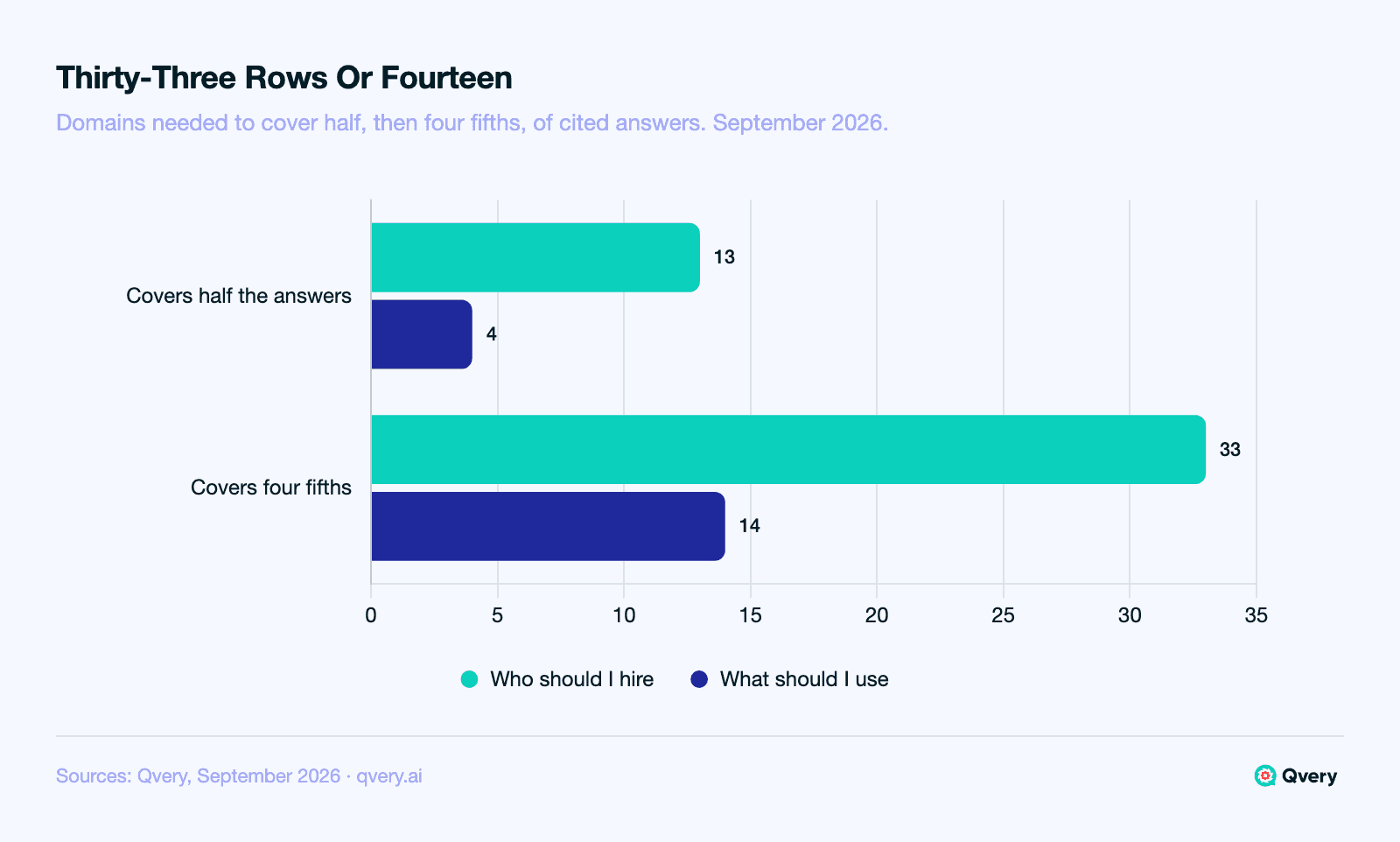
Thirteen domains to cover half of the answers that cited any source. That is a fragmented surface, and fragmentation is the defining fact about the hire question. The tool question consolidates into four.
Then the number that decides your programme. The two four-fifths lists share exactly one row: gov.uk.
One out of the smaller list's fourteen, a shared fraction of 0.07.
Here are the thirteen domains that cover half of the hire-side answers that cited any source:
Powered by Search, Clutch, Pulse CPAs, Hays, The Pedowitz Group, gov.uk, Clicks
Launch Leads, Reddit, Waypnt, CyberDuo, IT Jones, Tides Bookkeeping
The twenty rows after them, which take the list to four fifths, are almost all the same kind of thing: Walker Sands, Gartner, ClearlyRated, Proven SE Accountants, TM8, Office Solutions IT, Newform, Unbound, Compass MSP, KDI Services, James Todd, Quota Crushers, Forbes, Best IT MSPs, CaseStudies.com, Expertise, Agni, The Mx Group, Panda Techs and eSentire.
And the fourteen-row tool list, in order:
YouTube, HubSpot, QuickBooks, gov.uk
ManageEngine, Microsoft, G2, Ashby, Atlantic Computer Systems, Capterra, JumpCloud, Sage, Pinpoint, ServiceNow
Audit your category through the software question and you learn one government domain's worth about the hiring question.
So a services firm running one audit list has a list that describes one question shape and misdescribes the other. Two lists, and the hire one is more than twice the length.
What Comes Back When Someone Asks Who To Hire
Classify each cited domain by the kind of site it is and the fragmentation takes on a recognisable shape.
Firms' own domains were present in 82.76% of answers that cited any source on the hire side. Directories and review sites sat far below that. The consultancies, agencies and workshops themselves, on their own websites, were the sources cited most often.
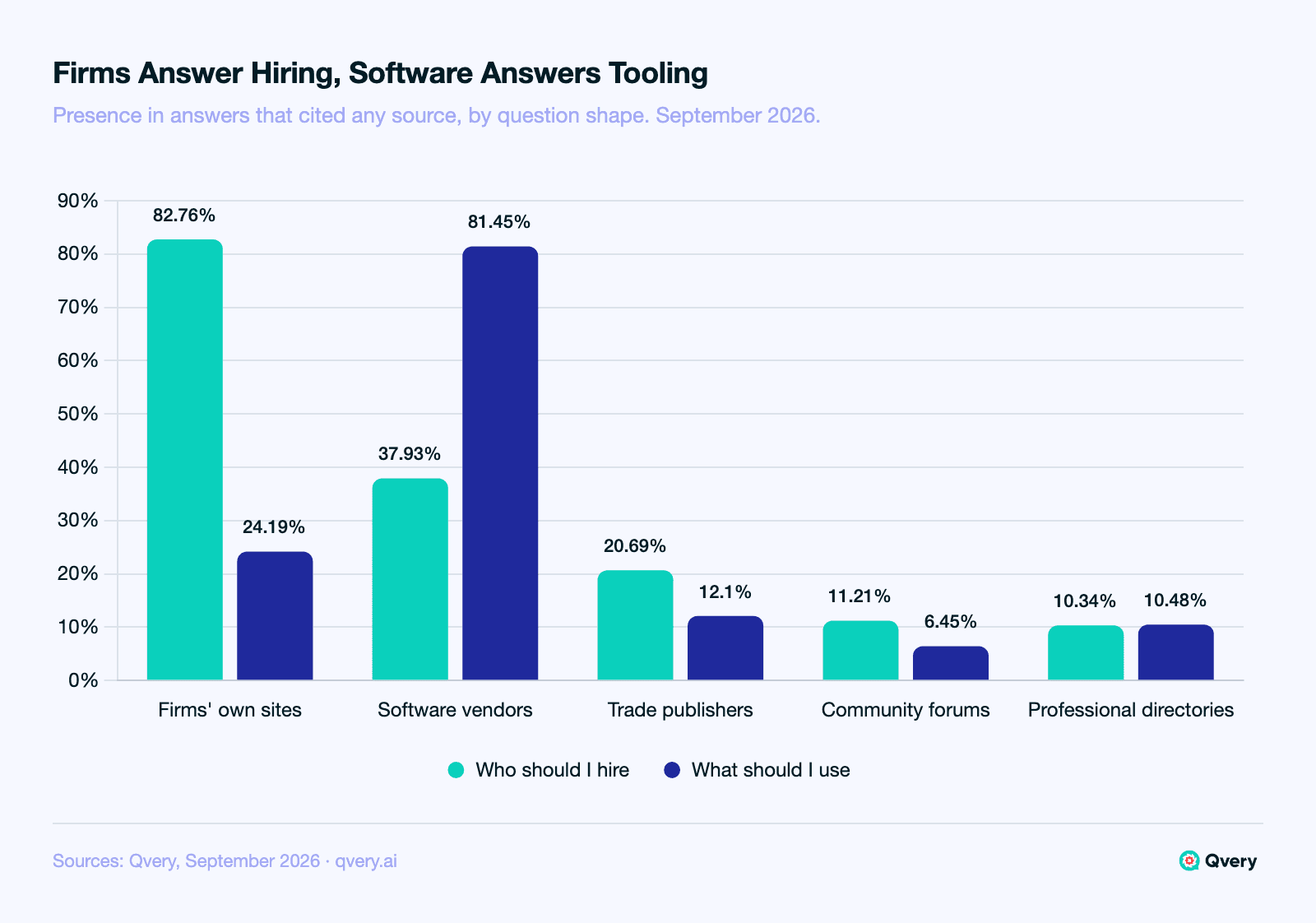
Compare that with the layer most often sold to services firms. Professional directories were present in 10.34% of answers that cited any source on the hire side, and software review directories in 3.45%.
Nine of the thirteen domains covering half of the hire-side answers that cited any source were individual firms' own sites.
The layer a firm controls outright is the layer most present in these answers. That is the most useful thing in this study for anyone who sells services.
Directories are the layer most often sold to services firms, and the layer least present in the answers we counted.
Three more layers, briefly. Software vendors were present in 37.93% of answers that cited any source on the hire side, so product domains turn up even where the buyer asked for a person.
Trade publishers were present in 20.69% of answers that cited any source on the hire side against 12.1% on the tool side, and community sources in 11.21% against 6.45%.
What Changes When The Same Job Is A Tool Question
Software vendors were present in 81.45% of answers that cited any source on the tool side, and firms' own sites in 24.19%. Video went the same way, 19.35% against 4.31% of answers that cited any source.
Four domains cover half of the tool-side answers that cited any source: YouTube, HubSpot, QuickBooks and gov.uk. That is a consolidated surface.
Two things follow for a services firm. The tool question comes back with software companies' own domains, which is a hard surface to enter from outside. The hire question comes back mostly with firms' own sites, which is a surface you already own a piece of.
Limits, once. We counted the domains answers cited. We did not read the answers, so nothing here says whether an answer named a specific firm, recommended one, or described the category and moved on. That read is yours, and it is worth doing by hand on ten of your own answers.
What A Firm Can Earn
Judgment, not findings. In the order I would spend on it.
Your own site, first and by a distance. It is the layer with no gatekeeper and the one present in most hire answers. Service pages that answer the buyer's question in the buyer's words, not capability statements.
Trade publishers second. Reachable through contributed writing and comment, and they sit higher on the hire side than on the tool side.
Community third. Slower, thinner, and real. It is a place your people already are.
Directories last. They were present in 10.34% of answers that cited any source on the hire side, and they are the layer most often sold to services firms as the answer.
Pick one. Name the page or profile that has to exist, give it an owner and a date.
Track Both Question Shapes In Qvery
One topic per service line, with both question shapes as queries under it. Qvery generates a starting set at onboarding and you edit it in plain language from there.
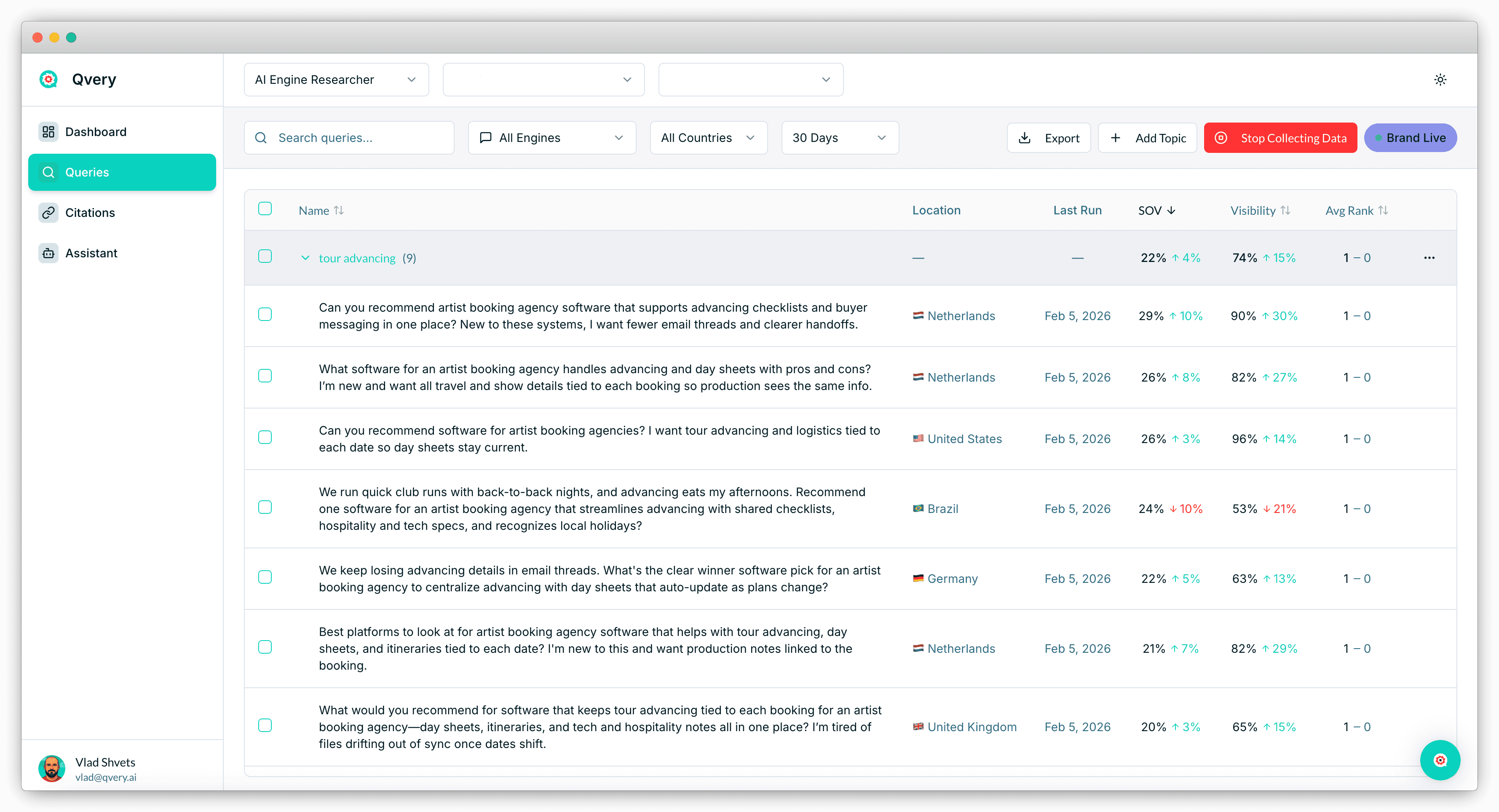
Every answer keeps the sources cited in it, tied to the query and the engine that produced it. The Citations view ranks the URLs and the domains behind those answers, each with a weight, filterable by engine and country, and the ranking exports. Rebuilding this article's count for your own category:
Open the Citations view for one service-line topic and read the Top Domains ranking.
Take rows from the top until another row stops changing what you would do. That is your working list.
Do it separately for each question shape, so you end up with two.
Mark every row present, absent or stale for your firm, and mark the rows that sit on both lists. One shared row is what this category returned.
A note on method. Our counts used a stricter definition than a top-ranked cut.
We took the smallest set of domains that together cover four fifths of the answers that cited any source, choosing them one at a time by how many still-uncovered answers each one adds. A ranked list read from the top is a close and usable version of the same thing.
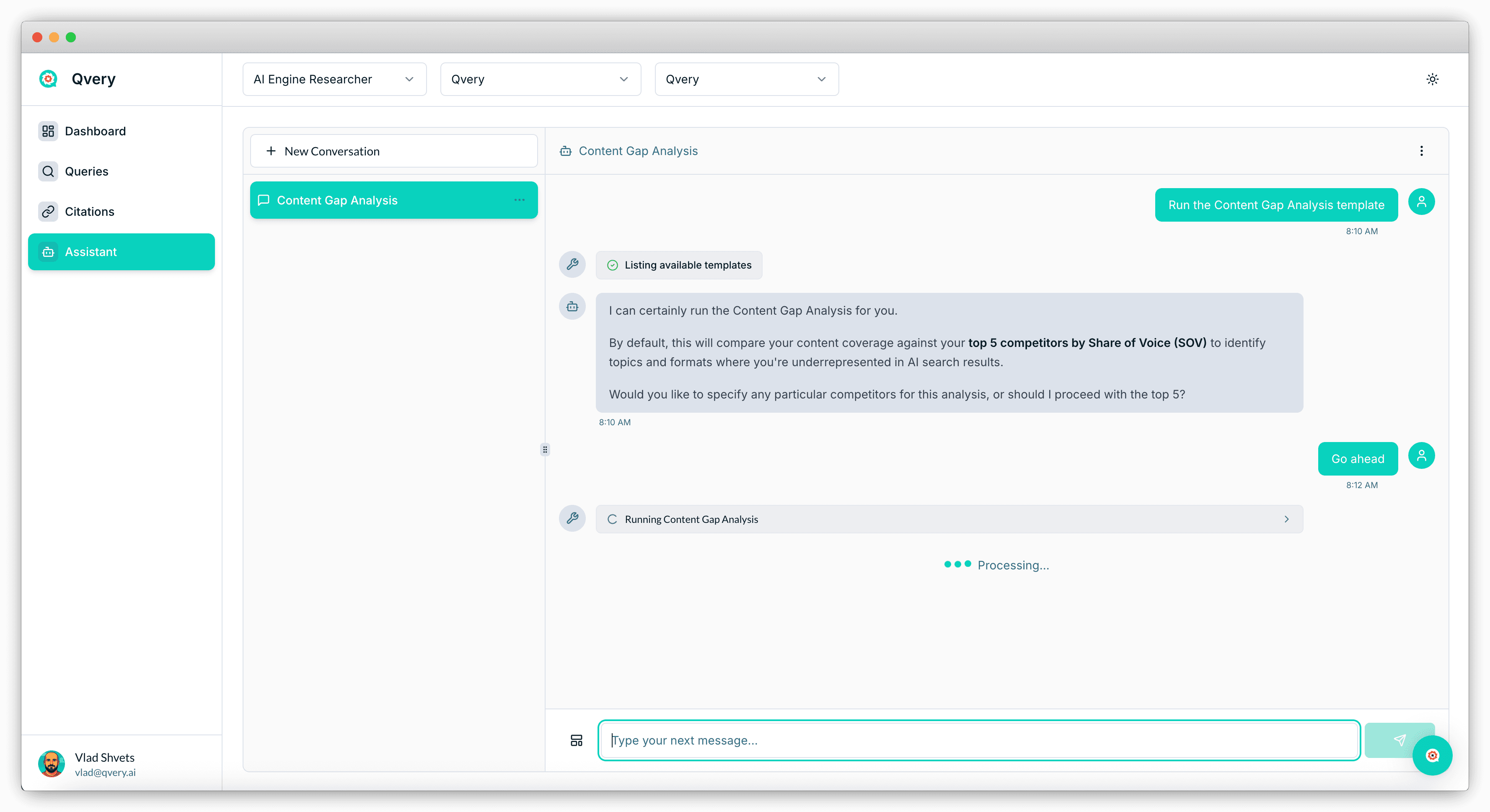
The Assistant can run the shipped templates on your account. It lists what is available, proposes a competitor set before starting, checks it with you, and runs. Worth a first pass before you do the four steps by hand.
The Citations view records and ranks the sources an answer cited. It does not sort them into firms, vendors and directories for you, and it does not report which firms an answer named in its text. Both reads are yours, done once, at the start.
Start a Qvery trial and put one service line in with both question shapes. Seven days free, no credit card, which is time to get the line configured and the first days of citations in.
Before the next thought-leadership brief goes out, read the hire side of your own category on its own, and check whether your domain is on the list at all.
Take one job your firm sells. Managed IT, demand generation, bookkeeping, whatever pays the bills.
Now ask it two ways. Who should I hire to do this, and what should I use to do this myself. Same job, same buyer, one of them ends in a retainer and the other in a subscription.
Those two questions came back with almost entirely different domains cited under them. Track one shape and your measurement describes one of the two, whichever one you happened to write queries for.
Nothing here is about who the engines recommend. It is about what an audit of your category should contain.
Ask The Question Your Buyer Asks, Both Ways
Write your five service lines down. For each one, write the hire question and the tool question, in the words a buyer would use.
Who should I hire to run paid search for a small SaaS company. What should I use to run paid search myself with no agency.
Which firm should handle bookkeeping for a two-person consultancy. What software should a two-person consultancy use for bookkeeping.
That is ten questions. A morning's work, and the input to everything that follows. The second column is the one that usually goes unwritten, because it feels like somebody else's market. Your buyer does not experience it that way.
Count Both Lists Before You Plan Anything
The first measurement is a count. Take one question shape, find the smallest set of domains covering half of the answers that cited any source, then the set covering four fifths. Repeat for the other shape.
Across a targeted set of buyer questions in marketing services and IT services we ran on ChatGPT and Google AI Mode in September 2026, the two shapes came out at wildly different sizes. Directional, not a census.
Who should I hire: thirteen domains cover half of the answers that cited any source. Thirty-three cover four fifths of them.
What should I use: four cover half of the answers that cited any source. Fourteen cover four fifths.
Thirteen domains to cover half of the answers that cited any source. That is a fragmented surface, and fragmentation is the defining fact about the hire question. The tool question consolidates into four.
Then the number that decides your programme. The two four-fifths lists share exactly one row: gov.uk.
One out of the smaller list's fourteen, a shared fraction of 0.07.
Here are the thirteen domains that cover half of the hire-side answers that cited any source:
Powered by Search, Clutch, Pulse CPAs, Hays, The Pedowitz Group, gov.uk, Clicks
Launch Leads, Reddit, Waypnt, CyberDuo, IT Jones, Tides Bookkeeping
The twenty rows after them, which take the list to four fifths, are almost all the same kind of thing: Walker Sands, Gartner, ClearlyRated, Proven SE Accountants, TM8, Office Solutions IT, Newform, Unbound, Compass MSP, KDI Services, James Todd, Quota Crushers, Forbes, Best IT MSPs, CaseStudies.com, Expertise, Agni, The Mx Group, Panda Techs and eSentire.
And the fourteen-row tool list, in order:
YouTube, HubSpot, QuickBooks, gov.uk
ManageEngine, Microsoft, G2, Ashby, Atlantic Computer Systems, Capterra, JumpCloud, Sage, Pinpoint, ServiceNow
Audit your category through the software question and you learn one government domain's worth about the hiring question.
So a services firm running one audit list has a list that describes one question shape and misdescribes the other. Two lists, and the hire one is more than twice the length.
What Comes Back When Someone Asks Who To Hire
Classify each cited domain by the kind of site it is and the fragmentation takes on a recognisable shape.
Firms' own domains were present in 82.76% of answers that cited any source on the hire side. Directories and review sites sat far below that. The consultancies, agencies and workshops themselves, on their own websites, were the sources cited most often.
Compare that with the layer most often sold to services firms. Professional directories were present in 10.34% of answers that cited any source on the hire side, and software review directories in 3.45%.
Nine of the thirteen domains covering half of the hire-side answers that cited any source were individual firms' own sites.
The layer a firm controls outright is the layer most present in these answers. That is the most useful thing in this study for anyone who sells services.
Directories are the layer most often sold to services firms, and the layer least present in the answers we counted.
Three more layers, briefly. Software vendors were present in 37.93% of answers that cited any source on the hire side, so product domains turn up even where the buyer asked for a person.
Trade publishers were present in 20.69% of answers that cited any source on the hire side against 12.1% on the tool side, and community sources in 11.21% against 6.45%.
What Changes When The Same Job Is A Tool Question
Software vendors were present in 81.45% of answers that cited any source on the tool side, and firms' own sites in 24.19%. Video went the same way, 19.35% against 4.31% of answers that cited any source.
Four domains cover half of the tool-side answers that cited any source: YouTube, HubSpot, QuickBooks and gov.uk. That is a consolidated surface.
Two things follow for a services firm. The tool question comes back with software companies' own domains, which is a hard surface to enter from outside. The hire question comes back mostly with firms' own sites, which is a surface you already own a piece of.
Limits, once. We counted the domains answers cited. We did not read the answers, so nothing here says whether an answer named a specific firm, recommended one, or described the category and moved on. That read is yours, and it is worth doing by hand on ten of your own answers.
What A Firm Can Earn
Judgment, not findings. In the order I would spend on it.
Your own site, first and by a distance. It is the layer with no gatekeeper and the one present in most hire answers. Service pages that answer the buyer's question in the buyer's words, not capability statements.
Trade publishers second. Reachable through contributed writing and comment, and they sit higher on the hire side than on the tool side.
Community third. Slower, thinner, and real. It is a place your people already are.
Directories last. They were present in 10.34% of answers that cited any source on the hire side, and they are the layer most often sold to services firms as the answer.
Pick one. Name the page or profile that has to exist, give it an owner and a date.
Track Both Question Shapes In Qvery
One topic per service line, with both question shapes as queries under it. Qvery generates a starting set at onboarding and you edit it in plain language from there.
Every answer keeps the sources cited in it, tied to the query and the engine that produced it. The Citations view ranks the URLs and the domains behind those answers, each with a weight, filterable by engine and country, and the ranking exports. Rebuilding this article's count for your own category:
Open the Citations view for one service-line topic and read the Top Domains ranking.
Take rows from the top until another row stops changing what you would do. That is your working list.
Do it separately for each question shape, so you end up with two.
Mark every row present, absent or stale for your firm, and mark the rows that sit on both lists. One shared row is what this category returned.
A note on method. Our counts used a stricter definition than a top-ranked cut.
We took the smallest set of domains that together cover four fifths of the answers that cited any source, choosing them one at a time by how many still-uncovered answers each one adds. A ranked list read from the top is a close and usable version of the same thing.
The Assistant can run the shipped templates on your account. It lists what is available, proposes a competitor set before starting, checks it with you, and runs. Worth a first pass before you do the four steps by hand.
The Citations view records and ranks the sources an answer cited. It does not sort them into firms, vendors and directories for you, and it does not report which firms an answer named in its text. Both reads are yours, done once, at the start.
Start a Qvery trial and put one service line in with both question shapes. Seven days free, no credit card, which is time to get the line configured and the first days of citations in.
Before the next thought-leadership brief goes out, read the hire side of your own category on its own, and check whether your domain is on the list at all.
Take one job your firm sells. Managed IT, demand generation, bookkeeping, whatever pays the bills.
Now ask it two ways. Who should I hire to do this, and what should I use to do this myself. Same job, same buyer, one of them ends in a retainer and the other in a subscription.
Those two questions came back with almost entirely different domains cited under them. Track one shape and your measurement describes one of the two, whichever one you happened to write queries for.
Nothing here is about who the engines recommend. It is about what an audit of your category should contain.
Ask The Question Your Buyer Asks, Both Ways
Write your five service lines down. For each one, write the hire question and the tool question, in the words a buyer would use.
Who should I hire to run paid search for a small SaaS company. What should I use to run paid search myself with no agency.
Which firm should handle bookkeeping for a two-person consultancy. What software should a two-person consultancy use for bookkeeping.
That is ten questions. A morning's work, and the input to everything that follows. The second column is the one that usually goes unwritten, because it feels like somebody else's market. Your buyer does not experience it that way.
Count Both Lists Before You Plan Anything
The first measurement is a count. Take one question shape, find the smallest set of domains covering half of the answers that cited any source, then the set covering four fifths. Repeat for the other shape.
Across a targeted set of buyer questions in marketing services and IT services we ran on ChatGPT and Google AI Mode in September 2026, the two shapes came out at wildly different sizes. Directional, not a census.
Who should I hire: thirteen domains cover half of the answers that cited any source. Thirty-three cover four fifths of them.
What should I use: four cover half of the answers that cited any source. Fourteen cover four fifths.
Thirteen domains to cover half of the answers that cited any source. That is a fragmented surface, and fragmentation is the defining fact about the hire question. The tool question consolidates into four.
Then the number that decides your programme. The two four-fifths lists share exactly one row: gov.uk.
One out of the smaller list's fourteen, a shared fraction of 0.07.
Here are the thirteen domains that cover half of the hire-side answers that cited any source:
Powered by Search, Clutch, Pulse CPAs, Hays, The Pedowitz Group, gov.uk, Clicks
Launch Leads, Reddit, Waypnt, CyberDuo, IT Jones, Tides Bookkeeping
The twenty rows after them, which take the list to four fifths, are almost all the same kind of thing: Walker Sands, Gartner, ClearlyRated, Proven SE Accountants, TM8, Office Solutions IT, Newform, Unbound, Compass MSP, KDI Services, James Todd, Quota Crushers, Forbes, Best IT MSPs, CaseStudies.com, Expertise, Agni, The Mx Group, Panda Techs and eSentire.
And the fourteen-row tool list, in order:
YouTube, HubSpot, QuickBooks, gov.uk
ManageEngine, Microsoft, G2, Ashby, Atlantic Computer Systems, Capterra, JumpCloud, Sage, Pinpoint, ServiceNow
Audit your category through the software question and you learn one government domain's worth about the hiring question.
So a services firm running one audit list has a list that describes one question shape and misdescribes the other. Two lists, and the hire one is more than twice the length.
What Comes Back When Someone Asks Who To Hire
Classify each cited domain by the kind of site it is and the fragmentation takes on a recognisable shape.
Firms' own domains were present in 82.76% of answers that cited any source on the hire side. Directories and review sites sat far below that. The consultancies, agencies and workshops themselves, on their own websites, were the sources cited most often.
Compare that with the layer most often sold to services firms. Professional directories were present in 10.34% of answers that cited any source on the hire side, and software review directories in 3.45%.
Nine of the thirteen domains covering half of the hire-side answers that cited any source were individual firms' own sites.
The layer a firm controls outright is the layer most present in these answers. That is the most useful thing in this study for anyone who sells services.
Directories are the layer most often sold to services firms, and the layer least present in the answers we counted.
Three more layers, briefly. Software vendors were present in 37.93% of answers that cited any source on the hire side, so product domains turn up even where the buyer asked for a person.
Trade publishers were present in 20.69% of answers that cited any source on the hire side against 12.1% on the tool side, and community sources in 11.21% against 6.45%.
What Changes When The Same Job Is A Tool Question
Software vendors were present in 81.45% of answers that cited any source on the tool side, and firms' own sites in 24.19%. Video went the same way, 19.35% against 4.31% of answers that cited any source.
Four domains cover half of the tool-side answers that cited any source: YouTube, HubSpot, QuickBooks and gov.uk. That is a consolidated surface.
Two things follow for a services firm. The tool question comes back with software companies' own domains, which is a hard surface to enter from outside. The hire question comes back mostly with firms' own sites, which is a surface you already own a piece of.
Limits, once. We counted the domains answers cited. We did not read the answers, so nothing here says whether an answer named a specific firm, recommended one, or described the category and moved on. That read is yours, and it is worth doing by hand on ten of your own answers.
What A Firm Can Earn
Judgment, not findings. In the order I would spend on it.
Your own site, first and by a distance. It is the layer with no gatekeeper and the one present in most hire answers. Service pages that answer the buyer's question in the buyer's words, not capability statements.
Trade publishers second. Reachable through contributed writing and comment, and they sit higher on the hire side than on the tool side.
Community third. Slower, thinner, and real. It is a place your people already are.
Directories last. They were present in 10.34% of answers that cited any source on the hire side, and they are the layer most often sold to services firms as the answer.
Pick one. Name the page or profile that has to exist, give it an owner and a date.
Track Both Question Shapes In Qvery
One topic per service line, with both question shapes as queries under it. Qvery generates a starting set at onboarding and you edit it in plain language from there.
Every answer keeps the sources cited in it, tied to the query and the engine that produced it. The Citations view ranks the URLs and the domains behind those answers, each with a weight, filterable by engine and country, and the ranking exports. Rebuilding this article's count for your own category:
Open the Citations view for one service-line topic and read the Top Domains ranking.
Take rows from the top until another row stops changing what you would do. That is your working list.
Do it separately for each question shape, so you end up with two.
Mark every row present, absent or stale for your firm, and mark the rows that sit on both lists. One shared row is what this category returned.
A note on method. Our counts used a stricter definition than a top-ranked cut.
We took the smallest set of domains that together cover four fifths of the answers that cited any source, choosing them one at a time by how many still-uncovered answers each one adds. A ranked list read from the top is a close and usable version of the same thing.
The Assistant can run the shipped templates on your account. It lists what is available, proposes a competitor set before starting, checks it with you, and runs. Worth a first pass before you do the four steps by hand.
The Citations view records and ranks the sources an answer cited. It does not sort them into firms, vendors and directories for you, and it does not report which firms an answer named in its text. Both reads are yours, done once, at the start.
Start a Qvery trial and put one service line in with both question shapes. Seven days free, no credit card, which is time to get the line configured and the first days of citations in.
Before the next thought-leadership brief goes out, read the hire side of your own category on its own, and check whether your domain is on the list at all.
Take one job your firm sells. Managed IT, demand generation, bookkeeping, whatever pays the bills.
Now ask it two ways. Who should I hire to do this, and what should I use to do this myself. Same job, same buyer, one of them ends in a retainer and the other in a subscription.
Those two questions came back with almost entirely different domains cited under them. Track one shape and your measurement describes one of the two, whichever one you happened to write queries for.
Nothing here is about who the engines recommend. It is about what an audit of your category should contain.
Ask The Question Your Buyer Asks, Both Ways
Write your five service lines down. For each one, write the hire question and the tool question, in the words a buyer would use.
Who should I hire to run paid search for a small SaaS company. What should I use to run paid search myself with no agency.
Which firm should handle bookkeeping for a two-person consultancy. What software should a two-person consultancy use for bookkeeping.
That is ten questions. A morning's work, and the input to everything that follows. The second column is the one that usually goes unwritten, because it feels like somebody else's market. Your buyer does not experience it that way.
Count Both Lists Before You Plan Anything
The first measurement is a count. Take one question shape, find the smallest set of domains covering half of the answers that cited any source, then the set covering four fifths. Repeat for the other shape.
Across a targeted set of buyer questions in marketing services and IT services we ran on ChatGPT and Google AI Mode in September 2026, the two shapes came out at wildly different sizes. Directional, not a census.
Who should I hire: thirteen domains cover half of the answers that cited any source. Thirty-three cover four fifths of them.
What should I use: four cover half of the answers that cited any source. Fourteen cover four fifths.
Thirteen domains to cover half of the answers that cited any source. That is a fragmented surface, and fragmentation is the defining fact about the hire question. The tool question consolidates into four.
Then the number that decides your programme. The two four-fifths lists share exactly one row: gov.uk.
One out of the smaller list's fourteen, a shared fraction of 0.07.
Here are the thirteen domains that cover half of the hire-side answers that cited any source:
Powered by Search, Clutch, Pulse CPAs, Hays, The Pedowitz Group, gov.uk, Clicks
Launch Leads, Reddit, Waypnt, CyberDuo, IT Jones, Tides Bookkeeping
The twenty rows after them, which take the list to four fifths, are almost all the same kind of thing: Walker Sands, Gartner, ClearlyRated, Proven SE Accountants, TM8, Office Solutions IT, Newform, Unbound, Compass MSP, KDI Services, James Todd, Quota Crushers, Forbes, Best IT MSPs, CaseStudies.com, Expertise, Agni, The Mx Group, Panda Techs and eSentire.
And the fourteen-row tool list, in order:
YouTube, HubSpot, QuickBooks, gov.uk
ManageEngine, Microsoft, G2, Ashby, Atlantic Computer Systems, Capterra, JumpCloud, Sage, Pinpoint, ServiceNow
Audit your category through the software question and you learn one government domain's worth about the hiring question.
So a services firm running one audit list has a list that describes one question shape and misdescribes the other. Two lists, and the hire one is more than twice the length.
What Comes Back When Someone Asks Who To Hire
Classify each cited domain by the kind of site it is and the fragmentation takes on a recognisable shape.
Firms' own domains were present in 82.76% of answers that cited any source on the hire side. Directories and review sites sat far below that. The consultancies, agencies and workshops themselves, on their own websites, were the sources cited most often.
Compare that with the layer most often sold to services firms. Professional directories were present in 10.34% of answers that cited any source on the hire side, and software review directories in 3.45%.
Nine of the thirteen domains covering half of the hire-side answers that cited any source were individual firms' own sites.
The layer a firm controls outright is the layer most present in these answers. That is the most useful thing in this study for anyone who sells services.
Directories are the layer most often sold to services firms, and the layer least present in the answers we counted.
Three more layers, briefly. Software vendors were present in 37.93% of answers that cited any source on the hire side, so product domains turn up even where the buyer asked for a person.
Trade publishers were present in 20.69% of answers that cited any source on the hire side against 12.1% on the tool side, and community sources in 11.21% against 6.45%.
What Changes When The Same Job Is A Tool Question
Software vendors were present in 81.45% of answers that cited any source on the tool side, and firms' own sites in 24.19%. Video went the same way, 19.35% against 4.31% of answers that cited any source.
Four domains cover half of the tool-side answers that cited any source: YouTube, HubSpot, QuickBooks and gov.uk. That is a consolidated surface.
Two things follow for a services firm. The tool question comes back with software companies' own domains, which is a hard surface to enter from outside. The hire question comes back mostly with firms' own sites, which is a surface you already own a piece of.
Limits, once. We counted the domains answers cited. We did not read the answers, so nothing here says whether an answer named a specific firm, recommended one, or described the category and moved on. That read is yours, and it is worth doing by hand on ten of your own answers.
What A Firm Can Earn
Judgment, not findings. In the order I would spend on it.
Your own site, first and by a distance. It is the layer with no gatekeeper and the one present in most hire answers. Service pages that answer the buyer's question in the buyer's words, not capability statements.
Trade publishers second. Reachable through contributed writing and comment, and they sit higher on the hire side than on the tool side.
Community third. Slower, thinner, and real. It is a place your people already are.
Directories last. They were present in 10.34% of answers that cited any source on the hire side, and they are the layer most often sold to services firms as the answer.
Pick one. Name the page or profile that has to exist, give it an owner and a date.
Track Both Question Shapes In Qvery
One topic per service line, with both question shapes as queries under it. Qvery generates a starting set at onboarding and you edit it in plain language from there.
Every answer keeps the sources cited in it, tied to the query and the engine that produced it. The Citations view ranks the URLs and the domains behind those answers, each with a weight, filterable by engine and country, and the ranking exports. Rebuilding this article's count for your own category:
Open the Citations view for one service-line topic and read the Top Domains ranking.
Take rows from the top until another row stops changing what you would do. That is your working list.
Do it separately for each question shape, so you end up with two.
Mark every row present, absent or stale for your firm, and mark the rows that sit on both lists. One shared row is what this category returned.
A note on method. Our counts used a stricter definition than a top-ranked cut.
We took the smallest set of domains that together cover four fifths of the answers that cited any source, choosing them one at a time by how many still-uncovered answers each one adds. A ranked list read from the top is a close and usable version of the same thing.
The Assistant can run the shipped templates on your account. It lists what is available, proposes a competitor set before starting, checks it with you, and runs. Worth a first pass before you do the four steps by hand.
The Citations view records and ranks the sources an answer cited. It does not sort them into firms, vendors and directories for you, and it does not report which firms an answer named in its text. Both reads are yours, done once, at the start.
Start a Qvery trial and put one service line in with both question shapes. Seven days free, no credit card, which is time to get the line configured and the first days of citations in.
Before the next thought-leadership brief goes out, read the hire side of your own category on its own, and check whether your domain is on the list at all.

© 2026 Qvery AI OÜ