By
Vlad Shvets
How To Run A Citation Gap Analysis (And Why The Source Mix Lies)
A worked citation gap analysis. The source mix looked identical across two ask shapes while the domains underneath shared a quarter of their rows, which is why you cannot plan from the mix.
A worked citation gap analysis. The source mix looked identical across two ask shapes while the domains underneath shared a quarter of their rows, which is why you cannot plan from the mix.
A worked citation gap analysis. The source mix looked identical across two ask shapes while the domains underneath shared a quarter of their rows, which is why you cannot plan from the mix.
A citation gap analysis answers one question: which websites are in the answers your buyers get, and which of those are not carrying you.
The output is a list of domains, split by the shape of the question that produced them, ranked by what you can realistically do about each one. Publications to email are a small part of it. Most rows will not be actionable at all, and saying so is part of the analysis.
The method below is worked through on one software category so you can see every step on real output. Then you run it on yours.
Two Gaps, And Only One Of Them Is This One
Two things get confused and they need different work.
Not being cited means your domain is missing from the sources under the answer. That gap is the one this method measures.
Not being named means the answer's text does not mention you, whether or not your site is cited. That is a different gap, you read it by eye, and no citation count will tell you about it.
Start by writing down ten questions in your category where you believe a competitor gets picked up and you do not. Do not write them all the same way, which is the point of the next section.
Split The Gap By The Shape Of The Ask
The same buyer asks about a category in two shapes.
A shortlist ask wants a list. Best email marketing platforms, top newsletter tools, email automation software options.
An evaluation ask wants a judgment. Which email platforms hold up, which newsletter tools are worth using, what people stay with after a year.
Run both. Then count the domains behind each, separately: the smallest set covering half of the answers that cited any source, then the set covering four fifths.
Across a targeted set of questions in one software category we ran on ChatGPT and Google AI Mode in September 2026, the two shapes produced two lists. Directional, not a census.
Evaluation asks: four domains cover half of the answers that cited any source. Eleven cover four fifths.
Shortlist asks: two cover half. Eight cover four fifths.
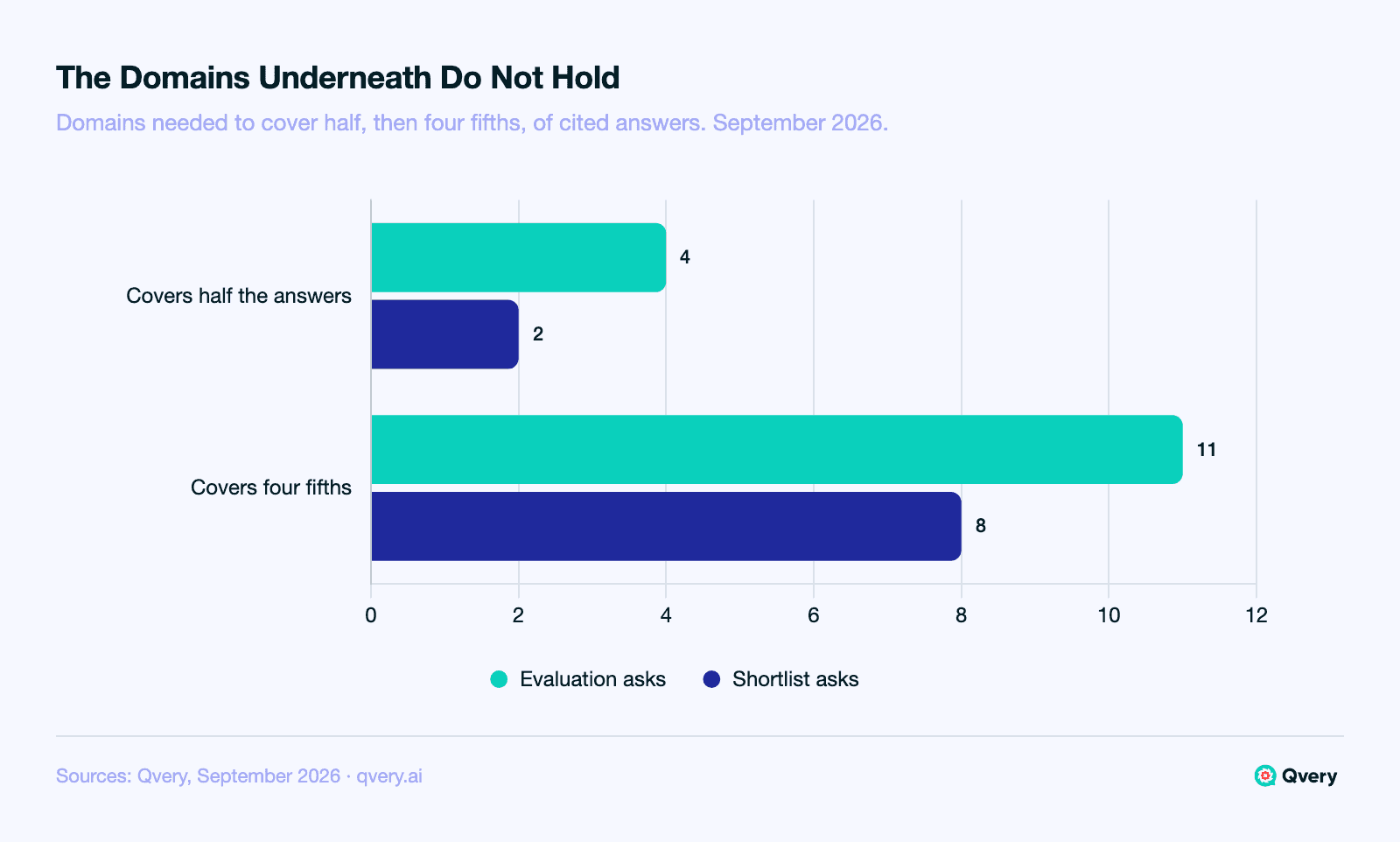
Two domains covering half of the shortlist-side answers that cited any source is a concentrated surface. And the two working lists share two rows: Mailchimp and YouTube. Two out of the smaller list's eight, a shared fraction of 0.25.
Here is the evaluation list in full, in the order the coverage was reached:
YouTube, Mailchimp, beehiiv, Proton
AWS documentation, Fit Small Business, MailerLite, Litmus, Sasanova, AICPA and CIMA, the Klaviyo knowledge base
And the shortlist list:
Mailchimp, YouTube
Omnichannel, Stackfyi, Stack Briefly, Zapier, HubSpot, TechRadar
The first four rows cover half of the evaluation-side answers that cited any source; the first two cover half of the shortlist ones.
Six of the eight shortlist rows do not appear on the evaluation list at all. Build one gap list from one shape of question and three quarters of the other shape's rows are missing from it.
The Source Mix Will Not Tell You This
Here is the trap, and it is the reason this method exists in the shape it does.
We classified every cited domain by the kind of site it is and compared the two ask shapes layer by layer.
Roundups and best-of pages were present in 43.1% of evaluation answers that cited any source and 50.82% of shortlist ones. Vendor-owned domains, 80.17% and 75.41%. Review directories, 14.66% and 15.57%. Community, 10.34% and 11.48%.
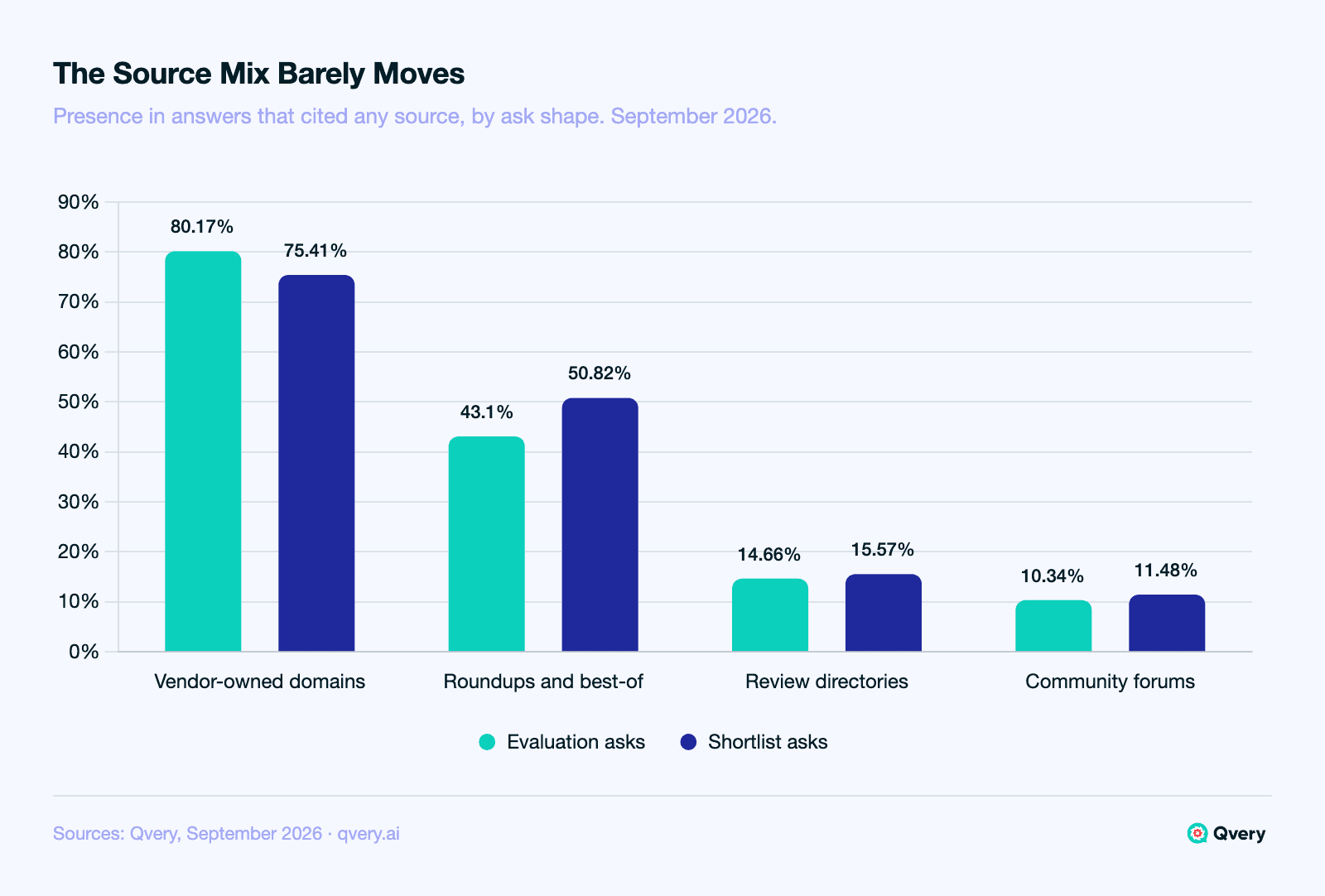
Four comparisons, four results inside the band we set in advance for calling two figures equivalent. At the level of source types, the two halves of this category look like the same market.
At the level of actual domains they share two rows out of eight.
Read the layer mix and one outreach list looks like enough for the category. Read the domains and you find two lists with a quarter in common.
Two more layers moved a little. Agency and consultant sources were present in 18.1% of evaluation answers that cited any source against 23.77% of shortlist ones, video in 18.97% against 25.41%. Both ratios landed in the band we registered as too close to call, so we do not call them.
Public and institutional sources appeared in the evaluation half and fell below our reporting floor on the shortlist half, so we report their presence and not a percentage.
Limits, once. We counted which domains the answers cited. We did not read what the answers said, so nothing here tells you whether a cited page recommended anyone. And a source being cited does not mean it was chosen for quality, or that anything you publish will be cited in its place.
From List To Plan
Judgment, not findings. A gap list is useless until every row has a verdict. Four classes cover almost everything:
Open to contribution. Publishers and communities that accept outside writing or participation. A page can exist here if you do the work.
Earned only. Editorial that decides for itself. Worth pitching, never worth planning around.
Competitor-owned. A rival's own domain in your answers. Nothing to pursue. It tells you what their page does that yours does not.
Not addressable. Government pages, knowledge bases, a cloud provider's documentation. Monitor and move on.
Rank the open rows, give the top three an owner and a date, and mark everything else monitor or ignore.
Most rows on a real gap list are not addressable, and writing that down is the difference between an analysis and a wish list. A gap analysis that ends with twenty outreach targets was not analysed, it was transcribed.
Run The Analysis In Qvery
Set up two topics for your category, one per ask shape, so you can read the two halves apart. Qvery generates a starting set at onboarding and you edit the queries in plain language.
Every answer keeps the sources cited in it, tied to the query and the engine that produced it. The Citations view ranks the URLs and the domains behind those answers, each with a weight, filterable by engine and country, and the ranking exports. That ranking is the raw material for the whole analysis:
Open the Citations view for the shortlist topic and read the Top Domains ranking.
Take rows from the top until another row stops changing what you would do about it.
Do the same for the evaluation topic. Two lists.
Mark the rows that appear on both, then give every row one of the four verdicts above.
A note on method. Our counts used a stricter definition than a top-ranked cut.
We took the smallest set of domains that together cover four fifths of the answers that cited any source, choosing them one at a time by how many still-uncovered answers each one adds. A ranked list read from the top is a close and usable version of the same thing, and it is what the product surfaces.
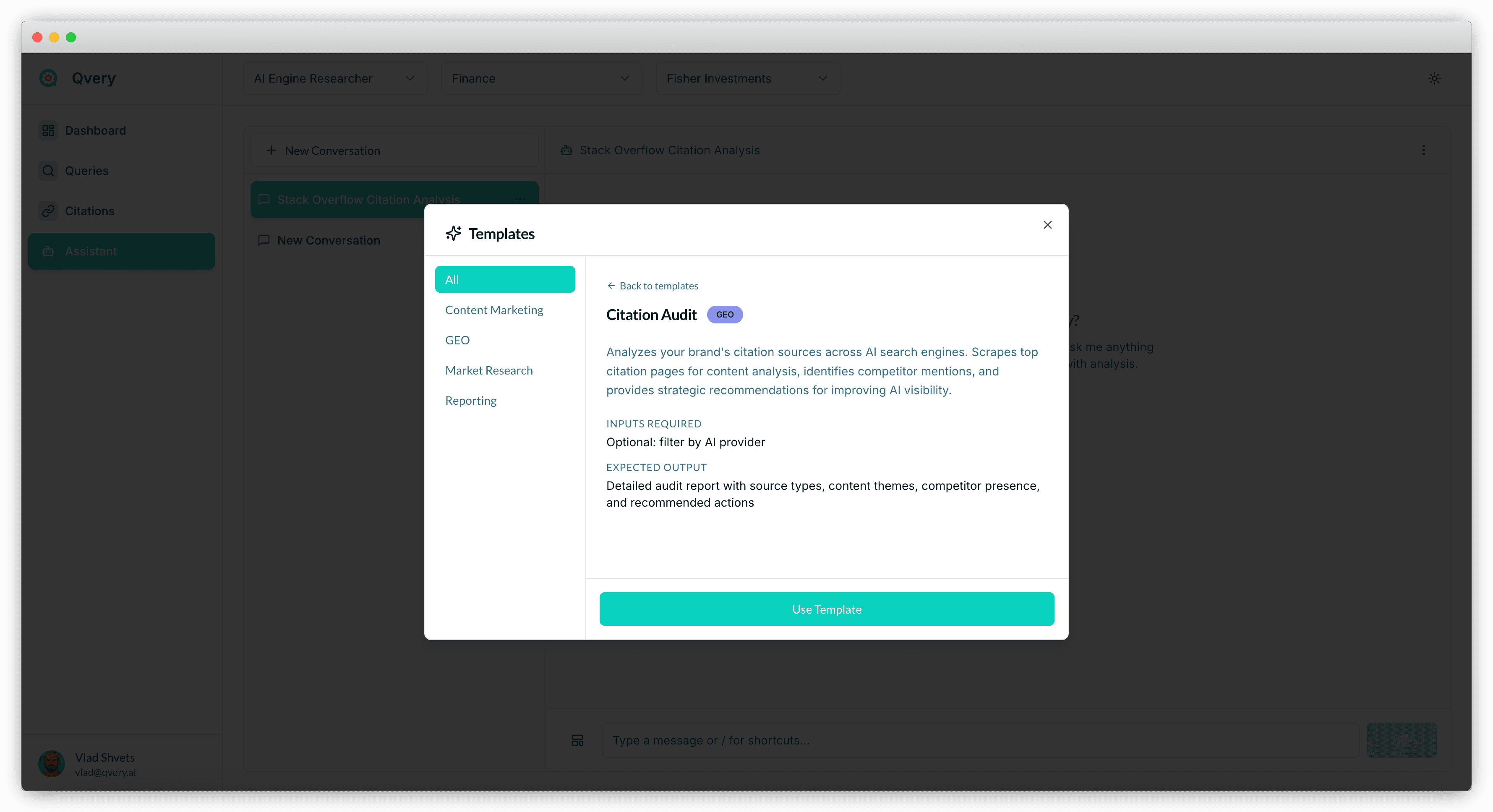
There is also a Citation Audit template in the Assistant. Its own description says it analyses your brand's citation sources across AI search engines and returns source types, content themes, competitor presence and recommended actions. Run it as a first pass; steps three and four still belong to you, because only you know which rows your team can realistically enter.
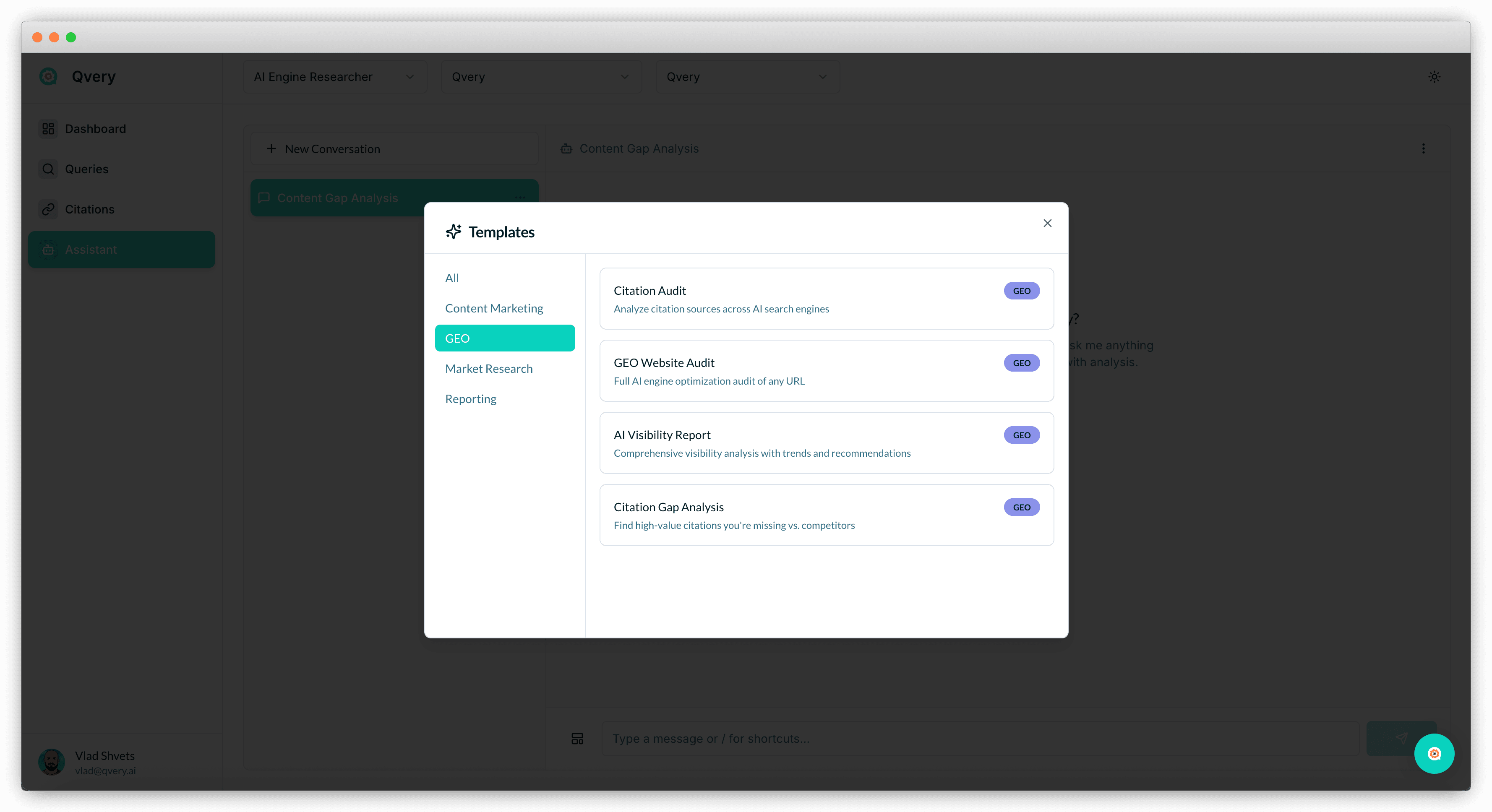
Two things the Citations view itself will not do for you. It ranks domains, it does not sort them into publishers, directories and competitors. And it records which sources an answer cited, not which brands the answer named in its text. Both of those reads turn a list into a plan, and both are yours.
Start a Qvery trial and run one category with both ask shapes in it. Seven days free, no credit card, which is time to get both topics configured and the first days of citations in.
Open the Citations view for your own category before you write a single outreach email. Build the list from both ask shapes, because in the category we worked here, six of the eight shortlist rows never appeared on the evaluation list at all.
A citation gap analysis answers one question: which websites are in the answers your buyers get, and which of those are not carrying you.
The output is a list of domains, split by the shape of the question that produced them, ranked by what you can realistically do about each one. Publications to email are a small part of it. Most rows will not be actionable at all, and saying so is part of the analysis.
The method below is worked through on one software category so you can see every step on real output. Then you run it on yours.
Two Gaps, And Only One Of Them Is This One
Two things get confused and they need different work.
Not being cited means your domain is missing from the sources under the answer. That gap is the one this method measures.
Not being named means the answer's text does not mention you, whether or not your site is cited. That is a different gap, you read it by eye, and no citation count will tell you about it.
Start by writing down ten questions in your category where you believe a competitor gets picked up and you do not. Do not write them all the same way, which is the point of the next section.
Split The Gap By The Shape Of The Ask
The same buyer asks about a category in two shapes.
A shortlist ask wants a list. Best email marketing platforms, top newsletter tools, email automation software options.
An evaluation ask wants a judgment. Which email platforms hold up, which newsletter tools are worth using, what people stay with after a year.
Run both. Then count the domains behind each, separately: the smallest set covering half of the answers that cited any source, then the set covering four fifths.
Across a targeted set of questions in one software category we ran on ChatGPT and Google AI Mode in September 2026, the two shapes produced two lists. Directional, not a census.
Evaluation asks: four domains cover half of the answers that cited any source. Eleven cover four fifths.
Shortlist asks: two cover half. Eight cover four fifths.
Two domains covering half of the shortlist-side answers that cited any source is a concentrated surface. And the two working lists share two rows: Mailchimp and YouTube. Two out of the smaller list's eight, a shared fraction of 0.25.
Here is the evaluation list in full, in the order the coverage was reached:
YouTube, Mailchimp, beehiiv, Proton
AWS documentation, Fit Small Business, MailerLite, Litmus, Sasanova, AICPA and CIMA, the Klaviyo knowledge base
And the shortlist list:
Mailchimp, YouTube
Omnichannel, Stackfyi, Stack Briefly, Zapier, HubSpot, TechRadar
The first four rows cover half of the evaluation-side answers that cited any source; the first two cover half of the shortlist ones.
Six of the eight shortlist rows do not appear on the evaluation list at all. Build one gap list from one shape of question and three quarters of the other shape's rows are missing from it.
The Source Mix Will Not Tell You This
Here is the trap, and it is the reason this method exists in the shape it does.
We classified every cited domain by the kind of site it is and compared the two ask shapes layer by layer.
Roundups and best-of pages were present in 43.1% of evaluation answers that cited any source and 50.82% of shortlist ones. Vendor-owned domains, 80.17% and 75.41%. Review directories, 14.66% and 15.57%. Community, 10.34% and 11.48%.
Four comparisons, four results inside the band we set in advance for calling two figures equivalent. At the level of source types, the two halves of this category look like the same market.
At the level of actual domains they share two rows out of eight.
Read the layer mix and one outreach list looks like enough for the category. Read the domains and you find two lists with a quarter in common.
Two more layers moved a little. Agency and consultant sources were present in 18.1% of evaluation answers that cited any source against 23.77% of shortlist ones, video in 18.97% against 25.41%. Both ratios landed in the band we registered as too close to call, so we do not call them.
Public and institutional sources appeared in the evaluation half and fell below our reporting floor on the shortlist half, so we report their presence and not a percentage.
Limits, once. We counted which domains the answers cited. We did not read what the answers said, so nothing here tells you whether a cited page recommended anyone. And a source being cited does not mean it was chosen for quality, or that anything you publish will be cited in its place.
From List To Plan
Judgment, not findings. A gap list is useless until every row has a verdict. Four classes cover almost everything:
Open to contribution. Publishers and communities that accept outside writing or participation. A page can exist here if you do the work.
Earned only. Editorial that decides for itself. Worth pitching, never worth planning around.
Competitor-owned. A rival's own domain in your answers. Nothing to pursue. It tells you what their page does that yours does not.
Not addressable. Government pages, knowledge bases, a cloud provider's documentation. Monitor and move on.
Rank the open rows, give the top three an owner and a date, and mark everything else monitor or ignore.
Most rows on a real gap list are not addressable, and writing that down is the difference between an analysis and a wish list. A gap analysis that ends with twenty outreach targets was not analysed, it was transcribed.
Run The Analysis In Qvery
Set up two topics for your category, one per ask shape, so you can read the two halves apart. Qvery generates a starting set at onboarding and you edit the queries in plain language.
Every answer keeps the sources cited in it, tied to the query and the engine that produced it. The Citations view ranks the URLs and the domains behind those answers, each with a weight, filterable by engine and country, and the ranking exports. That ranking is the raw material for the whole analysis:
Open the Citations view for the shortlist topic and read the Top Domains ranking.
Take rows from the top until another row stops changing what you would do about it.
Do the same for the evaluation topic. Two lists.
Mark the rows that appear on both, then give every row one of the four verdicts above.
A note on method. Our counts used a stricter definition than a top-ranked cut.
We took the smallest set of domains that together cover four fifths of the answers that cited any source, choosing them one at a time by how many still-uncovered answers each one adds. A ranked list read from the top is a close and usable version of the same thing, and it is what the product surfaces.
There is also a Citation Audit template in the Assistant. Its own description says it analyses your brand's citation sources across AI search engines and returns source types, content themes, competitor presence and recommended actions. Run it as a first pass; steps three and four still belong to you, because only you know which rows your team can realistically enter.
Two things the Citations view itself will not do for you. It ranks domains, it does not sort them into publishers, directories and competitors. And it records which sources an answer cited, not which brands the answer named in its text. Both of those reads turn a list into a plan, and both are yours.
Start a Qvery trial and run one category with both ask shapes in it. Seven days free, no credit card, which is time to get both topics configured and the first days of citations in.
Open the Citations view for your own category before you write a single outreach email. Build the list from both ask shapes, because in the category we worked here, six of the eight shortlist rows never appeared on the evaluation list at all.
A citation gap analysis answers one question: which websites are in the answers your buyers get, and which of those are not carrying you.
The output is a list of domains, split by the shape of the question that produced them, ranked by what you can realistically do about each one. Publications to email are a small part of it. Most rows will not be actionable at all, and saying so is part of the analysis.
The method below is worked through on one software category so you can see every step on real output. Then you run it on yours.
Two Gaps, And Only One Of Them Is This One
Two things get confused and they need different work.
Not being cited means your domain is missing from the sources under the answer. That gap is the one this method measures.
Not being named means the answer's text does not mention you, whether or not your site is cited. That is a different gap, you read it by eye, and no citation count will tell you about it.
Start by writing down ten questions in your category where you believe a competitor gets picked up and you do not. Do not write them all the same way, which is the point of the next section.
Split The Gap By The Shape Of The Ask
The same buyer asks about a category in two shapes.
A shortlist ask wants a list. Best email marketing platforms, top newsletter tools, email automation software options.
An evaluation ask wants a judgment. Which email platforms hold up, which newsletter tools are worth using, what people stay with after a year.
Run both. Then count the domains behind each, separately: the smallest set covering half of the answers that cited any source, then the set covering four fifths.
Across a targeted set of questions in one software category we ran on ChatGPT and Google AI Mode in September 2026, the two shapes produced two lists. Directional, not a census.
Evaluation asks: four domains cover half of the answers that cited any source. Eleven cover four fifths.
Shortlist asks: two cover half. Eight cover four fifths.
Two domains covering half of the shortlist-side answers that cited any source is a concentrated surface. And the two working lists share two rows: Mailchimp and YouTube. Two out of the smaller list's eight, a shared fraction of 0.25.
Here is the evaluation list in full, in the order the coverage was reached:
YouTube, Mailchimp, beehiiv, Proton
AWS documentation, Fit Small Business, MailerLite, Litmus, Sasanova, AICPA and CIMA, the Klaviyo knowledge base
And the shortlist list:
Mailchimp, YouTube
Omnichannel, Stackfyi, Stack Briefly, Zapier, HubSpot, TechRadar
The first four rows cover half of the evaluation-side answers that cited any source; the first two cover half of the shortlist ones.
Six of the eight shortlist rows do not appear on the evaluation list at all. Build one gap list from one shape of question and three quarters of the other shape's rows are missing from it.
The Source Mix Will Not Tell You This
Here is the trap, and it is the reason this method exists in the shape it does.
We classified every cited domain by the kind of site it is and compared the two ask shapes layer by layer.
Roundups and best-of pages were present in 43.1% of evaluation answers that cited any source and 50.82% of shortlist ones. Vendor-owned domains, 80.17% and 75.41%. Review directories, 14.66% and 15.57%. Community, 10.34% and 11.48%.
Four comparisons, four results inside the band we set in advance for calling two figures equivalent. At the level of source types, the two halves of this category look like the same market.
At the level of actual domains they share two rows out of eight.
Read the layer mix and one outreach list looks like enough for the category. Read the domains and you find two lists with a quarter in common.
Two more layers moved a little. Agency and consultant sources were present in 18.1% of evaluation answers that cited any source against 23.77% of shortlist ones, video in 18.97% against 25.41%. Both ratios landed in the band we registered as too close to call, so we do not call them.
Public and institutional sources appeared in the evaluation half and fell below our reporting floor on the shortlist half, so we report their presence and not a percentage.
Limits, once. We counted which domains the answers cited. We did not read what the answers said, so nothing here tells you whether a cited page recommended anyone. And a source being cited does not mean it was chosen for quality, or that anything you publish will be cited in its place.
From List To Plan
Judgment, not findings. A gap list is useless until every row has a verdict. Four classes cover almost everything:
Open to contribution. Publishers and communities that accept outside writing or participation. A page can exist here if you do the work.
Earned only. Editorial that decides for itself. Worth pitching, never worth planning around.
Competitor-owned. A rival's own domain in your answers. Nothing to pursue. It tells you what their page does that yours does not.
Not addressable. Government pages, knowledge bases, a cloud provider's documentation. Monitor and move on.
Rank the open rows, give the top three an owner and a date, and mark everything else monitor or ignore.
Most rows on a real gap list are not addressable, and writing that down is the difference between an analysis and a wish list. A gap analysis that ends with twenty outreach targets was not analysed, it was transcribed.
Run The Analysis In Qvery
Set up two topics for your category, one per ask shape, so you can read the two halves apart. Qvery generates a starting set at onboarding and you edit the queries in plain language.
Every answer keeps the sources cited in it, tied to the query and the engine that produced it. The Citations view ranks the URLs and the domains behind those answers, each with a weight, filterable by engine and country, and the ranking exports. That ranking is the raw material for the whole analysis:
Open the Citations view for the shortlist topic and read the Top Domains ranking.
Take rows from the top until another row stops changing what you would do about it.
Do the same for the evaluation topic. Two lists.
Mark the rows that appear on both, then give every row one of the four verdicts above.
A note on method. Our counts used a stricter definition than a top-ranked cut.
We took the smallest set of domains that together cover four fifths of the answers that cited any source, choosing them one at a time by how many still-uncovered answers each one adds. A ranked list read from the top is a close and usable version of the same thing, and it is what the product surfaces.
There is also a Citation Audit template in the Assistant. Its own description says it analyses your brand's citation sources across AI search engines and returns source types, content themes, competitor presence and recommended actions. Run it as a first pass; steps three and four still belong to you, because only you know which rows your team can realistically enter.
Two things the Citations view itself will not do for you. It ranks domains, it does not sort them into publishers, directories and competitors. And it records which sources an answer cited, not which brands the answer named in its text. Both of those reads turn a list into a plan, and both are yours.
Start a Qvery trial and run one category with both ask shapes in it. Seven days free, no credit card, which is time to get both topics configured and the first days of citations in.
Open the Citations view for your own category before you write a single outreach email. Build the list from both ask shapes, because in the category we worked here, six of the eight shortlist rows never appeared on the evaluation list at all.
A citation gap analysis answers one question: which websites are in the answers your buyers get, and which of those are not carrying you.
The output is a list of domains, split by the shape of the question that produced them, ranked by what you can realistically do about each one. Publications to email are a small part of it. Most rows will not be actionable at all, and saying so is part of the analysis.
The method below is worked through on one software category so you can see every step on real output. Then you run it on yours.
Two Gaps, And Only One Of Them Is This One
Two things get confused and they need different work.
Not being cited means your domain is missing from the sources under the answer. That gap is the one this method measures.
Not being named means the answer's text does not mention you, whether or not your site is cited. That is a different gap, you read it by eye, and no citation count will tell you about it.
Start by writing down ten questions in your category where you believe a competitor gets picked up and you do not. Do not write them all the same way, which is the point of the next section.
Split The Gap By The Shape Of The Ask
The same buyer asks about a category in two shapes.
A shortlist ask wants a list. Best email marketing platforms, top newsletter tools, email automation software options.
An evaluation ask wants a judgment. Which email platforms hold up, which newsletter tools are worth using, what people stay with after a year.
Run both. Then count the domains behind each, separately: the smallest set covering half of the answers that cited any source, then the set covering four fifths.
Across a targeted set of questions in one software category we ran on ChatGPT and Google AI Mode in September 2026, the two shapes produced two lists. Directional, not a census.
Evaluation asks: four domains cover half of the answers that cited any source. Eleven cover four fifths.
Shortlist asks: two cover half. Eight cover four fifths.
Two domains covering half of the shortlist-side answers that cited any source is a concentrated surface. And the two working lists share two rows: Mailchimp and YouTube. Two out of the smaller list's eight, a shared fraction of 0.25.
Here is the evaluation list in full, in the order the coverage was reached:
YouTube, Mailchimp, beehiiv, Proton
AWS documentation, Fit Small Business, MailerLite, Litmus, Sasanova, AICPA and CIMA, the Klaviyo knowledge base
And the shortlist list:
Mailchimp, YouTube
Omnichannel, Stackfyi, Stack Briefly, Zapier, HubSpot, TechRadar
The first four rows cover half of the evaluation-side answers that cited any source; the first two cover half of the shortlist ones.
Six of the eight shortlist rows do not appear on the evaluation list at all. Build one gap list from one shape of question and three quarters of the other shape's rows are missing from it.
The Source Mix Will Not Tell You This
Here is the trap, and it is the reason this method exists in the shape it does.
We classified every cited domain by the kind of site it is and compared the two ask shapes layer by layer.
Roundups and best-of pages were present in 43.1% of evaluation answers that cited any source and 50.82% of shortlist ones. Vendor-owned domains, 80.17% and 75.41%. Review directories, 14.66% and 15.57%. Community, 10.34% and 11.48%.
Four comparisons, four results inside the band we set in advance for calling two figures equivalent. At the level of source types, the two halves of this category look like the same market.
At the level of actual domains they share two rows out of eight.
Read the layer mix and one outreach list looks like enough for the category. Read the domains and you find two lists with a quarter in common.
Two more layers moved a little. Agency and consultant sources were present in 18.1% of evaluation answers that cited any source against 23.77% of shortlist ones, video in 18.97% against 25.41%. Both ratios landed in the band we registered as too close to call, so we do not call them.
Public and institutional sources appeared in the evaluation half and fell below our reporting floor on the shortlist half, so we report their presence and not a percentage.
Limits, once. We counted which domains the answers cited. We did not read what the answers said, so nothing here tells you whether a cited page recommended anyone. And a source being cited does not mean it was chosen for quality, or that anything you publish will be cited in its place.
From List To Plan
Judgment, not findings. A gap list is useless until every row has a verdict. Four classes cover almost everything:
Open to contribution. Publishers and communities that accept outside writing or participation. A page can exist here if you do the work.
Earned only. Editorial that decides for itself. Worth pitching, never worth planning around.
Competitor-owned. A rival's own domain in your answers. Nothing to pursue. It tells you what their page does that yours does not.
Not addressable. Government pages, knowledge bases, a cloud provider's documentation. Monitor and move on.
Rank the open rows, give the top three an owner and a date, and mark everything else monitor or ignore.
Most rows on a real gap list are not addressable, and writing that down is the difference between an analysis and a wish list. A gap analysis that ends with twenty outreach targets was not analysed, it was transcribed.
Run The Analysis In Qvery
Set up two topics for your category, one per ask shape, so you can read the two halves apart. Qvery generates a starting set at onboarding and you edit the queries in plain language.
Every answer keeps the sources cited in it, tied to the query and the engine that produced it. The Citations view ranks the URLs and the domains behind those answers, each with a weight, filterable by engine and country, and the ranking exports. That ranking is the raw material for the whole analysis:
Open the Citations view for the shortlist topic and read the Top Domains ranking.
Take rows from the top until another row stops changing what you would do about it.
Do the same for the evaluation topic. Two lists.
Mark the rows that appear on both, then give every row one of the four verdicts above.
A note on method. Our counts used a stricter definition than a top-ranked cut.
We took the smallest set of domains that together cover four fifths of the answers that cited any source, choosing them one at a time by how many still-uncovered answers each one adds. A ranked list read from the top is a close and usable version of the same thing, and it is what the product surfaces.
There is also a Citation Audit template in the Assistant. Its own description says it analyses your brand's citation sources across AI search engines and returns source types, content themes, competitor presence and recommended actions. Run it as a first pass; steps three and four still belong to you, because only you know which rows your team can realistically enter.
Two things the Citations view itself will not do for you. It ranks domains, it does not sort them into publishers, directories and competitors. And it records which sources an answer cited, not which brands the answer named in its text. Both of those reads turn a list into a plan, and both are yours.
Start a Qvery trial and run one category with both ask shapes in it. Seven days free, no credit card, which is time to get both topics configured and the first days of citations in.
Open the Citations view for your own category before you write a single outreach email. Build the list from both ask shapes, because in the category we worked here, six of the eight shortlist rows never appeared on the evaluation list at all.

© 2026 Qvery AI OÜ