By
Vlad Shvets
The Self-Listicle Playbook for Crypto Brands
Cited comparison pages appeared in custody and payments AI answers at equivalent rates, but the sites behind them differ, so the audit runs as two lists.
Cited comparison pages appeared in custody and payments AI answers at equivalent rates, but the sites behind them differ, so the audit runs as two lists.
Cited comparison pages appeared in custody and payments AI answers at equivalent rates, but the sites behind them differ, so the audit runs as two lists.
If you market a custody desk, a staking service, an exchange or a crypto payment gateway, someone has probably told you to publish your own best-of page for your category.
The logic sounds tidy: AI engines love lists (we have written up the general case for listicles in AI search before), so write the list, put yourself on it, and wait for ChatGPT to quote you.
Before anyone on your team writes that page, there is a cheaper question to answer. Which comparison pages do the engines already cite when your buyers ask for a provider, and does a custody buyer get the same pages as a payments buyer?
So we asked ChatGPT and Google AI Mode the recommendation questions crypto operators type in both buying situations, in September 2026, and tried to open every cited page that looked like a comparison to check whether it was one.
The short version: a real comparison page sat in 60.00% of custody and staking answers and 54.50% of exchange and payments answers. That is the same band, and it stays the same band even if every answer that cited an unresolved page and no confirmed one is counted as a comparison-page answer, so neither situation goes first in your audit.
The sites behind those answers differ between the two situations, though, so the audit runs twice.
This is what the engines cited, whoever published the pages. Whether a comparison page on your own site would get cited, or move your visibility, is something this evidence cannot tell you. What it can tell you is which comparison pages answer your buyers today, and how to check them yourself.
Comparison Pages Show Up in Custody Answers and Payments Answers Alike
A page counted as a comparison page here when its title or URL marked it as a crypto comparison and, once opened, it set out two or more named options to choose among. By that test, 60.00% of all custody and staking answers cited at least one, against 54.50% of all exchange and payments answers.
Both engines are pooled, with three ChatGPT answers for every two from Google AI Mode, so the rates lean on ChatGPT.
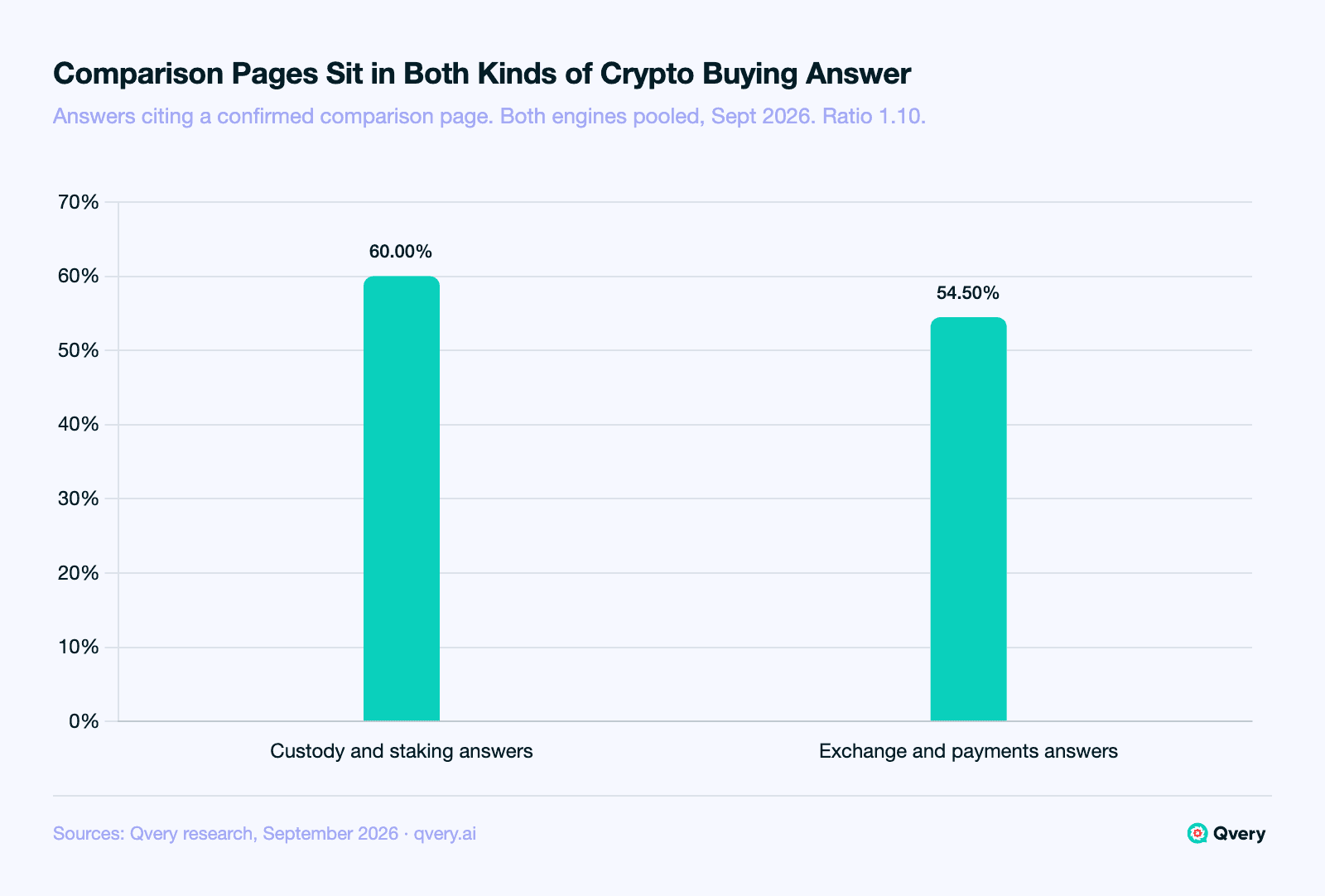
The ratio between the two is 1.10, which sits in the band we call equivalent. Our prediction going in was that custody and staking would lead, and the data did not support it.
A few answers cited a page we could not open or resolve and no confirmed comparison page. Count every one of those as a comparison-page answer and the rates read 61.50% and 57.50%, and the verdict holds either way.
For your audit, that means comparison pages belong in both buying situations and neither goes first. Had one situation shown a clearly higher rate, it would be the obvious place to start. Neither did.
Two things this result does not say. It does not say publishing a comparison page changes anyone's visibility: it records which pages were cited, and nothing about what happens after someone publishes one. And it does not say the two situations cite the same sites. The next two sections show they don't.
One author's before-and-after case study on Google's AI Overviews makes the structural case: the pages "where the engine could lift a clean" two-to-three-sentence answer "from the top of the post were the pages that gained citations."
That result comes from a different surface than the two engines we track, and our data measured neither page structure nor change over time, so it can neither confirm the claim nor knock it down. Treat it as one practitioner's result, not a rule.
If what you want is to be named on the lists other sites publish, rather than to publish your own, that is a separate route, and getting your product into the listicles AI engines cite walks through it.
A Two-Step Check Tells You Whether a Cited Page Is a Comparison Page
Your citation list will be full of URLs that look like comparisons. Some are, and some are one vendor's product page with the word best in the title. This is the check we ran, and you can run it on your own citations with nothing more than a browser.
Step one, before opening anything. Flag a cited URL when its title or URL carries a comparison marker and a crypto marker together.
Comparison markers: best, top, compare or comparison, alternatives, vs or versus, "list of" a number, a numbered roundup of providers, platforms, gateways, exchanges, wallets or tools.
Crypto markers: crypto, bitcoin, blockchain, custody, staking, wallet, token and similar words, or a crypto company's name.
Step two, open the page. Confirm that the page itself sets out two or more named products, providers, platforms or services to choose among, in a list, a ranking, a table, a roundup or a versus comparison.
Then record one of four states, never three:
Qualifying: the page sets out named options.
Non-qualifying: it opened and it does not.
Not fetched: the cited page itself never came back. A bare site root cited under an article's title belongs here too, because the root does not tell you which article was meant.
Fetched but unresolved: the page came back and its text did not settle the question.
The last two are unresolved, and they are never the same thing as non-qualifying. Folding them into "no" makes a page audit undercount.
Between 82.86% and 98.57% of the flagged URLs in custody and staking answers were real comparison pages, and between 79.38% and 97.94% in exchange and payments answers. The low number counts only pages we confirmed; the high one adds every page we could not resolve. The gap between the two is the unresolved pages.
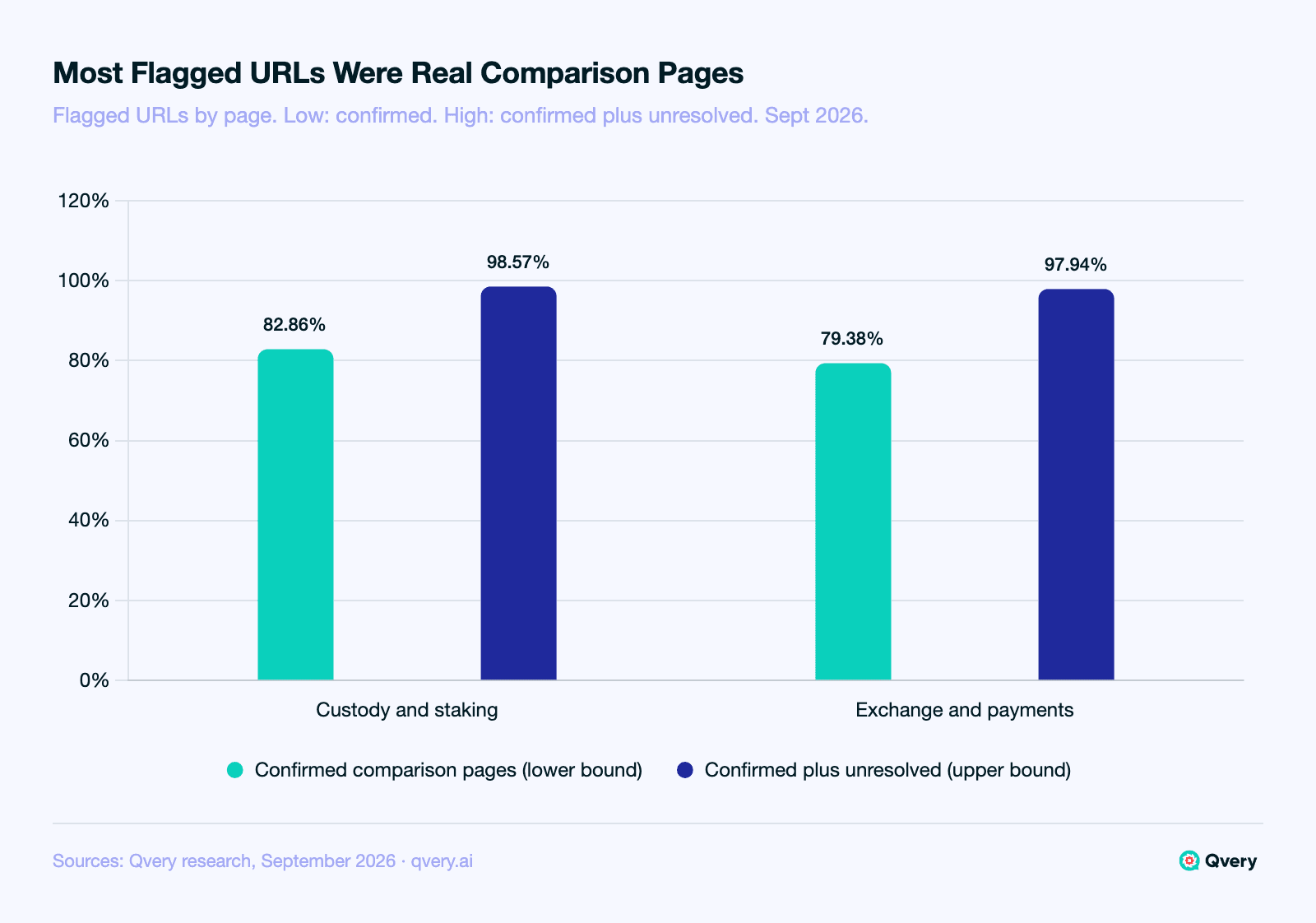
Among the pages we could resolve, 98.31% of custody and staking URLs and 97.47% of exchange and payments URLs qualified.
The practical meaning: where a page could be checked, a URL flagged by step one was almost always a real comparison page, so the flag is a workable first cut for triaging a long citation list. The unresolved gap is why step two is not optional.
What this check does not tell you: which comparison pages the two situations share, who published them, whether publishing one does anything, or whether pages that pitch a single product under a comparison title get cited less. We only saw pages that were cited, so there were no uncited pages to compare them against.
It also has nothing to say about formatting.
One guide on AI visibility for crypto marketing agencies recommends "Rebuilding technical whitepapers, tokenomics pages, and FAQs into machine-parsable formats with bullet points and clear definitions, the structure chat engines favor for citations." Our check judged whether a page sets out named options, and never looked at bullets or definitions, so it cannot tell you which structure the engines favor.
Two method notes. Step one read the URL and the title only, because the citation records carry no snippet. And pages that redirect to the same final URL count once per buying situation.
Custody and Payments Answers Cite Different Sites, So the Audit Runs Twice
Our earlier piece on reading ChatGPT citations by crypto segment splits infrastructure questions from consumer ones when it builds its audit. This is a different split on a different measure, and it answers a narrower question: does one list of sites to audit cover both buying situations?
For each situation we built a list of domains, adding at each step the domain that covered the most answers not yet covered, until the list reached 80% of the answers that cited any source. Here they are, in the order they were added.
Custody and staking, nine domains: fireblocks.com, bitcoinfoundation.org, coinbase.com, sec.gov, alchemy.com, fca.org.uk, eco.com, kraken.com, landytech.com.
Exchange and payments, eight domains: bitpay.com, stripe.com, spark.money, cryptio.co, triple-a.io, fireblocks.com, bitcoinfoundation.org, nowpayments.io.
Then we swapped them. The custody and staking list covered 42.93% of the exchange and payments answers that cited any source. The exchange and payments list covered 54.77% of the custody and staking answers that cited any source.
The lower of the two, unrounded, is 0.4293. That is well under 0.60, our bar for a single shared list, so each situation needs its own list.
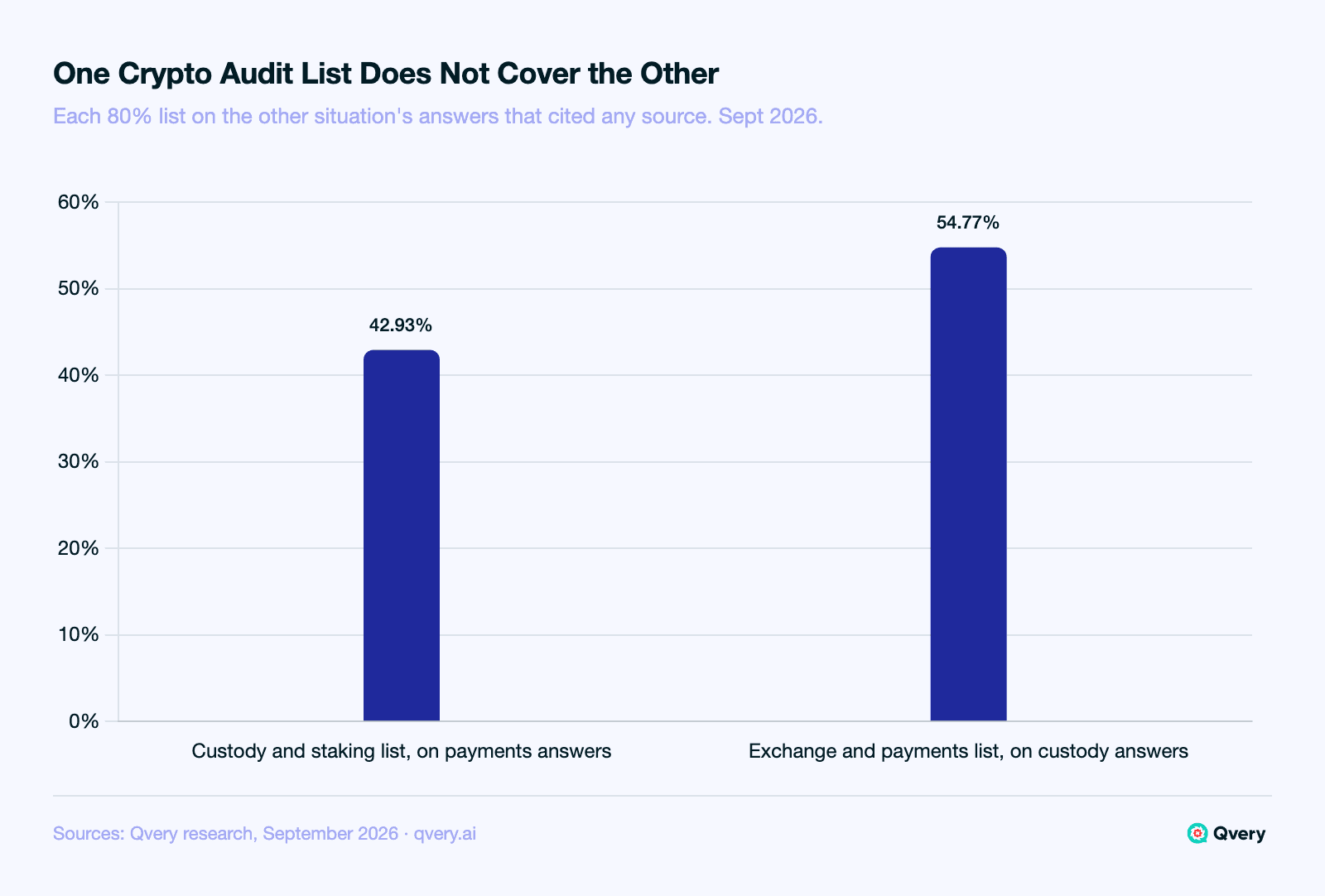
Two domains, bitcoinfoundation.org and fireblocks.com, sit on both lists. That overlap is descriptive and does not rescue a shared list.
These lists count any cited domain, whatever kind of page it served: vendor sites, regulators like sec.gov and fca.org.uk, publishers. They are lists of sites to audit, not inventories of comparison pages.
To build the inventory, run the two-step check from the section above over the cited pages of each listed domain. The mechanics of turning a list like this into a working audit are in our guide to running a content gap analysis.
One crypto marketing publication argues that "AI search engines are increasingly rewarding brands that demonstrate deep expertise and authority within specific niches of the crypto space."
The two buying situations drawing on different cited domains fits the idea of auditing them as separate surfaces. But nothing here measured expertise, authority or reward, and nothing here explains why any domain gets cited.
Run Both Audits as Standing Question Sets in Qvery
A one-time audit tells you what the engines cited on the day you looked. Qvery asks the same questions every day and keeps what the engines cited, so the audit stays current.
Start by setting up two question sets in Qvery, one for custody and staking and one for exchange and payments, written as the paired buying questions your operators ask.
Building tracking queries covers how to write pairs that differ only in the buying situation, and measuring a crypto brand's AI visibility covers building a crypto set from real buying questions. You add and edit those queries through Qvery Assistant.
Qvery then tracks visibility, share of voice and average rank for each set daily, across ChatGPT and Google AI Mode, in 200+ countries.
Every citation it captures is tied to the query and engine that produced it, so you can open the citations for one set, pull the comparison-looking URLs, and run the two-step check on the pages your own questions surface. The classification stays yours.
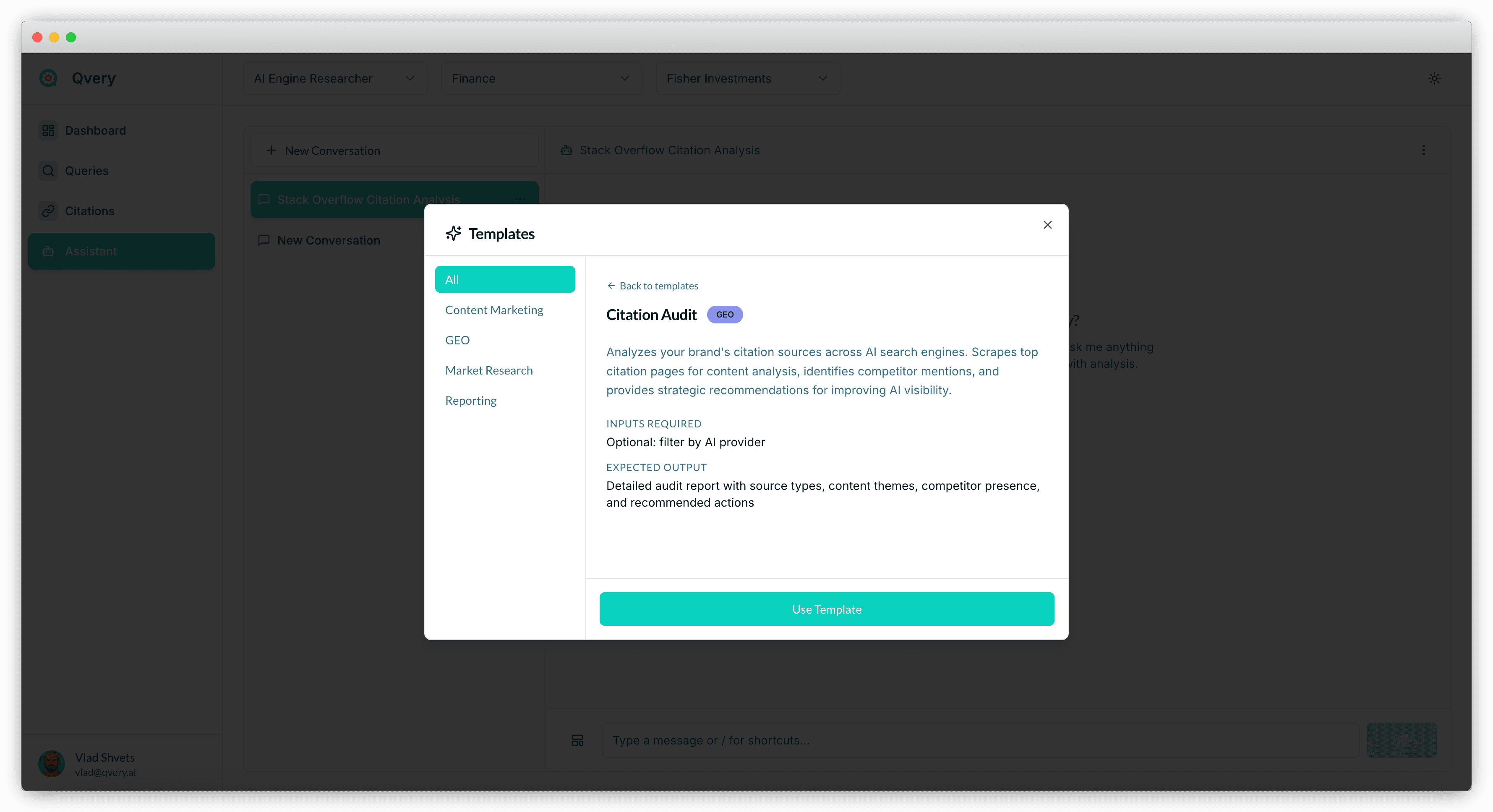
If you'd rather ask than filter, Qvery Assistant answers plain-language questions about your own data in the app: which domains your exchange and payments questions cited this week, or where your share of voice moved. Its Citation Audit template goes further, reporting the source types, content themes and competitor presence across your citations.
And if you do publish a comparison page, the same daily record shows whether it starts appearing among the citations on your questions. That is an observation over time, and it is not proof that the page caused anything.
Start a free 7-day trial of Qvery, no credit card required, and set up both question sets before you commission a single best-of page.
What This Evidence Cannot Settle
The biggest limit first: this cannot tell you whether publishing a comparison page improves visibility, or whether restructuring or reformatting one does, on your site or anyone else's. It recorded which pages the answers cited; it measured no change over time and no page structure.
Publisher unknown. Who published the cited pages is not established. Nothing here says self-published comparison pages fare better, worse or the same as anyone else's.
Page overlap unknown. Which comparison pages the two situations share was not measured, so there is no one-page-or-two recommendation.
No engine claim. The two engines' comparison-page rates were too close to report as a difference.
Unresolved evidence stays visible and is never counted as non-qualifying: some answers cited an unresolved page and no confirmed one, and some flagged URLs stayed unresolved.
URL and title only. Step one read nothing else, because the citation records carry no snippet.
ChatGPT-weighted. The pooled rates carry three ChatGPT answers to every two from Google AI Mode, and no Google AI Mode figure for a single buying situation prints, because each one rests on too few answers.
Scope: paired, unbranded recommendation questions about custody and staking and about exchange and payments. It does not cover every crypto buying situation, or any informational questions.
No naming data. We recorded cited pages and domains, not which brands the answers named.
No earlier month. There is no comparison with an earlier collection, and nothing here explains why a page was cited. This describes what appeared together.
Audit Both Buying Situations, Neither First
Take your own custody and staking questions and your own exchange and payments questions, and audit the comparison pages the engines already cite for each. Run each audit against its own domain list. Start neither one first.
Then, if you publish a comparison page, treat it as untested until your own tracking shows it among the citations, and even then read that as an observation, not proof.
If you market a custody desk, a staking service, an exchange or a crypto payment gateway, someone has probably told you to publish your own best-of page for your category.
The logic sounds tidy: AI engines love lists (we have written up the general case for listicles in AI search before), so write the list, put yourself on it, and wait for ChatGPT to quote you.
Before anyone on your team writes that page, there is a cheaper question to answer. Which comparison pages do the engines already cite when your buyers ask for a provider, and does a custody buyer get the same pages as a payments buyer?
So we asked ChatGPT and Google AI Mode the recommendation questions crypto operators type in both buying situations, in September 2026, and tried to open every cited page that looked like a comparison to check whether it was one.
The short version: a real comparison page sat in 60.00% of custody and staking answers and 54.50% of exchange and payments answers. That is the same band, and it stays the same band even if every answer that cited an unresolved page and no confirmed one is counted as a comparison-page answer, so neither situation goes first in your audit.
The sites behind those answers differ between the two situations, though, so the audit runs twice.
This is what the engines cited, whoever published the pages. Whether a comparison page on your own site would get cited, or move your visibility, is something this evidence cannot tell you. What it can tell you is which comparison pages answer your buyers today, and how to check them yourself.
Comparison Pages Show Up in Custody Answers and Payments Answers Alike
A page counted as a comparison page here when its title or URL marked it as a crypto comparison and, once opened, it set out two or more named options to choose among. By that test, 60.00% of all custody and staking answers cited at least one, against 54.50% of all exchange and payments answers.
Both engines are pooled, with three ChatGPT answers for every two from Google AI Mode, so the rates lean on ChatGPT.
The ratio between the two is 1.10, which sits in the band we call equivalent. Our prediction going in was that custody and staking would lead, and the data did not support it.
A few answers cited a page we could not open or resolve and no confirmed comparison page. Count every one of those as a comparison-page answer and the rates read 61.50% and 57.50%, and the verdict holds either way.
For your audit, that means comparison pages belong in both buying situations and neither goes first. Had one situation shown a clearly higher rate, it would be the obvious place to start. Neither did.
Two things this result does not say. It does not say publishing a comparison page changes anyone's visibility: it records which pages were cited, and nothing about what happens after someone publishes one. And it does not say the two situations cite the same sites. The next two sections show they don't.
One author's before-and-after case study on Google's AI Overviews makes the structural case: the pages "where the engine could lift a clean" two-to-three-sentence answer "from the top of the post were the pages that gained citations."
That result comes from a different surface than the two engines we track, and our data measured neither page structure nor change over time, so it can neither confirm the claim nor knock it down. Treat it as one practitioner's result, not a rule.
If what you want is to be named on the lists other sites publish, rather than to publish your own, that is a separate route, and getting your product into the listicles AI engines cite walks through it.
A Two-Step Check Tells You Whether a Cited Page Is a Comparison Page
Your citation list will be full of URLs that look like comparisons. Some are, and some are one vendor's product page with the word best in the title. This is the check we ran, and you can run it on your own citations with nothing more than a browser.
Step one, before opening anything. Flag a cited URL when its title or URL carries a comparison marker and a crypto marker together.
Comparison markers: best, top, compare or comparison, alternatives, vs or versus, "list of" a number, a numbered roundup of providers, platforms, gateways, exchanges, wallets or tools.
Crypto markers: crypto, bitcoin, blockchain, custody, staking, wallet, token and similar words, or a crypto company's name.
Step two, open the page. Confirm that the page itself sets out two or more named products, providers, platforms or services to choose among, in a list, a ranking, a table, a roundup or a versus comparison.
Then record one of four states, never three:
Qualifying: the page sets out named options.
Non-qualifying: it opened and it does not.
Not fetched: the cited page itself never came back. A bare site root cited under an article's title belongs here too, because the root does not tell you which article was meant.
Fetched but unresolved: the page came back and its text did not settle the question.
The last two are unresolved, and they are never the same thing as non-qualifying. Folding them into "no" makes a page audit undercount.
Between 82.86% and 98.57% of the flagged URLs in custody and staking answers were real comparison pages, and between 79.38% and 97.94% in exchange and payments answers. The low number counts only pages we confirmed; the high one adds every page we could not resolve. The gap between the two is the unresolved pages.
Among the pages we could resolve, 98.31% of custody and staking URLs and 97.47% of exchange and payments URLs qualified.
The practical meaning: where a page could be checked, a URL flagged by step one was almost always a real comparison page, so the flag is a workable first cut for triaging a long citation list. The unresolved gap is why step two is not optional.
What this check does not tell you: which comparison pages the two situations share, who published them, whether publishing one does anything, or whether pages that pitch a single product under a comparison title get cited less. We only saw pages that were cited, so there were no uncited pages to compare them against.
It also has nothing to say about formatting.
One guide on AI visibility for crypto marketing agencies recommends "Rebuilding technical whitepapers, tokenomics pages, and FAQs into machine-parsable formats with bullet points and clear definitions, the structure chat engines favor for citations." Our check judged whether a page sets out named options, and never looked at bullets or definitions, so it cannot tell you which structure the engines favor.
Two method notes. Step one read the URL and the title only, because the citation records carry no snippet. And pages that redirect to the same final URL count once per buying situation.
Custody and Payments Answers Cite Different Sites, So the Audit Runs Twice
Our earlier piece on reading ChatGPT citations by crypto segment splits infrastructure questions from consumer ones when it builds its audit. This is a different split on a different measure, and it answers a narrower question: does one list of sites to audit cover both buying situations?
For each situation we built a list of domains, adding at each step the domain that covered the most answers not yet covered, until the list reached 80% of the answers that cited any source. Here they are, in the order they were added.
Custody and staking, nine domains: fireblocks.com, bitcoinfoundation.org, coinbase.com, sec.gov, alchemy.com, fca.org.uk, eco.com, kraken.com, landytech.com.
Exchange and payments, eight domains: bitpay.com, stripe.com, spark.money, cryptio.co, triple-a.io, fireblocks.com, bitcoinfoundation.org, nowpayments.io.
Then we swapped them. The custody and staking list covered 42.93% of the exchange and payments answers that cited any source. The exchange and payments list covered 54.77% of the custody and staking answers that cited any source.
The lower of the two, unrounded, is 0.4293. That is well under 0.60, our bar for a single shared list, so each situation needs its own list.
Two domains, bitcoinfoundation.org and fireblocks.com, sit on both lists. That overlap is descriptive and does not rescue a shared list.
These lists count any cited domain, whatever kind of page it served: vendor sites, regulators like sec.gov and fca.org.uk, publishers. They are lists of sites to audit, not inventories of comparison pages.
To build the inventory, run the two-step check from the section above over the cited pages of each listed domain. The mechanics of turning a list like this into a working audit are in our guide to running a content gap analysis.
One crypto marketing publication argues that "AI search engines are increasingly rewarding brands that demonstrate deep expertise and authority within specific niches of the crypto space."
The two buying situations drawing on different cited domains fits the idea of auditing them as separate surfaces. But nothing here measured expertise, authority or reward, and nothing here explains why any domain gets cited.
Run Both Audits as Standing Question Sets in Qvery
A one-time audit tells you what the engines cited on the day you looked. Qvery asks the same questions every day and keeps what the engines cited, so the audit stays current.
Start by setting up two question sets in Qvery, one for custody and staking and one for exchange and payments, written as the paired buying questions your operators ask.
Building tracking queries covers how to write pairs that differ only in the buying situation, and measuring a crypto brand's AI visibility covers building a crypto set from real buying questions. You add and edit those queries through Qvery Assistant.
Qvery then tracks visibility, share of voice and average rank for each set daily, across ChatGPT and Google AI Mode, in 200+ countries.
Every citation it captures is tied to the query and engine that produced it, so you can open the citations for one set, pull the comparison-looking URLs, and run the two-step check on the pages your own questions surface. The classification stays yours.
If you'd rather ask than filter, Qvery Assistant answers plain-language questions about your own data in the app: which domains your exchange and payments questions cited this week, or where your share of voice moved. Its Citation Audit template goes further, reporting the source types, content themes and competitor presence across your citations.
And if you do publish a comparison page, the same daily record shows whether it starts appearing among the citations on your questions. That is an observation over time, and it is not proof that the page caused anything.
Start a free 7-day trial of Qvery, no credit card required, and set up both question sets before you commission a single best-of page.
What This Evidence Cannot Settle
The biggest limit first: this cannot tell you whether publishing a comparison page improves visibility, or whether restructuring or reformatting one does, on your site or anyone else's. It recorded which pages the answers cited; it measured no change over time and no page structure.
Publisher unknown. Who published the cited pages is not established. Nothing here says self-published comparison pages fare better, worse or the same as anyone else's.
Page overlap unknown. Which comparison pages the two situations share was not measured, so there is no one-page-or-two recommendation.
No engine claim. The two engines' comparison-page rates were too close to report as a difference.
Unresolved evidence stays visible and is never counted as non-qualifying: some answers cited an unresolved page and no confirmed one, and some flagged URLs stayed unresolved.
URL and title only. Step one read nothing else, because the citation records carry no snippet.
ChatGPT-weighted. The pooled rates carry three ChatGPT answers to every two from Google AI Mode, and no Google AI Mode figure for a single buying situation prints, because each one rests on too few answers.
Scope: paired, unbranded recommendation questions about custody and staking and about exchange and payments. It does not cover every crypto buying situation, or any informational questions.
No naming data. We recorded cited pages and domains, not which brands the answers named.
No earlier month. There is no comparison with an earlier collection, and nothing here explains why a page was cited. This describes what appeared together.
Audit Both Buying Situations, Neither First
Take your own custody and staking questions and your own exchange and payments questions, and audit the comparison pages the engines already cite for each. Run each audit against its own domain list. Start neither one first.
Then, if you publish a comparison page, treat it as untested until your own tracking shows it among the citations, and even then read that as an observation, not proof.
If you market a custody desk, a staking service, an exchange or a crypto payment gateway, someone has probably told you to publish your own best-of page for your category.
The logic sounds tidy: AI engines love lists (we have written up the general case for listicles in AI search before), so write the list, put yourself on it, and wait for ChatGPT to quote you.
Before anyone on your team writes that page, there is a cheaper question to answer. Which comparison pages do the engines already cite when your buyers ask for a provider, and does a custody buyer get the same pages as a payments buyer?
So we asked ChatGPT and Google AI Mode the recommendation questions crypto operators type in both buying situations, in September 2026, and tried to open every cited page that looked like a comparison to check whether it was one.
The short version: a real comparison page sat in 60.00% of custody and staking answers and 54.50% of exchange and payments answers. That is the same band, and it stays the same band even if every answer that cited an unresolved page and no confirmed one is counted as a comparison-page answer, so neither situation goes first in your audit.
The sites behind those answers differ between the two situations, though, so the audit runs twice.
This is what the engines cited, whoever published the pages. Whether a comparison page on your own site would get cited, or move your visibility, is something this evidence cannot tell you. What it can tell you is which comparison pages answer your buyers today, and how to check them yourself.
Comparison Pages Show Up in Custody Answers and Payments Answers Alike
A page counted as a comparison page here when its title or URL marked it as a crypto comparison and, once opened, it set out two or more named options to choose among. By that test, 60.00% of all custody and staking answers cited at least one, against 54.50% of all exchange and payments answers.
Both engines are pooled, with three ChatGPT answers for every two from Google AI Mode, so the rates lean on ChatGPT.
The ratio between the two is 1.10, which sits in the band we call equivalent. Our prediction going in was that custody and staking would lead, and the data did not support it.
A few answers cited a page we could not open or resolve and no confirmed comparison page. Count every one of those as a comparison-page answer and the rates read 61.50% and 57.50%, and the verdict holds either way.
For your audit, that means comparison pages belong in both buying situations and neither goes first. Had one situation shown a clearly higher rate, it would be the obvious place to start. Neither did.
Two things this result does not say. It does not say publishing a comparison page changes anyone's visibility: it records which pages were cited, and nothing about what happens after someone publishes one. And it does not say the two situations cite the same sites. The next two sections show they don't.
One author's before-and-after case study on Google's AI Overviews makes the structural case: the pages "where the engine could lift a clean" two-to-three-sentence answer "from the top of the post were the pages that gained citations."
That result comes from a different surface than the two engines we track, and our data measured neither page structure nor change over time, so it can neither confirm the claim nor knock it down. Treat it as one practitioner's result, not a rule.
If what you want is to be named on the lists other sites publish, rather than to publish your own, that is a separate route, and getting your product into the listicles AI engines cite walks through it.
A Two-Step Check Tells You Whether a Cited Page Is a Comparison Page
Your citation list will be full of URLs that look like comparisons. Some are, and some are one vendor's product page with the word best in the title. This is the check we ran, and you can run it on your own citations with nothing more than a browser.
Step one, before opening anything. Flag a cited URL when its title or URL carries a comparison marker and a crypto marker together.
Comparison markers: best, top, compare or comparison, alternatives, vs or versus, "list of" a number, a numbered roundup of providers, platforms, gateways, exchanges, wallets or tools.
Crypto markers: crypto, bitcoin, blockchain, custody, staking, wallet, token and similar words, or a crypto company's name.
Step two, open the page. Confirm that the page itself sets out two or more named products, providers, platforms or services to choose among, in a list, a ranking, a table, a roundup or a versus comparison.
Then record one of four states, never three:
Qualifying: the page sets out named options.
Non-qualifying: it opened and it does not.
Not fetched: the cited page itself never came back. A bare site root cited under an article's title belongs here too, because the root does not tell you which article was meant.
Fetched but unresolved: the page came back and its text did not settle the question.
The last two are unresolved, and they are never the same thing as non-qualifying. Folding them into "no" makes a page audit undercount.
Between 82.86% and 98.57% of the flagged URLs in custody and staking answers were real comparison pages, and between 79.38% and 97.94% in exchange and payments answers. The low number counts only pages we confirmed; the high one adds every page we could not resolve. The gap between the two is the unresolved pages.
Among the pages we could resolve, 98.31% of custody and staking URLs and 97.47% of exchange and payments URLs qualified.
The practical meaning: where a page could be checked, a URL flagged by step one was almost always a real comparison page, so the flag is a workable first cut for triaging a long citation list. The unresolved gap is why step two is not optional.
What this check does not tell you: which comparison pages the two situations share, who published them, whether publishing one does anything, or whether pages that pitch a single product under a comparison title get cited less. We only saw pages that were cited, so there were no uncited pages to compare them against.
It also has nothing to say about formatting.
One guide on AI visibility for crypto marketing agencies recommends "Rebuilding technical whitepapers, tokenomics pages, and FAQs into machine-parsable formats with bullet points and clear definitions, the structure chat engines favor for citations." Our check judged whether a page sets out named options, and never looked at bullets or definitions, so it cannot tell you which structure the engines favor.
Two method notes. Step one read the URL and the title only, because the citation records carry no snippet. And pages that redirect to the same final URL count once per buying situation.
Custody and Payments Answers Cite Different Sites, So the Audit Runs Twice
Our earlier piece on reading ChatGPT citations by crypto segment splits infrastructure questions from consumer ones when it builds its audit. This is a different split on a different measure, and it answers a narrower question: does one list of sites to audit cover both buying situations?
For each situation we built a list of domains, adding at each step the domain that covered the most answers not yet covered, until the list reached 80% of the answers that cited any source. Here they are, in the order they were added.
Custody and staking, nine domains: fireblocks.com, bitcoinfoundation.org, coinbase.com, sec.gov, alchemy.com, fca.org.uk, eco.com, kraken.com, landytech.com.
Exchange and payments, eight domains: bitpay.com, stripe.com, spark.money, cryptio.co, triple-a.io, fireblocks.com, bitcoinfoundation.org, nowpayments.io.
Then we swapped them. The custody and staking list covered 42.93% of the exchange and payments answers that cited any source. The exchange and payments list covered 54.77% of the custody and staking answers that cited any source.
The lower of the two, unrounded, is 0.4293. That is well under 0.60, our bar for a single shared list, so each situation needs its own list.
Two domains, bitcoinfoundation.org and fireblocks.com, sit on both lists. That overlap is descriptive and does not rescue a shared list.
These lists count any cited domain, whatever kind of page it served: vendor sites, regulators like sec.gov and fca.org.uk, publishers. They are lists of sites to audit, not inventories of comparison pages.
To build the inventory, run the two-step check from the section above over the cited pages of each listed domain. The mechanics of turning a list like this into a working audit are in our guide to running a content gap analysis.
One crypto marketing publication argues that "AI search engines are increasingly rewarding brands that demonstrate deep expertise and authority within specific niches of the crypto space."
The two buying situations drawing on different cited domains fits the idea of auditing them as separate surfaces. But nothing here measured expertise, authority or reward, and nothing here explains why any domain gets cited.
Run Both Audits as Standing Question Sets in Qvery
A one-time audit tells you what the engines cited on the day you looked. Qvery asks the same questions every day and keeps what the engines cited, so the audit stays current.
Start by setting up two question sets in Qvery, one for custody and staking and one for exchange and payments, written as the paired buying questions your operators ask.
Building tracking queries covers how to write pairs that differ only in the buying situation, and measuring a crypto brand's AI visibility covers building a crypto set from real buying questions. You add and edit those queries through Qvery Assistant.
Qvery then tracks visibility, share of voice and average rank for each set daily, across ChatGPT and Google AI Mode, in 200+ countries.
Every citation it captures is tied to the query and engine that produced it, so you can open the citations for one set, pull the comparison-looking URLs, and run the two-step check on the pages your own questions surface. The classification stays yours.
If you'd rather ask than filter, Qvery Assistant answers plain-language questions about your own data in the app: which domains your exchange and payments questions cited this week, or where your share of voice moved. Its Citation Audit template goes further, reporting the source types, content themes and competitor presence across your citations.
And if you do publish a comparison page, the same daily record shows whether it starts appearing among the citations on your questions. That is an observation over time, and it is not proof that the page caused anything.
Start a free 7-day trial of Qvery, no credit card required, and set up both question sets before you commission a single best-of page.
What This Evidence Cannot Settle
The biggest limit first: this cannot tell you whether publishing a comparison page improves visibility, or whether restructuring or reformatting one does, on your site or anyone else's. It recorded which pages the answers cited; it measured no change over time and no page structure.
Publisher unknown. Who published the cited pages is not established. Nothing here says self-published comparison pages fare better, worse or the same as anyone else's.
Page overlap unknown. Which comparison pages the two situations share was not measured, so there is no one-page-or-two recommendation.
No engine claim. The two engines' comparison-page rates were too close to report as a difference.
Unresolved evidence stays visible and is never counted as non-qualifying: some answers cited an unresolved page and no confirmed one, and some flagged URLs stayed unresolved.
URL and title only. Step one read nothing else, because the citation records carry no snippet.
ChatGPT-weighted. The pooled rates carry three ChatGPT answers to every two from Google AI Mode, and no Google AI Mode figure for a single buying situation prints, because each one rests on too few answers.
Scope: paired, unbranded recommendation questions about custody and staking and about exchange and payments. It does not cover every crypto buying situation, or any informational questions.
No naming data. We recorded cited pages and domains, not which brands the answers named.
No earlier month. There is no comparison with an earlier collection, and nothing here explains why a page was cited. This describes what appeared together.
Audit Both Buying Situations, Neither First
Take your own custody and staking questions and your own exchange and payments questions, and audit the comparison pages the engines already cite for each. Run each audit against its own domain list. Start neither one first.
Then, if you publish a comparison page, treat it as untested until your own tracking shows it among the citations, and even then read that as an observation, not proof.
If you market a custody desk, a staking service, an exchange or a crypto payment gateway, someone has probably told you to publish your own best-of page for your category.
The logic sounds tidy: AI engines love lists (we have written up the general case for listicles in AI search before), so write the list, put yourself on it, and wait for ChatGPT to quote you.
Before anyone on your team writes that page, there is a cheaper question to answer. Which comparison pages do the engines already cite when your buyers ask for a provider, and does a custody buyer get the same pages as a payments buyer?
So we asked ChatGPT and Google AI Mode the recommendation questions crypto operators type in both buying situations, in September 2026, and tried to open every cited page that looked like a comparison to check whether it was one.
The short version: a real comparison page sat in 60.00% of custody and staking answers and 54.50% of exchange and payments answers. That is the same band, and it stays the same band even if every answer that cited an unresolved page and no confirmed one is counted as a comparison-page answer, so neither situation goes first in your audit.
The sites behind those answers differ between the two situations, though, so the audit runs twice.
This is what the engines cited, whoever published the pages. Whether a comparison page on your own site would get cited, or move your visibility, is something this evidence cannot tell you. What it can tell you is which comparison pages answer your buyers today, and how to check them yourself.
Comparison Pages Show Up in Custody Answers and Payments Answers Alike
A page counted as a comparison page here when its title or URL marked it as a crypto comparison and, once opened, it set out two or more named options to choose among. By that test, 60.00% of all custody and staking answers cited at least one, against 54.50% of all exchange and payments answers.
Both engines are pooled, with three ChatGPT answers for every two from Google AI Mode, so the rates lean on ChatGPT.
The ratio between the two is 1.10, which sits in the band we call equivalent. Our prediction going in was that custody and staking would lead, and the data did not support it.
A few answers cited a page we could not open or resolve and no confirmed comparison page. Count every one of those as a comparison-page answer and the rates read 61.50% and 57.50%, and the verdict holds either way.
For your audit, that means comparison pages belong in both buying situations and neither goes first. Had one situation shown a clearly higher rate, it would be the obvious place to start. Neither did.
Two things this result does not say. It does not say publishing a comparison page changes anyone's visibility: it records which pages were cited, and nothing about what happens after someone publishes one. And it does not say the two situations cite the same sites. The next two sections show they don't.
One author's before-and-after case study on Google's AI Overviews makes the structural case: the pages "where the engine could lift a clean" two-to-three-sentence answer "from the top of the post were the pages that gained citations."
That result comes from a different surface than the two engines we track, and our data measured neither page structure nor change over time, so it can neither confirm the claim nor knock it down. Treat it as one practitioner's result, not a rule.
If what you want is to be named on the lists other sites publish, rather than to publish your own, that is a separate route, and getting your product into the listicles AI engines cite walks through it.
A Two-Step Check Tells You Whether a Cited Page Is a Comparison Page
Your citation list will be full of URLs that look like comparisons. Some are, and some are one vendor's product page with the word best in the title. This is the check we ran, and you can run it on your own citations with nothing more than a browser.
Step one, before opening anything. Flag a cited URL when its title or URL carries a comparison marker and a crypto marker together.
Comparison markers: best, top, compare or comparison, alternatives, vs or versus, "list of" a number, a numbered roundup of providers, platforms, gateways, exchanges, wallets or tools.
Crypto markers: crypto, bitcoin, blockchain, custody, staking, wallet, token and similar words, or a crypto company's name.
Step two, open the page. Confirm that the page itself sets out two or more named products, providers, platforms or services to choose among, in a list, a ranking, a table, a roundup or a versus comparison.
Then record one of four states, never three:
Qualifying: the page sets out named options.
Non-qualifying: it opened and it does not.
Not fetched: the cited page itself never came back. A bare site root cited under an article's title belongs here too, because the root does not tell you which article was meant.
Fetched but unresolved: the page came back and its text did not settle the question.
The last two are unresolved, and they are never the same thing as non-qualifying. Folding them into "no" makes a page audit undercount.
Between 82.86% and 98.57% of the flagged URLs in custody and staking answers were real comparison pages, and between 79.38% and 97.94% in exchange and payments answers. The low number counts only pages we confirmed; the high one adds every page we could not resolve. The gap between the two is the unresolved pages.
Among the pages we could resolve, 98.31% of custody and staking URLs and 97.47% of exchange and payments URLs qualified.
The practical meaning: where a page could be checked, a URL flagged by step one was almost always a real comparison page, so the flag is a workable first cut for triaging a long citation list. The unresolved gap is why step two is not optional.
What this check does not tell you: which comparison pages the two situations share, who published them, whether publishing one does anything, or whether pages that pitch a single product under a comparison title get cited less. We only saw pages that were cited, so there were no uncited pages to compare them against.
It also has nothing to say about formatting.
One guide on AI visibility for crypto marketing agencies recommends "Rebuilding technical whitepapers, tokenomics pages, and FAQs into machine-parsable formats with bullet points and clear definitions, the structure chat engines favor for citations." Our check judged whether a page sets out named options, and never looked at bullets or definitions, so it cannot tell you which structure the engines favor.
Two method notes. Step one read the URL and the title only, because the citation records carry no snippet. And pages that redirect to the same final URL count once per buying situation.
Custody and Payments Answers Cite Different Sites, So the Audit Runs Twice
Our earlier piece on reading ChatGPT citations by crypto segment splits infrastructure questions from consumer ones when it builds its audit. This is a different split on a different measure, and it answers a narrower question: does one list of sites to audit cover both buying situations?
For each situation we built a list of domains, adding at each step the domain that covered the most answers not yet covered, until the list reached 80% of the answers that cited any source. Here they are, in the order they were added.
Custody and staking, nine domains: fireblocks.com, bitcoinfoundation.org, coinbase.com, sec.gov, alchemy.com, fca.org.uk, eco.com, kraken.com, landytech.com.
Exchange and payments, eight domains: bitpay.com, stripe.com, spark.money, cryptio.co, triple-a.io, fireblocks.com, bitcoinfoundation.org, nowpayments.io.
Then we swapped them. The custody and staking list covered 42.93% of the exchange and payments answers that cited any source. The exchange and payments list covered 54.77% of the custody and staking answers that cited any source.
The lower of the two, unrounded, is 0.4293. That is well under 0.60, our bar for a single shared list, so each situation needs its own list.
Two domains, bitcoinfoundation.org and fireblocks.com, sit on both lists. That overlap is descriptive and does not rescue a shared list.
These lists count any cited domain, whatever kind of page it served: vendor sites, regulators like sec.gov and fca.org.uk, publishers. They are lists of sites to audit, not inventories of comparison pages.
To build the inventory, run the two-step check from the section above over the cited pages of each listed domain. The mechanics of turning a list like this into a working audit are in our guide to running a content gap analysis.
One crypto marketing publication argues that "AI search engines are increasingly rewarding brands that demonstrate deep expertise and authority within specific niches of the crypto space."
The two buying situations drawing on different cited domains fits the idea of auditing them as separate surfaces. But nothing here measured expertise, authority or reward, and nothing here explains why any domain gets cited.
Run Both Audits as Standing Question Sets in Qvery
A one-time audit tells you what the engines cited on the day you looked. Qvery asks the same questions every day and keeps what the engines cited, so the audit stays current.
Start by setting up two question sets in Qvery, one for custody and staking and one for exchange and payments, written as the paired buying questions your operators ask.
Building tracking queries covers how to write pairs that differ only in the buying situation, and measuring a crypto brand's AI visibility covers building a crypto set from real buying questions. You add and edit those queries through Qvery Assistant.
Qvery then tracks visibility, share of voice and average rank for each set daily, across ChatGPT and Google AI Mode, in 200+ countries.
Every citation it captures is tied to the query and engine that produced it, so you can open the citations for one set, pull the comparison-looking URLs, and run the two-step check on the pages your own questions surface. The classification stays yours.
If you'd rather ask than filter, Qvery Assistant answers plain-language questions about your own data in the app: which domains your exchange and payments questions cited this week, or where your share of voice moved. Its Citation Audit template goes further, reporting the source types, content themes and competitor presence across your citations.
And if you do publish a comparison page, the same daily record shows whether it starts appearing among the citations on your questions. That is an observation over time, and it is not proof that the page caused anything.
Start a free 7-day trial of Qvery, no credit card required, and set up both question sets before you commission a single best-of page.
What This Evidence Cannot Settle
The biggest limit first: this cannot tell you whether publishing a comparison page improves visibility, or whether restructuring or reformatting one does, on your site or anyone else's. It recorded which pages the answers cited; it measured no change over time and no page structure.
Publisher unknown. Who published the cited pages is not established. Nothing here says self-published comparison pages fare better, worse or the same as anyone else's.
Page overlap unknown. Which comparison pages the two situations share was not measured, so there is no one-page-or-two recommendation.
No engine claim. The two engines' comparison-page rates were too close to report as a difference.
Unresolved evidence stays visible and is never counted as non-qualifying: some answers cited an unresolved page and no confirmed one, and some flagged URLs stayed unresolved.
URL and title only. Step one read nothing else, because the citation records carry no snippet.
ChatGPT-weighted. The pooled rates carry three ChatGPT answers to every two from Google AI Mode, and no Google AI Mode figure for a single buying situation prints, because each one rests on too few answers.
Scope: paired, unbranded recommendation questions about custody and staking and about exchange and payments. It does not cover every crypto buying situation, or any informational questions.
No naming data. We recorded cited pages and domains, not which brands the answers named.
No earlier month. There is no comparison with an earlier collection, and nothing here explains why a page was cited. This describes what appeared together.
Audit Both Buying Situations, Neither First
Take your own custody and staking questions and your own exchange and payments questions, and audit the comparison pages the engines already cite for each. Run each audit against its own domain list. Start neither one first.
Then, if you publish a comparison page, treat it as untested until your own tracking shows it among the citations, and even then read that as an observation, not proof.

© 2026 Qvery AI OÜ