By
Vlad Shvets
How to Measure Your Crypto Brand's AI Engine Visibility
Crypto buying answers get assembled out of company estates: Coinbase, Kraken, and a long run of issuers, custodians and on-ramps on their own domains, with a regulator sitting in the middle of them and no Reddit thread in sight. Here is what to measure, and what you can stop paying for.
Crypto buying answers get assembled out of company estates: Coinbase, Kraken, and a long run of issuers, custodians and on-ramps on their own domains, with a regulator sitting in the middle of them and no Reddit thread in sight. Here is what to measure, and what you can stop paying for.
Crypto buying answers get assembled out of company estates: Coinbase, Kraken, and a long run of issuers, custodians and on-ramps on their own domains, with a regulator sitting in the middle of them and no Reddit thread in sight. Here is what to measure, and what you can stop paying for.
Somebody choosing where to buy their first stablecoin does not open five tabs any more. They ask, they get four names with a paragraph each, and they pick one. If your exchange is not among the four, the comparison happened without you in the room.
Most crypto teams have a rough sense of this and no number attached to it. The usual response is to open ChatGPT once a month, type the category question, and check whether the brand comes up. That is a coin flip with a screenshot.
Measuring it properly means knowing which questions to run and which competitors to run them against. Before either of those, it means knowing what these answers are built from.
So we ran the questions a crypto buyer types when they are choosing, on both engines, and logged every page the answers were assembled from.
The short version: you are competing inside a roster of company-owned pages, and the only name in that roster nobody can buy is a regulator.
Mentions are not what this category runs on.
Worth saying up front what this can and cannot tell you. It shows which pages the answers were built from. Whether being on one of those pages is what got a brand named is a different question, and this was not designed to answer it.
In Crypto, The Answer Is Built From Company Pages, Not Coverage
When ChatGPT answers a question about which exchange to use, it runs a search, opens a handful of pages, and writes from what it read. So what you want to know is which pages it opened, and how often yours is one of them.
Across a targeted set of the questions a buyer asks when choosing an exchange, a wallet, a custody provider or a stablecoin rail, run on ChatGPT and Google AI Mode in August 2026, here is what those answers were built from.
Every source figure below is ChatGPT's.
We could not resolve what Google AI Mode's answers pointed to in this set, so nothing here describes its sources.
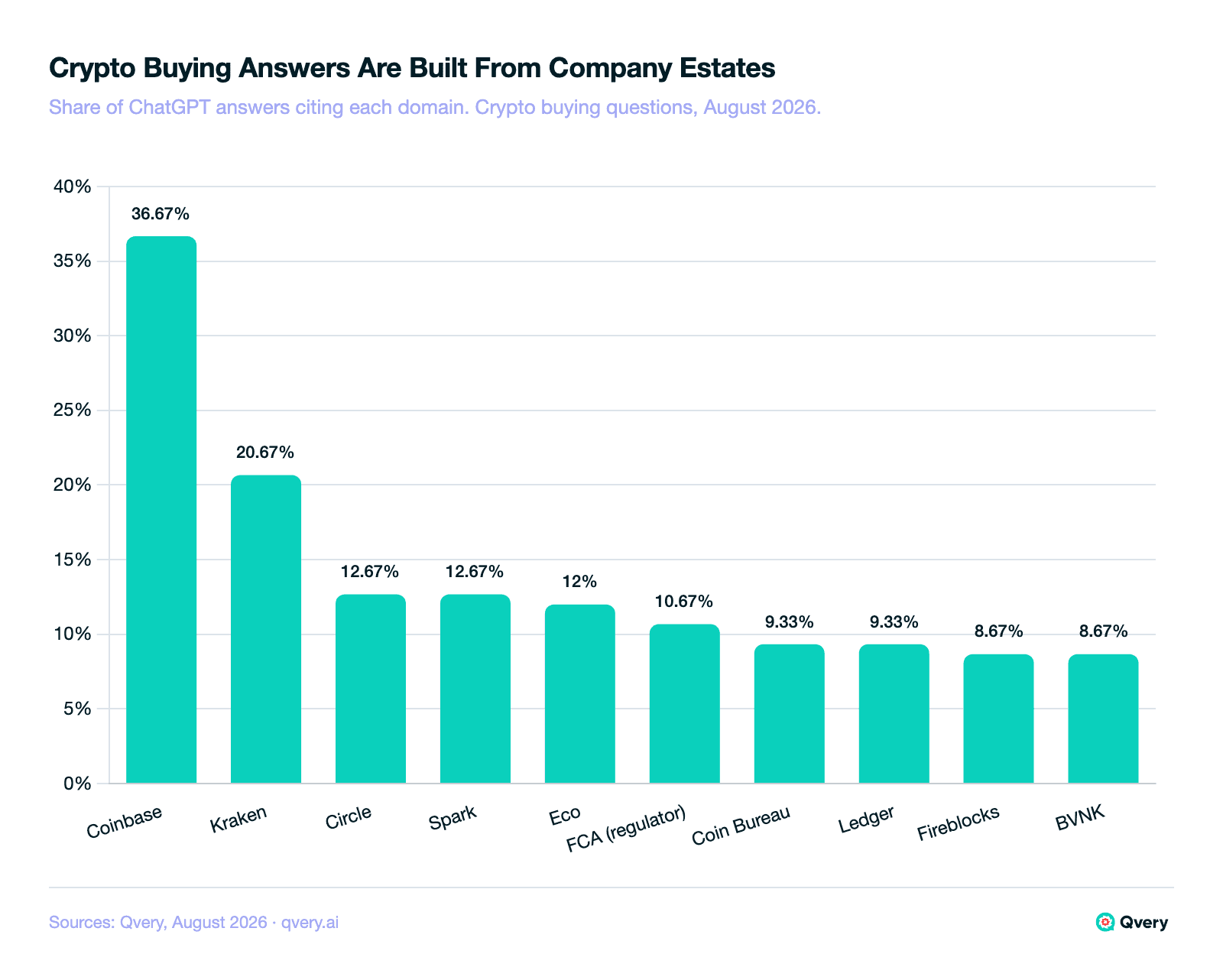
Coinbase appears in 36.67% of those answers, and Kraken in 20.67%. Behind them sits a long run of companies on their own domains: Circle and Spark at 12.67%, Eco at 12.00%, then Coin Bureau, Ledger, Fireblocks, BVNK, Stripe, BitGo, Chainalysis, MoonPay and Transak in the single digits.
Eighteen of the twenty most-cited sources are a company's own website.
Worth saying how the roster above was labelled, because classification is where this kind of work usually goes wrong.
We ran no classifier.
Every domain was read by hand and called what it plainly is: an exchange's own site, an issuer's own site, a regulator, a publication. Narrow and hand-checked is the only categorisation that has survived independent checking here.
That crypto leans on company-owned pages is not news to us. We published the category-wide version, where a vendor's own site reaches 80.65% of cited answers. What the buying questions add is the roster itself, and the roster is the part you can do something about.
Read that list as a competitive set. The pages standing between a buyer and your exchange are Coinbase's own security page and Circle's own documentation, and they are doing the job your blog was written to do. Whatever you measure next, measure it against those.
Reddit And The Trade Press Were Not Cited Once
Across these answers, ChatGPT cited no Reddit thread, no YouTube video, no Wikipedia entry, and nothing from CoinDesk or Cointelegraph.
Zero for each, not a thin share.
Between them the community layer and the trade press absorb a good part of what a crypto team spends every year.
Binance was not cited either, which is worth a pause if your competitive set was assembled from exchange market share.
Reddit is the third most-cited well-known domain in AI search, which is what makes the zero useful: what an engine cites turns out to be a fact about the question being asked, rather than a standing property of the source.
That absence is these buying questions, on this engine. Ask about crypto more broadly and the picture is different: our own category-wide collection put Reddit at 27.16% of cited answers, across a wider set of questions than these.
Nothing here says Reddit does not matter in crypto. It says Reddit was not in the answers to the questions a buyer asks in the last week before they choose.
A source can carry your category and still be absent from the handful of questions where the buying happens. Which means a visibility report built on category-level questions can be accurate and still point your budget at the wrong surface.
The One Name In That Roster Nobody Can Buy
One source in the leading group is not a company selling anything. The UK Financial Conduct Authority appears in 10.67% of these answers, ahead of Ledger, ahead of Fireblocks, and ahead of every compliance vendor in the set.
A handful of other supervisors turn up further down, in too few answers to put a number on, and I am not going to invent one.
A regulator is a different kind of source from everything around it. You can rewrite your own documentation this quarter. A supervisor's register does not take pitches, and no outreach program ends with a citation there. The only route onto that page is being a company the regulator has a reason to list.
That makes crypto an unusual category to work in. In most verticals the third-party layer is reviews, directories or forums, and each of those has a playbook attached. Here the third-party layer is a supervisor's own website, and the playbook is compliance you were doing anyway.
None of this establishes that being listed gets you named in an answer. It establishes what the answer is made of, which is the question you have to settle before the other one is worth asking.
The Country You Ask From Barely Moved The Answer
Crypto teams are global by default, so the next question is whether any of this changes by market.
We checked. It barely does.
Eight of the ten leading sources are the same whether the question comes from inside the United States or outside it. Coinbase leads both. Kraken is second in both.
And the regulator is cited in the same number of answers either way. That is the detail I went back and re-ran, because a British supervisor holding its position in answers to American questions looked like a bug.
It held both times I looked.
Qvery sells country coverage across more than 200 countries, and in this category the country a question came from did not change what the answer was built from.
It is worth being precise about how far that reaches, because it does not reach far. This is one category, and a particular kind of category: crypto is global, English-language, and sold roughly the same way everywhere.
Insurance, legal services and healthcare are local by construction, and our own law-firm work shows a hard gradient by market size. Nothing here says country tracking is optional. It says it did not move this one, and if you sell something local you should assume the opposite until you have checked.
One more limit worth naming: what varied here was where the question came from, not who was asking.
Every dimension you add to a measurement costs something to run. The ones worth paying for are the ones that change the answer, and the only way to learn which those are is to measure the dimension once and be willing to drop it.
Build The Set From Buying Questions, Then Track Who You Land Against
Three moves, and they are my read of what this implies rather than results the collection established.
First, build the query set out of buying questions, not category words. "Crypto exchange" is a category word, and it is not what anyone types when they are about to move money.
The questions that produced everything above look like this:
Which exchange for buying and selling
Which wallet for daily use
Which custody provider for a treasury with approval controls
Which on-ramp for small purchases
Which compliance software for a five-person team
Write twenty of those in your segment and you have the set. Write them the way a buyer would, with the constraint included, because the constraint is what makes a question specific enough to have a real answer.
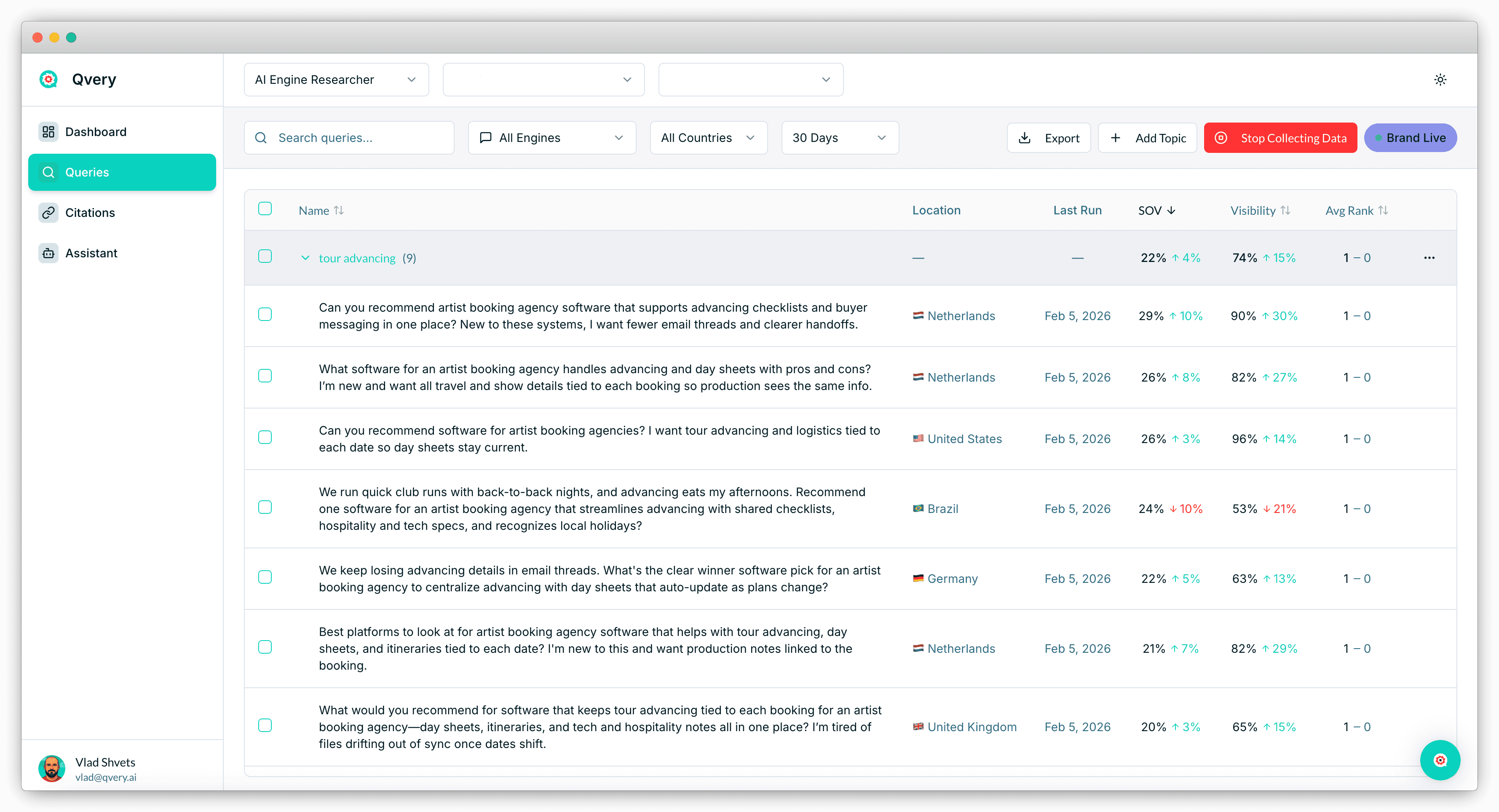
Second, track a roster of domains alongside the mention count. Your visibility number tells you whether you appeared. The roster tells you what you appeared against, and in this category that is the actionable half.
Put your own estate pages on one side and, on the other, the specific competitor pages the engines already reach for. That is a different list from the mention targets in a normal marketing plan, and it is shorter, which is good news.
Third, spend the country budget on question coverage instead. If you were planning to run your set from eight markets, run it from one and use the difference to run forty questions instead of twenty. Between the two dimensions, the questions moved the answer and the country did not.
Run Your Roster In Qvery Every Day
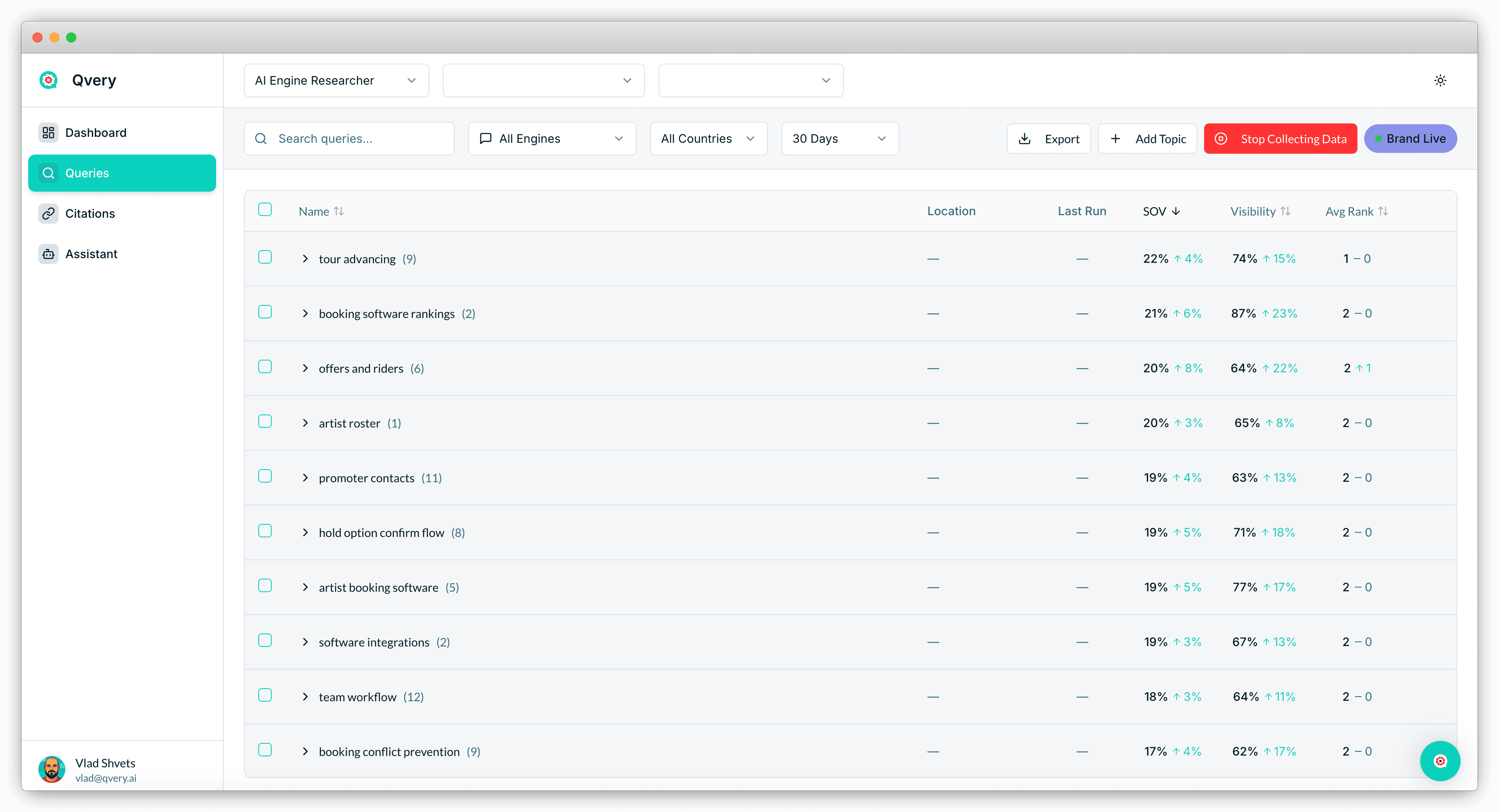
You enter your brand and Qvery generates the topics and queries to start from. You open Qvery Assistant and edit them until they read like the questions your buyers ask, adding the constrained ones by hand, because those are the ones with specific answers.
From then on Qvery runs the set daily across ChatGPT and Google AI Mode, tracks your visibility, share of voice and average rank against the brands you compete with, and captures every citation tied to the query and the engine that produced it.
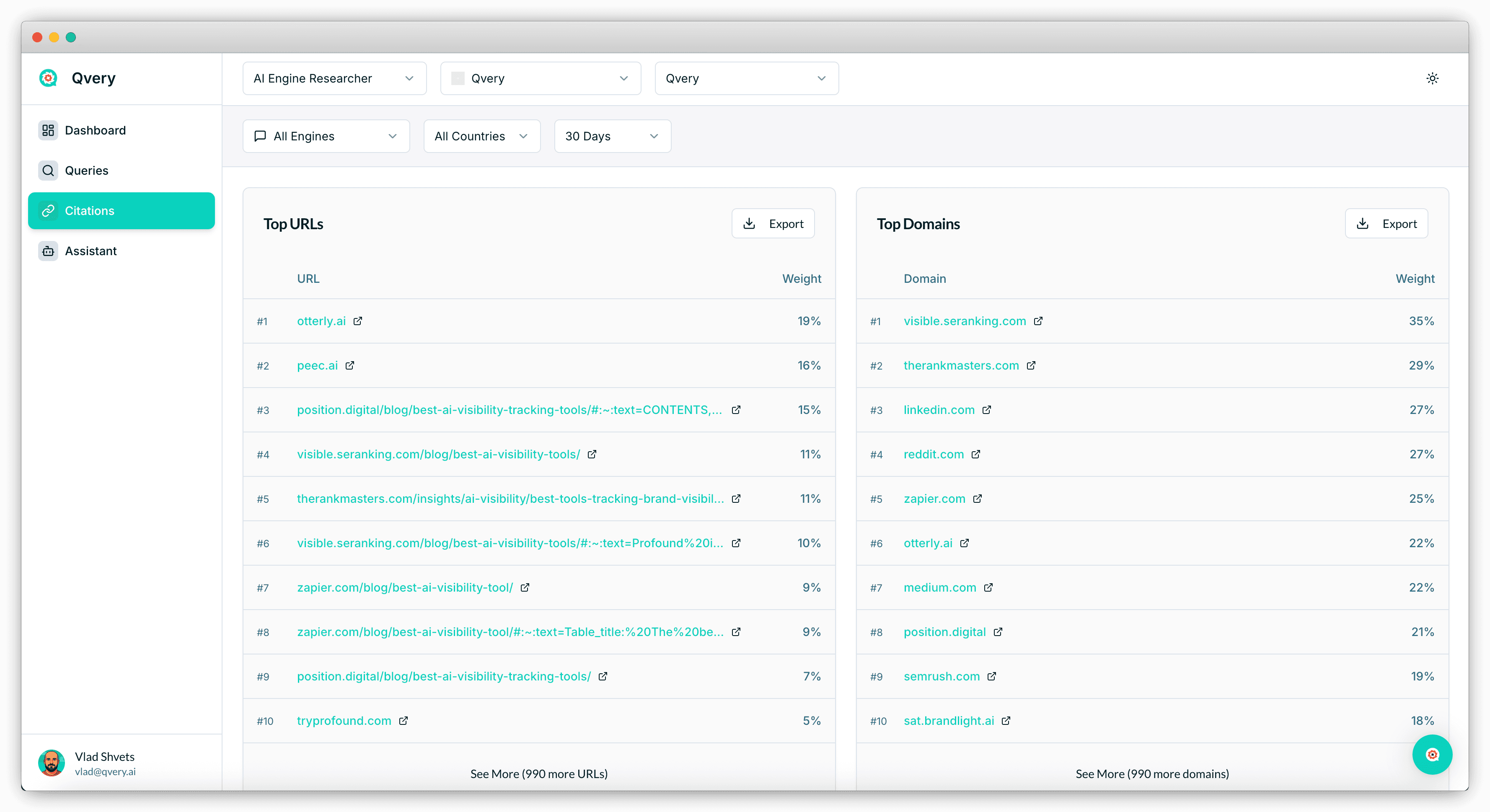
The roster question gets answered in Citations. Narrow it to the domains that keep coming back, and read how often each one appears against where your brand lands when it does.
Two or three of those domains will be worth a quarter of work. Most of the rest are somebody else's estate and always will be, and knowing which is which is the decision this view settles.
What Qvery will not do is tell you that fca.org.uk is a regulator and coinbase.com is a competitor. It captures the citation; the labeling of your roster stays yours to maintain, and it is an afternoon of work you do once.
Start your free trial and pull your first month of crypto citations by domain.
Start With The Twenty Questions That Decide It
Pick the twenty questions a buyer would type in the week before they choose between you and Coinbase. Run them on both engines and write down every domain that comes back.
If four of your competitors' own pages are on that list and none of yours are, you do not have a content problem. You have a documentation problem, and you now know exactly which pages to write.
Somebody choosing where to buy their first stablecoin does not open five tabs any more. They ask, they get four names with a paragraph each, and they pick one. If your exchange is not among the four, the comparison happened without you in the room.
Most crypto teams have a rough sense of this and no number attached to it. The usual response is to open ChatGPT once a month, type the category question, and check whether the brand comes up. That is a coin flip with a screenshot.
Measuring it properly means knowing which questions to run and which competitors to run them against. Before either of those, it means knowing what these answers are built from.
So we ran the questions a crypto buyer types when they are choosing, on both engines, and logged every page the answers were assembled from.
The short version: you are competing inside a roster of company-owned pages, and the only name in that roster nobody can buy is a regulator.
Mentions are not what this category runs on.
Worth saying up front what this can and cannot tell you. It shows which pages the answers were built from. Whether being on one of those pages is what got a brand named is a different question, and this was not designed to answer it.
In Crypto, The Answer Is Built From Company Pages, Not Coverage
When ChatGPT answers a question about which exchange to use, it runs a search, opens a handful of pages, and writes from what it read. So what you want to know is which pages it opened, and how often yours is one of them.
Across a targeted set of the questions a buyer asks when choosing an exchange, a wallet, a custody provider or a stablecoin rail, run on ChatGPT and Google AI Mode in August 2026, here is what those answers were built from.
Every source figure below is ChatGPT's.
We could not resolve what Google AI Mode's answers pointed to in this set, so nothing here describes its sources.
Coinbase appears in 36.67% of those answers, and Kraken in 20.67%. Behind them sits a long run of companies on their own domains: Circle and Spark at 12.67%, Eco at 12.00%, then Coin Bureau, Ledger, Fireblocks, BVNK, Stripe, BitGo, Chainalysis, MoonPay and Transak in the single digits.
Eighteen of the twenty most-cited sources are a company's own website.
Worth saying how the roster above was labelled, because classification is where this kind of work usually goes wrong.
We ran no classifier.
Every domain was read by hand and called what it plainly is: an exchange's own site, an issuer's own site, a regulator, a publication. Narrow and hand-checked is the only categorisation that has survived independent checking here.
That crypto leans on company-owned pages is not news to us. We published the category-wide version, where a vendor's own site reaches 80.65% of cited answers. What the buying questions add is the roster itself, and the roster is the part you can do something about.
Read that list as a competitive set. The pages standing between a buyer and your exchange are Coinbase's own security page and Circle's own documentation, and they are doing the job your blog was written to do. Whatever you measure next, measure it against those.
Reddit And The Trade Press Were Not Cited Once
Across these answers, ChatGPT cited no Reddit thread, no YouTube video, no Wikipedia entry, and nothing from CoinDesk or Cointelegraph.
Zero for each, not a thin share.
Between them the community layer and the trade press absorb a good part of what a crypto team spends every year.
Binance was not cited either, which is worth a pause if your competitive set was assembled from exchange market share.
Reddit is the third most-cited well-known domain in AI search, which is what makes the zero useful: what an engine cites turns out to be a fact about the question being asked, rather than a standing property of the source.
That absence is these buying questions, on this engine. Ask about crypto more broadly and the picture is different: our own category-wide collection put Reddit at 27.16% of cited answers, across a wider set of questions than these.
Nothing here says Reddit does not matter in crypto. It says Reddit was not in the answers to the questions a buyer asks in the last week before they choose.
A source can carry your category and still be absent from the handful of questions where the buying happens. Which means a visibility report built on category-level questions can be accurate and still point your budget at the wrong surface.
The One Name In That Roster Nobody Can Buy
One source in the leading group is not a company selling anything. The UK Financial Conduct Authority appears in 10.67% of these answers, ahead of Ledger, ahead of Fireblocks, and ahead of every compliance vendor in the set.
A handful of other supervisors turn up further down, in too few answers to put a number on, and I am not going to invent one.
A regulator is a different kind of source from everything around it. You can rewrite your own documentation this quarter. A supervisor's register does not take pitches, and no outreach program ends with a citation there. The only route onto that page is being a company the regulator has a reason to list.
That makes crypto an unusual category to work in. In most verticals the third-party layer is reviews, directories or forums, and each of those has a playbook attached. Here the third-party layer is a supervisor's own website, and the playbook is compliance you were doing anyway.
None of this establishes that being listed gets you named in an answer. It establishes what the answer is made of, which is the question you have to settle before the other one is worth asking.
The Country You Ask From Barely Moved The Answer
Crypto teams are global by default, so the next question is whether any of this changes by market.
We checked. It barely does.
Eight of the ten leading sources are the same whether the question comes from inside the United States or outside it. Coinbase leads both. Kraken is second in both.
And the regulator is cited in the same number of answers either way. That is the detail I went back and re-ran, because a British supervisor holding its position in answers to American questions looked like a bug.
It held both times I looked.
Qvery sells country coverage across more than 200 countries, and in this category the country a question came from did not change what the answer was built from.
It is worth being precise about how far that reaches, because it does not reach far. This is one category, and a particular kind of category: crypto is global, English-language, and sold roughly the same way everywhere.
Insurance, legal services and healthcare are local by construction, and our own law-firm work shows a hard gradient by market size. Nothing here says country tracking is optional. It says it did not move this one, and if you sell something local you should assume the opposite until you have checked.
One more limit worth naming: what varied here was where the question came from, not who was asking.
Every dimension you add to a measurement costs something to run. The ones worth paying for are the ones that change the answer, and the only way to learn which those are is to measure the dimension once and be willing to drop it.
Build The Set From Buying Questions, Then Track Who You Land Against
Three moves, and they are my read of what this implies rather than results the collection established.
First, build the query set out of buying questions, not category words. "Crypto exchange" is a category word, and it is not what anyone types when they are about to move money.
The questions that produced everything above look like this:
Which exchange for buying and selling
Which wallet for daily use
Which custody provider for a treasury with approval controls
Which on-ramp for small purchases
Which compliance software for a five-person team
Write twenty of those in your segment and you have the set. Write them the way a buyer would, with the constraint included, because the constraint is what makes a question specific enough to have a real answer.
Second, track a roster of domains alongside the mention count. Your visibility number tells you whether you appeared. The roster tells you what you appeared against, and in this category that is the actionable half.
Put your own estate pages on one side and, on the other, the specific competitor pages the engines already reach for. That is a different list from the mention targets in a normal marketing plan, and it is shorter, which is good news.
Third, spend the country budget on question coverage instead. If you were planning to run your set from eight markets, run it from one and use the difference to run forty questions instead of twenty. Between the two dimensions, the questions moved the answer and the country did not.
Run Your Roster In Qvery Every Day
You enter your brand and Qvery generates the topics and queries to start from. You open Qvery Assistant and edit them until they read like the questions your buyers ask, adding the constrained ones by hand, because those are the ones with specific answers.
From then on Qvery runs the set daily across ChatGPT and Google AI Mode, tracks your visibility, share of voice and average rank against the brands you compete with, and captures every citation tied to the query and the engine that produced it.
The roster question gets answered in Citations. Narrow it to the domains that keep coming back, and read how often each one appears against where your brand lands when it does.
Two or three of those domains will be worth a quarter of work. Most of the rest are somebody else's estate and always will be, and knowing which is which is the decision this view settles.
What Qvery will not do is tell you that fca.org.uk is a regulator and coinbase.com is a competitor. It captures the citation; the labeling of your roster stays yours to maintain, and it is an afternoon of work you do once.
Start your free trial and pull your first month of crypto citations by domain.
Start With The Twenty Questions That Decide It
Pick the twenty questions a buyer would type in the week before they choose between you and Coinbase. Run them on both engines and write down every domain that comes back.
If four of your competitors' own pages are on that list and none of yours are, you do not have a content problem. You have a documentation problem, and you now know exactly which pages to write.
Somebody choosing where to buy their first stablecoin does not open five tabs any more. They ask, they get four names with a paragraph each, and they pick one. If your exchange is not among the four, the comparison happened without you in the room.
Most crypto teams have a rough sense of this and no number attached to it. The usual response is to open ChatGPT once a month, type the category question, and check whether the brand comes up. That is a coin flip with a screenshot.
Measuring it properly means knowing which questions to run and which competitors to run them against. Before either of those, it means knowing what these answers are built from.
So we ran the questions a crypto buyer types when they are choosing, on both engines, and logged every page the answers were assembled from.
The short version: you are competing inside a roster of company-owned pages, and the only name in that roster nobody can buy is a regulator.
Mentions are not what this category runs on.
Worth saying up front what this can and cannot tell you. It shows which pages the answers were built from. Whether being on one of those pages is what got a brand named is a different question, and this was not designed to answer it.
In Crypto, The Answer Is Built From Company Pages, Not Coverage
When ChatGPT answers a question about which exchange to use, it runs a search, opens a handful of pages, and writes from what it read. So what you want to know is which pages it opened, and how often yours is one of them.
Across a targeted set of the questions a buyer asks when choosing an exchange, a wallet, a custody provider or a stablecoin rail, run on ChatGPT and Google AI Mode in August 2026, here is what those answers were built from.
Every source figure below is ChatGPT's.
We could not resolve what Google AI Mode's answers pointed to in this set, so nothing here describes its sources.
Coinbase appears in 36.67% of those answers, and Kraken in 20.67%. Behind them sits a long run of companies on their own domains: Circle and Spark at 12.67%, Eco at 12.00%, then Coin Bureau, Ledger, Fireblocks, BVNK, Stripe, BitGo, Chainalysis, MoonPay and Transak in the single digits.
Eighteen of the twenty most-cited sources are a company's own website.
Worth saying how the roster above was labelled, because classification is where this kind of work usually goes wrong.
We ran no classifier.
Every domain was read by hand and called what it plainly is: an exchange's own site, an issuer's own site, a regulator, a publication. Narrow and hand-checked is the only categorisation that has survived independent checking here.
That crypto leans on company-owned pages is not news to us. We published the category-wide version, where a vendor's own site reaches 80.65% of cited answers. What the buying questions add is the roster itself, and the roster is the part you can do something about.
Read that list as a competitive set. The pages standing between a buyer and your exchange are Coinbase's own security page and Circle's own documentation, and they are doing the job your blog was written to do. Whatever you measure next, measure it against those.
Reddit And The Trade Press Were Not Cited Once
Across these answers, ChatGPT cited no Reddit thread, no YouTube video, no Wikipedia entry, and nothing from CoinDesk or Cointelegraph.
Zero for each, not a thin share.
Between them the community layer and the trade press absorb a good part of what a crypto team spends every year.
Binance was not cited either, which is worth a pause if your competitive set was assembled from exchange market share.
Reddit is the third most-cited well-known domain in AI search, which is what makes the zero useful: what an engine cites turns out to be a fact about the question being asked, rather than a standing property of the source.
That absence is these buying questions, on this engine. Ask about crypto more broadly and the picture is different: our own category-wide collection put Reddit at 27.16% of cited answers, across a wider set of questions than these.
Nothing here says Reddit does not matter in crypto. It says Reddit was not in the answers to the questions a buyer asks in the last week before they choose.
A source can carry your category and still be absent from the handful of questions where the buying happens. Which means a visibility report built on category-level questions can be accurate and still point your budget at the wrong surface.
The One Name In That Roster Nobody Can Buy
One source in the leading group is not a company selling anything. The UK Financial Conduct Authority appears in 10.67% of these answers, ahead of Ledger, ahead of Fireblocks, and ahead of every compliance vendor in the set.
A handful of other supervisors turn up further down, in too few answers to put a number on, and I am not going to invent one.
A regulator is a different kind of source from everything around it. You can rewrite your own documentation this quarter. A supervisor's register does not take pitches, and no outreach program ends with a citation there. The only route onto that page is being a company the regulator has a reason to list.
That makes crypto an unusual category to work in. In most verticals the third-party layer is reviews, directories or forums, and each of those has a playbook attached. Here the third-party layer is a supervisor's own website, and the playbook is compliance you were doing anyway.
None of this establishes that being listed gets you named in an answer. It establishes what the answer is made of, which is the question you have to settle before the other one is worth asking.
The Country You Ask From Barely Moved The Answer
Crypto teams are global by default, so the next question is whether any of this changes by market.
We checked. It barely does.
Eight of the ten leading sources are the same whether the question comes from inside the United States or outside it. Coinbase leads both. Kraken is second in both.
And the regulator is cited in the same number of answers either way. That is the detail I went back and re-ran, because a British supervisor holding its position in answers to American questions looked like a bug.
It held both times I looked.
Qvery sells country coverage across more than 200 countries, and in this category the country a question came from did not change what the answer was built from.
It is worth being precise about how far that reaches, because it does not reach far. This is one category, and a particular kind of category: crypto is global, English-language, and sold roughly the same way everywhere.
Insurance, legal services and healthcare are local by construction, and our own law-firm work shows a hard gradient by market size. Nothing here says country tracking is optional. It says it did not move this one, and if you sell something local you should assume the opposite until you have checked.
One more limit worth naming: what varied here was where the question came from, not who was asking.
Every dimension you add to a measurement costs something to run. The ones worth paying for are the ones that change the answer, and the only way to learn which those are is to measure the dimension once and be willing to drop it.
Build The Set From Buying Questions, Then Track Who You Land Against
Three moves, and they are my read of what this implies rather than results the collection established.
First, build the query set out of buying questions, not category words. "Crypto exchange" is a category word, and it is not what anyone types when they are about to move money.
The questions that produced everything above look like this:
Which exchange for buying and selling
Which wallet for daily use
Which custody provider for a treasury with approval controls
Which on-ramp for small purchases
Which compliance software for a five-person team
Write twenty of those in your segment and you have the set. Write them the way a buyer would, with the constraint included, because the constraint is what makes a question specific enough to have a real answer.
Second, track a roster of domains alongside the mention count. Your visibility number tells you whether you appeared. The roster tells you what you appeared against, and in this category that is the actionable half.
Put your own estate pages on one side and, on the other, the specific competitor pages the engines already reach for. That is a different list from the mention targets in a normal marketing plan, and it is shorter, which is good news.
Third, spend the country budget on question coverage instead. If you were planning to run your set from eight markets, run it from one and use the difference to run forty questions instead of twenty. Between the two dimensions, the questions moved the answer and the country did not.
Run Your Roster In Qvery Every Day
You enter your brand and Qvery generates the topics and queries to start from. You open Qvery Assistant and edit them until they read like the questions your buyers ask, adding the constrained ones by hand, because those are the ones with specific answers.
From then on Qvery runs the set daily across ChatGPT and Google AI Mode, tracks your visibility, share of voice and average rank against the brands you compete with, and captures every citation tied to the query and the engine that produced it.
The roster question gets answered in Citations. Narrow it to the domains that keep coming back, and read how often each one appears against where your brand lands when it does.
Two or three of those domains will be worth a quarter of work. Most of the rest are somebody else's estate and always will be, and knowing which is which is the decision this view settles.
What Qvery will not do is tell you that fca.org.uk is a regulator and coinbase.com is a competitor. It captures the citation; the labeling of your roster stays yours to maintain, and it is an afternoon of work you do once.
Start your free trial and pull your first month of crypto citations by domain.
Start With The Twenty Questions That Decide It
Pick the twenty questions a buyer would type in the week before they choose between you and Coinbase. Run them on both engines and write down every domain that comes back.
If four of your competitors' own pages are on that list and none of yours are, you do not have a content problem. You have a documentation problem, and you now know exactly which pages to write.
Somebody choosing where to buy their first stablecoin does not open five tabs any more. They ask, they get four names with a paragraph each, and they pick one. If your exchange is not among the four, the comparison happened without you in the room.
Most crypto teams have a rough sense of this and no number attached to it. The usual response is to open ChatGPT once a month, type the category question, and check whether the brand comes up. That is a coin flip with a screenshot.
Measuring it properly means knowing which questions to run and which competitors to run them against. Before either of those, it means knowing what these answers are built from.
So we ran the questions a crypto buyer types when they are choosing, on both engines, and logged every page the answers were assembled from.
The short version: you are competing inside a roster of company-owned pages, and the only name in that roster nobody can buy is a regulator.
Mentions are not what this category runs on.
Worth saying up front what this can and cannot tell you. It shows which pages the answers were built from. Whether being on one of those pages is what got a brand named is a different question, and this was not designed to answer it.
In Crypto, The Answer Is Built From Company Pages, Not Coverage
When ChatGPT answers a question about which exchange to use, it runs a search, opens a handful of pages, and writes from what it read. So what you want to know is which pages it opened, and how often yours is one of them.
Across a targeted set of the questions a buyer asks when choosing an exchange, a wallet, a custody provider or a stablecoin rail, run on ChatGPT and Google AI Mode in August 2026, here is what those answers were built from.
Every source figure below is ChatGPT's.
We could not resolve what Google AI Mode's answers pointed to in this set, so nothing here describes its sources.
Coinbase appears in 36.67% of those answers, and Kraken in 20.67%. Behind them sits a long run of companies on their own domains: Circle and Spark at 12.67%, Eco at 12.00%, then Coin Bureau, Ledger, Fireblocks, BVNK, Stripe, BitGo, Chainalysis, MoonPay and Transak in the single digits.
Eighteen of the twenty most-cited sources are a company's own website.
Worth saying how the roster above was labelled, because classification is where this kind of work usually goes wrong.
We ran no classifier.
Every domain was read by hand and called what it plainly is: an exchange's own site, an issuer's own site, a regulator, a publication. Narrow and hand-checked is the only categorisation that has survived independent checking here.
That crypto leans on company-owned pages is not news to us. We published the category-wide version, where a vendor's own site reaches 80.65% of cited answers. What the buying questions add is the roster itself, and the roster is the part you can do something about.
Read that list as a competitive set. The pages standing between a buyer and your exchange are Coinbase's own security page and Circle's own documentation, and they are doing the job your blog was written to do. Whatever you measure next, measure it against those.
Reddit And The Trade Press Were Not Cited Once
Across these answers, ChatGPT cited no Reddit thread, no YouTube video, no Wikipedia entry, and nothing from CoinDesk or Cointelegraph.
Zero for each, not a thin share.
Between them the community layer and the trade press absorb a good part of what a crypto team spends every year.
Binance was not cited either, which is worth a pause if your competitive set was assembled from exchange market share.
Reddit is the third most-cited well-known domain in AI search, which is what makes the zero useful: what an engine cites turns out to be a fact about the question being asked, rather than a standing property of the source.
That absence is these buying questions, on this engine. Ask about crypto more broadly and the picture is different: our own category-wide collection put Reddit at 27.16% of cited answers, across a wider set of questions than these.
Nothing here says Reddit does not matter in crypto. It says Reddit was not in the answers to the questions a buyer asks in the last week before they choose.
A source can carry your category and still be absent from the handful of questions where the buying happens. Which means a visibility report built on category-level questions can be accurate and still point your budget at the wrong surface.
The One Name In That Roster Nobody Can Buy
One source in the leading group is not a company selling anything. The UK Financial Conduct Authority appears in 10.67% of these answers, ahead of Ledger, ahead of Fireblocks, and ahead of every compliance vendor in the set.
A handful of other supervisors turn up further down, in too few answers to put a number on, and I am not going to invent one.
A regulator is a different kind of source from everything around it. You can rewrite your own documentation this quarter. A supervisor's register does not take pitches, and no outreach program ends with a citation there. The only route onto that page is being a company the regulator has a reason to list.
That makes crypto an unusual category to work in. In most verticals the third-party layer is reviews, directories or forums, and each of those has a playbook attached. Here the third-party layer is a supervisor's own website, and the playbook is compliance you were doing anyway.
None of this establishes that being listed gets you named in an answer. It establishes what the answer is made of, which is the question you have to settle before the other one is worth asking.
The Country You Ask From Barely Moved The Answer
Crypto teams are global by default, so the next question is whether any of this changes by market.
We checked. It barely does.
Eight of the ten leading sources are the same whether the question comes from inside the United States or outside it. Coinbase leads both. Kraken is second in both.
And the regulator is cited in the same number of answers either way. That is the detail I went back and re-ran, because a British supervisor holding its position in answers to American questions looked like a bug.
It held both times I looked.
Qvery sells country coverage across more than 200 countries, and in this category the country a question came from did not change what the answer was built from.
It is worth being precise about how far that reaches, because it does not reach far. This is one category, and a particular kind of category: crypto is global, English-language, and sold roughly the same way everywhere.
Insurance, legal services and healthcare are local by construction, and our own law-firm work shows a hard gradient by market size. Nothing here says country tracking is optional. It says it did not move this one, and if you sell something local you should assume the opposite until you have checked.
One more limit worth naming: what varied here was where the question came from, not who was asking.
Every dimension you add to a measurement costs something to run. The ones worth paying for are the ones that change the answer, and the only way to learn which those are is to measure the dimension once and be willing to drop it.
Build The Set From Buying Questions, Then Track Who You Land Against
Three moves, and they are my read of what this implies rather than results the collection established.
First, build the query set out of buying questions, not category words. "Crypto exchange" is a category word, and it is not what anyone types when they are about to move money.
The questions that produced everything above look like this:
Which exchange for buying and selling
Which wallet for daily use
Which custody provider for a treasury with approval controls
Which on-ramp for small purchases
Which compliance software for a five-person team
Write twenty of those in your segment and you have the set. Write them the way a buyer would, with the constraint included, because the constraint is what makes a question specific enough to have a real answer.
Second, track a roster of domains alongside the mention count. Your visibility number tells you whether you appeared. The roster tells you what you appeared against, and in this category that is the actionable half.
Put your own estate pages on one side and, on the other, the specific competitor pages the engines already reach for. That is a different list from the mention targets in a normal marketing plan, and it is shorter, which is good news.
Third, spend the country budget on question coverage instead. If you were planning to run your set from eight markets, run it from one and use the difference to run forty questions instead of twenty. Between the two dimensions, the questions moved the answer and the country did not.
Run Your Roster In Qvery Every Day
You enter your brand and Qvery generates the topics and queries to start from. You open Qvery Assistant and edit them until they read like the questions your buyers ask, adding the constrained ones by hand, because those are the ones with specific answers.
From then on Qvery runs the set daily across ChatGPT and Google AI Mode, tracks your visibility, share of voice and average rank against the brands you compete with, and captures every citation tied to the query and the engine that produced it.
The roster question gets answered in Citations. Narrow it to the domains that keep coming back, and read how often each one appears against where your brand lands when it does.
Two or three of those domains will be worth a quarter of work. Most of the rest are somebody else's estate and always will be, and knowing which is which is the decision this view settles.
What Qvery will not do is tell you that fca.org.uk is a regulator and coinbase.com is a competitor. It captures the citation; the labeling of your roster stays yours to maintain, and it is an afternoon of work you do once.
Start your free trial and pull your first month of crypto citations by domain.
Start With The Twenty Questions That Decide It
Pick the twenty questions a buyer would type in the week before they choose between you and Coinbase. Run them on both engines and write down every domain that comes back.
If four of your competitors' own pages are on that list and none of yours are, you do not have a content problem. You have a documentation problem, and you now know exactly which pages to write.

© 2026 Qvery AI OÜ