By
Vlad Shvets
How Crypto Marketers Can Read ChatGPT Citations by Segment
Crypto has an unusual relationship with AI search. In most categories, a company's own website is a bit player in the answers about it. Here it is the main...
Crypto has an unusual relationship with AI search. In most categories, a company's own website is a bit player in the answers about it. Here it is the main...
Crypto has an unusual relationship with AI search. In most categories, a company's own website is a bit player in the answers about it. Here it is the main...
Crypto has an unusual relationship with AI search. In most categories, a company's own website is a bit player in the answers about it. Here it is the main event.
We ran a targeted collection across six crypto segments, from custody and compliance through to exchanges and wallets, to see what these answers are built from.
The headline number is high enough to change the plan. The more useful result is that the category splits cleanly in two, and the two halves need different work.
One boundary before any number. This measures which sources appear alongside the answers. It does not measure whether appearing on a source causes a brand to be recommended, and nothing here was designed to test that.
Your Own Site Is In Four Of Five Answers
Across a targeted set of crypto queries spanning compliance, custody, payments, exchanges, wallets, and staking, run on ChatGPT and Google AI Mode, August 2026, a vendor's own website appears in 80.65% of cited answers.
That is unusual. In most categories the answers about a company are assembled largely from third parties, with the company's own pages a minor contributor.
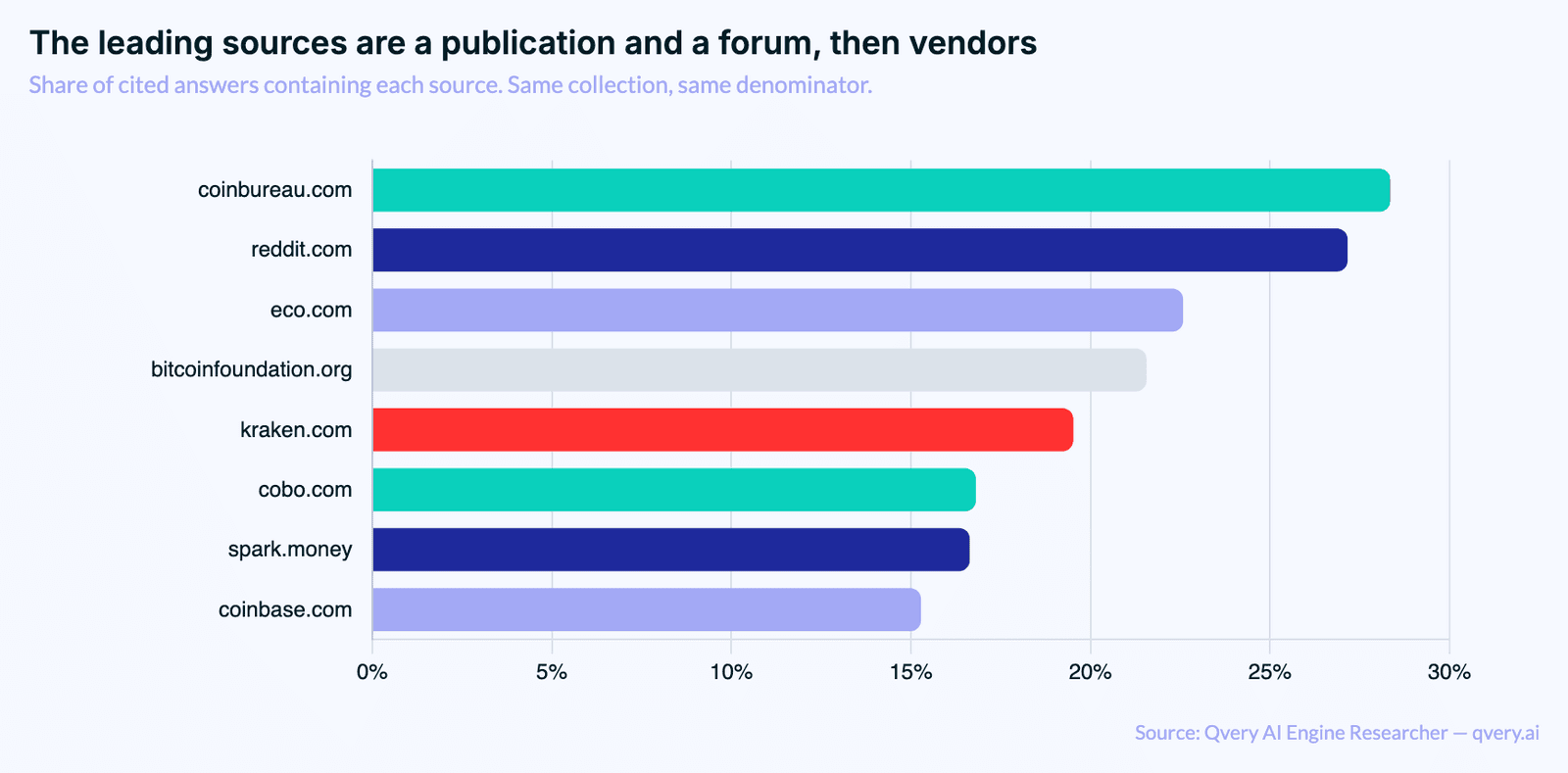
No single vendor dominates. Coin Bureau leads all individual sources at 28.35% and Reddit follows at 27.16%, then a long run of vendor domains in the teens and low twenties.
So the category is vendor-heavy in aggregate and unconcentrated at the individual level. Plenty of companies are in these answers, and no single one of them accounts for more than about a quarter.
In crypto, the content you publish is competing directly in the answer rather than trying to earn a mention inside somebody else's.
The Split That Should Change Your Plan
Pool the six segments into the two groups the industry operates as, and the picture separates.
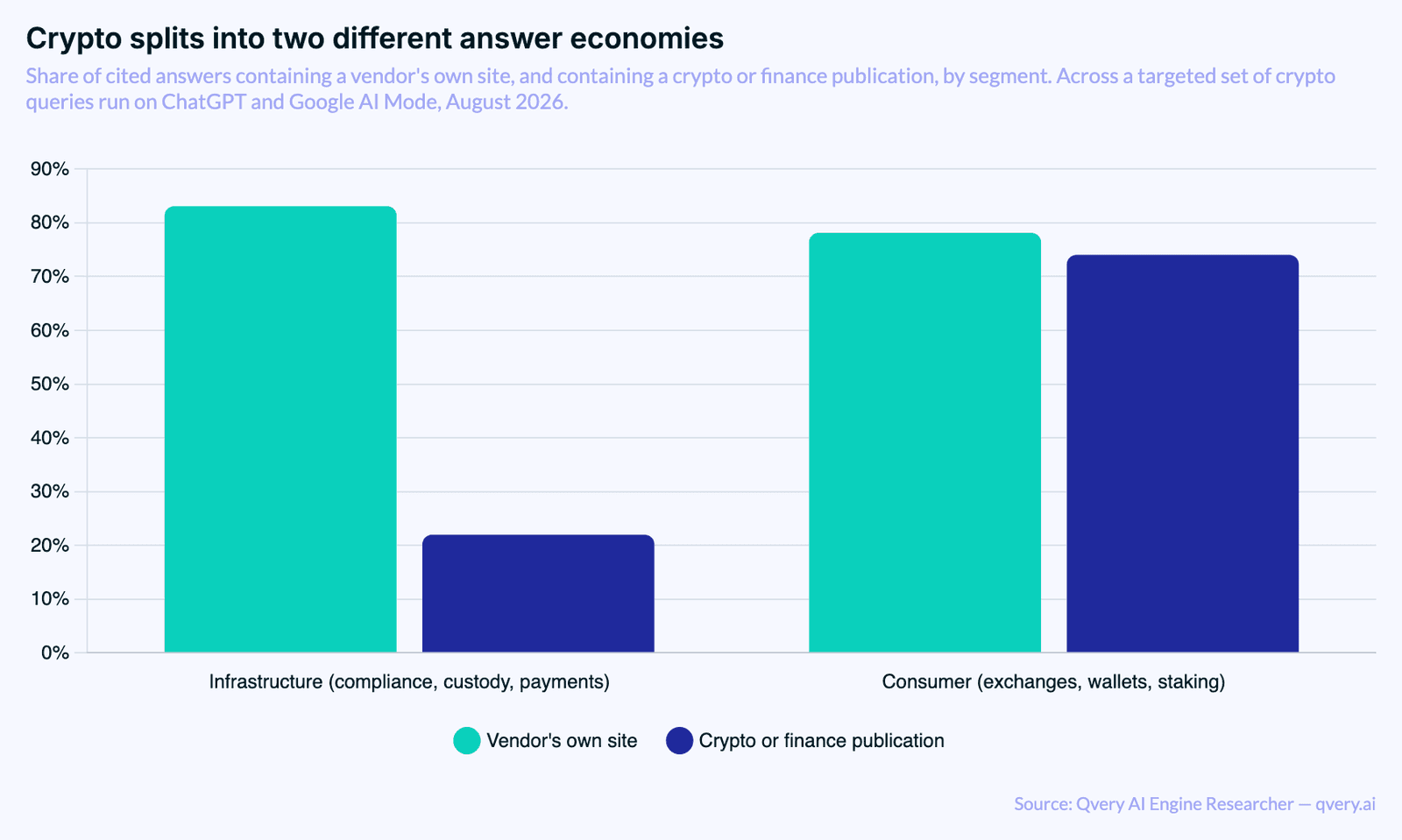
Vendor sites are present at roughly the same rate in both halves, 83.11% for infrastructure and 78.16% for consumer.
The publication layer is where they diverge. Crypto and finance publications appear in 74.06% of cited consumer answers and 21.96% of infrastructure ones, a 3.37 times gap.
Reddit follows the same shape, at 37.20% for consumer questions against 17.23% for infrastructure.
So if you sell custody, compliance, or payments infrastructure, the answers about your category are assembled largely from vendor documentation, with the press playing a minor role. If you sell an exchange or a wallet, you are working in a category where the press and a community are in three quarters and a third of answers respectively, alongside the vendor sites.
Read as observation: the infrastructure arm's answers are composed largely of vendor domains with publications at 21.96%, while the consumer arm carries both vendor domains and publications at 74.06%.
What The Engines Do Differently
Vendor presence runs higher on Google AI Mode at 87.92% than on ChatGPT at 78.18%, while the media layer runs the other way, at 52.95% on ChatGPT against 32.89% on Google AI Mode.
The two move in opposite directions: the engine citing vendor sites more often cites publications less often.
Read it as scope rather than advice. It is an August 2026 observation about where these sources appear, not a stable property of either engine and not a reason to prefer or defund one.
On trigger behaviour, ChatGPT ran a search on 97.78% of its runs here and Google AI Mode on 99.33% of its own. An August observation about these query sets, nothing more.
Building The Audit
Everything above is one collection at one moment. Four things follow, offered as the writer's judgment rather than as results. None is established by the collection.
Split infrastructure questions from consumer ones. The publication layer differs by 3.37 times between them, at 21.96% against 74.06%, so a pooled report describes neither.
Treat your own documentation as a tracked source. At roughly four in five answers, your own domain is a participant in this category rather than only a destination. Very few categories work that way.
Keep the engines apart. Vendor and media presence move in opposite directions between them.
Log it over time. A single snapshot cannot separate a source that structurally anchors your segment from one that appeared once.
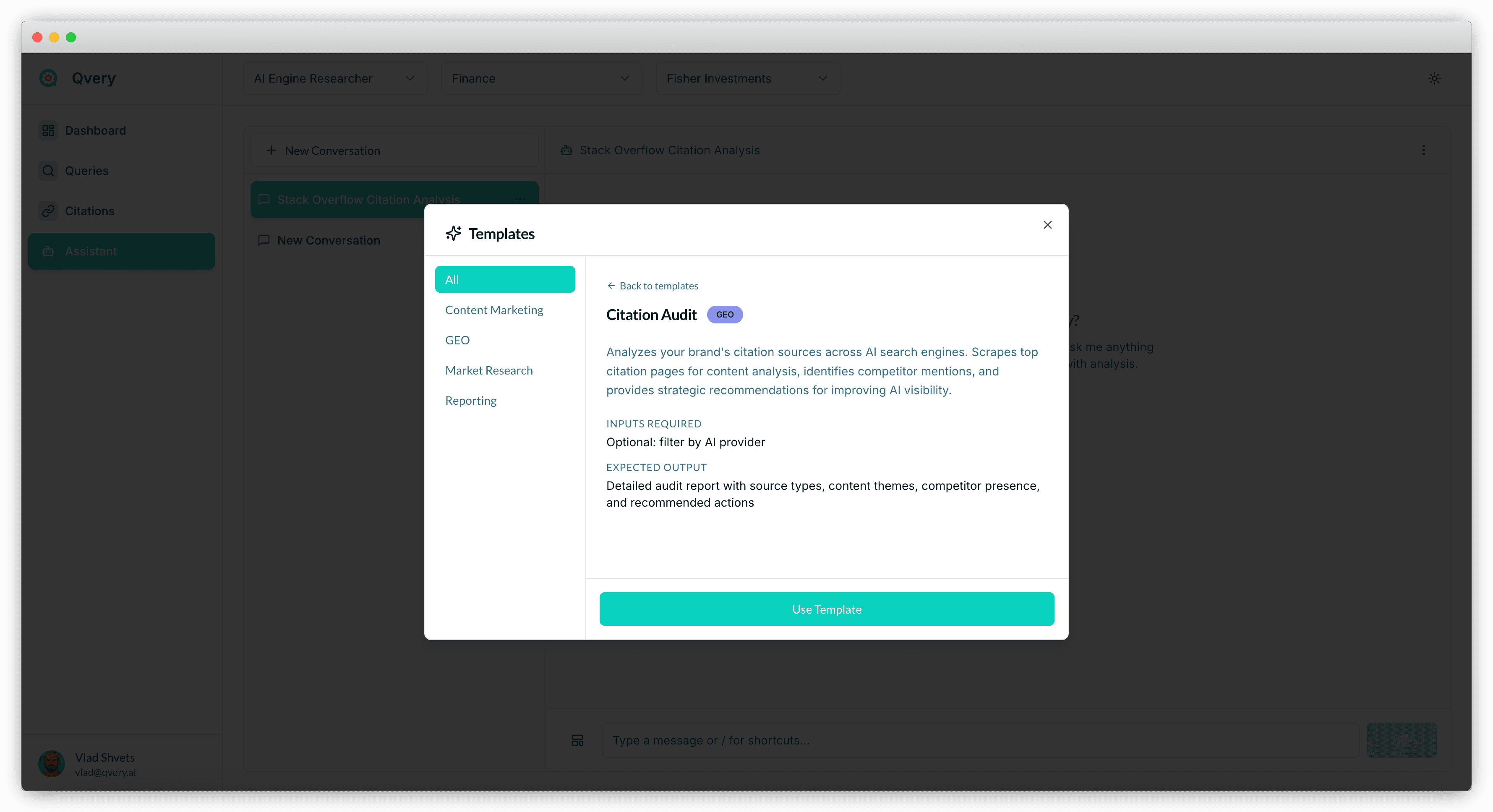
Qvery supplies the tracking underneath that. It tracks visibility, share of voice, and average rank across ChatGPT and Google AI Mode daily, in over 200 countries, and captures every citation tied to the query and engine that produced it. In Qvery Assistant you can ask about your own visibility, share of voice, citation, topic, and query data, add queries, trigger a run, or export a report.
The vendor and publication classification stays yours to maintain alongside those records. Ours are hand-checked named lists rather than classifier output.
Start your free trial and split your first month of crypto citations by segment.
Writer's Judgment, Not A Finding
Flagging this clearly, because the rest of the article stays inside what was measured.
Given that vendor sites reach roughly four in five cited answers, our judgment is that crypto is one of the few categories where documentation quality is a visibility investment rather than a support cost. That is a view about where effort is likely to pay, and the collection does not establish it.
Given the infrastructure and consumer split, our judgment is that an infrastructure brand gets less out of press outreach than its consumer-facing peers do, and should weight toward its own surfaces accordingly.
What the collection did establish is narrower and firmer. A vendor's own site appears in 80.65% of cited answers overall, publications reach 74.06% of consumer-segment answers against 21.96% of infrastructure ones, and no single source exceeds 28.35% of answers. Those are the bounds. What you do inside them is a decision, not a finding.
Crypto has an unusual relationship with AI search. In most categories, a company's own website is a bit player in the answers about it. Here it is the main event.
We ran a targeted collection across six crypto segments, from custody and compliance through to exchanges and wallets, to see what these answers are built from.
The headline number is high enough to change the plan. The more useful result is that the category splits cleanly in two, and the two halves need different work.
One boundary before any number. This measures which sources appear alongside the answers. It does not measure whether appearing on a source causes a brand to be recommended, and nothing here was designed to test that.
Your Own Site Is In Four Of Five Answers
Across a targeted set of crypto queries spanning compliance, custody, payments, exchanges, wallets, and staking, run on ChatGPT and Google AI Mode, August 2026, a vendor's own website appears in 80.65% of cited answers.
That is unusual. In most categories the answers about a company are assembled largely from third parties, with the company's own pages a minor contributor.
No single vendor dominates. Coin Bureau leads all individual sources at 28.35% and Reddit follows at 27.16%, then a long run of vendor domains in the teens and low twenties.
So the category is vendor-heavy in aggregate and unconcentrated at the individual level. Plenty of companies are in these answers, and no single one of them accounts for more than about a quarter.
In crypto, the content you publish is competing directly in the answer rather than trying to earn a mention inside somebody else's.
The Split That Should Change Your Plan
Pool the six segments into the two groups the industry operates as, and the picture separates.
Vendor sites are present at roughly the same rate in both halves, 83.11% for infrastructure and 78.16% for consumer.
The publication layer is where they diverge. Crypto and finance publications appear in 74.06% of cited consumer answers and 21.96% of infrastructure ones, a 3.37 times gap.
Reddit follows the same shape, at 37.20% for consumer questions against 17.23% for infrastructure.
So if you sell custody, compliance, or payments infrastructure, the answers about your category are assembled largely from vendor documentation, with the press playing a minor role. If you sell an exchange or a wallet, you are working in a category where the press and a community are in three quarters and a third of answers respectively, alongside the vendor sites.
Read as observation: the infrastructure arm's answers are composed largely of vendor domains with publications at 21.96%, while the consumer arm carries both vendor domains and publications at 74.06%.
What The Engines Do Differently
Vendor presence runs higher on Google AI Mode at 87.92% than on ChatGPT at 78.18%, while the media layer runs the other way, at 52.95% on ChatGPT against 32.89% on Google AI Mode.
The two move in opposite directions: the engine citing vendor sites more often cites publications less often.
Read it as scope rather than advice. It is an August 2026 observation about where these sources appear, not a stable property of either engine and not a reason to prefer or defund one.
On trigger behaviour, ChatGPT ran a search on 97.78% of its runs here and Google AI Mode on 99.33% of its own. An August observation about these query sets, nothing more.
Building The Audit
Everything above is one collection at one moment. Four things follow, offered as the writer's judgment rather than as results. None is established by the collection.
Split infrastructure questions from consumer ones. The publication layer differs by 3.37 times between them, at 21.96% against 74.06%, so a pooled report describes neither.
Treat your own documentation as a tracked source. At roughly four in five answers, your own domain is a participant in this category rather than only a destination. Very few categories work that way.
Keep the engines apart. Vendor and media presence move in opposite directions between them.
Log it over time. A single snapshot cannot separate a source that structurally anchors your segment from one that appeared once.
Qvery supplies the tracking underneath that. It tracks visibility, share of voice, and average rank across ChatGPT and Google AI Mode daily, in over 200 countries, and captures every citation tied to the query and engine that produced it. In Qvery Assistant you can ask about your own visibility, share of voice, citation, topic, and query data, add queries, trigger a run, or export a report.
The vendor and publication classification stays yours to maintain alongside those records. Ours are hand-checked named lists rather than classifier output.
Start your free trial and split your first month of crypto citations by segment.
Writer's Judgment, Not A Finding
Flagging this clearly, because the rest of the article stays inside what was measured.
Given that vendor sites reach roughly four in five cited answers, our judgment is that crypto is one of the few categories where documentation quality is a visibility investment rather than a support cost. That is a view about where effort is likely to pay, and the collection does not establish it.
Given the infrastructure and consumer split, our judgment is that an infrastructure brand gets less out of press outreach than its consumer-facing peers do, and should weight toward its own surfaces accordingly.
What the collection did establish is narrower and firmer. A vendor's own site appears in 80.65% of cited answers overall, publications reach 74.06% of consumer-segment answers against 21.96% of infrastructure ones, and no single source exceeds 28.35% of answers. Those are the bounds. What you do inside them is a decision, not a finding.
Crypto has an unusual relationship with AI search. In most categories, a company's own website is a bit player in the answers about it. Here it is the main event.
We ran a targeted collection across six crypto segments, from custody and compliance through to exchanges and wallets, to see what these answers are built from.
The headline number is high enough to change the plan. The more useful result is that the category splits cleanly in two, and the two halves need different work.
One boundary before any number. This measures which sources appear alongside the answers. It does not measure whether appearing on a source causes a brand to be recommended, and nothing here was designed to test that.
Your Own Site Is In Four Of Five Answers
Across a targeted set of crypto queries spanning compliance, custody, payments, exchanges, wallets, and staking, run on ChatGPT and Google AI Mode, August 2026, a vendor's own website appears in 80.65% of cited answers.
That is unusual. In most categories the answers about a company are assembled largely from third parties, with the company's own pages a minor contributor.
No single vendor dominates. Coin Bureau leads all individual sources at 28.35% and Reddit follows at 27.16%, then a long run of vendor domains in the teens and low twenties.
So the category is vendor-heavy in aggregate and unconcentrated at the individual level. Plenty of companies are in these answers, and no single one of them accounts for more than about a quarter.
In crypto, the content you publish is competing directly in the answer rather than trying to earn a mention inside somebody else's.
The Split That Should Change Your Plan
Pool the six segments into the two groups the industry operates as, and the picture separates.
Vendor sites are present at roughly the same rate in both halves, 83.11% for infrastructure and 78.16% for consumer.
The publication layer is where they diverge. Crypto and finance publications appear in 74.06% of cited consumer answers and 21.96% of infrastructure ones, a 3.37 times gap.
Reddit follows the same shape, at 37.20% for consumer questions against 17.23% for infrastructure.
So if you sell custody, compliance, or payments infrastructure, the answers about your category are assembled largely from vendor documentation, with the press playing a minor role. If you sell an exchange or a wallet, you are working in a category where the press and a community are in three quarters and a third of answers respectively, alongside the vendor sites.
Read as observation: the infrastructure arm's answers are composed largely of vendor domains with publications at 21.96%, while the consumer arm carries both vendor domains and publications at 74.06%.
What The Engines Do Differently
Vendor presence runs higher on Google AI Mode at 87.92% than on ChatGPT at 78.18%, while the media layer runs the other way, at 52.95% on ChatGPT against 32.89% on Google AI Mode.
The two move in opposite directions: the engine citing vendor sites more often cites publications less often.
Read it as scope rather than advice. It is an August 2026 observation about where these sources appear, not a stable property of either engine and not a reason to prefer or defund one.
On trigger behaviour, ChatGPT ran a search on 97.78% of its runs here and Google AI Mode on 99.33% of its own. An August observation about these query sets, nothing more.
Building The Audit
Everything above is one collection at one moment. Four things follow, offered as the writer's judgment rather than as results. None is established by the collection.
Split infrastructure questions from consumer ones. The publication layer differs by 3.37 times between them, at 21.96% against 74.06%, so a pooled report describes neither.
Treat your own documentation as a tracked source. At roughly four in five answers, your own domain is a participant in this category rather than only a destination. Very few categories work that way.
Keep the engines apart. Vendor and media presence move in opposite directions between them.
Log it over time. A single snapshot cannot separate a source that structurally anchors your segment from one that appeared once.
Qvery supplies the tracking underneath that. It tracks visibility, share of voice, and average rank across ChatGPT and Google AI Mode daily, in over 200 countries, and captures every citation tied to the query and engine that produced it. In Qvery Assistant you can ask about your own visibility, share of voice, citation, topic, and query data, add queries, trigger a run, or export a report.
The vendor and publication classification stays yours to maintain alongside those records. Ours are hand-checked named lists rather than classifier output.
Start your free trial and split your first month of crypto citations by segment.
Writer's Judgment, Not A Finding
Flagging this clearly, because the rest of the article stays inside what was measured.
Given that vendor sites reach roughly four in five cited answers, our judgment is that crypto is one of the few categories where documentation quality is a visibility investment rather than a support cost. That is a view about where effort is likely to pay, and the collection does not establish it.
Given the infrastructure and consumer split, our judgment is that an infrastructure brand gets less out of press outreach than its consumer-facing peers do, and should weight toward its own surfaces accordingly.
What the collection did establish is narrower and firmer. A vendor's own site appears in 80.65% of cited answers overall, publications reach 74.06% of consumer-segment answers against 21.96% of infrastructure ones, and no single source exceeds 28.35% of answers. Those are the bounds. What you do inside them is a decision, not a finding.
Crypto has an unusual relationship with AI search. In most categories, a company's own website is a bit player in the answers about it. Here it is the main event.
We ran a targeted collection across six crypto segments, from custody and compliance through to exchanges and wallets, to see what these answers are built from.
The headline number is high enough to change the plan. The more useful result is that the category splits cleanly in two, and the two halves need different work.
One boundary before any number. This measures which sources appear alongside the answers. It does not measure whether appearing on a source causes a brand to be recommended, and nothing here was designed to test that.
Your Own Site Is In Four Of Five Answers
Across a targeted set of crypto queries spanning compliance, custody, payments, exchanges, wallets, and staking, run on ChatGPT and Google AI Mode, August 2026, a vendor's own website appears in 80.65% of cited answers.
That is unusual. In most categories the answers about a company are assembled largely from third parties, with the company's own pages a minor contributor.
No single vendor dominates. Coin Bureau leads all individual sources at 28.35% and Reddit follows at 27.16%, then a long run of vendor domains in the teens and low twenties.
So the category is vendor-heavy in aggregate and unconcentrated at the individual level. Plenty of companies are in these answers, and no single one of them accounts for more than about a quarter.
In crypto, the content you publish is competing directly in the answer rather than trying to earn a mention inside somebody else's.
The Split That Should Change Your Plan
Pool the six segments into the two groups the industry operates as, and the picture separates.
Vendor sites are present at roughly the same rate in both halves, 83.11% for infrastructure and 78.16% for consumer.
The publication layer is where they diverge. Crypto and finance publications appear in 74.06% of cited consumer answers and 21.96% of infrastructure ones, a 3.37 times gap.
Reddit follows the same shape, at 37.20% for consumer questions against 17.23% for infrastructure.
So if you sell custody, compliance, or payments infrastructure, the answers about your category are assembled largely from vendor documentation, with the press playing a minor role. If you sell an exchange or a wallet, you are working in a category where the press and a community are in three quarters and a third of answers respectively, alongside the vendor sites.
Read as observation: the infrastructure arm's answers are composed largely of vendor domains with publications at 21.96%, while the consumer arm carries both vendor domains and publications at 74.06%.
What The Engines Do Differently
Vendor presence runs higher on Google AI Mode at 87.92% than on ChatGPT at 78.18%, while the media layer runs the other way, at 52.95% on ChatGPT against 32.89% on Google AI Mode.
The two move in opposite directions: the engine citing vendor sites more often cites publications less often.
Read it as scope rather than advice. It is an August 2026 observation about where these sources appear, not a stable property of either engine and not a reason to prefer or defund one.
On trigger behaviour, ChatGPT ran a search on 97.78% of its runs here and Google AI Mode on 99.33% of its own. An August observation about these query sets, nothing more.
Building The Audit
Everything above is one collection at one moment. Four things follow, offered as the writer's judgment rather than as results. None is established by the collection.
Split infrastructure questions from consumer ones. The publication layer differs by 3.37 times between them, at 21.96% against 74.06%, so a pooled report describes neither.
Treat your own documentation as a tracked source. At roughly four in five answers, your own domain is a participant in this category rather than only a destination. Very few categories work that way.
Keep the engines apart. Vendor and media presence move in opposite directions between them.
Log it over time. A single snapshot cannot separate a source that structurally anchors your segment from one that appeared once.
Qvery supplies the tracking underneath that. It tracks visibility, share of voice, and average rank across ChatGPT and Google AI Mode daily, in over 200 countries, and captures every citation tied to the query and engine that produced it. In Qvery Assistant you can ask about your own visibility, share of voice, citation, topic, and query data, add queries, trigger a run, or export a report.
The vendor and publication classification stays yours to maintain alongside those records. Ours are hand-checked named lists rather than classifier output.
Start your free trial and split your first month of crypto citations by segment.
Writer's Judgment, Not A Finding
Flagging this clearly, because the rest of the article stays inside what was measured.
Given that vendor sites reach roughly four in five cited answers, our judgment is that crypto is one of the few categories where documentation quality is a visibility investment rather than a support cost. That is a view about where effort is likely to pay, and the collection does not establish it.
Given the infrastructure and consumer split, our judgment is that an infrastructure brand gets less out of press outreach than its consumer-facing peers do, and should weight toward its own surfaces accordingly.
What the collection did establish is narrower and firmer. A vendor's own site appears in 80.65% of cited answers overall, publications reach 74.06% of consumer-segment answers against 21.96% of infrastructure ones, and no single source exceeds 28.35% of answers. Those are the bounds. What you do inside them is a decision, not a finding.

© 2026 Qvery AI OÜ