By
Vlad Shvets
How To Get Your Product Named In The Best-Of Listicles AI Engines Cite
Half of AI product answers lean on a best-of page, whatever you sell. Who writes the cited list flips with the category: testers run electronics, editors and retailers run taste. The pitch list, the recurring pages, and how to read yours.
Half of AI product answers lean on a best-of page, whatever you sell. Who writes the cited list flips with the category: testers run electronics, editors and retailers run taste. The pitch list, the recurring pages, and how to read yours.
Half of AI product answers lean on a best-of page, whatever you sell. Who writes the cited list flips with the category: testers run electronics, editors and retailers run taste. The pitch list, the recurring pages, and how to read yours.
Roughly half of the AI answers recommending products lean on somebody's best-of page. Not the brand's site, not a forum thread: an editor's ranked list, cited by name, deciding which five products a shopper hears about.
Most product marketers know this in the abstract and act on it the old way: chase coverage anywhere, hope some of it is a roundup. So we ran matched "best X" questions across two very different kinds of retail category and read which list pages the answers were built from.
The short version: the best-of format carries the answers in both kinds of category, but who writes the cited lists flips completely with what you sell. Which means the pitch list is knowable, and it is shorter and stranger than the PR plan assumes.
One warning attached to everything below: a single reading, not a settled law.
Half of Product Answers Lean on a Best-Of Page, Whatever You Sell
Across a targeted set of product-category questions we ran on ChatGPT and Google AI Mode in August 2026 (US-weighted, with a UK, Canadian, and Australian mix), 52.00% of all answers carried at least one best-of or buying-guide URL.
Split by category type, the rate barely moves: a best-of URL was in 53.23% of the lab-tested-category answers that cited any source, and 54.24% of the taste-driven ones. Headphones or handbags, the engines reach for a ranked list either way.
That stability is worth pausing on, because it makes list placement a portable strategy. The format is the most-cited content type in AI search across our wider data, and in these product questions it holds its majority regardless of the shelf.
Who Writes the List That Answers You Depends on What You Sell
The publisher behind the list is a different story. We sorted every repeat-cited source into four kinds: category-specialist testers, general lifestyle and news editorial, retailers and marketplaces, and community platforms.
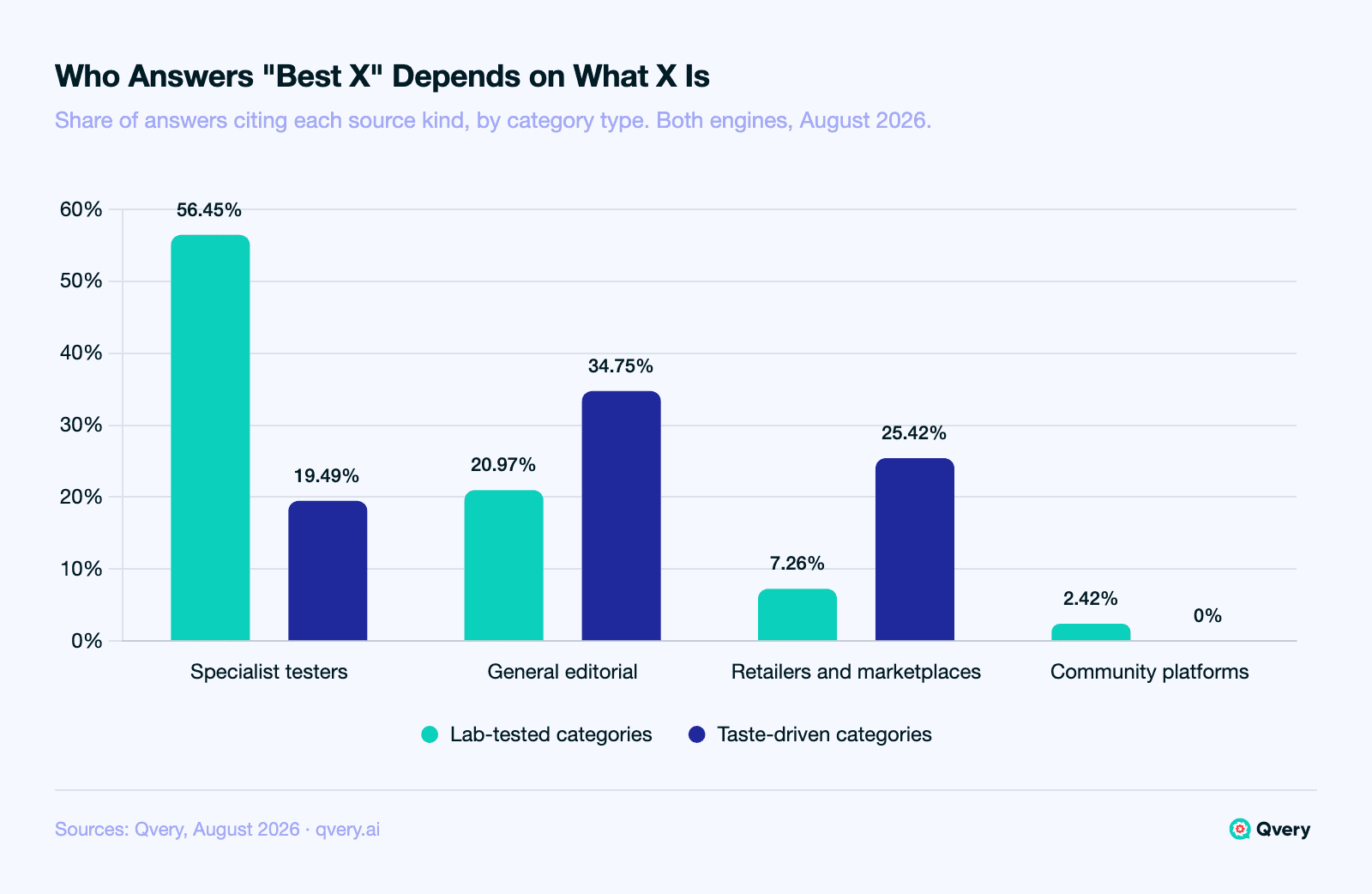
For lab-tested categories (headphones, TVs, vacuums, espresso machines), a specialist tester was in 56.45% of the answers that cited any source: the sites that publish measurements, teardowns, and test benches. General editorial trailed at 20.97%, and retail surfaces barely registered at 7.26%.
For taste-driven categories (apparel, footwear, bags, home decor), the testers fall to 19.49% of the answers that cited any source, and those answers are carried by general editorial at 34.75% and retailers and marketplaces at 25.42%: the magazine's "best walking sandals" piece and the department store's own buying guide.
A spec sheet gets you into the tester's lab, a look gets you into the editor's story, and the engines cite whichever one your category runs on.
And one absence, again: community platforms sat at 1.24% of all the answers that cited any source, and 0.00% on the taste side. In automotive and travel answers Reddit leads our citation data; in these August "best product" questions, the community layer did not make the sources. The recommendation is being written by people with bylines, not usernames.
The Cited Lists Are a ChatGPT Surface Right Now
Split the answers by engine and the whole surface tilts: a best-of URL appeared in 86.67% of ChatGPT's answers and 0.00% of Google AI Mode's (share of each engine's answers).
The zero carries its caveat: in this collection, every citation URL on the Google AI Mode side resolved to Google's own domain, so what that engine reads underneath is not visible to us, and its figure is a floor.
What the split does say is that the readable, pitchable list layer currently surfaces through ChatGPT's answers. That is a measurement, not advice to ignore an engine; your buyers use both.
Pitch the Standing Page, Not the Publication
The most useful thing in the data is also the most concrete: the same list pages kept coming back across different questions. The engines keep citing a specific standing URL the publisher maintains, rather than the publication in general.
In the lab-tested categories, the recurring pages were Tom's Guide's best-espresso-machines page, Wired's best-coffee-makers and best-espresso-machines galleries, Food Network's best-drip-coffee-makers page, Good Housekeeping's drip-machine list, and TechRadar's best-OLED-TVs page. On the taste side: Fleet Feet's best-shoes-for-standing-all-day guide, Pack Hacker's best-laptop-bag guide, NBC Select's and Good Housekeeping's walking-sandal lists, and Solereview's standing-all-day page.
The engine does not cite "Wired". It cites one Wired URL that has been updated for years, and your product is either on that page or it is not.
What follows is our judgment on the pattern, not a proven sequence:
In tester-run categories, pitch like an engineer. The unit, the loan program, the measurements that make the reviewer's job easy. A tester site updates its standing page when it has new test data; you are offering the data.
In editorial-run categories, pitch like a stylist. The story, the look, the season hook. The magazine's standing list updates around moments; give the editor the moment.
In taste categories, mind the retail layer too. A quarter of those answers leaned on retailer and marketplace surfaces, so the department-store buying guide and your marketplace presence are part of the same fight.
Prefer the page that updates. The URLs that recurred are standing pages with refresh histories. A one-off roundup from 2023 is a trophy; a maintained list is a channel.
Pull the Lists That Answer Your Category in Qvery
Everything above is our read across categories. The version you can act on is the list of URLs answering your category, this month.
In Qvery, track your category's buying questions and Qvery runs them daily on ChatGPT and Google AI Mode, capturing every citation tied to the query and engine that produced it. Open Citations, read the Top URLs behind your questions, and you are looking at the standing pages that answer your shelf: which best-of lists, whose, and how often.
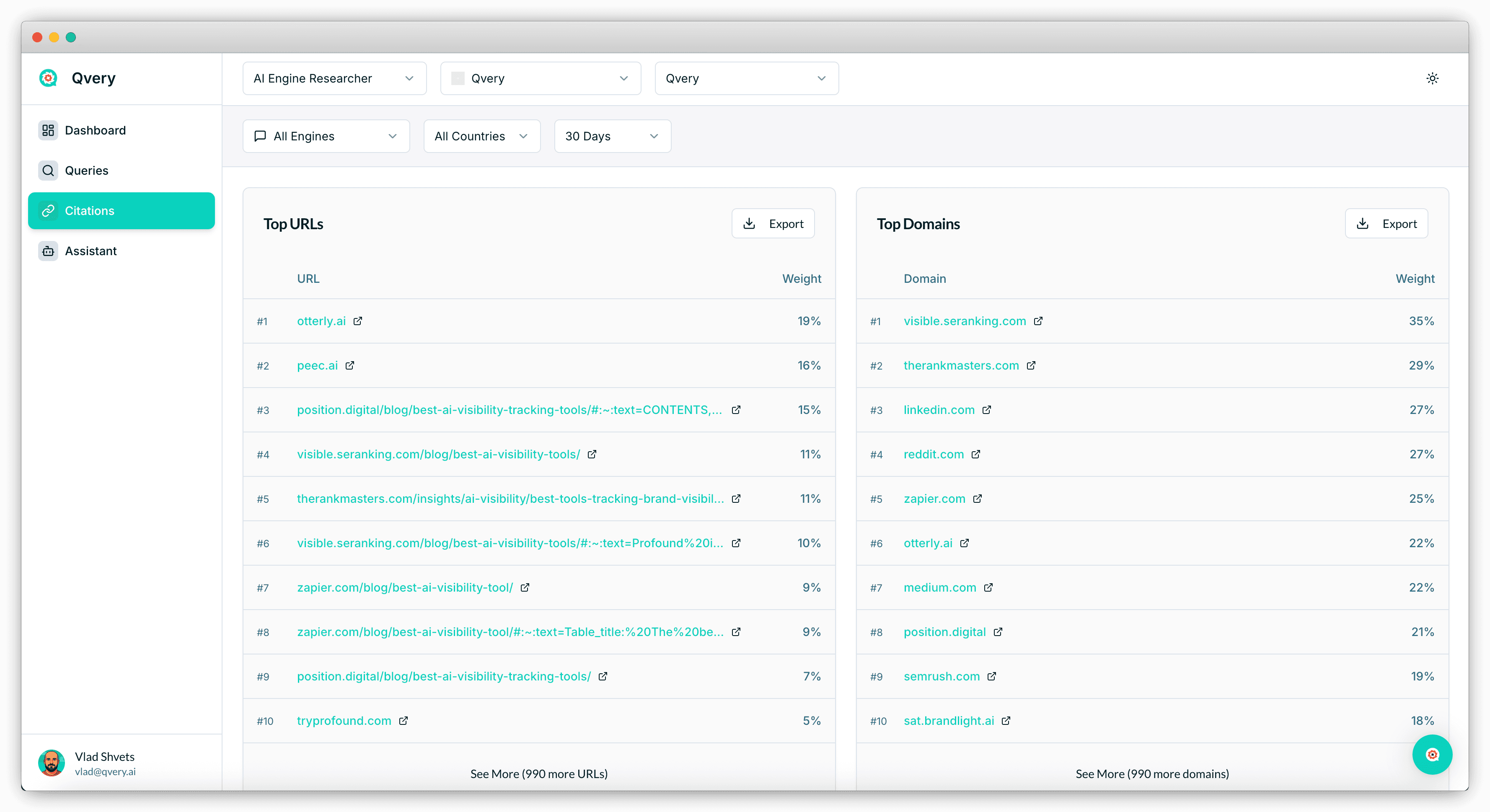
Whether your product is on those pages is a read you make in one sitting; earning the placement is the quarter's work. When a placement lands, the daily runs tell you, per query, whether the answers picked it up.
Sign up for Qvery and use the free 7-day trial to pull the list of lists for your category before you write a single pitch.
This week's move: open the standing best-of page that answers your category and read it the way the engine does. Who is on it, what data or story got them there, and when it was last updated. That page is the door; now you know whose it is.
Roughly half of the AI answers recommending products lean on somebody's best-of page. Not the brand's site, not a forum thread: an editor's ranked list, cited by name, deciding which five products a shopper hears about.
Most product marketers know this in the abstract and act on it the old way: chase coverage anywhere, hope some of it is a roundup. So we ran matched "best X" questions across two very different kinds of retail category and read which list pages the answers were built from.
The short version: the best-of format carries the answers in both kinds of category, but who writes the cited lists flips completely with what you sell. Which means the pitch list is knowable, and it is shorter and stranger than the PR plan assumes.
One warning attached to everything below: a single reading, not a settled law.
Half of Product Answers Lean on a Best-Of Page, Whatever You Sell
Across a targeted set of product-category questions we ran on ChatGPT and Google AI Mode in August 2026 (US-weighted, with a UK, Canadian, and Australian mix), 52.00% of all answers carried at least one best-of or buying-guide URL.
Split by category type, the rate barely moves: a best-of URL was in 53.23% of the lab-tested-category answers that cited any source, and 54.24% of the taste-driven ones. Headphones or handbags, the engines reach for a ranked list either way.
That stability is worth pausing on, because it makes list placement a portable strategy. The format is the most-cited content type in AI search across our wider data, and in these product questions it holds its majority regardless of the shelf.
Who Writes the List That Answers You Depends on What You Sell
The publisher behind the list is a different story. We sorted every repeat-cited source into four kinds: category-specialist testers, general lifestyle and news editorial, retailers and marketplaces, and community platforms.
For lab-tested categories (headphones, TVs, vacuums, espresso machines), a specialist tester was in 56.45% of the answers that cited any source: the sites that publish measurements, teardowns, and test benches. General editorial trailed at 20.97%, and retail surfaces barely registered at 7.26%.
For taste-driven categories (apparel, footwear, bags, home decor), the testers fall to 19.49% of the answers that cited any source, and those answers are carried by general editorial at 34.75% and retailers and marketplaces at 25.42%: the magazine's "best walking sandals" piece and the department store's own buying guide.
A spec sheet gets you into the tester's lab, a look gets you into the editor's story, and the engines cite whichever one your category runs on.
And one absence, again: community platforms sat at 1.24% of all the answers that cited any source, and 0.00% on the taste side. In automotive and travel answers Reddit leads our citation data; in these August "best product" questions, the community layer did not make the sources. The recommendation is being written by people with bylines, not usernames.
The Cited Lists Are a ChatGPT Surface Right Now
Split the answers by engine and the whole surface tilts: a best-of URL appeared in 86.67% of ChatGPT's answers and 0.00% of Google AI Mode's (share of each engine's answers).
The zero carries its caveat: in this collection, every citation URL on the Google AI Mode side resolved to Google's own domain, so what that engine reads underneath is not visible to us, and its figure is a floor.
What the split does say is that the readable, pitchable list layer currently surfaces through ChatGPT's answers. That is a measurement, not advice to ignore an engine; your buyers use both.
Pitch the Standing Page, Not the Publication
The most useful thing in the data is also the most concrete: the same list pages kept coming back across different questions. The engines keep citing a specific standing URL the publisher maintains, rather than the publication in general.
In the lab-tested categories, the recurring pages were Tom's Guide's best-espresso-machines page, Wired's best-coffee-makers and best-espresso-machines galleries, Food Network's best-drip-coffee-makers page, Good Housekeeping's drip-machine list, and TechRadar's best-OLED-TVs page. On the taste side: Fleet Feet's best-shoes-for-standing-all-day guide, Pack Hacker's best-laptop-bag guide, NBC Select's and Good Housekeeping's walking-sandal lists, and Solereview's standing-all-day page.
The engine does not cite "Wired". It cites one Wired URL that has been updated for years, and your product is either on that page or it is not.
What follows is our judgment on the pattern, not a proven sequence:
In tester-run categories, pitch like an engineer. The unit, the loan program, the measurements that make the reviewer's job easy. A tester site updates its standing page when it has new test data; you are offering the data.
In editorial-run categories, pitch like a stylist. The story, the look, the season hook. The magazine's standing list updates around moments; give the editor the moment.
In taste categories, mind the retail layer too. A quarter of those answers leaned on retailer and marketplace surfaces, so the department-store buying guide and your marketplace presence are part of the same fight.
Prefer the page that updates. The URLs that recurred are standing pages with refresh histories. A one-off roundup from 2023 is a trophy; a maintained list is a channel.
Pull the Lists That Answer Your Category in Qvery
Everything above is our read across categories. The version you can act on is the list of URLs answering your category, this month.
In Qvery, track your category's buying questions and Qvery runs them daily on ChatGPT and Google AI Mode, capturing every citation tied to the query and engine that produced it. Open Citations, read the Top URLs behind your questions, and you are looking at the standing pages that answer your shelf: which best-of lists, whose, and how often.
Whether your product is on those pages is a read you make in one sitting; earning the placement is the quarter's work. When a placement lands, the daily runs tell you, per query, whether the answers picked it up.
Sign up for Qvery and use the free 7-day trial to pull the list of lists for your category before you write a single pitch.
This week's move: open the standing best-of page that answers your category and read it the way the engine does. Who is on it, what data or story got them there, and when it was last updated. That page is the door; now you know whose it is.
Roughly half of the AI answers recommending products lean on somebody's best-of page. Not the brand's site, not a forum thread: an editor's ranked list, cited by name, deciding which five products a shopper hears about.
Most product marketers know this in the abstract and act on it the old way: chase coverage anywhere, hope some of it is a roundup. So we ran matched "best X" questions across two very different kinds of retail category and read which list pages the answers were built from.
The short version: the best-of format carries the answers in both kinds of category, but who writes the cited lists flips completely with what you sell. Which means the pitch list is knowable, and it is shorter and stranger than the PR plan assumes.
One warning attached to everything below: a single reading, not a settled law.
Half of Product Answers Lean on a Best-Of Page, Whatever You Sell
Across a targeted set of product-category questions we ran on ChatGPT and Google AI Mode in August 2026 (US-weighted, with a UK, Canadian, and Australian mix), 52.00% of all answers carried at least one best-of or buying-guide URL.
Split by category type, the rate barely moves: a best-of URL was in 53.23% of the lab-tested-category answers that cited any source, and 54.24% of the taste-driven ones. Headphones or handbags, the engines reach for a ranked list either way.
That stability is worth pausing on, because it makes list placement a portable strategy. The format is the most-cited content type in AI search across our wider data, and in these product questions it holds its majority regardless of the shelf.
Who Writes the List That Answers You Depends on What You Sell
The publisher behind the list is a different story. We sorted every repeat-cited source into four kinds: category-specialist testers, general lifestyle and news editorial, retailers and marketplaces, and community platforms.
For lab-tested categories (headphones, TVs, vacuums, espresso machines), a specialist tester was in 56.45% of the answers that cited any source: the sites that publish measurements, teardowns, and test benches. General editorial trailed at 20.97%, and retail surfaces barely registered at 7.26%.
For taste-driven categories (apparel, footwear, bags, home decor), the testers fall to 19.49% of the answers that cited any source, and those answers are carried by general editorial at 34.75% and retailers and marketplaces at 25.42%: the magazine's "best walking sandals" piece and the department store's own buying guide.
A spec sheet gets you into the tester's lab, a look gets you into the editor's story, and the engines cite whichever one your category runs on.
And one absence, again: community platforms sat at 1.24% of all the answers that cited any source, and 0.00% on the taste side. In automotive and travel answers Reddit leads our citation data; in these August "best product" questions, the community layer did not make the sources. The recommendation is being written by people with bylines, not usernames.
The Cited Lists Are a ChatGPT Surface Right Now
Split the answers by engine and the whole surface tilts: a best-of URL appeared in 86.67% of ChatGPT's answers and 0.00% of Google AI Mode's (share of each engine's answers).
The zero carries its caveat: in this collection, every citation URL on the Google AI Mode side resolved to Google's own domain, so what that engine reads underneath is not visible to us, and its figure is a floor.
What the split does say is that the readable, pitchable list layer currently surfaces through ChatGPT's answers. That is a measurement, not advice to ignore an engine; your buyers use both.
Pitch the Standing Page, Not the Publication
The most useful thing in the data is also the most concrete: the same list pages kept coming back across different questions. The engines keep citing a specific standing URL the publisher maintains, rather than the publication in general.
In the lab-tested categories, the recurring pages were Tom's Guide's best-espresso-machines page, Wired's best-coffee-makers and best-espresso-machines galleries, Food Network's best-drip-coffee-makers page, Good Housekeeping's drip-machine list, and TechRadar's best-OLED-TVs page. On the taste side: Fleet Feet's best-shoes-for-standing-all-day guide, Pack Hacker's best-laptop-bag guide, NBC Select's and Good Housekeeping's walking-sandal lists, and Solereview's standing-all-day page.
The engine does not cite "Wired". It cites one Wired URL that has been updated for years, and your product is either on that page or it is not.
What follows is our judgment on the pattern, not a proven sequence:
In tester-run categories, pitch like an engineer. The unit, the loan program, the measurements that make the reviewer's job easy. A tester site updates its standing page when it has new test data; you are offering the data.
In editorial-run categories, pitch like a stylist. The story, the look, the season hook. The magazine's standing list updates around moments; give the editor the moment.
In taste categories, mind the retail layer too. A quarter of those answers leaned on retailer and marketplace surfaces, so the department-store buying guide and your marketplace presence are part of the same fight.
Prefer the page that updates. The URLs that recurred are standing pages with refresh histories. A one-off roundup from 2023 is a trophy; a maintained list is a channel.
Pull the Lists That Answer Your Category in Qvery
Everything above is our read across categories. The version you can act on is the list of URLs answering your category, this month.
In Qvery, track your category's buying questions and Qvery runs them daily on ChatGPT and Google AI Mode, capturing every citation tied to the query and engine that produced it. Open Citations, read the Top URLs behind your questions, and you are looking at the standing pages that answer your shelf: which best-of lists, whose, and how often.
Whether your product is on those pages is a read you make in one sitting; earning the placement is the quarter's work. When a placement lands, the daily runs tell you, per query, whether the answers picked it up.
Sign up for Qvery and use the free 7-day trial to pull the list of lists for your category before you write a single pitch.
This week's move: open the standing best-of page that answers your category and read it the way the engine does. Who is on it, what data or story got them there, and when it was last updated. That page is the door; now you know whose it is.
Roughly half of the AI answers recommending products lean on somebody's best-of page. Not the brand's site, not a forum thread: an editor's ranked list, cited by name, deciding which five products a shopper hears about.
Most product marketers know this in the abstract and act on it the old way: chase coverage anywhere, hope some of it is a roundup. So we ran matched "best X" questions across two very different kinds of retail category and read which list pages the answers were built from.
The short version: the best-of format carries the answers in both kinds of category, but who writes the cited lists flips completely with what you sell. Which means the pitch list is knowable, and it is shorter and stranger than the PR plan assumes.
One warning attached to everything below: a single reading, not a settled law.
Half of Product Answers Lean on a Best-Of Page, Whatever You Sell
Across a targeted set of product-category questions we ran on ChatGPT and Google AI Mode in August 2026 (US-weighted, with a UK, Canadian, and Australian mix), 52.00% of all answers carried at least one best-of or buying-guide URL.
Split by category type, the rate barely moves: a best-of URL was in 53.23% of the lab-tested-category answers that cited any source, and 54.24% of the taste-driven ones. Headphones or handbags, the engines reach for a ranked list either way.
That stability is worth pausing on, because it makes list placement a portable strategy. The format is the most-cited content type in AI search across our wider data, and in these product questions it holds its majority regardless of the shelf.
Who Writes the List That Answers You Depends on What You Sell
The publisher behind the list is a different story. We sorted every repeat-cited source into four kinds: category-specialist testers, general lifestyle and news editorial, retailers and marketplaces, and community platforms.
For lab-tested categories (headphones, TVs, vacuums, espresso machines), a specialist tester was in 56.45% of the answers that cited any source: the sites that publish measurements, teardowns, and test benches. General editorial trailed at 20.97%, and retail surfaces barely registered at 7.26%.
For taste-driven categories (apparel, footwear, bags, home decor), the testers fall to 19.49% of the answers that cited any source, and those answers are carried by general editorial at 34.75% and retailers and marketplaces at 25.42%: the magazine's "best walking sandals" piece and the department store's own buying guide.
A spec sheet gets you into the tester's lab, a look gets you into the editor's story, and the engines cite whichever one your category runs on.
And one absence, again: community platforms sat at 1.24% of all the answers that cited any source, and 0.00% on the taste side. In automotive and travel answers Reddit leads our citation data; in these August "best product" questions, the community layer did not make the sources. The recommendation is being written by people with bylines, not usernames.
The Cited Lists Are a ChatGPT Surface Right Now
Split the answers by engine and the whole surface tilts: a best-of URL appeared in 86.67% of ChatGPT's answers and 0.00% of Google AI Mode's (share of each engine's answers).
The zero carries its caveat: in this collection, every citation URL on the Google AI Mode side resolved to Google's own domain, so what that engine reads underneath is not visible to us, and its figure is a floor.
What the split does say is that the readable, pitchable list layer currently surfaces through ChatGPT's answers. That is a measurement, not advice to ignore an engine; your buyers use both.
Pitch the Standing Page, Not the Publication
The most useful thing in the data is also the most concrete: the same list pages kept coming back across different questions. The engines keep citing a specific standing URL the publisher maintains, rather than the publication in general.
In the lab-tested categories, the recurring pages were Tom's Guide's best-espresso-machines page, Wired's best-coffee-makers and best-espresso-machines galleries, Food Network's best-drip-coffee-makers page, Good Housekeeping's drip-machine list, and TechRadar's best-OLED-TVs page. On the taste side: Fleet Feet's best-shoes-for-standing-all-day guide, Pack Hacker's best-laptop-bag guide, NBC Select's and Good Housekeeping's walking-sandal lists, and Solereview's standing-all-day page.
The engine does not cite "Wired". It cites one Wired URL that has been updated for years, and your product is either on that page or it is not.
What follows is our judgment on the pattern, not a proven sequence:
In tester-run categories, pitch like an engineer. The unit, the loan program, the measurements that make the reviewer's job easy. A tester site updates its standing page when it has new test data; you are offering the data.
In editorial-run categories, pitch like a stylist. The story, the look, the season hook. The magazine's standing list updates around moments; give the editor the moment.
In taste categories, mind the retail layer too. A quarter of those answers leaned on retailer and marketplace surfaces, so the department-store buying guide and your marketplace presence are part of the same fight.
Prefer the page that updates. The URLs that recurred are standing pages with refresh histories. A one-off roundup from 2023 is a trophy; a maintained list is a channel.
Pull the Lists That Answer Your Category in Qvery
Everything above is our read across categories. The version you can act on is the list of URLs answering your category, this month.
In Qvery, track your category's buying questions and Qvery runs them daily on ChatGPT and Google AI Mode, capturing every citation tied to the query and engine that produced it. Open Citations, read the Top URLs behind your questions, and you are looking at the standing pages that answer your shelf: which best-of lists, whose, and how often.
Whether your product is on those pages is a read you make in one sitting; earning the placement is the quarter's work. When a placement lands, the daily runs tell you, per query, whether the answers picked it up.
Sign up for Qvery and use the free 7-day trial to pull the list of lists for your category before you write a single pitch.
This week's move: open the standing best-of page that answers your category and read it the way the engine does. Who is on it, what data or story got them there, and when it was last updated. That page is the door; now you know whose it is.

© 2026 Qvery AI OÜ