By
Vlad Shvets
How To Run A Content Gap Analysis For AI Search
A worked content gap analysis. Learning questions and shopping questions returned almost the same list of websites, which makes one plan enough and is the opposite of what we expected.
A worked content gap analysis. Learning questions and shopping questions returned almost the same list of websites, which makes one plan enough and is the opposite of what we expected.
A worked content gap analysis. Learning questions and shopping questions returned almost the same list of websites, which makes one plan enough and is the opposite of what we expected.
Your content gap list is probably built entirely out of shopping questions. Best tool for this, top software for that, alternatives to the thing you compete with.
That is half a market. The other half is people asking how something works before they have any intention of buying, and in the category we worked this method on, those questions were answered by the same short list of websites.
Which is the finding worth having up front. The two halves did not need two plans. Whether that holds in your category is exactly what this analysis tells you, and the answer changes what you write next.
The Half Of The Market You Are Not Looking At
Sort your gap queries into two kinds before you decide anything.
Shopping questions ask what to get. Best small business security tools, top endpoint protection software, password managers for a small team.
Learning questions ask how something works. Why password managers matter, email security explained simply, what business backup involves in practice.
Marketing teams track the first kind because it looks closer to revenue. The second kind is where somebody forms an opinion about the category before any vendor is in the room, and most content plans have nothing in it at all.
Write ten of each for your category. That pair of lists is the input to everything below.
What Gets Cited When Nobody Is Shopping
Take the learning half first, since it is the half nobody looks at.
Across a targeted set of questions in one category we ran on ChatGPT and Google AI Mode in September 2026, public bodies and institutional sources were present in 71.3% of answers that cited any source on the learning side. Brands' own domains were present in 33.33% of them.
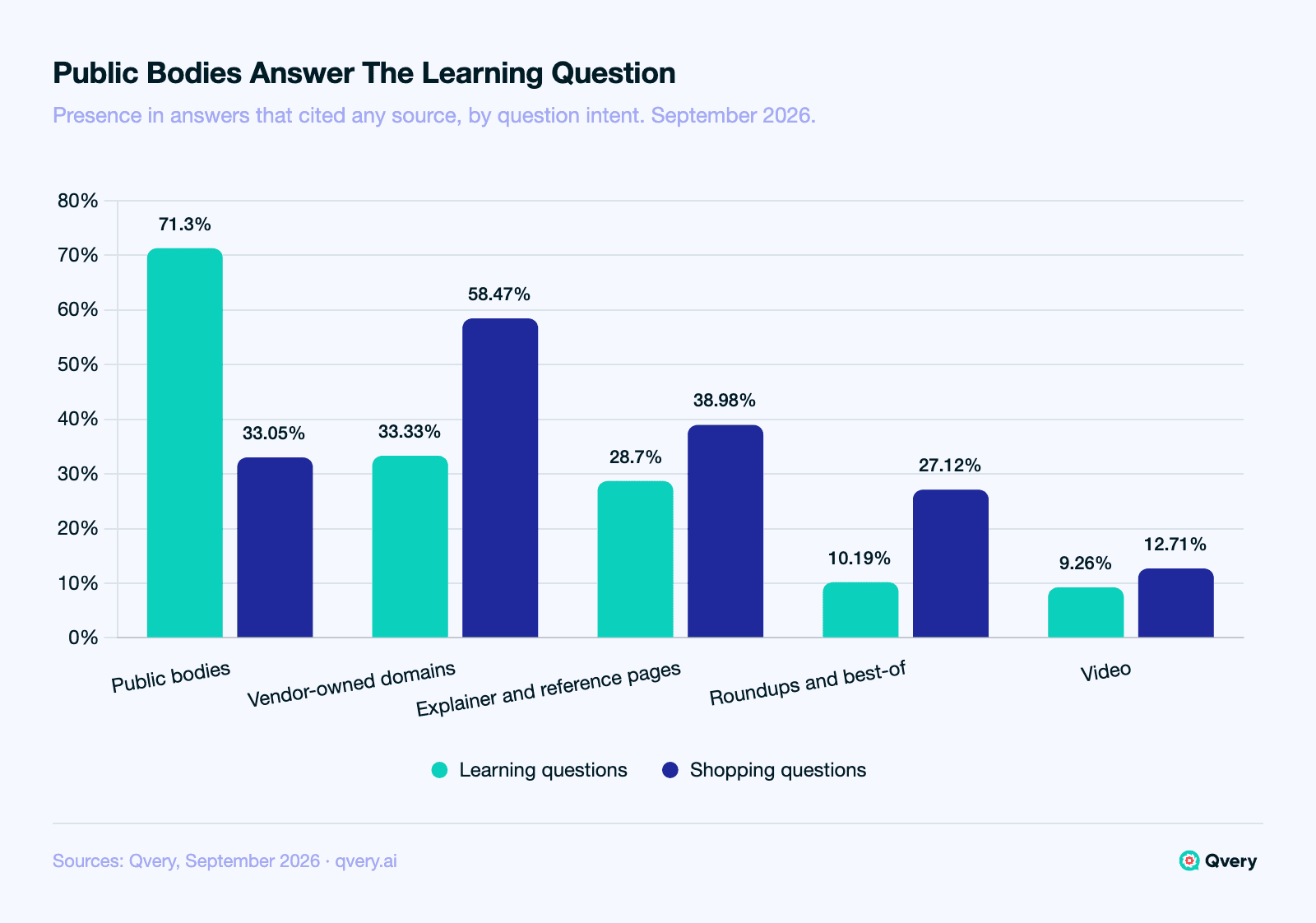
The shopping half runs the other way. Brands' own domains were present in 58.47% of answers that cited any source on the shopping side, public bodies in 33.05%. Roundups and best-of pages followed the shopping question too, 27.12% against 10.19% of answers that cited any source.
Explainer and reference pages were present in 38.98% of answers that cited any source on the shopping side and 28.7% on the learning side. That ratio was registered in advance as indeterminate, so we report it and call nothing.
Now the number that kills the usual excuse for ignoring learning questions.
Learning questions returned an answer with sources under it on 86.4% of the runs we made, against 94.4% for shopping questions. That is a share of every run, not of answers that cited something, and the two figures sit inside the band we set in advance for calling things equivalent.
Learning questions get sourced answers at about the same rate as buying questions. If your plan skips explainers because nobody cites them, it is planning against a number that is not there.
What Gets Cited When They Are
Now count the domains behind each half and compare the lists.
Learning questions: three domains cover half of the answers that cited any source. Seven cover four fifths.
Shopping questions: four cover half. Eleven cover four fifths.
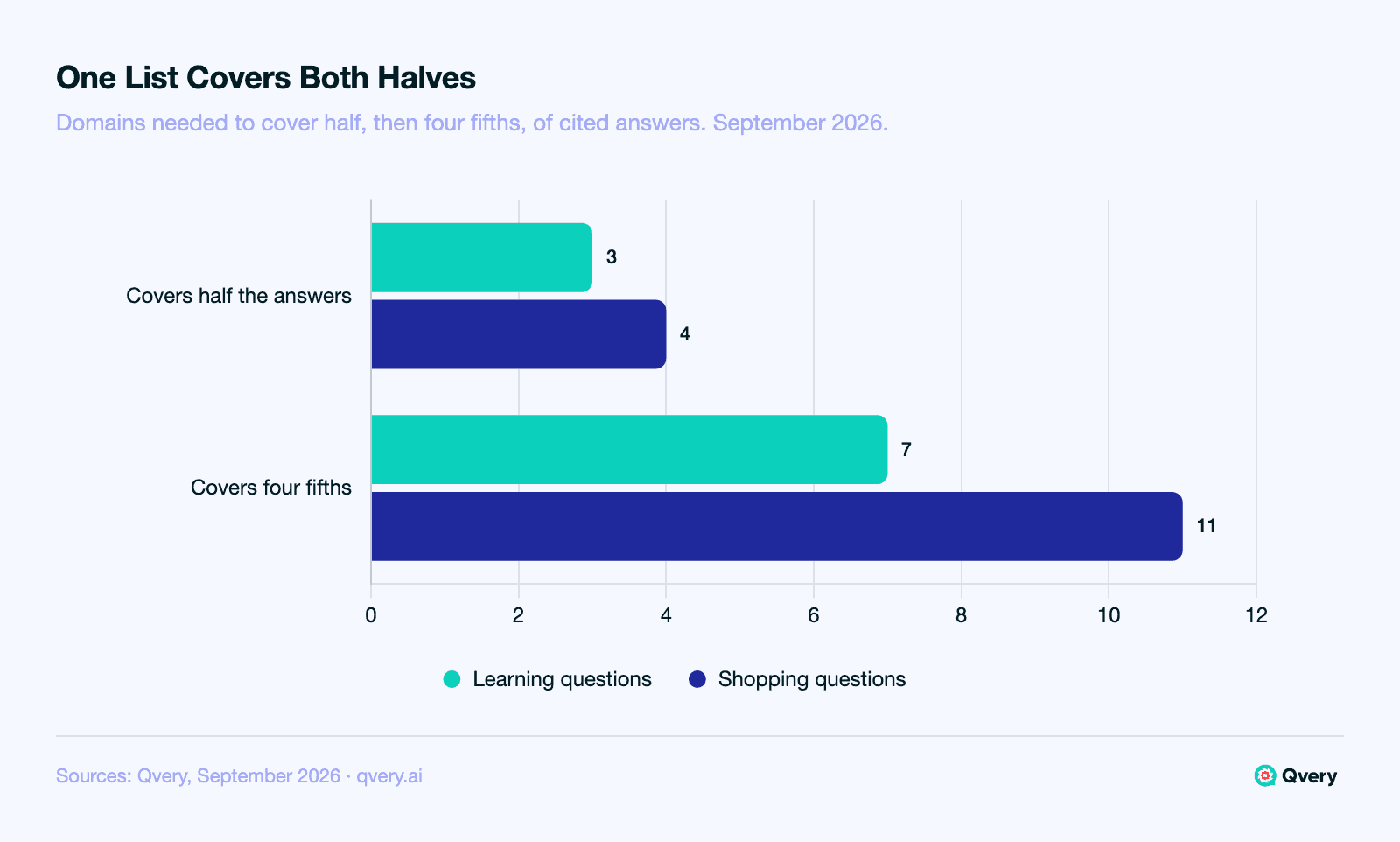
The two lists share five rows: three national cyber agencies, a large software vendor's own pages, and YouTube. Five out of the smaller list's seven, a shared fraction of 0.71.
Here is the learning list in full, in the order the coverage was reached:
CISA, the UK's NCSC, YouTube
the Australian Cyber Security Centre, Microsoft, the Canadian Centre for Cyber Security, IDrive
And the shopping list:
Microsoft, YouTube, CISA, Bitwarden
the UK's NCSC, Expert Insights, the Australian Cyber Security Centre, Backblaze, Huntress, an Australian security consultancy, Reddit
That is the opposite of what we expected and the opposite of what every other category in this series returned. Here one core list covers both halves. Beyond the five shared rows, the learning list has two of its own and the shopping list has six, thirteen domains in total.
For a marketing team that is a cheaper plan than two programmes: one core list, plus a short tail on each side, and pages that can be built to serve both a learning question and a shopping one.
It is also the reason to measure rather than assume. Had we published the two-list instruction as a rule, it would have been wrong here.
Every other category in this series returned two lists. This one returned one, which is why the method is a measurement and not a rule.
Limits, once. We counted which domains the answers cited. We did not read what the answers said, cannot tell you whether a cited page was recommended or merely referenced, and cannot promise that a page in the same format gets cited in its place. And this is one category, in one month.
Choosing What To Write
Judgment now, not findings. A gap list becomes a plan when every row has a verdict and every gap has a format.
Start where both halves meet. Five of these rows sit on both lists. A page that answers the learning question and links to the buying one is aimed at all five.
Match the format to the intent. Roundups followed the shopping question. Reference and explainer pages spread across both. The format that travels is the one that answers the question asked.
Do not chase the public bodies. You cannot become a national agency. You can be the page that translates one, in the words your buyers use.
Three pieces, named, owned, dated. A gap analysis that produces twenty briefs produces nothing.
The thing this analysis cannot tell you is whether your page will be picked up. It tells you where the answers currently come from, and that is enough to stop guessing.
Run It In Qvery
Set up two topics for the category, one for learning questions and one for shopping questions, so the two halves stay readable apart. Qvery generates a starting set at onboarding and you edit the queries in plain language.
Every answer keeps the sources cited in it, tied to the query and the engine that produced it. The Citations view ranks the URLs and the domains behind those answers, each with a weight, filterable by engine and country, and the ranking exports. The manual version of this analysis is four steps:
Open the Citations view for the learning topic and read the Top Domains ranking.
Take rows from the top until another row stops changing what you would do.
Do the same for the shopping topic.
Compare the two. Heavy overlap means one plan. Little overlap means two.
A note on method. Our counts used a stricter definition than a top-ranked cut.
We took the smallest set of domains that together cover four fifths of the answers that cited any source, choosing them one at a time by how many still-uncovered answers each adds. A ranked list read from the top is a close and usable version of the same thing.
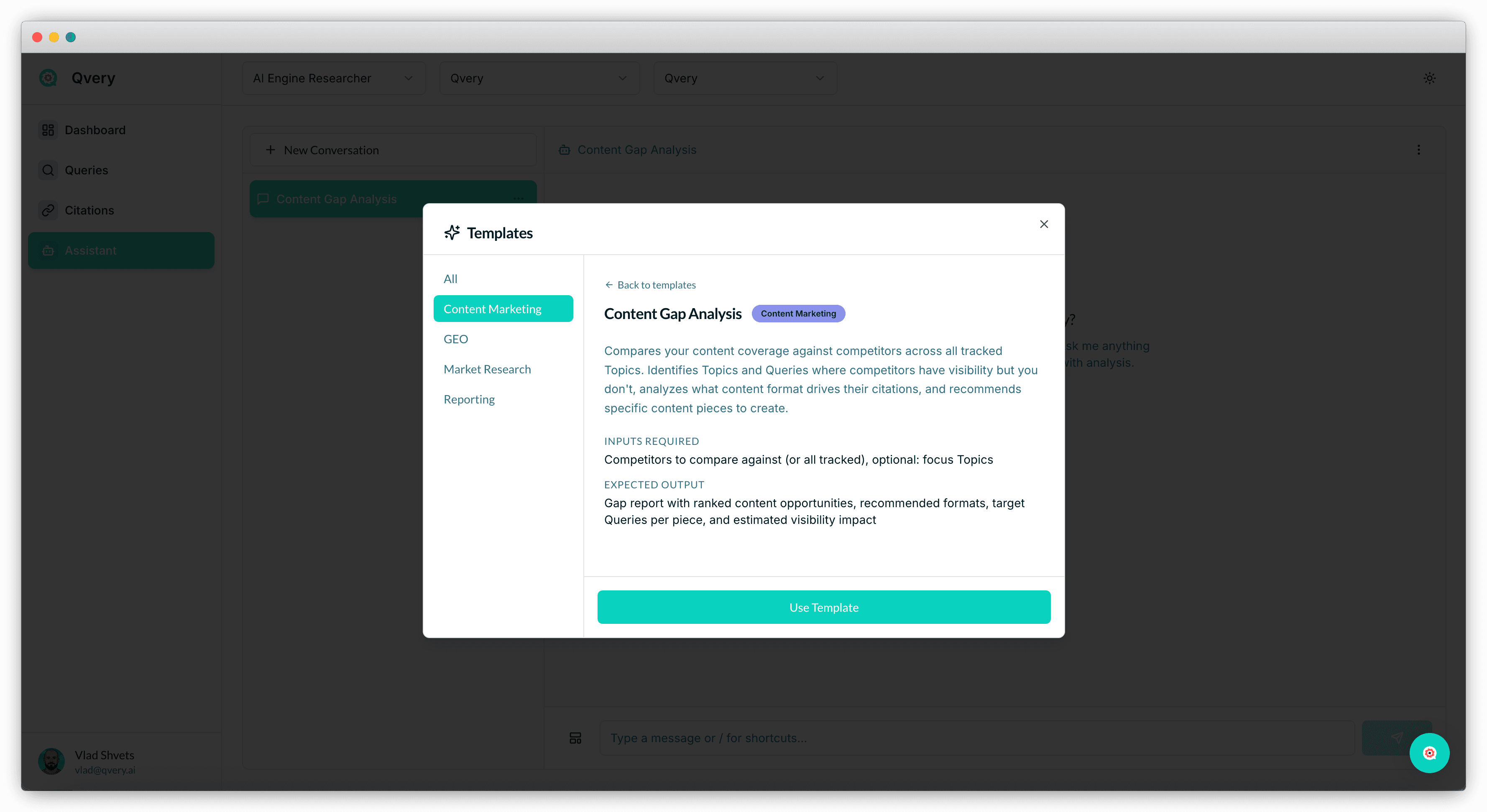
There is a Content Gap Analysis template in the Assistant for the comparison against a competitor set. Its own description says it compares your content coverage against competitors across tracked topics, identifies the topics and queries where they have visibility and you do not, and recommends pieces to create.
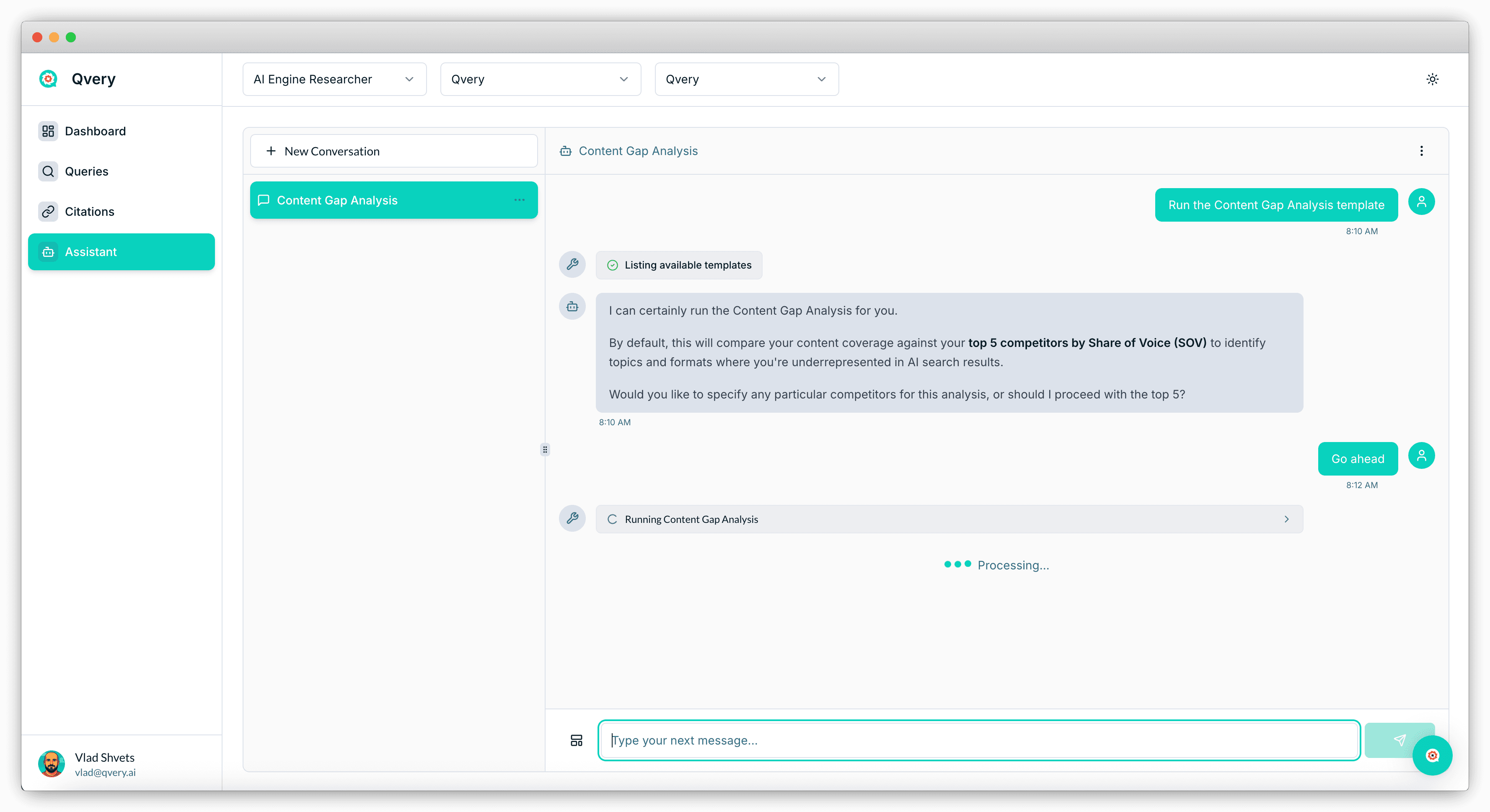
Ask the Assistant to run it and it lists what is available, proposes a competitor set, checks whether that set is right, and then runs. That is the fast pass. The four steps above are the one you keep, because they leave you with a list you understand row by row.
The Citations view records and ranks the sources an answer cited. It does not label a source as an agency, a vendor or a publisher, and it does not report which brands the answer named in its text. Those reads are yours.
Start a Qvery trial and load both kinds of question for one category. Seven days free, no credit card, which is time to get both topics configured and the first days of citations in.
Take the learning half into Thursday's content meeting. It is the half your content plan is most likely to be missing, and in this category it was answered by mostly the same domains as the shopping half.
Your content gap list is probably built entirely out of shopping questions. Best tool for this, top software for that, alternatives to the thing you compete with.
That is half a market. The other half is people asking how something works before they have any intention of buying, and in the category we worked this method on, those questions were answered by the same short list of websites.
Which is the finding worth having up front. The two halves did not need two plans. Whether that holds in your category is exactly what this analysis tells you, and the answer changes what you write next.
The Half Of The Market You Are Not Looking At
Sort your gap queries into two kinds before you decide anything.
Shopping questions ask what to get. Best small business security tools, top endpoint protection software, password managers for a small team.
Learning questions ask how something works. Why password managers matter, email security explained simply, what business backup involves in practice.
Marketing teams track the first kind because it looks closer to revenue. The second kind is where somebody forms an opinion about the category before any vendor is in the room, and most content plans have nothing in it at all.
Write ten of each for your category. That pair of lists is the input to everything below.
What Gets Cited When Nobody Is Shopping
Take the learning half first, since it is the half nobody looks at.
Across a targeted set of questions in one category we ran on ChatGPT and Google AI Mode in September 2026, public bodies and institutional sources were present in 71.3% of answers that cited any source on the learning side. Brands' own domains were present in 33.33% of them.
The shopping half runs the other way. Brands' own domains were present in 58.47% of answers that cited any source on the shopping side, public bodies in 33.05%. Roundups and best-of pages followed the shopping question too, 27.12% against 10.19% of answers that cited any source.
Explainer and reference pages were present in 38.98% of answers that cited any source on the shopping side and 28.7% on the learning side. That ratio was registered in advance as indeterminate, so we report it and call nothing.
Now the number that kills the usual excuse for ignoring learning questions.
Learning questions returned an answer with sources under it on 86.4% of the runs we made, against 94.4% for shopping questions. That is a share of every run, not of answers that cited something, and the two figures sit inside the band we set in advance for calling things equivalent.
Learning questions get sourced answers at about the same rate as buying questions. If your plan skips explainers because nobody cites them, it is planning against a number that is not there.
What Gets Cited When They Are
Now count the domains behind each half and compare the lists.
Learning questions: three domains cover half of the answers that cited any source. Seven cover four fifths.
Shopping questions: four cover half. Eleven cover four fifths.
The two lists share five rows: three national cyber agencies, a large software vendor's own pages, and YouTube. Five out of the smaller list's seven, a shared fraction of 0.71.
Here is the learning list in full, in the order the coverage was reached:
CISA, the UK's NCSC, YouTube
the Australian Cyber Security Centre, Microsoft, the Canadian Centre for Cyber Security, IDrive
And the shopping list:
Microsoft, YouTube, CISA, Bitwarden
the UK's NCSC, Expert Insights, the Australian Cyber Security Centre, Backblaze, Huntress, an Australian security consultancy, Reddit
That is the opposite of what we expected and the opposite of what every other category in this series returned. Here one core list covers both halves. Beyond the five shared rows, the learning list has two of its own and the shopping list has six, thirteen domains in total.
For a marketing team that is a cheaper plan than two programmes: one core list, plus a short tail on each side, and pages that can be built to serve both a learning question and a shopping one.
It is also the reason to measure rather than assume. Had we published the two-list instruction as a rule, it would have been wrong here.
Every other category in this series returned two lists. This one returned one, which is why the method is a measurement and not a rule.
Limits, once. We counted which domains the answers cited. We did not read what the answers said, cannot tell you whether a cited page was recommended or merely referenced, and cannot promise that a page in the same format gets cited in its place. And this is one category, in one month.
Choosing What To Write
Judgment now, not findings. A gap list becomes a plan when every row has a verdict and every gap has a format.
Start where both halves meet. Five of these rows sit on both lists. A page that answers the learning question and links to the buying one is aimed at all five.
Match the format to the intent. Roundups followed the shopping question. Reference and explainer pages spread across both. The format that travels is the one that answers the question asked.
Do not chase the public bodies. You cannot become a national agency. You can be the page that translates one, in the words your buyers use.
Three pieces, named, owned, dated. A gap analysis that produces twenty briefs produces nothing.
The thing this analysis cannot tell you is whether your page will be picked up. It tells you where the answers currently come from, and that is enough to stop guessing.
Run It In Qvery
Set up two topics for the category, one for learning questions and one for shopping questions, so the two halves stay readable apart. Qvery generates a starting set at onboarding and you edit the queries in plain language.
Every answer keeps the sources cited in it, tied to the query and the engine that produced it. The Citations view ranks the URLs and the domains behind those answers, each with a weight, filterable by engine and country, and the ranking exports. The manual version of this analysis is four steps:
Open the Citations view for the learning topic and read the Top Domains ranking.
Take rows from the top until another row stops changing what you would do.
Do the same for the shopping topic.
Compare the two. Heavy overlap means one plan. Little overlap means two.
A note on method. Our counts used a stricter definition than a top-ranked cut.
We took the smallest set of domains that together cover four fifths of the answers that cited any source, choosing them one at a time by how many still-uncovered answers each adds. A ranked list read from the top is a close and usable version of the same thing.
There is a Content Gap Analysis template in the Assistant for the comparison against a competitor set. Its own description says it compares your content coverage against competitors across tracked topics, identifies the topics and queries where they have visibility and you do not, and recommends pieces to create.
Ask the Assistant to run it and it lists what is available, proposes a competitor set, checks whether that set is right, and then runs. That is the fast pass. The four steps above are the one you keep, because they leave you with a list you understand row by row.
The Citations view records and ranks the sources an answer cited. It does not label a source as an agency, a vendor or a publisher, and it does not report which brands the answer named in its text. Those reads are yours.
Start a Qvery trial and load both kinds of question for one category. Seven days free, no credit card, which is time to get both topics configured and the first days of citations in.
Take the learning half into Thursday's content meeting. It is the half your content plan is most likely to be missing, and in this category it was answered by mostly the same domains as the shopping half.
Your content gap list is probably built entirely out of shopping questions. Best tool for this, top software for that, alternatives to the thing you compete with.
That is half a market. The other half is people asking how something works before they have any intention of buying, and in the category we worked this method on, those questions were answered by the same short list of websites.
Which is the finding worth having up front. The two halves did not need two plans. Whether that holds in your category is exactly what this analysis tells you, and the answer changes what you write next.
The Half Of The Market You Are Not Looking At
Sort your gap queries into two kinds before you decide anything.
Shopping questions ask what to get. Best small business security tools, top endpoint protection software, password managers for a small team.
Learning questions ask how something works. Why password managers matter, email security explained simply, what business backup involves in practice.
Marketing teams track the first kind because it looks closer to revenue. The second kind is where somebody forms an opinion about the category before any vendor is in the room, and most content plans have nothing in it at all.
Write ten of each for your category. That pair of lists is the input to everything below.
What Gets Cited When Nobody Is Shopping
Take the learning half first, since it is the half nobody looks at.
Across a targeted set of questions in one category we ran on ChatGPT and Google AI Mode in September 2026, public bodies and institutional sources were present in 71.3% of answers that cited any source on the learning side. Brands' own domains were present in 33.33% of them.
The shopping half runs the other way. Brands' own domains were present in 58.47% of answers that cited any source on the shopping side, public bodies in 33.05%. Roundups and best-of pages followed the shopping question too, 27.12% against 10.19% of answers that cited any source.
Explainer and reference pages were present in 38.98% of answers that cited any source on the shopping side and 28.7% on the learning side. That ratio was registered in advance as indeterminate, so we report it and call nothing.
Now the number that kills the usual excuse for ignoring learning questions.
Learning questions returned an answer with sources under it on 86.4% of the runs we made, against 94.4% for shopping questions. That is a share of every run, not of answers that cited something, and the two figures sit inside the band we set in advance for calling things equivalent.
Learning questions get sourced answers at about the same rate as buying questions. If your plan skips explainers because nobody cites them, it is planning against a number that is not there.
What Gets Cited When They Are
Now count the domains behind each half and compare the lists.
Learning questions: three domains cover half of the answers that cited any source. Seven cover four fifths.
Shopping questions: four cover half. Eleven cover four fifths.
The two lists share five rows: three national cyber agencies, a large software vendor's own pages, and YouTube. Five out of the smaller list's seven, a shared fraction of 0.71.
Here is the learning list in full, in the order the coverage was reached:
CISA, the UK's NCSC, YouTube
the Australian Cyber Security Centre, Microsoft, the Canadian Centre for Cyber Security, IDrive
And the shopping list:
Microsoft, YouTube, CISA, Bitwarden
the UK's NCSC, Expert Insights, the Australian Cyber Security Centre, Backblaze, Huntress, an Australian security consultancy, Reddit
That is the opposite of what we expected and the opposite of what every other category in this series returned. Here one core list covers both halves. Beyond the five shared rows, the learning list has two of its own and the shopping list has six, thirteen domains in total.
For a marketing team that is a cheaper plan than two programmes: one core list, plus a short tail on each side, and pages that can be built to serve both a learning question and a shopping one.
It is also the reason to measure rather than assume. Had we published the two-list instruction as a rule, it would have been wrong here.
Every other category in this series returned two lists. This one returned one, which is why the method is a measurement and not a rule.
Limits, once. We counted which domains the answers cited. We did not read what the answers said, cannot tell you whether a cited page was recommended or merely referenced, and cannot promise that a page in the same format gets cited in its place. And this is one category, in one month.
Choosing What To Write
Judgment now, not findings. A gap list becomes a plan when every row has a verdict and every gap has a format.
Start where both halves meet. Five of these rows sit on both lists. A page that answers the learning question and links to the buying one is aimed at all five.
Match the format to the intent. Roundups followed the shopping question. Reference and explainer pages spread across both. The format that travels is the one that answers the question asked.
Do not chase the public bodies. You cannot become a national agency. You can be the page that translates one, in the words your buyers use.
Three pieces, named, owned, dated. A gap analysis that produces twenty briefs produces nothing.
The thing this analysis cannot tell you is whether your page will be picked up. It tells you where the answers currently come from, and that is enough to stop guessing.
Run It In Qvery
Set up two topics for the category, one for learning questions and one for shopping questions, so the two halves stay readable apart. Qvery generates a starting set at onboarding and you edit the queries in plain language.
Every answer keeps the sources cited in it, tied to the query and the engine that produced it. The Citations view ranks the URLs and the domains behind those answers, each with a weight, filterable by engine and country, and the ranking exports. The manual version of this analysis is four steps:
Open the Citations view for the learning topic and read the Top Domains ranking.
Take rows from the top until another row stops changing what you would do.
Do the same for the shopping topic.
Compare the two. Heavy overlap means one plan. Little overlap means two.
A note on method. Our counts used a stricter definition than a top-ranked cut.
We took the smallest set of domains that together cover four fifths of the answers that cited any source, choosing them one at a time by how many still-uncovered answers each adds. A ranked list read from the top is a close and usable version of the same thing.
There is a Content Gap Analysis template in the Assistant for the comparison against a competitor set. Its own description says it compares your content coverage against competitors across tracked topics, identifies the topics and queries where they have visibility and you do not, and recommends pieces to create.
Ask the Assistant to run it and it lists what is available, proposes a competitor set, checks whether that set is right, and then runs. That is the fast pass. The four steps above are the one you keep, because they leave you with a list you understand row by row.
The Citations view records and ranks the sources an answer cited. It does not label a source as an agency, a vendor or a publisher, and it does not report which brands the answer named in its text. Those reads are yours.
Start a Qvery trial and load both kinds of question for one category. Seven days free, no credit card, which is time to get both topics configured and the first days of citations in.
Take the learning half into Thursday's content meeting. It is the half your content plan is most likely to be missing, and in this category it was answered by mostly the same domains as the shopping half.
Your content gap list is probably built entirely out of shopping questions. Best tool for this, top software for that, alternatives to the thing you compete with.
That is half a market. The other half is people asking how something works before they have any intention of buying, and in the category we worked this method on, those questions were answered by the same short list of websites.
Which is the finding worth having up front. The two halves did not need two plans. Whether that holds in your category is exactly what this analysis tells you, and the answer changes what you write next.
The Half Of The Market You Are Not Looking At
Sort your gap queries into two kinds before you decide anything.
Shopping questions ask what to get. Best small business security tools, top endpoint protection software, password managers for a small team.
Learning questions ask how something works. Why password managers matter, email security explained simply, what business backup involves in practice.
Marketing teams track the first kind because it looks closer to revenue. The second kind is where somebody forms an opinion about the category before any vendor is in the room, and most content plans have nothing in it at all.
Write ten of each for your category. That pair of lists is the input to everything below.
What Gets Cited When Nobody Is Shopping
Take the learning half first, since it is the half nobody looks at.
Across a targeted set of questions in one category we ran on ChatGPT and Google AI Mode in September 2026, public bodies and institutional sources were present in 71.3% of answers that cited any source on the learning side. Brands' own domains were present in 33.33% of them.
The shopping half runs the other way. Brands' own domains were present in 58.47% of answers that cited any source on the shopping side, public bodies in 33.05%. Roundups and best-of pages followed the shopping question too, 27.12% against 10.19% of answers that cited any source.
Explainer and reference pages were present in 38.98% of answers that cited any source on the shopping side and 28.7% on the learning side. That ratio was registered in advance as indeterminate, so we report it and call nothing.
Now the number that kills the usual excuse for ignoring learning questions.
Learning questions returned an answer with sources under it on 86.4% of the runs we made, against 94.4% for shopping questions. That is a share of every run, not of answers that cited something, and the two figures sit inside the band we set in advance for calling things equivalent.
Learning questions get sourced answers at about the same rate as buying questions. If your plan skips explainers because nobody cites them, it is planning against a number that is not there.
What Gets Cited When They Are
Now count the domains behind each half and compare the lists.
Learning questions: three domains cover half of the answers that cited any source. Seven cover four fifths.
Shopping questions: four cover half. Eleven cover four fifths.
The two lists share five rows: three national cyber agencies, a large software vendor's own pages, and YouTube. Five out of the smaller list's seven, a shared fraction of 0.71.
Here is the learning list in full, in the order the coverage was reached:
CISA, the UK's NCSC, YouTube
the Australian Cyber Security Centre, Microsoft, the Canadian Centre for Cyber Security, IDrive
And the shopping list:
Microsoft, YouTube, CISA, Bitwarden
the UK's NCSC, Expert Insights, the Australian Cyber Security Centre, Backblaze, Huntress, an Australian security consultancy, Reddit
That is the opposite of what we expected and the opposite of what every other category in this series returned. Here one core list covers both halves. Beyond the five shared rows, the learning list has two of its own and the shopping list has six, thirteen domains in total.
For a marketing team that is a cheaper plan than two programmes: one core list, plus a short tail on each side, and pages that can be built to serve both a learning question and a shopping one.
It is also the reason to measure rather than assume. Had we published the two-list instruction as a rule, it would have been wrong here.
Every other category in this series returned two lists. This one returned one, which is why the method is a measurement and not a rule.
Limits, once. We counted which domains the answers cited. We did not read what the answers said, cannot tell you whether a cited page was recommended or merely referenced, and cannot promise that a page in the same format gets cited in its place. And this is one category, in one month.
Choosing What To Write
Judgment now, not findings. A gap list becomes a plan when every row has a verdict and every gap has a format.
Start where both halves meet. Five of these rows sit on both lists. A page that answers the learning question and links to the buying one is aimed at all five.
Match the format to the intent. Roundups followed the shopping question. Reference and explainer pages spread across both. The format that travels is the one that answers the question asked.
Do not chase the public bodies. You cannot become a national agency. You can be the page that translates one, in the words your buyers use.
Three pieces, named, owned, dated. A gap analysis that produces twenty briefs produces nothing.
The thing this analysis cannot tell you is whether your page will be picked up. It tells you where the answers currently come from, and that is enough to stop guessing.
Run It In Qvery
Set up two topics for the category, one for learning questions and one for shopping questions, so the two halves stay readable apart. Qvery generates a starting set at onboarding and you edit the queries in plain language.
Every answer keeps the sources cited in it, tied to the query and the engine that produced it. The Citations view ranks the URLs and the domains behind those answers, each with a weight, filterable by engine and country, and the ranking exports. The manual version of this analysis is four steps:
Open the Citations view for the learning topic and read the Top Domains ranking.
Take rows from the top until another row stops changing what you would do.
Do the same for the shopping topic.
Compare the two. Heavy overlap means one plan. Little overlap means two.
A note on method. Our counts used a stricter definition than a top-ranked cut.
We took the smallest set of domains that together cover four fifths of the answers that cited any source, choosing them one at a time by how many still-uncovered answers each adds. A ranked list read from the top is a close and usable version of the same thing.
There is a Content Gap Analysis template in the Assistant for the comparison against a competitor set. Its own description says it compares your content coverage against competitors across tracked topics, identifies the topics and queries where they have visibility and you do not, and recommends pieces to create.
Ask the Assistant to run it and it lists what is available, proposes a competitor set, checks whether that set is right, and then runs. That is the fast pass. The four steps above are the one you keep, because they leave you with a list you understand row by row.
The Citations view records and ranks the sources an answer cited. It does not label a source as an agency, a vendor or a publisher, and it does not report which brands the answer named in its text. Those reads are yours.
Start a Qvery trial and load both kinds of question for one category. Seven days free, no credit card, which is time to get both topics configured and the first days of citations in.
Take the learning half into Thursday's content meeting. It is the half your content plan is most likely to be missing, and in this category it was answered by mostly the same domains as the shopping half.
© 2026 Qvery AI OÜ