By
Vlad Shvets
Should Your Ecommerce Brand Publish Its Own Best-Of Page? Audit What AI Engines Cite First
Brands' own best-of pages are cited in a small share of AI product answers. Whether the answer names the brand behind them could not be measured, so audit first.
Brands' own best-of pages are cited in a small share of AI product answers. Whether the answer names the brand behind them could not be measured, so audit first.
Brands' own best-of pages are cited in a small share of AI product answers. Whether the answer names the brand behind them could not be measured, so audit first.
If you run marketing for an ecommerce brand with no PR budget, someone has pitched you the in-house play. Write a best-of roundup for your category that includes your competitors, put yourself on it, and publish it on your own site.
It costs little more than a writer's time, and the general case for listicles in AI search makes it sound obvious.
For it to work in ChatGPT and Google AI Mode, though, two things have to be true. The engines have to cite that kind of page from a brand's own site, and the answer has to name the brand that published it.
So we asked both engines the product questions shoppers type in September 2026, each need asked two ways (compare these products, or what is the best product for this), and checked every cited page on a brand's own site against four tests.
The short version: brands' own best-of pages do get cited, in both kinds of question, but in a small share of answers. Whether one kind of question cites them more is inconclusive. Whether the answer named the brand behind the page could not be measured reliably.
So the audit comes first, and a page of your own is an experiment you track, not a play this evidence proves. What follows is observed citation only: nothing here says that publishing a page gets it cited.
Competitor-Inclusive Pages From Brands' Own Sites Appear in Both Kinds of Product Answer
A cited page counted only if it passed all four tests:
Format: a comparison or best-of page about products.
Relevance: it matches the product need the question asked about.
Publisher: it is published by or for the brand that owns the domain it sits on.
Competitors: it names at least two competing brands other than that publisher.
The brand-owned test was fixed before any page was opened; the other three were read from the page itself. Two coders read every fetched page independently, blind to each other, and an adjudicator settled each disagreement. They agreed on 0.9834 of the pages both coded (Cohen's kappa 0.9293).
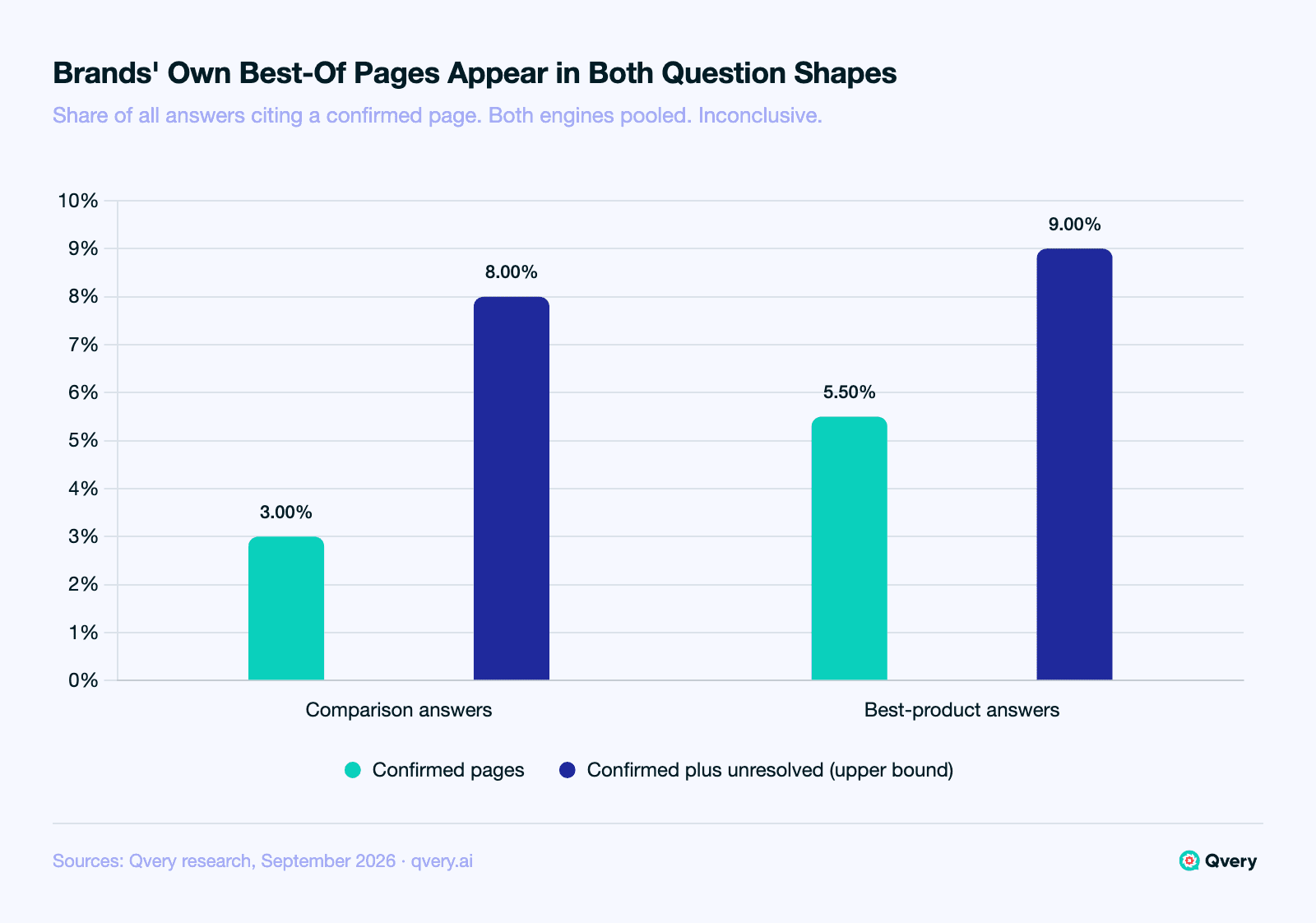
By those tests, 3.00% of all comparison answers cited a confirmed page, and 5.50% of all best-product answers did. Both engines are pooled, three ChatGPT answers for every two from Google AI Mode.
Some answers cited a brand page that could not be resolved and no confirmed one. Count every one of those as citing a confirmed page, and the rates rise to 8.00% and 9.00%.
Those unresolved answers are also why the comparison between the two question shapes stays open. Counted one way or the other, they move it across three different verdicts, so this evidence cannot say which shape cites these pages more.
Most of the brand-owned pages the answers cited were not comparison pages at all.
And more answers cited those than cited a confirmed one.
Here are the pages that passed all four tests, listed by the publisher's domain.
These passed in comparison answers:
ankarsrum.com: a hosted PDF copy of a stand-mixer review whose title credits America's Test Kitchen
blueair.com: best humidifiers for bedrooms
chewy.com: best odor-control cat litters, according to reviews
marathonsports.com: best all-terrain running shoes
wyze.com: the best video doorbell
These passed in best-product answers:
ankarsrum.com: the same PDF
apolloscooters.co: best electric scooters
blueair.com: the same page
chewy.com: best dust-free cat litters, according to reviews
culinaryprofis.com: Ankarsrum against Bosch and KitchenAid stand mixers
flexa.fit: thick yoga mats
levyelectric.com: best electric scooters for commuting
rei.com: best hiking boots, from REI's Expert Advice
segwaycorp.com: an electric-scooter commuting guide
spinemd.com: the Virginia Spine Institute's best office chairs for back pain
That list mixes product brands, retailers like Chewy and REI, and a spine clinic. Treat it as a map of who publishes these pages in the categories we asked about, not as a ranking of which kind of publisher does better.
For your own audit, two moves follow. Add the competitor-owned and retailer-owned comparison pages your own questions cite to the list of pages you watch. And if you publish one, hold it to the same four tests before you call it a comparison page.
What this does not say: that these pages are missing from either kind of answer, that either kind cites them more, that publishing one improves visibility, or that any answer named the page's publisher.
Aleyda Solis puts the audit case plainly: "For ecommerce: Audit the retailer, marketplace, alternative and comparison environments that influence product and brand answers, including where a competitor controls the cited page."
Brand and retailer comparison pages sitting among the cited pages in both shapes fits that advice. Whether those pages influence the answers is something co-occurrence cannot show.
If you would rather be named on the lists other sites publish than publish your own, that is a different route, and getting your product into the listicles AI engines cite covers it.
Whether the Answer Named the Page's Publisher Could Not Be Measured Reliably
The second half of the question was checked too. For every answer that cited a confirmed page, we extracted the brands the answer named and asked whether the page's publisher was among them.
Before any naming result could publish, a blind check of the extraction had to agree with a human reading on the names at a score of 0.85. It scored 0.697.
So nothing about naming ships: no naming rate, no rank, and no result pairing a cited page with its publisher's name. What ships is which pages and domains were cited. Whether your own page gets your brand named is something your own tracking has to show, and the section on Qvery below covers how.
Comparison and Best-Product Answers Share a Core of Domains, Then Split
We have already made the case for splitting a citation audit by the shape of the ask. This section is the ecommerce table behind that advice.
For each question shape we built a list of domains, adding at each step the domain that covered the most answers not yet covered, until the list reached 80% of the answers that cited any source.
Comparison questions, 19 domains: google.com, wired.com, rtings.com, nbcnews.com, consumerreports.org, decathlon.co.uk, outdoorgearlab.com, pmc.ncbi.nlm.nih.gov, bonappetit.com, choice.com.au, travelandleisure.com, deskfinds.com, k9ballistics.com, packandporter.com, scootergearlab.com, verywellfit.com, agentretrievalindex.com, ankarsrum.com, babylist.com.
Best-product questions, 13 domains: google.com, consumerreports.org, rtings.com, goodhousekeeping.com, pubmed.ncbi.nlm.nih.gov, outdoorgearlab.com, the-gadgeteer.com, choice.com.au, aad.org, bonappetit.com, cntraveler.com, flexa.fit, nbcnews.com.
Then we swapped them. The comparison list covered 73.47% of the best-product answers that cited any source. The best-product list covered 63.27% of the comparison answers that cited any source.
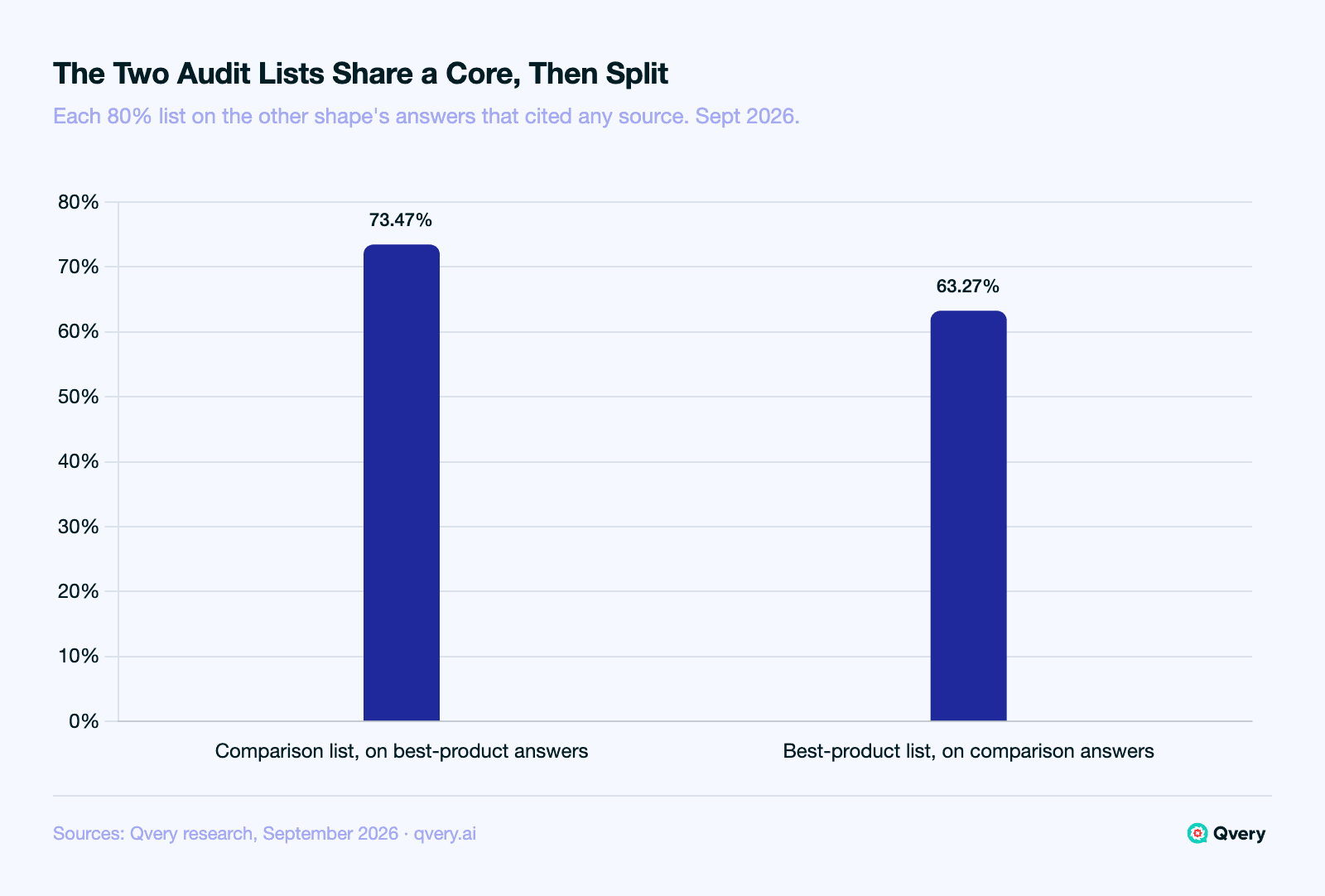
The lower of the two, unrounded, is 0.6327. That sits between our bars of 0.60 and 0.80, which means one list with two sections: a shared core, then each shape's own tail.
Seven domains sit on both lists: bonappetit.com, choice.com.au, consumerreports.org, google.com, nbcnews.com, outdoorgearlab.com and rtings.com. That overlap is description and decides nothing.
These lists count any cited domain, whatever kind of page it served. Treat them as domains to audit. To find the brand-owned comparison pages behind them, run the four tests from the first section over the brand pages each domain served.
One row needs a note. google.com heads both lists, and its cited pages are Google's own product-viewer entries, cited only in Google AI Mode answers. It is part of the engine, not a publisher you can pitch.
Our earlier piece on getting products into ChatGPT shopping answers tested question framing on a different measure. It is a different test, and neither result speaks for the other.
Track a Page You Publish on Both Question Shapes in Qvery
The audit and the experiment both run on the same record, and Qvery keeps it daily.
Set up your queries as pairs: a comparison question and an open best-product question for the same product need. Building tracking queries covers how to write pairs that differ only in the shape of the ask, and you add and edit them through Qvery Assistant.
Qvery tracks visibility, share of voice and average rank for those queries daily across ChatGPT and Google AI Mode, in 200+ countries. It captures every citation with the query and engine that produced it.
That gives you the audit: open the citations for each question shape, pull the brand-owned pages, and run the four tests on them.
It also gives you the experiment. If you publish a best-of page, you see whether it appears among the citations on each question shape and each engine, and whether your brand's visibility moves on those queries.
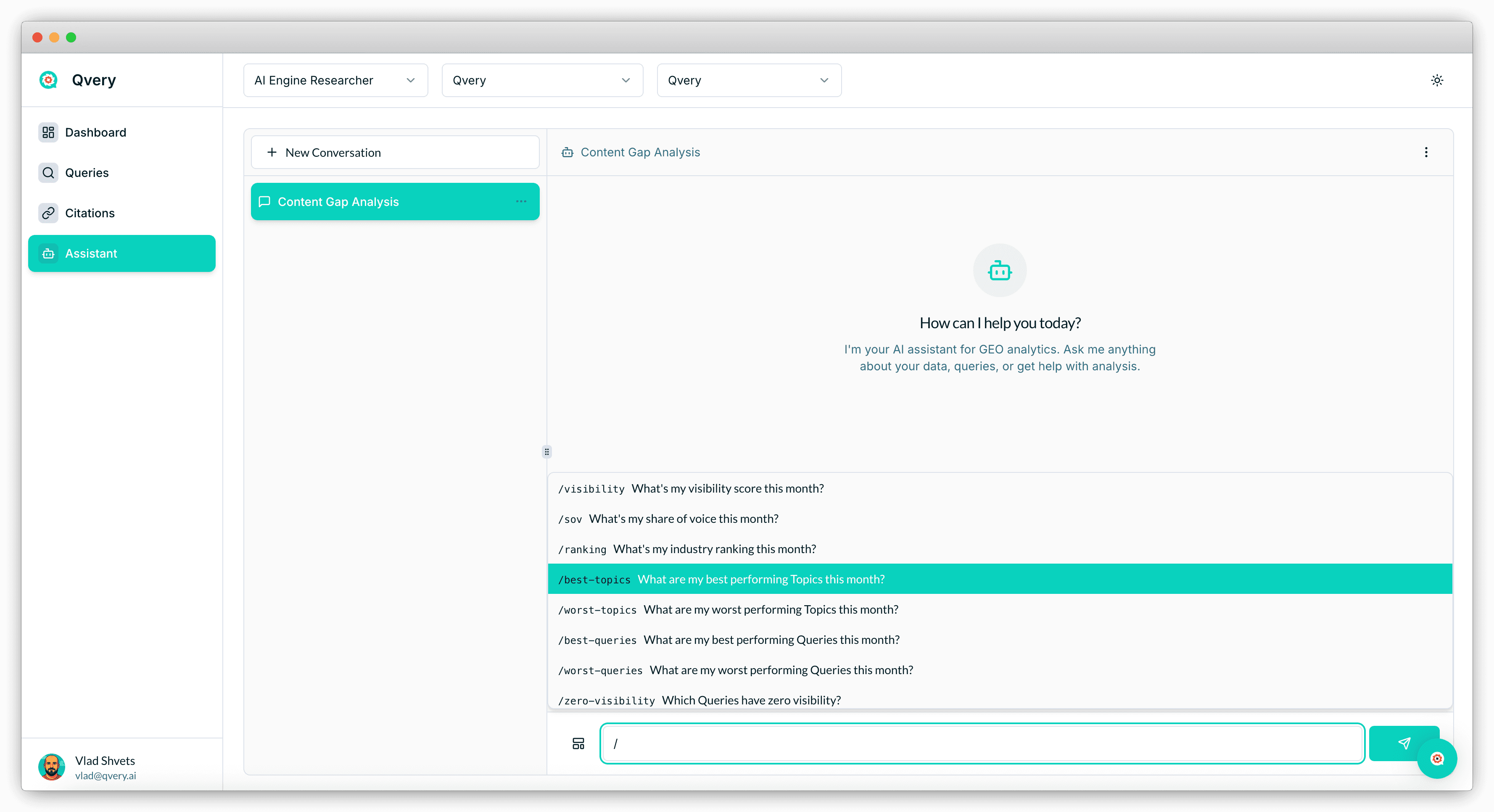
To ask instead of filter, open Qvery Assistant in the app and ask about your own visibility, share of voice or citations in plain language. You can add queries, trigger a data run or export a report from the same place.
What that record shows after your page goes live is an observation over time. It is not proof that the page caused anything.
Start a free 7-day trial of Qvery, no credit card required, and set up your paired questions before anyone writes the roundup.
What This Evidence Cannot Settle
The first limit: this is observed citation only. It recorded which pages and domains the answers cited in one collection. It measured no change over time and compared no uncited pages, so it cannot say whether publishing a comparison page on your own site gets it cited or changes any brand's visibility.
Naming unpublished. It was measured, and the blind reliability check scored 0.697 against a 0.85 bar, so no naming rate, rank or page-and-name result ships.
The shape comparison is inconclusive. Answers that cited unresolved brand pages could move it across three verdicts. Unresolved pages are never counted as not a comparison page.
Brand-owned domains only. A brand's comparison page published on someone else's domain sits outside the check. The brand-owned label comes from a validated domain table, not a hand audit of every domain.
No engine claim. No engine comparison was registered. The pooled rates carry three ChatGPT answers to every two from Google AI Mode, and no Google AI Mode figure for a single question shape prints, because each rests on too few answers.
Scope: paired, unbranded ecommerce product-recommendation questions, each need asked once each way. It does not cover every product category, or branded and informational questions.
One collection. The same question returns a different source list from run to run (measuring ecommerce share of voice explains why that matters), and nothing here is compared with an earlier month. This describes what appeared together and never explains it.
Audit First, Then Treat Your Own Page as an Experiment
Read the domains that answer your paired comparison and best-product questions, the shared core first and then each shape's own tail, and note where a competitor's or a retailer's own comparison page is among what those answers cite.
A competitor-inclusive best-of page on your own site is something the engines did cite from other brands in both shapes, so it is a fair experiment and not a proven play. If you publish one, track it on both question shapes, and read what appears as an observation, not proof.
If you run marketing for an ecommerce brand with no PR budget, someone has pitched you the in-house play. Write a best-of roundup for your category that includes your competitors, put yourself on it, and publish it on your own site.
It costs little more than a writer's time, and the general case for listicles in AI search makes it sound obvious.
For it to work in ChatGPT and Google AI Mode, though, two things have to be true. The engines have to cite that kind of page from a brand's own site, and the answer has to name the brand that published it.
So we asked both engines the product questions shoppers type in September 2026, each need asked two ways (compare these products, or what is the best product for this), and checked every cited page on a brand's own site against four tests.
The short version: brands' own best-of pages do get cited, in both kinds of question, but in a small share of answers. Whether one kind of question cites them more is inconclusive. Whether the answer named the brand behind the page could not be measured reliably.
So the audit comes first, and a page of your own is an experiment you track, not a play this evidence proves. What follows is observed citation only: nothing here says that publishing a page gets it cited.
Competitor-Inclusive Pages From Brands' Own Sites Appear in Both Kinds of Product Answer
A cited page counted only if it passed all four tests:
Format: a comparison or best-of page about products.
Relevance: it matches the product need the question asked about.
Publisher: it is published by or for the brand that owns the domain it sits on.
Competitors: it names at least two competing brands other than that publisher.
The brand-owned test was fixed before any page was opened; the other three were read from the page itself. Two coders read every fetched page independently, blind to each other, and an adjudicator settled each disagreement. They agreed on 0.9834 of the pages both coded (Cohen's kappa 0.9293).
By those tests, 3.00% of all comparison answers cited a confirmed page, and 5.50% of all best-product answers did. Both engines are pooled, three ChatGPT answers for every two from Google AI Mode.
Some answers cited a brand page that could not be resolved and no confirmed one. Count every one of those as citing a confirmed page, and the rates rise to 8.00% and 9.00%.
Those unresolved answers are also why the comparison between the two question shapes stays open. Counted one way or the other, they move it across three different verdicts, so this evidence cannot say which shape cites these pages more.
Most of the brand-owned pages the answers cited were not comparison pages at all.
And more answers cited those than cited a confirmed one.
Here are the pages that passed all four tests, listed by the publisher's domain.
These passed in comparison answers:
ankarsrum.com: a hosted PDF copy of a stand-mixer review whose title credits America's Test Kitchen
blueair.com: best humidifiers for bedrooms
chewy.com: best odor-control cat litters, according to reviews
marathonsports.com: best all-terrain running shoes
wyze.com: the best video doorbell
These passed in best-product answers:
ankarsrum.com: the same PDF
apolloscooters.co: best electric scooters
blueair.com: the same page
chewy.com: best dust-free cat litters, according to reviews
culinaryprofis.com: Ankarsrum against Bosch and KitchenAid stand mixers
flexa.fit: thick yoga mats
levyelectric.com: best electric scooters for commuting
rei.com: best hiking boots, from REI's Expert Advice
segwaycorp.com: an electric-scooter commuting guide
spinemd.com: the Virginia Spine Institute's best office chairs for back pain
That list mixes product brands, retailers like Chewy and REI, and a spine clinic. Treat it as a map of who publishes these pages in the categories we asked about, not as a ranking of which kind of publisher does better.
For your own audit, two moves follow. Add the competitor-owned and retailer-owned comparison pages your own questions cite to the list of pages you watch. And if you publish one, hold it to the same four tests before you call it a comparison page.
What this does not say: that these pages are missing from either kind of answer, that either kind cites them more, that publishing one improves visibility, or that any answer named the page's publisher.
Aleyda Solis puts the audit case plainly: "For ecommerce: Audit the retailer, marketplace, alternative and comparison environments that influence product and brand answers, including where a competitor controls the cited page."
Brand and retailer comparison pages sitting among the cited pages in both shapes fits that advice. Whether those pages influence the answers is something co-occurrence cannot show.
If you would rather be named on the lists other sites publish than publish your own, that is a different route, and getting your product into the listicles AI engines cite covers it.
Whether the Answer Named the Page's Publisher Could Not Be Measured Reliably
The second half of the question was checked too. For every answer that cited a confirmed page, we extracted the brands the answer named and asked whether the page's publisher was among them.
Before any naming result could publish, a blind check of the extraction had to agree with a human reading on the names at a score of 0.85. It scored 0.697.
So nothing about naming ships: no naming rate, no rank, and no result pairing a cited page with its publisher's name. What ships is which pages and domains were cited. Whether your own page gets your brand named is something your own tracking has to show, and the section on Qvery below covers how.
Comparison and Best-Product Answers Share a Core of Domains, Then Split
We have already made the case for splitting a citation audit by the shape of the ask. This section is the ecommerce table behind that advice.
For each question shape we built a list of domains, adding at each step the domain that covered the most answers not yet covered, until the list reached 80% of the answers that cited any source.
Comparison questions, 19 domains: google.com, wired.com, rtings.com, nbcnews.com, consumerreports.org, decathlon.co.uk, outdoorgearlab.com, pmc.ncbi.nlm.nih.gov, bonappetit.com, choice.com.au, travelandleisure.com, deskfinds.com, k9ballistics.com, packandporter.com, scootergearlab.com, verywellfit.com, agentretrievalindex.com, ankarsrum.com, babylist.com.
Best-product questions, 13 domains: google.com, consumerreports.org, rtings.com, goodhousekeeping.com, pubmed.ncbi.nlm.nih.gov, outdoorgearlab.com, the-gadgeteer.com, choice.com.au, aad.org, bonappetit.com, cntraveler.com, flexa.fit, nbcnews.com.
Then we swapped them. The comparison list covered 73.47% of the best-product answers that cited any source. The best-product list covered 63.27% of the comparison answers that cited any source.
The lower of the two, unrounded, is 0.6327. That sits between our bars of 0.60 and 0.80, which means one list with two sections: a shared core, then each shape's own tail.
Seven domains sit on both lists: bonappetit.com, choice.com.au, consumerreports.org, google.com, nbcnews.com, outdoorgearlab.com and rtings.com. That overlap is description and decides nothing.
These lists count any cited domain, whatever kind of page it served. Treat them as domains to audit. To find the brand-owned comparison pages behind them, run the four tests from the first section over the brand pages each domain served.
One row needs a note. google.com heads both lists, and its cited pages are Google's own product-viewer entries, cited only in Google AI Mode answers. It is part of the engine, not a publisher you can pitch.
Our earlier piece on getting products into ChatGPT shopping answers tested question framing on a different measure. It is a different test, and neither result speaks for the other.
Track a Page You Publish on Both Question Shapes in Qvery
The audit and the experiment both run on the same record, and Qvery keeps it daily.
Set up your queries as pairs: a comparison question and an open best-product question for the same product need. Building tracking queries covers how to write pairs that differ only in the shape of the ask, and you add and edit them through Qvery Assistant.
Qvery tracks visibility, share of voice and average rank for those queries daily across ChatGPT and Google AI Mode, in 200+ countries. It captures every citation with the query and engine that produced it.
That gives you the audit: open the citations for each question shape, pull the brand-owned pages, and run the four tests on them.
It also gives you the experiment. If you publish a best-of page, you see whether it appears among the citations on each question shape and each engine, and whether your brand's visibility moves on those queries.
To ask instead of filter, open Qvery Assistant in the app and ask about your own visibility, share of voice or citations in plain language. You can add queries, trigger a data run or export a report from the same place.
What that record shows after your page goes live is an observation over time. It is not proof that the page caused anything.
Start a free 7-day trial of Qvery, no credit card required, and set up your paired questions before anyone writes the roundup.
What This Evidence Cannot Settle
The first limit: this is observed citation only. It recorded which pages and domains the answers cited in one collection. It measured no change over time and compared no uncited pages, so it cannot say whether publishing a comparison page on your own site gets it cited or changes any brand's visibility.
Naming unpublished. It was measured, and the blind reliability check scored 0.697 against a 0.85 bar, so no naming rate, rank or page-and-name result ships.
The shape comparison is inconclusive. Answers that cited unresolved brand pages could move it across three verdicts. Unresolved pages are never counted as not a comparison page.
Brand-owned domains only. A brand's comparison page published on someone else's domain sits outside the check. The brand-owned label comes from a validated domain table, not a hand audit of every domain.
No engine claim. No engine comparison was registered. The pooled rates carry three ChatGPT answers to every two from Google AI Mode, and no Google AI Mode figure for a single question shape prints, because each rests on too few answers.
Scope: paired, unbranded ecommerce product-recommendation questions, each need asked once each way. It does not cover every product category, or branded and informational questions.
One collection. The same question returns a different source list from run to run (measuring ecommerce share of voice explains why that matters), and nothing here is compared with an earlier month. This describes what appeared together and never explains it.
Audit First, Then Treat Your Own Page as an Experiment
Read the domains that answer your paired comparison and best-product questions, the shared core first and then each shape's own tail, and note where a competitor's or a retailer's own comparison page is among what those answers cite.
A competitor-inclusive best-of page on your own site is something the engines did cite from other brands in both shapes, so it is a fair experiment and not a proven play. If you publish one, track it on both question shapes, and read what appears as an observation, not proof.
If you run marketing for an ecommerce brand with no PR budget, someone has pitched you the in-house play. Write a best-of roundup for your category that includes your competitors, put yourself on it, and publish it on your own site.
It costs little more than a writer's time, and the general case for listicles in AI search makes it sound obvious.
For it to work in ChatGPT and Google AI Mode, though, two things have to be true. The engines have to cite that kind of page from a brand's own site, and the answer has to name the brand that published it.
So we asked both engines the product questions shoppers type in September 2026, each need asked two ways (compare these products, or what is the best product for this), and checked every cited page on a brand's own site against four tests.
The short version: brands' own best-of pages do get cited, in both kinds of question, but in a small share of answers. Whether one kind of question cites them more is inconclusive. Whether the answer named the brand behind the page could not be measured reliably.
So the audit comes first, and a page of your own is an experiment you track, not a play this evidence proves. What follows is observed citation only: nothing here says that publishing a page gets it cited.
Competitor-Inclusive Pages From Brands' Own Sites Appear in Both Kinds of Product Answer
A cited page counted only if it passed all four tests:
Format: a comparison or best-of page about products.
Relevance: it matches the product need the question asked about.
Publisher: it is published by or for the brand that owns the domain it sits on.
Competitors: it names at least two competing brands other than that publisher.
The brand-owned test was fixed before any page was opened; the other three were read from the page itself. Two coders read every fetched page independently, blind to each other, and an adjudicator settled each disagreement. They agreed on 0.9834 of the pages both coded (Cohen's kappa 0.9293).
By those tests, 3.00% of all comparison answers cited a confirmed page, and 5.50% of all best-product answers did. Both engines are pooled, three ChatGPT answers for every two from Google AI Mode.
Some answers cited a brand page that could not be resolved and no confirmed one. Count every one of those as citing a confirmed page, and the rates rise to 8.00% and 9.00%.
Those unresolved answers are also why the comparison between the two question shapes stays open. Counted one way or the other, they move it across three different verdicts, so this evidence cannot say which shape cites these pages more.
Most of the brand-owned pages the answers cited were not comparison pages at all.
And more answers cited those than cited a confirmed one.
Here are the pages that passed all four tests, listed by the publisher's domain.
These passed in comparison answers:
ankarsrum.com: a hosted PDF copy of a stand-mixer review whose title credits America's Test Kitchen
blueair.com: best humidifiers for bedrooms
chewy.com: best odor-control cat litters, according to reviews
marathonsports.com: best all-terrain running shoes
wyze.com: the best video doorbell
These passed in best-product answers:
ankarsrum.com: the same PDF
apolloscooters.co: best electric scooters
blueair.com: the same page
chewy.com: best dust-free cat litters, according to reviews
culinaryprofis.com: Ankarsrum against Bosch and KitchenAid stand mixers
flexa.fit: thick yoga mats
levyelectric.com: best electric scooters for commuting
rei.com: best hiking boots, from REI's Expert Advice
segwaycorp.com: an electric-scooter commuting guide
spinemd.com: the Virginia Spine Institute's best office chairs for back pain
That list mixes product brands, retailers like Chewy and REI, and a spine clinic. Treat it as a map of who publishes these pages in the categories we asked about, not as a ranking of which kind of publisher does better.
For your own audit, two moves follow. Add the competitor-owned and retailer-owned comparison pages your own questions cite to the list of pages you watch. And if you publish one, hold it to the same four tests before you call it a comparison page.
What this does not say: that these pages are missing from either kind of answer, that either kind cites them more, that publishing one improves visibility, or that any answer named the page's publisher.
Aleyda Solis puts the audit case plainly: "For ecommerce: Audit the retailer, marketplace, alternative and comparison environments that influence product and brand answers, including where a competitor controls the cited page."
Brand and retailer comparison pages sitting among the cited pages in both shapes fits that advice. Whether those pages influence the answers is something co-occurrence cannot show.
If you would rather be named on the lists other sites publish than publish your own, that is a different route, and getting your product into the listicles AI engines cite covers it.
Whether the Answer Named the Page's Publisher Could Not Be Measured Reliably
The second half of the question was checked too. For every answer that cited a confirmed page, we extracted the brands the answer named and asked whether the page's publisher was among them.
Before any naming result could publish, a blind check of the extraction had to agree with a human reading on the names at a score of 0.85. It scored 0.697.
So nothing about naming ships: no naming rate, no rank, and no result pairing a cited page with its publisher's name. What ships is which pages and domains were cited. Whether your own page gets your brand named is something your own tracking has to show, and the section on Qvery below covers how.
Comparison and Best-Product Answers Share a Core of Domains, Then Split
We have already made the case for splitting a citation audit by the shape of the ask. This section is the ecommerce table behind that advice.
For each question shape we built a list of domains, adding at each step the domain that covered the most answers not yet covered, until the list reached 80% of the answers that cited any source.
Comparison questions, 19 domains: google.com, wired.com, rtings.com, nbcnews.com, consumerreports.org, decathlon.co.uk, outdoorgearlab.com, pmc.ncbi.nlm.nih.gov, bonappetit.com, choice.com.au, travelandleisure.com, deskfinds.com, k9ballistics.com, packandporter.com, scootergearlab.com, verywellfit.com, agentretrievalindex.com, ankarsrum.com, babylist.com.
Best-product questions, 13 domains: google.com, consumerreports.org, rtings.com, goodhousekeeping.com, pubmed.ncbi.nlm.nih.gov, outdoorgearlab.com, the-gadgeteer.com, choice.com.au, aad.org, bonappetit.com, cntraveler.com, flexa.fit, nbcnews.com.
Then we swapped them. The comparison list covered 73.47% of the best-product answers that cited any source. The best-product list covered 63.27% of the comparison answers that cited any source.
The lower of the two, unrounded, is 0.6327. That sits between our bars of 0.60 and 0.80, which means one list with two sections: a shared core, then each shape's own tail.
Seven domains sit on both lists: bonappetit.com, choice.com.au, consumerreports.org, google.com, nbcnews.com, outdoorgearlab.com and rtings.com. That overlap is description and decides nothing.
These lists count any cited domain, whatever kind of page it served. Treat them as domains to audit. To find the brand-owned comparison pages behind them, run the four tests from the first section over the brand pages each domain served.
One row needs a note. google.com heads both lists, and its cited pages are Google's own product-viewer entries, cited only in Google AI Mode answers. It is part of the engine, not a publisher you can pitch.
Our earlier piece on getting products into ChatGPT shopping answers tested question framing on a different measure. It is a different test, and neither result speaks for the other.
Track a Page You Publish on Both Question Shapes in Qvery
The audit and the experiment both run on the same record, and Qvery keeps it daily.
Set up your queries as pairs: a comparison question and an open best-product question for the same product need. Building tracking queries covers how to write pairs that differ only in the shape of the ask, and you add and edit them through Qvery Assistant.
Qvery tracks visibility, share of voice and average rank for those queries daily across ChatGPT and Google AI Mode, in 200+ countries. It captures every citation with the query and engine that produced it.
That gives you the audit: open the citations for each question shape, pull the brand-owned pages, and run the four tests on them.
It also gives you the experiment. If you publish a best-of page, you see whether it appears among the citations on each question shape and each engine, and whether your brand's visibility moves on those queries.
To ask instead of filter, open Qvery Assistant in the app and ask about your own visibility, share of voice or citations in plain language. You can add queries, trigger a data run or export a report from the same place.
What that record shows after your page goes live is an observation over time. It is not proof that the page caused anything.
Start a free 7-day trial of Qvery, no credit card required, and set up your paired questions before anyone writes the roundup.
What This Evidence Cannot Settle
The first limit: this is observed citation only. It recorded which pages and domains the answers cited in one collection. It measured no change over time and compared no uncited pages, so it cannot say whether publishing a comparison page on your own site gets it cited or changes any brand's visibility.
Naming unpublished. It was measured, and the blind reliability check scored 0.697 against a 0.85 bar, so no naming rate, rank or page-and-name result ships.
The shape comparison is inconclusive. Answers that cited unresolved brand pages could move it across three verdicts. Unresolved pages are never counted as not a comparison page.
Brand-owned domains only. A brand's comparison page published on someone else's domain sits outside the check. The brand-owned label comes from a validated domain table, not a hand audit of every domain.
No engine claim. No engine comparison was registered. The pooled rates carry three ChatGPT answers to every two from Google AI Mode, and no Google AI Mode figure for a single question shape prints, because each rests on too few answers.
Scope: paired, unbranded ecommerce product-recommendation questions, each need asked once each way. It does not cover every product category, or branded and informational questions.
One collection. The same question returns a different source list from run to run (measuring ecommerce share of voice explains why that matters), and nothing here is compared with an earlier month. This describes what appeared together and never explains it.
Audit First, Then Treat Your Own Page as an Experiment
Read the domains that answer your paired comparison and best-product questions, the shared core first and then each shape's own tail, and note where a competitor's or a retailer's own comparison page is among what those answers cite.
A competitor-inclusive best-of page on your own site is something the engines did cite from other brands in both shapes, so it is a fair experiment and not a proven play. If you publish one, track it on both question shapes, and read what appears as an observation, not proof.
If you run marketing for an ecommerce brand with no PR budget, someone has pitched you the in-house play. Write a best-of roundup for your category that includes your competitors, put yourself on it, and publish it on your own site.
It costs little more than a writer's time, and the general case for listicles in AI search makes it sound obvious.
For it to work in ChatGPT and Google AI Mode, though, two things have to be true. The engines have to cite that kind of page from a brand's own site, and the answer has to name the brand that published it.
So we asked both engines the product questions shoppers type in September 2026, each need asked two ways (compare these products, or what is the best product for this), and checked every cited page on a brand's own site against four tests.
The short version: brands' own best-of pages do get cited, in both kinds of question, but in a small share of answers. Whether one kind of question cites them more is inconclusive. Whether the answer named the brand behind the page could not be measured reliably.
So the audit comes first, and a page of your own is an experiment you track, not a play this evidence proves. What follows is observed citation only: nothing here says that publishing a page gets it cited.
Competitor-Inclusive Pages From Brands' Own Sites Appear in Both Kinds of Product Answer
A cited page counted only if it passed all four tests:
Format: a comparison or best-of page about products.
Relevance: it matches the product need the question asked about.
Publisher: it is published by or for the brand that owns the domain it sits on.
Competitors: it names at least two competing brands other than that publisher.
The brand-owned test was fixed before any page was opened; the other three were read from the page itself. Two coders read every fetched page independently, blind to each other, and an adjudicator settled each disagreement. They agreed on 0.9834 of the pages both coded (Cohen's kappa 0.9293).
By those tests, 3.00% of all comparison answers cited a confirmed page, and 5.50% of all best-product answers did. Both engines are pooled, three ChatGPT answers for every two from Google AI Mode.
Some answers cited a brand page that could not be resolved and no confirmed one. Count every one of those as citing a confirmed page, and the rates rise to 8.00% and 9.00%.
Those unresolved answers are also why the comparison between the two question shapes stays open. Counted one way or the other, they move it across three different verdicts, so this evidence cannot say which shape cites these pages more.
Most of the brand-owned pages the answers cited were not comparison pages at all.
And more answers cited those than cited a confirmed one.
Here are the pages that passed all four tests, listed by the publisher's domain.
These passed in comparison answers:
ankarsrum.com: a hosted PDF copy of a stand-mixer review whose title credits America's Test Kitchen
blueair.com: best humidifiers for bedrooms
chewy.com: best odor-control cat litters, according to reviews
marathonsports.com: best all-terrain running shoes
wyze.com: the best video doorbell
These passed in best-product answers:
ankarsrum.com: the same PDF
apolloscooters.co: best electric scooters
blueair.com: the same page
chewy.com: best dust-free cat litters, according to reviews
culinaryprofis.com: Ankarsrum against Bosch and KitchenAid stand mixers
flexa.fit: thick yoga mats
levyelectric.com: best electric scooters for commuting
rei.com: best hiking boots, from REI's Expert Advice
segwaycorp.com: an electric-scooter commuting guide
spinemd.com: the Virginia Spine Institute's best office chairs for back pain
That list mixes product brands, retailers like Chewy and REI, and a spine clinic. Treat it as a map of who publishes these pages in the categories we asked about, not as a ranking of which kind of publisher does better.
For your own audit, two moves follow. Add the competitor-owned and retailer-owned comparison pages your own questions cite to the list of pages you watch. And if you publish one, hold it to the same four tests before you call it a comparison page.
What this does not say: that these pages are missing from either kind of answer, that either kind cites them more, that publishing one improves visibility, or that any answer named the page's publisher.
Aleyda Solis puts the audit case plainly: "For ecommerce: Audit the retailer, marketplace, alternative and comparison environments that influence product and brand answers, including where a competitor controls the cited page."
Brand and retailer comparison pages sitting among the cited pages in both shapes fits that advice. Whether those pages influence the answers is something co-occurrence cannot show.
If you would rather be named on the lists other sites publish than publish your own, that is a different route, and getting your product into the listicles AI engines cite covers it.
Whether the Answer Named the Page's Publisher Could Not Be Measured Reliably
The second half of the question was checked too. For every answer that cited a confirmed page, we extracted the brands the answer named and asked whether the page's publisher was among them.
Before any naming result could publish, a blind check of the extraction had to agree with a human reading on the names at a score of 0.85. It scored 0.697.
So nothing about naming ships: no naming rate, no rank, and no result pairing a cited page with its publisher's name. What ships is which pages and domains were cited. Whether your own page gets your brand named is something your own tracking has to show, and the section on Qvery below covers how.
Comparison and Best-Product Answers Share a Core of Domains, Then Split
We have already made the case for splitting a citation audit by the shape of the ask. This section is the ecommerce table behind that advice.
For each question shape we built a list of domains, adding at each step the domain that covered the most answers not yet covered, until the list reached 80% of the answers that cited any source.
Comparison questions, 19 domains: google.com, wired.com, rtings.com, nbcnews.com, consumerreports.org, decathlon.co.uk, outdoorgearlab.com, pmc.ncbi.nlm.nih.gov, bonappetit.com, choice.com.au, travelandleisure.com, deskfinds.com, k9ballistics.com, packandporter.com, scootergearlab.com, verywellfit.com, agentretrievalindex.com, ankarsrum.com, babylist.com.
Best-product questions, 13 domains: google.com, consumerreports.org, rtings.com, goodhousekeeping.com, pubmed.ncbi.nlm.nih.gov, outdoorgearlab.com, the-gadgeteer.com, choice.com.au, aad.org, bonappetit.com, cntraveler.com, flexa.fit, nbcnews.com.
Then we swapped them. The comparison list covered 73.47% of the best-product answers that cited any source. The best-product list covered 63.27% of the comparison answers that cited any source.
The lower of the two, unrounded, is 0.6327. That sits between our bars of 0.60 and 0.80, which means one list with two sections: a shared core, then each shape's own tail.
Seven domains sit on both lists: bonappetit.com, choice.com.au, consumerreports.org, google.com, nbcnews.com, outdoorgearlab.com and rtings.com. That overlap is description and decides nothing.
These lists count any cited domain, whatever kind of page it served. Treat them as domains to audit. To find the brand-owned comparison pages behind them, run the four tests from the first section over the brand pages each domain served.
One row needs a note. google.com heads both lists, and its cited pages are Google's own product-viewer entries, cited only in Google AI Mode answers. It is part of the engine, not a publisher you can pitch.
Our earlier piece on getting products into ChatGPT shopping answers tested question framing on a different measure. It is a different test, and neither result speaks for the other.
Track a Page You Publish on Both Question Shapes in Qvery
The audit and the experiment both run on the same record, and Qvery keeps it daily.
Set up your queries as pairs: a comparison question and an open best-product question for the same product need. Building tracking queries covers how to write pairs that differ only in the shape of the ask, and you add and edit them through Qvery Assistant.
Qvery tracks visibility, share of voice and average rank for those queries daily across ChatGPT and Google AI Mode, in 200+ countries. It captures every citation with the query and engine that produced it.
That gives you the audit: open the citations for each question shape, pull the brand-owned pages, and run the four tests on them.
It also gives you the experiment. If you publish a best-of page, you see whether it appears among the citations on each question shape and each engine, and whether your brand's visibility moves on those queries.
To ask instead of filter, open Qvery Assistant in the app and ask about your own visibility, share of voice or citations in plain language. You can add queries, trigger a data run or export a report from the same place.
What that record shows after your page goes live is an observation over time. It is not proof that the page caused anything.
Start a free 7-day trial of Qvery, no credit card required, and set up your paired questions before anyone writes the roundup.
What This Evidence Cannot Settle
The first limit: this is observed citation only. It recorded which pages and domains the answers cited in one collection. It measured no change over time and compared no uncited pages, so it cannot say whether publishing a comparison page on your own site gets it cited or changes any brand's visibility.
Naming unpublished. It was measured, and the blind reliability check scored 0.697 against a 0.85 bar, so no naming rate, rank or page-and-name result ships.
The shape comparison is inconclusive. Answers that cited unresolved brand pages could move it across three verdicts. Unresolved pages are never counted as not a comparison page.
Brand-owned domains only. A brand's comparison page published on someone else's domain sits outside the check. The brand-owned label comes from a validated domain table, not a hand audit of every domain.
No engine claim. No engine comparison was registered. The pooled rates carry three ChatGPT answers to every two from Google AI Mode, and no Google AI Mode figure for a single question shape prints, because each rests on too few answers.
Scope: paired, unbranded ecommerce product-recommendation questions, each need asked once each way. It does not cover every product category, or branded and informational questions.
One collection. The same question returns a different source list from run to run (measuring ecommerce share of voice explains why that matters), and nothing here is compared with an earlier month. This describes what appeared together and never explains it.
Audit First, Then Treat Your Own Page as an Experiment
Read the domains that answer your paired comparison and best-product questions, the shared core first and then each shape's own tail, and note where a competitor's or a retailer's own comparison page is among what those answers cite.
A competitor-inclusive best-of page on your own site is something the engines did cite from other brands in both shapes, so it is a fair experiment and not a proven play. If you publish one, track it on both question shapes, and read what appears as an observation, not proof.

© 2026 Qvery AI OÜ