By
Vlad Shvets
How to Get Your Products Into ChatGPT Shopping Results: What to Audit First
Most e-commerce teams treat AI search as one channel. Get recommended by the AI, the thinking goes, and you get recommended everywhere.
Most e-commerce teams treat AI search as one channel. Get recommended by the AI, the thinking goes, and you get recommended everywhere.
Most e-commerce teams treat AI search as one channel. Get recommended by the AI, the thinking goes, and you get recommended everywhere.
Most e-commerce teams treat AI search as one channel. Get recommended by the AI, the thinking goes, and you get recommended everywhere.
We ran a targeted collection across product recommendation queries in six categories to see which sources these answers are built from. The two engines turned out to be reading almost entirely different internets.
One boundary before any number. This measures which sources appear alongside the answers. It does not measure whether appearing on a source causes a product to be recommended, and nothing here was designed to test that.
Two Engines, Two Different Source Sets
Across 108 US product recommendation queries spanning six retail categories, 36 per question framing, run on ChatGPT three times each and Google AI Mode once, August 2026, here is what each engine cited.
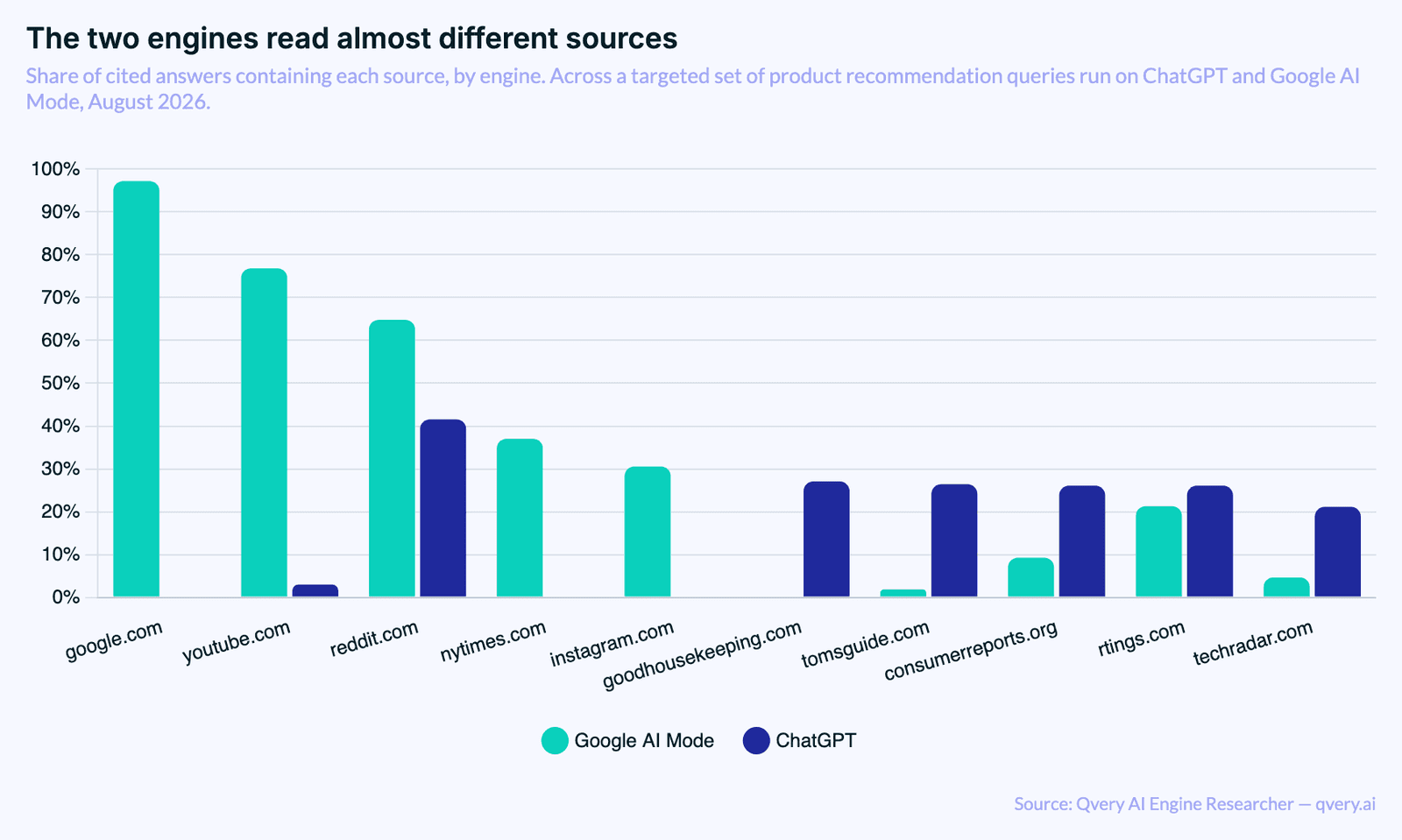
The two engines' leading source lists overlap by just 37.5%.
Google AI Mode's shopping answers lean on Google's own properties at 97.22%, YouTube at 76.85%, Reddit at 64.81%, the New York Times at 37.04%, and Instagram at 30.56%.
ChatGPT's lean on independent review publications: Good Housekeeping at 27.06%, Tom's Guide at 26.40%, Consumer Reports and RTINGS at 26.07% each, TechRadar at 21.12%.
The asymmetries are close to absolute in places. Good Housekeeping, the New York Times, and Instagram each appear on one engine and register zero on the other.
Good Housekeeping, the New York Times, and Instagram each appear in one engine's answers and register zero in the other's.
What That Means For A Placement Strategy
The practical consequence is that "get into AI shopping results" describes two separate jobs, and they need different work.
The cited ChatGPT answers in this collection frequently include the established testing publications: Good Housekeeping, Consumer Reports, RTINGS, Tom's Guide, and TechRadar. Those are organisations that test products and maintain evergreen category pages.
Getting into Google AI Mode's shopping answers looks nothing like that. The leading sources there are Google's own surfaces, video, a community, and a social platform. Most of those cannot be pitched at all.
Reddit is the exception that spans both, at 64.81% on Google AI Mode and 41.58% on ChatGPT. Those are the two highest same-source figures we measured across the engine divide.
RTINGS comes closest to joining it, at 26.07% on ChatGPT and 21.30% on Google AI Mode. That 4.77-point gap is the smallest engine difference among the named review publications.
Reddit is therefore the one source in this collection whose presence does not depend on which engine the shopper opened. What follows from that for a budget is a judgment, and it sits in the final section.
Question Framing Barely Moves It
We built the collection to test whether the way a shopper phrases a question changes which sources answer it. Three framings: broad category questions, questions with a specific constraint, and budget-limited questions.
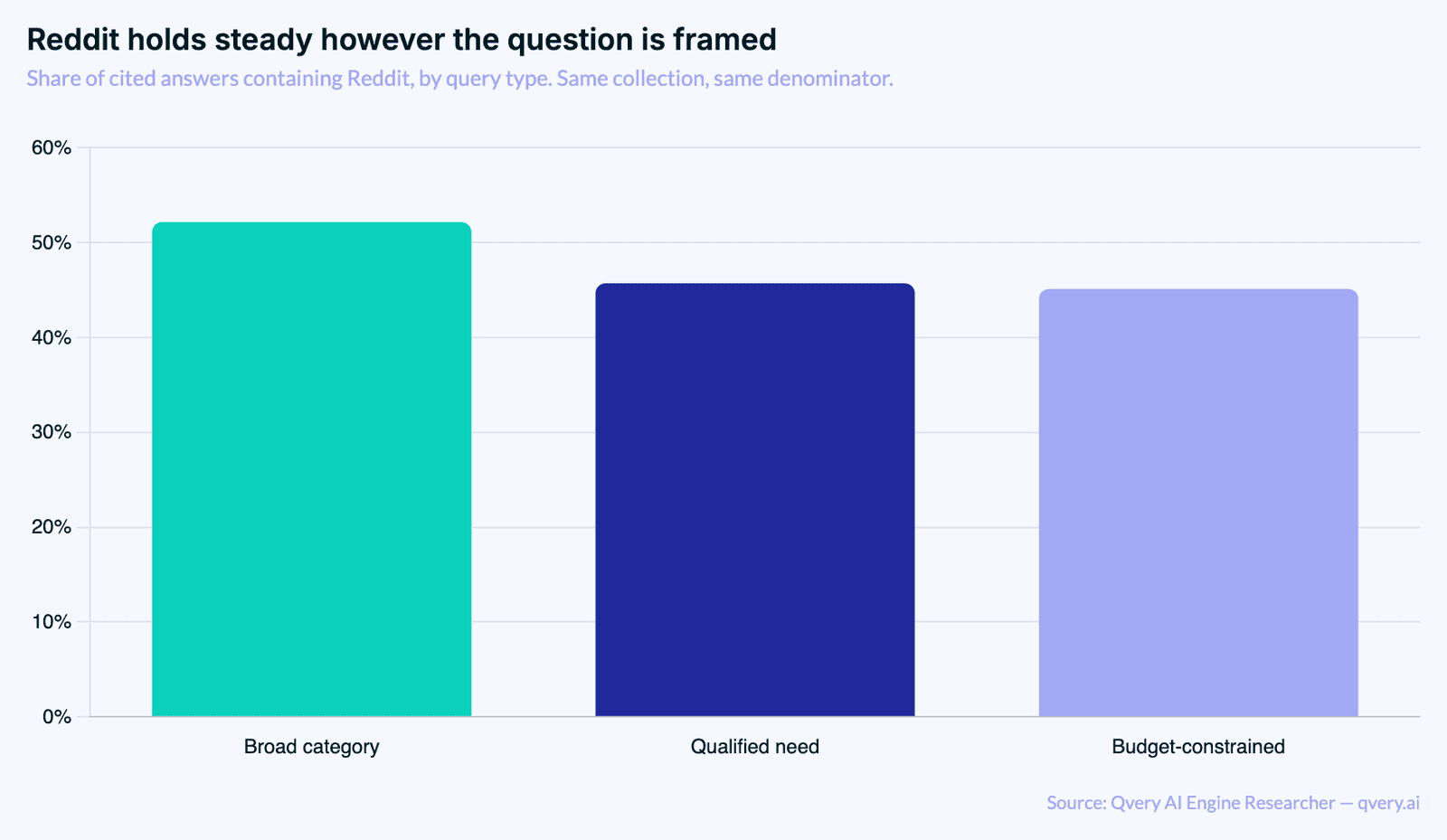
Reddit sits at 52.17% for broad questions, 45.71% for qualified ones, and 45.11% for budget ones. A spread of 7.06 points across three arms that each cleared our reporting floor.
Compare that with the engine difference above, where individual sources swing by 70 points or more. The engine a shopper uses matters far more than how they phrase the question.
That is a useful thing to know before you spend a quarter building content for a specific query shape. The variance that matters in this category is not in the phrasing.
Reddit's presence by framing runs 52.17%, 45.71%, and 45.11%, so the three question types draw on it at broadly similar rates.
Category did vary more than framing, which is worth a note: the collection covered audio, baby, beauty, fashion, home and kitchen, and outdoor and fitness, and the individual arms within each are too small to carry published percentages. We are stating that as a limit rather than dressing up numbers the sample cannot support.
Building An Audit That Survives This
Everything above is one collection at one moment. Four things follow, offered as the writer's judgment rather than as results. None is established by the collection.
Never pool the engines. At 37.5% overlap between the two leading lists, a blended source report describes neither engine.
Track the review publications separately from the platforms. They are reachable by different means, on different timelines, and they pay off in different engines.
Measure community presence as its own line. Reddit is the only source here with real presence on both sides, which makes it the least engine-contingent thing in the category.
Log it over time. A single snapshot cannot tell you whether a source is structural in your category or appeared once. Only a repeated record separates them.
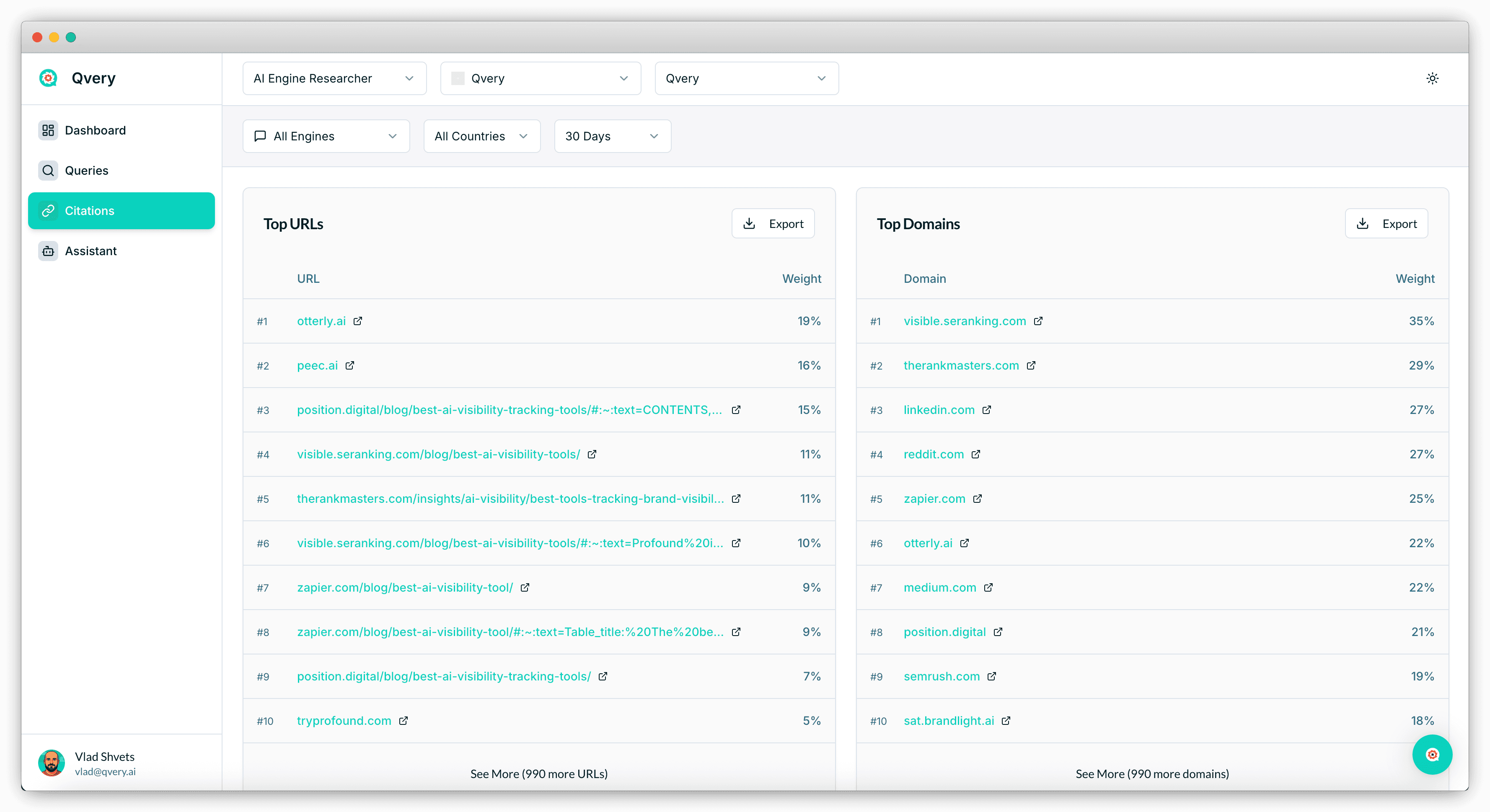
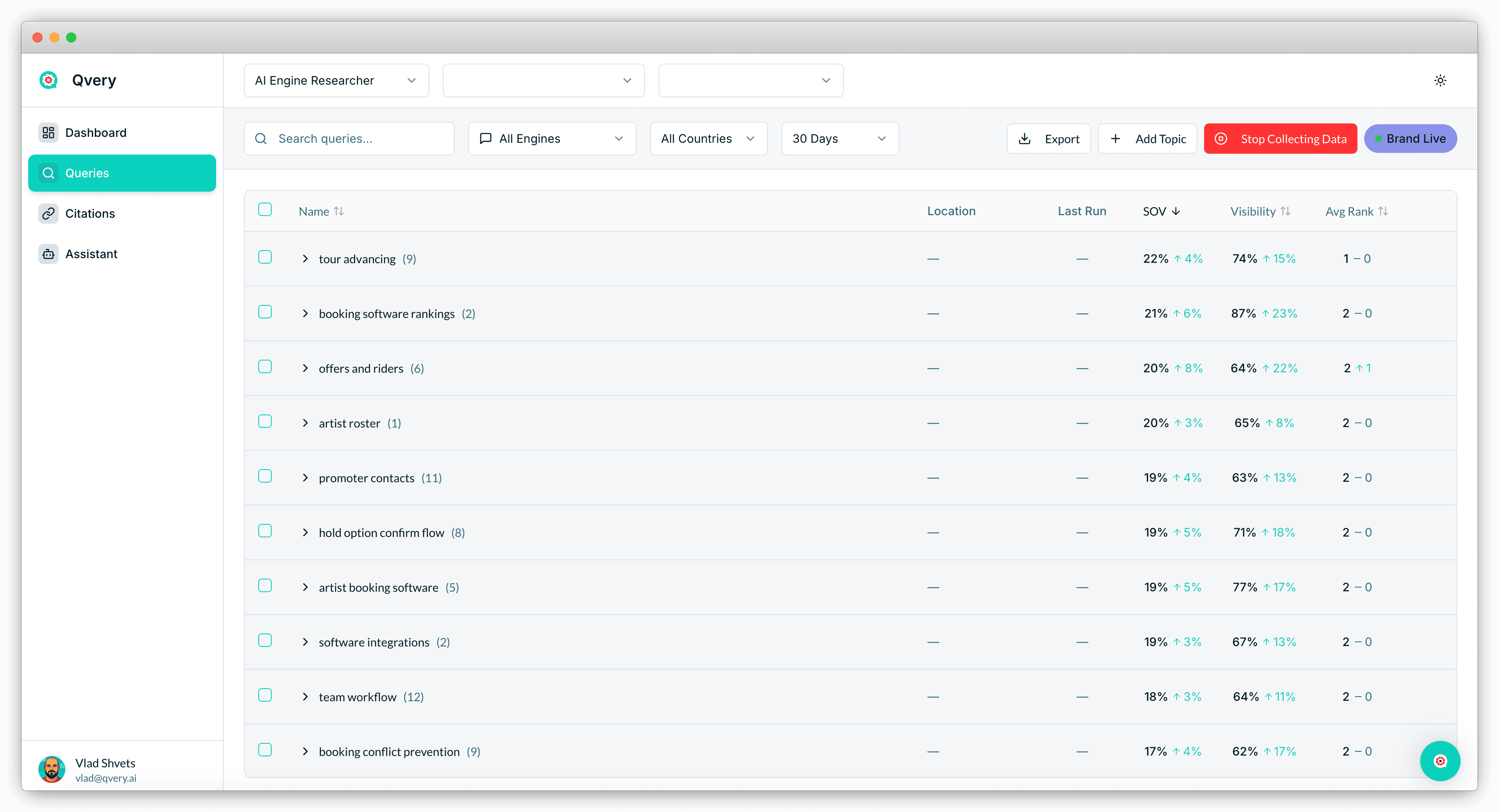
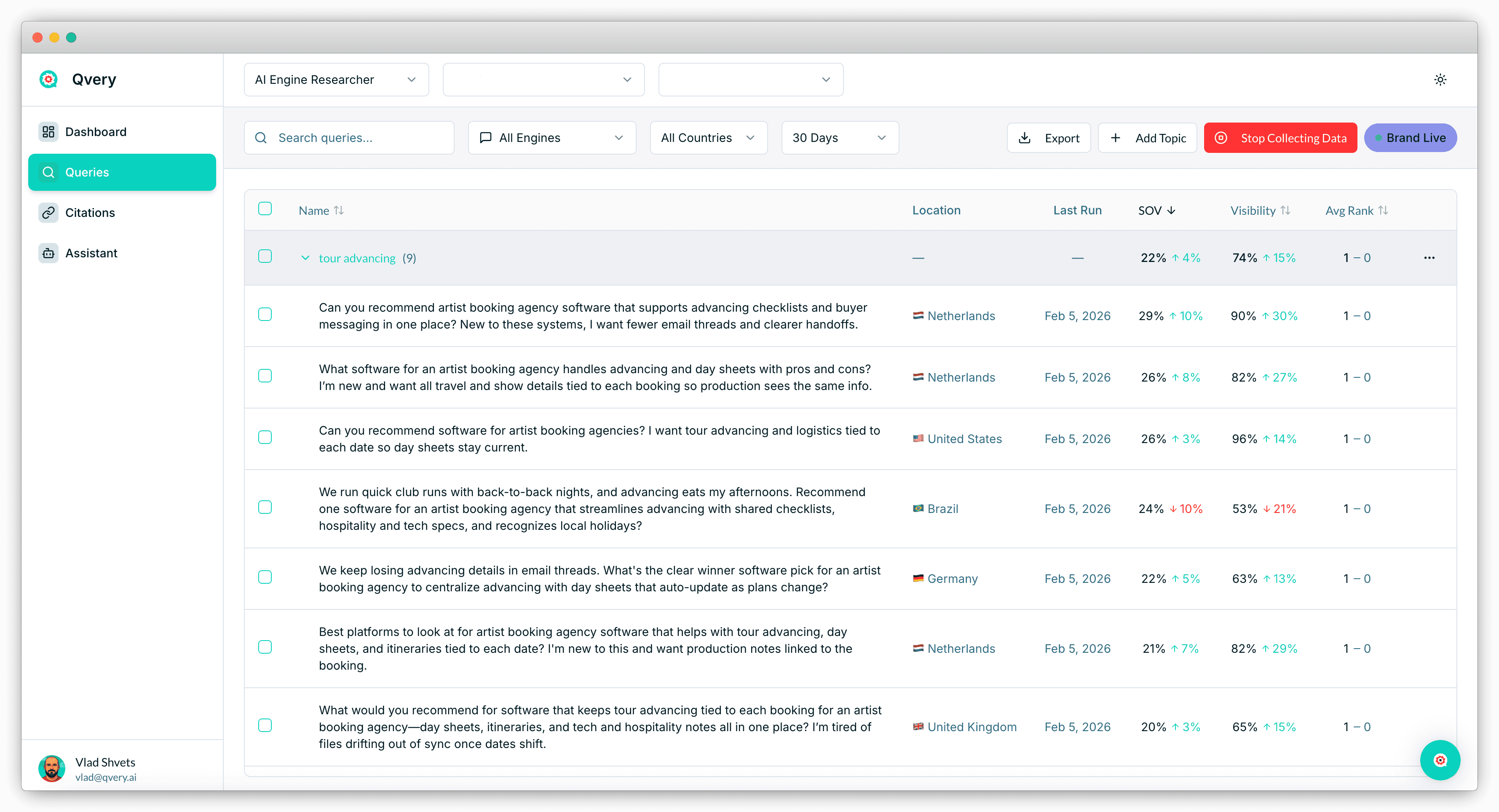
Qvery supplies the tracking underneath that. It tracks visibility, share of voice, and average rank across ChatGPT and Google AI Mode daily, in over 200 countries, and captures every citation tied to the query and engine that produced it. In Qvery Assistant you can ask about your own visibility, share of voice, citation, topic, and query data, add queries, trigger a run, or export a report.
Start your free trial and split your first month of product citations by engine.
Writer's Judgment, Not A Finding
Flagging this clearly, because the rest of the article stays inside what was measured.
Given the 37.5% overlap between the engines' leading lists, our judgment is that an e-commerce brand should measure and report the two engines separately rather than averaging them into a single number.
Given that Reddit is the one source with real presence in both, our judgment is that community presence is the single most productive investment in this category. That is a view about where effort is likely to pay. The collection does not establish it, and nothing here shows that a thread or a review placement will produce a recommendation.
What the collection did establish is narrower and firmer. Google's own properties appear in 97.22% of cited Google AI Mode answers and none of ChatGPT's, and YouTube reaches 76.85% against 2.97%. The named review publications run from 21.12% to 27.06% of ChatGPT's cited answers and from 0.00% to 21.30% of Google AI Mode's, while Reddit spans both at 64.81% and 41.58%.
Those are the bounds. What you do inside them is a decision, not a finding.
Most e-commerce teams treat AI search as one channel. Get recommended by the AI, the thinking goes, and you get recommended everywhere.
We ran a targeted collection across product recommendation queries in six categories to see which sources these answers are built from. The two engines turned out to be reading almost entirely different internets.
One boundary before any number. This measures which sources appear alongside the answers. It does not measure whether appearing on a source causes a product to be recommended, and nothing here was designed to test that.
Two Engines, Two Different Source Sets
Across 108 US product recommendation queries spanning six retail categories, 36 per question framing, run on ChatGPT three times each and Google AI Mode once, August 2026, here is what each engine cited.
The two engines' leading source lists overlap by just 37.5%.
Google AI Mode's shopping answers lean on Google's own properties at 97.22%, YouTube at 76.85%, Reddit at 64.81%, the New York Times at 37.04%, and Instagram at 30.56%.
ChatGPT's lean on independent review publications: Good Housekeeping at 27.06%, Tom's Guide at 26.40%, Consumer Reports and RTINGS at 26.07% each, TechRadar at 21.12%.
The asymmetries are close to absolute in places. Good Housekeeping, the New York Times, and Instagram each appear on one engine and register zero on the other.
Good Housekeeping, the New York Times, and Instagram each appear in one engine's answers and register zero in the other's.
What That Means For A Placement Strategy
The practical consequence is that "get into AI shopping results" describes two separate jobs, and they need different work.
The cited ChatGPT answers in this collection frequently include the established testing publications: Good Housekeeping, Consumer Reports, RTINGS, Tom's Guide, and TechRadar. Those are organisations that test products and maintain evergreen category pages.
Getting into Google AI Mode's shopping answers looks nothing like that. The leading sources there are Google's own surfaces, video, a community, and a social platform. Most of those cannot be pitched at all.
Reddit is the exception that spans both, at 64.81% on Google AI Mode and 41.58% on ChatGPT. Those are the two highest same-source figures we measured across the engine divide.
RTINGS comes closest to joining it, at 26.07% on ChatGPT and 21.30% on Google AI Mode. That 4.77-point gap is the smallest engine difference among the named review publications.
Reddit is therefore the one source in this collection whose presence does not depend on which engine the shopper opened. What follows from that for a budget is a judgment, and it sits in the final section.
Question Framing Barely Moves It
We built the collection to test whether the way a shopper phrases a question changes which sources answer it. Three framings: broad category questions, questions with a specific constraint, and budget-limited questions.
Reddit sits at 52.17% for broad questions, 45.71% for qualified ones, and 45.11% for budget ones. A spread of 7.06 points across three arms that each cleared our reporting floor.
Compare that with the engine difference above, where individual sources swing by 70 points or more. The engine a shopper uses matters far more than how they phrase the question.
That is a useful thing to know before you spend a quarter building content for a specific query shape. The variance that matters in this category is not in the phrasing.
Reddit's presence by framing runs 52.17%, 45.71%, and 45.11%, so the three question types draw on it at broadly similar rates.
Category did vary more than framing, which is worth a note: the collection covered audio, baby, beauty, fashion, home and kitchen, and outdoor and fitness, and the individual arms within each are too small to carry published percentages. We are stating that as a limit rather than dressing up numbers the sample cannot support.
Building An Audit That Survives This
Everything above is one collection at one moment. Four things follow, offered as the writer's judgment rather than as results. None is established by the collection.
Never pool the engines. At 37.5% overlap between the two leading lists, a blended source report describes neither engine.
Track the review publications separately from the platforms. They are reachable by different means, on different timelines, and they pay off in different engines.
Measure community presence as its own line. Reddit is the only source here with real presence on both sides, which makes it the least engine-contingent thing in the category.
Log it over time. A single snapshot cannot tell you whether a source is structural in your category or appeared once. Only a repeated record separates them.
Qvery supplies the tracking underneath that. It tracks visibility, share of voice, and average rank across ChatGPT and Google AI Mode daily, in over 200 countries, and captures every citation tied to the query and engine that produced it. In Qvery Assistant you can ask about your own visibility, share of voice, citation, topic, and query data, add queries, trigger a run, or export a report.
Start your free trial and split your first month of product citations by engine.
Writer's Judgment, Not A Finding
Flagging this clearly, because the rest of the article stays inside what was measured.
Given the 37.5% overlap between the engines' leading lists, our judgment is that an e-commerce brand should measure and report the two engines separately rather than averaging them into a single number.
Given that Reddit is the one source with real presence in both, our judgment is that community presence is the single most productive investment in this category. That is a view about where effort is likely to pay. The collection does not establish it, and nothing here shows that a thread or a review placement will produce a recommendation.
What the collection did establish is narrower and firmer. Google's own properties appear in 97.22% of cited Google AI Mode answers and none of ChatGPT's, and YouTube reaches 76.85% against 2.97%. The named review publications run from 21.12% to 27.06% of ChatGPT's cited answers and from 0.00% to 21.30% of Google AI Mode's, while Reddit spans both at 64.81% and 41.58%.
Those are the bounds. What you do inside them is a decision, not a finding.
Most e-commerce teams treat AI search as one channel. Get recommended by the AI, the thinking goes, and you get recommended everywhere.
We ran a targeted collection across product recommendation queries in six categories to see which sources these answers are built from. The two engines turned out to be reading almost entirely different internets.
One boundary before any number. This measures which sources appear alongside the answers. It does not measure whether appearing on a source causes a product to be recommended, and nothing here was designed to test that.
Two Engines, Two Different Source Sets
Across 108 US product recommendation queries spanning six retail categories, 36 per question framing, run on ChatGPT three times each and Google AI Mode once, August 2026, here is what each engine cited.
The two engines' leading source lists overlap by just 37.5%.
Google AI Mode's shopping answers lean on Google's own properties at 97.22%, YouTube at 76.85%, Reddit at 64.81%, the New York Times at 37.04%, and Instagram at 30.56%.
ChatGPT's lean on independent review publications: Good Housekeeping at 27.06%, Tom's Guide at 26.40%, Consumer Reports and RTINGS at 26.07% each, TechRadar at 21.12%.
The asymmetries are close to absolute in places. Good Housekeeping, the New York Times, and Instagram each appear on one engine and register zero on the other.
Good Housekeeping, the New York Times, and Instagram each appear in one engine's answers and register zero in the other's.
What That Means For A Placement Strategy
The practical consequence is that "get into AI shopping results" describes two separate jobs, and they need different work.
The cited ChatGPT answers in this collection frequently include the established testing publications: Good Housekeeping, Consumer Reports, RTINGS, Tom's Guide, and TechRadar. Those are organisations that test products and maintain evergreen category pages.
Getting into Google AI Mode's shopping answers looks nothing like that. The leading sources there are Google's own surfaces, video, a community, and a social platform. Most of those cannot be pitched at all.
Reddit is the exception that spans both, at 64.81% on Google AI Mode and 41.58% on ChatGPT. Those are the two highest same-source figures we measured across the engine divide.
RTINGS comes closest to joining it, at 26.07% on ChatGPT and 21.30% on Google AI Mode. That 4.77-point gap is the smallest engine difference among the named review publications.
Reddit is therefore the one source in this collection whose presence does not depend on which engine the shopper opened. What follows from that for a budget is a judgment, and it sits in the final section.
Question Framing Barely Moves It
We built the collection to test whether the way a shopper phrases a question changes which sources answer it. Three framings: broad category questions, questions with a specific constraint, and budget-limited questions.
Reddit sits at 52.17% for broad questions, 45.71% for qualified ones, and 45.11% for budget ones. A spread of 7.06 points across three arms that each cleared our reporting floor.
Compare that with the engine difference above, where individual sources swing by 70 points or more. The engine a shopper uses matters far more than how they phrase the question.
That is a useful thing to know before you spend a quarter building content for a specific query shape. The variance that matters in this category is not in the phrasing.
Reddit's presence by framing runs 52.17%, 45.71%, and 45.11%, so the three question types draw on it at broadly similar rates.
Category did vary more than framing, which is worth a note: the collection covered audio, baby, beauty, fashion, home and kitchen, and outdoor and fitness, and the individual arms within each are too small to carry published percentages. We are stating that as a limit rather than dressing up numbers the sample cannot support.
Building An Audit That Survives This
Everything above is one collection at one moment. Four things follow, offered as the writer's judgment rather than as results. None is established by the collection.
Never pool the engines. At 37.5% overlap between the two leading lists, a blended source report describes neither engine.
Track the review publications separately from the platforms. They are reachable by different means, on different timelines, and they pay off in different engines.
Measure community presence as its own line. Reddit is the only source here with real presence on both sides, which makes it the least engine-contingent thing in the category.
Log it over time. A single snapshot cannot tell you whether a source is structural in your category or appeared once. Only a repeated record separates them.
Qvery supplies the tracking underneath that. It tracks visibility, share of voice, and average rank across ChatGPT and Google AI Mode daily, in over 200 countries, and captures every citation tied to the query and engine that produced it. In Qvery Assistant you can ask about your own visibility, share of voice, citation, topic, and query data, add queries, trigger a run, or export a report.
Start your free trial and split your first month of product citations by engine.
Writer's Judgment, Not A Finding
Flagging this clearly, because the rest of the article stays inside what was measured.
Given the 37.5% overlap between the engines' leading lists, our judgment is that an e-commerce brand should measure and report the two engines separately rather than averaging them into a single number.
Given that Reddit is the one source with real presence in both, our judgment is that community presence is the single most productive investment in this category. That is a view about where effort is likely to pay. The collection does not establish it, and nothing here shows that a thread or a review placement will produce a recommendation.
What the collection did establish is narrower and firmer. Google's own properties appear in 97.22% of cited Google AI Mode answers and none of ChatGPT's, and YouTube reaches 76.85% against 2.97%. The named review publications run from 21.12% to 27.06% of ChatGPT's cited answers and from 0.00% to 21.30% of Google AI Mode's, while Reddit spans both at 64.81% and 41.58%.
Those are the bounds. What you do inside them is a decision, not a finding.
Most e-commerce teams treat AI search as one channel. Get recommended by the AI, the thinking goes, and you get recommended everywhere.
We ran a targeted collection across product recommendation queries in six categories to see which sources these answers are built from. The two engines turned out to be reading almost entirely different internets.
One boundary before any number. This measures which sources appear alongside the answers. It does not measure whether appearing on a source causes a product to be recommended, and nothing here was designed to test that.
Two Engines, Two Different Source Sets
Across 108 US product recommendation queries spanning six retail categories, 36 per question framing, run on ChatGPT three times each and Google AI Mode once, August 2026, here is what each engine cited.
The two engines' leading source lists overlap by just 37.5%.
Google AI Mode's shopping answers lean on Google's own properties at 97.22%, YouTube at 76.85%, Reddit at 64.81%, the New York Times at 37.04%, and Instagram at 30.56%.
ChatGPT's lean on independent review publications: Good Housekeeping at 27.06%, Tom's Guide at 26.40%, Consumer Reports and RTINGS at 26.07% each, TechRadar at 21.12%.
The asymmetries are close to absolute in places. Good Housekeeping, the New York Times, and Instagram each appear on one engine and register zero on the other.
Good Housekeeping, the New York Times, and Instagram each appear in one engine's answers and register zero in the other's.
What That Means For A Placement Strategy
The practical consequence is that "get into AI shopping results" describes two separate jobs, and they need different work.
The cited ChatGPT answers in this collection frequently include the established testing publications: Good Housekeeping, Consumer Reports, RTINGS, Tom's Guide, and TechRadar. Those are organisations that test products and maintain evergreen category pages.
Getting into Google AI Mode's shopping answers looks nothing like that. The leading sources there are Google's own surfaces, video, a community, and a social platform. Most of those cannot be pitched at all.
Reddit is the exception that spans both, at 64.81% on Google AI Mode and 41.58% on ChatGPT. Those are the two highest same-source figures we measured across the engine divide.
RTINGS comes closest to joining it, at 26.07% on ChatGPT and 21.30% on Google AI Mode. That 4.77-point gap is the smallest engine difference among the named review publications.
Reddit is therefore the one source in this collection whose presence does not depend on which engine the shopper opened. What follows from that for a budget is a judgment, and it sits in the final section.
Question Framing Barely Moves It
We built the collection to test whether the way a shopper phrases a question changes which sources answer it. Three framings: broad category questions, questions with a specific constraint, and budget-limited questions.
Reddit sits at 52.17% for broad questions, 45.71% for qualified ones, and 45.11% for budget ones. A spread of 7.06 points across three arms that each cleared our reporting floor.
Compare that with the engine difference above, where individual sources swing by 70 points or more. The engine a shopper uses matters far more than how they phrase the question.
That is a useful thing to know before you spend a quarter building content for a specific query shape. The variance that matters in this category is not in the phrasing.
Reddit's presence by framing runs 52.17%, 45.71%, and 45.11%, so the three question types draw on it at broadly similar rates.
Category did vary more than framing, which is worth a note: the collection covered audio, baby, beauty, fashion, home and kitchen, and outdoor and fitness, and the individual arms within each are too small to carry published percentages. We are stating that as a limit rather than dressing up numbers the sample cannot support.
Building An Audit That Survives This
Everything above is one collection at one moment. Four things follow, offered as the writer's judgment rather than as results. None is established by the collection.
Never pool the engines. At 37.5% overlap between the two leading lists, a blended source report describes neither engine.
Track the review publications separately from the platforms. They are reachable by different means, on different timelines, and they pay off in different engines.
Measure community presence as its own line. Reddit is the only source here with real presence on both sides, which makes it the least engine-contingent thing in the category.
Log it over time. A single snapshot cannot tell you whether a source is structural in your category or appeared once. Only a repeated record separates them.
Qvery supplies the tracking underneath that. It tracks visibility, share of voice, and average rank across ChatGPT and Google AI Mode daily, in over 200 countries, and captures every citation tied to the query and engine that produced it. In Qvery Assistant you can ask about your own visibility, share of voice, citation, topic, and query data, add queries, trigger a run, or export a report.
Start your free trial and split your first month of product citations by engine.
Writer's Judgment, Not A Finding
Flagging this clearly, because the rest of the article stays inside what was measured.
Given the 37.5% overlap between the engines' leading lists, our judgment is that an e-commerce brand should measure and report the two engines separately rather than averaging them into a single number.
Given that Reddit is the one source with real presence in both, our judgment is that community presence is the single most productive investment in this category. That is a view about where effort is likely to pay. The collection does not establish it, and nothing here shows that a thread or a review placement will produce a recommendation.
What the collection did establish is narrower and firmer. Google's own properties appear in 97.22% of cited Google AI Mode answers and none of ChatGPT's, and YouTube reaches 76.85% against 2.97%. The named review publications run from 21.12% to 27.06% of ChatGPT's cited answers and from 0.00% to 21.30% of Google AI Mode's, while Reddit spans both at 64.81% and 41.58%.
Those are the bounds. What you do inside them is a decision, not a finding.

© 2026 Qvery AI OÜ