By
Vlad Shvets
Can AI Engines Read Your Product Pages? Audit What Yours Serve Before You Rebuild
We tried to compare the product pages ChatGPT and Google AI Mode cite with uncited ones. Too few pairs to read, so audit your pages before you rebuild them.
We tried to compare the product pages ChatGPT and Google AI Mode cite with uncited ones. Too few pairs to read, so audit your pages before you rebuild them.
We tried to compare the product pages ChatGPT and Google AI Mode cite with uncited ones. Too few pairs to read, so audit your pages before you rebuild them.
Your product pages were built to sell to people: a hero image, a buy button, copy written for a shopper who is already half convinced. If you market an ecommerce brand, someone has probably told you that is exactly why AI engines skip them.
The proposed fix is a rebuild. Add structured specifications, Product and Offer markup and plain factual copy, the argument goes, and the engines will read the page and cite it.
Before you spend a quarter on that, it is worth asking whether cited product pages differ from uncited ones at all.
So in September 2026 we took the product pages ChatGPT and Google AI Mode cited in product-recommendation answers and tried to set each one against an uncited product page from the same question's Google top ten, checking what each served in its raw HTML and after rendering.
Either result would have been useful. A clear difference would have named fields worth investigating. Finding the same fields on both sides would have said they do not separate cited pages from the rest.
The short version: the comparison could not be made. It needed 30 matched pairs in each group and got two in one kind of question and one in the other. So this evidence neither supports nor rules out rebuilding, re-marking-up or re-rendering a product page to get it cited.
What you can use now is the audit itself, run on your own pages, and one audit list for each shape of product question. One boundary throughout: a rendering fetch shows what a page serves, not what an engine read.
What the Audit Checked on Every Cited Product Page
A cited page counted as a product page when it sat on the seller's or maker's own domain and passed a single-product URL check and a hand-check.
That was decided from the URL and the question's product category, never from anything on the page. The set includes makers' pages and retailers' own listings, on sites like chewy.com and homedepot.com.
Each product page was then checked two ways.
Raw HTML, the page the server sends before any script runs: Product and Offer markup (JSON-LD or microdata), a price, availability, at least one specification, and review information.
After rendering: a price, specifications or availability. A field counts as rendered only when it appeared after rendering but not in the raw HTML.
A page that could not be fetched stays unresolved. It is never counted as failing.
Every cited product page in both kinds of question went through that check. We are not giving figures from it, and the reason matters. With no uncited pages beside them, those checks describe the pages the answers cited, and cannot say whether any field separates them from pages that were not cited.
Use the same check on your own pages as a record of what each page exposes, not as a citation lever.
One SEO agency's view is that "The sites that show up most often typically possess high topical authority, quality original content, proper answer formatting, sound SEO practices, schema marking, and trustworthy branding signals."
The same page says "Google AI Overviews collect data from websites that it finds credible, authoritative, technically sound, and highly relevant to the specific search query."
Both lines describe Google's AI Overviews, a surface we did not collect, and the first describes traits of often-cited sites rather than a comparison with sites that were not cited.
For ChatGPT and Google AI Mode product answers, the comparison that could show whether marked-up or technically sound product pages get cited more is too small to read. So no single trait here becomes a product-page priority.
For what the engines read on a vendor's own site in a different vertical, see what AI engines cite from SaaS landing pages.
Why the Page Comparison Could Not Decide Anything
For each cited product page, the comparison page was a product page from the same question's Google organic top ten, collected in the question's country, on a seller's or maker's own site, that neither engine cited. We took the first unused one alphabetically and never used one twice.
That pool ran dry almost at once. It supplied a usable comparison page for two cited product pages in specification questions and one in use-case questions. The rest of the cited product pages had no uncited comparison page available at all.
So the comparison stays open: no direction for any field, and no percentage or ratio either.
Reading a difference would take at least 30 matched pairs in each group, with every page fetched or its gap accounted for. Even then, a difference names fields to investigate, not a fix. The comparison page should also be a different product: one of the pairs here is the same kettle in another color.
One agency sums up a common theory: "Translation: classic SEO gets you into the candidate pool, and content depth gets you cited."
Our comparison pages came from exactly that pool, the organic top ten, to set pages that were cited against pages that ranked and were not. The pool supplied too few to say what separates them, and the line describes Google's AI Overviews, which we did not collect.
What we can show is which domains the answers cited most, counting any page on each domain, in order:
Specification questions: google.com, rtings.com, nytimes.com, sleepfoundation.org, babylist.com, techgearlab.com, bonappetit.com, chewy.com, thegoodguys.com.au, target.com (realbuyerexperiences.com tied for tenth).
Use-case questions: google.com, rtings.com, outdoorgearlab.com, reddit.com, nytimes.com, realbuyerexperiences.com, youtube.com, wired.com, goodhousekeeping.com, foodnetwork.com (rei.com and runrepeat.com tied for tenth).
These lists mix review sites, publishers, retailers, a community forum, a video site and Google's own product viewer. A retailer's domain can hold product pages we audited, but the lists do not say which cited pages were product pages, and they are not the matched set.
google.com needs a note. Its cited entries are chiefly Google's own product-viewer pages, and it was cited almost only in Google AI Mode answers. It is part of the engine, not a site to pitch.
Before you change a product page to chase citations, find uncited pages from the same questions to compare it with, and read no difference until each group holds 30 pages.
Specification and Use-Case Questions Need Separate Audit Lists
We have already made the case for splitting a citation audit by the shape of the ask. This is the ecommerce table behind that advice, for questions with a specification to meet and questions that describe a use.
For each kind of question we built a list of domains, adding at each step the domain that covered the most answers not yet covered, until the list reached 80% of the answers that cited any source.
Specification questions, 23 domains: google.com, rtings.com, techgearlab.com, thegoodguys.com.au, bonappetit.com, amermounts.ca, asics.com, chewy.com, day4camp.com, flw-bag.com, gov.uk, kidobebe.com, liforme.com, nbcnews.com, pcworld.com, simply-ergonomic.co.uk, sleepfoundation.org, support.google.com, treelinereview.com, wfhkit.co.uk, babylist.com, bluettipower.com, cyclingnews.com.
Use-case questions, 18 domains: google.com, rtings.com, outdoorgearlab.com, realbuyerexperiences.com, consumerreports.org, wired.com, bunnings.com.au, healthychildren.org, nbcnews.com, foodsafety.gov, gadgetscout.co.uk, kidobebe.com, runnersworld.com, sleepfoundation.org, smarthomegearhq.com, techgearlab.com, thegoodguys.com.au, anythinglefthanded.co.uk.
Then we swapped them. The specification list covered 61.38% of the use-case answers that cited any source. The use-case list covered 57.59% of the specification answers that cited any source.
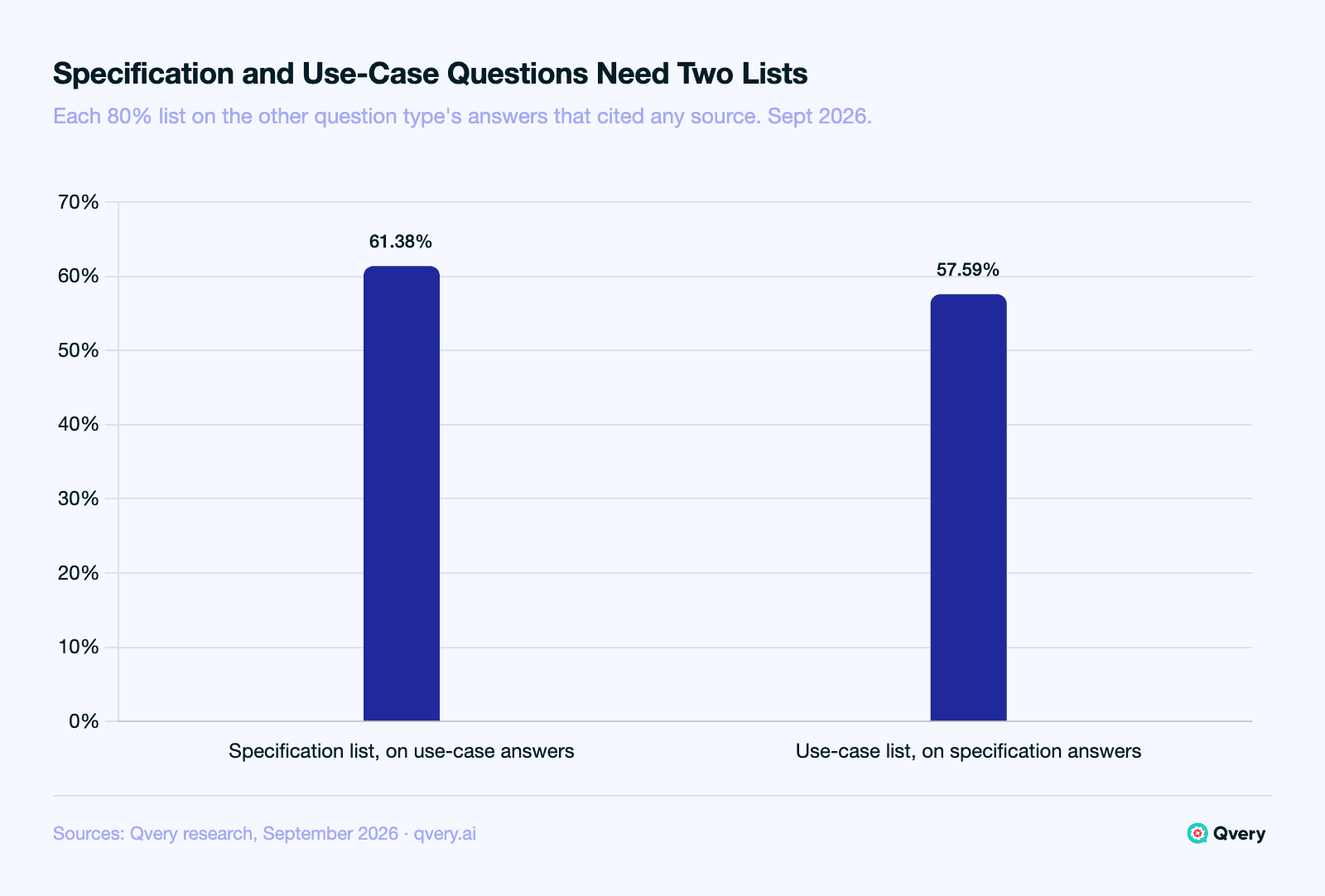
The lower of the two, 0.5759 of the specification answers that cited any source, is under our 0.60 bar for one shared list, so each needs its own list.
Seven domains sit on both: google.com, kidobebe.com, nbcnews.com, rtings.com, sleepfoundation.org, techgearlab.com and thegoodguys.com.au. That overlap is description and decides nothing.
Past the first few domains, many domains each add the same few answers and are taken alphabetically, so the head of each list is firm and its tail is one valid choice among several.
These lists hold domains of every kind. They tell you where to look, not which product pages to fix, and they give no reason for the difference between the two question shapes.
Our earlier piece on getting products into ChatGPT shopping answers tested question framing on a different measure. It is a different test, and neither result speaks for the other.
Track Both Question Shapes for Your Products in Qvery
Qvery gives you the cited half of this audit every day.
Set up your queries as pairs over the same product needs: one with a specification to meet and one describing a use. Building tracking queries covers writing pairs like these, and you add and edit them through Qvery Assistant.
Qvery tracks visibility, share of voice and average rank on those queries daily across ChatGPT and Google AI Mode, in 200+ countries.
Every citation it captures is tied to the query and engine that produced it, so you see which of your own product pages, and which other domains, the answers cite on each question shape and engine.
To ask instead of filter, open Qvery Assistant in the app and ask about your own visibility, share of voice or citations in plain language.
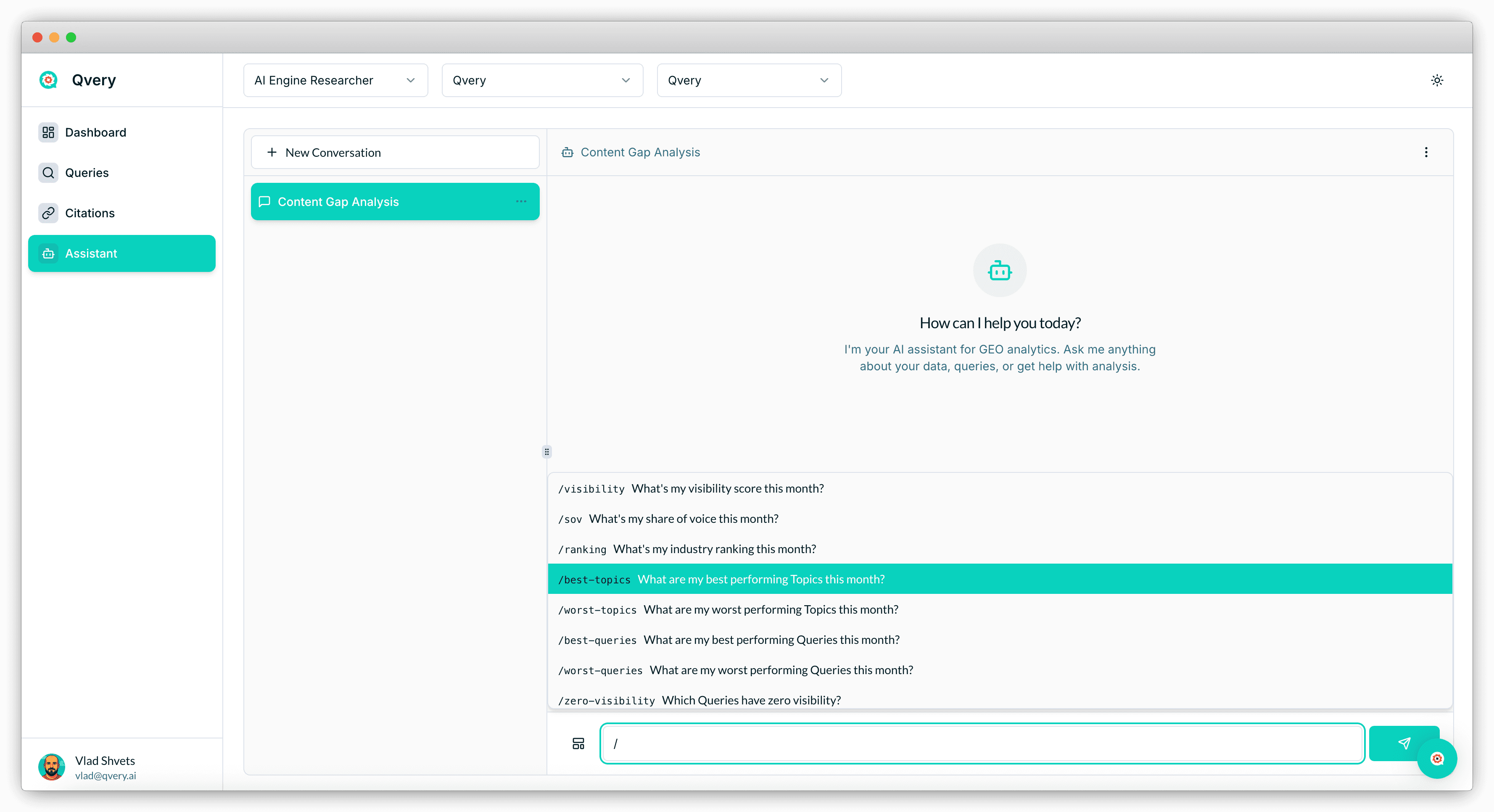
Qvery shows which pages are cited. It does not show what a page serves in its HTML or why an answer cited it, so the page check and the uncited comparison pages stay your own work.
Start a free 7-day trial of Qvery, no credit card required, and set up your specification and use-case question pairs before you brief a redesign.
What This Evidence Cannot Settle
Too small to read. The page comparison had two matched pairs and one, against 30 per group. It says nothing about whether any field, markup type, raw-HTML availability, rendering or visual polish is more common among cited product pages, or whether changing one earns a citation.
No audit figures. No uncited pages stand beside them, use-case questions produced too few product pages to report, and specification questions left too many pages unresolved for any figure to hold.
Fetch, not engine. The rendering was one fetch's view of the page. Fetching, extraction, citation and recommendation are separate outcomes, and none stands in for another.
Own-domain product pages only. The register covers pages on the seller's or maker's own domain, fixed before fetching; a product page elsewhere sits outside it.
Coverage only. Cross-coverage measures whether one list's domains appear in the other question type's answers, and explains nothing.
No engine claim. Pages are pooled across both engines. The pooled answer figures carry three ChatGPT answers for every two from Google AI Mode, and no Google AI Mode figure for a single question type prints.
Scope: unbranded ecommerce product-recommendation questions in US, UK, Canadian and Australian settings, each need asked once with a specification and once with a use case.
One collection. The same question returns a different source list from run to run (measuring ecommerce share of voice explains why), and nothing is compared with an earlier month.
Check Before You Rebuild
Keep one audit list for specification questions and one for use-case questions, and check what your own product pages serve before and after rendering.
Do not rebuild, re-mark-up or re-render a product page on the premise that AI engines cannot read it until a comparison with uncited pages from the same questions, 30 pairs a group, shows a difference worth investigating. This evidence neither shows that premise nor rules it out.
Your product pages were built to sell to people: a hero image, a buy button, copy written for a shopper who is already half convinced. If you market an ecommerce brand, someone has probably told you that is exactly why AI engines skip them.
The proposed fix is a rebuild. Add structured specifications, Product and Offer markup and plain factual copy, the argument goes, and the engines will read the page and cite it.
Before you spend a quarter on that, it is worth asking whether cited product pages differ from uncited ones at all.
So in September 2026 we took the product pages ChatGPT and Google AI Mode cited in product-recommendation answers and tried to set each one against an uncited product page from the same question's Google top ten, checking what each served in its raw HTML and after rendering.
Either result would have been useful. A clear difference would have named fields worth investigating. Finding the same fields on both sides would have said they do not separate cited pages from the rest.
The short version: the comparison could not be made. It needed 30 matched pairs in each group and got two in one kind of question and one in the other. So this evidence neither supports nor rules out rebuilding, re-marking-up or re-rendering a product page to get it cited.
What you can use now is the audit itself, run on your own pages, and one audit list for each shape of product question. One boundary throughout: a rendering fetch shows what a page serves, not what an engine read.
What the Audit Checked on Every Cited Product Page
A cited page counted as a product page when it sat on the seller's or maker's own domain and passed a single-product URL check and a hand-check.
That was decided from the URL and the question's product category, never from anything on the page. The set includes makers' pages and retailers' own listings, on sites like chewy.com and homedepot.com.
Each product page was then checked two ways.
Raw HTML, the page the server sends before any script runs: Product and Offer markup (JSON-LD or microdata), a price, availability, at least one specification, and review information.
After rendering: a price, specifications or availability. A field counts as rendered only when it appeared after rendering but not in the raw HTML.
A page that could not be fetched stays unresolved. It is never counted as failing.
Every cited product page in both kinds of question went through that check. We are not giving figures from it, and the reason matters. With no uncited pages beside them, those checks describe the pages the answers cited, and cannot say whether any field separates them from pages that were not cited.
Use the same check on your own pages as a record of what each page exposes, not as a citation lever.
One SEO agency's view is that "The sites that show up most often typically possess high topical authority, quality original content, proper answer formatting, sound SEO practices, schema marking, and trustworthy branding signals."
The same page says "Google AI Overviews collect data from websites that it finds credible, authoritative, technically sound, and highly relevant to the specific search query."
Both lines describe Google's AI Overviews, a surface we did not collect, and the first describes traits of often-cited sites rather than a comparison with sites that were not cited.
For ChatGPT and Google AI Mode product answers, the comparison that could show whether marked-up or technically sound product pages get cited more is too small to read. So no single trait here becomes a product-page priority.
For what the engines read on a vendor's own site in a different vertical, see what AI engines cite from SaaS landing pages.
Why the Page Comparison Could Not Decide Anything
For each cited product page, the comparison page was a product page from the same question's Google organic top ten, collected in the question's country, on a seller's or maker's own site, that neither engine cited. We took the first unused one alphabetically and never used one twice.
That pool ran dry almost at once. It supplied a usable comparison page for two cited product pages in specification questions and one in use-case questions. The rest of the cited product pages had no uncited comparison page available at all.
So the comparison stays open: no direction for any field, and no percentage or ratio either.
Reading a difference would take at least 30 matched pairs in each group, with every page fetched or its gap accounted for. Even then, a difference names fields to investigate, not a fix. The comparison page should also be a different product: one of the pairs here is the same kettle in another color.
One agency sums up a common theory: "Translation: classic SEO gets you into the candidate pool, and content depth gets you cited."
Our comparison pages came from exactly that pool, the organic top ten, to set pages that were cited against pages that ranked and were not. The pool supplied too few to say what separates them, and the line describes Google's AI Overviews, which we did not collect.
What we can show is which domains the answers cited most, counting any page on each domain, in order:
Specification questions: google.com, rtings.com, nytimes.com, sleepfoundation.org, babylist.com, techgearlab.com, bonappetit.com, chewy.com, thegoodguys.com.au, target.com (realbuyerexperiences.com tied for tenth).
Use-case questions: google.com, rtings.com, outdoorgearlab.com, reddit.com, nytimes.com, realbuyerexperiences.com, youtube.com, wired.com, goodhousekeeping.com, foodnetwork.com (rei.com and runrepeat.com tied for tenth).
These lists mix review sites, publishers, retailers, a community forum, a video site and Google's own product viewer. A retailer's domain can hold product pages we audited, but the lists do not say which cited pages were product pages, and they are not the matched set.
google.com needs a note. Its cited entries are chiefly Google's own product-viewer pages, and it was cited almost only in Google AI Mode answers. It is part of the engine, not a site to pitch.
Before you change a product page to chase citations, find uncited pages from the same questions to compare it with, and read no difference until each group holds 30 pages.
Specification and Use-Case Questions Need Separate Audit Lists
We have already made the case for splitting a citation audit by the shape of the ask. This is the ecommerce table behind that advice, for questions with a specification to meet and questions that describe a use.
For each kind of question we built a list of domains, adding at each step the domain that covered the most answers not yet covered, until the list reached 80% of the answers that cited any source.
Specification questions, 23 domains: google.com, rtings.com, techgearlab.com, thegoodguys.com.au, bonappetit.com, amermounts.ca, asics.com, chewy.com, day4camp.com, flw-bag.com, gov.uk, kidobebe.com, liforme.com, nbcnews.com, pcworld.com, simply-ergonomic.co.uk, sleepfoundation.org, support.google.com, treelinereview.com, wfhkit.co.uk, babylist.com, bluettipower.com, cyclingnews.com.
Use-case questions, 18 domains: google.com, rtings.com, outdoorgearlab.com, realbuyerexperiences.com, consumerreports.org, wired.com, bunnings.com.au, healthychildren.org, nbcnews.com, foodsafety.gov, gadgetscout.co.uk, kidobebe.com, runnersworld.com, sleepfoundation.org, smarthomegearhq.com, techgearlab.com, thegoodguys.com.au, anythinglefthanded.co.uk.
Then we swapped them. The specification list covered 61.38% of the use-case answers that cited any source. The use-case list covered 57.59% of the specification answers that cited any source.
The lower of the two, 0.5759 of the specification answers that cited any source, is under our 0.60 bar for one shared list, so each needs its own list.
Seven domains sit on both: google.com, kidobebe.com, nbcnews.com, rtings.com, sleepfoundation.org, techgearlab.com and thegoodguys.com.au. That overlap is description and decides nothing.
Past the first few domains, many domains each add the same few answers and are taken alphabetically, so the head of each list is firm and its tail is one valid choice among several.
These lists hold domains of every kind. They tell you where to look, not which product pages to fix, and they give no reason for the difference between the two question shapes.
Our earlier piece on getting products into ChatGPT shopping answers tested question framing on a different measure. It is a different test, and neither result speaks for the other.
Track Both Question Shapes for Your Products in Qvery
Qvery gives you the cited half of this audit every day.
Set up your queries as pairs over the same product needs: one with a specification to meet and one describing a use. Building tracking queries covers writing pairs like these, and you add and edit them through Qvery Assistant.
Qvery tracks visibility, share of voice and average rank on those queries daily across ChatGPT and Google AI Mode, in 200+ countries.
Every citation it captures is tied to the query and engine that produced it, so you see which of your own product pages, and which other domains, the answers cite on each question shape and engine.
To ask instead of filter, open Qvery Assistant in the app and ask about your own visibility, share of voice or citations in plain language.
Qvery shows which pages are cited. It does not show what a page serves in its HTML or why an answer cited it, so the page check and the uncited comparison pages stay your own work.
Start a free 7-day trial of Qvery, no credit card required, and set up your specification and use-case question pairs before you brief a redesign.
What This Evidence Cannot Settle
Too small to read. The page comparison had two matched pairs and one, against 30 per group. It says nothing about whether any field, markup type, raw-HTML availability, rendering or visual polish is more common among cited product pages, or whether changing one earns a citation.
No audit figures. No uncited pages stand beside them, use-case questions produced too few product pages to report, and specification questions left too many pages unresolved for any figure to hold.
Fetch, not engine. The rendering was one fetch's view of the page. Fetching, extraction, citation and recommendation are separate outcomes, and none stands in for another.
Own-domain product pages only. The register covers pages on the seller's or maker's own domain, fixed before fetching; a product page elsewhere sits outside it.
Coverage only. Cross-coverage measures whether one list's domains appear in the other question type's answers, and explains nothing.
No engine claim. Pages are pooled across both engines. The pooled answer figures carry three ChatGPT answers for every two from Google AI Mode, and no Google AI Mode figure for a single question type prints.
Scope: unbranded ecommerce product-recommendation questions in US, UK, Canadian and Australian settings, each need asked once with a specification and once with a use case.
One collection. The same question returns a different source list from run to run (measuring ecommerce share of voice explains why), and nothing is compared with an earlier month.
Check Before You Rebuild
Keep one audit list for specification questions and one for use-case questions, and check what your own product pages serve before and after rendering.
Do not rebuild, re-mark-up or re-render a product page on the premise that AI engines cannot read it until a comparison with uncited pages from the same questions, 30 pairs a group, shows a difference worth investigating. This evidence neither shows that premise nor rules it out.
Your product pages were built to sell to people: a hero image, a buy button, copy written for a shopper who is already half convinced. If you market an ecommerce brand, someone has probably told you that is exactly why AI engines skip them.
The proposed fix is a rebuild. Add structured specifications, Product and Offer markup and plain factual copy, the argument goes, and the engines will read the page and cite it.
Before you spend a quarter on that, it is worth asking whether cited product pages differ from uncited ones at all.
So in September 2026 we took the product pages ChatGPT and Google AI Mode cited in product-recommendation answers and tried to set each one against an uncited product page from the same question's Google top ten, checking what each served in its raw HTML and after rendering.
Either result would have been useful. A clear difference would have named fields worth investigating. Finding the same fields on both sides would have said they do not separate cited pages from the rest.
The short version: the comparison could not be made. It needed 30 matched pairs in each group and got two in one kind of question and one in the other. So this evidence neither supports nor rules out rebuilding, re-marking-up or re-rendering a product page to get it cited.
What you can use now is the audit itself, run on your own pages, and one audit list for each shape of product question. One boundary throughout: a rendering fetch shows what a page serves, not what an engine read.
What the Audit Checked on Every Cited Product Page
A cited page counted as a product page when it sat on the seller's or maker's own domain and passed a single-product URL check and a hand-check.
That was decided from the URL and the question's product category, never from anything on the page. The set includes makers' pages and retailers' own listings, on sites like chewy.com and homedepot.com.
Each product page was then checked two ways.
Raw HTML, the page the server sends before any script runs: Product and Offer markup (JSON-LD or microdata), a price, availability, at least one specification, and review information.
After rendering: a price, specifications or availability. A field counts as rendered only when it appeared after rendering but not in the raw HTML.
A page that could not be fetched stays unresolved. It is never counted as failing.
Every cited product page in both kinds of question went through that check. We are not giving figures from it, and the reason matters. With no uncited pages beside them, those checks describe the pages the answers cited, and cannot say whether any field separates them from pages that were not cited.
Use the same check on your own pages as a record of what each page exposes, not as a citation lever.
One SEO agency's view is that "The sites that show up most often typically possess high topical authority, quality original content, proper answer formatting, sound SEO practices, schema marking, and trustworthy branding signals."
The same page says "Google AI Overviews collect data from websites that it finds credible, authoritative, technically sound, and highly relevant to the specific search query."
Both lines describe Google's AI Overviews, a surface we did not collect, and the first describes traits of often-cited sites rather than a comparison with sites that were not cited.
For ChatGPT and Google AI Mode product answers, the comparison that could show whether marked-up or technically sound product pages get cited more is too small to read. So no single trait here becomes a product-page priority.
For what the engines read on a vendor's own site in a different vertical, see what AI engines cite from SaaS landing pages.
Why the Page Comparison Could Not Decide Anything
For each cited product page, the comparison page was a product page from the same question's Google organic top ten, collected in the question's country, on a seller's or maker's own site, that neither engine cited. We took the first unused one alphabetically and never used one twice.
That pool ran dry almost at once. It supplied a usable comparison page for two cited product pages in specification questions and one in use-case questions. The rest of the cited product pages had no uncited comparison page available at all.
So the comparison stays open: no direction for any field, and no percentage or ratio either.
Reading a difference would take at least 30 matched pairs in each group, with every page fetched or its gap accounted for. Even then, a difference names fields to investigate, not a fix. The comparison page should also be a different product: one of the pairs here is the same kettle in another color.
One agency sums up a common theory: "Translation: classic SEO gets you into the candidate pool, and content depth gets you cited."
Our comparison pages came from exactly that pool, the organic top ten, to set pages that were cited against pages that ranked and were not. The pool supplied too few to say what separates them, and the line describes Google's AI Overviews, which we did not collect.
What we can show is which domains the answers cited most, counting any page on each domain, in order:
Specification questions: google.com, rtings.com, nytimes.com, sleepfoundation.org, babylist.com, techgearlab.com, bonappetit.com, chewy.com, thegoodguys.com.au, target.com (realbuyerexperiences.com tied for tenth).
Use-case questions: google.com, rtings.com, outdoorgearlab.com, reddit.com, nytimes.com, realbuyerexperiences.com, youtube.com, wired.com, goodhousekeeping.com, foodnetwork.com (rei.com and runrepeat.com tied for tenth).
These lists mix review sites, publishers, retailers, a community forum, a video site and Google's own product viewer. A retailer's domain can hold product pages we audited, but the lists do not say which cited pages were product pages, and they are not the matched set.
google.com needs a note. Its cited entries are chiefly Google's own product-viewer pages, and it was cited almost only in Google AI Mode answers. It is part of the engine, not a site to pitch.
Before you change a product page to chase citations, find uncited pages from the same questions to compare it with, and read no difference until each group holds 30 pages.
Specification and Use-Case Questions Need Separate Audit Lists
We have already made the case for splitting a citation audit by the shape of the ask. This is the ecommerce table behind that advice, for questions with a specification to meet and questions that describe a use.
For each kind of question we built a list of domains, adding at each step the domain that covered the most answers not yet covered, until the list reached 80% of the answers that cited any source.
Specification questions, 23 domains: google.com, rtings.com, techgearlab.com, thegoodguys.com.au, bonappetit.com, amermounts.ca, asics.com, chewy.com, day4camp.com, flw-bag.com, gov.uk, kidobebe.com, liforme.com, nbcnews.com, pcworld.com, simply-ergonomic.co.uk, sleepfoundation.org, support.google.com, treelinereview.com, wfhkit.co.uk, babylist.com, bluettipower.com, cyclingnews.com.
Use-case questions, 18 domains: google.com, rtings.com, outdoorgearlab.com, realbuyerexperiences.com, consumerreports.org, wired.com, bunnings.com.au, healthychildren.org, nbcnews.com, foodsafety.gov, gadgetscout.co.uk, kidobebe.com, runnersworld.com, sleepfoundation.org, smarthomegearhq.com, techgearlab.com, thegoodguys.com.au, anythinglefthanded.co.uk.
Then we swapped them. The specification list covered 61.38% of the use-case answers that cited any source. The use-case list covered 57.59% of the specification answers that cited any source.
The lower of the two, 0.5759 of the specification answers that cited any source, is under our 0.60 bar for one shared list, so each needs its own list.
Seven domains sit on both: google.com, kidobebe.com, nbcnews.com, rtings.com, sleepfoundation.org, techgearlab.com and thegoodguys.com.au. That overlap is description and decides nothing.
Past the first few domains, many domains each add the same few answers and are taken alphabetically, so the head of each list is firm and its tail is one valid choice among several.
These lists hold domains of every kind. They tell you where to look, not which product pages to fix, and they give no reason for the difference between the two question shapes.
Our earlier piece on getting products into ChatGPT shopping answers tested question framing on a different measure. It is a different test, and neither result speaks for the other.
Track Both Question Shapes for Your Products in Qvery
Qvery gives you the cited half of this audit every day.
Set up your queries as pairs over the same product needs: one with a specification to meet and one describing a use. Building tracking queries covers writing pairs like these, and you add and edit them through Qvery Assistant.
Qvery tracks visibility, share of voice and average rank on those queries daily across ChatGPT and Google AI Mode, in 200+ countries.
Every citation it captures is tied to the query and engine that produced it, so you see which of your own product pages, and which other domains, the answers cite on each question shape and engine.
To ask instead of filter, open Qvery Assistant in the app and ask about your own visibility, share of voice or citations in plain language.
Qvery shows which pages are cited. It does not show what a page serves in its HTML or why an answer cited it, so the page check and the uncited comparison pages stay your own work.
Start a free 7-day trial of Qvery, no credit card required, and set up your specification and use-case question pairs before you brief a redesign.
What This Evidence Cannot Settle
Too small to read. The page comparison had two matched pairs and one, against 30 per group. It says nothing about whether any field, markup type, raw-HTML availability, rendering or visual polish is more common among cited product pages, or whether changing one earns a citation.
No audit figures. No uncited pages stand beside them, use-case questions produced too few product pages to report, and specification questions left too many pages unresolved for any figure to hold.
Fetch, not engine. The rendering was one fetch's view of the page. Fetching, extraction, citation and recommendation are separate outcomes, and none stands in for another.
Own-domain product pages only. The register covers pages on the seller's or maker's own domain, fixed before fetching; a product page elsewhere sits outside it.
Coverage only. Cross-coverage measures whether one list's domains appear in the other question type's answers, and explains nothing.
No engine claim. Pages are pooled across both engines. The pooled answer figures carry three ChatGPT answers for every two from Google AI Mode, and no Google AI Mode figure for a single question type prints.
Scope: unbranded ecommerce product-recommendation questions in US, UK, Canadian and Australian settings, each need asked once with a specification and once with a use case.
One collection. The same question returns a different source list from run to run (measuring ecommerce share of voice explains why), and nothing is compared with an earlier month.
Check Before You Rebuild
Keep one audit list for specification questions and one for use-case questions, and check what your own product pages serve before and after rendering.
Do not rebuild, re-mark-up or re-render a product page on the premise that AI engines cannot read it until a comparison with uncited pages from the same questions, 30 pairs a group, shows a difference worth investigating. This evidence neither shows that premise nor rules it out.
Your product pages were built to sell to people: a hero image, a buy button, copy written for a shopper who is already half convinced. If you market an ecommerce brand, someone has probably told you that is exactly why AI engines skip them.
The proposed fix is a rebuild. Add structured specifications, Product and Offer markup and plain factual copy, the argument goes, and the engines will read the page and cite it.
Before you spend a quarter on that, it is worth asking whether cited product pages differ from uncited ones at all.
So in September 2026 we took the product pages ChatGPT and Google AI Mode cited in product-recommendation answers and tried to set each one against an uncited product page from the same question's Google top ten, checking what each served in its raw HTML and after rendering.
Either result would have been useful. A clear difference would have named fields worth investigating. Finding the same fields on both sides would have said they do not separate cited pages from the rest.
The short version: the comparison could not be made. It needed 30 matched pairs in each group and got two in one kind of question and one in the other. So this evidence neither supports nor rules out rebuilding, re-marking-up or re-rendering a product page to get it cited.
What you can use now is the audit itself, run on your own pages, and one audit list for each shape of product question. One boundary throughout: a rendering fetch shows what a page serves, not what an engine read.
What the Audit Checked on Every Cited Product Page
A cited page counted as a product page when it sat on the seller's or maker's own domain and passed a single-product URL check and a hand-check.
That was decided from the URL and the question's product category, never from anything on the page. The set includes makers' pages and retailers' own listings, on sites like chewy.com and homedepot.com.
Each product page was then checked two ways.
Raw HTML, the page the server sends before any script runs: Product and Offer markup (JSON-LD or microdata), a price, availability, at least one specification, and review information.
After rendering: a price, specifications or availability. A field counts as rendered only when it appeared after rendering but not in the raw HTML.
A page that could not be fetched stays unresolved. It is never counted as failing.
Every cited product page in both kinds of question went through that check. We are not giving figures from it, and the reason matters. With no uncited pages beside them, those checks describe the pages the answers cited, and cannot say whether any field separates them from pages that were not cited.
Use the same check on your own pages as a record of what each page exposes, not as a citation lever.
One SEO agency's view is that "The sites that show up most often typically possess high topical authority, quality original content, proper answer formatting, sound SEO practices, schema marking, and trustworthy branding signals."
The same page says "Google AI Overviews collect data from websites that it finds credible, authoritative, technically sound, and highly relevant to the specific search query."
Both lines describe Google's AI Overviews, a surface we did not collect, and the first describes traits of often-cited sites rather than a comparison with sites that were not cited.
For ChatGPT and Google AI Mode product answers, the comparison that could show whether marked-up or technically sound product pages get cited more is too small to read. So no single trait here becomes a product-page priority.
For what the engines read on a vendor's own site in a different vertical, see what AI engines cite from SaaS landing pages.
Why the Page Comparison Could Not Decide Anything
For each cited product page, the comparison page was a product page from the same question's Google organic top ten, collected in the question's country, on a seller's or maker's own site, that neither engine cited. We took the first unused one alphabetically and never used one twice.
That pool ran dry almost at once. It supplied a usable comparison page for two cited product pages in specification questions and one in use-case questions. The rest of the cited product pages had no uncited comparison page available at all.
So the comparison stays open: no direction for any field, and no percentage or ratio either.
Reading a difference would take at least 30 matched pairs in each group, with every page fetched or its gap accounted for. Even then, a difference names fields to investigate, not a fix. The comparison page should also be a different product: one of the pairs here is the same kettle in another color.
One agency sums up a common theory: "Translation: classic SEO gets you into the candidate pool, and content depth gets you cited."
Our comparison pages came from exactly that pool, the organic top ten, to set pages that were cited against pages that ranked and were not. The pool supplied too few to say what separates them, and the line describes Google's AI Overviews, which we did not collect.
What we can show is which domains the answers cited most, counting any page on each domain, in order:
Specification questions: google.com, rtings.com, nytimes.com, sleepfoundation.org, babylist.com, techgearlab.com, bonappetit.com, chewy.com, thegoodguys.com.au, target.com (realbuyerexperiences.com tied for tenth).
Use-case questions: google.com, rtings.com, outdoorgearlab.com, reddit.com, nytimes.com, realbuyerexperiences.com, youtube.com, wired.com, goodhousekeeping.com, foodnetwork.com (rei.com and runrepeat.com tied for tenth).
These lists mix review sites, publishers, retailers, a community forum, a video site and Google's own product viewer. A retailer's domain can hold product pages we audited, but the lists do not say which cited pages were product pages, and they are not the matched set.
google.com needs a note. Its cited entries are chiefly Google's own product-viewer pages, and it was cited almost only in Google AI Mode answers. It is part of the engine, not a site to pitch.
Before you change a product page to chase citations, find uncited pages from the same questions to compare it with, and read no difference until each group holds 30 pages.
Specification and Use-Case Questions Need Separate Audit Lists
We have already made the case for splitting a citation audit by the shape of the ask. This is the ecommerce table behind that advice, for questions with a specification to meet and questions that describe a use.
For each kind of question we built a list of domains, adding at each step the domain that covered the most answers not yet covered, until the list reached 80% of the answers that cited any source.
Specification questions, 23 domains: google.com, rtings.com, techgearlab.com, thegoodguys.com.au, bonappetit.com, amermounts.ca, asics.com, chewy.com, day4camp.com, flw-bag.com, gov.uk, kidobebe.com, liforme.com, nbcnews.com, pcworld.com, simply-ergonomic.co.uk, sleepfoundation.org, support.google.com, treelinereview.com, wfhkit.co.uk, babylist.com, bluettipower.com, cyclingnews.com.
Use-case questions, 18 domains: google.com, rtings.com, outdoorgearlab.com, realbuyerexperiences.com, consumerreports.org, wired.com, bunnings.com.au, healthychildren.org, nbcnews.com, foodsafety.gov, gadgetscout.co.uk, kidobebe.com, runnersworld.com, sleepfoundation.org, smarthomegearhq.com, techgearlab.com, thegoodguys.com.au, anythinglefthanded.co.uk.
Then we swapped them. The specification list covered 61.38% of the use-case answers that cited any source. The use-case list covered 57.59% of the specification answers that cited any source.
The lower of the two, 0.5759 of the specification answers that cited any source, is under our 0.60 bar for one shared list, so each needs its own list.
Seven domains sit on both: google.com, kidobebe.com, nbcnews.com, rtings.com, sleepfoundation.org, techgearlab.com and thegoodguys.com.au. That overlap is description and decides nothing.
Past the first few domains, many domains each add the same few answers and are taken alphabetically, so the head of each list is firm and its tail is one valid choice among several.
These lists hold domains of every kind. They tell you where to look, not which product pages to fix, and they give no reason for the difference between the two question shapes.
Our earlier piece on getting products into ChatGPT shopping answers tested question framing on a different measure. It is a different test, and neither result speaks for the other.
Track Both Question Shapes for Your Products in Qvery
Qvery gives you the cited half of this audit every day.
Set up your queries as pairs over the same product needs: one with a specification to meet and one describing a use. Building tracking queries covers writing pairs like these, and you add and edit them through Qvery Assistant.
Qvery tracks visibility, share of voice and average rank on those queries daily across ChatGPT and Google AI Mode, in 200+ countries.
Every citation it captures is tied to the query and engine that produced it, so you see which of your own product pages, and which other domains, the answers cite on each question shape and engine.
To ask instead of filter, open Qvery Assistant in the app and ask about your own visibility, share of voice or citations in plain language.
Qvery shows which pages are cited. It does not show what a page serves in its HTML or why an answer cited it, so the page check and the uncited comparison pages stay your own work.
Start a free 7-day trial of Qvery, no credit card required, and set up your specification and use-case question pairs before you brief a redesign.
What This Evidence Cannot Settle
Too small to read. The page comparison had two matched pairs and one, against 30 per group. It says nothing about whether any field, markup type, raw-HTML availability, rendering or visual polish is more common among cited product pages, or whether changing one earns a citation.
No audit figures. No uncited pages stand beside them, use-case questions produced too few product pages to report, and specification questions left too many pages unresolved for any figure to hold.
Fetch, not engine. The rendering was one fetch's view of the page. Fetching, extraction, citation and recommendation are separate outcomes, and none stands in for another.
Own-domain product pages only. The register covers pages on the seller's or maker's own domain, fixed before fetching; a product page elsewhere sits outside it.
Coverage only. Cross-coverage measures whether one list's domains appear in the other question type's answers, and explains nothing.
No engine claim. Pages are pooled across both engines. The pooled answer figures carry three ChatGPT answers for every two from Google AI Mode, and no Google AI Mode figure for a single question type prints.
Scope: unbranded ecommerce product-recommendation questions in US, UK, Canadian and Australian settings, each need asked once with a specification and once with a use case.
One collection. The same question returns a different source list from run to run (measuring ecommerce share of voice explains why), and nothing is compared with an earlier month.
Check Before You Rebuild
Keep one audit list for specification questions and one for use-case questions, and check what your own product pages serve before and after rendering.
Do not rebuild, re-mark-up or re-render a product page on the premise that AI engines cannot read it until a comparison with uncited pages from the same questions, 30 pairs a group, shows a difference worth investigating. This evidence neither shows that premise nor rules it out.

© 2026 Qvery AI OÜ