By
Vlad Shvets
The Landing Page Route: How SaaS Product Pages Become AI Engine Citations
Constrain a SaaS buying question by price and the roundups answer it; constrain it by integration and the engines go straight to the vendors. What the engines read on your own site, page type by page type, and where the landing-page route runs.
Constrain a SaaS buying question by price and the roundups answer it; constrain it by integration and the engines go straight to the vendors. What the engines read on your own site, page type by page type, and where the landing-page route runs.
Constrain a SaaS buying question by price and the roundups answer it; constrain it by integration and the engines go straight to the vendors. What the engines read on your own site, page type by page type, and where the landing-page route runs.
SaaS marketers treat product pages as conversion assets with one job: turn a visitor into a trial. The AI-search corollary everyone repeats is that your landing pages are now citation assets too, so polish them and the engines will quote you.
We tested the route with a twist: the same buying questions, once constrained by price ("best help desk under $50 a month") and once by integration ("best help desk that works with Shopify"), on ChatGPT and Google AI Mode.
The short version: your pages are in the answers either way, but which page gets read, and whether the roundup layer shows up at all, depends on the constraint in the buyer's question. Price questions feed the comparison sites. Integration questions go straight to you.
One note first: a single reading; the split below is a direction to test, not a rule.
Integration Constraints Empty the Roundup Shelf
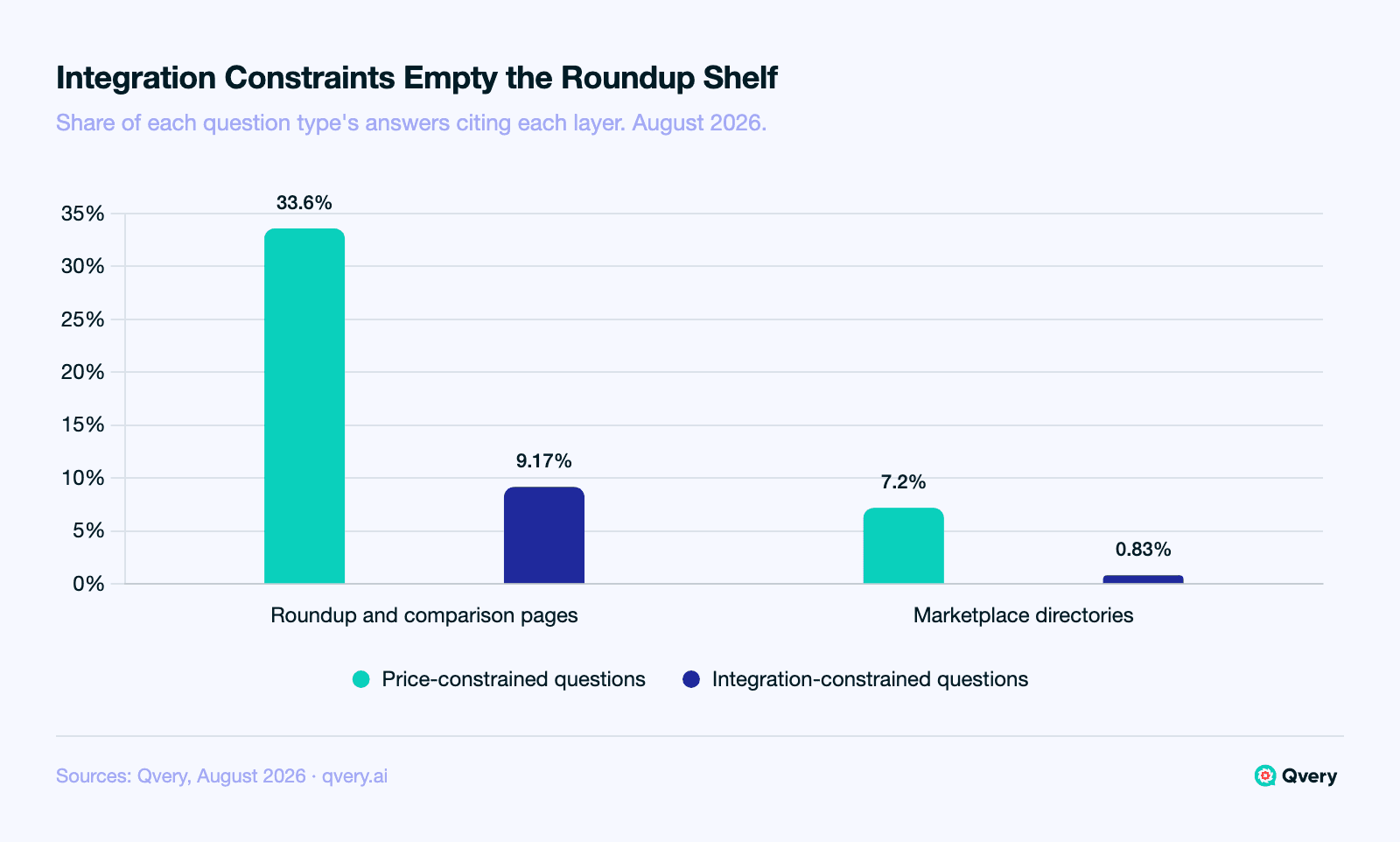
Across a targeted set of constrained SaaS buying questions we ran on ChatGPT and Google AI Mode in August 2026 (US-weighted, with a UK, Canadian, and Australian mix), a roundup or comparison page was in 33.60% of the price-question answers, and 9.17% of the integration-question ones (share of each question type's answers). The marketplace directories fell the same way, 7.20% to 0.83%.
The mechanics make sense once you see it: "under $50" is a spreadsheet question, and the roundup sites have already built the spreadsheet. "Works with Shopify" is a compatibility question, and no listicle keeps integration matrices current. The engine goes to the party that maintains the answer.
Price questions get answered by whoever built the comparison table. Integration questions get answered by whoever maintains the integration.
What the Engines Read on Your Own Site
A vendor's own site was in 44.80% of the price-question answers and 57.50% of the integration-question ones: the direction favors integration questions, though not steeply enough for us to call it more than direction.
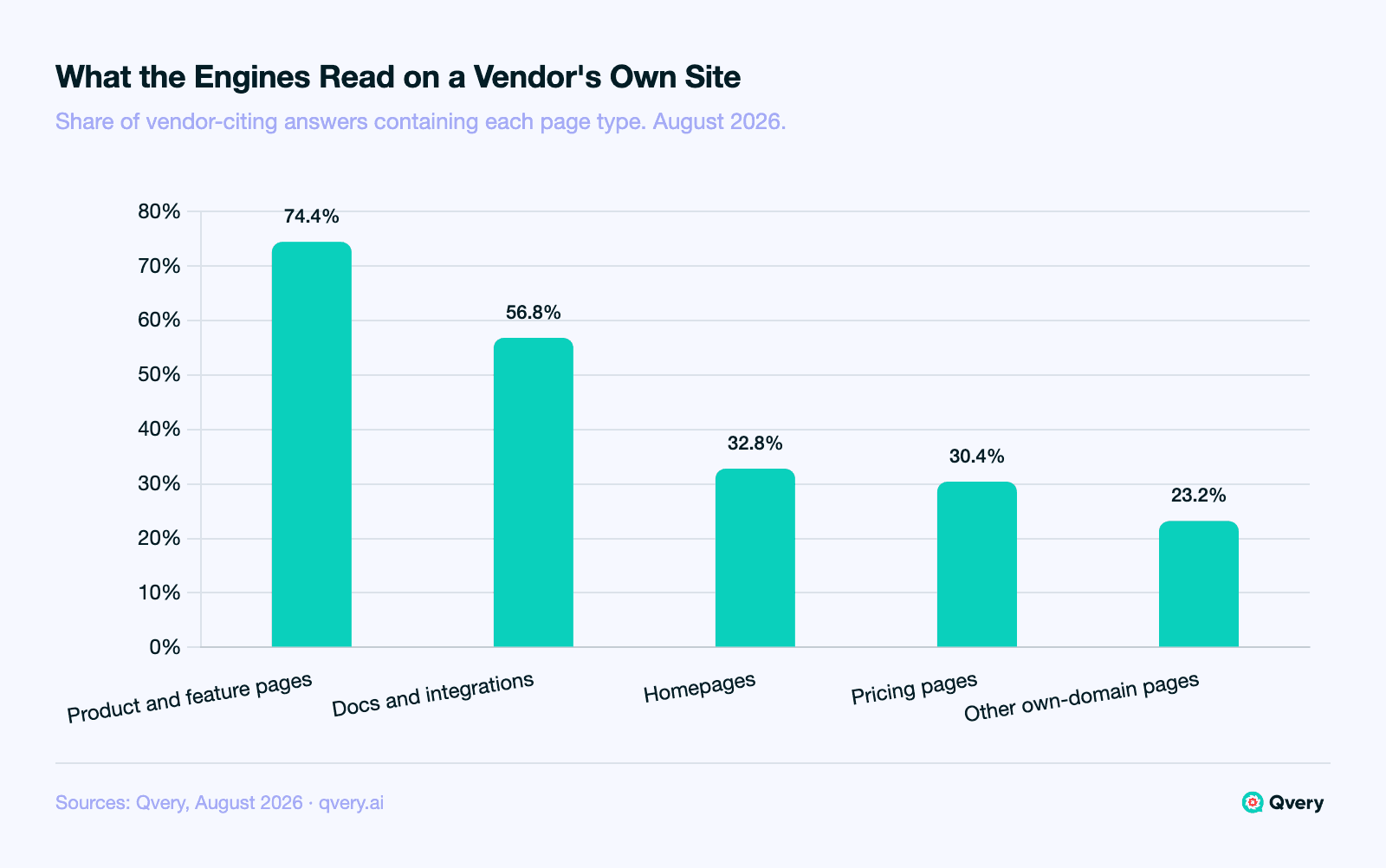
Inside the answers that cited a vendor's own domain, the page types split like this: product and feature pages in 74.40%, docs and integrations pages in 56.80%, homepages in 32.80%, pricing pages in 30.40% (of answers that cited a vendor-owned domain).
Your docs are a first-class citation surface. The pages engineering writes for existing customers are in over half of vendor-citing answers, outranking the pricing page most marketing teams argue about.
Within the two question types, the split ran the way you would guess, pricing pages showing up for price questions and docs for integration ones; the per-question bases were too thin for clean numbers, so take that as direction.
(One reading note: a large share of Google AI Mode's citations resolve to Google's own domain rather than an external source, so these reads lean on the ChatGPT side of the record. Community sources, for completeness: effectively absent from both question types.)
The Landing Page Route, Corrected
Our judgment given the pattern, not a proven sequence:
Write the feature page for the constraint, not the category. "Help desk for Shopify stores" with the integration named in prose beats a generic features tour. Constrained questions are where the engines read you directly.
Promote your docs to the marketing team. Integration guides, API pages, app-directory entries: in these answers they carry more weight than the homepage. Keep them public, current, and readable without a login.
State prices in prose. The pricing page is in roughly three of ten vendor-citing answers; a price the engine can quote beats a "talk to sales" wall on exactly the questions where roundups otherwise answer for you.
Fight the roundup fight only where it happens. The comparison sites decide price questions; work your placements there, and spend the integration-question budget on your own estate instead.
Read Which of Your Pages the Answers Use in Qvery
Which constraint your buyers really type, and which of your pages the answers lift, is your data to read.
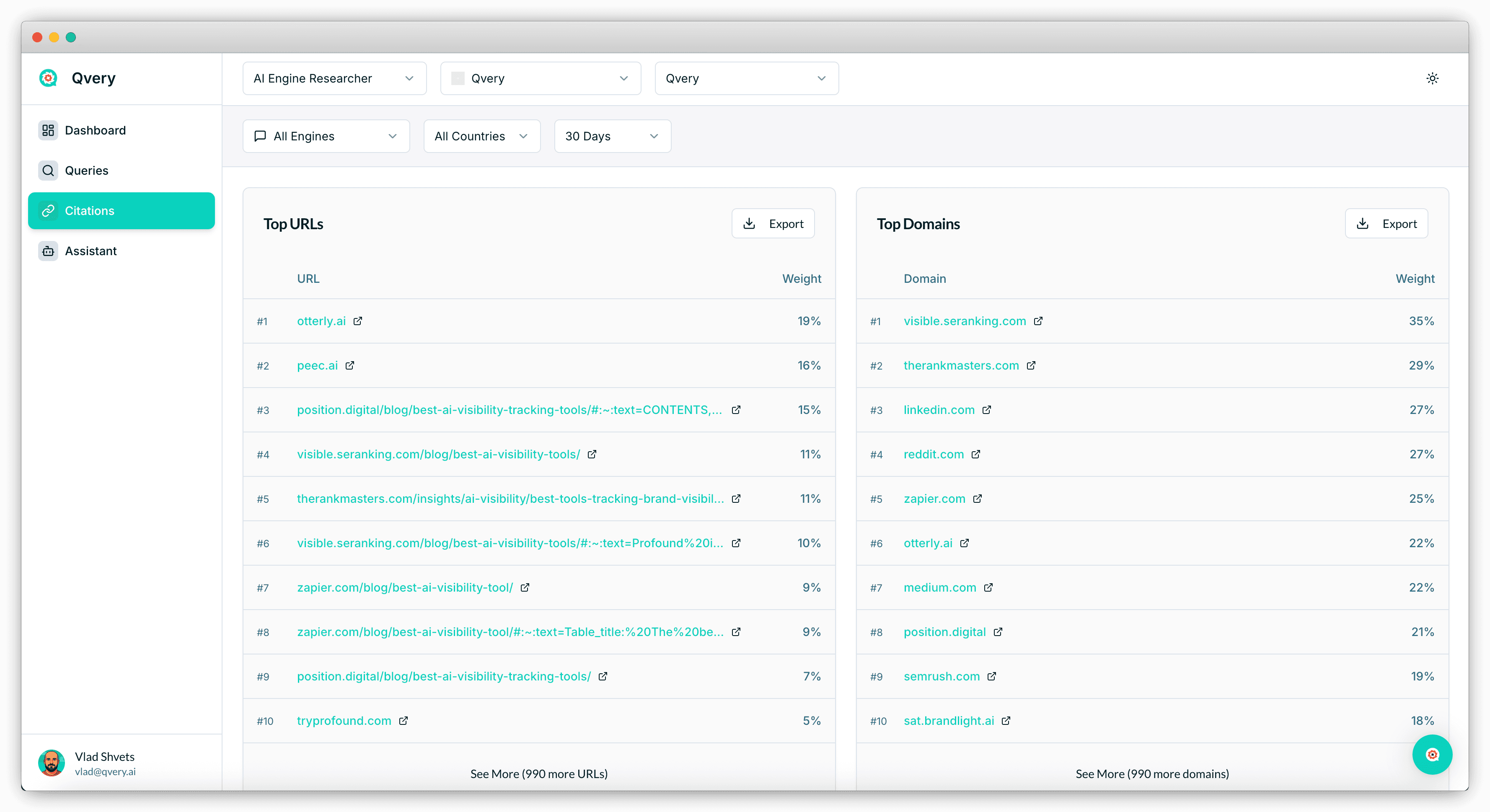
In Qvery, track your category's constrained questions and Qvery runs them daily on ChatGPT and Google AI Mode, capturing every citation tied to the query and engine that produced it. Open Citations, look at the Top URLs under your own domain, and see whether the answers are reading your product pages, your docs, or nothing of yours at all.
Before you rewrite the wrong page, let the free 7-day trial tell you which one is doing the talking: sign up for Qvery.
One move this week: open your most important integration guide and read it as an answer to "does this work with X." If it buries the yes, the engine buries you.
SaaS marketers treat product pages as conversion assets with one job: turn a visitor into a trial. The AI-search corollary everyone repeats is that your landing pages are now citation assets too, so polish them and the engines will quote you.
We tested the route with a twist: the same buying questions, once constrained by price ("best help desk under $50 a month") and once by integration ("best help desk that works with Shopify"), on ChatGPT and Google AI Mode.
The short version: your pages are in the answers either way, but which page gets read, and whether the roundup layer shows up at all, depends on the constraint in the buyer's question. Price questions feed the comparison sites. Integration questions go straight to you.
One note first: a single reading; the split below is a direction to test, not a rule.
Integration Constraints Empty the Roundup Shelf
Across a targeted set of constrained SaaS buying questions we ran on ChatGPT and Google AI Mode in August 2026 (US-weighted, with a UK, Canadian, and Australian mix), a roundup or comparison page was in 33.60% of the price-question answers, and 9.17% of the integration-question ones (share of each question type's answers). The marketplace directories fell the same way, 7.20% to 0.83%.
The mechanics make sense once you see it: "under $50" is a spreadsheet question, and the roundup sites have already built the spreadsheet. "Works with Shopify" is a compatibility question, and no listicle keeps integration matrices current. The engine goes to the party that maintains the answer.
Price questions get answered by whoever built the comparison table. Integration questions get answered by whoever maintains the integration.
What the Engines Read on Your Own Site
A vendor's own site was in 44.80% of the price-question answers and 57.50% of the integration-question ones: the direction favors integration questions, though not steeply enough for us to call it more than direction.
Inside the answers that cited a vendor's own domain, the page types split like this: product and feature pages in 74.40%, docs and integrations pages in 56.80%, homepages in 32.80%, pricing pages in 30.40% (of answers that cited a vendor-owned domain).
Your docs are a first-class citation surface. The pages engineering writes for existing customers are in over half of vendor-citing answers, outranking the pricing page most marketing teams argue about.
Within the two question types, the split ran the way you would guess, pricing pages showing up for price questions and docs for integration ones; the per-question bases were too thin for clean numbers, so take that as direction.
(One reading note: a large share of Google AI Mode's citations resolve to Google's own domain rather than an external source, so these reads lean on the ChatGPT side of the record. Community sources, for completeness: effectively absent from both question types.)
The Landing Page Route, Corrected
Our judgment given the pattern, not a proven sequence:
Write the feature page for the constraint, not the category. "Help desk for Shopify stores" with the integration named in prose beats a generic features tour. Constrained questions are where the engines read you directly.
Promote your docs to the marketing team. Integration guides, API pages, app-directory entries: in these answers they carry more weight than the homepage. Keep them public, current, and readable without a login.
State prices in prose. The pricing page is in roughly three of ten vendor-citing answers; a price the engine can quote beats a "talk to sales" wall on exactly the questions where roundups otherwise answer for you.
Fight the roundup fight only where it happens. The comparison sites decide price questions; work your placements there, and spend the integration-question budget on your own estate instead.
Read Which of Your Pages the Answers Use in Qvery
Which constraint your buyers really type, and which of your pages the answers lift, is your data to read.
In Qvery, track your category's constrained questions and Qvery runs them daily on ChatGPT and Google AI Mode, capturing every citation tied to the query and engine that produced it. Open Citations, look at the Top URLs under your own domain, and see whether the answers are reading your product pages, your docs, or nothing of yours at all.
Before you rewrite the wrong page, let the free 7-day trial tell you which one is doing the talking: sign up for Qvery.
One move this week: open your most important integration guide and read it as an answer to "does this work with X." If it buries the yes, the engine buries you.
SaaS marketers treat product pages as conversion assets with one job: turn a visitor into a trial. The AI-search corollary everyone repeats is that your landing pages are now citation assets too, so polish them and the engines will quote you.
We tested the route with a twist: the same buying questions, once constrained by price ("best help desk under $50 a month") and once by integration ("best help desk that works with Shopify"), on ChatGPT and Google AI Mode.
The short version: your pages are in the answers either way, but which page gets read, and whether the roundup layer shows up at all, depends on the constraint in the buyer's question. Price questions feed the comparison sites. Integration questions go straight to you.
One note first: a single reading; the split below is a direction to test, not a rule.
Integration Constraints Empty the Roundup Shelf
Across a targeted set of constrained SaaS buying questions we ran on ChatGPT and Google AI Mode in August 2026 (US-weighted, with a UK, Canadian, and Australian mix), a roundup or comparison page was in 33.60% of the price-question answers, and 9.17% of the integration-question ones (share of each question type's answers). The marketplace directories fell the same way, 7.20% to 0.83%.
The mechanics make sense once you see it: "under $50" is a spreadsheet question, and the roundup sites have already built the spreadsheet. "Works with Shopify" is a compatibility question, and no listicle keeps integration matrices current. The engine goes to the party that maintains the answer.
Price questions get answered by whoever built the comparison table. Integration questions get answered by whoever maintains the integration.
What the Engines Read on Your Own Site
A vendor's own site was in 44.80% of the price-question answers and 57.50% of the integration-question ones: the direction favors integration questions, though not steeply enough for us to call it more than direction.
Inside the answers that cited a vendor's own domain, the page types split like this: product and feature pages in 74.40%, docs and integrations pages in 56.80%, homepages in 32.80%, pricing pages in 30.40% (of answers that cited a vendor-owned domain).
Your docs are a first-class citation surface. The pages engineering writes for existing customers are in over half of vendor-citing answers, outranking the pricing page most marketing teams argue about.
Within the two question types, the split ran the way you would guess, pricing pages showing up for price questions and docs for integration ones; the per-question bases were too thin for clean numbers, so take that as direction.
(One reading note: a large share of Google AI Mode's citations resolve to Google's own domain rather than an external source, so these reads lean on the ChatGPT side of the record. Community sources, for completeness: effectively absent from both question types.)
The Landing Page Route, Corrected
Our judgment given the pattern, not a proven sequence:
Write the feature page for the constraint, not the category. "Help desk for Shopify stores" with the integration named in prose beats a generic features tour. Constrained questions are where the engines read you directly.
Promote your docs to the marketing team. Integration guides, API pages, app-directory entries: in these answers they carry more weight than the homepage. Keep them public, current, and readable without a login.
State prices in prose. The pricing page is in roughly three of ten vendor-citing answers; a price the engine can quote beats a "talk to sales" wall on exactly the questions where roundups otherwise answer for you.
Fight the roundup fight only where it happens. The comparison sites decide price questions; work your placements there, and spend the integration-question budget on your own estate instead.
Read Which of Your Pages the Answers Use in Qvery
Which constraint your buyers really type, and which of your pages the answers lift, is your data to read.
In Qvery, track your category's constrained questions and Qvery runs them daily on ChatGPT and Google AI Mode, capturing every citation tied to the query and engine that produced it. Open Citations, look at the Top URLs under your own domain, and see whether the answers are reading your product pages, your docs, or nothing of yours at all.
Before you rewrite the wrong page, let the free 7-day trial tell you which one is doing the talking: sign up for Qvery.
One move this week: open your most important integration guide and read it as an answer to "does this work with X." If it buries the yes, the engine buries you.
SaaS marketers treat product pages as conversion assets with one job: turn a visitor into a trial. The AI-search corollary everyone repeats is that your landing pages are now citation assets too, so polish them and the engines will quote you.
We tested the route with a twist: the same buying questions, once constrained by price ("best help desk under $50 a month") and once by integration ("best help desk that works with Shopify"), on ChatGPT and Google AI Mode.
The short version: your pages are in the answers either way, but which page gets read, and whether the roundup layer shows up at all, depends on the constraint in the buyer's question. Price questions feed the comparison sites. Integration questions go straight to you.
One note first: a single reading; the split below is a direction to test, not a rule.
Integration Constraints Empty the Roundup Shelf
Across a targeted set of constrained SaaS buying questions we ran on ChatGPT and Google AI Mode in August 2026 (US-weighted, with a UK, Canadian, and Australian mix), a roundup or comparison page was in 33.60% of the price-question answers, and 9.17% of the integration-question ones (share of each question type's answers). The marketplace directories fell the same way, 7.20% to 0.83%.
The mechanics make sense once you see it: "under $50" is a spreadsheet question, and the roundup sites have already built the spreadsheet. "Works with Shopify" is a compatibility question, and no listicle keeps integration matrices current. The engine goes to the party that maintains the answer.
Price questions get answered by whoever built the comparison table. Integration questions get answered by whoever maintains the integration.
What the Engines Read on Your Own Site
A vendor's own site was in 44.80% of the price-question answers and 57.50% of the integration-question ones: the direction favors integration questions, though not steeply enough for us to call it more than direction.
Inside the answers that cited a vendor's own domain, the page types split like this: product and feature pages in 74.40%, docs and integrations pages in 56.80%, homepages in 32.80%, pricing pages in 30.40% (of answers that cited a vendor-owned domain).
Your docs are a first-class citation surface. The pages engineering writes for existing customers are in over half of vendor-citing answers, outranking the pricing page most marketing teams argue about.
Within the two question types, the split ran the way you would guess, pricing pages showing up for price questions and docs for integration ones; the per-question bases were too thin for clean numbers, so take that as direction.
(One reading note: a large share of Google AI Mode's citations resolve to Google's own domain rather than an external source, so these reads lean on the ChatGPT side of the record. Community sources, for completeness: effectively absent from both question types.)
The Landing Page Route, Corrected
Our judgment given the pattern, not a proven sequence:
Write the feature page for the constraint, not the category. "Help desk for Shopify stores" with the integration named in prose beats a generic features tour. Constrained questions are where the engines read you directly.
Promote your docs to the marketing team. Integration guides, API pages, app-directory entries: in these answers they carry more weight than the homepage. Keep them public, current, and readable without a login.
State prices in prose. The pricing page is in roughly three of ten vendor-citing answers; a price the engine can quote beats a "talk to sales" wall on exactly the questions where roundups otherwise answer for you.
Fight the roundup fight only where it happens. The comparison sites decide price questions; work your placements there, and spend the integration-question budget on your own estate instead.
Read Which of Your Pages the Answers Use in Qvery
Which constraint your buyers really type, and which of your pages the answers lift, is your data to read.
In Qvery, track your category's constrained questions and Qvery runs them daily on ChatGPT and Google AI Mode, capturing every citation tied to the query and engine that produced it. Open Citations, look at the Top URLs under your own domain, and see whether the answers are reading your product pages, your docs, or nothing of yours at all.
Before you rewrite the wrong page, let the free 7-day trial tell you which one is doing the talking: sign up for Qvery.
One move this week: open your most important integration guide and read it as an answer to "does this work with X." If it buries the yes, the engine buries you.

© 2026 Qvery AI OÜ