On this page
- AI-Native Firms Send Every Matter to AI First and to a Lawyer Last
- Decide Matter Type by Matter Type, Not Practice Group by Practice Group
- Set the Fixed Fee From What the Matter Takes Now
- Partner Pay Decides Whether a Practice Group Runs It or You Build a Separate Unit
- How Qvery Builds the First Pass for One of Your Matter Types
- Run One Matter Type AI-First for a Quarter Before Deciding Anything Bigger
- Frequently asked questions
In a law firm of a few hundred people, the routine matters are worked the same way as the hard ones. A lease review, an NDA, an entity formation or a demand package goes to whoever has time, gets billed by the hour, and these days gets drafted with an AI assistant open beside it.
The hours the assistant saves go back into the lawyer's day. The client's bill barely moves, and neither does the firm's margin.
Follow one matter through a firm that calls itself AI-native and most of what it does differently turns out to be copyable.
The short version: the difference is a production method, not a new kind of firm. AI does the first pass on every matter of one type before a lawyer opens it, one person owns how that matter type is produced, and the matter carries a fixed fee set from what it takes now.
A practice group can adopt it one matter type at a time if partner pay allows, and we build that first pass.
Most of the evidence comes from the new firms and the people who track them, and nobody has published audited margins. The conduct rules cited are the ABA's model rules; your state's version decides.
AI-Native Firms Send Every Matter to AI First and to a Lawyer Last
In most firms a lawyer opens a new matter and may reach for an assistant. In an AI-native firm the matter reaches the AI first, as a fixed step: it reads the request and its documents, checks them against the firm's checklist, drafts the response and marks what doesn't fit.
The lawyer starts from that draft, works through the marked points, reads the rest and signs.
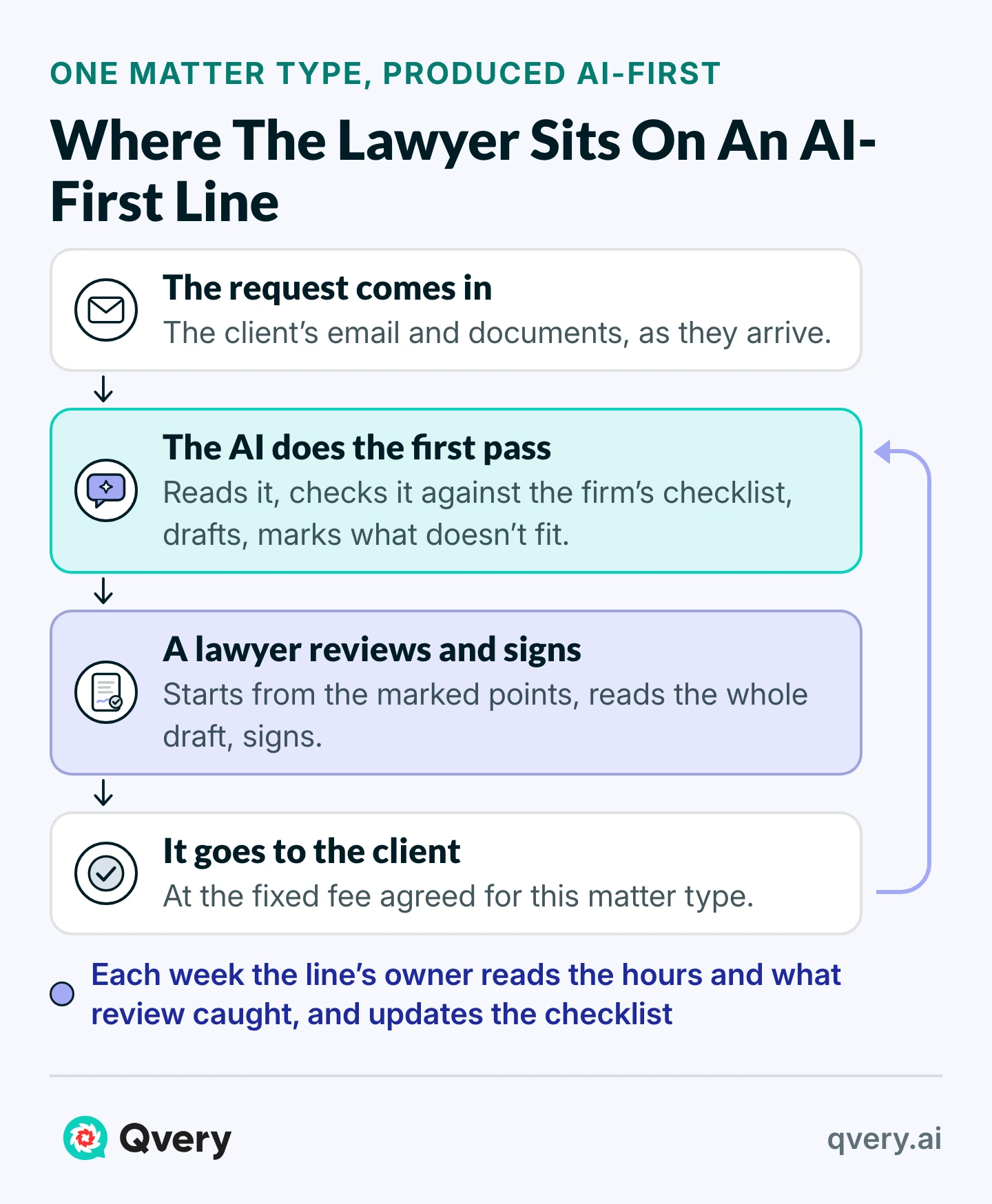
Matt Pollins, who keeps a directory of these firms called the AI Firm Index, presented a survey of the firms on it this September. Their answers describe a production line more than a technology:
He hasn't published how many firms answered; the index listed more than 60 at the time, mostly startups and scale-ups.
The lawyer at the end is there because AI drafts read like correct work. An assistant rarely says it couldn't tell what a clause means; it writes something confident instead.
Showalter PLLC, a litigation and corporate boutique, says on its site that every citation is verified against primary sources and its lawyers own every word; Eve, which sells agents to plaintiff firms, says its agents' drafts get attorney review before anything is filed or sent.
ABA Formal Opinion 512 already puts the policy on a firm's managing lawyers and the checking on its supervisors, whoever wrote the first draft.
Decide Matter Type by Matter Type, Not Practice Group by Practice Group
A practice group is a bundle of tasks with very different exposure to AI, as Pollins puts it about the whole profession. Your real estate group's lease reviews and its portfolio negotiations sit under one partner and have little in common as work.
The firms on his index list their focus most often as startup work, contracts, transactions, real estate, intellectual property and consumer matters. Lawyers using AI report the same split in their own work: the biggest gains where the first draft was mostly standard text already, close to nothing on novel work.
So run the test on each matter type, not on the group:
Count how often it comes in
Enough matters a month that a line is worth running.
Check whether its inputs vary
If every matter arrives the same way and ends in the same document, it is a template job, not an AI job; lawyers automated those long before AI by writing down the decision points. AI earns its place where the inputs change shape.
Find what it took the last twenty times
In time entries by matter type, not in a partner's memory. Without that record you cannot price it.
Ask whether partner pay can follow the work
Can the partners whose pay counts those hours be credited when the work moves? This decides whether the group runs it or the firm builds a separate unit.
Here is how I'd sort the matter types a firm your size typically runs, on the first three questions:
| Matter type | How it arrives | Where I'd put it |
|---|---|---|
| NDA or vendor contract review | The other side's paper, checked against your playbook | AI-first in the group |
| Commercial lease review | Long documents with riders and amendments | AI-first in the group |
| Personal injury demand package | Medical records and bills, different every time | AI-first in the group |
| Discovery responses | Requests and productions that vary by case | AI-first, signed off by the trial team |
| Entity formation | The same facts and the same documents | Template it |
| A negotiated acquisition | Every deal different | Keep it bespoke |
| A trial | Decided in the room | Keep it bespoke |
Any AI-first row moves to a separate unit when question four fails. We have walked through two of them step by step: reviewing NDAs against your firm's playbook and building a medical chronology.
For the rest of a firm's document work, from intake to closing files, our legal playbook sorts where an agent takes the first pass.
Set the Fixed Fee From What the Matter Takes Now
Lawyers who run on fixed fees describe the same discipline: a fee only on work that is predictable and in your control, a written scope with a written list of what it excludes, and a switch to hourly the client approves in writing.
The number comes from the record, every matter of that type with the email and status calls included, read as a spread across matters. Of the matters you'd quote at five hours, how many finished in three, and how many ran to seven? Reread the fee every quarter against the new numbers.
Tips from Reddit
I only offer flat fee on things that are extremely predictable and within my control. For example, I can offer a flat fee on a certain deliverable, but any negotiation or anything beyond minor edits is billed at our hourly rate.
Very strict limited scope representation that turns to an hourly fee, if approved in writing, for any work beyond that.
After every matter, I put all of the time into a tracking sheet, which compiles info by case type.
Opinion 512 says that if AI lets a lawyer finish much faster, charging the same flat fee as without it may be unreasonable under Rule 1.5, and that hourly work bills only the time spent, including the time to brief the tool and review its draft. So set the fee from the new production time.
Pollins sketches a contract review that took 20 hours dropping to four, at half the revenue. At an hourly rate R, that is 20R before and 10R after: each lawyer-hour now earns two and a half times the rate, which becomes margin only if the sixteen freed hours are filled with more matters or bespoke work.
Put your own numbers in: matters a month, hours each today, hours each after the first pass, and what is left of the fee.
The fair objection, mostly from large-firm lawyers: much of this work was flat-fee before AI, and smaller firms already charge half the large firms' rates.
It misses where the fee comes from: a fixed fee holds only where the firm knows the matter type's spread, and a firm that merely cut its price absorbs every difficult matter.
Partner Pay Decides Whether a Practice Group Runs It or You Build a Separate Unit
The line needs an owner. Pollins describes the job as owning not the legal output but the system that produces it: the intake, the quality checks, the turnaround promises and the numbers. In a firm your size that can be a partner given the remit, working with whoever runs your systems.
Now read the arithmetic from that partner's side. If the partner is paid on hours billed, routing a 20-hour matter to the line costs them sixteen hours, and in Pollins' words partners then have "little economic reason" to do it.
Two moves work together: credit the partner for the relationship and the origination when the work moves, paying on the line's margin, and start the line with new clients or overflow, where little billing is at stake.
If the pay system can't change for that group, build the line as a separate unit with its own pricing and its own numbers, as established firms already do.
The index lists an international IP firm's AI-native patent unit and a law firm inside a legal services company, and Dentons' founding CEO argued at a conference Pollins co-chaired this September that large firms probably can't pivot whole and should build captive AI-native units.
None of this needs new ownership. Outside investors, often through a management services company beside the firm, help a new firm build software and buy marketing; the method's three parts need neither.
How Qvery Builds the First Pass for One of Your Matter Types
We build one agent for one matter type in one firm. First we learn how that matter runs today, from the request arriving to the document going out, and who touches it.
Then we build the agent that does the first pass on every new matter of that type, connected to the systems your lawyers already use: the document management system, the matter management system, the shared inbox.
It reads what came in, checks it against your checklist and precedents, drafts, and hands the responsible lawyer the draft with every point that didn't fit and why. It runs on its own, on autopilot, beside the lawyers who sign.
A first working result arrives in two weeks. We train the line's owner and the lawyers who review, and every week it runs we count the hours saved and the errors avoided, which is also the record your fixed fee is set from.
The matter type that passed your test is where that count starts.
Run One Matter Type AI-First for a Quarter Before Deciding Anything Bigger
Pick one matter type the test says to run AI-first, ideally one where new clients or overflow keep the billing at stake low. Then:
Record the baseline
A quarter of the matter type before it moves: matters, hours by step, and what review catches.
Name the owner and call your insurer
Ask your malpractice insurer what it expects before the line goes live.
Run every new matter through the first pass
Every matter of that type, from the day the line starts.
Price new matters at a fixed fee
Set it from the new numbers, with the written scope, the exclusions and the switch to hourly.
Compare at the quarter's end
Turnaround, the lawyer's review time per matter, what review caught, and the spread, against the baseline.
Stop if review time doesn't fall, or if review keeps catching the same error.
If the record can't be got out of the systems the matter runs on, fix the data first; neither route works without it. If partner pay blocks it, the matter type goes to a separate unit; if the spread stays wide, it stays bespoke.
This week, pull last year's time entries for the one matter type your lawyers say is beneath them, and count the hours each one took.
Frequently asked questions
What is an AI-native law firm?
A firm where AI does the first pass on every matter before a lawyer touches it: it reads the documents, checks them against the firm's checklist, drafts and marks what doesn't fit, and a lawyer reviews the whole draft and signs. Most also sell the work as a defined offering and employ someone whose job is the AI and the workflow.
Are AI-native law firms only startups?
No. Most of the firms tracked so far are startups or scale-ups, but the directory that lists them also includes dedicated AI-native units inside established firms, such as an international IP firm's patent unit. The method belongs to a matter type, not to the age of the firm.
Can an existing law firm become AI-native?
Not all at once, and it doesn't need to. Move one matter type at a time: one that repeats, whose inputs vary too much for a template, and whose last twenty matters you can see in your time entries. Run it AI-first for a quarter with a named owner and a fixed fee from the new numbers. Where partner pay can't credit the moved work, build a separate unit.
Do AI-native law firms charge fixed fees?
Most price the work up front. In the survey of firms on his AI Firm Index that Matt Pollins presented in September 2026, 86% said most of their revenue comes from fixed fees, subscriptions or products. A fixed fee holds when the firm knows the spread of hours across past matters and writes down what the fee excludes.
Which legal work suits an AI-first approach?
Work that repeats and arrives in documents whose content varies: contracts on the other side's paper checked against your playbook, leases with riders and amendments, medical records behind a demand, discovery requests and productions. Work that repeats with almost no variation suits a template better. Negotiated deals and trials stay bespoke, because judgment in the moment decides them.
How much routine legal work can AI automate?
Nobody has a measured answer that transfers to your firm. General Legal's CEO has said he believes AI can automate 95% of routine legal work; no measurement of it has been published. What you can measure is your own: run one matter type AI-first for a quarter and compare review time, turnaround and what review caught against the quarter before.
Do lawyers still review AI-drafted filings?
Yes, and the firms built around AI say so in writing. One verifies every citation against primary sources; a vendor to plaintiff firms has attorneys review everything before it is filed or sent. ABA Formal Opinion 512 makes managing lawyers set the policy and supervisors check the work. The lawyer starts from the marked exceptions, then reads the whole draft before signing.
Who should own the AI-first line in a law firm?
One named person with the remit for the whole line: how matters come in, the checks a draft must pass, the turnaround promised to clients and the weekly numbers. In a firm of a few hundred people that is usually a partner who knows the matter type, working with whoever runs the firm's systems.
Do AI-native law firms need outside investors?
Not to run the method. Doing the first pass with AI, naming an owner and setting a fixed fee from your own numbers need no new ownership. Outside money, often through a management services company beside the firm, helps a new firm build software and market itself. A firm of a few hundred people can buy or partner for that.
Is it ethical to charge a flat fee when AI writes most of the first draft?
Yes, if the fee is reasonable. ABA Formal Opinion 512 warns that charging the same flat fee after AI makes the work much faster may be unreasonable under Rule 1.5. Set the fee from the new production time and say what it covers. Your own state's rules and ethics opinions decide.