By
Vlad Shvets
Qvery Webinar #11: Using Qvery For Competitor Research
In our eleventh Qvery webinar, we covered the topic every marketing team thinks they understand and almost none actually does correctly: competitor research.
Share of voice is zero-sum. There is no version of the math where everyone's visibility goes up. If yours rises, someone else's falls.
We used Casper as the demo. Casper is a brand you have almost certainly heard of, with quite average AI numbers: 3 percent share of voice, 15 percent visibility, average rank 4. They sit at position nine in their industry ranking — a known brand losing slowly to Nectar, Helix, and Saatva, each of which is roughly three times their share of voice. Casper's case is the canonical one: how does a known but underperforming brand decide where to attack?
This webinar leans on two earlier ones — webinar one, where we introduced share of voice as the central metric, and webinar five, where we covered Qvery Assistant's templates and how to chain them. If you have watched neither, the foundation here will feel thin. Start with webinar one and circle back.
Share Of Voice Is A Zero-Sum Game
The math is simple and uncomfortable. Across any industry, the share of voice percentages for all brands have to add to 100. There is no slack.
If your share goes up four points this quarter, some combination of competitors lost four points to you. This is true for visibility as well, but visibility has multiple sub-metrics (frequency, rank, sentiment) and tends to move more slowly. Share of voice is the cleanest zero-sum game in AI search.
Reading The Industry Ranking Correctly
The industry ranking table on the Qvery dashboard surfaces the entire competitive picture in one screen. The three metrics that matter per brand are share of voice (the prize), visibility (the surface area), and average rank (the quality of each appearance).
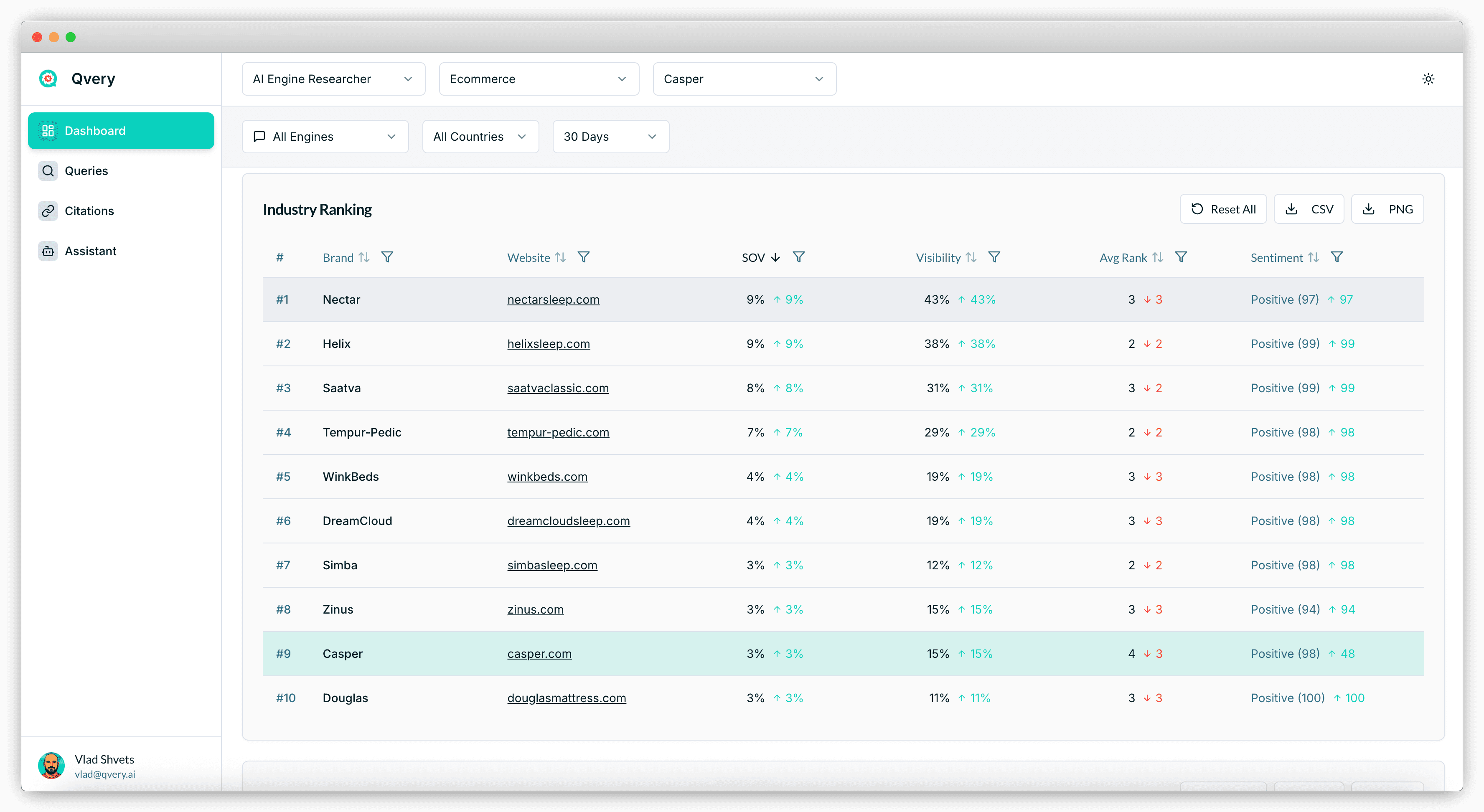
The gap between visibility and share of voice is the strategic tell. Casper sits at 15 percent visibility — meaning they appear in 15 percent of tracked queries — but only 3 percent share of voice. That ratio tells you Casper is in the room a lot, but never at the front of the conversation. Their average rank of 4 confirms it. When AI engines recommend mattresses, they often mention Casper somewhere in the list. They never put Casper first.
Compare with Helix at position two: 38 percent visibility, 9 percent share of voice, average rank 2. Helix appears in fewer queries than the leader but ranks dramatically better when they do appear. That is a different position to attack from — and a different problem to fix. The shape of your industry ranking row tells you which problem to solve first.
The Competitor Deep Dive Template
The Competitor Deep Dive template is where surface-level numbers turn into structural understanding. You run it inside Qvery Assistant, specify up to five competitors (or accept the top five by share of voice), and choose your AI engine filter.
The agent dispatches a multi-step analysis: pulls every relevant query, examines how each competitor is described in AI responses, identifies their winning topics, and surfaces their strengths and weaknesses.
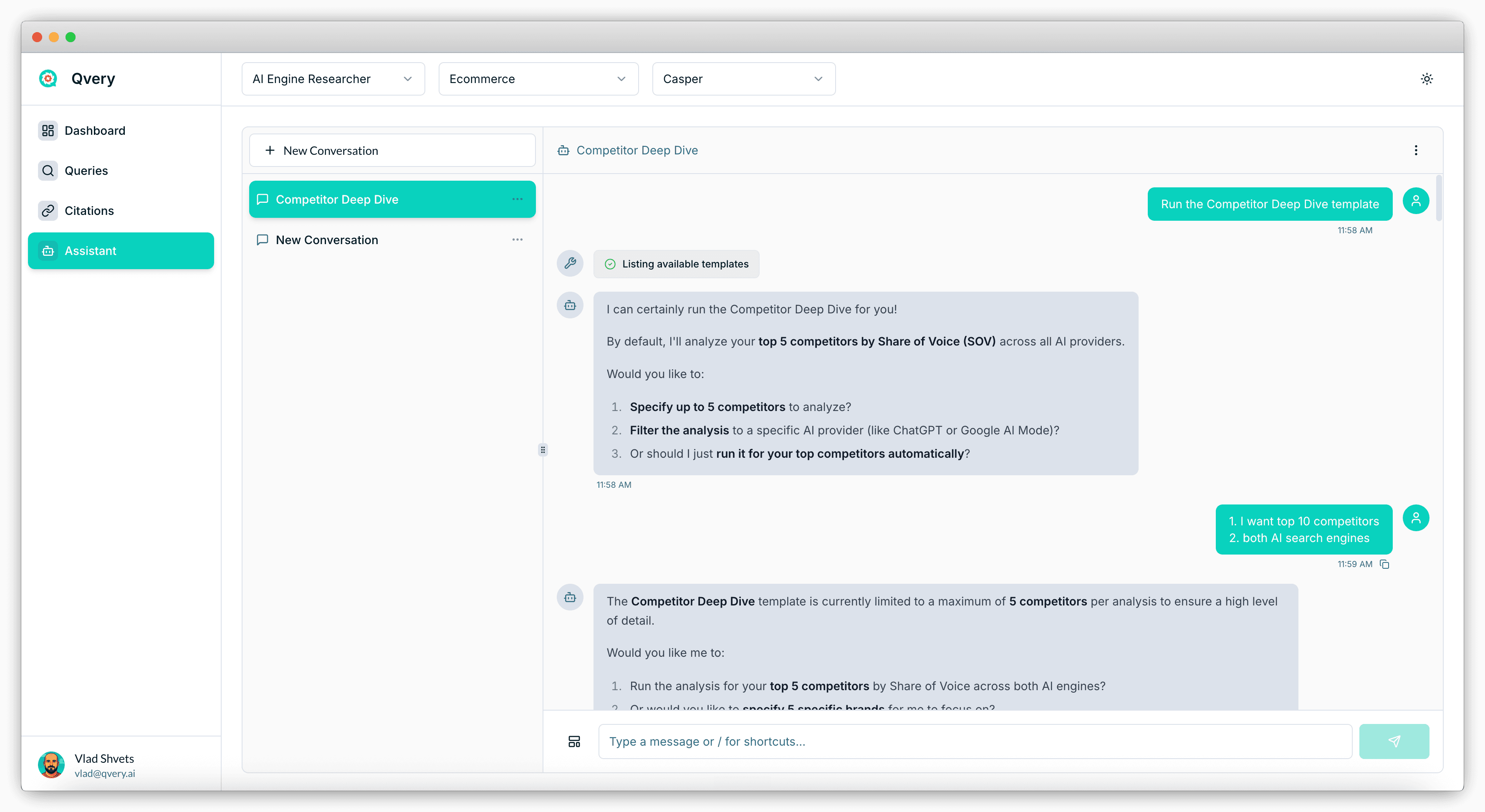
The five-competitor limit is intentional. The depth of analysis per brand is what makes the output usable — at ten, you get a shallow read on each; at five, you get a real diagnosis.
For Casper, the deep dive surfaced a pattern that had not been obvious from the dashboard: every top competitor owned a specific medical or physical "problem." Nectar dominated back pain queries. Helix owned sciatica. Saatva had hip support locked down.
Casper was positioned as a lifestyle generalist — a brand for "people who want a mattress," competing in a market where the AI engines were rewarding brands for "people with a specific spinal alignment issue." Which is a polite way of saying Casper was selling a category to a market that had moved on to solutions.
From Analysis To Marketing Plan
A deep dive that does not end in a plan is just expensive math. Qvery Assistant runs the next step in the same conversation. Ask it to convert the analysis into an 18-month marketing plan and it produces a structured document — strategic pillars, specific tactics, KPIs, and a sequence.
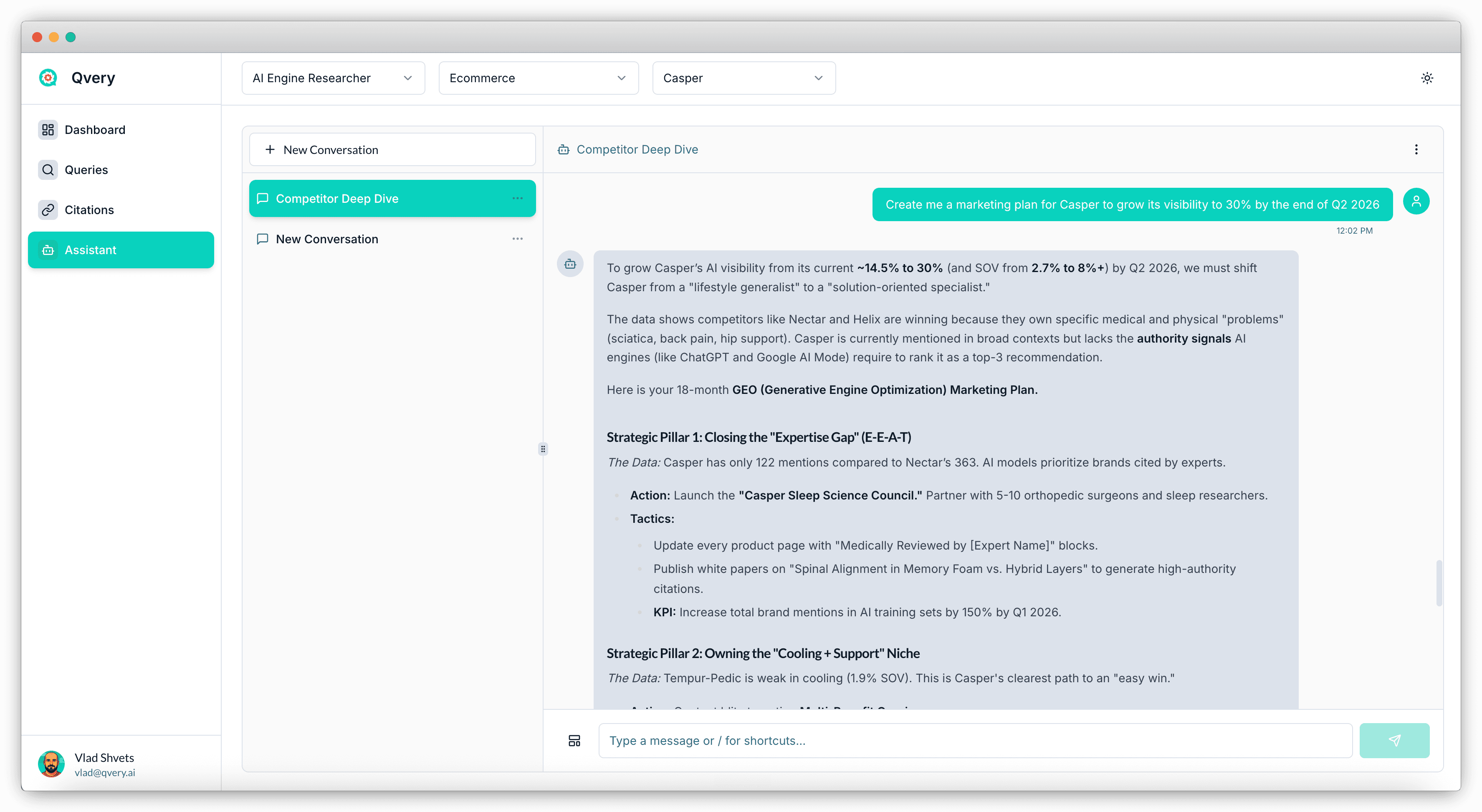
The plan is not a content brief. It is a positioning document with specific actions, partner targets (orthopedic surgeons and sleep researchers), product page changes (medically-reviewed blocks), publishing priorities (white papers on spinal alignment), and quantified KPIs (150 percent growth in mentions by Q1 2026).
The strategic pillars are sequenced — Pillar 1 closes the expertise gap that makes AI engines treat Casper as a lower-authority brand; Pillar 2 attacks the specific niche where the strongest competitor is weakest.
This is the level of output that, in a normal consulting engagement, costs six figures and takes two months. Qvery Assistant produced it in roughly four minutes of conversation. The data inputs were already there. The synthesis was the thing the AI agent did for us.
Chaining Workflows: Competitor Research Is The Front Door
The Competitor Deep Dive is step one of a quarterly workflow. Once you know which competitor you are taking share from, the rest of the Qvery template library lines up downstream:
Content Gap Analysis (covered in webinar nine) tells you which articles to publish to take their winning topics.
Citation Gap Analysis (covered in webinar ten) tells you which third-party URLs to get mentioned on to weaken their citation footprint.
GEO Website Audit (covered in webinar eight) tells you which structural fixes give you a parsing advantage they may not have.
The chain is the workflow. A quarterly Qvery review is not one report — it is four reports run in sequence, each one feeding the next. Competitor deep dive picks the target. Content gap analysis identifies the publishing list. Citation gap analysis identifies the outreach list. GEO audit identifies the structural fixes.
By the end of the chain, you have a quarter of work planned at the level of specific articles, specific outreach targets, and specific page-level changes.
Prompt Examples For Competitor Research
These prompts work inside Qvery Assistant on any account with at least 30 days of competitive data.
Prompt 1: Run The Deep Dive On Specific Competitors
"Run the Competitor Deep Dive template on these five competitors specifically: [COMPETITOR 1], [COMPETITOR 2], [COMPETITOR 3], [COMPETITOR 4], [COMPETITOR 5]. For each one, give me threat level, top three winning topics, top three weaknesses, and the single most specific opportunity for [YOUR BRAND] to attack. Conclude with a recommendation of which one competitor I should focus on for the next quarter and why."
Prompt 2: Convert The Deep Dive Into An 18-Month Plan
"Take the Competitor Deep Dive you just produced and convert it into an 18-month marketing plan for [YOUR BRAND]. Output two to three strategic pillars, each with: the data justification, the strategic action, three to five concrete tactics, and a quantified KPI with a date. Sequence the pillars so the highest-impact, fastest-to-execute work ships in the first six months."
Prompt 3: Chain Deep Dive Into Content Gap Analysis
"Now that we have identified [COMPETITOR NAME] as the target for this quarter, run the Content Gap Analysis template focused exclusively on the topics where this competitor is winning. Surface the top 10 content gaps with recommended formats, target queries, and a one-paragraph brief per article. Order by estimated visibility impact."
Prompt 4: Pick The Right Competitor To Target This Quarter
"Looking at my industry ranking, recommend the single competitor I should target this quarter to maximize share of voice gains. Consider: how realistic the catch is in 90 days, how much topic overlap exists between us, how vulnerable they are on their winning topics, and whether anyone else is already attacking them. Output the recommendation with a one-paragraph justification and the top three queries I should focus on first."
The Bottom Line
Share of voice is zero-sum. Growing your visibility requires taking it from someone specific. Diffuse competitor strategies produce diffuse results.
Read the industry ranking by ratios, not absolutes. The gap between visibility and share of voice tells you whether a competitor is in the room a lot but losing (Casper's pattern) or selectively present and winning (Helix's pattern). They require different counter-strategies.
The Competitor Deep Dive is the diagnosis. It surfaces what each competitor owns, where they are vulnerable, and what your specific advantages are. Five competitors deep beats ten competitors shallow.
Convert the analysis into a plan in the same chat. Ask Qvery Assistant to turn the deep dive into a quantified marketing plan with strategic pillars, tactics, and KPIs. The output is at consulting-engagement quality.
The deep dive is step one of the quarterly chain. Content Gap Analysis, Citation Gap Analysis, and GEO Website Audit are the downstream steps. The full chain is the quarterly review.
If you found this useful, check out the other webinars at qvery.ai/webinars. And if you ran the Competitor Deep Dive on your own brand and want a second pair of eyes on the diagnosis, email me at vlad@qvery.ai.
See you on the next one.