By
Vlad Shvets
Qvery Webinar #10: Analyzing AI Search Citation Data
In our tenth Qvery webinar, we dug into citation data — the actual fuel underneath every recommendation an AI search engine gives.
Citation analysis sounds like one of those topics that nobody outside the team really cares about, the way only true believers read movie credits. But the citations are where visibility actually gets decided.
If you can read the citation list correctly, you see the entire conversation happening in your space, and you also see, painfully clearly, the parts of it you do not control.
We used GetYourGuide as the demo — a marketplace for travel experiences that you have probably booked through without realizing it. They sit at the top of their citation footprint, with their own domain pulling 37 percent of total citation weight. That sounds dominant. It is not. Viator follows at 35 percent. Reddit and Facebook are larger than both. The citation list does not pick a winner; it tells you who is in the room.
This builds directly on webinar three, where we introduced citation weight as the metric that replaced domain rating. If that one was the why, this one is the how — how to read citation data inside Qvery, why ChatGPT and Google AI Mode behave very differently from each other, and how to turn the data into a decision instead of a screenshot.
Citations Are A Conversation You Don't Own
Every AI response is built from sources. The list of those sources, weighted by how often each one shows up across your tracked queries, is your citation footprint.
Most of the footprint is not yours. The footprint is the conversation happening about your space (articles, forums, reviews, blog posts, encyclopedias) and the AI is summarizing whichever of those sources it judges most authoritative.
You can only influence that conversation by understanding what is in it, who controls each piece, and why the AI is pulling from where it is pulling from. Reading citations is a lot like reading the credits on a film. You did not write them, but they tell you who the studio thinks did the work — and what the budget went on. If your brand never appears in the credits, the AI does not think you contributed to the film.
The first job of citation analysis is structural: figure out what the conversation is made of. The second is strategic: figure out which parts of it you can own outright, which parts you can influence through outreach and content, and which parts are above your pay grade and you should plan around instead.
ChatGPT And Google AI Mode Read Different Internets
The single most important thing to know about citation data is that ChatGPT and Google AI Mode pull from materially different sources. They are both AI search engines. They are both indexing the same internet. They cite it completely differently.
Reddit dominates both. That part is universal — across every industry we measure, Reddit is the most or second-most-cited domain on both engines. After that, the engines diverge:
Google AI Mode heavily favors TripAdvisor, YouTube, and other Google-ecosystem assets. This is unsurprising — Google has full access to its own properties, including video transcripts.
ChatGPT favors text-heavy sources: long-form blog posts, Wikipedia, well-structured product pages, and editorial publications. Video is barely visible.
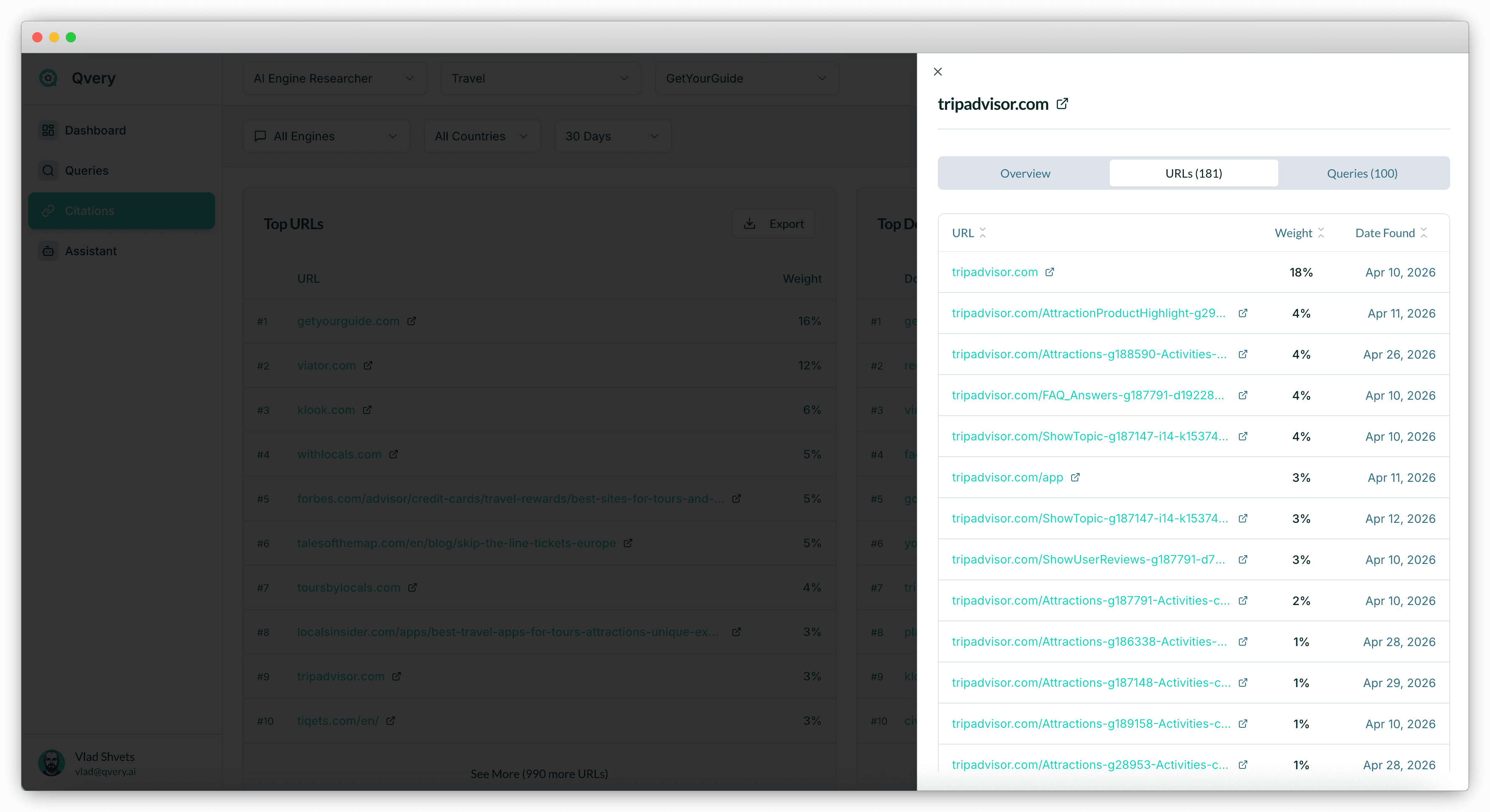
TripAdvisor is the cleanest example of the asymmetry. We pulled the data across our travel customers: roughly 90 percent of all TripAdvisor citations come from Google AI Mode. Less than 10 percent come from ChatGPT. The same site, the same content, two engines reading it almost in inverse proportion. One of them clearly went to film school; the other reads the book first.
For a travel brand, this matters enormously. A unified "citation strategy" treating ChatGPT and Google AI Mode as the same target leaves half your visibility on the table. The correct split is two parallel programs: build YouTube and TripAdvisor presence for Google AI Mode visibility, build content marketing and Reddit presence for ChatGPT. Same brand, two strategies, two different audiences of AI agents reading entirely different pages.
Reading The Citations Module Correctly
The Citations module in Qvery splits into two panels that tell different stories. Most people read one and ignore the other. Both matter.
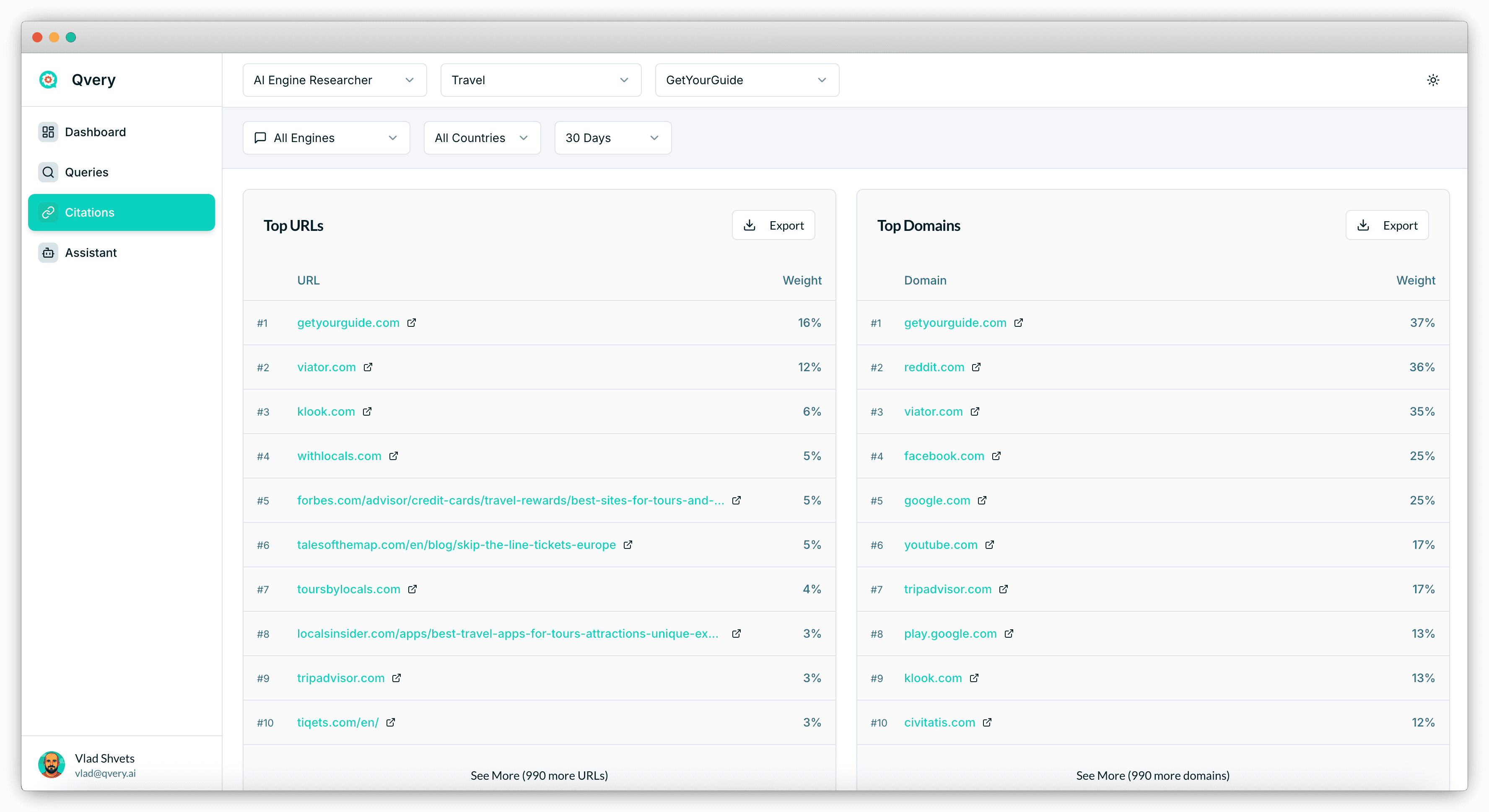
Top URLs shows the specific pages driving your visibility. This is where you see which exact articles, threads, reviews, or product pages the AI is treating as authoritative for queries in your space. For GetYourGuide, their own homepage tops the URL list at 16 percent.
The rest of the top ten is a mix of competitors and adjacent travel content — Forbes Advisor, talesofthemap.com, localsinsider.com — each carrying 3 to 5 percent citation weight.
Top Domains aggregates by site. One domain might own multiple URLs, and the panel rolls them up into a single weighted total. GetYourGuide leads at 37 percent — that is the domain-level citation ownership across their tracked queries. Reddit follows at 36 percent, Viator at 35 percent. The fact that Reddit outweighs a direct commercial competitor by one percentage point is the entire UGC argument summarized in one row.
Both panels respect the filters above them: engine, country, and time window. Always check at least two engine filters when you read citations — the Top URLs list under "ChatGPT only" can look completely different from the same list under "Google AI Mode only," and the average across both is sometimes the least useful view.
Two Templates That Map Your Citation Footprint
Two templates inside Qvery Assistant do the analytical heavy lifting on citations. They run in roughly the order you should use them.
Citation Audit is the general-purpose tool. Point it at your top URLs (we usually run it across the top 200) and it categorizes the citations by source type, identifies content themes, breaks down competitor presence, and recommends actions. It is the report you run when you want to know what your citation footprint is made of, before you decide what to do about it.
Citation Gap Analysis is the targeted version. It cross-references your citation footprint against your competitors and identifies the high-weight URLs where the competitor appears and you do not. The output is a sorted list of outreach targets — the specific pages where your brand should be mentioned and currently is not.
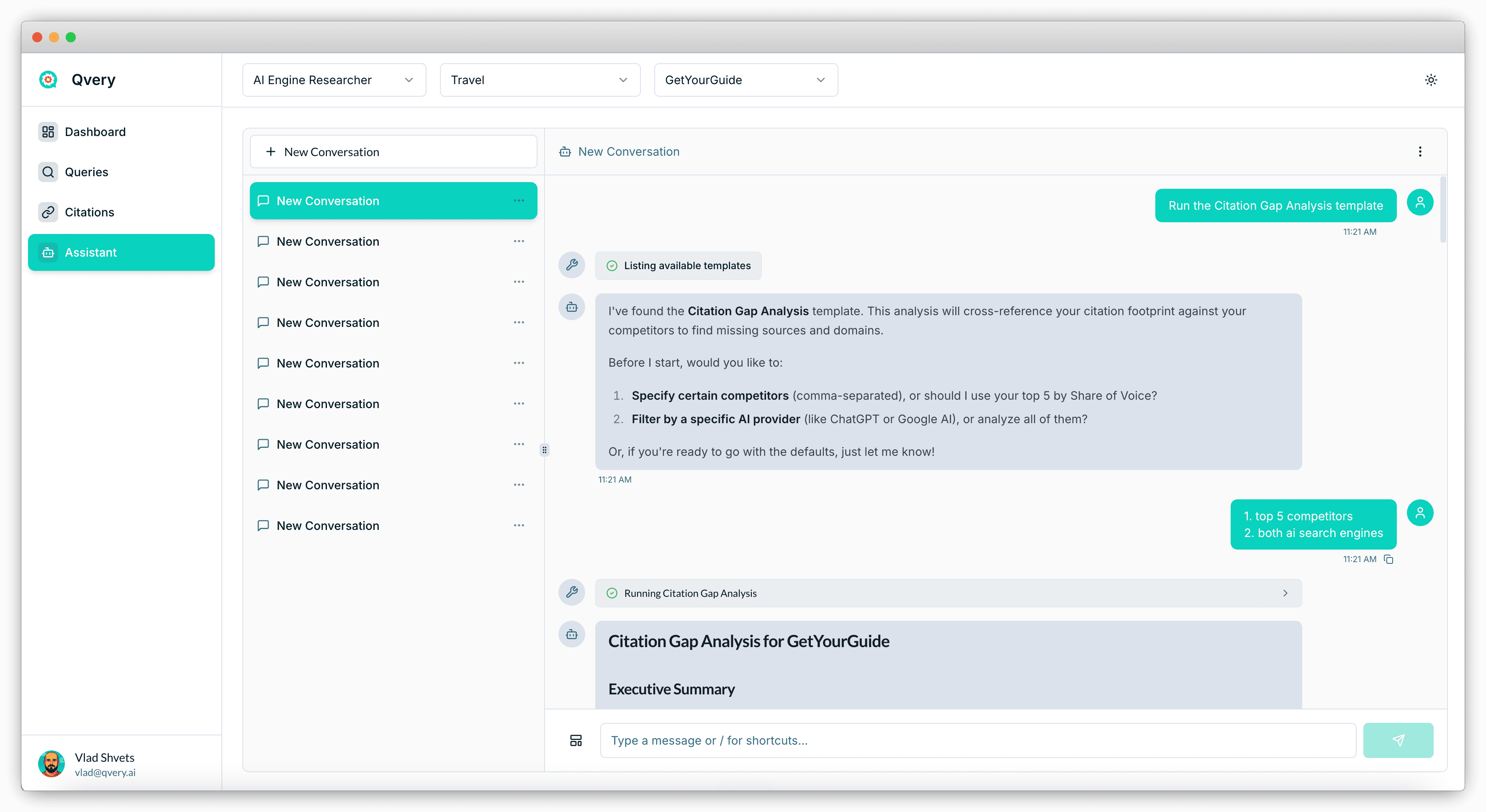
For GetYourGuide, the gap analysis surfaced specific Forbes Advisor and editorial pages where Viator, Klook, and Withlocals were cited and GetYourGuide was not. Those become the outreach list. Half a day of analyst work, compressed into a 60-second template run, sorted by impact, ready to act on.
Citation Ownership: The Metric To Watch
Citation ownership is the percentage of total citation weight in your space that belongs to URLs on your own domain. It is the metric that replaces citation count, and the one that actually maps to control.
GetYourGuide owns 37 percent of citation weight across their tracked queries. That is high. Most brands we measure sit between 10 and 25 percent. Why ownership matters more than mention count: ownership is the only part of the citation footprint you fully control.
The pages on your domain, the schema you ship, the content you publish — these are levers you can pull directly. Third-party citations on Forbes, Reddit, or TripAdvisor are influenced, not owned. You can build the mentions, but you cannot rewrite the article when the editor changes their mind.
The end-state strategy is a balance: drive your owned citation weight as high as your category will support (heavy investment in blog content, help center pages, comparison pages, and structured data), and influence the remaining percentage through outreach, UGC presence, and partnerships. The brands that win sustained AI engine visibility are the ones treating both as ongoing programs, not one-time campaigns.
Prompt Examples For Citation Analysis
These prompts work inside Qvery Assistant on any account with at least 30 days of citation data.
Prompt 1: Run The Citation Audit On Your Top 200 URLs
"Run the Citation Audit template on my top 200 URLs across both ChatGPT and Google AI Mode. Categorize the citations by source type (own domain, competitor, community, editorial, software directory, other), identify the dominant content themes in each category, and recommend three specific actions I should take in the next 30 days based on what you find."
Prompt 2: Compare Your Citation Footprint Across Engines
"Generate a side-by-side citation footprint comparison between ChatGPT and Google AI Mode for [YOUR BRAND]. Show the top 20 domains for each engine, calculate the percentage overlap between the two lists, and identify domains that appear prominently in one engine but barely register in the other. Conclude with a one-paragraph read on whether my current citation strategy is balanced or skewed."
Prompt 3: Filter The Gap Analysis By Domain Type
"Run a Citation Gap Analysis against my top five competitors, then filter the output to show only editorial publications and independent blogs (exclude software directories, forums, and competitor domains). Sort the remaining gaps by citation weight and add a one-sentence outreach angle for each, based on what the page is currently about."
Prompt 4: Explain A Citation Ownership Shift
"My citation ownership dropped by [X] percentage points over the past 30 days. Pull the URLs and domains where I lost the most weight, identify any new high-weight citations that have appeared in my space during that period, and tell me whether the drop is a real shift in the conversation or a temporary fluctuation. Conclude with a recommendation: defend the existing footprint or pivot to the new sources."
The Bottom Line
Citations are a conversation you do not own. Most of your citation footprint lives on third-party sites. The analysis is about understanding which parts you can own, influence, or have to live with.
ChatGPT and Google AI Mode are not the same audience. They cite materially different sources — TripAdvisor and YouTube skew heavily to Google, text-heavy editorial skews to ChatGPT. Always check the citation list under each engine filter separately.
Top URLs and Top Domains tell different stories. URLs show specific influential pages; Domains show site-level aggregation. The interesting decisions usually surface when you read both.
Citation ownership is the metric to watch. Your domain's share of total citation weight is the only part of the footprint you fully control. Drive it up; influence the rest.
If you found this useful, check out the other webinars at qvery.ai/webinars. And if your citation footprint looks weird or you want a second opinion on a Top URLs list you cannot make sense of, email me at vlad@qvery.ai.
See you on the next one.