By
Vlad Shvets
Qvery Webinar #3: Building Mentions That AI Engines Trust
Hey, Vlad here. In our third webinar, we tackled the second pillar of AI Engine Optimization: third-party mentions. Not backlinks. Mentions. The distinction matters more than most marketers realize, and getting it wrong means you're optimizing for a game that ended two years ago.
If you missed the first two webinars, here's the quick version: in webinar one, we covered the three pillars of AI engine visibility. In webinar two, we went deep on optimizing your own website. This time, we're going beyond your own domain and looking at how to get your brand mentioned in the right places around the web.
Because here's the thing: you can have the best website in your industry, with perfect schema markup and enough information gain to make a data scientist weep with joy. But if nobody else on the internet is talking about you, AI search engines are going to treat your brand the way most people treat the terms and conditions: acknowledged, never actually read.
Mentions Vs. Backlinks: What Actually Changed
For the past decade, backlinks were the currency of the internet. The more high-quality sites that linked to you, the higher you ranked. SEO professionals built entire careers around link building. Agencies charged per link. Conferences held panels about link acquisition strategies. It was a whole economy — like the stock market, except the only commodity was hyperlinks and nobody was having any fun.
That era is winding down. Google has confirmed that backlinks have been devalued as a ranking factor. They still matter as a credibility baseline — you need some links to prove you're a real company and not a domain squatter with a dream — but the direct correlation between "more backlinks equals more traffic" has broken down.
What replaced it? Mentions.
A mention is exactly what it sounds like: your brand being referenced somewhere on the web. The critical difference is that a mention doesn't need a hyperlink. No dofollow, no nofollow, no link at all. Just your brand name appearing in a relevant context on a relevant page. And here's what matters:
Traditional SEO tools are blind to this. Ahrefs and Semrush are fantastic at finding backlinks. But if a website mentions your brand without linking to you, these tools can't see it. It's like trying to count how many people are talking about you at a party by only checking who's pointing at you.
AI search engines have no such limitation. When ChatGPT or Google AI Mode searches the web, it finds brands mentioned everywhere, with or without hyperlinks, and uses entity recognition to connect those mentions to the right companies. The AI already knows which website belongs to which brand. It doesn't need a hyperlink to figure that out.
The AI can even generate its own links. In the AI-generated response, the search engine might provide a hyperlink to your website even when none of the original sources had one. The AI connects the dots on its own. Handy, that.
Why This Matters For Your Strategy
The practical implication is straightforward. If you're still spending most of your outreach budget on acquiring dofollow backlinks, you're optimizing for a metric that matters less every quarter. Building contextual mentions on the right websites is the play now.
And "contextual" is the key word here. It's not just whether your brand appears on a page. The AI reads the whole picture:
The surrounding text and tone of the mention
Whether other brands are mentioned alongside you (and how)
How the content is structured and how authoritative it appears
Whether the mention is a genuine recommendation or a passing reference
Think of it this way: a backlink is a handshake. A contextual mention is a recommendation from a trusted friend. AI search engines treat them accordingly — and so should your marketing budget.
The Five Types Of Third-Party Mentions
Not all mentions are created equal. During the webinar, I broke down the major categories of third-party mentions, roughly ordered from highest value to lowest barrier to entry. Think of it as a menu where the appetizers are free but the entrees require you to build actual relationships with people. Terrifying, I know.
1. Competitor Listicles
These are the gold standard. When your competitors list you in their comparison pages, it signals to AI search engines that you're a legitimate player in the space. It's the digital equivalent of your rivals admitting you exist and might actually be good at what you do — which, depending on your industry, might require an act of Congress.
The catch: most competitor listicles are understandably biased. Every company puts themselves first and everyone else second. The smartest approach is to be objective:
Explain transparently where your product is a great fit and where a competitor's might be better.
Build relationships with competitors to keep these listicles accurate and up to date.
If everyone plays fair, the competition shifts to where it should be: sales, support, onboarding, and the actual product.
Counterintuitive? Sure. But the market rewards honesty, and so do AI search engines.
2. Partnerships And Adjacent Niches
These are mentions from companies you're not competing with: integration partners, companies in your supply chain, businesses in adjacent industries. You mention them, they mention you. Clear win-win, no competitive tension, no one needs therapy afterward.
If you have integration partners, product ecosystem partners, or companies you regularly collaborate with, there's almost no reason you shouldn't be cross-mentioning each other. It helps both sides with AI engine visibility and gives the search engines richer context about how your product fits into the broader ecosystem.
3. Affiliate Listicles
Professional affiliate marketers create comparison content for a living. They're not going to mention your brand out of the goodness of their hearts — they need a financial incentive. If you have an active affiliate program with competitive commissions, this can be a powerful channel for building mentions at scale.
Fair warning: the quality of affiliate content varies wildly. Some affiliate sites produce genuinely helpful, well-researched comparisons. Others produce content that reads like it was written by a thesaurus that fell down a flight of stairs. Be selective about who you work with, or you'll end up with mentions that do more harm than good.
4. Bloggers
Here's something that might surprise you: AI search engines often cite smaller, independent bloggers over large corporate websites. Why? Because bloggers tend to have unique opinions, specific experiences, and genuine perspectives that don't exist anywhere else. And that's exactly the kind of high-information-gain content that AI search engines are hungry for.
These are often industry veterans, niche enthusiasts, or practitioners who blog because they're genuinely passionate about your space. They're the sommeliers of your industry — they know things the big corporate wine lists never cover. Building relationships with them is worth the effort. You might even learn something.
5. Software Directories
This is the lowest hanging fruit. Getting listed on platforms like G2, Capterra, and Product Hunt is usually free or very affordable, and AI search engines actively pull reviews and scores from these platforms. If you haven't claimed your profiles, you're leaving easy visibility on the table.
What you need to do:
Claim and optimize your profiles on all major directories.
Encourage customers to leave honest reviews (emphasis on honest — fake reviews are the participation trophies of marketing, and everyone can tell).
Keep your information updated as your product evolves.
It's not glamorous work, but it compounds over time.
Using Qvery To Find The URLs That Actually Matter
Here's where Qvery becomes indispensable. Because not all mentions are equally valuable, and knowing where to get mentioned is just as important as getting mentioned at all.
In the Qvery Citations module, you can see every URL that AI search engines have been pulling in as citations for the queries you're tracking. Each URL comes with a citation weight: the percentage of times that specific URL gets used as a source across all your Qvery executions.
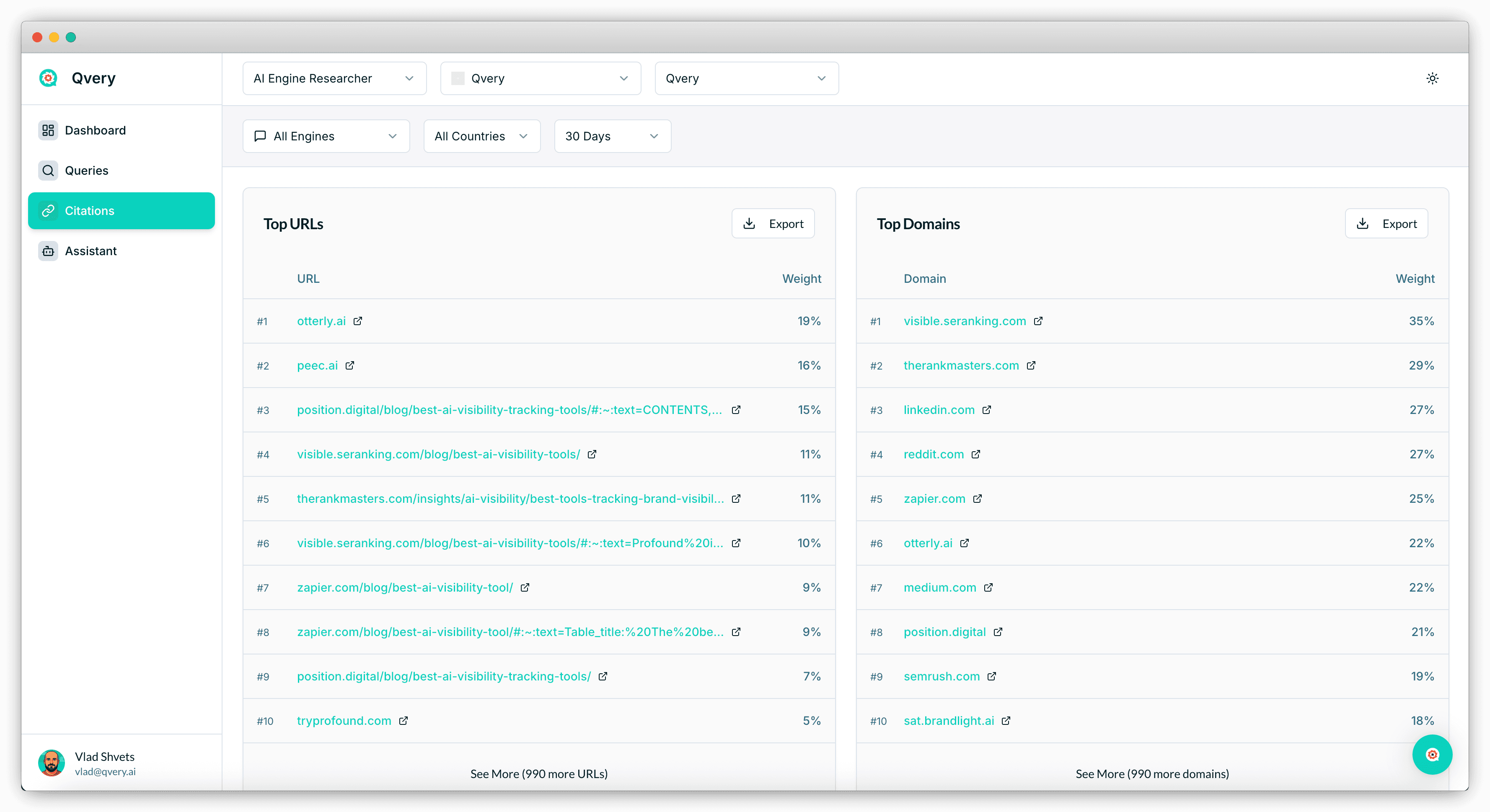
And here's the pattern that shows up every single time, regardless of industry: it follows an extreme Pareto distribution. A handful of URLs carry enormous weight — 10%, 15%, even 23% — while the vast majority sit at 1% or less. They got pulled in once or twice and that's it.
What this means for your outreach strategy:
Getting your brand mentioned on the three or four highest-weight URLs will have a dramatically bigger impact than getting mentioned on 50 low-weight pages.
You can filter citations by engine (ChatGPT vs Google AI Mode), by country, and by date range to get even more precise targeting.
Google AI Mode citations include URL fragments that point to specific passages, so you can see exactly which section of a page the AI found valuable.
This is like having a treasure map where X marks the spot, except the treasure is AI engine visibility and the map updates in real time. Traditional SEO tools give you a globe and say "good luck."
Citation Weight: The Metric That Replaced Domain Rating
In the old world of link building, we obsessed over domain rating (DR) and URL rating (UR). "Only build links from DR 50+ sites." Every SEO professional had their cutoff, every agency had their spreadsheet, and entire meetings were held debating whether a DR 48 site was worth the email. Peak civilization, really.
For mentions, the equivalent metric is citation weight. And it's a fundamentally better signal:
It measures actual influence. A page with 23% citation weight matters far more than a page with 1%, regardless of what Ahrefs says about either domain's rating.
It's based on real AI behavior. Citation weight is calculated from observing which URLs AI search engines actually use to generate recommendations — not from crawling backlinks.
Only Qvery can show it. Because we track the actual citations, not just the link graph.
The Complete Outreach Workflow
Now let me walk you through the entire workflow, from identifying targets to sending emails. Five steps. No MBA required.
Step 1: Export And Analyze Your Qvery Data
Go to the Citations section in Qvery, export your top URLs as a CSV, and then use an LLM like Claude or ChatGPT to categorize them. You want to identify listicles, comparison pages, blog posts, and other content where it would make sense for your brand to appear.
Step 2: Check Where You're Already Mentioned
Use Firecrawl (which has a generous free plan) as an MCP server connected to Claude to scrape these pages and check for your brand name automatically. The URLs where you're not yet mentioned are your outreach targets. Prioritize them by citation weight.
Step 3: Prospect Emails
I recommend AnyMail Finder for prospecting contact information. Upload your target domains as a CSV, select the department you want to reach (usually marketing or content), and let it find the right email addresses. It's like a phone book, except it actually works and isn't from 1997.
Step 4: Personalize Your Outreach
Generic outreach gets generic results — which is to say, no results. Use Firecrawl to pull content from each target website so you can reference specific articles, recent content, or company details in your emails. The more specific your outreach, the higher your response rate.
Step 5: Sequence And Send
For email sequencing and warmup, I recommend Instantly. It handles both the sending sequences and the IP warmup that ensures your emails land in inboxes rather than spam folders. Connect your email, set up your sequences, and let it run.
Prompt Examples For Analyzing Your Qvery Data
These prompts work with any exported Qvery citation data. Just paste your CSV into Claude or ChatGPT along with the prompt.
Prompt 1: Identify Listicles And Comparison Pages
"I have exported citation data from Qvery. This CSV contains URLs that AI search engines are using as citations, along with their citation weight percentages. Please analyze this list and identify all URLs that appear to be listicles, comparison pages, 'best of' roundups, or review articles. For each one, note the citation weight and categorize them by type. Sort the results by citation weight, highest first."
Prompt 2: Find Outreach Opportunities By Category
"Here is my exported Qvery citation data. Please categorize all URLs into the following groups: (1) Competitor websites, (2) Industry blogs and publishers, (3) Software directories and review sites, (4) Affiliate and comparison sites, (5) Forums and UGC platforms, (6) Other. For each category, sort by citation weight and highlight the top five URLs. My company is [YOUR COMPANY NAME] in the [YOUR INDUSTRY] space."
Prompt 3: Check Brand Mentions Using Firecrawl
"I have a list of URLs from my Qvery citation export. Please use Firecrawl to visit each of these URLs and check whether my brand [YOUR BRAND NAME] is mentioned anywhere on the page. Create a table with three columns: URL, citation weight, and whether my brand is mentioned (yes/no). Sort by citation weight, highest first, and highlight all URLs where my brand is NOT yet mentioned — these are my outreach targets."
Prompt 4: Generate Personalized Outreach Emails
"I have a list of target URLs where I want to get my brand mentioned. For each URL, please visit the page, understand the content and context, and draft a short personalized outreach email asking the site owner to include my brand. My company is [YOUR COMPANY NAME], we do [WHAT YOU DO], and our main differentiator is [KEY DIFFERENTIATOR]. Keep each email under 150 words. Offer to feature their company on our blog in return."
The Outreach Email Template
Here's a real template that worked well for a B2B software company we helped with mention building. It's short, direct, and offers mutual value. Adapt it to your industry and make it yours:
Hi [Name],
Nice to meet you. I'm [Your Name], [Your Role] at [Your Company]. We're a [one-sentence description of what you do].
I came across your article [article title or topic] and thought it was really well done. I'm reaching out because we'd love to explore a content collaboration. Specifically, we'd be interested in being featured in your [specific page or listicle], and in return, we'd be happy to feature [their company] on our blog.
Would you be open to a quick chat about this?
Best,
[Your Name]
Keep it short. Keep it honest. And always offer something in return. Nobody wants to do favors for strangers, but most people are open to mutually beneficial collaborations — especially when you lead with genuine appreciation for their work instead of a copy-pasted pitch that smells like it was written at 2am on a Tuesday. Which it probably was.
What We're Building At Qvery
Everything I just described as a manual workflow — exporting data, analyzing with LLMs, checking mentions, prospecting emails — we're building into Qvery as automated workflows. Because if there's one thing we believe at Qvery, it's that marketers already have enough homework. Tools track. Agents work.
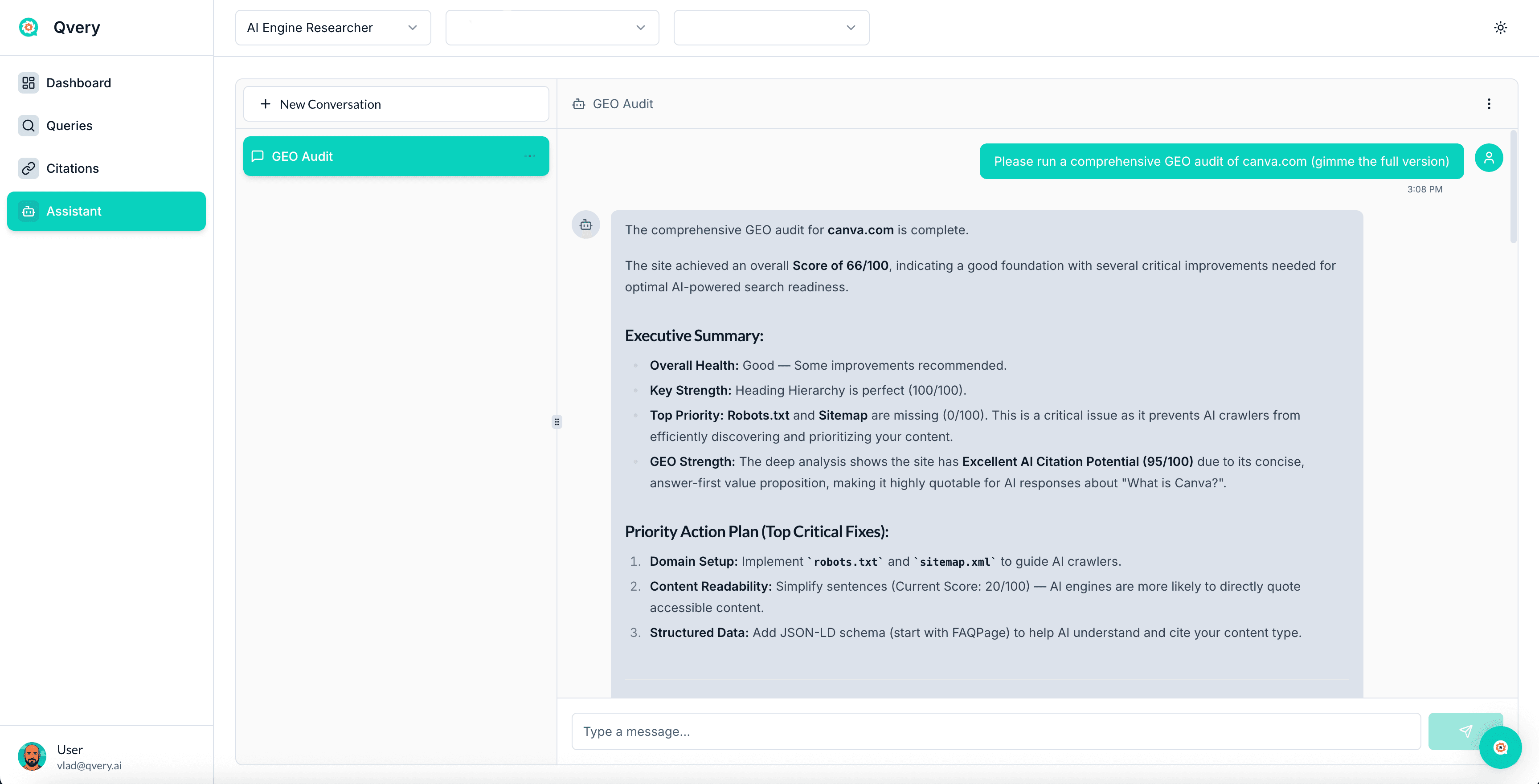
What's on the roadmap:
Automatic mention detection: Qvery will scrape every citation URL and tell you where your brand is already mentioned and where it isn't. No more manual checking.
Qvery Assistant: our built-in AI chat that lets you explore citation data conversationally. Ask it "show me the top 10 listicles by citation weight where my brand isn't mentioned" and get an actionable list in seconds.
Automated outreach workflows: from identifying targets to drafting emails, all inside Qvery.
The Bottom Line
Let me recap what we covered:
Mentions are the new backlinks. AI search engines use entity recognition to find your brand across the web, with or without hyperlinks. Building contextual mentions on high-value pages matters more than chasing dofollow links.
Not all mentions are equal. Citation weight tells you which URLs actually influence AI search results. Focus on the handful of pages that carry the most weight, not the long tail of 1% citations.
Five types of mentions to pursue: competitor listicles, partnerships, affiliates, bloggers, and software directories. Each requires a different approach, but all contribute to your AI engine visibility.
The outreach workflow is five steps: export from Qvery, analyze with LLMs, check existing mentions, prospect emails, and send personalized sequences.
Qvery is automating all of this. Mention detection, Qvery Assistant, and automated workflows are on the roadmap. The manual work gets easier every month.
If you found this useful, check out the other webinars at qvery.ai/webinars. And if you've got questions or want to share your own mention-building strategies, email me at vlad@qvery.ai. We genuinely read everything.
See you on the next one.