By
Vlad Shvets
Qvery Webinar #1: Understanding AI Engine Visibility
Your Brand Is Invisible (and You Don't Even Know It)
Here's a fun exercise. Open ChatGPT right now, type in what your company does, and see if it recommends you. Go on. We'll wait.
If your brand showed up — congratulations, you can close this tab and go celebrate. But if you got a confident list of recommendations and your company wasn't on it, welcome to the club. It's a big club. There are no T-shirts yet, but we're working on it.
The uncomfortable truth is that a growing number of your potential customers are asking AI for recommendations instead of Googling. And AI doesn't care about your Google Ads budget, your carefully optimized meta descriptions, or that blog post you spent three weeks writing about "the ultimate guide to [your industry]." It has its own way of deciding who gets recommended, and most brands have zero visibility into how that works.
That's what this post is about. We ran a webinar at Qvery breaking down what AI Engine Visibility actually is, how it's measured, what drives it, and what you can do about it. Consider this the no-fluff version.
First, Who's Talking
I'm Vlad, CEO and co-founder at Qvery. My background is in marketing and SEO, and for the past two years I've been helping brands figure out how to be discoverable on AI search engines. My co-founder Pjotr is the CTO and the technical mind behind everything we build.
Qvery was born out of this research and a simple mission: build AI agents for marketers that help brands measure and grow their visibility on AI search engines like ChatGPT and Google AI Mode. Not just dashboards. Not just tracking. Agents that actually help you take action.
The Question That's Giving CMOs Cold Sweats
"What should we do to rank in AI search engines?"
Company owners are asking their marketing teams. CMOs are Googling it (ironic, we know). Someone types the brand name into ChatGPT, it doesn't show up, and suddenly there's a fire drill. Meetings get called. Slack channels get created. Someone suggests "maybe we should make a TikTok."
This is exactly why the category of AI visibility tools appeared, and why we built Qvery. But measuring visibility is just the starting point. The real question is: how do you actually grow it?
That's what we're focused on. We're not building another analytics dashboard you'll check once a month. We're building AI agents that help marketers take action and improve their presence in AI search results.
Traditional Search vs. AI Search: Two Completely Different Animals
To understand AI Engine Visibility, it helps to see just how different AI search engines are from what we've been using for the past 25 years. And they are very different. Like, "moths and butterflies look similar until you actually pay attention" different.
Traditional Search (Google, 10 Blue Links)
You know the drill. You've been doing this since you were old enough to misspell things on the internet:
Keyword matching: You type a short query — "best CRM software" — and Google matches it to indexed pages.
10 blue links: You get a list of results. You click through, open a few tabs, compare information manually, and eventually make a decision (or give up and ask a friend).
Short queries: Most people search with just a couple of words because longer queries tend to produce noisy results.
Static rankings: Positions change slowly. You track your rank daily and celebrate moving from 8th to 7th place like it's a national holiday.
Manual research: You're doing the heavy lifting — opening pages, reading content, building your own shortlist. The search engine finds the pages; you do everything else.
AI Search Engines (ChatGPT, Google AI Mode)
Now forget everything you just read. Well, don't forget it — it's still useful context. But the mental model is entirely different:
Intent understanding: The AI takes your query and actually understands what you're looking for, not just the words you used. It's like the difference between asking a librarian for "books about dogs" and telling your smartest friend "I'm thinking about getting a medium-sized dog that's good with kids and doesn't shed too much."
Query fan out: Your single query gets broken into dozens or even hundreds of variations, each approached from a different angle. You asked one question; the AI is quietly researching fifty.
Passage-level retrieval: The search engine doesn't just find pages. It extracts specific passages, compares information across sources, and synthesizes a complete answer. It's doing the homework you used to do with twelve open tabs.
Complete answers: Instead of a list of links, you get a direct recommendation. No clicking through multiple pages. No "10 best CRM tools" listicles where you scroll past eight paragraphs of filler to find the actual list.
Conversational queries: People search with longer, more natural questions. The more context you give, the better the output.
Probabilistic results: Recommendations vary based on conversation history, location, language, and model. Two people asking about the same topic will likely get different answers. There's no "position 1" to obsess over anymore.
Here's the key shift: in traditional search, there are keywords, rankings, and positions. In AI search, there are use cases. Two completely different queries, phrased with entirely different words, can be about the same use case, and the AI understands that.
Results change daily. The data is dynamic and probabilistic, which is why tracking your visibility requires a fundamentally different approach. Your old SEO rank tracker? It's not going to cut it here.
The Three Pillars of AI Engine Visibility
So what actually determines whether your brand gets recommended by AI search engines? After two years of research and working with brands across industries, we've found it boils down to three pillars.
Think of it like a three-legged stool. Remove one leg and... well, you know what happens with two-legged stools. Nothing good.
Pillar 1: Your Own Website
Your website is still critically important. It's your opportunity to influence how AI search engines perceive your brand and your industry.
But — and this is a big but — what worked five years ago doesn't work anymore. The old playbook of massive websites, hundreds of pages, and skyscraper content that covers every basic topic? That era is fading. Publishing your 47th article about "what is CRM" when there are already ten thousand of them on the internet isn't impressing anyone, least of all an AI that has already read all ten thousand.
The key concept is information gain — a term from data science that essentially means: how much genuinely unique information does your page contain?
When AI search engines perform a web search, they're looking for information they don't already know. Read that again. They want what's new, what's different, what they can't get from the other 999 pages about the same topic. That means your content needs to include things like:
Real-life experiences and case studies
Unique data and original research
Your opinions and unique take on industry topics
Transparent comparisons and specific use cases
Generic content that simply covers the basics? It's going to be ignored. Not out of malice — the AI just doesn't need another explainer on what email marketing is. The fundamentals still matter: your site should be technically sound, well-linked, and authoritative. But the content itself needs to offer something the AI can't find anywhere else.
Pillar 2: Third-Party Mentions
Here's where things get interesting. Because of how AI search engines work — searching across multiple sources and comparing what different websites say — third-party mentions are incredibly important. Possibly more important than most marketers realize.
Think about how you make decisions as a human. If a company tells you they're the best, you nod politely. If three independent reviewers say the same thing, you start paying attention. AI search engines work the same way. They're automating the process of going to different pages, seeing what the consensus is, and generating recommendations based on that.
As marketers, this means building relationships with:
Bloggers and publishers in your industry
Influencers and affiliates
Even competitors — because transparent comparisons actually benefit everyone
That last one sounds counterintuitive, but it's true. When brands are interlinked and clearly explain how each product is different, the market gets split more evenly, and consumers (and the AI) get higher-quality information. It's a rare case where being generous with information about your competitors can actually help you.
Pillar 3: UGC (User-Generated Content)
If you want to know the single most important website on the internet right now when it comes to AI search, it's not some fancy industry publication. It's Reddit. Yes, Reddit. The same place where people argue about whether a hot dog is a sandwich.
Reddit is responsible for roughly 15–20% of all citations — the URLs that AI search engines pull from to generate recommendations. Both Google and OpenAI get data from Reddit through the Reddit API directly. The search engines know that Reddit is a goldmine of genuine, unfiltered opinions and recommendations from actual humans.
And here's what's important: it's not just about being mentioned in old Reddit threads from months or years ago. AI search engines check for recency. They want to see fresh mentions — like threads from this week or last month — to make sure the information is still current. An old thread praising your product from 2022 is nice, but a thread from last Tuesday carries significantly more weight.
For brands, this means having a strong enough product and community that people are naturally talking about you on platforms like Reddit and TripAdvisor. It's one of the harder pillars to influence (you can't exactly make people post about you on Reddit without things getting awkward), but it's also one of the most powerful.
How Qvery Measures All of This
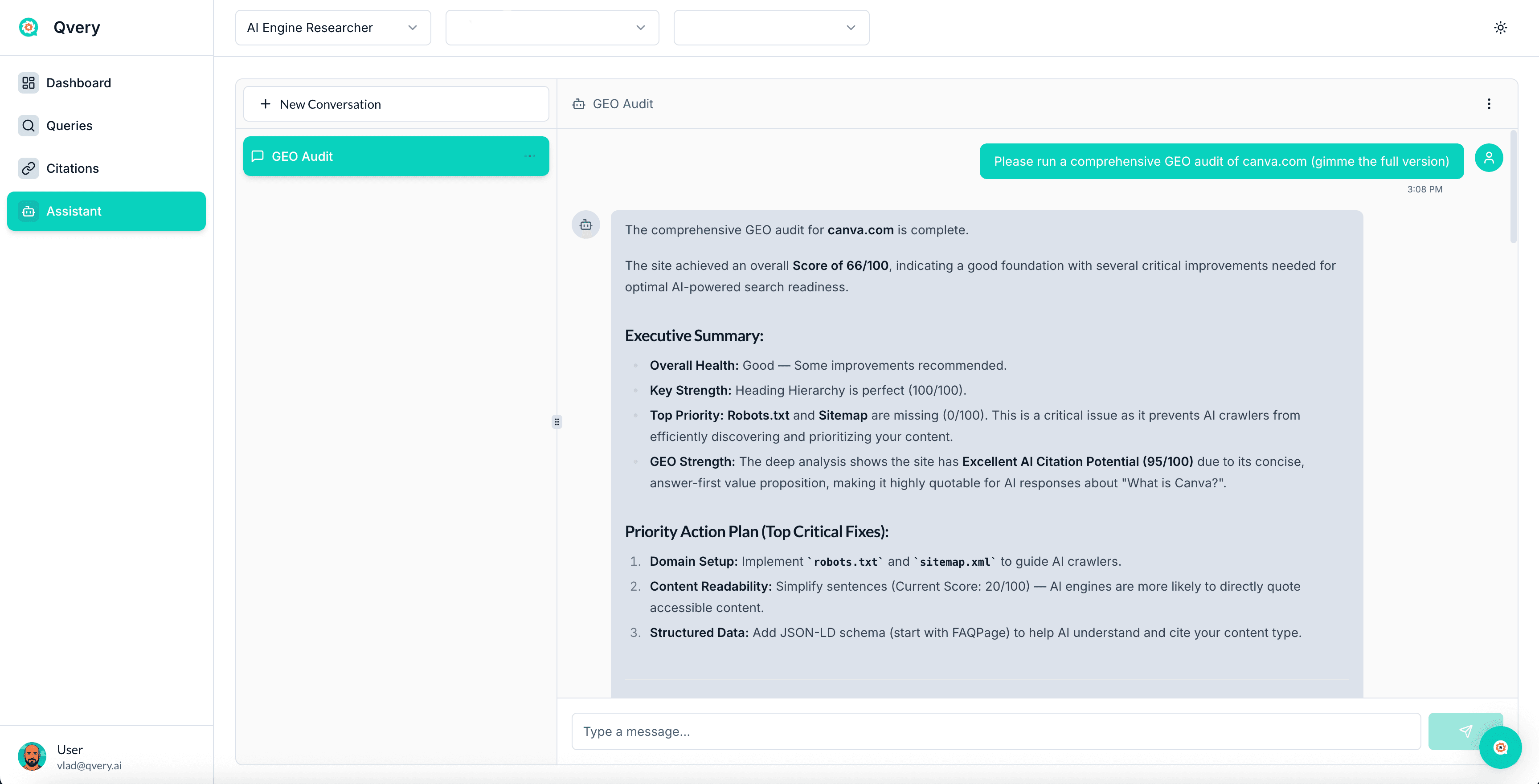
Theory is nice. But at some point you need to actually measure what's happening. That's where Qvery comes in.
We've broken down AI Engine Visibility into a few core metrics that give you a clear picture of where you stand:
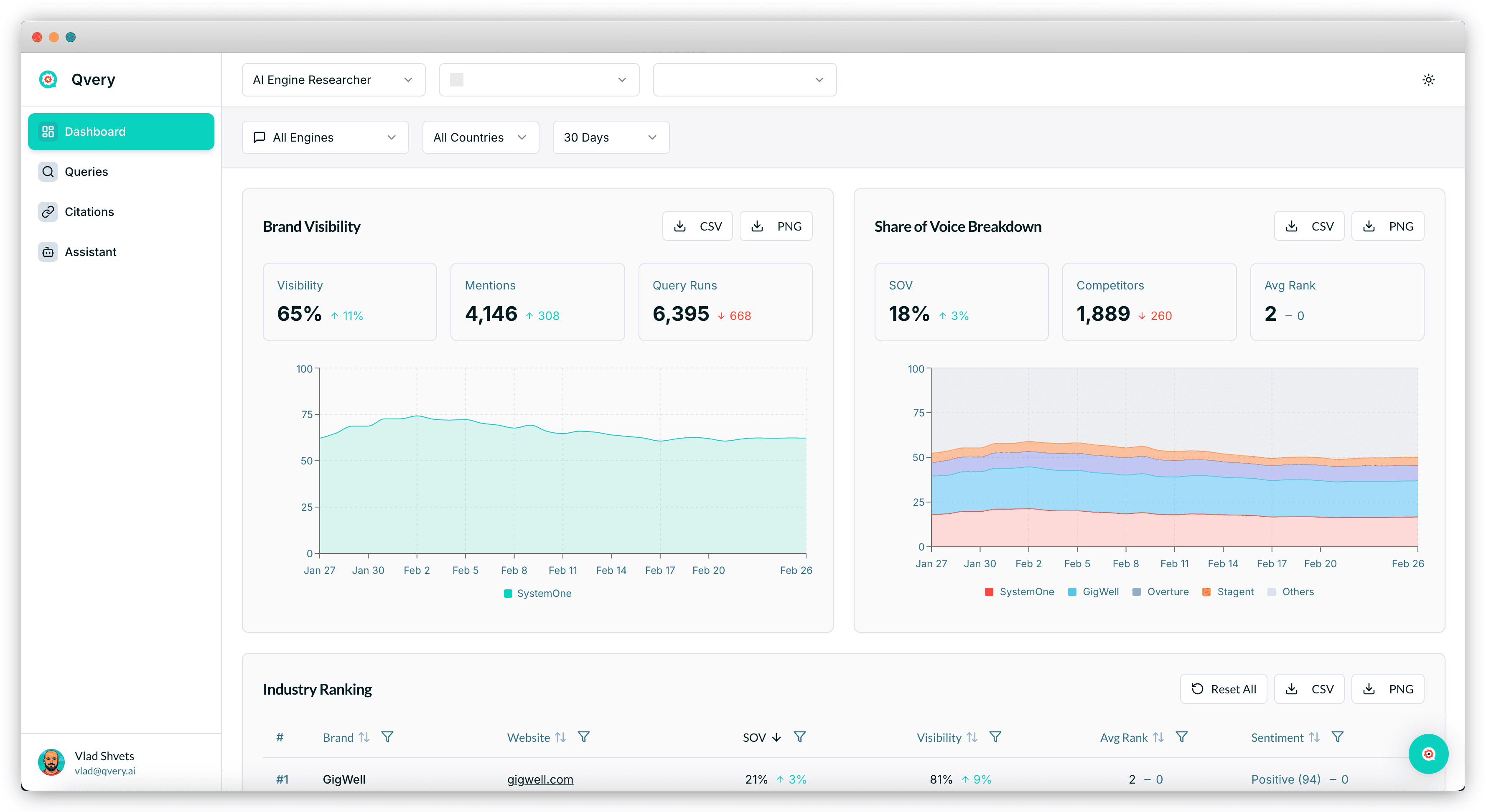
Brand Visibility — The percentage of queries where your brand gets mentioned. If your visibility is 64%, it means that out of all tracked queries, your brand appeared in 64% of AI-generated responses. Simple, clear, and occasionally terrifying when you realize how low it is.
Share of Voice — A more nuanced metric that accounts for the total number of brand recommendations and your position within those recommendations. More mentions plus higher positions equals higher share of voice. Think of it as visibility with weighting.
Average Rank — When your brand does get recommended, where does it typically appear in the list? An average rank of 2 means you're usually the second recommendation. Not bad. Not first, but not bad.
Drilling Down: Engines, Countries, and Topics
One of the most powerful things about Qvery is the ability to slice your visibility data in ways that actually reveal something useful. You can check your visibility across:
All engines combined, or specifically on ChatGPT or Google AI Mode
Different countries, because your visibility can vary dramatically by market
Different topics and use cases, grouped by related queries
For example, a brand might have 35% visibility on ChatGPT but 90% on Google AI Mode. That's a massive discrepancy, and understanding why is where the strategic insights live. Maybe ChatGPT relies more heavily on certain sources. Maybe your competitor has a Reddit army and you don't. The data tells the story.
Topics, Queries, and Executions
At Qvery, we group similar queries into topics because, as we discussed, different queries can represent the same underlying use case.
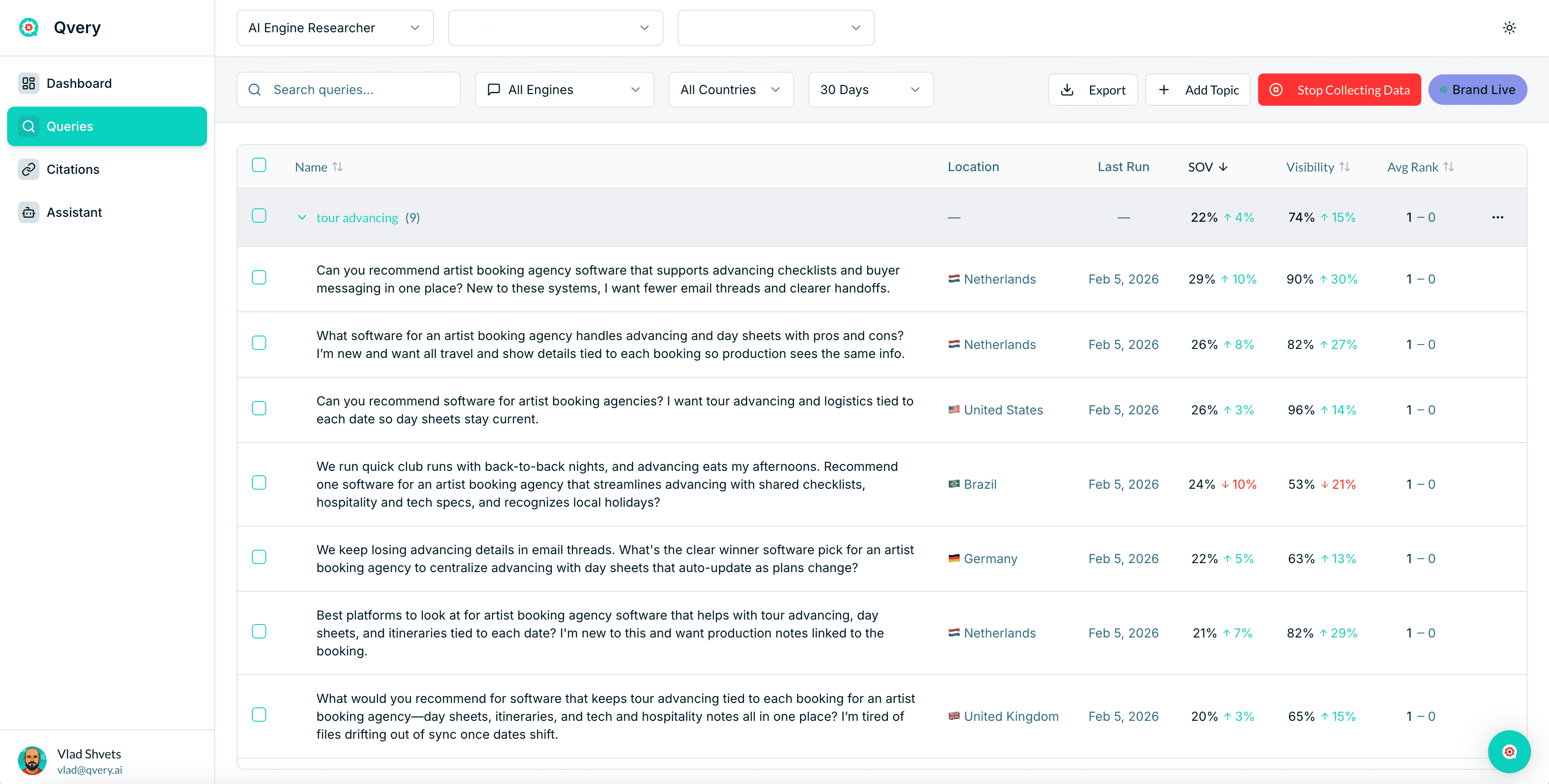
Each topic shows cumulative share of voice and visibility, giving you the big picture. But you can also drill down into individual queries to see:
Which brands are getting recommended for each specific query
How the actual AI-generated responses (we call them executions) change daily
Which citations the AI search engines are pulling from
Share of voice breakdown between competing brands
This granular view is where Qvery becomes truly powerful: it lets you understand not just if you're visible, but why, and what you can do about it. Because knowing you have 35% visibility is interesting. Knowing which specific citations are making your competitor more visible — that's actionable.
What's Coming Next
This post covered the foundations: what AI Engine Visibility is, how it works, and the three pillars that drive it. If you've made it this far, you now understand this space better than most marketing teams we talk to. Seriously.
In upcoming webinars and posts, we'll go deeper into each pillar:
How to optimize your website for AI search engines (hint: it's not what you're used to)
How to build third-party mentions and run effective outreach
How to leverage UGC platforms strategically, without being that brand on Reddit
The AI agents we're building at Qvery to help automate this process end-to-end
Head over to qvery.ai/webinars for all recordings, transcripts, and updates. And if you have questions, reach out through the chat on our site or email me at vlad@qvery.ai. We read everything, and we're genuinely happy to help.