By
Vlad Shvets
Qvery Webinar #2: Optimizing Your Website For AI Search
Hey, Vlad here. In our second webinar, we went deep on the most important pillar of AI Engine Optimization (AEO): your own website. Yes, the thing you already have. The thing you've probably been neglecting while chasing backlinks and praying to the algorithm gods. Turns out it matters more than everything else combined.
In the first webinar, we covered the big picture: how AI search engines differ from traditional search, and the three pillars every brand needs to focus on. If you haven't watched it yet, I highly recommend starting there.
This time I walked through the specific strategies and concepts you need to get right if you want your website to show up when someone asks ChatGPT or Google AI Mode about your industry. No fluff, no buzzwords: just what actually works.
Keywords Are Dead. Queries Are Everything.
Let me start with this. On AI search engines, there are no keywords. There are only queries. (If you just felt a small existential crisis about your entire SEO career, that's completely normal.)
Every person searches differently. Some type a couple of words. Others write detailed, granular questions. Some use voice search. And AI search engines personalize the results based on the context, location, and even the conversation history of each user.
Two people searching from the same location are likely going to get different results. There's no such thing as ranking for queries. There's only being discoverable for specific search intent.
AI search is probabilistic. The real question is: what's the probability that your brand shows up when someone searches for a given intent, no matter how they formulate the actual query?
Backlinks Vs Contextual Mentions
Another massive difference between traditional SEO and AEO is how backlinks work.
A few years ago, backlinks were basically the currency of the internet. Website owners traded links, SEO specialists tried to game the system, and companies grew web traffic by acquiring more links. It was a whole rat race. (Think of it as the internet's version of trading baseball cards, except less fun and with more spreadsheets.)
On AI search engines, links still matter, but not nearly as much as before. What's far more important is being mentioned in the right places around the web, and being mentioned contextually.
It's not just the mention that matters but also the surrounding text, the whole context of your mention. And oftentimes there's very little difference whether there's a link pointing to your website or whether it's an unlinked mention.
AI search engines use entity recognition. If your brand name is mentioned positively somewhere on the web, even without a hyperlink, the AI can connect that mention to your company entity. It already knows your website. And it might recommend your brand with a link to your site, even if none of the original sources had hyperlinks.
Chasing backlinks alone doesn't make sense anymore. Building contextual mentions where it matters is the play.
Structured Data And Schema Markup
This falls squarely under good old SEO, and good SEOs have been doing this for years. What's changed is the importance and the potential ROI of implementing it properly. Think of it as eating your vegetables: everyone knows they should, almost nobody does it well, and the AI search engines are now checking your plate.
Structured data and schema markup is basically an HTML tag you put in the header of your website that allows AI search engines to come to your site and, instead of scraping the content, just grab the structured information from the header. Faster retrieval, faster contextualization of what your page is about.
If you want AI search engines to read and understand a particular page faster, create an FAQ schema or another type of schema depending on your content, and implement it properly.
At Qvery, we have an FAQ schema on our main page covering all the basics: what is Qvery, who is it for, what is AI Engine Researcher, how does Qvery work, and so on. All the answers together are under 5,000 characters, and we dropped the FAQ schema right in the header of the page.
You can validate your schema using the Rich Results Test from Google. Just put your URL in there and check if your schema is implemented correctly.
A few tips on schema markup:
Implement FAQ schemas on your main page and key product pages.
Don't overdo it. If you add FAQ schema to every single page on your website, it's going to lead to a subpar user experience and probably be too much for the search engines.
Use it wisely and strategically on the pages that matter most.
Ease Of Retrieval: Think In Passages, Not Pages
This is one of the biggest mindset shifts you need to make. AI search engines don't retrieve entire pages. They look at which sections of your page are relevant for what they're searching for and they retrieve a specific chunk. A passage. A fragment.
AI search engines retrieve based on the passage level. You should really think about your content as passages and fragments and sections of a page instead of thinking about only individual pages.
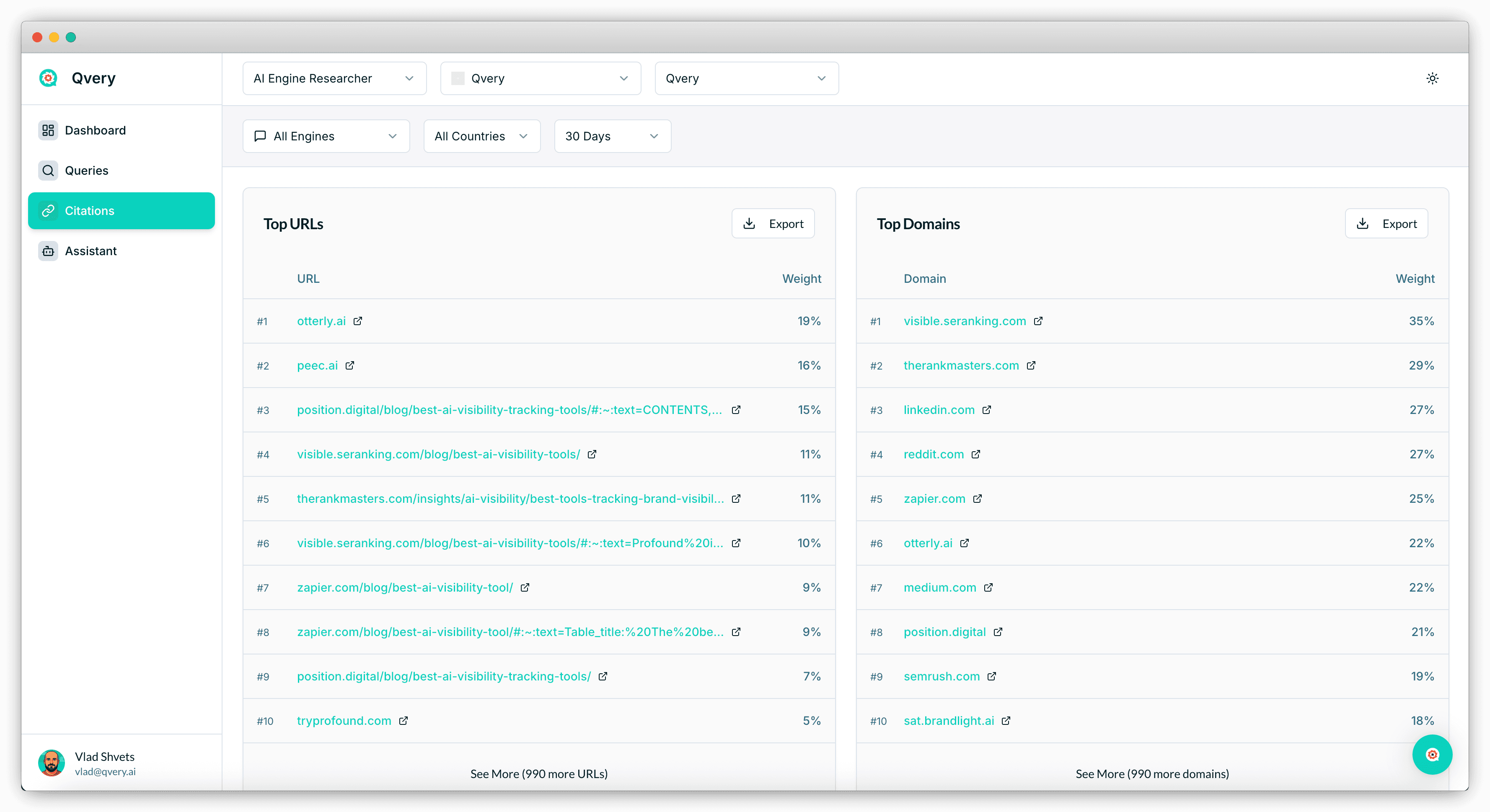
In Qvery, you can actually see this in action. If you go to the Citations section and look at Google AI Mode citations, you'll see that it's not just pulling in full URLs. It's pulling in specific page fragments, specific sections of your content that are relevant to a given query.
So when you think about ease of retrieval, think about how you structure your content, how you break down sections of your web pages, and how you break down your web pages overall. Instead of having one massive product page that covers everything, consider multiple shorter, focused pages that are easier to retrieve. Each of those pages could also have its own FAQ schema to make it even easier for AI search engines to contextualize.
Information Gain: Create Content That Doesn't Exist Yet
Information gain is a technical term from data science. It means the percentage of genuinely new information on a given page.
When you search anything on AI search engines, there are two ways they might answer. If you ask about history or well-known facts, the AI already has that in its training data. But if you ask about software recommendations, e-commerce, recent trends, anything connected to real life or modernity, it's going to perform a web search. And when it does that web search, it's looking for information it doesn't yet know.
What you're supposed to be thinking about as a brand is: how do we create content that doesn't exist yet? Case studies, opinion articles, unique research, tutorials. Anything that isn't part of the training data and is genuinely useful to users.
Five or 10 years ago, skyscraper content and comprehensive guides used to work amazingly well. Not anymore. Content creation has been commoditized. Everyone and their intern can produce "The Ultimate Guide to [Literally Anything]" and they have. It's not about the length of your article or the number of words. It's about the information gain. How much unique value are you adding?
Topical Authority And Content Gaps
This ties closely to information gain but goes beyond it. You have to go deep on topics. You have to explain things in depth.
If your audience is large, there are probably different segments. Some people are very knowledgeable, some are just getting started. Not all content has to be for experts. You can create beginner tutorials with high information gain that explain things from a fresh perspective. And you can also have deep expert content.
Your whole web property needs to clearly explain why you're the expert. What your credentials are, what your experience is, what you know. This matters both for human readers and for AI search engines, because they use entity recognition to determine whether a company is an authority in a given subject.
Credibility Signals
Here's where backlinks still play a role. If your website is completely unlinked from the rest of the web, even if you have amazing content with high information gain and FAQ schemas everywhere, your site isn't going to get crawled by the AI search engines because it isn't linked anywhere.
Think of backlinks as a credibility baseline. You need to be on the map. You need to show that you're a legitimate brand with some web presence and that other websites link to you. Once that baseline is established, then you're competing based on your content quality, information gain, and all the other variables.
Using Qvery To Optimize Your Website
Now let me walk you through how to use Qvery data to actually put all of this into practice.
Step 1: See which pages AI search engines are pulling from your site.
In Qvery, go to the Citations section and filter by your own domain. You'll see all the pages and page fragments that ChatGPT and Google AI Mode have been pulling in as citations over the past 30 days. Look at the citation weight for each URL: that tells you how frequently that page gets pulled in relative to all your query executions.
Step 2: Export your citations and analyze them with an LLM.
Export your citation data from Qvery and then use an LLM like Claude or ChatGPT to find patterns. Below are some generic prompts you can use as a starting point.
Prompt Examples For Analyzing Your Qvery Data
These prompts are designed to work for any website. Simply export the relevant data from Qvery and paste it into your preferred LLM tool.
Prompt 1: Analyze Your Own Site Citations
"I have exported citation data from Qvery for my website. This CSV contains all the URLs and page fragments from my site that AI search engines (ChatGPT and Google AI Mode) have been pulling in as citations over the past 30 days, along with their citation weight percentages. Please analyze this data and tell me: (1) Which pages have the highest citation weight and why they might be performing well, (2) What patterns you see in the type of content that gets cited most frequently, (3) Which pages have low citation weight and what might be improved about them, (4) Any content themes or formats that seem to work particularly well for AI search engines."
Prompt 2: Content Gap Analysis Using Competitor Citations
"I have exported the top 1,000 cited URLs across my industry from Qvery. This includes URLs from both my website and competitor websites, along with citation weight percentages. Please compare the content that competitors have which my site does not. Identify landing pages, blog posts, or content types that competitors are getting cited for that I am missing entirely. Give me a prioritized list of content I should create based on what is working for competitors in AI search."
Prompt 3: Content Planning Based On Citation Patterns
"Here is my exported citation data from Qvery along with my current content plan [PASTE CONTENT PLAN OR SITEMAP]. Please compare the two and tell me: (1) Which topics from my content plan are already being cited by AI search engines, (2) Which planned topics are not yet being cited and might need a different approach, (3) What new topics should I add to my content plan based on what AI search engines are actively looking for in my industry, (4) Which existing content should I rewrite or improve to increase its citation weight."
Qvery Assistant: The Future Of Automated Workflows
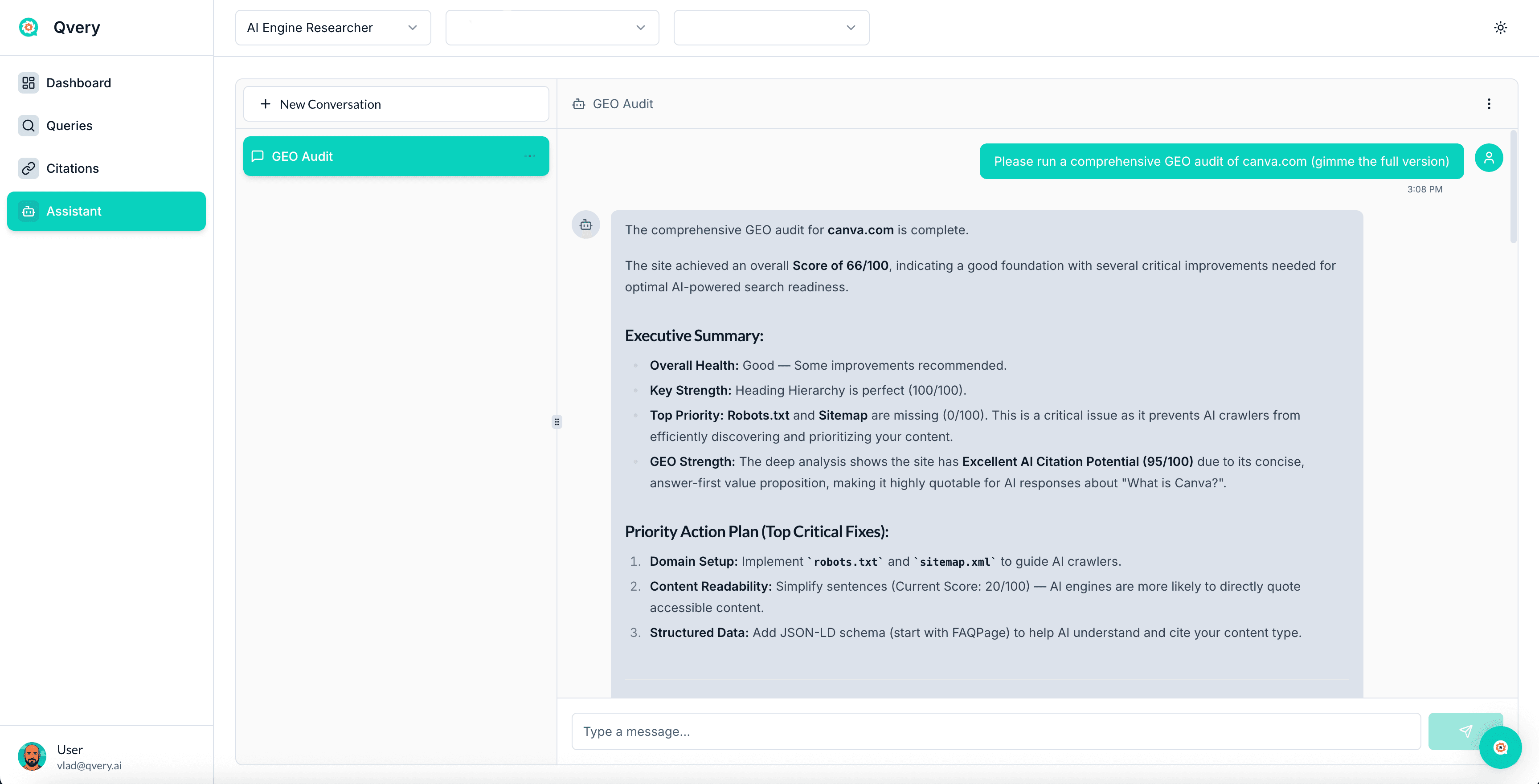
One more thing I wanted to show in the webinar is Qvery Assistant. This is our built-in AI assistant that's going to allow you to both explore Qvery data and run complex marketing workflows directly from the platform.
Qvery Assistant will have access to all of your Qvery data, powerful MCP connectors, and external web tools. We're building a library of templates: pre-made workflows that you can run with just a text command.
The first template we built is a GEO Audit. You can ask Qvery Assistant to generate a comprehensive GEO audit for any website, and it will go to that site, scrape content from different places, and put together a full audit in real time covering metadata quality, accessibility, heading structure, sitemap, and more.
Everything I've explained in this webinar as manual steps you take with LLMs, we're already building into Qvery as automated workflows. Content Optimizer, Mention Builder, UGC Agent: it's all on the roadmap.
The Bottom Line
Let me recap the key takeaways from this webinar:
Structured data and schema markup: make your website easy to retrieve with properly implemented FAQ schemas on your key pages.
Ease of retrieval: think in passages, not pages. Structure your content so AI search engines can pull specific, relevant sections.
Information gain: create content that doesn't exist yet. Unique case studies, original research, expert opinions. That's what AI search engines are looking for.
Topical authority: go deep on your topics, cover different audience segments, and make it clear why you're the expert.
Credibility signals: make sure your website has a baseline of backlinks and web presence so AI search engines know you exist.
The foundations we covered are here to stay. The tactics and implementation will keep evolving, and that's exactly what we're building at Qvery: AI agents that do the optimization work for you on autopilot.
If you come up with new ways to use Qvery data or interesting prompts you've applied to your citation exports, let us know. We'd love to share them with the community.
Thanks for watching, and see you on the next webinar.