By
Vlad Shvets
Qvery Webinar #9: Content Gap Analysis For AI Search
In our ninth Qvery webinar, we tackled content gap analysis — the workflow that turns "what should we write next quarter" from a brainstorm into a sorted list.
Most content planning is a buffet at a wedding: pile a lot on the plate, hope something works, eat the cake later. Content gap analysis flips that. It tells you which articles your competitors are getting cited for, which topics you have not touched, and which competitor pages you could outrank with a better version of the same idea.
The reason this matters: blog content is the single largest source of citations in AI search. Across the brands we measure at Qvery, more than half of every citation comes from blog posts and content pages.
Your blog is doing the heaviest lifting for your AI engine visibility, whether or not your content plan reflects that.
This webinar sits between webinar two — the first pillar of AI engine visibility, your own website — and webinar three, the second pillar, third-party mentions. Gap analysis is where the two meet. You're identifying the content your own site needs so it can be cited the way your competitors already are.
Why Blog Content Is Your Biggest Citation Lever
The homepage matters, but it caps out fast. A homepage tends to get cited for one or two queries — the ones explicitly about your brand. Blog content scales differently. A single well-written guide can be cited for dozens of queries across the topic it covers, and the citation weight compounds as the article ages and accumulates context signals.
For our demo, we used Audley Travel — a luxury travel agency competing against Black Tomato, Abercrombie & Kent, Scott Dunn, AndBeyond, and Micato Safaris. Audley's overall position in AI search is moderate. They show up. They are not invisible.
But they are losing share in exactly the queries that matter most — the "non-traditional" luxury travel queries, the themed guides, the destination-specific recommendations. Which, for a luxury travel brand, is a bit like a sommelier losing to ChatGPT on wine pairings.
When we ran the gap analysis, the diagnosis was unambiguous: the competitors were winning by publishing themed guides and destination expertise pages that Audley simply did not have. The gap was not in raw keyword coverage. It was in citation-grade blog content on the topics AI engines were already pulling from.
The Wrong Way To Plan A Content Calendar
The standard playbook for content planning has not really changed since 2015. Open Ahrefs or Semrush. Export the keywords. Layer in some intent buckets. Argue about whether a 1,500-volume keyword is worth more than a 600-volume one. Schedule three posts a week. Ship.
The problem is that keyword volume measures what people typed into traditional Google. It does not measure what AI engines actually cite when answering questions in your space. A topic with high keyword volume might never appear as a citation. A low-volume topic might be the single highest-cited blog post in your industry. Volume and citation weight are different metrics, and the gap between them is where most content programs quietly underperform.
The right input for an AI-era content calendar is citation data. Which URLs are AI engines pulling from when they answer queries in your space? Which of those URLs belong to you? Which belong to competitors? Which exist in your space at all? Those are the questions that drive a calendar that compounds in AI search.
How The Content Gap Analysis Template Works
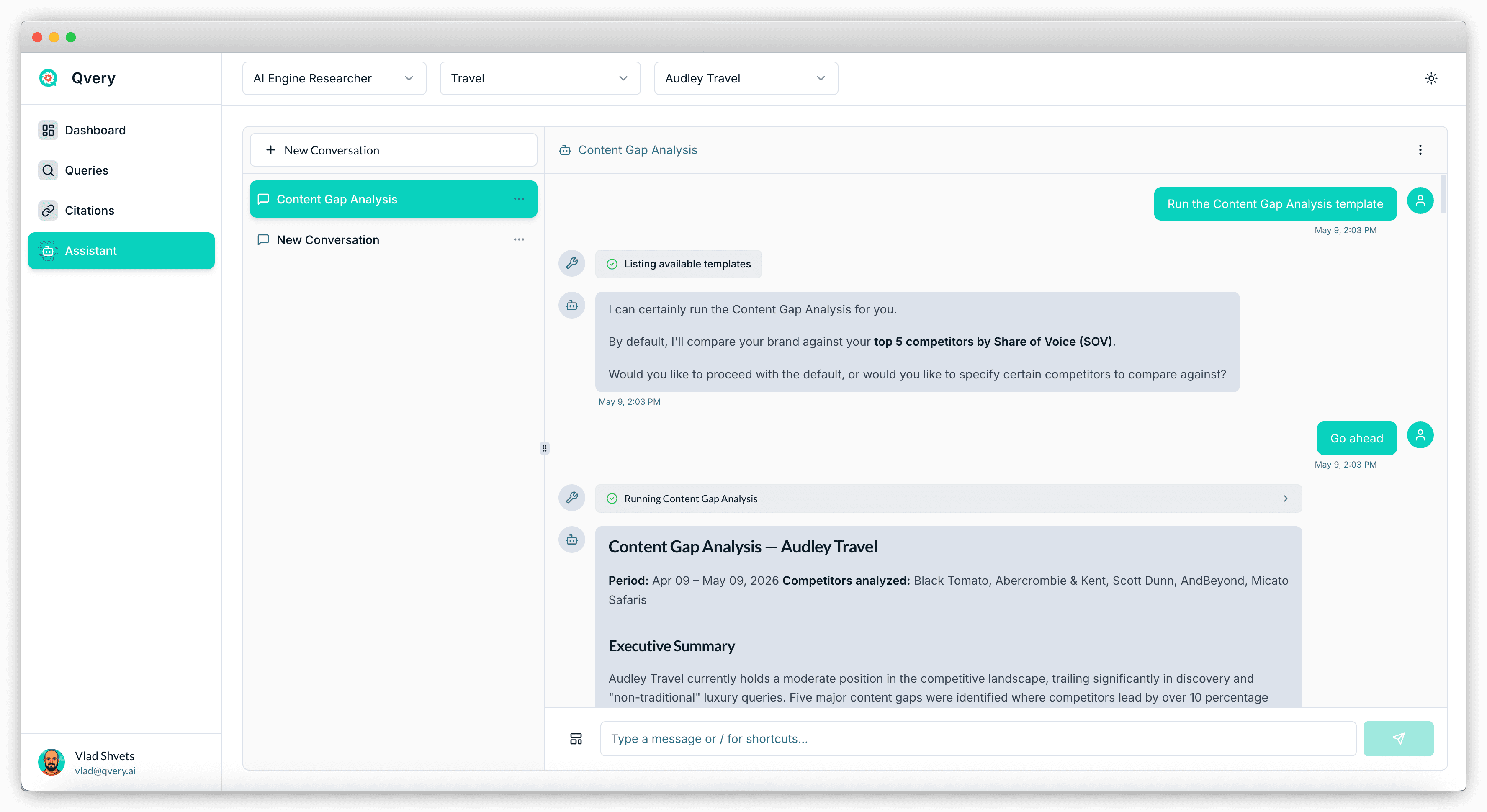
The Content Gap Analysis template lives inside Qvery Assistant. The inputs are simple — your brand is already known to the account, and you either accept the default (top five competitors by share of voice) or specify a custom competitor set. The template does the rest: pulling citation data, dispatching agents to crawl competitor content, and matching what AI engines cite against what each brand has published.
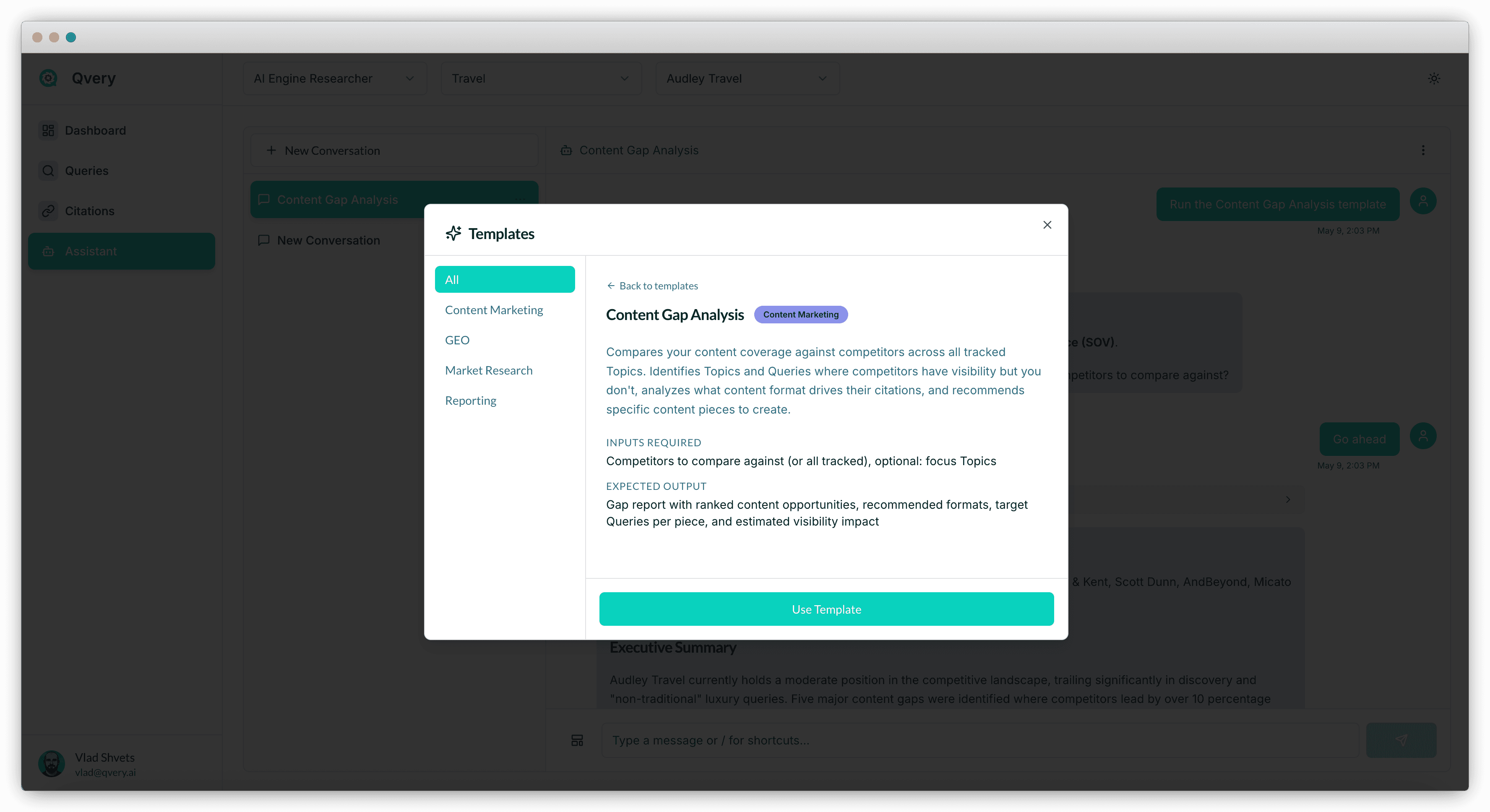
The output is a structured report: an executive summary, a list of ranked content opportunities with format recommendations, the target queries each piece should rank for, and an estimated visibility impact per piece. For Audley Travel, the gap analysis ran against the top five competitors and produced a punch list of five major content gaps where competitors led by more than 10 percentage points of share of voice.
You are, right now, reading a blog post that was built using exactly this logic — a webinar adapted into a citation-grade article on a topic AI engines are increasingly asked about. The recursion is real, and intentional.
Outrank Existing Citations Via Information Gain
Here is the most counterintuitive idea in this whole post: the best content opportunities are not the topics nobody has covered. They are the topics where a high-citation-weight competitor article already exists, and you could write a better one. Publish where citations already are.
Why? Because AI search engines are looking for the single best source on a topic. If an article exists with strong citation weight, that is a signal the AI is already willing to cite that topic — the question is just which article it cites. A new article with more information gain — more original perspective, more recent data, more granular advice — can displace the existing citation. It is not a 12-month SEO play. It is a write-the-better-paragraph play.
To find these opportunities, ask Qvery Assistant for the highest-citation-weight blog posts on competitor domains. The template does not surface this by default. The follow-up prompt does.
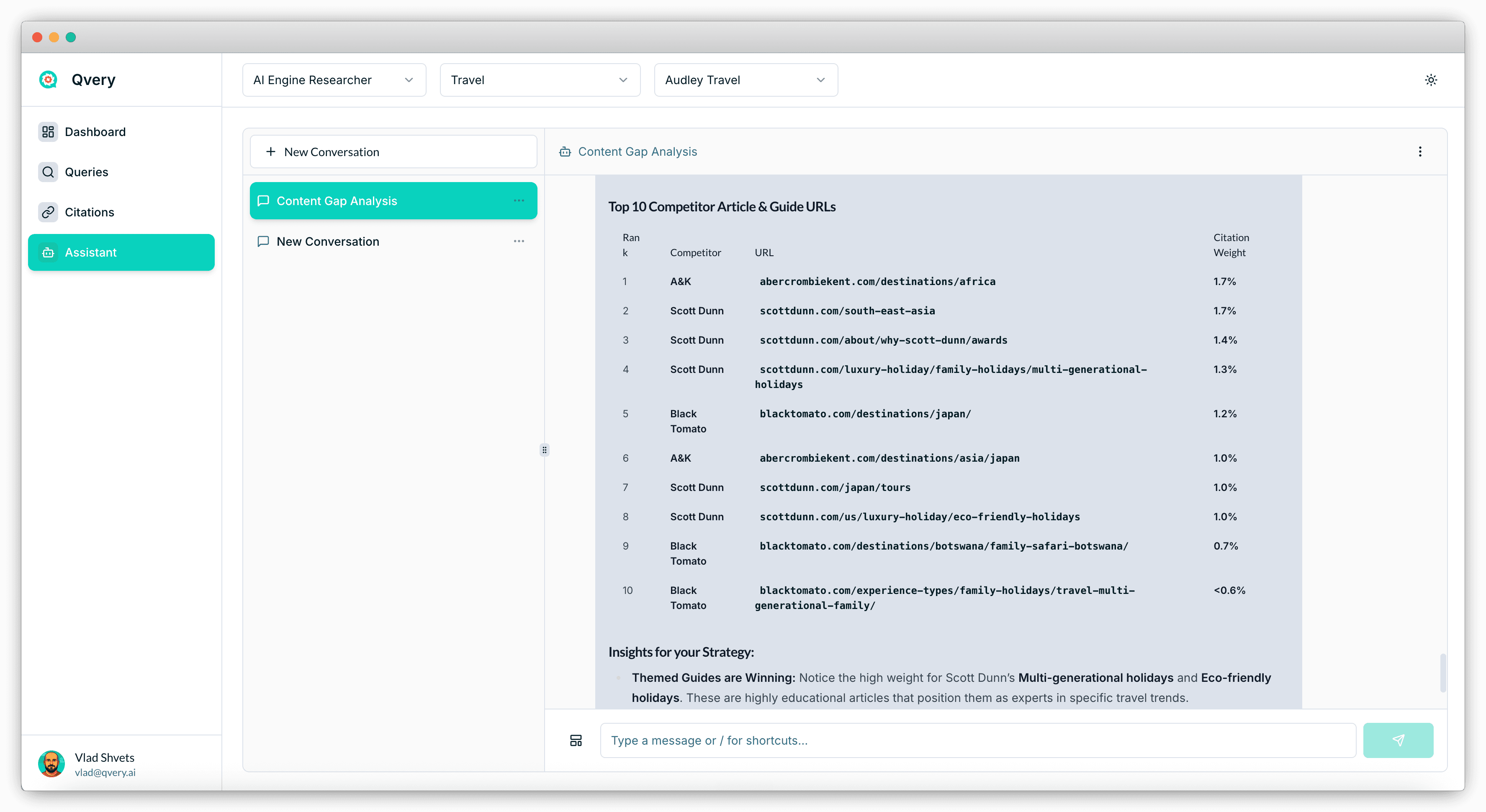
For Audley, the pattern was clear immediately. Scott Dunn's themed guides — multi-generational holidays, eco-friendly holidays — were carrying disproportionate citation weight. Abercrombie & Kent's destination-deep-dive pages were doing the same for specific regions. Audley had general destination pages but no themed guides at this level of depth. The content plan wrote itself: produce destination-themed guides that outclass the existing competitor versions, ship them as the new authority, and watch citation weight migrate.
This is the same logic that has worked in traditional SEO for a decade. Information gain wins. The difference now is that the audience is an AI agent, not a human reader, and the agent is reading more pages, faster, with less patience for filler.
Prompt Examples For Content Gap Workflows
These prompts work inside Qvery Assistant once you have at least 30 days of citation data. Adjust the bracketed placeholders for your brand and industry.
Prompt 1: Run Gap Analysis Against A Specific Competitor
"Run the Content Gap Analysis template comparing [YOUR BRAND] against only [COMPETITOR NAME]. Focus the analysis on topics where the competitor has more than 15 percentage points of share of voice over me. Output the top five content gaps with recommended formats, target queries, and a one-paragraph brief I could hand to a writer."
Prompt 2: Surface The Top 20 Competitor Blog Posts By Citation Weight
"Pull the top 20 blog posts and guide pages on competitor domains that are currently driving the most citations in my industry. Sort by citation weight, show the URL and the competitor it belongs to, and group by content theme. Highlight any themes where three or more competitors are winning with the same format."
Prompt 3: Generate A Full Outline For A Specific Gap
"From the gap analysis you just produced, take the highest-impact content opportunity and write a complete article outline for it. Include the primary query it should rank for, three secondary queries, a recommended structure (H1 through H3), the unique angle that would beat the existing competitor citations, and a 100-word draft of the opening paragraph."
Prompt 4: Convert The Gap Report Into A 12-Week Content Calendar
"Take the gap analysis report and turn it into a 12-week content calendar. Each week, list one article to ship: title, target queries, recommended word count, and which competitor citation this piece is intended to displace. Order the calendar so the highest-impact pieces ship first. Flag any weeks where a single competitor is over-represented so I can balance the calendar."
The Bottom Line
Blog content is more than half of your AI citations. Across every brand we measure, blog and guide pages out-cite the homepage, the product pages, and the pricing page combined. Plan your content calendar like that is true, because it is.
Keyword tools are the wrong input. Volume measures what people typed into Google. Citation weight measures what AI engines actually pull from. They are different metrics. Plan from citation data.
Publish where citations already are. The best opportunities are not untouched topics — they are topics where a high-citation competitor article already exists and yours could be better.
Themed guides win in luxury verticals. The Audley example is industry-specific, but the pattern generalizes — depth-of-expertise content beats breadth-of-coverage content for AI engine citations.
The template plus the follow-ups is the full workflow. Run the Content Gap Analysis template, surface competitor blog posts by citation weight, generate outlines, and convert the whole thing into a quarter of calendar — all inside Qvery Assistant, all in one chat.
If you found this useful, check out the other webinars at qvery.ai/webinars. And if you ran a content gap analysis and want a second pair of eyes on the gaps — or if you have built a follow-up prompt inside Qvery Assistant that surfaced something interesting — email me at vlad@qvery.ai.
See you on the next one.