By
Vlad Shvets
The Self-Listicle Playbook for SaaS: How to Build a Best-Tools Roundup Like the Ones AI Engines Cite
Vendors' own best-tools roundups were cited in at least 49.00% of direct SaaS buying answers. What the cited ones put on the page, and how to build yours.
Vendors' own best-tools roundups were cited in at least 49.00% of direct SaaS buying answers. What the cited ones put on the page, and how to build yours.
Vendors' own best-tools roundups were cited in at least 49.00% of direct SaaS buying answers. What the cited ones put on the page, and how to build yours.
If you market a SaaS product, someone has probably asked you to publish a best-tools roundup for your category, with your own product on the list.
Before you write it, look at the roundups the AI engines already cite.
We asked ChatGPT and Google AI Mode two kinds of SaaS buying question in September 2026: direct best-tools questions and buyer-evaluation questions, across paired needs in CRM, payroll, help desk, accounting and other categories. Then we opened every cited vendor page to check whether it was one of these roundups.
The short version: a vendor's own best-tools roundup was cited in at least 49.00% of direct best-tools answers and at least 45.50% of buyer-evaluation answers. The cited roundups name competitors, state their criteria and carry a comparison unit such as a multi-product table, in both kinds of answer.
These describe pages that were cited. We coded no uncited roundup, so nothing here says any of these choices gets a page cited. What you can do is build each roundup to what the cited ones document, as your own editorial choice, and then measure it on both kinds of question.
AI Engines Cite Vendors' Own Best-Tools Roundups on Both Kinds of Buying Question
Here is what counted as a vendor roundup, and it doubles as the build spec. It is a page on a SaaS company's own site that recommends or compares tools of one product category, includes the publisher's own product, and presents at least three tools in a list, ranking, comparison or table.
Two coders read every candidate page blind, and a third settled their disagreements. A sample drawn from outside the pages they read turned up no roundup the first pass had missed.
By that test, a vendor roundup was cited in at least 49.00% of direct best-tools answers and at least 45.50% of buyer-evaluation answers, each a share of all the answers of that type, both engines pooled. Those are floors, because some answers cited a vendor page the coders could not settle and no confirmed roundup.
The citations are spread thin. No single vendor's roundups were cited by more than a handful of direct best-tools answers, and in buyer-evaluation answers only one vendor's were. We leave that vendor unnamed.
PromptRush's SaaS page describes where the shortlists come from: "AI engines build those shortlists from review sites like G2 and Capterra, comparison articles, Reddit threads and your own product pages, so a strong Google ranking doesn't guarantee a mention."
Our data confirms the part about vendors' own pages, and narrows it to their roundups. It measured no share for review sites, comparison articles or Reddit, so it says nothing about how those compare.
For how much of SaaS category answering runs through vendor sites in general, see SaaS AI answers run on vendor sites, not review sites.
Name Your Competitors and State Your Criteria
The coders also recorded what each cited roundup put on the page. Two of those records bear on how you write yours.
Competitors named. A competitor counts when the page names a product from another company as a tool the reader could use. Among the cited roundups the coders could settle, none was documented without one, in either kind of answer. A few could not be settled from the part of the page the coders read.
Criteria stated. Criteria count when the page uses them, or tells the reader to use them, to choose, rank or compare. They were documented on cited roundups in both kinds of answer.
A few direct best-tools roundups were documented without them; among the buyer-evaluation roundups the coders settled, none was. Some in each could not be settled.
Those are records of what cited pages carry, not reasons they were cited.
Our recommendation, and it is ours rather than a finding: publish your criteria, apply them to every entry including your own, and name the real alternatives in your category. A roundup that holds its own product to the same criteria as everyone else's has a claim to be credible.
PromptRush makes a related point about pages that put you beside competitors:
Clear "[you] vs [competitor]" and "[competitor] alternatives" pages give AI a source that includes you.
Read at its strongest, that says comparison and alternatives pages hand an AI engine a source with your product in it. It says nothing about ranking yourself or how to choose the competitors, and we don't attribute that to it.
Our cited roundups include the publisher by definition and name competitors, which fits the idea. But that is co-occurrence on pages that were cited, not evidence that including yourself gets a page cited. A two-product page that sets you against one competitor also falls outside what we counted, which needed at least three tools.
Kaleigh Moore, writing on LinkedIn, argues that "AI Overviews favor comprehensive content that addresses the initial query and the likely next questions." We collected ChatGPT and Google AI Mode answers, not AI Overviews, and coded cited pages only, so this data cannot say what any engine favors.
Put the Comparison in a Table
The third record is the comparison unit: the part of the page that sets several products against each other. It was measured two ways, and the two are kept apart because they check different things.
The page text. The coders documented all three units on cited roundups in both kinds of answer: a multi-product table, a structured ranked list, and repeated product cards, one card per tool.
Each was also documented absent on other cited roundups, so none of the three is universal, and some pages could not be settled either way. The ranked list was the code the two coders agreed on least.
The raw page. A script read the whole served HTML of each cited roundup. In both kinds of answer, it found tables of at least three rows and two columns, ordered lists or numbered headings, repeated heading cards, and ItemList structured data.
That audit reads markup shape, not content. A table it finds may not hold products, and anything a script draws after the page loads is invisible to it, so "not found" never means absent.
We don't rank the units against each other. The records say each one exists on cited roundups, not which matters more, and not that any of them gets a page cited.
Our recommendation, again as editorial advice: lead with one multi-product table that gives every product the same fields, then write one entry per product beneath it.
No Case Here for Separate Roundups by Question Type or Engine
A natural next question is whether direct best-tools questions and buyer-evaluation questions need different roundups. Before collecting, we predicted the direct questions would cite vendor roundups at least one and a half times as often.
At least 49.00% of direct best-tools answers and at least 45.50% of buyer-evaluation answers cited a vendor roundup. Count every answer that cited an unsettled vendor page and no confirmed roundup as a roundup answer, and the figures would be 68.00% and 62.00%.
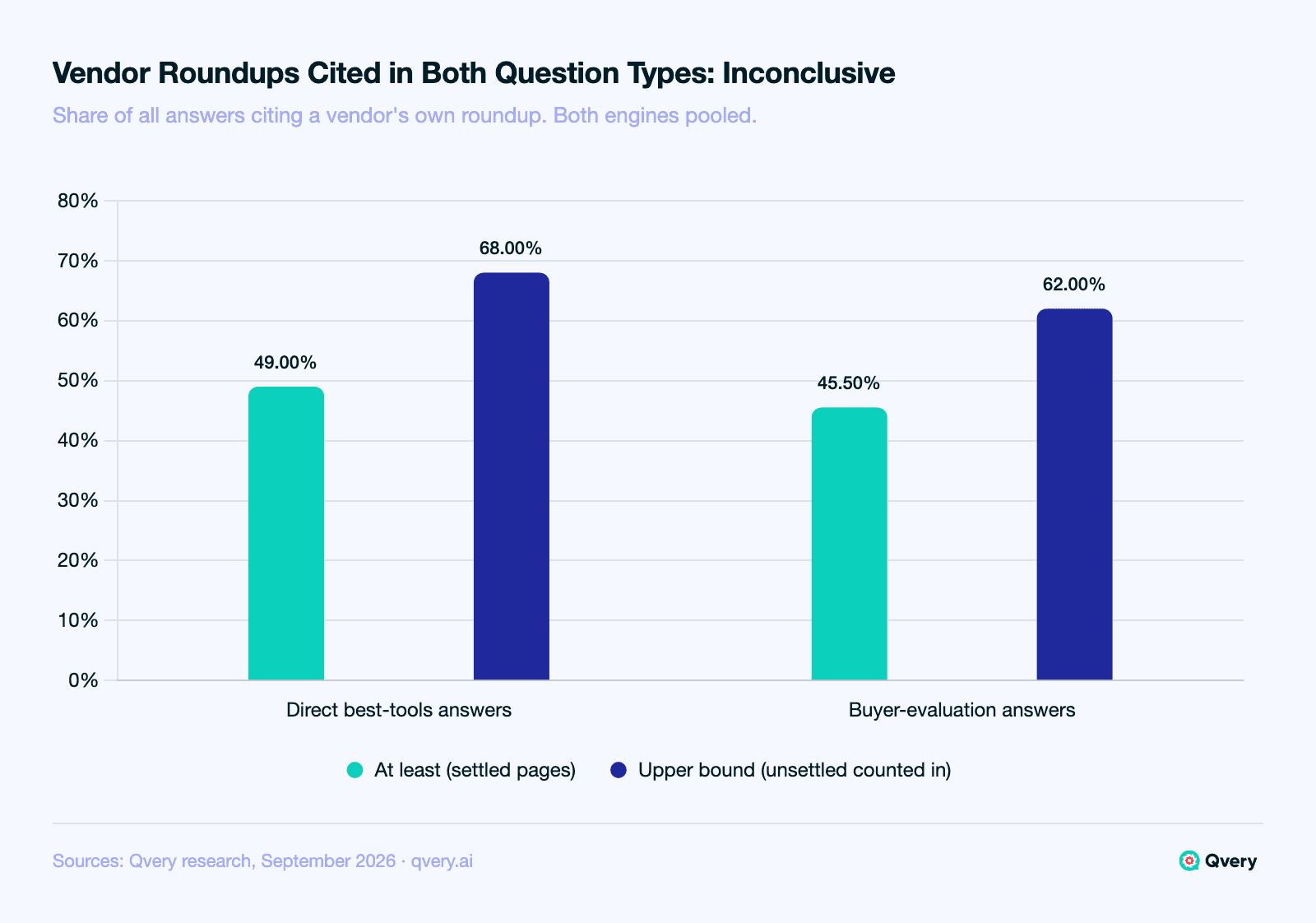
However those unsettled answers resolve, the gap never reaches one and a half times. They could still land in the band we call equivalent or in the band we call indeterminate, so we claim neither a difference nor that the two are the same.
The engines read the same way. At least 48.75% of ChatGPT answers and at least 45.00% of Google AI Mode answers cited a vendor roundup, both question types pooled. No way the unsettled answers resolve produces a one-and-a-half-times gap between them, and nothing here shows they are equivalent either.
Nathan Ojaokomo notes that "Different AI platforms pull from different sources." This data tests one event, a vendor roundup being cited, and for that event it finds no engine gap of that size. It does not test his broader claim.
So on this evidence, don't split a roundup by question type or by engine.
Measure It on Two Lists
Where the two kinds of question do part ways is in the rest of what they cite. That matters for measurement, not for how you build the page.
For each question type we built a list of domains, adding at each step the domain that covered the most answers not yet covered, until the list reached 80% of the answers that cited any source. The direct best-tools list holds 36 domains and the buyer-evaluation list 38, with 8 on both.
The buyer-evaluation list covered 40.82% of the direct best-tools answers that cited any source. The direct best-tools list covered 41.33% of the buyer-evaluation answers that cited any source.
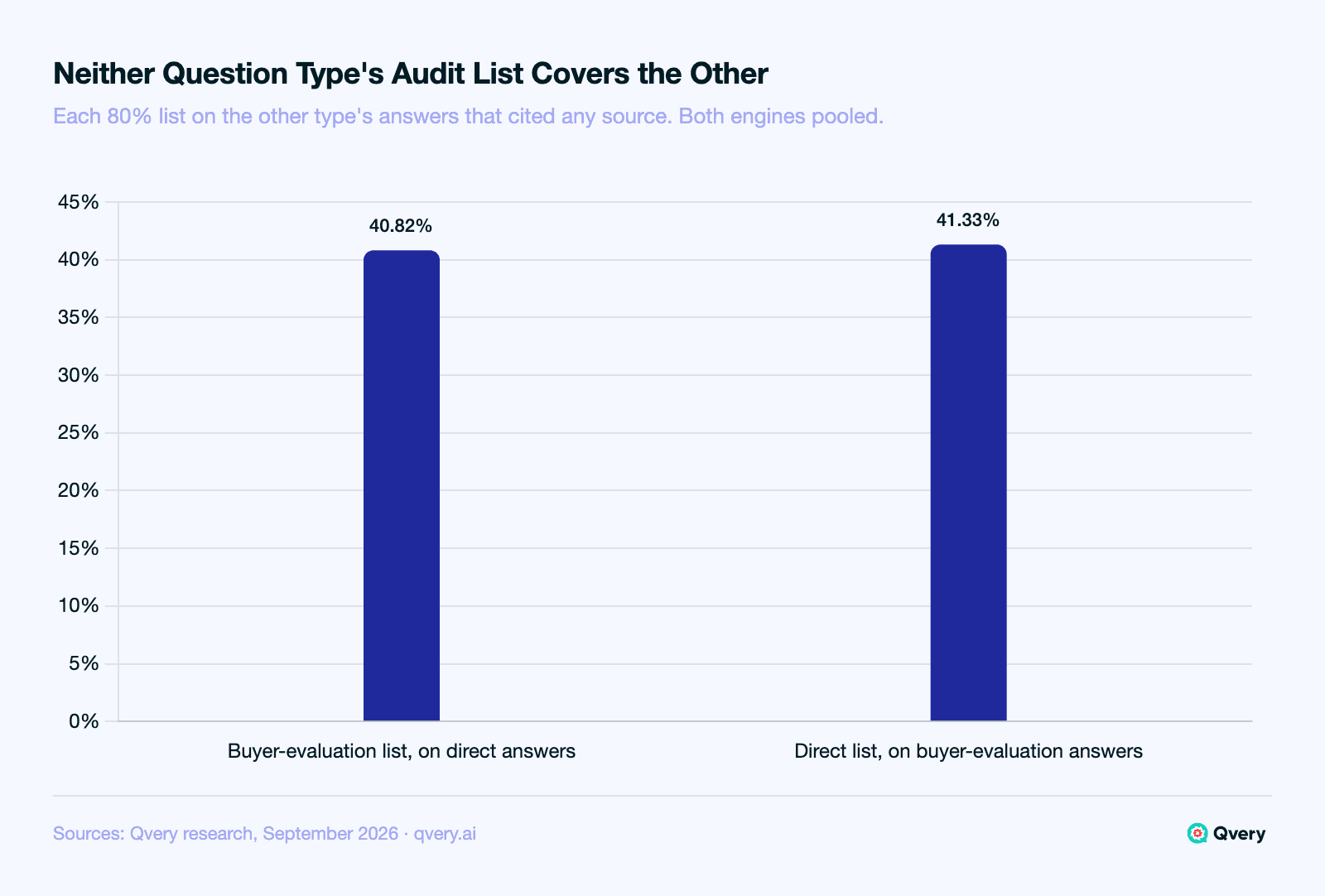
The lower figure, 0.4082, is under our 0.60 bar for a shared list, so each question type needs its own list. These lists count every cited domain, reddit.com, youtube.com and capterra.com among them, so a domain's place on a list does not make it a roundup publisher.
The eight domains on both lists: bitwarden.com, buildertrend.com, buildium.com, capterra.com, clockify.me, reddit.com, youtube.com and zapier.com. The full lists, in the order they were built:
Direct best-tools, 36 domains: youtube.com, reddit.com, zoho.com, zapier.com, squareup.com, capterra.com, docusign.com, guides.reviews, help.salesforce.com, bamboohr.com, basedash.com, bitwarden.com, churchtrac.com, dropbox.com, gartner.com, itechguides.com, microsoft.com, uschamber.com, actionstep.com, apps.shopify.com, bankreconciler.app, buffer.com, buildium.com, canny.io, charitydigital.org.uk, clickup.com, clockify.me, gymdesk.com, hostinger.com, support.ironcladapp.com, veeam.com, arch.tamu.edu, buildertrend.com, close.com, d2l.com, docs.helpscout.com.
Buyer-evaluation, 38 domains: reddit.com, shopify.com, youtube.com, zapier.com, learn.microsoft.com, stackbriefly.com, stackfyi.com, rippling.com, ramp.com, clio.com, guideflow.com, help.firstpromoter.com, medium.com, quickbooks.intuit.com, birdeye.com, bitwarden.com, buildium.com, capterra.com, clockify.me, cloudflare.com, fedena.com, help.zoho.com, justgiving.com, lever.co, pcmag.com, refiner.io, slack.com, technologyadvice.com, baadigi.com, buildertrend.com, capterra.com.au, choice.com.au, churchplanner.ca, clickreach.io, coggno.com, consumercat.com, facebook.com, fieldpulse.com.
This decides the scope of your tracking, not how many roundups to publish.
Writing the two question sets is covered in how to generate LLM tracking queries, and turning each list into an audit in how to run a citation gap analysis. Getting onto other publishers' roundups is a different route, covered in mentions are the new backlinks for SaaS.
Track Whether Your Roundup Is Cited in Qvery
Once the roundup is live, the question is whether it shows up. Add both question sets to Qvery as queries, the direct best-tools questions and the buyer-evaluation questions, either directly or through Qvery Assistant.
Qvery tracks visibility, share of voice and average rank on both sets daily across ChatGPT and Google AI Mode, in 200+ countries.
Every citation is tied to the query and engine that produced it, so you can see whether your roundup's own URL is among the citations on each list.
To ask instead of filter, open Qvery Assistant in the app and ask about your own visibility, share of voice or citations in plain language.
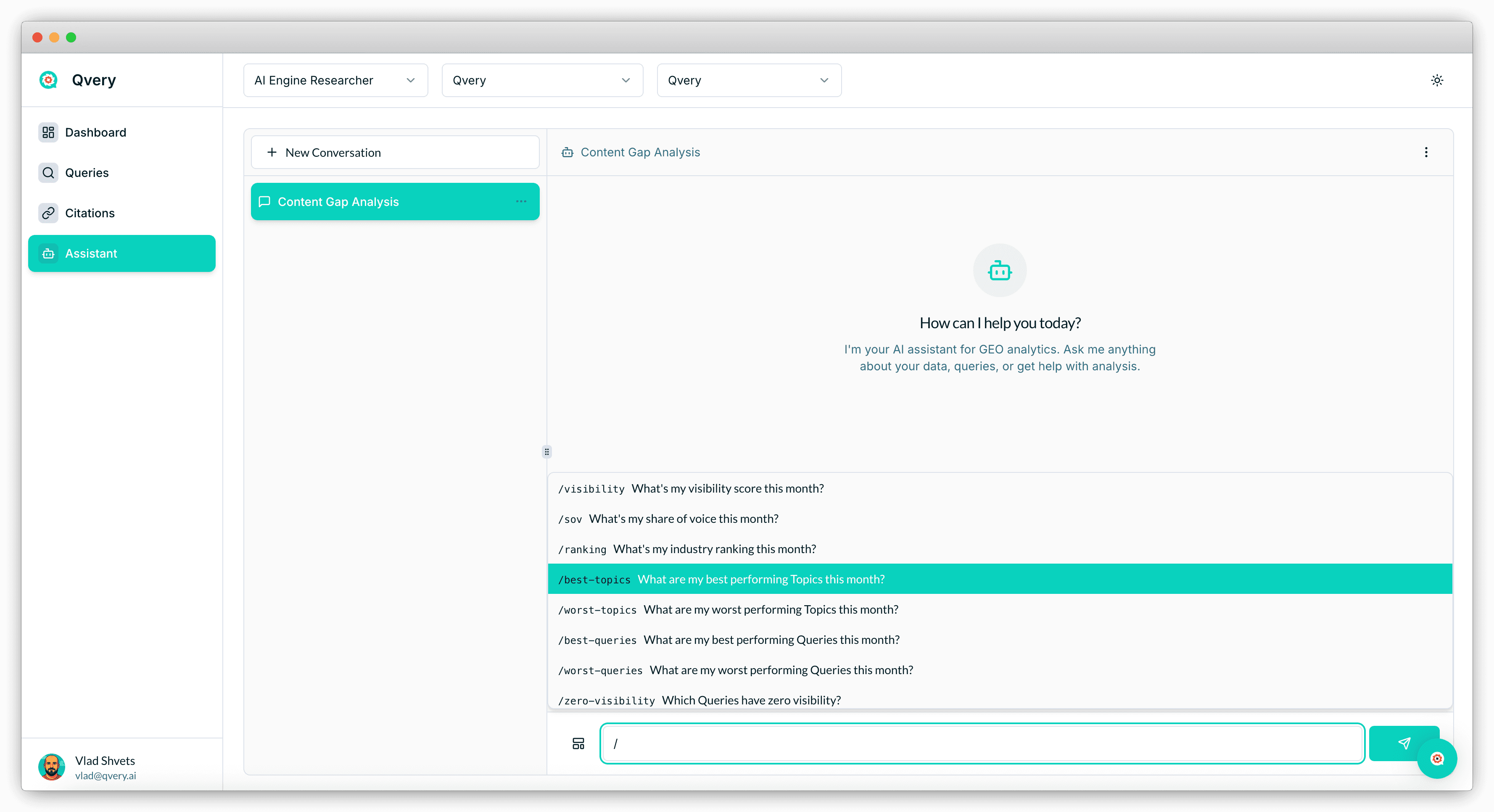
The tracking shows whether the page is cited, not why.
Start a free 7-day trial of Qvery, no credit card required, and add both question sets before your roundup goes live.
What This Data Cannot Settle
Cited pages only. No uncited roundup was coded, so no construction choice is shown to get a page cited, and no feature prevalence is reported.
Co-occurrence only. The records describe what appeared on cited pages, with no explanation of why they were cited.
The opening of each page. The coders read the first part of each page, and many cited roundups run longer. Where that part did not settle a record, they marked it unknown rather than absent.
Markup shape. The code audit reads the raw served HTML, so it misses anything a script draws after load.
Open comparisons. Unsettled answers keep both the question-type and the engine comparisons open.
Category scope. Paired SaaS buying needs across categories like CRM, payroll, help desk and accounting. AI-visibility software was not among them.
ChatGPT-weighted. Pooled figures carry three ChatGPT answers for every two from Google AI Mode.
No outcome measures. Nothing here measures naming, recommendation status, traffic, conversion or a before-and-after change.
Build Each Roundup to What the Cited Ones Document
For each best-tools roundup you publish, build it to what the cited vendor roundups document: one category, at least three tools with your product among them, real competitors named, criteria stated and applied to every entry including yours, and a multi-product table.
Treat that as your editorial choice, not a proven lever, and track direct best-tools and buyer-evaluation questions as separate lists in both engines to see whether it is cited.
If you market a SaaS product, someone has probably asked you to publish a best-tools roundup for your category, with your own product on the list.
Before you write it, look at the roundups the AI engines already cite.
We asked ChatGPT and Google AI Mode two kinds of SaaS buying question in September 2026: direct best-tools questions and buyer-evaluation questions, across paired needs in CRM, payroll, help desk, accounting and other categories. Then we opened every cited vendor page to check whether it was one of these roundups.
The short version: a vendor's own best-tools roundup was cited in at least 49.00% of direct best-tools answers and at least 45.50% of buyer-evaluation answers. The cited roundups name competitors, state their criteria and carry a comparison unit such as a multi-product table, in both kinds of answer.
These describe pages that were cited. We coded no uncited roundup, so nothing here says any of these choices gets a page cited. What you can do is build each roundup to what the cited ones document, as your own editorial choice, and then measure it on both kinds of question.
AI Engines Cite Vendors' Own Best-Tools Roundups on Both Kinds of Buying Question
Here is what counted as a vendor roundup, and it doubles as the build spec. It is a page on a SaaS company's own site that recommends or compares tools of one product category, includes the publisher's own product, and presents at least three tools in a list, ranking, comparison or table.
Two coders read every candidate page blind, and a third settled their disagreements. A sample drawn from outside the pages they read turned up no roundup the first pass had missed.
By that test, a vendor roundup was cited in at least 49.00% of direct best-tools answers and at least 45.50% of buyer-evaluation answers, each a share of all the answers of that type, both engines pooled. Those are floors, because some answers cited a vendor page the coders could not settle and no confirmed roundup.
The citations are spread thin. No single vendor's roundups were cited by more than a handful of direct best-tools answers, and in buyer-evaluation answers only one vendor's were. We leave that vendor unnamed.
PromptRush's SaaS page describes where the shortlists come from: "AI engines build those shortlists from review sites like G2 and Capterra, comparison articles, Reddit threads and your own product pages, so a strong Google ranking doesn't guarantee a mention."
Our data confirms the part about vendors' own pages, and narrows it to their roundups. It measured no share for review sites, comparison articles or Reddit, so it says nothing about how those compare.
For how much of SaaS category answering runs through vendor sites in general, see SaaS AI answers run on vendor sites, not review sites.
Name Your Competitors and State Your Criteria
The coders also recorded what each cited roundup put on the page. Two of those records bear on how you write yours.
Competitors named. A competitor counts when the page names a product from another company as a tool the reader could use. Among the cited roundups the coders could settle, none was documented without one, in either kind of answer. A few could not be settled from the part of the page the coders read.
Criteria stated. Criteria count when the page uses them, or tells the reader to use them, to choose, rank or compare. They were documented on cited roundups in both kinds of answer.
A few direct best-tools roundups were documented without them; among the buyer-evaluation roundups the coders settled, none was. Some in each could not be settled.
Those are records of what cited pages carry, not reasons they were cited.
Our recommendation, and it is ours rather than a finding: publish your criteria, apply them to every entry including your own, and name the real alternatives in your category. A roundup that holds its own product to the same criteria as everyone else's has a claim to be credible.
PromptRush makes a related point about pages that put you beside competitors:
Clear "[you] vs [competitor]" and "[competitor] alternatives" pages give AI a source that includes you.
Read at its strongest, that says comparison and alternatives pages hand an AI engine a source with your product in it. It says nothing about ranking yourself or how to choose the competitors, and we don't attribute that to it.
Our cited roundups include the publisher by definition and name competitors, which fits the idea. But that is co-occurrence on pages that were cited, not evidence that including yourself gets a page cited. A two-product page that sets you against one competitor also falls outside what we counted, which needed at least three tools.
Kaleigh Moore, writing on LinkedIn, argues that "AI Overviews favor comprehensive content that addresses the initial query and the likely next questions." We collected ChatGPT and Google AI Mode answers, not AI Overviews, and coded cited pages only, so this data cannot say what any engine favors.
Put the Comparison in a Table
The third record is the comparison unit: the part of the page that sets several products against each other. It was measured two ways, and the two are kept apart because they check different things.
The page text. The coders documented all three units on cited roundups in both kinds of answer: a multi-product table, a structured ranked list, and repeated product cards, one card per tool.
Each was also documented absent on other cited roundups, so none of the three is universal, and some pages could not be settled either way. The ranked list was the code the two coders agreed on least.
The raw page. A script read the whole served HTML of each cited roundup. In both kinds of answer, it found tables of at least three rows and two columns, ordered lists or numbered headings, repeated heading cards, and ItemList structured data.
That audit reads markup shape, not content. A table it finds may not hold products, and anything a script draws after the page loads is invisible to it, so "not found" never means absent.
We don't rank the units against each other. The records say each one exists on cited roundups, not which matters more, and not that any of them gets a page cited.
Our recommendation, again as editorial advice: lead with one multi-product table that gives every product the same fields, then write one entry per product beneath it.
No Case Here for Separate Roundups by Question Type or Engine
A natural next question is whether direct best-tools questions and buyer-evaluation questions need different roundups. Before collecting, we predicted the direct questions would cite vendor roundups at least one and a half times as often.
At least 49.00% of direct best-tools answers and at least 45.50% of buyer-evaluation answers cited a vendor roundup. Count every answer that cited an unsettled vendor page and no confirmed roundup as a roundup answer, and the figures would be 68.00% and 62.00%.
However those unsettled answers resolve, the gap never reaches one and a half times. They could still land in the band we call equivalent or in the band we call indeterminate, so we claim neither a difference nor that the two are the same.
The engines read the same way. At least 48.75% of ChatGPT answers and at least 45.00% of Google AI Mode answers cited a vendor roundup, both question types pooled. No way the unsettled answers resolve produces a one-and-a-half-times gap between them, and nothing here shows they are equivalent either.
Nathan Ojaokomo notes that "Different AI platforms pull from different sources." This data tests one event, a vendor roundup being cited, and for that event it finds no engine gap of that size. It does not test his broader claim.
So on this evidence, don't split a roundup by question type or by engine.
Measure It on Two Lists
Where the two kinds of question do part ways is in the rest of what they cite. That matters for measurement, not for how you build the page.
For each question type we built a list of domains, adding at each step the domain that covered the most answers not yet covered, until the list reached 80% of the answers that cited any source. The direct best-tools list holds 36 domains and the buyer-evaluation list 38, with 8 on both.
The buyer-evaluation list covered 40.82% of the direct best-tools answers that cited any source. The direct best-tools list covered 41.33% of the buyer-evaluation answers that cited any source.
The lower figure, 0.4082, is under our 0.60 bar for a shared list, so each question type needs its own list. These lists count every cited domain, reddit.com, youtube.com and capterra.com among them, so a domain's place on a list does not make it a roundup publisher.
The eight domains on both lists: bitwarden.com, buildertrend.com, buildium.com, capterra.com, clockify.me, reddit.com, youtube.com and zapier.com. The full lists, in the order they were built:
Direct best-tools, 36 domains: youtube.com, reddit.com, zoho.com, zapier.com, squareup.com, capterra.com, docusign.com, guides.reviews, help.salesforce.com, bamboohr.com, basedash.com, bitwarden.com, churchtrac.com, dropbox.com, gartner.com, itechguides.com, microsoft.com, uschamber.com, actionstep.com, apps.shopify.com, bankreconciler.app, buffer.com, buildium.com, canny.io, charitydigital.org.uk, clickup.com, clockify.me, gymdesk.com, hostinger.com, support.ironcladapp.com, veeam.com, arch.tamu.edu, buildertrend.com, close.com, d2l.com, docs.helpscout.com.
Buyer-evaluation, 38 domains: reddit.com, shopify.com, youtube.com, zapier.com, learn.microsoft.com, stackbriefly.com, stackfyi.com, rippling.com, ramp.com, clio.com, guideflow.com, help.firstpromoter.com, medium.com, quickbooks.intuit.com, birdeye.com, bitwarden.com, buildium.com, capterra.com, clockify.me, cloudflare.com, fedena.com, help.zoho.com, justgiving.com, lever.co, pcmag.com, refiner.io, slack.com, technologyadvice.com, baadigi.com, buildertrend.com, capterra.com.au, choice.com.au, churchplanner.ca, clickreach.io, coggno.com, consumercat.com, facebook.com, fieldpulse.com.
This decides the scope of your tracking, not how many roundups to publish.
Writing the two question sets is covered in how to generate LLM tracking queries, and turning each list into an audit in how to run a citation gap analysis. Getting onto other publishers' roundups is a different route, covered in mentions are the new backlinks for SaaS.
Track Whether Your Roundup Is Cited in Qvery
Once the roundup is live, the question is whether it shows up. Add both question sets to Qvery as queries, the direct best-tools questions and the buyer-evaluation questions, either directly or through Qvery Assistant.
Qvery tracks visibility, share of voice and average rank on both sets daily across ChatGPT and Google AI Mode, in 200+ countries.
Every citation is tied to the query and engine that produced it, so you can see whether your roundup's own URL is among the citations on each list.
To ask instead of filter, open Qvery Assistant in the app and ask about your own visibility, share of voice or citations in plain language.
The tracking shows whether the page is cited, not why.
Start a free 7-day trial of Qvery, no credit card required, and add both question sets before your roundup goes live.
What This Data Cannot Settle
Cited pages only. No uncited roundup was coded, so no construction choice is shown to get a page cited, and no feature prevalence is reported.
Co-occurrence only. The records describe what appeared on cited pages, with no explanation of why they were cited.
The opening of each page. The coders read the first part of each page, and many cited roundups run longer. Where that part did not settle a record, they marked it unknown rather than absent.
Markup shape. The code audit reads the raw served HTML, so it misses anything a script draws after load.
Open comparisons. Unsettled answers keep both the question-type and the engine comparisons open.
Category scope. Paired SaaS buying needs across categories like CRM, payroll, help desk and accounting. AI-visibility software was not among them.
ChatGPT-weighted. Pooled figures carry three ChatGPT answers for every two from Google AI Mode.
No outcome measures. Nothing here measures naming, recommendation status, traffic, conversion or a before-and-after change.
Build Each Roundup to What the Cited Ones Document
For each best-tools roundup you publish, build it to what the cited vendor roundups document: one category, at least three tools with your product among them, real competitors named, criteria stated and applied to every entry including yours, and a multi-product table.
Treat that as your editorial choice, not a proven lever, and track direct best-tools and buyer-evaluation questions as separate lists in both engines to see whether it is cited.
If you market a SaaS product, someone has probably asked you to publish a best-tools roundup for your category, with your own product on the list.
Before you write it, look at the roundups the AI engines already cite.
We asked ChatGPT and Google AI Mode two kinds of SaaS buying question in September 2026: direct best-tools questions and buyer-evaluation questions, across paired needs in CRM, payroll, help desk, accounting and other categories. Then we opened every cited vendor page to check whether it was one of these roundups.
The short version: a vendor's own best-tools roundup was cited in at least 49.00% of direct best-tools answers and at least 45.50% of buyer-evaluation answers. The cited roundups name competitors, state their criteria and carry a comparison unit such as a multi-product table, in both kinds of answer.
These describe pages that were cited. We coded no uncited roundup, so nothing here says any of these choices gets a page cited. What you can do is build each roundup to what the cited ones document, as your own editorial choice, and then measure it on both kinds of question.
AI Engines Cite Vendors' Own Best-Tools Roundups on Both Kinds of Buying Question
Here is what counted as a vendor roundup, and it doubles as the build spec. It is a page on a SaaS company's own site that recommends or compares tools of one product category, includes the publisher's own product, and presents at least three tools in a list, ranking, comparison or table.
Two coders read every candidate page blind, and a third settled their disagreements. A sample drawn from outside the pages they read turned up no roundup the first pass had missed.
By that test, a vendor roundup was cited in at least 49.00% of direct best-tools answers and at least 45.50% of buyer-evaluation answers, each a share of all the answers of that type, both engines pooled. Those are floors, because some answers cited a vendor page the coders could not settle and no confirmed roundup.
The citations are spread thin. No single vendor's roundups were cited by more than a handful of direct best-tools answers, and in buyer-evaluation answers only one vendor's were. We leave that vendor unnamed.
PromptRush's SaaS page describes where the shortlists come from: "AI engines build those shortlists from review sites like G2 and Capterra, comparison articles, Reddit threads and your own product pages, so a strong Google ranking doesn't guarantee a mention."
Our data confirms the part about vendors' own pages, and narrows it to their roundups. It measured no share for review sites, comparison articles or Reddit, so it says nothing about how those compare.
For how much of SaaS category answering runs through vendor sites in general, see SaaS AI answers run on vendor sites, not review sites.
Name Your Competitors and State Your Criteria
The coders also recorded what each cited roundup put on the page. Two of those records bear on how you write yours.
Competitors named. A competitor counts when the page names a product from another company as a tool the reader could use. Among the cited roundups the coders could settle, none was documented without one, in either kind of answer. A few could not be settled from the part of the page the coders read.
Criteria stated. Criteria count when the page uses them, or tells the reader to use them, to choose, rank or compare. They were documented on cited roundups in both kinds of answer.
A few direct best-tools roundups were documented without them; among the buyer-evaluation roundups the coders settled, none was. Some in each could not be settled.
Those are records of what cited pages carry, not reasons they were cited.
Our recommendation, and it is ours rather than a finding: publish your criteria, apply them to every entry including your own, and name the real alternatives in your category. A roundup that holds its own product to the same criteria as everyone else's has a claim to be credible.
PromptRush makes a related point about pages that put you beside competitors:
Clear "[you] vs [competitor]" and "[competitor] alternatives" pages give AI a source that includes you.
Read at its strongest, that says comparison and alternatives pages hand an AI engine a source with your product in it. It says nothing about ranking yourself or how to choose the competitors, and we don't attribute that to it.
Our cited roundups include the publisher by definition and name competitors, which fits the idea. But that is co-occurrence on pages that were cited, not evidence that including yourself gets a page cited. A two-product page that sets you against one competitor also falls outside what we counted, which needed at least three tools.
Kaleigh Moore, writing on LinkedIn, argues that "AI Overviews favor comprehensive content that addresses the initial query and the likely next questions." We collected ChatGPT and Google AI Mode answers, not AI Overviews, and coded cited pages only, so this data cannot say what any engine favors.
Put the Comparison in a Table
The third record is the comparison unit: the part of the page that sets several products against each other. It was measured two ways, and the two are kept apart because they check different things.
The page text. The coders documented all three units on cited roundups in both kinds of answer: a multi-product table, a structured ranked list, and repeated product cards, one card per tool.
Each was also documented absent on other cited roundups, so none of the three is universal, and some pages could not be settled either way. The ranked list was the code the two coders agreed on least.
The raw page. A script read the whole served HTML of each cited roundup. In both kinds of answer, it found tables of at least three rows and two columns, ordered lists or numbered headings, repeated heading cards, and ItemList structured data.
That audit reads markup shape, not content. A table it finds may not hold products, and anything a script draws after the page loads is invisible to it, so "not found" never means absent.
We don't rank the units against each other. The records say each one exists on cited roundups, not which matters more, and not that any of them gets a page cited.
Our recommendation, again as editorial advice: lead with one multi-product table that gives every product the same fields, then write one entry per product beneath it.
No Case Here for Separate Roundups by Question Type or Engine
A natural next question is whether direct best-tools questions and buyer-evaluation questions need different roundups. Before collecting, we predicted the direct questions would cite vendor roundups at least one and a half times as often.
At least 49.00% of direct best-tools answers and at least 45.50% of buyer-evaluation answers cited a vendor roundup. Count every answer that cited an unsettled vendor page and no confirmed roundup as a roundup answer, and the figures would be 68.00% and 62.00%.
However those unsettled answers resolve, the gap never reaches one and a half times. They could still land in the band we call equivalent or in the band we call indeterminate, so we claim neither a difference nor that the two are the same.
The engines read the same way. At least 48.75% of ChatGPT answers and at least 45.00% of Google AI Mode answers cited a vendor roundup, both question types pooled. No way the unsettled answers resolve produces a one-and-a-half-times gap between them, and nothing here shows they are equivalent either.
Nathan Ojaokomo notes that "Different AI platforms pull from different sources." This data tests one event, a vendor roundup being cited, and for that event it finds no engine gap of that size. It does not test his broader claim.
So on this evidence, don't split a roundup by question type or by engine.
Measure It on Two Lists
Where the two kinds of question do part ways is in the rest of what they cite. That matters for measurement, not for how you build the page.
For each question type we built a list of domains, adding at each step the domain that covered the most answers not yet covered, until the list reached 80% of the answers that cited any source. The direct best-tools list holds 36 domains and the buyer-evaluation list 38, with 8 on both.
The buyer-evaluation list covered 40.82% of the direct best-tools answers that cited any source. The direct best-tools list covered 41.33% of the buyer-evaluation answers that cited any source.
The lower figure, 0.4082, is under our 0.60 bar for a shared list, so each question type needs its own list. These lists count every cited domain, reddit.com, youtube.com and capterra.com among them, so a domain's place on a list does not make it a roundup publisher.
The eight domains on both lists: bitwarden.com, buildertrend.com, buildium.com, capterra.com, clockify.me, reddit.com, youtube.com and zapier.com. The full lists, in the order they were built:
Direct best-tools, 36 domains: youtube.com, reddit.com, zoho.com, zapier.com, squareup.com, capterra.com, docusign.com, guides.reviews, help.salesforce.com, bamboohr.com, basedash.com, bitwarden.com, churchtrac.com, dropbox.com, gartner.com, itechguides.com, microsoft.com, uschamber.com, actionstep.com, apps.shopify.com, bankreconciler.app, buffer.com, buildium.com, canny.io, charitydigital.org.uk, clickup.com, clockify.me, gymdesk.com, hostinger.com, support.ironcladapp.com, veeam.com, arch.tamu.edu, buildertrend.com, close.com, d2l.com, docs.helpscout.com.
Buyer-evaluation, 38 domains: reddit.com, shopify.com, youtube.com, zapier.com, learn.microsoft.com, stackbriefly.com, stackfyi.com, rippling.com, ramp.com, clio.com, guideflow.com, help.firstpromoter.com, medium.com, quickbooks.intuit.com, birdeye.com, bitwarden.com, buildium.com, capterra.com, clockify.me, cloudflare.com, fedena.com, help.zoho.com, justgiving.com, lever.co, pcmag.com, refiner.io, slack.com, technologyadvice.com, baadigi.com, buildertrend.com, capterra.com.au, choice.com.au, churchplanner.ca, clickreach.io, coggno.com, consumercat.com, facebook.com, fieldpulse.com.
This decides the scope of your tracking, not how many roundups to publish.
Writing the two question sets is covered in how to generate LLM tracking queries, and turning each list into an audit in how to run a citation gap analysis. Getting onto other publishers' roundups is a different route, covered in mentions are the new backlinks for SaaS.
Track Whether Your Roundup Is Cited in Qvery
Once the roundup is live, the question is whether it shows up. Add both question sets to Qvery as queries, the direct best-tools questions and the buyer-evaluation questions, either directly or through Qvery Assistant.
Qvery tracks visibility, share of voice and average rank on both sets daily across ChatGPT and Google AI Mode, in 200+ countries.
Every citation is tied to the query and engine that produced it, so you can see whether your roundup's own URL is among the citations on each list.
To ask instead of filter, open Qvery Assistant in the app and ask about your own visibility, share of voice or citations in plain language.
The tracking shows whether the page is cited, not why.
Start a free 7-day trial of Qvery, no credit card required, and add both question sets before your roundup goes live.
What This Data Cannot Settle
Cited pages only. No uncited roundup was coded, so no construction choice is shown to get a page cited, and no feature prevalence is reported.
Co-occurrence only. The records describe what appeared on cited pages, with no explanation of why they were cited.
The opening of each page. The coders read the first part of each page, and many cited roundups run longer. Where that part did not settle a record, they marked it unknown rather than absent.
Markup shape. The code audit reads the raw served HTML, so it misses anything a script draws after load.
Open comparisons. Unsettled answers keep both the question-type and the engine comparisons open.
Category scope. Paired SaaS buying needs across categories like CRM, payroll, help desk and accounting. AI-visibility software was not among them.
ChatGPT-weighted. Pooled figures carry three ChatGPT answers for every two from Google AI Mode.
No outcome measures. Nothing here measures naming, recommendation status, traffic, conversion or a before-and-after change.
Build Each Roundup to What the Cited Ones Document
For each best-tools roundup you publish, build it to what the cited vendor roundups document: one category, at least three tools with your product among them, real competitors named, criteria stated and applied to every entry including yours, and a multi-product table.
Treat that as your editorial choice, not a proven lever, and track direct best-tools and buyer-evaluation questions as separate lists in both engines to see whether it is cited.
If you market a SaaS product, someone has probably asked you to publish a best-tools roundup for your category, with your own product on the list.
Before you write it, look at the roundups the AI engines already cite.
We asked ChatGPT and Google AI Mode two kinds of SaaS buying question in September 2026: direct best-tools questions and buyer-evaluation questions, across paired needs in CRM, payroll, help desk, accounting and other categories. Then we opened every cited vendor page to check whether it was one of these roundups.
The short version: a vendor's own best-tools roundup was cited in at least 49.00% of direct best-tools answers and at least 45.50% of buyer-evaluation answers. The cited roundups name competitors, state their criteria and carry a comparison unit such as a multi-product table, in both kinds of answer.
These describe pages that were cited. We coded no uncited roundup, so nothing here says any of these choices gets a page cited. What you can do is build each roundup to what the cited ones document, as your own editorial choice, and then measure it on both kinds of question.
AI Engines Cite Vendors' Own Best-Tools Roundups on Both Kinds of Buying Question
Here is what counted as a vendor roundup, and it doubles as the build spec. It is a page on a SaaS company's own site that recommends or compares tools of one product category, includes the publisher's own product, and presents at least three tools in a list, ranking, comparison or table.
Two coders read every candidate page blind, and a third settled their disagreements. A sample drawn from outside the pages they read turned up no roundup the first pass had missed.
By that test, a vendor roundup was cited in at least 49.00% of direct best-tools answers and at least 45.50% of buyer-evaluation answers, each a share of all the answers of that type, both engines pooled. Those are floors, because some answers cited a vendor page the coders could not settle and no confirmed roundup.
The citations are spread thin. No single vendor's roundups were cited by more than a handful of direct best-tools answers, and in buyer-evaluation answers only one vendor's were. We leave that vendor unnamed.
PromptRush's SaaS page describes where the shortlists come from: "AI engines build those shortlists from review sites like G2 and Capterra, comparison articles, Reddit threads and your own product pages, so a strong Google ranking doesn't guarantee a mention."
Our data confirms the part about vendors' own pages, and narrows it to their roundups. It measured no share for review sites, comparison articles or Reddit, so it says nothing about how those compare.
For how much of SaaS category answering runs through vendor sites in general, see SaaS AI answers run on vendor sites, not review sites.
Name Your Competitors and State Your Criteria
The coders also recorded what each cited roundup put on the page. Two of those records bear on how you write yours.
Competitors named. A competitor counts when the page names a product from another company as a tool the reader could use. Among the cited roundups the coders could settle, none was documented without one, in either kind of answer. A few could not be settled from the part of the page the coders read.
Criteria stated. Criteria count when the page uses them, or tells the reader to use them, to choose, rank or compare. They were documented on cited roundups in both kinds of answer.
A few direct best-tools roundups were documented without them; among the buyer-evaluation roundups the coders settled, none was. Some in each could not be settled.
Those are records of what cited pages carry, not reasons they were cited.
Our recommendation, and it is ours rather than a finding: publish your criteria, apply them to every entry including your own, and name the real alternatives in your category. A roundup that holds its own product to the same criteria as everyone else's has a claim to be credible.
PromptRush makes a related point about pages that put you beside competitors:
Clear "[you] vs [competitor]" and "[competitor] alternatives" pages give AI a source that includes you.
Read at its strongest, that says comparison and alternatives pages hand an AI engine a source with your product in it. It says nothing about ranking yourself or how to choose the competitors, and we don't attribute that to it.
Our cited roundups include the publisher by definition and name competitors, which fits the idea. But that is co-occurrence on pages that were cited, not evidence that including yourself gets a page cited. A two-product page that sets you against one competitor also falls outside what we counted, which needed at least three tools.
Kaleigh Moore, writing on LinkedIn, argues that "AI Overviews favor comprehensive content that addresses the initial query and the likely next questions." We collected ChatGPT and Google AI Mode answers, not AI Overviews, and coded cited pages only, so this data cannot say what any engine favors.
Put the Comparison in a Table
The third record is the comparison unit: the part of the page that sets several products against each other. It was measured two ways, and the two are kept apart because they check different things.
The page text. The coders documented all three units on cited roundups in both kinds of answer: a multi-product table, a structured ranked list, and repeated product cards, one card per tool.
Each was also documented absent on other cited roundups, so none of the three is universal, and some pages could not be settled either way. The ranked list was the code the two coders agreed on least.
The raw page. A script read the whole served HTML of each cited roundup. In both kinds of answer, it found tables of at least three rows and two columns, ordered lists or numbered headings, repeated heading cards, and ItemList structured data.
That audit reads markup shape, not content. A table it finds may not hold products, and anything a script draws after the page loads is invisible to it, so "not found" never means absent.
We don't rank the units against each other. The records say each one exists on cited roundups, not which matters more, and not that any of them gets a page cited.
Our recommendation, again as editorial advice: lead with one multi-product table that gives every product the same fields, then write one entry per product beneath it.
No Case Here for Separate Roundups by Question Type or Engine
A natural next question is whether direct best-tools questions and buyer-evaluation questions need different roundups. Before collecting, we predicted the direct questions would cite vendor roundups at least one and a half times as often.
At least 49.00% of direct best-tools answers and at least 45.50% of buyer-evaluation answers cited a vendor roundup. Count every answer that cited an unsettled vendor page and no confirmed roundup as a roundup answer, and the figures would be 68.00% and 62.00%.
However those unsettled answers resolve, the gap never reaches one and a half times. They could still land in the band we call equivalent or in the band we call indeterminate, so we claim neither a difference nor that the two are the same.
The engines read the same way. At least 48.75% of ChatGPT answers and at least 45.00% of Google AI Mode answers cited a vendor roundup, both question types pooled. No way the unsettled answers resolve produces a one-and-a-half-times gap between them, and nothing here shows they are equivalent either.
Nathan Ojaokomo notes that "Different AI platforms pull from different sources." This data tests one event, a vendor roundup being cited, and for that event it finds no engine gap of that size. It does not test his broader claim.
So on this evidence, don't split a roundup by question type or by engine.
Measure It on Two Lists
Where the two kinds of question do part ways is in the rest of what they cite. That matters for measurement, not for how you build the page.
For each question type we built a list of domains, adding at each step the domain that covered the most answers not yet covered, until the list reached 80% of the answers that cited any source. The direct best-tools list holds 36 domains and the buyer-evaluation list 38, with 8 on both.
The buyer-evaluation list covered 40.82% of the direct best-tools answers that cited any source. The direct best-tools list covered 41.33% of the buyer-evaluation answers that cited any source.
The lower figure, 0.4082, is under our 0.60 bar for a shared list, so each question type needs its own list. These lists count every cited domain, reddit.com, youtube.com and capterra.com among them, so a domain's place on a list does not make it a roundup publisher.
The eight domains on both lists: bitwarden.com, buildertrend.com, buildium.com, capterra.com, clockify.me, reddit.com, youtube.com and zapier.com. The full lists, in the order they were built:
Direct best-tools, 36 domains: youtube.com, reddit.com, zoho.com, zapier.com, squareup.com, capterra.com, docusign.com, guides.reviews, help.salesforce.com, bamboohr.com, basedash.com, bitwarden.com, churchtrac.com, dropbox.com, gartner.com, itechguides.com, microsoft.com, uschamber.com, actionstep.com, apps.shopify.com, bankreconciler.app, buffer.com, buildium.com, canny.io, charitydigital.org.uk, clickup.com, clockify.me, gymdesk.com, hostinger.com, support.ironcladapp.com, veeam.com, arch.tamu.edu, buildertrend.com, close.com, d2l.com, docs.helpscout.com.
Buyer-evaluation, 38 domains: reddit.com, shopify.com, youtube.com, zapier.com, learn.microsoft.com, stackbriefly.com, stackfyi.com, rippling.com, ramp.com, clio.com, guideflow.com, help.firstpromoter.com, medium.com, quickbooks.intuit.com, birdeye.com, bitwarden.com, buildium.com, capterra.com, clockify.me, cloudflare.com, fedena.com, help.zoho.com, justgiving.com, lever.co, pcmag.com, refiner.io, slack.com, technologyadvice.com, baadigi.com, buildertrend.com, capterra.com.au, choice.com.au, churchplanner.ca, clickreach.io, coggno.com, consumercat.com, facebook.com, fieldpulse.com.
This decides the scope of your tracking, not how many roundups to publish.
Writing the two question sets is covered in how to generate LLM tracking queries, and turning each list into an audit in how to run a citation gap analysis. Getting onto other publishers' roundups is a different route, covered in mentions are the new backlinks for SaaS.
Track Whether Your Roundup Is Cited in Qvery
Once the roundup is live, the question is whether it shows up. Add both question sets to Qvery as queries, the direct best-tools questions and the buyer-evaluation questions, either directly or through Qvery Assistant.
Qvery tracks visibility, share of voice and average rank on both sets daily across ChatGPT and Google AI Mode, in 200+ countries.
Every citation is tied to the query and engine that produced it, so you can see whether your roundup's own URL is among the citations on each list.
To ask instead of filter, open Qvery Assistant in the app and ask about your own visibility, share of voice or citations in plain language.
The tracking shows whether the page is cited, not why.
Start a free 7-day trial of Qvery, no credit card required, and add both question sets before your roundup goes live.
What This Data Cannot Settle
Cited pages only. No uncited roundup was coded, so no construction choice is shown to get a page cited, and no feature prevalence is reported.
Co-occurrence only. The records describe what appeared on cited pages, with no explanation of why they were cited.
The opening of each page. The coders read the first part of each page, and many cited roundups run longer. Where that part did not settle a record, they marked it unknown rather than absent.
Markup shape. The code audit reads the raw served HTML, so it misses anything a script draws after load.
Open comparisons. Unsettled answers keep both the question-type and the engine comparisons open.
Category scope. Paired SaaS buying needs across categories like CRM, payroll, help desk and accounting. AI-visibility software was not among them.
ChatGPT-weighted. Pooled figures carry three ChatGPT answers for every two from Google AI Mode.
No outcome measures. Nothing here measures naming, recommendation status, traffic, conversion or a before-and-after change.
Build Each Roundup to What the Cited Ones Document
For each best-tools roundup you publish, build it to what the cited vendor roundups document: one category, at least three tools with your product among them, real competitors named, criteria stated and applied to every entry including yours, and a multi-product table.
Treat that as your editorial choice, not a proven lever, and track direct best-tools and buyer-evaluation questions as separate lists in both engines to see whether it is cited.

© 2026 Qvery AI OÜ