By
Vlad Shvets
Your SaaS Category's AI Answers Run on Vendor Sites, Not Review Sites
We ran matched buying questions in a mature SaaS category and a two-year-old one. Both run on vendor-owned domains; review directories barely register in either, and only G2 registered at all. What that means for a SaaS marketer's source plan.
We ran matched buying questions in a mature SaaS category and a two-year-old one. Both run on vendor-owned domains; review directories barely register in either, and only G2 registered at all. What that means for a SaaS marketer's source plan.
We ran matched buying questions in a mature SaaS category and a two-year-old one. Both run on vendor-owned domains; review directories barely register in either, and only G2 registered at all. What that means for a SaaS marketer's source plan.
Every SaaS marketer has internalized the same map of AI visibility: the engines lean on the review layer, so the G2 profile and the comparison sites are where a category's answers get decided. The budget line for "directories" survives every planning cycle on that belief.
We ran matched buying questions in two SaaS categories at opposite ends of life: CRM, a category older than some of its users, and AI voice agents, a category barely two years old, and read which sources the answers were built from.
The short version: in both categories, the answers run on the vendors' own websites, the review layer barely registers, and the interesting differences are in which vendors and what fills the gaps.
A boundary first: two categories, one month; treat it as a bearing, not a verdict.
The Mature Category's Answers Come From the Vendors Themselves
Across a targeted set of paired CRM and AI voice-agent buying questions we ran on ChatGPT and Google AI Mode in August 2026 (US-weighted, with a UK, Canadian, and Australian mix), the CRM side told a story nobody's directory budget expects.
This is a read of the answers we had not pre-committed to test, so treat it as direction: HubSpot's own domain was in 35.20% of the CRM answers, Pipedrive's and Zoho's in 26.40% each, Salesforce's in 24.00% (share of that category's answers).
The leading non-vendor source, an editorial comparison site, reached 6.40%. The answers to "which CRM should we buy" are being assembled, to a first approximation, from the sellers' own estates: pricing pages, feature docs, comparison pages the vendors wrote about each other.
That rhymes with what we measured in crypto, where company-owned estates carry the buying answers, and it inverts the old web's etiquette. The engine does not treat your homepage as bias to be discounted; it treats it as documentation.
The most-cited source about a software category is the software.
The Two-Year-Old Category Is Even More of a Vendor Story
The emerging side had every excuse to behave differently: thin coverage, no incumbents, a category still naming itself. Instead it doubled down. Retell's domain was in 30.40% of the voice-agent answers, Vapi's in 15.20%, Synthflow's in 11.20%, ElevenLabs' in 8.80%, Bland's in 8.00% (share of that category's answers; same directional read).
What fills the space around the startups is the part worth staring at: not the tech press, but low-profile content and stack-listing sites with no standing name in the category. When a category is young, the engines take whoever showed up and wrote something parseable.
Two years in, nobody has earned the trusted-middleman seat for voice agents. Which means, for a while, that seat is open.
Review Directories Barely Register, and Only G2 Registered at All
Now the layer the budget believes in. A tracked review directory (G2, Capterra, GetApp, Trustpilot, SoftwareAdvice) appeared in 4.80% of the mature category's answers and 1.60% of the emerging category's. And in both categories, the only directory of the five that appeared at all was G2.
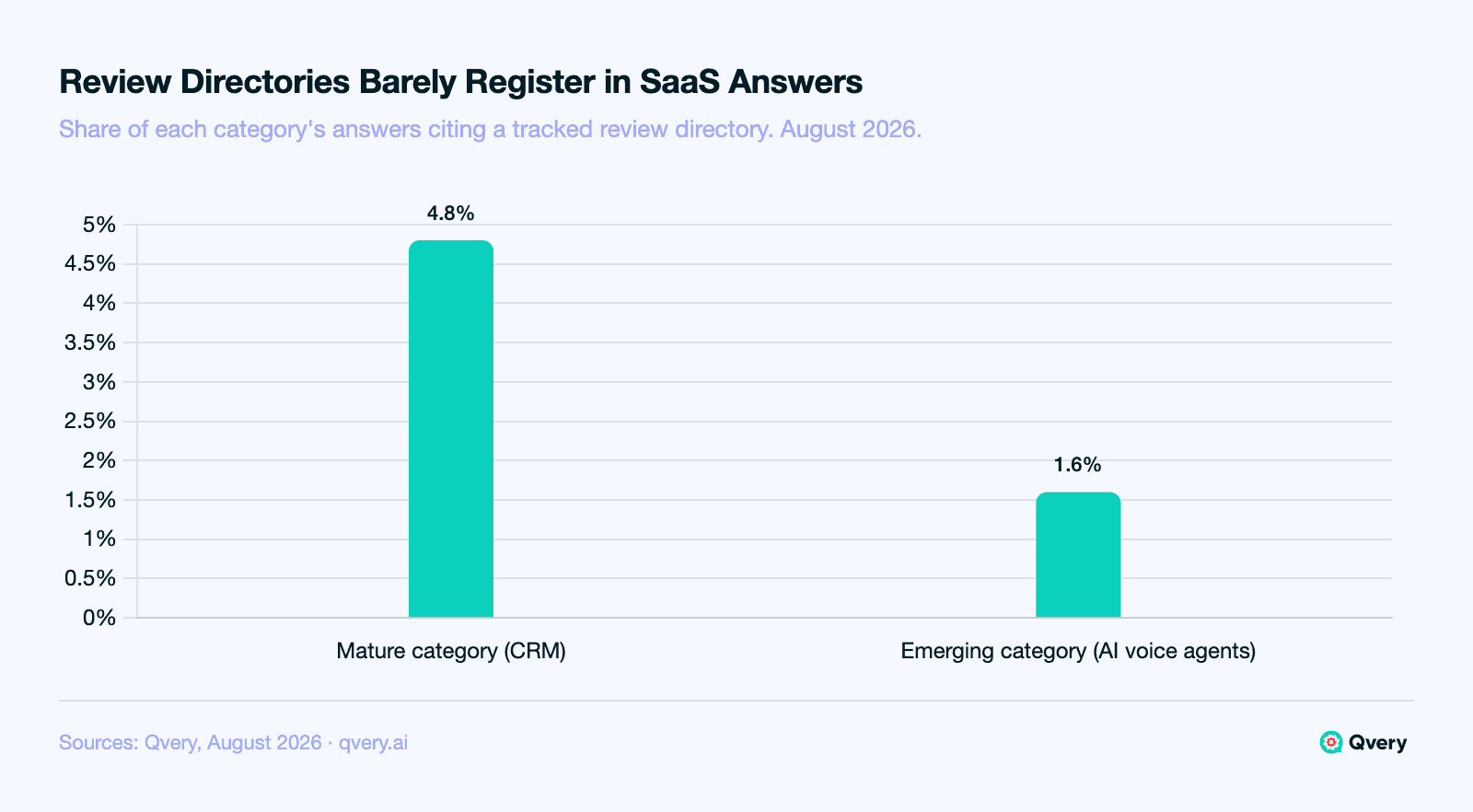
This is consistent with the broader pattern we documented in the software-directories data: a small, shrinking citation layer where only a couple of listings are worth optimizing. In the mature category it is a single-digit sideshow; in the young one it is close to absent, because the young vendors barely have profiles to cite.
(One reading caveat in fairness to the directories: on the Google AI Mode side of these answers, every citation URL resolved to Google's own domain, so all of these presence figures are floors of what we could resolve.)
What This Buys a SaaS Marketer
Our judgment on the pattern, not a proven sequence:
Treat your own estate as the primary citation surface. Pricing stated in prose, feature pages that answer comparisons, straight versus pages. In both categories the engines read the vendors directly; the question is whether your pages are the readable ones.
Keep G2 as a line item, retire the category as a strategy. One directory registered, at single digits. Maintain the profile that appears in your category's answers and stop paying rent on the other four.
In a young category, the middle layer is unclaimed. The no-name sites filling emerging-category answers are beatable on quality tomorrow morning. A real comparison resource for a two-year-old category has almost no competition for the engines' attention.
Watch your competitors' estates like a source list. If the engines assemble answers from vendor pages, your rival's new comparison page is not just marketing, it is a citation candidate against you.
Check Whose Estate Answers Your Category in Qvery
The read above is two categories in one month. Yours may differ, and it will drift.
In Qvery, track your category's buying questions and Qvery runs them daily on ChatGPT and Google AI Mode, capturing every citation tied to the query and engine that produced it. Open Citations and read the Top Domains behind your questions: how much is vendor estates, whose, and whether the one directory that matters in your category is yours or your competitor's.
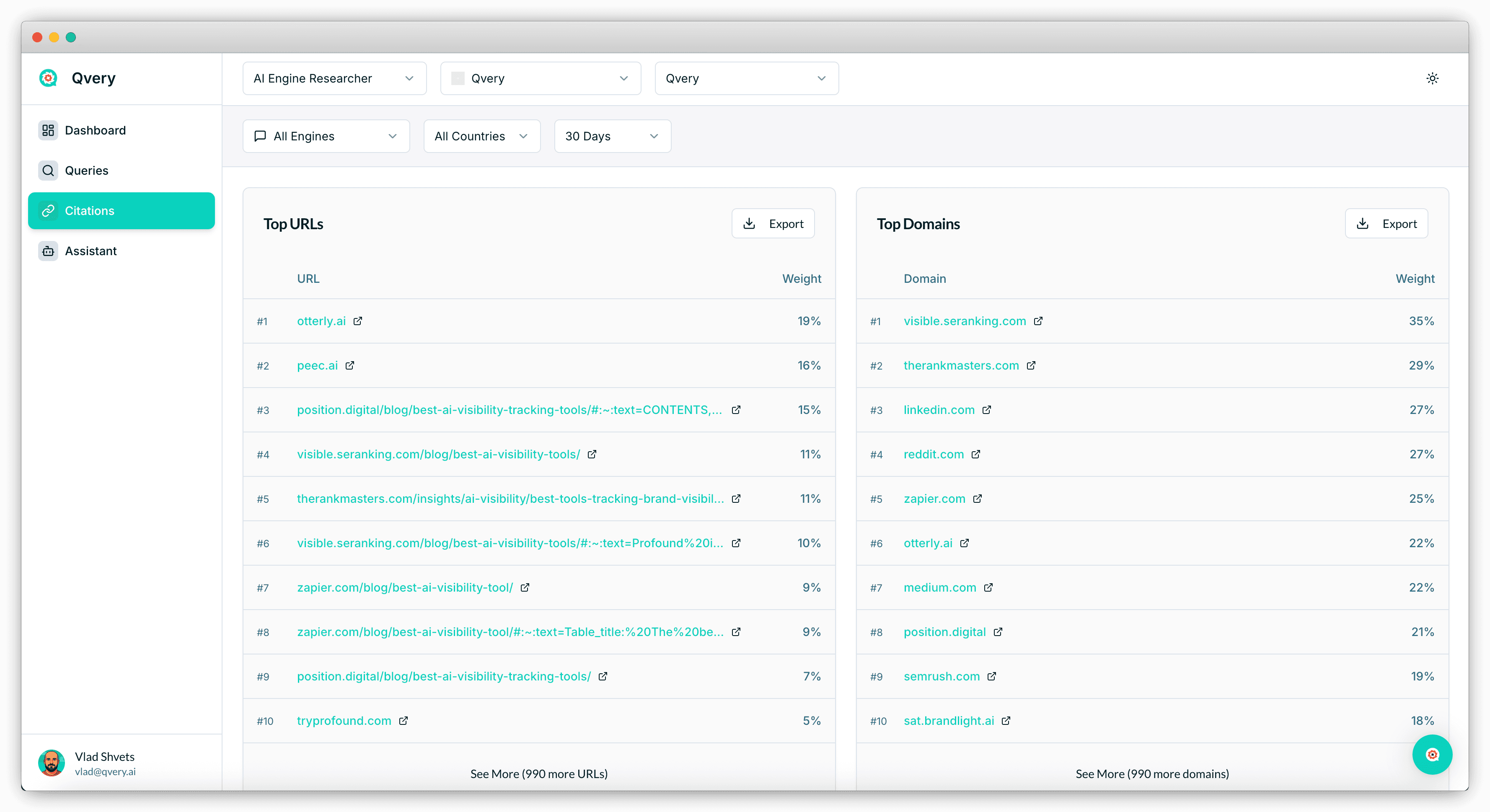
The estate-versus-directory read is yours to make from the list; Qvery's job is keeping the list current while the category moves.
Sign up for Qvery, use the free 7-day trial, and pull the source list for your own category before the next budget meeting defends the directory line by habit.
One move this week: open your three biggest competitors' most-cited pages and read them as the engine does. That is the shelf your category's answers come from, and your pages are either on it or they are not.
Every SaaS marketer has internalized the same map of AI visibility: the engines lean on the review layer, so the G2 profile and the comparison sites are where a category's answers get decided. The budget line for "directories" survives every planning cycle on that belief.
We ran matched buying questions in two SaaS categories at opposite ends of life: CRM, a category older than some of its users, and AI voice agents, a category barely two years old, and read which sources the answers were built from.
The short version: in both categories, the answers run on the vendors' own websites, the review layer barely registers, and the interesting differences are in which vendors and what fills the gaps.
A boundary first: two categories, one month; treat it as a bearing, not a verdict.
The Mature Category's Answers Come From the Vendors Themselves
Across a targeted set of paired CRM and AI voice-agent buying questions we ran on ChatGPT and Google AI Mode in August 2026 (US-weighted, with a UK, Canadian, and Australian mix), the CRM side told a story nobody's directory budget expects.
This is a read of the answers we had not pre-committed to test, so treat it as direction: HubSpot's own domain was in 35.20% of the CRM answers, Pipedrive's and Zoho's in 26.40% each, Salesforce's in 24.00% (share of that category's answers).
The leading non-vendor source, an editorial comparison site, reached 6.40%. The answers to "which CRM should we buy" are being assembled, to a first approximation, from the sellers' own estates: pricing pages, feature docs, comparison pages the vendors wrote about each other.
That rhymes with what we measured in crypto, where company-owned estates carry the buying answers, and it inverts the old web's etiquette. The engine does not treat your homepage as bias to be discounted; it treats it as documentation.
The most-cited source about a software category is the software.
The Two-Year-Old Category Is Even More of a Vendor Story
The emerging side had every excuse to behave differently: thin coverage, no incumbents, a category still naming itself. Instead it doubled down. Retell's domain was in 30.40% of the voice-agent answers, Vapi's in 15.20%, Synthflow's in 11.20%, ElevenLabs' in 8.80%, Bland's in 8.00% (share of that category's answers; same directional read).
What fills the space around the startups is the part worth staring at: not the tech press, but low-profile content and stack-listing sites with no standing name in the category. When a category is young, the engines take whoever showed up and wrote something parseable.
Two years in, nobody has earned the trusted-middleman seat for voice agents. Which means, for a while, that seat is open.
Review Directories Barely Register, and Only G2 Registered at All
Now the layer the budget believes in. A tracked review directory (G2, Capterra, GetApp, Trustpilot, SoftwareAdvice) appeared in 4.80% of the mature category's answers and 1.60% of the emerging category's. And in both categories, the only directory of the five that appeared at all was G2.
This is consistent with the broader pattern we documented in the software-directories data: a small, shrinking citation layer where only a couple of listings are worth optimizing. In the mature category it is a single-digit sideshow; in the young one it is close to absent, because the young vendors barely have profiles to cite.
(One reading caveat in fairness to the directories: on the Google AI Mode side of these answers, every citation URL resolved to Google's own domain, so all of these presence figures are floors of what we could resolve.)
What This Buys a SaaS Marketer
Our judgment on the pattern, not a proven sequence:
Treat your own estate as the primary citation surface. Pricing stated in prose, feature pages that answer comparisons, straight versus pages. In both categories the engines read the vendors directly; the question is whether your pages are the readable ones.
Keep G2 as a line item, retire the category as a strategy. One directory registered, at single digits. Maintain the profile that appears in your category's answers and stop paying rent on the other four.
In a young category, the middle layer is unclaimed. The no-name sites filling emerging-category answers are beatable on quality tomorrow morning. A real comparison resource for a two-year-old category has almost no competition for the engines' attention.
Watch your competitors' estates like a source list. If the engines assemble answers from vendor pages, your rival's new comparison page is not just marketing, it is a citation candidate against you.
Check Whose Estate Answers Your Category in Qvery
The read above is two categories in one month. Yours may differ, and it will drift.
In Qvery, track your category's buying questions and Qvery runs them daily on ChatGPT and Google AI Mode, capturing every citation tied to the query and engine that produced it. Open Citations and read the Top Domains behind your questions: how much is vendor estates, whose, and whether the one directory that matters in your category is yours or your competitor's.
The estate-versus-directory read is yours to make from the list; Qvery's job is keeping the list current while the category moves.
Sign up for Qvery, use the free 7-day trial, and pull the source list for your own category before the next budget meeting defends the directory line by habit.
One move this week: open your three biggest competitors' most-cited pages and read them as the engine does. That is the shelf your category's answers come from, and your pages are either on it or they are not.
Every SaaS marketer has internalized the same map of AI visibility: the engines lean on the review layer, so the G2 profile and the comparison sites are where a category's answers get decided. The budget line for "directories" survives every planning cycle on that belief.
We ran matched buying questions in two SaaS categories at opposite ends of life: CRM, a category older than some of its users, and AI voice agents, a category barely two years old, and read which sources the answers were built from.
The short version: in both categories, the answers run on the vendors' own websites, the review layer barely registers, and the interesting differences are in which vendors and what fills the gaps.
A boundary first: two categories, one month; treat it as a bearing, not a verdict.
The Mature Category's Answers Come From the Vendors Themselves
Across a targeted set of paired CRM and AI voice-agent buying questions we ran on ChatGPT and Google AI Mode in August 2026 (US-weighted, with a UK, Canadian, and Australian mix), the CRM side told a story nobody's directory budget expects.
This is a read of the answers we had not pre-committed to test, so treat it as direction: HubSpot's own domain was in 35.20% of the CRM answers, Pipedrive's and Zoho's in 26.40% each, Salesforce's in 24.00% (share of that category's answers).
The leading non-vendor source, an editorial comparison site, reached 6.40%. The answers to "which CRM should we buy" are being assembled, to a first approximation, from the sellers' own estates: pricing pages, feature docs, comparison pages the vendors wrote about each other.
That rhymes with what we measured in crypto, where company-owned estates carry the buying answers, and it inverts the old web's etiquette. The engine does not treat your homepage as bias to be discounted; it treats it as documentation.
The most-cited source about a software category is the software.
The Two-Year-Old Category Is Even More of a Vendor Story
The emerging side had every excuse to behave differently: thin coverage, no incumbents, a category still naming itself. Instead it doubled down. Retell's domain was in 30.40% of the voice-agent answers, Vapi's in 15.20%, Synthflow's in 11.20%, ElevenLabs' in 8.80%, Bland's in 8.00% (share of that category's answers; same directional read).
What fills the space around the startups is the part worth staring at: not the tech press, but low-profile content and stack-listing sites with no standing name in the category. When a category is young, the engines take whoever showed up and wrote something parseable.
Two years in, nobody has earned the trusted-middleman seat for voice agents. Which means, for a while, that seat is open.
Review Directories Barely Register, and Only G2 Registered at All
Now the layer the budget believes in. A tracked review directory (G2, Capterra, GetApp, Trustpilot, SoftwareAdvice) appeared in 4.80% of the mature category's answers and 1.60% of the emerging category's. And in both categories, the only directory of the five that appeared at all was G2.
This is consistent with the broader pattern we documented in the software-directories data: a small, shrinking citation layer where only a couple of listings are worth optimizing. In the mature category it is a single-digit sideshow; in the young one it is close to absent, because the young vendors barely have profiles to cite.
(One reading caveat in fairness to the directories: on the Google AI Mode side of these answers, every citation URL resolved to Google's own domain, so all of these presence figures are floors of what we could resolve.)
What This Buys a SaaS Marketer
Our judgment on the pattern, not a proven sequence:
Treat your own estate as the primary citation surface. Pricing stated in prose, feature pages that answer comparisons, straight versus pages. In both categories the engines read the vendors directly; the question is whether your pages are the readable ones.
Keep G2 as a line item, retire the category as a strategy. One directory registered, at single digits. Maintain the profile that appears in your category's answers and stop paying rent on the other four.
In a young category, the middle layer is unclaimed. The no-name sites filling emerging-category answers are beatable on quality tomorrow morning. A real comparison resource for a two-year-old category has almost no competition for the engines' attention.
Watch your competitors' estates like a source list. If the engines assemble answers from vendor pages, your rival's new comparison page is not just marketing, it is a citation candidate against you.
Check Whose Estate Answers Your Category in Qvery
The read above is two categories in one month. Yours may differ, and it will drift.
In Qvery, track your category's buying questions and Qvery runs them daily on ChatGPT and Google AI Mode, capturing every citation tied to the query and engine that produced it. Open Citations and read the Top Domains behind your questions: how much is vendor estates, whose, and whether the one directory that matters in your category is yours or your competitor's.
The estate-versus-directory read is yours to make from the list; Qvery's job is keeping the list current while the category moves.
Sign up for Qvery, use the free 7-day trial, and pull the source list for your own category before the next budget meeting defends the directory line by habit.
One move this week: open your three biggest competitors' most-cited pages and read them as the engine does. That is the shelf your category's answers come from, and your pages are either on it or they are not.
Every SaaS marketer has internalized the same map of AI visibility: the engines lean on the review layer, so the G2 profile and the comparison sites are where a category's answers get decided. The budget line for "directories" survives every planning cycle on that belief.
We ran matched buying questions in two SaaS categories at opposite ends of life: CRM, a category older than some of its users, and AI voice agents, a category barely two years old, and read which sources the answers were built from.
The short version: in both categories, the answers run on the vendors' own websites, the review layer barely registers, and the interesting differences are in which vendors and what fills the gaps.
A boundary first: two categories, one month; treat it as a bearing, not a verdict.
The Mature Category's Answers Come From the Vendors Themselves
Across a targeted set of paired CRM and AI voice-agent buying questions we ran on ChatGPT and Google AI Mode in August 2026 (US-weighted, with a UK, Canadian, and Australian mix), the CRM side told a story nobody's directory budget expects.
This is a read of the answers we had not pre-committed to test, so treat it as direction: HubSpot's own domain was in 35.20% of the CRM answers, Pipedrive's and Zoho's in 26.40% each, Salesforce's in 24.00% (share of that category's answers).
The leading non-vendor source, an editorial comparison site, reached 6.40%. The answers to "which CRM should we buy" are being assembled, to a first approximation, from the sellers' own estates: pricing pages, feature docs, comparison pages the vendors wrote about each other.
That rhymes with what we measured in crypto, where company-owned estates carry the buying answers, and it inverts the old web's etiquette. The engine does not treat your homepage as bias to be discounted; it treats it as documentation.
The most-cited source about a software category is the software.
The Two-Year-Old Category Is Even More of a Vendor Story
The emerging side had every excuse to behave differently: thin coverage, no incumbents, a category still naming itself. Instead it doubled down. Retell's domain was in 30.40% of the voice-agent answers, Vapi's in 15.20%, Synthflow's in 11.20%, ElevenLabs' in 8.80%, Bland's in 8.00% (share of that category's answers; same directional read).
What fills the space around the startups is the part worth staring at: not the tech press, but low-profile content and stack-listing sites with no standing name in the category. When a category is young, the engines take whoever showed up and wrote something parseable.
Two years in, nobody has earned the trusted-middleman seat for voice agents. Which means, for a while, that seat is open.
Review Directories Barely Register, and Only G2 Registered at All
Now the layer the budget believes in. A tracked review directory (G2, Capterra, GetApp, Trustpilot, SoftwareAdvice) appeared in 4.80% of the mature category's answers and 1.60% of the emerging category's. And in both categories, the only directory of the five that appeared at all was G2.
This is consistent with the broader pattern we documented in the software-directories data: a small, shrinking citation layer where only a couple of listings are worth optimizing. In the mature category it is a single-digit sideshow; in the young one it is close to absent, because the young vendors barely have profiles to cite.
(One reading caveat in fairness to the directories: on the Google AI Mode side of these answers, every citation URL resolved to Google's own domain, so all of these presence figures are floors of what we could resolve.)
What This Buys a SaaS Marketer
Our judgment on the pattern, not a proven sequence:
Treat your own estate as the primary citation surface. Pricing stated in prose, feature pages that answer comparisons, straight versus pages. In both categories the engines read the vendors directly; the question is whether your pages are the readable ones.
Keep G2 as a line item, retire the category as a strategy. One directory registered, at single digits. Maintain the profile that appears in your category's answers and stop paying rent on the other four.
In a young category, the middle layer is unclaimed. The no-name sites filling emerging-category answers are beatable on quality tomorrow morning. A real comparison resource for a two-year-old category has almost no competition for the engines' attention.
Watch your competitors' estates like a source list. If the engines assemble answers from vendor pages, your rival's new comparison page is not just marketing, it is a citation candidate against you.
Check Whose Estate Answers Your Category in Qvery
The read above is two categories in one month. Yours may differ, and it will drift.
In Qvery, track your category's buying questions and Qvery runs them daily on ChatGPT and Google AI Mode, capturing every citation tied to the query and engine that produced it. Open Citations and read the Top Domains behind your questions: how much is vendor estates, whose, and whether the one directory that matters in your category is yours or your competitor's.
The estate-versus-directory read is yours to make from the list; Qvery's job is keeping the list current while the category moves.
Sign up for Qvery, use the free 7-day trial, and pull the source list for your own category before the next budget meeting defends the directory line by habit.
One move this week: open your three biggest competitors' most-cited pages and read them as the engine does. That is the shelf your category's answers come from, and your pages are either on it or they are not.

© 2026 Qvery AI OÜ