By
Vlad Shvets
Software Directories Still Feed AI Citations, Even as G2 Slides
Software directories earn ~1.19% of all AI citations even as G2 slides 78%. A practical, per-listing checklist for which directories to optimize and how to win citations.
Software directories earn ~1.19% of all AI citations even as G2 slides 78%. A practical, per-listing checklist for which directories to optimize and how to win citations.
Software directories earn ~1.19% of all AI citations even as G2 slides 78%. A practical, per-listing checklist for which directories to optimize and how to win citations.
Software review directories earn about 1.19% of all AI citations across ChatGPT and Google AI Mode, a modest slice, and the biggest directory in the category, G2, just lost 78% of its citation share between January and March.
Optimizing every directory nobody cites is the marketing equivalent of repainting every fence on the block when only the three facing the street get seen.
A shrinking category with a leader in freefall sounds like a place to stop spending effort. It is, on most of these directories. On the two or three that cite brands in your category, it is one of the highest-payoff afternoons you can spend, because a directory field is the one place an AI engine reads your product as a structured spec instead of guessing from your homepage. Being listed on the whole set with nobody citing them is worse than being optimized on the two or three directories ChatGPT and Google AI Mode pull from for your category.
AI Engines Pull From Directories Because They Are Pre-Parsed
A G2 or Capterra profile arrives at the engine already structured. Categories are tagged and attributes are scored, every review carries a date, and the whole profile reads like a machine-readable spec sheet for your product. An AI engine doesn't have to interpret your clever homepage hero copy to figure out what you do. The directory already did the parsing.
That last part is why a category at barely 1% of citations still earns a place on your list. The same structure that makes a directory easy to parse is structure you don't get to fake. Your homepage can hide a missing feature behind nice copy; a directory field can't.
The engine never sees the field you skipped. It sees a No, and a No on a feature your competitor marked Yes is how you quietly lose the comparison query.
That's also why an incomplete listing hurts more than no listing. A profile with three filled fields and a 2021 logo tells the engine nobody maintains this product, and it passes that impression straight to the buyer.
The Leader Is the One Shrinking Fastest
Software review and directory sites combined account for 1.19% of all AI citations across ChatGPT and Google AI Mode, measured across millions of AI citations since January 2026. The engine split matters more than the headline number: directories pull 0.87% on ChatGPT and 1.47% on Google AI Mode, roughly twice the share on Google's side.
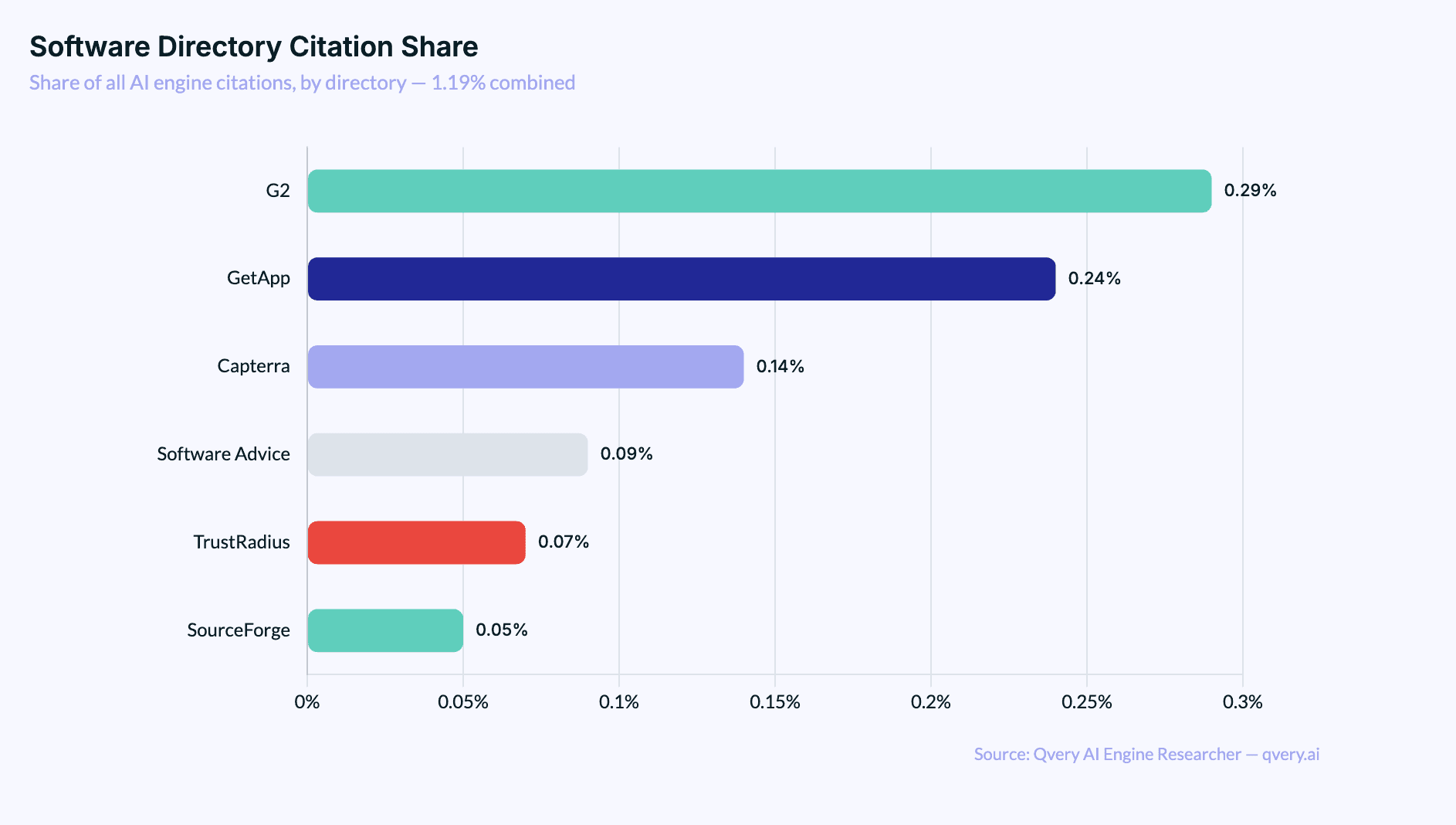
Inside the category, here is how the three tracked leaders stack up:
G2: 0.29% of all citations, the leading review site we track, average citation rank 14.33.
GetApp: 0.24%, the #2 directory in our data.
Capterra: 0.14%, average citation rank 14.00.
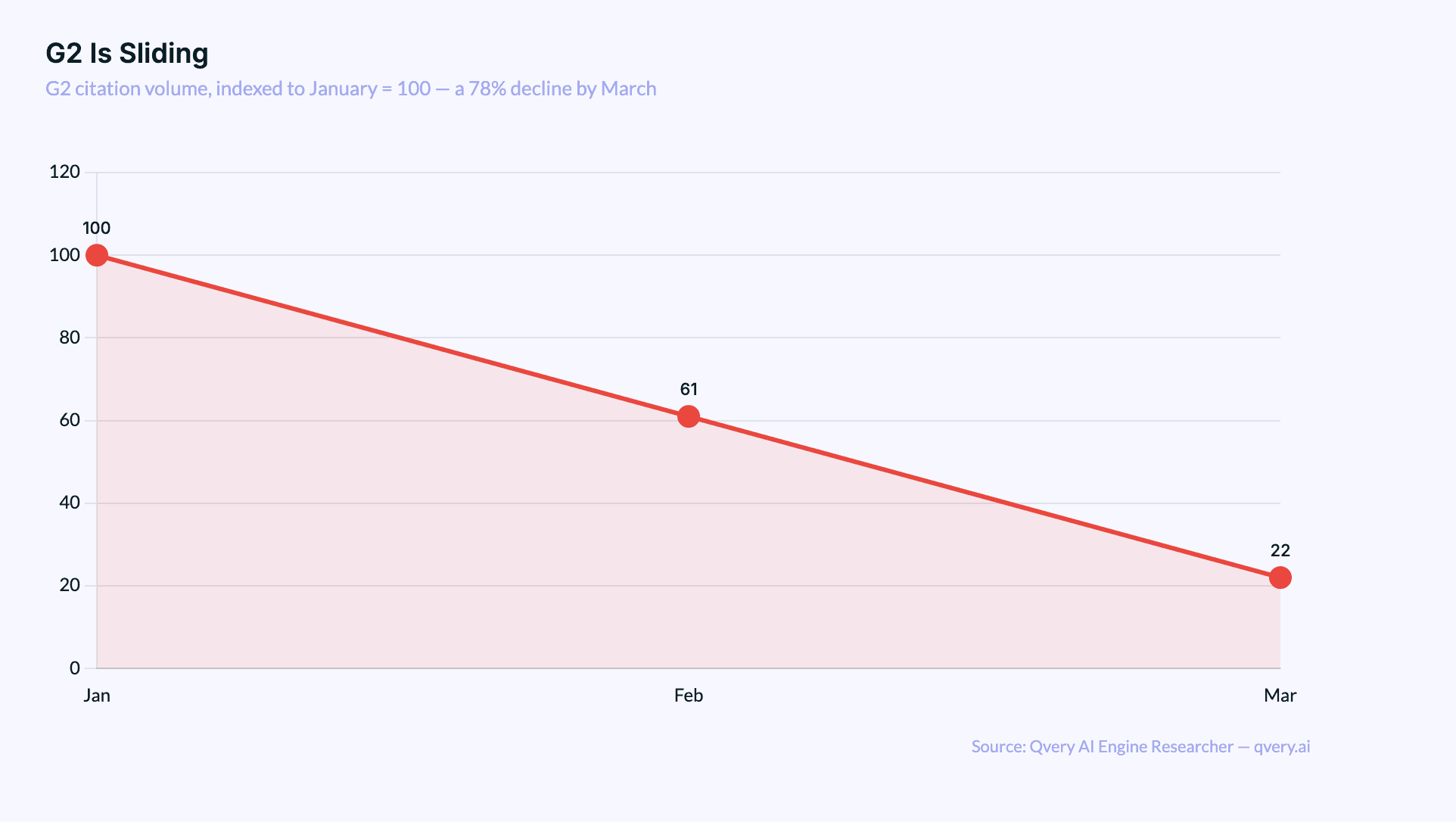
And G2, the leader, is the one sliding. Its citation share fell 78% from January to March, part of a broader pattern where review sites are declining as AI citation sources. I'll be honest, I don't know where this category bottoms out, and I've stopped pretending the slope tells us. What the data does say is which two or three listings are still feeding answers right now, so that's where I'd put the work.
Qvery Tells You Which Directories Are Worth Optimizing
Before you fill out a single listing field, find out whether directories even register for your category. Citation share is a category average, and your category is not the average. For some verticals directories are a meaningful source, for others they barely appear. The decision is narrow: which two or three of G2, GetApp, Capterra, Trustpilot, and SoftwareAdvice cite brands in your space.
Open the AI Engine Researcher and go to the Citations view. We built the Directory tag into this view for exactly this reason, because eyeballing which directory mattered was guesswork. Filter the view to that tag and you see precisely which of those five are feeding answers about your brand and how much each one carries.
Read the citation weight column closely, because that's where the two-or-three decision gets made. Citation weight is the relative citation influence of a source, so a directory that appears once carries far less weight than one that shows up repeatedly across your queries, and the column tells you which is which. Read it alongside the Average Rank column, since a directory cited often but always near the bottom of the answer is a weaker bet than one cited less but cited high. Sort by citation weight, draw the line after the second or third, and you have your shortlist.
Next, apply the engine filter and toggle between ChatGPT and Google AI Mode. Because directories skew toward Google AI Mode (1.47% vs 0.87% on ChatGPT), the payoff from a directory listing lands mostly in Google AI Mode answers; build your ChatGPT visibility through other sources in parallel. Frame the effort that way before you commit the time.
If you'd rather just ask, the Qvery Assistant answers it directly. Ask which of the five major directories cite brands in your category, and it ranks them by citation weight so you know which two to bother with before you open a single listing form.
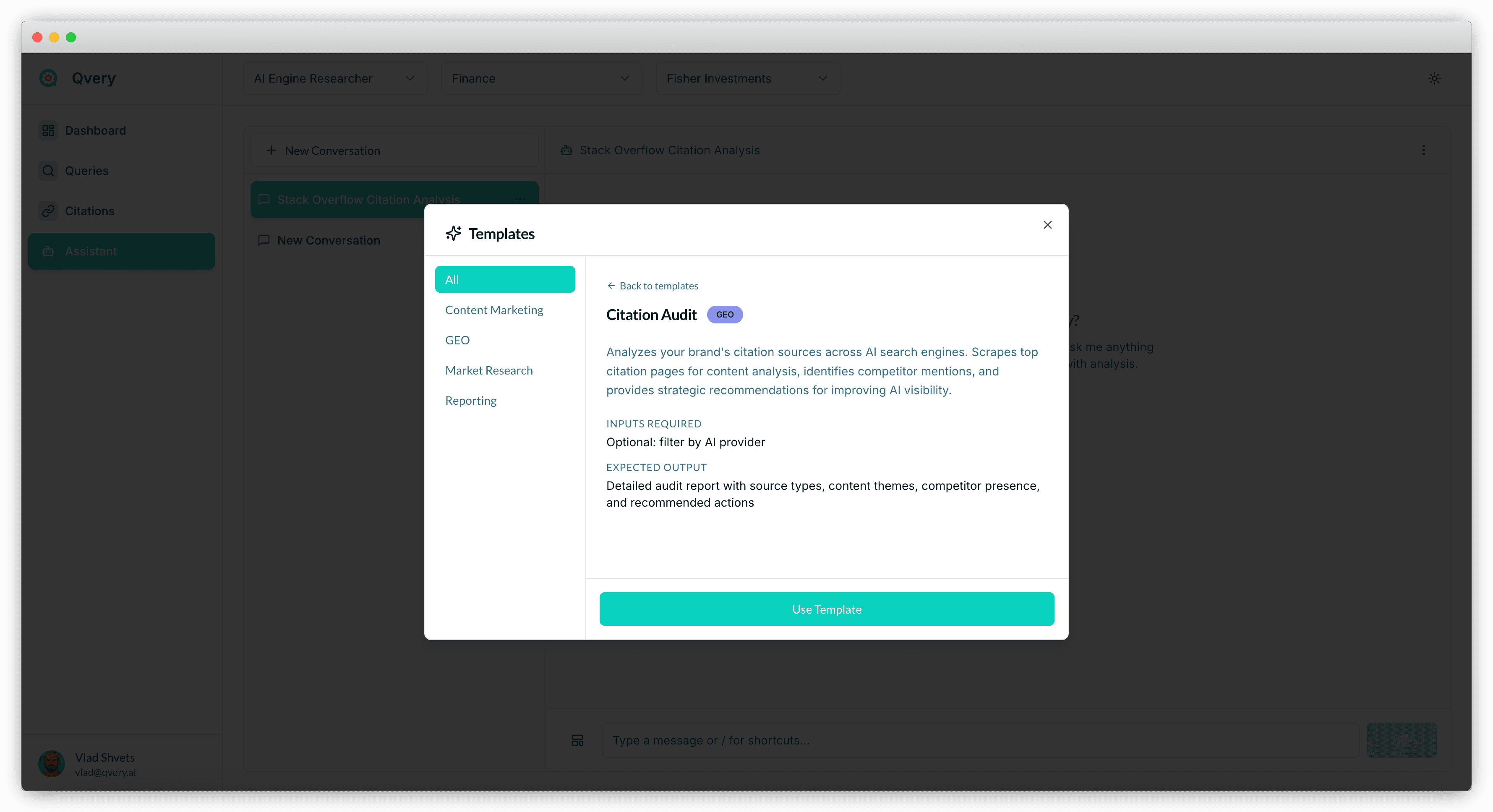
Once you know which directories carry weight for you, you stop optimizing all of them and start optimizing the two or three that show up in your Citations view. Then you work the checklist below on each one.
Most of This List Is Not Worth Optimizing
These are the directories worth evaluating. The first five are the ones Qvery tracks and has citation data for; the rest are generic directory advice with no Qvery citation backing. Run each one through your Citations view first, then optimize the ones that earn their place.
G2: the leading review site we track and the first one to confirm. Still the category leader despite the slide.
GetApp: the #2 directory in our data at 0.24%, and an easy one to neglect precisely because it's less famous than G2.
Capterra: 0.14% of citations, average rank 14.00. Lower share than G2 and GetApp, but part of Qvery's tracked set.
Trustpilot: part of Qvery's tracked set, broader than software-only review sites.
SoftwareAdvice: part of Qvery's tracked set, worth a listing where your buyers research.
TrustRadius: a brand-building play, not a confirmed AI citation source (not in our tracked data), worth it if your buyers write long, detailed reviews.
Product Hunt: a launch-day brand play, not a confirmed AI citation source (not in our tracked data).
Whichever two or three earn a spot in your Citations view, the listing work below is the same on each.
A Complete Listing Beats Three More Half-Filled Ones
Coverage is not the win here. A single listing complete and current enough that an AI engine can parse your whole value proposition without guessing is the win. Work each listing like this.
Complete every field, not most of them. That means descriptions, supported platforms, integrations, and deployment options, every one of them. An empty field signals a missing capability, and an AI engine summarizing your profile will faithfully report the gap.
Pick the right categories. Directories let you self-categorize, and most people pick the broadest possible bucket out of ego. Pick the specific one. Say you sell email marketing built for ecommerce. List under "Email Marketing for Ecommerce" and you get cited for the query a real buyer types. List under "Marketing Software" and you are one of four hundred products in a bucket the engine has no reason to open, like shelving a cookbook in "Books." The broad category feels safer and gets you cited for nothing; the narrow one is the only place a directory citation pays off.
Fill the structured attributes. This is the part most teams skip and the part AI engines love most. A feature checkbox marked Yes for SOC 2 lets the engine answer a compliance query with your name in it. The same fact buried in a prose description doesn't.
Keep reviews fresh. Reviews that stopped two years ago signal a product losing momentum. Ask the customers who rave about you in their team Slack to leave a recent review. Some directories run review-drive programs with gift-card rewards or co-marketing, and there's no shame in using them.
Respond to reviews, both the glowing ones and the brutal ones, because a vendor reply on a negative review is itself parseable content and signals an active, maintained product rather than a listing on autopilot.
Keep pricing current. This is the maintenance task with the highest payoff. Stale pricing means an AI engine confidently quotes a number you stopped charging a year ago, which is a fun conversation to have on a sales call. Keep the feature data current for the same reason.
Treat Each Directory as Its Own Decision, Not the Category as One
When we checked the Citations view for one B2B partner, exactly one directory was feeding answers in their category. They'd been maintaining five. The mistake teams make is treating the category as one decision when it's three or four per-listing decisions, and only on the listings your Citations view names.
In practice the split looks like this:
The two or three that earn citations: worked hard, every field complete, and framed as a Google AI Mode play because that's where the share lands.
Everything else: kept alive but off the maintenance calendar, because the engines aren't reading them for your category anyway.
The five-listing maintenance habit is the thing to kill. Pull your Citations view, find the two or three directories that feed answers in your category, complete those listings, and ignore the rest.
Software review directories earn about 1.19% of all AI citations across ChatGPT and Google AI Mode, a modest slice, and the biggest directory in the category, G2, just lost 78% of its citation share between January and March.
Optimizing every directory nobody cites is the marketing equivalent of repainting every fence on the block when only the three facing the street get seen.
A shrinking category with a leader in freefall sounds like a place to stop spending effort. It is, on most of these directories. On the two or three that cite brands in your category, it is one of the highest-payoff afternoons you can spend, because a directory field is the one place an AI engine reads your product as a structured spec instead of guessing from your homepage. Being listed on the whole set with nobody citing them is worse than being optimized on the two or three directories ChatGPT and Google AI Mode pull from for your category.
AI Engines Pull From Directories Because They Are Pre-Parsed
A G2 or Capterra profile arrives at the engine already structured. Categories are tagged and attributes are scored, every review carries a date, and the whole profile reads like a machine-readable spec sheet for your product. An AI engine doesn't have to interpret your clever homepage hero copy to figure out what you do. The directory already did the parsing.
That last part is why a category at barely 1% of citations still earns a place on your list. The same structure that makes a directory easy to parse is structure you don't get to fake. Your homepage can hide a missing feature behind nice copy; a directory field can't.
The engine never sees the field you skipped. It sees a No, and a No on a feature your competitor marked Yes is how you quietly lose the comparison query.
That's also why an incomplete listing hurts more than no listing. A profile with three filled fields and a 2021 logo tells the engine nobody maintains this product, and it passes that impression straight to the buyer.
The Leader Is the One Shrinking Fastest
Software review and directory sites combined account for 1.19% of all AI citations across ChatGPT and Google AI Mode, measured across millions of AI citations since January 2026. The engine split matters more than the headline number: directories pull 0.87% on ChatGPT and 1.47% on Google AI Mode, roughly twice the share on Google's side.
Inside the category, here is how the three tracked leaders stack up:
G2: 0.29% of all citations, the leading review site we track, average citation rank 14.33.
GetApp: 0.24%, the #2 directory in our data.
Capterra: 0.14%, average citation rank 14.00.
And G2, the leader, is the one sliding. Its citation share fell 78% from January to March, part of a broader pattern where review sites are declining as AI citation sources. I'll be honest, I don't know where this category bottoms out, and I've stopped pretending the slope tells us. What the data does say is which two or three listings are still feeding answers right now, so that's where I'd put the work.
Qvery Tells You Which Directories Are Worth Optimizing
Before you fill out a single listing field, find out whether directories even register for your category. Citation share is a category average, and your category is not the average. For some verticals directories are a meaningful source, for others they barely appear. The decision is narrow: which two or three of G2, GetApp, Capterra, Trustpilot, and SoftwareAdvice cite brands in your space.
Open the AI Engine Researcher and go to the Citations view. We built the Directory tag into this view for exactly this reason, because eyeballing which directory mattered was guesswork. Filter the view to that tag and you see precisely which of those five are feeding answers about your brand and how much each one carries.
Read the citation weight column closely, because that's where the two-or-three decision gets made. Citation weight is the relative citation influence of a source, so a directory that appears once carries far less weight than one that shows up repeatedly across your queries, and the column tells you which is which. Read it alongside the Average Rank column, since a directory cited often but always near the bottom of the answer is a weaker bet than one cited less but cited high. Sort by citation weight, draw the line after the second or third, and you have your shortlist.
Next, apply the engine filter and toggle between ChatGPT and Google AI Mode. Because directories skew toward Google AI Mode (1.47% vs 0.87% on ChatGPT), the payoff from a directory listing lands mostly in Google AI Mode answers; build your ChatGPT visibility through other sources in parallel. Frame the effort that way before you commit the time.
If you'd rather just ask, the Qvery Assistant answers it directly. Ask which of the five major directories cite brands in your category, and it ranks them by citation weight so you know which two to bother with before you open a single listing form.
Once you know which directories carry weight for you, you stop optimizing all of them and start optimizing the two or three that show up in your Citations view. Then you work the checklist below on each one.
Most of This List Is Not Worth Optimizing
These are the directories worth evaluating. The first five are the ones Qvery tracks and has citation data for; the rest are generic directory advice with no Qvery citation backing. Run each one through your Citations view first, then optimize the ones that earn their place.
G2: the leading review site we track and the first one to confirm. Still the category leader despite the slide.
GetApp: the #2 directory in our data at 0.24%, and an easy one to neglect precisely because it's less famous than G2.
Capterra: 0.14% of citations, average rank 14.00. Lower share than G2 and GetApp, but part of Qvery's tracked set.
Trustpilot: part of Qvery's tracked set, broader than software-only review sites.
SoftwareAdvice: part of Qvery's tracked set, worth a listing where your buyers research.
TrustRadius: a brand-building play, not a confirmed AI citation source (not in our tracked data), worth it if your buyers write long, detailed reviews.
Product Hunt: a launch-day brand play, not a confirmed AI citation source (not in our tracked data).
Whichever two or three earn a spot in your Citations view, the listing work below is the same on each.
A Complete Listing Beats Three More Half-Filled Ones
Coverage is not the win here. A single listing complete and current enough that an AI engine can parse your whole value proposition without guessing is the win. Work each listing like this.
Complete every field, not most of them. That means descriptions, supported platforms, integrations, and deployment options, every one of them. An empty field signals a missing capability, and an AI engine summarizing your profile will faithfully report the gap.
Pick the right categories. Directories let you self-categorize, and most people pick the broadest possible bucket out of ego. Pick the specific one. Say you sell email marketing built for ecommerce. List under "Email Marketing for Ecommerce" and you get cited for the query a real buyer types. List under "Marketing Software" and you are one of four hundred products in a bucket the engine has no reason to open, like shelving a cookbook in "Books." The broad category feels safer and gets you cited for nothing; the narrow one is the only place a directory citation pays off.
Fill the structured attributes. This is the part most teams skip and the part AI engines love most. A feature checkbox marked Yes for SOC 2 lets the engine answer a compliance query with your name in it. The same fact buried in a prose description doesn't.
Keep reviews fresh. Reviews that stopped two years ago signal a product losing momentum. Ask the customers who rave about you in their team Slack to leave a recent review. Some directories run review-drive programs with gift-card rewards or co-marketing, and there's no shame in using them.
Respond to reviews, both the glowing ones and the brutal ones, because a vendor reply on a negative review is itself parseable content and signals an active, maintained product rather than a listing on autopilot.
Keep pricing current. This is the maintenance task with the highest payoff. Stale pricing means an AI engine confidently quotes a number you stopped charging a year ago, which is a fun conversation to have on a sales call. Keep the feature data current for the same reason.
Treat Each Directory as Its Own Decision, Not the Category as One
When we checked the Citations view for one B2B partner, exactly one directory was feeding answers in their category. They'd been maintaining five. The mistake teams make is treating the category as one decision when it's three or four per-listing decisions, and only on the listings your Citations view names.
In practice the split looks like this:
The two or three that earn citations: worked hard, every field complete, and framed as a Google AI Mode play because that's where the share lands.
Everything else: kept alive but off the maintenance calendar, because the engines aren't reading them for your category anyway.
The five-listing maintenance habit is the thing to kill. Pull your Citations view, find the two or three directories that feed answers in your category, complete those listings, and ignore the rest.
Software review directories earn about 1.19% of all AI citations across ChatGPT and Google AI Mode, a modest slice, and the biggest directory in the category, G2, just lost 78% of its citation share between January and March.
Optimizing every directory nobody cites is the marketing equivalent of repainting every fence on the block when only the three facing the street get seen.
A shrinking category with a leader in freefall sounds like a place to stop spending effort. It is, on most of these directories. On the two or three that cite brands in your category, it is one of the highest-payoff afternoons you can spend, because a directory field is the one place an AI engine reads your product as a structured spec instead of guessing from your homepage. Being listed on the whole set with nobody citing them is worse than being optimized on the two or three directories ChatGPT and Google AI Mode pull from for your category.
AI Engines Pull From Directories Because They Are Pre-Parsed
A G2 or Capterra profile arrives at the engine already structured. Categories are tagged and attributes are scored, every review carries a date, and the whole profile reads like a machine-readable spec sheet for your product. An AI engine doesn't have to interpret your clever homepage hero copy to figure out what you do. The directory already did the parsing.
That last part is why a category at barely 1% of citations still earns a place on your list. The same structure that makes a directory easy to parse is structure you don't get to fake. Your homepage can hide a missing feature behind nice copy; a directory field can't.
The engine never sees the field you skipped. It sees a No, and a No on a feature your competitor marked Yes is how you quietly lose the comparison query.
That's also why an incomplete listing hurts more than no listing. A profile with three filled fields and a 2021 logo tells the engine nobody maintains this product, and it passes that impression straight to the buyer.
The Leader Is the One Shrinking Fastest
Software review and directory sites combined account for 1.19% of all AI citations across ChatGPT and Google AI Mode, measured across millions of AI citations since January 2026. The engine split matters more than the headline number: directories pull 0.87% on ChatGPT and 1.47% on Google AI Mode, roughly twice the share on Google's side.
Inside the category, here is how the three tracked leaders stack up:
G2: 0.29% of all citations, the leading review site we track, average citation rank 14.33.
GetApp: 0.24%, the #2 directory in our data.
Capterra: 0.14%, average citation rank 14.00.
And G2, the leader, is the one sliding. Its citation share fell 78% from January to March, part of a broader pattern where review sites are declining as AI citation sources. I'll be honest, I don't know where this category bottoms out, and I've stopped pretending the slope tells us. What the data does say is which two or three listings are still feeding answers right now, so that's where I'd put the work.
Qvery Tells You Which Directories Are Worth Optimizing
Before you fill out a single listing field, find out whether directories even register for your category. Citation share is a category average, and your category is not the average. For some verticals directories are a meaningful source, for others they barely appear. The decision is narrow: which two or three of G2, GetApp, Capterra, Trustpilot, and SoftwareAdvice cite brands in your space.
Open the AI Engine Researcher and go to the Citations view. We built the Directory tag into this view for exactly this reason, because eyeballing which directory mattered was guesswork. Filter the view to that tag and you see precisely which of those five are feeding answers about your brand and how much each one carries.
Read the citation weight column closely, because that's where the two-or-three decision gets made. Citation weight is the relative citation influence of a source, so a directory that appears once carries far less weight than one that shows up repeatedly across your queries, and the column tells you which is which. Read it alongside the Average Rank column, since a directory cited often but always near the bottom of the answer is a weaker bet than one cited less but cited high. Sort by citation weight, draw the line after the second or third, and you have your shortlist.
Next, apply the engine filter and toggle between ChatGPT and Google AI Mode. Because directories skew toward Google AI Mode (1.47% vs 0.87% on ChatGPT), the payoff from a directory listing lands mostly in Google AI Mode answers; build your ChatGPT visibility through other sources in parallel. Frame the effort that way before you commit the time.
If you'd rather just ask, the Qvery Assistant answers it directly. Ask which of the five major directories cite brands in your category, and it ranks them by citation weight so you know which two to bother with before you open a single listing form.
Once you know which directories carry weight for you, you stop optimizing all of them and start optimizing the two or three that show up in your Citations view. Then you work the checklist below on each one.
Most of This List Is Not Worth Optimizing
These are the directories worth evaluating. The first five are the ones Qvery tracks and has citation data for; the rest are generic directory advice with no Qvery citation backing. Run each one through your Citations view first, then optimize the ones that earn their place.
G2: the leading review site we track and the first one to confirm. Still the category leader despite the slide.
GetApp: the #2 directory in our data at 0.24%, and an easy one to neglect precisely because it's less famous than G2.
Capterra: 0.14% of citations, average rank 14.00. Lower share than G2 and GetApp, but part of Qvery's tracked set.
Trustpilot: part of Qvery's tracked set, broader than software-only review sites.
SoftwareAdvice: part of Qvery's tracked set, worth a listing where your buyers research.
TrustRadius: a brand-building play, not a confirmed AI citation source (not in our tracked data), worth it if your buyers write long, detailed reviews.
Product Hunt: a launch-day brand play, not a confirmed AI citation source (not in our tracked data).
Whichever two or three earn a spot in your Citations view, the listing work below is the same on each.
A Complete Listing Beats Three More Half-Filled Ones
Coverage is not the win here. A single listing complete and current enough that an AI engine can parse your whole value proposition without guessing is the win. Work each listing like this.
Complete every field, not most of them. That means descriptions, supported platforms, integrations, and deployment options, every one of them. An empty field signals a missing capability, and an AI engine summarizing your profile will faithfully report the gap.
Pick the right categories. Directories let you self-categorize, and most people pick the broadest possible bucket out of ego. Pick the specific one. Say you sell email marketing built for ecommerce. List under "Email Marketing for Ecommerce" and you get cited for the query a real buyer types. List under "Marketing Software" and you are one of four hundred products in a bucket the engine has no reason to open, like shelving a cookbook in "Books." The broad category feels safer and gets you cited for nothing; the narrow one is the only place a directory citation pays off.
Fill the structured attributes. This is the part most teams skip and the part AI engines love most. A feature checkbox marked Yes for SOC 2 lets the engine answer a compliance query with your name in it. The same fact buried in a prose description doesn't.
Keep reviews fresh. Reviews that stopped two years ago signal a product losing momentum. Ask the customers who rave about you in their team Slack to leave a recent review. Some directories run review-drive programs with gift-card rewards or co-marketing, and there's no shame in using them.
Respond to reviews, both the glowing ones and the brutal ones, because a vendor reply on a negative review is itself parseable content and signals an active, maintained product rather than a listing on autopilot.
Keep pricing current. This is the maintenance task with the highest payoff. Stale pricing means an AI engine confidently quotes a number you stopped charging a year ago, which is a fun conversation to have on a sales call. Keep the feature data current for the same reason.
Treat Each Directory as Its Own Decision, Not the Category as One
When we checked the Citations view for one B2B partner, exactly one directory was feeding answers in their category. They'd been maintaining five. The mistake teams make is treating the category as one decision when it's three or four per-listing decisions, and only on the listings your Citations view names.
In practice the split looks like this:
The two or three that earn citations: worked hard, every field complete, and framed as a Google AI Mode play because that's where the share lands.
Everything else: kept alive but off the maintenance calendar, because the engines aren't reading them for your category anyway.
The five-listing maintenance habit is the thing to kill. Pull your Citations view, find the two or three directories that feed answers in your category, complete those listings, and ignore the rest.
Software review directories earn about 1.19% of all AI citations across ChatGPT and Google AI Mode, a modest slice, and the biggest directory in the category, G2, just lost 78% of its citation share between January and March.
Optimizing every directory nobody cites is the marketing equivalent of repainting every fence on the block when only the three facing the street get seen.
A shrinking category with a leader in freefall sounds like a place to stop spending effort. It is, on most of these directories. On the two or three that cite brands in your category, it is one of the highest-payoff afternoons you can spend, because a directory field is the one place an AI engine reads your product as a structured spec instead of guessing from your homepage. Being listed on the whole set with nobody citing them is worse than being optimized on the two or three directories ChatGPT and Google AI Mode pull from for your category.
AI Engines Pull From Directories Because They Are Pre-Parsed
A G2 or Capterra profile arrives at the engine already structured. Categories are tagged and attributes are scored, every review carries a date, and the whole profile reads like a machine-readable spec sheet for your product. An AI engine doesn't have to interpret your clever homepage hero copy to figure out what you do. The directory already did the parsing.
That last part is why a category at barely 1% of citations still earns a place on your list. The same structure that makes a directory easy to parse is structure you don't get to fake. Your homepage can hide a missing feature behind nice copy; a directory field can't.
The engine never sees the field you skipped. It sees a No, and a No on a feature your competitor marked Yes is how you quietly lose the comparison query.
That's also why an incomplete listing hurts more than no listing. A profile with three filled fields and a 2021 logo tells the engine nobody maintains this product, and it passes that impression straight to the buyer.
The Leader Is the One Shrinking Fastest
Software review and directory sites combined account for 1.19% of all AI citations across ChatGPT and Google AI Mode, measured across millions of AI citations since January 2026. The engine split matters more than the headline number: directories pull 0.87% on ChatGPT and 1.47% on Google AI Mode, roughly twice the share on Google's side.
Inside the category, here is how the three tracked leaders stack up:
G2: 0.29% of all citations, the leading review site we track, average citation rank 14.33.
GetApp: 0.24%, the #2 directory in our data.
Capterra: 0.14%, average citation rank 14.00.
And G2, the leader, is the one sliding. Its citation share fell 78% from January to March, part of a broader pattern where review sites are declining as AI citation sources. I'll be honest, I don't know where this category bottoms out, and I've stopped pretending the slope tells us. What the data does say is which two or three listings are still feeding answers right now, so that's where I'd put the work.
Qvery Tells You Which Directories Are Worth Optimizing
Before you fill out a single listing field, find out whether directories even register for your category. Citation share is a category average, and your category is not the average. For some verticals directories are a meaningful source, for others they barely appear. The decision is narrow: which two or three of G2, GetApp, Capterra, Trustpilot, and SoftwareAdvice cite brands in your space.
Open the AI Engine Researcher and go to the Citations view. We built the Directory tag into this view for exactly this reason, because eyeballing which directory mattered was guesswork. Filter the view to that tag and you see precisely which of those five are feeding answers about your brand and how much each one carries.
Read the citation weight column closely, because that's where the two-or-three decision gets made. Citation weight is the relative citation influence of a source, so a directory that appears once carries far less weight than one that shows up repeatedly across your queries, and the column tells you which is which. Read it alongside the Average Rank column, since a directory cited often but always near the bottom of the answer is a weaker bet than one cited less but cited high. Sort by citation weight, draw the line after the second or third, and you have your shortlist.
Next, apply the engine filter and toggle between ChatGPT and Google AI Mode. Because directories skew toward Google AI Mode (1.47% vs 0.87% on ChatGPT), the payoff from a directory listing lands mostly in Google AI Mode answers; build your ChatGPT visibility through other sources in parallel. Frame the effort that way before you commit the time.
If you'd rather just ask, the Qvery Assistant answers it directly. Ask which of the five major directories cite brands in your category, and it ranks them by citation weight so you know which two to bother with before you open a single listing form.
Once you know which directories carry weight for you, you stop optimizing all of them and start optimizing the two or three that show up in your Citations view. Then you work the checklist below on each one.
Most of This List Is Not Worth Optimizing
These are the directories worth evaluating. The first five are the ones Qvery tracks and has citation data for; the rest are generic directory advice with no Qvery citation backing. Run each one through your Citations view first, then optimize the ones that earn their place.
G2: the leading review site we track and the first one to confirm. Still the category leader despite the slide.
GetApp: the #2 directory in our data at 0.24%, and an easy one to neglect precisely because it's less famous than G2.
Capterra: 0.14% of citations, average rank 14.00. Lower share than G2 and GetApp, but part of Qvery's tracked set.
Trustpilot: part of Qvery's tracked set, broader than software-only review sites.
SoftwareAdvice: part of Qvery's tracked set, worth a listing where your buyers research.
TrustRadius: a brand-building play, not a confirmed AI citation source (not in our tracked data), worth it if your buyers write long, detailed reviews.
Product Hunt: a launch-day brand play, not a confirmed AI citation source (not in our tracked data).
Whichever two or three earn a spot in your Citations view, the listing work below is the same on each.
A Complete Listing Beats Three More Half-Filled Ones
Coverage is not the win here. A single listing complete and current enough that an AI engine can parse your whole value proposition without guessing is the win. Work each listing like this.
Complete every field, not most of them. That means descriptions, supported platforms, integrations, and deployment options, every one of them. An empty field signals a missing capability, and an AI engine summarizing your profile will faithfully report the gap.
Pick the right categories. Directories let you self-categorize, and most people pick the broadest possible bucket out of ego. Pick the specific one. Say you sell email marketing built for ecommerce. List under "Email Marketing for Ecommerce" and you get cited for the query a real buyer types. List under "Marketing Software" and you are one of four hundred products in a bucket the engine has no reason to open, like shelving a cookbook in "Books." The broad category feels safer and gets you cited for nothing; the narrow one is the only place a directory citation pays off.
Fill the structured attributes. This is the part most teams skip and the part AI engines love most. A feature checkbox marked Yes for SOC 2 lets the engine answer a compliance query with your name in it. The same fact buried in a prose description doesn't.
Keep reviews fresh. Reviews that stopped two years ago signal a product losing momentum. Ask the customers who rave about you in their team Slack to leave a recent review. Some directories run review-drive programs with gift-card rewards or co-marketing, and there's no shame in using them.
Respond to reviews, both the glowing ones and the brutal ones, because a vendor reply on a negative review is itself parseable content and signals an active, maintained product rather than a listing on autopilot.
Keep pricing current. This is the maintenance task with the highest payoff. Stale pricing means an AI engine confidently quotes a number you stopped charging a year ago, which is a fun conversation to have on a sales call. Keep the feature data current for the same reason.
Treat Each Directory as Its Own Decision, Not the Category as One
When we checked the Citations view for one B2B partner, exactly one directory was feeding answers in their category. They'd been maintaining five. The mistake teams make is treating the category as one decision when it's three or four per-listing decisions, and only on the listings your Citations view names.
In practice the split looks like this:
The two or three that earn citations: worked hard, every field complete, and framed as a Google AI Mode play because that's where the share lands.
Everything else: kept alive but off the maintenance calendar, because the engines aren't reading them for your category anyway.
The five-listing maintenance habit is the thing to kill. Pull your Citations view, find the two or three directories that feed answers in your category, complete those listings, and ignore the rest.

© 2026 Qvery AI OÜ