By
Vlad Shvets
How to Get AI Search Engines to Recommend Your Restaurant
We ran 64 restaurant-discovery queries on ChatGPT and Google AI Mode. Reddit dominates, Yelp barely registers, and your own website rarely gets cited. Here's what gets your restaurant recommended.
We ran 64 restaurant-discovery queries on ChatGPT and Google AI Mode. Reddit dominates, Yelp barely registers, and your own website rarely gets cited. Here's what gets your restaurant recommended.
We ran 64 restaurant-discovery queries on ChatGPT and Google AI Mode. Reddit dominates, Yelp barely registers, and your own website rarely gets cited. Here's what gets your restaurant recommended.
Here is a test you can run before the dinner rush starts. Open ChatGPT, type "best restaurants in [your city]," and see whether your place is on the list it hands back.
If you showed up, congratulations, you can close this tab and get back to expediting tickets. If you got a confident, friendly set of recommendations and your restaurant was nowhere in it, you have plenty of company.
A growing share of your would-be guests are asking an AI engine where to eat instead of scrolling Google, and the AI has its own opinion about who earns a mention. It doesn't care about your paid search budget or the meta description you agonized over. (It hasn't read your website. We'll come back to that, because it's the most useful thing in this post.)
So I ran it. I took 64 unbranded restaurant-discovery queries ("best restaurants in Austin," "where to eat in Chicago," "romantic dinner in Miami," "best brunch in Seattle," and more across a dozen US cities), ran each one on ChatGPT and Google AI Mode, and logged every source the engines cited before they answered. The breakdown isn't what most operators expect, and it points to a short, concrete list of moves.
What We Found When We Asked AI Where to Eat
The most-cited source, on both engines, was Reddit, cited in 57.8% of ChatGPT's answers and 59.4% of Google AI Mode's, ahead of everything else on either engine.
The website where strangers argue about whether a hot dog is a sandwich is also the website AI trusts most when it decides where you should have dinner.
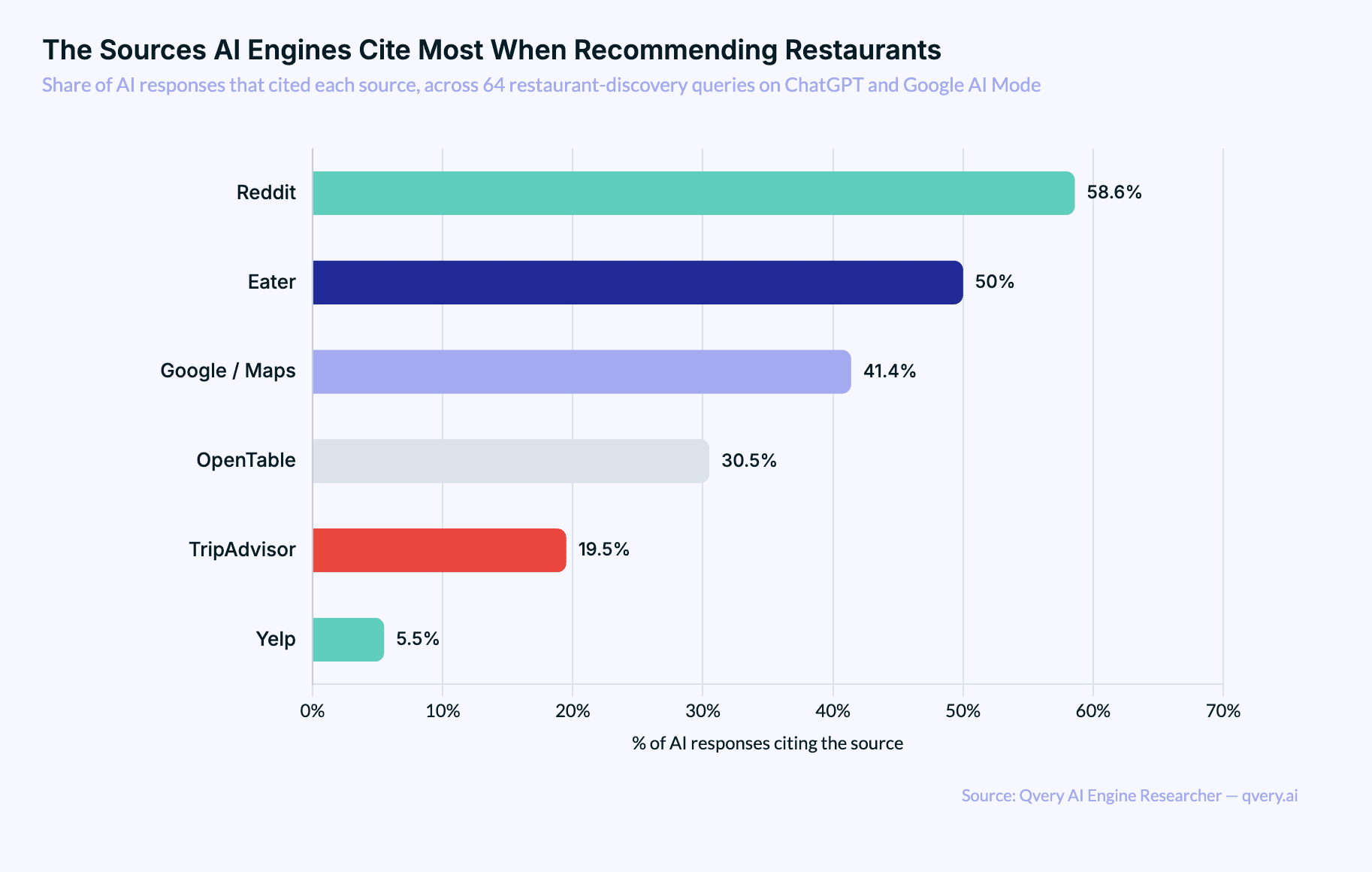
Right behind Reddit came Eater and the editorial "best of" guides, Time Out, The Infatuation, and the local city magazines, cited in roughly half of all responses. Then Google's own surfaces, Maps included. Then the reservation and review platforms.
The bigger surprise is what almost didn't show up. Yelp registered in 5.5% of responses. The platform built entirely on restaurant reviews, with a cartoon mascot to match, is close to invisible to AI engines.
So is your own website. Across the whole study, more than three-quarters of the individual sites AI cited appeared in only a single response, a long tail of pages the engines pulled once and never opened again. Your homepage is somewhere in that pile.
There's a structural reason for the split. Reddit threads, Eater lists, and OpenTable pages are open text an engine can read top to bottom. Much of Yelp's signal sits behind its app, its login, and its own ranking logic, where an AI crawler gets a thinner read. AI cites what it can read in full, which is how an open forum post outruns a database of millions of reviews.
AI doesn't visit your restaurant. It reads what other people wrote about you and recommends from the consensus, so if that consensus doesn't exist, neither do you.
Why AI Picks Restaurants Differently Than Google
For 25 years, local search worked one way. You optimized your Google Business Profile, chased reviews, fought for the map pack, and tried to rank for "restaurants near me." That machinery still matters, but it doesn't transfer to AI search the way you'd hope.
When we compared AI citations against Google's organic top 10 across our wider dataset, the overlap was only 13.9%. Even the #1 organic result on Google has only a 48.8% chance of being cited by an AI engine for the same query.
The mechanics are different. AI engines don't match your query to a phrase. They read intent, fan one question out into dozens of narrower ones, then pull passages from many sources and synthesize a single answer. "Where should we go for an anniversary in Denver" quietly becomes a research project about ambiance, price, neighborhoods, and what recent diners said out loud.
Restaurant and travel discovery has the highest AI-to-Google overlap of any category we track, at 26.8%, so local intent does lean a bit harder on traditional signals than software queries do, but not nearly enough to coast on the old playbook.
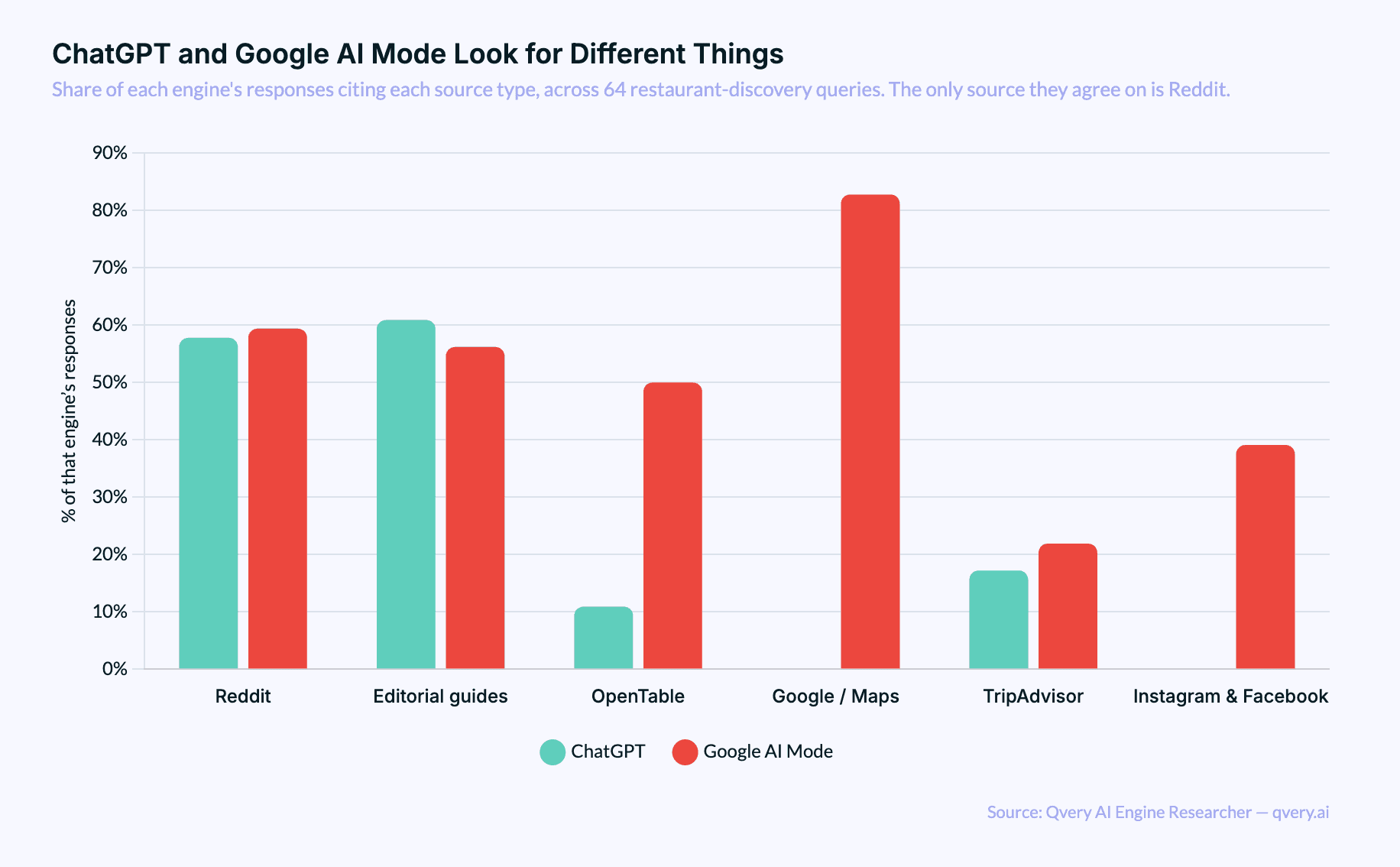
The other shift is that the two engines barely agree with each other.
Google AI Mode: cited its own Maps and Google surfaces in 82.8% of responses, leaned on OpenTable in half of them, and pulled Instagram and Facebook in roughly four of ten.
ChatGPT: cited almost none of those, preferring Reddit and the editorial guides.
The two engines overlap on exactly one source: Reddit.
Where AI Looks for Restaurant Recommendations
Strip away the per-engine noise and the data lands on the same three places AI engines look for any brand, just wearing an apron. We've mapped these three pillars of AI engine visibility before. For restaurants, they sort cleanly, and most operators are working hard on the one that matters least.
1. The Surfaces You Control (and the One You Can't)
Your website is the surface you most want to win and the one AI cites least. That sounds bleak until you see what AI does read from your side: the structured profiles. Your Google Business Profile and Maps listing, your OpenTable page, your TripAdvisor entry.
On Google AI Mode, Maps appeared in 82.8% of answers and OpenTable in half of them. These are the parts of "you" the engines pull, so they need to be complete, current, and photo-rich, with accurate hours, a real menu, the neighborhood, and the price band.
Then there's the website itself. It'll rarely be cited directly, but it's where AI forms its first impression of who you are. The fix is the same one that works everywhere in AI search: give it something it can't get from the other thousand pages: a real point of view, the chef's own story, the specific dishes, the reason the place exists. The 400th generic "fine dining in [city]" page is worth nothing. A page that says something true is worth a citation.
2. The Lists Other People Make
Editorial guides were the second most-cited force in our study, and they're the most addressable one. Eater, Time Out, The Infatuation, the alt-weekly's annual roundup: best-of lists are the most-cited content type in AI search, and getting onto one is a publicist's job, not an engineer's.
Pitch the food editor with a specific angle. Invite the neighborhood blogger to the new tasting menu. One good list placement can outweigh months of work on your own pages.
The pitch that works is a specific story, not a request to be added. A food editor ignores "please feature our restaurant." They answer "we're running a one-night Oaxacan tasting menu with a mezcal pairing, here are three dates, come in." Make it true and time-bound.
And mind the clock on the lists themselves, because AI weighs recency: a roundup that hasn't been refreshed in two years counts for less than this season's update, which is the version worth getting into.
One note on TripAdvisor. It's a top-five domain in AI search overall, and 90.4% of its citations come from Google AI Mode. For restaurants specifically, though, it sat mid-pack, in roughly a fifth of responses. It's worth a complete profile, especially for the Google AI Mode crowd, but it isn't the lever that travel and hotels make it look like.
3. What Real Diners Say
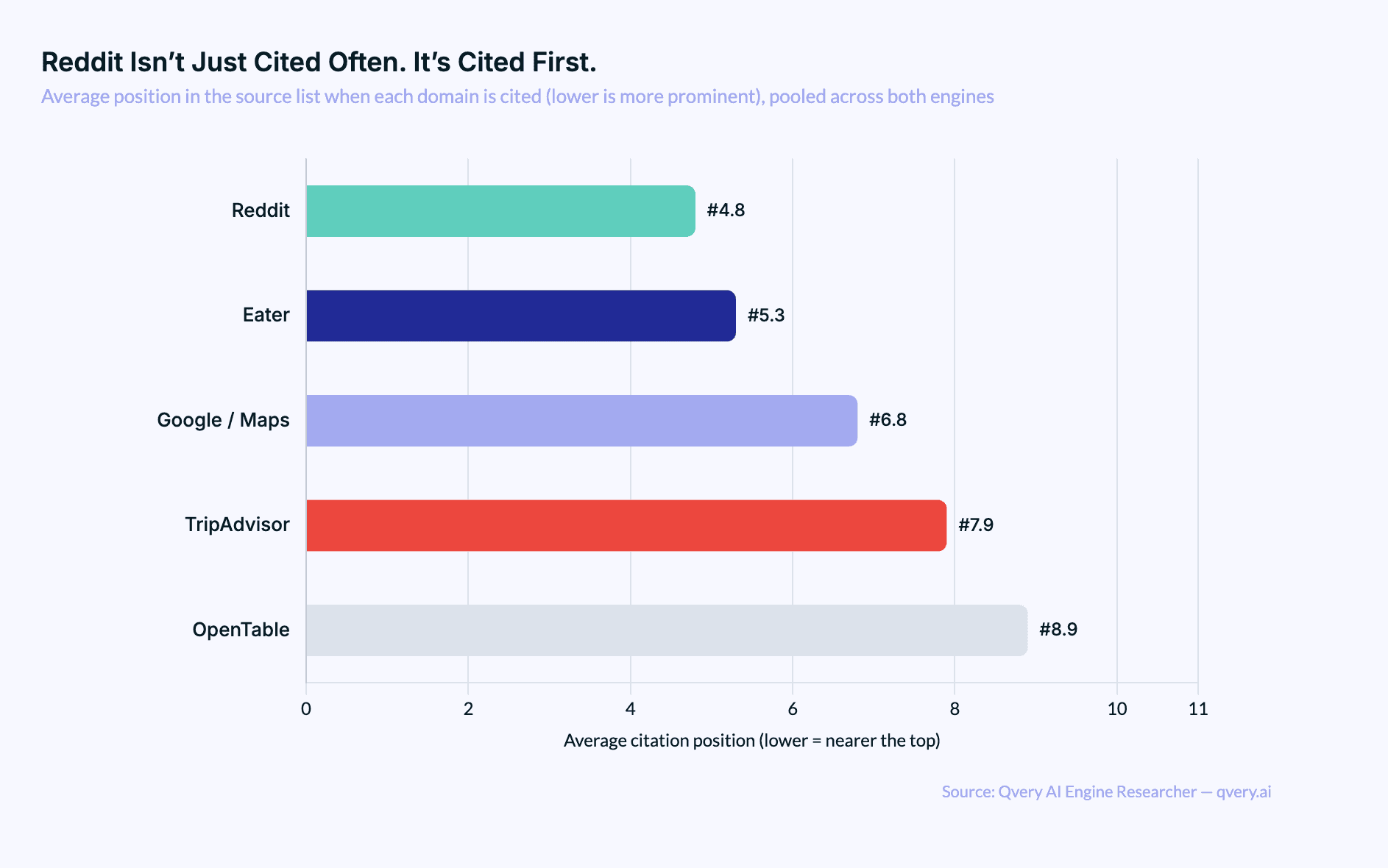
Reddit shows up here too, and this time at the very top. In our wider data, Reddit's the #3 most-cited domain in AI search and the single largest source of user-generated citations. For restaurant discovery it was #1 outright, on both engines, and it wasn't buried at the bottom of the list. It was cited early.
The threads that surface are the obvious ones: a city's food subreddit weighing in on the best tacos in town, or where to take visiting parents for a nice dinner. That is exactly where a real recommendation of your restaurant would live.
This is the pillar you can't buy your way into, and it comes with the same clock the lists do: a thread from last month carries more than a glowing post from 2022. You can't plant these without it backfiring, but you can earn them: be good enough that the city's food subreddit brings you up on its own, then show up as the owner who answers questions instead of the one who argues with one-star reviews.
You can buy a billboard or an influencer dinner. You can't buy the sentence a stranger writes about you on Reddit, and that's exactly why AI trusts it.
You Can't Grow What You Can't See
If a city's worth of diners is asking AI where to eat, you want to know whether you're in the answer, how often, and how high up. Three numbers tell that story, and they measure genuinely different things.
Visibility: the share of those queries where you appear at all.
Share of voice: how often you show up, weighted by how prominently.
Average rank: where you land in the list when you do make it.
A restaurant can be visible and still have weak share of voice, recommended often but always last. When we run this for a hospitality brand, the first surprise is usually that gap: they assumed they were fine because they showed up, until they saw they were landing in sixth place behind the same three competitors every time.
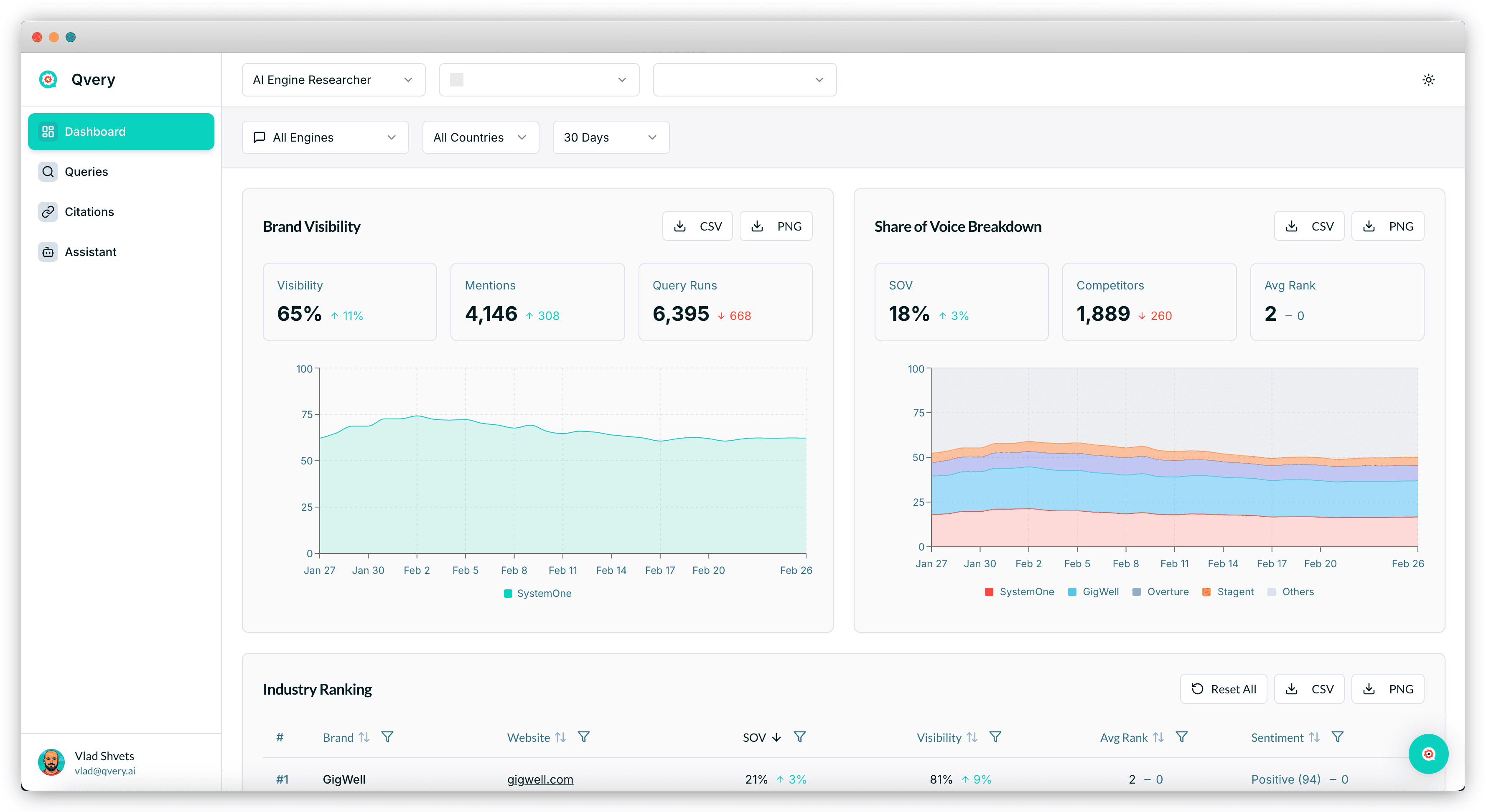
This is the problem we build for at Qvery. Our AI Engine Researcher runs the restaurant-discovery queries that matter for your city and cuisine every day across ChatGPT and Google AI Mode, tracks your visibility and share of voice against the restaurants you compete with, and shows the specific citations driving each result: the Reddit threads, the Eater lists, the OpenTable pages. You sign up, enter your restaurant, and see where you stand in about 15 minutes.
What to Do This Month
None of this requires a rebrand. It requires showing up in the places AI reads.
Profiles: claim and complete every one AI pulls, your Google Business Profile, Maps, OpenTable, and TripAdvisor, with current hours, a real menu, the price band, and recent photos.
Lists: earn one local placement by pitching a food editor or neighborhood writer with a specific, true, time-bound angle, not a press release.
Reddit: become the kind of place your city's food subreddit brings up unprompted, and answer like a host when you're mentioned.
Website: replace the generic copy with the chef's point of view and the dishes only you serve.
Share of voice: track it, because you can't improve a number you've never seen, and most of your competitors haven't seen theirs either.
I won't pretend the engines hold still. Our June numbers will drift, and Yelp could climb back while ChatGPT rediscovers maps. What won't change is the underlying fact: AI recommends the restaurants enough people are talking about, in the sources it reads. That has always been the most meritocratic part of the business, and for once the technology agrees.
Here is a test you can run before the dinner rush starts. Open ChatGPT, type "best restaurants in [your city]," and see whether your place is on the list it hands back.
If you showed up, congratulations, you can close this tab and get back to expediting tickets. If you got a confident, friendly set of recommendations and your restaurant was nowhere in it, you have plenty of company.
A growing share of your would-be guests are asking an AI engine where to eat instead of scrolling Google, and the AI has its own opinion about who earns a mention. It doesn't care about your paid search budget or the meta description you agonized over. (It hasn't read your website. We'll come back to that, because it's the most useful thing in this post.)
So I ran it. I took 64 unbranded restaurant-discovery queries ("best restaurants in Austin," "where to eat in Chicago," "romantic dinner in Miami," "best brunch in Seattle," and more across a dozen US cities), ran each one on ChatGPT and Google AI Mode, and logged every source the engines cited before they answered. The breakdown isn't what most operators expect, and it points to a short, concrete list of moves.
What We Found When We Asked AI Where to Eat
The most-cited source, on both engines, was Reddit, cited in 57.8% of ChatGPT's answers and 59.4% of Google AI Mode's, ahead of everything else on either engine.
The website where strangers argue about whether a hot dog is a sandwich is also the website AI trusts most when it decides where you should have dinner.
Right behind Reddit came Eater and the editorial "best of" guides, Time Out, The Infatuation, and the local city magazines, cited in roughly half of all responses. Then Google's own surfaces, Maps included. Then the reservation and review platforms.
The bigger surprise is what almost didn't show up. Yelp registered in 5.5% of responses. The platform built entirely on restaurant reviews, with a cartoon mascot to match, is close to invisible to AI engines.
So is your own website. Across the whole study, more than three-quarters of the individual sites AI cited appeared in only a single response, a long tail of pages the engines pulled once and never opened again. Your homepage is somewhere in that pile.
There's a structural reason for the split. Reddit threads, Eater lists, and OpenTable pages are open text an engine can read top to bottom. Much of Yelp's signal sits behind its app, its login, and its own ranking logic, where an AI crawler gets a thinner read. AI cites what it can read in full, which is how an open forum post outruns a database of millions of reviews.
AI doesn't visit your restaurant. It reads what other people wrote about you and recommends from the consensus, so if that consensus doesn't exist, neither do you.
Why AI Picks Restaurants Differently Than Google
For 25 years, local search worked one way. You optimized your Google Business Profile, chased reviews, fought for the map pack, and tried to rank for "restaurants near me." That machinery still matters, but it doesn't transfer to AI search the way you'd hope.
When we compared AI citations against Google's organic top 10 across our wider dataset, the overlap was only 13.9%. Even the #1 organic result on Google has only a 48.8% chance of being cited by an AI engine for the same query.
The mechanics are different. AI engines don't match your query to a phrase. They read intent, fan one question out into dozens of narrower ones, then pull passages from many sources and synthesize a single answer. "Where should we go for an anniversary in Denver" quietly becomes a research project about ambiance, price, neighborhoods, and what recent diners said out loud.
Restaurant and travel discovery has the highest AI-to-Google overlap of any category we track, at 26.8%, so local intent does lean a bit harder on traditional signals than software queries do, but not nearly enough to coast on the old playbook.
The other shift is that the two engines barely agree with each other.
Google AI Mode: cited its own Maps and Google surfaces in 82.8% of responses, leaned on OpenTable in half of them, and pulled Instagram and Facebook in roughly four of ten.
ChatGPT: cited almost none of those, preferring Reddit and the editorial guides.
The two engines overlap on exactly one source: Reddit.
Where AI Looks for Restaurant Recommendations
Strip away the per-engine noise and the data lands on the same three places AI engines look for any brand, just wearing an apron. We've mapped these three pillars of AI engine visibility before. For restaurants, they sort cleanly, and most operators are working hard on the one that matters least.
1. The Surfaces You Control (and the One You Can't)
Your website is the surface you most want to win and the one AI cites least. That sounds bleak until you see what AI does read from your side: the structured profiles. Your Google Business Profile and Maps listing, your OpenTable page, your TripAdvisor entry.
On Google AI Mode, Maps appeared in 82.8% of answers and OpenTable in half of them. These are the parts of "you" the engines pull, so they need to be complete, current, and photo-rich, with accurate hours, a real menu, the neighborhood, and the price band.
Then there's the website itself. It'll rarely be cited directly, but it's where AI forms its first impression of who you are. The fix is the same one that works everywhere in AI search: give it something it can't get from the other thousand pages: a real point of view, the chef's own story, the specific dishes, the reason the place exists. The 400th generic "fine dining in [city]" page is worth nothing. A page that says something true is worth a citation.
2. The Lists Other People Make
Editorial guides were the second most-cited force in our study, and they're the most addressable one. Eater, Time Out, The Infatuation, the alt-weekly's annual roundup: best-of lists are the most-cited content type in AI search, and getting onto one is a publicist's job, not an engineer's.
Pitch the food editor with a specific angle. Invite the neighborhood blogger to the new tasting menu. One good list placement can outweigh months of work on your own pages.
The pitch that works is a specific story, not a request to be added. A food editor ignores "please feature our restaurant." They answer "we're running a one-night Oaxacan tasting menu with a mezcal pairing, here are three dates, come in." Make it true and time-bound.
And mind the clock on the lists themselves, because AI weighs recency: a roundup that hasn't been refreshed in two years counts for less than this season's update, which is the version worth getting into.
One note on TripAdvisor. It's a top-five domain in AI search overall, and 90.4% of its citations come from Google AI Mode. For restaurants specifically, though, it sat mid-pack, in roughly a fifth of responses. It's worth a complete profile, especially for the Google AI Mode crowd, but it isn't the lever that travel and hotels make it look like.
3. What Real Diners Say
Reddit shows up here too, and this time at the very top. In our wider data, Reddit's the #3 most-cited domain in AI search and the single largest source of user-generated citations. For restaurant discovery it was #1 outright, on both engines, and it wasn't buried at the bottom of the list. It was cited early.
The threads that surface are the obvious ones: a city's food subreddit weighing in on the best tacos in town, or where to take visiting parents for a nice dinner. That is exactly where a real recommendation of your restaurant would live.
This is the pillar you can't buy your way into, and it comes with the same clock the lists do: a thread from last month carries more than a glowing post from 2022. You can't plant these without it backfiring, but you can earn them: be good enough that the city's food subreddit brings you up on its own, then show up as the owner who answers questions instead of the one who argues with one-star reviews.
You can buy a billboard or an influencer dinner. You can't buy the sentence a stranger writes about you on Reddit, and that's exactly why AI trusts it.
You Can't Grow What You Can't See
If a city's worth of diners is asking AI where to eat, you want to know whether you're in the answer, how often, and how high up. Three numbers tell that story, and they measure genuinely different things.
Visibility: the share of those queries where you appear at all.
Share of voice: how often you show up, weighted by how prominently.
Average rank: where you land in the list when you do make it.
A restaurant can be visible and still have weak share of voice, recommended often but always last. When we run this for a hospitality brand, the first surprise is usually that gap: they assumed they were fine because they showed up, until they saw they were landing in sixth place behind the same three competitors every time.
This is the problem we build for at Qvery. Our AI Engine Researcher runs the restaurant-discovery queries that matter for your city and cuisine every day across ChatGPT and Google AI Mode, tracks your visibility and share of voice against the restaurants you compete with, and shows the specific citations driving each result: the Reddit threads, the Eater lists, the OpenTable pages. You sign up, enter your restaurant, and see where you stand in about 15 minutes.
What to Do This Month
None of this requires a rebrand. It requires showing up in the places AI reads.
Profiles: claim and complete every one AI pulls, your Google Business Profile, Maps, OpenTable, and TripAdvisor, with current hours, a real menu, the price band, and recent photos.
Lists: earn one local placement by pitching a food editor or neighborhood writer with a specific, true, time-bound angle, not a press release.
Reddit: become the kind of place your city's food subreddit brings up unprompted, and answer like a host when you're mentioned.
Website: replace the generic copy with the chef's point of view and the dishes only you serve.
Share of voice: track it, because you can't improve a number you've never seen, and most of your competitors haven't seen theirs either.
I won't pretend the engines hold still. Our June numbers will drift, and Yelp could climb back while ChatGPT rediscovers maps. What won't change is the underlying fact: AI recommends the restaurants enough people are talking about, in the sources it reads. That has always been the most meritocratic part of the business, and for once the technology agrees.
Here is a test you can run before the dinner rush starts. Open ChatGPT, type "best restaurants in [your city]," and see whether your place is on the list it hands back.
If you showed up, congratulations, you can close this tab and get back to expediting tickets. If you got a confident, friendly set of recommendations and your restaurant was nowhere in it, you have plenty of company.
A growing share of your would-be guests are asking an AI engine where to eat instead of scrolling Google, and the AI has its own opinion about who earns a mention. It doesn't care about your paid search budget or the meta description you agonized over. (It hasn't read your website. We'll come back to that, because it's the most useful thing in this post.)
So I ran it. I took 64 unbranded restaurant-discovery queries ("best restaurants in Austin," "where to eat in Chicago," "romantic dinner in Miami," "best brunch in Seattle," and more across a dozen US cities), ran each one on ChatGPT and Google AI Mode, and logged every source the engines cited before they answered. The breakdown isn't what most operators expect, and it points to a short, concrete list of moves.
What We Found When We Asked AI Where to Eat
The most-cited source, on both engines, was Reddit, cited in 57.8% of ChatGPT's answers and 59.4% of Google AI Mode's, ahead of everything else on either engine.
The website where strangers argue about whether a hot dog is a sandwich is also the website AI trusts most when it decides where you should have dinner.
Right behind Reddit came Eater and the editorial "best of" guides, Time Out, The Infatuation, and the local city magazines, cited in roughly half of all responses. Then Google's own surfaces, Maps included. Then the reservation and review platforms.
The bigger surprise is what almost didn't show up. Yelp registered in 5.5% of responses. The platform built entirely on restaurant reviews, with a cartoon mascot to match, is close to invisible to AI engines.
So is your own website. Across the whole study, more than three-quarters of the individual sites AI cited appeared in only a single response, a long tail of pages the engines pulled once and never opened again. Your homepage is somewhere in that pile.
There's a structural reason for the split. Reddit threads, Eater lists, and OpenTable pages are open text an engine can read top to bottom. Much of Yelp's signal sits behind its app, its login, and its own ranking logic, where an AI crawler gets a thinner read. AI cites what it can read in full, which is how an open forum post outruns a database of millions of reviews.
AI doesn't visit your restaurant. It reads what other people wrote about you and recommends from the consensus, so if that consensus doesn't exist, neither do you.
Why AI Picks Restaurants Differently Than Google
For 25 years, local search worked one way. You optimized your Google Business Profile, chased reviews, fought for the map pack, and tried to rank for "restaurants near me." That machinery still matters, but it doesn't transfer to AI search the way you'd hope.
When we compared AI citations against Google's organic top 10 across our wider dataset, the overlap was only 13.9%. Even the #1 organic result on Google has only a 48.8% chance of being cited by an AI engine for the same query.
The mechanics are different. AI engines don't match your query to a phrase. They read intent, fan one question out into dozens of narrower ones, then pull passages from many sources and synthesize a single answer. "Where should we go for an anniversary in Denver" quietly becomes a research project about ambiance, price, neighborhoods, and what recent diners said out loud.
Restaurant and travel discovery has the highest AI-to-Google overlap of any category we track, at 26.8%, so local intent does lean a bit harder on traditional signals than software queries do, but not nearly enough to coast on the old playbook.
The other shift is that the two engines barely agree with each other.
Google AI Mode: cited its own Maps and Google surfaces in 82.8% of responses, leaned on OpenTable in half of them, and pulled Instagram and Facebook in roughly four of ten.
ChatGPT: cited almost none of those, preferring Reddit and the editorial guides.
The two engines overlap on exactly one source: Reddit.
Where AI Looks for Restaurant Recommendations
Strip away the per-engine noise and the data lands on the same three places AI engines look for any brand, just wearing an apron. We've mapped these three pillars of AI engine visibility before. For restaurants, they sort cleanly, and most operators are working hard on the one that matters least.
1. The Surfaces You Control (and the One You Can't)
Your website is the surface you most want to win and the one AI cites least. That sounds bleak until you see what AI does read from your side: the structured profiles. Your Google Business Profile and Maps listing, your OpenTable page, your TripAdvisor entry.
On Google AI Mode, Maps appeared in 82.8% of answers and OpenTable in half of them. These are the parts of "you" the engines pull, so they need to be complete, current, and photo-rich, with accurate hours, a real menu, the neighborhood, and the price band.
Then there's the website itself. It'll rarely be cited directly, but it's where AI forms its first impression of who you are. The fix is the same one that works everywhere in AI search: give it something it can't get from the other thousand pages: a real point of view, the chef's own story, the specific dishes, the reason the place exists. The 400th generic "fine dining in [city]" page is worth nothing. A page that says something true is worth a citation.
2. The Lists Other People Make
Editorial guides were the second most-cited force in our study, and they're the most addressable one. Eater, Time Out, The Infatuation, the alt-weekly's annual roundup: best-of lists are the most-cited content type in AI search, and getting onto one is a publicist's job, not an engineer's.
Pitch the food editor with a specific angle. Invite the neighborhood blogger to the new tasting menu. One good list placement can outweigh months of work on your own pages.
The pitch that works is a specific story, not a request to be added. A food editor ignores "please feature our restaurant." They answer "we're running a one-night Oaxacan tasting menu with a mezcal pairing, here are three dates, come in." Make it true and time-bound.
And mind the clock on the lists themselves, because AI weighs recency: a roundup that hasn't been refreshed in two years counts for less than this season's update, which is the version worth getting into.
One note on TripAdvisor. It's a top-five domain in AI search overall, and 90.4% of its citations come from Google AI Mode. For restaurants specifically, though, it sat mid-pack, in roughly a fifth of responses. It's worth a complete profile, especially for the Google AI Mode crowd, but it isn't the lever that travel and hotels make it look like.
3. What Real Diners Say
Reddit shows up here too, and this time at the very top. In our wider data, Reddit's the #3 most-cited domain in AI search and the single largest source of user-generated citations. For restaurant discovery it was #1 outright, on both engines, and it wasn't buried at the bottom of the list. It was cited early.
The threads that surface are the obvious ones: a city's food subreddit weighing in on the best tacos in town, or where to take visiting parents for a nice dinner. That is exactly where a real recommendation of your restaurant would live.
This is the pillar you can't buy your way into, and it comes with the same clock the lists do: a thread from last month carries more than a glowing post from 2022. You can't plant these without it backfiring, but you can earn them: be good enough that the city's food subreddit brings you up on its own, then show up as the owner who answers questions instead of the one who argues with one-star reviews.
You can buy a billboard or an influencer dinner. You can't buy the sentence a stranger writes about you on Reddit, and that's exactly why AI trusts it.
You Can't Grow What You Can't See
If a city's worth of diners is asking AI where to eat, you want to know whether you're in the answer, how often, and how high up. Three numbers tell that story, and they measure genuinely different things.
Visibility: the share of those queries where you appear at all.
Share of voice: how often you show up, weighted by how prominently.
Average rank: where you land in the list when you do make it.
A restaurant can be visible and still have weak share of voice, recommended often but always last. When we run this for a hospitality brand, the first surprise is usually that gap: they assumed they were fine because they showed up, until they saw they were landing in sixth place behind the same three competitors every time.
This is the problem we build for at Qvery. Our AI Engine Researcher runs the restaurant-discovery queries that matter for your city and cuisine every day across ChatGPT and Google AI Mode, tracks your visibility and share of voice against the restaurants you compete with, and shows the specific citations driving each result: the Reddit threads, the Eater lists, the OpenTable pages. You sign up, enter your restaurant, and see where you stand in about 15 minutes.
What to Do This Month
None of this requires a rebrand. It requires showing up in the places AI reads.
Profiles: claim and complete every one AI pulls, your Google Business Profile, Maps, OpenTable, and TripAdvisor, with current hours, a real menu, the price band, and recent photos.
Lists: earn one local placement by pitching a food editor or neighborhood writer with a specific, true, time-bound angle, not a press release.
Reddit: become the kind of place your city's food subreddit brings up unprompted, and answer like a host when you're mentioned.
Website: replace the generic copy with the chef's point of view and the dishes only you serve.
Share of voice: track it, because you can't improve a number you've never seen, and most of your competitors haven't seen theirs either.
I won't pretend the engines hold still. Our June numbers will drift, and Yelp could climb back while ChatGPT rediscovers maps. What won't change is the underlying fact: AI recommends the restaurants enough people are talking about, in the sources it reads. That has always been the most meritocratic part of the business, and for once the technology agrees.
Here is a test you can run before the dinner rush starts. Open ChatGPT, type "best restaurants in [your city]," and see whether your place is on the list it hands back.
If you showed up, congratulations, you can close this tab and get back to expediting tickets. If you got a confident, friendly set of recommendations and your restaurant was nowhere in it, you have plenty of company.
A growing share of your would-be guests are asking an AI engine where to eat instead of scrolling Google, and the AI has its own opinion about who earns a mention. It doesn't care about your paid search budget or the meta description you agonized over. (It hasn't read your website. We'll come back to that, because it's the most useful thing in this post.)
So I ran it. I took 64 unbranded restaurant-discovery queries ("best restaurants in Austin," "where to eat in Chicago," "romantic dinner in Miami," "best brunch in Seattle," and more across a dozen US cities), ran each one on ChatGPT and Google AI Mode, and logged every source the engines cited before they answered. The breakdown isn't what most operators expect, and it points to a short, concrete list of moves.
What We Found When We Asked AI Where to Eat
The most-cited source, on both engines, was Reddit, cited in 57.8% of ChatGPT's answers and 59.4% of Google AI Mode's, ahead of everything else on either engine.
The website where strangers argue about whether a hot dog is a sandwich is also the website AI trusts most when it decides where you should have dinner.
Right behind Reddit came Eater and the editorial "best of" guides, Time Out, The Infatuation, and the local city magazines, cited in roughly half of all responses. Then Google's own surfaces, Maps included. Then the reservation and review platforms.
The bigger surprise is what almost didn't show up. Yelp registered in 5.5% of responses. The platform built entirely on restaurant reviews, with a cartoon mascot to match, is close to invisible to AI engines.
So is your own website. Across the whole study, more than three-quarters of the individual sites AI cited appeared in only a single response, a long tail of pages the engines pulled once and never opened again. Your homepage is somewhere in that pile.
There's a structural reason for the split. Reddit threads, Eater lists, and OpenTable pages are open text an engine can read top to bottom. Much of Yelp's signal sits behind its app, its login, and its own ranking logic, where an AI crawler gets a thinner read. AI cites what it can read in full, which is how an open forum post outruns a database of millions of reviews.
AI doesn't visit your restaurant. It reads what other people wrote about you and recommends from the consensus, so if that consensus doesn't exist, neither do you.
Why AI Picks Restaurants Differently Than Google
For 25 years, local search worked one way. You optimized your Google Business Profile, chased reviews, fought for the map pack, and tried to rank for "restaurants near me." That machinery still matters, but it doesn't transfer to AI search the way you'd hope.
When we compared AI citations against Google's organic top 10 across our wider dataset, the overlap was only 13.9%. Even the #1 organic result on Google has only a 48.8% chance of being cited by an AI engine for the same query.
The mechanics are different. AI engines don't match your query to a phrase. They read intent, fan one question out into dozens of narrower ones, then pull passages from many sources and synthesize a single answer. "Where should we go for an anniversary in Denver" quietly becomes a research project about ambiance, price, neighborhoods, and what recent diners said out loud.
Restaurant and travel discovery has the highest AI-to-Google overlap of any category we track, at 26.8%, so local intent does lean a bit harder on traditional signals than software queries do, but not nearly enough to coast on the old playbook.
The other shift is that the two engines barely agree with each other.
Google AI Mode: cited its own Maps and Google surfaces in 82.8% of responses, leaned on OpenTable in half of them, and pulled Instagram and Facebook in roughly four of ten.
ChatGPT: cited almost none of those, preferring Reddit and the editorial guides.
The two engines overlap on exactly one source: Reddit.
Where AI Looks for Restaurant Recommendations
Strip away the per-engine noise and the data lands on the same three places AI engines look for any brand, just wearing an apron. We've mapped these three pillars of AI engine visibility before. For restaurants, they sort cleanly, and most operators are working hard on the one that matters least.
1. The Surfaces You Control (and the One You Can't)
Your website is the surface you most want to win and the one AI cites least. That sounds bleak until you see what AI does read from your side: the structured profiles. Your Google Business Profile and Maps listing, your OpenTable page, your TripAdvisor entry.
On Google AI Mode, Maps appeared in 82.8% of answers and OpenTable in half of them. These are the parts of "you" the engines pull, so they need to be complete, current, and photo-rich, with accurate hours, a real menu, the neighborhood, and the price band.
Then there's the website itself. It'll rarely be cited directly, but it's where AI forms its first impression of who you are. The fix is the same one that works everywhere in AI search: give it something it can't get from the other thousand pages: a real point of view, the chef's own story, the specific dishes, the reason the place exists. The 400th generic "fine dining in [city]" page is worth nothing. A page that says something true is worth a citation.
2. The Lists Other People Make
Editorial guides were the second most-cited force in our study, and they're the most addressable one. Eater, Time Out, The Infatuation, the alt-weekly's annual roundup: best-of lists are the most-cited content type in AI search, and getting onto one is a publicist's job, not an engineer's.
Pitch the food editor with a specific angle. Invite the neighborhood blogger to the new tasting menu. One good list placement can outweigh months of work on your own pages.
The pitch that works is a specific story, not a request to be added. A food editor ignores "please feature our restaurant." They answer "we're running a one-night Oaxacan tasting menu with a mezcal pairing, here are three dates, come in." Make it true and time-bound.
And mind the clock on the lists themselves, because AI weighs recency: a roundup that hasn't been refreshed in two years counts for less than this season's update, which is the version worth getting into.
One note on TripAdvisor. It's a top-five domain in AI search overall, and 90.4% of its citations come from Google AI Mode. For restaurants specifically, though, it sat mid-pack, in roughly a fifth of responses. It's worth a complete profile, especially for the Google AI Mode crowd, but it isn't the lever that travel and hotels make it look like.
3. What Real Diners Say
Reddit shows up here too, and this time at the very top. In our wider data, Reddit's the #3 most-cited domain in AI search and the single largest source of user-generated citations. For restaurant discovery it was #1 outright, on both engines, and it wasn't buried at the bottom of the list. It was cited early.
The threads that surface are the obvious ones: a city's food subreddit weighing in on the best tacos in town, or where to take visiting parents for a nice dinner. That is exactly where a real recommendation of your restaurant would live.
This is the pillar you can't buy your way into, and it comes with the same clock the lists do: a thread from last month carries more than a glowing post from 2022. You can't plant these without it backfiring, but you can earn them: be good enough that the city's food subreddit brings you up on its own, then show up as the owner who answers questions instead of the one who argues with one-star reviews.
You can buy a billboard or an influencer dinner. You can't buy the sentence a stranger writes about you on Reddit, and that's exactly why AI trusts it.
You Can't Grow What You Can't See
If a city's worth of diners is asking AI where to eat, you want to know whether you're in the answer, how often, and how high up. Three numbers tell that story, and they measure genuinely different things.
Visibility: the share of those queries where you appear at all.
Share of voice: how often you show up, weighted by how prominently.
Average rank: where you land in the list when you do make it.
A restaurant can be visible and still have weak share of voice, recommended often but always last. When we run this for a hospitality brand, the first surprise is usually that gap: they assumed they were fine because they showed up, until they saw they were landing in sixth place behind the same three competitors every time.
This is the problem we build for at Qvery. Our AI Engine Researcher runs the restaurant-discovery queries that matter for your city and cuisine every day across ChatGPT and Google AI Mode, tracks your visibility and share of voice against the restaurants you compete with, and shows the specific citations driving each result: the Reddit threads, the Eater lists, the OpenTable pages. You sign up, enter your restaurant, and see where you stand in about 15 minutes.
What to Do This Month
None of this requires a rebrand. It requires showing up in the places AI reads.
Profiles: claim and complete every one AI pulls, your Google Business Profile, Maps, OpenTable, and TripAdvisor, with current hours, a real menu, the price band, and recent photos.
Lists: earn one local placement by pitching a food editor or neighborhood writer with a specific, true, time-bound angle, not a press release.
Reddit: become the kind of place your city's food subreddit brings up unprompted, and answer like a host when you're mentioned.
Website: replace the generic copy with the chef's point of view and the dishes only you serve.
Share of voice: track it, because you can't improve a number you've never seen, and most of your competitors haven't seen theirs either.
I won't pretend the engines hold still. Our June numbers will drift, and Yelp could climb back while ChatGPT rediscovers maps. What won't change is the underlying fact: AI recommends the restaurants enough people are talking about, in the sources it reads. That has always been the most meritocratic part of the business, and for once the technology agrees.

© 2026 Qvery AI OÜ