By
Vlad Shvets
Why Google AI Mode Cites TripAdvisor 9x More Than ChatGPT
TripAdvisor is a top-five cited domain on Google AI Mode and a footnote on ChatGPT. 90.4% of all TripAdvisor citations come from Google AI. The cleanest example of why AI search isn't a single thing, and what travel brands should do about it.
TripAdvisor is a top-five cited domain on Google AI Mode and a footnote on ChatGPT. 90.4% of all TripAdvisor citations come from Google AI. The cleanest example of why AI search isn't a single thing, and what travel brands should do about it.
TripAdvisor is a top-five cited domain on Google AI Mode and a footnote on ChatGPT. 90.4% of all TripAdvisor citations come from Google AI. The cleanest example of why AI search isn't a single thing, and what travel brands should do about it.
TripAdvisor sits in a strange spot in our citation data. On Google AI Mode it's a top-five cited domain. On ChatGPT it accounts for less than half a percent of citations. Travelers use both engines constantly, which makes understanding how each one treats TripAdvisor matter more than picking a side.
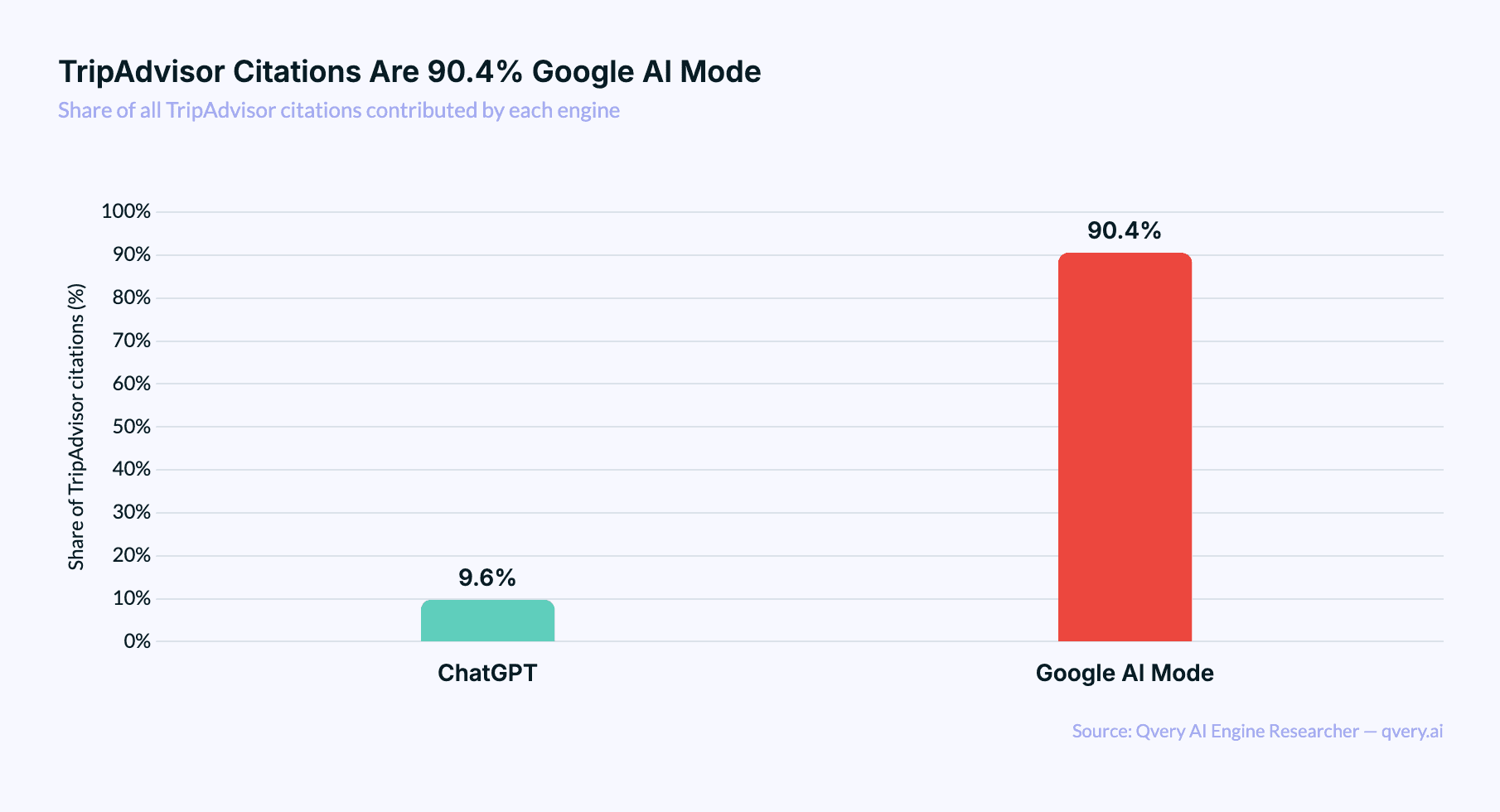
TripAdvisor accounts for 1.19% of all citations across both engines combined. 90.4% of those citations come from Google AI Mode. The other 9.6% come from ChatGPT, and that ChatGPT share has been shrinking every month.
Most engine splits in our dataset are skewed. Wikipedia is 97% ChatGPT. Quora is 100% Google AI Mode. YouTube is 91% Google AI. TripAdvisor sits firmly in that "extremely engine-skewed" category, but unlike most of those domains, TripAdvisor is also high-volume.
The combination of "huge citation share" and "almost entirely one engine" is what makes it the cleanest example of why a travel brand's AI visibility strategy has to handle both engines on different terms.
TripAdvisor Is a Top-Five Domain on Google AI Mode
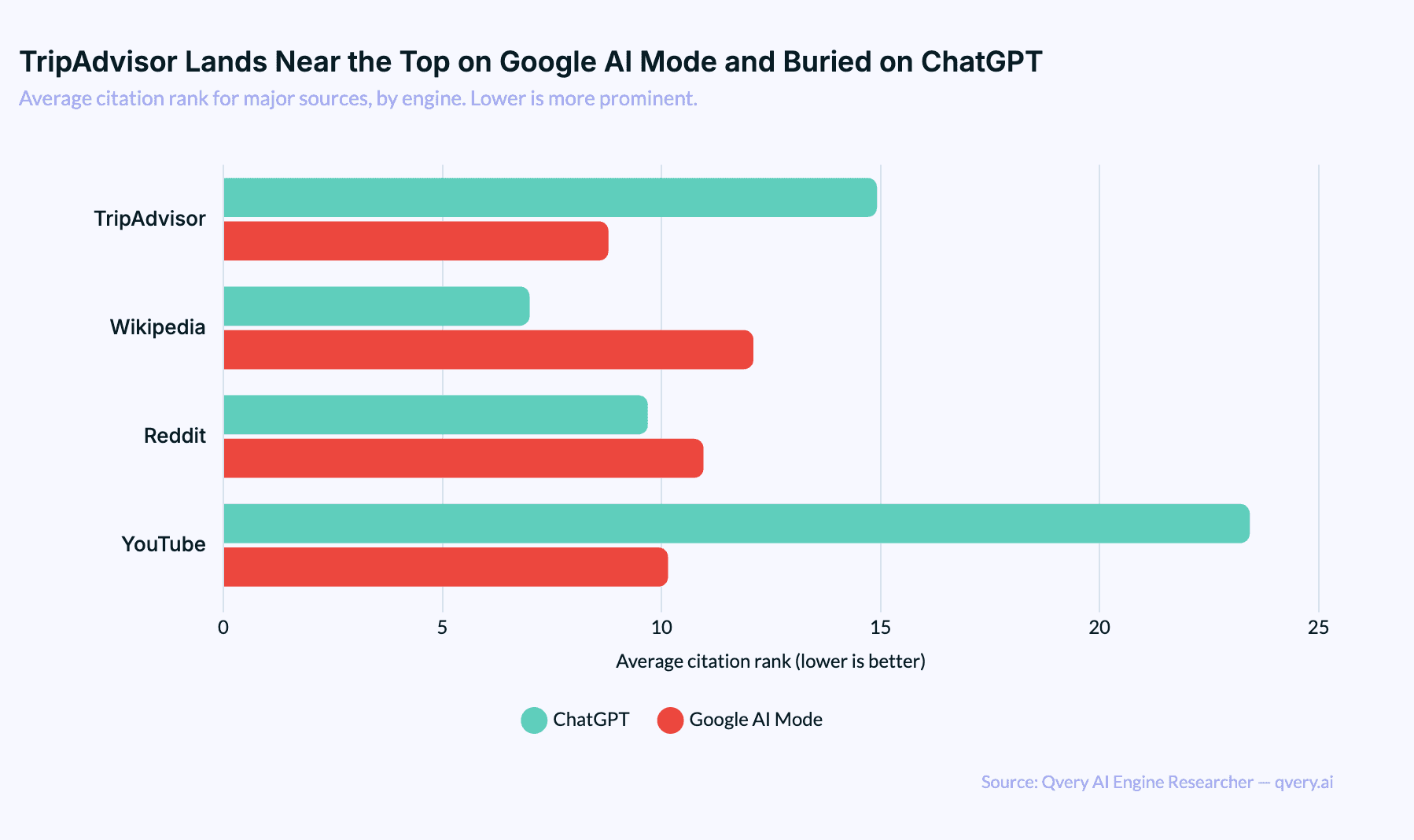
The headline finding sounds dramatic until you look at the placement data. On Google AI Mode, TripAdvisor isn't just cited often, it's cited prominently. Of every TripAdvisor citation we record on Google AI, 7.5% appear at rank 1, the very top of the citation list. The average rank is 8.79. The median is 7. When Google AI cites TripAdvisor, it's almost always at the front of the response.
For comparison, Reddit's average rank on Google AI Mode is 10.96. TripAdvisor outranks Reddit on Google AI when it gets cited. That's an unusual structural finding. Most travel brands assume Reddit is the higher-authority signal because it dominates other categories. In travel, on Google AI Mode, that assumption is wrong.
On ChatGPT the picture is the opposite. Average rank on ChatGPT: 14.92. Median: 14. TripAdvisor ChatGPT citations land deep in the citation list. ChatGPT cites TripAdvisor occasionally, but it doesn't trust it the way Google AI does. The reasons are structural, and we'll get to them.
The Whole Travel Vertical Skews Google AI
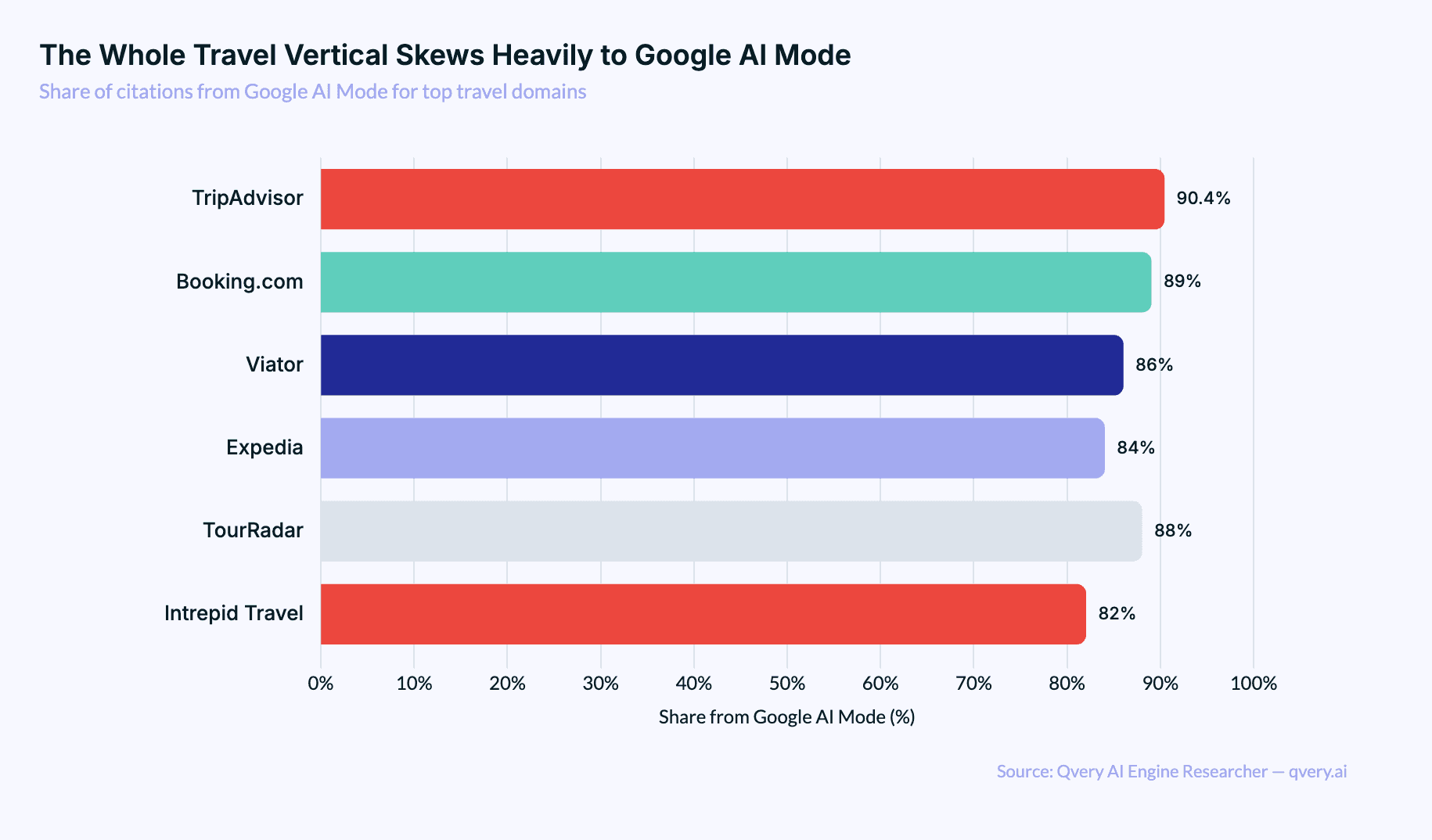
TripAdvisor isn't an outlier in its category. It's the cleanest example of a pattern that runs across the entire travel and hospitality vertical. Every major travel domain we track skews heavily toward Google AI Mode.
Looking across travel sources, the engine pattern is consistent:
TripAdvisor: 90.4% Google AI Mode.
Booking.com: Heavily Google AI Mode.
Expedia: Heavily Google AI Mode.
Viator: Heavily Google AI Mode.
TourRadar: Heavily Google AI Mode.
Intrepid Travel: Heavily Google AI Mode.
The pattern doesn't depend on whether the source is review-led or booking-led. Every travel platform we track behaves the same way. The vertical itself is engine-skewed, not the individual brands.
The reason has nothing to do with TripAdvisor's content quality. It has to do with Google's existing structured data. Google has spent two decades building a travel knowledge graph: Maps entities, hotel cards, restaurant listings, attraction summaries, country and city pages.
TripAdvisor is one of the original feeders of that graph. Booking.com, Expedia, Viator, and the rest fill out the rest of it. When Google AI Mode generates a travel response, it pulls from that graph almost by default. The cited TripAdvisor URL is just the surface of a much deeper integration that's been running for two decades.
ChatGPT has none of that. It treats TripAdvisor URLs the way it treats any other web page: a generic source it can either retrieve or ignore. Without the underlying knowledge graph, the value of citing TripAdvisor at all drops. That's the structural difference, and it's the reason the engine split is this extreme.
TripAdvisor Lands Near the Top of Google AI Citation Lists
Volume and prominence are different metrics. TripAdvisor wins both on Google AI Mode.
The placement-rate breakdown:
Top-3 rate on Google AI: 22.4% of cited TripAdvisor pages land in the first three citations. That's high.
Top-5 rate on Google AI: 37.0%. More than a third of TripAdvisor citations are in the top five.
Top-10 rate on Google AI: 67.4%. Two-thirds of TripAdvisor citations land where readers actually see them.
On ChatGPT the same metrics are about half as good. Top-3 rate 12.4%. Top-5 21.1%. Top-10 37.1%. Still cited, just not prominently.
The story to take from this is engine-specific specialization. TripAdvisor on Google AI Mode behaves like Wikipedia on ChatGPT: extreme engine concentration paired with extreme prominence within that engine.
Brands need to understand this is a feature of how each engine sources information, not a bug to fix. (You don't fix it by complaining to OpenAI. You fix it by adjusting how you invest in TripAdvisor optimization.)
Reviews Are What Google AI Cites. Booking Pages Aren't.
Within the travel vertical, the content type distinction matters as much as the platform distinction. TripAdvisor citations skew toward review and attraction-listing pages. Booking-platform citations (Booking.com, Expedia, Viator) skew toward listing and reservation pages.
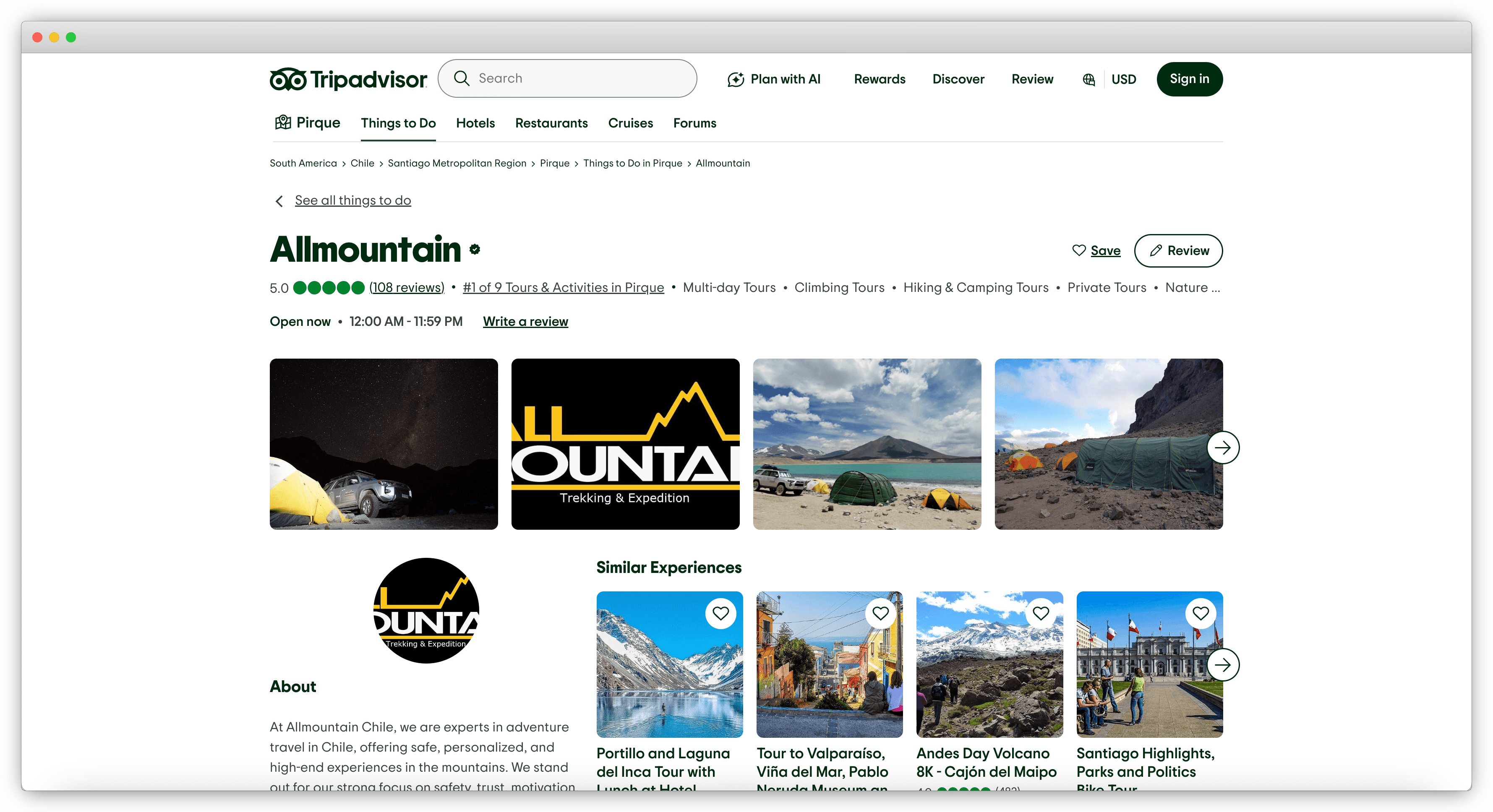
Both engines treat these as different functional roles. TripAdvisor surfaces when a query is "what to do in New York" or "best food tour in Lisbon." Booking platforms surface when a query is "where to book a hotel in Lisbon" or "best flight to San Francisco." The platforms aren't competing for the same citations. They're complementary.
This matters for travel brand strategy. If you're a hotel, your TripAdvisor presence is what gets cited for "best places to stay" queries. Your Booking.com listing is what gets cited for "book a hotel" queries. Both are needed, and they fill different gaps in your AI visibility footprint.
ChatGPT's TripAdvisor Citations Have Been Quietly Declining
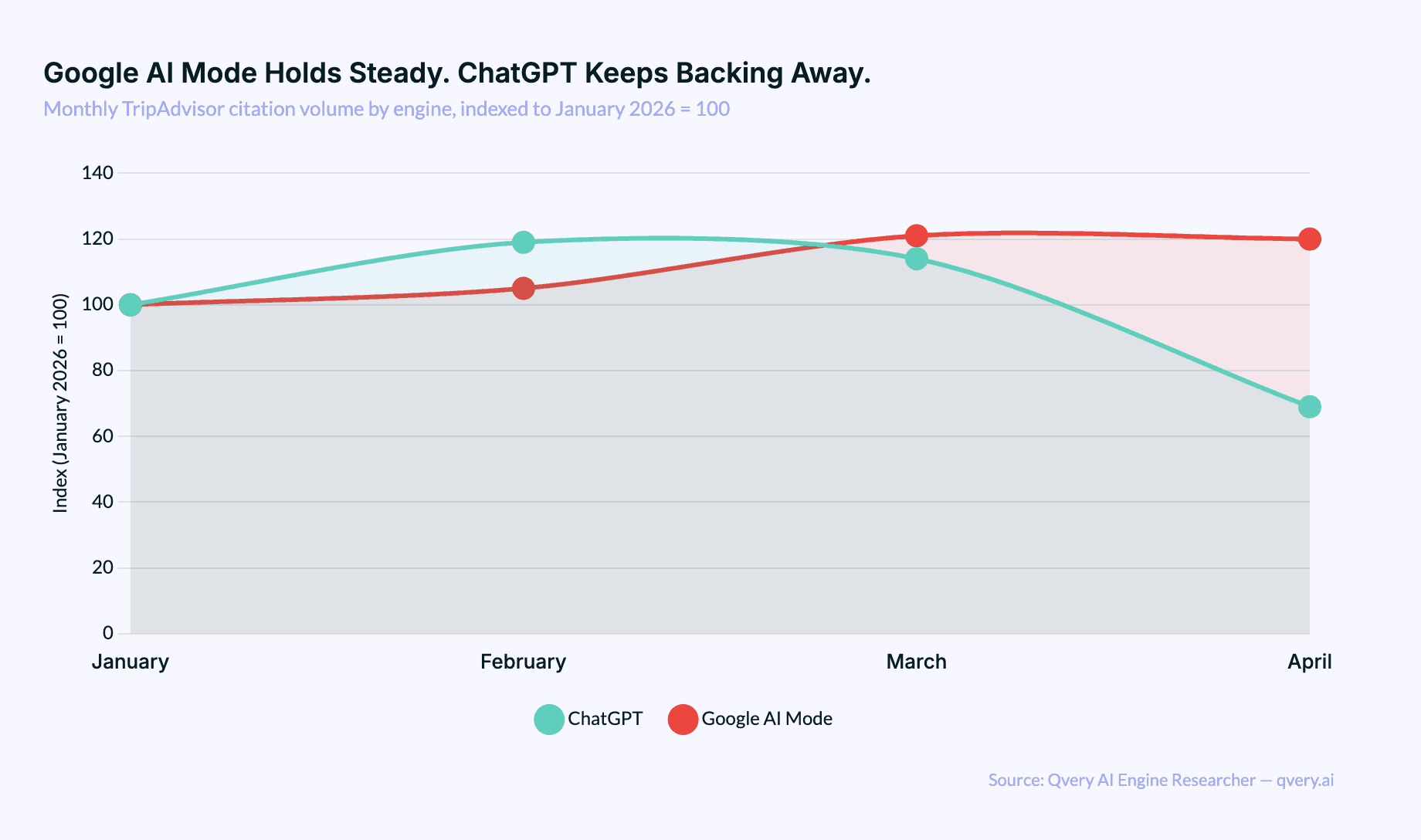
The engine split was already extreme. It's getting more extreme. ChatGPT's TripAdvisor citation volume in April 2026 was 31% below January 2026. While Google AI Mode held roughly stable through the same period, ChatGPT pulled back from TripAdvisor along with most of the other social and review sources.
This is the same April 2026 pattern we documented for social media: ChatGPT didn't cut citations across the board. It consolidated to Reddit and Wikipedia, and pulled back from almost everything else. TripAdvisor took a smaller hit than LinkedIn or Facebook, but the direction is the same.
The TripAdvisor brief in March said the engine split was 89% Google AI. By May, it's 90.4%. ChatGPT keeps backing away. Google AI keeps holding steady.
If the trend continues, TripAdvisor will be 95% or more Google AI Mode by the end of 2026. Travel brands optimizing for AI visibility should plan accordingly. ChatGPT is becoming a smaller and smaller share of the TripAdvisor citation pool.
Multilingual Subdomains Don't Move the Needle
One question we get from international travel brands is whether AI engines pull from TripAdvisor's multilingual subdomains. The answer is mostly no.
The umbrella TripAdvisor citation count we work with includes every multilingual variant: tripadvisor.com, .co.uk, .ca, .co.za, .com.au, .co.nz, .in, .ie, .de, .es, .it, and a handful of others. The English-language subdomains together account for 95% of all TripAdvisor citations. Non-English subdomains together are below 1%.
This holds even when the query comes from a non-English-speaking country. A query from Germany asking about hotels in Munich pulls reviews from tripadvisor.com, not tripadvisor.de. AI engines prefer the English content because the English content is denser, has more reviews per attraction, and is what the engines have processed most. The localization story for TripAdvisor citations is "English wins everywhere."
What This Means for Travel and Hospitality Brands
The strategic takeaway is direct. Travelers making destination, restaurant, or activity decisions on AI engines see TripAdvisor reviews constantly. The vast majority of that exposure flows through Google AI Mode, but the same buyer is also asking ChatGPT about hotels, cities, and itineraries every day.
That means the work for travel brands is concrete.
Maintain accurate TripAdvisor listings for every property and attraction.
Encourage reviews from real customers.
Claim and optimize attraction pages.
Respond to reviews actively.
The presence of substantive recent reviews is what AI engines surface, and the absence of them is what makes a property invisible.
For non-travel categories, TripAdvisor is irrelevant. Don't worry about it. Your audience isn't asking the questions that surface TripAdvisor citations. The category specialization here is real and useful. You don't need to win every domain in AI search. You need to win the ones that match your category.
See Your TripAdvisor Citation Footprint With Qvery Assistant
The 90.4% Google AI skew is the average across our entire dataset. Your specific property, destination, or travel brand has its own TripAdvisor pattern: the exact attraction pages that get cited, the specific review themes that surface, the competitor listings that out-cite yours. Qvery Assistant is built to surface that.
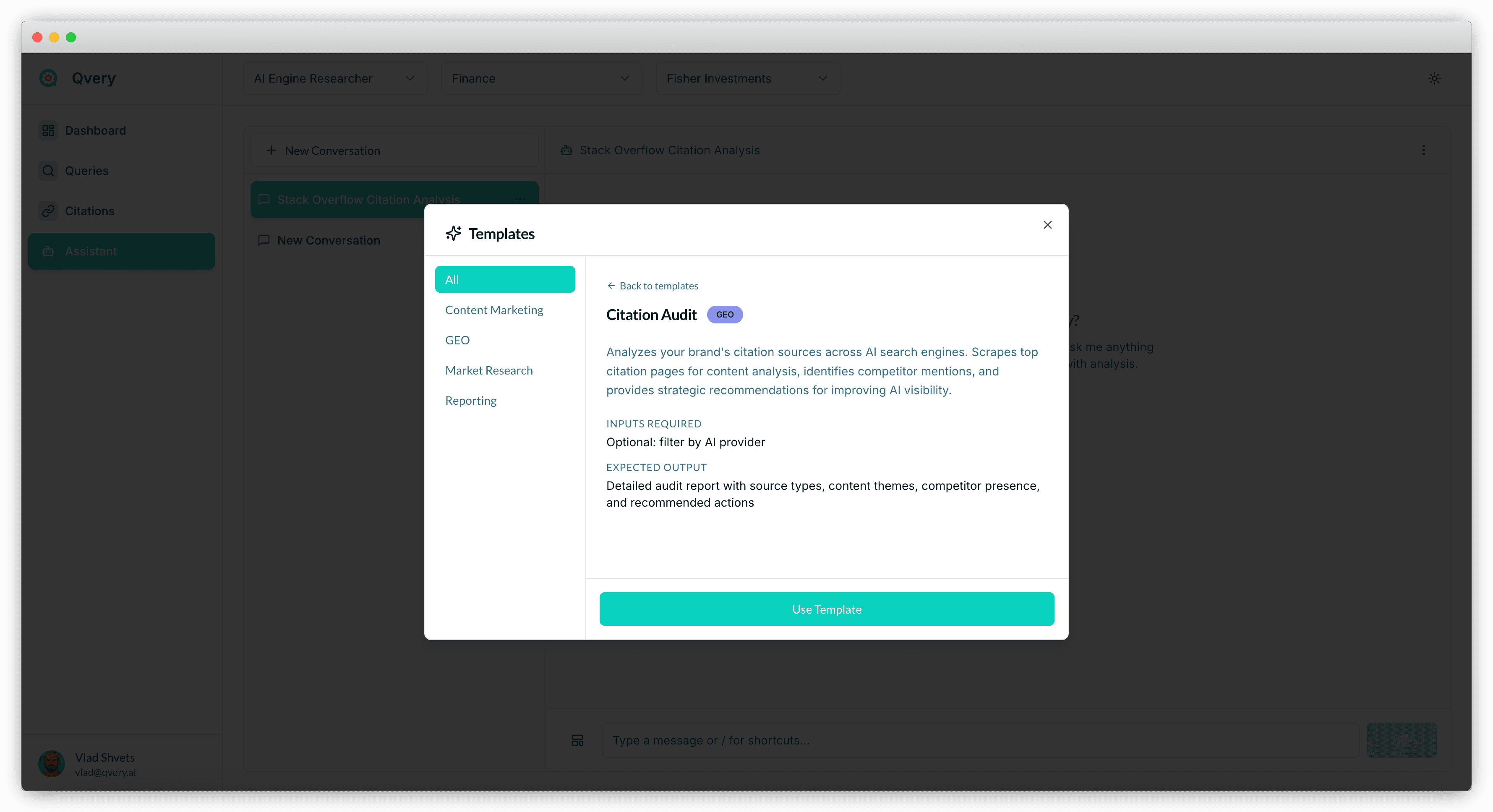
Ask it "show me my top-cited TripAdvisor URLs and their average rank position" and the answer comes back in seconds. Run the Citation Gap Analysis template against your three closest competitors and you'll see which TripAdvisor pages they earn that you don't. The Assistant has full context on every query you track and every citation we've recorded.
If you don't have a Qvery account yet, go ahead and start your 7-day free trial.
TripAdvisor sits in a strange spot in our citation data. On Google AI Mode it's a top-five cited domain. On ChatGPT it accounts for less than half a percent of citations. Travelers use both engines constantly, which makes understanding how each one treats TripAdvisor matter more than picking a side.
TripAdvisor accounts for 1.19% of all citations across both engines combined. 90.4% of those citations come from Google AI Mode. The other 9.6% come from ChatGPT, and that ChatGPT share has been shrinking every month.
Most engine splits in our dataset are skewed. Wikipedia is 97% ChatGPT. Quora is 100% Google AI Mode. YouTube is 91% Google AI. TripAdvisor sits firmly in that "extremely engine-skewed" category, but unlike most of those domains, TripAdvisor is also high-volume.
The combination of "huge citation share" and "almost entirely one engine" is what makes it the cleanest example of why a travel brand's AI visibility strategy has to handle both engines on different terms.
TripAdvisor Is a Top-Five Domain on Google AI Mode
The headline finding sounds dramatic until you look at the placement data. On Google AI Mode, TripAdvisor isn't just cited often, it's cited prominently. Of every TripAdvisor citation we record on Google AI, 7.5% appear at rank 1, the very top of the citation list. The average rank is 8.79. The median is 7. When Google AI cites TripAdvisor, it's almost always at the front of the response.
For comparison, Reddit's average rank on Google AI Mode is 10.96. TripAdvisor outranks Reddit on Google AI when it gets cited. That's an unusual structural finding. Most travel brands assume Reddit is the higher-authority signal because it dominates other categories. In travel, on Google AI Mode, that assumption is wrong.
On ChatGPT the picture is the opposite. Average rank on ChatGPT: 14.92. Median: 14. TripAdvisor ChatGPT citations land deep in the citation list. ChatGPT cites TripAdvisor occasionally, but it doesn't trust it the way Google AI does. The reasons are structural, and we'll get to them.
The Whole Travel Vertical Skews Google AI
TripAdvisor isn't an outlier in its category. It's the cleanest example of a pattern that runs across the entire travel and hospitality vertical. Every major travel domain we track skews heavily toward Google AI Mode.
Looking across travel sources, the engine pattern is consistent:
TripAdvisor: 90.4% Google AI Mode.
Booking.com: Heavily Google AI Mode.
Expedia: Heavily Google AI Mode.
Viator: Heavily Google AI Mode.
TourRadar: Heavily Google AI Mode.
Intrepid Travel: Heavily Google AI Mode.
The pattern doesn't depend on whether the source is review-led or booking-led. Every travel platform we track behaves the same way. The vertical itself is engine-skewed, not the individual brands.
The reason has nothing to do with TripAdvisor's content quality. It has to do with Google's existing structured data. Google has spent two decades building a travel knowledge graph: Maps entities, hotel cards, restaurant listings, attraction summaries, country and city pages.
TripAdvisor is one of the original feeders of that graph. Booking.com, Expedia, Viator, and the rest fill out the rest of it. When Google AI Mode generates a travel response, it pulls from that graph almost by default. The cited TripAdvisor URL is just the surface of a much deeper integration that's been running for two decades.
ChatGPT has none of that. It treats TripAdvisor URLs the way it treats any other web page: a generic source it can either retrieve or ignore. Without the underlying knowledge graph, the value of citing TripAdvisor at all drops. That's the structural difference, and it's the reason the engine split is this extreme.
TripAdvisor Lands Near the Top of Google AI Citation Lists
Volume and prominence are different metrics. TripAdvisor wins both on Google AI Mode.
The placement-rate breakdown:
Top-3 rate on Google AI: 22.4% of cited TripAdvisor pages land in the first three citations. That's high.
Top-5 rate on Google AI: 37.0%. More than a third of TripAdvisor citations are in the top five.
Top-10 rate on Google AI: 67.4%. Two-thirds of TripAdvisor citations land where readers actually see them.
On ChatGPT the same metrics are about half as good. Top-3 rate 12.4%. Top-5 21.1%. Top-10 37.1%. Still cited, just not prominently.
The story to take from this is engine-specific specialization. TripAdvisor on Google AI Mode behaves like Wikipedia on ChatGPT: extreme engine concentration paired with extreme prominence within that engine.
Brands need to understand this is a feature of how each engine sources information, not a bug to fix. (You don't fix it by complaining to OpenAI. You fix it by adjusting how you invest in TripAdvisor optimization.)
Reviews Are What Google AI Cites. Booking Pages Aren't.
Within the travel vertical, the content type distinction matters as much as the platform distinction. TripAdvisor citations skew toward review and attraction-listing pages. Booking-platform citations (Booking.com, Expedia, Viator) skew toward listing and reservation pages.
Both engines treat these as different functional roles. TripAdvisor surfaces when a query is "what to do in New York" or "best food tour in Lisbon." Booking platforms surface when a query is "where to book a hotel in Lisbon" or "best flight to San Francisco." The platforms aren't competing for the same citations. They're complementary.
This matters for travel brand strategy. If you're a hotel, your TripAdvisor presence is what gets cited for "best places to stay" queries. Your Booking.com listing is what gets cited for "book a hotel" queries. Both are needed, and they fill different gaps in your AI visibility footprint.
ChatGPT's TripAdvisor Citations Have Been Quietly Declining
The engine split was already extreme. It's getting more extreme. ChatGPT's TripAdvisor citation volume in April 2026 was 31% below January 2026. While Google AI Mode held roughly stable through the same period, ChatGPT pulled back from TripAdvisor along with most of the other social and review sources.
This is the same April 2026 pattern we documented for social media: ChatGPT didn't cut citations across the board. It consolidated to Reddit and Wikipedia, and pulled back from almost everything else. TripAdvisor took a smaller hit than LinkedIn or Facebook, but the direction is the same.
The TripAdvisor brief in March said the engine split was 89% Google AI. By May, it's 90.4%. ChatGPT keeps backing away. Google AI keeps holding steady.
If the trend continues, TripAdvisor will be 95% or more Google AI Mode by the end of 2026. Travel brands optimizing for AI visibility should plan accordingly. ChatGPT is becoming a smaller and smaller share of the TripAdvisor citation pool.
Multilingual Subdomains Don't Move the Needle
One question we get from international travel brands is whether AI engines pull from TripAdvisor's multilingual subdomains. The answer is mostly no.
The umbrella TripAdvisor citation count we work with includes every multilingual variant: tripadvisor.com, .co.uk, .ca, .co.za, .com.au, .co.nz, .in, .ie, .de, .es, .it, and a handful of others. The English-language subdomains together account for 95% of all TripAdvisor citations. Non-English subdomains together are below 1%.
This holds even when the query comes from a non-English-speaking country. A query from Germany asking about hotels in Munich pulls reviews from tripadvisor.com, not tripadvisor.de. AI engines prefer the English content because the English content is denser, has more reviews per attraction, and is what the engines have processed most. The localization story for TripAdvisor citations is "English wins everywhere."
What This Means for Travel and Hospitality Brands
The strategic takeaway is direct. Travelers making destination, restaurant, or activity decisions on AI engines see TripAdvisor reviews constantly. The vast majority of that exposure flows through Google AI Mode, but the same buyer is also asking ChatGPT about hotels, cities, and itineraries every day.
That means the work for travel brands is concrete.
Maintain accurate TripAdvisor listings for every property and attraction.
Encourage reviews from real customers.
Claim and optimize attraction pages.
Respond to reviews actively.
The presence of substantive recent reviews is what AI engines surface, and the absence of them is what makes a property invisible.
For non-travel categories, TripAdvisor is irrelevant. Don't worry about it. Your audience isn't asking the questions that surface TripAdvisor citations. The category specialization here is real and useful. You don't need to win every domain in AI search. You need to win the ones that match your category.
See Your TripAdvisor Citation Footprint With Qvery Assistant
The 90.4% Google AI skew is the average across our entire dataset. Your specific property, destination, or travel brand has its own TripAdvisor pattern: the exact attraction pages that get cited, the specific review themes that surface, the competitor listings that out-cite yours. Qvery Assistant is built to surface that.
Ask it "show me my top-cited TripAdvisor URLs and their average rank position" and the answer comes back in seconds. Run the Citation Gap Analysis template against your three closest competitors and you'll see which TripAdvisor pages they earn that you don't. The Assistant has full context on every query you track and every citation we've recorded.
If you don't have a Qvery account yet, go ahead and start your 7-day free trial.
TripAdvisor sits in a strange spot in our citation data. On Google AI Mode it's a top-five cited domain. On ChatGPT it accounts for less than half a percent of citations. Travelers use both engines constantly, which makes understanding how each one treats TripAdvisor matter more than picking a side.
TripAdvisor accounts for 1.19% of all citations across both engines combined. 90.4% of those citations come from Google AI Mode. The other 9.6% come from ChatGPT, and that ChatGPT share has been shrinking every month.
Most engine splits in our dataset are skewed. Wikipedia is 97% ChatGPT. Quora is 100% Google AI Mode. YouTube is 91% Google AI. TripAdvisor sits firmly in that "extremely engine-skewed" category, but unlike most of those domains, TripAdvisor is also high-volume.
The combination of "huge citation share" and "almost entirely one engine" is what makes it the cleanest example of why a travel brand's AI visibility strategy has to handle both engines on different terms.
TripAdvisor Is a Top-Five Domain on Google AI Mode
The headline finding sounds dramatic until you look at the placement data. On Google AI Mode, TripAdvisor isn't just cited often, it's cited prominently. Of every TripAdvisor citation we record on Google AI, 7.5% appear at rank 1, the very top of the citation list. The average rank is 8.79. The median is 7. When Google AI cites TripAdvisor, it's almost always at the front of the response.
For comparison, Reddit's average rank on Google AI Mode is 10.96. TripAdvisor outranks Reddit on Google AI when it gets cited. That's an unusual structural finding. Most travel brands assume Reddit is the higher-authority signal because it dominates other categories. In travel, on Google AI Mode, that assumption is wrong.
On ChatGPT the picture is the opposite. Average rank on ChatGPT: 14.92. Median: 14. TripAdvisor ChatGPT citations land deep in the citation list. ChatGPT cites TripAdvisor occasionally, but it doesn't trust it the way Google AI does. The reasons are structural, and we'll get to them.
The Whole Travel Vertical Skews Google AI
TripAdvisor isn't an outlier in its category. It's the cleanest example of a pattern that runs across the entire travel and hospitality vertical. Every major travel domain we track skews heavily toward Google AI Mode.
Looking across travel sources, the engine pattern is consistent:
TripAdvisor: 90.4% Google AI Mode.
Booking.com: Heavily Google AI Mode.
Expedia: Heavily Google AI Mode.
Viator: Heavily Google AI Mode.
TourRadar: Heavily Google AI Mode.
Intrepid Travel: Heavily Google AI Mode.
The pattern doesn't depend on whether the source is review-led or booking-led. Every travel platform we track behaves the same way. The vertical itself is engine-skewed, not the individual brands.
The reason has nothing to do with TripAdvisor's content quality. It has to do with Google's existing structured data. Google has spent two decades building a travel knowledge graph: Maps entities, hotel cards, restaurant listings, attraction summaries, country and city pages.
TripAdvisor is one of the original feeders of that graph. Booking.com, Expedia, Viator, and the rest fill out the rest of it. When Google AI Mode generates a travel response, it pulls from that graph almost by default. The cited TripAdvisor URL is just the surface of a much deeper integration that's been running for two decades.
ChatGPT has none of that. It treats TripAdvisor URLs the way it treats any other web page: a generic source it can either retrieve or ignore. Without the underlying knowledge graph, the value of citing TripAdvisor at all drops. That's the structural difference, and it's the reason the engine split is this extreme.
TripAdvisor Lands Near the Top of Google AI Citation Lists
Volume and prominence are different metrics. TripAdvisor wins both on Google AI Mode.
The placement-rate breakdown:
Top-3 rate on Google AI: 22.4% of cited TripAdvisor pages land in the first three citations. That's high.
Top-5 rate on Google AI: 37.0%. More than a third of TripAdvisor citations are in the top five.
Top-10 rate on Google AI: 67.4%. Two-thirds of TripAdvisor citations land where readers actually see them.
On ChatGPT the same metrics are about half as good. Top-3 rate 12.4%. Top-5 21.1%. Top-10 37.1%. Still cited, just not prominently.
The story to take from this is engine-specific specialization. TripAdvisor on Google AI Mode behaves like Wikipedia on ChatGPT: extreme engine concentration paired with extreme prominence within that engine.
Brands need to understand this is a feature of how each engine sources information, not a bug to fix. (You don't fix it by complaining to OpenAI. You fix it by adjusting how you invest in TripAdvisor optimization.)
Reviews Are What Google AI Cites. Booking Pages Aren't.
Within the travel vertical, the content type distinction matters as much as the platform distinction. TripAdvisor citations skew toward review and attraction-listing pages. Booking-platform citations (Booking.com, Expedia, Viator) skew toward listing and reservation pages.
Both engines treat these as different functional roles. TripAdvisor surfaces when a query is "what to do in New York" or "best food tour in Lisbon." Booking platforms surface when a query is "where to book a hotel in Lisbon" or "best flight to San Francisco." The platforms aren't competing for the same citations. They're complementary.
This matters for travel brand strategy. If you're a hotel, your TripAdvisor presence is what gets cited for "best places to stay" queries. Your Booking.com listing is what gets cited for "book a hotel" queries. Both are needed, and they fill different gaps in your AI visibility footprint.
ChatGPT's TripAdvisor Citations Have Been Quietly Declining
The engine split was already extreme. It's getting more extreme. ChatGPT's TripAdvisor citation volume in April 2026 was 31% below January 2026. While Google AI Mode held roughly stable through the same period, ChatGPT pulled back from TripAdvisor along with most of the other social and review sources.
This is the same April 2026 pattern we documented for social media: ChatGPT didn't cut citations across the board. It consolidated to Reddit and Wikipedia, and pulled back from almost everything else. TripAdvisor took a smaller hit than LinkedIn or Facebook, but the direction is the same.
The TripAdvisor brief in March said the engine split was 89% Google AI. By May, it's 90.4%. ChatGPT keeps backing away. Google AI keeps holding steady.
If the trend continues, TripAdvisor will be 95% or more Google AI Mode by the end of 2026. Travel brands optimizing for AI visibility should plan accordingly. ChatGPT is becoming a smaller and smaller share of the TripAdvisor citation pool.
Multilingual Subdomains Don't Move the Needle
One question we get from international travel brands is whether AI engines pull from TripAdvisor's multilingual subdomains. The answer is mostly no.
The umbrella TripAdvisor citation count we work with includes every multilingual variant: tripadvisor.com, .co.uk, .ca, .co.za, .com.au, .co.nz, .in, .ie, .de, .es, .it, and a handful of others. The English-language subdomains together account for 95% of all TripAdvisor citations. Non-English subdomains together are below 1%.
This holds even when the query comes from a non-English-speaking country. A query from Germany asking about hotels in Munich pulls reviews from tripadvisor.com, not tripadvisor.de. AI engines prefer the English content because the English content is denser, has more reviews per attraction, and is what the engines have processed most. The localization story for TripAdvisor citations is "English wins everywhere."
What This Means for Travel and Hospitality Brands
The strategic takeaway is direct. Travelers making destination, restaurant, or activity decisions on AI engines see TripAdvisor reviews constantly. The vast majority of that exposure flows through Google AI Mode, but the same buyer is also asking ChatGPT about hotels, cities, and itineraries every day.
That means the work for travel brands is concrete.
Maintain accurate TripAdvisor listings for every property and attraction.
Encourage reviews from real customers.
Claim and optimize attraction pages.
Respond to reviews actively.
The presence of substantive recent reviews is what AI engines surface, and the absence of them is what makes a property invisible.
For non-travel categories, TripAdvisor is irrelevant. Don't worry about it. Your audience isn't asking the questions that surface TripAdvisor citations. The category specialization here is real and useful. You don't need to win every domain in AI search. You need to win the ones that match your category.
See Your TripAdvisor Citation Footprint With Qvery Assistant
The 90.4% Google AI skew is the average across our entire dataset. Your specific property, destination, or travel brand has its own TripAdvisor pattern: the exact attraction pages that get cited, the specific review themes that surface, the competitor listings that out-cite yours. Qvery Assistant is built to surface that.
Ask it "show me my top-cited TripAdvisor URLs and their average rank position" and the answer comes back in seconds. Run the Citation Gap Analysis template against your three closest competitors and you'll see which TripAdvisor pages they earn that you don't. The Assistant has full context on every query you track and every citation we've recorded.
If you don't have a Qvery account yet, go ahead and start your 7-day free trial.
TripAdvisor sits in a strange spot in our citation data. On Google AI Mode it's a top-five cited domain. On ChatGPT it accounts for less than half a percent of citations. Travelers use both engines constantly, which makes understanding how each one treats TripAdvisor matter more than picking a side.
TripAdvisor accounts for 1.19% of all citations across both engines combined. 90.4% of those citations come from Google AI Mode. The other 9.6% come from ChatGPT, and that ChatGPT share has been shrinking every month.
Most engine splits in our dataset are skewed. Wikipedia is 97% ChatGPT. Quora is 100% Google AI Mode. YouTube is 91% Google AI. TripAdvisor sits firmly in that "extremely engine-skewed" category, but unlike most of those domains, TripAdvisor is also high-volume.
The combination of "huge citation share" and "almost entirely one engine" is what makes it the cleanest example of why a travel brand's AI visibility strategy has to handle both engines on different terms.
TripAdvisor Is a Top-Five Domain on Google AI Mode
The headline finding sounds dramatic until you look at the placement data. On Google AI Mode, TripAdvisor isn't just cited often, it's cited prominently. Of every TripAdvisor citation we record on Google AI, 7.5% appear at rank 1, the very top of the citation list. The average rank is 8.79. The median is 7. When Google AI cites TripAdvisor, it's almost always at the front of the response.
For comparison, Reddit's average rank on Google AI Mode is 10.96. TripAdvisor outranks Reddit on Google AI when it gets cited. That's an unusual structural finding. Most travel brands assume Reddit is the higher-authority signal because it dominates other categories. In travel, on Google AI Mode, that assumption is wrong.
On ChatGPT the picture is the opposite. Average rank on ChatGPT: 14.92. Median: 14. TripAdvisor ChatGPT citations land deep in the citation list. ChatGPT cites TripAdvisor occasionally, but it doesn't trust it the way Google AI does. The reasons are structural, and we'll get to them.
The Whole Travel Vertical Skews Google AI
TripAdvisor isn't an outlier in its category. It's the cleanest example of a pattern that runs across the entire travel and hospitality vertical. Every major travel domain we track skews heavily toward Google AI Mode.
Looking across travel sources, the engine pattern is consistent:
TripAdvisor: 90.4% Google AI Mode.
Booking.com: Heavily Google AI Mode.
Expedia: Heavily Google AI Mode.
Viator: Heavily Google AI Mode.
TourRadar: Heavily Google AI Mode.
Intrepid Travel: Heavily Google AI Mode.
The pattern doesn't depend on whether the source is review-led or booking-led. Every travel platform we track behaves the same way. The vertical itself is engine-skewed, not the individual brands.
The reason has nothing to do with TripAdvisor's content quality. It has to do with Google's existing structured data. Google has spent two decades building a travel knowledge graph: Maps entities, hotel cards, restaurant listings, attraction summaries, country and city pages.
TripAdvisor is one of the original feeders of that graph. Booking.com, Expedia, Viator, and the rest fill out the rest of it. When Google AI Mode generates a travel response, it pulls from that graph almost by default. The cited TripAdvisor URL is just the surface of a much deeper integration that's been running for two decades.
ChatGPT has none of that. It treats TripAdvisor URLs the way it treats any other web page: a generic source it can either retrieve or ignore. Without the underlying knowledge graph, the value of citing TripAdvisor at all drops. That's the structural difference, and it's the reason the engine split is this extreme.
TripAdvisor Lands Near the Top of Google AI Citation Lists
Volume and prominence are different metrics. TripAdvisor wins both on Google AI Mode.
The placement-rate breakdown:
Top-3 rate on Google AI: 22.4% of cited TripAdvisor pages land in the first three citations. That's high.
Top-5 rate on Google AI: 37.0%. More than a third of TripAdvisor citations are in the top five.
Top-10 rate on Google AI: 67.4%. Two-thirds of TripAdvisor citations land where readers actually see them.
On ChatGPT the same metrics are about half as good. Top-3 rate 12.4%. Top-5 21.1%. Top-10 37.1%. Still cited, just not prominently.
The story to take from this is engine-specific specialization. TripAdvisor on Google AI Mode behaves like Wikipedia on ChatGPT: extreme engine concentration paired with extreme prominence within that engine.
Brands need to understand this is a feature of how each engine sources information, not a bug to fix. (You don't fix it by complaining to OpenAI. You fix it by adjusting how you invest in TripAdvisor optimization.)
Reviews Are What Google AI Cites. Booking Pages Aren't.
Within the travel vertical, the content type distinction matters as much as the platform distinction. TripAdvisor citations skew toward review and attraction-listing pages. Booking-platform citations (Booking.com, Expedia, Viator) skew toward listing and reservation pages.
Both engines treat these as different functional roles. TripAdvisor surfaces when a query is "what to do in New York" or "best food tour in Lisbon." Booking platforms surface when a query is "where to book a hotel in Lisbon" or "best flight to San Francisco." The platforms aren't competing for the same citations. They're complementary.
This matters for travel brand strategy. If you're a hotel, your TripAdvisor presence is what gets cited for "best places to stay" queries. Your Booking.com listing is what gets cited for "book a hotel" queries. Both are needed, and they fill different gaps in your AI visibility footprint.
ChatGPT's TripAdvisor Citations Have Been Quietly Declining
The engine split was already extreme. It's getting more extreme. ChatGPT's TripAdvisor citation volume in April 2026 was 31% below January 2026. While Google AI Mode held roughly stable through the same period, ChatGPT pulled back from TripAdvisor along with most of the other social and review sources.
This is the same April 2026 pattern we documented for social media: ChatGPT didn't cut citations across the board. It consolidated to Reddit and Wikipedia, and pulled back from almost everything else. TripAdvisor took a smaller hit than LinkedIn or Facebook, but the direction is the same.
The TripAdvisor brief in March said the engine split was 89% Google AI. By May, it's 90.4%. ChatGPT keeps backing away. Google AI keeps holding steady.
If the trend continues, TripAdvisor will be 95% or more Google AI Mode by the end of 2026. Travel brands optimizing for AI visibility should plan accordingly. ChatGPT is becoming a smaller and smaller share of the TripAdvisor citation pool.
Multilingual Subdomains Don't Move the Needle
One question we get from international travel brands is whether AI engines pull from TripAdvisor's multilingual subdomains. The answer is mostly no.
The umbrella TripAdvisor citation count we work with includes every multilingual variant: tripadvisor.com, .co.uk, .ca, .co.za, .com.au, .co.nz, .in, .ie, .de, .es, .it, and a handful of others. The English-language subdomains together account for 95% of all TripAdvisor citations. Non-English subdomains together are below 1%.
This holds even when the query comes from a non-English-speaking country. A query from Germany asking about hotels in Munich pulls reviews from tripadvisor.com, not tripadvisor.de. AI engines prefer the English content because the English content is denser, has more reviews per attraction, and is what the engines have processed most. The localization story for TripAdvisor citations is "English wins everywhere."
What This Means for Travel and Hospitality Brands
The strategic takeaway is direct. Travelers making destination, restaurant, or activity decisions on AI engines see TripAdvisor reviews constantly. The vast majority of that exposure flows through Google AI Mode, but the same buyer is also asking ChatGPT about hotels, cities, and itineraries every day.
That means the work for travel brands is concrete.
Maintain accurate TripAdvisor listings for every property and attraction.
Encourage reviews from real customers.
Claim and optimize attraction pages.
Respond to reviews actively.
The presence of substantive recent reviews is what AI engines surface, and the absence of them is what makes a property invisible.
For non-travel categories, TripAdvisor is irrelevant. Don't worry about it. Your audience isn't asking the questions that surface TripAdvisor citations. The category specialization here is real and useful. You don't need to win every domain in AI search. You need to win the ones that match your category.
See Your TripAdvisor Citation Footprint With Qvery Assistant
The 90.4% Google AI skew is the average across our entire dataset. Your specific property, destination, or travel brand has its own TripAdvisor pattern: the exact attraction pages that get cited, the specific review themes that surface, the competitor listings that out-cite yours. Qvery Assistant is built to surface that.
Ask it "show me my top-cited TripAdvisor URLs and their average rank position" and the answer comes back in seconds. Run the Citation Gap Analysis template against your three closest competitors and you'll see which TripAdvisor pages they earn that you don't. The Assistant has full context on every query you track and every citation we've recorded.
If you don't have a Qvery account yet, go ahead and start your 7-day free trial.

© 2026 Qvery AI OÜ