By
Vlad Shvets
ChatGPT Has Cited Quora Zero Times. Google AI Mode Cites It Constantly.
Quora is the only high-volume source in our entire AI citation dataset that ChatGPT has cited exactly zero times. Every Quora citation comes from Google AI Mode. The mirror image of Wikipedia's ChatGPT-only behavior. Here's what the data says about why.
Quora is the only high-volume source in our entire AI citation dataset that ChatGPT has cited exactly zero times. Every Quora citation comes from Google AI Mode. The mirror image of Wikipedia's ChatGPT-only behavior. Here's what the data says about why.
Quora is the only high-volume source in our entire AI citation dataset that ChatGPT has cited exactly zero times. Every Quora citation comes from Google AI Mode. The mirror image of Wikipedia's ChatGPT-only behavior. Here's what the data says about why.
I keep getting the same question from marketers: "Should we be on Quora?" My answer used to be a hedged "depends on your audience." The data made it cleaner. Quora is a UGC platform like Reddit, just much smaller, and for reasons we'll get to, it shows up only on Google AI Mode. ChatGPT cites it zero times. That makes Quora an unusual shape in the AI search landscape: a real Google AI Mode presence and a complete blind spot on ChatGPT.
Meanwhile, Google AI Mode cites Quora regularly. Every Quora citation in our entire dataset, without exception, comes from Google AI Mode. That makes Quora the most engine-exclusive high-volume source we track. The mirror image of Wikipedia, which we've already written about as ChatGPT's favorite reference source. (The AI has decided that Q&A platforms get exactly one engine each.)
ChatGPT Has Never Cited Quora. We Checked.
The headline finding is binary. Out of more than two million ChatGPT citations in our dataset, not a single one points to quora.com. We ran the SQL query, double-checked the schema, ran it again with a fresh date range. The result was the same every time: zero.
Statistically, a ratio of zero out of a few million is impossible if Quora were treated as a normal source. Even sources ChatGPT mostly ignores still get cited a handful of times. Twitter and X combined get cited 69 times by ChatGPT. TikTok gets cited twice. Pinterest gets cited a hundred times. Quora gets zero.
The pattern is too clean to be accidental. The most plausible explanation is a deliberate exclusion at the OpenAI level. Quora has had public licensing disputes, gated content via Quora Spaces, and a long-running quality argument with people who actually use it. OpenAI may have simply removed Quora from ChatGPT's source pool. We can't prove that without OpenAI publishing their source list, and they don't. But the data leaves very little room for any other interpretation.
Out of two million ChatGPT citations, Quora appears zero times. Out of every Quora citation in our database, ChatGPT contributed exactly none.
Quora and Wikipedia Are Mirror Images of Each Other
The cleanest way to understand what's happening with Quora is to put it next to Wikipedia. They're the two most engine-skewed high-volume sources in our entire dataset, and they sit on opposite ends of the engine spectrum.
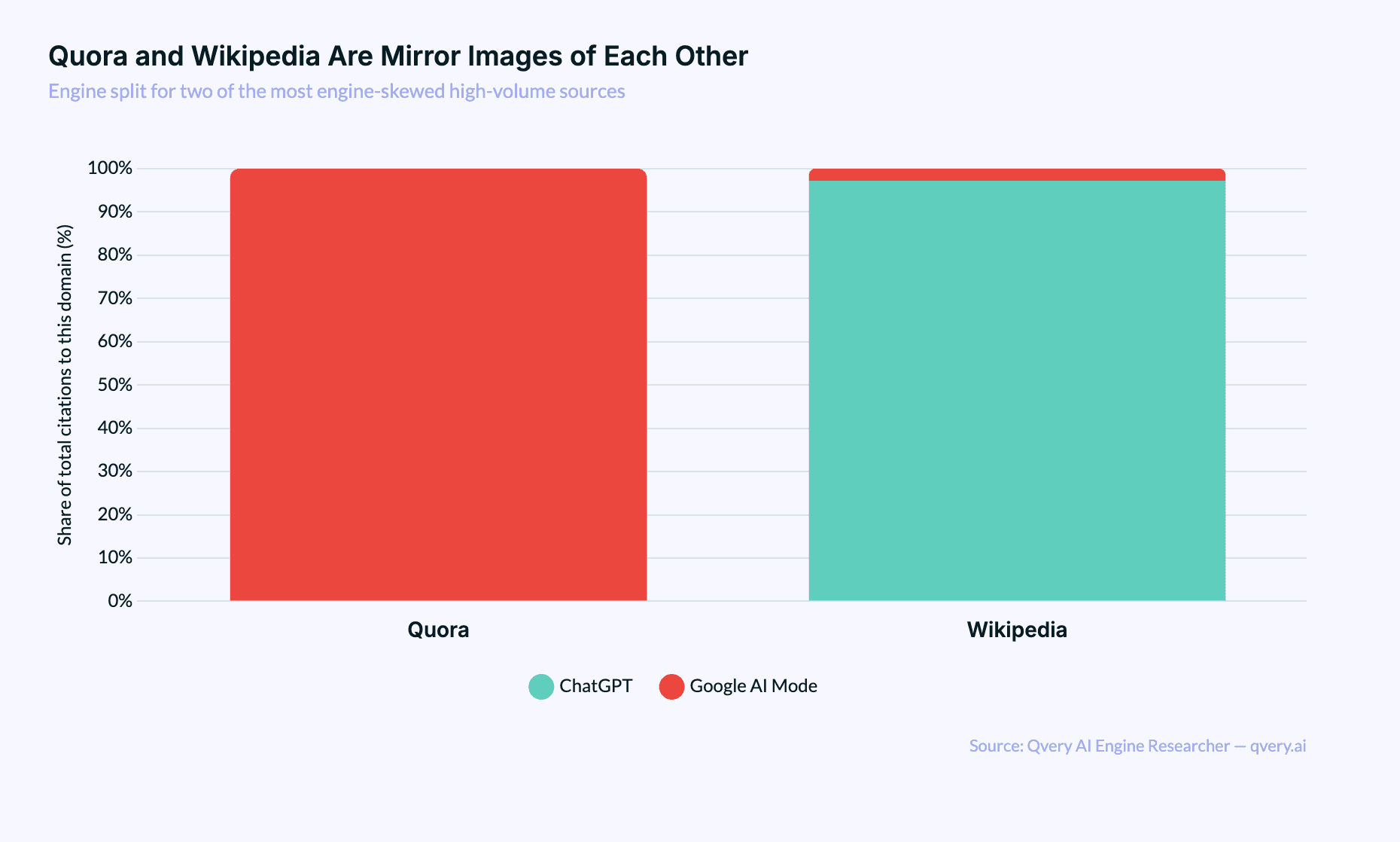
Wikipedia is 97.2% ChatGPT. Google AI Mode barely cites it because Google has already absorbed Wikipedia's structured knowledge into its own knowledge graph. Quora is 100% Google AI Mode. ChatGPT doesn't cite it for whatever reason OpenAI chose. The shape is identical. The engines are reversed.
This is the kind of finding that should reshape how you think about AI search. Visibility metrics treat AI search as a single thing. The engines are not a single thing. They have different source pools, different licensing relationships, and apparently very different opinions about which Q&A platform belongs in their citation lists.
Reddit, the third major Q&A peer, sits in the middle. It's roughly evenly split between engines. Reddit is the only major Q&A and discussion source both engines treat as authoritative. Quora and Wikipedia are the extremes. Reddit is the rule.
Even on Google AI Mode, Quora Is a Footnote
Quora's exclusivity sounds like it should mean dominance. It doesn't. Even on Google AI Mode, where Quora is the only Q&A platform with this kind of single-engine relationship, Quora accounts for just 0.084% of all citations. About one in every twelve hundred.
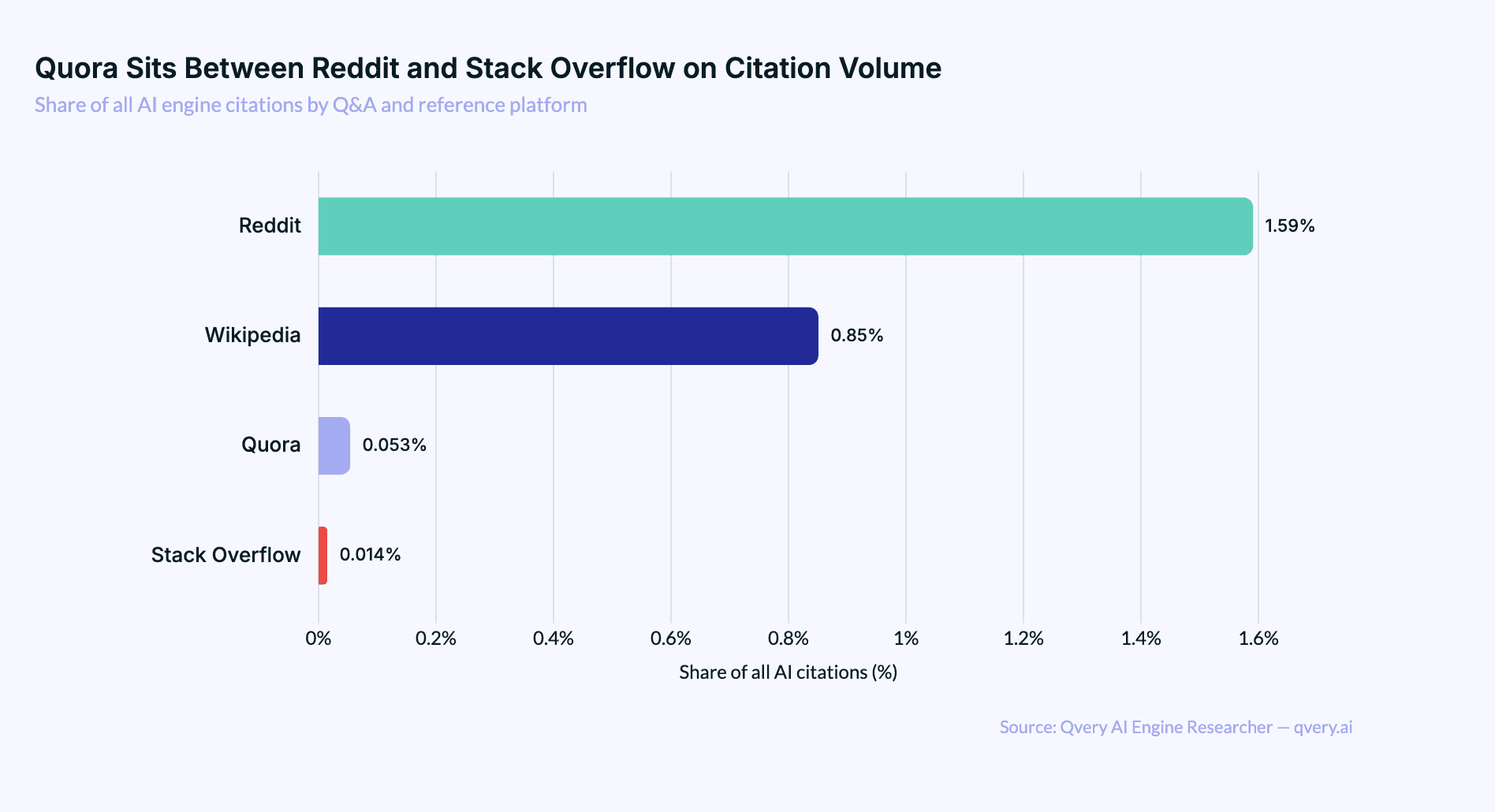
The full picture, as a percentage of all citations across both engines, looks like this:
Reddit sits at 1.59% of all citations. Roughly a hundred times Quora.
Wikipedia sits at 0.85%. Roughly sixteen times Quora.
Quora sits at 0.053%. Small.
Stack Overflow, the other tiny Q&A source, sits at 0.014%. Smaller.
Quora beats Stack Overflow by a factor of four, but that's like winning a footrace where everyone else is sitting down. The story isn't "Quora is dominant on Google AI Mode." The story is "Quora is exclusive to Google AI Mode, and it's still small."
Quora Gets Cited for Tool Comparisons, Not Personal Stories
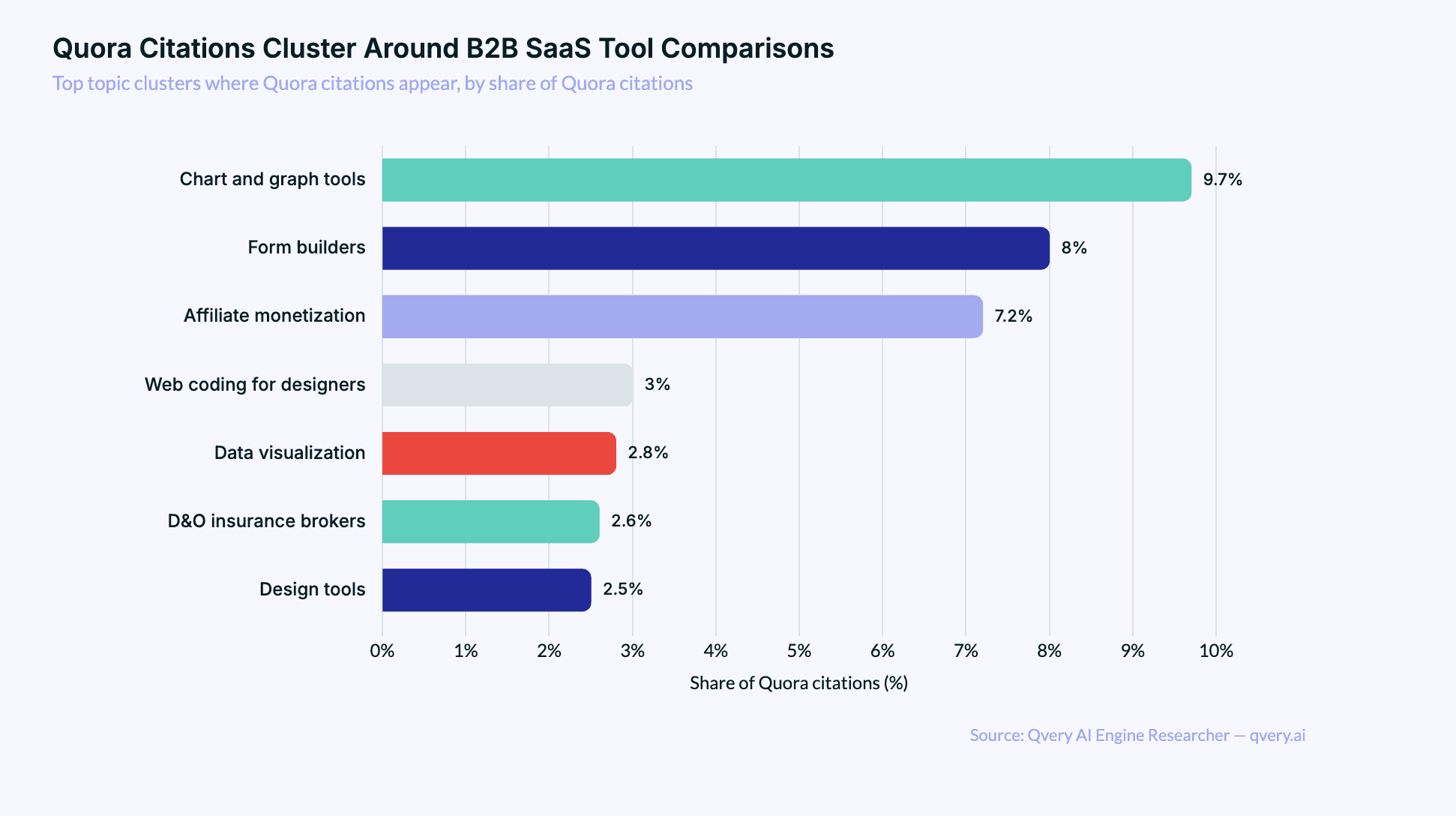
The content type that earns Quora its citations is narrow. The most-cited Quora pages in our dataset are all structured "compare X to Y" or "which is better" Q&As. The single most-cited Quora URL is a Skimlinks-versus-Viglink comparison thread for affiliate marketing tooling. The next most-cited is a Q&A on Directors and Officers insurance for early-stage startups. Below that: drag-and-drop website builders, affiliate tracking solutions, and design tools.
The personal-essay format Quora is also full of, where someone shares a heartfelt story about leaving their corporate job, doesn't show up at all. AI engines don't treat that content as citable. They treat the structured comparison answers as citable. The format is doing the work, not the platform.
This matches the broader pattern across all citation sources. Listicles are the most-cited content type in AI search. Quora's Q&A version of a listicle is a "compare X to Y" thread with three or four answers ranking different tools. AI engines find that format easy to extract and reuse.
The topic clusters this drives are predictable: chart and graph tools, form builders, affiliate monetization, web coding for designers, data visualization, and Directors and Officers insurance. None of those are mass-market consumer topics. They're SaaS marketing and B2B specialty topics.
Quora's Geography Is English-Speaking and India-Heavy
The country distribution for Quora-citing executions tells you who AI engines think Quora is for. The United States leads, as it does for almost every domain. The United Kingdom, Germany, and Australia follow. Then India shows up at position 4, well above where it ranks for most other sources we track.
India's strong presence reflects what Quora already is in the real world: a platform with a huge active user base in India, especially around tech and SaaS topics.
Google AI Mode appears to be picking up on that. The platform's Indian content is showing up in queries from Indian users, and apparently in queries from non-Indian users where Quora's answers happen to be the best available.
The non-English picture is interesting. Quora is mostly an English-content platform, even when the query comes from Germany, Belgium, or the UAE. AI engines aren't pulling from quora.com's Spanish or French sister sites at any meaningful rate. The English content does the work. The localization story for Quora citations is "English wins everywhere."
Quora's Citation Rate on Google AI Has Been Stable to Growing
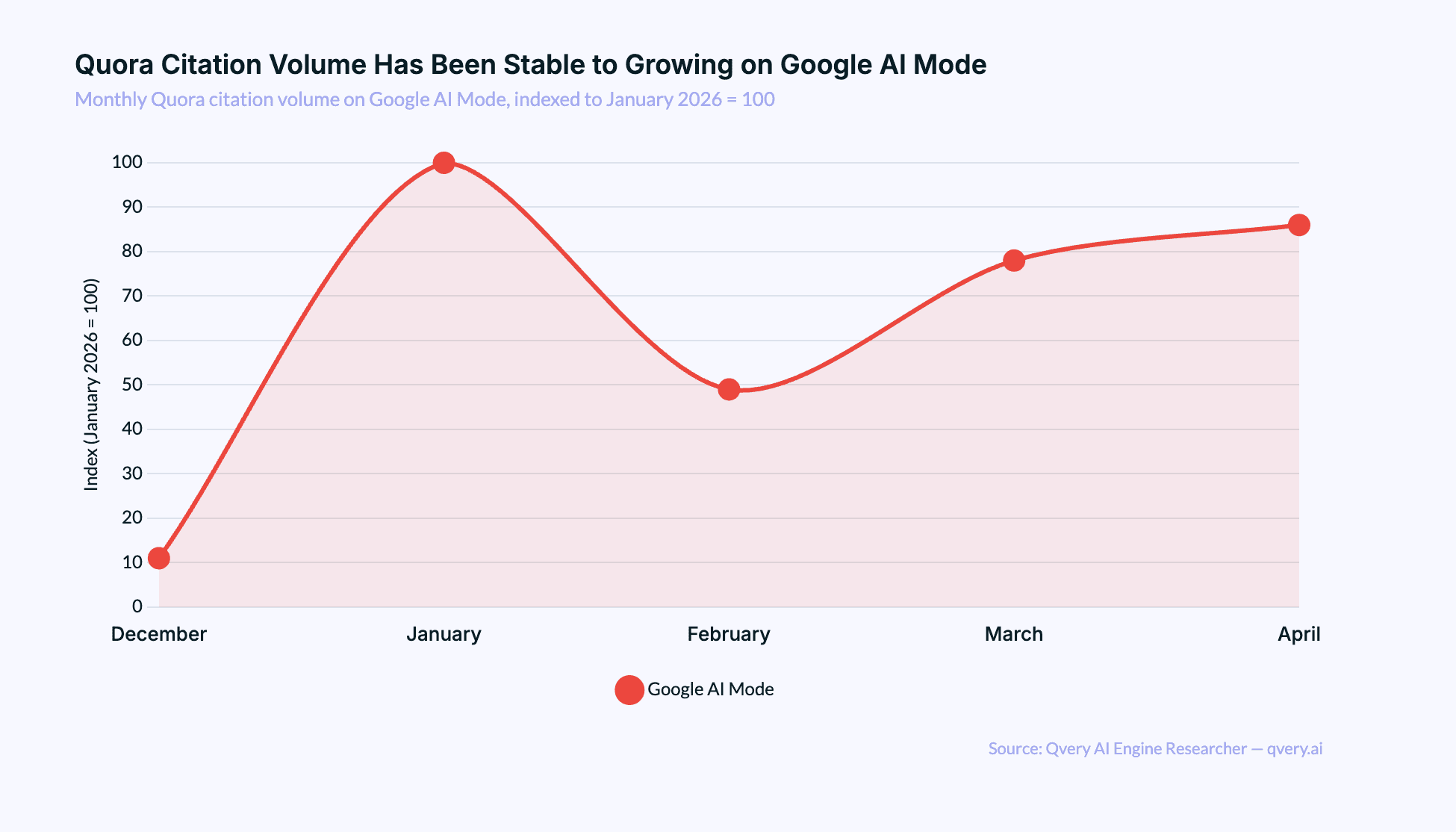
Quora's monthly citation volume on Google AI Mode dipped in February 2026 but recovered in March and April. The April number is the second-highest month in our dataset, behind only the January spike.
What Quora Citations Mean for Brand Strategy
The strategic implication is unusual. For most brands, Quora is a footnote. The 0.053% citation share doesn't move the needle for consumer brands or general B2B marketing.
Your audience uses both ChatGPT and Google AI Mode constantly, which is why Quora can never be a strategy on its own. It's one slice of a broader citation footprint. A strong Quora presence on the right comparison threads earns Google AI Mode citation share that competitors aren't fighting for, alongside the rest of the work that drives ChatGPT and overall visibility. Maintaining it is worth the effort. Mistaking it for the whole game is not.
Run This for Your Quora Footprint With Qvery Assistant
Quora's 100% Google AI Mode pattern is the cross-dataset shape. For your brand specifically, the question is whether any Quora threads are pulling weight at all, and which ones they are.
Qvery Assistant is the AI agent inside your Qvery account that turns that into a quick lookup. Type "show me every Quora citation in my queries with rank position" and you'll have the answer in seconds.
Run a Citation Gap Analysis against the competitors in your category and you'll see which Quora threads they earn citations on that you don't.
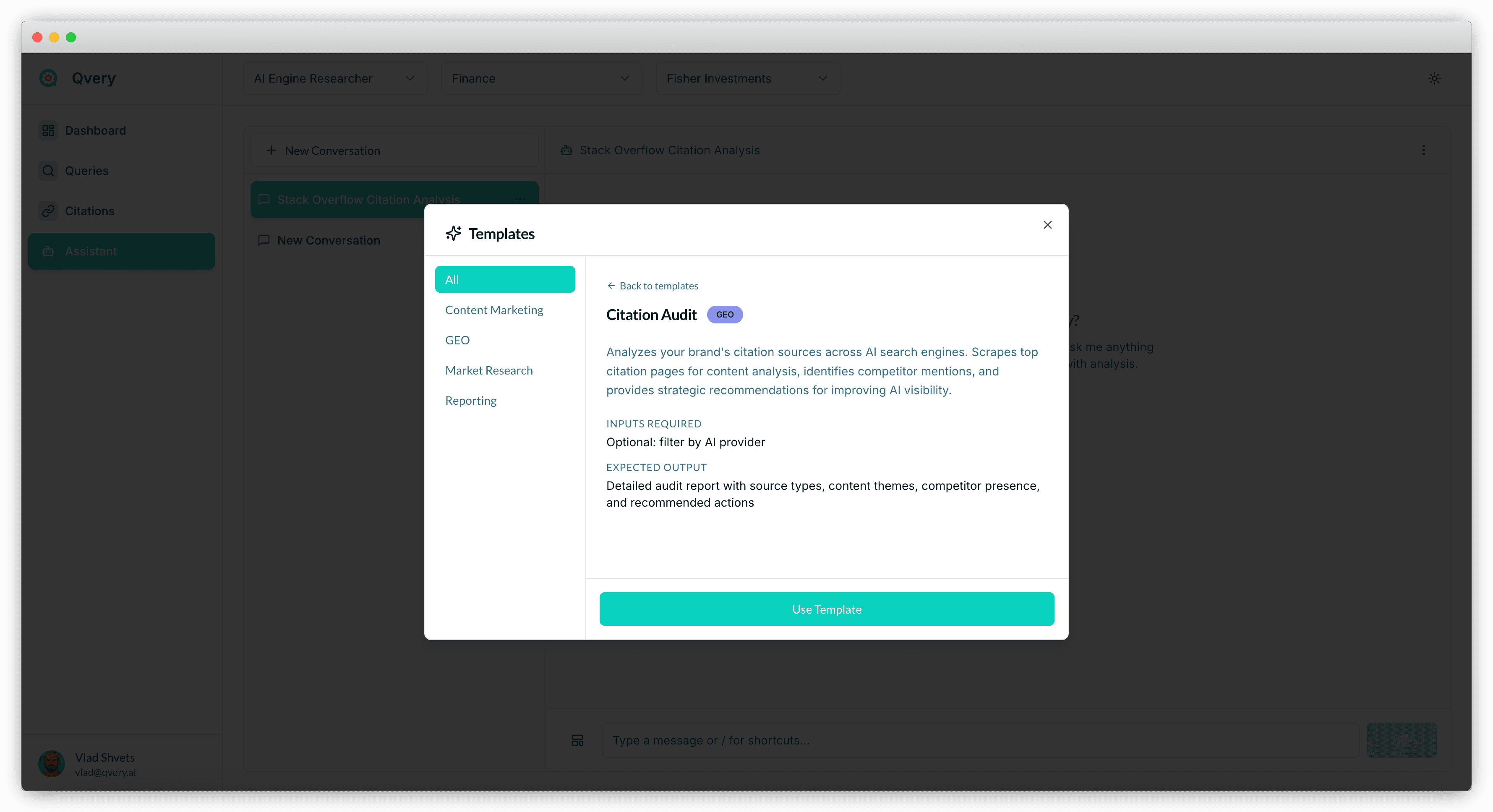
If you find something interesting or surprising on Qvery Assistant, do email us and let us know. And if you aren't on Qvery yet, start your free 7-day trial now.
I keep getting the same question from marketers: "Should we be on Quora?" My answer used to be a hedged "depends on your audience." The data made it cleaner. Quora is a UGC platform like Reddit, just much smaller, and for reasons we'll get to, it shows up only on Google AI Mode. ChatGPT cites it zero times. That makes Quora an unusual shape in the AI search landscape: a real Google AI Mode presence and a complete blind spot on ChatGPT.
Meanwhile, Google AI Mode cites Quora regularly. Every Quora citation in our entire dataset, without exception, comes from Google AI Mode. That makes Quora the most engine-exclusive high-volume source we track. The mirror image of Wikipedia, which we've already written about as ChatGPT's favorite reference source. (The AI has decided that Q&A platforms get exactly one engine each.)
ChatGPT Has Never Cited Quora. We Checked.
The headline finding is binary. Out of more than two million ChatGPT citations in our dataset, not a single one points to quora.com. We ran the SQL query, double-checked the schema, ran it again with a fresh date range. The result was the same every time: zero.
Statistically, a ratio of zero out of a few million is impossible if Quora were treated as a normal source. Even sources ChatGPT mostly ignores still get cited a handful of times. Twitter and X combined get cited 69 times by ChatGPT. TikTok gets cited twice. Pinterest gets cited a hundred times. Quora gets zero.
The pattern is too clean to be accidental. The most plausible explanation is a deliberate exclusion at the OpenAI level. Quora has had public licensing disputes, gated content via Quora Spaces, and a long-running quality argument with people who actually use it. OpenAI may have simply removed Quora from ChatGPT's source pool. We can't prove that without OpenAI publishing their source list, and they don't. But the data leaves very little room for any other interpretation.
Out of two million ChatGPT citations, Quora appears zero times. Out of every Quora citation in our database, ChatGPT contributed exactly none.
Quora and Wikipedia Are Mirror Images of Each Other
The cleanest way to understand what's happening with Quora is to put it next to Wikipedia. They're the two most engine-skewed high-volume sources in our entire dataset, and they sit on opposite ends of the engine spectrum.
Wikipedia is 97.2% ChatGPT. Google AI Mode barely cites it because Google has already absorbed Wikipedia's structured knowledge into its own knowledge graph. Quora is 100% Google AI Mode. ChatGPT doesn't cite it for whatever reason OpenAI chose. The shape is identical. The engines are reversed.
This is the kind of finding that should reshape how you think about AI search. Visibility metrics treat AI search as a single thing. The engines are not a single thing. They have different source pools, different licensing relationships, and apparently very different opinions about which Q&A platform belongs in their citation lists.
Reddit, the third major Q&A peer, sits in the middle. It's roughly evenly split between engines. Reddit is the only major Q&A and discussion source both engines treat as authoritative. Quora and Wikipedia are the extremes. Reddit is the rule.
Even on Google AI Mode, Quora Is a Footnote
Quora's exclusivity sounds like it should mean dominance. It doesn't. Even on Google AI Mode, where Quora is the only Q&A platform with this kind of single-engine relationship, Quora accounts for just 0.084% of all citations. About one in every twelve hundred.
The full picture, as a percentage of all citations across both engines, looks like this:
Reddit sits at 1.59% of all citations. Roughly a hundred times Quora.
Wikipedia sits at 0.85%. Roughly sixteen times Quora.
Quora sits at 0.053%. Small.
Stack Overflow, the other tiny Q&A source, sits at 0.014%. Smaller.
Quora beats Stack Overflow by a factor of four, but that's like winning a footrace where everyone else is sitting down. The story isn't "Quora is dominant on Google AI Mode." The story is "Quora is exclusive to Google AI Mode, and it's still small."
Quora Gets Cited for Tool Comparisons, Not Personal Stories
The content type that earns Quora its citations is narrow. The most-cited Quora pages in our dataset are all structured "compare X to Y" or "which is better" Q&As. The single most-cited Quora URL is a Skimlinks-versus-Viglink comparison thread for affiliate marketing tooling. The next most-cited is a Q&A on Directors and Officers insurance for early-stage startups. Below that: drag-and-drop website builders, affiliate tracking solutions, and design tools.
The personal-essay format Quora is also full of, where someone shares a heartfelt story about leaving their corporate job, doesn't show up at all. AI engines don't treat that content as citable. They treat the structured comparison answers as citable. The format is doing the work, not the platform.
This matches the broader pattern across all citation sources. Listicles are the most-cited content type in AI search. Quora's Q&A version of a listicle is a "compare X to Y" thread with three or four answers ranking different tools. AI engines find that format easy to extract and reuse.
The topic clusters this drives are predictable: chart and graph tools, form builders, affiliate monetization, web coding for designers, data visualization, and Directors and Officers insurance. None of those are mass-market consumer topics. They're SaaS marketing and B2B specialty topics.
Quora's Geography Is English-Speaking and India-Heavy
The country distribution for Quora-citing executions tells you who AI engines think Quora is for. The United States leads, as it does for almost every domain. The United Kingdom, Germany, and Australia follow. Then India shows up at position 4, well above where it ranks for most other sources we track.
India's strong presence reflects what Quora already is in the real world: a platform with a huge active user base in India, especially around tech and SaaS topics.
Google AI Mode appears to be picking up on that. The platform's Indian content is showing up in queries from Indian users, and apparently in queries from non-Indian users where Quora's answers happen to be the best available.
The non-English picture is interesting. Quora is mostly an English-content platform, even when the query comes from Germany, Belgium, or the UAE. AI engines aren't pulling from quora.com's Spanish or French sister sites at any meaningful rate. The English content does the work. The localization story for Quora citations is "English wins everywhere."
Quora's Citation Rate on Google AI Has Been Stable to Growing
Quora's monthly citation volume on Google AI Mode dipped in February 2026 but recovered in March and April. The April number is the second-highest month in our dataset, behind only the January spike.
What Quora Citations Mean for Brand Strategy
The strategic implication is unusual. For most brands, Quora is a footnote. The 0.053% citation share doesn't move the needle for consumer brands or general B2B marketing.
Your audience uses both ChatGPT and Google AI Mode constantly, which is why Quora can never be a strategy on its own. It's one slice of a broader citation footprint. A strong Quora presence on the right comparison threads earns Google AI Mode citation share that competitors aren't fighting for, alongside the rest of the work that drives ChatGPT and overall visibility. Maintaining it is worth the effort. Mistaking it for the whole game is not.
Run This for Your Quora Footprint With Qvery Assistant
Quora's 100% Google AI Mode pattern is the cross-dataset shape. For your brand specifically, the question is whether any Quora threads are pulling weight at all, and which ones they are.
Qvery Assistant is the AI agent inside your Qvery account that turns that into a quick lookup. Type "show me every Quora citation in my queries with rank position" and you'll have the answer in seconds.
Run a Citation Gap Analysis against the competitors in your category and you'll see which Quora threads they earn citations on that you don't.
If you find something interesting or surprising on Qvery Assistant, do email us and let us know. And if you aren't on Qvery yet, start your free 7-day trial now.
I keep getting the same question from marketers: "Should we be on Quora?" My answer used to be a hedged "depends on your audience." The data made it cleaner. Quora is a UGC platform like Reddit, just much smaller, and for reasons we'll get to, it shows up only on Google AI Mode. ChatGPT cites it zero times. That makes Quora an unusual shape in the AI search landscape: a real Google AI Mode presence and a complete blind spot on ChatGPT.
Meanwhile, Google AI Mode cites Quora regularly. Every Quora citation in our entire dataset, without exception, comes from Google AI Mode. That makes Quora the most engine-exclusive high-volume source we track. The mirror image of Wikipedia, which we've already written about as ChatGPT's favorite reference source. (The AI has decided that Q&A platforms get exactly one engine each.)
ChatGPT Has Never Cited Quora. We Checked.
The headline finding is binary. Out of more than two million ChatGPT citations in our dataset, not a single one points to quora.com. We ran the SQL query, double-checked the schema, ran it again with a fresh date range. The result was the same every time: zero.
Statistically, a ratio of zero out of a few million is impossible if Quora were treated as a normal source. Even sources ChatGPT mostly ignores still get cited a handful of times. Twitter and X combined get cited 69 times by ChatGPT. TikTok gets cited twice. Pinterest gets cited a hundred times. Quora gets zero.
The pattern is too clean to be accidental. The most plausible explanation is a deliberate exclusion at the OpenAI level. Quora has had public licensing disputes, gated content via Quora Spaces, and a long-running quality argument with people who actually use it. OpenAI may have simply removed Quora from ChatGPT's source pool. We can't prove that without OpenAI publishing their source list, and they don't. But the data leaves very little room for any other interpretation.
Out of two million ChatGPT citations, Quora appears zero times. Out of every Quora citation in our database, ChatGPT contributed exactly none.
Quora and Wikipedia Are Mirror Images of Each Other
The cleanest way to understand what's happening with Quora is to put it next to Wikipedia. They're the two most engine-skewed high-volume sources in our entire dataset, and they sit on opposite ends of the engine spectrum.
Wikipedia is 97.2% ChatGPT. Google AI Mode barely cites it because Google has already absorbed Wikipedia's structured knowledge into its own knowledge graph. Quora is 100% Google AI Mode. ChatGPT doesn't cite it for whatever reason OpenAI chose. The shape is identical. The engines are reversed.
This is the kind of finding that should reshape how you think about AI search. Visibility metrics treat AI search as a single thing. The engines are not a single thing. They have different source pools, different licensing relationships, and apparently very different opinions about which Q&A platform belongs in their citation lists.
Reddit, the third major Q&A peer, sits in the middle. It's roughly evenly split between engines. Reddit is the only major Q&A and discussion source both engines treat as authoritative. Quora and Wikipedia are the extremes. Reddit is the rule.
Even on Google AI Mode, Quora Is a Footnote
Quora's exclusivity sounds like it should mean dominance. It doesn't. Even on Google AI Mode, where Quora is the only Q&A platform with this kind of single-engine relationship, Quora accounts for just 0.084% of all citations. About one in every twelve hundred.
The full picture, as a percentage of all citations across both engines, looks like this:
Reddit sits at 1.59% of all citations. Roughly a hundred times Quora.
Wikipedia sits at 0.85%. Roughly sixteen times Quora.
Quora sits at 0.053%. Small.
Stack Overflow, the other tiny Q&A source, sits at 0.014%. Smaller.
Quora beats Stack Overflow by a factor of four, but that's like winning a footrace where everyone else is sitting down. The story isn't "Quora is dominant on Google AI Mode." The story is "Quora is exclusive to Google AI Mode, and it's still small."
Quora Gets Cited for Tool Comparisons, Not Personal Stories
The content type that earns Quora its citations is narrow. The most-cited Quora pages in our dataset are all structured "compare X to Y" or "which is better" Q&As. The single most-cited Quora URL is a Skimlinks-versus-Viglink comparison thread for affiliate marketing tooling. The next most-cited is a Q&A on Directors and Officers insurance for early-stage startups. Below that: drag-and-drop website builders, affiliate tracking solutions, and design tools.
The personal-essay format Quora is also full of, where someone shares a heartfelt story about leaving their corporate job, doesn't show up at all. AI engines don't treat that content as citable. They treat the structured comparison answers as citable. The format is doing the work, not the platform.
This matches the broader pattern across all citation sources. Listicles are the most-cited content type in AI search. Quora's Q&A version of a listicle is a "compare X to Y" thread with three or four answers ranking different tools. AI engines find that format easy to extract and reuse.
The topic clusters this drives are predictable: chart and graph tools, form builders, affiliate monetization, web coding for designers, data visualization, and Directors and Officers insurance. None of those are mass-market consumer topics. They're SaaS marketing and B2B specialty topics.
Quora's Geography Is English-Speaking and India-Heavy
The country distribution for Quora-citing executions tells you who AI engines think Quora is for. The United States leads, as it does for almost every domain. The United Kingdom, Germany, and Australia follow. Then India shows up at position 4, well above where it ranks for most other sources we track.
India's strong presence reflects what Quora already is in the real world: a platform with a huge active user base in India, especially around tech and SaaS topics.
Google AI Mode appears to be picking up on that. The platform's Indian content is showing up in queries from Indian users, and apparently in queries from non-Indian users where Quora's answers happen to be the best available.
The non-English picture is interesting. Quora is mostly an English-content platform, even when the query comes from Germany, Belgium, or the UAE. AI engines aren't pulling from quora.com's Spanish or French sister sites at any meaningful rate. The English content does the work. The localization story for Quora citations is "English wins everywhere."
Quora's Citation Rate on Google AI Has Been Stable to Growing
Quora's monthly citation volume on Google AI Mode dipped in February 2026 but recovered in March and April. The April number is the second-highest month in our dataset, behind only the January spike.
What Quora Citations Mean for Brand Strategy
The strategic implication is unusual. For most brands, Quora is a footnote. The 0.053% citation share doesn't move the needle for consumer brands or general B2B marketing.
Your audience uses both ChatGPT and Google AI Mode constantly, which is why Quora can never be a strategy on its own. It's one slice of a broader citation footprint. A strong Quora presence on the right comparison threads earns Google AI Mode citation share that competitors aren't fighting for, alongside the rest of the work that drives ChatGPT and overall visibility. Maintaining it is worth the effort. Mistaking it for the whole game is not.
Run This for Your Quora Footprint With Qvery Assistant
Quora's 100% Google AI Mode pattern is the cross-dataset shape. For your brand specifically, the question is whether any Quora threads are pulling weight at all, and which ones they are.
Qvery Assistant is the AI agent inside your Qvery account that turns that into a quick lookup. Type "show me every Quora citation in my queries with rank position" and you'll have the answer in seconds.
Run a Citation Gap Analysis against the competitors in your category and you'll see which Quora threads they earn citations on that you don't.
If you find something interesting or surprising on Qvery Assistant, do email us and let us know. And if you aren't on Qvery yet, start your free 7-day trial now.
I keep getting the same question from marketers: "Should we be on Quora?" My answer used to be a hedged "depends on your audience." The data made it cleaner. Quora is a UGC platform like Reddit, just much smaller, and for reasons we'll get to, it shows up only on Google AI Mode. ChatGPT cites it zero times. That makes Quora an unusual shape in the AI search landscape: a real Google AI Mode presence and a complete blind spot on ChatGPT.
Meanwhile, Google AI Mode cites Quora regularly. Every Quora citation in our entire dataset, without exception, comes from Google AI Mode. That makes Quora the most engine-exclusive high-volume source we track. The mirror image of Wikipedia, which we've already written about as ChatGPT's favorite reference source. (The AI has decided that Q&A platforms get exactly one engine each.)
ChatGPT Has Never Cited Quora. We Checked.
The headline finding is binary. Out of more than two million ChatGPT citations in our dataset, not a single one points to quora.com. We ran the SQL query, double-checked the schema, ran it again with a fresh date range. The result was the same every time: zero.
Statistically, a ratio of zero out of a few million is impossible if Quora were treated as a normal source. Even sources ChatGPT mostly ignores still get cited a handful of times. Twitter and X combined get cited 69 times by ChatGPT. TikTok gets cited twice. Pinterest gets cited a hundred times. Quora gets zero.
The pattern is too clean to be accidental. The most plausible explanation is a deliberate exclusion at the OpenAI level. Quora has had public licensing disputes, gated content via Quora Spaces, and a long-running quality argument with people who actually use it. OpenAI may have simply removed Quora from ChatGPT's source pool. We can't prove that without OpenAI publishing their source list, and they don't. But the data leaves very little room for any other interpretation.
Out of two million ChatGPT citations, Quora appears zero times. Out of every Quora citation in our database, ChatGPT contributed exactly none.
Quora and Wikipedia Are Mirror Images of Each Other
The cleanest way to understand what's happening with Quora is to put it next to Wikipedia. They're the two most engine-skewed high-volume sources in our entire dataset, and they sit on opposite ends of the engine spectrum.
Wikipedia is 97.2% ChatGPT. Google AI Mode barely cites it because Google has already absorbed Wikipedia's structured knowledge into its own knowledge graph. Quora is 100% Google AI Mode. ChatGPT doesn't cite it for whatever reason OpenAI chose. The shape is identical. The engines are reversed.
This is the kind of finding that should reshape how you think about AI search. Visibility metrics treat AI search as a single thing. The engines are not a single thing. They have different source pools, different licensing relationships, and apparently very different opinions about which Q&A platform belongs in their citation lists.
Reddit, the third major Q&A peer, sits in the middle. It's roughly evenly split between engines. Reddit is the only major Q&A and discussion source both engines treat as authoritative. Quora and Wikipedia are the extremes. Reddit is the rule.
Even on Google AI Mode, Quora Is a Footnote
Quora's exclusivity sounds like it should mean dominance. It doesn't. Even on Google AI Mode, where Quora is the only Q&A platform with this kind of single-engine relationship, Quora accounts for just 0.084% of all citations. About one in every twelve hundred.
The full picture, as a percentage of all citations across both engines, looks like this:
Reddit sits at 1.59% of all citations. Roughly a hundred times Quora.
Wikipedia sits at 0.85%. Roughly sixteen times Quora.
Quora sits at 0.053%. Small.
Stack Overflow, the other tiny Q&A source, sits at 0.014%. Smaller.
Quora beats Stack Overflow by a factor of four, but that's like winning a footrace where everyone else is sitting down. The story isn't "Quora is dominant on Google AI Mode." The story is "Quora is exclusive to Google AI Mode, and it's still small."
Quora Gets Cited for Tool Comparisons, Not Personal Stories
The content type that earns Quora its citations is narrow. The most-cited Quora pages in our dataset are all structured "compare X to Y" or "which is better" Q&As. The single most-cited Quora URL is a Skimlinks-versus-Viglink comparison thread for affiliate marketing tooling. The next most-cited is a Q&A on Directors and Officers insurance for early-stage startups. Below that: drag-and-drop website builders, affiliate tracking solutions, and design tools.
The personal-essay format Quora is also full of, where someone shares a heartfelt story about leaving their corporate job, doesn't show up at all. AI engines don't treat that content as citable. They treat the structured comparison answers as citable. The format is doing the work, not the platform.
This matches the broader pattern across all citation sources. Listicles are the most-cited content type in AI search. Quora's Q&A version of a listicle is a "compare X to Y" thread with three or four answers ranking different tools. AI engines find that format easy to extract and reuse.
The topic clusters this drives are predictable: chart and graph tools, form builders, affiliate monetization, web coding for designers, data visualization, and Directors and Officers insurance. None of those are mass-market consumer topics. They're SaaS marketing and B2B specialty topics.
Quora's Geography Is English-Speaking and India-Heavy
The country distribution for Quora-citing executions tells you who AI engines think Quora is for. The United States leads, as it does for almost every domain. The United Kingdom, Germany, and Australia follow. Then India shows up at position 4, well above where it ranks for most other sources we track.
India's strong presence reflects what Quora already is in the real world: a platform with a huge active user base in India, especially around tech and SaaS topics.
Google AI Mode appears to be picking up on that. The platform's Indian content is showing up in queries from Indian users, and apparently in queries from non-Indian users where Quora's answers happen to be the best available.
The non-English picture is interesting. Quora is mostly an English-content platform, even when the query comes from Germany, Belgium, or the UAE. AI engines aren't pulling from quora.com's Spanish or French sister sites at any meaningful rate. The English content does the work. The localization story for Quora citations is "English wins everywhere."
Quora's Citation Rate on Google AI Has Been Stable to Growing
Quora's monthly citation volume on Google AI Mode dipped in February 2026 but recovered in March and April. The April number is the second-highest month in our dataset, behind only the January spike.
What Quora Citations Mean for Brand Strategy
The strategic implication is unusual. For most brands, Quora is a footnote. The 0.053% citation share doesn't move the needle for consumer brands or general B2B marketing.
Your audience uses both ChatGPT and Google AI Mode constantly, which is why Quora can never be a strategy on its own. It's one slice of a broader citation footprint. A strong Quora presence on the right comparison threads earns Google AI Mode citation share that competitors aren't fighting for, alongside the rest of the work that drives ChatGPT and overall visibility. Maintaining it is worth the effort. Mistaking it for the whole game is not.
Run This for Your Quora Footprint With Qvery Assistant
Quora's 100% Google AI Mode pattern is the cross-dataset shape. For your brand specifically, the question is whether any Quora threads are pulling weight at all, and which ones they are.
Qvery Assistant is the AI agent inside your Qvery account that turns that into a quick lookup. Type "show me every Quora citation in my queries with rank position" and you'll have the answer in seconds.
Run a Citation Gap Analysis against the competitors in your category and you'll see which Quora threads they earn citations on that you don't.
If you find something interesting or surprising on Qvery Assistant, do email us and let us know. And if you aren't on Qvery yet, start your free 7-day trial now.

© 2026 Qvery AI OÜ