By
Vlad Shvets
Wikipedia AI Citations: ChatGPT's Favorite Source That Google AI Ignores
Wikipedia has the best citation rank of any domain in AI search. But 98.8% of those citations come from one engine.
Wikipedia has the best citation rank of any domain in AI search. But 98.8% of those citations come from one engine.
Wikipedia has the best citation rank of any domain in AI search. But 98.8% of those citations come from one engine.
Wikipedia has the best average citation rank of any domain in AI search. Better than Reddit. Better than YouTube. Better than your carefully optimized company blog that took three years to build. The world's free encyclopedia, the website your college professor told you to never cite, is the single most prominently placed source across AI engines.
But here's where it gets weird: 98.8% of all Wikipedia citations come from one engine.
The other engine barely knows Wikipedia exists. So when someone asks "should I create a Wikipedia page for my brand?" the honest answer is: it depends on which AI engine you'd like to optimize for. (Helpful, I know.)
We ran the numbers across our proprietary citation dataset at Qvery, covering queries from January through March 2026 across both ChatGPT and Google AI Mode. Here's what Wikipedia's citation data actually says.
Wikipedia Ranks Higher Than Every Other Major Domain
Let's start with the headline stat. When AI engines cite Wikipedia, they place it at an average rank of 5.65. That means Wikipedia typically shows up as one of the first five or six sources in any response. For context, Reddit averages 11.56. YouTube averages 14.13. LinkedIn sits at a sad 15.90.
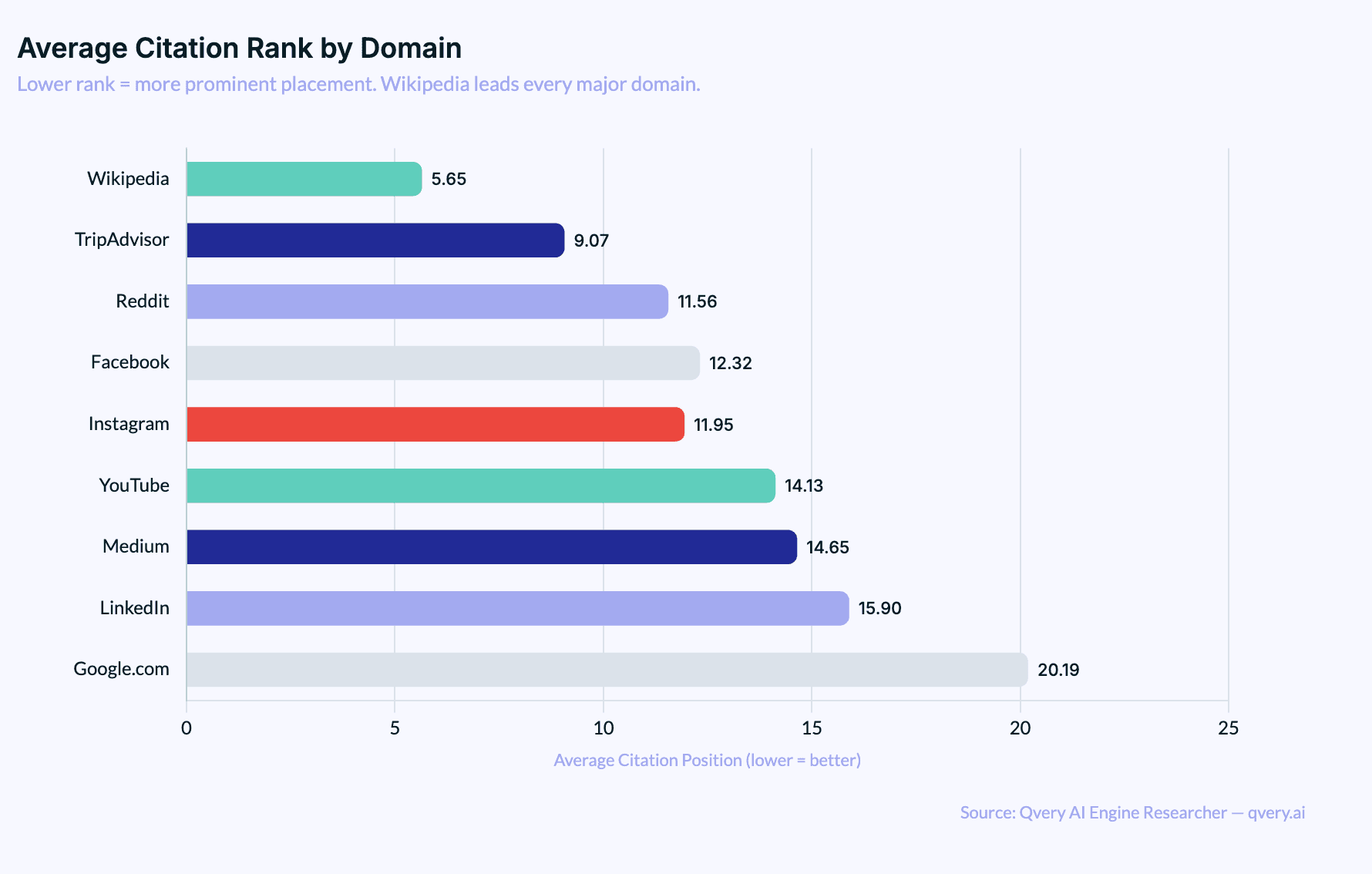
It gets more dramatic when you look at top-5 placement rates. When Wikipedia is cited, it lands in positions 1 through 5 a staggering 52.4% of the time. More than half. Reddit manages 22.9%. YouTube gets 19.4%. LinkedIn limps in at 15.1%.
Wikipedia doesn't just get cited. It gets cited first. Among well-known domains, Wikipedia appears in position 1 more than twice as often as the second-place domain, TripAdvisor. And 99.7% of those position-1 Wikipedia citations come from ChatGPT.
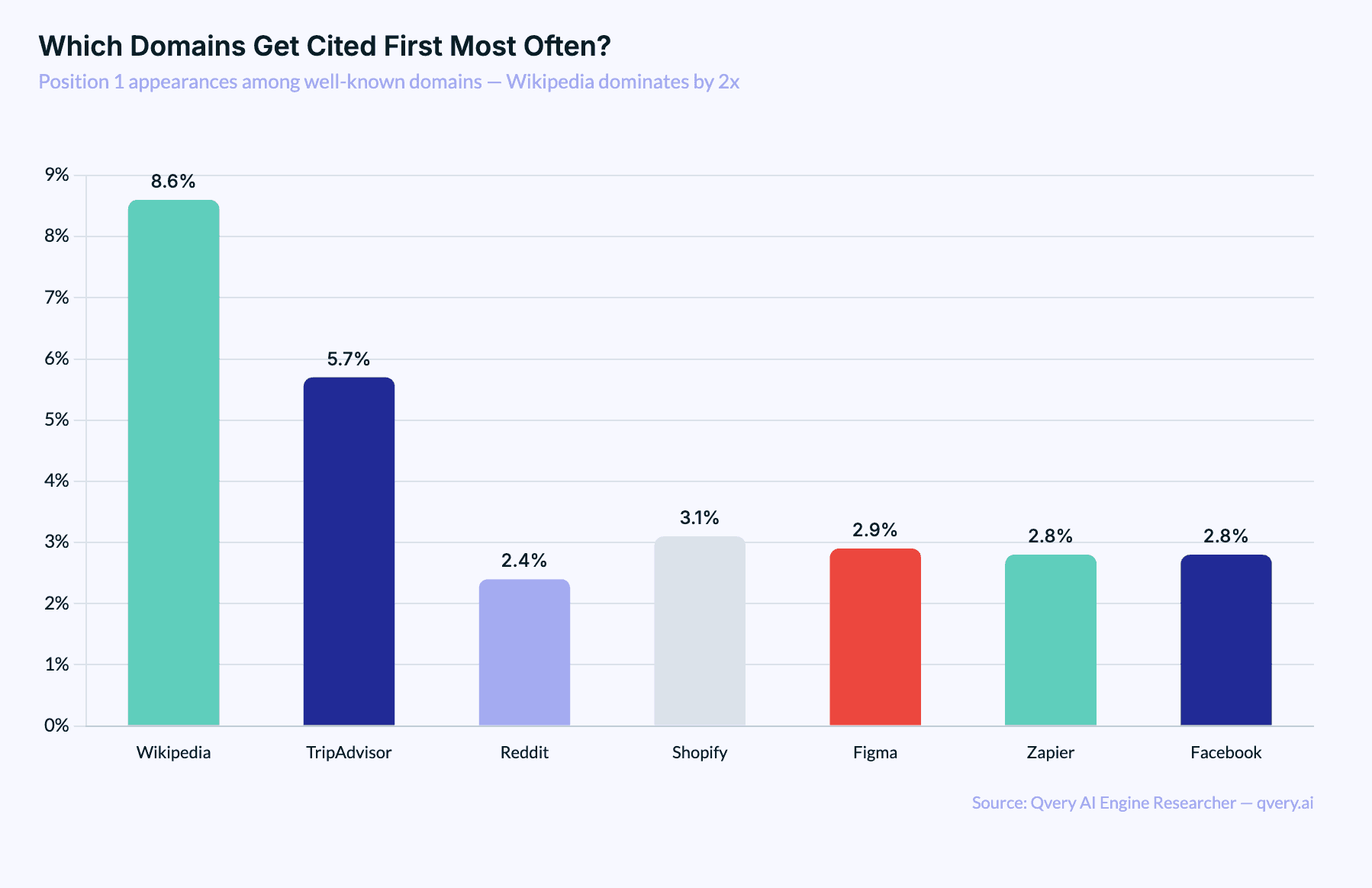
Wikipedia doesn't compete for citation placement. It starts at the top and occasionally gets pushed down.
The 124x Gap
Here's the number that should reframe every conversation about Wikipedia and AI search: ChatGPT cites Wikipedia at 2.49% of all its responses. Google AI Mode cites Wikipedia at 0.02%. That's a 124x difference. The most extreme platform split of any source in our entire dataset.
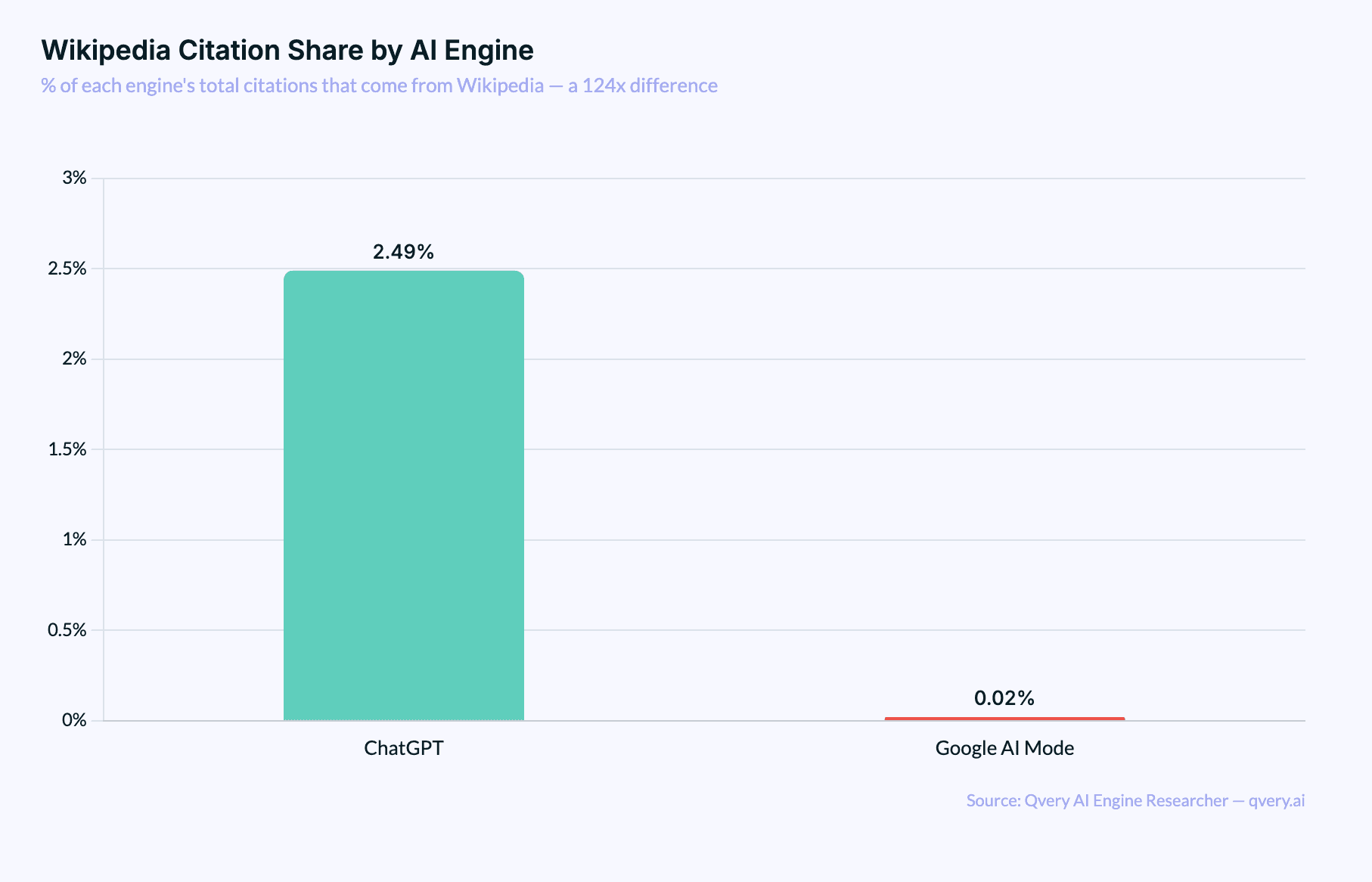
Put differently: 98.8% of all Wikipedia citations in AI search come from ChatGPT. Google AI Mode produces just 1.2%. Wikipedia is not an "AI search source." Wikipedia is a ChatGPT source that Google AI Mode almost entirely ignores.
This isn't a rounding error. Google AI Mode produced fewer than 500 Wikipedia citations across our entire tracking period. ChatGPT produced over 80x more. If you're optimizing for Google AI Mode, Wikipedia is essentially invisible. If you're optimizing for ChatGPT, Wikipedia is the third most-cited domain in the entire index.
Why ChatGPT Loves Wikipedia (And Google AI Doesn't Need It)
The split isn't random. It reflects a fundamental architectural difference between how these two engines handle knowledge.
ChatGPT is a citation engine. It generates responses and then attaches external sources to back up what it said. When ChatGPT needs to cite a factual claim, an entity definition, or background context, Wikipedia is the obvious choice. It's comprehensive, well-structured, and covers nearly every notable entity on the planet. ChatGPT uses Wikipedia the way a college student uses it: as the starting point for everything, even though the professor said not to.
Google AI Mode is a knowledge graph engine. Google has spent two decades building its own structured knowledge base. When Google AI Mode needs to cite a factual claim, it pulls from its own index, its own entity relationships, its own maps and databases. It doesn't need to link to Wikipedia because it already absorbed Wikipedia's information into its own systems. Why cite the encyclopedia when you are the encyclopedia?
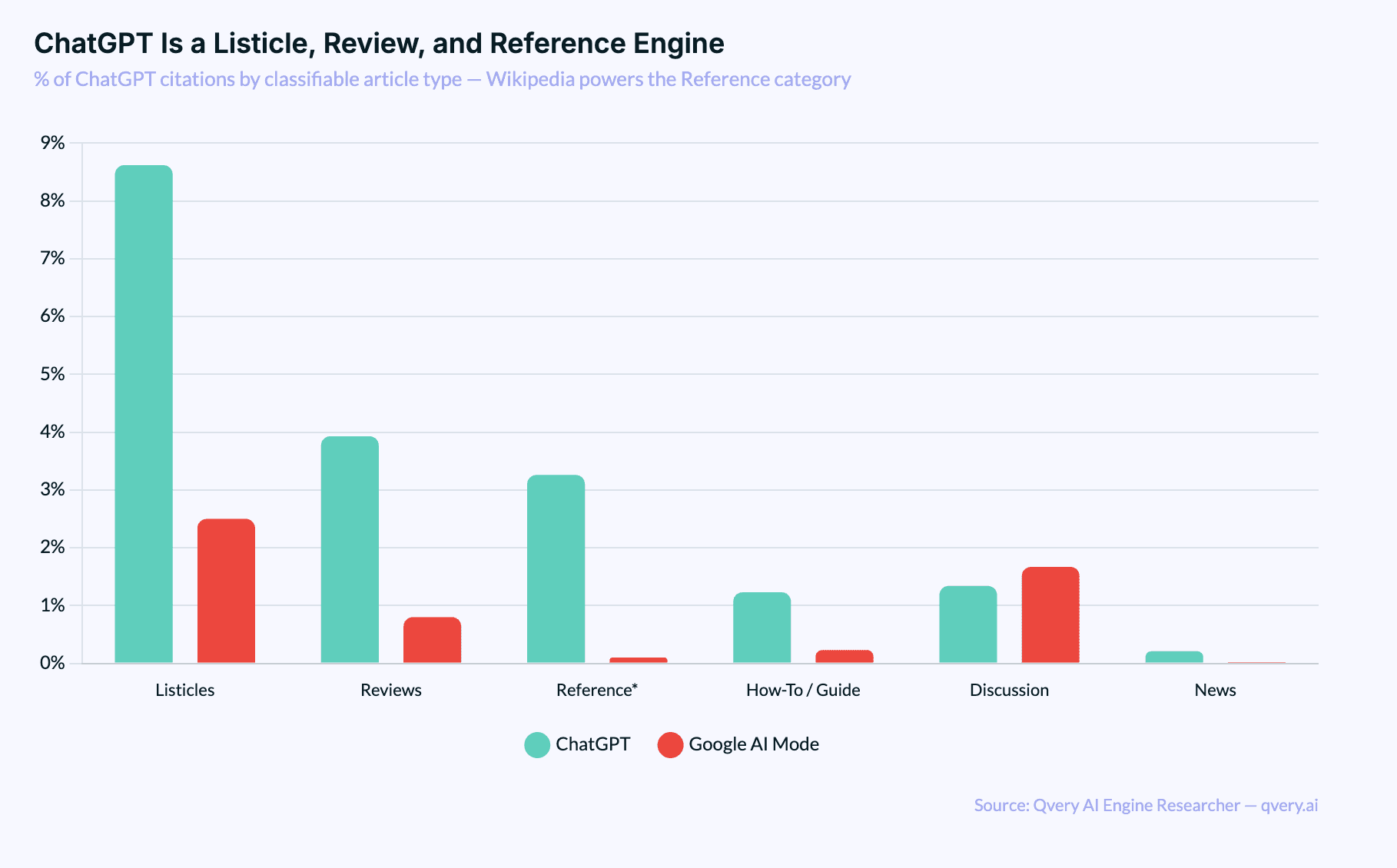
This explains the data perfectly. ChatGPT's reference content category (definitions, "what is" articles, encyclopedic content) accounts for 3.26% of its citations, and 84% of that comes from Wikipedia. Google AI Mode's reference category is just 0.10%. Google AI synthesizes reference information internally. ChatGPT outsources it to Wikipedia.
Wikipedia Is ChatGPT's Opening Move
Look at what ChatGPT does with Wikipedia and a pattern emerges. It doesn't just cite Wikipedia somewhere in the response. It leads with Wikipedia.
Nearly 10% of all ChatGPT Wikipedia citations appear at position 1. That's extraordinarily high. For comparison, Reddit appears at position 1 only 1.4% of the time on ChatGPT. YouTube? Zero position-1 citations on ChatGPT. Not one. Ever.
ChatGPT treats Wikipedia as the authoritative opening reference. It's the credibility anchor. Ask ChatGPT what a company does, what a technology is, or how an industry works, and it'll often start with the Wikipedia article, then layer on more specific sources below. Think of it as ChatGPT's version of "according to the encyclopedia."
This behavior is structural, not accidental. ChatGPT has been trained to view encyclopedic content as the baseline truth layer. Wikipedia articles are well-structured, factually dense, and entity-rich. They're the perfect citation for ChatGPT's preferred response format: define the thing, then get specific.
Where Wikipedia Sits in the Citation Ecosystem
Let's zoom out and look at Wikipedia's position among all classifiable citation sources.
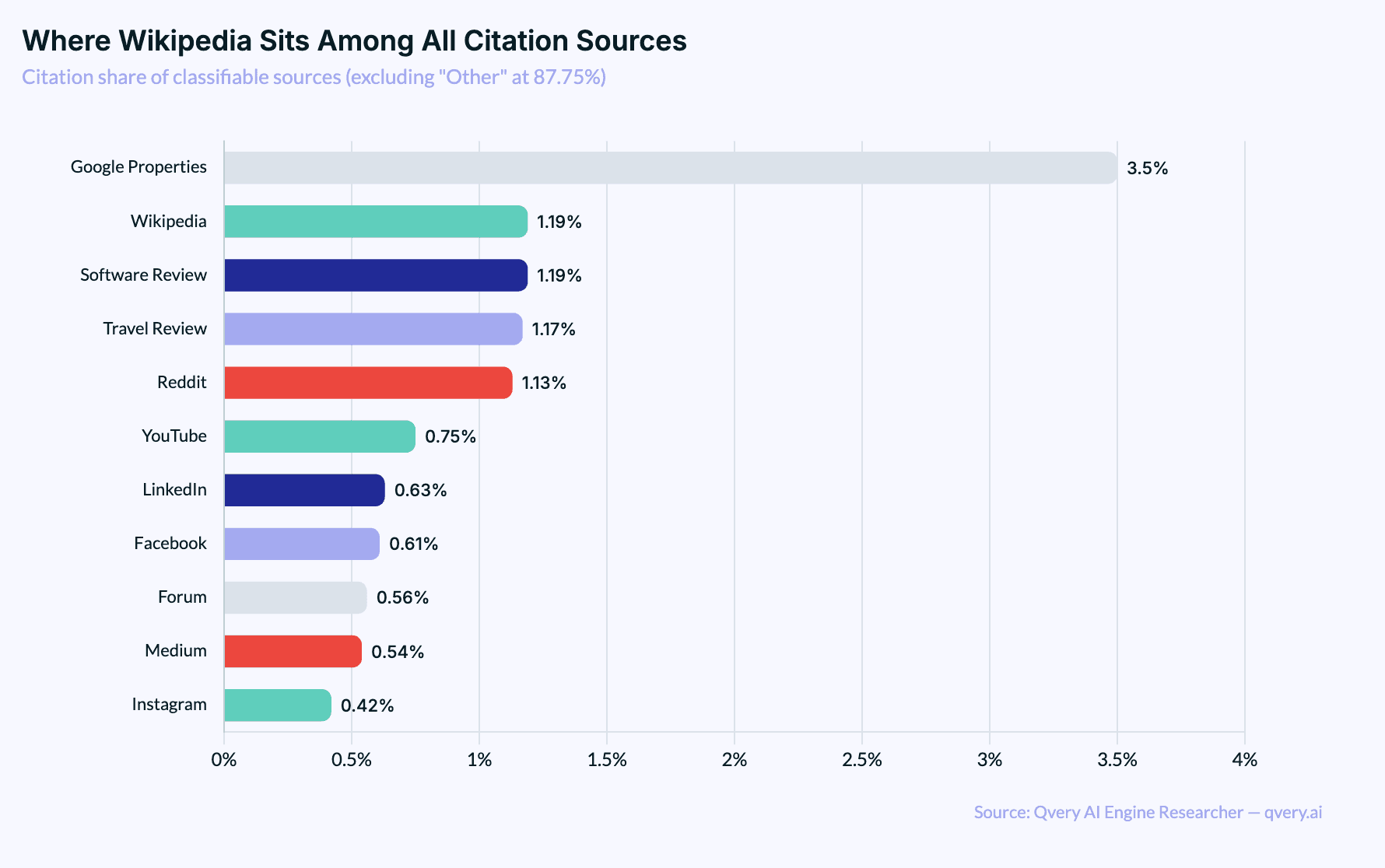
Wikipedia accounts for 1.19% of all citations across both engines (when counted by the broader Wikipedia category including all language editions). That puts it in a virtual tie with software review sites (1.19%) and just above Reddit (1.13%). But that aggregate number is misleading because of the platform split. On ChatGPT alone, Wikipedia's 2.49% share makes it the third most-cited domain behind only google.com and brand websites.
Here's what makes Wikipedia unusual compared to other sources:
Highest citation rank (5.65 average) of any major domain
Highest top-5 rate (52.4%) of any platform
Most platform-exclusive source (98.8% from one engine)
Most likely to be position 1 among well-known domains
No other source combines all four of these. Reddit is more balanced across platforms. YouTube has better Google AI placement. But nothing matches Wikipedia's concentration of authority on ChatGPT.
The Decline: Wikipedia Is Slowly Losing Share
There's a "but" coming. Wikipedia's share on ChatGPT is declining. It dropped from 2.60% in January to 2.48% in February. A small move, but in a dataset this size, directionally meaningful.
The decline on ChatGPT likely reflects a broader trend we're seeing across the data: ChatGPT is becoming less reliant on encyclopedic reference content over time. Its per-response citation density dropped 41% between January and March, and the types of content it cites are shifting toward more specific, primary sources rather than general-purpose references.
That said, "declining from 2.60% to 2.48%" is not "disappearing." Wikipedia remains ChatGPT's go-to reference source, and unless OpenAI fundamentally changes how ChatGPT constructs citations, that's unlikely to change overnight.
So, Should You Create a Wikipedia Page?
This is the question everyone asks us. Usually after seeing their competitor show up in ChatGPT results with a Wikipedia citation and wondering why they don't have one.
Let's be direct: your audience uses both ChatGPT and Google AI Mode. Nobody picks one AI search engine and ignores the other. So the question isn't "which engine does my audience use?" It's "how much weight should Wikipedia carry in your AI visibility strategy?"
On ChatGPT, Wikipedia is one of the highest-leverage citation sources that exist. Average rank of 5.65. Top-5 placement 52.4% of the time. No other third-party domain gives you that kind of positioning. If your brand has a Wikipedia page, ChatGPT will find it, cite it, and place it near the top.
On Google AI Mode, Wikipedia is invisible. Cited 0.02% of the time. Your effort there would be better spent on your own website content, earning mentions on review sites, or building a Reddit presence (which Google AI Mode cites at 1.05%).
That makes Wikipedia a supplement, not a strategy. It covers half the AI search landscape extremely well and the other half not at all. Create the page if you qualify. But don't treat it as your AEO foundation.
A few practical caveats before you start drafting your Wikipedia article:
Wikipedia's notability guidelines are strict. If your company doesn't meet them (significant coverage in independent, reliable sources), you can't create a page. Trying to force one will get it deleted.
You cannot control what the Wikipedia article says. If your brand has controversies, those will be in the article, and ChatGPT will cite that version.
A Wikipedia page alone doesn't guarantee citation. ChatGPT cites Wikipedia for entity-level queries (what is X, who makes Y) more than product-specific queries (best tool for Z). Your page needs to exist, but your content strategy still needs to target the right queries.
A Wikipedia page is the single highest-ranking citation source on ChatGPT. But it only works on one of the two major AI engines.
How Qvery Tracks Wikipedia (And Every Other Citation Source)
Every data point in this post comes from Qvery's AI Engine Researcher. It runs your brand's queries across ChatGPT and Google AI Mode daily, captures every citation, and tracks where each one comes from, what rank position it appears in, and how it changes over time.
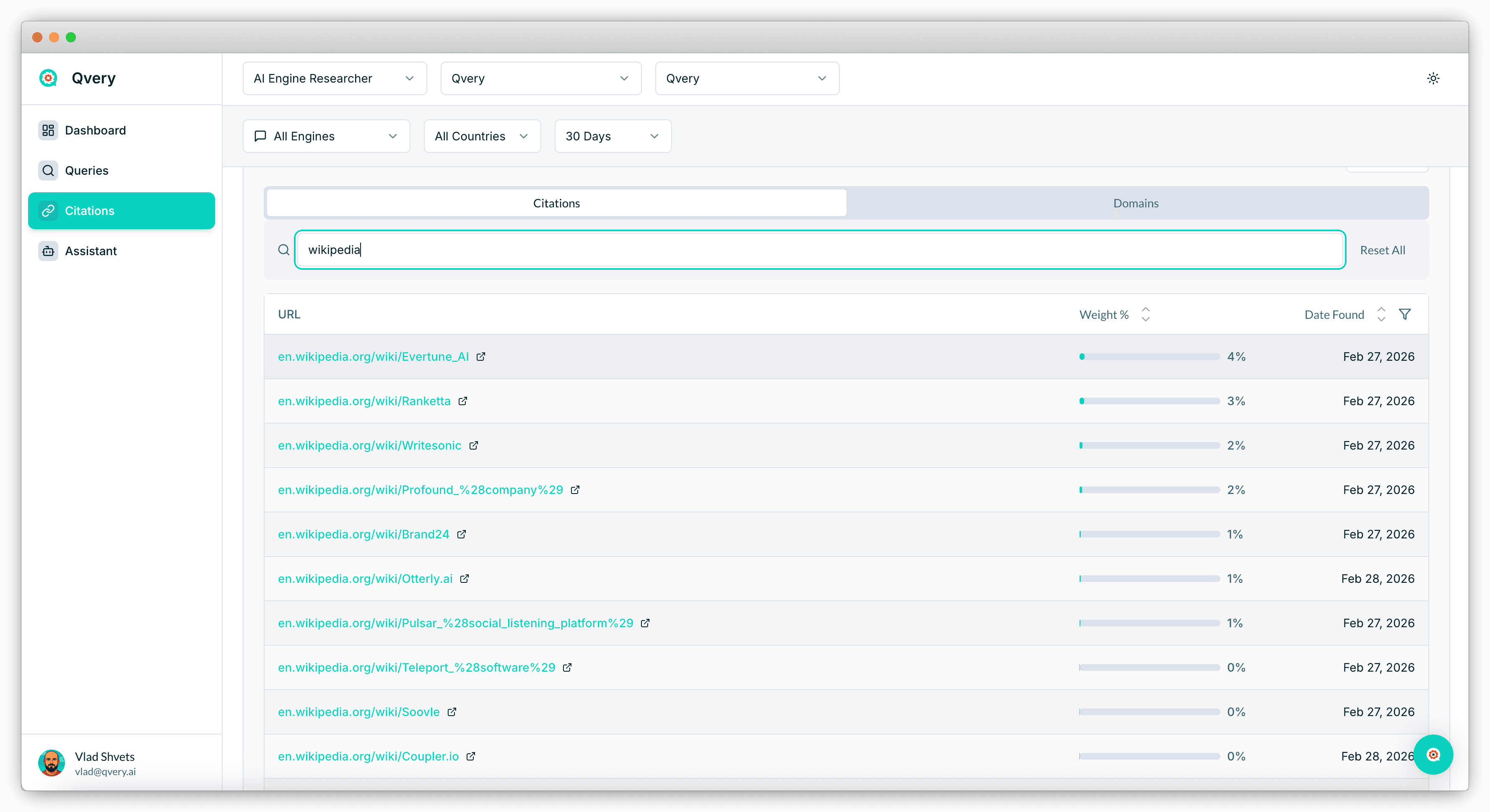
You can filter by source domain (Wikipedia, Reddit, YouTube, your competitors' websites), by AI engine, by time period, and by query. If you want to know whether your brand has a Wikipedia citation on ChatGPT right now, or whether your competitor does, that's a 30-second lookup.
The broader takeaway from this data isn't just about Wikipedia. It's about platform-specific citation behavior.
ChatGPT and Google AI Mode don't just cite different amounts. They cite fundamentally different types of sources. Wikipedia, encyclopedic references, and listicle content skew heavily toward ChatGPT. Google Properties, TripAdvisor, and social media skew toward Google AI Mode.
Optimizing for "AI search" as a monolith is like optimizing for "social media" without specifying the platform. You need to know which engine you're targeting and what that engine actually cites.
That's what Qvery is built to tell you. Start a free trial and see where your citations actually come from.
Wikipedia has the best average citation rank of any domain in AI search. Better than Reddit. Better than YouTube. Better than your carefully optimized company blog that took three years to build. The world's free encyclopedia, the website your college professor told you to never cite, is the single most prominently placed source across AI engines.
But here's where it gets weird: 98.8% of all Wikipedia citations come from one engine.
The other engine barely knows Wikipedia exists. So when someone asks "should I create a Wikipedia page for my brand?" the honest answer is: it depends on which AI engine you'd like to optimize for. (Helpful, I know.)
We ran the numbers across our proprietary citation dataset at Qvery, covering queries from January through March 2026 across both ChatGPT and Google AI Mode. Here's what Wikipedia's citation data actually says.
Wikipedia Ranks Higher Than Every Other Major Domain
Let's start with the headline stat. When AI engines cite Wikipedia, they place it at an average rank of 5.65. That means Wikipedia typically shows up as one of the first five or six sources in any response. For context, Reddit averages 11.56. YouTube averages 14.13. LinkedIn sits at a sad 15.90.
It gets more dramatic when you look at top-5 placement rates. When Wikipedia is cited, it lands in positions 1 through 5 a staggering 52.4% of the time. More than half. Reddit manages 22.9%. YouTube gets 19.4%. LinkedIn limps in at 15.1%.
Wikipedia doesn't just get cited. It gets cited first. Among well-known domains, Wikipedia appears in position 1 more than twice as often as the second-place domain, TripAdvisor. And 99.7% of those position-1 Wikipedia citations come from ChatGPT.
Wikipedia doesn't compete for citation placement. It starts at the top and occasionally gets pushed down.
The 124x Gap
Here's the number that should reframe every conversation about Wikipedia and AI search: ChatGPT cites Wikipedia at 2.49% of all its responses. Google AI Mode cites Wikipedia at 0.02%. That's a 124x difference. The most extreme platform split of any source in our entire dataset.
Put differently: 98.8% of all Wikipedia citations in AI search come from ChatGPT. Google AI Mode produces just 1.2%. Wikipedia is not an "AI search source." Wikipedia is a ChatGPT source that Google AI Mode almost entirely ignores.
This isn't a rounding error. Google AI Mode produced fewer than 500 Wikipedia citations across our entire tracking period. ChatGPT produced over 80x more. If you're optimizing for Google AI Mode, Wikipedia is essentially invisible. If you're optimizing for ChatGPT, Wikipedia is the third most-cited domain in the entire index.
Why ChatGPT Loves Wikipedia (And Google AI Doesn't Need It)
The split isn't random. It reflects a fundamental architectural difference between how these two engines handle knowledge.
ChatGPT is a citation engine. It generates responses and then attaches external sources to back up what it said. When ChatGPT needs to cite a factual claim, an entity definition, or background context, Wikipedia is the obvious choice. It's comprehensive, well-structured, and covers nearly every notable entity on the planet. ChatGPT uses Wikipedia the way a college student uses it: as the starting point for everything, even though the professor said not to.
Google AI Mode is a knowledge graph engine. Google has spent two decades building its own structured knowledge base. When Google AI Mode needs to cite a factual claim, it pulls from its own index, its own entity relationships, its own maps and databases. It doesn't need to link to Wikipedia because it already absorbed Wikipedia's information into its own systems. Why cite the encyclopedia when you are the encyclopedia?
This explains the data perfectly. ChatGPT's reference content category (definitions, "what is" articles, encyclopedic content) accounts for 3.26% of its citations, and 84% of that comes from Wikipedia. Google AI Mode's reference category is just 0.10%. Google AI synthesizes reference information internally. ChatGPT outsources it to Wikipedia.
Wikipedia Is ChatGPT's Opening Move
Look at what ChatGPT does with Wikipedia and a pattern emerges. It doesn't just cite Wikipedia somewhere in the response. It leads with Wikipedia.
Nearly 10% of all ChatGPT Wikipedia citations appear at position 1. That's extraordinarily high. For comparison, Reddit appears at position 1 only 1.4% of the time on ChatGPT. YouTube? Zero position-1 citations on ChatGPT. Not one. Ever.
ChatGPT treats Wikipedia as the authoritative opening reference. It's the credibility anchor. Ask ChatGPT what a company does, what a technology is, or how an industry works, and it'll often start with the Wikipedia article, then layer on more specific sources below. Think of it as ChatGPT's version of "according to the encyclopedia."
This behavior is structural, not accidental. ChatGPT has been trained to view encyclopedic content as the baseline truth layer. Wikipedia articles are well-structured, factually dense, and entity-rich. They're the perfect citation for ChatGPT's preferred response format: define the thing, then get specific.
Where Wikipedia Sits in the Citation Ecosystem
Let's zoom out and look at Wikipedia's position among all classifiable citation sources.
Wikipedia accounts for 1.19% of all citations across both engines (when counted by the broader Wikipedia category including all language editions). That puts it in a virtual tie with software review sites (1.19%) and just above Reddit (1.13%). But that aggregate number is misleading because of the platform split. On ChatGPT alone, Wikipedia's 2.49% share makes it the third most-cited domain behind only google.com and brand websites.
Here's what makes Wikipedia unusual compared to other sources:
Highest citation rank (5.65 average) of any major domain
Highest top-5 rate (52.4%) of any platform
Most platform-exclusive source (98.8% from one engine)
Most likely to be position 1 among well-known domains
No other source combines all four of these. Reddit is more balanced across platforms. YouTube has better Google AI placement. But nothing matches Wikipedia's concentration of authority on ChatGPT.
The Decline: Wikipedia Is Slowly Losing Share
There's a "but" coming. Wikipedia's share on ChatGPT is declining. It dropped from 2.60% in January to 2.48% in February. A small move, but in a dataset this size, directionally meaningful.
The decline on ChatGPT likely reflects a broader trend we're seeing across the data: ChatGPT is becoming less reliant on encyclopedic reference content over time. Its per-response citation density dropped 41% between January and March, and the types of content it cites are shifting toward more specific, primary sources rather than general-purpose references.
That said, "declining from 2.60% to 2.48%" is not "disappearing." Wikipedia remains ChatGPT's go-to reference source, and unless OpenAI fundamentally changes how ChatGPT constructs citations, that's unlikely to change overnight.
So, Should You Create a Wikipedia Page?
This is the question everyone asks us. Usually after seeing their competitor show up in ChatGPT results with a Wikipedia citation and wondering why they don't have one.
Let's be direct: your audience uses both ChatGPT and Google AI Mode. Nobody picks one AI search engine and ignores the other. So the question isn't "which engine does my audience use?" It's "how much weight should Wikipedia carry in your AI visibility strategy?"
On ChatGPT, Wikipedia is one of the highest-leverage citation sources that exist. Average rank of 5.65. Top-5 placement 52.4% of the time. No other third-party domain gives you that kind of positioning. If your brand has a Wikipedia page, ChatGPT will find it, cite it, and place it near the top.
On Google AI Mode, Wikipedia is invisible. Cited 0.02% of the time. Your effort there would be better spent on your own website content, earning mentions on review sites, or building a Reddit presence (which Google AI Mode cites at 1.05%).
That makes Wikipedia a supplement, not a strategy. It covers half the AI search landscape extremely well and the other half not at all. Create the page if you qualify. But don't treat it as your AEO foundation.
A few practical caveats before you start drafting your Wikipedia article:
Wikipedia's notability guidelines are strict. If your company doesn't meet them (significant coverage in independent, reliable sources), you can't create a page. Trying to force one will get it deleted.
You cannot control what the Wikipedia article says. If your brand has controversies, those will be in the article, and ChatGPT will cite that version.
A Wikipedia page alone doesn't guarantee citation. ChatGPT cites Wikipedia for entity-level queries (what is X, who makes Y) more than product-specific queries (best tool for Z). Your page needs to exist, but your content strategy still needs to target the right queries.
A Wikipedia page is the single highest-ranking citation source on ChatGPT. But it only works on one of the two major AI engines.
How Qvery Tracks Wikipedia (And Every Other Citation Source)
Every data point in this post comes from Qvery's AI Engine Researcher. It runs your brand's queries across ChatGPT and Google AI Mode daily, captures every citation, and tracks where each one comes from, what rank position it appears in, and how it changes over time.
You can filter by source domain (Wikipedia, Reddit, YouTube, your competitors' websites), by AI engine, by time period, and by query. If you want to know whether your brand has a Wikipedia citation on ChatGPT right now, or whether your competitor does, that's a 30-second lookup.
The broader takeaway from this data isn't just about Wikipedia. It's about platform-specific citation behavior.
ChatGPT and Google AI Mode don't just cite different amounts. They cite fundamentally different types of sources. Wikipedia, encyclopedic references, and listicle content skew heavily toward ChatGPT. Google Properties, TripAdvisor, and social media skew toward Google AI Mode.
Optimizing for "AI search" as a monolith is like optimizing for "social media" without specifying the platform. You need to know which engine you're targeting and what that engine actually cites.
That's what Qvery is built to tell you. Start a free trial and see where your citations actually come from.
Wikipedia has the best average citation rank of any domain in AI search. Better than Reddit. Better than YouTube. Better than your carefully optimized company blog that took three years to build. The world's free encyclopedia, the website your college professor told you to never cite, is the single most prominently placed source across AI engines.
But here's where it gets weird: 98.8% of all Wikipedia citations come from one engine.
The other engine barely knows Wikipedia exists. So when someone asks "should I create a Wikipedia page for my brand?" the honest answer is: it depends on which AI engine you'd like to optimize for. (Helpful, I know.)
We ran the numbers across our proprietary citation dataset at Qvery, covering queries from January through March 2026 across both ChatGPT and Google AI Mode. Here's what Wikipedia's citation data actually says.
Wikipedia Ranks Higher Than Every Other Major Domain
Let's start with the headline stat. When AI engines cite Wikipedia, they place it at an average rank of 5.65. That means Wikipedia typically shows up as one of the first five or six sources in any response. For context, Reddit averages 11.56. YouTube averages 14.13. LinkedIn sits at a sad 15.90.
It gets more dramatic when you look at top-5 placement rates. When Wikipedia is cited, it lands in positions 1 through 5 a staggering 52.4% of the time. More than half. Reddit manages 22.9%. YouTube gets 19.4%. LinkedIn limps in at 15.1%.
Wikipedia doesn't just get cited. It gets cited first. Among well-known domains, Wikipedia appears in position 1 more than twice as often as the second-place domain, TripAdvisor. And 99.7% of those position-1 Wikipedia citations come from ChatGPT.
Wikipedia doesn't compete for citation placement. It starts at the top and occasionally gets pushed down.
The 124x Gap
Here's the number that should reframe every conversation about Wikipedia and AI search: ChatGPT cites Wikipedia at 2.49% of all its responses. Google AI Mode cites Wikipedia at 0.02%. That's a 124x difference. The most extreme platform split of any source in our entire dataset.
Put differently: 98.8% of all Wikipedia citations in AI search come from ChatGPT. Google AI Mode produces just 1.2%. Wikipedia is not an "AI search source." Wikipedia is a ChatGPT source that Google AI Mode almost entirely ignores.
This isn't a rounding error. Google AI Mode produced fewer than 500 Wikipedia citations across our entire tracking period. ChatGPT produced over 80x more. If you're optimizing for Google AI Mode, Wikipedia is essentially invisible. If you're optimizing for ChatGPT, Wikipedia is the third most-cited domain in the entire index.
Why ChatGPT Loves Wikipedia (And Google AI Doesn't Need It)
The split isn't random. It reflects a fundamental architectural difference between how these two engines handle knowledge.
ChatGPT is a citation engine. It generates responses and then attaches external sources to back up what it said. When ChatGPT needs to cite a factual claim, an entity definition, or background context, Wikipedia is the obvious choice. It's comprehensive, well-structured, and covers nearly every notable entity on the planet. ChatGPT uses Wikipedia the way a college student uses it: as the starting point for everything, even though the professor said not to.
Google AI Mode is a knowledge graph engine. Google has spent two decades building its own structured knowledge base. When Google AI Mode needs to cite a factual claim, it pulls from its own index, its own entity relationships, its own maps and databases. It doesn't need to link to Wikipedia because it already absorbed Wikipedia's information into its own systems. Why cite the encyclopedia when you are the encyclopedia?
This explains the data perfectly. ChatGPT's reference content category (definitions, "what is" articles, encyclopedic content) accounts for 3.26% of its citations, and 84% of that comes from Wikipedia. Google AI Mode's reference category is just 0.10%. Google AI synthesizes reference information internally. ChatGPT outsources it to Wikipedia.
Wikipedia Is ChatGPT's Opening Move
Look at what ChatGPT does with Wikipedia and a pattern emerges. It doesn't just cite Wikipedia somewhere in the response. It leads with Wikipedia.
Nearly 10% of all ChatGPT Wikipedia citations appear at position 1. That's extraordinarily high. For comparison, Reddit appears at position 1 only 1.4% of the time on ChatGPT. YouTube? Zero position-1 citations on ChatGPT. Not one. Ever.
ChatGPT treats Wikipedia as the authoritative opening reference. It's the credibility anchor. Ask ChatGPT what a company does, what a technology is, or how an industry works, and it'll often start with the Wikipedia article, then layer on more specific sources below. Think of it as ChatGPT's version of "according to the encyclopedia."
This behavior is structural, not accidental. ChatGPT has been trained to view encyclopedic content as the baseline truth layer. Wikipedia articles are well-structured, factually dense, and entity-rich. They're the perfect citation for ChatGPT's preferred response format: define the thing, then get specific.
Where Wikipedia Sits in the Citation Ecosystem
Let's zoom out and look at Wikipedia's position among all classifiable citation sources.
Wikipedia accounts for 1.19% of all citations across both engines (when counted by the broader Wikipedia category including all language editions). That puts it in a virtual tie with software review sites (1.19%) and just above Reddit (1.13%). But that aggregate number is misleading because of the platform split. On ChatGPT alone, Wikipedia's 2.49% share makes it the third most-cited domain behind only google.com and brand websites.
Here's what makes Wikipedia unusual compared to other sources:
Highest citation rank (5.65 average) of any major domain
Highest top-5 rate (52.4%) of any platform
Most platform-exclusive source (98.8% from one engine)
Most likely to be position 1 among well-known domains
No other source combines all four of these. Reddit is more balanced across platforms. YouTube has better Google AI placement. But nothing matches Wikipedia's concentration of authority on ChatGPT.
The Decline: Wikipedia Is Slowly Losing Share
There's a "but" coming. Wikipedia's share on ChatGPT is declining. It dropped from 2.60% in January to 2.48% in February. A small move, but in a dataset this size, directionally meaningful.
The decline on ChatGPT likely reflects a broader trend we're seeing across the data: ChatGPT is becoming less reliant on encyclopedic reference content over time. Its per-response citation density dropped 41% between January and March, and the types of content it cites are shifting toward more specific, primary sources rather than general-purpose references.
That said, "declining from 2.60% to 2.48%" is not "disappearing." Wikipedia remains ChatGPT's go-to reference source, and unless OpenAI fundamentally changes how ChatGPT constructs citations, that's unlikely to change overnight.
So, Should You Create a Wikipedia Page?
This is the question everyone asks us. Usually after seeing their competitor show up in ChatGPT results with a Wikipedia citation and wondering why they don't have one.
Let's be direct: your audience uses both ChatGPT and Google AI Mode. Nobody picks one AI search engine and ignores the other. So the question isn't "which engine does my audience use?" It's "how much weight should Wikipedia carry in your AI visibility strategy?"
On ChatGPT, Wikipedia is one of the highest-leverage citation sources that exist. Average rank of 5.65. Top-5 placement 52.4% of the time. No other third-party domain gives you that kind of positioning. If your brand has a Wikipedia page, ChatGPT will find it, cite it, and place it near the top.
On Google AI Mode, Wikipedia is invisible. Cited 0.02% of the time. Your effort there would be better spent on your own website content, earning mentions on review sites, or building a Reddit presence (which Google AI Mode cites at 1.05%).
That makes Wikipedia a supplement, not a strategy. It covers half the AI search landscape extremely well and the other half not at all. Create the page if you qualify. But don't treat it as your AEO foundation.
A few practical caveats before you start drafting your Wikipedia article:
Wikipedia's notability guidelines are strict. If your company doesn't meet them (significant coverage in independent, reliable sources), you can't create a page. Trying to force one will get it deleted.
You cannot control what the Wikipedia article says. If your brand has controversies, those will be in the article, and ChatGPT will cite that version.
A Wikipedia page alone doesn't guarantee citation. ChatGPT cites Wikipedia for entity-level queries (what is X, who makes Y) more than product-specific queries (best tool for Z). Your page needs to exist, but your content strategy still needs to target the right queries.
A Wikipedia page is the single highest-ranking citation source on ChatGPT. But it only works on one of the two major AI engines.
How Qvery Tracks Wikipedia (And Every Other Citation Source)
Every data point in this post comes from Qvery's AI Engine Researcher. It runs your brand's queries across ChatGPT and Google AI Mode daily, captures every citation, and tracks where each one comes from, what rank position it appears in, and how it changes over time.
You can filter by source domain (Wikipedia, Reddit, YouTube, your competitors' websites), by AI engine, by time period, and by query. If you want to know whether your brand has a Wikipedia citation on ChatGPT right now, or whether your competitor does, that's a 30-second lookup.
The broader takeaway from this data isn't just about Wikipedia. It's about platform-specific citation behavior.
ChatGPT and Google AI Mode don't just cite different amounts. They cite fundamentally different types of sources. Wikipedia, encyclopedic references, and listicle content skew heavily toward ChatGPT. Google Properties, TripAdvisor, and social media skew toward Google AI Mode.
Optimizing for "AI search" as a monolith is like optimizing for "social media" without specifying the platform. You need to know which engine you're targeting and what that engine actually cites.
That's what Qvery is built to tell you. Start a free trial and see where your citations actually come from.
Wikipedia has the best average citation rank of any domain in AI search. Better than Reddit. Better than YouTube. Better than your carefully optimized company blog that took three years to build. The world's free encyclopedia, the website your college professor told you to never cite, is the single most prominently placed source across AI engines.
But here's where it gets weird: 98.8% of all Wikipedia citations come from one engine.
The other engine barely knows Wikipedia exists. So when someone asks "should I create a Wikipedia page for my brand?" the honest answer is: it depends on which AI engine you'd like to optimize for. (Helpful, I know.)
We ran the numbers across our proprietary citation dataset at Qvery, covering queries from January through March 2026 across both ChatGPT and Google AI Mode. Here's what Wikipedia's citation data actually says.
Wikipedia Ranks Higher Than Every Other Major Domain
Let's start with the headline stat. When AI engines cite Wikipedia, they place it at an average rank of 5.65. That means Wikipedia typically shows up as one of the first five or six sources in any response. For context, Reddit averages 11.56. YouTube averages 14.13. LinkedIn sits at a sad 15.90.
It gets more dramatic when you look at top-5 placement rates. When Wikipedia is cited, it lands in positions 1 through 5 a staggering 52.4% of the time. More than half. Reddit manages 22.9%. YouTube gets 19.4%. LinkedIn limps in at 15.1%.
Wikipedia doesn't just get cited. It gets cited first. Among well-known domains, Wikipedia appears in position 1 more than twice as often as the second-place domain, TripAdvisor. And 99.7% of those position-1 Wikipedia citations come from ChatGPT.
Wikipedia doesn't compete for citation placement. It starts at the top and occasionally gets pushed down.
The 124x Gap
Here's the number that should reframe every conversation about Wikipedia and AI search: ChatGPT cites Wikipedia at 2.49% of all its responses. Google AI Mode cites Wikipedia at 0.02%. That's a 124x difference. The most extreme platform split of any source in our entire dataset.
Put differently: 98.8% of all Wikipedia citations in AI search come from ChatGPT. Google AI Mode produces just 1.2%. Wikipedia is not an "AI search source." Wikipedia is a ChatGPT source that Google AI Mode almost entirely ignores.
This isn't a rounding error. Google AI Mode produced fewer than 500 Wikipedia citations across our entire tracking period. ChatGPT produced over 80x more. If you're optimizing for Google AI Mode, Wikipedia is essentially invisible. If you're optimizing for ChatGPT, Wikipedia is the third most-cited domain in the entire index.
Why ChatGPT Loves Wikipedia (And Google AI Doesn't Need It)
The split isn't random. It reflects a fundamental architectural difference between how these two engines handle knowledge.
ChatGPT is a citation engine. It generates responses and then attaches external sources to back up what it said. When ChatGPT needs to cite a factual claim, an entity definition, or background context, Wikipedia is the obvious choice. It's comprehensive, well-structured, and covers nearly every notable entity on the planet. ChatGPT uses Wikipedia the way a college student uses it: as the starting point for everything, even though the professor said not to.
Google AI Mode is a knowledge graph engine. Google has spent two decades building its own structured knowledge base. When Google AI Mode needs to cite a factual claim, it pulls from its own index, its own entity relationships, its own maps and databases. It doesn't need to link to Wikipedia because it already absorbed Wikipedia's information into its own systems. Why cite the encyclopedia when you are the encyclopedia?
This explains the data perfectly. ChatGPT's reference content category (definitions, "what is" articles, encyclopedic content) accounts for 3.26% of its citations, and 84% of that comes from Wikipedia. Google AI Mode's reference category is just 0.10%. Google AI synthesizes reference information internally. ChatGPT outsources it to Wikipedia.
Wikipedia Is ChatGPT's Opening Move
Look at what ChatGPT does with Wikipedia and a pattern emerges. It doesn't just cite Wikipedia somewhere in the response. It leads with Wikipedia.
Nearly 10% of all ChatGPT Wikipedia citations appear at position 1. That's extraordinarily high. For comparison, Reddit appears at position 1 only 1.4% of the time on ChatGPT. YouTube? Zero position-1 citations on ChatGPT. Not one. Ever.
ChatGPT treats Wikipedia as the authoritative opening reference. It's the credibility anchor. Ask ChatGPT what a company does, what a technology is, or how an industry works, and it'll often start with the Wikipedia article, then layer on more specific sources below. Think of it as ChatGPT's version of "according to the encyclopedia."
This behavior is structural, not accidental. ChatGPT has been trained to view encyclopedic content as the baseline truth layer. Wikipedia articles are well-structured, factually dense, and entity-rich. They're the perfect citation for ChatGPT's preferred response format: define the thing, then get specific.
Where Wikipedia Sits in the Citation Ecosystem
Let's zoom out and look at Wikipedia's position among all classifiable citation sources.
Wikipedia accounts for 1.19% of all citations across both engines (when counted by the broader Wikipedia category including all language editions). That puts it in a virtual tie with software review sites (1.19%) and just above Reddit (1.13%). But that aggregate number is misleading because of the platform split. On ChatGPT alone, Wikipedia's 2.49% share makes it the third most-cited domain behind only google.com and brand websites.
Here's what makes Wikipedia unusual compared to other sources:
Highest citation rank (5.65 average) of any major domain
Highest top-5 rate (52.4%) of any platform
Most platform-exclusive source (98.8% from one engine)
Most likely to be position 1 among well-known domains
No other source combines all four of these. Reddit is more balanced across platforms. YouTube has better Google AI placement. But nothing matches Wikipedia's concentration of authority on ChatGPT.
The Decline: Wikipedia Is Slowly Losing Share
There's a "but" coming. Wikipedia's share on ChatGPT is declining. It dropped from 2.60% in January to 2.48% in February. A small move, but in a dataset this size, directionally meaningful.
The decline on ChatGPT likely reflects a broader trend we're seeing across the data: ChatGPT is becoming less reliant on encyclopedic reference content over time. Its per-response citation density dropped 41% between January and March, and the types of content it cites are shifting toward more specific, primary sources rather than general-purpose references.
That said, "declining from 2.60% to 2.48%" is not "disappearing." Wikipedia remains ChatGPT's go-to reference source, and unless OpenAI fundamentally changes how ChatGPT constructs citations, that's unlikely to change overnight.
So, Should You Create a Wikipedia Page?
This is the question everyone asks us. Usually after seeing their competitor show up in ChatGPT results with a Wikipedia citation and wondering why they don't have one.
Let's be direct: your audience uses both ChatGPT and Google AI Mode. Nobody picks one AI search engine and ignores the other. So the question isn't "which engine does my audience use?" It's "how much weight should Wikipedia carry in your AI visibility strategy?"
On ChatGPT, Wikipedia is one of the highest-leverage citation sources that exist. Average rank of 5.65. Top-5 placement 52.4% of the time. No other third-party domain gives you that kind of positioning. If your brand has a Wikipedia page, ChatGPT will find it, cite it, and place it near the top.
On Google AI Mode, Wikipedia is invisible. Cited 0.02% of the time. Your effort there would be better spent on your own website content, earning mentions on review sites, or building a Reddit presence (which Google AI Mode cites at 1.05%).
That makes Wikipedia a supplement, not a strategy. It covers half the AI search landscape extremely well and the other half not at all. Create the page if you qualify. But don't treat it as your AEO foundation.
A few practical caveats before you start drafting your Wikipedia article:
Wikipedia's notability guidelines are strict. If your company doesn't meet them (significant coverage in independent, reliable sources), you can't create a page. Trying to force one will get it deleted.
You cannot control what the Wikipedia article says. If your brand has controversies, those will be in the article, and ChatGPT will cite that version.
A Wikipedia page alone doesn't guarantee citation. ChatGPT cites Wikipedia for entity-level queries (what is X, who makes Y) more than product-specific queries (best tool for Z). Your page needs to exist, but your content strategy still needs to target the right queries.
A Wikipedia page is the single highest-ranking citation source on ChatGPT. But it only works on one of the two major AI engines.
How Qvery Tracks Wikipedia (And Every Other Citation Source)
Every data point in this post comes from Qvery's AI Engine Researcher. It runs your brand's queries across ChatGPT and Google AI Mode daily, captures every citation, and tracks where each one comes from, what rank position it appears in, and how it changes over time.
You can filter by source domain (Wikipedia, Reddit, YouTube, your competitors' websites), by AI engine, by time period, and by query. If you want to know whether your brand has a Wikipedia citation on ChatGPT right now, or whether your competitor does, that's a 30-second lookup.
The broader takeaway from this data isn't just about Wikipedia. It's about platform-specific citation behavior.
ChatGPT and Google AI Mode don't just cite different amounts. They cite fundamentally different types of sources. Wikipedia, encyclopedic references, and listicle content skew heavily toward ChatGPT. Google Properties, TripAdvisor, and social media skew toward Google AI Mode.
Optimizing for "AI search" as a monolith is like optimizing for "social media" without specifying the platform. You need to know which engine you're targeting and what that engine actually cites.
That's what Qvery is built to tell you. Start a free trial and see where your citations actually come from.

© 2026 Qvery AI OÜ