By
Vlad Shvets
Healthcare AI Citations: What ChatGPT and Google AI Mode Cite for Health Questions
Health recommendation and information questions draw on different sources, and the two engines split on platforms. The rates, the domain lists, and the limits.
Health recommendation and information questions draw on different sources, and the two engines split on platforms. The rates, the domain lists, and the limits.
Health recommendation and information questions draw on different sources, and the two engines split on platforms. The rates, the domain lists, and the limits.
Ask an AI engine to recommend a telehealth service and ask it how a deductible works, and you get answers built from two different webs. We ran both kinds of health question through ChatGPT and Google AI Mode in September 2026 and scored every answer by the kind of site it cited.
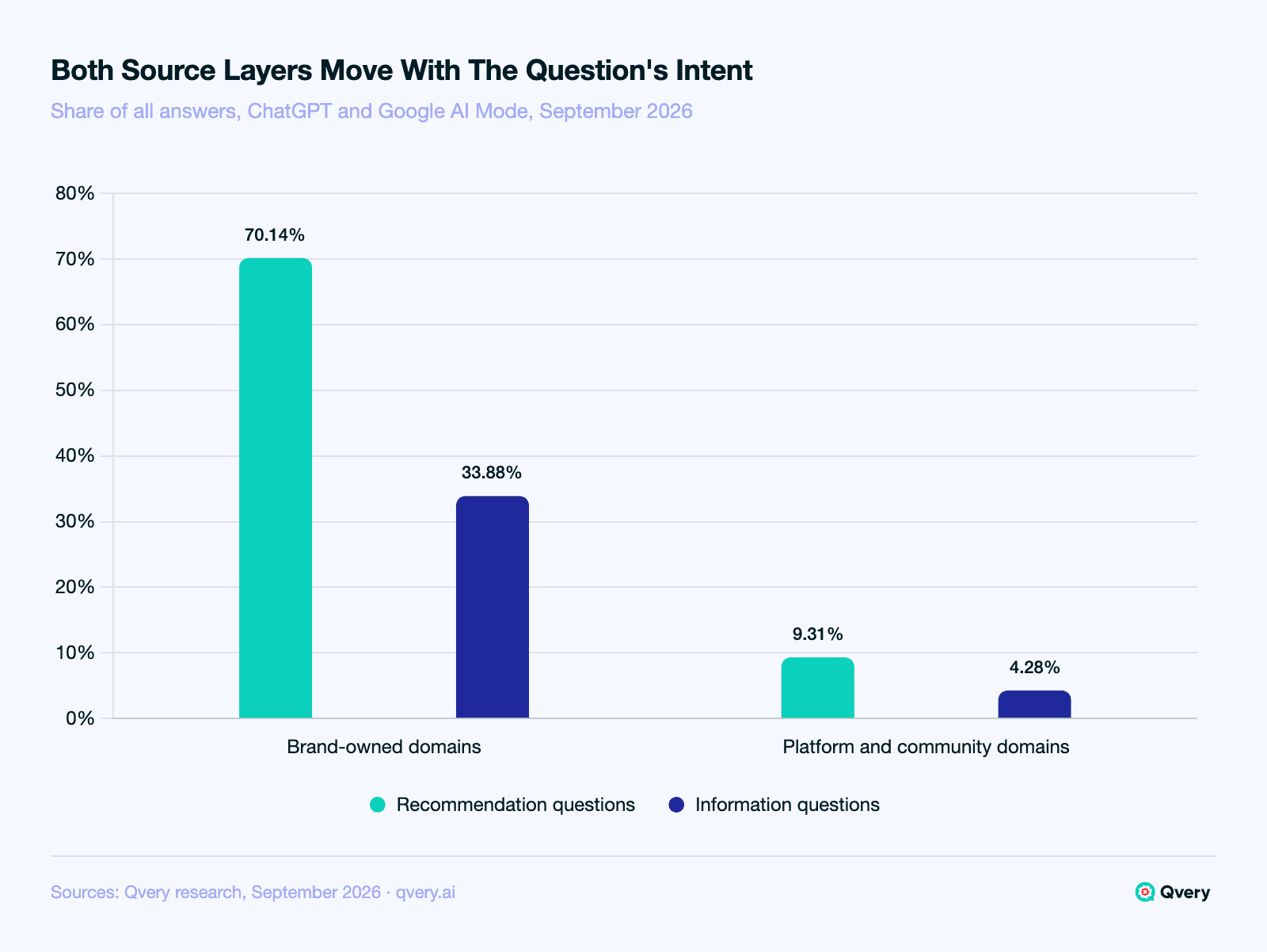
Brand-owned sites appeared in 70.14% of recommendation answers and 33.88% of information answers. Platform and community sites appeared in 9.31% and 4.28%, an informational-to-recommendation ratio of 0.46. On recommendation questions the engines split: platform sites appeared in 28.33% of Google AI Mode answers and 2.96% of ChatGPT answers. The decision that follows is whether a healthcare brand can track one set of questions, on one engine, and call it AI visibility.
Key Takeaways
Brand-owned domains appeared in 70.14% of recommendation answers and 33.88% of information answers, each a share of all answers in its slice.
Platform and community domains appeared in 9.31% of recommendation answers and 4.28% of information answers, a ratio of 0.46, so platforms are the rarer layer on information questions.
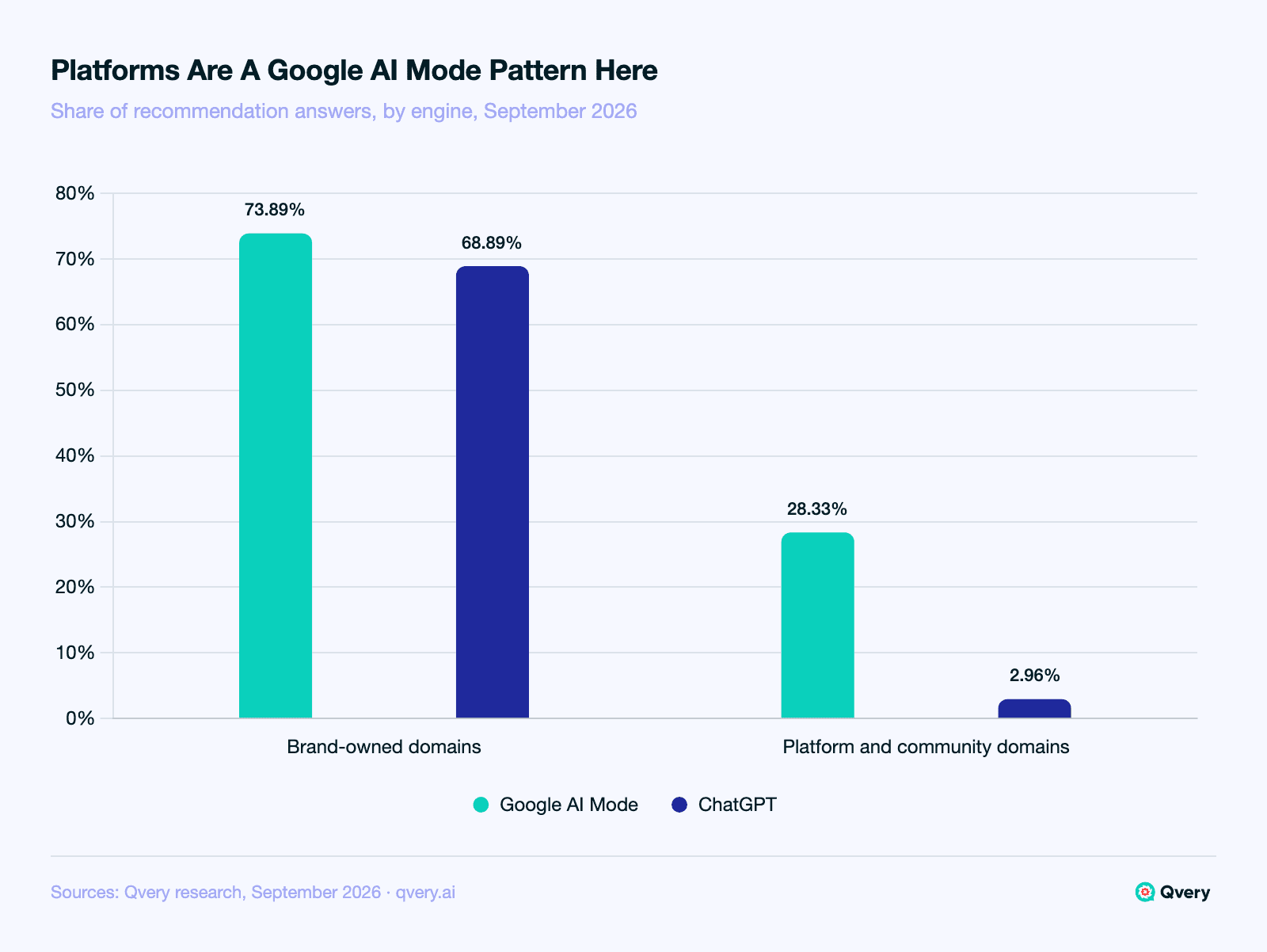
On recommendation answers, platform domains appeared in 28.33% of Google AI Mode answers against 2.96% of ChatGPT answers, a ratio of 9.56.
On the same answers, brand-owned domains appeared in 73.89% of Google AI Mode answers and 68.89% of ChatGPT answers: high on both.
The two intents need different watch lists: the recommendation list covers 44.8% of information answers that cited any source, while the information list covers only 15.05% of recommendation answers that cited any source.
These come from a frozen September 2026 healthcare question set: six recommendation subtopics (telehealth and online doctor visits, health insurance plans, online therapy and mental health services, prescription delivery and online pharmacy, fitness and nutrition coaching, dental and vision care providers) plus one information set. Only two source layers are reported, brand-owned and platform, because they are the two that passed validation.
Both Layers Move With the Question's Intent
The answers are built from different sites depending on whether the question asks for a recommendation or for an explanation.
Brand-owned domains appeared in 70.14% of recommendation answers and 33.88% of information answers. Platform and community domains appeared in 9.31% and 4.28%, an informational-to-recommendation ratio of 0.46, which supports the direction we registered before collecting: platforms are the rarer layer when the question asks for information.
One detail sits under the platform figure. Every information answer that cited a platform domain came from Google AI Mode; none of ChatGPT's information answers cited one at all. Google AI Mode's own information share is not printed here, because that slice is too small to carry a percentage. This does not say platforms are absent from information answers in general.
Do People Take Health Information From Other Patients and From Social Media?
Two Pew Research Center figures frame why a platform check belongs in a healthcare routine at all. They describe where people say they get health information, not what the engines cite.
66% of Americans say they at least sometimes get health information from people facing similar health issues.
36% say the same about social media.
For a reading of why the question, not the category, is the variable, our Reddit healthcare AI visibility analysis measured its own sample and covers that ground.
Which Domains Head Each Intent's Citations
The shares here are of answers that cited any source, within each slice.
Recommendation questions, the eight domains covering half of cited answers: amazon.com, healthline.com, healthcare.gov, teladochealth.com, forbes.com, nhs.uk, medicare.gov, goodrx.com.
Recommendation questions, the list covering 80%: those eight plus betterhelp.com, cigna.com, nutriscan.app, mdlive.com, healthdirect.gov.au, macrolog.co, bupa.co.uk, hhs.gov, fitbod.me, irs.gov, myfitnesspal.com, reddit.com, trustpilot.com, sensai.fit, coveredca.com, telus.com, and talkspace.com.
Information questions, the three domains covering half of cited answers: nih.gov, nhs.uk, healthcare.gov.
Information questions, the list covering 80%: those three plus mayoclinic.org, cdc.gov, medlineplus.gov, clevelandclinic.org, and heart.org.
Cross-coverage: the recommendation list covers 44.8% of information answers that cited any source; the information list covers 15.05% of recommendation answers that cited any source.
Verdict: each intent needs its own list. Only healthcare.gov and nhs.uk sit on both.
For how to build and maintain a list like this, measuring a healthcare brand's AI engine visibility walks through the method; its own separate-lists call was made on coverage questions versus provider questions, a different split from the one here. The question-type precedent is in our telehealth AI engine visibility post, and the information list's shape sits next to our reading of health product citations by claim type.
The Engines Split on Recommendation Questions
Are People Asking General AI Chatbots, or Their Provider's Own?
22% of Americans say they at least sometimes get health information from AI chatbots.
In Rock Health's survey, 23% of all respondents used ChatGPT for health information, against 5% who used a chatbot their provider offered.
Rock Health's respondents reached for a general chatbot more often than a provider's own. That is the audience behind the answers below.
On recommendation questions, the two engines build answers from different layers. Platform domains appeared in 28.33% of Google AI Mode recommendation answers and 2.96% of ChatGPT's, a ratio of 9.56. Brand-owned presence is the opposite story: 73.89% on Google AI Mode and 68.89% on ChatGPT, high on both, and no direction was registered for that gap, so we build no advice on it.
A third split runs the other way. ChatGPT cited the hand-checked set of government and university health domains in 35.56% of its recommendation answers, against 13.89% of Google AI Mode's. So on health recommendations, Google AI Mode leans toward platforms and ChatGPT toward institutional sources. Nothing here says why either engine does it.
Frase's write-up on which engines cite which sources tells teams to "Build entity and brand authority across the web, since branded mentions correlate with AI visibility more strongly than backlinks, then tune each engine for the source types it favors and keep your content clearly structured and extractable." The engine half of that is supported here: the two engines' platform presence differs on these recommendation answers. The rest of the sentence covers branded mentions and backlinks, which this study didn't measure.
Arfadia's piece on why the engines cite hospitals differently says "Most healthcare marketing teams still build one AI-visibility plan and assume it travels across platforms." By platforms it means engines, and the data complicates the assumption: platform presence does not travel between the two engines on recommendation questions, while brand-owned presence is high on both. What the study measures is cited sources, not how a plan performs.
What Qvery Measures Live
You can run the same two-way split on your own questions. In Qvery you add and edit the queries you track, so health recommendation questions and information questions can sit in separate groups, and you read visibility, share of voice, and average rank across ChatGPT and Google AI Mode every day, in 200+ countries, with every citation tied to the query and engine that produced it. Qvery Assistant answers plain-language questions about your own data in the app.
If those three metrics need untangling first, AI visibility versus share of voice defines them. What Qvery won't do is sort your citations into this study's brand-owned and platform labels, or build the coverage lists for you.
To see your own two slices, start a free 7-day trial. Checkout is self-serve and no credit card is required.
The Limits of These Numbers
These are co-occurrence rates: which kinds of sites appear alongside an answer, never why an engine cites them, and never evidence that a layer earns visibility. Nothing here measures trust, naming, or whether a brand was recommended. The other boundaries:
A lean toward ChatGPT. The pooled rates count every answer once, and ChatGPT answered more of them than Google AI Mode did, so the pooled numbers lean that way.
One engine's information slice is unreported. Google AI Mode's information sample was too small to carry a percentage, and the pooled information platform figure is entirely its answers.
No claim about shared domains beyond the two list members named above.
One question set. A frozen September 2026 healthcare set covering the subtopics listed earlier, not healthcare as a whole.
Two layers only. The eight-way source split failed validation, so only brand-owned and platform are reported.
No trend. An earlier collection used a different method, so no change over time ships.
Track Health Questions as Two Sets, and Read the Engines Apart
Track health recommendation questions and health information questions as two separate sets, each with its own brand-owned and platform baseline and its own domain list, built with the method in the healthcare measurement guide. Then read recommendation questions engine by engine: in this corpus platform presence on them is mostly a Google AI Mode pattern, while brand-owned presence is high on both.
Ask an AI engine to recommend a telehealth service and ask it how a deductible works, and you get answers built from two different webs. We ran both kinds of health question through ChatGPT and Google AI Mode in September 2026 and scored every answer by the kind of site it cited.
Brand-owned sites appeared in 70.14% of recommendation answers and 33.88% of information answers. Platform and community sites appeared in 9.31% and 4.28%, an informational-to-recommendation ratio of 0.46. On recommendation questions the engines split: platform sites appeared in 28.33% of Google AI Mode answers and 2.96% of ChatGPT answers. The decision that follows is whether a healthcare brand can track one set of questions, on one engine, and call it AI visibility.
Key Takeaways
Brand-owned domains appeared in 70.14% of recommendation answers and 33.88% of information answers, each a share of all answers in its slice.
Platform and community domains appeared in 9.31% of recommendation answers and 4.28% of information answers, a ratio of 0.46, so platforms are the rarer layer on information questions.
On recommendation answers, platform domains appeared in 28.33% of Google AI Mode answers against 2.96% of ChatGPT answers, a ratio of 9.56.
On the same answers, brand-owned domains appeared in 73.89% of Google AI Mode answers and 68.89% of ChatGPT answers: high on both.
The two intents need different watch lists: the recommendation list covers 44.8% of information answers that cited any source, while the information list covers only 15.05% of recommendation answers that cited any source.
These come from a frozen September 2026 healthcare question set: six recommendation subtopics (telehealth and online doctor visits, health insurance plans, online therapy and mental health services, prescription delivery and online pharmacy, fitness and nutrition coaching, dental and vision care providers) plus one information set. Only two source layers are reported, brand-owned and platform, because they are the two that passed validation.
Both Layers Move With the Question's Intent
The answers are built from different sites depending on whether the question asks for a recommendation or for an explanation.
Brand-owned domains appeared in 70.14% of recommendation answers and 33.88% of information answers. Platform and community domains appeared in 9.31% and 4.28%, an informational-to-recommendation ratio of 0.46, which supports the direction we registered before collecting: platforms are the rarer layer when the question asks for information.
One detail sits under the platform figure. Every information answer that cited a platform domain came from Google AI Mode; none of ChatGPT's information answers cited one at all. Google AI Mode's own information share is not printed here, because that slice is too small to carry a percentage. This does not say platforms are absent from information answers in general.
Do People Take Health Information From Other Patients and From Social Media?
Two Pew Research Center figures frame why a platform check belongs in a healthcare routine at all. They describe where people say they get health information, not what the engines cite.
66% of Americans say they at least sometimes get health information from people facing similar health issues.
36% say the same about social media.
For a reading of why the question, not the category, is the variable, our Reddit healthcare AI visibility analysis measured its own sample and covers that ground.
Which Domains Head Each Intent's Citations
The shares here are of answers that cited any source, within each slice.
Recommendation questions, the eight domains covering half of cited answers: amazon.com, healthline.com, healthcare.gov, teladochealth.com, forbes.com, nhs.uk, medicare.gov, goodrx.com.
Recommendation questions, the list covering 80%: those eight plus betterhelp.com, cigna.com, nutriscan.app, mdlive.com, healthdirect.gov.au, macrolog.co, bupa.co.uk, hhs.gov, fitbod.me, irs.gov, myfitnesspal.com, reddit.com, trustpilot.com, sensai.fit, coveredca.com, telus.com, and talkspace.com.
Information questions, the three domains covering half of cited answers: nih.gov, nhs.uk, healthcare.gov.
Information questions, the list covering 80%: those three plus mayoclinic.org, cdc.gov, medlineplus.gov, clevelandclinic.org, and heart.org.
Cross-coverage: the recommendation list covers 44.8% of information answers that cited any source; the information list covers 15.05% of recommendation answers that cited any source.
Verdict: each intent needs its own list. Only healthcare.gov and nhs.uk sit on both.
For how to build and maintain a list like this, measuring a healthcare brand's AI engine visibility walks through the method; its own separate-lists call was made on coverage questions versus provider questions, a different split from the one here. The question-type precedent is in our telehealth AI engine visibility post, and the information list's shape sits next to our reading of health product citations by claim type.
The Engines Split on Recommendation Questions
Are People Asking General AI Chatbots, or Their Provider's Own?
22% of Americans say they at least sometimes get health information from AI chatbots.
In Rock Health's survey, 23% of all respondents used ChatGPT for health information, against 5% who used a chatbot their provider offered.
Rock Health's respondents reached for a general chatbot more often than a provider's own. That is the audience behind the answers below.
On recommendation questions, the two engines build answers from different layers. Platform domains appeared in 28.33% of Google AI Mode recommendation answers and 2.96% of ChatGPT's, a ratio of 9.56. Brand-owned presence is the opposite story: 73.89% on Google AI Mode and 68.89% on ChatGPT, high on both, and no direction was registered for that gap, so we build no advice on it.
A third split runs the other way. ChatGPT cited the hand-checked set of government and university health domains in 35.56% of its recommendation answers, against 13.89% of Google AI Mode's. So on health recommendations, Google AI Mode leans toward platforms and ChatGPT toward institutional sources. Nothing here says why either engine does it.
Frase's write-up on which engines cite which sources tells teams to "Build entity and brand authority across the web, since branded mentions correlate with AI visibility more strongly than backlinks, then tune each engine for the source types it favors and keep your content clearly structured and extractable." The engine half of that is supported here: the two engines' platform presence differs on these recommendation answers. The rest of the sentence covers branded mentions and backlinks, which this study didn't measure.
Arfadia's piece on why the engines cite hospitals differently says "Most healthcare marketing teams still build one AI-visibility plan and assume it travels across platforms." By platforms it means engines, and the data complicates the assumption: platform presence does not travel between the two engines on recommendation questions, while brand-owned presence is high on both. What the study measures is cited sources, not how a plan performs.
What Qvery Measures Live
You can run the same two-way split on your own questions. In Qvery you add and edit the queries you track, so health recommendation questions and information questions can sit in separate groups, and you read visibility, share of voice, and average rank across ChatGPT and Google AI Mode every day, in 200+ countries, with every citation tied to the query and engine that produced it. Qvery Assistant answers plain-language questions about your own data in the app.
If those three metrics need untangling first, AI visibility versus share of voice defines them. What Qvery won't do is sort your citations into this study's brand-owned and platform labels, or build the coverage lists for you.
To see your own two slices, start a free 7-day trial. Checkout is self-serve and no credit card is required.
The Limits of These Numbers
These are co-occurrence rates: which kinds of sites appear alongside an answer, never why an engine cites them, and never evidence that a layer earns visibility. Nothing here measures trust, naming, or whether a brand was recommended. The other boundaries:
A lean toward ChatGPT. The pooled rates count every answer once, and ChatGPT answered more of them than Google AI Mode did, so the pooled numbers lean that way.
One engine's information slice is unreported. Google AI Mode's information sample was too small to carry a percentage, and the pooled information platform figure is entirely its answers.
No claim about shared domains beyond the two list members named above.
One question set. A frozen September 2026 healthcare set covering the subtopics listed earlier, not healthcare as a whole.
Two layers only. The eight-way source split failed validation, so only brand-owned and platform are reported.
No trend. An earlier collection used a different method, so no change over time ships.
Track Health Questions as Two Sets, and Read the Engines Apart
Track health recommendation questions and health information questions as two separate sets, each with its own brand-owned and platform baseline and its own domain list, built with the method in the healthcare measurement guide. Then read recommendation questions engine by engine: in this corpus platform presence on them is mostly a Google AI Mode pattern, while brand-owned presence is high on both.
Ask an AI engine to recommend a telehealth service and ask it how a deductible works, and you get answers built from two different webs. We ran both kinds of health question through ChatGPT and Google AI Mode in September 2026 and scored every answer by the kind of site it cited.
Brand-owned sites appeared in 70.14% of recommendation answers and 33.88% of information answers. Platform and community sites appeared in 9.31% and 4.28%, an informational-to-recommendation ratio of 0.46. On recommendation questions the engines split: platform sites appeared in 28.33% of Google AI Mode answers and 2.96% of ChatGPT answers. The decision that follows is whether a healthcare brand can track one set of questions, on one engine, and call it AI visibility.
Key Takeaways
Brand-owned domains appeared in 70.14% of recommendation answers and 33.88% of information answers, each a share of all answers in its slice.
Platform and community domains appeared in 9.31% of recommendation answers and 4.28% of information answers, a ratio of 0.46, so platforms are the rarer layer on information questions.
On recommendation answers, platform domains appeared in 28.33% of Google AI Mode answers against 2.96% of ChatGPT answers, a ratio of 9.56.
On the same answers, brand-owned domains appeared in 73.89% of Google AI Mode answers and 68.89% of ChatGPT answers: high on both.
The two intents need different watch lists: the recommendation list covers 44.8% of information answers that cited any source, while the information list covers only 15.05% of recommendation answers that cited any source.
These come from a frozen September 2026 healthcare question set: six recommendation subtopics (telehealth and online doctor visits, health insurance plans, online therapy and mental health services, prescription delivery and online pharmacy, fitness and nutrition coaching, dental and vision care providers) plus one information set. Only two source layers are reported, brand-owned and platform, because they are the two that passed validation.
Both Layers Move With the Question's Intent
The answers are built from different sites depending on whether the question asks for a recommendation or for an explanation.
Brand-owned domains appeared in 70.14% of recommendation answers and 33.88% of information answers. Platform and community domains appeared in 9.31% and 4.28%, an informational-to-recommendation ratio of 0.46, which supports the direction we registered before collecting: platforms are the rarer layer when the question asks for information.
One detail sits under the platform figure. Every information answer that cited a platform domain came from Google AI Mode; none of ChatGPT's information answers cited one at all. Google AI Mode's own information share is not printed here, because that slice is too small to carry a percentage. This does not say platforms are absent from information answers in general.
Do People Take Health Information From Other Patients and From Social Media?
Two Pew Research Center figures frame why a platform check belongs in a healthcare routine at all. They describe where people say they get health information, not what the engines cite.
66% of Americans say they at least sometimes get health information from people facing similar health issues.
36% say the same about social media.
For a reading of why the question, not the category, is the variable, our Reddit healthcare AI visibility analysis measured its own sample and covers that ground.
Which Domains Head Each Intent's Citations
The shares here are of answers that cited any source, within each slice.
Recommendation questions, the eight domains covering half of cited answers: amazon.com, healthline.com, healthcare.gov, teladochealth.com, forbes.com, nhs.uk, medicare.gov, goodrx.com.
Recommendation questions, the list covering 80%: those eight plus betterhelp.com, cigna.com, nutriscan.app, mdlive.com, healthdirect.gov.au, macrolog.co, bupa.co.uk, hhs.gov, fitbod.me, irs.gov, myfitnesspal.com, reddit.com, trustpilot.com, sensai.fit, coveredca.com, telus.com, and talkspace.com.
Information questions, the three domains covering half of cited answers: nih.gov, nhs.uk, healthcare.gov.
Information questions, the list covering 80%: those three plus mayoclinic.org, cdc.gov, medlineplus.gov, clevelandclinic.org, and heart.org.
Cross-coverage: the recommendation list covers 44.8% of information answers that cited any source; the information list covers 15.05% of recommendation answers that cited any source.
Verdict: each intent needs its own list. Only healthcare.gov and nhs.uk sit on both.
For how to build and maintain a list like this, measuring a healthcare brand's AI engine visibility walks through the method; its own separate-lists call was made on coverage questions versus provider questions, a different split from the one here. The question-type precedent is in our telehealth AI engine visibility post, and the information list's shape sits next to our reading of health product citations by claim type.
The Engines Split on Recommendation Questions
Are People Asking General AI Chatbots, or Their Provider's Own?
22% of Americans say they at least sometimes get health information from AI chatbots.
In Rock Health's survey, 23% of all respondents used ChatGPT for health information, against 5% who used a chatbot their provider offered.
Rock Health's respondents reached for a general chatbot more often than a provider's own. That is the audience behind the answers below.
On recommendation questions, the two engines build answers from different layers. Platform domains appeared in 28.33% of Google AI Mode recommendation answers and 2.96% of ChatGPT's, a ratio of 9.56. Brand-owned presence is the opposite story: 73.89% on Google AI Mode and 68.89% on ChatGPT, high on both, and no direction was registered for that gap, so we build no advice on it.
A third split runs the other way. ChatGPT cited the hand-checked set of government and university health domains in 35.56% of its recommendation answers, against 13.89% of Google AI Mode's. So on health recommendations, Google AI Mode leans toward platforms and ChatGPT toward institutional sources. Nothing here says why either engine does it.
Frase's write-up on which engines cite which sources tells teams to "Build entity and brand authority across the web, since branded mentions correlate with AI visibility more strongly than backlinks, then tune each engine for the source types it favors and keep your content clearly structured and extractable." The engine half of that is supported here: the two engines' platform presence differs on these recommendation answers. The rest of the sentence covers branded mentions and backlinks, which this study didn't measure.
Arfadia's piece on why the engines cite hospitals differently says "Most healthcare marketing teams still build one AI-visibility plan and assume it travels across platforms." By platforms it means engines, and the data complicates the assumption: platform presence does not travel between the two engines on recommendation questions, while brand-owned presence is high on both. What the study measures is cited sources, not how a plan performs.
What Qvery Measures Live
You can run the same two-way split on your own questions. In Qvery you add and edit the queries you track, so health recommendation questions and information questions can sit in separate groups, and you read visibility, share of voice, and average rank across ChatGPT and Google AI Mode every day, in 200+ countries, with every citation tied to the query and engine that produced it. Qvery Assistant answers plain-language questions about your own data in the app.
If those three metrics need untangling first, AI visibility versus share of voice defines them. What Qvery won't do is sort your citations into this study's brand-owned and platform labels, or build the coverage lists for you.
To see your own two slices, start a free 7-day trial. Checkout is self-serve and no credit card is required.
The Limits of These Numbers
These are co-occurrence rates: which kinds of sites appear alongside an answer, never why an engine cites them, and never evidence that a layer earns visibility. Nothing here measures trust, naming, or whether a brand was recommended. The other boundaries:
A lean toward ChatGPT. The pooled rates count every answer once, and ChatGPT answered more of them than Google AI Mode did, so the pooled numbers lean that way.
One engine's information slice is unreported. Google AI Mode's information sample was too small to carry a percentage, and the pooled information platform figure is entirely its answers.
No claim about shared domains beyond the two list members named above.
One question set. A frozen September 2026 healthcare set covering the subtopics listed earlier, not healthcare as a whole.
Two layers only. The eight-way source split failed validation, so only brand-owned and platform are reported.
No trend. An earlier collection used a different method, so no change over time ships.
Track Health Questions as Two Sets, and Read the Engines Apart
Track health recommendation questions and health information questions as two separate sets, each with its own brand-owned and platform baseline and its own domain list, built with the method in the healthcare measurement guide. Then read recommendation questions engine by engine: in this corpus platform presence on them is mostly a Google AI Mode pattern, while brand-owned presence is high on both.
Ask an AI engine to recommend a telehealth service and ask it how a deductible works, and you get answers built from two different webs. We ran both kinds of health question through ChatGPT and Google AI Mode in September 2026 and scored every answer by the kind of site it cited.
Brand-owned sites appeared in 70.14% of recommendation answers and 33.88% of information answers. Platform and community sites appeared in 9.31% and 4.28%, an informational-to-recommendation ratio of 0.46. On recommendation questions the engines split: platform sites appeared in 28.33% of Google AI Mode answers and 2.96% of ChatGPT answers. The decision that follows is whether a healthcare brand can track one set of questions, on one engine, and call it AI visibility.
Key Takeaways
Brand-owned domains appeared in 70.14% of recommendation answers and 33.88% of information answers, each a share of all answers in its slice.
Platform and community domains appeared in 9.31% of recommendation answers and 4.28% of information answers, a ratio of 0.46, so platforms are the rarer layer on information questions.
On recommendation answers, platform domains appeared in 28.33% of Google AI Mode answers against 2.96% of ChatGPT answers, a ratio of 9.56.
On the same answers, brand-owned domains appeared in 73.89% of Google AI Mode answers and 68.89% of ChatGPT answers: high on both.
The two intents need different watch lists: the recommendation list covers 44.8% of information answers that cited any source, while the information list covers only 15.05% of recommendation answers that cited any source.
These come from a frozen September 2026 healthcare question set: six recommendation subtopics (telehealth and online doctor visits, health insurance plans, online therapy and mental health services, prescription delivery and online pharmacy, fitness and nutrition coaching, dental and vision care providers) plus one information set. Only two source layers are reported, brand-owned and platform, because they are the two that passed validation.
Both Layers Move With the Question's Intent
The answers are built from different sites depending on whether the question asks for a recommendation or for an explanation.
Brand-owned domains appeared in 70.14% of recommendation answers and 33.88% of information answers. Platform and community domains appeared in 9.31% and 4.28%, an informational-to-recommendation ratio of 0.46, which supports the direction we registered before collecting: platforms are the rarer layer when the question asks for information.
One detail sits under the platform figure. Every information answer that cited a platform domain came from Google AI Mode; none of ChatGPT's information answers cited one at all. Google AI Mode's own information share is not printed here, because that slice is too small to carry a percentage. This does not say platforms are absent from information answers in general.
Do People Take Health Information From Other Patients and From Social Media?
Two Pew Research Center figures frame why a platform check belongs in a healthcare routine at all. They describe where people say they get health information, not what the engines cite.
66% of Americans say they at least sometimes get health information from people facing similar health issues.
36% say the same about social media.
For a reading of why the question, not the category, is the variable, our Reddit healthcare AI visibility analysis measured its own sample and covers that ground.
Which Domains Head Each Intent's Citations
The shares here are of answers that cited any source, within each slice.
Recommendation questions, the eight domains covering half of cited answers: amazon.com, healthline.com, healthcare.gov, teladochealth.com, forbes.com, nhs.uk, medicare.gov, goodrx.com.
Recommendation questions, the list covering 80%: those eight plus betterhelp.com, cigna.com, nutriscan.app, mdlive.com, healthdirect.gov.au, macrolog.co, bupa.co.uk, hhs.gov, fitbod.me, irs.gov, myfitnesspal.com, reddit.com, trustpilot.com, sensai.fit, coveredca.com, telus.com, and talkspace.com.
Information questions, the three domains covering half of cited answers: nih.gov, nhs.uk, healthcare.gov.
Information questions, the list covering 80%: those three plus mayoclinic.org, cdc.gov, medlineplus.gov, clevelandclinic.org, and heart.org.
Cross-coverage: the recommendation list covers 44.8% of information answers that cited any source; the information list covers 15.05% of recommendation answers that cited any source.
Verdict: each intent needs its own list. Only healthcare.gov and nhs.uk sit on both.
For how to build and maintain a list like this, measuring a healthcare brand's AI engine visibility walks through the method; its own separate-lists call was made on coverage questions versus provider questions, a different split from the one here. The question-type precedent is in our telehealth AI engine visibility post, and the information list's shape sits next to our reading of health product citations by claim type.
The Engines Split on Recommendation Questions
Are People Asking General AI Chatbots, or Their Provider's Own?
22% of Americans say they at least sometimes get health information from AI chatbots.
In Rock Health's survey, 23% of all respondents used ChatGPT for health information, against 5% who used a chatbot their provider offered.
Rock Health's respondents reached for a general chatbot more often than a provider's own. That is the audience behind the answers below.
On recommendation questions, the two engines build answers from different layers. Platform domains appeared in 28.33% of Google AI Mode recommendation answers and 2.96% of ChatGPT's, a ratio of 9.56. Brand-owned presence is the opposite story: 73.89% on Google AI Mode and 68.89% on ChatGPT, high on both, and no direction was registered for that gap, so we build no advice on it.
A third split runs the other way. ChatGPT cited the hand-checked set of government and university health domains in 35.56% of its recommendation answers, against 13.89% of Google AI Mode's. So on health recommendations, Google AI Mode leans toward platforms and ChatGPT toward institutional sources. Nothing here says why either engine does it.
Frase's write-up on which engines cite which sources tells teams to "Build entity and brand authority across the web, since branded mentions correlate with AI visibility more strongly than backlinks, then tune each engine for the source types it favors and keep your content clearly structured and extractable." The engine half of that is supported here: the two engines' platform presence differs on these recommendation answers. The rest of the sentence covers branded mentions and backlinks, which this study didn't measure.
Arfadia's piece on why the engines cite hospitals differently says "Most healthcare marketing teams still build one AI-visibility plan and assume it travels across platforms." By platforms it means engines, and the data complicates the assumption: platform presence does not travel between the two engines on recommendation questions, while brand-owned presence is high on both. What the study measures is cited sources, not how a plan performs.
What Qvery Measures Live
You can run the same two-way split on your own questions. In Qvery you add and edit the queries you track, so health recommendation questions and information questions can sit in separate groups, and you read visibility, share of voice, and average rank across ChatGPT and Google AI Mode every day, in 200+ countries, with every citation tied to the query and engine that produced it. Qvery Assistant answers plain-language questions about your own data in the app.
If those three metrics need untangling first, AI visibility versus share of voice defines them. What Qvery won't do is sort your citations into this study's brand-owned and platform labels, or build the coverage lists for you.
To see your own two slices, start a free 7-day trial. Checkout is self-serve and no credit card is required.
The Limits of These Numbers
These are co-occurrence rates: which kinds of sites appear alongside an answer, never why an engine cites them, and never evidence that a layer earns visibility. Nothing here measures trust, naming, or whether a brand was recommended. The other boundaries:
A lean toward ChatGPT. The pooled rates count every answer once, and ChatGPT answered more of them than Google AI Mode did, so the pooled numbers lean that way.
One engine's information slice is unreported. Google AI Mode's information sample was too small to carry a percentage, and the pooled information platform figure is entirely its answers.
No claim about shared domains beyond the two list members named above.
One question set. A frozen September 2026 healthcare set covering the subtopics listed earlier, not healthcare as a whole.
Two layers only. The eight-way source split failed validation, so only brand-owned and platform are reported.
No trend. An earlier collection used a different method, so no change over time ships.
Track Health Questions as Two Sets, and Read the Engines Apart
Track health recommendation questions and health information questions as two separate sets, each with its own brand-owned and platform baseline and its own domain list, built with the method in the healthcare measurement guide. Then read recommendation questions engine by engine: in this corpus platform presence on them is mostly a Google AI Mode pattern, while brand-owned presence is high on both.

© 2026 Qvery AI OÜ