By
Vlad Shvets
Reddit Marketing For Healthcare Brands: What AI Search Cites Instead
Health brands get pitched Reddit retainers on a number from someone else's vertical. In the consumer-health questions we ran, community sources were not in the answers at all, and the health publishers, pharmacies and telehealth providers were.
Health brands get pitched Reddit retainers on a number from someone else's vertical. In the consumer-health questions we ran, community sources were not in the answers at all, and the health publishers, pharmacies and telehealth providers were.
Health brands get pitched Reddit retainers on a number from someone else's vertical. In the consumer-health questions we ran, community sources were not in the answers at all, and the health publishers, pharmacies and telehealth providers were.
If you market a health brand, somebody has pitched you a Reddit retainer in the last year. The pitch is usually the same, and it usually opens with the same fact: Reddit is the most cited source in AI search, so a presence in the right threads is how you get into the answers.
That fact is ours. We published it, and on the questions behind it, it holds.
The trouble is what happens when a number from one vertical gets sold into another. A health brand is being asked to fund a channel on evidence collected somewhere else, and nobody in the room has checked whether the questions their buyers ask look anything like the questions that produced the number.
So we ran the consumer-health questions a buyer asks, on ChatGPT and Google AI Mode, alongside a matched set of ordinary consumer questions from outside health.
The short version: community sources were not in either set. Health was not suppressing them, and the questions from outside health did not have them either. What moves Reddit's share is the shape of the question, not the sensitivity of the category.
One boundary before any of it. This records which sources appear alongside an answer, and it does not establish that appearing on one causes a brand to be named. ChatGPT ran a live search on nearly all of these questions, so its citations are the search-triggered subset.
Reddit Is Not In These Health Answers, And Not Because Health Is Special
These figures come from a targeted set of consumer-health questions we ran on ChatGPT and Google AI Mode in August 2026, against a matched set of non-health consumer questions asked the same way.
We went in expecting health to push community sources out. Health is regulated, engines are cautious with medical advice, and there was a plausible story about a category-specific throttle.
There is no throttle in these answers to find.
In the health questions, community sources appeared in so few cited answers that a percentage would be dishonest. In the non-health comparison, the same.
I am deliberately not giving you either rate. At this depth a rate that small is an event count wearing a percent sign, and publishing it would invite exactly the comparison it cannot support.
What ships instead is the ordering: community sources did not clear the level at which a share becomes reportable, in either set of questions.
Nothing was being suppressed in health, because the layer was not there in the comparison either.
A near-zero is the easiest result in the world to get by accident, so it is worth saying why we believe this one. Run the same reading against our city-anchored lawyer-hiring questions and reddit.com comes back in 26.67% of all answers.
The absence is in the answers, not in how we read them.
The Variable Is The Question, Not The Category
We have published that Reddit is the most cited source we track, and on the questions behind that post it is. This is a different set of questions and it says something narrower.
Reddit's share is a property of the question, not a constant across a brand's whole market:
City-anchored lawyer-hiring questions: reddit.com in 26.67% of all answers.
Online-course questions: 70.59% of answers that cited any source.
Consumer-health recommendations: below the level at which a share can be reported, and the same for the non-health comparison.
Those figures sit on different denominators, so they get no ratio and no chart here. A comparison across unlike denominators is exactly the kind of number that gets repeated without its footnote.
Read them as three separate facts. The range they describe is not subtle at any denominator.
A tracked query is the exact question, in the buyer's words, which is the variable doing all the work above.
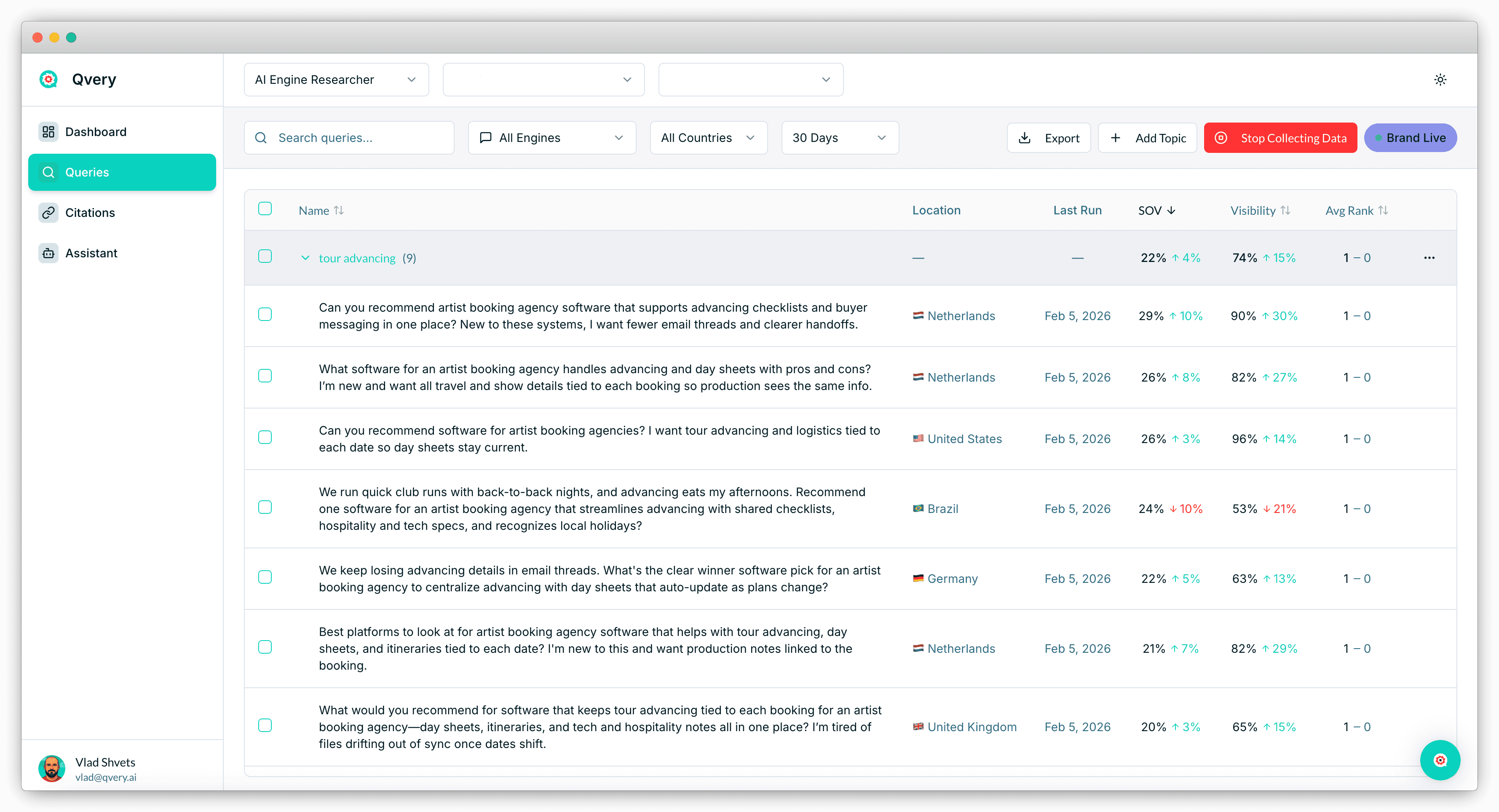
What separates those question shapes is worth thinking about for your own category. "Which personal injury lawyer should I hire in Sacramento" and "which SQL course is worth paying for" are questions where a stranger's experience is the evidence a buyer wants, and forums are where that experience is written down.
"Which allergy medication should I take" is not that kind of question, and neither, apparently, is most of the non-health set. Those answers reach for institutions and retailers instead.
So the house line needs its scope said out loud. Reddit is the most cited source across everything we have measured it against, and it is still the first place to look.
It is not a constant across categories.
A retainer sold on the strength of a number from somebody else's vertical is a retainer sold on the wrong number.
What Is Carrying The Health Answers
The two sets barely share a source. Below the search engine's own domain, which is an artifact of how one of the two engines cites rather than a fact about either category, the rosters separate almost completely.
The health answers are carried by three layers, none of them a forum:
Health publishers: healthline.com and helpguide.org, the general-audience explainer tier.
Retail pharmacy: cvs.com and walgreens.com, cited on their own domains.
Telehealth providers: talkspace.com and betterhelp.com, the service itself answering the question.
A specialty body: aad.org, the American Academy of Dermatology.
The non-health questions, asked the same way, are carried by service directories and marketplaces instead: expertise.com, rover.com, and lugg.com.
Two categories, one question shape, and almost no overlap in who answers.
That roster is the actionable half for a health brand, and it points somewhere quite different from a community strategy. Being present on a health publisher, a retail pharmacy listing, or a provider directory is an editorial and partnership job, with named owners and a submission process.
It is slower and less fashionable than seeding threads. In these question shapes it is where the answers are being assembled from.
A budget that moves from the second to the first is not a cut, it is a redirection toward the layer that showed up.
Which layer is carrying you is a read off the citation list, ranked by weight rather than by reputation.
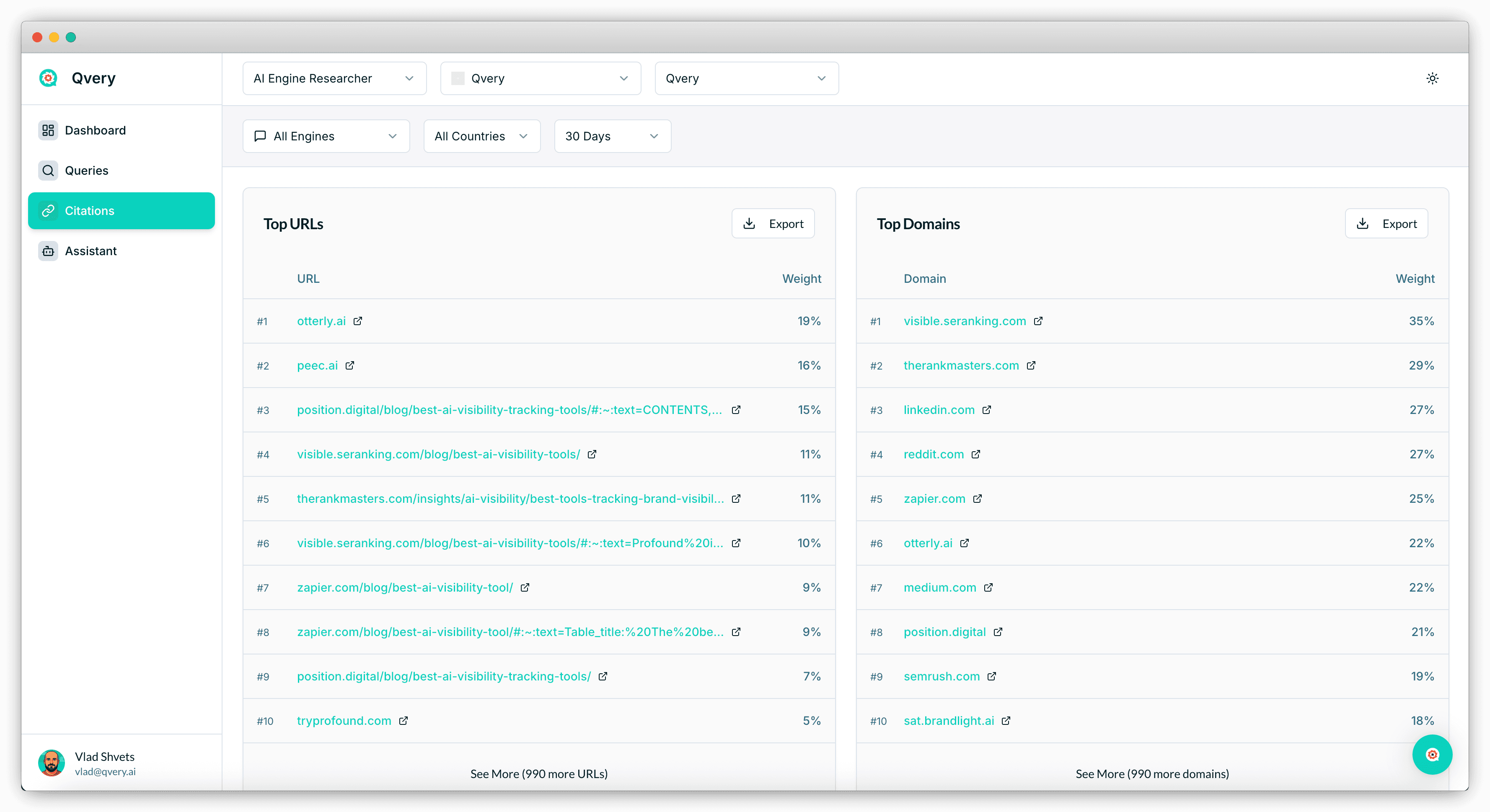
The account in that view is not a health brand, and the ranked-weight read is the part that transfers.
There is one more observation worth naming and not worth quantifying. Institutional and government sources appear in the health answers, with the UK's NHS and the American Academy of Dermatology both showing up, and nothing institutional appears in the non-health set at all.
The direction is clean and the evidence is thin. It rests on a handful of appearances, below the level we set for calling it real, so it ships as something we saw and not as something we measured.
If you work in health it is still the most interesting thing on this list, because it points at which doors are worth knocking on.
Testing Your Own Category Before You Fund A Channel
None of this tells you whether Reddit matters for you. It tells you the question is answerable in an afternoon, and that the answer differs by more than most people assume.
Four steps, and the third is the one everybody skips:
Write the ten questions: the ones your buyers ask, in their words. Use their terms and not your product name, because the phrasing carries the whole effect here.
Run each on both engines: more than once, and record which domains get cited. You are looking for whether community sources appear at all, not for a precise rate.
Run a comparison set. Take questions from a category you are not in, matched to the same template, and measure them the same way.
Compare absence against absence. Without a comparison you cannot tell absence from suppression, and those two have completely different budget implications.
A zero is the one result that looks identical whether your method works or not, so it is the only result that needs a positive check.
That is the habit worth stealing from this article. Before you conclude a source is missing from your category, run your method against questions where that source should be obvious. If it does not find it there, your method is broken. If it does, believe your zero.
If community sources are absent from your questions and present in your comparison, something about your category is pushing them out and it is worth understanding.
If they are absent from both, they were never the channel for that question shape.
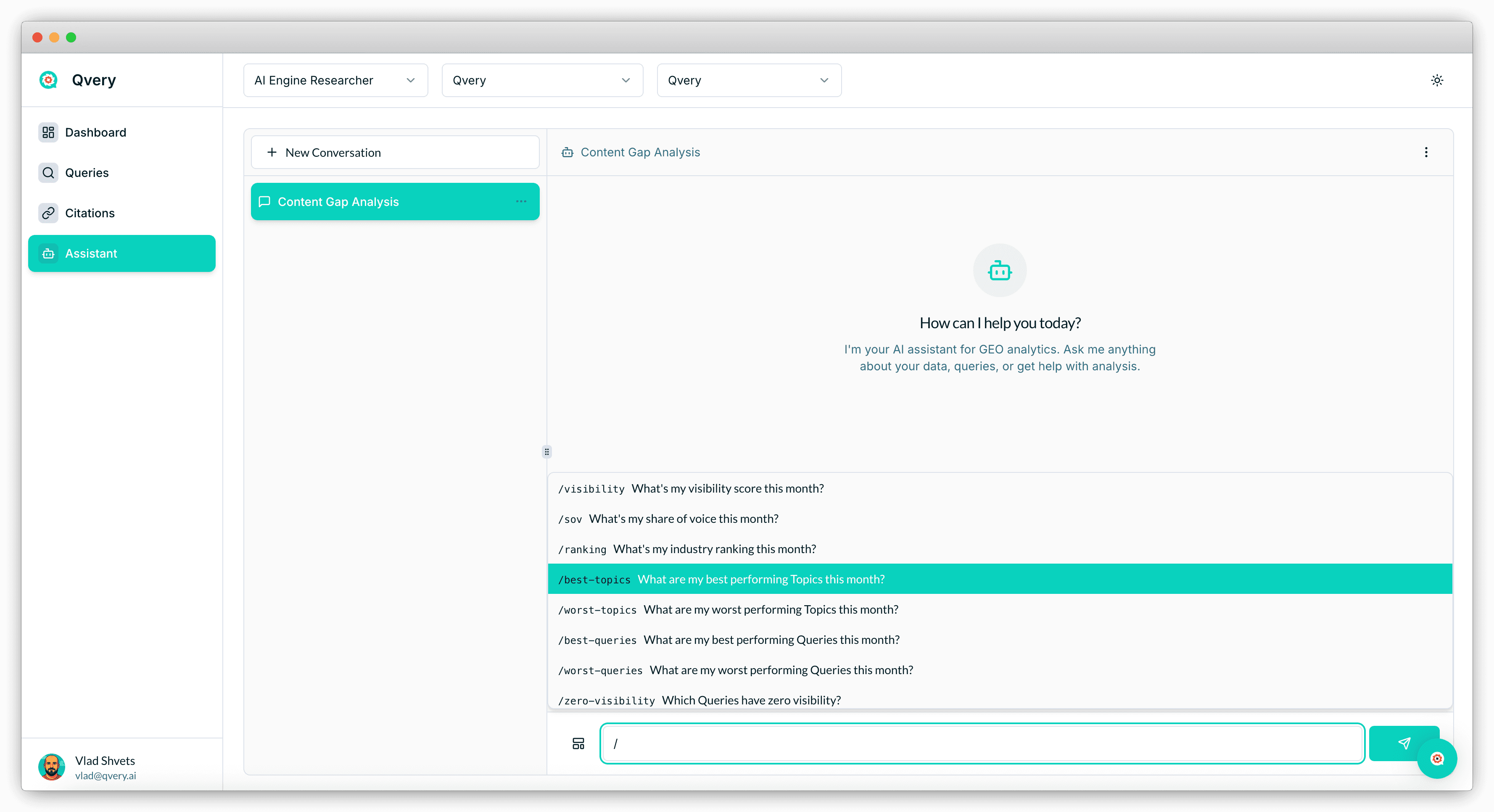
One judgment to add, which we did not measure. I would expect the community layer to reappear in health at question shapes this set did not cover.
Questions about lived experience, side effects over months, or what a clinic was like to deal with are the kind where a stranger's account is the evidence a buyer wants.
We asked recommendation questions, and recommendation questions in health went to institutions and retailers. If your buyers ask the other kind, measure that kind before you conclude anything from this article.
Look Up Your Citation Layer In Qvery Instead Of Assuming It
Every step above is a measurement you can do by hand once. Doing it every month, across a query set that grows, is the part that stops happening.
Put both sets in as tracked queries, your ten and your comparison, and let them run. Qvery captures every citation daily across ChatGPT and Google AI Mode, tied to the query and the engine that produced it.
Then the question this article asked becomes a lookup rather than a project:
Top Domains, by weight: which layer is carrying your answers, which is the roster above for your own category.
Filter to a community domain: whether it appears at all, which is the whole test.
Your set against your comparison: two topics, read against each other, so absence and suppression stop looking alike.
The period filter: whether a layer that was absent has arrived, since question shapes and engines both move.
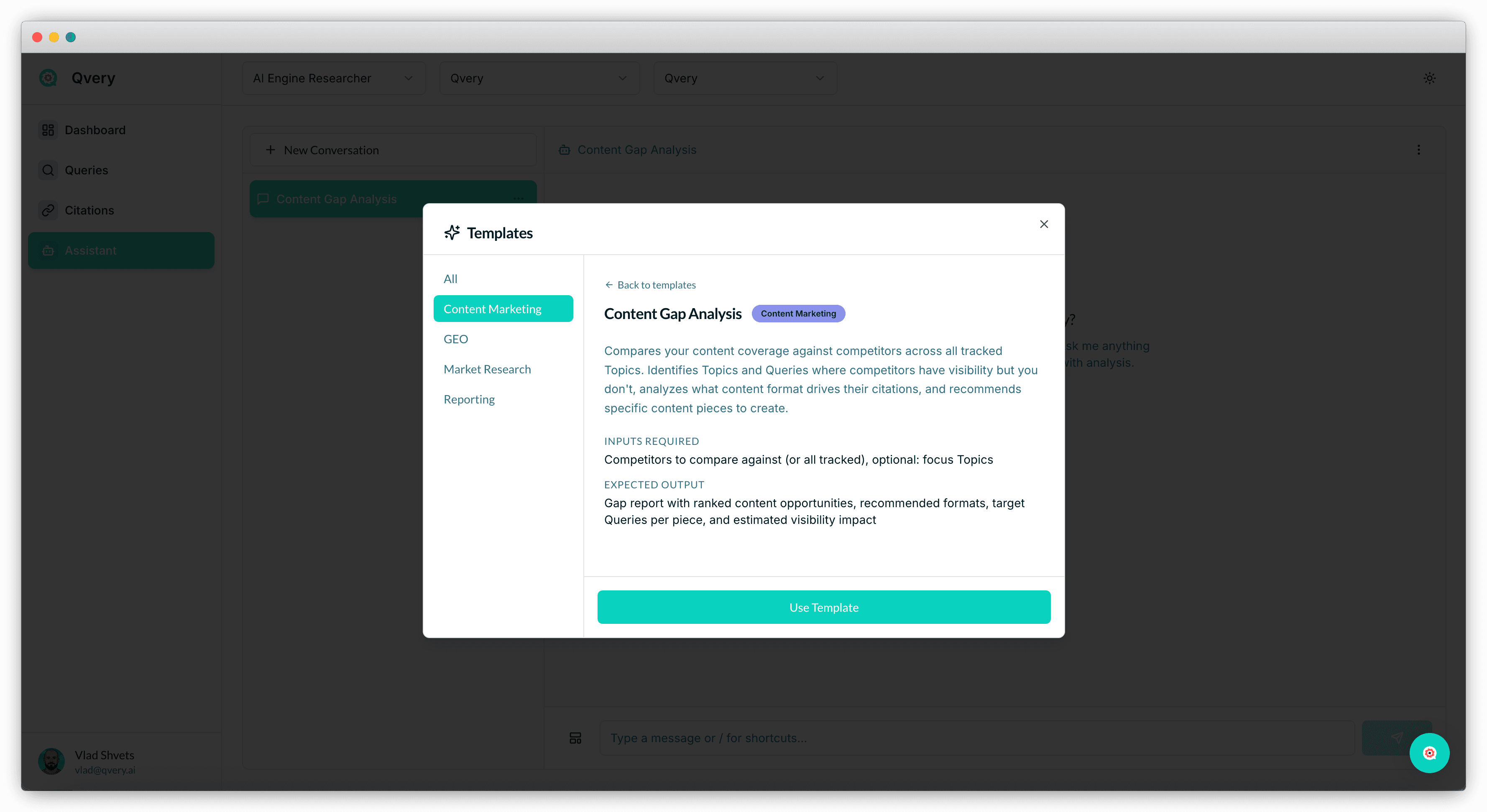
In Qvery Assistant you ask for the same thing in plain language, and the shipped templates include a citation audit and a citation gap analysis, which are the two shapes of the work above.
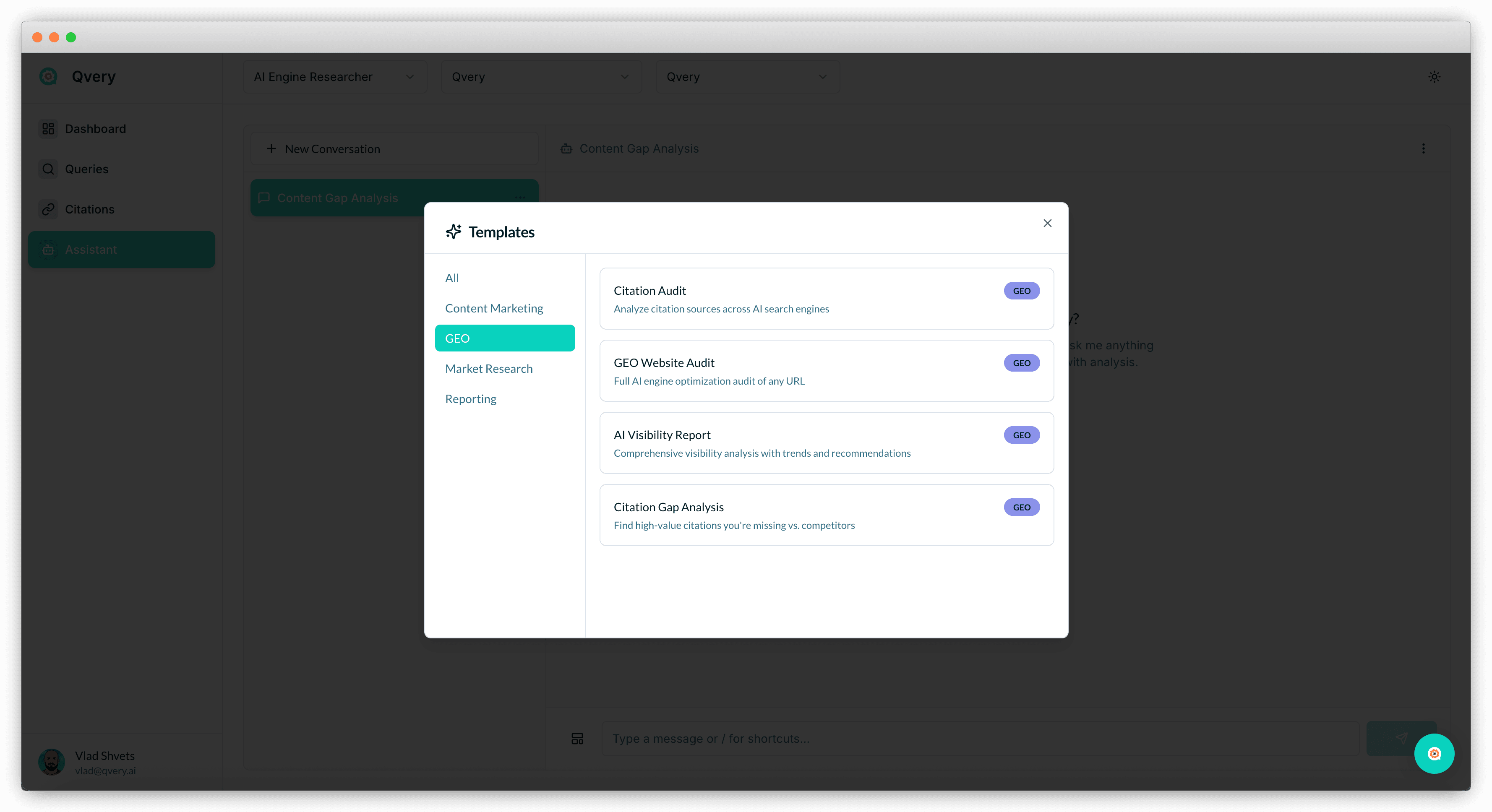
The gap analysis is the one that answers "so what do I publish next," by naming the topics where competitors are cited and you are not.
Two things Qvery will not do here. It will not tell you whether a channel is worth funding. It reports what is in the answers, and the budget decision stays yours, made better by having the roster in front of you.
And it will not classify a domain as a community source for you. Deciding that a forum counts and a review aggregator does not is your call on a list of URLs.
Start your free trial and put your ten questions in with a comparison set beside them.
Before any of that, though: write your ten questions down and run them twice this week. If Reddit is not in your answers, you have just saved a retainer. If it is, you now know which threads to care about.
If you market a health brand, somebody has pitched you a Reddit retainer in the last year. The pitch is usually the same, and it usually opens with the same fact: Reddit is the most cited source in AI search, so a presence in the right threads is how you get into the answers.
That fact is ours. We published it, and on the questions behind it, it holds.
The trouble is what happens when a number from one vertical gets sold into another. A health brand is being asked to fund a channel on evidence collected somewhere else, and nobody in the room has checked whether the questions their buyers ask look anything like the questions that produced the number.
So we ran the consumer-health questions a buyer asks, on ChatGPT and Google AI Mode, alongside a matched set of ordinary consumer questions from outside health.
The short version: community sources were not in either set. Health was not suppressing them, and the questions from outside health did not have them either. What moves Reddit's share is the shape of the question, not the sensitivity of the category.
One boundary before any of it. This records which sources appear alongside an answer, and it does not establish that appearing on one causes a brand to be named. ChatGPT ran a live search on nearly all of these questions, so its citations are the search-triggered subset.
Reddit Is Not In These Health Answers, And Not Because Health Is Special
These figures come from a targeted set of consumer-health questions we ran on ChatGPT and Google AI Mode in August 2026, against a matched set of non-health consumer questions asked the same way.
We went in expecting health to push community sources out. Health is regulated, engines are cautious with medical advice, and there was a plausible story about a category-specific throttle.
There is no throttle in these answers to find.
In the health questions, community sources appeared in so few cited answers that a percentage would be dishonest. In the non-health comparison, the same.
I am deliberately not giving you either rate. At this depth a rate that small is an event count wearing a percent sign, and publishing it would invite exactly the comparison it cannot support.
What ships instead is the ordering: community sources did not clear the level at which a share becomes reportable, in either set of questions.
Nothing was being suppressed in health, because the layer was not there in the comparison either.
A near-zero is the easiest result in the world to get by accident, so it is worth saying why we believe this one. Run the same reading against our city-anchored lawyer-hiring questions and reddit.com comes back in 26.67% of all answers.
The absence is in the answers, not in how we read them.
The Variable Is The Question, Not The Category
We have published that Reddit is the most cited source we track, and on the questions behind that post it is. This is a different set of questions and it says something narrower.
Reddit's share is a property of the question, not a constant across a brand's whole market:
City-anchored lawyer-hiring questions: reddit.com in 26.67% of all answers.
Online-course questions: 70.59% of answers that cited any source.
Consumer-health recommendations: below the level at which a share can be reported, and the same for the non-health comparison.
Those figures sit on different denominators, so they get no ratio and no chart here. A comparison across unlike denominators is exactly the kind of number that gets repeated without its footnote.
Read them as three separate facts. The range they describe is not subtle at any denominator.
A tracked query is the exact question, in the buyer's words, which is the variable doing all the work above.
What separates those question shapes is worth thinking about for your own category. "Which personal injury lawyer should I hire in Sacramento" and "which SQL course is worth paying for" are questions where a stranger's experience is the evidence a buyer wants, and forums are where that experience is written down.
"Which allergy medication should I take" is not that kind of question, and neither, apparently, is most of the non-health set. Those answers reach for institutions and retailers instead.
So the house line needs its scope said out loud. Reddit is the most cited source across everything we have measured it against, and it is still the first place to look.
It is not a constant across categories.
A retainer sold on the strength of a number from somebody else's vertical is a retainer sold on the wrong number.
What Is Carrying The Health Answers
The two sets barely share a source. Below the search engine's own domain, which is an artifact of how one of the two engines cites rather than a fact about either category, the rosters separate almost completely.
The health answers are carried by three layers, none of them a forum:
Health publishers: healthline.com and helpguide.org, the general-audience explainer tier.
Retail pharmacy: cvs.com and walgreens.com, cited on their own domains.
Telehealth providers: talkspace.com and betterhelp.com, the service itself answering the question.
A specialty body: aad.org, the American Academy of Dermatology.
The non-health questions, asked the same way, are carried by service directories and marketplaces instead: expertise.com, rover.com, and lugg.com.
Two categories, one question shape, and almost no overlap in who answers.
That roster is the actionable half for a health brand, and it points somewhere quite different from a community strategy. Being present on a health publisher, a retail pharmacy listing, or a provider directory is an editorial and partnership job, with named owners and a submission process.
It is slower and less fashionable than seeding threads. In these question shapes it is where the answers are being assembled from.
A budget that moves from the second to the first is not a cut, it is a redirection toward the layer that showed up.
Which layer is carrying you is a read off the citation list, ranked by weight rather than by reputation.
The account in that view is not a health brand, and the ranked-weight read is the part that transfers.
There is one more observation worth naming and not worth quantifying. Institutional and government sources appear in the health answers, with the UK's NHS and the American Academy of Dermatology both showing up, and nothing institutional appears in the non-health set at all.
The direction is clean and the evidence is thin. It rests on a handful of appearances, below the level we set for calling it real, so it ships as something we saw and not as something we measured.
If you work in health it is still the most interesting thing on this list, because it points at which doors are worth knocking on.
Testing Your Own Category Before You Fund A Channel
None of this tells you whether Reddit matters for you. It tells you the question is answerable in an afternoon, and that the answer differs by more than most people assume.
Four steps, and the third is the one everybody skips:
Write the ten questions: the ones your buyers ask, in their words. Use their terms and not your product name, because the phrasing carries the whole effect here.
Run each on both engines: more than once, and record which domains get cited. You are looking for whether community sources appear at all, not for a precise rate.
Run a comparison set. Take questions from a category you are not in, matched to the same template, and measure them the same way.
Compare absence against absence. Without a comparison you cannot tell absence from suppression, and those two have completely different budget implications.
A zero is the one result that looks identical whether your method works or not, so it is the only result that needs a positive check.
That is the habit worth stealing from this article. Before you conclude a source is missing from your category, run your method against questions where that source should be obvious. If it does not find it there, your method is broken. If it does, believe your zero.
If community sources are absent from your questions and present in your comparison, something about your category is pushing them out and it is worth understanding.
If they are absent from both, they were never the channel for that question shape.
One judgment to add, which we did not measure. I would expect the community layer to reappear in health at question shapes this set did not cover.
Questions about lived experience, side effects over months, or what a clinic was like to deal with are the kind where a stranger's account is the evidence a buyer wants.
We asked recommendation questions, and recommendation questions in health went to institutions and retailers. If your buyers ask the other kind, measure that kind before you conclude anything from this article.
Look Up Your Citation Layer In Qvery Instead Of Assuming It
Every step above is a measurement you can do by hand once. Doing it every month, across a query set that grows, is the part that stops happening.
Put both sets in as tracked queries, your ten and your comparison, and let them run. Qvery captures every citation daily across ChatGPT and Google AI Mode, tied to the query and the engine that produced it.
Then the question this article asked becomes a lookup rather than a project:
Top Domains, by weight: which layer is carrying your answers, which is the roster above for your own category.
Filter to a community domain: whether it appears at all, which is the whole test.
Your set against your comparison: two topics, read against each other, so absence and suppression stop looking alike.
The period filter: whether a layer that was absent has arrived, since question shapes and engines both move.
In Qvery Assistant you ask for the same thing in plain language, and the shipped templates include a citation audit and a citation gap analysis, which are the two shapes of the work above.
The gap analysis is the one that answers "so what do I publish next," by naming the topics where competitors are cited and you are not.
Two things Qvery will not do here. It will not tell you whether a channel is worth funding. It reports what is in the answers, and the budget decision stays yours, made better by having the roster in front of you.
And it will not classify a domain as a community source for you. Deciding that a forum counts and a review aggregator does not is your call on a list of URLs.
Start your free trial and put your ten questions in with a comparison set beside them.
Before any of that, though: write your ten questions down and run them twice this week. If Reddit is not in your answers, you have just saved a retainer. If it is, you now know which threads to care about.
If you market a health brand, somebody has pitched you a Reddit retainer in the last year. The pitch is usually the same, and it usually opens with the same fact: Reddit is the most cited source in AI search, so a presence in the right threads is how you get into the answers.
That fact is ours. We published it, and on the questions behind it, it holds.
The trouble is what happens when a number from one vertical gets sold into another. A health brand is being asked to fund a channel on evidence collected somewhere else, and nobody in the room has checked whether the questions their buyers ask look anything like the questions that produced the number.
So we ran the consumer-health questions a buyer asks, on ChatGPT and Google AI Mode, alongside a matched set of ordinary consumer questions from outside health.
The short version: community sources were not in either set. Health was not suppressing them, and the questions from outside health did not have them either. What moves Reddit's share is the shape of the question, not the sensitivity of the category.
One boundary before any of it. This records which sources appear alongside an answer, and it does not establish that appearing on one causes a brand to be named. ChatGPT ran a live search on nearly all of these questions, so its citations are the search-triggered subset.
Reddit Is Not In These Health Answers, And Not Because Health Is Special
These figures come from a targeted set of consumer-health questions we ran on ChatGPT and Google AI Mode in August 2026, against a matched set of non-health consumer questions asked the same way.
We went in expecting health to push community sources out. Health is regulated, engines are cautious with medical advice, and there was a plausible story about a category-specific throttle.
There is no throttle in these answers to find.
In the health questions, community sources appeared in so few cited answers that a percentage would be dishonest. In the non-health comparison, the same.
I am deliberately not giving you either rate. At this depth a rate that small is an event count wearing a percent sign, and publishing it would invite exactly the comparison it cannot support.
What ships instead is the ordering: community sources did not clear the level at which a share becomes reportable, in either set of questions.
Nothing was being suppressed in health, because the layer was not there in the comparison either.
A near-zero is the easiest result in the world to get by accident, so it is worth saying why we believe this one. Run the same reading against our city-anchored lawyer-hiring questions and reddit.com comes back in 26.67% of all answers.
The absence is in the answers, not in how we read them.
The Variable Is The Question, Not The Category
We have published that Reddit is the most cited source we track, and on the questions behind that post it is. This is a different set of questions and it says something narrower.
Reddit's share is a property of the question, not a constant across a brand's whole market:
City-anchored lawyer-hiring questions: reddit.com in 26.67% of all answers.
Online-course questions: 70.59% of answers that cited any source.
Consumer-health recommendations: below the level at which a share can be reported, and the same for the non-health comparison.
Those figures sit on different denominators, so they get no ratio and no chart here. A comparison across unlike denominators is exactly the kind of number that gets repeated without its footnote.
Read them as three separate facts. The range they describe is not subtle at any denominator.
A tracked query is the exact question, in the buyer's words, which is the variable doing all the work above.
What separates those question shapes is worth thinking about for your own category. "Which personal injury lawyer should I hire in Sacramento" and "which SQL course is worth paying for" are questions where a stranger's experience is the evidence a buyer wants, and forums are where that experience is written down.
"Which allergy medication should I take" is not that kind of question, and neither, apparently, is most of the non-health set. Those answers reach for institutions and retailers instead.
So the house line needs its scope said out loud. Reddit is the most cited source across everything we have measured it against, and it is still the first place to look.
It is not a constant across categories.
A retainer sold on the strength of a number from somebody else's vertical is a retainer sold on the wrong number.
What Is Carrying The Health Answers
The two sets barely share a source. Below the search engine's own domain, which is an artifact of how one of the two engines cites rather than a fact about either category, the rosters separate almost completely.
The health answers are carried by three layers, none of them a forum:
Health publishers: healthline.com and helpguide.org, the general-audience explainer tier.
Retail pharmacy: cvs.com and walgreens.com, cited on their own domains.
Telehealth providers: talkspace.com and betterhelp.com, the service itself answering the question.
A specialty body: aad.org, the American Academy of Dermatology.
The non-health questions, asked the same way, are carried by service directories and marketplaces instead: expertise.com, rover.com, and lugg.com.
Two categories, one question shape, and almost no overlap in who answers.
That roster is the actionable half for a health brand, and it points somewhere quite different from a community strategy. Being present on a health publisher, a retail pharmacy listing, or a provider directory is an editorial and partnership job, with named owners and a submission process.
It is slower and less fashionable than seeding threads. In these question shapes it is where the answers are being assembled from.
A budget that moves from the second to the first is not a cut, it is a redirection toward the layer that showed up.
Which layer is carrying you is a read off the citation list, ranked by weight rather than by reputation.
The account in that view is not a health brand, and the ranked-weight read is the part that transfers.
There is one more observation worth naming and not worth quantifying. Institutional and government sources appear in the health answers, with the UK's NHS and the American Academy of Dermatology both showing up, and nothing institutional appears in the non-health set at all.
The direction is clean and the evidence is thin. It rests on a handful of appearances, below the level we set for calling it real, so it ships as something we saw and not as something we measured.
If you work in health it is still the most interesting thing on this list, because it points at which doors are worth knocking on.
Testing Your Own Category Before You Fund A Channel
None of this tells you whether Reddit matters for you. It tells you the question is answerable in an afternoon, and that the answer differs by more than most people assume.
Four steps, and the third is the one everybody skips:
Write the ten questions: the ones your buyers ask, in their words. Use their terms and not your product name, because the phrasing carries the whole effect here.
Run each on both engines: more than once, and record which domains get cited. You are looking for whether community sources appear at all, not for a precise rate.
Run a comparison set. Take questions from a category you are not in, matched to the same template, and measure them the same way.
Compare absence against absence. Without a comparison you cannot tell absence from suppression, and those two have completely different budget implications.
A zero is the one result that looks identical whether your method works or not, so it is the only result that needs a positive check.
That is the habit worth stealing from this article. Before you conclude a source is missing from your category, run your method against questions where that source should be obvious. If it does not find it there, your method is broken. If it does, believe your zero.
If community sources are absent from your questions and present in your comparison, something about your category is pushing them out and it is worth understanding.
If they are absent from both, they were never the channel for that question shape.
One judgment to add, which we did not measure. I would expect the community layer to reappear in health at question shapes this set did not cover.
Questions about lived experience, side effects over months, or what a clinic was like to deal with are the kind where a stranger's account is the evidence a buyer wants.
We asked recommendation questions, and recommendation questions in health went to institutions and retailers. If your buyers ask the other kind, measure that kind before you conclude anything from this article.
Look Up Your Citation Layer In Qvery Instead Of Assuming It
Every step above is a measurement you can do by hand once. Doing it every month, across a query set that grows, is the part that stops happening.
Put both sets in as tracked queries, your ten and your comparison, and let them run. Qvery captures every citation daily across ChatGPT and Google AI Mode, tied to the query and the engine that produced it.
Then the question this article asked becomes a lookup rather than a project:
Top Domains, by weight: which layer is carrying your answers, which is the roster above for your own category.
Filter to a community domain: whether it appears at all, which is the whole test.
Your set against your comparison: two topics, read against each other, so absence and suppression stop looking alike.
The period filter: whether a layer that was absent has arrived, since question shapes and engines both move.
In Qvery Assistant you ask for the same thing in plain language, and the shipped templates include a citation audit and a citation gap analysis, which are the two shapes of the work above.
The gap analysis is the one that answers "so what do I publish next," by naming the topics where competitors are cited and you are not.
Two things Qvery will not do here. It will not tell you whether a channel is worth funding. It reports what is in the answers, and the budget decision stays yours, made better by having the roster in front of you.
And it will not classify a domain as a community source for you. Deciding that a forum counts and a review aggregator does not is your call on a list of URLs.
Start your free trial and put your ten questions in with a comparison set beside them.
Before any of that, though: write your ten questions down and run them twice this week. If Reddit is not in your answers, you have just saved a retainer. If it is, you now know which threads to care about.
If you market a health brand, somebody has pitched you a Reddit retainer in the last year. The pitch is usually the same, and it usually opens with the same fact: Reddit is the most cited source in AI search, so a presence in the right threads is how you get into the answers.
That fact is ours. We published it, and on the questions behind it, it holds.
The trouble is what happens when a number from one vertical gets sold into another. A health brand is being asked to fund a channel on evidence collected somewhere else, and nobody in the room has checked whether the questions their buyers ask look anything like the questions that produced the number.
So we ran the consumer-health questions a buyer asks, on ChatGPT and Google AI Mode, alongside a matched set of ordinary consumer questions from outside health.
The short version: community sources were not in either set. Health was not suppressing them, and the questions from outside health did not have them either. What moves Reddit's share is the shape of the question, not the sensitivity of the category.
One boundary before any of it. This records which sources appear alongside an answer, and it does not establish that appearing on one causes a brand to be named. ChatGPT ran a live search on nearly all of these questions, so its citations are the search-triggered subset.
Reddit Is Not In These Health Answers, And Not Because Health Is Special
These figures come from a targeted set of consumer-health questions we ran on ChatGPT and Google AI Mode in August 2026, against a matched set of non-health consumer questions asked the same way.
We went in expecting health to push community sources out. Health is regulated, engines are cautious with medical advice, and there was a plausible story about a category-specific throttle.
There is no throttle in these answers to find.
In the health questions, community sources appeared in so few cited answers that a percentage would be dishonest. In the non-health comparison, the same.
I am deliberately not giving you either rate. At this depth a rate that small is an event count wearing a percent sign, and publishing it would invite exactly the comparison it cannot support.
What ships instead is the ordering: community sources did not clear the level at which a share becomes reportable, in either set of questions.
Nothing was being suppressed in health, because the layer was not there in the comparison either.
A near-zero is the easiest result in the world to get by accident, so it is worth saying why we believe this one. Run the same reading against our city-anchored lawyer-hiring questions and reddit.com comes back in 26.67% of all answers.
The absence is in the answers, not in how we read them.
The Variable Is The Question, Not The Category
We have published that Reddit is the most cited source we track, and on the questions behind that post it is. This is a different set of questions and it says something narrower.
Reddit's share is a property of the question, not a constant across a brand's whole market:
City-anchored lawyer-hiring questions: reddit.com in 26.67% of all answers.
Online-course questions: 70.59% of answers that cited any source.
Consumer-health recommendations: below the level at which a share can be reported, and the same for the non-health comparison.
Those figures sit on different denominators, so they get no ratio and no chart here. A comparison across unlike denominators is exactly the kind of number that gets repeated without its footnote.
Read them as three separate facts. The range they describe is not subtle at any denominator.
A tracked query is the exact question, in the buyer's words, which is the variable doing all the work above.
What separates those question shapes is worth thinking about for your own category. "Which personal injury lawyer should I hire in Sacramento" and "which SQL course is worth paying for" are questions where a stranger's experience is the evidence a buyer wants, and forums are where that experience is written down.
"Which allergy medication should I take" is not that kind of question, and neither, apparently, is most of the non-health set. Those answers reach for institutions and retailers instead.
So the house line needs its scope said out loud. Reddit is the most cited source across everything we have measured it against, and it is still the first place to look.
It is not a constant across categories.
A retainer sold on the strength of a number from somebody else's vertical is a retainer sold on the wrong number.
What Is Carrying The Health Answers
The two sets barely share a source. Below the search engine's own domain, which is an artifact of how one of the two engines cites rather than a fact about either category, the rosters separate almost completely.
The health answers are carried by three layers, none of them a forum:
Health publishers: healthline.com and helpguide.org, the general-audience explainer tier.
Retail pharmacy: cvs.com and walgreens.com, cited on their own domains.
Telehealth providers: talkspace.com and betterhelp.com, the service itself answering the question.
A specialty body: aad.org, the American Academy of Dermatology.
The non-health questions, asked the same way, are carried by service directories and marketplaces instead: expertise.com, rover.com, and lugg.com.
Two categories, one question shape, and almost no overlap in who answers.
That roster is the actionable half for a health brand, and it points somewhere quite different from a community strategy. Being present on a health publisher, a retail pharmacy listing, or a provider directory is an editorial and partnership job, with named owners and a submission process.
It is slower and less fashionable than seeding threads. In these question shapes it is where the answers are being assembled from.
A budget that moves from the second to the first is not a cut, it is a redirection toward the layer that showed up.
Which layer is carrying you is a read off the citation list, ranked by weight rather than by reputation.
The account in that view is not a health brand, and the ranked-weight read is the part that transfers.
There is one more observation worth naming and not worth quantifying. Institutional and government sources appear in the health answers, with the UK's NHS and the American Academy of Dermatology both showing up, and nothing institutional appears in the non-health set at all.
The direction is clean and the evidence is thin. It rests on a handful of appearances, below the level we set for calling it real, so it ships as something we saw and not as something we measured.
If you work in health it is still the most interesting thing on this list, because it points at which doors are worth knocking on.
Testing Your Own Category Before You Fund A Channel
None of this tells you whether Reddit matters for you. It tells you the question is answerable in an afternoon, and that the answer differs by more than most people assume.
Four steps, and the third is the one everybody skips:
Write the ten questions: the ones your buyers ask, in their words. Use their terms and not your product name, because the phrasing carries the whole effect here.
Run each on both engines: more than once, and record which domains get cited. You are looking for whether community sources appear at all, not for a precise rate.
Run a comparison set. Take questions from a category you are not in, matched to the same template, and measure them the same way.
Compare absence against absence. Without a comparison you cannot tell absence from suppression, and those two have completely different budget implications.
A zero is the one result that looks identical whether your method works or not, so it is the only result that needs a positive check.
That is the habit worth stealing from this article. Before you conclude a source is missing from your category, run your method against questions where that source should be obvious. If it does not find it there, your method is broken. If it does, believe your zero.
If community sources are absent from your questions and present in your comparison, something about your category is pushing them out and it is worth understanding.
If they are absent from both, they were never the channel for that question shape.
One judgment to add, which we did not measure. I would expect the community layer to reappear in health at question shapes this set did not cover.
Questions about lived experience, side effects over months, or what a clinic was like to deal with are the kind where a stranger's account is the evidence a buyer wants.
We asked recommendation questions, and recommendation questions in health went to institutions and retailers. If your buyers ask the other kind, measure that kind before you conclude anything from this article.
Look Up Your Citation Layer In Qvery Instead Of Assuming It
Every step above is a measurement you can do by hand once. Doing it every month, across a query set that grows, is the part that stops happening.
Put both sets in as tracked queries, your ten and your comparison, and let them run. Qvery captures every citation daily across ChatGPT and Google AI Mode, tied to the query and the engine that produced it.
Then the question this article asked becomes a lookup rather than a project:
Top Domains, by weight: which layer is carrying your answers, which is the roster above for your own category.
Filter to a community domain: whether it appears at all, which is the whole test.
Your set against your comparison: two topics, read against each other, so absence and suppression stop looking alike.
The period filter: whether a layer that was absent has arrived, since question shapes and engines both move.
In Qvery Assistant you ask for the same thing in plain language, and the shipped templates include a citation audit and a citation gap analysis, which are the two shapes of the work above.
The gap analysis is the one that answers "so what do I publish next," by naming the topics where competitors are cited and you are not.
Two things Qvery will not do here. It will not tell you whether a channel is worth funding. It reports what is in the answers, and the budget decision stays yours, made better by having the roster in front of you.
And it will not classify a domain as a community source for you. Deciding that a forum counts and a review aggregator does not is your call on a list of URLs.
Start your free trial and put your ten questions in with a comparison set beside them.
Before any of that, though: write your ten questions down and run them twice this week. If Reddit is not in your answers, you have just saved a retainer. If it is, you now know which threads to care about.

© 2026 Qvery AI OÜ