By
Vlad Shvets
How to Measure AI Search Recommendations for Your Online Course
If you sell an online course, a bootcamp, or a certificate program, there is a good chance your marketing plan treats AI search the way it treats every...
If you sell an online course, a bootcamp, or a certificate program, there is a good chance your marketing plan treats AI search the way it treats every...
If you sell an online course, a bootcamp, or a certificate program, there is a good chance your marketing plan treats AI search the way it treats every...
If you sell an online course, a bootcamp, or a certificate program, there is a good chance your marketing plan treats AI search the way it treats every other channel: publish good pages, get listed in the right places, wait.
We ran a targeted collection across course, bootcamp, and certificate questions to see what these answers are built from. One source dominates so completely, and so evenly, that it reorders the priorities.
One boundary before any number. This measures which sources appear alongside the answers. It does not measure whether appearing on a source causes a course to be recommended, and nothing here was designed to test that.
Reddit Is In Seven Of Ten Answers
Across 134 targeted online course, bootcamp, and certificate queries run on ChatGPT three times each and Google AI Mode once, August 2026, Reddit appears in 70.59% of cited answers.
No other source in this collection comes close to it.
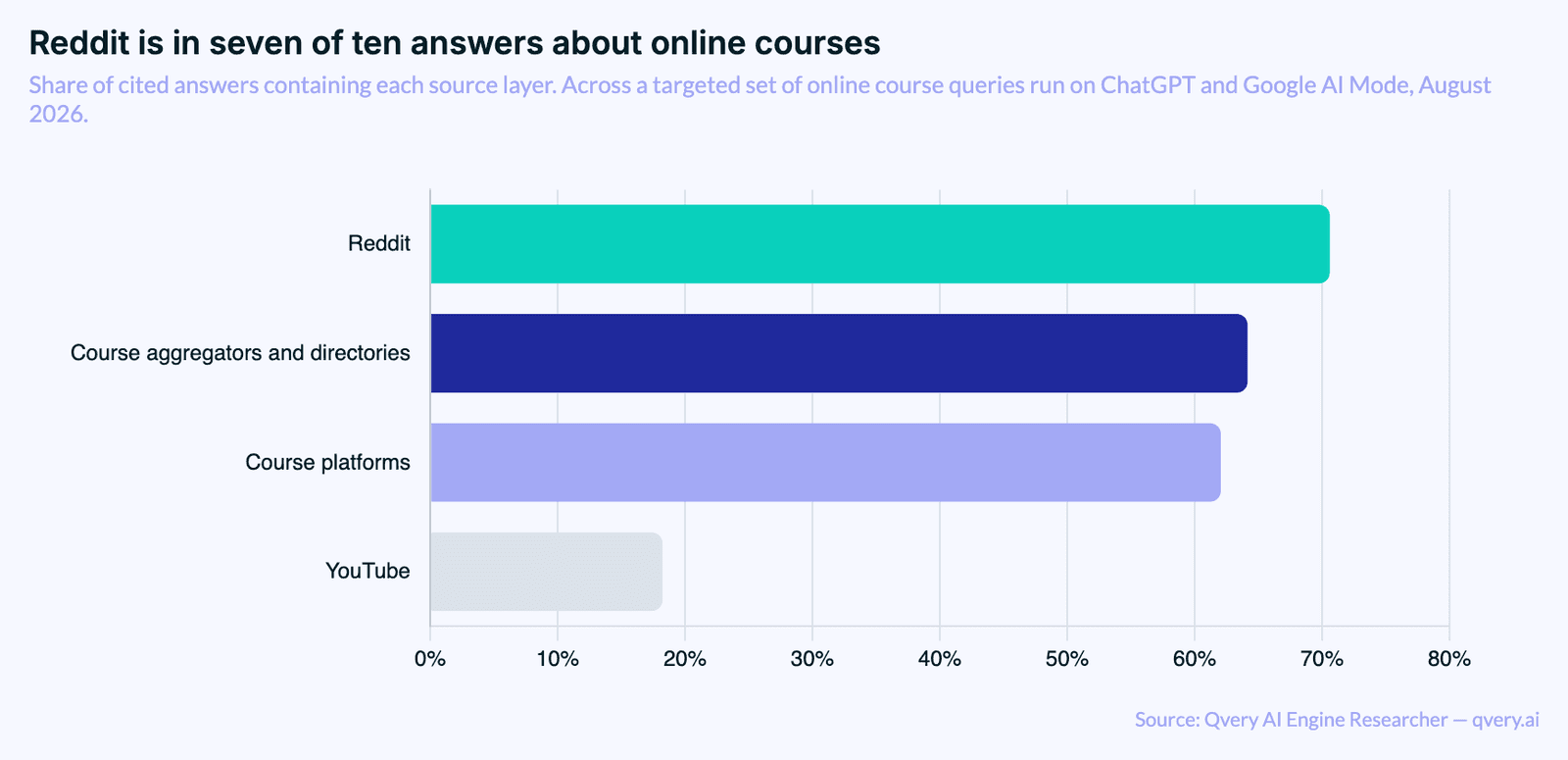
Behind it, course aggregators and directories at 64.14% and the course platforms themselves at 62.05%.
Those two categories are hand-checked named lists rather than the output of a classifier: a short list of unambiguous, well-known sites read individually.
The single most-cited source in this category is a forum where nobody is trying to sell you a course.
And It Barely Moves By Course Type
The usual next move would be to find the segment where Reddit matters less and aim there. That segment does not appear to exist.
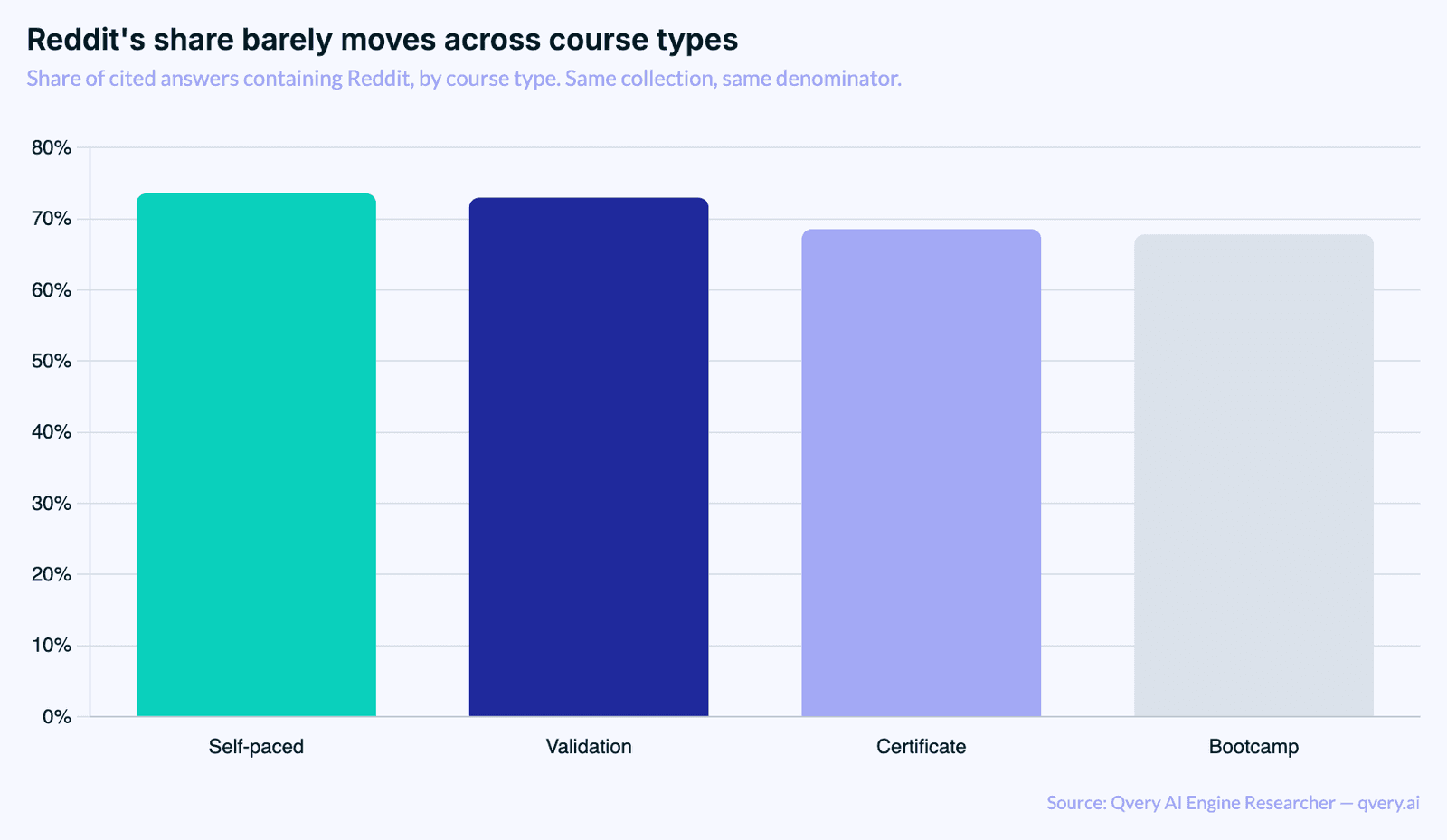
Self-paced courses at 73.61%, questions validating a specific program at 73.00%, certificates at 68.57%, bootcamps at 67.83%. A spread of 5.78 points across four arms that each cleared our reporting floor.
Compare that with the legal category we collected separately, where the leading source layer swung by more than 50 points depending on whether someone was searching for a firm or checking one. Here it is flat.
So Reddit is not a quirk of one query type in this category. It is the substrate underneath all of them, from someone browsing options to someone checking whether a specific program is worth the money.
Course platforms behave differently and do vary: they appear in 81.94% of self-paced answers against 38.46% of bootcamp ones. Which makes sense, since the self-paced catalogue largely lives on those platforms and bootcamps largely do not.
That gap is the useful one for a bootcamp operator. If you sell a bootcamp, the platform layer that carries most self-paced course visibility is not carrying yours, and the two sources that are, Reddit and the aggregators, are both third-party surfaces.
The validation family is worth calling out separately. Those are questions about whether a specific named program is any good, asked by someone already considering it, and Reddit sits at 73.00% of those cited answers. That is the moment closest to a purchase decision in this category, and it runs on a forum.
The Engine Split Is The Most Extreme We Have Measured
Then there is video, where the two engines behave almost like different products.
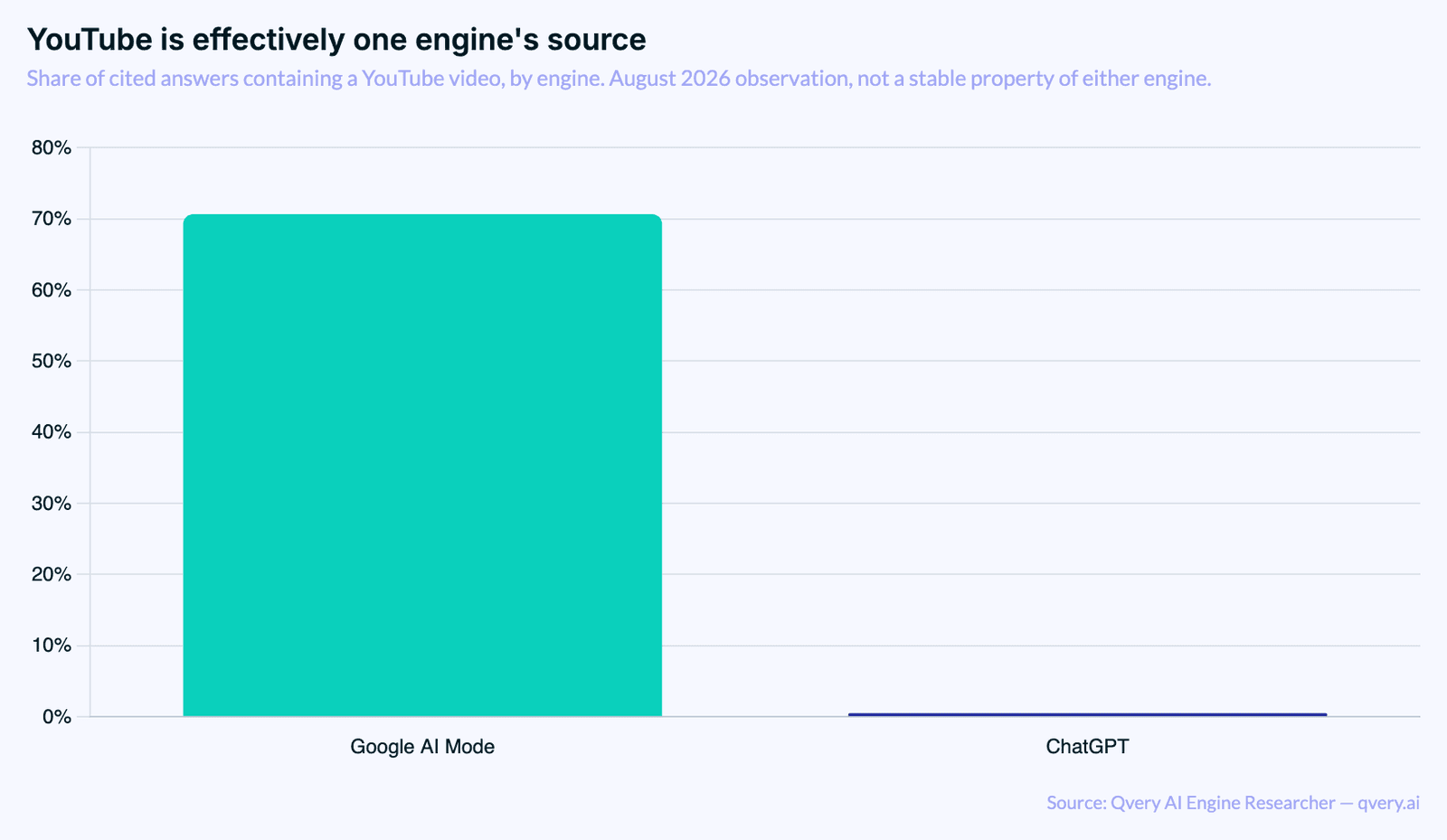
YouTube appears in 70.68% of cited Google AI Mode answers and 0.51% of cited ChatGPT ones.
We saw the same shape in an unrelated automotive collection, where YouTube reached 58.62% of cited Google AI Mode answers and 0.00% of ChatGPT ones. Two different verticals, two separate collections, the same asymmetry.
Read that as scope rather than advice. It is an August 2026 observation about where video appears, not a stable property of either engine and not a reason to prefer or defund one.
What it means for measurement is that a video result reported without naming the engine is not interpretable in this category.
Reddit, by contrast, holds up across both: 71.32% on the ChatGPT side and 68.42% on the Google AI Mode side. It is the one source in this collection that does not care which engine the question was asked in.
That stability is what makes it the sensible thing to build a plan around. Every other source we measured in this category is contingent on something: the engine asked, the type of course, or whether the buyer is browsing or checking. Reddit is present at roughly the same rate through all of it.
Several other sources in the collection are close to engine-exclusive as well, appearing on one side and effectively not on the other. A pooled source report averages two different pictures and produces a number that describes neither, so keep the engines apart in whatever you build.
What To Do With A Category That Runs On A Forum
Nothing above says that a Reddit thread causes a recommendation. It says the answers your prospective students see are assembled substantially from Reddit, aggregators, and platform pages, in that order.
Four things follow, offered as the writer's judgment given the observed associations rather than as results. The collection does not establish that any of them changes what gets cited.
Find out what the threads about your program say. Not whether they exist, but what is in them, on the specific questions your buyers ask, in the subreddits where your category is discussed.
Get the aggregator listings right. Course directories and comparison sites sit at 64.14% here, close behind Reddit and comfortably ahead of most editorial coverage. Those listings are structured, checkable, and largely within your control.
Report video by engine, never pooled. At 70.68% on one engine and 0.51% on the other, a pooled video number describes neither.
Log it over time. A single snapshot cannot distinguish a thread that structurally anchors your category from one that surfaced once. Only a repeated record separates them.
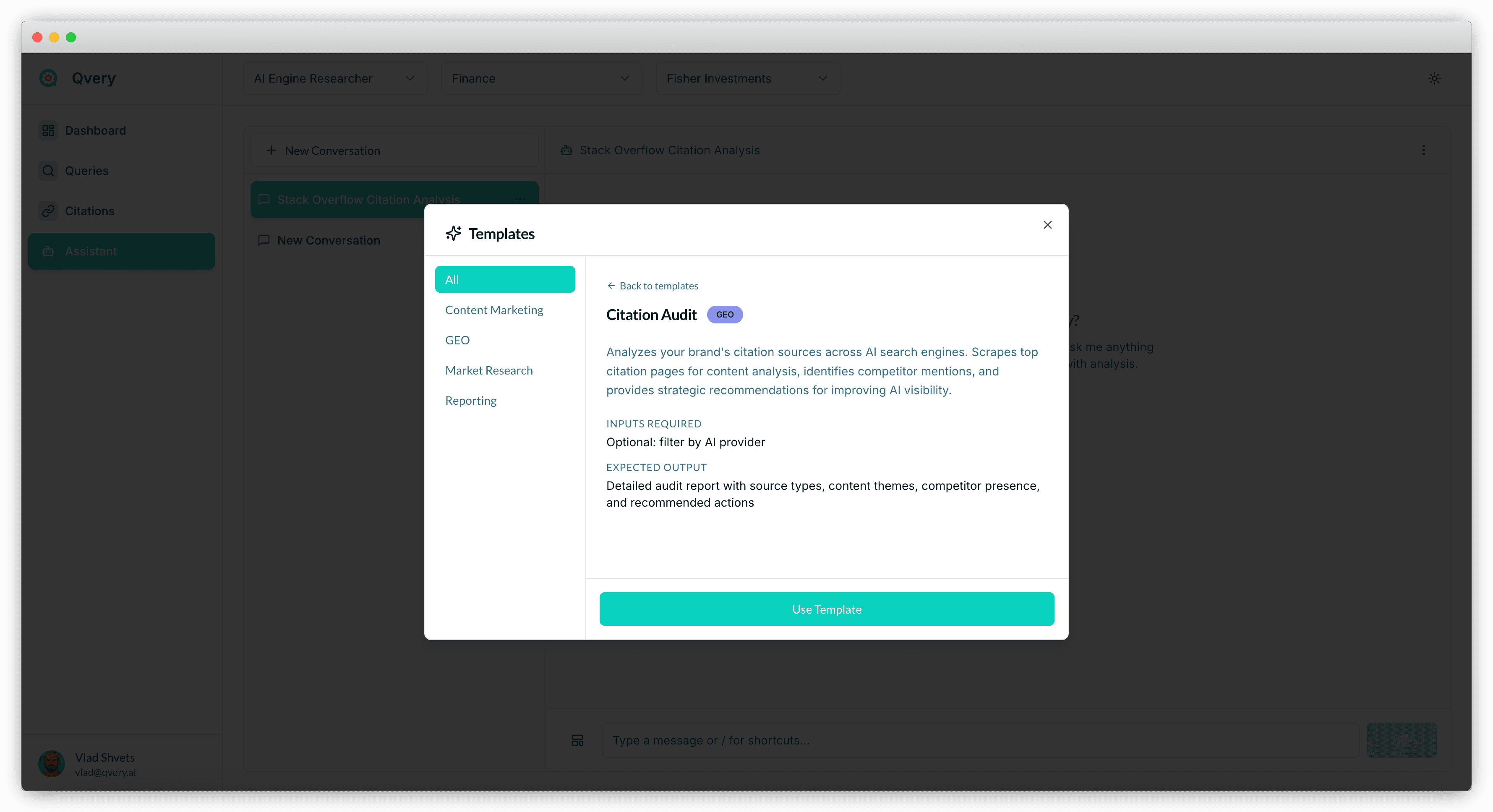
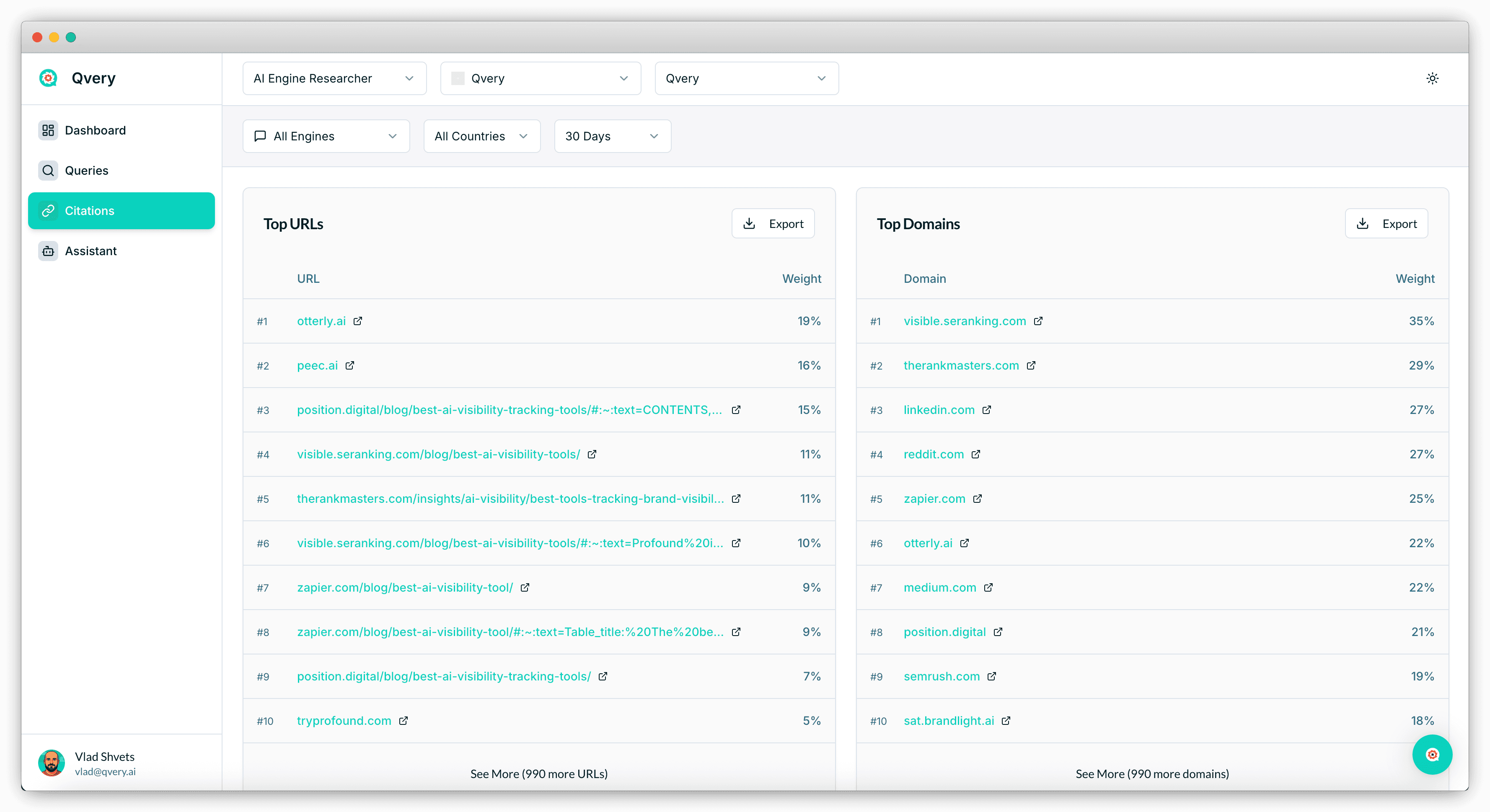
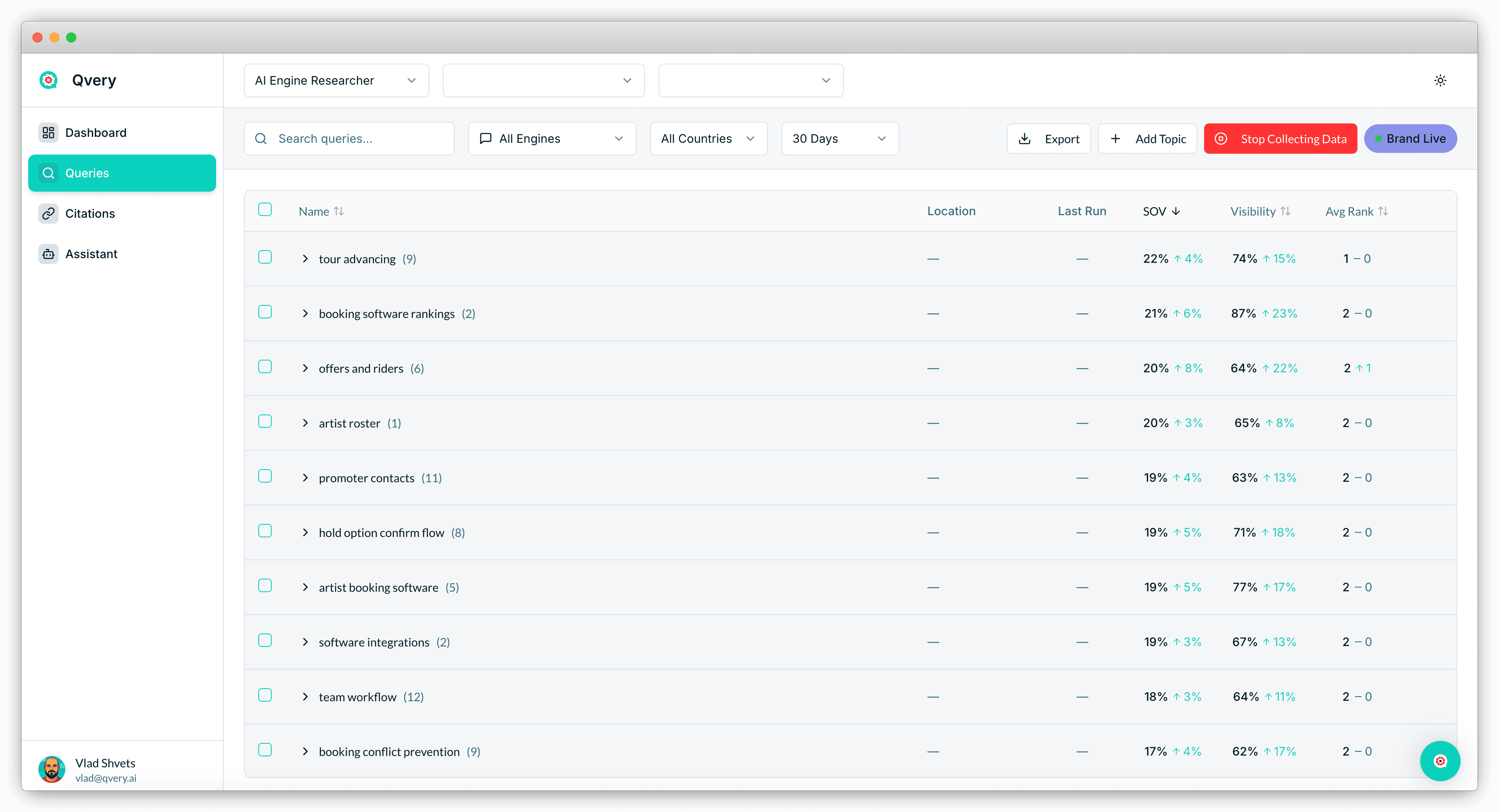
Qvery supplies the tracking underneath that. It tracks visibility, share of voice, and average rank across ChatGPT and Google AI Mode daily, in over 200 countries, and captures every citation tied to the query and engine that produced it. In Qvery Assistant you can ask about your own visibility, share of voice, citation, topic, and query data, add queries, trigger a run, or export a report.
Start your free trial and see which sources are answering the questions your students ask.
Writer's Judgment, Not A Finding
Flagging this clearly, because the rest of the article stays inside what was measured.
Given that Reddit sits at 70.59% of cited answers and stays within 5.78 points across every course type we tested, our judgment is that community presence deserves to be a named workstream in this category rather than a side project.
That is a view about where effort is likely to pay. The collection does not establish it, and we would be cautious about anyone promising that a thread can be engineered into an answer.
A second judgment: the aggregator layer is the most tractable thing in this data. It is nearly as present as Reddit, it is structured, and unlike a forum it is a surface you can straightforwardly ask to be listed on.
What the collection did establish is narrower and firmer. Reddit appears in 70.59% of cited answers and stays within 5.78 points across four course types, aggregators reach 64.14% and platforms 62.05%, and YouTube runs 70.68% on one engine against 0.51% on the other. Those are the bounds. What you do inside them is a decision, not a finding.
If you sell an online course, a bootcamp, or a certificate program, there is a good chance your marketing plan treats AI search the way it treats every other channel: publish good pages, get listed in the right places, wait.
We ran a targeted collection across course, bootcamp, and certificate questions to see what these answers are built from. One source dominates so completely, and so evenly, that it reorders the priorities.
One boundary before any number. This measures which sources appear alongside the answers. It does not measure whether appearing on a source causes a course to be recommended, and nothing here was designed to test that.
Reddit Is In Seven Of Ten Answers
Across 134 targeted online course, bootcamp, and certificate queries run on ChatGPT three times each and Google AI Mode once, August 2026, Reddit appears in 70.59% of cited answers.
No other source in this collection comes close to it.
Behind it, course aggregators and directories at 64.14% and the course platforms themselves at 62.05%.
Those two categories are hand-checked named lists rather than the output of a classifier: a short list of unambiguous, well-known sites read individually.
The single most-cited source in this category is a forum where nobody is trying to sell you a course.
And It Barely Moves By Course Type
The usual next move would be to find the segment where Reddit matters less and aim there. That segment does not appear to exist.
Self-paced courses at 73.61%, questions validating a specific program at 73.00%, certificates at 68.57%, bootcamps at 67.83%. A spread of 5.78 points across four arms that each cleared our reporting floor.
Compare that with the legal category we collected separately, where the leading source layer swung by more than 50 points depending on whether someone was searching for a firm or checking one. Here it is flat.
So Reddit is not a quirk of one query type in this category. It is the substrate underneath all of them, from someone browsing options to someone checking whether a specific program is worth the money.
Course platforms behave differently and do vary: they appear in 81.94% of self-paced answers against 38.46% of bootcamp ones. Which makes sense, since the self-paced catalogue largely lives on those platforms and bootcamps largely do not.
That gap is the useful one for a bootcamp operator. If you sell a bootcamp, the platform layer that carries most self-paced course visibility is not carrying yours, and the two sources that are, Reddit and the aggregators, are both third-party surfaces.
The validation family is worth calling out separately. Those are questions about whether a specific named program is any good, asked by someone already considering it, and Reddit sits at 73.00% of those cited answers. That is the moment closest to a purchase decision in this category, and it runs on a forum.
The Engine Split Is The Most Extreme We Have Measured
Then there is video, where the two engines behave almost like different products.
YouTube appears in 70.68% of cited Google AI Mode answers and 0.51% of cited ChatGPT ones.
We saw the same shape in an unrelated automotive collection, where YouTube reached 58.62% of cited Google AI Mode answers and 0.00% of ChatGPT ones. Two different verticals, two separate collections, the same asymmetry.
Read that as scope rather than advice. It is an August 2026 observation about where video appears, not a stable property of either engine and not a reason to prefer or defund one.
What it means for measurement is that a video result reported without naming the engine is not interpretable in this category.
Reddit, by contrast, holds up across both: 71.32% on the ChatGPT side and 68.42% on the Google AI Mode side. It is the one source in this collection that does not care which engine the question was asked in.
That stability is what makes it the sensible thing to build a plan around. Every other source we measured in this category is contingent on something: the engine asked, the type of course, or whether the buyer is browsing or checking. Reddit is present at roughly the same rate through all of it.
Several other sources in the collection are close to engine-exclusive as well, appearing on one side and effectively not on the other. A pooled source report averages two different pictures and produces a number that describes neither, so keep the engines apart in whatever you build.
What To Do With A Category That Runs On A Forum
Nothing above says that a Reddit thread causes a recommendation. It says the answers your prospective students see are assembled substantially from Reddit, aggregators, and platform pages, in that order.
Four things follow, offered as the writer's judgment given the observed associations rather than as results. The collection does not establish that any of them changes what gets cited.
Find out what the threads about your program say. Not whether they exist, but what is in them, on the specific questions your buyers ask, in the subreddits where your category is discussed.
Get the aggregator listings right. Course directories and comparison sites sit at 64.14% here, close behind Reddit and comfortably ahead of most editorial coverage. Those listings are structured, checkable, and largely within your control.
Report video by engine, never pooled. At 70.68% on one engine and 0.51% on the other, a pooled video number describes neither.
Log it over time. A single snapshot cannot distinguish a thread that structurally anchors your category from one that surfaced once. Only a repeated record separates them.
Qvery supplies the tracking underneath that. It tracks visibility, share of voice, and average rank across ChatGPT and Google AI Mode daily, in over 200 countries, and captures every citation tied to the query and engine that produced it. In Qvery Assistant you can ask about your own visibility, share of voice, citation, topic, and query data, add queries, trigger a run, or export a report.
Start your free trial and see which sources are answering the questions your students ask.
Writer's Judgment, Not A Finding
Flagging this clearly, because the rest of the article stays inside what was measured.
Given that Reddit sits at 70.59% of cited answers and stays within 5.78 points across every course type we tested, our judgment is that community presence deserves to be a named workstream in this category rather than a side project.
That is a view about where effort is likely to pay. The collection does not establish it, and we would be cautious about anyone promising that a thread can be engineered into an answer.
A second judgment: the aggregator layer is the most tractable thing in this data. It is nearly as present as Reddit, it is structured, and unlike a forum it is a surface you can straightforwardly ask to be listed on.
What the collection did establish is narrower and firmer. Reddit appears in 70.59% of cited answers and stays within 5.78 points across four course types, aggregators reach 64.14% and platforms 62.05%, and YouTube runs 70.68% on one engine against 0.51% on the other. Those are the bounds. What you do inside them is a decision, not a finding.
If you sell an online course, a bootcamp, or a certificate program, there is a good chance your marketing plan treats AI search the way it treats every other channel: publish good pages, get listed in the right places, wait.
We ran a targeted collection across course, bootcamp, and certificate questions to see what these answers are built from. One source dominates so completely, and so evenly, that it reorders the priorities.
One boundary before any number. This measures which sources appear alongside the answers. It does not measure whether appearing on a source causes a course to be recommended, and nothing here was designed to test that.
Reddit Is In Seven Of Ten Answers
Across 134 targeted online course, bootcamp, and certificate queries run on ChatGPT three times each and Google AI Mode once, August 2026, Reddit appears in 70.59% of cited answers.
No other source in this collection comes close to it.
Behind it, course aggregators and directories at 64.14% and the course platforms themselves at 62.05%.
Those two categories are hand-checked named lists rather than the output of a classifier: a short list of unambiguous, well-known sites read individually.
The single most-cited source in this category is a forum where nobody is trying to sell you a course.
And It Barely Moves By Course Type
The usual next move would be to find the segment where Reddit matters less and aim there. That segment does not appear to exist.
Self-paced courses at 73.61%, questions validating a specific program at 73.00%, certificates at 68.57%, bootcamps at 67.83%. A spread of 5.78 points across four arms that each cleared our reporting floor.
Compare that with the legal category we collected separately, where the leading source layer swung by more than 50 points depending on whether someone was searching for a firm or checking one. Here it is flat.
So Reddit is not a quirk of one query type in this category. It is the substrate underneath all of them, from someone browsing options to someone checking whether a specific program is worth the money.
Course platforms behave differently and do vary: they appear in 81.94% of self-paced answers against 38.46% of bootcamp ones. Which makes sense, since the self-paced catalogue largely lives on those platforms and bootcamps largely do not.
That gap is the useful one for a bootcamp operator. If you sell a bootcamp, the platform layer that carries most self-paced course visibility is not carrying yours, and the two sources that are, Reddit and the aggregators, are both third-party surfaces.
The validation family is worth calling out separately. Those are questions about whether a specific named program is any good, asked by someone already considering it, and Reddit sits at 73.00% of those cited answers. That is the moment closest to a purchase decision in this category, and it runs on a forum.
The Engine Split Is The Most Extreme We Have Measured
Then there is video, where the two engines behave almost like different products.
YouTube appears in 70.68% of cited Google AI Mode answers and 0.51% of cited ChatGPT ones.
We saw the same shape in an unrelated automotive collection, where YouTube reached 58.62% of cited Google AI Mode answers and 0.00% of ChatGPT ones. Two different verticals, two separate collections, the same asymmetry.
Read that as scope rather than advice. It is an August 2026 observation about where video appears, not a stable property of either engine and not a reason to prefer or defund one.
What it means for measurement is that a video result reported without naming the engine is not interpretable in this category.
Reddit, by contrast, holds up across both: 71.32% on the ChatGPT side and 68.42% on the Google AI Mode side. It is the one source in this collection that does not care which engine the question was asked in.
That stability is what makes it the sensible thing to build a plan around. Every other source we measured in this category is contingent on something: the engine asked, the type of course, or whether the buyer is browsing or checking. Reddit is present at roughly the same rate through all of it.
Several other sources in the collection are close to engine-exclusive as well, appearing on one side and effectively not on the other. A pooled source report averages two different pictures and produces a number that describes neither, so keep the engines apart in whatever you build.
What To Do With A Category That Runs On A Forum
Nothing above says that a Reddit thread causes a recommendation. It says the answers your prospective students see are assembled substantially from Reddit, aggregators, and platform pages, in that order.
Four things follow, offered as the writer's judgment given the observed associations rather than as results. The collection does not establish that any of them changes what gets cited.
Find out what the threads about your program say. Not whether they exist, but what is in them, on the specific questions your buyers ask, in the subreddits where your category is discussed.
Get the aggregator listings right. Course directories and comparison sites sit at 64.14% here, close behind Reddit and comfortably ahead of most editorial coverage. Those listings are structured, checkable, and largely within your control.
Report video by engine, never pooled. At 70.68% on one engine and 0.51% on the other, a pooled video number describes neither.
Log it over time. A single snapshot cannot distinguish a thread that structurally anchors your category from one that surfaced once. Only a repeated record separates them.
Qvery supplies the tracking underneath that. It tracks visibility, share of voice, and average rank across ChatGPT and Google AI Mode daily, in over 200 countries, and captures every citation tied to the query and engine that produced it. In Qvery Assistant you can ask about your own visibility, share of voice, citation, topic, and query data, add queries, trigger a run, or export a report.
Start your free trial and see which sources are answering the questions your students ask.
Writer's Judgment, Not A Finding
Flagging this clearly, because the rest of the article stays inside what was measured.
Given that Reddit sits at 70.59% of cited answers and stays within 5.78 points across every course type we tested, our judgment is that community presence deserves to be a named workstream in this category rather than a side project.
That is a view about where effort is likely to pay. The collection does not establish it, and we would be cautious about anyone promising that a thread can be engineered into an answer.
A second judgment: the aggregator layer is the most tractable thing in this data. It is nearly as present as Reddit, it is structured, and unlike a forum it is a surface you can straightforwardly ask to be listed on.
What the collection did establish is narrower and firmer. Reddit appears in 70.59% of cited answers and stays within 5.78 points across four course types, aggregators reach 64.14% and platforms 62.05%, and YouTube runs 70.68% on one engine against 0.51% on the other. Those are the bounds. What you do inside them is a decision, not a finding.
If you sell an online course, a bootcamp, or a certificate program, there is a good chance your marketing plan treats AI search the way it treats every other channel: publish good pages, get listed in the right places, wait.
We ran a targeted collection across course, bootcamp, and certificate questions to see what these answers are built from. One source dominates so completely, and so evenly, that it reorders the priorities.
One boundary before any number. This measures which sources appear alongside the answers. It does not measure whether appearing on a source causes a course to be recommended, and nothing here was designed to test that.
Reddit Is In Seven Of Ten Answers
Across 134 targeted online course, bootcamp, and certificate queries run on ChatGPT three times each and Google AI Mode once, August 2026, Reddit appears in 70.59% of cited answers.
No other source in this collection comes close to it.
Behind it, course aggregators and directories at 64.14% and the course platforms themselves at 62.05%.
Those two categories are hand-checked named lists rather than the output of a classifier: a short list of unambiguous, well-known sites read individually.
The single most-cited source in this category is a forum where nobody is trying to sell you a course.
And It Barely Moves By Course Type
The usual next move would be to find the segment where Reddit matters less and aim there. That segment does not appear to exist.
Self-paced courses at 73.61%, questions validating a specific program at 73.00%, certificates at 68.57%, bootcamps at 67.83%. A spread of 5.78 points across four arms that each cleared our reporting floor.
Compare that with the legal category we collected separately, where the leading source layer swung by more than 50 points depending on whether someone was searching for a firm or checking one. Here it is flat.
So Reddit is not a quirk of one query type in this category. It is the substrate underneath all of them, from someone browsing options to someone checking whether a specific program is worth the money.
Course platforms behave differently and do vary: they appear in 81.94% of self-paced answers against 38.46% of bootcamp ones. Which makes sense, since the self-paced catalogue largely lives on those platforms and bootcamps largely do not.
That gap is the useful one for a bootcamp operator. If you sell a bootcamp, the platform layer that carries most self-paced course visibility is not carrying yours, and the two sources that are, Reddit and the aggregators, are both third-party surfaces.
The validation family is worth calling out separately. Those are questions about whether a specific named program is any good, asked by someone already considering it, and Reddit sits at 73.00% of those cited answers. That is the moment closest to a purchase decision in this category, and it runs on a forum.
The Engine Split Is The Most Extreme We Have Measured
Then there is video, where the two engines behave almost like different products.
YouTube appears in 70.68% of cited Google AI Mode answers and 0.51% of cited ChatGPT ones.
We saw the same shape in an unrelated automotive collection, where YouTube reached 58.62% of cited Google AI Mode answers and 0.00% of ChatGPT ones. Two different verticals, two separate collections, the same asymmetry.
Read that as scope rather than advice. It is an August 2026 observation about where video appears, not a stable property of either engine and not a reason to prefer or defund one.
What it means for measurement is that a video result reported without naming the engine is not interpretable in this category.
Reddit, by contrast, holds up across both: 71.32% on the ChatGPT side and 68.42% on the Google AI Mode side. It is the one source in this collection that does not care which engine the question was asked in.
That stability is what makes it the sensible thing to build a plan around. Every other source we measured in this category is contingent on something: the engine asked, the type of course, or whether the buyer is browsing or checking. Reddit is present at roughly the same rate through all of it.
Several other sources in the collection are close to engine-exclusive as well, appearing on one side and effectively not on the other. A pooled source report averages two different pictures and produces a number that describes neither, so keep the engines apart in whatever you build.
What To Do With A Category That Runs On A Forum
Nothing above says that a Reddit thread causes a recommendation. It says the answers your prospective students see are assembled substantially from Reddit, aggregators, and platform pages, in that order.
Four things follow, offered as the writer's judgment given the observed associations rather than as results. The collection does not establish that any of them changes what gets cited.
Find out what the threads about your program say. Not whether they exist, but what is in them, on the specific questions your buyers ask, in the subreddits where your category is discussed.
Get the aggregator listings right. Course directories and comparison sites sit at 64.14% here, close behind Reddit and comfortably ahead of most editorial coverage. Those listings are structured, checkable, and largely within your control.
Report video by engine, never pooled. At 70.68% on one engine and 0.51% on the other, a pooled video number describes neither.
Log it over time. A single snapshot cannot distinguish a thread that structurally anchors your category from one that surfaced once. Only a repeated record separates them.
Qvery supplies the tracking underneath that. It tracks visibility, share of voice, and average rank across ChatGPT and Google AI Mode daily, in over 200 countries, and captures every citation tied to the query and engine that produced it. In Qvery Assistant you can ask about your own visibility, share of voice, citation, topic, and query data, add queries, trigger a run, or export a report.
Start your free trial and see which sources are answering the questions your students ask.
Writer's Judgment, Not A Finding
Flagging this clearly, because the rest of the article stays inside what was measured.
Given that Reddit sits at 70.59% of cited answers and stays within 5.78 points across every course type we tested, our judgment is that community presence deserves to be a named workstream in this category rather than a side project.
That is a view about where effort is likely to pay. The collection does not establish it, and we would be cautious about anyone promising that a thread can be engineered into an answer.
A second judgment: the aggregator layer is the most tractable thing in this data. It is nearly as present as Reddit, it is structured, and unlike a forum it is a surface you can straightforwardly ask to be listed on.
What the collection did establish is narrower and firmer. Reddit appears in 70.59% of cited answers and stays within 5.78 points across four course types, aggregators reach 64.14% and platforms 62.05%, and YouTube runs 70.68% on one engine against 0.51% on the other. Those are the bounds. What you do inside them is a decision, not a finding.

© 2026 Qvery AI OÜ