By
Vlad Shvets
How Car Brands Show Up in AI Search
Qvery data on which sources ChatGPT and Google AI Mode cite when recommending cars: Reddit out-cites every review site, and ChatGPT answers most car questions without searching.
Qvery data on which sources ChatGPT and Google AI Mode cite when recommending cars: Reddit out-cites every review site, and ChatGPT answers most car questions without searching.
Qvery data on which sources ChatGPT and Google AI Mode cite when recommending cars: Reddit out-cites every review site, and ChatGPT answers most car questions without searching.
Ask ChatGPT "what's the most reliable midsize SUV for a family of five" and you'd expect it to lean on the people who test cars for a living: Edmunds, Kelley Blue Book, Consumer Reports, the serious folks with crash sleds and spec sheets. And it does lean on them, partly: a car is about as structured as a product gets, a fixed set of specs, so you'd assume the engines reward whoever publishes the cleanest spec table.
But across the queries we ran for this vertical, the single most-cited domain was Reddit, where the top answer to "is this thing reliable" comes from someone who drove it past 80,000 miles. A forum post out-cites every review and spec source individually, and the two AI engines we track disagree sharply about where to find any of it.
The aggregators everyone optimizes for still matter. They're just not where the close calls get decided.
Reddit Is the Single Most-Cited Domain, Outranking Every Review Site Individually
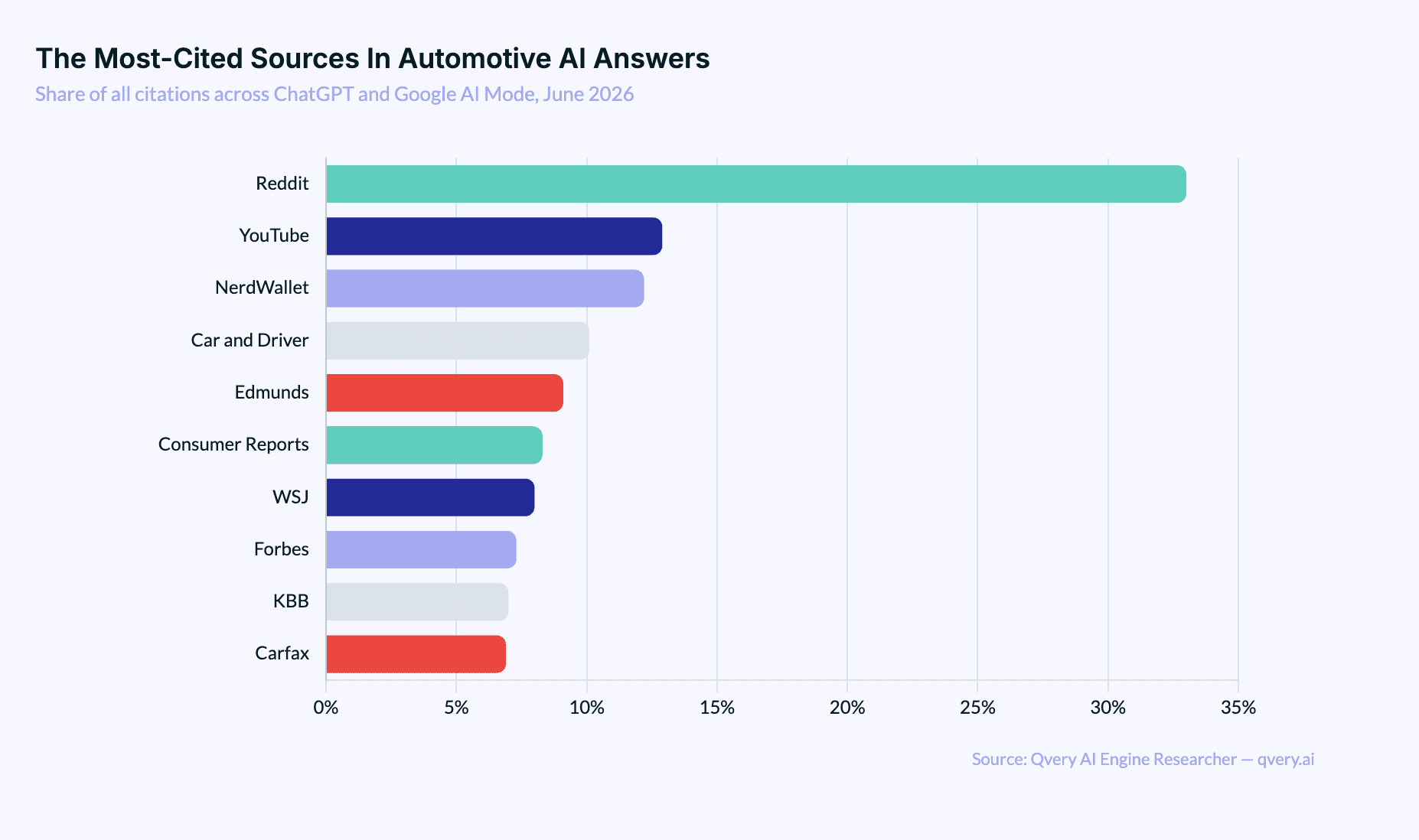
Across a sample of roughly 250 automotive category and advice queries we ran on ChatGPT and Google AI Mode (June 2026), Reddit appeared in 33.0% of all citations, more than twice the share of the next source. Among answers that cited anything at all, it showed up in 58.8% of them. Reddit as a domain out-cited Edmunds (roughly 9.1%) and KBB (roughly 7.0%) by more than 3x.
This isn't a fluke of the automotive niche. Reddit is the single most important community source across the verticals we track, and the mechanics of why AI engines reach for Reddit hold here too. Cars just amplify it, because half of what a buyer wants to know ("does this transmission last past 80k miles") is exactly the question a spec page can't answer and a long owner thread can.
The spec sheet is the one thing a manufacturer fully controls. It's also the one thing the engine treats as the floor, not the answer.
So while this vertical is textbook aggregator-and-listing-led (review portals and directories dominate the source mix as a category), it sits on top of a community layer that quietly decides the close calls. You can ride the aggregators all you want, but the forums are where the recommendation gets settled.
The Source Mix Says Aggregator, But the Tail Is Community
Group every cited source by type and the archetype confirms itself. Editorial reviews, ranked lists, and the auto-finance and insurance content the classifier groups with them are the biggest bucket at 41.6% of all appearances: Car and Driver, Consumer Reports, and MotorTrend sit alongside personal-finance crossover sites like NerdWallet and the "best cars under $30k" content from insurance and lending sites. Inside that bucket, NerdWallet is the most-cited domain at 12.2%, ahead of the biggest pure car-review site, Car and Driver (roughly 10.1%).
The rest of the mix breaks down like this.
Directory-style aggregators: 25.1%, the second-largest bucket. Edmunds, KBB, Cars.com, Carfax, Autotrader, CarGurus.
Community: 14.6%, the layer that decides the subjective calls.
Owned-brand pages: 10.4%, mostly manufacturer and finance-brand pages.
Video: 5.2%, almost entirely YouTube, almost entirely on Google AI Mode.
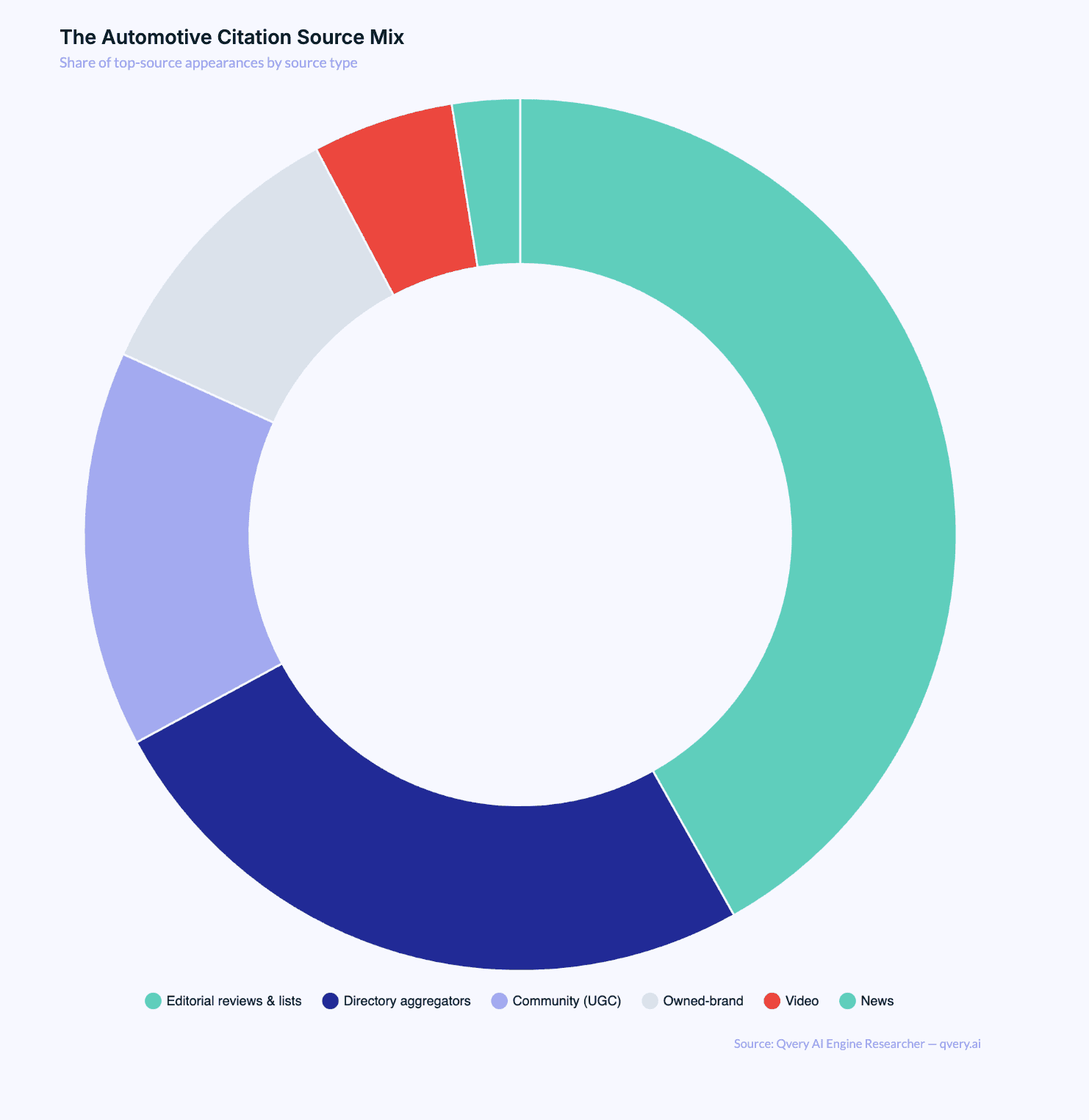
That editorial reviews and ranked lists are the largest classifiable bucket tracks with the cross-vertical pattern, where ranked lists are the most-cited content type. The reason is unglamorous: a "Best Compact SUVs of 2026" piece hands the engine a finished shortlist with the winners already picked, so it can quote the list instead of reasoning from a spec sheet.
The strategic read is that no single domain owns this category. Reddit leads but the rest of the citations scatter across dozens of review sites, aggregators, and finance crossovers. That fragmentation is the opportunity. You don't have to outrank Edmunds, you just have to be present and accurate across enough of the cited layer that the engine keeps bumping into you.
ChatGPT and Google AI Mode Read From Two Different Bookshelves
The two engines barely agree on which sources to trust. ChatGPT reaches for the editorial verdict (Car and Driver was almost entirely a ChatGPT source, about 96% of its appearances), while Google AI Mode pulls from a different layer entirely, where US News showed up on 100% of its appearances and never once on ChatGPT.
What ChatGPT pulls: editorial verdicts and ranked lists, the Car and Driver / WSJ / Forbes layer of expert "should you buy it" reviews.
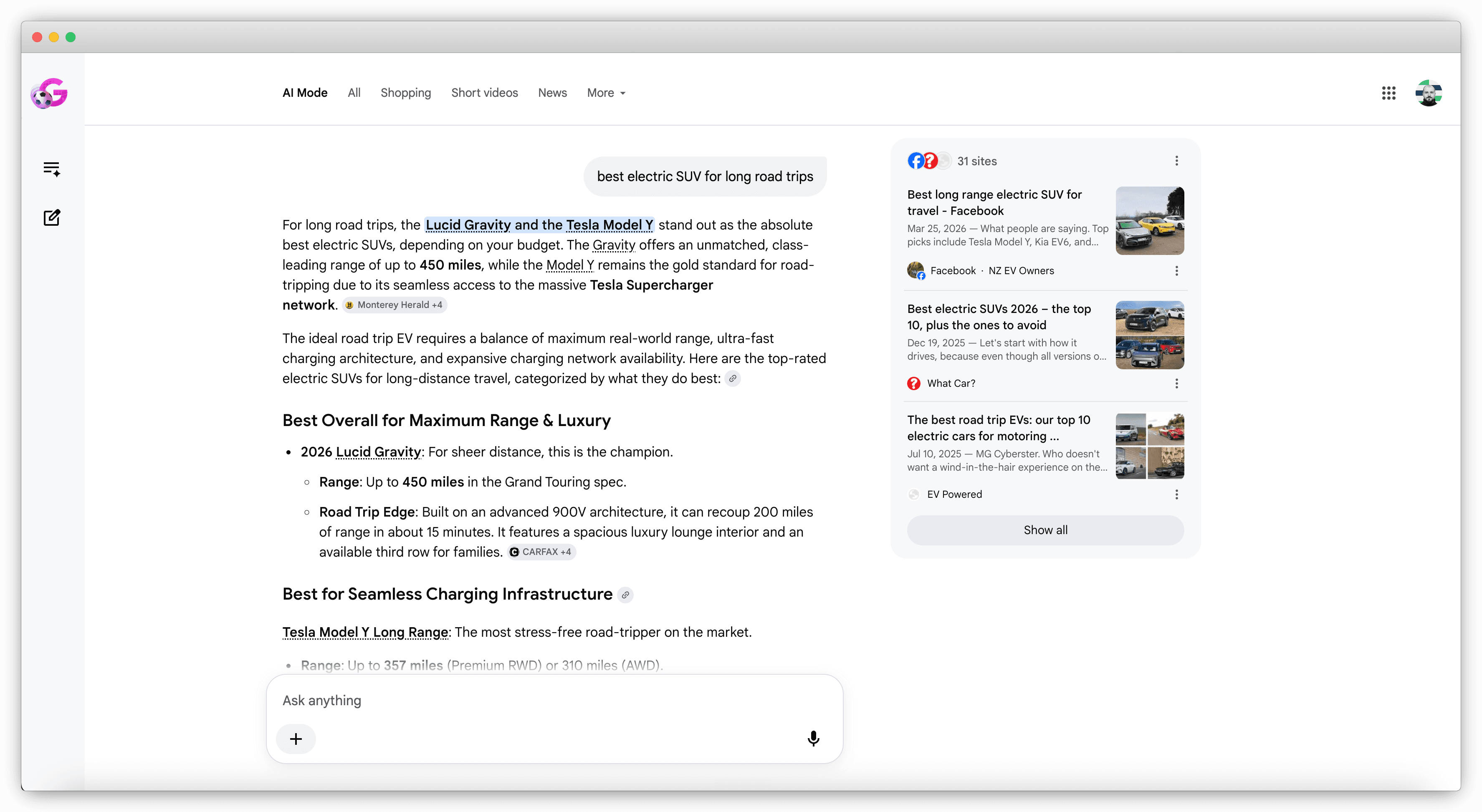
What Google AI Mode pulls: video reviews, owned-brand and manufacturer pages, and aggregator listings the engine can read live. YouTube showed up far more on Google AI Mode than ChatGPT, roughly 4.7x more appearances, the same engine skew we see in the broader YouTube citation data.
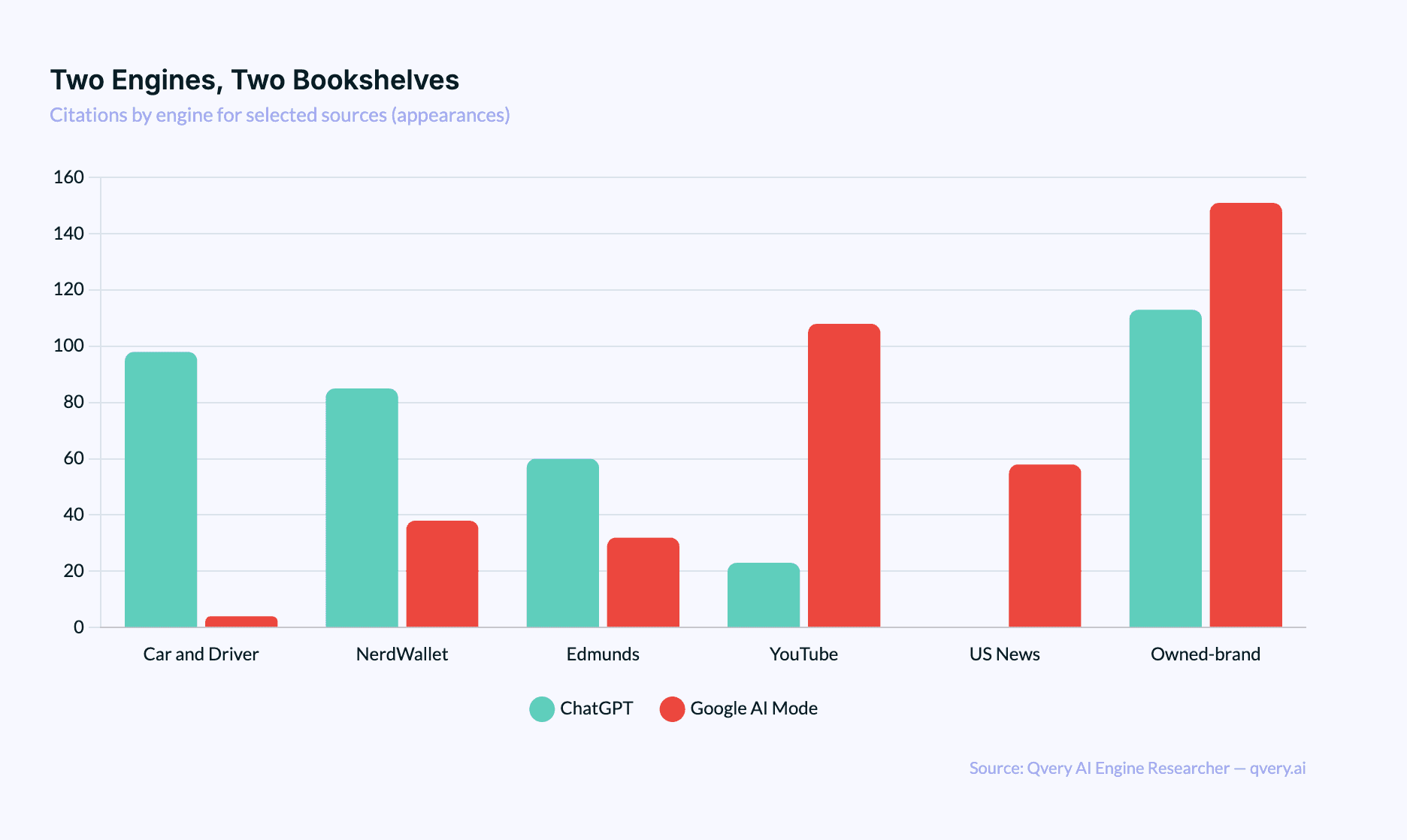
Picking one engine to optimize for is a supplement, not a strategy, because your buyers use both. Your content has to cover both: editorial reviews and ranked lists feed the ChatGPT side, while video reviews, a complete brand site, and aggregator presence feed Google AI Mode. Reddit, helpfully, gets cited on both engines, skewing only modestly to ChatGPT (about a 1.7-to-1 split), which is part of why it's such efficient ground to win.
ChatGPT Answers Most Car Questions Without Searching at All
On ChatGPT, only 41.8% of queries triggered a live web search. The other 58.2% of the time, ChatGPT answered from memory, from what it absorbed during training, with no citations at all. Google AI Mode did the reverse: it ran a search and surfaced sources on basically every query, a 99.2% trigger rate.
More than half the time someone asks ChatGPT for a car recommendation, the engine never goes looking. It's recommending from the version of the internet it memorized (a snapshot frozen at the model's training cutoff, which by car-shopping standards is roughly the automotive equivalent of advising someone off last year's brochure). The only way to be in that answer is to have been a prominent, repeated source in the training-favored institutional layer long before the question was ever asked.
In a search-first world you could rank your way in after the fact. In a training-first answer, the door closed at the model's cutoff.
This is also why being a household name in Google's index doesn't transfer. Across our cross-vertical data, only about 13.9% of AI-cited sources overlap with Google's organic top 10. Being the #1 organic result gives you roughly a 48.8% chance of the AI citation for the same query. In automotive it's worse, because more than half of ChatGPT's answers never check the live web at all.
Recommendation Queries Are Where the Citations Live
Not all car questions behave the same. When we split queries by intent, recommendation-style prompts got cited far more often than informational ones. Roughly 68% of recommendation queries ("best," "most reliable," "should I buy") pulled a cited source, versus about 26% of informational ones. The engine is most willing to show its work exactly when it's putting a brand forward by name.
Recommendation prompts: "best," "most reliable," "should I buy." High citation rate, where shortlists get built.
Informational prompts: "how do EV batteries work." Low citation rate, often answered from memory.
That's good news, because recommendation queries are also where purchase decisions get made. A buyer asking "best electric SUV for long road trips" is closer to a checkbook than one asking "how do EV batteries work." And recommendation queries are where Reddit concentrates: roughly 83% of Reddit's automotive citations landed on recommendation queries, not informational ones. Across the queries we ran, the prompts that surfaced a named brand were almost always the recommendation ones, not the spec-page informational ones, so if you only have budget to influence one query type, make it the recommendation prompts.
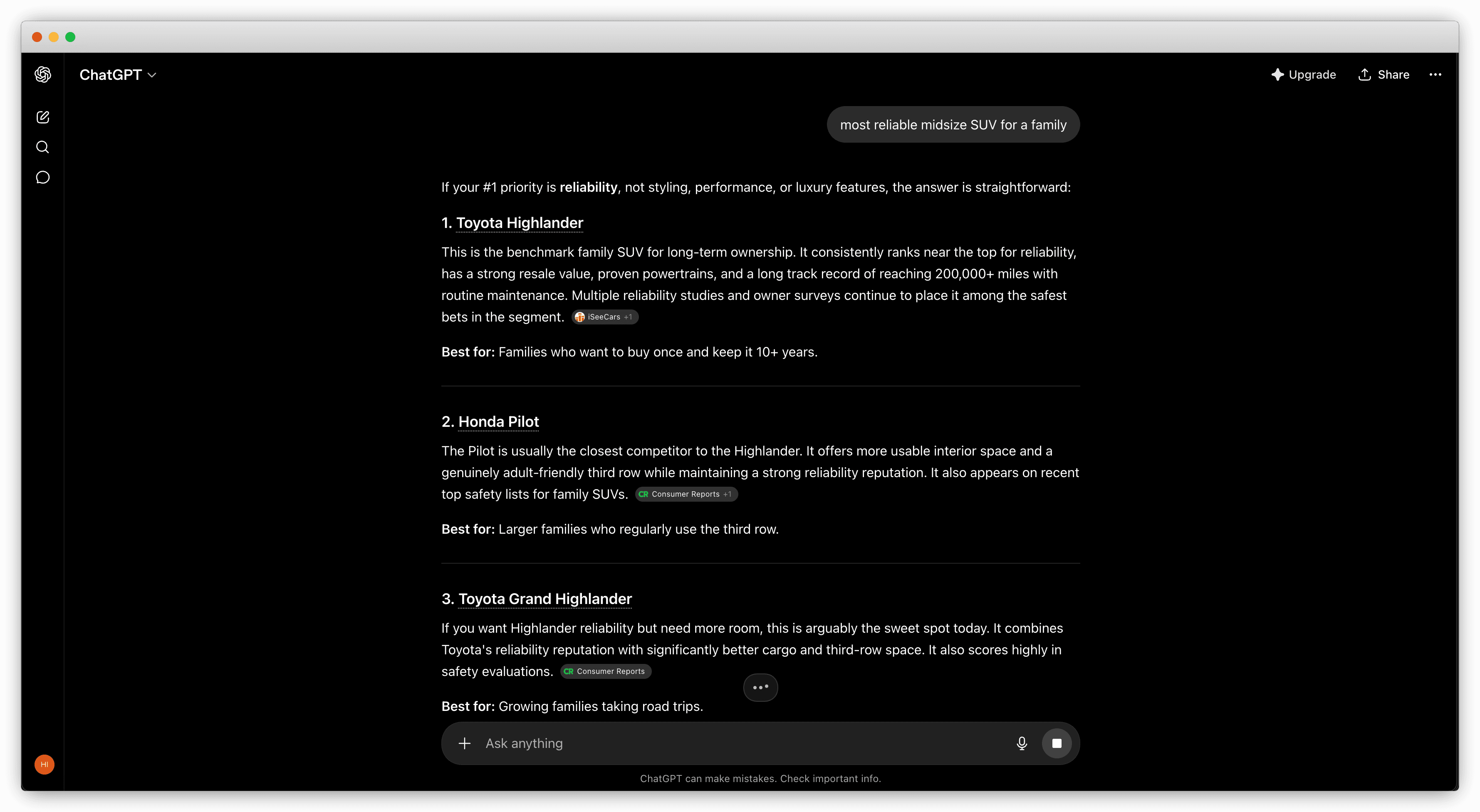
The practical move is to build content that maps to how people prompt. Head-to-head comparisons ("Honda CR-V vs Toyota RAV4") are the format engines lift most cleanly, alongside need-based shortlists ("best truck for towing under $50k") and self-contained FAQ blocks where the answer lives in the first sentence ("How long do CR-V transmissions last? Typically 200,000-plus miles with regular maintenance"). All three line up with the comparison-and-shortlist content that already dominates the cited layer.
Dealers Don't Rank, They Ride
Individual dealership sites are nearly invisible here, and the structure explains why. Across our cross-vertical data, the recurring-citation tier is the top 0.3% of domains, and 46.5% of cited domains earn just one citation, so a single dealer has no realistic path into the layer the engines pull from on a query like "best SUV near Denver." Many dealer sites also restrict AI crawlers, which keeps their inventory out of the engine's reach in the first place.
So the answer for a local brand isn't to fight Edmunds. It's to ride the layer the engine already trusts. Get inventory listed completely and accurately on Cars.com, Autotrader, and CarGurus. Keep specs and pricing current, because a model-year mismatch or stale MSRP erodes the engine's confidence in your data.
Use Vehicle schema on your own listing pages so the same car reads identically everywhere the engine triangulates it. And keep the owner-review and Reddit footprint alive in the right model and brand subreddits, because that's the layer doing the deciding on the reliability verdict.
Manufacturer spec pages: the cleanest owned signal, one stable URL per trim, feeding the structured-data layer Google AI Mode favors.
Aggregator listings: your borrowed visibility, the way a buyer finds your specific car through a source the engine already cites.
Reddit and forum presence: the tiebreaker on reliability and "is it worth it," cited on both engines, impossible to fake at volume.
The Sources Citing You Are Measurable, One Query at a Time
Everything above is generalizable, but the real question is what's true for your brand specifically: when a buyer asks an AI engine for a recommendation in your segment, are you in the answer, and which sources put you there.
That's the workflow our AI Engine Researcher agent runs. Across the roughly 250 automotive queries we ran on ChatGPT and Google AI Mode for this piece, the thing that surprised us was how often Reddit out-cited the review sites we expected to win.
You enter your brand and your segment. The agent generates the recommendation queries real buyers type, runs them across ChatGPT and Google AI Mode on a recurring schedule, and shows you exactly where you appear and where a competitor appears instead. For each answer, it lists the sources the engine cited, whether that's a Reddit thread, a review verdict, or a ranked list. Instead of guessing whether your Cars.com listing or your CR-V thread is doing the work, you see the cited sources behind every recommendation.
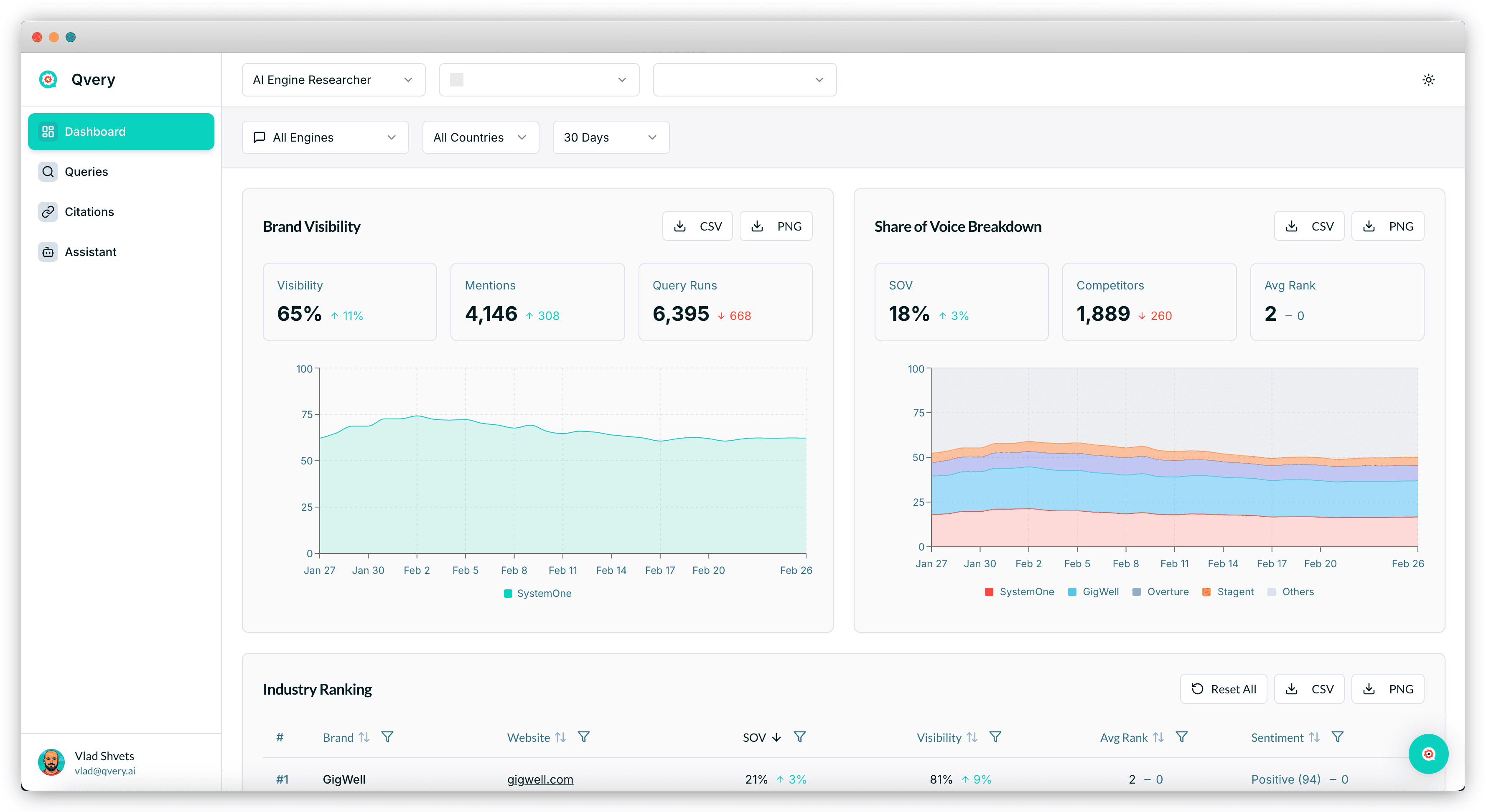
From there it points at the gaps. If the engine cites a Reddit thread for a competitor and nothing for you, that's a UGC gap. If it leans on a "best of" list you're not in, that's a mention gap. You can watch your share of voice move per query, per engine, as you build presence in the cited layer. Sign up, enter your brand, and you'll see your first results within minutes.
The thing I keep coming back to with automotive is how little the cleanest data wins on its own. We assumed specs would rule a category built entirely out of specs, and instead a forum out-cites every review site individually while the two engines pull from sources that barely overlap. The picture isn't settled, the engines shuffle their citation behavior month to month, but the shape is clear enough to act on: be accurate in the aggregators and present in the communities, and stop trusting that the best spec sheet wins.
Ask ChatGPT "what's the most reliable midsize SUV for a family of five" and you'd expect it to lean on the people who test cars for a living: Edmunds, Kelley Blue Book, Consumer Reports, the serious folks with crash sleds and spec sheets. And it does lean on them, partly: a car is about as structured as a product gets, a fixed set of specs, so you'd assume the engines reward whoever publishes the cleanest spec table.
But across the queries we ran for this vertical, the single most-cited domain was Reddit, where the top answer to "is this thing reliable" comes from someone who drove it past 80,000 miles. A forum post out-cites every review and spec source individually, and the two AI engines we track disagree sharply about where to find any of it.
The aggregators everyone optimizes for still matter. They're just not where the close calls get decided.
Reddit Is the Single Most-Cited Domain, Outranking Every Review Site Individually
Across a sample of roughly 250 automotive category and advice queries we ran on ChatGPT and Google AI Mode (June 2026), Reddit appeared in 33.0% of all citations, more than twice the share of the next source. Among answers that cited anything at all, it showed up in 58.8% of them. Reddit as a domain out-cited Edmunds (roughly 9.1%) and KBB (roughly 7.0%) by more than 3x.
This isn't a fluke of the automotive niche. Reddit is the single most important community source across the verticals we track, and the mechanics of why AI engines reach for Reddit hold here too. Cars just amplify it, because half of what a buyer wants to know ("does this transmission last past 80k miles") is exactly the question a spec page can't answer and a long owner thread can.
The spec sheet is the one thing a manufacturer fully controls. It's also the one thing the engine treats as the floor, not the answer.
So while this vertical is textbook aggregator-and-listing-led (review portals and directories dominate the source mix as a category), it sits on top of a community layer that quietly decides the close calls. You can ride the aggregators all you want, but the forums are where the recommendation gets settled.
The Source Mix Says Aggregator, But the Tail Is Community
Group every cited source by type and the archetype confirms itself. Editorial reviews, ranked lists, and the auto-finance and insurance content the classifier groups with them are the biggest bucket at 41.6% of all appearances: Car and Driver, Consumer Reports, and MotorTrend sit alongside personal-finance crossover sites like NerdWallet and the "best cars under $30k" content from insurance and lending sites. Inside that bucket, NerdWallet is the most-cited domain at 12.2%, ahead of the biggest pure car-review site, Car and Driver (roughly 10.1%).
The rest of the mix breaks down like this.
Directory-style aggregators: 25.1%, the second-largest bucket. Edmunds, KBB, Cars.com, Carfax, Autotrader, CarGurus.
Community: 14.6%, the layer that decides the subjective calls.
Owned-brand pages: 10.4%, mostly manufacturer and finance-brand pages.
Video: 5.2%, almost entirely YouTube, almost entirely on Google AI Mode.
That editorial reviews and ranked lists are the largest classifiable bucket tracks with the cross-vertical pattern, where ranked lists are the most-cited content type. The reason is unglamorous: a "Best Compact SUVs of 2026" piece hands the engine a finished shortlist with the winners already picked, so it can quote the list instead of reasoning from a spec sheet.
The strategic read is that no single domain owns this category. Reddit leads but the rest of the citations scatter across dozens of review sites, aggregators, and finance crossovers. That fragmentation is the opportunity. You don't have to outrank Edmunds, you just have to be present and accurate across enough of the cited layer that the engine keeps bumping into you.
ChatGPT and Google AI Mode Read From Two Different Bookshelves
The two engines barely agree on which sources to trust. ChatGPT reaches for the editorial verdict (Car and Driver was almost entirely a ChatGPT source, about 96% of its appearances), while Google AI Mode pulls from a different layer entirely, where US News showed up on 100% of its appearances and never once on ChatGPT.
What ChatGPT pulls: editorial verdicts and ranked lists, the Car and Driver / WSJ / Forbes layer of expert "should you buy it" reviews.
What Google AI Mode pulls: video reviews, owned-brand and manufacturer pages, and aggregator listings the engine can read live. YouTube showed up far more on Google AI Mode than ChatGPT, roughly 4.7x more appearances, the same engine skew we see in the broader YouTube citation data.
Picking one engine to optimize for is a supplement, not a strategy, because your buyers use both. Your content has to cover both: editorial reviews and ranked lists feed the ChatGPT side, while video reviews, a complete brand site, and aggregator presence feed Google AI Mode. Reddit, helpfully, gets cited on both engines, skewing only modestly to ChatGPT (about a 1.7-to-1 split), which is part of why it's such efficient ground to win.
ChatGPT Answers Most Car Questions Without Searching at All
On ChatGPT, only 41.8% of queries triggered a live web search. The other 58.2% of the time, ChatGPT answered from memory, from what it absorbed during training, with no citations at all. Google AI Mode did the reverse: it ran a search and surfaced sources on basically every query, a 99.2% trigger rate.
More than half the time someone asks ChatGPT for a car recommendation, the engine never goes looking. It's recommending from the version of the internet it memorized (a snapshot frozen at the model's training cutoff, which by car-shopping standards is roughly the automotive equivalent of advising someone off last year's brochure). The only way to be in that answer is to have been a prominent, repeated source in the training-favored institutional layer long before the question was ever asked.
In a search-first world you could rank your way in after the fact. In a training-first answer, the door closed at the model's cutoff.
This is also why being a household name in Google's index doesn't transfer. Across our cross-vertical data, only about 13.9% of AI-cited sources overlap with Google's organic top 10. Being the #1 organic result gives you roughly a 48.8% chance of the AI citation for the same query. In automotive it's worse, because more than half of ChatGPT's answers never check the live web at all.
Recommendation Queries Are Where the Citations Live
Not all car questions behave the same. When we split queries by intent, recommendation-style prompts got cited far more often than informational ones. Roughly 68% of recommendation queries ("best," "most reliable," "should I buy") pulled a cited source, versus about 26% of informational ones. The engine is most willing to show its work exactly when it's putting a brand forward by name.
Recommendation prompts: "best," "most reliable," "should I buy." High citation rate, where shortlists get built.
Informational prompts: "how do EV batteries work." Low citation rate, often answered from memory.
That's good news, because recommendation queries are also where purchase decisions get made. A buyer asking "best electric SUV for long road trips" is closer to a checkbook than one asking "how do EV batteries work." And recommendation queries are where Reddit concentrates: roughly 83% of Reddit's automotive citations landed on recommendation queries, not informational ones. Across the queries we ran, the prompts that surfaced a named brand were almost always the recommendation ones, not the spec-page informational ones, so if you only have budget to influence one query type, make it the recommendation prompts.
The practical move is to build content that maps to how people prompt. Head-to-head comparisons ("Honda CR-V vs Toyota RAV4") are the format engines lift most cleanly, alongside need-based shortlists ("best truck for towing under $50k") and self-contained FAQ blocks where the answer lives in the first sentence ("How long do CR-V transmissions last? Typically 200,000-plus miles with regular maintenance"). All three line up with the comparison-and-shortlist content that already dominates the cited layer.
Dealers Don't Rank, They Ride
Individual dealership sites are nearly invisible here, and the structure explains why. Across our cross-vertical data, the recurring-citation tier is the top 0.3% of domains, and 46.5% of cited domains earn just one citation, so a single dealer has no realistic path into the layer the engines pull from on a query like "best SUV near Denver." Many dealer sites also restrict AI crawlers, which keeps their inventory out of the engine's reach in the first place.
So the answer for a local brand isn't to fight Edmunds. It's to ride the layer the engine already trusts. Get inventory listed completely and accurately on Cars.com, Autotrader, and CarGurus. Keep specs and pricing current, because a model-year mismatch or stale MSRP erodes the engine's confidence in your data.
Use Vehicle schema on your own listing pages so the same car reads identically everywhere the engine triangulates it. And keep the owner-review and Reddit footprint alive in the right model and brand subreddits, because that's the layer doing the deciding on the reliability verdict.
Manufacturer spec pages: the cleanest owned signal, one stable URL per trim, feeding the structured-data layer Google AI Mode favors.
Aggregator listings: your borrowed visibility, the way a buyer finds your specific car through a source the engine already cites.
Reddit and forum presence: the tiebreaker on reliability and "is it worth it," cited on both engines, impossible to fake at volume.
The Sources Citing You Are Measurable, One Query at a Time
Everything above is generalizable, but the real question is what's true for your brand specifically: when a buyer asks an AI engine for a recommendation in your segment, are you in the answer, and which sources put you there.
That's the workflow our AI Engine Researcher agent runs. Across the roughly 250 automotive queries we ran on ChatGPT and Google AI Mode for this piece, the thing that surprised us was how often Reddit out-cited the review sites we expected to win.
You enter your brand and your segment. The agent generates the recommendation queries real buyers type, runs them across ChatGPT and Google AI Mode on a recurring schedule, and shows you exactly where you appear and where a competitor appears instead. For each answer, it lists the sources the engine cited, whether that's a Reddit thread, a review verdict, or a ranked list. Instead of guessing whether your Cars.com listing or your CR-V thread is doing the work, you see the cited sources behind every recommendation.
From there it points at the gaps. If the engine cites a Reddit thread for a competitor and nothing for you, that's a UGC gap. If it leans on a "best of" list you're not in, that's a mention gap. You can watch your share of voice move per query, per engine, as you build presence in the cited layer. Sign up, enter your brand, and you'll see your first results within minutes.
The thing I keep coming back to with automotive is how little the cleanest data wins on its own. We assumed specs would rule a category built entirely out of specs, and instead a forum out-cites every review site individually while the two engines pull from sources that barely overlap. The picture isn't settled, the engines shuffle their citation behavior month to month, but the shape is clear enough to act on: be accurate in the aggregators and present in the communities, and stop trusting that the best spec sheet wins.
Ask ChatGPT "what's the most reliable midsize SUV for a family of five" and you'd expect it to lean on the people who test cars for a living: Edmunds, Kelley Blue Book, Consumer Reports, the serious folks with crash sleds and spec sheets. And it does lean on them, partly: a car is about as structured as a product gets, a fixed set of specs, so you'd assume the engines reward whoever publishes the cleanest spec table.
But across the queries we ran for this vertical, the single most-cited domain was Reddit, where the top answer to "is this thing reliable" comes from someone who drove it past 80,000 miles. A forum post out-cites every review and spec source individually, and the two AI engines we track disagree sharply about where to find any of it.
The aggregators everyone optimizes for still matter. They're just not where the close calls get decided.
Reddit Is the Single Most-Cited Domain, Outranking Every Review Site Individually
Across a sample of roughly 250 automotive category and advice queries we ran on ChatGPT and Google AI Mode (June 2026), Reddit appeared in 33.0% of all citations, more than twice the share of the next source. Among answers that cited anything at all, it showed up in 58.8% of them. Reddit as a domain out-cited Edmunds (roughly 9.1%) and KBB (roughly 7.0%) by more than 3x.
This isn't a fluke of the automotive niche. Reddit is the single most important community source across the verticals we track, and the mechanics of why AI engines reach for Reddit hold here too. Cars just amplify it, because half of what a buyer wants to know ("does this transmission last past 80k miles") is exactly the question a spec page can't answer and a long owner thread can.
The spec sheet is the one thing a manufacturer fully controls. It's also the one thing the engine treats as the floor, not the answer.
So while this vertical is textbook aggregator-and-listing-led (review portals and directories dominate the source mix as a category), it sits on top of a community layer that quietly decides the close calls. You can ride the aggregators all you want, but the forums are where the recommendation gets settled.
The Source Mix Says Aggregator, But the Tail Is Community
Group every cited source by type and the archetype confirms itself. Editorial reviews, ranked lists, and the auto-finance and insurance content the classifier groups with them are the biggest bucket at 41.6% of all appearances: Car and Driver, Consumer Reports, and MotorTrend sit alongside personal-finance crossover sites like NerdWallet and the "best cars under $30k" content from insurance and lending sites. Inside that bucket, NerdWallet is the most-cited domain at 12.2%, ahead of the biggest pure car-review site, Car and Driver (roughly 10.1%).
The rest of the mix breaks down like this.
Directory-style aggregators: 25.1%, the second-largest bucket. Edmunds, KBB, Cars.com, Carfax, Autotrader, CarGurus.
Community: 14.6%, the layer that decides the subjective calls.
Owned-brand pages: 10.4%, mostly manufacturer and finance-brand pages.
Video: 5.2%, almost entirely YouTube, almost entirely on Google AI Mode.
That editorial reviews and ranked lists are the largest classifiable bucket tracks with the cross-vertical pattern, where ranked lists are the most-cited content type. The reason is unglamorous: a "Best Compact SUVs of 2026" piece hands the engine a finished shortlist with the winners already picked, so it can quote the list instead of reasoning from a spec sheet.
The strategic read is that no single domain owns this category. Reddit leads but the rest of the citations scatter across dozens of review sites, aggregators, and finance crossovers. That fragmentation is the opportunity. You don't have to outrank Edmunds, you just have to be present and accurate across enough of the cited layer that the engine keeps bumping into you.
ChatGPT and Google AI Mode Read From Two Different Bookshelves
The two engines barely agree on which sources to trust. ChatGPT reaches for the editorial verdict (Car and Driver was almost entirely a ChatGPT source, about 96% of its appearances), while Google AI Mode pulls from a different layer entirely, where US News showed up on 100% of its appearances and never once on ChatGPT.
What ChatGPT pulls: editorial verdicts and ranked lists, the Car and Driver / WSJ / Forbes layer of expert "should you buy it" reviews.
What Google AI Mode pulls: video reviews, owned-brand and manufacturer pages, and aggregator listings the engine can read live. YouTube showed up far more on Google AI Mode than ChatGPT, roughly 4.7x more appearances, the same engine skew we see in the broader YouTube citation data.
Picking one engine to optimize for is a supplement, not a strategy, because your buyers use both. Your content has to cover both: editorial reviews and ranked lists feed the ChatGPT side, while video reviews, a complete brand site, and aggregator presence feed Google AI Mode. Reddit, helpfully, gets cited on both engines, skewing only modestly to ChatGPT (about a 1.7-to-1 split), which is part of why it's such efficient ground to win.
ChatGPT Answers Most Car Questions Without Searching at All
On ChatGPT, only 41.8% of queries triggered a live web search. The other 58.2% of the time, ChatGPT answered from memory, from what it absorbed during training, with no citations at all. Google AI Mode did the reverse: it ran a search and surfaced sources on basically every query, a 99.2% trigger rate.
More than half the time someone asks ChatGPT for a car recommendation, the engine never goes looking. It's recommending from the version of the internet it memorized (a snapshot frozen at the model's training cutoff, which by car-shopping standards is roughly the automotive equivalent of advising someone off last year's brochure). The only way to be in that answer is to have been a prominent, repeated source in the training-favored institutional layer long before the question was ever asked.
In a search-first world you could rank your way in after the fact. In a training-first answer, the door closed at the model's cutoff.
This is also why being a household name in Google's index doesn't transfer. Across our cross-vertical data, only about 13.9% of AI-cited sources overlap with Google's organic top 10. Being the #1 organic result gives you roughly a 48.8% chance of the AI citation for the same query. In automotive it's worse, because more than half of ChatGPT's answers never check the live web at all.
Recommendation Queries Are Where the Citations Live
Not all car questions behave the same. When we split queries by intent, recommendation-style prompts got cited far more often than informational ones. Roughly 68% of recommendation queries ("best," "most reliable," "should I buy") pulled a cited source, versus about 26% of informational ones. The engine is most willing to show its work exactly when it's putting a brand forward by name.
Recommendation prompts: "best," "most reliable," "should I buy." High citation rate, where shortlists get built.
Informational prompts: "how do EV batteries work." Low citation rate, often answered from memory.
That's good news, because recommendation queries are also where purchase decisions get made. A buyer asking "best electric SUV for long road trips" is closer to a checkbook than one asking "how do EV batteries work." And recommendation queries are where Reddit concentrates: roughly 83% of Reddit's automotive citations landed on recommendation queries, not informational ones. Across the queries we ran, the prompts that surfaced a named brand were almost always the recommendation ones, not the spec-page informational ones, so if you only have budget to influence one query type, make it the recommendation prompts.
The practical move is to build content that maps to how people prompt. Head-to-head comparisons ("Honda CR-V vs Toyota RAV4") are the format engines lift most cleanly, alongside need-based shortlists ("best truck for towing under $50k") and self-contained FAQ blocks where the answer lives in the first sentence ("How long do CR-V transmissions last? Typically 200,000-plus miles with regular maintenance"). All three line up with the comparison-and-shortlist content that already dominates the cited layer.
Dealers Don't Rank, They Ride
Individual dealership sites are nearly invisible here, and the structure explains why. Across our cross-vertical data, the recurring-citation tier is the top 0.3% of domains, and 46.5% of cited domains earn just one citation, so a single dealer has no realistic path into the layer the engines pull from on a query like "best SUV near Denver." Many dealer sites also restrict AI crawlers, which keeps their inventory out of the engine's reach in the first place.
So the answer for a local brand isn't to fight Edmunds. It's to ride the layer the engine already trusts. Get inventory listed completely and accurately on Cars.com, Autotrader, and CarGurus. Keep specs and pricing current, because a model-year mismatch or stale MSRP erodes the engine's confidence in your data.
Use Vehicle schema on your own listing pages so the same car reads identically everywhere the engine triangulates it. And keep the owner-review and Reddit footprint alive in the right model and brand subreddits, because that's the layer doing the deciding on the reliability verdict.
Manufacturer spec pages: the cleanest owned signal, one stable URL per trim, feeding the structured-data layer Google AI Mode favors.
Aggregator listings: your borrowed visibility, the way a buyer finds your specific car through a source the engine already cites.
Reddit and forum presence: the tiebreaker on reliability and "is it worth it," cited on both engines, impossible to fake at volume.
The Sources Citing You Are Measurable, One Query at a Time
Everything above is generalizable, but the real question is what's true for your brand specifically: when a buyer asks an AI engine for a recommendation in your segment, are you in the answer, and which sources put you there.
That's the workflow our AI Engine Researcher agent runs. Across the roughly 250 automotive queries we ran on ChatGPT and Google AI Mode for this piece, the thing that surprised us was how often Reddit out-cited the review sites we expected to win.
You enter your brand and your segment. The agent generates the recommendation queries real buyers type, runs them across ChatGPT and Google AI Mode on a recurring schedule, and shows you exactly where you appear and where a competitor appears instead. For each answer, it lists the sources the engine cited, whether that's a Reddit thread, a review verdict, or a ranked list. Instead of guessing whether your Cars.com listing or your CR-V thread is doing the work, you see the cited sources behind every recommendation.
From there it points at the gaps. If the engine cites a Reddit thread for a competitor and nothing for you, that's a UGC gap. If it leans on a "best of" list you're not in, that's a mention gap. You can watch your share of voice move per query, per engine, as you build presence in the cited layer. Sign up, enter your brand, and you'll see your first results within minutes.
The thing I keep coming back to with automotive is how little the cleanest data wins on its own. We assumed specs would rule a category built entirely out of specs, and instead a forum out-cites every review site individually while the two engines pull from sources that barely overlap. The picture isn't settled, the engines shuffle their citation behavior month to month, but the shape is clear enough to act on: be accurate in the aggregators and present in the communities, and stop trusting that the best spec sheet wins.
Ask ChatGPT "what's the most reliable midsize SUV for a family of five" and you'd expect it to lean on the people who test cars for a living: Edmunds, Kelley Blue Book, Consumer Reports, the serious folks with crash sleds and spec sheets. And it does lean on them, partly: a car is about as structured as a product gets, a fixed set of specs, so you'd assume the engines reward whoever publishes the cleanest spec table.
But across the queries we ran for this vertical, the single most-cited domain was Reddit, where the top answer to "is this thing reliable" comes from someone who drove it past 80,000 miles. A forum post out-cites every review and spec source individually, and the two AI engines we track disagree sharply about where to find any of it.
The aggregators everyone optimizes for still matter. They're just not where the close calls get decided.
Reddit Is the Single Most-Cited Domain, Outranking Every Review Site Individually
Across a sample of roughly 250 automotive category and advice queries we ran on ChatGPT and Google AI Mode (June 2026), Reddit appeared in 33.0% of all citations, more than twice the share of the next source. Among answers that cited anything at all, it showed up in 58.8% of them. Reddit as a domain out-cited Edmunds (roughly 9.1%) and KBB (roughly 7.0%) by more than 3x.
This isn't a fluke of the automotive niche. Reddit is the single most important community source across the verticals we track, and the mechanics of why AI engines reach for Reddit hold here too. Cars just amplify it, because half of what a buyer wants to know ("does this transmission last past 80k miles") is exactly the question a spec page can't answer and a long owner thread can.
The spec sheet is the one thing a manufacturer fully controls. It's also the one thing the engine treats as the floor, not the answer.
So while this vertical is textbook aggregator-and-listing-led (review portals and directories dominate the source mix as a category), it sits on top of a community layer that quietly decides the close calls. You can ride the aggregators all you want, but the forums are where the recommendation gets settled.
The Source Mix Says Aggregator, But the Tail Is Community
Group every cited source by type and the archetype confirms itself. Editorial reviews, ranked lists, and the auto-finance and insurance content the classifier groups with them are the biggest bucket at 41.6% of all appearances: Car and Driver, Consumer Reports, and MotorTrend sit alongside personal-finance crossover sites like NerdWallet and the "best cars under $30k" content from insurance and lending sites. Inside that bucket, NerdWallet is the most-cited domain at 12.2%, ahead of the biggest pure car-review site, Car and Driver (roughly 10.1%).
The rest of the mix breaks down like this.
Directory-style aggregators: 25.1%, the second-largest bucket. Edmunds, KBB, Cars.com, Carfax, Autotrader, CarGurus.
Community: 14.6%, the layer that decides the subjective calls.
Owned-brand pages: 10.4%, mostly manufacturer and finance-brand pages.
Video: 5.2%, almost entirely YouTube, almost entirely on Google AI Mode.
That editorial reviews and ranked lists are the largest classifiable bucket tracks with the cross-vertical pattern, where ranked lists are the most-cited content type. The reason is unglamorous: a "Best Compact SUVs of 2026" piece hands the engine a finished shortlist with the winners already picked, so it can quote the list instead of reasoning from a spec sheet.
The strategic read is that no single domain owns this category. Reddit leads but the rest of the citations scatter across dozens of review sites, aggregators, and finance crossovers. That fragmentation is the opportunity. You don't have to outrank Edmunds, you just have to be present and accurate across enough of the cited layer that the engine keeps bumping into you.
ChatGPT and Google AI Mode Read From Two Different Bookshelves
The two engines barely agree on which sources to trust. ChatGPT reaches for the editorial verdict (Car and Driver was almost entirely a ChatGPT source, about 96% of its appearances), while Google AI Mode pulls from a different layer entirely, where US News showed up on 100% of its appearances and never once on ChatGPT.
What ChatGPT pulls: editorial verdicts and ranked lists, the Car and Driver / WSJ / Forbes layer of expert "should you buy it" reviews.
What Google AI Mode pulls: video reviews, owned-brand and manufacturer pages, and aggregator listings the engine can read live. YouTube showed up far more on Google AI Mode than ChatGPT, roughly 4.7x more appearances, the same engine skew we see in the broader YouTube citation data.
Picking one engine to optimize for is a supplement, not a strategy, because your buyers use both. Your content has to cover both: editorial reviews and ranked lists feed the ChatGPT side, while video reviews, a complete brand site, and aggregator presence feed Google AI Mode. Reddit, helpfully, gets cited on both engines, skewing only modestly to ChatGPT (about a 1.7-to-1 split), which is part of why it's such efficient ground to win.
ChatGPT Answers Most Car Questions Without Searching at All
On ChatGPT, only 41.8% of queries triggered a live web search. The other 58.2% of the time, ChatGPT answered from memory, from what it absorbed during training, with no citations at all. Google AI Mode did the reverse: it ran a search and surfaced sources on basically every query, a 99.2% trigger rate.
More than half the time someone asks ChatGPT for a car recommendation, the engine never goes looking. It's recommending from the version of the internet it memorized (a snapshot frozen at the model's training cutoff, which by car-shopping standards is roughly the automotive equivalent of advising someone off last year's brochure). The only way to be in that answer is to have been a prominent, repeated source in the training-favored institutional layer long before the question was ever asked.
In a search-first world you could rank your way in after the fact. In a training-first answer, the door closed at the model's cutoff.
This is also why being a household name in Google's index doesn't transfer. Across our cross-vertical data, only about 13.9% of AI-cited sources overlap with Google's organic top 10. Being the #1 organic result gives you roughly a 48.8% chance of the AI citation for the same query. In automotive it's worse, because more than half of ChatGPT's answers never check the live web at all.
Recommendation Queries Are Where the Citations Live
Not all car questions behave the same. When we split queries by intent, recommendation-style prompts got cited far more often than informational ones. Roughly 68% of recommendation queries ("best," "most reliable," "should I buy") pulled a cited source, versus about 26% of informational ones. The engine is most willing to show its work exactly when it's putting a brand forward by name.
Recommendation prompts: "best," "most reliable," "should I buy." High citation rate, where shortlists get built.
Informational prompts: "how do EV batteries work." Low citation rate, often answered from memory.
That's good news, because recommendation queries are also where purchase decisions get made. A buyer asking "best electric SUV for long road trips" is closer to a checkbook than one asking "how do EV batteries work." And recommendation queries are where Reddit concentrates: roughly 83% of Reddit's automotive citations landed on recommendation queries, not informational ones. Across the queries we ran, the prompts that surfaced a named brand were almost always the recommendation ones, not the spec-page informational ones, so if you only have budget to influence one query type, make it the recommendation prompts.
The practical move is to build content that maps to how people prompt. Head-to-head comparisons ("Honda CR-V vs Toyota RAV4") are the format engines lift most cleanly, alongside need-based shortlists ("best truck for towing under $50k") and self-contained FAQ blocks where the answer lives in the first sentence ("How long do CR-V transmissions last? Typically 200,000-plus miles with regular maintenance"). All three line up with the comparison-and-shortlist content that already dominates the cited layer.
Dealers Don't Rank, They Ride
Individual dealership sites are nearly invisible here, and the structure explains why. Across our cross-vertical data, the recurring-citation tier is the top 0.3% of domains, and 46.5% of cited domains earn just one citation, so a single dealer has no realistic path into the layer the engines pull from on a query like "best SUV near Denver." Many dealer sites also restrict AI crawlers, which keeps their inventory out of the engine's reach in the first place.
So the answer for a local brand isn't to fight Edmunds. It's to ride the layer the engine already trusts. Get inventory listed completely and accurately on Cars.com, Autotrader, and CarGurus. Keep specs and pricing current, because a model-year mismatch or stale MSRP erodes the engine's confidence in your data.
Use Vehicle schema on your own listing pages so the same car reads identically everywhere the engine triangulates it. And keep the owner-review and Reddit footprint alive in the right model and brand subreddits, because that's the layer doing the deciding on the reliability verdict.
Manufacturer spec pages: the cleanest owned signal, one stable URL per trim, feeding the structured-data layer Google AI Mode favors.
Aggregator listings: your borrowed visibility, the way a buyer finds your specific car through a source the engine already cites.
Reddit and forum presence: the tiebreaker on reliability and "is it worth it," cited on both engines, impossible to fake at volume.
The Sources Citing You Are Measurable, One Query at a Time
Everything above is generalizable, but the real question is what's true for your brand specifically: when a buyer asks an AI engine for a recommendation in your segment, are you in the answer, and which sources put you there.
That's the workflow our AI Engine Researcher agent runs. Across the roughly 250 automotive queries we ran on ChatGPT and Google AI Mode for this piece, the thing that surprised us was how often Reddit out-cited the review sites we expected to win.
You enter your brand and your segment. The agent generates the recommendation queries real buyers type, runs them across ChatGPT and Google AI Mode on a recurring schedule, and shows you exactly where you appear and where a competitor appears instead. For each answer, it lists the sources the engine cited, whether that's a Reddit thread, a review verdict, or a ranked list. Instead of guessing whether your Cars.com listing or your CR-V thread is doing the work, you see the cited sources behind every recommendation.
From there it points at the gaps. If the engine cites a Reddit thread for a competitor and nothing for you, that's a UGC gap. If it leans on a "best of" list you're not in, that's a mention gap. You can watch your share of voice move per query, per engine, as you build presence in the cited layer. Sign up, enter your brand, and you'll see your first results within minutes.
The thing I keep coming back to with automotive is how little the cleanest data wins on its own. We assumed specs would rule a category built entirely out of specs, and instead a forum out-cites every review site individually while the two engines pull from sources that barely overlap. The picture isn't settled, the engines shuffle their citation behavior month to month, but the shape is clear enough to act on: be accurate in the aggregators and present in the communities, and stop trusting that the best spec sheet wins.

© 2026 Qvery AI OÜ