By
Vlad Shvets
What A Healthcare AI Visibility Baseline Needs
A healthcare baseline that does not separate provider questions from coverage questions is not a baseline. What each half cites, how long each audit list runs, and the five things to write down before you sign anything.
A healthcare baseline that does not separate provider questions from coverage questions is not a baseline. What each half cites, how long each audit list runs, and the five things to write down before you sign anything.
A healthcare baseline that does not separate provider questions from coverage questions is not a baseline. What each half cites, how long each audit list runs, and the five things to write down before you sign anything.
There is a proposal on your desk. It says AI search, it has a number at the bottom, and it promises to make your clinic, your platform or your plan show up in the answers people get instead of a search results page.
Before you sign it, one question. What is your baseline today?
The usual answer is a single blended number for the whole category. A blended number cannot be a baseline here, because patients ask two different questions and the two get answered by two different sets of websites.
This is about defining the measurement. It says nothing about who is winning.
Patients Ask Two Questions And Only One Of Them Is About You
The first question is about a provider. Which telehealth service, which therapist, which dentist near me, which clinic for this procedure.
The second is about coverage. Does my plan pay for this, which plan covers dental, what does the public system cover and what do I buy on top.
A health brand usually sits on one side. A therapy platform lives on the provider side. A benefits plan lives on the coverage side. Plenty of companies straddle both, and those are the ones most at risk of averaging themselves into a meaningless number.
Write down the ten questions your patients type before they know your name. Sort them into the two piles. That sorting is the baseline's first requirement, and it costs nothing.
Count The Rows Before You Count Anything Else
The cheapest useful measurement is a count of the websites you have to care about.
Take one pile. Find the smallest set of domains covering half of the answers that cited any source, then the set covering four fifths. Do it for the other pile. Then compare.
Across a targeted set of patient questions we ran on ChatGPT and Google AI Mode in September 2026, the two piles came out like this. Directional, not a census.
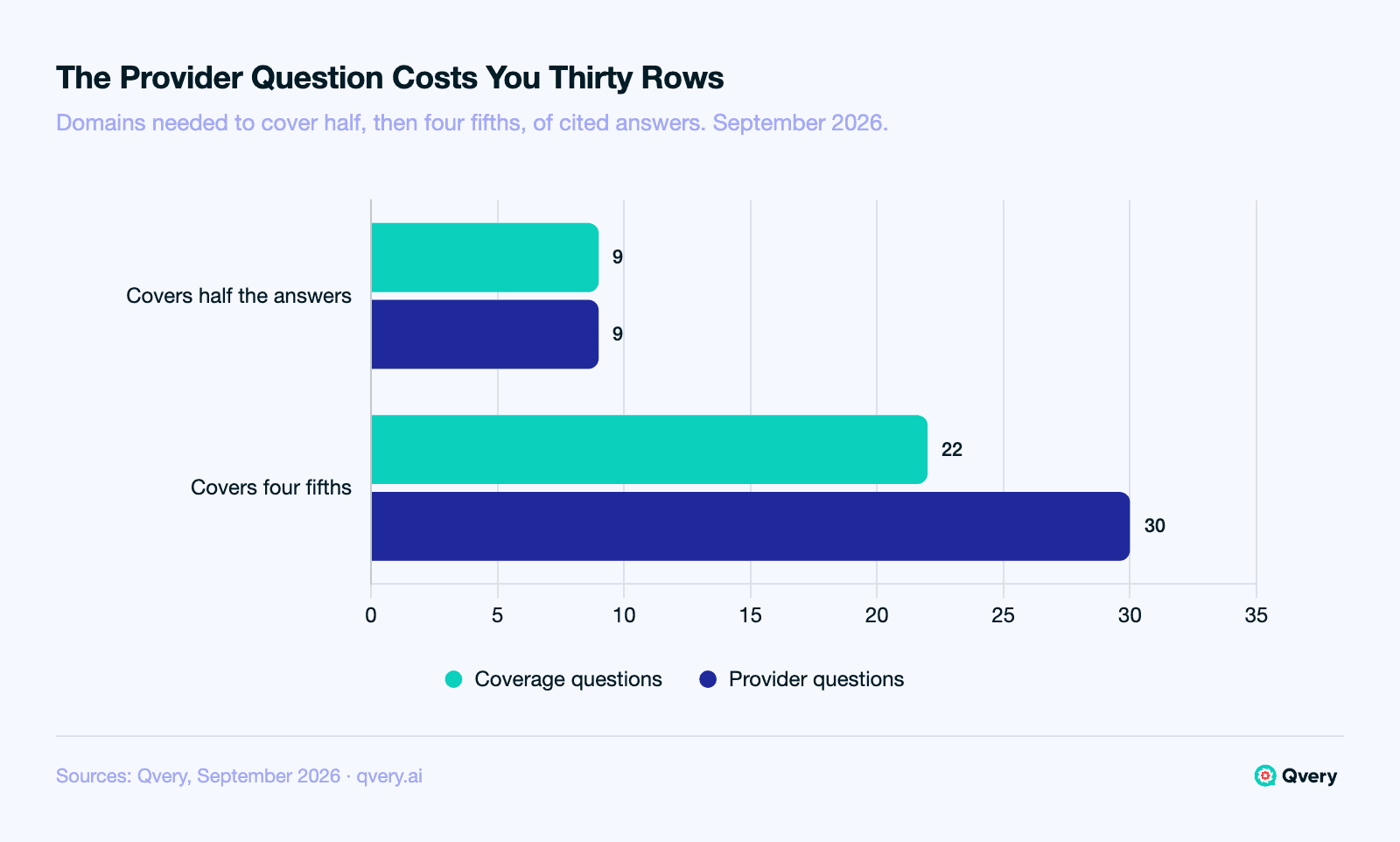
Coverage questions: nine domains cover half of the answers that cited any source. Twenty-two cover four fifths.
Provider questions: nine cover half. Thirty cover four fifths.
Now the number that decides your programme. Those two lists share two rows, canada.ca and forbes.com. Two out of the smaller list's twenty-two, a shared fraction of 0.09.
Here is the coverage list in full, in the order the coverage was reached:
Sun Life, Forbes, NHS, Aetna, MyTribe Insurance, HealthCare.gov, gov.uk, EyeMed, Canada.ca
privatehealth.gov.au, Medicare.gov, Delta Dental, NerdWallet, Which?, Walgreens, GreenShield
Sam's Club, 988 Lifeline, Aeva, The Mental Health Coalition, UnitedHealthcare, Sword Health
And the provider list:
Bupa, health.gov.au, Talkspace, Teladoc, Canada.ca, Google, DocTap, Forbes, Ontario Psychological Association
MDLive, Healthgrades, Pushtalk, NHS Inform Scotland, Well Clinics, Diamondback Dentistry, Livi
ADA Find-a-Dentist, HCA Healthcare UK, Trainwell, 50 Dollar Eye Guy, Dentulu, One Stop Talk
Michael Hill Optometrists, NewYork-Presbyterian, AZ Fitness, Arizona Blue Cross, a Cleveland implant practice, an eye-care practice in Savannah, a Canadian therapy service and a dental centre in Ontario
The coverage list is insurers, public health services and benefit administrators. The provider list is mostly individual clinics, practices and platforms on their own sites, with a long tail of local names you would not recognise unless you work in that city.
Two shared rows out of twenty-two is two lists that happen to sit in the same industry.
So a healthcare brand does not get one audit list. It gets the list for its side, and if it sells on both sides it runs two. Whether that means two owners is your call, not the data's.
What Each Side Answers With
Classify each cited domain by what kind of site it is and the two lists take on a recognisable shape.
Institutional and government sources were present in 50.42% of answers that cited any source on the coverage side and 17.95% on the provider side.
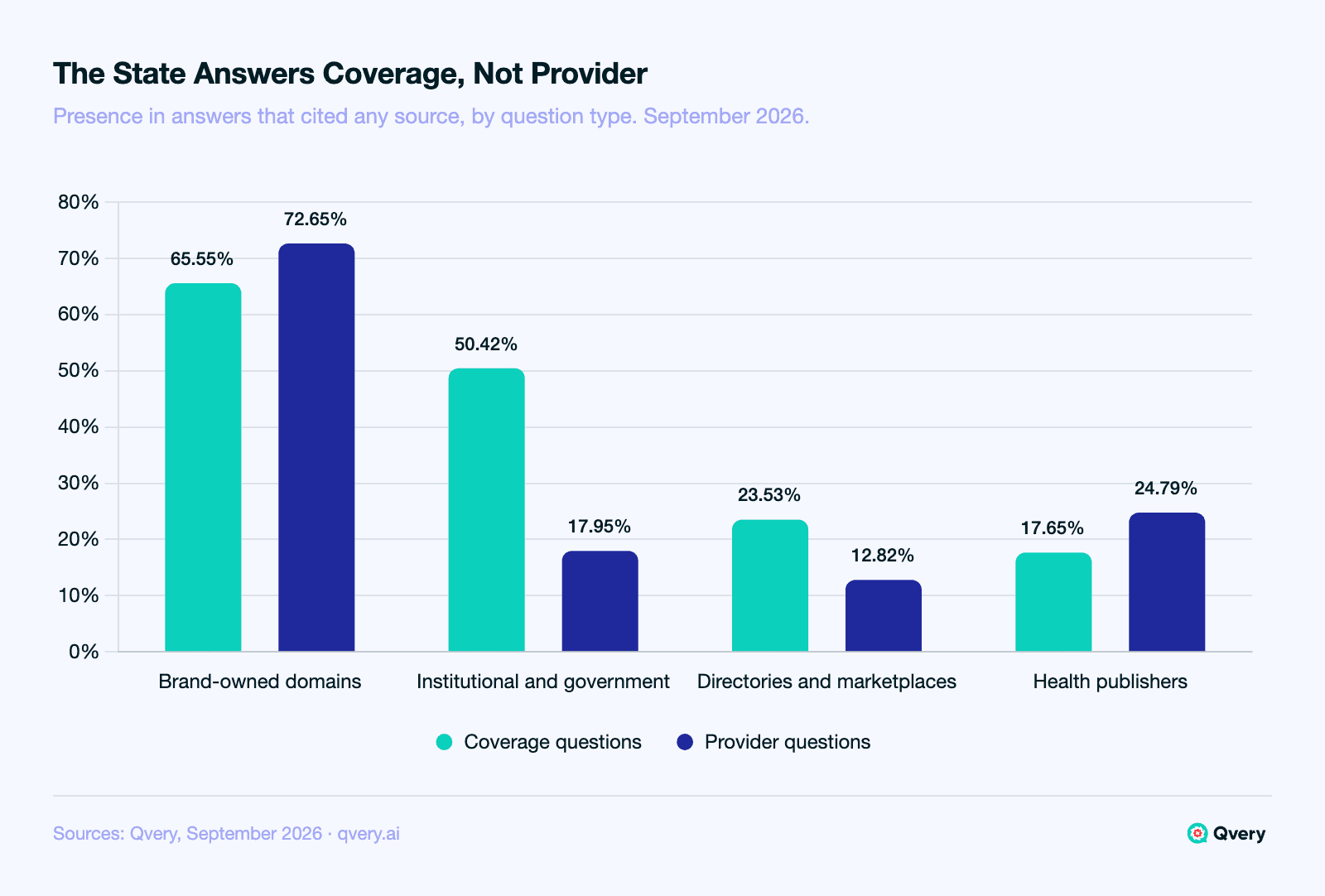
Two more layers move with the question type. Directories and marketplaces were present in 23.53% of answers that cited any source on the coverage side against 12.82% on the provider side.
Health publishers went the other way, 24.79% of answers that cited any source on the provider side against 17.65% on the coverage side. That ratio was registered in advance as indeterminate, so we report it and call nothing.
Now the encouraging part. Brand-owned domains were present in 72.65% of answers that cited any source on the provider side and 65.55% on the coverage side.
Some brand's own pages sit in the answer surface on both sides. Whether yours is among them is the first thing to check, and it is a page you already control rather than a placement you have to earn.
The cheapest thing on a healthcare baseline is the thing nobody checks: whether your own domain is in the citations for your own side.
One boundary worth saying plainly. We counted the sources answers cited. We did not read what those answers said about anybody, we did not measure why one clinic was cited over another, and none of this tells you whether an answer recommended you or merely mentioned the category.
What A Baseline Has To Contain
Judgment, not findings. A baseline you can defend in a budget meeting has five parts.
Question type, kept separate. Provider and coverage tracked as different sets, never averaged into a category number.
Both engines, reported apart. ChatGPT and Google AI Mode are the two Qvery tracks. This study did not compare their answers, and a pooled figure is harder to act on than two you can read.
A named competitor set. Share of voice against a list you wrote down beats share of voice against whoever the engine felt like naming that day.
A window, decided first. One run is a sample. Say how many days you watch before anything counts as movement.
A stated limitation. A citation count tells you which sources an answer used. It does not tell you whether the answer recommended you, mentioned you, or discussed the category without you. Say so before month one gets scored.
Write those five down before the vendor call, not after. They are also the fairest way to hold an agency to account, because they fix the scoreboard before anyone starts playing.
Set The Two Question Types Up In Qvery
Create one topic per sub-vertical you operate in, filed under the question type it belongs to, and put the patient questions under each as queries. Qvery generates a starting set at onboarding and you edit from there in plain language.
Each topic then reports daily on whether you appear, how much of the conversation you hold against the competitors you named, and where you land when you do appear. If those three are not distinct in your head, we separated them in AI visibility versus share of voice.
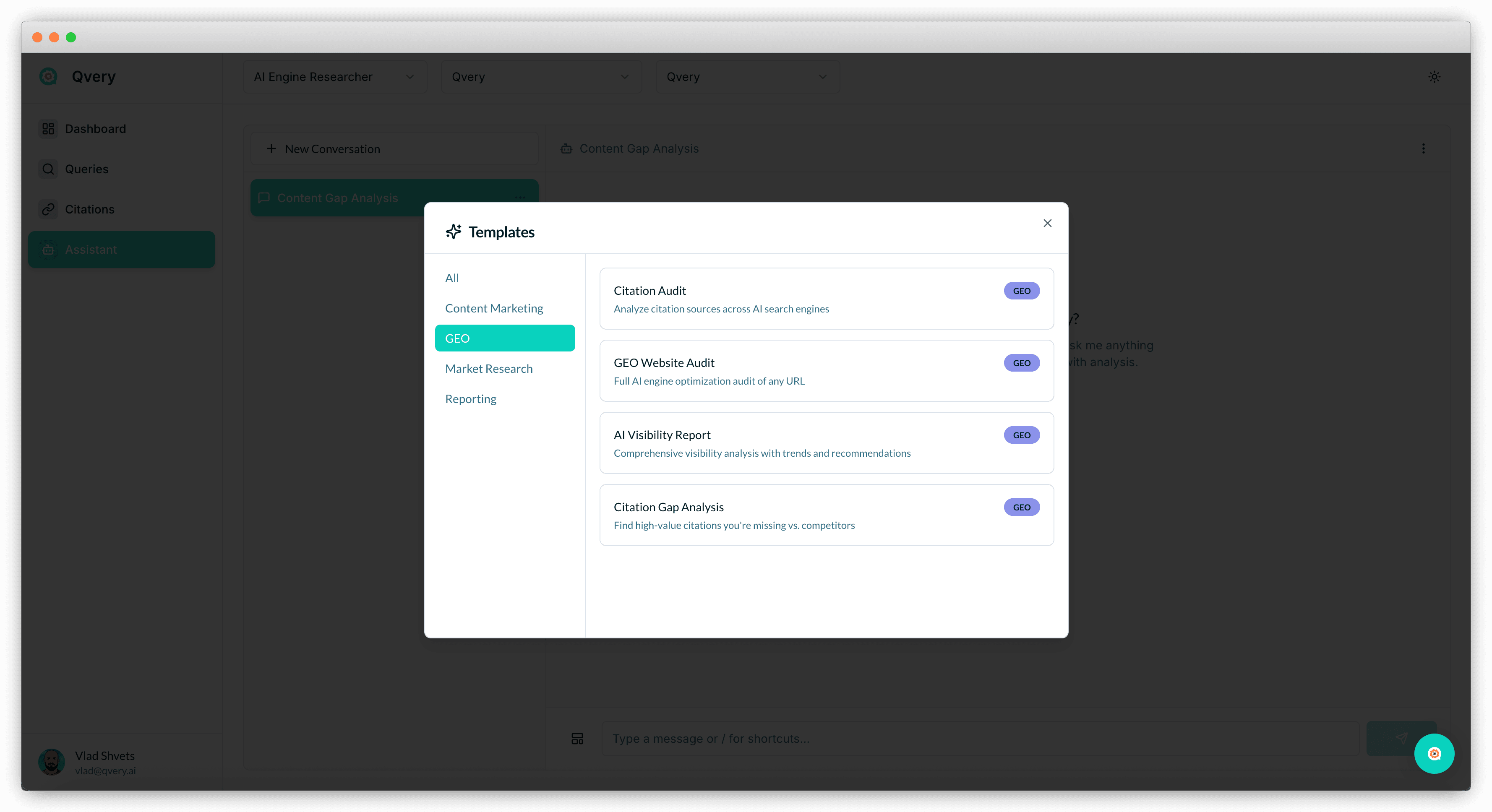
Every answer keeps the sources cited in it, tied to the query and the engine that produced it. The Citations view ranks the URLs and domains behind those answers, each with a weight, filterable by engine and country, and the ranking exports.
That is where your own audit list comes from:
Open the Citations view for one question type's topics and read the Top Domains ranking.
Take rows from the top until another row stops changing what you would do. That is your working list.
Do the same for the other question type.
Mark every row present, absent or stale for your brand, and mark the rows that sit on both lists.
A note on method, so the numbers above are reproducible rather than magic. Our counts used a stricter definition than a top-ranked cut.
We took the smallest set of domains that together cover four fifths of the answers that cited any source, choosing them one at a time by how many still-uncovered answers each one adds. A ranked list read from the top is a close and usable version of the same thing.
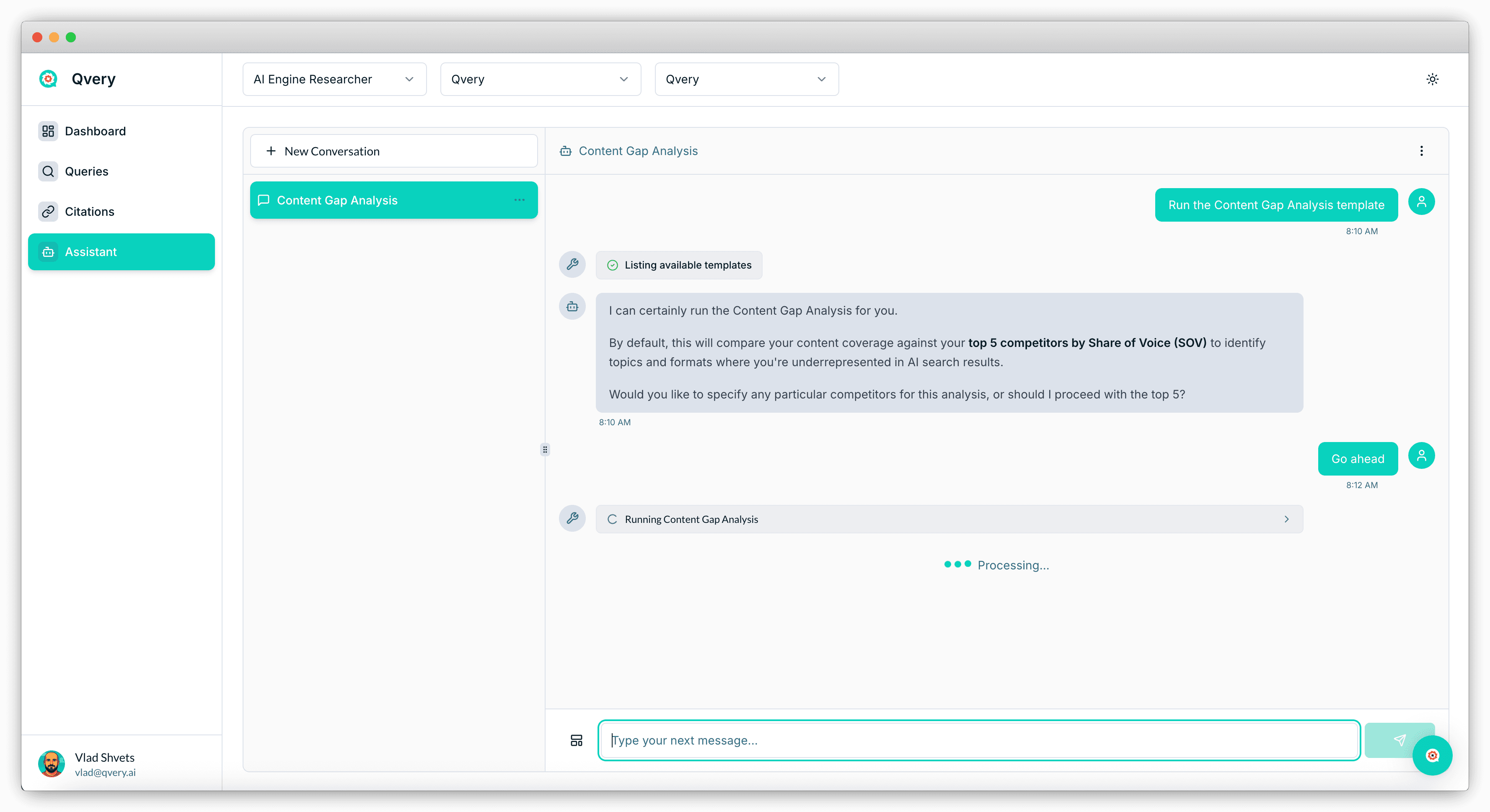
The Assistant can run the shipped templates for you. It lists what is available, proposes a competitor set before it starts, asks whether to go ahead, and then runs. Useful as a first pass; the four steps above are the version you keep.
Two limits to know going in. The Citations view records and ranks which sources an answer cited; it does not sort those sources into regulators, directories and publishers for you, and it does not report which brands the answer named in its text. Both reads are yours, done once, when you build the list.
Start a Qvery trial and set up your side of the split first. Seven days free, no credit card, which is time to get the baseline configured and the first days of data in before the proposal needs an answer.
Before the next vendor call, write your baseline definition down. One page. A proposal you cannot score against it is a brochure with a price on it.
There is a proposal on your desk. It says AI search, it has a number at the bottom, and it promises to make your clinic, your platform or your plan show up in the answers people get instead of a search results page.
Before you sign it, one question. What is your baseline today?
The usual answer is a single blended number for the whole category. A blended number cannot be a baseline here, because patients ask two different questions and the two get answered by two different sets of websites.
This is about defining the measurement. It says nothing about who is winning.
Patients Ask Two Questions And Only One Of Them Is About You
The first question is about a provider. Which telehealth service, which therapist, which dentist near me, which clinic for this procedure.
The second is about coverage. Does my plan pay for this, which plan covers dental, what does the public system cover and what do I buy on top.
A health brand usually sits on one side. A therapy platform lives on the provider side. A benefits plan lives on the coverage side. Plenty of companies straddle both, and those are the ones most at risk of averaging themselves into a meaningless number.
Write down the ten questions your patients type before they know your name. Sort them into the two piles. That sorting is the baseline's first requirement, and it costs nothing.
Count The Rows Before You Count Anything Else
The cheapest useful measurement is a count of the websites you have to care about.
Take one pile. Find the smallest set of domains covering half of the answers that cited any source, then the set covering four fifths. Do it for the other pile. Then compare.
Across a targeted set of patient questions we ran on ChatGPT and Google AI Mode in September 2026, the two piles came out like this. Directional, not a census.
Coverage questions: nine domains cover half of the answers that cited any source. Twenty-two cover four fifths.
Provider questions: nine cover half. Thirty cover four fifths.
Now the number that decides your programme. Those two lists share two rows, canada.ca and forbes.com. Two out of the smaller list's twenty-two, a shared fraction of 0.09.
Here is the coverage list in full, in the order the coverage was reached:
Sun Life, Forbes, NHS, Aetna, MyTribe Insurance, HealthCare.gov, gov.uk, EyeMed, Canada.ca
privatehealth.gov.au, Medicare.gov, Delta Dental, NerdWallet, Which?, Walgreens, GreenShield
Sam's Club, 988 Lifeline, Aeva, The Mental Health Coalition, UnitedHealthcare, Sword Health
And the provider list:
Bupa, health.gov.au, Talkspace, Teladoc, Canada.ca, Google, DocTap, Forbes, Ontario Psychological Association
MDLive, Healthgrades, Pushtalk, NHS Inform Scotland, Well Clinics, Diamondback Dentistry, Livi
ADA Find-a-Dentist, HCA Healthcare UK, Trainwell, 50 Dollar Eye Guy, Dentulu, One Stop Talk
Michael Hill Optometrists, NewYork-Presbyterian, AZ Fitness, Arizona Blue Cross, a Cleveland implant practice, an eye-care practice in Savannah, a Canadian therapy service and a dental centre in Ontario
The coverage list is insurers, public health services and benefit administrators. The provider list is mostly individual clinics, practices and platforms on their own sites, with a long tail of local names you would not recognise unless you work in that city.
Two shared rows out of twenty-two is two lists that happen to sit in the same industry.
So a healthcare brand does not get one audit list. It gets the list for its side, and if it sells on both sides it runs two. Whether that means two owners is your call, not the data's.
What Each Side Answers With
Classify each cited domain by what kind of site it is and the two lists take on a recognisable shape.
Institutional and government sources were present in 50.42% of answers that cited any source on the coverage side and 17.95% on the provider side.
Two more layers move with the question type. Directories and marketplaces were present in 23.53% of answers that cited any source on the coverage side against 12.82% on the provider side.
Health publishers went the other way, 24.79% of answers that cited any source on the provider side against 17.65% on the coverage side. That ratio was registered in advance as indeterminate, so we report it and call nothing.
Now the encouraging part. Brand-owned domains were present in 72.65% of answers that cited any source on the provider side and 65.55% on the coverage side.
Some brand's own pages sit in the answer surface on both sides. Whether yours is among them is the first thing to check, and it is a page you already control rather than a placement you have to earn.
The cheapest thing on a healthcare baseline is the thing nobody checks: whether your own domain is in the citations for your own side.
One boundary worth saying plainly. We counted the sources answers cited. We did not read what those answers said about anybody, we did not measure why one clinic was cited over another, and none of this tells you whether an answer recommended you or merely mentioned the category.
What A Baseline Has To Contain
Judgment, not findings. A baseline you can defend in a budget meeting has five parts.
Question type, kept separate. Provider and coverage tracked as different sets, never averaged into a category number.
Both engines, reported apart. ChatGPT and Google AI Mode are the two Qvery tracks. This study did not compare their answers, and a pooled figure is harder to act on than two you can read.
A named competitor set. Share of voice against a list you wrote down beats share of voice against whoever the engine felt like naming that day.
A window, decided first. One run is a sample. Say how many days you watch before anything counts as movement.
A stated limitation. A citation count tells you which sources an answer used. It does not tell you whether the answer recommended you, mentioned you, or discussed the category without you. Say so before month one gets scored.
Write those five down before the vendor call, not after. They are also the fairest way to hold an agency to account, because they fix the scoreboard before anyone starts playing.
Set The Two Question Types Up In Qvery
Create one topic per sub-vertical you operate in, filed under the question type it belongs to, and put the patient questions under each as queries. Qvery generates a starting set at onboarding and you edit from there in plain language.
Each topic then reports daily on whether you appear, how much of the conversation you hold against the competitors you named, and where you land when you do appear. If those three are not distinct in your head, we separated them in AI visibility versus share of voice.
Every answer keeps the sources cited in it, tied to the query and the engine that produced it. The Citations view ranks the URLs and domains behind those answers, each with a weight, filterable by engine and country, and the ranking exports.
That is where your own audit list comes from:
Open the Citations view for one question type's topics and read the Top Domains ranking.
Take rows from the top until another row stops changing what you would do. That is your working list.
Do the same for the other question type.
Mark every row present, absent or stale for your brand, and mark the rows that sit on both lists.
A note on method, so the numbers above are reproducible rather than magic. Our counts used a stricter definition than a top-ranked cut.
We took the smallest set of domains that together cover four fifths of the answers that cited any source, choosing them one at a time by how many still-uncovered answers each one adds. A ranked list read from the top is a close and usable version of the same thing.
The Assistant can run the shipped templates for you. It lists what is available, proposes a competitor set before it starts, asks whether to go ahead, and then runs. Useful as a first pass; the four steps above are the version you keep.
Two limits to know going in. The Citations view records and ranks which sources an answer cited; it does not sort those sources into regulators, directories and publishers for you, and it does not report which brands the answer named in its text. Both reads are yours, done once, when you build the list.
Start a Qvery trial and set up your side of the split first. Seven days free, no credit card, which is time to get the baseline configured and the first days of data in before the proposal needs an answer.
Before the next vendor call, write your baseline definition down. One page. A proposal you cannot score against it is a brochure with a price on it.
There is a proposal on your desk. It says AI search, it has a number at the bottom, and it promises to make your clinic, your platform or your plan show up in the answers people get instead of a search results page.
Before you sign it, one question. What is your baseline today?
The usual answer is a single blended number for the whole category. A blended number cannot be a baseline here, because patients ask two different questions and the two get answered by two different sets of websites.
This is about defining the measurement. It says nothing about who is winning.
Patients Ask Two Questions And Only One Of Them Is About You
The first question is about a provider. Which telehealth service, which therapist, which dentist near me, which clinic for this procedure.
The second is about coverage. Does my plan pay for this, which plan covers dental, what does the public system cover and what do I buy on top.
A health brand usually sits on one side. A therapy platform lives on the provider side. A benefits plan lives on the coverage side. Plenty of companies straddle both, and those are the ones most at risk of averaging themselves into a meaningless number.
Write down the ten questions your patients type before they know your name. Sort them into the two piles. That sorting is the baseline's first requirement, and it costs nothing.
Count The Rows Before You Count Anything Else
The cheapest useful measurement is a count of the websites you have to care about.
Take one pile. Find the smallest set of domains covering half of the answers that cited any source, then the set covering four fifths. Do it for the other pile. Then compare.
Across a targeted set of patient questions we ran on ChatGPT and Google AI Mode in September 2026, the two piles came out like this. Directional, not a census.
Coverage questions: nine domains cover half of the answers that cited any source. Twenty-two cover four fifths.
Provider questions: nine cover half. Thirty cover four fifths.
Now the number that decides your programme. Those two lists share two rows, canada.ca and forbes.com. Two out of the smaller list's twenty-two, a shared fraction of 0.09.
Here is the coverage list in full, in the order the coverage was reached:
Sun Life, Forbes, NHS, Aetna, MyTribe Insurance, HealthCare.gov, gov.uk, EyeMed, Canada.ca
privatehealth.gov.au, Medicare.gov, Delta Dental, NerdWallet, Which?, Walgreens, GreenShield
Sam's Club, 988 Lifeline, Aeva, The Mental Health Coalition, UnitedHealthcare, Sword Health
And the provider list:
Bupa, health.gov.au, Talkspace, Teladoc, Canada.ca, Google, DocTap, Forbes, Ontario Psychological Association
MDLive, Healthgrades, Pushtalk, NHS Inform Scotland, Well Clinics, Diamondback Dentistry, Livi
ADA Find-a-Dentist, HCA Healthcare UK, Trainwell, 50 Dollar Eye Guy, Dentulu, One Stop Talk
Michael Hill Optometrists, NewYork-Presbyterian, AZ Fitness, Arizona Blue Cross, a Cleveland implant practice, an eye-care practice in Savannah, a Canadian therapy service and a dental centre in Ontario
The coverage list is insurers, public health services and benefit administrators. The provider list is mostly individual clinics, practices and platforms on their own sites, with a long tail of local names you would not recognise unless you work in that city.
Two shared rows out of twenty-two is two lists that happen to sit in the same industry.
So a healthcare brand does not get one audit list. It gets the list for its side, and if it sells on both sides it runs two. Whether that means two owners is your call, not the data's.
What Each Side Answers With
Classify each cited domain by what kind of site it is and the two lists take on a recognisable shape.
Institutional and government sources were present in 50.42% of answers that cited any source on the coverage side and 17.95% on the provider side.
Two more layers move with the question type. Directories and marketplaces were present in 23.53% of answers that cited any source on the coverage side against 12.82% on the provider side.
Health publishers went the other way, 24.79% of answers that cited any source on the provider side against 17.65% on the coverage side. That ratio was registered in advance as indeterminate, so we report it and call nothing.
Now the encouraging part. Brand-owned domains were present in 72.65% of answers that cited any source on the provider side and 65.55% on the coverage side.
Some brand's own pages sit in the answer surface on both sides. Whether yours is among them is the first thing to check, and it is a page you already control rather than a placement you have to earn.
The cheapest thing on a healthcare baseline is the thing nobody checks: whether your own domain is in the citations for your own side.
One boundary worth saying plainly. We counted the sources answers cited. We did not read what those answers said about anybody, we did not measure why one clinic was cited over another, and none of this tells you whether an answer recommended you or merely mentioned the category.
What A Baseline Has To Contain
Judgment, not findings. A baseline you can defend in a budget meeting has five parts.
Question type, kept separate. Provider and coverage tracked as different sets, never averaged into a category number.
Both engines, reported apart. ChatGPT and Google AI Mode are the two Qvery tracks. This study did not compare their answers, and a pooled figure is harder to act on than two you can read.
A named competitor set. Share of voice against a list you wrote down beats share of voice against whoever the engine felt like naming that day.
A window, decided first. One run is a sample. Say how many days you watch before anything counts as movement.
A stated limitation. A citation count tells you which sources an answer used. It does not tell you whether the answer recommended you, mentioned you, or discussed the category without you. Say so before month one gets scored.
Write those five down before the vendor call, not after. They are also the fairest way to hold an agency to account, because they fix the scoreboard before anyone starts playing.
Set The Two Question Types Up In Qvery
Create one topic per sub-vertical you operate in, filed under the question type it belongs to, and put the patient questions under each as queries. Qvery generates a starting set at onboarding and you edit from there in plain language.
Each topic then reports daily on whether you appear, how much of the conversation you hold against the competitors you named, and where you land when you do appear. If those three are not distinct in your head, we separated them in AI visibility versus share of voice.
Every answer keeps the sources cited in it, tied to the query and the engine that produced it. The Citations view ranks the URLs and domains behind those answers, each with a weight, filterable by engine and country, and the ranking exports.
That is where your own audit list comes from:
Open the Citations view for one question type's topics and read the Top Domains ranking.
Take rows from the top until another row stops changing what you would do. That is your working list.
Do the same for the other question type.
Mark every row present, absent or stale for your brand, and mark the rows that sit on both lists.
A note on method, so the numbers above are reproducible rather than magic. Our counts used a stricter definition than a top-ranked cut.
We took the smallest set of domains that together cover four fifths of the answers that cited any source, choosing them one at a time by how many still-uncovered answers each one adds. A ranked list read from the top is a close and usable version of the same thing.
The Assistant can run the shipped templates for you. It lists what is available, proposes a competitor set before it starts, asks whether to go ahead, and then runs. Useful as a first pass; the four steps above are the version you keep.
Two limits to know going in. The Citations view records and ranks which sources an answer cited; it does not sort those sources into regulators, directories and publishers for you, and it does not report which brands the answer named in its text. Both reads are yours, done once, when you build the list.
Start a Qvery trial and set up your side of the split first. Seven days free, no credit card, which is time to get the baseline configured and the first days of data in before the proposal needs an answer.
Before the next vendor call, write your baseline definition down. One page. A proposal you cannot score against it is a brochure with a price on it.
There is a proposal on your desk. It says AI search, it has a number at the bottom, and it promises to make your clinic, your platform or your plan show up in the answers people get instead of a search results page.
Before you sign it, one question. What is your baseline today?
The usual answer is a single blended number for the whole category. A blended number cannot be a baseline here, because patients ask two different questions and the two get answered by two different sets of websites.
This is about defining the measurement. It says nothing about who is winning.
Patients Ask Two Questions And Only One Of Them Is About You
The first question is about a provider. Which telehealth service, which therapist, which dentist near me, which clinic for this procedure.
The second is about coverage. Does my plan pay for this, which plan covers dental, what does the public system cover and what do I buy on top.
A health brand usually sits on one side. A therapy platform lives on the provider side. A benefits plan lives on the coverage side. Plenty of companies straddle both, and those are the ones most at risk of averaging themselves into a meaningless number.
Write down the ten questions your patients type before they know your name. Sort them into the two piles. That sorting is the baseline's first requirement, and it costs nothing.
Count The Rows Before You Count Anything Else
The cheapest useful measurement is a count of the websites you have to care about.
Take one pile. Find the smallest set of domains covering half of the answers that cited any source, then the set covering four fifths. Do it for the other pile. Then compare.
Across a targeted set of patient questions we ran on ChatGPT and Google AI Mode in September 2026, the two piles came out like this. Directional, not a census.
Coverage questions: nine domains cover half of the answers that cited any source. Twenty-two cover four fifths.
Provider questions: nine cover half. Thirty cover four fifths.
Now the number that decides your programme. Those two lists share two rows, canada.ca and forbes.com. Two out of the smaller list's twenty-two, a shared fraction of 0.09.
Here is the coverage list in full, in the order the coverage was reached:
Sun Life, Forbes, NHS, Aetna, MyTribe Insurance, HealthCare.gov, gov.uk, EyeMed, Canada.ca
privatehealth.gov.au, Medicare.gov, Delta Dental, NerdWallet, Which?, Walgreens, GreenShield
Sam's Club, 988 Lifeline, Aeva, The Mental Health Coalition, UnitedHealthcare, Sword Health
And the provider list:
Bupa, health.gov.au, Talkspace, Teladoc, Canada.ca, Google, DocTap, Forbes, Ontario Psychological Association
MDLive, Healthgrades, Pushtalk, NHS Inform Scotland, Well Clinics, Diamondback Dentistry, Livi
ADA Find-a-Dentist, HCA Healthcare UK, Trainwell, 50 Dollar Eye Guy, Dentulu, One Stop Talk
Michael Hill Optometrists, NewYork-Presbyterian, AZ Fitness, Arizona Blue Cross, a Cleveland implant practice, an eye-care practice in Savannah, a Canadian therapy service and a dental centre in Ontario
The coverage list is insurers, public health services and benefit administrators. The provider list is mostly individual clinics, practices and platforms on their own sites, with a long tail of local names you would not recognise unless you work in that city.
Two shared rows out of twenty-two is two lists that happen to sit in the same industry.
So a healthcare brand does not get one audit list. It gets the list for its side, and if it sells on both sides it runs two. Whether that means two owners is your call, not the data's.
What Each Side Answers With
Classify each cited domain by what kind of site it is and the two lists take on a recognisable shape.
Institutional and government sources were present in 50.42% of answers that cited any source on the coverage side and 17.95% on the provider side.
Two more layers move with the question type. Directories and marketplaces were present in 23.53% of answers that cited any source on the coverage side against 12.82% on the provider side.
Health publishers went the other way, 24.79% of answers that cited any source on the provider side against 17.65% on the coverage side. That ratio was registered in advance as indeterminate, so we report it and call nothing.
Now the encouraging part. Brand-owned domains were present in 72.65% of answers that cited any source on the provider side and 65.55% on the coverage side.
Some brand's own pages sit in the answer surface on both sides. Whether yours is among them is the first thing to check, and it is a page you already control rather than a placement you have to earn.
The cheapest thing on a healthcare baseline is the thing nobody checks: whether your own domain is in the citations for your own side.
One boundary worth saying plainly. We counted the sources answers cited. We did not read what those answers said about anybody, we did not measure why one clinic was cited over another, and none of this tells you whether an answer recommended you or merely mentioned the category.
What A Baseline Has To Contain
Judgment, not findings. A baseline you can defend in a budget meeting has five parts.
Question type, kept separate. Provider and coverage tracked as different sets, never averaged into a category number.
Both engines, reported apart. ChatGPT and Google AI Mode are the two Qvery tracks. This study did not compare their answers, and a pooled figure is harder to act on than two you can read.
A named competitor set. Share of voice against a list you wrote down beats share of voice against whoever the engine felt like naming that day.
A window, decided first. One run is a sample. Say how many days you watch before anything counts as movement.
A stated limitation. A citation count tells you which sources an answer used. It does not tell you whether the answer recommended you, mentioned you, or discussed the category without you. Say so before month one gets scored.
Write those five down before the vendor call, not after. They are also the fairest way to hold an agency to account, because they fix the scoreboard before anyone starts playing.
Set The Two Question Types Up In Qvery
Create one topic per sub-vertical you operate in, filed under the question type it belongs to, and put the patient questions under each as queries. Qvery generates a starting set at onboarding and you edit from there in plain language.
Each topic then reports daily on whether you appear, how much of the conversation you hold against the competitors you named, and where you land when you do appear. If those three are not distinct in your head, we separated them in AI visibility versus share of voice.
Every answer keeps the sources cited in it, tied to the query and the engine that produced it. The Citations view ranks the URLs and domains behind those answers, each with a weight, filterable by engine and country, and the ranking exports.
That is where your own audit list comes from:
Open the Citations view for one question type's topics and read the Top Domains ranking.
Take rows from the top until another row stops changing what you would do. That is your working list.
Do the same for the other question type.
Mark every row present, absent or stale for your brand, and mark the rows that sit on both lists.
A note on method, so the numbers above are reproducible rather than magic. Our counts used a stricter definition than a top-ranked cut.
We took the smallest set of domains that together cover four fifths of the answers that cited any source, choosing them one at a time by how many still-uncovered answers each one adds. A ranked list read from the top is a close and usable version of the same thing.
The Assistant can run the shipped templates for you. It lists what is available, proposes a competitor set before it starts, asks whether to go ahead, and then runs. Useful as a first pass; the four steps above are the version you keep.
Two limits to know going in. The Citations view records and ranks which sources an answer cited; it does not sort those sources into regulators, directories and publishers for you, and it does not report which brands the answer named in its text. Both reads are yours, done once, when you build the list.
Start a Qvery trial and set up your side of the split first. Seven days free, no credit card, which is time to get the baseline configured and the first days of data in before the proposal needs an answer.
Before the next vendor call, write your baseline definition down. One page. A proposal you cannot score against it is a brochure with a price on it.
© 2026 Qvery AI OÜ