By
Vlad Shvets
AI Visibility For Health Product Brands: Which Sources Answer For You
The standard advice is to get onto a Healthline roundup. In the health-product questions we ran, Healthline reaches 4.88% of clinical-claim answers and Medical News Today none at all. The NIH, the FDA and the NHS answer that half of the category instead.
The standard advice is to get onto a Healthline roundup. In the health-product questions we ran, Healthline reaches 4.88% of clinical-claim answers and Medical News Today none at all. The NIH, the FDA and the NHS answer that half of the category instead.
The standard advice is to get onto a Healthline roundup. In the health-product questions we ran, Healthline reaches 4.88% of clinical-claim answers and Medical News Today none at all. The NIH, the FDA and the NHS answer that half of the category instead.
If you market a supplement, somebody has told you to get onto a Healthline roundup. It is the standard advice in this category, and it has been for years: the medically-reviewed publishers are where health answers come from, so buy or earn your way into their best-of lists.
Agencies price retainers against that belief. It is a reasonable belief to hold, because Healthline is enormous, it ranks for nearly every health question anyone types, and it carries a medical-review byline that looks exactly like the signal an engine ought to reward.
So we ran the questions a person asks when they are buying a health product, on ChatGPT and Google AI Mode, and logged what the answers were built from.
In the clinical-claim questions, Healthline appears in 4.88% of answers that cited any source. Medical News Today does not appear at all. What does appear is the National Institutes of Health, the FDA, and the NHS.
The short version: health products split into two categories with two entirely different source layers, and the line between them is whether your product makes a clinical claim.
A note on what this measures, because it matters more here than usual. These are the sources that sat alongside the answers. Whether appearing on one of them causes a product to be named is a different question, and nothing here was built to answer it.
Healthline Is Not The Gate
We expected the opposite going in. The guess was that a set of medically-reviewed publishers, Healthline and Medical News Today alongside Verywell, Innerbody, and ConsumerLab, would carry most of the health-product answers between them.
The set did not come close. Healthline sits at 4.88% of answers that cited any source on the clinical-claim side, Medical News Today is absent, and Verywell Fit turns up at 8.20% on the other side of the split entirely.
Two members of a five-member publisher set, landing on opposite sides, describes a couple of sites doing ordinary publishing work rather than a layer with gatekeeping power over the category.
That deserves stating plainly because the commission for this article assumed the opposite, and because the assumption is widespread enough that agencies sell against it.
It survived in our own brief until we measured it. Search rankings and AI citations are mostly different lists, and this is what that looks like inside one category.
One number needs its own frame before anyone puts it beside ours. Our telehealth work published Healthline in 30.11% of cited answers, and that figure is real.
It answers a different question. That one asked about care providers, this one asks about products you buy, and the two figures are not two readings of one quantity.
Before you buy or pitch a roundup placement, run your own ten product questions and write down the domains that come back. If the publication you are pitching is missing from that list, you have your answer about where the budget should go.
Clinical-Claim Answers Come From The Government
Across a targeted set of health-product questions we ran on ChatGPT and Google AI Mode in August 2026, weighted toward the United States, here is what the clinical-claim half was assembled from, as shares of answers that cited any source:
NIH Office of Dietary Supplements: 16.26%, the leading source on that side.
NIH complementary and integrative health: 9.76%, a second NIH property in its own right.
The NHS: 7.32%, and the FDA 5.69%.
Healthline: 4.88%, the only medically-reviewed publisher to appear on this side at all.
menopause.org and health.com: 4.07% each, closing the group.
Two of the four leaders are the same institution. The Office of Dietary Supplements and the centre for complementary and integrative health are separate NIH properties, and each was cited often enough to carry a number on its own.
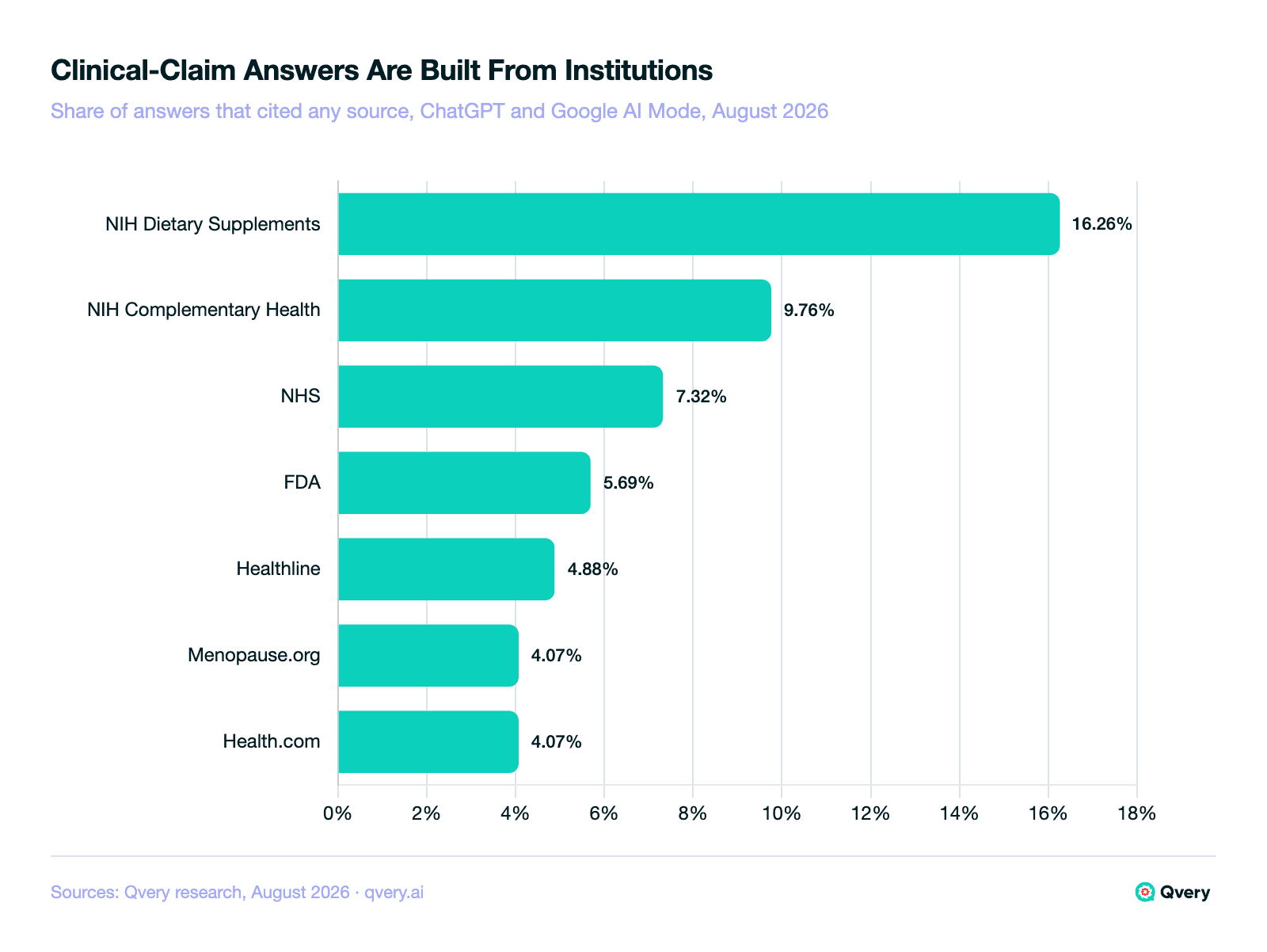
These were ordinary shopping questions. "Best magnesium supplements." "Which sleep aids work for frequent travelers." "Recommend a vitamin B12 supplement for vegetarians." A person asking what to buy, and an answer assembled substantially out of government health information.
One row is left out of that chart on purpose. Google AI Mode returns its citations as Google's own wrapper links instead of publisher URLs, so google.com sits near the top of both lists here as engine plumbing.
Dropping it changes no other figure. Both halves carry the same mix of engines, so the two stay comparable against each other.
There is no press strategy that puts a supplement brand into an NIH fact sheet. That layer is written about ingredients, not about brands.
Those fact sheets are organized by ingredient. Magnesium, melatonin, vitamin D, iron: each has a page stating what the evidence supports and what it does not, updated on a schedule that has nothing to do with anybody's product launch.
A brand selling magnesium is competing next to a document about magnesium.
If the label claims more than that document supports, the answer that names your product can carry the correction in the same breath.
Pull the NIH and FDA pages for whatever you sell and read them the way an engine reads them. That text sits beside your product in the answer, and your claims have to survive next to it.
Wellness Answers Come From The Gadget Press
Now the other half, asked the same way on the same engines, about sleep trackers, fitness gear, and kitchen equipment.
On the same denominator, that half was assembled from a completely different set:
Wired: 18.03%, the leading source on that side.
Forbes: 12.30%, and Wareable 9.84%.
Verywell Fit: 8.20%, the best-placed medically-reviewed title anywhere here.
Food Network: 6.56%, which tells you how a kitchen gadget gets judged.
TechRadar, RTINGS and PubMed Central: 5.74% each.
Men's Health: 4.92%, closing the group.
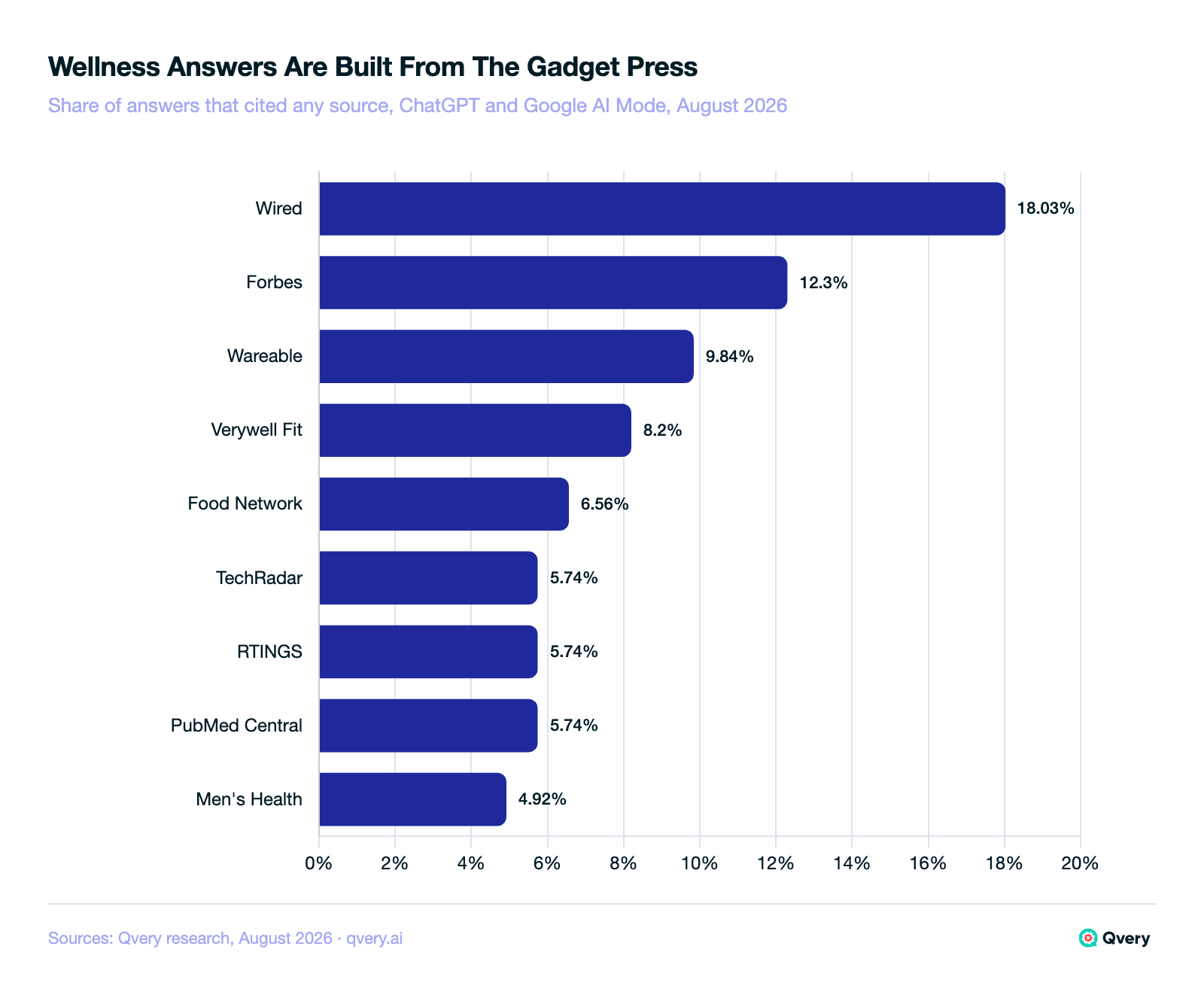
Notice which of those names are health publications and which are not. Wired, TechRadar, and RTINGS are consumer-technology titles, and Food Network is a cooking one.
A sleep tracker is being judged as a gadget here, by the people who judge gadgets.
A sleep tracker is reviewed by people who review gadgets, so the medical credential on your packaging is not the thing being evaluated.
The one medically-reviewed title in the group, Verywell Fit at 8.20%, is the highest-placed member of that publisher set anywhere here. It sits on the wellness side, which is the reverse of what we expected.
We had also expected the medically-reviewed set to out-appear general editorial. General editorial leads it outright, with Wired at more than twice the rate of the best-placed medically-reviewed title we saw.
There is an asymmetry in the shape of the two rosters as well. The clinical side is carried by four institutions and a short tail of publishers. The wellness side is nine publications, which is a wider field with more ways in.
So the same company, selling a sleep supplement and a sleep tracker, faces two different jobs. One is a regulatory and evidence problem. The other is a reviewer-relations problem with a known process and a known cost.
If your product sits on this side, build the reviewer list out of the names above and start sending units. The review cycle is long, so the useful version of that sentence is that you should have started last quarter.
No Retailer Made Either List
Compare the leading sources of the two halves and exactly one domain appears on both. It is Google's link wrapper, so the two rosters of real sources overlap at nothing.
A third thing we expected did hold. We thought retailer and marketplace pages would be a minority of what these answers cite, and none of them reached the leading group on either side.
That result is the one most likely to be misread, so the narrow version is worth stating.
That is a statement about where the answer was assembled, and not a claim that your product listing is worthless. A marketplace is where the transaction happens, and what we measured is what the engine reads before it recommends anything.
Those are different jobs on different pages, and only one of them shows up in this data. If your plan for AI visibility runs entirely through your marketplace listing, that is the gap in it.
Which layer is answering for you is a read off the citation list, ranked by weight rather than by which names you recognize.
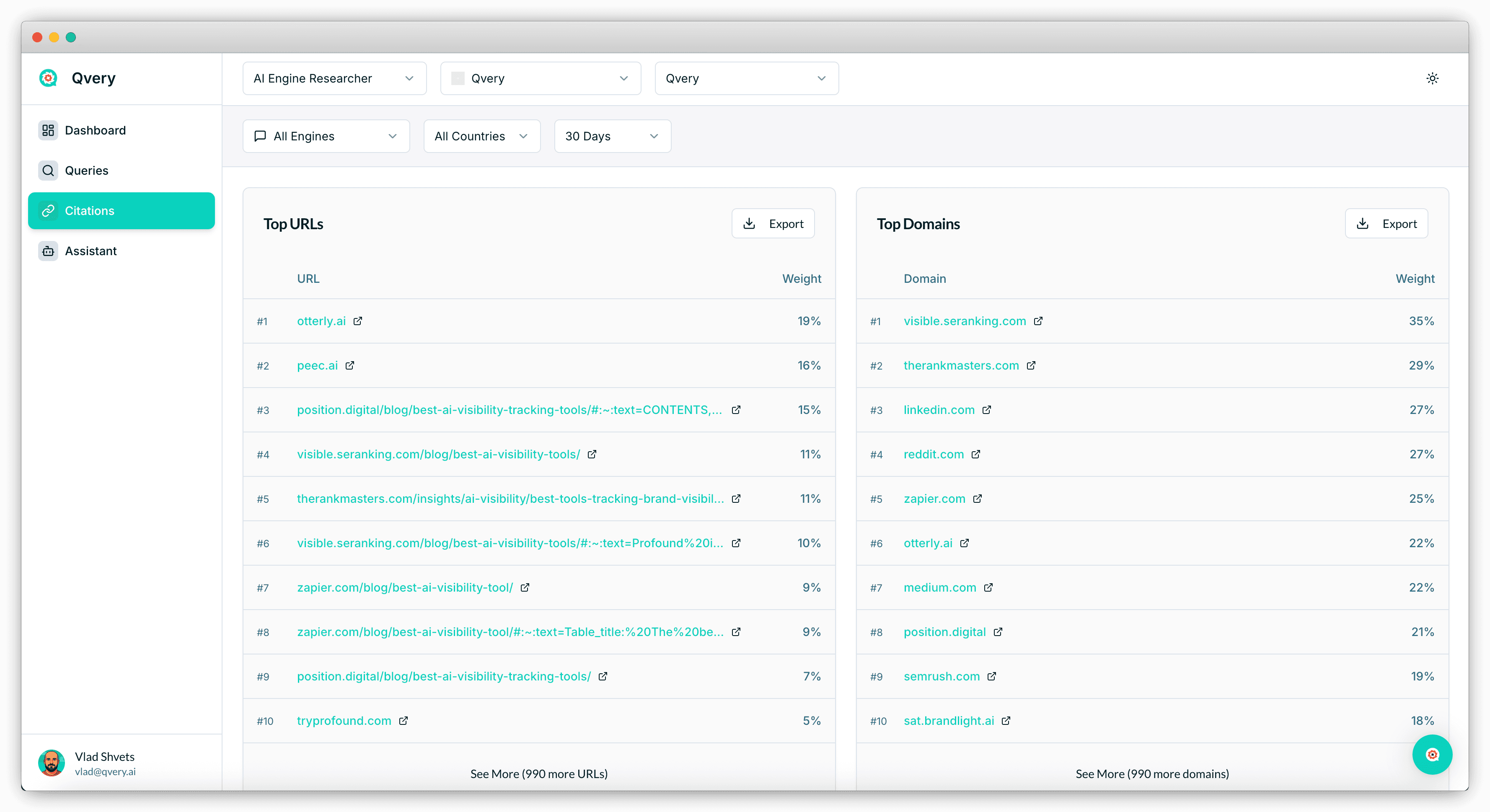
The account in that view is not a health brand, and the ranked-weight read is the part that transfers.
A fourth question cannot be answered here. We wanted to know whether the publisher layer thins on safety questions, the "is this ingredient dangerous" family, and neither half of what we asked carries that intent. That question stays open.
Work out which side your product sits on before you read another word of AI visibility advice, because half of what is written about health brands is addressed to the other one.
The Evidence Job And The Reviewer Job
Everything from here is judgment on what the pattern suggests. The numbers show what appeared alongside these answers, and they do not show that changing any of it changes what gets cited.
Our read is that the clinical side is barely a marketing problem in the ordinary sense. When the sources answering a question are the NIH, the FDA, and the NHS, the lever is the evidence base for your ingredient and the accuracy of your claims against it.
Both of those are slow, expensive, and mostly owned outside the marketing team, which is an uncomfortable thing for a marketing budget to discover.
The wellness side is the familiar job. Editorial reviewers, a product that survives testing, and enough persistence to get into the roundups those reviewers publish. It is not easy, but it is a known process with names attached to it, and the names are in the chart above.
There is a reading of this that sounds like bad news for supplement brands, and we do not think it is one. Knowing the answer is assembled from institutional sources tells you where the work sits: upstream of marketing, in what the product can demonstrate, which compounds in a way a roundup placement does not.
The mistake we would expect to see is a brand with both kinds of product running one budget and one plan across them. The two halves of that catalogue are being read by different sources and judged on different evidence.
One more thing is worth saying about timing. An ingredient's evidence base moves on the timescale of studies, and a device roundup refreshes on the timescale of product cycles. If you sell both, the two halves of your plan should not sit on the same review cadence either.
Answer one question in writing before you plan next quarter: does your packaging make a claim a regulator would recognize? Budget from that answer rather than from the category label on your industry.
Split Your Health Queries By Claim Type In Qvery
Two lists, kept apart from the first run:
The clinical list: your ingredients and the conditions people buy them for, written the way a customer says them.
The wellness list: your devices and the jobs people buy them to do.
A blended report across both would average the NIH and Wired into a picture of neither.
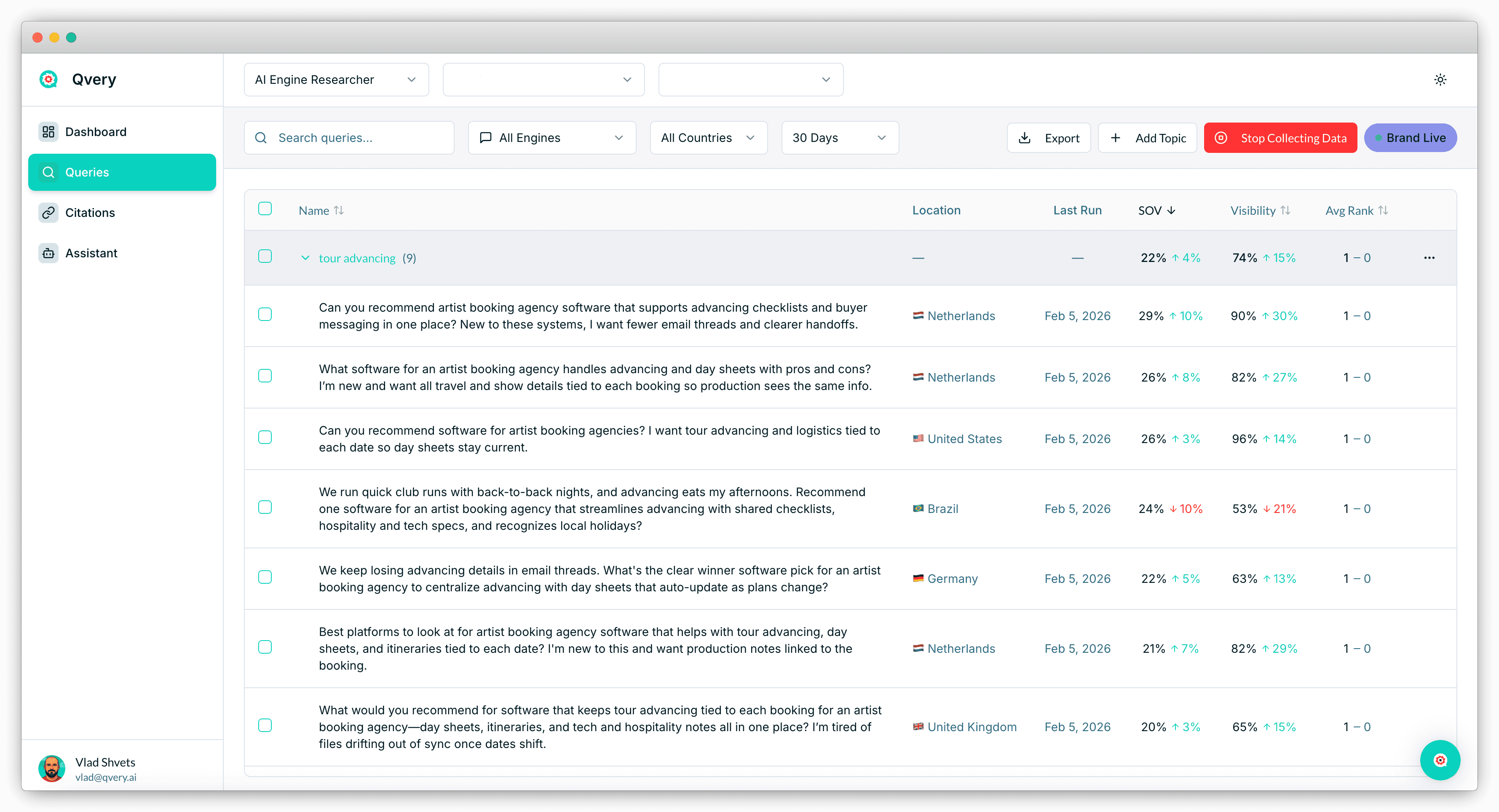
Set them up as two topics and let them run. Qvery asks them daily on ChatGPT and Google AI Mode, in over 200 countries, and captures every citation tied to the query and the engine that produced it.
Then read the two rows against each other:
Visibility per topic: whether you are named at all on each side of your catalogue.
Top Domains per topic: institutions on one, magazines on the other, which tells you which team owns the work.
Top URLs, wellness side: the specific roundups being quoted, which is your reviewer list.
The delta: whether the wellness row moves after you ship units to reviewers, since that is the only side with a lever short enough to see.
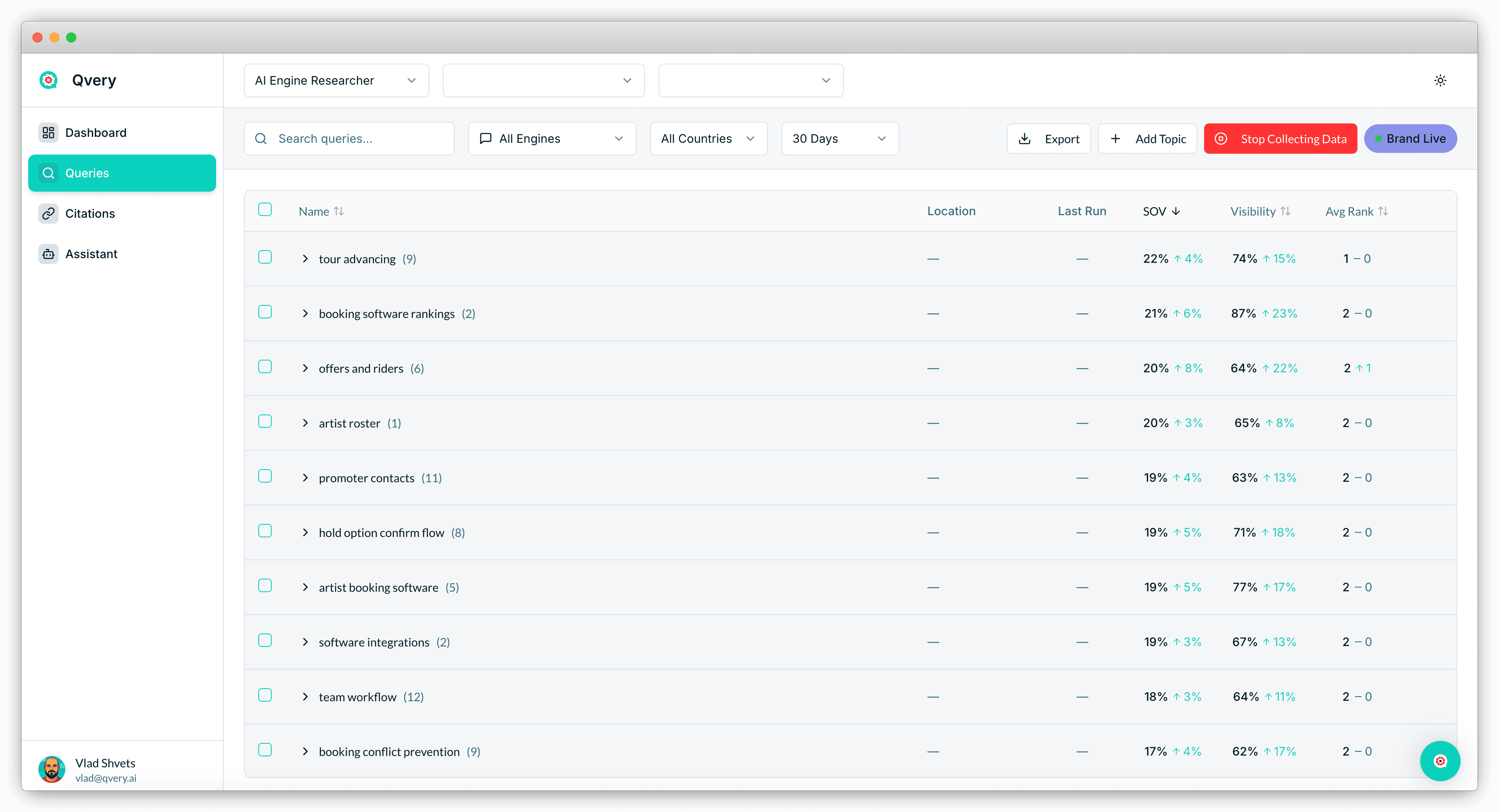
In Qvery Assistant you ask for the same cut in plain language, and it runs the analysis rather than handing you a number to interpret.
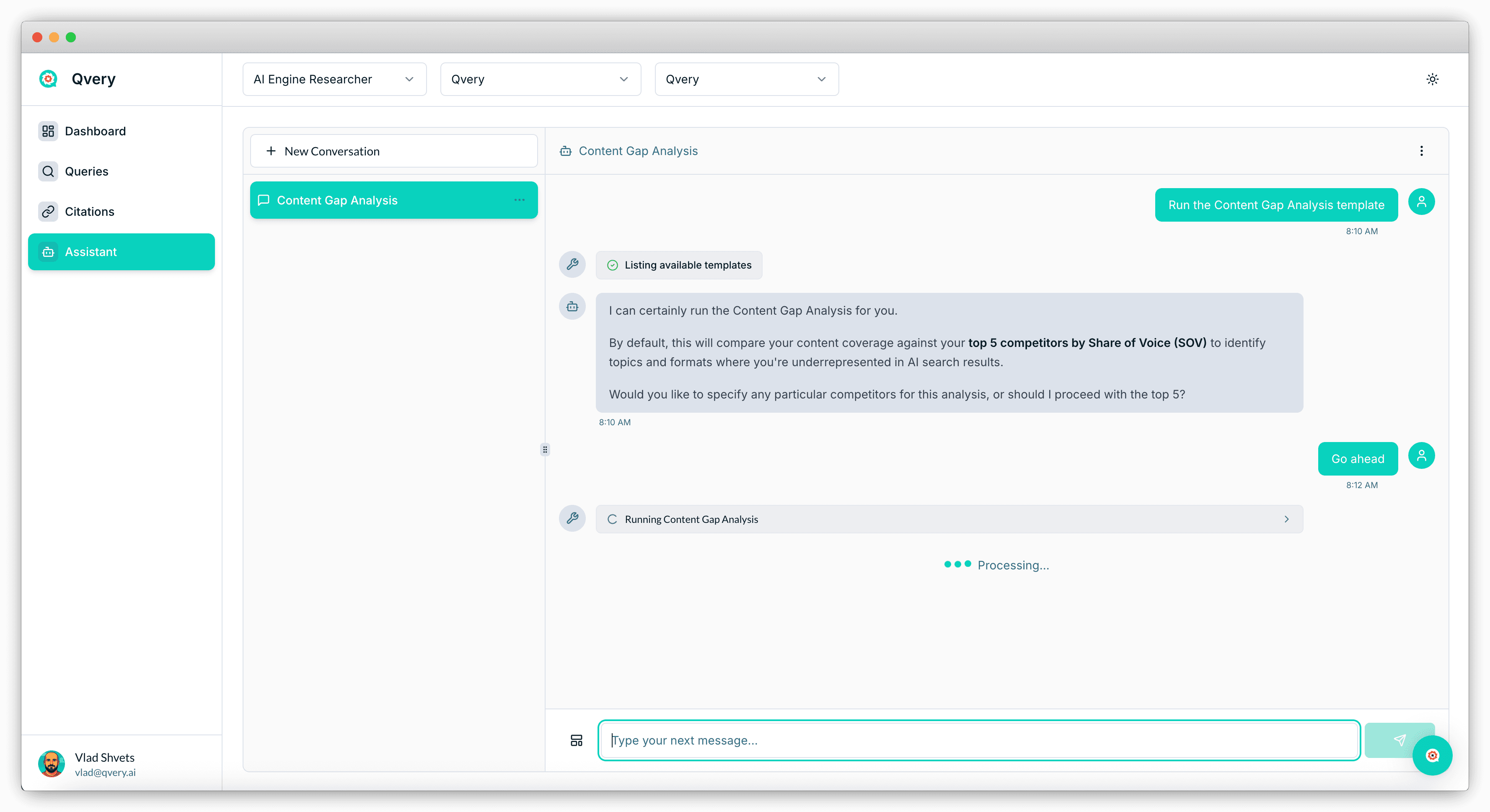
Two things stay yours. Deciding whether a cited domain is an institutional source, a consumer reviewer, or a retailer is a judgment call on a list of URLs, and Qvery captures the list rather than classifying it.
And it will not tell you which side a product belongs on. That is a regulatory question about your own packaging, and it is the one that decides everything else here.
Start your free trial and split your first month of health-product citations by claim type.
If the clinical list comes back full of government pages and the wellness list comes back full of magazines, you are looking at the same split we measured, and the two halves of your catalogue need two different plans.
If you market a supplement, somebody has told you to get onto a Healthline roundup. It is the standard advice in this category, and it has been for years: the medically-reviewed publishers are where health answers come from, so buy or earn your way into their best-of lists.
Agencies price retainers against that belief. It is a reasonable belief to hold, because Healthline is enormous, it ranks for nearly every health question anyone types, and it carries a medical-review byline that looks exactly like the signal an engine ought to reward.
So we ran the questions a person asks when they are buying a health product, on ChatGPT and Google AI Mode, and logged what the answers were built from.
In the clinical-claim questions, Healthline appears in 4.88% of answers that cited any source. Medical News Today does not appear at all. What does appear is the National Institutes of Health, the FDA, and the NHS.
The short version: health products split into two categories with two entirely different source layers, and the line between them is whether your product makes a clinical claim.
A note on what this measures, because it matters more here than usual. These are the sources that sat alongside the answers. Whether appearing on one of them causes a product to be named is a different question, and nothing here was built to answer it.
Healthline Is Not The Gate
We expected the opposite going in. The guess was that a set of medically-reviewed publishers, Healthline and Medical News Today alongside Verywell, Innerbody, and ConsumerLab, would carry most of the health-product answers between them.
The set did not come close. Healthline sits at 4.88% of answers that cited any source on the clinical-claim side, Medical News Today is absent, and Verywell Fit turns up at 8.20% on the other side of the split entirely.
Two members of a five-member publisher set, landing on opposite sides, describes a couple of sites doing ordinary publishing work rather than a layer with gatekeeping power over the category.
That deserves stating plainly because the commission for this article assumed the opposite, and because the assumption is widespread enough that agencies sell against it.
It survived in our own brief until we measured it. Search rankings and AI citations are mostly different lists, and this is what that looks like inside one category.
One number needs its own frame before anyone puts it beside ours. Our telehealth work published Healthline in 30.11% of cited answers, and that figure is real.
It answers a different question. That one asked about care providers, this one asks about products you buy, and the two figures are not two readings of one quantity.
Before you buy or pitch a roundup placement, run your own ten product questions and write down the domains that come back. If the publication you are pitching is missing from that list, you have your answer about where the budget should go.
Clinical-Claim Answers Come From The Government
Across a targeted set of health-product questions we ran on ChatGPT and Google AI Mode in August 2026, weighted toward the United States, here is what the clinical-claim half was assembled from, as shares of answers that cited any source:
NIH Office of Dietary Supplements: 16.26%, the leading source on that side.
NIH complementary and integrative health: 9.76%, a second NIH property in its own right.
The NHS: 7.32%, and the FDA 5.69%.
Healthline: 4.88%, the only medically-reviewed publisher to appear on this side at all.
menopause.org and health.com: 4.07% each, closing the group.
Two of the four leaders are the same institution. The Office of Dietary Supplements and the centre for complementary and integrative health are separate NIH properties, and each was cited often enough to carry a number on its own.
These were ordinary shopping questions. "Best magnesium supplements." "Which sleep aids work for frequent travelers." "Recommend a vitamin B12 supplement for vegetarians." A person asking what to buy, and an answer assembled substantially out of government health information.
One row is left out of that chart on purpose. Google AI Mode returns its citations as Google's own wrapper links instead of publisher URLs, so google.com sits near the top of both lists here as engine plumbing.
Dropping it changes no other figure. Both halves carry the same mix of engines, so the two stay comparable against each other.
There is no press strategy that puts a supplement brand into an NIH fact sheet. That layer is written about ingredients, not about brands.
Those fact sheets are organized by ingredient. Magnesium, melatonin, vitamin D, iron: each has a page stating what the evidence supports and what it does not, updated on a schedule that has nothing to do with anybody's product launch.
A brand selling magnesium is competing next to a document about magnesium.
If the label claims more than that document supports, the answer that names your product can carry the correction in the same breath.
Pull the NIH and FDA pages for whatever you sell and read them the way an engine reads them. That text sits beside your product in the answer, and your claims have to survive next to it.
Wellness Answers Come From The Gadget Press
Now the other half, asked the same way on the same engines, about sleep trackers, fitness gear, and kitchen equipment.
On the same denominator, that half was assembled from a completely different set:
Wired: 18.03%, the leading source on that side.
Forbes: 12.30%, and Wareable 9.84%.
Verywell Fit: 8.20%, the best-placed medically-reviewed title anywhere here.
Food Network: 6.56%, which tells you how a kitchen gadget gets judged.
TechRadar, RTINGS and PubMed Central: 5.74% each.
Men's Health: 4.92%, closing the group.
Notice which of those names are health publications and which are not. Wired, TechRadar, and RTINGS are consumer-technology titles, and Food Network is a cooking one.
A sleep tracker is being judged as a gadget here, by the people who judge gadgets.
A sleep tracker is reviewed by people who review gadgets, so the medical credential on your packaging is not the thing being evaluated.
The one medically-reviewed title in the group, Verywell Fit at 8.20%, is the highest-placed member of that publisher set anywhere here. It sits on the wellness side, which is the reverse of what we expected.
We had also expected the medically-reviewed set to out-appear general editorial. General editorial leads it outright, with Wired at more than twice the rate of the best-placed medically-reviewed title we saw.
There is an asymmetry in the shape of the two rosters as well. The clinical side is carried by four institutions and a short tail of publishers. The wellness side is nine publications, which is a wider field with more ways in.
So the same company, selling a sleep supplement and a sleep tracker, faces two different jobs. One is a regulatory and evidence problem. The other is a reviewer-relations problem with a known process and a known cost.
If your product sits on this side, build the reviewer list out of the names above and start sending units. The review cycle is long, so the useful version of that sentence is that you should have started last quarter.
No Retailer Made Either List
Compare the leading sources of the two halves and exactly one domain appears on both. It is Google's link wrapper, so the two rosters of real sources overlap at nothing.
A third thing we expected did hold. We thought retailer and marketplace pages would be a minority of what these answers cite, and none of them reached the leading group on either side.
That result is the one most likely to be misread, so the narrow version is worth stating.
That is a statement about where the answer was assembled, and not a claim that your product listing is worthless. A marketplace is where the transaction happens, and what we measured is what the engine reads before it recommends anything.
Those are different jobs on different pages, and only one of them shows up in this data. If your plan for AI visibility runs entirely through your marketplace listing, that is the gap in it.
Which layer is answering for you is a read off the citation list, ranked by weight rather than by which names you recognize.
The account in that view is not a health brand, and the ranked-weight read is the part that transfers.
A fourth question cannot be answered here. We wanted to know whether the publisher layer thins on safety questions, the "is this ingredient dangerous" family, and neither half of what we asked carries that intent. That question stays open.
Work out which side your product sits on before you read another word of AI visibility advice, because half of what is written about health brands is addressed to the other one.
The Evidence Job And The Reviewer Job
Everything from here is judgment on what the pattern suggests. The numbers show what appeared alongside these answers, and they do not show that changing any of it changes what gets cited.
Our read is that the clinical side is barely a marketing problem in the ordinary sense. When the sources answering a question are the NIH, the FDA, and the NHS, the lever is the evidence base for your ingredient and the accuracy of your claims against it.
Both of those are slow, expensive, and mostly owned outside the marketing team, which is an uncomfortable thing for a marketing budget to discover.
The wellness side is the familiar job. Editorial reviewers, a product that survives testing, and enough persistence to get into the roundups those reviewers publish. It is not easy, but it is a known process with names attached to it, and the names are in the chart above.
There is a reading of this that sounds like bad news for supplement brands, and we do not think it is one. Knowing the answer is assembled from institutional sources tells you where the work sits: upstream of marketing, in what the product can demonstrate, which compounds in a way a roundup placement does not.
The mistake we would expect to see is a brand with both kinds of product running one budget and one plan across them. The two halves of that catalogue are being read by different sources and judged on different evidence.
One more thing is worth saying about timing. An ingredient's evidence base moves on the timescale of studies, and a device roundup refreshes on the timescale of product cycles. If you sell both, the two halves of your plan should not sit on the same review cadence either.
Answer one question in writing before you plan next quarter: does your packaging make a claim a regulator would recognize? Budget from that answer rather than from the category label on your industry.
Split Your Health Queries By Claim Type In Qvery
Two lists, kept apart from the first run:
The clinical list: your ingredients and the conditions people buy them for, written the way a customer says them.
The wellness list: your devices and the jobs people buy them to do.
A blended report across both would average the NIH and Wired into a picture of neither.
Set them up as two topics and let them run. Qvery asks them daily on ChatGPT and Google AI Mode, in over 200 countries, and captures every citation tied to the query and the engine that produced it.
Then read the two rows against each other:
Visibility per topic: whether you are named at all on each side of your catalogue.
Top Domains per topic: institutions on one, magazines on the other, which tells you which team owns the work.
Top URLs, wellness side: the specific roundups being quoted, which is your reviewer list.
The delta: whether the wellness row moves after you ship units to reviewers, since that is the only side with a lever short enough to see.
In Qvery Assistant you ask for the same cut in plain language, and it runs the analysis rather than handing you a number to interpret.
Two things stay yours. Deciding whether a cited domain is an institutional source, a consumer reviewer, or a retailer is a judgment call on a list of URLs, and Qvery captures the list rather than classifying it.
And it will not tell you which side a product belongs on. That is a regulatory question about your own packaging, and it is the one that decides everything else here.
Start your free trial and split your first month of health-product citations by claim type.
If the clinical list comes back full of government pages and the wellness list comes back full of magazines, you are looking at the same split we measured, and the two halves of your catalogue need two different plans.
If you market a supplement, somebody has told you to get onto a Healthline roundup. It is the standard advice in this category, and it has been for years: the medically-reviewed publishers are where health answers come from, so buy or earn your way into their best-of lists.
Agencies price retainers against that belief. It is a reasonable belief to hold, because Healthline is enormous, it ranks for nearly every health question anyone types, and it carries a medical-review byline that looks exactly like the signal an engine ought to reward.
So we ran the questions a person asks when they are buying a health product, on ChatGPT and Google AI Mode, and logged what the answers were built from.
In the clinical-claim questions, Healthline appears in 4.88% of answers that cited any source. Medical News Today does not appear at all. What does appear is the National Institutes of Health, the FDA, and the NHS.
The short version: health products split into two categories with two entirely different source layers, and the line between them is whether your product makes a clinical claim.
A note on what this measures, because it matters more here than usual. These are the sources that sat alongside the answers. Whether appearing on one of them causes a product to be named is a different question, and nothing here was built to answer it.
Healthline Is Not The Gate
We expected the opposite going in. The guess was that a set of medically-reviewed publishers, Healthline and Medical News Today alongside Verywell, Innerbody, and ConsumerLab, would carry most of the health-product answers between them.
The set did not come close. Healthline sits at 4.88% of answers that cited any source on the clinical-claim side, Medical News Today is absent, and Verywell Fit turns up at 8.20% on the other side of the split entirely.
Two members of a five-member publisher set, landing on opposite sides, describes a couple of sites doing ordinary publishing work rather than a layer with gatekeeping power over the category.
That deserves stating plainly because the commission for this article assumed the opposite, and because the assumption is widespread enough that agencies sell against it.
It survived in our own brief until we measured it. Search rankings and AI citations are mostly different lists, and this is what that looks like inside one category.
One number needs its own frame before anyone puts it beside ours. Our telehealth work published Healthline in 30.11% of cited answers, and that figure is real.
It answers a different question. That one asked about care providers, this one asks about products you buy, and the two figures are not two readings of one quantity.
Before you buy or pitch a roundup placement, run your own ten product questions and write down the domains that come back. If the publication you are pitching is missing from that list, you have your answer about where the budget should go.
Clinical-Claim Answers Come From The Government
Across a targeted set of health-product questions we ran on ChatGPT and Google AI Mode in August 2026, weighted toward the United States, here is what the clinical-claim half was assembled from, as shares of answers that cited any source:
NIH Office of Dietary Supplements: 16.26%, the leading source on that side.
NIH complementary and integrative health: 9.76%, a second NIH property in its own right.
The NHS: 7.32%, and the FDA 5.69%.
Healthline: 4.88%, the only medically-reviewed publisher to appear on this side at all.
menopause.org and health.com: 4.07% each, closing the group.
Two of the four leaders are the same institution. The Office of Dietary Supplements and the centre for complementary and integrative health are separate NIH properties, and each was cited often enough to carry a number on its own.
These were ordinary shopping questions. "Best magnesium supplements." "Which sleep aids work for frequent travelers." "Recommend a vitamin B12 supplement for vegetarians." A person asking what to buy, and an answer assembled substantially out of government health information.
One row is left out of that chart on purpose. Google AI Mode returns its citations as Google's own wrapper links instead of publisher URLs, so google.com sits near the top of both lists here as engine plumbing.
Dropping it changes no other figure. Both halves carry the same mix of engines, so the two stay comparable against each other.
There is no press strategy that puts a supplement brand into an NIH fact sheet. That layer is written about ingredients, not about brands.
Those fact sheets are organized by ingredient. Magnesium, melatonin, vitamin D, iron: each has a page stating what the evidence supports and what it does not, updated on a schedule that has nothing to do with anybody's product launch.
A brand selling magnesium is competing next to a document about magnesium.
If the label claims more than that document supports, the answer that names your product can carry the correction in the same breath.
Pull the NIH and FDA pages for whatever you sell and read them the way an engine reads them. That text sits beside your product in the answer, and your claims have to survive next to it.
Wellness Answers Come From The Gadget Press
Now the other half, asked the same way on the same engines, about sleep trackers, fitness gear, and kitchen equipment.
On the same denominator, that half was assembled from a completely different set:
Wired: 18.03%, the leading source on that side.
Forbes: 12.30%, and Wareable 9.84%.
Verywell Fit: 8.20%, the best-placed medically-reviewed title anywhere here.
Food Network: 6.56%, which tells you how a kitchen gadget gets judged.
TechRadar, RTINGS and PubMed Central: 5.74% each.
Men's Health: 4.92%, closing the group.
Notice which of those names are health publications and which are not. Wired, TechRadar, and RTINGS are consumer-technology titles, and Food Network is a cooking one.
A sleep tracker is being judged as a gadget here, by the people who judge gadgets.
A sleep tracker is reviewed by people who review gadgets, so the medical credential on your packaging is not the thing being evaluated.
The one medically-reviewed title in the group, Verywell Fit at 8.20%, is the highest-placed member of that publisher set anywhere here. It sits on the wellness side, which is the reverse of what we expected.
We had also expected the medically-reviewed set to out-appear general editorial. General editorial leads it outright, with Wired at more than twice the rate of the best-placed medically-reviewed title we saw.
There is an asymmetry in the shape of the two rosters as well. The clinical side is carried by four institutions and a short tail of publishers. The wellness side is nine publications, which is a wider field with more ways in.
So the same company, selling a sleep supplement and a sleep tracker, faces two different jobs. One is a regulatory and evidence problem. The other is a reviewer-relations problem with a known process and a known cost.
If your product sits on this side, build the reviewer list out of the names above and start sending units. The review cycle is long, so the useful version of that sentence is that you should have started last quarter.
No Retailer Made Either List
Compare the leading sources of the two halves and exactly one domain appears on both. It is Google's link wrapper, so the two rosters of real sources overlap at nothing.
A third thing we expected did hold. We thought retailer and marketplace pages would be a minority of what these answers cite, and none of them reached the leading group on either side.
That result is the one most likely to be misread, so the narrow version is worth stating.
That is a statement about where the answer was assembled, and not a claim that your product listing is worthless. A marketplace is where the transaction happens, and what we measured is what the engine reads before it recommends anything.
Those are different jobs on different pages, and only one of them shows up in this data. If your plan for AI visibility runs entirely through your marketplace listing, that is the gap in it.
Which layer is answering for you is a read off the citation list, ranked by weight rather than by which names you recognize.
The account in that view is not a health brand, and the ranked-weight read is the part that transfers.
A fourth question cannot be answered here. We wanted to know whether the publisher layer thins on safety questions, the "is this ingredient dangerous" family, and neither half of what we asked carries that intent. That question stays open.
Work out which side your product sits on before you read another word of AI visibility advice, because half of what is written about health brands is addressed to the other one.
The Evidence Job And The Reviewer Job
Everything from here is judgment on what the pattern suggests. The numbers show what appeared alongside these answers, and they do not show that changing any of it changes what gets cited.
Our read is that the clinical side is barely a marketing problem in the ordinary sense. When the sources answering a question are the NIH, the FDA, and the NHS, the lever is the evidence base for your ingredient and the accuracy of your claims against it.
Both of those are slow, expensive, and mostly owned outside the marketing team, which is an uncomfortable thing for a marketing budget to discover.
The wellness side is the familiar job. Editorial reviewers, a product that survives testing, and enough persistence to get into the roundups those reviewers publish. It is not easy, but it is a known process with names attached to it, and the names are in the chart above.
There is a reading of this that sounds like bad news for supplement brands, and we do not think it is one. Knowing the answer is assembled from institutional sources tells you where the work sits: upstream of marketing, in what the product can demonstrate, which compounds in a way a roundup placement does not.
The mistake we would expect to see is a brand with both kinds of product running one budget and one plan across them. The two halves of that catalogue are being read by different sources and judged on different evidence.
One more thing is worth saying about timing. An ingredient's evidence base moves on the timescale of studies, and a device roundup refreshes on the timescale of product cycles. If you sell both, the two halves of your plan should not sit on the same review cadence either.
Answer one question in writing before you plan next quarter: does your packaging make a claim a regulator would recognize? Budget from that answer rather than from the category label on your industry.
Split Your Health Queries By Claim Type In Qvery
Two lists, kept apart from the first run:
The clinical list: your ingredients and the conditions people buy them for, written the way a customer says them.
The wellness list: your devices and the jobs people buy them to do.
A blended report across both would average the NIH and Wired into a picture of neither.
Set them up as two topics and let them run. Qvery asks them daily on ChatGPT and Google AI Mode, in over 200 countries, and captures every citation tied to the query and the engine that produced it.
Then read the two rows against each other:
Visibility per topic: whether you are named at all on each side of your catalogue.
Top Domains per topic: institutions on one, magazines on the other, which tells you which team owns the work.
Top URLs, wellness side: the specific roundups being quoted, which is your reviewer list.
The delta: whether the wellness row moves after you ship units to reviewers, since that is the only side with a lever short enough to see.
In Qvery Assistant you ask for the same cut in plain language, and it runs the analysis rather than handing you a number to interpret.
Two things stay yours. Deciding whether a cited domain is an institutional source, a consumer reviewer, or a retailer is a judgment call on a list of URLs, and Qvery captures the list rather than classifying it.
And it will not tell you which side a product belongs on. That is a regulatory question about your own packaging, and it is the one that decides everything else here.
Start your free trial and split your first month of health-product citations by claim type.
If the clinical list comes back full of government pages and the wellness list comes back full of magazines, you are looking at the same split we measured, and the two halves of your catalogue need two different plans.
If you market a supplement, somebody has told you to get onto a Healthline roundup. It is the standard advice in this category, and it has been for years: the medically-reviewed publishers are where health answers come from, so buy or earn your way into their best-of lists.
Agencies price retainers against that belief. It is a reasonable belief to hold, because Healthline is enormous, it ranks for nearly every health question anyone types, and it carries a medical-review byline that looks exactly like the signal an engine ought to reward.
So we ran the questions a person asks when they are buying a health product, on ChatGPT and Google AI Mode, and logged what the answers were built from.
In the clinical-claim questions, Healthline appears in 4.88% of answers that cited any source. Medical News Today does not appear at all. What does appear is the National Institutes of Health, the FDA, and the NHS.
The short version: health products split into two categories with two entirely different source layers, and the line between them is whether your product makes a clinical claim.
A note on what this measures, because it matters more here than usual. These are the sources that sat alongside the answers. Whether appearing on one of them causes a product to be named is a different question, and nothing here was built to answer it.
Healthline Is Not The Gate
We expected the opposite going in. The guess was that a set of medically-reviewed publishers, Healthline and Medical News Today alongside Verywell, Innerbody, and ConsumerLab, would carry most of the health-product answers between them.
The set did not come close. Healthline sits at 4.88% of answers that cited any source on the clinical-claim side, Medical News Today is absent, and Verywell Fit turns up at 8.20% on the other side of the split entirely.
Two members of a five-member publisher set, landing on opposite sides, describes a couple of sites doing ordinary publishing work rather than a layer with gatekeeping power over the category.
That deserves stating plainly because the commission for this article assumed the opposite, and because the assumption is widespread enough that agencies sell against it.
It survived in our own brief until we measured it. Search rankings and AI citations are mostly different lists, and this is what that looks like inside one category.
One number needs its own frame before anyone puts it beside ours. Our telehealth work published Healthline in 30.11% of cited answers, and that figure is real.
It answers a different question. That one asked about care providers, this one asks about products you buy, and the two figures are not two readings of one quantity.
Before you buy or pitch a roundup placement, run your own ten product questions and write down the domains that come back. If the publication you are pitching is missing from that list, you have your answer about where the budget should go.
Clinical-Claim Answers Come From The Government
Across a targeted set of health-product questions we ran on ChatGPT and Google AI Mode in August 2026, weighted toward the United States, here is what the clinical-claim half was assembled from, as shares of answers that cited any source:
NIH Office of Dietary Supplements: 16.26%, the leading source on that side.
NIH complementary and integrative health: 9.76%, a second NIH property in its own right.
The NHS: 7.32%, and the FDA 5.69%.
Healthline: 4.88%, the only medically-reviewed publisher to appear on this side at all.
menopause.org and health.com: 4.07% each, closing the group.
Two of the four leaders are the same institution. The Office of Dietary Supplements and the centre for complementary and integrative health are separate NIH properties, and each was cited often enough to carry a number on its own.
These were ordinary shopping questions. "Best magnesium supplements." "Which sleep aids work for frequent travelers." "Recommend a vitamin B12 supplement for vegetarians." A person asking what to buy, and an answer assembled substantially out of government health information.
One row is left out of that chart on purpose. Google AI Mode returns its citations as Google's own wrapper links instead of publisher URLs, so google.com sits near the top of both lists here as engine plumbing.
Dropping it changes no other figure. Both halves carry the same mix of engines, so the two stay comparable against each other.
There is no press strategy that puts a supplement brand into an NIH fact sheet. That layer is written about ingredients, not about brands.
Those fact sheets are organized by ingredient. Magnesium, melatonin, vitamin D, iron: each has a page stating what the evidence supports and what it does not, updated on a schedule that has nothing to do with anybody's product launch.
A brand selling magnesium is competing next to a document about magnesium.
If the label claims more than that document supports, the answer that names your product can carry the correction in the same breath.
Pull the NIH and FDA pages for whatever you sell and read them the way an engine reads them. That text sits beside your product in the answer, and your claims have to survive next to it.
Wellness Answers Come From The Gadget Press
Now the other half, asked the same way on the same engines, about sleep trackers, fitness gear, and kitchen equipment.
On the same denominator, that half was assembled from a completely different set:
Wired: 18.03%, the leading source on that side.
Forbes: 12.30%, and Wareable 9.84%.
Verywell Fit: 8.20%, the best-placed medically-reviewed title anywhere here.
Food Network: 6.56%, which tells you how a kitchen gadget gets judged.
TechRadar, RTINGS and PubMed Central: 5.74% each.
Men's Health: 4.92%, closing the group.
Notice which of those names are health publications and which are not. Wired, TechRadar, and RTINGS are consumer-technology titles, and Food Network is a cooking one.
A sleep tracker is being judged as a gadget here, by the people who judge gadgets.
A sleep tracker is reviewed by people who review gadgets, so the medical credential on your packaging is not the thing being evaluated.
The one medically-reviewed title in the group, Verywell Fit at 8.20%, is the highest-placed member of that publisher set anywhere here. It sits on the wellness side, which is the reverse of what we expected.
We had also expected the medically-reviewed set to out-appear general editorial. General editorial leads it outright, with Wired at more than twice the rate of the best-placed medically-reviewed title we saw.
There is an asymmetry in the shape of the two rosters as well. The clinical side is carried by four institutions and a short tail of publishers. The wellness side is nine publications, which is a wider field with more ways in.
So the same company, selling a sleep supplement and a sleep tracker, faces two different jobs. One is a regulatory and evidence problem. The other is a reviewer-relations problem with a known process and a known cost.
If your product sits on this side, build the reviewer list out of the names above and start sending units. The review cycle is long, so the useful version of that sentence is that you should have started last quarter.
No Retailer Made Either List
Compare the leading sources of the two halves and exactly one domain appears on both. It is Google's link wrapper, so the two rosters of real sources overlap at nothing.
A third thing we expected did hold. We thought retailer and marketplace pages would be a minority of what these answers cite, and none of them reached the leading group on either side.
That result is the one most likely to be misread, so the narrow version is worth stating.
That is a statement about where the answer was assembled, and not a claim that your product listing is worthless. A marketplace is where the transaction happens, and what we measured is what the engine reads before it recommends anything.
Those are different jobs on different pages, and only one of them shows up in this data. If your plan for AI visibility runs entirely through your marketplace listing, that is the gap in it.
Which layer is answering for you is a read off the citation list, ranked by weight rather than by which names you recognize.
The account in that view is not a health brand, and the ranked-weight read is the part that transfers.
A fourth question cannot be answered here. We wanted to know whether the publisher layer thins on safety questions, the "is this ingredient dangerous" family, and neither half of what we asked carries that intent. That question stays open.
Work out which side your product sits on before you read another word of AI visibility advice, because half of what is written about health brands is addressed to the other one.
The Evidence Job And The Reviewer Job
Everything from here is judgment on what the pattern suggests. The numbers show what appeared alongside these answers, and they do not show that changing any of it changes what gets cited.
Our read is that the clinical side is barely a marketing problem in the ordinary sense. When the sources answering a question are the NIH, the FDA, and the NHS, the lever is the evidence base for your ingredient and the accuracy of your claims against it.
Both of those are slow, expensive, and mostly owned outside the marketing team, which is an uncomfortable thing for a marketing budget to discover.
The wellness side is the familiar job. Editorial reviewers, a product that survives testing, and enough persistence to get into the roundups those reviewers publish. It is not easy, but it is a known process with names attached to it, and the names are in the chart above.
There is a reading of this that sounds like bad news for supplement brands, and we do not think it is one. Knowing the answer is assembled from institutional sources tells you where the work sits: upstream of marketing, in what the product can demonstrate, which compounds in a way a roundup placement does not.
The mistake we would expect to see is a brand with both kinds of product running one budget and one plan across them. The two halves of that catalogue are being read by different sources and judged on different evidence.
One more thing is worth saying about timing. An ingredient's evidence base moves on the timescale of studies, and a device roundup refreshes on the timescale of product cycles. If you sell both, the two halves of your plan should not sit on the same review cadence either.
Answer one question in writing before you plan next quarter: does your packaging make a claim a regulator would recognize? Budget from that answer rather than from the category label on your industry.
Split Your Health Queries By Claim Type In Qvery
Two lists, kept apart from the first run:
The clinical list: your ingredients and the conditions people buy them for, written the way a customer says them.
The wellness list: your devices and the jobs people buy them to do.
A blended report across both would average the NIH and Wired into a picture of neither.
Set them up as two topics and let them run. Qvery asks them daily on ChatGPT and Google AI Mode, in over 200 countries, and captures every citation tied to the query and the engine that produced it.
Then read the two rows against each other:
Visibility per topic: whether you are named at all on each side of your catalogue.
Top Domains per topic: institutions on one, magazines on the other, which tells you which team owns the work.
Top URLs, wellness side: the specific roundups being quoted, which is your reviewer list.
The delta: whether the wellness row moves after you ship units to reviewers, since that is the only side with a lever short enough to see.
In Qvery Assistant you ask for the same cut in plain language, and it runs the analysis rather than handing you a number to interpret.
Two things stay yours. Deciding whether a cited domain is an institutional source, a consumer reviewer, or a retailer is a judgment call on a list of URLs, and Qvery captures the list rather than classifying it.
And it will not tell you which side a product belongs on. That is a regulatory question about your own packaging, and it is the one that decides everything else here.
Start your free trial and split your first month of health-product citations by claim type.
If the clinical list comes back full of government pages and the wellness list comes back full of magazines, you are looking at the same split we measured, and the two halves of your catalogue need two different plans.

© 2026 Qvery AI OÜ