By
Vlad Shvets
The Crypto Review Pages ChatGPT and Google AI Mode Cite: Where to Check Your Listing First
The review pages inside AI answers' crypto audit lists come from Coin Bureau and bitcoinfoundation.org, for exchanges and other crypto products alike. Where to check your listing first.
The review pages inside AI answers' crypto audit lists come from Coin Bureau and bitcoinfoundation.org, for exchanges and other crypto products alike. Where to check your listing first.
The review pages inside AI answers' crypto audit lists come from Coin Bureau and bitcoinfoundation.org, for exchanges and other crypto products alike. Where to check your listing first.
If you run marketing for a crypto exchange, wallet, or tax tool, you know AI answers lean on third-party review sites, and that being listed on them accurately matters. What's less obvious is which review pages the answers cite for your kind of product, and so where a listing check should start.
So we asked ChatGPT and Google AI Mode two kinds of crypto question in September 2026: which exchange to use, and which wallet, portfolio, tax, staking, market-data, or trading tool to use. Then we recorded which domains and pages the answers cited.
The review pages inside both audit lists came from the same two sites: Coin Bureau and bitcoinfoundation.org. Exchange companies and product companies should still keep separate checklists, because the rest of the cited sources didn't carry over between the two kinds of question.
Had the two lists overlapped enough, one checklist would have served both. They didn't.
This data can't tell you who those review pages list, your competitors included, or how to get onto them.
Check These Review Pages First, Whichever Crypto Product You Sell
An audit list here is the smallest set of domains that together appear in 80% of a question type's answers that cited any source. Other review and aggregator sites were cited too, but fell outside both lists.
Inside the lists, the review pages were Coin Bureau's and bitcoinfoundation.org's. For exchange questions, these pages were cited:
Coin Bureau: best Australian crypto exchanges, best crypto exchanges for beginners, best crypto portfolio trackers, best DeFi wallets, Kraken vs Coinbase, safest crypto exchanges, Trezor vs Ledger, a single-exchange review, a head-to-head with Kraken, and Phantom wallet review.
bitcoinfoundation.org: best crypto apps for beginners, best crypto wallets, crypto exchange API, best crypto staking platforms, top crypto exchange platforms, and a citation to the site's homepage, under the title "Best Crypto Custody Providers in the US", whose page can't be identified from the address.
For other crypto product questions, these pages were cited:
Coin Bureau: best DeFi wallets, Trezor vs Ledger, and crypto tax software.
bitcoinfoundation.org: best Bitcoin wallets for beginners, best crypto wallets, best Web3 wallets, and the same homepage citation.
The job is to check each page by hand: does it list your company, and does it describe you accurately? We can't answer that for you.
Too few pages were cited for a page-level measure, and our automated reading of who each page lists failed its accuracy check, so no roster ships.
Wellows argues that "Unlike traditional SEO, crypto AI visibility depends on whether an LLM trusts the project enough to recommend it inside the answer." Nothing here measures trust or whether an engine recommends a project. It shows which third-party pages the answers cited, which is where a listing check starts.
For the listing hygiene itself, the basics carry over from other verticals: see getting more TripAdvisor reviews, and for getting named on best-of pages other sites publish, getting a product into the listicles AI engines cite.
Exchanges and Other Crypto Products Need Separate Audit Lists
The review pages are the same two sites on both sides, but the full source lists aren't. We applied each question type's audit list to the other type's answers.
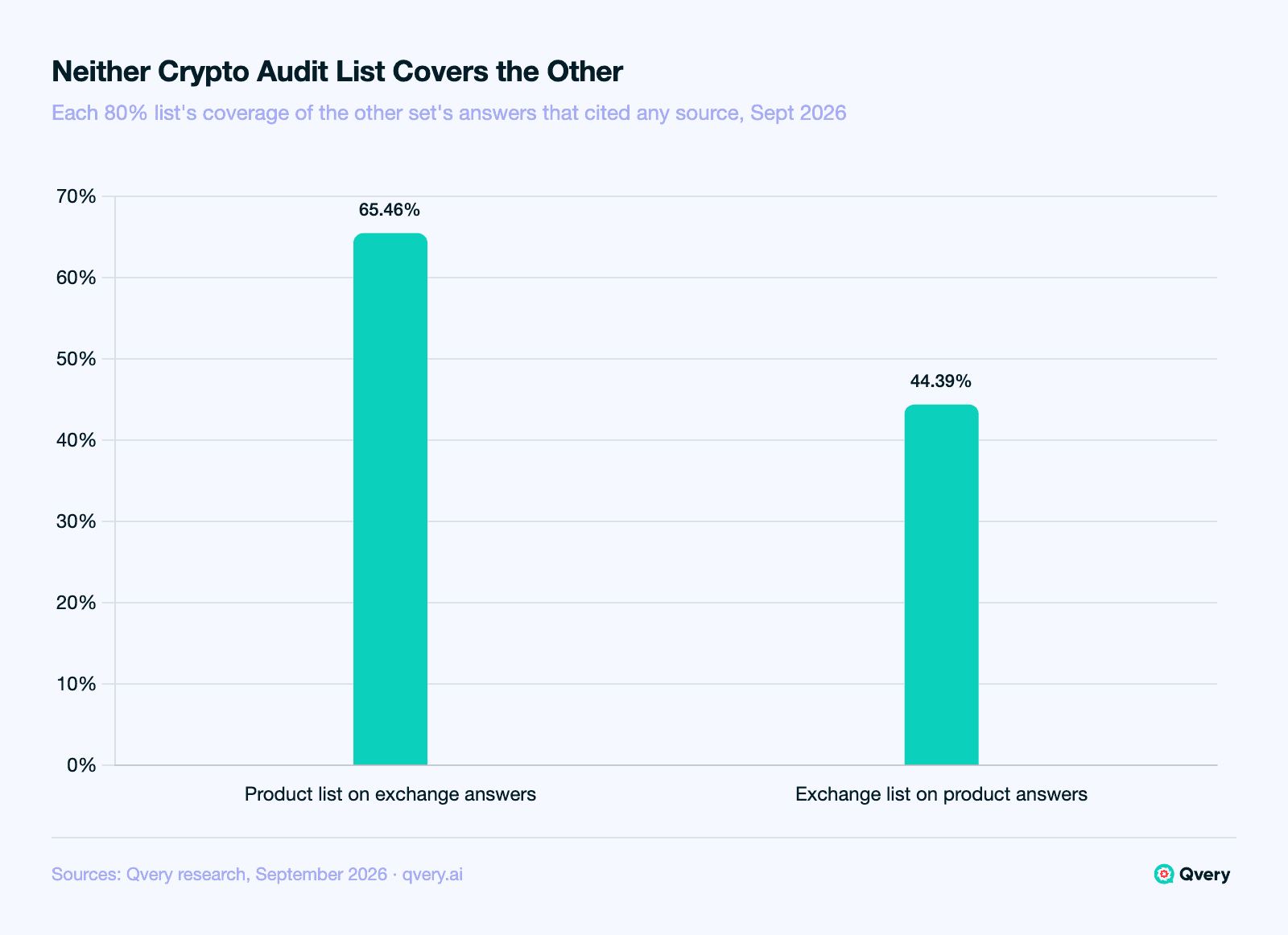
The product list covered 65.46% of the exchange answers that cited any source. The exchange list covered 44.39% of the product answers that cited any source. The lower one sits below the line where one list could serve both, so each needs its own list.
The two lists, in the order the greedy build added them (that order reflects coverage, not a count of citations):
Exchange questions (14): support.kraken.com, kraken.com, reddit.com, bitcoinfoundation.org, koinly.io, coinbureau.com, help.coinbase.com, binance.com, canada.ca, ethereum.org, fca.org.uk, astraea.law, coinbase.com, and mexc.com.
Other crypto products (23): koinly.io, help.coinbase.com, sharesight.com, tradingview.com, reddit.com, turbotax.intuit.com, bitcoinfoundation.org, youtube.com, trezor.io, alphavantage.co, coinbureau.com, fca.org.uk, asx.com.au, btcmarkets.net, databento.com, exodus.com, google.com, interactivebrokers.com, wealthsimple.com, zerion.io, bitsgap.com, bybit.com, and docs.rocketpool.net.
bitcoinfoundation.org and coinbureau.com sit in both lists, and no other hand-checked review or aggregator site sits in either. Whether the review sites alone would need separate lists wasn't measured; the two-list call covers every cited domain.
5W PR argues that the brand buyers "default to in 2026" is whatever AI assistants surface when they search for the best crypto exchange.
This data doesn't measure which brands get surfaced or what buyers pick. It shows the sources behind exchange questions and other product questions differ enough that one audit list doesn't cover both.
For building and tracking your question set, see measuring crypto brand AI visibility. Getting ChatGPT to recommend your crypto brand looks at a different split, business against retail buyers.
Which Engine Cites Which Review Page
A team that watches one engine shouldn't build its checklist from that engine alone. Here is where each review site turned up:
ChatGPT, exchanges: coinbureau.com.
ChatGPT, products: coinbureau.com.
Google AI Mode, exchanges: bitcoinfoundation.org and coinbureau.com.
Google AI Mode, products: bitcoinfoundation.org.
That's membership: a site's pages were cited in that set at least once, not how often. Coin Bureau's place in Google AI Mode's exchange answers rests on a single answer. bitcoinfoundation.org was absent from ChatGPT's answers in both sets. None of this is a claim that the engines differ or prefer anything.
A checklist built from one engine's citations would miss a review site the other engine cites. Build it from both.
321 Web Marketing writes that "citation frequency and branded mentions are the metrics that show whether the brand's content is reaching the audience, earning trust, and building authority."
This data records which review pages were cited, in which engine, for which question type. It measured no reach, trust, authority, or branded mentions, so it can't test the half of that claim that matters.
Keep the Checklist Current on Your Own Questions in Qvery
Add your own question type to Qvery as queries, exchange questions or product questions, and both if you sell both. Qvery tracks them daily on ChatGPT and Google AI Mode, in any of 200+ countries, and reports your visibility, share of voice, and average rank; visibility vs. share of voice explains the difference.
Every citation is tied to the query and the engine that produced it, so you can see whether Coin Bureau and bitcoinfoundation.org pages keep appearing on your questions, and in which engine. Ask Qvery Assistant which review pages your questions cited this week, or have it export a report.
Qvery shows which pages are cited on your questions. It doesn't read the review pages or say whether you're listed on them. Start a free 7-day trial, no credit card required, and load your first ten questions.
What This Can't Tell You
This records which domains and pages the answers cited in one September 2026 set of unbranded crypto recommendation questions, mostly US with some GB, CA, and AU questions.
It doesn't report who any cited page lists, your competitors included.
The automated reading of each page's list agreed with a hand check too rarely to publish, and no company was set up for checking, so there's no listed or not-listed verdict for anyone. There's no page-level rate, because too few pages were cited, and no route onto any site, because no submission or correction step was collected.
The audit lists are coverage sets, not rankings of every review site. Membership by engine is description, not an engine comparison, and Google AI Mode's sets carry membership only, never a percentage. No brand naming was measured, and a cited page isn't shown to rate or recommend anyone.
The lists count every answer once, and ChatGPT answered more of the questions than Google AI Mode, so they lean toward ChatGPT. Nothing is compared with an earlier collection.
Start With the Two Review Sites in Your Own List
Keep separate audit lists for exchange questions and for other crypto products, and check by hand how the Coin Bureau and bitcoinfoundation.org pages in your list, from both engines, describe you. This evidence says where to look, not who is listed there or how to get on.
If you run marketing for a crypto exchange, wallet, or tax tool, you know AI answers lean on third-party review sites, and that being listed on them accurately matters. What's less obvious is which review pages the answers cite for your kind of product, and so where a listing check should start.
So we asked ChatGPT and Google AI Mode two kinds of crypto question in September 2026: which exchange to use, and which wallet, portfolio, tax, staking, market-data, or trading tool to use. Then we recorded which domains and pages the answers cited.
The review pages inside both audit lists came from the same two sites: Coin Bureau and bitcoinfoundation.org. Exchange companies and product companies should still keep separate checklists, because the rest of the cited sources didn't carry over between the two kinds of question.
Had the two lists overlapped enough, one checklist would have served both. They didn't.
This data can't tell you who those review pages list, your competitors included, or how to get onto them.
Check These Review Pages First, Whichever Crypto Product You Sell
An audit list here is the smallest set of domains that together appear in 80% of a question type's answers that cited any source. Other review and aggregator sites were cited too, but fell outside both lists.
Inside the lists, the review pages were Coin Bureau's and bitcoinfoundation.org's. For exchange questions, these pages were cited:
Coin Bureau: best Australian crypto exchanges, best crypto exchanges for beginners, best crypto portfolio trackers, best DeFi wallets, Kraken vs Coinbase, safest crypto exchanges, Trezor vs Ledger, a single-exchange review, a head-to-head with Kraken, and Phantom wallet review.
bitcoinfoundation.org: best crypto apps for beginners, best crypto wallets, crypto exchange API, best crypto staking platforms, top crypto exchange platforms, and a citation to the site's homepage, under the title "Best Crypto Custody Providers in the US", whose page can't be identified from the address.
For other crypto product questions, these pages were cited:
Coin Bureau: best DeFi wallets, Trezor vs Ledger, and crypto tax software.
bitcoinfoundation.org: best Bitcoin wallets for beginners, best crypto wallets, best Web3 wallets, and the same homepage citation.
The job is to check each page by hand: does it list your company, and does it describe you accurately? We can't answer that for you.
Too few pages were cited for a page-level measure, and our automated reading of who each page lists failed its accuracy check, so no roster ships.
Wellows argues that "Unlike traditional SEO, crypto AI visibility depends on whether an LLM trusts the project enough to recommend it inside the answer." Nothing here measures trust or whether an engine recommends a project. It shows which third-party pages the answers cited, which is where a listing check starts.
For the listing hygiene itself, the basics carry over from other verticals: see getting more TripAdvisor reviews, and for getting named on best-of pages other sites publish, getting a product into the listicles AI engines cite.
Exchanges and Other Crypto Products Need Separate Audit Lists
The review pages are the same two sites on both sides, but the full source lists aren't. We applied each question type's audit list to the other type's answers.
The product list covered 65.46% of the exchange answers that cited any source. The exchange list covered 44.39% of the product answers that cited any source. The lower one sits below the line where one list could serve both, so each needs its own list.
The two lists, in the order the greedy build added them (that order reflects coverage, not a count of citations):
Exchange questions (14): support.kraken.com, kraken.com, reddit.com, bitcoinfoundation.org, koinly.io, coinbureau.com, help.coinbase.com, binance.com, canada.ca, ethereum.org, fca.org.uk, astraea.law, coinbase.com, and mexc.com.
Other crypto products (23): koinly.io, help.coinbase.com, sharesight.com, tradingview.com, reddit.com, turbotax.intuit.com, bitcoinfoundation.org, youtube.com, trezor.io, alphavantage.co, coinbureau.com, fca.org.uk, asx.com.au, btcmarkets.net, databento.com, exodus.com, google.com, interactivebrokers.com, wealthsimple.com, zerion.io, bitsgap.com, bybit.com, and docs.rocketpool.net.
bitcoinfoundation.org and coinbureau.com sit in both lists, and no other hand-checked review or aggregator site sits in either. Whether the review sites alone would need separate lists wasn't measured; the two-list call covers every cited domain.
5W PR argues that the brand buyers "default to in 2026" is whatever AI assistants surface when they search for the best crypto exchange.
This data doesn't measure which brands get surfaced or what buyers pick. It shows the sources behind exchange questions and other product questions differ enough that one audit list doesn't cover both.
For building and tracking your question set, see measuring crypto brand AI visibility. Getting ChatGPT to recommend your crypto brand looks at a different split, business against retail buyers.
Which Engine Cites Which Review Page
A team that watches one engine shouldn't build its checklist from that engine alone. Here is where each review site turned up:
ChatGPT, exchanges: coinbureau.com.
ChatGPT, products: coinbureau.com.
Google AI Mode, exchanges: bitcoinfoundation.org and coinbureau.com.
Google AI Mode, products: bitcoinfoundation.org.
That's membership: a site's pages were cited in that set at least once, not how often. Coin Bureau's place in Google AI Mode's exchange answers rests on a single answer. bitcoinfoundation.org was absent from ChatGPT's answers in both sets. None of this is a claim that the engines differ or prefer anything.
A checklist built from one engine's citations would miss a review site the other engine cites. Build it from both.
321 Web Marketing writes that "citation frequency and branded mentions are the metrics that show whether the brand's content is reaching the audience, earning trust, and building authority."
This data records which review pages were cited, in which engine, for which question type. It measured no reach, trust, authority, or branded mentions, so it can't test the half of that claim that matters.
Keep the Checklist Current on Your Own Questions in Qvery
Add your own question type to Qvery as queries, exchange questions or product questions, and both if you sell both. Qvery tracks them daily on ChatGPT and Google AI Mode, in any of 200+ countries, and reports your visibility, share of voice, and average rank; visibility vs. share of voice explains the difference.
Every citation is tied to the query and the engine that produced it, so you can see whether Coin Bureau and bitcoinfoundation.org pages keep appearing on your questions, and in which engine. Ask Qvery Assistant which review pages your questions cited this week, or have it export a report.
Qvery shows which pages are cited on your questions. It doesn't read the review pages or say whether you're listed on them. Start a free 7-day trial, no credit card required, and load your first ten questions.
What This Can't Tell You
This records which domains and pages the answers cited in one September 2026 set of unbranded crypto recommendation questions, mostly US with some GB, CA, and AU questions.
It doesn't report who any cited page lists, your competitors included.
The automated reading of each page's list agreed with a hand check too rarely to publish, and no company was set up for checking, so there's no listed or not-listed verdict for anyone. There's no page-level rate, because too few pages were cited, and no route onto any site, because no submission or correction step was collected.
The audit lists are coverage sets, not rankings of every review site. Membership by engine is description, not an engine comparison, and Google AI Mode's sets carry membership only, never a percentage. No brand naming was measured, and a cited page isn't shown to rate or recommend anyone.
The lists count every answer once, and ChatGPT answered more of the questions than Google AI Mode, so they lean toward ChatGPT. Nothing is compared with an earlier collection.
Start With the Two Review Sites in Your Own List
Keep separate audit lists for exchange questions and for other crypto products, and check by hand how the Coin Bureau and bitcoinfoundation.org pages in your list, from both engines, describe you. This evidence says where to look, not who is listed there or how to get on.
If you run marketing for a crypto exchange, wallet, or tax tool, you know AI answers lean on third-party review sites, and that being listed on them accurately matters. What's less obvious is which review pages the answers cite for your kind of product, and so where a listing check should start.
So we asked ChatGPT and Google AI Mode two kinds of crypto question in September 2026: which exchange to use, and which wallet, portfolio, tax, staking, market-data, or trading tool to use. Then we recorded which domains and pages the answers cited.
The review pages inside both audit lists came from the same two sites: Coin Bureau and bitcoinfoundation.org. Exchange companies and product companies should still keep separate checklists, because the rest of the cited sources didn't carry over between the two kinds of question.
Had the two lists overlapped enough, one checklist would have served both. They didn't.
This data can't tell you who those review pages list, your competitors included, or how to get onto them.
Check These Review Pages First, Whichever Crypto Product You Sell
An audit list here is the smallest set of domains that together appear in 80% of a question type's answers that cited any source. Other review and aggregator sites were cited too, but fell outside both lists.
Inside the lists, the review pages were Coin Bureau's and bitcoinfoundation.org's. For exchange questions, these pages were cited:
Coin Bureau: best Australian crypto exchanges, best crypto exchanges for beginners, best crypto portfolio trackers, best DeFi wallets, Kraken vs Coinbase, safest crypto exchanges, Trezor vs Ledger, a single-exchange review, a head-to-head with Kraken, and Phantom wallet review.
bitcoinfoundation.org: best crypto apps for beginners, best crypto wallets, crypto exchange API, best crypto staking platforms, top crypto exchange platforms, and a citation to the site's homepage, under the title "Best Crypto Custody Providers in the US", whose page can't be identified from the address.
For other crypto product questions, these pages were cited:
Coin Bureau: best DeFi wallets, Trezor vs Ledger, and crypto tax software.
bitcoinfoundation.org: best Bitcoin wallets for beginners, best crypto wallets, best Web3 wallets, and the same homepage citation.
The job is to check each page by hand: does it list your company, and does it describe you accurately? We can't answer that for you.
Too few pages were cited for a page-level measure, and our automated reading of who each page lists failed its accuracy check, so no roster ships.
Wellows argues that "Unlike traditional SEO, crypto AI visibility depends on whether an LLM trusts the project enough to recommend it inside the answer." Nothing here measures trust or whether an engine recommends a project. It shows which third-party pages the answers cited, which is where a listing check starts.
For the listing hygiene itself, the basics carry over from other verticals: see getting more TripAdvisor reviews, and for getting named on best-of pages other sites publish, getting a product into the listicles AI engines cite.
Exchanges and Other Crypto Products Need Separate Audit Lists
The review pages are the same two sites on both sides, but the full source lists aren't. We applied each question type's audit list to the other type's answers.
The product list covered 65.46% of the exchange answers that cited any source. The exchange list covered 44.39% of the product answers that cited any source. The lower one sits below the line where one list could serve both, so each needs its own list.
The two lists, in the order the greedy build added them (that order reflects coverage, not a count of citations):
Exchange questions (14): support.kraken.com, kraken.com, reddit.com, bitcoinfoundation.org, koinly.io, coinbureau.com, help.coinbase.com, binance.com, canada.ca, ethereum.org, fca.org.uk, astraea.law, coinbase.com, and mexc.com.
Other crypto products (23): koinly.io, help.coinbase.com, sharesight.com, tradingview.com, reddit.com, turbotax.intuit.com, bitcoinfoundation.org, youtube.com, trezor.io, alphavantage.co, coinbureau.com, fca.org.uk, asx.com.au, btcmarkets.net, databento.com, exodus.com, google.com, interactivebrokers.com, wealthsimple.com, zerion.io, bitsgap.com, bybit.com, and docs.rocketpool.net.
bitcoinfoundation.org and coinbureau.com sit in both lists, and no other hand-checked review or aggregator site sits in either. Whether the review sites alone would need separate lists wasn't measured; the two-list call covers every cited domain.
5W PR argues that the brand buyers "default to in 2026" is whatever AI assistants surface when they search for the best crypto exchange.
This data doesn't measure which brands get surfaced or what buyers pick. It shows the sources behind exchange questions and other product questions differ enough that one audit list doesn't cover both.
For building and tracking your question set, see measuring crypto brand AI visibility. Getting ChatGPT to recommend your crypto brand looks at a different split, business against retail buyers.
Which Engine Cites Which Review Page
A team that watches one engine shouldn't build its checklist from that engine alone. Here is where each review site turned up:
ChatGPT, exchanges: coinbureau.com.
ChatGPT, products: coinbureau.com.
Google AI Mode, exchanges: bitcoinfoundation.org and coinbureau.com.
Google AI Mode, products: bitcoinfoundation.org.
That's membership: a site's pages were cited in that set at least once, not how often. Coin Bureau's place in Google AI Mode's exchange answers rests on a single answer. bitcoinfoundation.org was absent from ChatGPT's answers in both sets. None of this is a claim that the engines differ or prefer anything.
A checklist built from one engine's citations would miss a review site the other engine cites. Build it from both.
321 Web Marketing writes that "citation frequency and branded mentions are the metrics that show whether the brand's content is reaching the audience, earning trust, and building authority."
This data records which review pages were cited, in which engine, for which question type. It measured no reach, trust, authority, or branded mentions, so it can't test the half of that claim that matters.
Keep the Checklist Current on Your Own Questions in Qvery
Add your own question type to Qvery as queries, exchange questions or product questions, and both if you sell both. Qvery tracks them daily on ChatGPT and Google AI Mode, in any of 200+ countries, and reports your visibility, share of voice, and average rank; visibility vs. share of voice explains the difference.
Every citation is tied to the query and the engine that produced it, so you can see whether Coin Bureau and bitcoinfoundation.org pages keep appearing on your questions, and in which engine. Ask Qvery Assistant which review pages your questions cited this week, or have it export a report.
Qvery shows which pages are cited on your questions. It doesn't read the review pages or say whether you're listed on them. Start a free 7-day trial, no credit card required, and load your first ten questions.
What This Can't Tell You
This records which domains and pages the answers cited in one September 2026 set of unbranded crypto recommendation questions, mostly US with some GB, CA, and AU questions.
It doesn't report who any cited page lists, your competitors included.
The automated reading of each page's list agreed with a hand check too rarely to publish, and no company was set up for checking, so there's no listed or not-listed verdict for anyone. There's no page-level rate, because too few pages were cited, and no route onto any site, because no submission or correction step was collected.
The audit lists are coverage sets, not rankings of every review site. Membership by engine is description, not an engine comparison, and Google AI Mode's sets carry membership only, never a percentage. No brand naming was measured, and a cited page isn't shown to rate or recommend anyone.
The lists count every answer once, and ChatGPT answered more of the questions than Google AI Mode, so they lean toward ChatGPT. Nothing is compared with an earlier collection.
Start With the Two Review Sites in Your Own List
Keep separate audit lists for exchange questions and for other crypto products, and check by hand how the Coin Bureau and bitcoinfoundation.org pages in your list, from both engines, describe you. This evidence says where to look, not who is listed there or how to get on.
If you run marketing for a crypto exchange, wallet, or tax tool, you know AI answers lean on third-party review sites, and that being listed on them accurately matters. What's less obvious is which review pages the answers cite for your kind of product, and so where a listing check should start.
So we asked ChatGPT and Google AI Mode two kinds of crypto question in September 2026: which exchange to use, and which wallet, portfolio, tax, staking, market-data, or trading tool to use. Then we recorded which domains and pages the answers cited.
The review pages inside both audit lists came from the same two sites: Coin Bureau and bitcoinfoundation.org. Exchange companies and product companies should still keep separate checklists, because the rest of the cited sources didn't carry over between the two kinds of question.
Had the two lists overlapped enough, one checklist would have served both. They didn't.
This data can't tell you who those review pages list, your competitors included, or how to get onto them.
Check These Review Pages First, Whichever Crypto Product You Sell
An audit list here is the smallest set of domains that together appear in 80% of a question type's answers that cited any source. Other review and aggregator sites were cited too, but fell outside both lists.
Inside the lists, the review pages were Coin Bureau's and bitcoinfoundation.org's. For exchange questions, these pages were cited:
Coin Bureau: best Australian crypto exchanges, best crypto exchanges for beginners, best crypto portfolio trackers, best DeFi wallets, Kraken vs Coinbase, safest crypto exchanges, Trezor vs Ledger, a single-exchange review, a head-to-head with Kraken, and Phantom wallet review.
bitcoinfoundation.org: best crypto apps for beginners, best crypto wallets, crypto exchange API, best crypto staking platforms, top crypto exchange platforms, and a citation to the site's homepage, under the title "Best Crypto Custody Providers in the US", whose page can't be identified from the address.
For other crypto product questions, these pages were cited:
Coin Bureau: best DeFi wallets, Trezor vs Ledger, and crypto tax software.
bitcoinfoundation.org: best Bitcoin wallets for beginners, best crypto wallets, best Web3 wallets, and the same homepage citation.
The job is to check each page by hand: does it list your company, and does it describe you accurately? We can't answer that for you.
Too few pages were cited for a page-level measure, and our automated reading of who each page lists failed its accuracy check, so no roster ships.
Wellows argues that "Unlike traditional SEO, crypto AI visibility depends on whether an LLM trusts the project enough to recommend it inside the answer." Nothing here measures trust or whether an engine recommends a project. It shows which third-party pages the answers cited, which is where a listing check starts.
For the listing hygiene itself, the basics carry over from other verticals: see getting more TripAdvisor reviews, and for getting named on best-of pages other sites publish, getting a product into the listicles AI engines cite.
Exchanges and Other Crypto Products Need Separate Audit Lists
The review pages are the same two sites on both sides, but the full source lists aren't. We applied each question type's audit list to the other type's answers.
The product list covered 65.46% of the exchange answers that cited any source. The exchange list covered 44.39% of the product answers that cited any source. The lower one sits below the line where one list could serve both, so each needs its own list.
The two lists, in the order the greedy build added them (that order reflects coverage, not a count of citations):
Exchange questions (14): support.kraken.com, kraken.com, reddit.com, bitcoinfoundation.org, koinly.io, coinbureau.com, help.coinbase.com, binance.com, canada.ca, ethereum.org, fca.org.uk, astraea.law, coinbase.com, and mexc.com.
Other crypto products (23): koinly.io, help.coinbase.com, sharesight.com, tradingview.com, reddit.com, turbotax.intuit.com, bitcoinfoundation.org, youtube.com, trezor.io, alphavantage.co, coinbureau.com, fca.org.uk, asx.com.au, btcmarkets.net, databento.com, exodus.com, google.com, interactivebrokers.com, wealthsimple.com, zerion.io, bitsgap.com, bybit.com, and docs.rocketpool.net.
bitcoinfoundation.org and coinbureau.com sit in both lists, and no other hand-checked review or aggregator site sits in either. Whether the review sites alone would need separate lists wasn't measured; the two-list call covers every cited domain.
5W PR argues that the brand buyers "default to in 2026" is whatever AI assistants surface when they search for the best crypto exchange.
This data doesn't measure which brands get surfaced or what buyers pick. It shows the sources behind exchange questions and other product questions differ enough that one audit list doesn't cover both.
For building and tracking your question set, see measuring crypto brand AI visibility. Getting ChatGPT to recommend your crypto brand looks at a different split, business against retail buyers.
Which Engine Cites Which Review Page
A team that watches one engine shouldn't build its checklist from that engine alone. Here is where each review site turned up:
ChatGPT, exchanges: coinbureau.com.
ChatGPT, products: coinbureau.com.
Google AI Mode, exchanges: bitcoinfoundation.org and coinbureau.com.
Google AI Mode, products: bitcoinfoundation.org.
That's membership: a site's pages were cited in that set at least once, not how often. Coin Bureau's place in Google AI Mode's exchange answers rests on a single answer. bitcoinfoundation.org was absent from ChatGPT's answers in both sets. None of this is a claim that the engines differ or prefer anything.
A checklist built from one engine's citations would miss a review site the other engine cites. Build it from both.
321 Web Marketing writes that "citation frequency and branded mentions are the metrics that show whether the brand's content is reaching the audience, earning trust, and building authority."
This data records which review pages were cited, in which engine, for which question type. It measured no reach, trust, authority, or branded mentions, so it can't test the half of that claim that matters.
Keep the Checklist Current on Your Own Questions in Qvery
Add your own question type to Qvery as queries, exchange questions or product questions, and both if you sell both. Qvery tracks them daily on ChatGPT and Google AI Mode, in any of 200+ countries, and reports your visibility, share of voice, and average rank; visibility vs. share of voice explains the difference.
Every citation is tied to the query and the engine that produced it, so you can see whether Coin Bureau and bitcoinfoundation.org pages keep appearing on your questions, and in which engine. Ask Qvery Assistant which review pages your questions cited this week, or have it export a report.
Qvery shows which pages are cited on your questions. It doesn't read the review pages or say whether you're listed on them. Start a free 7-day trial, no credit card required, and load your first ten questions.
What This Can't Tell You
This records which domains and pages the answers cited in one September 2026 set of unbranded crypto recommendation questions, mostly US with some GB, CA, and AU questions.
It doesn't report who any cited page lists, your competitors included.
The automated reading of each page's list agreed with a hand check too rarely to publish, and no company was set up for checking, so there's no listed or not-listed verdict for anyone. There's no page-level rate, because too few pages were cited, and no route onto any site, because no submission or correction step was collected.
The audit lists are coverage sets, not rankings of every review site. Membership by engine is description, not an engine comparison, and Google AI Mode's sets carry membership only, never a percentage. No brand naming was measured, and a cited page isn't shown to rate or recommend anyone.
The lists count every answer once, and ChatGPT answered more of the questions than Google AI Mode, so they lean toward ChatGPT. Nothing is compared with an earlier collection.
Start With the Two Review Sites in Your Own List
Keep separate audit lists for exchange questions and for other crypto products, and check by hand how the Coin Bureau and bitcoinfoundation.org pages in your list, from both engines, describe you. This evidence says where to look, not who is listed there or how to get on.

© 2026 Qvery AI OÜ