By
Vlad Shvets
How to Get More TripAdvisor Reviews for Travel Brands
TripAdvisor is the #4 most-cited domain in travel, and 89% of that comes from Google AI Mode. Here is how to grow reviews the ToS-safe way so AI engines cite you.
TripAdvisor is the #4 most-cited domain in travel, and 89% of that comes from Google AI Mode. Here is how to grow reviews the ToS-safe way so AI engines cite you.
TripAdvisor is the #4 most-cited domain in travel, and 89% of that comes from Google AI Mode. Here is how to grow reviews the ToS-safe way so AI engines cite you.
I went looking for which travel sources AI engines trust, and TripAdvisor kept showing up where I didn't expect it. TripAdvisor is the #4 most-cited domain inside travel queries across ChatGPT and Google AI Mode, and 89% of those citations come from Google AI Mode, which parses the structured guts of your listing whether you've touched it in two years or not.
Most travel operators treat their TripAdvisor page like a high school yearbook photo: set up once, never looked at again. Meanwhile, an AI engine is parsing your star rating, review count, recent comments, and owner responses, then deciding whether to recommend your tour over the one down the street.
TripAdvisor's split between the two engines is one of the most lopsided I work with: it earns far more on Google AI Mode than on ChatGPT. I'll be honest that this split is still moving, so I re-check it every few weeks rather than treat it as settled.
Why TripAdvisor Punches So Far Above Its Weight in Travel
Across millions of AI citations on ChatGPT and Google AI Mode since January 2026, TripAdvisor accounts for 0.82% of all AI citations.
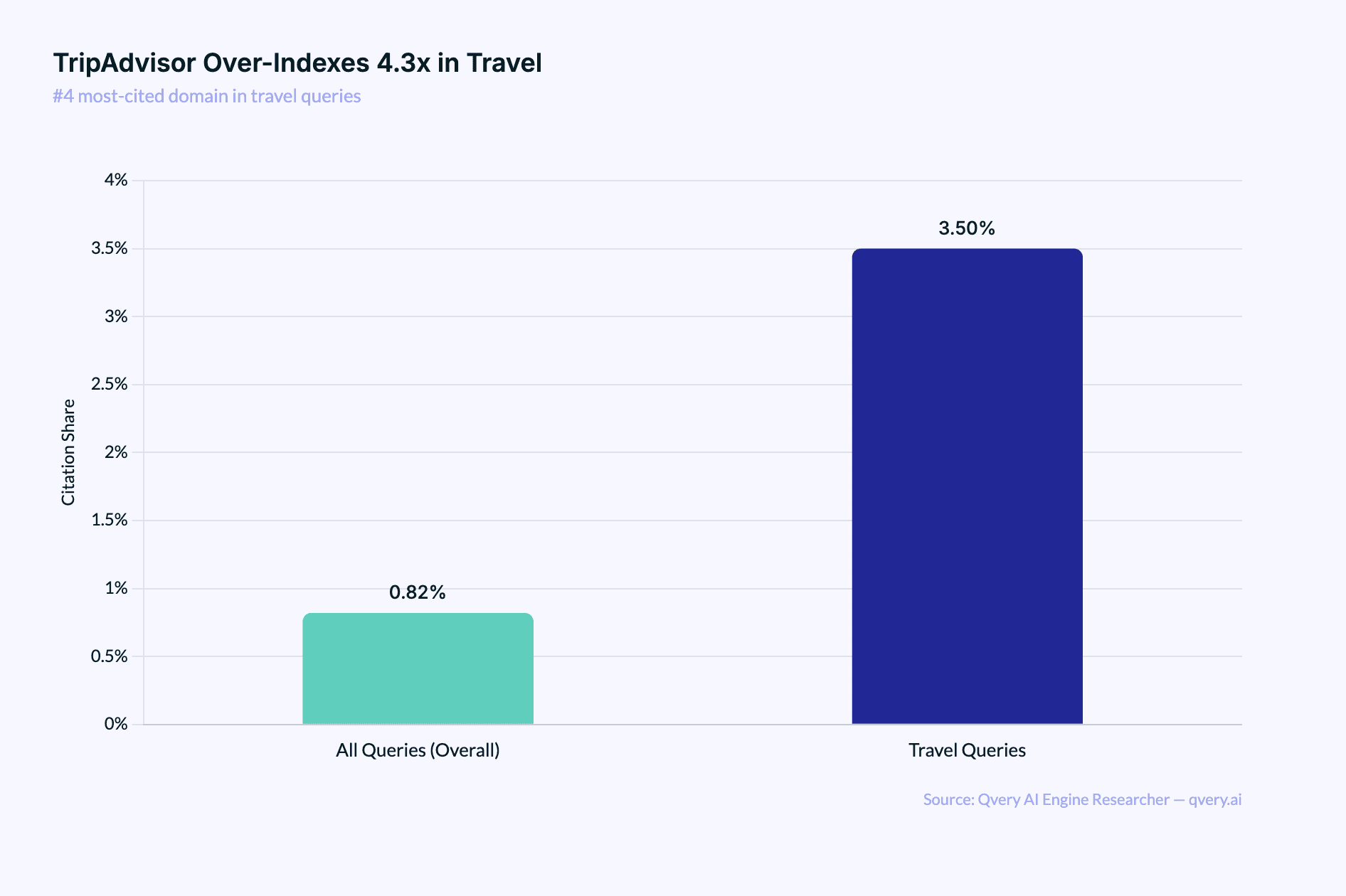
That number does almost nothing for a tour operator until you zoom into travel queries, where TripAdvisor over-indexes 4.3x and jumps to 3.5% of travel citations. When someone asks an AI engine for the best snorkeling tour in Cozumel or a walkable hotel near the Trevi Fountain, TripAdvisor is one of the handful of sources the engine leans on.
To put 0.82% in context, the citation field is brutally flat: 46.5% of all cited domains are cited exactly once, and no single domain in the entire set exceeds 3.5%. In a field that level, a tour operator's TripAdvisor listing is sitting on one of the few sources an engine reuses.
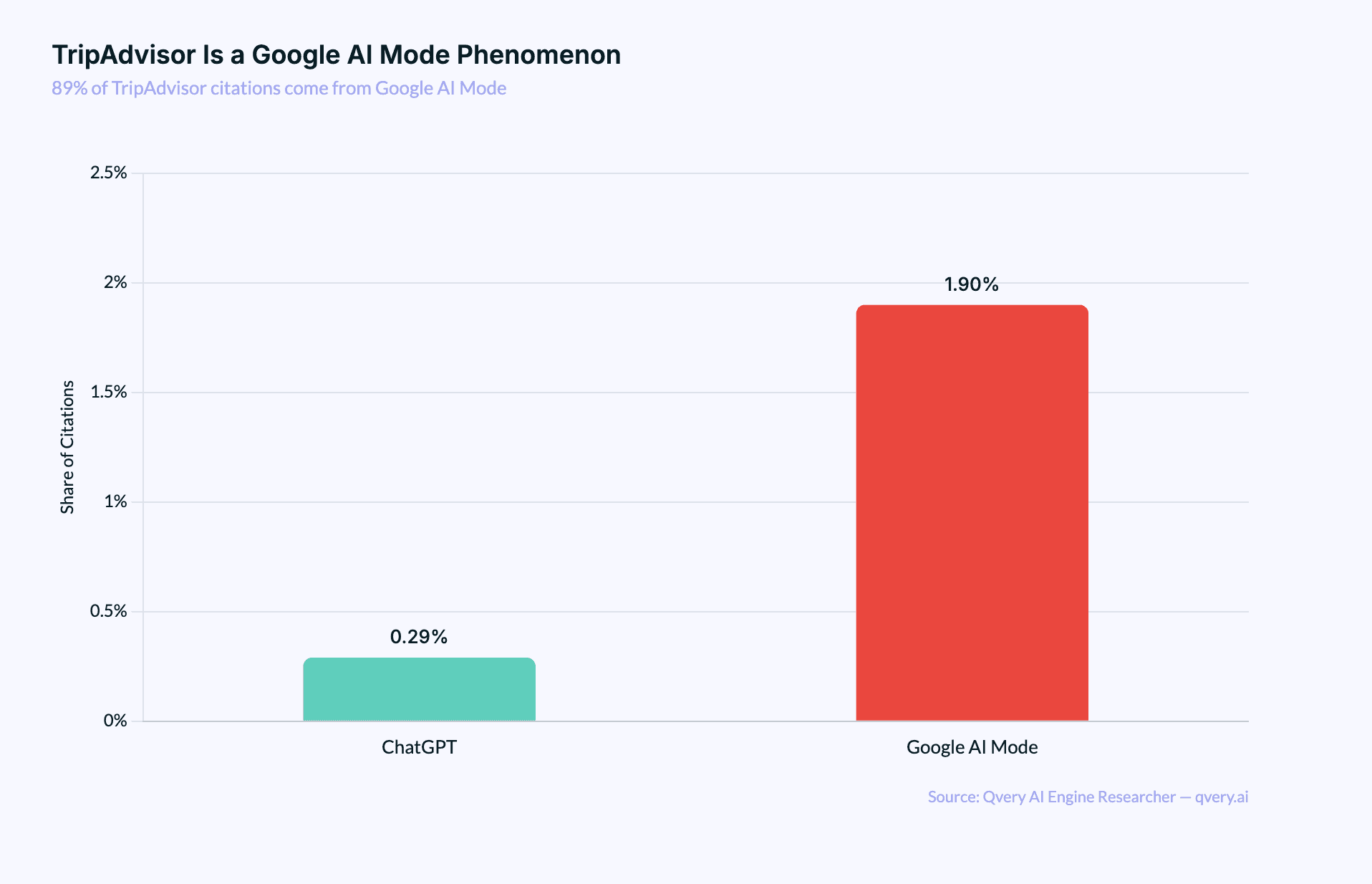
TripAdvisor earns 0.29% of ChatGPT citations versus 1.90% on Google AI Mode. That 6.6x gap is the widest I see for any travel source, wide enough that I re-ran the query to rule out an error. Its average citation rank is 9.04, which is strong placement when it does appear. Google AI Mode treats TripAdvisor like a primary reference, while ChatGPT rarely surfaces it at all. Your customers use both engines, so the work you do on TripAdvisor lands almost entirely on Google AI Mode, and you build ChatGPT visibility in parallel through other sources.
Why TripAdvisor Holds While Other Review Sites Slide
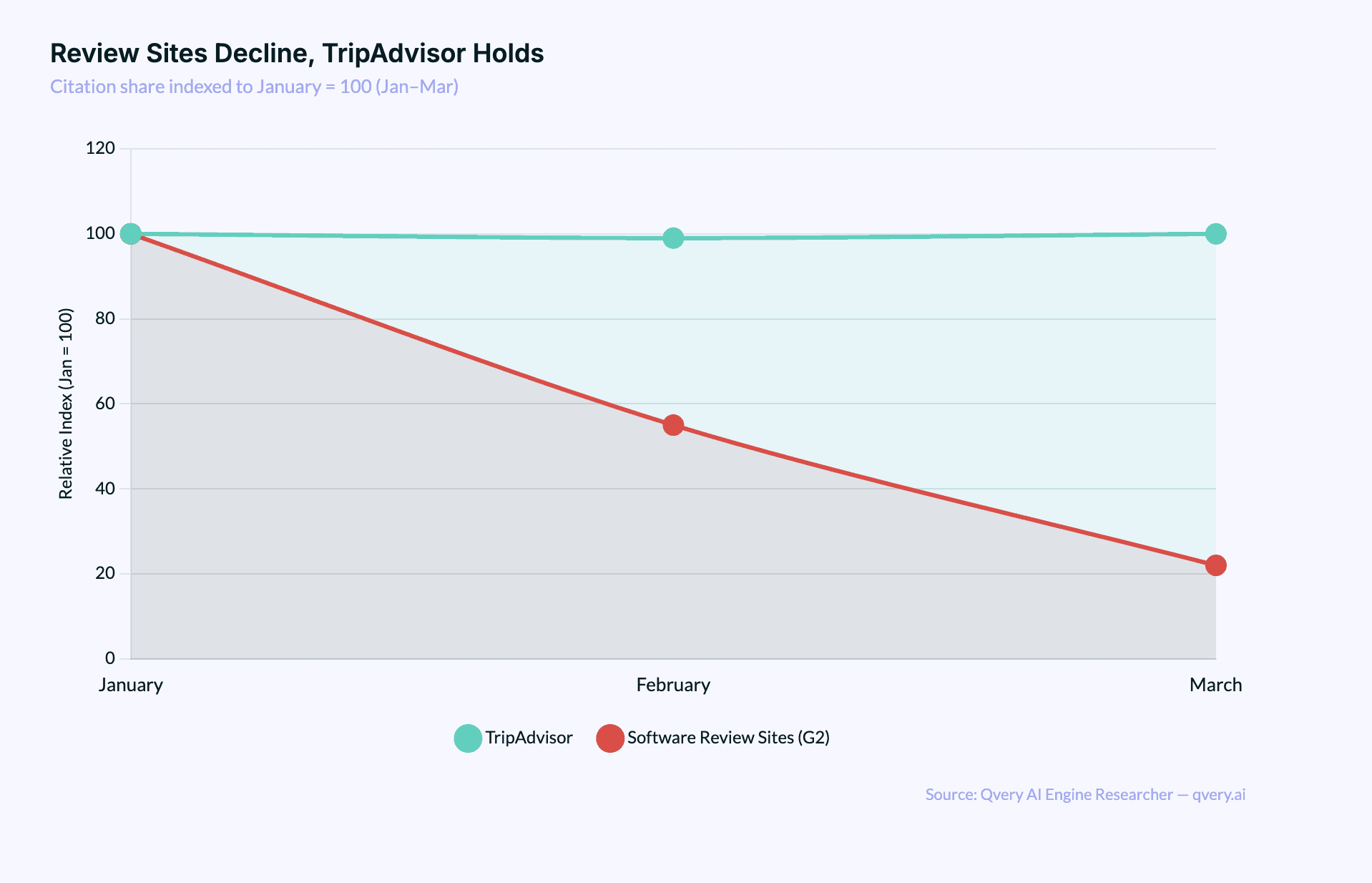
Review and directory sites generally are sliding while TripAdvisor holds. Software review and directory sites combined make up 1.19% of all citations, and they are declining. G2, the leading software review site, fell 78% in citation share from January to March. TripAdvisor, over the same window, held steady.
A TripAdvisor listing is a tidy package of star rating, review count, category, location, price band, photos, and dated reviews, the kind of fielded data an engine can lift without guessing. The review sites that are sliding tend to read like marketing brochures, which is exactly the kind of vague copy an engine can't quote. TripAdvisor reads like a database, and that is exactly what an AI engine wants to quote.
A listing with 200 reviews and nothing in the last six months gives a parser little signal that the business is still active, and a parser weights this quarter's reviews far above last year's. Cadence ends up mattering more than lifetime count.
That reframes the exercise: each review is less about nudging a fence-sitting traveler and more about feeding a parser. Every recent, detailed, owner-answered review is one more reason for Google AI Mode to treat your business as a live, well-documented entity instead of a stale stub.
Check Whether AI Is Citing Your Listing or Your Rival's
Before you pour effort into review growth, confirm TripAdvisor is doing the work for your specific brand and category. The dataset averages tell you it matters for travel as a whole. They don't tell you whether AI engines are citing your listing or your competitor's, and you can't tell by eye.
In Qvery's AI Engine Researcher, open the Citations view and filter to tripadvisor.com. You see exactly which TripAdvisor pages AI engines pull from for your brand, each with its Visibility % and Average Rank, so you can see which listings are pulling their weight. When we ran this for a tour operator, their cited TripAdvisor listing carried roughly four times the visibility of their own website inside travel queries, which told us their review page was the asset worth feeding.
Then run the competitor comparison. It surfaces which competitors' TripAdvisor pages earn the most citations, which is your benchmark for what a citation-worthy listing looks like in your category. If a competitor's listing is getting cited and yours is not, the gap is usually review volume, recency, or completeness, and those are all fixable.
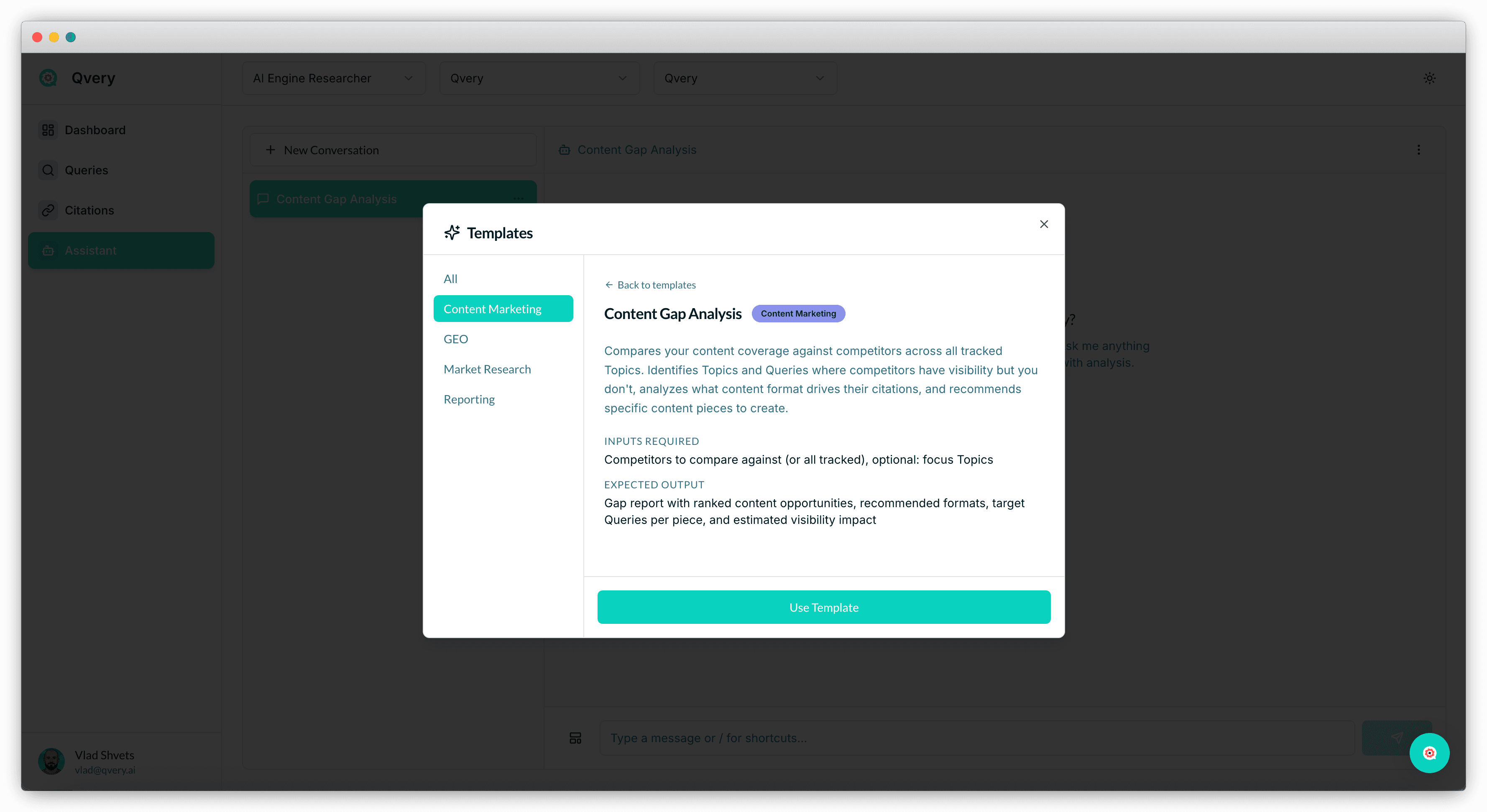
Then toggle to ChatGPT-only to see the handful of pages still earning citations there, so you know which listings double as ChatGPT assets rather than pure Google AI Mode plays.
How to Grow Review Volume Without Breaking the Rules
The one move that does the most work is asking at the peak-happiness moment. A guest is never going to love you more than they do in the first hour after a great experience: stepping off the boat still salty and grinning, or finishing the wine at the end of a food tour. Ask in that window. Wait a week and you're asking a memory, not a feeling.
Make the ask frictionless or it dies. Nobody is going to open the TripAdvisor app, search your business name, and scroll to find the review button like it's a scavenger hunt. Hand them the shortcut instead:
QR codes on the table tent, the tour brochure, the room key card, or the receipt, pointing straight to your review page.
Email and SMS follow-ups sent a few hours after the experience, with the direct review link as the one and only call to action.
A short, specific message: "Loved having you on the sunset sail today? A quick TripAdvisor review helps other travelers find us." A specific prompt outperforms a generic "please leave a review."
Train your staff to mention it naturally as part of the goodbye, not as a desperate plea at the end. A guide who says "if you had a good time today, a TripAdvisor review genuinely helps our small crew" will out-collect any automated system, because it comes from a human the guest just spent the day with.
The Tactics That Quietly Kill Your Listing
One rule has no exceptions: never buy reviews. Beyond violating TripAdvisor's terms of service, manipulation leaves patterns: sudden bursts, oddly similar phrasing, reviewers with no posting history. AI engines are getting good at flagging exactly that. A listing flagged as manipulated is worth less than one with half the reviews and full credibility. You would be paying money to lower your citation probability, which is an impressively bad trade.
Steady volume beats bursts. Forty reviews dribbling in over six months reads as a healthy, busy business to both humans and parsers. Forty reviews in a single weekend reads as a campaign, and not the good kind. Aim for a consistent trickle, not a flood.
A review from this month tells the parser your business is open today. A five-star earned in 2024 tells it you were open in 2024, which is a different and far less useful claim.
Respond to Everything and Keep the Listing Current
Respond to every review, the glowing ones and the brutal ones. A thoughtful reply to a one-star complaint does more for your reputation than the complaint does damage, and it adds fresh, dated, business-specific text to the page, which is one more structured signal for the parser. Owner responses are part of what makes a TripAdvisor listing read as actively run rather than parked.
Keep the listing complete and current. A full profile is a buffet of structured fields for an AI engine to cite:
Photos that are recent and plentiful, not three blurry shots from the opening week.
Accurate categories and amenities, since these are the exact attributes an engine matches against a query like "wheelchair-accessible walking tour."
Current hours and pricing, plus contact details, because stale data is a reason for an engine to trust a competitor instead.
One caution worth keeping in view: this is heavily a Google AI Mode play. Reddit sits at 0.75% in travel, well below its overall 1.17% citation share, and travel has the highest AI-versus-Google-organic overlap of any vertical at 26.8%, which means a chunk of what wins in travel AI search also wins in classic Google. TripAdvisor is your structured-data engine. To cover the ChatGPT side, you build visibility through other sources in parallel.
The Listing You Ignore Is the One Google Reads Most
Start with the single number that tells you the most: the date on your most recent review. If it's older than a few months, that's the gap to close before anything else, because recency is what keeps the page reading as current. From there the fix is unglamorous: a profile filled all the way out, owner replies on the reviews you have, and a steady drip of recent ones coming in. Those are the listings Google AI Mode keeps recommending, and closing the gap is usually a few months of consistent attention, not a rebrand.
Google AI Mode is reading your listing today. Pull it up, fill in what's missing, reply to the reviews you have, and ask your next happy guest for one while the trip is still fresh.
I went looking for which travel sources AI engines trust, and TripAdvisor kept showing up where I didn't expect it. TripAdvisor is the #4 most-cited domain inside travel queries across ChatGPT and Google AI Mode, and 89% of those citations come from Google AI Mode, which parses the structured guts of your listing whether you've touched it in two years or not.
Most travel operators treat their TripAdvisor page like a high school yearbook photo: set up once, never looked at again. Meanwhile, an AI engine is parsing your star rating, review count, recent comments, and owner responses, then deciding whether to recommend your tour over the one down the street.
TripAdvisor's split between the two engines is one of the most lopsided I work with: it earns far more on Google AI Mode than on ChatGPT. I'll be honest that this split is still moving, so I re-check it every few weeks rather than treat it as settled.
Why TripAdvisor Punches So Far Above Its Weight in Travel
Across millions of AI citations on ChatGPT and Google AI Mode since January 2026, TripAdvisor accounts for 0.82% of all AI citations.
That number does almost nothing for a tour operator until you zoom into travel queries, where TripAdvisor over-indexes 4.3x and jumps to 3.5% of travel citations. When someone asks an AI engine for the best snorkeling tour in Cozumel or a walkable hotel near the Trevi Fountain, TripAdvisor is one of the handful of sources the engine leans on.
To put 0.82% in context, the citation field is brutally flat: 46.5% of all cited domains are cited exactly once, and no single domain in the entire set exceeds 3.5%. In a field that level, a tour operator's TripAdvisor listing is sitting on one of the few sources an engine reuses.
TripAdvisor earns 0.29% of ChatGPT citations versus 1.90% on Google AI Mode. That 6.6x gap is the widest I see for any travel source, wide enough that I re-ran the query to rule out an error. Its average citation rank is 9.04, which is strong placement when it does appear. Google AI Mode treats TripAdvisor like a primary reference, while ChatGPT rarely surfaces it at all. Your customers use both engines, so the work you do on TripAdvisor lands almost entirely on Google AI Mode, and you build ChatGPT visibility in parallel through other sources.
Why TripAdvisor Holds While Other Review Sites Slide
Review and directory sites generally are sliding while TripAdvisor holds. Software review and directory sites combined make up 1.19% of all citations, and they are declining. G2, the leading software review site, fell 78% in citation share from January to March. TripAdvisor, over the same window, held steady.
A TripAdvisor listing is a tidy package of star rating, review count, category, location, price band, photos, and dated reviews, the kind of fielded data an engine can lift without guessing. The review sites that are sliding tend to read like marketing brochures, which is exactly the kind of vague copy an engine can't quote. TripAdvisor reads like a database, and that is exactly what an AI engine wants to quote.
A listing with 200 reviews and nothing in the last six months gives a parser little signal that the business is still active, and a parser weights this quarter's reviews far above last year's. Cadence ends up mattering more than lifetime count.
That reframes the exercise: each review is less about nudging a fence-sitting traveler and more about feeding a parser. Every recent, detailed, owner-answered review is one more reason for Google AI Mode to treat your business as a live, well-documented entity instead of a stale stub.
Check Whether AI Is Citing Your Listing or Your Rival's
Before you pour effort into review growth, confirm TripAdvisor is doing the work for your specific brand and category. The dataset averages tell you it matters for travel as a whole. They don't tell you whether AI engines are citing your listing or your competitor's, and you can't tell by eye.
In Qvery's AI Engine Researcher, open the Citations view and filter to tripadvisor.com. You see exactly which TripAdvisor pages AI engines pull from for your brand, each with its Visibility % and Average Rank, so you can see which listings are pulling their weight. When we ran this for a tour operator, their cited TripAdvisor listing carried roughly four times the visibility of their own website inside travel queries, which told us their review page was the asset worth feeding.
Then run the competitor comparison. It surfaces which competitors' TripAdvisor pages earn the most citations, which is your benchmark for what a citation-worthy listing looks like in your category. If a competitor's listing is getting cited and yours is not, the gap is usually review volume, recency, or completeness, and those are all fixable.
Then toggle to ChatGPT-only to see the handful of pages still earning citations there, so you know which listings double as ChatGPT assets rather than pure Google AI Mode plays.
How to Grow Review Volume Without Breaking the Rules
The one move that does the most work is asking at the peak-happiness moment. A guest is never going to love you more than they do in the first hour after a great experience: stepping off the boat still salty and grinning, or finishing the wine at the end of a food tour. Ask in that window. Wait a week and you're asking a memory, not a feeling.
Make the ask frictionless or it dies. Nobody is going to open the TripAdvisor app, search your business name, and scroll to find the review button like it's a scavenger hunt. Hand them the shortcut instead:
QR codes on the table tent, the tour brochure, the room key card, or the receipt, pointing straight to your review page.
Email and SMS follow-ups sent a few hours after the experience, with the direct review link as the one and only call to action.
A short, specific message: "Loved having you on the sunset sail today? A quick TripAdvisor review helps other travelers find us." A specific prompt outperforms a generic "please leave a review."
Train your staff to mention it naturally as part of the goodbye, not as a desperate plea at the end. A guide who says "if you had a good time today, a TripAdvisor review genuinely helps our small crew" will out-collect any automated system, because it comes from a human the guest just spent the day with.
The Tactics That Quietly Kill Your Listing
One rule has no exceptions: never buy reviews. Beyond violating TripAdvisor's terms of service, manipulation leaves patterns: sudden bursts, oddly similar phrasing, reviewers with no posting history. AI engines are getting good at flagging exactly that. A listing flagged as manipulated is worth less than one with half the reviews and full credibility. You would be paying money to lower your citation probability, which is an impressively bad trade.
Steady volume beats bursts. Forty reviews dribbling in over six months reads as a healthy, busy business to both humans and parsers. Forty reviews in a single weekend reads as a campaign, and not the good kind. Aim for a consistent trickle, not a flood.
A review from this month tells the parser your business is open today. A five-star earned in 2024 tells it you were open in 2024, which is a different and far less useful claim.
Respond to Everything and Keep the Listing Current
Respond to every review, the glowing ones and the brutal ones. A thoughtful reply to a one-star complaint does more for your reputation than the complaint does damage, and it adds fresh, dated, business-specific text to the page, which is one more structured signal for the parser. Owner responses are part of what makes a TripAdvisor listing read as actively run rather than parked.
Keep the listing complete and current. A full profile is a buffet of structured fields for an AI engine to cite:
Photos that are recent and plentiful, not three blurry shots from the opening week.
Accurate categories and amenities, since these are the exact attributes an engine matches against a query like "wheelchair-accessible walking tour."
Current hours and pricing, plus contact details, because stale data is a reason for an engine to trust a competitor instead.
One caution worth keeping in view: this is heavily a Google AI Mode play. Reddit sits at 0.75% in travel, well below its overall 1.17% citation share, and travel has the highest AI-versus-Google-organic overlap of any vertical at 26.8%, which means a chunk of what wins in travel AI search also wins in classic Google. TripAdvisor is your structured-data engine. To cover the ChatGPT side, you build visibility through other sources in parallel.
The Listing You Ignore Is the One Google Reads Most
Start with the single number that tells you the most: the date on your most recent review. If it's older than a few months, that's the gap to close before anything else, because recency is what keeps the page reading as current. From there the fix is unglamorous: a profile filled all the way out, owner replies on the reviews you have, and a steady drip of recent ones coming in. Those are the listings Google AI Mode keeps recommending, and closing the gap is usually a few months of consistent attention, not a rebrand.
Google AI Mode is reading your listing today. Pull it up, fill in what's missing, reply to the reviews you have, and ask your next happy guest for one while the trip is still fresh.
I went looking for which travel sources AI engines trust, and TripAdvisor kept showing up where I didn't expect it. TripAdvisor is the #4 most-cited domain inside travel queries across ChatGPT and Google AI Mode, and 89% of those citations come from Google AI Mode, which parses the structured guts of your listing whether you've touched it in two years or not.
Most travel operators treat their TripAdvisor page like a high school yearbook photo: set up once, never looked at again. Meanwhile, an AI engine is parsing your star rating, review count, recent comments, and owner responses, then deciding whether to recommend your tour over the one down the street.
TripAdvisor's split between the two engines is one of the most lopsided I work with: it earns far more on Google AI Mode than on ChatGPT. I'll be honest that this split is still moving, so I re-check it every few weeks rather than treat it as settled.
Why TripAdvisor Punches So Far Above Its Weight in Travel
Across millions of AI citations on ChatGPT and Google AI Mode since January 2026, TripAdvisor accounts for 0.82% of all AI citations.
That number does almost nothing for a tour operator until you zoom into travel queries, where TripAdvisor over-indexes 4.3x and jumps to 3.5% of travel citations. When someone asks an AI engine for the best snorkeling tour in Cozumel or a walkable hotel near the Trevi Fountain, TripAdvisor is one of the handful of sources the engine leans on.
To put 0.82% in context, the citation field is brutally flat: 46.5% of all cited domains are cited exactly once, and no single domain in the entire set exceeds 3.5%. In a field that level, a tour operator's TripAdvisor listing is sitting on one of the few sources an engine reuses.
TripAdvisor earns 0.29% of ChatGPT citations versus 1.90% on Google AI Mode. That 6.6x gap is the widest I see for any travel source, wide enough that I re-ran the query to rule out an error. Its average citation rank is 9.04, which is strong placement when it does appear. Google AI Mode treats TripAdvisor like a primary reference, while ChatGPT rarely surfaces it at all. Your customers use both engines, so the work you do on TripAdvisor lands almost entirely on Google AI Mode, and you build ChatGPT visibility in parallel through other sources.
Why TripAdvisor Holds While Other Review Sites Slide
Review and directory sites generally are sliding while TripAdvisor holds. Software review and directory sites combined make up 1.19% of all citations, and they are declining. G2, the leading software review site, fell 78% in citation share from January to March. TripAdvisor, over the same window, held steady.
A TripAdvisor listing is a tidy package of star rating, review count, category, location, price band, photos, and dated reviews, the kind of fielded data an engine can lift without guessing. The review sites that are sliding tend to read like marketing brochures, which is exactly the kind of vague copy an engine can't quote. TripAdvisor reads like a database, and that is exactly what an AI engine wants to quote.
A listing with 200 reviews and nothing in the last six months gives a parser little signal that the business is still active, and a parser weights this quarter's reviews far above last year's. Cadence ends up mattering more than lifetime count.
That reframes the exercise: each review is less about nudging a fence-sitting traveler and more about feeding a parser. Every recent, detailed, owner-answered review is one more reason for Google AI Mode to treat your business as a live, well-documented entity instead of a stale stub.
Check Whether AI Is Citing Your Listing or Your Rival's
Before you pour effort into review growth, confirm TripAdvisor is doing the work for your specific brand and category. The dataset averages tell you it matters for travel as a whole. They don't tell you whether AI engines are citing your listing or your competitor's, and you can't tell by eye.
In Qvery's AI Engine Researcher, open the Citations view and filter to tripadvisor.com. You see exactly which TripAdvisor pages AI engines pull from for your brand, each with its Visibility % and Average Rank, so you can see which listings are pulling their weight. When we ran this for a tour operator, their cited TripAdvisor listing carried roughly four times the visibility of their own website inside travel queries, which told us their review page was the asset worth feeding.
Then run the competitor comparison. It surfaces which competitors' TripAdvisor pages earn the most citations, which is your benchmark for what a citation-worthy listing looks like in your category. If a competitor's listing is getting cited and yours is not, the gap is usually review volume, recency, or completeness, and those are all fixable.
Then toggle to ChatGPT-only to see the handful of pages still earning citations there, so you know which listings double as ChatGPT assets rather than pure Google AI Mode plays.
How to Grow Review Volume Without Breaking the Rules
The one move that does the most work is asking at the peak-happiness moment. A guest is never going to love you more than they do in the first hour after a great experience: stepping off the boat still salty and grinning, or finishing the wine at the end of a food tour. Ask in that window. Wait a week and you're asking a memory, not a feeling.
Make the ask frictionless or it dies. Nobody is going to open the TripAdvisor app, search your business name, and scroll to find the review button like it's a scavenger hunt. Hand them the shortcut instead:
QR codes on the table tent, the tour brochure, the room key card, or the receipt, pointing straight to your review page.
Email and SMS follow-ups sent a few hours after the experience, with the direct review link as the one and only call to action.
A short, specific message: "Loved having you on the sunset sail today? A quick TripAdvisor review helps other travelers find us." A specific prompt outperforms a generic "please leave a review."
Train your staff to mention it naturally as part of the goodbye, not as a desperate plea at the end. A guide who says "if you had a good time today, a TripAdvisor review genuinely helps our small crew" will out-collect any automated system, because it comes from a human the guest just spent the day with.
The Tactics That Quietly Kill Your Listing
One rule has no exceptions: never buy reviews. Beyond violating TripAdvisor's terms of service, manipulation leaves patterns: sudden bursts, oddly similar phrasing, reviewers with no posting history. AI engines are getting good at flagging exactly that. A listing flagged as manipulated is worth less than one with half the reviews and full credibility. You would be paying money to lower your citation probability, which is an impressively bad trade.
Steady volume beats bursts. Forty reviews dribbling in over six months reads as a healthy, busy business to both humans and parsers. Forty reviews in a single weekend reads as a campaign, and not the good kind. Aim for a consistent trickle, not a flood.
A review from this month tells the parser your business is open today. A five-star earned in 2024 tells it you were open in 2024, which is a different and far less useful claim.
Respond to Everything and Keep the Listing Current
Respond to every review, the glowing ones and the brutal ones. A thoughtful reply to a one-star complaint does more for your reputation than the complaint does damage, and it adds fresh, dated, business-specific text to the page, which is one more structured signal for the parser. Owner responses are part of what makes a TripAdvisor listing read as actively run rather than parked.
Keep the listing complete and current. A full profile is a buffet of structured fields for an AI engine to cite:
Photos that are recent and plentiful, not three blurry shots from the opening week.
Accurate categories and amenities, since these are the exact attributes an engine matches against a query like "wheelchair-accessible walking tour."
Current hours and pricing, plus contact details, because stale data is a reason for an engine to trust a competitor instead.
One caution worth keeping in view: this is heavily a Google AI Mode play. Reddit sits at 0.75% in travel, well below its overall 1.17% citation share, and travel has the highest AI-versus-Google-organic overlap of any vertical at 26.8%, which means a chunk of what wins in travel AI search also wins in classic Google. TripAdvisor is your structured-data engine. To cover the ChatGPT side, you build visibility through other sources in parallel.
The Listing You Ignore Is the One Google Reads Most
Start with the single number that tells you the most: the date on your most recent review. If it's older than a few months, that's the gap to close before anything else, because recency is what keeps the page reading as current. From there the fix is unglamorous: a profile filled all the way out, owner replies on the reviews you have, and a steady drip of recent ones coming in. Those are the listings Google AI Mode keeps recommending, and closing the gap is usually a few months of consistent attention, not a rebrand.
Google AI Mode is reading your listing today. Pull it up, fill in what's missing, reply to the reviews you have, and ask your next happy guest for one while the trip is still fresh.
I went looking for which travel sources AI engines trust, and TripAdvisor kept showing up where I didn't expect it. TripAdvisor is the #4 most-cited domain inside travel queries across ChatGPT and Google AI Mode, and 89% of those citations come from Google AI Mode, which parses the structured guts of your listing whether you've touched it in two years or not.
Most travel operators treat their TripAdvisor page like a high school yearbook photo: set up once, never looked at again. Meanwhile, an AI engine is parsing your star rating, review count, recent comments, and owner responses, then deciding whether to recommend your tour over the one down the street.
TripAdvisor's split between the two engines is one of the most lopsided I work with: it earns far more on Google AI Mode than on ChatGPT. I'll be honest that this split is still moving, so I re-check it every few weeks rather than treat it as settled.
Why TripAdvisor Punches So Far Above Its Weight in Travel
Across millions of AI citations on ChatGPT and Google AI Mode since January 2026, TripAdvisor accounts for 0.82% of all AI citations.
That number does almost nothing for a tour operator until you zoom into travel queries, where TripAdvisor over-indexes 4.3x and jumps to 3.5% of travel citations. When someone asks an AI engine for the best snorkeling tour in Cozumel or a walkable hotel near the Trevi Fountain, TripAdvisor is one of the handful of sources the engine leans on.
To put 0.82% in context, the citation field is brutally flat: 46.5% of all cited domains are cited exactly once, and no single domain in the entire set exceeds 3.5%. In a field that level, a tour operator's TripAdvisor listing is sitting on one of the few sources an engine reuses.
TripAdvisor earns 0.29% of ChatGPT citations versus 1.90% on Google AI Mode. That 6.6x gap is the widest I see for any travel source, wide enough that I re-ran the query to rule out an error. Its average citation rank is 9.04, which is strong placement when it does appear. Google AI Mode treats TripAdvisor like a primary reference, while ChatGPT rarely surfaces it at all. Your customers use both engines, so the work you do on TripAdvisor lands almost entirely on Google AI Mode, and you build ChatGPT visibility in parallel through other sources.
Why TripAdvisor Holds While Other Review Sites Slide
Review and directory sites generally are sliding while TripAdvisor holds. Software review and directory sites combined make up 1.19% of all citations, and they are declining. G2, the leading software review site, fell 78% in citation share from January to March. TripAdvisor, over the same window, held steady.
A TripAdvisor listing is a tidy package of star rating, review count, category, location, price band, photos, and dated reviews, the kind of fielded data an engine can lift without guessing. The review sites that are sliding tend to read like marketing brochures, which is exactly the kind of vague copy an engine can't quote. TripAdvisor reads like a database, and that is exactly what an AI engine wants to quote.
A listing with 200 reviews and nothing in the last six months gives a parser little signal that the business is still active, and a parser weights this quarter's reviews far above last year's. Cadence ends up mattering more than lifetime count.
That reframes the exercise: each review is less about nudging a fence-sitting traveler and more about feeding a parser. Every recent, detailed, owner-answered review is one more reason for Google AI Mode to treat your business as a live, well-documented entity instead of a stale stub.
Check Whether AI Is Citing Your Listing or Your Rival's
Before you pour effort into review growth, confirm TripAdvisor is doing the work for your specific brand and category. The dataset averages tell you it matters for travel as a whole. They don't tell you whether AI engines are citing your listing or your competitor's, and you can't tell by eye.
In Qvery's AI Engine Researcher, open the Citations view and filter to tripadvisor.com. You see exactly which TripAdvisor pages AI engines pull from for your brand, each with its Visibility % and Average Rank, so you can see which listings are pulling their weight. When we ran this for a tour operator, their cited TripAdvisor listing carried roughly four times the visibility of their own website inside travel queries, which told us their review page was the asset worth feeding.
Then run the competitor comparison. It surfaces which competitors' TripAdvisor pages earn the most citations, which is your benchmark for what a citation-worthy listing looks like in your category. If a competitor's listing is getting cited and yours is not, the gap is usually review volume, recency, or completeness, and those are all fixable.
Then toggle to ChatGPT-only to see the handful of pages still earning citations there, so you know which listings double as ChatGPT assets rather than pure Google AI Mode plays.
How to Grow Review Volume Without Breaking the Rules
The one move that does the most work is asking at the peak-happiness moment. A guest is never going to love you more than they do in the first hour after a great experience: stepping off the boat still salty and grinning, or finishing the wine at the end of a food tour. Ask in that window. Wait a week and you're asking a memory, not a feeling.
Make the ask frictionless or it dies. Nobody is going to open the TripAdvisor app, search your business name, and scroll to find the review button like it's a scavenger hunt. Hand them the shortcut instead:
QR codes on the table tent, the tour brochure, the room key card, or the receipt, pointing straight to your review page.
Email and SMS follow-ups sent a few hours after the experience, with the direct review link as the one and only call to action.
A short, specific message: "Loved having you on the sunset sail today? A quick TripAdvisor review helps other travelers find us." A specific prompt outperforms a generic "please leave a review."
Train your staff to mention it naturally as part of the goodbye, not as a desperate plea at the end. A guide who says "if you had a good time today, a TripAdvisor review genuinely helps our small crew" will out-collect any automated system, because it comes from a human the guest just spent the day with.
The Tactics That Quietly Kill Your Listing
One rule has no exceptions: never buy reviews. Beyond violating TripAdvisor's terms of service, manipulation leaves patterns: sudden bursts, oddly similar phrasing, reviewers with no posting history. AI engines are getting good at flagging exactly that. A listing flagged as manipulated is worth less than one with half the reviews and full credibility. You would be paying money to lower your citation probability, which is an impressively bad trade.
Steady volume beats bursts. Forty reviews dribbling in over six months reads as a healthy, busy business to both humans and parsers. Forty reviews in a single weekend reads as a campaign, and not the good kind. Aim for a consistent trickle, not a flood.
A review from this month tells the parser your business is open today. A five-star earned in 2024 tells it you were open in 2024, which is a different and far less useful claim.
Respond to Everything and Keep the Listing Current
Respond to every review, the glowing ones and the brutal ones. A thoughtful reply to a one-star complaint does more for your reputation than the complaint does damage, and it adds fresh, dated, business-specific text to the page, which is one more structured signal for the parser. Owner responses are part of what makes a TripAdvisor listing read as actively run rather than parked.
Keep the listing complete and current. A full profile is a buffet of structured fields for an AI engine to cite:
Photos that are recent and plentiful, not three blurry shots from the opening week.
Accurate categories and amenities, since these are the exact attributes an engine matches against a query like "wheelchair-accessible walking tour."
Current hours and pricing, plus contact details, because stale data is a reason for an engine to trust a competitor instead.
One caution worth keeping in view: this is heavily a Google AI Mode play. Reddit sits at 0.75% in travel, well below its overall 1.17% citation share, and travel has the highest AI-versus-Google-organic overlap of any vertical at 26.8%, which means a chunk of what wins in travel AI search also wins in classic Google. TripAdvisor is your structured-data engine. To cover the ChatGPT side, you build visibility through other sources in parallel.
The Listing You Ignore Is the One Google Reads Most
Start with the single number that tells you the most: the date on your most recent review. If it's older than a few months, that's the gap to close before anything else, because recency is what keeps the page reading as current. From there the fix is unglamorous: a profile filled all the way out, owner replies on the reviews you have, and a steady drip of recent ones coming in. Those are the listings Google AI Mode keeps recommending, and closing the gap is usually a few months of consistent attention, not a rebrand.
Google AI Mode is reading your listing today. Pull it up, fill in what's missing, reply to the reviews you have, and ask your next happy guest for one while the trip is still fresh.

© 2026 Qvery AI OÜ