By
Vlad Shvets
Travel Content Farms vs Booking Brands in ChatGPT Answers: Which Sites Get Cited
The big booking brands appeared in 32.08% of ChatGPT travel answers and the affiliate comparison set in 2.92%. What that means for your travel citation audit.
The big booking brands appeared in 32.08% of ChatGPT travel answers and the affiliate comparison set in 2.92%. What that means for your travel citation audit.
The big booking brands appeared in 32.08% of ChatGPT travel answers and the affiliate comparison set in 2.92%. What that means for your travel citation audit.
If you market a travel brand, you may have heard the hopeful version of AI search. ChatGPT, the story goes, cites little-known affiliate comparison sites ahead of Booking.com, so the bar is low and a small travel brand can walk right in.
It is a good story, and it is worth checking before anyone builds a content plan on it.
So we asked ChatGPT the travel recommendation questions people type in September 2026, once as broad trip discovery and once with a booking constraint added, and counted which answers cited either of two sets of sites we fixed before counting: the big booking brands, and the affiliate comparison publishers the story is about.
The short version: the booking brands appeared in 32.08% of ChatGPT's travel answers, and the affiliate comparison set in 2.92%. The premise does not hold on this measure. That measure is which sites the answers cited, and nothing about what the answers said or why.
The rest of this post is the audit that follows from it: what goes on a travel citation audit list, and whether one list is enough. Had the affiliate set led, the audit would have started with it. On these results, the audit starts from the sites your own answers cite.
Two Sets of Sites, Written Down Before We Counted
Both sets were fixed before a single answer was counted, so the audit can be repeated.
Booking brands, seven domains: airbnb.com, booking.com, expedia.com, hotels.com, kayak.com, tripadvisor.com, vrbo.com. This was a named list, so nothing was added to it or struck from it.
Affiliate publishers, one domain: nortonmediaenterprise.com. Every candidate had to meet three written criteria:
A templated comparison format covering multiple products.
A documented affiliate marker on the page.
No documented credentialed author.
A second candidate, haznos.org, was struck by an independent hand-check. It has no citations anywhere in this data, so there was no cited page to check, and a domain-level look showed a general how-to publisher. A domain with no citations changes no count, so striking it moves no figure in this post.
To run this on your own market, do it the same way: list the candidate domains first, write the criteria down before you look at the answers, and record whatever you cannot resolve.
The Booking Brands Showed Up Far More Often Than the Affiliate Set
Across ChatGPT's valid travel answers, the booking set appeared in 32.08% and the affiliate set in 2.92%, a ratio of 0.09. The direction is the booking set's.
The overlap is small. Both sets appeared together in 1.67% of answers, the affiliate set alone in 1.25%, and the booking set alone in 30.42%.
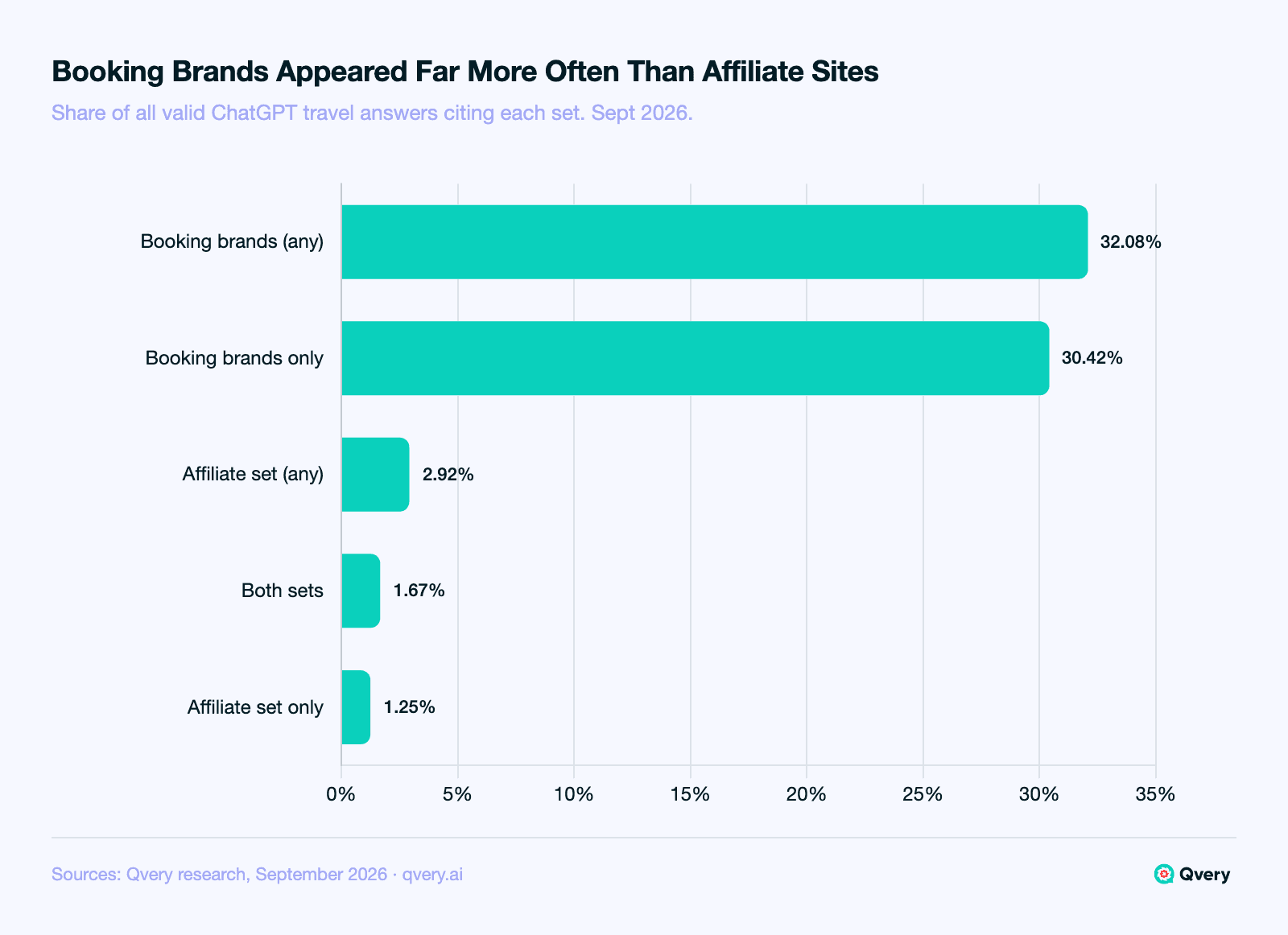
And most answers cited neither set at all.
For your audit, that means neither named set is the thing to chase. Start from the domains your own answers cite.
One tourism marketing agency argues that "Only a limited number of tourism brands appear in AI-generated responses, which means discoverability increasingly concentrates around businesses AI systems interpret as credible, structured and trustworthy."
Our data measured whether two named sets appeared, not market concentration and not credibility. The fact that most answers cited neither set is a reason to look past both before accepting that conclusion.
Two limits sit on this result. It does not establish that a large booking brand is necessary to appear in an answer; it records what appeared together and cannot settle necessity either way. And it explains nothing: no crowding out, no substitution, no reason one set appears more.
How the booking platforms themselves get cited is its own subject, covered in how OTA listings feed AI citations.
Broad Discovery and Booking Questions Need Separate Audit Lists
For each kind of question we built a list of domains, adding at each step the domain that covered the most answers not yet covered, until the list reached 80% of the answers that cited any source. The broad-discovery list runs to 41 domains and the booking-constrained list to 25.
Then we swapped them. The booking-constrained list covered 42.02% of the broad-discovery answers that cited any source. The broad-discovery list covered 59.78% of the booking-constrained answers that cited any source.
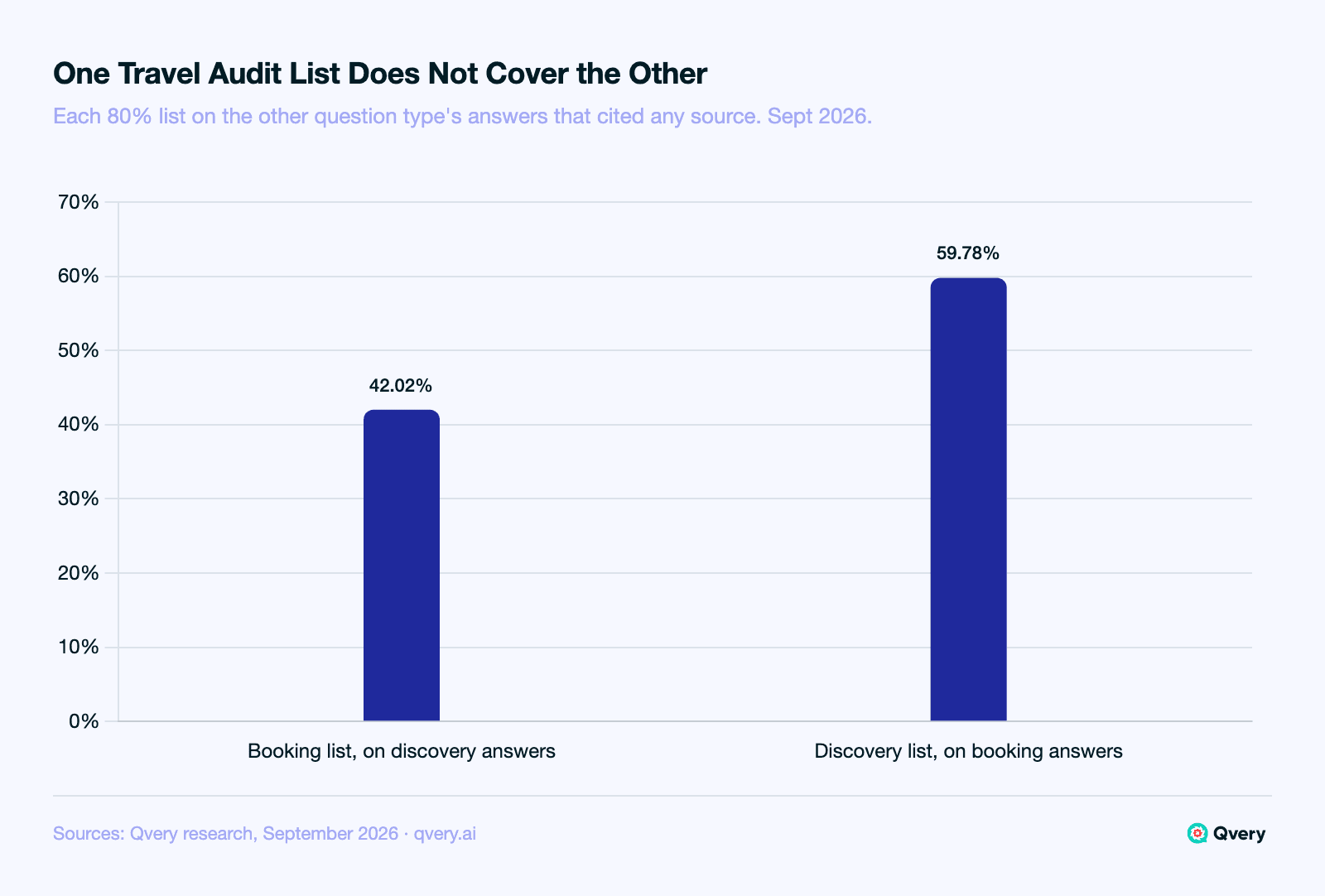
The lower of the two, unrounded, is 0.4202. Our bar for one shared list is 0.60, so each needs its own list.
That does not mean the two lists share no domains, and it does not mean any one domain causes the difference.
A travel industry digest put the broader point this way: "The research shows there is no single formula for AI visibility, with airlines, hotels, online travel agencies, car rental brands, ski resorts and holiday rental platforms each relying on different combinations of search, authority, community and content signals."
Our lists give that a narrow, measured consequence for two kinds of ChatGPT travel question, two lists instead of one. They explain nothing about why.
For the wider travel citation layer, including how the engines differ, see where travel brands show up in AI search. For the mechanics of the audit itself, see how to run a content gap analysis.
A Booking Constraint Does Not Change the Affiliate Picture in a Way We Can Call
The affiliate set appeared in 2.50% of broad-discovery answers and 3.33% of booking-constrained answers. The ratio is 0.75, which sits in the band we set in advance as indeterminate.
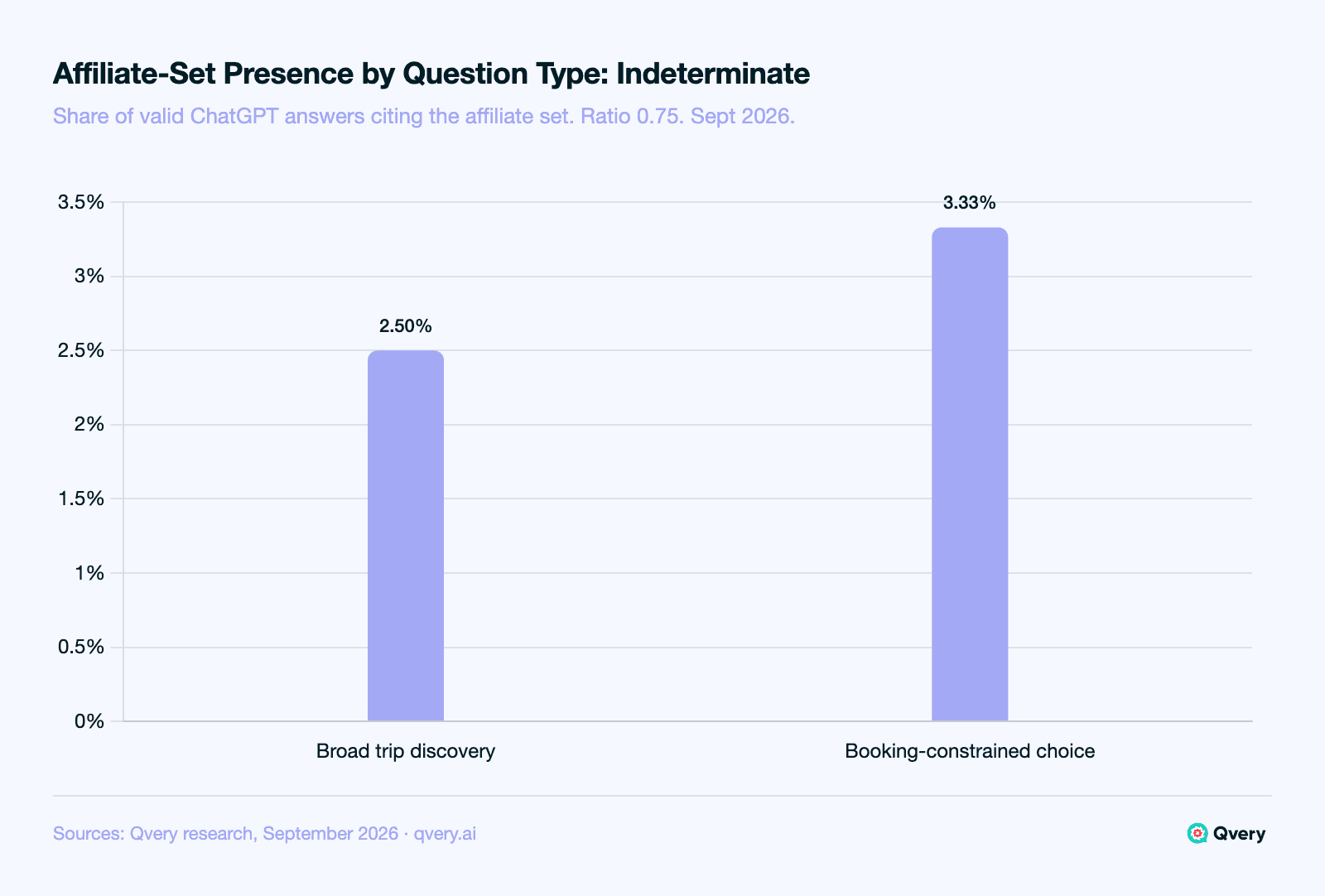
So our prediction that broad discovery would carry more affiliate citations is not supported, and no direction is claimed either way.
For your audit, measure both kinds of question before you prioritize either. Do not infer that adding booking details to a question changes which sites get cited.
One travel marketing agency writes: "Today’s AI-driven search prioritizes specificity, context, and intent." Our own contrast on exactly that axis, broad discovery against booking-constrained questions, is indeterminate. It does not confirm a predictable, intent-driven pattern, and it does not identify a mechanism.
Which Affiliate Pages Get Cited Stays Open
We also looked at the pages the affiliate set had cited, to see which kind of page gets cited. There were too few distinct pages to rank page types. Every one we could check was a comparison or best-of page, and none was left unresolved.
That is too thin to say comparison pages come first, or that other page types are absent. More distinct cited pages from a completed set would settle it.
Adobe's advice for travel brands is that "FAQs, practical guides, and side-by-side comparisons go a long way in making content more summarizable." Our data cannot rank page types, so it neither supports nor contradicts a comparison-page advantage.
Run the Travel Audit as a Standing Measurement in Qvery
The audit above is one month of ChatGPT answers. Qvery runs it every day on your own questions.
Set up your queries as pairs, the way we did here: the same trip need asked as broad discovery and with a booking constraint. Building tracking queries covers writing pairs like these, and you add and edit them through Qvery Assistant.
Qvery tracks visibility, share of voice and average rank on those queries daily across ChatGPT and Google AI Mode, in 200+ countries.
Every citation it captures is tied to the query and engine that produced it, so you can see which domains your own travel questions cite, build each audit list from them, and check both named sets against what is there.
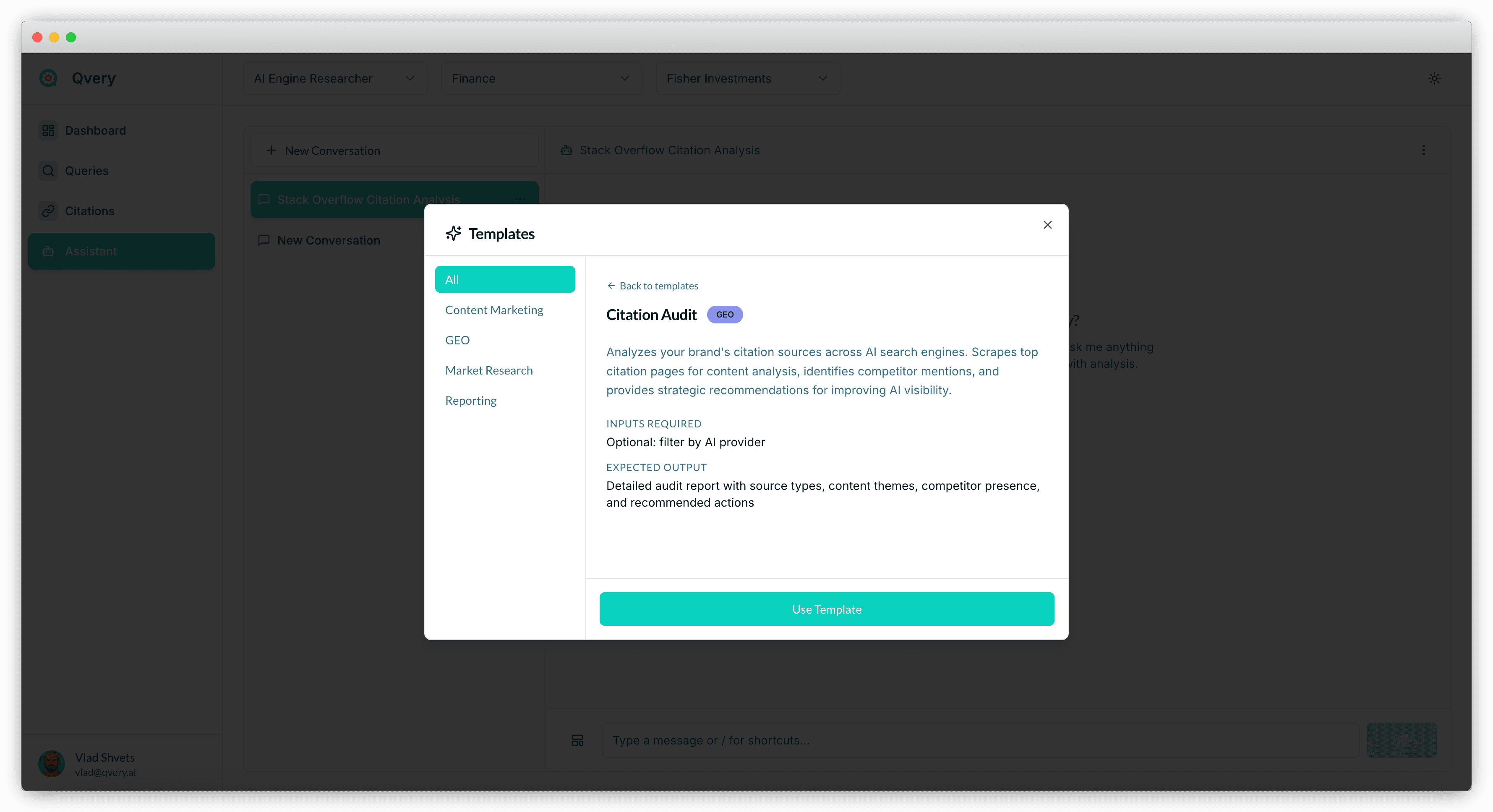
To ask instead of filter, open Qvery Assistant in the app and ask about your own visibility, share of voice or citations in plain language.
Start a free 7-day trial of Qvery, no credit card required, and set up your paired travel questions before you plan a single comparison page.
What This Data Cannot Settle
ChatGPT only. Every finding here is within ChatGPT. Google AI Mode was asked too, but its per-question-type bases are too small for any figure, the affiliate set did not appear in any of its answers, and no engine comparison prints.
Presence only. This records which sites were cited, not what the answers said, whether they were right, or why.
No necessity, no causation. Nothing here shows a big booking brand is required to appear, or that either set causes anything.
No page-type ranking. Too few distinct affiliate pages to rank.
This month only. No earlier figures are pooled or compared.
Build Your Travel Audit From What Your Answers Cite
Run the presence audit on your own travel questions. List the domains your answers cite, and treat neither the booking brands nor the affiliate publishers as a requirement.
Keep one list for broad discovery questions and one for booking-constrained questions, because one list does not cover the other half.
If you market a travel brand, you may have heard the hopeful version of AI search. ChatGPT, the story goes, cites little-known affiliate comparison sites ahead of Booking.com, so the bar is low and a small travel brand can walk right in.
It is a good story, and it is worth checking before anyone builds a content plan on it.
So we asked ChatGPT the travel recommendation questions people type in September 2026, once as broad trip discovery and once with a booking constraint added, and counted which answers cited either of two sets of sites we fixed before counting: the big booking brands, and the affiliate comparison publishers the story is about.
The short version: the booking brands appeared in 32.08% of ChatGPT's travel answers, and the affiliate comparison set in 2.92%. The premise does not hold on this measure. That measure is which sites the answers cited, and nothing about what the answers said or why.
The rest of this post is the audit that follows from it: what goes on a travel citation audit list, and whether one list is enough. Had the affiliate set led, the audit would have started with it. On these results, the audit starts from the sites your own answers cite.
Two Sets of Sites, Written Down Before We Counted
Both sets were fixed before a single answer was counted, so the audit can be repeated.
Booking brands, seven domains: airbnb.com, booking.com, expedia.com, hotels.com, kayak.com, tripadvisor.com, vrbo.com. This was a named list, so nothing was added to it or struck from it.
Affiliate publishers, one domain: nortonmediaenterprise.com. Every candidate had to meet three written criteria:
A templated comparison format covering multiple products.
A documented affiliate marker on the page.
No documented credentialed author.
A second candidate, haznos.org, was struck by an independent hand-check. It has no citations anywhere in this data, so there was no cited page to check, and a domain-level look showed a general how-to publisher. A domain with no citations changes no count, so striking it moves no figure in this post.
To run this on your own market, do it the same way: list the candidate domains first, write the criteria down before you look at the answers, and record whatever you cannot resolve.
The Booking Brands Showed Up Far More Often Than the Affiliate Set
Across ChatGPT's valid travel answers, the booking set appeared in 32.08% and the affiliate set in 2.92%, a ratio of 0.09. The direction is the booking set's.
The overlap is small. Both sets appeared together in 1.67% of answers, the affiliate set alone in 1.25%, and the booking set alone in 30.42%.
And most answers cited neither set at all.
For your audit, that means neither named set is the thing to chase. Start from the domains your own answers cite.
One tourism marketing agency argues that "Only a limited number of tourism brands appear in AI-generated responses, which means discoverability increasingly concentrates around businesses AI systems interpret as credible, structured and trustworthy."
Our data measured whether two named sets appeared, not market concentration and not credibility. The fact that most answers cited neither set is a reason to look past both before accepting that conclusion.
Two limits sit on this result. It does not establish that a large booking brand is necessary to appear in an answer; it records what appeared together and cannot settle necessity either way. And it explains nothing: no crowding out, no substitution, no reason one set appears more.
How the booking platforms themselves get cited is its own subject, covered in how OTA listings feed AI citations.
Broad Discovery and Booking Questions Need Separate Audit Lists
For each kind of question we built a list of domains, adding at each step the domain that covered the most answers not yet covered, until the list reached 80% of the answers that cited any source. The broad-discovery list runs to 41 domains and the booking-constrained list to 25.
Then we swapped them. The booking-constrained list covered 42.02% of the broad-discovery answers that cited any source. The broad-discovery list covered 59.78% of the booking-constrained answers that cited any source.
The lower of the two, unrounded, is 0.4202. Our bar for one shared list is 0.60, so each needs its own list.
That does not mean the two lists share no domains, and it does not mean any one domain causes the difference.
A travel industry digest put the broader point this way: "The research shows there is no single formula for AI visibility, with airlines, hotels, online travel agencies, car rental brands, ski resorts and holiday rental platforms each relying on different combinations of search, authority, community and content signals."
Our lists give that a narrow, measured consequence for two kinds of ChatGPT travel question, two lists instead of one. They explain nothing about why.
For the wider travel citation layer, including how the engines differ, see where travel brands show up in AI search. For the mechanics of the audit itself, see how to run a content gap analysis.
A Booking Constraint Does Not Change the Affiliate Picture in a Way We Can Call
The affiliate set appeared in 2.50% of broad-discovery answers and 3.33% of booking-constrained answers. The ratio is 0.75, which sits in the band we set in advance as indeterminate.
So our prediction that broad discovery would carry more affiliate citations is not supported, and no direction is claimed either way.
For your audit, measure both kinds of question before you prioritize either. Do not infer that adding booking details to a question changes which sites get cited.
One travel marketing agency writes: "Today’s AI-driven search prioritizes specificity, context, and intent." Our own contrast on exactly that axis, broad discovery against booking-constrained questions, is indeterminate. It does not confirm a predictable, intent-driven pattern, and it does not identify a mechanism.
Which Affiliate Pages Get Cited Stays Open
We also looked at the pages the affiliate set had cited, to see which kind of page gets cited. There were too few distinct pages to rank page types. Every one we could check was a comparison or best-of page, and none was left unresolved.
That is too thin to say comparison pages come first, or that other page types are absent. More distinct cited pages from a completed set would settle it.
Adobe's advice for travel brands is that "FAQs, practical guides, and side-by-side comparisons go a long way in making content more summarizable." Our data cannot rank page types, so it neither supports nor contradicts a comparison-page advantage.
Run the Travel Audit as a Standing Measurement in Qvery
The audit above is one month of ChatGPT answers. Qvery runs it every day on your own questions.
Set up your queries as pairs, the way we did here: the same trip need asked as broad discovery and with a booking constraint. Building tracking queries covers writing pairs like these, and you add and edit them through Qvery Assistant.
Qvery tracks visibility, share of voice and average rank on those queries daily across ChatGPT and Google AI Mode, in 200+ countries.
Every citation it captures is tied to the query and engine that produced it, so you can see which domains your own travel questions cite, build each audit list from them, and check both named sets against what is there.
To ask instead of filter, open Qvery Assistant in the app and ask about your own visibility, share of voice or citations in plain language.
Start a free 7-day trial of Qvery, no credit card required, and set up your paired travel questions before you plan a single comparison page.
What This Data Cannot Settle
ChatGPT only. Every finding here is within ChatGPT. Google AI Mode was asked too, but its per-question-type bases are too small for any figure, the affiliate set did not appear in any of its answers, and no engine comparison prints.
Presence only. This records which sites were cited, not what the answers said, whether they were right, or why.
No necessity, no causation. Nothing here shows a big booking brand is required to appear, or that either set causes anything.
No page-type ranking. Too few distinct affiliate pages to rank.
This month only. No earlier figures are pooled or compared.
Build Your Travel Audit From What Your Answers Cite
Run the presence audit on your own travel questions. List the domains your answers cite, and treat neither the booking brands nor the affiliate publishers as a requirement.
Keep one list for broad discovery questions and one for booking-constrained questions, because one list does not cover the other half.
If you market a travel brand, you may have heard the hopeful version of AI search. ChatGPT, the story goes, cites little-known affiliate comparison sites ahead of Booking.com, so the bar is low and a small travel brand can walk right in.
It is a good story, and it is worth checking before anyone builds a content plan on it.
So we asked ChatGPT the travel recommendation questions people type in September 2026, once as broad trip discovery and once with a booking constraint added, and counted which answers cited either of two sets of sites we fixed before counting: the big booking brands, and the affiliate comparison publishers the story is about.
The short version: the booking brands appeared in 32.08% of ChatGPT's travel answers, and the affiliate comparison set in 2.92%. The premise does not hold on this measure. That measure is which sites the answers cited, and nothing about what the answers said or why.
The rest of this post is the audit that follows from it: what goes on a travel citation audit list, and whether one list is enough. Had the affiliate set led, the audit would have started with it. On these results, the audit starts from the sites your own answers cite.
Two Sets of Sites, Written Down Before We Counted
Both sets were fixed before a single answer was counted, so the audit can be repeated.
Booking brands, seven domains: airbnb.com, booking.com, expedia.com, hotels.com, kayak.com, tripadvisor.com, vrbo.com. This was a named list, so nothing was added to it or struck from it.
Affiliate publishers, one domain: nortonmediaenterprise.com. Every candidate had to meet three written criteria:
A templated comparison format covering multiple products.
A documented affiliate marker on the page.
No documented credentialed author.
A second candidate, haznos.org, was struck by an independent hand-check. It has no citations anywhere in this data, so there was no cited page to check, and a domain-level look showed a general how-to publisher. A domain with no citations changes no count, so striking it moves no figure in this post.
To run this on your own market, do it the same way: list the candidate domains first, write the criteria down before you look at the answers, and record whatever you cannot resolve.
The Booking Brands Showed Up Far More Often Than the Affiliate Set
Across ChatGPT's valid travel answers, the booking set appeared in 32.08% and the affiliate set in 2.92%, a ratio of 0.09. The direction is the booking set's.
The overlap is small. Both sets appeared together in 1.67% of answers, the affiliate set alone in 1.25%, and the booking set alone in 30.42%.
And most answers cited neither set at all.
For your audit, that means neither named set is the thing to chase. Start from the domains your own answers cite.
One tourism marketing agency argues that "Only a limited number of tourism brands appear in AI-generated responses, which means discoverability increasingly concentrates around businesses AI systems interpret as credible, structured and trustworthy."
Our data measured whether two named sets appeared, not market concentration and not credibility. The fact that most answers cited neither set is a reason to look past both before accepting that conclusion.
Two limits sit on this result. It does not establish that a large booking brand is necessary to appear in an answer; it records what appeared together and cannot settle necessity either way. And it explains nothing: no crowding out, no substitution, no reason one set appears more.
How the booking platforms themselves get cited is its own subject, covered in how OTA listings feed AI citations.
Broad Discovery and Booking Questions Need Separate Audit Lists
For each kind of question we built a list of domains, adding at each step the domain that covered the most answers not yet covered, until the list reached 80% of the answers that cited any source. The broad-discovery list runs to 41 domains and the booking-constrained list to 25.
Then we swapped them. The booking-constrained list covered 42.02% of the broad-discovery answers that cited any source. The broad-discovery list covered 59.78% of the booking-constrained answers that cited any source.
The lower of the two, unrounded, is 0.4202. Our bar for one shared list is 0.60, so each needs its own list.
That does not mean the two lists share no domains, and it does not mean any one domain causes the difference.
A travel industry digest put the broader point this way: "The research shows there is no single formula for AI visibility, with airlines, hotels, online travel agencies, car rental brands, ski resorts and holiday rental platforms each relying on different combinations of search, authority, community and content signals."
Our lists give that a narrow, measured consequence for two kinds of ChatGPT travel question, two lists instead of one. They explain nothing about why.
For the wider travel citation layer, including how the engines differ, see where travel brands show up in AI search. For the mechanics of the audit itself, see how to run a content gap analysis.
A Booking Constraint Does Not Change the Affiliate Picture in a Way We Can Call
The affiliate set appeared in 2.50% of broad-discovery answers and 3.33% of booking-constrained answers. The ratio is 0.75, which sits in the band we set in advance as indeterminate.
So our prediction that broad discovery would carry more affiliate citations is not supported, and no direction is claimed either way.
For your audit, measure both kinds of question before you prioritize either. Do not infer that adding booking details to a question changes which sites get cited.
One travel marketing agency writes: "Today’s AI-driven search prioritizes specificity, context, and intent." Our own contrast on exactly that axis, broad discovery against booking-constrained questions, is indeterminate. It does not confirm a predictable, intent-driven pattern, and it does not identify a mechanism.
Which Affiliate Pages Get Cited Stays Open
We also looked at the pages the affiliate set had cited, to see which kind of page gets cited. There were too few distinct pages to rank page types. Every one we could check was a comparison or best-of page, and none was left unresolved.
That is too thin to say comparison pages come first, or that other page types are absent. More distinct cited pages from a completed set would settle it.
Adobe's advice for travel brands is that "FAQs, practical guides, and side-by-side comparisons go a long way in making content more summarizable." Our data cannot rank page types, so it neither supports nor contradicts a comparison-page advantage.
Run the Travel Audit as a Standing Measurement in Qvery
The audit above is one month of ChatGPT answers. Qvery runs it every day on your own questions.
Set up your queries as pairs, the way we did here: the same trip need asked as broad discovery and with a booking constraint. Building tracking queries covers writing pairs like these, and you add and edit them through Qvery Assistant.
Qvery tracks visibility, share of voice and average rank on those queries daily across ChatGPT and Google AI Mode, in 200+ countries.
Every citation it captures is tied to the query and engine that produced it, so you can see which domains your own travel questions cite, build each audit list from them, and check both named sets against what is there.
To ask instead of filter, open Qvery Assistant in the app and ask about your own visibility, share of voice or citations in plain language.
Start a free 7-day trial of Qvery, no credit card required, and set up your paired travel questions before you plan a single comparison page.
What This Data Cannot Settle
ChatGPT only. Every finding here is within ChatGPT. Google AI Mode was asked too, but its per-question-type bases are too small for any figure, the affiliate set did not appear in any of its answers, and no engine comparison prints.
Presence only. This records which sites were cited, not what the answers said, whether they were right, or why.
No necessity, no causation. Nothing here shows a big booking brand is required to appear, or that either set causes anything.
No page-type ranking. Too few distinct affiliate pages to rank.
This month only. No earlier figures are pooled or compared.
Build Your Travel Audit From What Your Answers Cite
Run the presence audit on your own travel questions. List the domains your answers cite, and treat neither the booking brands nor the affiliate publishers as a requirement.
Keep one list for broad discovery questions and one for booking-constrained questions, because one list does not cover the other half.
If you market a travel brand, you may have heard the hopeful version of AI search. ChatGPT, the story goes, cites little-known affiliate comparison sites ahead of Booking.com, so the bar is low and a small travel brand can walk right in.
It is a good story, and it is worth checking before anyone builds a content plan on it.
So we asked ChatGPT the travel recommendation questions people type in September 2026, once as broad trip discovery and once with a booking constraint added, and counted which answers cited either of two sets of sites we fixed before counting: the big booking brands, and the affiliate comparison publishers the story is about.
The short version: the booking brands appeared in 32.08% of ChatGPT's travel answers, and the affiliate comparison set in 2.92%. The premise does not hold on this measure. That measure is which sites the answers cited, and nothing about what the answers said or why.
The rest of this post is the audit that follows from it: what goes on a travel citation audit list, and whether one list is enough. Had the affiliate set led, the audit would have started with it. On these results, the audit starts from the sites your own answers cite.
Two Sets of Sites, Written Down Before We Counted
Both sets were fixed before a single answer was counted, so the audit can be repeated.
Booking brands, seven domains: airbnb.com, booking.com, expedia.com, hotels.com, kayak.com, tripadvisor.com, vrbo.com. This was a named list, so nothing was added to it or struck from it.
Affiliate publishers, one domain: nortonmediaenterprise.com. Every candidate had to meet three written criteria:
A templated comparison format covering multiple products.
A documented affiliate marker on the page.
No documented credentialed author.
A second candidate, haznos.org, was struck by an independent hand-check. It has no citations anywhere in this data, so there was no cited page to check, and a domain-level look showed a general how-to publisher. A domain with no citations changes no count, so striking it moves no figure in this post.
To run this on your own market, do it the same way: list the candidate domains first, write the criteria down before you look at the answers, and record whatever you cannot resolve.
The Booking Brands Showed Up Far More Often Than the Affiliate Set
Across ChatGPT's valid travel answers, the booking set appeared in 32.08% and the affiliate set in 2.92%, a ratio of 0.09. The direction is the booking set's.
The overlap is small. Both sets appeared together in 1.67% of answers, the affiliate set alone in 1.25%, and the booking set alone in 30.42%.
And most answers cited neither set at all.
For your audit, that means neither named set is the thing to chase. Start from the domains your own answers cite.
One tourism marketing agency argues that "Only a limited number of tourism brands appear in AI-generated responses, which means discoverability increasingly concentrates around businesses AI systems interpret as credible, structured and trustworthy."
Our data measured whether two named sets appeared, not market concentration and not credibility. The fact that most answers cited neither set is a reason to look past both before accepting that conclusion.
Two limits sit on this result. It does not establish that a large booking brand is necessary to appear in an answer; it records what appeared together and cannot settle necessity either way. And it explains nothing: no crowding out, no substitution, no reason one set appears more.
How the booking platforms themselves get cited is its own subject, covered in how OTA listings feed AI citations.
Broad Discovery and Booking Questions Need Separate Audit Lists
For each kind of question we built a list of domains, adding at each step the domain that covered the most answers not yet covered, until the list reached 80% of the answers that cited any source. The broad-discovery list runs to 41 domains and the booking-constrained list to 25.
Then we swapped them. The booking-constrained list covered 42.02% of the broad-discovery answers that cited any source. The broad-discovery list covered 59.78% of the booking-constrained answers that cited any source.
The lower of the two, unrounded, is 0.4202. Our bar for one shared list is 0.60, so each needs its own list.
That does not mean the two lists share no domains, and it does not mean any one domain causes the difference.
A travel industry digest put the broader point this way: "The research shows there is no single formula for AI visibility, with airlines, hotels, online travel agencies, car rental brands, ski resorts and holiday rental platforms each relying on different combinations of search, authority, community and content signals."
Our lists give that a narrow, measured consequence for two kinds of ChatGPT travel question, two lists instead of one. They explain nothing about why.
For the wider travel citation layer, including how the engines differ, see where travel brands show up in AI search. For the mechanics of the audit itself, see how to run a content gap analysis.
A Booking Constraint Does Not Change the Affiliate Picture in a Way We Can Call
The affiliate set appeared in 2.50% of broad-discovery answers and 3.33% of booking-constrained answers. The ratio is 0.75, which sits in the band we set in advance as indeterminate.
So our prediction that broad discovery would carry more affiliate citations is not supported, and no direction is claimed either way.
For your audit, measure both kinds of question before you prioritize either. Do not infer that adding booking details to a question changes which sites get cited.
One travel marketing agency writes: "Today’s AI-driven search prioritizes specificity, context, and intent." Our own contrast on exactly that axis, broad discovery against booking-constrained questions, is indeterminate. It does not confirm a predictable, intent-driven pattern, and it does not identify a mechanism.
Which Affiliate Pages Get Cited Stays Open
We also looked at the pages the affiliate set had cited, to see which kind of page gets cited. There were too few distinct pages to rank page types. Every one we could check was a comparison or best-of page, and none was left unresolved.
That is too thin to say comparison pages come first, or that other page types are absent. More distinct cited pages from a completed set would settle it.
Adobe's advice for travel brands is that "FAQs, practical guides, and side-by-side comparisons go a long way in making content more summarizable." Our data cannot rank page types, so it neither supports nor contradicts a comparison-page advantage.
Run the Travel Audit as a Standing Measurement in Qvery
The audit above is one month of ChatGPT answers. Qvery runs it every day on your own questions.
Set up your queries as pairs, the way we did here: the same trip need asked as broad discovery and with a booking constraint. Building tracking queries covers writing pairs like these, and you add and edit them through Qvery Assistant.
Qvery tracks visibility, share of voice and average rank on those queries daily across ChatGPT and Google AI Mode, in 200+ countries.
Every citation it captures is tied to the query and engine that produced it, so you can see which domains your own travel questions cite, build each audit list from them, and check both named sets against what is there.
To ask instead of filter, open Qvery Assistant in the app and ask about your own visibility, share of voice or citations in plain language.
Start a free 7-day trial of Qvery, no credit card required, and set up your paired travel questions before you plan a single comparison page.
What This Data Cannot Settle
ChatGPT only. Every finding here is within ChatGPT. Google AI Mode was asked too, but its per-question-type bases are too small for any figure, the affiliate set did not appear in any of its answers, and no engine comparison prints.
Presence only. This records which sites were cited, not what the answers said, whether they were right, or why.
No necessity, no causation. Nothing here shows a big booking brand is required to appear, or that either set causes anything.
No page-type ranking. Too few distinct affiliate pages to rank.
This month only. No earlier figures are pooled or compared.
Build Your Travel Audit From What Your Answers Cite
Run the presence audit on your own travel questions. List the domains your answers cite, and treat neither the booking brands nor the affiliate publishers as a requirement.
Keep one list for broad discovery questions and one for booking-constrained questions, because one list does not cover the other half.

© 2026 Qvery AI OÜ