By
Vlad Shvets
How Travel Brands Win the AI Citation Layer
Qvery's data on 250 travel queries shows Reddit, OTAs, and editorial lists own the AI citation layer, ChatGPT and Google AI Mode pull different sources, and what travel brands do about it.
Qvery's data on 250 travel queries shows Reddit, OTAs, and editorial lists own the AI citation layer, ChatGPT and Google AI Mode pull different sources, and what travel brands do about it.
Qvery's data on 250 travel queries shows Reddit, OTAs, and editorial lists own the AI citation layer, ChatGPT and Google AI Mode pull different sources, and what travel brands do about it.
We ran a sample of roughly 250 travel category and advice queries on ChatGPT and Google AI Mode in June 2026, the kind of thing a real person types when they want a shortlist of hotels or things to do. One source showed up in 71.3% of the answers that cited anything at all. That source wasn't Booking.com, Expedia, or any hotel chain with a marketing budget. It was Reddit, and the lead was so lopsided I re-ran the whole sample to be sure.
Most travel brands have spent years building a beautiful booking site the engines treat like furniture. The good news is the data shows where the citations come from, so you can go work those sources instead of polishing pages no engine reads.
The engine is going to cite an intermediary in travel no matter what you do. The data shows exactly which ones, and what that means for your brand.
Travel Citations Live in the Aggregator and Listing Layer
We sort verticals by what the engines lean on. Some are reference-led, where encyclopedic and regulatory sources carry the answer (fintech, insurance). Some are community-led, where forums, video, and thought leadership do the heavy lifting. Travel is a textbook aggregator-and-listing-led vertical (archetype B). The engine almost never reaches for the individual hotel or operator site first. It reaches for a thick, trusted intermediary layer and synthesizes from there.
The bucket math makes it obvious. Across the answers we ran, directory and aggregator sources accounted for 28.8% of all cited sources, editorial and "best of" review listicles another 24.3%, and community and UGC sources 23.0%. Those three layers alone are roughly three-quarters of every citation in the vertical. The individual brand site, the one you control, is a rounding error inside the "other" and "owned-brand" slivers at the bottom.
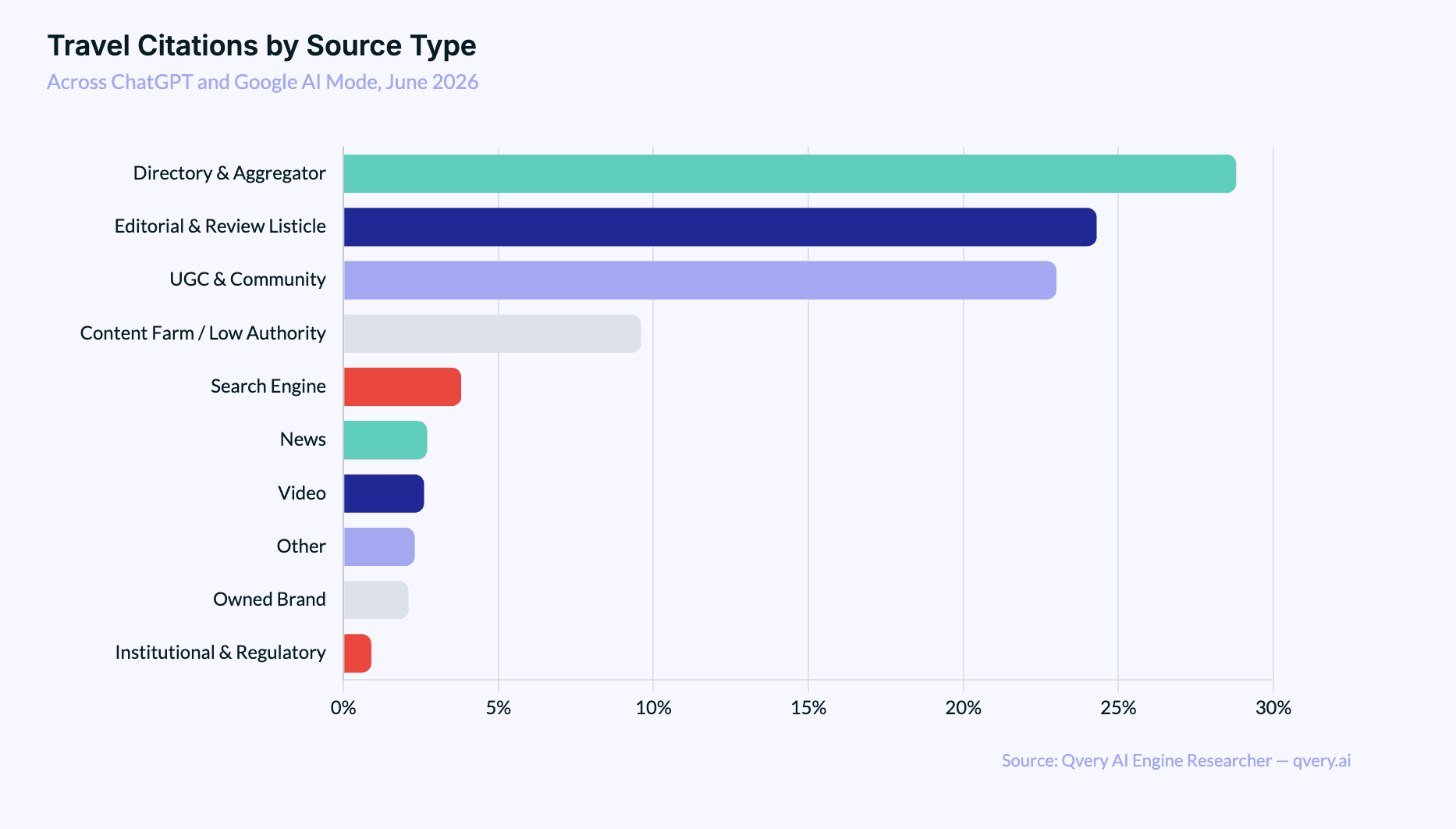
This is the structural reason most individual travel sites are invisible at the exact moment a traveler is deciding. Your pages were built to sell a room or a tour, not to answer a question. The intermediaries were built to answer questions at scale, with star ratings, review counts, ranked positions, and price bands already machine-legible. The engine wants the format the intermediary already produces. So the move is not to outrank that layer. The move is to be the property that layer names, ranks well, and describes favorably.
Reddit Is the Single Most-Cited Travel Source, and It Isn't Close
Inside that community layer, one domain does almost all the work. Across the queries we ran, Reddit appeared in 43.6% of all answers and 71.3% of the answers that cited any source, ranking #1 by a wide margin. The next-closest single domain, Forbes, showed up in 12.1% of all answers. Reddit appears roughly 3.6x more often than the runner-up.
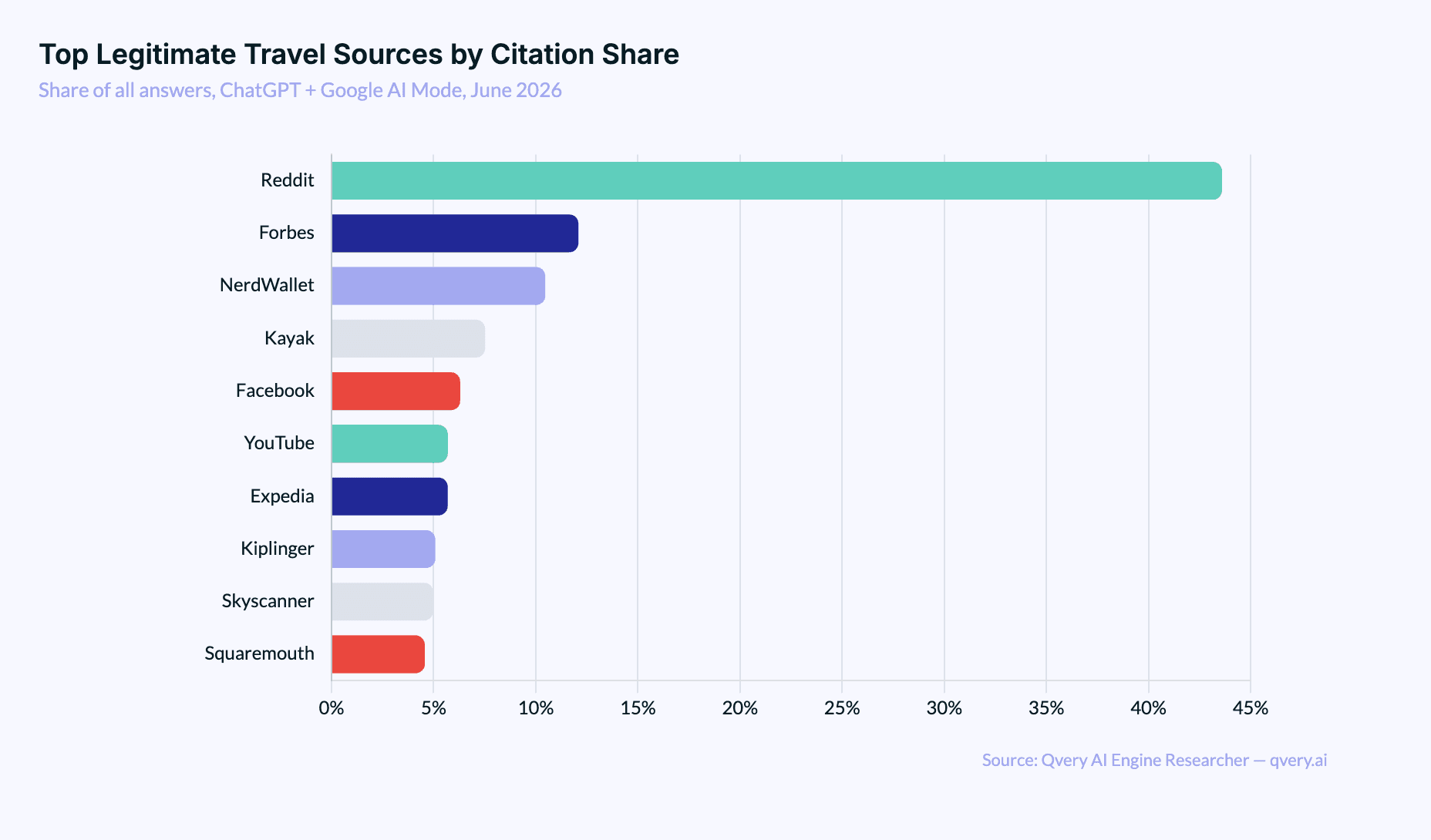
The reason is the same one we see across every vertical where Reddit over-indexes: it reads as candid, first-person, non-promotional consensus, which is the tonal opposite of a brand page. When someone asks "best neighborhood to stay in Lisbon" or "is this tour worth it," the engine wants the answer that sounds like a person who went, not the one that sounds like it's trying to sell a room. Travel just happens to be the vertical where that preference is most extreme. It's the same pattern that makes Reddit the single most important UGC source in AI search generally, dialed up.
The one citation source with the highest leverage in travel is also the one you are structurally forbidden from buying your way into.
For a travel brand this is the highest-leverage citation source you don't own and can't buy. Posting your own threads gets flagged, and the engine weights planted ones to nothing. The only move that works is being good enough that real people in r/travel, r/solotravel, and destination subreddits recommend you without being asked, and the engine weights those threads precisely because it can tell they weren't planted.
ChatGPT and Google AI Mode Build the Same Answer From Different Sources
The two engines build the same answer from very different sources. The source mix splits hard by engine, and that split is the most useful thing in the travel data. The work that lands a citation on one engine often does nothing on the other. Treat them as one audience, because real travelers use both.
Editorial listicles skew hard to ChatGPT: Forbes is cited 10.9x more often on ChatGPT than on Google AI Mode, and Condé Nast Traveler skews about 8.5-to-1 the same way. Video flips it: YouTube is cited about 4.6x more on Google AI Mode than on ChatGPT, in line with how Google AI Mode cites YouTube heavily while ChatGPT barely touches it. The aggregators are the rare layer that plays on both, with directory sources splitting almost evenly between the two engines (roughly 51% / 49%).
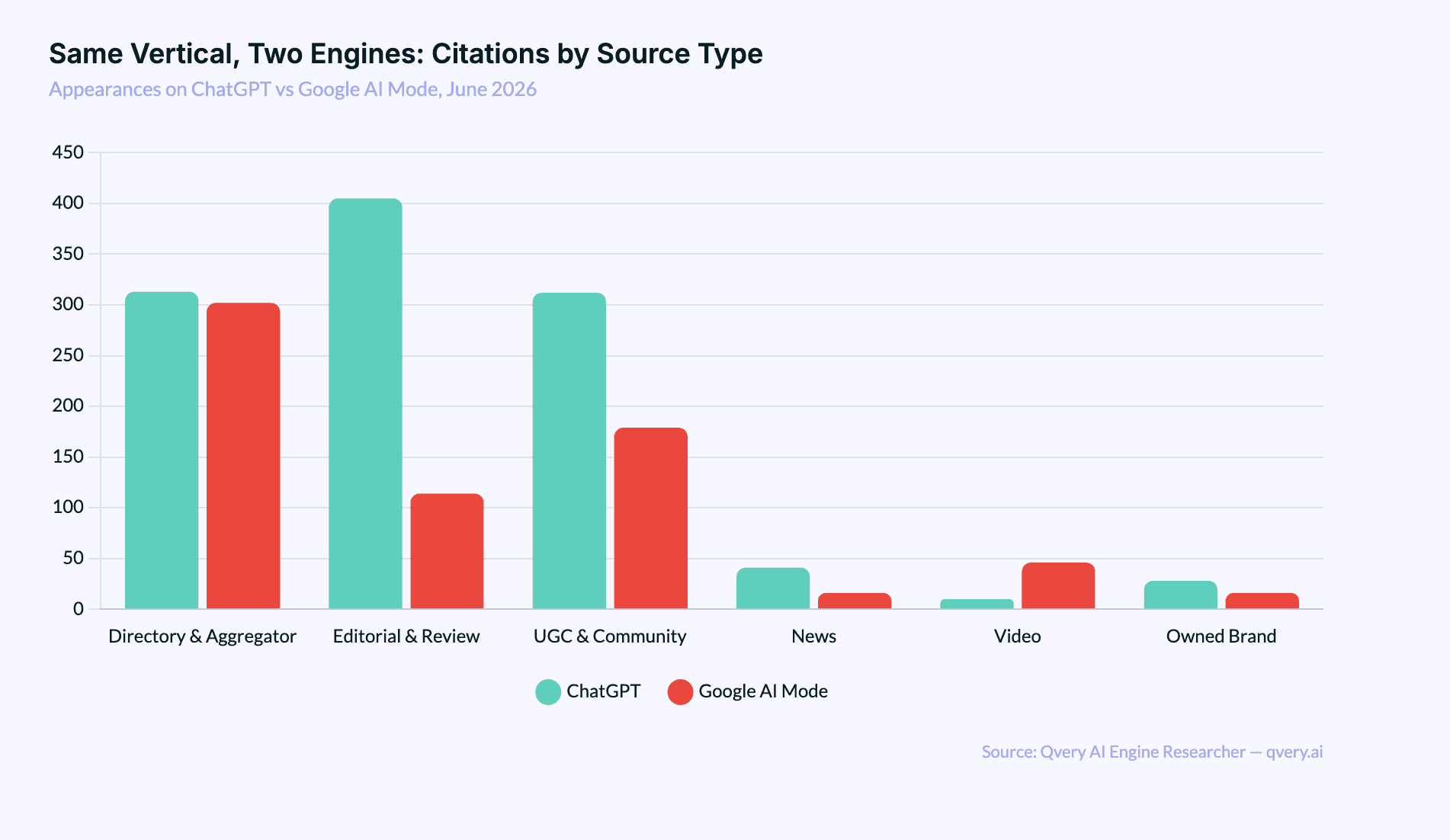
There's no engine to pick here. The aggregator presence you build serves both, the editorial placements you earn land mostly on ChatGPT, so you build Google AI Mode visibility through video and structured local data in parallel. The three pillars of AI engine visibility, optimized site content plus third-party mentions plus UGC, are the same everywhere, but in travel each pillar pays out on a different engine.
Google Cites Its Own Surfaces First on Google AI Mode
One domain in our top sources behaves unlike all the others. Google.com appeared in 8.3% of all answers, which already puts it ahead of Kayak and Expedia. But the split is the story: Google.com is cited on Google AI Mode roughly 5x more often than on ChatGPT. When Google AI Mode answers a travel query, it leans on Google's own surfaces, Maps reviews, Hotels, Flights, local listings, as first-party sources and keeps much of the journey inside its own walls.
That's not a conspiracy, it's home-field advantage. Google owns the surfaces, so it cites them. For geo-anchored travel answers on Google AI Mode, your Google Business Profile and Maps presence are not optional hygiene, they are a primary citation surface. A complete, review-rich, accurately categorized local profile is the single highest-leverage lever you have on the engine that searches every travel query it gets.
On Google AI Mode, the question of whether your brand gets cited is often decided inside Google Maps before the engine ever looks at the open web.
ChatGPT Answers Half the Time Without Searching the Web
The other engine has its own quirk, and it changes what you optimize for. In our travel sample, ChatGPT triggered a live web search on only 48.7% of the queries we ran. The other half of the time it answered from memory, from what it already absorbed in training, citing nothing live at all. Google AI Mode, by contrast, searched on effectively every query.
ChatGPT: live search on 48.7% of travel queries; the rest answered from training memory.
Google AI Mode: live search on effectively every query.
So when ChatGPT does decide a travel question deserves fresh sources, it has gotten pickier about them. Fewer, more selective citations on one engine and full live search on the other change the job. The practical implication for travel brands is a two-track game. For the half of ChatGPT answers that never search, you want to be the property and the brand that's already well-established in the training-favored institutional and editorial sources, so the model recalls you without looking anything up. For everything else, you want to be present in the live-retrievable layer, the aggregators, the lists, the local data, so you get pulled in when the engine does go looking.
Recommendation Queries Are Where Travel Brands Are Made or Ignored
Travel queries divide cleanly by intent, and the divide matters. Recommendation-style queries got cited 73.2% of the time; informational ones only 29.8%. When a traveler asks for a shortlist, the engine almost always names sources, and Reddit, the OTAs, and the editorial lists fill that space. When someone asks a flat factual question, citations thin out and institutional sources like the U.S. State Department surface far more often on those factual queries than on recommendation ones. So the citation game in travel is really a recommendation-intent game, and the institutional sources barely show up there.
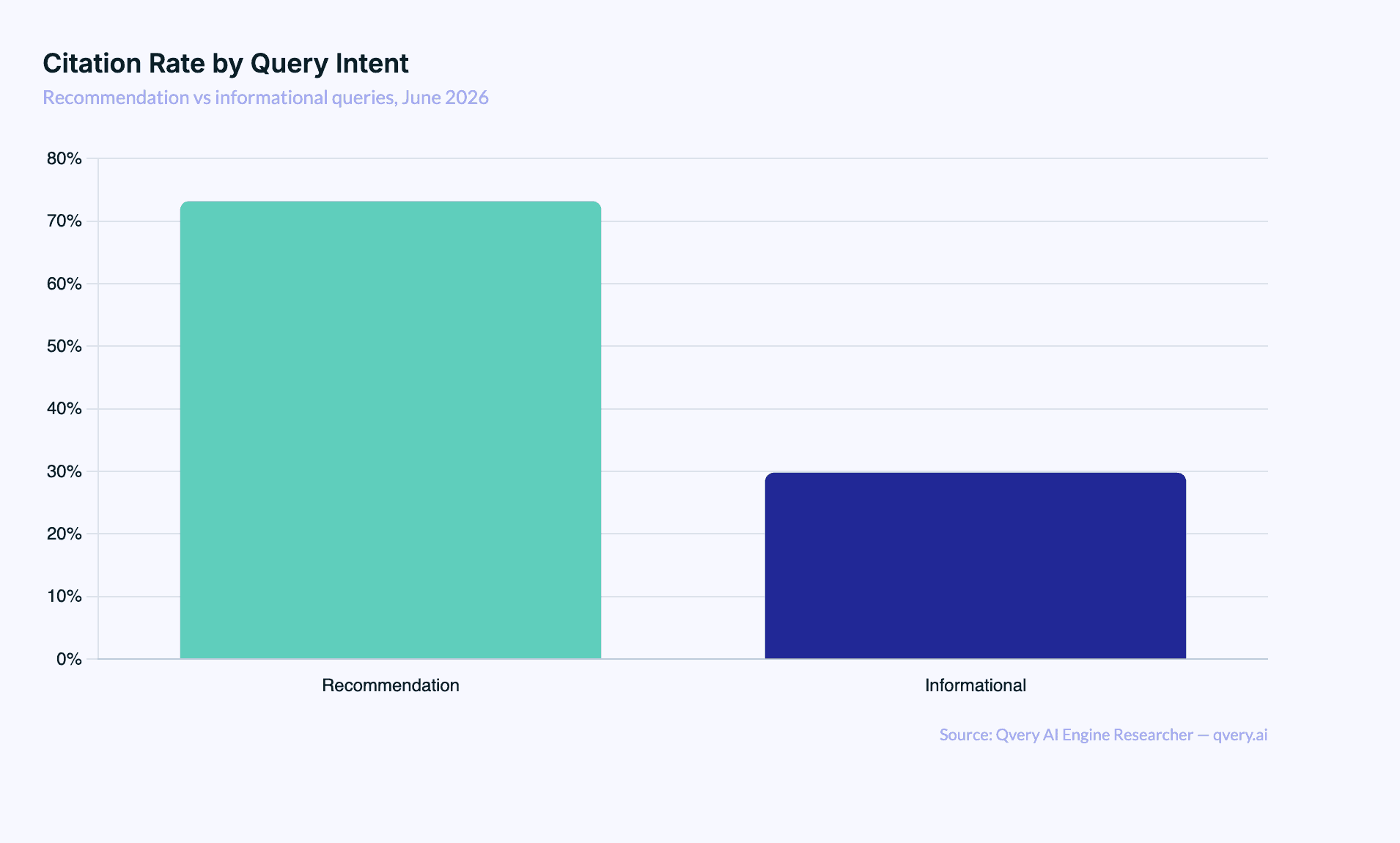
A long tail of thin, low-authority content-farm sites, the kind with generic travel names and no editorial reputation, accounted for nearly 10% of cited sources, and over 99% of those appearances landed on ChatGPT rather than Google AI Mode. That one surprised us, and we don't fully understand yet why ChatGPT tolerates that layer when Google AI Mode does not. Nobody should read this as a strategy, building a content farm to win a citation is a fast way to get nothing. It's a reminder that citation presence and source quality are different things, and that being in the right kind of source matters more than the count.
Qvery Shows You Which Layer Mentions You
If you run a travel brand, the first thing you want is to stop guessing which of these layers mentions you. Qvery's AI Engine Researcher runs the category and advice queries your travelers are really asking across both ChatGPT and Google AI Mode, then shows you which sources the engines cited and whether your brand appeared inside any of them. You see, query by query, that the answer to "best boutique hotels in Lisbon" was built from a Reddit thread, a Condé Nast list, and three OTA pages, and exactly which of those named you.
From there you can see the gap. If the engine keeps citing a Lonely Planet ranking or a NerdWallet value piece and your property isn't on it, that's a concrete target, not a vague aspiration. Qvery's Mention Builder turns those gaps into outreach: it identifies the specific third-party sources already feeding the answers in your category and helps you earn placement on the ones that move your visibility. The point is that you stop optimizing a page nobody cites and start working the sources the engines already trust.
You sign up, enter your brand and your destinations, and see your first data inside 15 minutes. No call required to find out whether ChatGPT and Google AI Mode are recommending you or recommending the property down the street.
Go Deep on the One Layer That Owns Your Sub-Topic
Pick the layer the data says owns your sub-topic and go deep there before you spread thin.
Hotel quality: review platforms and your Google Maps profile.
Flights and fare value: the metasearch aggregators and the points-focused communities.
Tours and things to do: the experience platforms and TripAdvisor.
Destination inspiration: Reddit, YouTube, and the editorial lists, where Google AI Mode fires hardest on exploratory intent.
The one thing that's true across all of it: the engines have already decided that travelers trust intermediaries more than they trust you, and most of the sources doing the recommending don't even rank in Google's organic top 10, which means the citations are sitting in places you can already influence, on platforms you don't have to outrank to appear on.
We ran a sample of roughly 250 travel category and advice queries on ChatGPT and Google AI Mode in June 2026, the kind of thing a real person types when they want a shortlist of hotels or things to do. One source showed up in 71.3% of the answers that cited anything at all. That source wasn't Booking.com, Expedia, or any hotel chain with a marketing budget. It was Reddit, and the lead was so lopsided I re-ran the whole sample to be sure.
Most travel brands have spent years building a beautiful booking site the engines treat like furniture. The good news is the data shows where the citations come from, so you can go work those sources instead of polishing pages no engine reads.
The engine is going to cite an intermediary in travel no matter what you do. The data shows exactly which ones, and what that means for your brand.
Travel Citations Live in the Aggregator and Listing Layer
We sort verticals by what the engines lean on. Some are reference-led, where encyclopedic and regulatory sources carry the answer (fintech, insurance). Some are community-led, where forums, video, and thought leadership do the heavy lifting. Travel is a textbook aggregator-and-listing-led vertical (archetype B). The engine almost never reaches for the individual hotel or operator site first. It reaches for a thick, trusted intermediary layer and synthesizes from there.
The bucket math makes it obvious. Across the answers we ran, directory and aggregator sources accounted for 28.8% of all cited sources, editorial and "best of" review listicles another 24.3%, and community and UGC sources 23.0%. Those three layers alone are roughly three-quarters of every citation in the vertical. The individual brand site, the one you control, is a rounding error inside the "other" and "owned-brand" slivers at the bottom.
This is the structural reason most individual travel sites are invisible at the exact moment a traveler is deciding. Your pages were built to sell a room or a tour, not to answer a question. The intermediaries were built to answer questions at scale, with star ratings, review counts, ranked positions, and price bands already machine-legible. The engine wants the format the intermediary already produces. So the move is not to outrank that layer. The move is to be the property that layer names, ranks well, and describes favorably.
Reddit Is the Single Most-Cited Travel Source, and It Isn't Close
Inside that community layer, one domain does almost all the work. Across the queries we ran, Reddit appeared in 43.6% of all answers and 71.3% of the answers that cited any source, ranking #1 by a wide margin. The next-closest single domain, Forbes, showed up in 12.1% of all answers. Reddit appears roughly 3.6x more often than the runner-up.
The reason is the same one we see across every vertical where Reddit over-indexes: it reads as candid, first-person, non-promotional consensus, which is the tonal opposite of a brand page. When someone asks "best neighborhood to stay in Lisbon" or "is this tour worth it," the engine wants the answer that sounds like a person who went, not the one that sounds like it's trying to sell a room. Travel just happens to be the vertical where that preference is most extreme. It's the same pattern that makes Reddit the single most important UGC source in AI search generally, dialed up.
The one citation source with the highest leverage in travel is also the one you are structurally forbidden from buying your way into.
For a travel brand this is the highest-leverage citation source you don't own and can't buy. Posting your own threads gets flagged, and the engine weights planted ones to nothing. The only move that works is being good enough that real people in r/travel, r/solotravel, and destination subreddits recommend you without being asked, and the engine weights those threads precisely because it can tell they weren't planted.
ChatGPT and Google AI Mode Build the Same Answer From Different Sources
The two engines build the same answer from very different sources. The source mix splits hard by engine, and that split is the most useful thing in the travel data. The work that lands a citation on one engine often does nothing on the other. Treat them as one audience, because real travelers use both.
Editorial listicles skew hard to ChatGPT: Forbes is cited 10.9x more often on ChatGPT than on Google AI Mode, and Condé Nast Traveler skews about 8.5-to-1 the same way. Video flips it: YouTube is cited about 4.6x more on Google AI Mode than on ChatGPT, in line with how Google AI Mode cites YouTube heavily while ChatGPT barely touches it. The aggregators are the rare layer that plays on both, with directory sources splitting almost evenly between the two engines (roughly 51% / 49%).
There's no engine to pick here. The aggregator presence you build serves both, the editorial placements you earn land mostly on ChatGPT, so you build Google AI Mode visibility through video and structured local data in parallel. The three pillars of AI engine visibility, optimized site content plus third-party mentions plus UGC, are the same everywhere, but in travel each pillar pays out on a different engine.
Google Cites Its Own Surfaces First on Google AI Mode
One domain in our top sources behaves unlike all the others. Google.com appeared in 8.3% of all answers, which already puts it ahead of Kayak and Expedia. But the split is the story: Google.com is cited on Google AI Mode roughly 5x more often than on ChatGPT. When Google AI Mode answers a travel query, it leans on Google's own surfaces, Maps reviews, Hotels, Flights, local listings, as first-party sources and keeps much of the journey inside its own walls.
That's not a conspiracy, it's home-field advantage. Google owns the surfaces, so it cites them. For geo-anchored travel answers on Google AI Mode, your Google Business Profile and Maps presence are not optional hygiene, they are a primary citation surface. A complete, review-rich, accurately categorized local profile is the single highest-leverage lever you have on the engine that searches every travel query it gets.
On Google AI Mode, the question of whether your brand gets cited is often decided inside Google Maps before the engine ever looks at the open web.
ChatGPT Answers Half the Time Without Searching the Web
The other engine has its own quirk, and it changes what you optimize for. In our travel sample, ChatGPT triggered a live web search on only 48.7% of the queries we ran. The other half of the time it answered from memory, from what it already absorbed in training, citing nothing live at all. Google AI Mode, by contrast, searched on effectively every query.
ChatGPT: live search on 48.7% of travel queries; the rest answered from training memory.
Google AI Mode: live search on effectively every query.
So when ChatGPT does decide a travel question deserves fresh sources, it has gotten pickier about them. Fewer, more selective citations on one engine and full live search on the other change the job. The practical implication for travel brands is a two-track game. For the half of ChatGPT answers that never search, you want to be the property and the brand that's already well-established in the training-favored institutional and editorial sources, so the model recalls you without looking anything up. For everything else, you want to be present in the live-retrievable layer, the aggregators, the lists, the local data, so you get pulled in when the engine does go looking.
Recommendation Queries Are Where Travel Brands Are Made or Ignored
Travel queries divide cleanly by intent, and the divide matters. Recommendation-style queries got cited 73.2% of the time; informational ones only 29.8%. When a traveler asks for a shortlist, the engine almost always names sources, and Reddit, the OTAs, and the editorial lists fill that space. When someone asks a flat factual question, citations thin out and institutional sources like the U.S. State Department surface far more often on those factual queries than on recommendation ones. So the citation game in travel is really a recommendation-intent game, and the institutional sources barely show up there.
A long tail of thin, low-authority content-farm sites, the kind with generic travel names and no editorial reputation, accounted for nearly 10% of cited sources, and over 99% of those appearances landed on ChatGPT rather than Google AI Mode. That one surprised us, and we don't fully understand yet why ChatGPT tolerates that layer when Google AI Mode does not. Nobody should read this as a strategy, building a content farm to win a citation is a fast way to get nothing. It's a reminder that citation presence and source quality are different things, and that being in the right kind of source matters more than the count.
Qvery Shows You Which Layer Mentions You
If you run a travel brand, the first thing you want is to stop guessing which of these layers mentions you. Qvery's AI Engine Researcher runs the category and advice queries your travelers are really asking across both ChatGPT and Google AI Mode, then shows you which sources the engines cited and whether your brand appeared inside any of them. You see, query by query, that the answer to "best boutique hotels in Lisbon" was built from a Reddit thread, a Condé Nast list, and three OTA pages, and exactly which of those named you.
From there you can see the gap. If the engine keeps citing a Lonely Planet ranking or a NerdWallet value piece and your property isn't on it, that's a concrete target, not a vague aspiration. Qvery's Mention Builder turns those gaps into outreach: it identifies the specific third-party sources already feeding the answers in your category and helps you earn placement on the ones that move your visibility. The point is that you stop optimizing a page nobody cites and start working the sources the engines already trust.
You sign up, enter your brand and your destinations, and see your first data inside 15 minutes. No call required to find out whether ChatGPT and Google AI Mode are recommending you or recommending the property down the street.
Go Deep on the One Layer That Owns Your Sub-Topic
Pick the layer the data says owns your sub-topic and go deep there before you spread thin.
Hotel quality: review platforms and your Google Maps profile.
Flights and fare value: the metasearch aggregators and the points-focused communities.
Tours and things to do: the experience platforms and TripAdvisor.
Destination inspiration: Reddit, YouTube, and the editorial lists, where Google AI Mode fires hardest on exploratory intent.
The one thing that's true across all of it: the engines have already decided that travelers trust intermediaries more than they trust you, and most of the sources doing the recommending don't even rank in Google's organic top 10, which means the citations are sitting in places you can already influence, on platforms you don't have to outrank to appear on.
We ran a sample of roughly 250 travel category and advice queries on ChatGPT and Google AI Mode in June 2026, the kind of thing a real person types when they want a shortlist of hotels or things to do. One source showed up in 71.3% of the answers that cited anything at all. That source wasn't Booking.com, Expedia, or any hotel chain with a marketing budget. It was Reddit, and the lead was so lopsided I re-ran the whole sample to be sure.
Most travel brands have spent years building a beautiful booking site the engines treat like furniture. The good news is the data shows where the citations come from, so you can go work those sources instead of polishing pages no engine reads.
The engine is going to cite an intermediary in travel no matter what you do. The data shows exactly which ones, and what that means for your brand.
Travel Citations Live in the Aggregator and Listing Layer
We sort verticals by what the engines lean on. Some are reference-led, where encyclopedic and regulatory sources carry the answer (fintech, insurance). Some are community-led, where forums, video, and thought leadership do the heavy lifting. Travel is a textbook aggregator-and-listing-led vertical (archetype B). The engine almost never reaches for the individual hotel or operator site first. It reaches for a thick, trusted intermediary layer and synthesizes from there.
The bucket math makes it obvious. Across the answers we ran, directory and aggregator sources accounted for 28.8% of all cited sources, editorial and "best of" review listicles another 24.3%, and community and UGC sources 23.0%. Those three layers alone are roughly three-quarters of every citation in the vertical. The individual brand site, the one you control, is a rounding error inside the "other" and "owned-brand" slivers at the bottom.
This is the structural reason most individual travel sites are invisible at the exact moment a traveler is deciding. Your pages were built to sell a room or a tour, not to answer a question. The intermediaries were built to answer questions at scale, with star ratings, review counts, ranked positions, and price bands already machine-legible. The engine wants the format the intermediary already produces. So the move is not to outrank that layer. The move is to be the property that layer names, ranks well, and describes favorably.
Reddit Is the Single Most-Cited Travel Source, and It Isn't Close
Inside that community layer, one domain does almost all the work. Across the queries we ran, Reddit appeared in 43.6% of all answers and 71.3% of the answers that cited any source, ranking #1 by a wide margin. The next-closest single domain, Forbes, showed up in 12.1% of all answers. Reddit appears roughly 3.6x more often than the runner-up.
The reason is the same one we see across every vertical where Reddit over-indexes: it reads as candid, first-person, non-promotional consensus, which is the tonal opposite of a brand page. When someone asks "best neighborhood to stay in Lisbon" or "is this tour worth it," the engine wants the answer that sounds like a person who went, not the one that sounds like it's trying to sell a room. Travel just happens to be the vertical where that preference is most extreme. It's the same pattern that makes Reddit the single most important UGC source in AI search generally, dialed up.
The one citation source with the highest leverage in travel is also the one you are structurally forbidden from buying your way into.
For a travel brand this is the highest-leverage citation source you don't own and can't buy. Posting your own threads gets flagged, and the engine weights planted ones to nothing. The only move that works is being good enough that real people in r/travel, r/solotravel, and destination subreddits recommend you without being asked, and the engine weights those threads precisely because it can tell they weren't planted.
ChatGPT and Google AI Mode Build the Same Answer From Different Sources
The two engines build the same answer from very different sources. The source mix splits hard by engine, and that split is the most useful thing in the travel data. The work that lands a citation on one engine often does nothing on the other. Treat them as one audience, because real travelers use both.
Editorial listicles skew hard to ChatGPT: Forbes is cited 10.9x more often on ChatGPT than on Google AI Mode, and Condé Nast Traveler skews about 8.5-to-1 the same way. Video flips it: YouTube is cited about 4.6x more on Google AI Mode than on ChatGPT, in line with how Google AI Mode cites YouTube heavily while ChatGPT barely touches it. The aggregators are the rare layer that plays on both, with directory sources splitting almost evenly between the two engines (roughly 51% / 49%).
There's no engine to pick here. The aggregator presence you build serves both, the editorial placements you earn land mostly on ChatGPT, so you build Google AI Mode visibility through video and structured local data in parallel. The three pillars of AI engine visibility, optimized site content plus third-party mentions plus UGC, are the same everywhere, but in travel each pillar pays out on a different engine.
Google Cites Its Own Surfaces First on Google AI Mode
One domain in our top sources behaves unlike all the others. Google.com appeared in 8.3% of all answers, which already puts it ahead of Kayak and Expedia. But the split is the story: Google.com is cited on Google AI Mode roughly 5x more often than on ChatGPT. When Google AI Mode answers a travel query, it leans on Google's own surfaces, Maps reviews, Hotels, Flights, local listings, as first-party sources and keeps much of the journey inside its own walls.
That's not a conspiracy, it's home-field advantage. Google owns the surfaces, so it cites them. For geo-anchored travel answers on Google AI Mode, your Google Business Profile and Maps presence are not optional hygiene, they are a primary citation surface. A complete, review-rich, accurately categorized local profile is the single highest-leverage lever you have on the engine that searches every travel query it gets.
On Google AI Mode, the question of whether your brand gets cited is often decided inside Google Maps before the engine ever looks at the open web.
ChatGPT Answers Half the Time Without Searching the Web
The other engine has its own quirk, and it changes what you optimize for. In our travel sample, ChatGPT triggered a live web search on only 48.7% of the queries we ran. The other half of the time it answered from memory, from what it already absorbed in training, citing nothing live at all. Google AI Mode, by contrast, searched on effectively every query.
ChatGPT: live search on 48.7% of travel queries; the rest answered from training memory.
Google AI Mode: live search on effectively every query.
So when ChatGPT does decide a travel question deserves fresh sources, it has gotten pickier about them. Fewer, more selective citations on one engine and full live search on the other change the job. The practical implication for travel brands is a two-track game. For the half of ChatGPT answers that never search, you want to be the property and the brand that's already well-established in the training-favored institutional and editorial sources, so the model recalls you without looking anything up. For everything else, you want to be present in the live-retrievable layer, the aggregators, the lists, the local data, so you get pulled in when the engine does go looking.
Recommendation Queries Are Where Travel Brands Are Made or Ignored
Travel queries divide cleanly by intent, and the divide matters. Recommendation-style queries got cited 73.2% of the time; informational ones only 29.8%. When a traveler asks for a shortlist, the engine almost always names sources, and Reddit, the OTAs, and the editorial lists fill that space. When someone asks a flat factual question, citations thin out and institutional sources like the U.S. State Department surface far more often on those factual queries than on recommendation ones. So the citation game in travel is really a recommendation-intent game, and the institutional sources barely show up there.
A long tail of thin, low-authority content-farm sites, the kind with generic travel names and no editorial reputation, accounted for nearly 10% of cited sources, and over 99% of those appearances landed on ChatGPT rather than Google AI Mode. That one surprised us, and we don't fully understand yet why ChatGPT tolerates that layer when Google AI Mode does not. Nobody should read this as a strategy, building a content farm to win a citation is a fast way to get nothing. It's a reminder that citation presence and source quality are different things, and that being in the right kind of source matters more than the count.
Qvery Shows You Which Layer Mentions You
If you run a travel brand, the first thing you want is to stop guessing which of these layers mentions you. Qvery's AI Engine Researcher runs the category and advice queries your travelers are really asking across both ChatGPT and Google AI Mode, then shows you which sources the engines cited and whether your brand appeared inside any of them. You see, query by query, that the answer to "best boutique hotels in Lisbon" was built from a Reddit thread, a Condé Nast list, and three OTA pages, and exactly which of those named you.
From there you can see the gap. If the engine keeps citing a Lonely Planet ranking or a NerdWallet value piece and your property isn't on it, that's a concrete target, not a vague aspiration. Qvery's Mention Builder turns those gaps into outreach: it identifies the specific third-party sources already feeding the answers in your category and helps you earn placement on the ones that move your visibility. The point is that you stop optimizing a page nobody cites and start working the sources the engines already trust.
You sign up, enter your brand and your destinations, and see your first data inside 15 minutes. No call required to find out whether ChatGPT and Google AI Mode are recommending you or recommending the property down the street.
Go Deep on the One Layer That Owns Your Sub-Topic
Pick the layer the data says owns your sub-topic and go deep there before you spread thin.
Hotel quality: review platforms and your Google Maps profile.
Flights and fare value: the metasearch aggregators and the points-focused communities.
Tours and things to do: the experience platforms and TripAdvisor.
Destination inspiration: Reddit, YouTube, and the editorial lists, where Google AI Mode fires hardest on exploratory intent.
The one thing that's true across all of it: the engines have already decided that travelers trust intermediaries more than they trust you, and most of the sources doing the recommending don't even rank in Google's organic top 10, which means the citations are sitting in places you can already influence, on platforms you don't have to outrank to appear on.
We ran a sample of roughly 250 travel category and advice queries on ChatGPT and Google AI Mode in June 2026, the kind of thing a real person types when they want a shortlist of hotels or things to do. One source showed up in 71.3% of the answers that cited anything at all. That source wasn't Booking.com, Expedia, or any hotel chain with a marketing budget. It was Reddit, and the lead was so lopsided I re-ran the whole sample to be sure.
Most travel brands have spent years building a beautiful booking site the engines treat like furniture. The good news is the data shows where the citations come from, so you can go work those sources instead of polishing pages no engine reads.
The engine is going to cite an intermediary in travel no matter what you do. The data shows exactly which ones, and what that means for your brand.
Travel Citations Live in the Aggregator and Listing Layer
We sort verticals by what the engines lean on. Some are reference-led, where encyclopedic and regulatory sources carry the answer (fintech, insurance). Some are community-led, where forums, video, and thought leadership do the heavy lifting. Travel is a textbook aggregator-and-listing-led vertical (archetype B). The engine almost never reaches for the individual hotel or operator site first. It reaches for a thick, trusted intermediary layer and synthesizes from there.
The bucket math makes it obvious. Across the answers we ran, directory and aggregator sources accounted for 28.8% of all cited sources, editorial and "best of" review listicles another 24.3%, and community and UGC sources 23.0%. Those three layers alone are roughly three-quarters of every citation in the vertical. The individual brand site, the one you control, is a rounding error inside the "other" and "owned-brand" slivers at the bottom.
This is the structural reason most individual travel sites are invisible at the exact moment a traveler is deciding. Your pages were built to sell a room or a tour, not to answer a question. The intermediaries were built to answer questions at scale, with star ratings, review counts, ranked positions, and price bands already machine-legible. The engine wants the format the intermediary already produces. So the move is not to outrank that layer. The move is to be the property that layer names, ranks well, and describes favorably.
Reddit Is the Single Most-Cited Travel Source, and It Isn't Close
Inside that community layer, one domain does almost all the work. Across the queries we ran, Reddit appeared in 43.6% of all answers and 71.3% of the answers that cited any source, ranking #1 by a wide margin. The next-closest single domain, Forbes, showed up in 12.1% of all answers. Reddit appears roughly 3.6x more often than the runner-up.
The reason is the same one we see across every vertical where Reddit over-indexes: it reads as candid, first-person, non-promotional consensus, which is the tonal opposite of a brand page. When someone asks "best neighborhood to stay in Lisbon" or "is this tour worth it," the engine wants the answer that sounds like a person who went, not the one that sounds like it's trying to sell a room. Travel just happens to be the vertical where that preference is most extreme. It's the same pattern that makes Reddit the single most important UGC source in AI search generally, dialed up.
The one citation source with the highest leverage in travel is also the one you are structurally forbidden from buying your way into.
For a travel brand this is the highest-leverage citation source you don't own and can't buy. Posting your own threads gets flagged, and the engine weights planted ones to nothing. The only move that works is being good enough that real people in r/travel, r/solotravel, and destination subreddits recommend you without being asked, and the engine weights those threads precisely because it can tell they weren't planted.
ChatGPT and Google AI Mode Build the Same Answer From Different Sources
The two engines build the same answer from very different sources. The source mix splits hard by engine, and that split is the most useful thing in the travel data. The work that lands a citation on one engine often does nothing on the other. Treat them as one audience, because real travelers use both.
Editorial listicles skew hard to ChatGPT: Forbes is cited 10.9x more often on ChatGPT than on Google AI Mode, and Condé Nast Traveler skews about 8.5-to-1 the same way. Video flips it: YouTube is cited about 4.6x more on Google AI Mode than on ChatGPT, in line with how Google AI Mode cites YouTube heavily while ChatGPT barely touches it. The aggregators are the rare layer that plays on both, with directory sources splitting almost evenly between the two engines (roughly 51% / 49%).
There's no engine to pick here. The aggregator presence you build serves both, the editorial placements you earn land mostly on ChatGPT, so you build Google AI Mode visibility through video and structured local data in parallel. The three pillars of AI engine visibility, optimized site content plus third-party mentions plus UGC, are the same everywhere, but in travel each pillar pays out on a different engine.
Google Cites Its Own Surfaces First on Google AI Mode
One domain in our top sources behaves unlike all the others. Google.com appeared in 8.3% of all answers, which already puts it ahead of Kayak and Expedia. But the split is the story: Google.com is cited on Google AI Mode roughly 5x more often than on ChatGPT. When Google AI Mode answers a travel query, it leans on Google's own surfaces, Maps reviews, Hotels, Flights, local listings, as first-party sources and keeps much of the journey inside its own walls.
That's not a conspiracy, it's home-field advantage. Google owns the surfaces, so it cites them. For geo-anchored travel answers on Google AI Mode, your Google Business Profile and Maps presence are not optional hygiene, they are a primary citation surface. A complete, review-rich, accurately categorized local profile is the single highest-leverage lever you have on the engine that searches every travel query it gets.
On Google AI Mode, the question of whether your brand gets cited is often decided inside Google Maps before the engine ever looks at the open web.
ChatGPT Answers Half the Time Without Searching the Web
The other engine has its own quirk, and it changes what you optimize for. In our travel sample, ChatGPT triggered a live web search on only 48.7% of the queries we ran. The other half of the time it answered from memory, from what it already absorbed in training, citing nothing live at all. Google AI Mode, by contrast, searched on effectively every query.
ChatGPT: live search on 48.7% of travel queries; the rest answered from training memory.
Google AI Mode: live search on effectively every query.
So when ChatGPT does decide a travel question deserves fresh sources, it has gotten pickier about them. Fewer, more selective citations on one engine and full live search on the other change the job. The practical implication for travel brands is a two-track game. For the half of ChatGPT answers that never search, you want to be the property and the brand that's already well-established in the training-favored institutional and editorial sources, so the model recalls you without looking anything up. For everything else, you want to be present in the live-retrievable layer, the aggregators, the lists, the local data, so you get pulled in when the engine does go looking.
Recommendation Queries Are Where Travel Brands Are Made or Ignored
Travel queries divide cleanly by intent, and the divide matters. Recommendation-style queries got cited 73.2% of the time; informational ones only 29.8%. When a traveler asks for a shortlist, the engine almost always names sources, and Reddit, the OTAs, and the editorial lists fill that space. When someone asks a flat factual question, citations thin out and institutional sources like the U.S. State Department surface far more often on those factual queries than on recommendation ones. So the citation game in travel is really a recommendation-intent game, and the institutional sources barely show up there.
A long tail of thin, low-authority content-farm sites, the kind with generic travel names and no editorial reputation, accounted for nearly 10% of cited sources, and over 99% of those appearances landed on ChatGPT rather than Google AI Mode. That one surprised us, and we don't fully understand yet why ChatGPT tolerates that layer when Google AI Mode does not. Nobody should read this as a strategy, building a content farm to win a citation is a fast way to get nothing. It's a reminder that citation presence and source quality are different things, and that being in the right kind of source matters more than the count.
Qvery Shows You Which Layer Mentions You
If you run a travel brand, the first thing you want is to stop guessing which of these layers mentions you. Qvery's AI Engine Researcher runs the category and advice queries your travelers are really asking across both ChatGPT and Google AI Mode, then shows you which sources the engines cited and whether your brand appeared inside any of them. You see, query by query, that the answer to "best boutique hotels in Lisbon" was built from a Reddit thread, a Condé Nast list, and three OTA pages, and exactly which of those named you.
From there you can see the gap. If the engine keeps citing a Lonely Planet ranking or a NerdWallet value piece and your property isn't on it, that's a concrete target, not a vague aspiration. Qvery's Mention Builder turns those gaps into outreach: it identifies the specific third-party sources already feeding the answers in your category and helps you earn placement on the ones that move your visibility. The point is that you stop optimizing a page nobody cites and start working the sources the engines already trust.
You sign up, enter your brand and your destinations, and see your first data inside 15 minutes. No call required to find out whether ChatGPT and Google AI Mode are recommending you or recommending the property down the street.
Go Deep on the One Layer That Owns Your Sub-Topic
Pick the layer the data says owns your sub-topic and go deep there before you spread thin.
Hotel quality: review platforms and your Google Maps profile.
Flights and fare value: the metasearch aggregators and the points-focused communities.
Tours and things to do: the experience platforms and TripAdvisor.
Destination inspiration: Reddit, YouTube, and the editorial lists, where Google AI Mode fires hardest on exploratory intent.
The one thing that's true across all of it: the engines have already decided that travelers trust intermediaries more than they trust you, and most of the sources doing the recommending don't even rank in Google's organic top 10, which means the citations are sitting in places you can already influence, on platforms you don't have to outrank to appear on.

© 2026 Qvery AI OÜ