By
Vlad Shvets
The OTA Pages AI Answers Cite Are Mostly Not Your Listing
We measured what of the OTA layer reaches AI travel answers. It appears in about one cited answer in four, at the same rate whether or not you're named, and it cites the OTAs' city hubs, not your listing. Except on Booking.com.
We measured what of the OTA layer reaches AI travel answers. It appears in about one cited answer in four, at the same rate whether or not you're named, and it cites the OTAs' city hubs, not your listing. Except on Booking.com.
We measured what of the OTA layer reaches AI travel answers. It appears in about one cited answer in four, at the same rate whether or not you're named, and it cites the OTAs' city hubs, not your listing. Except on Booking.com.
Ask a hotel or tour operator about their AI search plan and you usually get some version of channel management: we are on Expedia, Booking, and the metasearch sites, the OTAs rank everywhere, so when the engines answer a travel question, our listings are in the machine.
So we measured what of the OTA layer reaches AI travel answers, and, inside hotel answers specifically, which pages the engines cite when they reach into an OTA at all.
The short version: the layer is real and smaller than the assumption, and it shows up at the same rate whether or not the traveler names you. It is heavily one-engine-sided, and the pages it cites are overwhelmingly the OTAs' own city lists rather than anyone's listing. With one exception a supplier should know by name.
Before the numbers: one late-summer reading, not a permanent map.
Naming a Supplier Does Not Summon the OTAs
Across a targeted set of travel booking and evaluation questions spanning hotels, tours, travel insurance, and flights, run on ChatGPT and Google AI Mode in August 2026 (US-weighted, with a UK, Canadian, and Australian mix), an OTA or metasearch domain appeared in 24.00% of the answers that cited any source when the question named a specific supplier, and 21.77% when a matched question asked for a shortlist instead.
That near-identical pair is the finding. The OTA layer's presence is a property of travel answers, not of your name being in the question. A traveler checking out your hotel by name and a traveler asking for options in your city are drawing from this layer at the same rate: about one cited answer in four or five.
The OTA Layer Is a ChatGPT Phenomenon in These Answers
Split the same answers by engine and the layer stops being one thing. An OTA domain appeared in 38.00% of ChatGPT's answers and in 0.00% of Google AI Mode's (share of each engine's answers to the questions we ran).
The zero needs its caveat said plainly: Google AI Mode routes a large share of its citations through Google's own redirect domain, where the destination is unreadable, so its figure is a floor of what we could resolve.
But the resolvable remainder had room to show OTAs and did not. On the Google side of these travel answers, the visible citations went elsewhere, consistent with how Google AI Mode leans on Google's own surfaces in travel.
The OTA presence a supplier is counting on lives almost entirely inside one engine's answers.
That is a measurement, not advice to pick an engine; your travelers use both. It just means OTA work and Google-side work are two different jobs.
Inside Hotel Answers, the Cited OTA Pages Are City Lists, Not Listings
Then there is the question nobody checks: when an answer does cite an OTA, which page is it citing?
Across the hotel shortlist questions we ran on both engines in August 2026, we resolved the cited OTA URLs to their page types. 73.79% of the OTA pages cited were city, theme, filter, or search list pages. 21.57% were a single property's page. 4.64% were the OTAs' own help and editorial content.

The mechanics are familiar by now: a "hotels in Savannah's Historic District" hub arrives at the engine as a finished, ranked shortlist, which is the format AI answers lift most readily. Your property page, however complete, is one candidate; the hub is the answer.
When an AI answer reaches into an OTA, three times out of four it grabs the shelf, not the product.
So the practical unit of OTA visibility is usually not your listing. It is the hub pages your listing does or does not surface on: the city page, the "family hotels near the aquarium" filter, the neighborhood list.
Booking.com Is the Exception: Nearly Half Its Cited Pages Are Property Pages
The layer is not uniform, and the differences are what a supplier can act on. Among the OTAs cited often enough to read individually, the share of cited pages that were a single property's page: Booking.com 46.71%, hotels.com 17.99%, Expedia 14.89%.
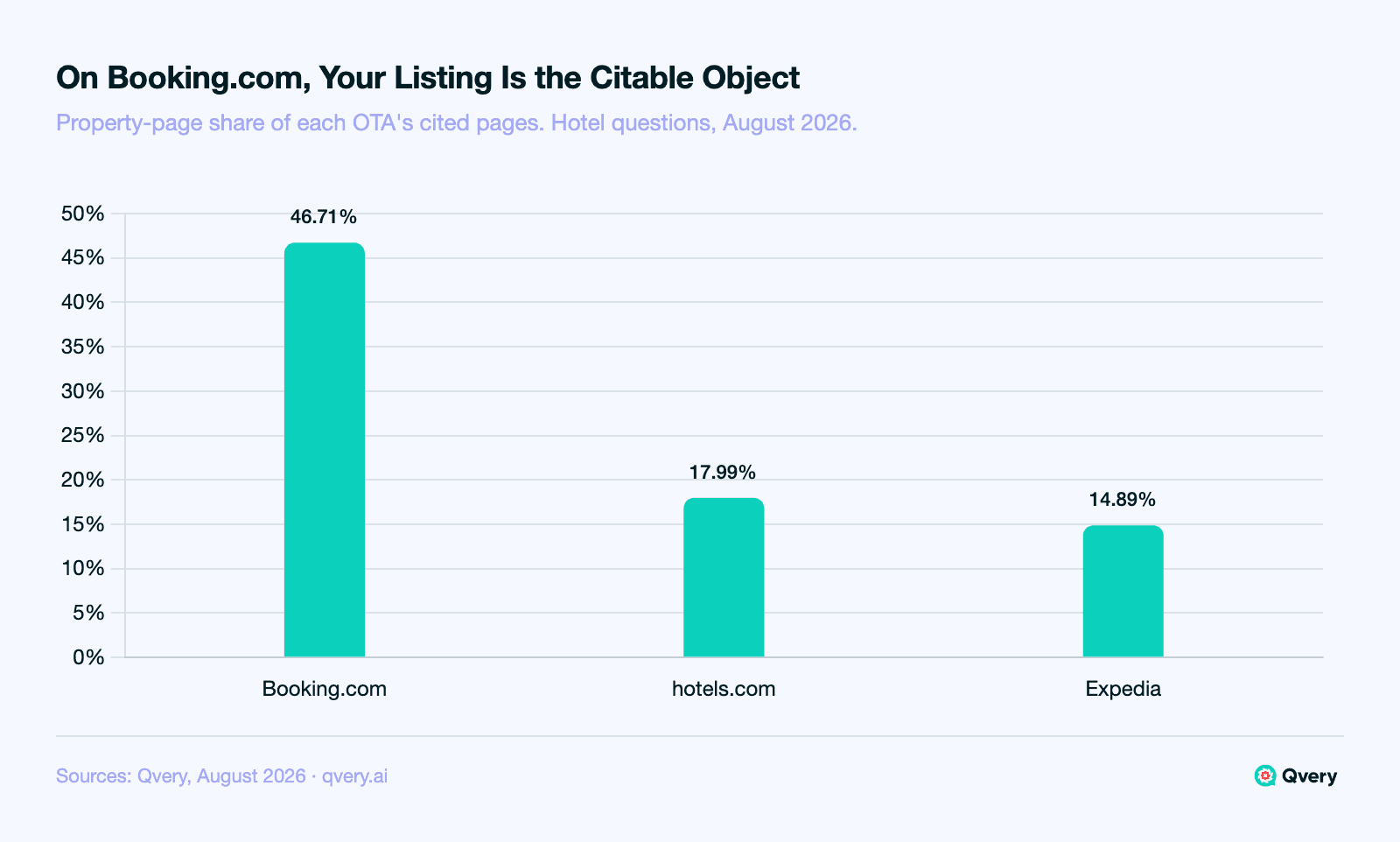
Booking's per-property pages, including its per-property review pages, are open, stable URLs the engines evidently read and cite directly. On the Expedia side, citations concentrate on the Travel-Guide and filter hubs, with individual properties appearing mostly as entries inside them.
On Booking.com, your listing itself is a citable object. On Expedia, your visibility rides the hubs you rank inside. Same layer, two different games.
The Play, for a Supplier Who Cannot Own the Layer
The pattern does not prove that any of this causes a recommendation; it says where the cited surface is. Our judgment on where the effort goes, given that:
Treat your Booking.com property page as public content, not inventory plumbing. Complete fields, current photos, live review flow. It is the listing these answers cite directly most often, so it is the version of you the engine is most likely to hand a traveler.
On hub-first OTAs, chase the hubs, not the page polish. If the cited object is "best family hotels in Moab", the work is being present, well-ranked, and well-reviewed inside that hub: the filters you appear under, the themes you qualify for, the review volume that moves hub position.
Do not book OTA completeness as your Google AI Mode strategy. In the questions we ran, that engine's resolvable travel citations went to other surfaces. Your Maps presence and the community layer are different work and different sources.
Open the URLs Behind Your Market's Citations in Qvery
All of the above is our read across many destinations. The version that matters is your city and your category, this month.
In Qvery, track the questions your travelers ask ("boutique hotels in Savannah historic district", "is [your property] good for families") and Qvery runs them daily on ChatGPT and Google AI Mode, capturing every citation tied to the query and engine that produced it.
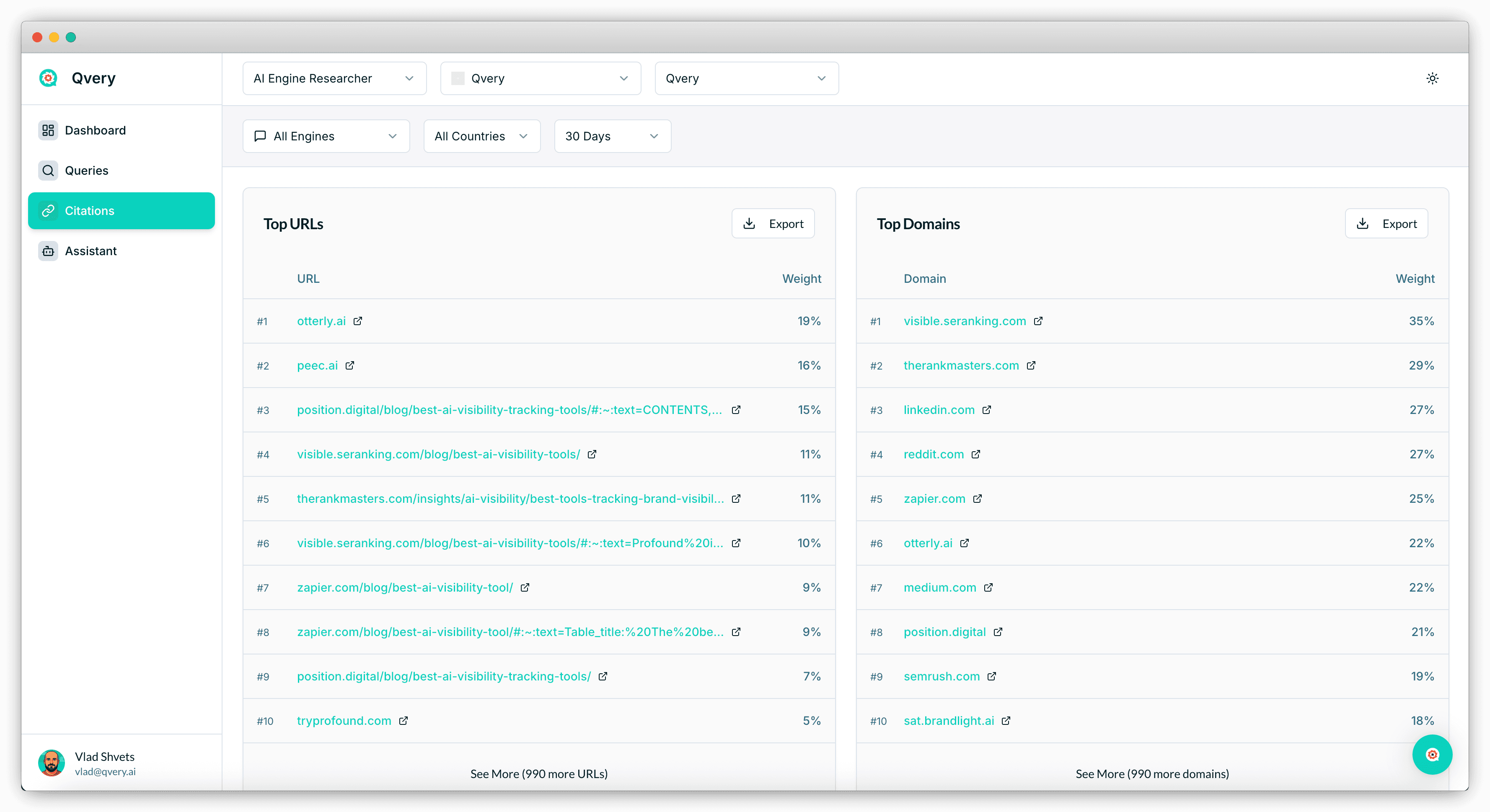
Then do the read this article did, on your own market: open Citations, look at the OTA URLs behind your questions, and see which page carried each citation, the city hub or a property page, yours or a competitor's. That page-type read is yours to make; Qvery's job is to hand you the URLs and keep the record fresh as the answers move.
Sign up for Qvery: the free 7-day trial is enough to find out which shelf your market's answers are built from.
The Monday move costs half an hour: pull the OTA URLs cited for your destination this week and count how many of those pages have your name on them at all. If the answer is none, you now know which hubs to go live on, and that your Booking page is the one listing worth treating like a landing page.
Ask a hotel or tour operator about their AI search plan and you usually get some version of channel management: we are on Expedia, Booking, and the metasearch sites, the OTAs rank everywhere, so when the engines answer a travel question, our listings are in the machine.
So we measured what of the OTA layer reaches AI travel answers, and, inside hotel answers specifically, which pages the engines cite when they reach into an OTA at all.
The short version: the layer is real and smaller than the assumption, and it shows up at the same rate whether or not the traveler names you. It is heavily one-engine-sided, and the pages it cites are overwhelmingly the OTAs' own city lists rather than anyone's listing. With one exception a supplier should know by name.
Before the numbers: one late-summer reading, not a permanent map.
Naming a Supplier Does Not Summon the OTAs
Across a targeted set of travel booking and evaluation questions spanning hotels, tours, travel insurance, and flights, run on ChatGPT and Google AI Mode in August 2026 (US-weighted, with a UK, Canadian, and Australian mix), an OTA or metasearch domain appeared in 24.00% of the answers that cited any source when the question named a specific supplier, and 21.77% when a matched question asked for a shortlist instead.
That near-identical pair is the finding. The OTA layer's presence is a property of travel answers, not of your name being in the question. A traveler checking out your hotel by name and a traveler asking for options in your city are drawing from this layer at the same rate: about one cited answer in four or five.
The OTA Layer Is a ChatGPT Phenomenon in These Answers
Split the same answers by engine and the layer stops being one thing. An OTA domain appeared in 38.00% of ChatGPT's answers and in 0.00% of Google AI Mode's (share of each engine's answers to the questions we ran).
The zero needs its caveat said plainly: Google AI Mode routes a large share of its citations through Google's own redirect domain, where the destination is unreadable, so its figure is a floor of what we could resolve.
But the resolvable remainder had room to show OTAs and did not. On the Google side of these travel answers, the visible citations went elsewhere, consistent with how Google AI Mode leans on Google's own surfaces in travel.
The OTA presence a supplier is counting on lives almost entirely inside one engine's answers.
That is a measurement, not advice to pick an engine; your travelers use both. It just means OTA work and Google-side work are two different jobs.
Inside Hotel Answers, the Cited OTA Pages Are City Lists, Not Listings
Then there is the question nobody checks: when an answer does cite an OTA, which page is it citing?
Across the hotel shortlist questions we ran on both engines in August 2026, we resolved the cited OTA URLs to their page types. 73.79% of the OTA pages cited were city, theme, filter, or search list pages. 21.57% were a single property's page. 4.64% were the OTAs' own help and editorial content.
The mechanics are familiar by now: a "hotels in Savannah's Historic District" hub arrives at the engine as a finished, ranked shortlist, which is the format AI answers lift most readily. Your property page, however complete, is one candidate; the hub is the answer.
When an AI answer reaches into an OTA, three times out of four it grabs the shelf, not the product.
So the practical unit of OTA visibility is usually not your listing. It is the hub pages your listing does or does not surface on: the city page, the "family hotels near the aquarium" filter, the neighborhood list.
Booking.com Is the Exception: Nearly Half Its Cited Pages Are Property Pages
The layer is not uniform, and the differences are what a supplier can act on. Among the OTAs cited often enough to read individually, the share of cited pages that were a single property's page: Booking.com 46.71%, hotels.com 17.99%, Expedia 14.89%.
Booking's per-property pages, including its per-property review pages, are open, stable URLs the engines evidently read and cite directly. On the Expedia side, citations concentrate on the Travel-Guide and filter hubs, with individual properties appearing mostly as entries inside them.
On Booking.com, your listing itself is a citable object. On Expedia, your visibility rides the hubs you rank inside. Same layer, two different games.
The Play, for a Supplier Who Cannot Own the Layer
The pattern does not prove that any of this causes a recommendation; it says where the cited surface is. Our judgment on where the effort goes, given that:
Treat your Booking.com property page as public content, not inventory plumbing. Complete fields, current photos, live review flow. It is the listing these answers cite directly most often, so it is the version of you the engine is most likely to hand a traveler.
On hub-first OTAs, chase the hubs, not the page polish. If the cited object is "best family hotels in Moab", the work is being present, well-ranked, and well-reviewed inside that hub: the filters you appear under, the themes you qualify for, the review volume that moves hub position.
Do not book OTA completeness as your Google AI Mode strategy. In the questions we ran, that engine's resolvable travel citations went to other surfaces. Your Maps presence and the community layer are different work and different sources.
Open the URLs Behind Your Market's Citations in Qvery
All of the above is our read across many destinations. The version that matters is your city and your category, this month.
In Qvery, track the questions your travelers ask ("boutique hotels in Savannah historic district", "is [your property] good for families") and Qvery runs them daily on ChatGPT and Google AI Mode, capturing every citation tied to the query and engine that produced it.
Then do the read this article did, on your own market: open Citations, look at the OTA URLs behind your questions, and see which page carried each citation, the city hub or a property page, yours or a competitor's. That page-type read is yours to make; Qvery's job is to hand you the URLs and keep the record fresh as the answers move.
Sign up for Qvery: the free 7-day trial is enough to find out which shelf your market's answers are built from.
The Monday move costs half an hour: pull the OTA URLs cited for your destination this week and count how many of those pages have your name on them at all. If the answer is none, you now know which hubs to go live on, and that your Booking page is the one listing worth treating like a landing page.
Ask a hotel or tour operator about their AI search plan and you usually get some version of channel management: we are on Expedia, Booking, and the metasearch sites, the OTAs rank everywhere, so when the engines answer a travel question, our listings are in the machine.
So we measured what of the OTA layer reaches AI travel answers, and, inside hotel answers specifically, which pages the engines cite when they reach into an OTA at all.
The short version: the layer is real and smaller than the assumption, and it shows up at the same rate whether or not the traveler names you. It is heavily one-engine-sided, and the pages it cites are overwhelmingly the OTAs' own city lists rather than anyone's listing. With one exception a supplier should know by name.
Before the numbers: one late-summer reading, not a permanent map.
Naming a Supplier Does Not Summon the OTAs
Across a targeted set of travel booking and evaluation questions spanning hotels, tours, travel insurance, and flights, run on ChatGPT and Google AI Mode in August 2026 (US-weighted, with a UK, Canadian, and Australian mix), an OTA or metasearch domain appeared in 24.00% of the answers that cited any source when the question named a specific supplier, and 21.77% when a matched question asked for a shortlist instead.
That near-identical pair is the finding. The OTA layer's presence is a property of travel answers, not of your name being in the question. A traveler checking out your hotel by name and a traveler asking for options in your city are drawing from this layer at the same rate: about one cited answer in four or five.
The OTA Layer Is a ChatGPT Phenomenon in These Answers
Split the same answers by engine and the layer stops being one thing. An OTA domain appeared in 38.00% of ChatGPT's answers and in 0.00% of Google AI Mode's (share of each engine's answers to the questions we ran).
The zero needs its caveat said plainly: Google AI Mode routes a large share of its citations through Google's own redirect domain, where the destination is unreadable, so its figure is a floor of what we could resolve.
But the resolvable remainder had room to show OTAs and did not. On the Google side of these travel answers, the visible citations went elsewhere, consistent with how Google AI Mode leans on Google's own surfaces in travel.
The OTA presence a supplier is counting on lives almost entirely inside one engine's answers.
That is a measurement, not advice to pick an engine; your travelers use both. It just means OTA work and Google-side work are two different jobs.
Inside Hotel Answers, the Cited OTA Pages Are City Lists, Not Listings
Then there is the question nobody checks: when an answer does cite an OTA, which page is it citing?
Across the hotel shortlist questions we ran on both engines in August 2026, we resolved the cited OTA URLs to their page types. 73.79% of the OTA pages cited were city, theme, filter, or search list pages. 21.57% were a single property's page. 4.64% were the OTAs' own help and editorial content.
The mechanics are familiar by now: a "hotels in Savannah's Historic District" hub arrives at the engine as a finished, ranked shortlist, which is the format AI answers lift most readily. Your property page, however complete, is one candidate; the hub is the answer.
When an AI answer reaches into an OTA, three times out of four it grabs the shelf, not the product.
So the practical unit of OTA visibility is usually not your listing. It is the hub pages your listing does or does not surface on: the city page, the "family hotels near the aquarium" filter, the neighborhood list.
Booking.com Is the Exception: Nearly Half Its Cited Pages Are Property Pages
The layer is not uniform, and the differences are what a supplier can act on. Among the OTAs cited often enough to read individually, the share of cited pages that were a single property's page: Booking.com 46.71%, hotels.com 17.99%, Expedia 14.89%.
Booking's per-property pages, including its per-property review pages, are open, stable URLs the engines evidently read and cite directly. On the Expedia side, citations concentrate on the Travel-Guide and filter hubs, with individual properties appearing mostly as entries inside them.
On Booking.com, your listing itself is a citable object. On Expedia, your visibility rides the hubs you rank inside. Same layer, two different games.
The Play, for a Supplier Who Cannot Own the Layer
The pattern does not prove that any of this causes a recommendation; it says where the cited surface is. Our judgment on where the effort goes, given that:
Treat your Booking.com property page as public content, not inventory plumbing. Complete fields, current photos, live review flow. It is the listing these answers cite directly most often, so it is the version of you the engine is most likely to hand a traveler.
On hub-first OTAs, chase the hubs, not the page polish. If the cited object is "best family hotels in Moab", the work is being present, well-ranked, and well-reviewed inside that hub: the filters you appear under, the themes you qualify for, the review volume that moves hub position.
Do not book OTA completeness as your Google AI Mode strategy. In the questions we ran, that engine's resolvable travel citations went to other surfaces. Your Maps presence and the community layer are different work and different sources.
Open the URLs Behind Your Market's Citations in Qvery
All of the above is our read across many destinations. The version that matters is your city and your category, this month.
In Qvery, track the questions your travelers ask ("boutique hotels in Savannah historic district", "is [your property] good for families") and Qvery runs them daily on ChatGPT and Google AI Mode, capturing every citation tied to the query and engine that produced it.
Then do the read this article did, on your own market: open Citations, look at the OTA URLs behind your questions, and see which page carried each citation, the city hub or a property page, yours or a competitor's. That page-type read is yours to make; Qvery's job is to hand you the URLs and keep the record fresh as the answers move.
Sign up for Qvery: the free 7-day trial is enough to find out which shelf your market's answers are built from.
The Monday move costs half an hour: pull the OTA URLs cited for your destination this week and count how many of those pages have your name on them at all. If the answer is none, you now know which hubs to go live on, and that your Booking page is the one listing worth treating like a landing page.
Ask a hotel or tour operator about their AI search plan and you usually get some version of channel management: we are on Expedia, Booking, and the metasearch sites, the OTAs rank everywhere, so when the engines answer a travel question, our listings are in the machine.
So we measured what of the OTA layer reaches AI travel answers, and, inside hotel answers specifically, which pages the engines cite when they reach into an OTA at all.
The short version: the layer is real and smaller than the assumption, and it shows up at the same rate whether or not the traveler names you. It is heavily one-engine-sided, and the pages it cites are overwhelmingly the OTAs' own city lists rather than anyone's listing. With one exception a supplier should know by name.
Before the numbers: one late-summer reading, not a permanent map.
Naming a Supplier Does Not Summon the OTAs
Across a targeted set of travel booking and evaluation questions spanning hotels, tours, travel insurance, and flights, run on ChatGPT and Google AI Mode in August 2026 (US-weighted, with a UK, Canadian, and Australian mix), an OTA or metasearch domain appeared in 24.00% of the answers that cited any source when the question named a specific supplier, and 21.77% when a matched question asked for a shortlist instead.
That near-identical pair is the finding. The OTA layer's presence is a property of travel answers, not of your name being in the question. A traveler checking out your hotel by name and a traveler asking for options in your city are drawing from this layer at the same rate: about one cited answer in four or five.
The OTA Layer Is a ChatGPT Phenomenon in These Answers
Split the same answers by engine and the layer stops being one thing. An OTA domain appeared in 38.00% of ChatGPT's answers and in 0.00% of Google AI Mode's (share of each engine's answers to the questions we ran).
The zero needs its caveat said plainly: Google AI Mode routes a large share of its citations through Google's own redirect domain, where the destination is unreadable, so its figure is a floor of what we could resolve.
But the resolvable remainder had room to show OTAs and did not. On the Google side of these travel answers, the visible citations went elsewhere, consistent with how Google AI Mode leans on Google's own surfaces in travel.
The OTA presence a supplier is counting on lives almost entirely inside one engine's answers.
That is a measurement, not advice to pick an engine; your travelers use both. It just means OTA work and Google-side work are two different jobs.
Inside Hotel Answers, the Cited OTA Pages Are City Lists, Not Listings
Then there is the question nobody checks: when an answer does cite an OTA, which page is it citing?
Across the hotel shortlist questions we ran on both engines in August 2026, we resolved the cited OTA URLs to their page types. 73.79% of the OTA pages cited were city, theme, filter, or search list pages. 21.57% were a single property's page. 4.64% were the OTAs' own help and editorial content.
The mechanics are familiar by now: a "hotels in Savannah's Historic District" hub arrives at the engine as a finished, ranked shortlist, which is the format AI answers lift most readily. Your property page, however complete, is one candidate; the hub is the answer.
When an AI answer reaches into an OTA, three times out of four it grabs the shelf, not the product.
So the practical unit of OTA visibility is usually not your listing. It is the hub pages your listing does or does not surface on: the city page, the "family hotels near the aquarium" filter, the neighborhood list.
Booking.com Is the Exception: Nearly Half Its Cited Pages Are Property Pages
The layer is not uniform, and the differences are what a supplier can act on. Among the OTAs cited often enough to read individually, the share of cited pages that were a single property's page: Booking.com 46.71%, hotels.com 17.99%, Expedia 14.89%.
Booking's per-property pages, including its per-property review pages, are open, stable URLs the engines evidently read and cite directly. On the Expedia side, citations concentrate on the Travel-Guide and filter hubs, with individual properties appearing mostly as entries inside them.
On Booking.com, your listing itself is a citable object. On Expedia, your visibility rides the hubs you rank inside. Same layer, two different games.
The Play, for a Supplier Who Cannot Own the Layer
The pattern does not prove that any of this causes a recommendation; it says where the cited surface is. Our judgment on where the effort goes, given that:
Treat your Booking.com property page as public content, not inventory plumbing. Complete fields, current photos, live review flow. It is the listing these answers cite directly most often, so it is the version of you the engine is most likely to hand a traveler.
On hub-first OTAs, chase the hubs, not the page polish. If the cited object is "best family hotels in Moab", the work is being present, well-ranked, and well-reviewed inside that hub: the filters you appear under, the themes you qualify for, the review volume that moves hub position.
Do not book OTA completeness as your Google AI Mode strategy. In the questions we ran, that engine's resolvable travel citations went to other surfaces. Your Maps presence and the community layer are different work and different sources.
Open the URLs Behind Your Market's Citations in Qvery
All of the above is our read across many destinations. The version that matters is your city and your category, this month.
In Qvery, track the questions your travelers ask ("boutique hotels in Savannah historic district", "is [your property] good for families") and Qvery runs them daily on ChatGPT and Google AI Mode, capturing every citation tied to the query and engine that produced it.
Then do the read this article did, on your own market: open Citations, look at the OTA URLs behind your questions, and see which page carried each citation, the city hub or a property page, yours or a competitor's. That page-type read is yours to make; Qvery's job is to hand you the URLs and keep the record fresh as the answers move.
Sign up for Qvery: the free 7-day trial is enough to find out which shelf your market's answers are built from.
The Monday move costs half an hour: pull the OTA URLs cited for your destination this week and count how many of those pages have your name on them at all. If the answer is none, you now know which hubs to go live on, and that your Booking page is the one listing worth treating like a landing page.

© 2026 Qvery AI OÜ