By
Vlad Shvets
AI Search for Car Dealerships: Ride the Aggregators AI Engines Already Cite
Which automotive aggregators ChatGPT and Google AI Mode cite when shoppers ask about dealerships, what pages on them, and why generic and city questions need separate audit lists.
Which automotive aggregators ChatGPT and Google AI Mode cite when shoppers ask about dealerships, what pages on them, and why generic and city questions need separate audit lists.
Which automotive aggregators ChatGPT and Google AI Mode cite when shoppers ask about dealerships, what pages on them, and why generic and city questions need separate audit lists.
A growing share of car shoppers skip the search results page and ask ChatGPT or Google AI Mode where to buy, lease or service a car. If you market a dealership, you have probably been told the fix lives on your own website.
Before you rebuild anything, there is a more basic question. When a shopper asks for a dealership, which automotive sites does the answer cite, what kind of page on those sites, and does the answer name a dealership at all?
So we asked both engines the dealership questions shoppers type, once plainly and once with a US city added, in September 2026, and coded the cited pages from automotive marketplaces, directories and review sites by what kind of page they were.
The short version: the answers cite aggregators you can name, edmunds.com, kbb.com and cars.com on generic questions and caredge.com and dealerrater.com on city questions.
Dealer profiles and editorial comparisons are both on them, in both kinds of question. Which of the two each kind of question leans on is not settled, and whether the answers name a dealership could not be measured reliably.
So our judgment, and it is judgment from what appeared together rather than a measured effect: audit the aggregators each kind of question cites, check both page types, and track generic and city questions apart.
Had the page-type comparison resolved, the audit would start with the favored type. It did not, so it covers both.
Dealer Profiles and Editorial Comparisons Both Show Up, and Neither Question Type Ranks Them
Start with the aggregators themselves. These are the third-party automotive marketplace, directory, research and review sites whose cited pages we coded, in order of how many answers cited them.
Generic questions: edmunds.com, kbb.com, cars.com, caranddriver.com, caredge.com and consumerreports.org (tied), usnews.com (its U.S. News Cars pages), motortrend.com.
City questions: caredge.com and dealerrater.com (tied), cars.com, carwhere.com.
One more sits on that list in both kinds of question: google.com, the Business Profile viewer inside Google AI Mode answers. It heads both audit lists further down, but we could not code its entries as pages, because they cannot be opened as pages.
Two coders read every fetched aggregator page blind and sorted it as a dealer profile, an inventory page, an editorial comparison or something else, and an adjudicator ruled on every disagreement. They agreed on 0.7257 of the pages both coded (Cohen's kappa 0.6069).
The result: dealer-profile pages and editorial-comparison pages both appear among the resolved aggregator pages, in generic answers and in city answers alike.
What we cannot tell you is which kind of question leans on which page type.
Some registered pages in each question type could not be resolved, coded unknown or never fetched. The Business Profile entries and a few bare site roots could not be coded at all. That evidence could change which way either comparison falls, so no direction ships.
For your planning, that means building no generic-versus-city page-type priority on this data. It also says nothing about whether to invest in dealer profiles or editorial comparisons in the first place.
Whether the Answers Name a Dealership Could Not Be Measured Reliably
It is usually the first thing a dealer marketer asks, and this data cannot answer it.
We extracted the dealership names from each answer: a dealership, a dealer group, a dealership location or a car-buying service, never a make, model or trim. Before any naming result could publish, that extraction had to match a blind hand-coded check at a name-level score of 0.85. It reached 0.827 (precision 0.722, recall 0.968).
So nothing about naming ships: no naming rate, no ranking of dealerships and no list of names. What ships instead is which domains the answers cited, the aggregators above and the audit lists below.
Most of the disagreement came from names the extraction counted and the hand-code did not: service departments, RV and motorcycle sellers, car-subscription services, and brand-level phrases such as Toyota dealerships.
Keep One Audit List for Generic Questions and One for City Questions
For each kind of question we built a list of domains, adding at each step the domain that covered the most answers not yet covered, until the list reached 80% of the answers that cited any source. These are all cited domains, not only the aggregators above.
Generic questions, 43 domains: google.com, edmunds.com, cars.com, ford.com, caredge.com, carvana.com, iihs.org, nerdwallet.com, reddit.com, sixt.com, caranddriver.com, chase.com, classicnosparts.com, nhtsa.gov, yellowpages.com, autonation.com, bankrate.com, bluecompassrv.com, blueridgenorthgafordcars.com, cars.usnews.com, carwise.com, chevrolet.com, consumer.ftc.gov, creditacceptance.com, dealerrater.com, discounttire.com, griecotoyota.com, jiffylube.com, lemonsquad.com, military.truecar.com, northtexastruckstop.com, yamahamotorsports.com, aamcophilly-frankfordave.com, abwautos.com, airimportrepairs.com, api.connectcdk.com, applefordpro.com, assets-origin.hemmings.com, audimiamisouth.com, audisanjose.com, audisantamonica.com, automoonthego.com, autonationtoyotalasvegas.com.
City questions, 26 domains: google.com, reddit.com, caredge.com, carmax.com, enterprisecarsales.com, hondacitychicago.com, dealerrater.com, evergreenchevrolet.com, iihs.org, legendautosales.com, mavis.com, wheelsofchicago.com, cars.com, cottmanautomall.com, envisionmotorsfleet.com, bellford.com, courtesyfleet.com, faulknerhyundaiphilly.com, galpin.com, lexusofmanhattan.com, marinochevrolet.com, meritcars.com, nhtsa.gov, nirvc.com, promobileauto.com, seattle.gov.
Then we swapped them. The generic list covered 47.98% of the city answers that cited any source. The city list covered 39.80% of the generic answers that cited any source.
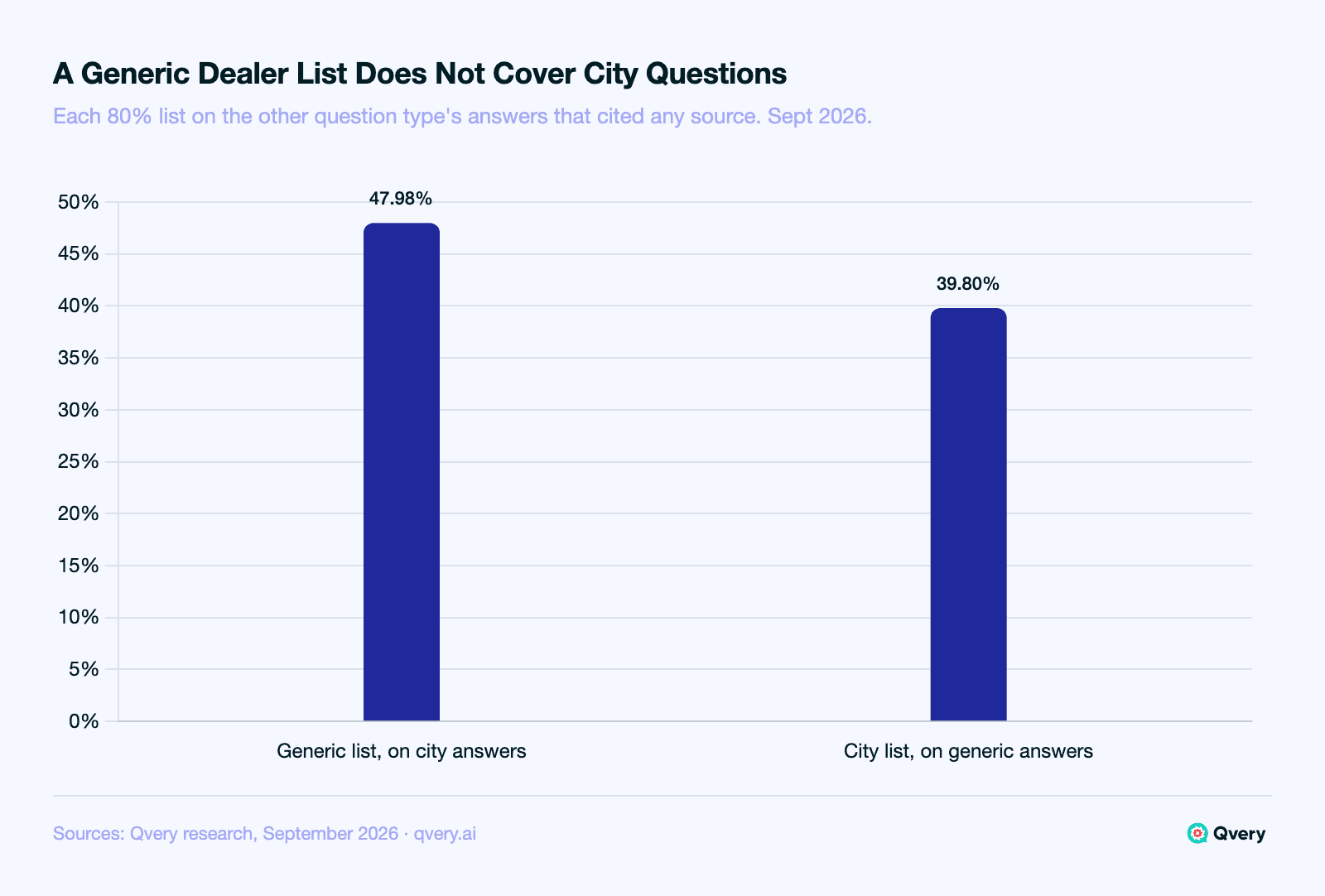
The lower of the two, 39.80% of the answers that cited any source on generic questions, is well under our 60% bar for a shared list, so each needs its own list.
Seven domains are on both lists: caredge.com, cars.com, dealerrater.com, google.com, iihs.org, nhtsa.gov and reddit.com. That overlap is description and decides nothing.
These are cited domains. They are not the dealerships the answers name, and nothing here says the answers recommend them.
We have made the same generic-versus-local call before in measuring real estate AI visibility, and the automotive AI visibility audit covers how to run one for a car brand.
What Your Own Site Changes Do Is Outside This Data
Three pieces of advice for dealers are worth hearing out, because each points at your own site.
Cars Commerce argues that a dealership's visibility now rides on "how well AI can crawl (yes, it still crawls), understand, and feature your expertise."
SearchScore writes that "Manufacturers and dealerships that provide clear, structured model information on their websites increase the accuracy and frequency with which their vehicles appear in AI-generated recommendations."
And Cars Commerce again: "Publishing high-quality, authoritative content over time builds your digital reputation, effectively teaching the AI that your dealership is a trustworthy source of information."
Our data records which domains and page types were cited beside which questions. It measured no effect of crawler access, structured model information or your own publishing on citations, so it neither confirms nor refutes any of the three. SearchScore's claim is about vehicles appearing in recommendations, and we measured neither vehicles nor recommendation status.
For the broader dealer-layer picture, how automotive brands show up in AI search covers why dealers ride on other people's pages.
Track Generic and City Questions for Your Dealership in Qvery
The audit above is a snapshot. Qvery makes it a daily record for your own dealership.
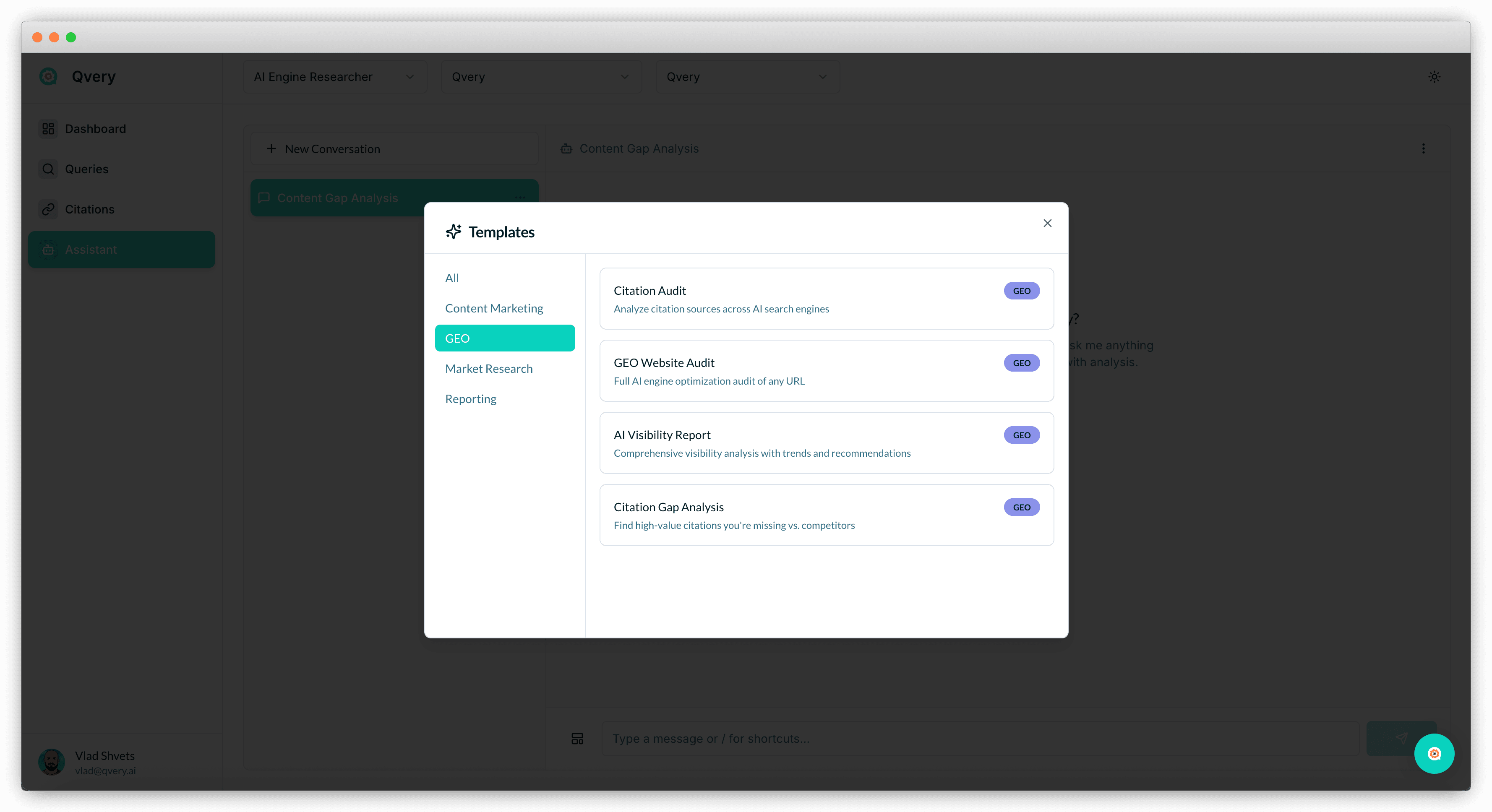
Set up your queries in pairs: the same need asked generically and with your metro added. Building tracking queries covers writing pairs like these, and you add and edit them through Qvery Assistant.
Qvery tracks visibility, share of voice and average rank on those queries daily across ChatGPT and Google AI Mode, in 200+ countries.
Every citation it captures is tied to the query and engine that produced it, so you see which aggregator pages the engines cite on your questions, and whether your own pages are among them.
To ask rather than filter, open Qvery Assistant in the app and ask about your own visibility, share of voice or citations in plain language.
Tracking shows which sources are cited and whether your dealership appears. It does not show what a site change does, and it does not settle the page-type comparison above.
Start a free 7-day trial of Qvery, no credit card required, and set up your first generic and city question pairs today.
What This Data Cannot Settle
Scope: paired US dealership-selection questions, asked plainly and with a US metro added. It records which domains and pages were cited beside which questions; it measures the effect of nothing.
No naming. The dealership-name extraction reached 0.827 against a 0.85 bar, so no naming result ships.
No effects. There is no recommendation status, no causal claim, no dealership-level outcome and no effect of site changes.
The page-type comparison is unresolved. Registered pages that could not be resolved, the Business Profile entries and a few bare site roots could all move it.
No engine claim. No engine comparison was registered, and no Google AI Mode figure for a single question type prints, because each rests on too few answers.
ChatGPT-weighted. The pooled lists carry three ChatGPT answers for every two from Google AI Mode.
Third-party aggregators only. The coded set admits only domains labelled third-party, so truecar.com and iihs.org, labelled brand-owned, sit outside it.
This month only. Nothing here is compared with an earlier collection.
Audit the Aggregators Each Question Type Cites
Our judgment from what appeared together, not a measured effect: audit your dealership's presence on the aggregators the answers already cite, with one list for generic questions and one for city questions.
On those aggregators, check both your dealer profiles and the editorial comparisons that cover you, because this data does not say which of the two either kind of question leans on.
A growing share of car shoppers skip the search results page and ask ChatGPT or Google AI Mode where to buy, lease or service a car. If you market a dealership, you have probably been told the fix lives on your own website.
Before you rebuild anything, there is a more basic question. When a shopper asks for a dealership, which automotive sites does the answer cite, what kind of page on those sites, and does the answer name a dealership at all?
So we asked both engines the dealership questions shoppers type, once plainly and once with a US city added, in September 2026, and coded the cited pages from automotive marketplaces, directories and review sites by what kind of page they were.
The short version: the answers cite aggregators you can name, edmunds.com, kbb.com and cars.com on generic questions and caredge.com and dealerrater.com on city questions.
Dealer profiles and editorial comparisons are both on them, in both kinds of question. Which of the two each kind of question leans on is not settled, and whether the answers name a dealership could not be measured reliably.
So our judgment, and it is judgment from what appeared together rather than a measured effect: audit the aggregators each kind of question cites, check both page types, and track generic and city questions apart.
Had the page-type comparison resolved, the audit would start with the favored type. It did not, so it covers both.
Dealer Profiles and Editorial Comparisons Both Show Up, and Neither Question Type Ranks Them
Start with the aggregators themselves. These are the third-party automotive marketplace, directory, research and review sites whose cited pages we coded, in order of how many answers cited them.
Generic questions: edmunds.com, kbb.com, cars.com, caranddriver.com, caredge.com and consumerreports.org (tied), usnews.com (its U.S. News Cars pages), motortrend.com.
City questions: caredge.com and dealerrater.com (tied), cars.com, carwhere.com.
One more sits on that list in both kinds of question: google.com, the Business Profile viewer inside Google AI Mode answers. It heads both audit lists further down, but we could not code its entries as pages, because they cannot be opened as pages.
Two coders read every fetched aggregator page blind and sorted it as a dealer profile, an inventory page, an editorial comparison or something else, and an adjudicator ruled on every disagreement. They agreed on 0.7257 of the pages both coded (Cohen's kappa 0.6069).
The result: dealer-profile pages and editorial-comparison pages both appear among the resolved aggregator pages, in generic answers and in city answers alike.
What we cannot tell you is which kind of question leans on which page type.
Some registered pages in each question type could not be resolved, coded unknown or never fetched. The Business Profile entries and a few bare site roots could not be coded at all. That evidence could change which way either comparison falls, so no direction ships.
For your planning, that means building no generic-versus-city page-type priority on this data. It also says nothing about whether to invest in dealer profiles or editorial comparisons in the first place.
Whether the Answers Name a Dealership Could Not Be Measured Reliably
It is usually the first thing a dealer marketer asks, and this data cannot answer it.
We extracted the dealership names from each answer: a dealership, a dealer group, a dealership location or a car-buying service, never a make, model or trim. Before any naming result could publish, that extraction had to match a blind hand-coded check at a name-level score of 0.85. It reached 0.827 (precision 0.722, recall 0.968).
So nothing about naming ships: no naming rate, no ranking of dealerships and no list of names. What ships instead is which domains the answers cited, the aggregators above and the audit lists below.
Most of the disagreement came from names the extraction counted and the hand-code did not: service departments, RV and motorcycle sellers, car-subscription services, and brand-level phrases such as Toyota dealerships.
Keep One Audit List for Generic Questions and One for City Questions
For each kind of question we built a list of domains, adding at each step the domain that covered the most answers not yet covered, until the list reached 80% of the answers that cited any source. These are all cited domains, not only the aggregators above.
Generic questions, 43 domains: google.com, edmunds.com, cars.com, ford.com, caredge.com, carvana.com, iihs.org, nerdwallet.com, reddit.com, sixt.com, caranddriver.com, chase.com, classicnosparts.com, nhtsa.gov, yellowpages.com, autonation.com, bankrate.com, bluecompassrv.com, blueridgenorthgafordcars.com, cars.usnews.com, carwise.com, chevrolet.com, consumer.ftc.gov, creditacceptance.com, dealerrater.com, discounttire.com, griecotoyota.com, jiffylube.com, lemonsquad.com, military.truecar.com, northtexastruckstop.com, yamahamotorsports.com, aamcophilly-frankfordave.com, abwautos.com, airimportrepairs.com, api.connectcdk.com, applefordpro.com, assets-origin.hemmings.com, audimiamisouth.com, audisanjose.com, audisantamonica.com, automoonthego.com, autonationtoyotalasvegas.com.
City questions, 26 domains: google.com, reddit.com, caredge.com, carmax.com, enterprisecarsales.com, hondacitychicago.com, dealerrater.com, evergreenchevrolet.com, iihs.org, legendautosales.com, mavis.com, wheelsofchicago.com, cars.com, cottmanautomall.com, envisionmotorsfleet.com, bellford.com, courtesyfleet.com, faulknerhyundaiphilly.com, galpin.com, lexusofmanhattan.com, marinochevrolet.com, meritcars.com, nhtsa.gov, nirvc.com, promobileauto.com, seattle.gov.
Then we swapped them. The generic list covered 47.98% of the city answers that cited any source. The city list covered 39.80% of the generic answers that cited any source.
The lower of the two, 39.80% of the answers that cited any source on generic questions, is well under our 60% bar for a shared list, so each needs its own list.
Seven domains are on both lists: caredge.com, cars.com, dealerrater.com, google.com, iihs.org, nhtsa.gov and reddit.com. That overlap is description and decides nothing.
These are cited domains. They are not the dealerships the answers name, and nothing here says the answers recommend them.
We have made the same generic-versus-local call before in measuring real estate AI visibility, and the automotive AI visibility audit covers how to run one for a car brand.
What Your Own Site Changes Do Is Outside This Data
Three pieces of advice for dealers are worth hearing out, because each points at your own site.
Cars Commerce argues that a dealership's visibility now rides on "how well AI can crawl (yes, it still crawls), understand, and feature your expertise."
SearchScore writes that "Manufacturers and dealerships that provide clear, structured model information on their websites increase the accuracy and frequency with which their vehicles appear in AI-generated recommendations."
And Cars Commerce again: "Publishing high-quality, authoritative content over time builds your digital reputation, effectively teaching the AI that your dealership is a trustworthy source of information."
Our data records which domains and page types were cited beside which questions. It measured no effect of crawler access, structured model information or your own publishing on citations, so it neither confirms nor refutes any of the three. SearchScore's claim is about vehicles appearing in recommendations, and we measured neither vehicles nor recommendation status.
For the broader dealer-layer picture, how automotive brands show up in AI search covers why dealers ride on other people's pages.
Track Generic and City Questions for Your Dealership in Qvery
The audit above is a snapshot. Qvery makes it a daily record for your own dealership.
Set up your queries in pairs: the same need asked generically and with your metro added. Building tracking queries covers writing pairs like these, and you add and edit them through Qvery Assistant.
Qvery tracks visibility, share of voice and average rank on those queries daily across ChatGPT and Google AI Mode, in 200+ countries.
Every citation it captures is tied to the query and engine that produced it, so you see which aggregator pages the engines cite on your questions, and whether your own pages are among them.
To ask rather than filter, open Qvery Assistant in the app and ask about your own visibility, share of voice or citations in plain language.
Tracking shows which sources are cited and whether your dealership appears. It does not show what a site change does, and it does not settle the page-type comparison above.
Start a free 7-day trial of Qvery, no credit card required, and set up your first generic and city question pairs today.
What This Data Cannot Settle
Scope: paired US dealership-selection questions, asked plainly and with a US metro added. It records which domains and pages were cited beside which questions; it measures the effect of nothing.
No naming. The dealership-name extraction reached 0.827 against a 0.85 bar, so no naming result ships.
No effects. There is no recommendation status, no causal claim, no dealership-level outcome and no effect of site changes.
The page-type comparison is unresolved. Registered pages that could not be resolved, the Business Profile entries and a few bare site roots could all move it.
No engine claim. No engine comparison was registered, and no Google AI Mode figure for a single question type prints, because each rests on too few answers.
ChatGPT-weighted. The pooled lists carry three ChatGPT answers for every two from Google AI Mode.
Third-party aggregators only. The coded set admits only domains labelled third-party, so truecar.com and iihs.org, labelled brand-owned, sit outside it.
This month only. Nothing here is compared with an earlier collection.
Audit the Aggregators Each Question Type Cites
Our judgment from what appeared together, not a measured effect: audit your dealership's presence on the aggregators the answers already cite, with one list for generic questions and one for city questions.
On those aggregators, check both your dealer profiles and the editorial comparisons that cover you, because this data does not say which of the two either kind of question leans on.
A growing share of car shoppers skip the search results page and ask ChatGPT or Google AI Mode where to buy, lease or service a car. If you market a dealership, you have probably been told the fix lives on your own website.
Before you rebuild anything, there is a more basic question. When a shopper asks for a dealership, which automotive sites does the answer cite, what kind of page on those sites, and does the answer name a dealership at all?
So we asked both engines the dealership questions shoppers type, once plainly and once with a US city added, in September 2026, and coded the cited pages from automotive marketplaces, directories and review sites by what kind of page they were.
The short version: the answers cite aggregators you can name, edmunds.com, kbb.com and cars.com on generic questions and caredge.com and dealerrater.com on city questions.
Dealer profiles and editorial comparisons are both on them, in both kinds of question. Which of the two each kind of question leans on is not settled, and whether the answers name a dealership could not be measured reliably.
So our judgment, and it is judgment from what appeared together rather than a measured effect: audit the aggregators each kind of question cites, check both page types, and track generic and city questions apart.
Had the page-type comparison resolved, the audit would start with the favored type. It did not, so it covers both.
Dealer Profiles and Editorial Comparisons Both Show Up, and Neither Question Type Ranks Them
Start with the aggregators themselves. These are the third-party automotive marketplace, directory, research and review sites whose cited pages we coded, in order of how many answers cited them.
Generic questions: edmunds.com, kbb.com, cars.com, caranddriver.com, caredge.com and consumerreports.org (tied), usnews.com (its U.S. News Cars pages), motortrend.com.
City questions: caredge.com and dealerrater.com (tied), cars.com, carwhere.com.
One more sits on that list in both kinds of question: google.com, the Business Profile viewer inside Google AI Mode answers. It heads both audit lists further down, but we could not code its entries as pages, because they cannot be opened as pages.
Two coders read every fetched aggregator page blind and sorted it as a dealer profile, an inventory page, an editorial comparison or something else, and an adjudicator ruled on every disagreement. They agreed on 0.7257 of the pages both coded (Cohen's kappa 0.6069).
The result: dealer-profile pages and editorial-comparison pages both appear among the resolved aggregator pages, in generic answers and in city answers alike.
What we cannot tell you is which kind of question leans on which page type.
Some registered pages in each question type could not be resolved, coded unknown or never fetched. The Business Profile entries and a few bare site roots could not be coded at all. That evidence could change which way either comparison falls, so no direction ships.
For your planning, that means building no generic-versus-city page-type priority on this data. It also says nothing about whether to invest in dealer profiles or editorial comparisons in the first place.
Whether the Answers Name a Dealership Could Not Be Measured Reliably
It is usually the first thing a dealer marketer asks, and this data cannot answer it.
We extracted the dealership names from each answer: a dealership, a dealer group, a dealership location or a car-buying service, never a make, model or trim. Before any naming result could publish, that extraction had to match a blind hand-coded check at a name-level score of 0.85. It reached 0.827 (precision 0.722, recall 0.968).
So nothing about naming ships: no naming rate, no ranking of dealerships and no list of names. What ships instead is which domains the answers cited, the aggregators above and the audit lists below.
Most of the disagreement came from names the extraction counted and the hand-code did not: service departments, RV and motorcycle sellers, car-subscription services, and brand-level phrases such as Toyota dealerships.
Keep One Audit List for Generic Questions and One for City Questions
For each kind of question we built a list of domains, adding at each step the domain that covered the most answers not yet covered, until the list reached 80% of the answers that cited any source. These are all cited domains, not only the aggregators above.
Generic questions, 43 domains: google.com, edmunds.com, cars.com, ford.com, caredge.com, carvana.com, iihs.org, nerdwallet.com, reddit.com, sixt.com, caranddriver.com, chase.com, classicnosparts.com, nhtsa.gov, yellowpages.com, autonation.com, bankrate.com, bluecompassrv.com, blueridgenorthgafordcars.com, cars.usnews.com, carwise.com, chevrolet.com, consumer.ftc.gov, creditacceptance.com, dealerrater.com, discounttire.com, griecotoyota.com, jiffylube.com, lemonsquad.com, military.truecar.com, northtexastruckstop.com, yamahamotorsports.com, aamcophilly-frankfordave.com, abwautos.com, airimportrepairs.com, api.connectcdk.com, applefordpro.com, assets-origin.hemmings.com, audimiamisouth.com, audisanjose.com, audisantamonica.com, automoonthego.com, autonationtoyotalasvegas.com.
City questions, 26 domains: google.com, reddit.com, caredge.com, carmax.com, enterprisecarsales.com, hondacitychicago.com, dealerrater.com, evergreenchevrolet.com, iihs.org, legendautosales.com, mavis.com, wheelsofchicago.com, cars.com, cottmanautomall.com, envisionmotorsfleet.com, bellford.com, courtesyfleet.com, faulknerhyundaiphilly.com, galpin.com, lexusofmanhattan.com, marinochevrolet.com, meritcars.com, nhtsa.gov, nirvc.com, promobileauto.com, seattle.gov.
Then we swapped them. The generic list covered 47.98% of the city answers that cited any source. The city list covered 39.80% of the generic answers that cited any source.
The lower of the two, 39.80% of the answers that cited any source on generic questions, is well under our 60% bar for a shared list, so each needs its own list.
Seven domains are on both lists: caredge.com, cars.com, dealerrater.com, google.com, iihs.org, nhtsa.gov and reddit.com. That overlap is description and decides nothing.
These are cited domains. They are not the dealerships the answers name, and nothing here says the answers recommend them.
We have made the same generic-versus-local call before in measuring real estate AI visibility, and the automotive AI visibility audit covers how to run one for a car brand.
What Your Own Site Changes Do Is Outside This Data
Three pieces of advice for dealers are worth hearing out, because each points at your own site.
Cars Commerce argues that a dealership's visibility now rides on "how well AI can crawl (yes, it still crawls), understand, and feature your expertise."
SearchScore writes that "Manufacturers and dealerships that provide clear, structured model information on their websites increase the accuracy and frequency with which their vehicles appear in AI-generated recommendations."
And Cars Commerce again: "Publishing high-quality, authoritative content over time builds your digital reputation, effectively teaching the AI that your dealership is a trustworthy source of information."
Our data records which domains and page types were cited beside which questions. It measured no effect of crawler access, structured model information or your own publishing on citations, so it neither confirms nor refutes any of the three. SearchScore's claim is about vehicles appearing in recommendations, and we measured neither vehicles nor recommendation status.
For the broader dealer-layer picture, how automotive brands show up in AI search covers why dealers ride on other people's pages.
Track Generic and City Questions for Your Dealership in Qvery
The audit above is a snapshot. Qvery makes it a daily record for your own dealership.
Set up your queries in pairs: the same need asked generically and with your metro added. Building tracking queries covers writing pairs like these, and you add and edit them through Qvery Assistant.
Qvery tracks visibility, share of voice and average rank on those queries daily across ChatGPT and Google AI Mode, in 200+ countries.
Every citation it captures is tied to the query and engine that produced it, so you see which aggregator pages the engines cite on your questions, and whether your own pages are among them.
To ask rather than filter, open Qvery Assistant in the app and ask about your own visibility, share of voice or citations in plain language.
Tracking shows which sources are cited and whether your dealership appears. It does not show what a site change does, and it does not settle the page-type comparison above.
Start a free 7-day trial of Qvery, no credit card required, and set up your first generic and city question pairs today.
What This Data Cannot Settle
Scope: paired US dealership-selection questions, asked plainly and with a US metro added. It records which domains and pages were cited beside which questions; it measures the effect of nothing.
No naming. The dealership-name extraction reached 0.827 against a 0.85 bar, so no naming result ships.
No effects. There is no recommendation status, no causal claim, no dealership-level outcome and no effect of site changes.
The page-type comparison is unresolved. Registered pages that could not be resolved, the Business Profile entries and a few bare site roots could all move it.
No engine claim. No engine comparison was registered, and no Google AI Mode figure for a single question type prints, because each rests on too few answers.
ChatGPT-weighted. The pooled lists carry three ChatGPT answers for every two from Google AI Mode.
Third-party aggregators only. The coded set admits only domains labelled third-party, so truecar.com and iihs.org, labelled brand-owned, sit outside it.
This month only. Nothing here is compared with an earlier collection.
Audit the Aggregators Each Question Type Cites
Our judgment from what appeared together, not a measured effect: audit your dealership's presence on the aggregators the answers already cite, with one list for generic questions and one for city questions.
On those aggregators, check both your dealer profiles and the editorial comparisons that cover you, because this data does not say which of the two either kind of question leans on.
A growing share of car shoppers skip the search results page and ask ChatGPT or Google AI Mode where to buy, lease or service a car. If you market a dealership, you have probably been told the fix lives on your own website.
Before you rebuild anything, there is a more basic question. When a shopper asks for a dealership, which automotive sites does the answer cite, what kind of page on those sites, and does the answer name a dealership at all?
So we asked both engines the dealership questions shoppers type, once plainly and once with a US city added, in September 2026, and coded the cited pages from automotive marketplaces, directories and review sites by what kind of page they were.
The short version: the answers cite aggregators you can name, edmunds.com, kbb.com and cars.com on generic questions and caredge.com and dealerrater.com on city questions.
Dealer profiles and editorial comparisons are both on them, in both kinds of question. Which of the two each kind of question leans on is not settled, and whether the answers name a dealership could not be measured reliably.
So our judgment, and it is judgment from what appeared together rather than a measured effect: audit the aggregators each kind of question cites, check both page types, and track generic and city questions apart.
Had the page-type comparison resolved, the audit would start with the favored type. It did not, so it covers both.
Dealer Profiles and Editorial Comparisons Both Show Up, and Neither Question Type Ranks Them
Start with the aggregators themselves. These are the third-party automotive marketplace, directory, research and review sites whose cited pages we coded, in order of how many answers cited them.
Generic questions: edmunds.com, kbb.com, cars.com, caranddriver.com, caredge.com and consumerreports.org (tied), usnews.com (its U.S. News Cars pages), motortrend.com.
City questions: caredge.com and dealerrater.com (tied), cars.com, carwhere.com.
One more sits on that list in both kinds of question: google.com, the Business Profile viewer inside Google AI Mode answers. It heads both audit lists further down, but we could not code its entries as pages, because they cannot be opened as pages.
Two coders read every fetched aggregator page blind and sorted it as a dealer profile, an inventory page, an editorial comparison or something else, and an adjudicator ruled on every disagreement. They agreed on 0.7257 of the pages both coded (Cohen's kappa 0.6069).
The result: dealer-profile pages and editorial-comparison pages both appear among the resolved aggregator pages, in generic answers and in city answers alike.
What we cannot tell you is which kind of question leans on which page type.
Some registered pages in each question type could not be resolved, coded unknown or never fetched. The Business Profile entries and a few bare site roots could not be coded at all. That evidence could change which way either comparison falls, so no direction ships.
For your planning, that means building no generic-versus-city page-type priority on this data. It also says nothing about whether to invest in dealer profiles or editorial comparisons in the first place.
Whether the Answers Name a Dealership Could Not Be Measured Reliably
It is usually the first thing a dealer marketer asks, and this data cannot answer it.
We extracted the dealership names from each answer: a dealership, a dealer group, a dealership location or a car-buying service, never a make, model or trim. Before any naming result could publish, that extraction had to match a blind hand-coded check at a name-level score of 0.85. It reached 0.827 (precision 0.722, recall 0.968).
So nothing about naming ships: no naming rate, no ranking of dealerships and no list of names. What ships instead is which domains the answers cited, the aggregators above and the audit lists below.
Most of the disagreement came from names the extraction counted and the hand-code did not: service departments, RV and motorcycle sellers, car-subscription services, and brand-level phrases such as Toyota dealerships.
Keep One Audit List for Generic Questions and One for City Questions
For each kind of question we built a list of domains, adding at each step the domain that covered the most answers not yet covered, until the list reached 80% of the answers that cited any source. These are all cited domains, not only the aggregators above.
Generic questions, 43 domains: google.com, edmunds.com, cars.com, ford.com, caredge.com, carvana.com, iihs.org, nerdwallet.com, reddit.com, sixt.com, caranddriver.com, chase.com, classicnosparts.com, nhtsa.gov, yellowpages.com, autonation.com, bankrate.com, bluecompassrv.com, blueridgenorthgafordcars.com, cars.usnews.com, carwise.com, chevrolet.com, consumer.ftc.gov, creditacceptance.com, dealerrater.com, discounttire.com, griecotoyota.com, jiffylube.com, lemonsquad.com, military.truecar.com, northtexastruckstop.com, yamahamotorsports.com, aamcophilly-frankfordave.com, abwautos.com, airimportrepairs.com, api.connectcdk.com, applefordpro.com, assets-origin.hemmings.com, audimiamisouth.com, audisanjose.com, audisantamonica.com, automoonthego.com, autonationtoyotalasvegas.com.
City questions, 26 domains: google.com, reddit.com, caredge.com, carmax.com, enterprisecarsales.com, hondacitychicago.com, dealerrater.com, evergreenchevrolet.com, iihs.org, legendautosales.com, mavis.com, wheelsofchicago.com, cars.com, cottmanautomall.com, envisionmotorsfleet.com, bellford.com, courtesyfleet.com, faulknerhyundaiphilly.com, galpin.com, lexusofmanhattan.com, marinochevrolet.com, meritcars.com, nhtsa.gov, nirvc.com, promobileauto.com, seattle.gov.
Then we swapped them. The generic list covered 47.98% of the city answers that cited any source. The city list covered 39.80% of the generic answers that cited any source.
The lower of the two, 39.80% of the answers that cited any source on generic questions, is well under our 60% bar for a shared list, so each needs its own list.
Seven domains are on both lists: caredge.com, cars.com, dealerrater.com, google.com, iihs.org, nhtsa.gov and reddit.com. That overlap is description and decides nothing.
These are cited domains. They are not the dealerships the answers name, and nothing here says the answers recommend them.
We have made the same generic-versus-local call before in measuring real estate AI visibility, and the automotive AI visibility audit covers how to run one for a car brand.
What Your Own Site Changes Do Is Outside This Data
Three pieces of advice for dealers are worth hearing out, because each points at your own site.
Cars Commerce argues that a dealership's visibility now rides on "how well AI can crawl (yes, it still crawls), understand, and feature your expertise."
SearchScore writes that "Manufacturers and dealerships that provide clear, structured model information on their websites increase the accuracy and frequency with which their vehicles appear in AI-generated recommendations."
And Cars Commerce again: "Publishing high-quality, authoritative content over time builds your digital reputation, effectively teaching the AI that your dealership is a trustworthy source of information."
Our data records which domains and page types were cited beside which questions. It measured no effect of crawler access, structured model information or your own publishing on citations, so it neither confirms nor refutes any of the three. SearchScore's claim is about vehicles appearing in recommendations, and we measured neither vehicles nor recommendation status.
For the broader dealer-layer picture, how automotive brands show up in AI search covers why dealers ride on other people's pages.
Track Generic and City Questions for Your Dealership in Qvery
The audit above is a snapshot. Qvery makes it a daily record for your own dealership.
Set up your queries in pairs: the same need asked generically and with your metro added. Building tracking queries covers writing pairs like these, and you add and edit them through Qvery Assistant.
Qvery tracks visibility, share of voice and average rank on those queries daily across ChatGPT and Google AI Mode, in 200+ countries.
Every citation it captures is tied to the query and engine that produced it, so you see which aggregator pages the engines cite on your questions, and whether your own pages are among them.
To ask rather than filter, open Qvery Assistant in the app and ask about your own visibility, share of voice or citations in plain language.
Tracking shows which sources are cited and whether your dealership appears. It does not show what a site change does, and it does not settle the page-type comparison above.
Start a free 7-day trial of Qvery, no credit card required, and set up your first generic and city question pairs today.
What This Data Cannot Settle
Scope: paired US dealership-selection questions, asked plainly and with a US metro added. It records which domains and pages were cited beside which questions; it measures the effect of nothing.
No naming. The dealership-name extraction reached 0.827 against a 0.85 bar, so no naming result ships.
No effects. There is no recommendation status, no causal claim, no dealership-level outcome and no effect of site changes.
The page-type comparison is unresolved. Registered pages that could not be resolved, the Business Profile entries and a few bare site roots could all move it.
No engine claim. No engine comparison was registered, and no Google AI Mode figure for a single question type prints, because each rests on too few answers.
ChatGPT-weighted. The pooled lists carry three ChatGPT answers for every two from Google AI Mode.
Third-party aggregators only. The coded set admits only domains labelled third-party, so truecar.com and iihs.org, labelled brand-owned, sit outside it.
This month only. Nothing here is compared with an earlier collection.
Audit the Aggregators Each Question Type Cites
Our judgment from what appeared together, not a measured effect: audit your dealership's presence on the aggregators the answers already cite, with one list for generic questions and one for city questions.
On those aggregators, check both your dealer profiles and the editorial comparisons that cover you, because this data does not say which of the two either kind of question leans on.

© 2026 Qvery AI OÜ