By
Vlad Shvets
The Automotive AI Visibility Audit: One List Or Two
Buying a car and owning one are answered by different websites. The ownership audit list is twice the length of the purchase one, and they share three rows.
Buying a car and owning one are answered by different websites. The ownership audit list is twice the length of the purchase one, and they share three rows.
Buying a car and owning one are answered by different websites. The ownership audit list is twice the length of the purchase one, and they share three rows.
An automotive AI visibility audit goes wrong on the first slide when it picks a brand, runs a pile of car-shaped questions, and reports one number for a business that competes in two different conversations.
Buying a car and owning one came back with different sets of cited domains, in different proportions. A dealer group that services what it sells is standing in both.
So scope the audit before you run it. That means choosing which stage you are auditing, and knowing what it costs you to audit both.
This is about which domains get cited, not about who the engines recommend.
Scope The Audit Before You Run It
Automotive questions cluster into families: new vehicle choice, used vehicle choice, financing, servicing and maintenance, parts and accessories, and the whole world of insurance sitting alongside.
Those families split into two stages. Purchase covers everything before the keys change hands. Ownership covers everything after: servicing, repairs, warranties, tyres, resale.
Decide which stage your revenue comes from. A manufacturer will mostly say purchase, an independent workshop mostly ownership.
A franchised dealer group is in both, and pooling the questions is what leaves both halves half-audited.
Write your own families down. Mark the ones your business competes in and delete the rest.
An audit that includes families you do not sell into buys you noise and a longer argument, not thoroughness.
One caveat on scope, because it decides what you can take from the rest of this piece. Electric-vehicle questions, insurance questions and purchase-financing questions were deliberately left out, so nothing below speaks to any of those three and you should not stretch it to cover them.
Count The Audit List For Each Stage
The first number in a scoped audit is not a share, it is a count. How many domains do you have to care about?
Take one stage's questions. Find the smallest set of domains covering half of the answers that cited any source, then the set covering four fifths.
Repeat for the other stage.
Across a targeted set of driver questions we ran on ChatGPT and Google AI Mode in September 2026, the two stages came out at very different sizes. Directional, not a census.
Purchase questions: three domains cover half of the answers that cited any source. Eleven cover four fifths of them.
Ownership questions: seven cover half of the answers that cited any source. Twenty-two cover four fifths.

Three domains covering half of the purchase-side answers that cited any source tells you how concentrated that side is.
The ownership side takes seven to reach the same point, and twenty-two to reach four fifths. Twice the list, for the stage most audits treat as an afterthought.
The two four-fifths lists share three rows: Consumer Reports, Google and YouTube. Three out of the smaller list's eleven, a shared fraction of 0.27.
Here is the purchase list in full, in the order the coverage was reached:
Edmunds, Consumer Reports, YouTube
Car and Driver, iSeeCars, Autotrader UK, Carsguide, Cars.com, Google, Toyota, Honda Canada
The first three cover half of the purchase-side answers that cited any source. The rest is the motoring press and the classifieds.
And the ownership list:
Reddit, Google, Carfax, Consumer Reports, the BVRLA, ConsumerAffairs, mycar
MotorEasy, Discount Tire, gov.uk, RepairPal, Repco, AutoZone, HopSkipDrive, CARCHEX, The Sun
Fountain Tire, OMVIC, Care.com, YouTube, CNBC, Ensurall
The first seven cover half of the ownership-side answers that cited any source. After that it is warranty and servicing businesses, a vehicle-hire trade body and a provincial regulator.
Three shared rows out of eleven is a shared core with a distinct tail. One audit list, kept in two sections, and the ownership section is twice the length of the purchase one.
If you compete in both stages, take each list and mark every row present, absent or stale for your business before you argue about budget.
The ownership list is the longer half, and the one most audits leave out.
A dealer group that services what it sells competes in two conversations and usually measures one of them.
What Answers Buying, And What Answers Owning
Classify each cited domain by the kind of site it is and the two lists take on a recognisable shape.
Editorial review sites were present in 63.16% of answers that cited any source on the purchase side and 31.58% on the ownership side, while community sources run the other way, present in 20.18% of answers that cited any source on the ownership side against 5.26% on the purchase side.
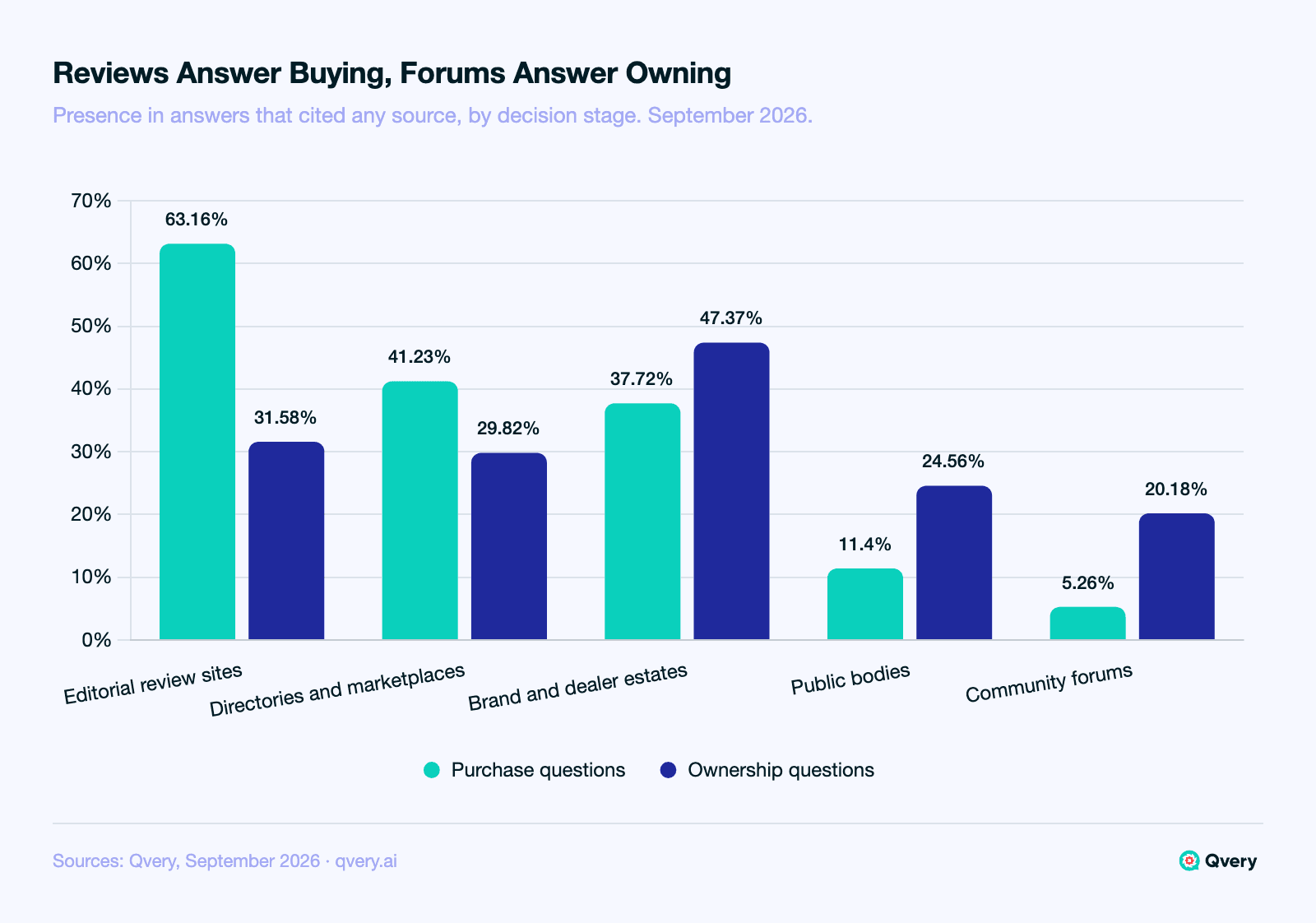
Two more layers with planning consequences. Directories and marketplaces were present in 41.23% of answers that cited any source on the purchase side and 29.82% on the ownership side.
Public bodies went the other way, present in 24.56% of answers that cited any source on the ownership side against 11.4% on the purchase side.
Brand and dealer estates were present in 47.37% of answers that cited any source on the ownership side and 37.72% on the purchase side.
That ratio sits inside the band we set in advance for calling two figures equivalent, so we publish it as equivalent. Some brand's or dealer's own pages were in the answer either way; whether yours is among them is the thing to go and check.
We counted the domains answers cited. We did not read the answers, did not measure why one review site was cited over another, and cannot tell you whether a citation sold a car or a service plan.
Build The Benchmark Set Yourself
An audit needs a competitor set, and this is where most automotive audits go soft. They benchmark against a list somebody wrote in a strategy deck two years ago.
Do it from your own answers instead. Judgment, not findings:
Run ten of your own questions from the stage you compete in, five per engine.
Read the answers and write down every business the answer names, not just the ones you consider rivals.
Keep the two or three that recur. Those are your benchmark set for that stage.
Redo it each quarter. In ownership especially, the names that recur are often not the ones in the deck.
Reading the answers by hand tells you something no citation count can. Whether the answer recommends you, mentions you in passing, or walks through the category without naming a single business. Those three outcomes need three different responses, and a dashboard that counts citations cannot tell them apart for you. So this step stays manual and stays on your calendar.
Run The Scoped Audit In Qvery
Create one topic per question family, all inside the stage you are auditing, and put the driver questions under each as queries. Qvery generates a starting set at onboarding and you edit it in plain language from there.
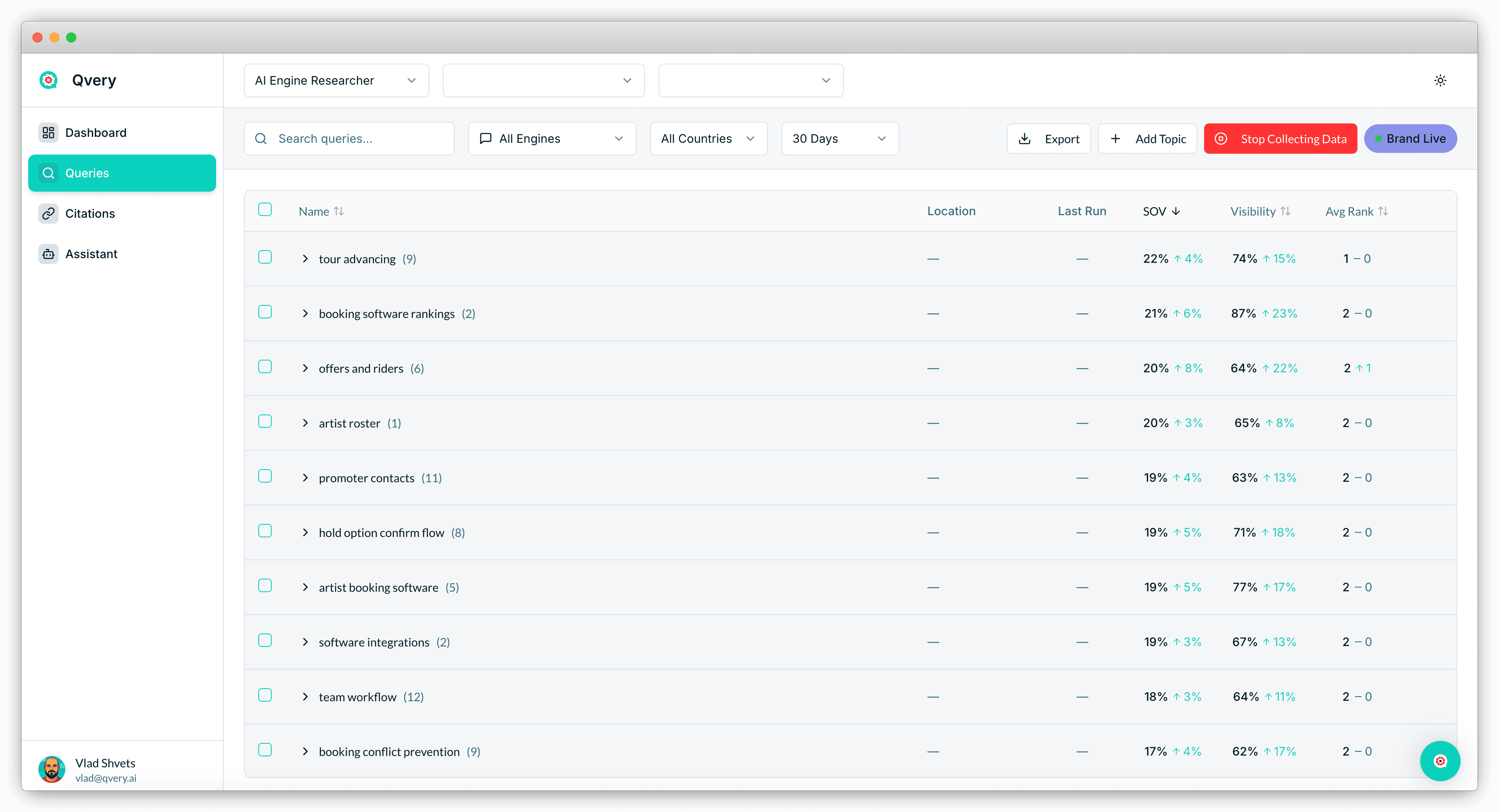
Each topic reports whether you appear, how much of the conversation you hold against the competitors you named, and where you land when you appear. The three are separate questions and we untangled them in AI visibility versus share of voice.
Every answer keeps the sources cited in it, tied to the query and the engine that produced it. The Citations view ranks the URLs and domains behind those answers, each with a weight, filterable by engine and country, and the ranking exports. Your own audit list comes out of it:
Open the Citations view for one stage's topics and read the Top Domains ranking.
Take rows from the top until another row stops changing what you would do. That is your audit list.
Go down it and mark every row present, absent or stale for your business.
If you compete in both stages, repeat and mark the rows that sit on both lists.
A note on method. Our counts used a stricter definition than a top-ranked cut.
We took the smallest set of domains that together cover four fifths of the answers that cited any source, choosing them one at a time by how many still-uncovered answers each one adds. A ranked list read from the top is a close and usable version of the same thing.
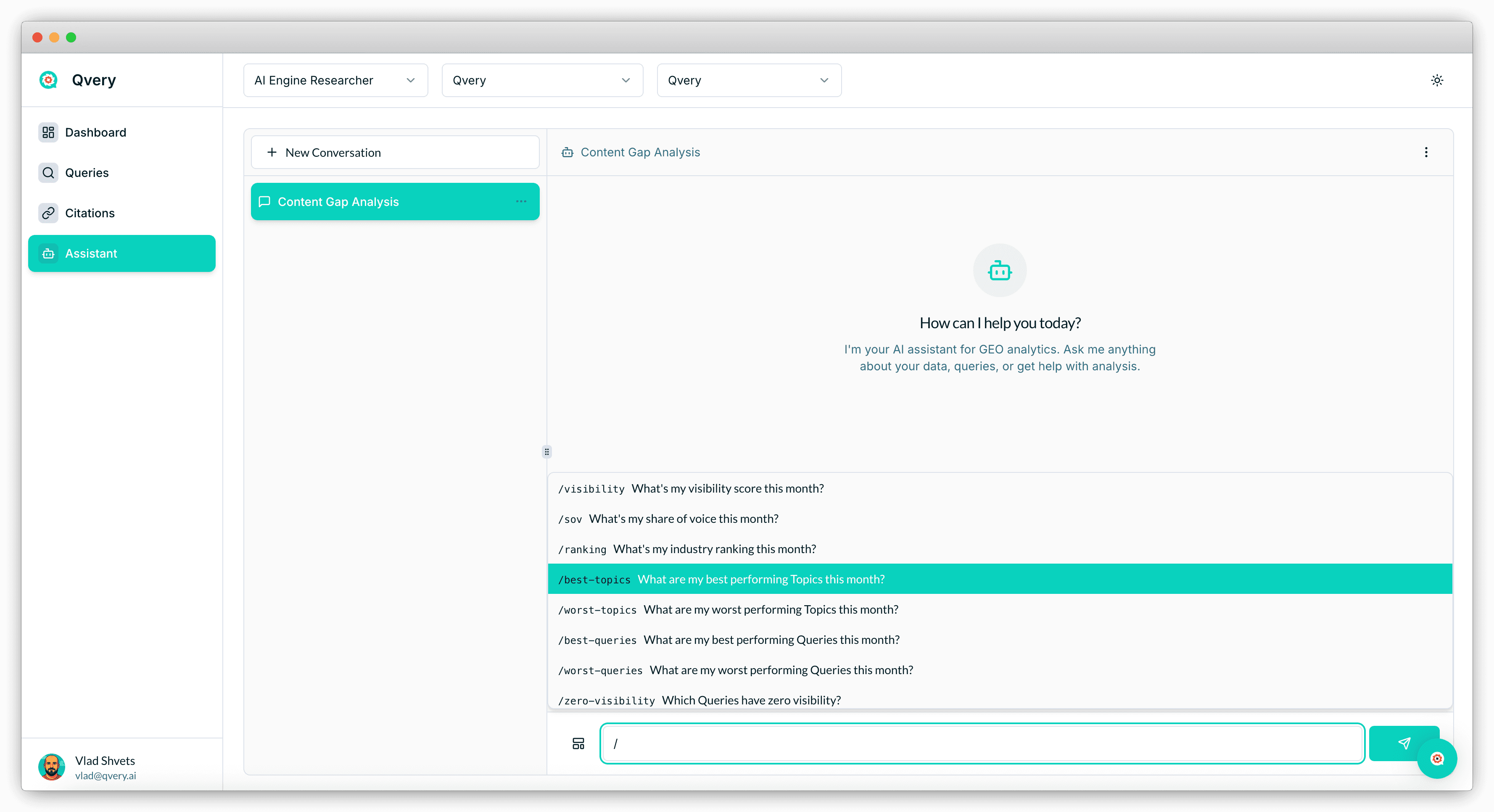
Then ask which question families return zero visibility. Check that answer against your revenue: if the families with no visibility are the ones you make money on, that is the audit's first finding.
Two limits going in. The Citations view records and ranks the sources cited; it does not label a source as press, marketplace or regulator, and it does not report which businesses the answer named. Both of those reads are yours, done once, by hand.
Start a Qvery trial and scope it to one stage first. Seven days free, no credit card, which is time to get the stage configured and the first days of data in.
Pick the stage your revenue comes from and audit that one properly this week. A half-scoped audit of both stages is worth less than a complete audit of one.
An automotive AI visibility audit goes wrong on the first slide when it picks a brand, runs a pile of car-shaped questions, and reports one number for a business that competes in two different conversations.
Buying a car and owning one came back with different sets of cited domains, in different proportions. A dealer group that services what it sells is standing in both.
So scope the audit before you run it. That means choosing which stage you are auditing, and knowing what it costs you to audit both.
This is about which domains get cited, not about who the engines recommend.
Scope The Audit Before You Run It
Automotive questions cluster into families: new vehicle choice, used vehicle choice, financing, servicing and maintenance, parts and accessories, and the whole world of insurance sitting alongside.
Those families split into two stages. Purchase covers everything before the keys change hands. Ownership covers everything after: servicing, repairs, warranties, tyres, resale.
Decide which stage your revenue comes from. A manufacturer will mostly say purchase, an independent workshop mostly ownership.
A franchised dealer group is in both, and pooling the questions is what leaves both halves half-audited.
Write your own families down. Mark the ones your business competes in and delete the rest.
An audit that includes families you do not sell into buys you noise and a longer argument, not thoroughness.
One caveat on scope, because it decides what you can take from the rest of this piece. Electric-vehicle questions, insurance questions and purchase-financing questions were deliberately left out, so nothing below speaks to any of those three and you should not stretch it to cover them.
Count The Audit List For Each Stage
The first number in a scoped audit is not a share, it is a count. How many domains do you have to care about?
Take one stage's questions. Find the smallest set of domains covering half of the answers that cited any source, then the set covering four fifths.
Repeat for the other stage.
Across a targeted set of driver questions we ran on ChatGPT and Google AI Mode in September 2026, the two stages came out at very different sizes. Directional, not a census.
Purchase questions: three domains cover half of the answers that cited any source. Eleven cover four fifths of them.
Ownership questions: seven cover half of the answers that cited any source. Twenty-two cover four fifths.
Three domains covering half of the purchase-side answers that cited any source tells you how concentrated that side is.
The ownership side takes seven to reach the same point, and twenty-two to reach four fifths. Twice the list, for the stage most audits treat as an afterthought.
The two four-fifths lists share three rows: Consumer Reports, Google and YouTube. Three out of the smaller list's eleven, a shared fraction of 0.27.
Here is the purchase list in full, in the order the coverage was reached:
Edmunds, Consumer Reports, YouTube
Car and Driver, iSeeCars, Autotrader UK, Carsguide, Cars.com, Google, Toyota, Honda Canada
The first three cover half of the purchase-side answers that cited any source. The rest is the motoring press and the classifieds.
And the ownership list:
Reddit, Google, Carfax, Consumer Reports, the BVRLA, ConsumerAffairs, mycar
MotorEasy, Discount Tire, gov.uk, RepairPal, Repco, AutoZone, HopSkipDrive, CARCHEX, The Sun
Fountain Tire, OMVIC, Care.com, YouTube, CNBC, Ensurall
The first seven cover half of the ownership-side answers that cited any source. After that it is warranty and servicing businesses, a vehicle-hire trade body and a provincial regulator.
Three shared rows out of eleven is a shared core with a distinct tail. One audit list, kept in two sections, and the ownership section is twice the length of the purchase one.
If you compete in both stages, take each list and mark every row present, absent or stale for your business before you argue about budget.
The ownership list is the longer half, and the one most audits leave out.
A dealer group that services what it sells competes in two conversations and usually measures one of them.
What Answers Buying, And What Answers Owning
Classify each cited domain by the kind of site it is and the two lists take on a recognisable shape.
Editorial review sites were present in 63.16% of answers that cited any source on the purchase side and 31.58% on the ownership side, while community sources run the other way, present in 20.18% of answers that cited any source on the ownership side against 5.26% on the purchase side.
Two more layers with planning consequences. Directories and marketplaces were present in 41.23% of answers that cited any source on the purchase side and 29.82% on the ownership side.
Public bodies went the other way, present in 24.56% of answers that cited any source on the ownership side against 11.4% on the purchase side.
Brand and dealer estates were present in 47.37% of answers that cited any source on the ownership side and 37.72% on the purchase side.
That ratio sits inside the band we set in advance for calling two figures equivalent, so we publish it as equivalent. Some brand's or dealer's own pages were in the answer either way; whether yours is among them is the thing to go and check.
We counted the domains answers cited. We did not read the answers, did not measure why one review site was cited over another, and cannot tell you whether a citation sold a car or a service plan.
Build The Benchmark Set Yourself
An audit needs a competitor set, and this is where most automotive audits go soft. They benchmark against a list somebody wrote in a strategy deck two years ago.
Do it from your own answers instead. Judgment, not findings:
Run ten of your own questions from the stage you compete in, five per engine.
Read the answers and write down every business the answer names, not just the ones you consider rivals.
Keep the two or three that recur. Those are your benchmark set for that stage.
Redo it each quarter. In ownership especially, the names that recur are often not the ones in the deck.
Reading the answers by hand tells you something no citation count can. Whether the answer recommends you, mentions you in passing, or walks through the category without naming a single business. Those three outcomes need three different responses, and a dashboard that counts citations cannot tell them apart for you. So this step stays manual and stays on your calendar.
Run The Scoped Audit In Qvery
Create one topic per question family, all inside the stage you are auditing, and put the driver questions under each as queries. Qvery generates a starting set at onboarding and you edit it in plain language from there.
Each topic reports whether you appear, how much of the conversation you hold against the competitors you named, and where you land when you appear. The three are separate questions and we untangled them in AI visibility versus share of voice.
Every answer keeps the sources cited in it, tied to the query and the engine that produced it. The Citations view ranks the URLs and domains behind those answers, each with a weight, filterable by engine and country, and the ranking exports. Your own audit list comes out of it:
Open the Citations view for one stage's topics and read the Top Domains ranking.
Take rows from the top until another row stops changing what you would do. That is your audit list.
Go down it and mark every row present, absent or stale for your business.
If you compete in both stages, repeat and mark the rows that sit on both lists.
A note on method. Our counts used a stricter definition than a top-ranked cut.
We took the smallest set of domains that together cover four fifths of the answers that cited any source, choosing them one at a time by how many still-uncovered answers each one adds. A ranked list read from the top is a close and usable version of the same thing.
Then ask which question families return zero visibility. Check that answer against your revenue: if the families with no visibility are the ones you make money on, that is the audit's first finding.
Two limits going in. The Citations view records and ranks the sources cited; it does not label a source as press, marketplace or regulator, and it does not report which businesses the answer named. Both of those reads are yours, done once, by hand.
Start a Qvery trial and scope it to one stage first. Seven days free, no credit card, which is time to get the stage configured and the first days of data in.
Pick the stage your revenue comes from and audit that one properly this week. A half-scoped audit of both stages is worth less than a complete audit of one.
An automotive AI visibility audit goes wrong on the first slide when it picks a brand, runs a pile of car-shaped questions, and reports one number for a business that competes in two different conversations.
Buying a car and owning one came back with different sets of cited domains, in different proportions. A dealer group that services what it sells is standing in both.
So scope the audit before you run it. That means choosing which stage you are auditing, and knowing what it costs you to audit both.
This is about which domains get cited, not about who the engines recommend.
Scope The Audit Before You Run It
Automotive questions cluster into families: new vehicle choice, used vehicle choice, financing, servicing and maintenance, parts and accessories, and the whole world of insurance sitting alongside.
Those families split into two stages. Purchase covers everything before the keys change hands. Ownership covers everything after: servicing, repairs, warranties, tyres, resale.
Decide which stage your revenue comes from. A manufacturer will mostly say purchase, an independent workshop mostly ownership.
A franchised dealer group is in both, and pooling the questions is what leaves both halves half-audited.
Write your own families down. Mark the ones your business competes in and delete the rest.
An audit that includes families you do not sell into buys you noise and a longer argument, not thoroughness.
One caveat on scope, because it decides what you can take from the rest of this piece. Electric-vehicle questions, insurance questions and purchase-financing questions were deliberately left out, so nothing below speaks to any of those three and you should not stretch it to cover them.
Count The Audit List For Each Stage
The first number in a scoped audit is not a share, it is a count. How many domains do you have to care about?
Take one stage's questions. Find the smallest set of domains covering half of the answers that cited any source, then the set covering four fifths.
Repeat for the other stage.
Across a targeted set of driver questions we ran on ChatGPT and Google AI Mode in September 2026, the two stages came out at very different sizes. Directional, not a census.
Purchase questions: three domains cover half of the answers that cited any source. Eleven cover four fifths of them.
Ownership questions: seven cover half of the answers that cited any source. Twenty-two cover four fifths.
Three domains covering half of the purchase-side answers that cited any source tells you how concentrated that side is.
The ownership side takes seven to reach the same point, and twenty-two to reach four fifths. Twice the list, for the stage most audits treat as an afterthought.
The two four-fifths lists share three rows: Consumer Reports, Google and YouTube. Three out of the smaller list's eleven, a shared fraction of 0.27.
Here is the purchase list in full, in the order the coverage was reached:
Edmunds, Consumer Reports, YouTube
Car and Driver, iSeeCars, Autotrader UK, Carsguide, Cars.com, Google, Toyota, Honda Canada
The first three cover half of the purchase-side answers that cited any source. The rest is the motoring press and the classifieds.
And the ownership list:
Reddit, Google, Carfax, Consumer Reports, the BVRLA, ConsumerAffairs, mycar
MotorEasy, Discount Tire, gov.uk, RepairPal, Repco, AutoZone, HopSkipDrive, CARCHEX, The Sun
Fountain Tire, OMVIC, Care.com, YouTube, CNBC, Ensurall
The first seven cover half of the ownership-side answers that cited any source. After that it is warranty and servicing businesses, a vehicle-hire trade body and a provincial regulator.
Three shared rows out of eleven is a shared core with a distinct tail. One audit list, kept in two sections, and the ownership section is twice the length of the purchase one.
If you compete in both stages, take each list and mark every row present, absent or stale for your business before you argue about budget.
The ownership list is the longer half, and the one most audits leave out.
A dealer group that services what it sells competes in two conversations and usually measures one of them.
What Answers Buying, And What Answers Owning
Classify each cited domain by the kind of site it is and the two lists take on a recognisable shape.
Editorial review sites were present in 63.16% of answers that cited any source on the purchase side and 31.58% on the ownership side, while community sources run the other way, present in 20.18% of answers that cited any source on the ownership side against 5.26% on the purchase side.
Two more layers with planning consequences. Directories and marketplaces were present in 41.23% of answers that cited any source on the purchase side and 29.82% on the ownership side.
Public bodies went the other way, present in 24.56% of answers that cited any source on the ownership side against 11.4% on the purchase side.
Brand and dealer estates were present in 47.37% of answers that cited any source on the ownership side and 37.72% on the purchase side.
That ratio sits inside the band we set in advance for calling two figures equivalent, so we publish it as equivalent. Some brand's or dealer's own pages were in the answer either way; whether yours is among them is the thing to go and check.
We counted the domains answers cited. We did not read the answers, did not measure why one review site was cited over another, and cannot tell you whether a citation sold a car or a service plan.
Build The Benchmark Set Yourself
An audit needs a competitor set, and this is where most automotive audits go soft. They benchmark against a list somebody wrote in a strategy deck two years ago.
Do it from your own answers instead. Judgment, not findings:
Run ten of your own questions from the stage you compete in, five per engine.
Read the answers and write down every business the answer names, not just the ones you consider rivals.
Keep the two or three that recur. Those are your benchmark set for that stage.
Redo it each quarter. In ownership especially, the names that recur are often not the ones in the deck.
Reading the answers by hand tells you something no citation count can. Whether the answer recommends you, mentions you in passing, or walks through the category without naming a single business. Those three outcomes need three different responses, and a dashboard that counts citations cannot tell them apart for you. So this step stays manual and stays on your calendar.
Run The Scoped Audit In Qvery
Create one topic per question family, all inside the stage you are auditing, and put the driver questions under each as queries. Qvery generates a starting set at onboarding and you edit it in plain language from there.
Each topic reports whether you appear, how much of the conversation you hold against the competitors you named, and where you land when you appear. The three are separate questions and we untangled them in AI visibility versus share of voice.
Every answer keeps the sources cited in it, tied to the query and the engine that produced it. The Citations view ranks the URLs and domains behind those answers, each with a weight, filterable by engine and country, and the ranking exports. Your own audit list comes out of it:
Open the Citations view for one stage's topics and read the Top Domains ranking.
Take rows from the top until another row stops changing what you would do. That is your audit list.
Go down it and mark every row present, absent or stale for your business.
If you compete in both stages, repeat and mark the rows that sit on both lists.
A note on method. Our counts used a stricter definition than a top-ranked cut.
We took the smallest set of domains that together cover four fifths of the answers that cited any source, choosing them one at a time by how many still-uncovered answers each one adds. A ranked list read from the top is a close and usable version of the same thing.
Then ask which question families return zero visibility. Check that answer against your revenue: if the families with no visibility are the ones you make money on, that is the audit's first finding.
Two limits going in. The Citations view records and ranks the sources cited; it does not label a source as press, marketplace or regulator, and it does not report which businesses the answer named. Both of those reads are yours, done once, by hand.
Start a Qvery trial and scope it to one stage first. Seven days free, no credit card, which is time to get the stage configured and the first days of data in.
Pick the stage your revenue comes from and audit that one properly this week. A half-scoped audit of both stages is worth less than a complete audit of one.
An automotive AI visibility audit goes wrong on the first slide when it picks a brand, runs a pile of car-shaped questions, and reports one number for a business that competes in two different conversations.
Buying a car and owning one came back with different sets of cited domains, in different proportions. A dealer group that services what it sells is standing in both.
So scope the audit before you run it. That means choosing which stage you are auditing, and knowing what it costs you to audit both.
This is about which domains get cited, not about who the engines recommend.
Scope The Audit Before You Run It
Automotive questions cluster into families: new vehicle choice, used vehicle choice, financing, servicing and maintenance, parts and accessories, and the whole world of insurance sitting alongside.
Those families split into two stages. Purchase covers everything before the keys change hands. Ownership covers everything after: servicing, repairs, warranties, tyres, resale.
Decide which stage your revenue comes from. A manufacturer will mostly say purchase, an independent workshop mostly ownership.
A franchised dealer group is in both, and pooling the questions is what leaves both halves half-audited.
Write your own families down. Mark the ones your business competes in and delete the rest.
An audit that includes families you do not sell into buys you noise and a longer argument, not thoroughness.
One caveat on scope, because it decides what you can take from the rest of this piece. Electric-vehicle questions, insurance questions and purchase-financing questions were deliberately left out, so nothing below speaks to any of those three and you should not stretch it to cover them.
Count The Audit List For Each Stage
The first number in a scoped audit is not a share, it is a count. How many domains do you have to care about?
Take one stage's questions. Find the smallest set of domains covering half of the answers that cited any source, then the set covering four fifths.
Repeat for the other stage.
Across a targeted set of driver questions we ran on ChatGPT and Google AI Mode in September 2026, the two stages came out at very different sizes. Directional, not a census.
Purchase questions: three domains cover half of the answers that cited any source. Eleven cover four fifths of them.
Ownership questions: seven cover half of the answers that cited any source. Twenty-two cover four fifths.
Three domains covering half of the purchase-side answers that cited any source tells you how concentrated that side is.
The ownership side takes seven to reach the same point, and twenty-two to reach four fifths. Twice the list, for the stage most audits treat as an afterthought.
The two four-fifths lists share three rows: Consumer Reports, Google and YouTube. Three out of the smaller list's eleven, a shared fraction of 0.27.
Here is the purchase list in full, in the order the coverage was reached:
Edmunds, Consumer Reports, YouTube
Car and Driver, iSeeCars, Autotrader UK, Carsguide, Cars.com, Google, Toyota, Honda Canada
The first three cover half of the purchase-side answers that cited any source. The rest is the motoring press and the classifieds.
And the ownership list:
Reddit, Google, Carfax, Consumer Reports, the BVRLA, ConsumerAffairs, mycar
MotorEasy, Discount Tire, gov.uk, RepairPal, Repco, AutoZone, HopSkipDrive, CARCHEX, The Sun
Fountain Tire, OMVIC, Care.com, YouTube, CNBC, Ensurall
The first seven cover half of the ownership-side answers that cited any source. After that it is warranty and servicing businesses, a vehicle-hire trade body and a provincial regulator.
Three shared rows out of eleven is a shared core with a distinct tail. One audit list, kept in two sections, and the ownership section is twice the length of the purchase one.
If you compete in both stages, take each list and mark every row present, absent or stale for your business before you argue about budget.
The ownership list is the longer half, and the one most audits leave out.
A dealer group that services what it sells competes in two conversations and usually measures one of them.
What Answers Buying, And What Answers Owning
Classify each cited domain by the kind of site it is and the two lists take on a recognisable shape.
Editorial review sites were present in 63.16% of answers that cited any source on the purchase side and 31.58% on the ownership side, while community sources run the other way, present in 20.18% of answers that cited any source on the ownership side against 5.26% on the purchase side.
Two more layers with planning consequences. Directories and marketplaces were present in 41.23% of answers that cited any source on the purchase side and 29.82% on the ownership side.
Public bodies went the other way, present in 24.56% of answers that cited any source on the ownership side against 11.4% on the purchase side.
Brand and dealer estates were present in 47.37% of answers that cited any source on the ownership side and 37.72% on the purchase side.
That ratio sits inside the band we set in advance for calling two figures equivalent, so we publish it as equivalent. Some brand's or dealer's own pages were in the answer either way; whether yours is among them is the thing to go and check.
We counted the domains answers cited. We did not read the answers, did not measure why one review site was cited over another, and cannot tell you whether a citation sold a car or a service plan.
Build The Benchmark Set Yourself
An audit needs a competitor set, and this is where most automotive audits go soft. They benchmark against a list somebody wrote in a strategy deck two years ago.
Do it from your own answers instead. Judgment, not findings:
Run ten of your own questions from the stage you compete in, five per engine.
Read the answers and write down every business the answer names, not just the ones you consider rivals.
Keep the two or three that recur. Those are your benchmark set for that stage.
Redo it each quarter. In ownership especially, the names that recur are often not the ones in the deck.
Reading the answers by hand tells you something no citation count can. Whether the answer recommends you, mentions you in passing, or walks through the category without naming a single business. Those three outcomes need three different responses, and a dashboard that counts citations cannot tell them apart for you. So this step stays manual and stays on your calendar.
Run The Scoped Audit In Qvery
Create one topic per question family, all inside the stage you are auditing, and put the driver questions under each as queries. Qvery generates a starting set at onboarding and you edit it in plain language from there.
Each topic reports whether you appear, how much of the conversation you hold against the competitors you named, and where you land when you appear. The three are separate questions and we untangled them in AI visibility versus share of voice.
Every answer keeps the sources cited in it, tied to the query and the engine that produced it. The Citations view ranks the URLs and domains behind those answers, each with a weight, filterable by engine and country, and the ranking exports. Your own audit list comes out of it:
Open the Citations view for one stage's topics and read the Top Domains ranking.
Take rows from the top until another row stops changing what you would do. That is your audit list.
Go down it and mark every row present, absent or stale for your business.
If you compete in both stages, repeat and mark the rows that sit on both lists.
A note on method. Our counts used a stricter definition than a top-ranked cut.
We took the smallest set of domains that together cover four fifths of the answers that cited any source, choosing them one at a time by how many still-uncovered answers each one adds. A ranked list read from the top is a close and usable version of the same thing.
Then ask which question families return zero visibility. Check that answer against your revenue: if the families with no visibility are the ones you make money on, that is the audit's first finding.
Two limits going in. The Citations view records and ranks the sources cited; it does not label a source as press, marketplace or regulator, and it does not report which businesses the answer named. Both of those reads are yours, done once, by hand.
Start a Qvery trial and scope it to one stage first. Seven days free, no credit card, which is time to get the stage configured and the first days of data in.
Pick the stage your revenue comes from and audit that one properly this week. A half-scoped audit of both stages is worth less than a complete audit of one.

© 2026 Qvery AI OÜ