
On this page
- Most Steps in a Loan File Compare One Document With Another
- The Document List Is Built the Moment the Application Lands
- Every Page Is Read Into a Draft Your Processor Accepts
- Income Judgment, Explanations and the Credit Decision Stay With People
- What the Agents May Touch
- The First Month
- Frequently asked questions
A loan file reaches your processors as a pile. Does this sound familiar?
- Pay stubs and W-2s, the annual wage statements, some from last year.
- Two months of bank statements, with pages missing.
- Tax returns, a purchase contract, a court order behind child support.
- A letter about a deposit nobody can explain.
At Qvery, we help mortgage lenders cut what each loan costs to process, with custom AI agents that chase missing documents and check every upload against the application.
Someone builds the list of what the borrower owes, chases it item by item, opens each PDF, keys the figures into the loan origination system and compares them with what the borrower wrote on the application. A check missed there comes back late, as a new condition, what an underwriter requires before closing, the week of closing, or a loan an investor can push back.
Most Steps in a Loan File Compare One Document With Another
Building the needs list, sorting what arrives, reading each page, keying the figures, checking them against the application and writing up the conditions all compare one thing with another. Only a few steps decide: whether a self-employed borrower's income is stable, whether an unexplained deposit is acceptable, and whether the loan gets approved.
Independent lenders spent $11,094 to produce each loan in 2025 and kept $785 of profit on it, by the Mortgage Bankers Association's count: about one dollar for every fourteen spent.
Say gathering, reading, keying and comparing take three hours a file. With AI agents doing that work, the processor spends half an hour accepting their drafts and about five minutes on a sample, close to two and a half hours handed back a file: about $87 at a processor's pay and benefits, roughly 11% of the profit a loan earns.
 Vlad ShvetsPartner @ Qvery
When a lender keeps $785 on a loan that cost $11,094 to produce, the margin lives in the cost of each file. About $87 handed back per file is roughly 11% of that profit, before counting the files you can close in a rate drop without hiring ahead of it. So put the agents on the chase and the comparing first, where most of a processor's three hours go, and leave the judgment calls where they are.
Loan interviewers and clerks, the federal category for processors, earned a mean $52,520 in May 2025, the Bureau of Labor Statistics reports; with benefits at 30% of what private employers spend, about $75,000.
In our example, a lender of about 200 people closing 300 loans a month has ten processors; at three hours a file that is about 900 hours a month, 52% of their week. The calculator works out what the preparation costs a year today, what it costs with the agents taking 80% of it, and how fast the build pays back, and it opens on that example.
Loan File Preparation ROI Calculator
What Gathering, Reading, Keying And Comparing Each Loan File Costs You, And What An Agent Saves
Saved Per Year
$300,000
8,653 hours handed back, after $12,000 a year to run it
- Hours Handed Back
- 8,653 hours a year
- Agent Running Cost (Estimate)
- $1,000 a month
- Payback Per $10,000 Of Build
- 0.4 months
On these numbers, the agent saves $300,000 a year after its own running cost, and every $10,000 of the build is earned back in 0.4 months.
On the example, the preparation falls from $390,000 to $90,000 a year, running cost included: $300,000 and 8,653 hours handed back, which repays each $10,000 of the build in about 0.4 months. At a few hundred files a month that is also room to carry the next rate drop without hiring ahead of it.
Our finance playbook prices this chase for missing documents, beside business financials keyed into spreadsheets and letters from borrowers that start a legal deadline.
The Document List Is Built the Moment the Application Lands
The needs list follows from what the borrower declared: pay stubs and W-2s for a salaried job, tax returns for a business owner, the court order behind child support, the last two months of statements for each account holding the down payment.
The agents draft it from the application itself, and your processor approves it once before it goes to the borrower.
The time goes on what comes back. Borrowers upload pages three and seven of a statement, a screenshot instead of a download, last year's W-2 instead of this one.
The agents check each upload as it arrives, against the list: the right document, every page present, both months covered, the right account, readable. The borrower hears what is missing within minutes, while they are still holding their phone. At first a processor sees each message before it goes; reminders for items on the approved list go out on their own only once you decide, in writing, that they may.
A divorce, a death in the family or a business that changed hands goes straight to a person. Try the check on one of your own loan files with its checklist, and see the request it would send the borrower.
Every Page Is Read Into a Draft Your Processor Accepts
Sorting a hundred-page upload into labeled documents and reading the fields off each one (employer, pay period, year-to-date earnings, balances, account numbers) are the steps AI handles best.
The agents never write into your loan origination system. They fill a draft view, a screen where each value sits beside its source page, and the processor accepts or corrects it. When the borrower sends a newer statement, the agents reread it and mark the old values replaced.
Each mismatch with the application becomes a draft condition with its evidence attached, so your processor clears or sends it instead of hunting for it.
Fannie Mae can give a lender protection from having to buy back a loan on what its own validation service checks from electronic data. An AI agent reading PDFs earns no such relief, so the risk of its misses stays with you.
That is why a person reads a sample of the files the agents found nothing wrong with. An agent that flags its own doubts does not flag its confident mistakes, and only a second read of the source pages shows how often it misses.
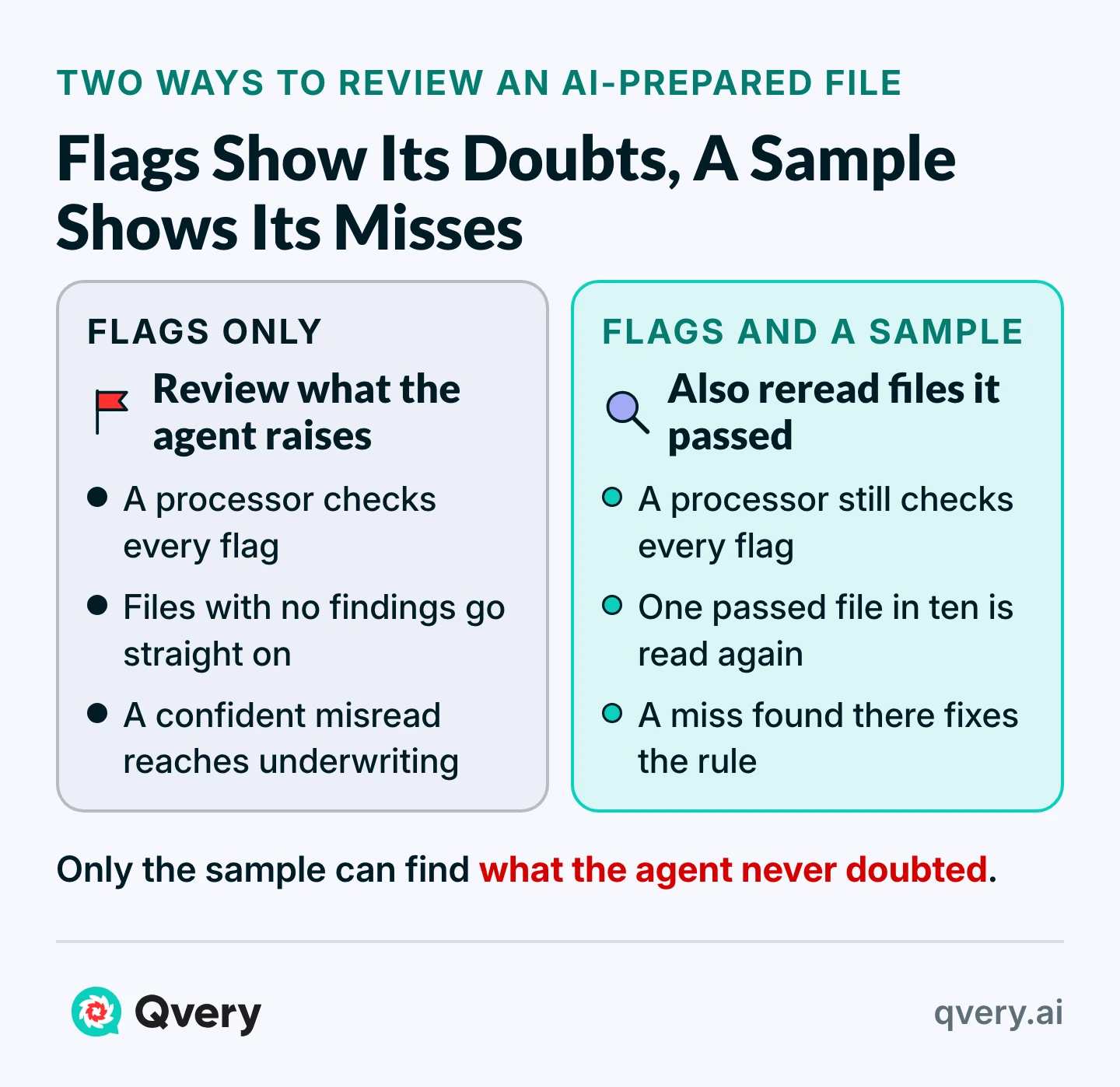
The sample starts at one file in ten; every miss is recorded, and the rate rises the week one appears.
 Piotr BabelPartner @ Qvery
An agent reading a pay stub is wrong in two ways. The doubts it flags cost your processor a minute. The misreads it is sure of cost nothing until an underwriter or an investor finds them, which is why the second read of passed files matters more than the flags. Every value sits beside its source page in the draft view, so rereading one file in ten takes minutes, and a miss found there changes the rule that let it through.
Income Judgment, Explanations and the Credit Decision Stay With People
Where a deposit cannot be fully sourced, Fannie Mae's guide says the lender "must use reasonable judgment". Letters of explanation, gift funds from a relative and exceptions to your own overlays, the extra lending rules you add to the agencies', are the same kind of work. So is the processor's quiet craft of organizing the underwriting submission and knowing which document needs an explanation beside it.
What Reddit says
What loan officers say AI can and cannot do in a file
I put a 100+ page fax into AI and it neatly sorted it into pdfs with 100% accuracy. It's like 50% - 80% accurate for income or guidelines making it useless. It has uses you just can't rely on it and always need to verify what you get back.
I always said this: the loans AI can do are super easy. They’re not a problem for me. The difficult loans - goofy variable income, assets that show things you don’t want to see - cannot be done by AI.
You can send the cleanest checklist on earth and people will still upload page 3 and 7 of a statement and forget the rest.
The approval is a person's. The agents' job here is to hand each person the facts, gathered and sourced, so the judgment starts at once.
What the Agents May Touch
| The agents draft and chase | A person decides |
|---|---|
| The document list, from the application | The processor approves it before it goes out |
| Reminders for items on the approved list | Divorce, death or a changed business: a person handles it |
| A draft value beside every source page | Nothing reaches the loan system until a processor accepts it |
| Draft conditions with their evidence | The processor clears or sends each one |
| A weekly sample of files with no findings | A person rereads it and reports the miss rate |
| A trace from every value to the page it came from | One named owner signs off each change to the agents' rules |
Borrowers send pay stubs, tax returns and bank statements with account numbers on them, so what the agents may read and where those files are processed is agreed in writing first, and each value's trace to its page stays with the loan file.
The First Month
We begin with a month of closed files and your needs lists, and the agents prepare those files again beside what your processors produced. Your processors see where the drafts differ, we agree with you what runs live, and within two weeks of access the agents check new uploads as borrowers send them.
Frequently asked questions
How is AI processing different from automated underwriting?
Automated underwriting systems such as Fannie Mae's assess a loan from the data a lender submits. AI processing works earlier: it reads the borrower's documents, turns them into checked data and drafts the conditions. One prepares what the other evaluates, and Fannie Mae still requires the lender to confirm that data and use its own judgment.
Can AI calculate income for a self-employed borrower?
It can run the cash-flow arithmetic from tax returns, and approved tools already do. Fannie Mae still requires the lender to prepare a written evaluation of how much income is stable and continuous, and that judgment belongs to an underwriter. Treat any AI-calculated figure for a business owner as a draft to check.
Can AI chase borrowers for missing documents?
Yes. Once a processor approves the document list, our agents check each upload within minutes and tell the borrower exactly which page or month is missing; at first a processor sees each message, and reminders go out on their own only once you agree they may. Sensitive situations, such as a divorce or a death in the family, go to a person.
Which steps of mortgage processing can AI agents do?
The comparing: building the needs list, sorting what arrives, reading each page, keying the figures, checking them against the application and drafting the conditions. The few steps that decide, like whether self-employed income is stable, stay with people.
How much does it cost a lender to produce a mortgage?
Independent lenders spent $11,094 to produce each loan in 2025 and kept $785 of profit on it, by the Mortgage Bankers Association's count: about one dollar for every fourteen spent.
How much processor time can AI agents save per loan file?
On this post's assumption of three hours a file, the processor spends half an hour accepting the agents' drafts and about five minutes on a sample: close to two and a half hours handed back, about $87 a file.
How much can AI agents save a lender closing 300 loans a month?
In the example, ten processors spend about 900 hours a month on preparation, $390,000 a year. With agents taking 80%, it falls to $90,000, running cost included: $300,000 and 8,653 hours back.
What does a mortgage processor cost a lender?
Loan interviewers and clerks, the federal category for processors, earned a mean $52,520 in May 2025, the Bureau of Labor Statistics reports. With benefits at 30% of private employer costs, about $75,000 a year.
Where are borrowers' documents processed?
Where the written agreement we sign before the agents start says. Qvery AI OÜ is an EU company and signs a data processing agreement, and one named owner at your company signs off every change to the agents' rules.
Do AI agents write into the loan origination system?
No. They fill a draft view where each value sits beside its source page, and the processor accepts or corrects it. A newer statement is reread and the old values marked replaced.
What happens when a document doesn't match the application?
Each mismatch becomes a draft condition with its evidence attached. The processor clears or sends it instead of hunting for it. The agents provide the evidence; the processor decides what happens to the condition.
Does Fannie Mae protect lenders from AI reading mistakes?
No. Fannie Mae can relieve a lender of buybacks on what its own validation service checks from electronic data. An AI agent reading PDFs earns no such relief, so the risk of its misses stays with you.
Why sample loan files the AI found nothing wrong with?
Because an agent that flags its own doubts does not flag its confident mistakes. A person rereads one file in ten at first; every miss is recorded, and the rate rises the week one appears.
How accurate is AI at reading mortgage documents?
Sorting is strong: one loan officer on Reddit put a 100+ page fax into AI and got it sorted with 100% accuracy. The same officer called it 50% to 80% accurate on income or guidelines, so the results still need checking.
Which loan decisions stay with a person?
Judgment calls: a deposit that cannot be fully sourced, letters of explanation, gift funds from a relative and exceptions to your own lending overlays. The approval itself is a person's; the agents hand each person the facts, gathered and sourced.
What documents does a mortgage needs list include?
Whatever follows from what the borrower declared: pay stubs and W-2s for a salaried job, tax returns for a business owner, the court order behind child support, and the last two months of statements for each account holding the down payment. The agents draft it from the application; your processor approves it once.
