By
Vlad Shvets
98% of UGC Citations in AI Search Come From Just Four Platforms
Reddit owns 73.5% of all UGC citations in AI search and is still growing. dev.to, SourceForge, and Slashdot make up almost everything else. Stack Overflow is the invisible giant. The full UGC landscape mapped, with practical recommendations for each tier.
Reddit owns 73.5% of all UGC citations in AI search and is still growing. dev.to, SourceForge, and Slashdot make up almost everything else. Stack Overflow is the invisible giant. The full UGC landscape mapped, with practical recommendations for each tier.
Reddit owns 73.5% of all UGC citations in AI search and is still growing. dev.to, SourceForge, and Slashdot make up almost everything else. Stack Overflow is the invisible giant. The full UGC landscape mapped, with practical recommendations for each tier.
User-generated content is one of the three pillars of AI engine visibility. Most marketers I talk to assume that means a long list of forums, Q&A sites, and community platforms split somewhat evenly across AI engine citations. The actual data tells a much shorter story.
There are four UGC platforms that AI engines cite in any meaningful volume, and one of them owns nearly three quarters of the entire category.
We've been tracking AI engine citations across ChatGPT and Google AI Mode through Qvery's AI Engine Researcher.
The UGC umbrella, defined as Reddit, dev.to, SourceForge, Slashdot, Quora, ProductHunt, Stack Overflow, Hacker News, and a long tail of smaller platforms, accounts for 2.17% of all AI engine citations. That's a meaningful slice, smaller than social media as a category but ahead of TripAdvisor and ahead of Wikipedia.
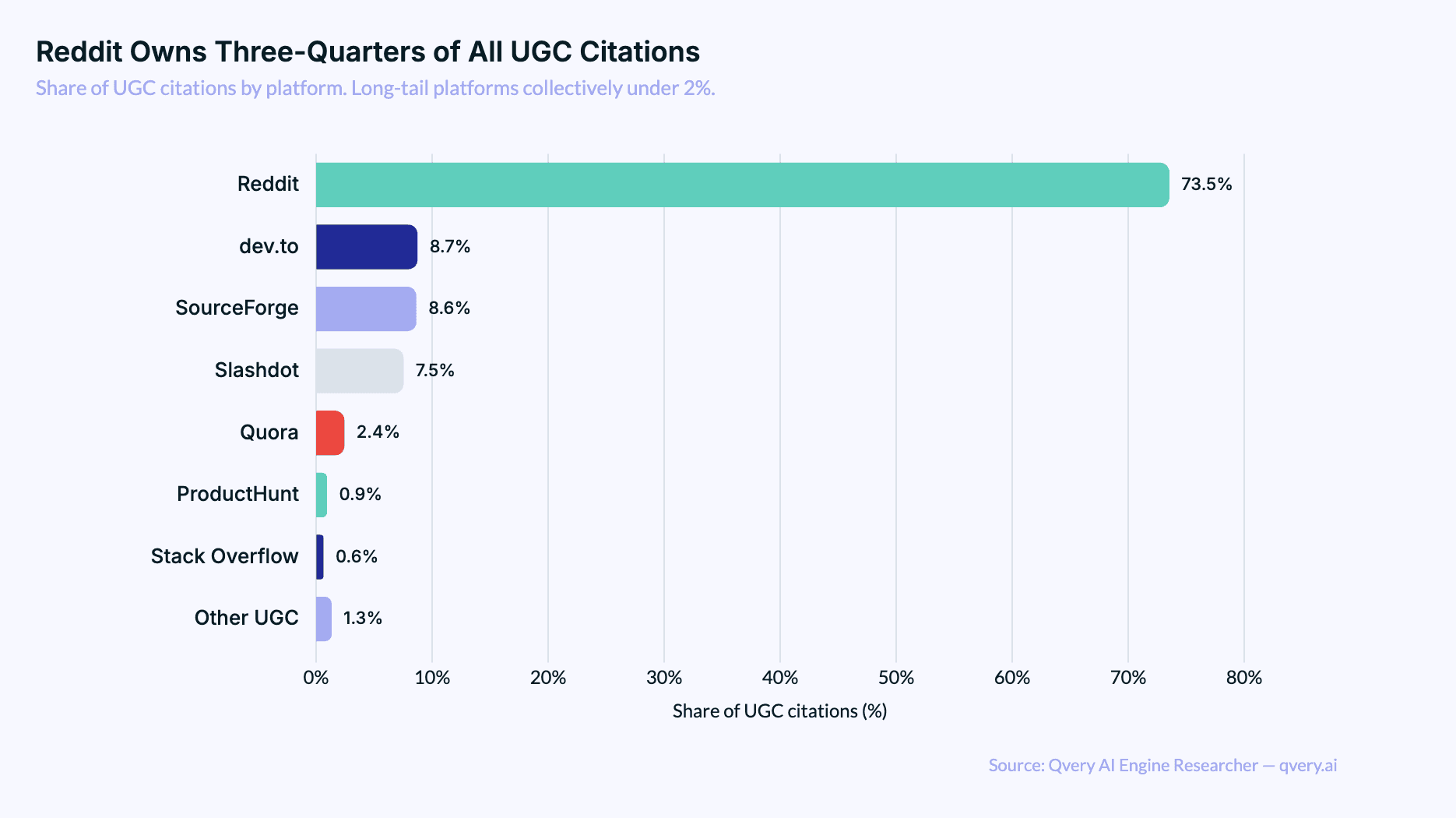
Inside the umbrella, the distribution is brutally concentrated. Reddit owns 73.5% of all UGC citations and is still growing. The next three platforms (dev.to, SourceForge, Slashdot) collectively own about a quarter.
Everything else, the long tail of UGC sites that marketers spend time worrying about, accounts for less than 2% of UGC citations combined. (Most of the platforms in your "UGC strategy" deck don't show up in AI citations at all.)
Reddit Owns Three-Quarters of All UGC Citations and Its Share Is Growing
Reddit's UGC dominance is the headline finding. As of May 2026, Reddit accounts for 73.5% of all UGC citations across both AI engines.
That number was 58.9% when we ran the analysis two months earlier. Reddit didn't just hold its lead. It expanded it dramatically while other UGC platforms grew slower or declined.
Per platform, the UGC breakdown:
Reddit: 73.5% of UGC citations.
dev.to: 8.7%.
SourceForge: 8.6%.
Slashdot: 7.5%.
Quora: 2.4%.
ProductHunt: 0.9%.
Stack Overflow, Hacker News, HackerNoon, IndieHackers, others combined: under 2%.
ChatGPT explicitly favors Reddit because of the OpenAI partnership signed in 2024, and Reddit's content is recent enough that it hasn't been fully absorbed into foundation model training data yet.
Reddit threads also have a structural advantage: every comment is a retrievable passage, which means a single thread can satisfy multiple queries. Smaller UGC platforms can't compete on that scale. (The supermajority isn't Reddit being unusually good. It's everyone else being structurally smaller.)
dev.to, SourceForge, and Slashdot Are the Surprising Runners-Up
The next three platforms are the unexpected story.
dev.to, SourceForge, and Slashdot are within a percentage point of each other in citation share, and together they account for nearly a quarter of all UGC citations. Most SaaS marketers I talk to underestimate all three.
dev.to makes sense once you see the data. It's where developers publish technical content that AI engines treat as fresh and retrievable. Stack Overflow's old answers got absorbed into the training data. dev.to's recent articles haven't, which is exactly why they get cited more. We've written about this dynamic in detail in the Stack Overflow analysis.
SourceForge is the one that surprised us most. SourceForge.net hosts an enormous library of B2B software-comparison and directory pages. AI engines treat them like Capterra or G2 listings: structured, ranked content that's easy to extract. SaaS marketers consistently overlook SourceForge as a third-party mention target. The data says they shouldn't.
Slashdot is the legacy IT-news platform that's been around since 1997. Most of its cited pages are 2018-2023 commentary articles. The depth of its archives, plus the fact that Google has been indexing it for two decades, makes it a meaningful citation source for tech-related queries.
The pattern across all three: they're older platforms with deep, well-indexed archives, hosting content formats that AI engines find easy to retrieve. Newer, smaller, more "modern" UGC platforms haven't replaced them.
Stack Overflow Is the Invisible Giant in the Room
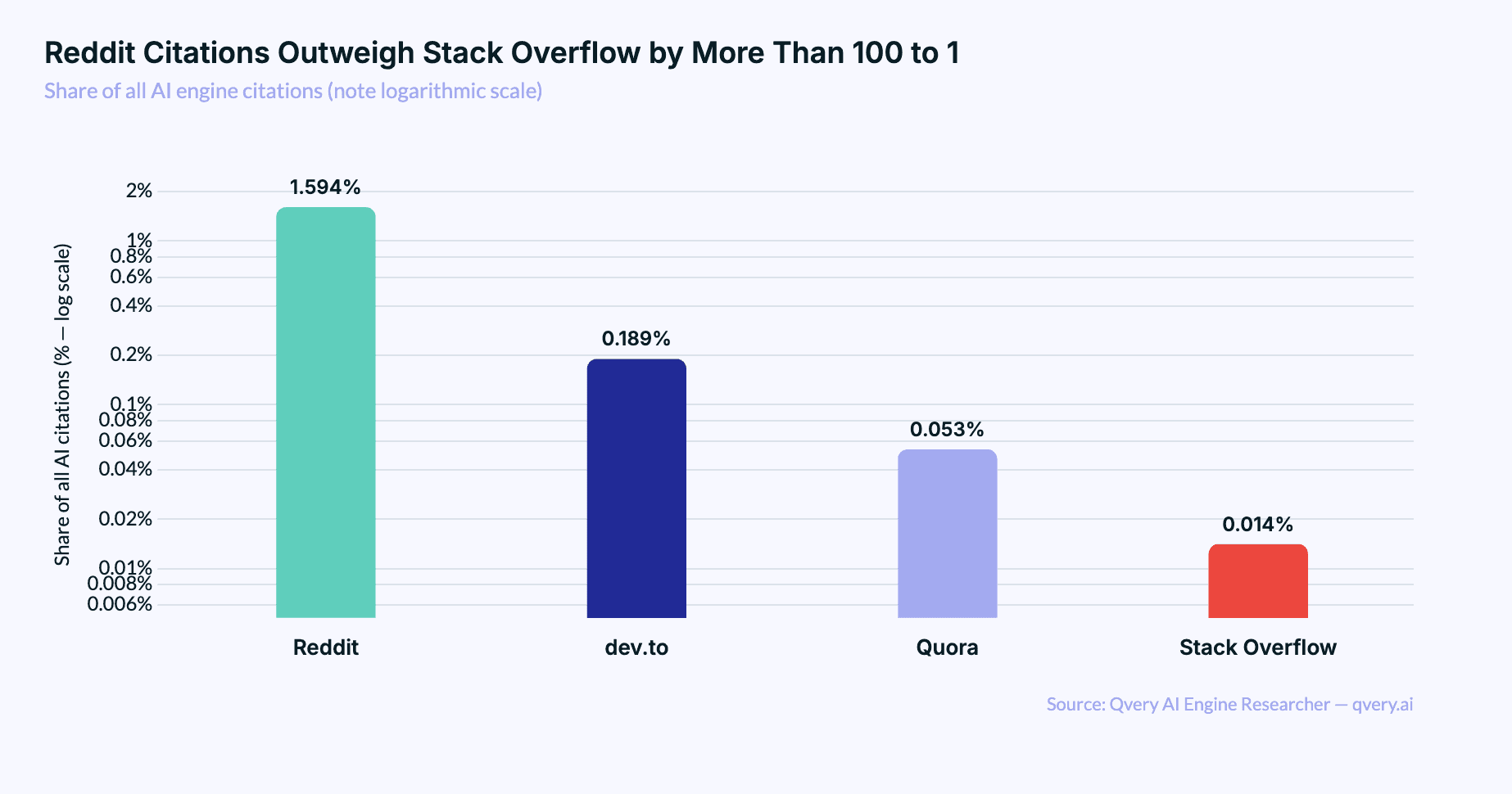
The most jarring finding in the UGC breakdown is what's missing. Stack Overflow, the world's largest developer Q&A site by an enormous margin, accounts for just 0.6% of all UGC citations.
That's a smaller share than ProductHunt. By raw page count, Stack Overflow has more answered questions than the rest of UGC combined.
The reason is the same absorption thesis we documented in our Stack Overflow analysis. Foundation models have been training on Stack Overflow's data dumps since 2020. The site's content is sitting inside the models, not outside them.
When an AI engine needs to answer a code question, it doesn't retrieve a Stack Overflow page. It already has the answer baked in. dev.to wins because it's fresher. Reddit wins because OpenAI explicitly partnered with it.
Stack Overflow has more pages than the rest of UGC combined and accounts for 0.6% of UGC citations. Page count is not citation share. Content age is.
UGC Is the Most Engine-Balanced Source Category
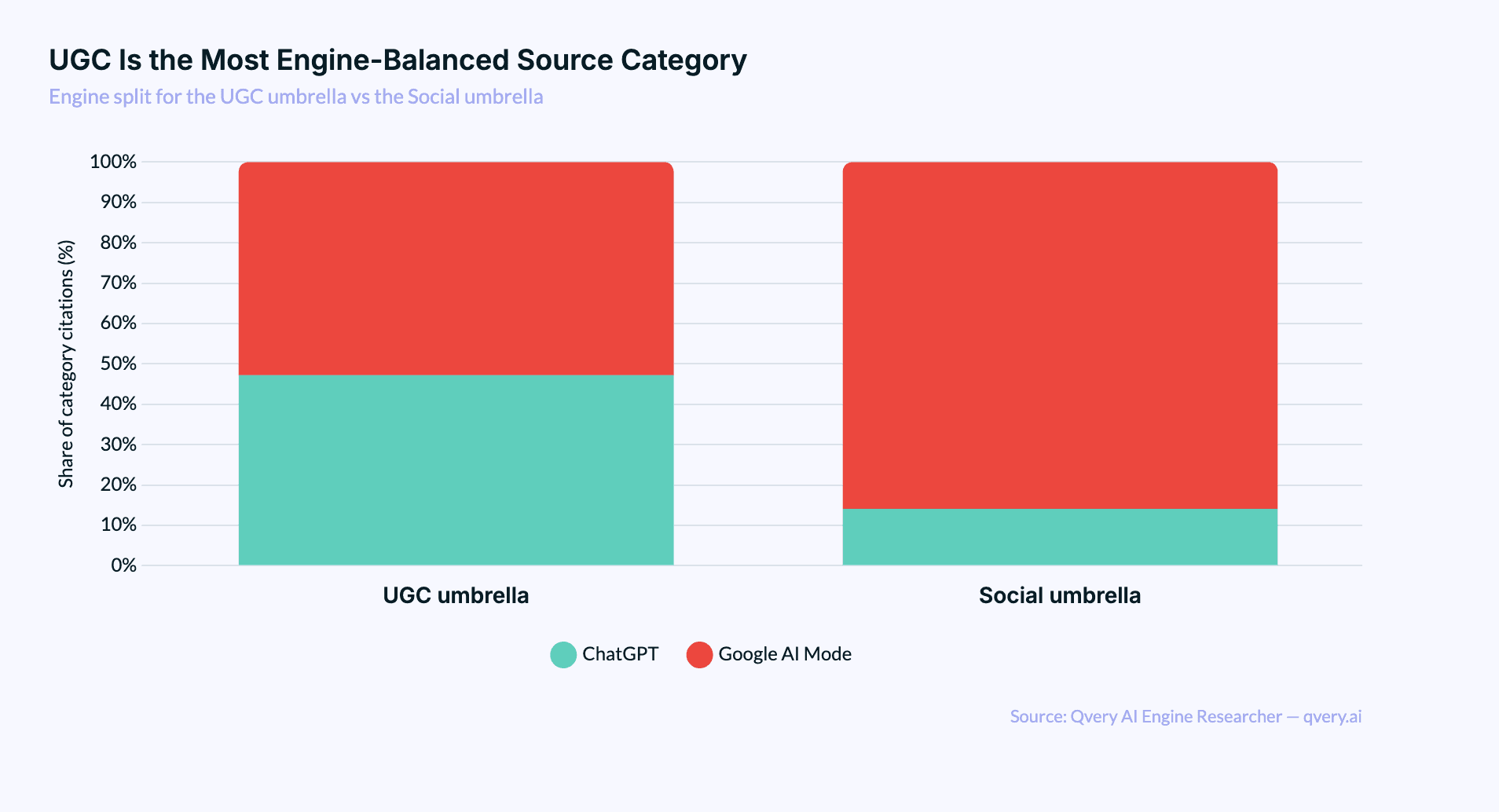
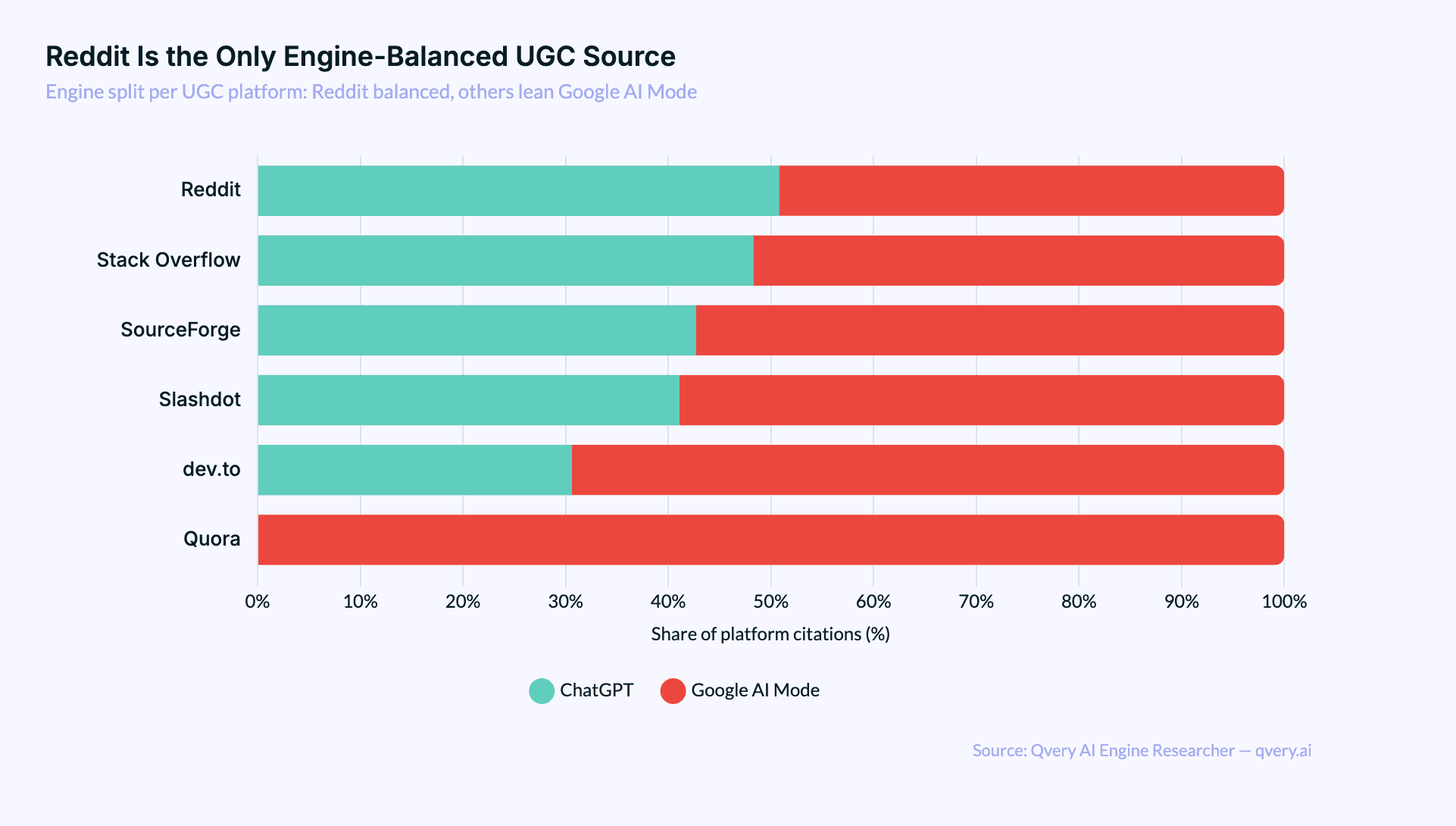
One of the more useful structural findings about UGC is that, unlike social media or travel, it's roughly engine-balanced. The UGC umbrella as a whole splits 52.8% Google AI Mode and 47.2% ChatGPT. That's the most balanced engine split of any major source category we track.
The balance is driven almost entirely by Reddit. Reddit alone splits roughly 50/50 between engines. Strip Reddit out of the UGC umbrella and the rest leans heavily toward Google AI Mode. dev.to is 69% Google AI. SourceForge is 57%. Slashdot is 59%. Quora is, of course, 100% Google AI Mode. The non-Reddit UGC umbrella looks like the rest of the AI search landscape: weighted toward Google AI.
This makes Reddit the only UGC source that earns meaningful citation share on both engines simultaneously. For a brand building UGC visibility, that property matters. Reddit citations work against both ChatGPT and Google AI Mode queries. Stack Overflow, dev.to, and SourceForge citations are mostly engine-specific.
ChatGPT's Citation Collapse Did Not Hit UGC
The most consequential AI search finding of 2026 so far is the April ChatGPT citation collapse on social platforms. ChatGPT's citation rate to LinkedIn, Facebook, Instagram, YouTube, and dev.to fell by 70 to 97% between January and April. Almost every social and reference category took a hit.
UGC is the exception. ChatGPT's UGC citations stayed roughly stable through April, and on Reddit specifically, ChatGPT actually grew. The Reddit growth more than offset the dev.to decline that hit the smaller UGC platforms.
Net result: while social media collapsed on ChatGPT, UGC held. The reason is, again, Reddit. ChatGPT's April retreat was a consolidation play, not an across-the-board cut. The engine pulled back from social, kept Wikipedia stable, and leaned harder into Reddit. UGC was protected by virtue of being mostly Reddit.
For brands building UGC visibility, this is the most under-appreciated finding in the data. The category is resilient against engine-specific behavior shifts in a way that social media isn't. As long as Reddit is in your UGC strategy, your UGC citations are insulated from the kind of single-engine collapse that social media suffered.
The UGC Ecosystem AI Engines Actually Use Is Four Platforms
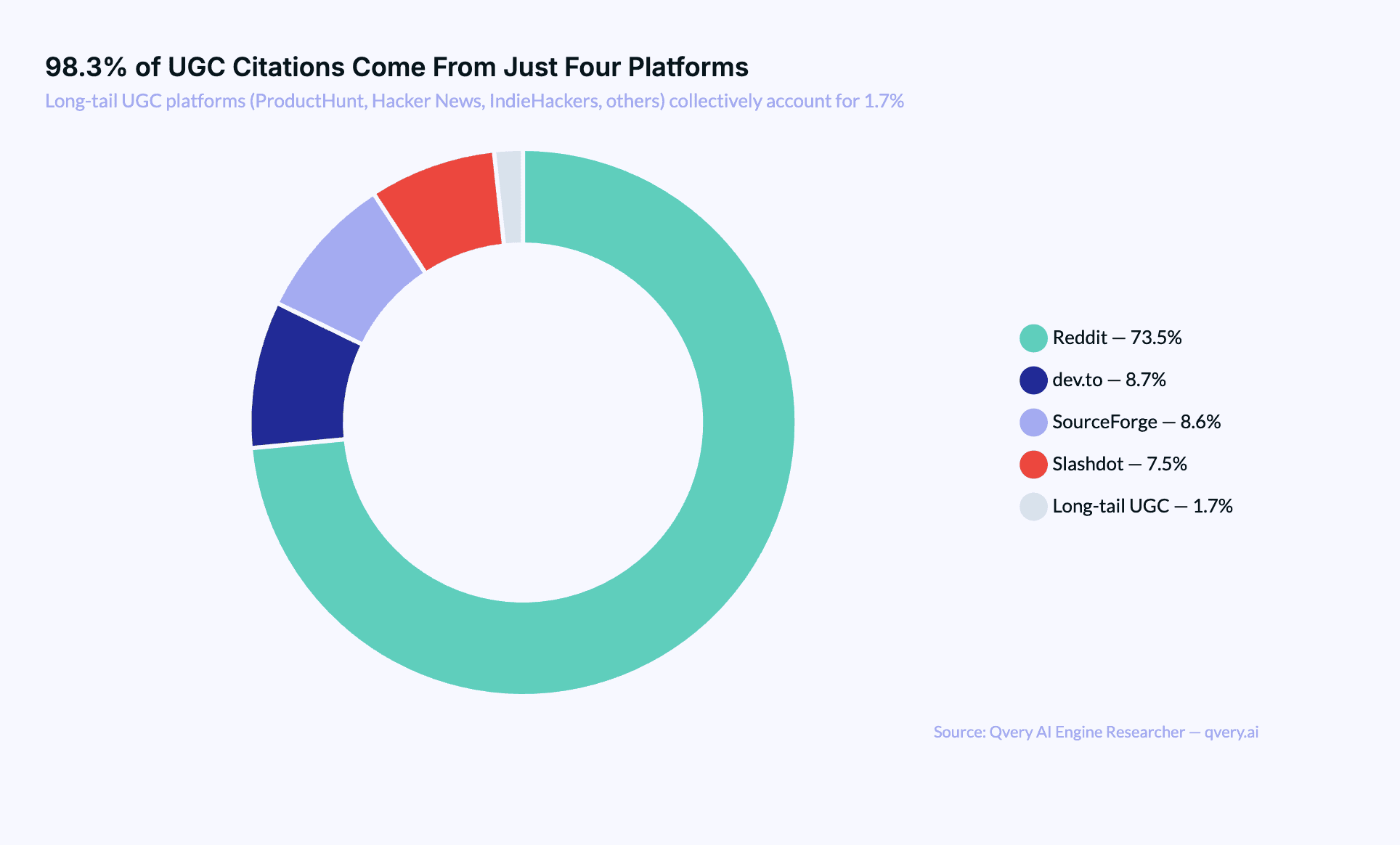
If you tally what gets cited at any meaningful rate, the UGC ecosystem AI engines actually use is just four platforms: Reddit, dev.to, SourceForge, and Slashdot. Together they account for 98.3% of UGC citations. Everything else is the long tail.
The long tail looks impressive on paper:
ProductHunt
Hacker News
IndieHackers
HackerNoon
Codepen
SuperUser
ServerFault
Math Stack Exchange
Metafilter.
Combined, those platforms generate under 2% of all UGC citations. None of them are wrong to include in a UGC marketing plan, but their AI search citation contribution is genuinely small.
This is one of those findings where the implication is uncomfortable. A lot of UGC marketing time gets allocated to platforms that don't move the citation needle. ProductHunt launches, Hacker News submissions, IndieHackers community engagement: all valuable for other reasons (audience, signals, traffic), but the AI citation return on those efforts is rounding-error small.
What This Means for Brands Building UGC Visibility
The strategy that the data supports is short, which is its own kind of useful. For most brands, UGC visibility starts and ends with Reddit. We've written extensively about how to build genuine Reddit presence without getting destroyed by the community.
The short version: build authority before promoting anything, add value first, learn each subreddit's culture before posting, and play the long game.
For SaaS and tech brands specifically, dev.to and SourceForge are worth dedicated attention. dev.to rewards substantive technical articles published by named developers. SourceForge rewards getting your product included in directory and comparison pages. Both pay off in citations the same way third-party listicle inclusion does in mainstream content.
Slashdot is harder. Its citation share is real, but its citations come from old archives, not new submissions. Building Slashdot presence today won't generate citations on the same timeline as dev.to or Reddit.
For everything else (ProductHunt, Hacker News, IndieHackers, HackerNoon, smaller community platforms), invest if you have other reasons to invest. The AI search citation contribution is small enough that it shouldn't be the deciding factor.
One last note. UGC is structurally complementary to your own website content. The three pillars framework is real: your own site, third-party mentions, and UGC. Each pillar plays a different role.
UGC is the experience layer, the place where AI engines find evidence that real users have real opinions about your product. That role is irreplaceable, and Reddit fills 73.5% of it.
Map Your UGC Citation Footprint With Qvery Assistant
The 73.5% Reddit supermajority is the cross-dataset average. For your specific brand, the UGC breakdown could look completely different: heavier on dev.to if you sell developer tools, on SourceForge if you sell to IT buyers, on Reddit if you sell to consumers, on a long-tail platform we didn't even mention.
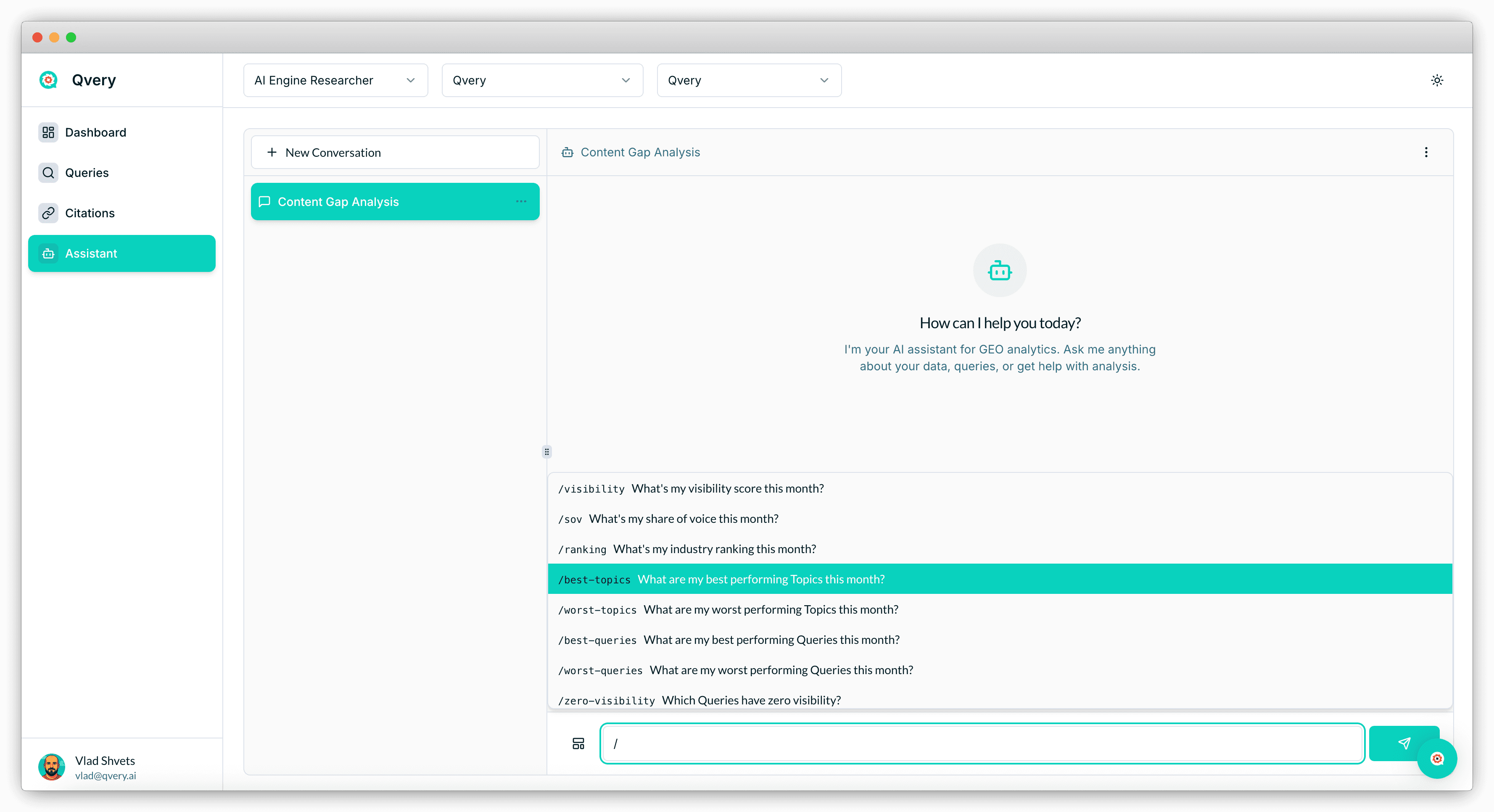
Qvery Assistant is the AI agent inside your Qvery account that turns that question into an answer.
Ask it "which UGC platforms drive my citations and how does that compare to my closest competitor". Run the Reddit A-to-Z template to find the specific subreddits and threads where your category lives, with the exact URLs AI engines are citing. The Assistant is conversational, fast, and with a full memory of your workspace.
If you'd like to measure and grow your AI engine visibility, don't hesitate and start your free 7-day trial of Qvery now.
User-generated content is one of the three pillars of AI engine visibility. Most marketers I talk to assume that means a long list of forums, Q&A sites, and community platforms split somewhat evenly across AI engine citations. The actual data tells a much shorter story.
There are four UGC platforms that AI engines cite in any meaningful volume, and one of them owns nearly three quarters of the entire category.
We've been tracking AI engine citations across ChatGPT and Google AI Mode through Qvery's AI Engine Researcher.
The UGC umbrella, defined as Reddit, dev.to, SourceForge, Slashdot, Quora, ProductHunt, Stack Overflow, Hacker News, and a long tail of smaller platforms, accounts for 2.17% of all AI engine citations. That's a meaningful slice, smaller than social media as a category but ahead of TripAdvisor and ahead of Wikipedia.
Inside the umbrella, the distribution is brutally concentrated. Reddit owns 73.5% of all UGC citations and is still growing. The next three platforms (dev.to, SourceForge, Slashdot) collectively own about a quarter.
Everything else, the long tail of UGC sites that marketers spend time worrying about, accounts for less than 2% of UGC citations combined. (Most of the platforms in your "UGC strategy" deck don't show up in AI citations at all.)
Reddit Owns Three-Quarters of All UGC Citations and Its Share Is Growing
Reddit's UGC dominance is the headline finding. As of May 2026, Reddit accounts for 73.5% of all UGC citations across both AI engines.
That number was 58.9% when we ran the analysis two months earlier. Reddit didn't just hold its lead. It expanded it dramatically while other UGC platforms grew slower or declined.
Per platform, the UGC breakdown:
Reddit: 73.5% of UGC citations.
dev.to: 8.7%.
SourceForge: 8.6%.
Slashdot: 7.5%.
Quora: 2.4%.
ProductHunt: 0.9%.
Stack Overflow, Hacker News, HackerNoon, IndieHackers, others combined: under 2%.
ChatGPT explicitly favors Reddit because of the OpenAI partnership signed in 2024, and Reddit's content is recent enough that it hasn't been fully absorbed into foundation model training data yet.
Reddit threads also have a structural advantage: every comment is a retrievable passage, which means a single thread can satisfy multiple queries. Smaller UGC platforms can't compete on that scale. (The supermajority isn't Reddit being unusually good. It's everyone else being structurally smaller.)
dev.to, SourceForge, and Slashdot Are the Surprising Runners-Up
The next three platforms are the unexpected story.
dev.to, SourceForge, and Slashdot are within a percentage point of each other in citation share, and together they account for nearly a quarter of all UGC citations. Most SaaS marketers I talk to underestimate all three.
dev.to makes sense once you see the data. It's where developers publish technical content that AI engines treat as fresh and retrievable. Stack Overflow's old answers got absorbed into the training data. dev.to's recent articles haven't, which is exactly why they get cited more. We've written about this dynamic in detail in the Stack Overflow analysis.
SourceForge is the one that surprised us most. SourceForge.net hosts an enormous library of B2B software-comparison and directory pages. AI engines treat them like Capterra or G2 listings: structured, ranked content that's easy to extract. SaaS marketers consistently overlook SourceForge as a third-party mention target. The data says they shouldn't.
Slashdot is the legacy IT-news platform that's been around since 1997. Most of its cited pages are 2018-2023 commentary articles. The depth of its archives, plus the fact that Google has been indexing it for two decades, makes it a meaningful citation source for tech-related queries.
The pattern across all three: they're older platforms with deep, well-indexed archives, hosting content formats that AI engines find easy to retrieve. Newer, smaller, more "modern" UGC platforms haven't replaced them.
Stack Overflow Is the Invisible Giant in the Room
The most jarring finding in the UGC breakdown is what's missing. Stack Overflow, the world's largest developer Q&A site by an enormous margin, accounts for just 0.6% of all UGC citations.
That's a smaller share than ProductHunt. By raw page count, Stack Overflow has more answered questions than the rest of UGC combined.
The reason is the same absorption thesis we documented in our Stack Overflow analysis. Foundation models have been training on Stack Overflow's data dumps since 2020. The site's content is sitting inside the models, not outside them.
When an AI engine needs to answer a code question, it doesn't retrieve a Stack Overflow page. It already has the answer baked in. dev.to wins because it's fresher. Reddit wins because OpenAI explicitly partnered with it.
Stack Overflow has more pages than the rest of UGC combined and accounts for 0.6% of UGC citations. Page count is not citation share. Content age is.
UGC Is the Most Engine-Balanced Source Category
One of the more useful structural findings about UGC is that, unlike social media or travel, it's roughly engine-balanced. The UGC umbrella as a whole splits 52.8% Google AI Mode and 47.2% ChatGPT. That's the most balanced engine split of any major source category we track.
The balance is driven almost entirely by Reddit. Reddit alone splits roughly 50/50 between engines. Strip Reddit out of the UGC umbrella and the rest leans heavily toward Google AI Mode. dev.to is 69% Google AI. SourceForge is 57%. Slashdot is 59%. Quora is, of course, 100% Google AI Mode. The non-Reddit UGC umbrella looks like the rest of the AI search landscape: weighted toward Google AI.
This makes Reddit the only UGC source that earns meaningful citation share on both engines simultaneously. For a brand building UGC visibility, that property matters. Reddit citations work against both ChatGPT and Google AI Mode queries. Stack Overflow, dev.to, and SourceForge citations are mostly engine-specific.
ChatGPT's Citation Collapse Did Not Hit UGC
The most consequential AI search finding of 2026 so far is the April ChatGPT citation collapse on social platforms. ChatGPT's citation rate to LinkedIn, Facebook, Instagram, YouTube, and dev.to fell by 70 to 97% between January and April. Almost every social and reference category took a hit.
UGC is the exception. ChatGPT's UGC citations stayed roughly stable through April, and on Reddit specifically, ChatGPT actually grew. The Reddit growth more than offset the dev.to decline that hit the smaller UGC platforms.
Net result: while social media collapsed on ChatGPT, UGC held. The reason is, again, Reddit. ChatGPT's April retreat was a consolidation play, not an across-the-board cut. The engine pulled back from social, kept Wikipedia stable, and leaned harder into Reddit. UGC was protected by virtue of being mostly Reddit.
For brands building UGC visibility, this is the most under-appreciated finding in the data. The category is resilient against engine-specific behavior shifts in a way that social media isn't. As long as Reddit is in your UGC strategy, your UGC citations are insulated from the kind of single-engine collapse that social media suffered.
The UGC Ecosystem AI Engines Actually Use Is Four Platforms
If you tally what gets cited at any meaningful rate, the UGC ecosystem AI engines actually use is just four platforms: Reddit, dev.to, SourceForge, and Slashdot. Together they account for 98.3% of UGC citations. Everything else is the long tail.
The long tail looks impressive on paper:
ProductHunt
Hacker News
IndieHackers
HackerNoon
Codepen
SuperUser
ServerFault
Math Stack Exchange
Metafilter.
Combined, those platforms generate under 2% of all UGC citations. None of them are wrong to include in a UGC marketing plan, but their AI search citation contribution is genuinely small.
This is one of those findings where the implication is uncomfortable. A lot of UGC marketing time gets allocated to platforms that don't move the citation needle. ProductHunt launches, Hacker News submissions, IndieHackers community engagement: all valuable for other reasons (audience, signals, traffic), but the AI citation return on those efforts is rounding-error small.
What This Means for Brands Building UGC Visibility
The strategy that the data supports is short, which is its own kind of useful. For most brands, UGC visibility starts and ends with Reddit. We've written extensively about how to build genuine Reddit presence without getting destroyed by the community.
The short version: build authority before promoting anything, add value first, learn each subreddit's culture before posting, and play the long game.
For SaaS and tech brands specifically, dev.to and SourceForge are worth dedicated attention. dev.to rewards substantive technical articles published by named developers. SourceForge rewards getting your product included in directory and comparison pages. Both pay off in citations the same way third-party listicle inclusion does in mainstream content.
Slashdot is harder. Its citation share is real, but its citations come from old archives, not new submissions. Building Slashdot presence today won't generate citations on the same timeline as dev.to or Reddit.
For everything else (ProductHunt, Hacker News, IndieHackers, HackerNoon, smaller community platforms), invest if you have other reasons to invest. The AI search citation contribution is small enough that it shouldn't be the deciding factor.
One last note. UGC is structurally complementary to your own website content. The three pillars framework is real: your own site, third-party mentions, and UGC. Each pillar plays a different role.
UGC is the experience layer, the place where AI engines find evidence that real users have real opinions about your product. That role is irreplaceable, and Reddit fills 73.5% of it.
Map Your UGC Citation Footprint With Qvery Assistant
The 73.5% Reddit supermajority is the cross-dataset average. For your specific brand, the UGC breakdown could look completely different: heavier on dev.to if you sell developer tools, on SourceForge if you sell to IT buyers, on Reddit if you sell to consumers, on a long-tail platform we didn't even mention.
Qvery Assistant is the AI agent inside your Qvery account that turns that question into an answer.
Ask it "which UGC platforms drive my citations and how does that compare to my closest competitor". Run the Reddit A-to-Z template to find the specific subreddits and threads where your category lives, with the exact URLs AI engines are citing. The Assistant is conversational, fast, and with a full memory of your workspace.
If you'd like to measure and grow your AI engine visibility, don't hesitate and start your free 7-day trial of Qvery now.
User-generated content is one of the three pillars of AI engine visibility. Most marketers I talk to assume that means a long list of forums, Q&A sites, and community platforms split somewhat evenly across AI engine citations. The actual data tells a much shorter story.
There are four UGC platforms that AI engines cite in any meaningful volume, and one of them owns nearly three quarters of the entire category.
We've been tracking AI engine citations across ChatGPT and Google AI Mode through Qvery's AI Engine Researcher.
The UGC umbrella, defined as Reddit, dev.to, SourceForge, Slashdot, Quora, ProductHunt, Stack Overflow, Hacker News, and a long tail of smaller platforms, accounts for 2.17% of all AI engine citations. That's a meaningful slice, smaller than social media as a category but ahead of TripAdvisor and ahead of Wikipedia.
Inside the umbrella, the distribution is brutally concentrated. Reddit owns 73.5% of all UGC citations and is still growing. The next three platforms (dev.to, SourceForge, Slashdot) collectively own about a quarter.
Everything else, the long tail of UGC sites that marketers spend time worrying about, accounts for less than 2% of UGC citations combined. (Most of the platforms in your "UGC strategy" deck don't show up in AI citations at all.)
Reddit Owns Three-Quarters of All UGC Citations and Its Share Is Growing
Reddit's UGC dominance is the headline finding. As of May 2026, Reddit accounts for 73.5% of all UGC citations across both AI engines.
That number was 58.9% when we ran the analysis two months earlier. Reddit didn't just hold its lead. It expanded it dramatically while other UGC platforms grew slower or declined.
Per platform, the UGC breakdown:
Reddit: 73.5% of UGC citations.
dev.to: 8.7%.
SourceForge: 8.6%.
Slashdot: 7.5%.
Quora: 2.4%.
ProductHunt: 0.9%.
Stack Overflow, Hacker News, HackerNoon, IndieHackers, others combined: under 2%.
ChatGPT explicitly favors Reddit because of the OpenAI partnership signed in 2024, and Reddit's content is recent enough that it hasn't been fully absorbed into foundation model training data yet.
Reddit threads also have a structural advantage: every comment is a retrievable passage, which means a single thread can satisfy multiple queries. Smaller UGC platforms can't compete on that scale. (The supermajority isn't Reddit being unusually good. It's everyone else being structurally smaller.)
dev.to, SourceForge, and Slashdot Are the Surprising Runners-Up
The next three platforms are the unexpected story.
dev.to, SourceForge, and Slashdot are within a percentage point of each other in citation share, and together they account for nearly a quarter of all UGC citations. Most SaaS marketers I talk to underestimate all three.
dev.to makes sense once you see the data. It's where developers publish technical content that AI engines treat as fresh and retrievable. Stack Overflow's old answers got absorbed into the training data. dev.to's recent articles haven't, which is exactly why they get cited more. We've written about this dynamic in detail in the Stack Overflow analysis.
SourceForge is the one that surprised us most. SourceForge.net hosts an enormous library of B2B software-comparison and directory pages. AI engines treat them like Capterra or G2 listings: structured, ranked content that's easy to extract. SaaS marketers consistently overlook SourceForge as a third-party mention target. The data says they shouldn't.
Slashdot is the legacy IT-news platform that's been around since 1997. Most of its cited pages are 2018-2023 commentary articles. The depth of its archives, plus the fact that Google has been indexing it for two decades, makes it a meaningful citation source for tech-related queries.
The pattern across all three: they're older platforms with deep, well-indexed archives, hosting content formats that AI engines find easy to retrieve. Newer, smaller, more "modern" UGC platforms haven't replaced them.
Stack Overflow Is the Invisible Giant in the Room
The most jarring finding in the UGC breakdown is what's missing. Stack Overflow, the world's largest developer Q&A site by an enormous margin, accounts for just 0.6% of all UGC citations.
That's a smaller share than ProductHunt. By raw page count, Stack Overflow has more answered questions than the rest of UGC combined.
The reason is the same absorption thesis we documented in our Stack Overflow analysis. Foundation models have been training on Stack Overflow's data dumps since 2020. The site's content is sitting inside the models, not outside them.
When an AI engine needs to answer a code question, it doesn't retrieve a Stack Overflow page. It already has the answer baked in. dev.to wins because it's fresher. Reddit wins because OpenAI explicitly partnered with it.
Stack Overflow has more pages than the rest of UGC combined and accounts for 0.6% of UGC citations. Page count is not citation share. Content age is.
UGC Is the Most Engine-Balanced Source Category
One of the more useful structural findings about UGC is that, unlike social media or travel, it's roughly engine-balanced. The UGC umbrella as a whole splits 52.8% Google AI Mode and 47.2% ChatGPT. That's the most balanced engine split of any major source category we track.
The balance is driven almost entirely by Reddit. Reddit alone splits roughly 50/50 between engines. Strip Reddit out of the UGC umbrella and the rest leans heavily toward Google AI Mode. dev.to is 69% Google AI. SourceForge is 57%. Slashdot is 59%. Quora is, of course, 100% Google AI Mode. The non-Reddit UGC umbrella looks like the rest of the AI search landscape: weighted toward Google AI.
This makes Reddit the only UGC source that earns meaningful citation share on both engines simultaneously. For a brand building UGC visibility, that property matters. Reddit citations work against both ChatGPT and Google AI Mode queries. Stack Overflow, dev.to, and SourceForge citations are mostly engine-specific.
ChatGPT's Citation Collapse Did Not Hit UGC
The most consequential AI search finding of 2026 so far is the April ChatGPT citation collapse on social platforms. ChatGPT's citation rate to LinkedIn, Facebook, Instagram, YouTube, and dev.to fell by 70 to 97% between January and April. Almost every social and reference category took a hit.
UGC is the exception. ChatGPT's UGC citations stayed roughly stable through April, and on Reddit specifically, ChatGPT actually grew. The Reddit growth more than offset the dev.to decline that hit the smaller UGC platforms.
Net result: while social media collapsed on ChatGPT, UGC held. The reason is, again, Reddit. ChatGPT's April retreat was a consolidation play, not an across-the-board cut. The engine pulled back from social, kept Wikipedia stable, and leaned harder into Reddit. UGC was protected by virtue of being mostly Reddit.
For brands building UGC visibility, this is the most under-appreciated finding in the data. The category is resilient against engine-specific behavior shifts in a way that social media isn't. As long as Reddit is in your UGC strategy, your UGC citations are insulated from the kind of single-engine collapse that social media suffered.
The UGC Ecosystem AI Engines Actually Use Is Four Platforms
If you tally what gets cited at any meaningful rate, the UGC ecosystem AI engines actually use is just four platforms: Reddit, dev.to, SourceForge, and Slashdot. Together they account for 98.3% of UGC citations. Everything else is the long tail.
The long tail looks impressive on paper:
ProductHunt
Hacker News
IndieHackers
HackerNoon
Codepen
SuperUser
ServerFault
Math Stack Exchange
Metafilter.
Combined, those platforms generate under 2% of all UGC citations. None of them are wrong to include in a UGC marketing plan, but their AI search citation contribution is genuinely small.
This is one of those findings where the implication is uncomfortable. A lot of UGC marketing time gets allocated to platforms that don't move the citation needle. ProductHunt launches, Hacker News submissions, IndieHackers community engagement: all valuable for other reasons (audience, signals, traffic), but the AI citation return on those efforts is rounding-error small.
What This Means for Brands Building UGC Visibility
The strategy that the data supports is short, which is its own kind of useful. For most brands, UGC visibility starts and ends with Reddit. We've written extensively about how to build genuine Reddit presence without getting destroyed by the community.
The short version: build authority before promoting anything, add value first, learn each subreddit's culture before posting, and play the long game.
For SaaS and tech brands specifically, dev.to and SourceForge are worth dedicated attention. dev.to rewards substantive technical articles published by named developers. SourceForge rewards getting your product included in directory and comparison pages. Both pay off in citations the same way third-party listicle inclusion does in mainstream content.
Slashdot is harder. Its citation share is real, but its citations come from old archives, not new submissions. Building Slashdot presence today won't generate citations on the same timeline as dev.to or Reddit.
For everything else (ProductHunt, Hacker News, IndieHackers, HackerNoon, smaller community platforms), invest if you have other reasons to invest. The AI search citation contribution is small enough that it shouldn't be the deciding factor.
One last note. UGC is structurally complementary to your own website content. The three pillars framework is real: your own site, third-party mentions, and UGC. Each pillar plays a different role.
UGC is the experience layer, the place where AI engines find evidence that real users have real opinions about your product. That role is irreplaceable, and Reddit fills 73.5% of it.
Map Your UGC Citation Footprint With Qvery Assistant
The 73.5% Reddit supermajority is the cross-dataset average. For your specific brand, the UGC breakdown could look completely different: heavier on dev.to if you sell developer tools, on SourceForge if you sell to IT buyers, on Reddit if you sell to consumers, on a long-tail platform we didn't even mention.
Qvery Assistant is the AI agent inside your Qvery account that turns that question into an answer.
Ask it "which UGC platforms drive my citations and how does that compare to my closest competitor". Run the Reddit A-to-Z template to find the specific subreddits and threads where your category lives, with the exact URLs AI engines are citing. The Assistant is conversational, fast, and with a full memory of your workspace.
If you'd like to measure and grow your AI engine visibility, don't hesitate and start your free 7-day trial of Qvery now.
User-generated content is one of the three pillars of AI engine visibility. Most marketers I talk to assume that means a long list of forums, Q&A sites, and community platforms split somewhat evenly across AI engine citations. The actual data tells a much shorter story.
There are four UGC platforms that AI engines cite in any meaningful volume, and one of them owns nearly three quarters of the entire category.
We've been tracking AI engine citations across ChatGPT and Google AI Mode through Qvery's AI Engine Researcher.
The UGC umbrella, defined as Reddit, dev.to, SourceForge, Slashdot, Quora, ProductHunt, Stack Overflow, Hacker News, and a long tail of smaller platforms, accounts for 2.17% of all AI engine citations. That's a meaningful slice, smaller than social media as a category but ahead of TripAdvisor and ahead of Wikipedia.
Inside the umbrella, the distribution is brutally concentrated. Reddit owns 73.5% of all UGC citations and is still growing. The next three platforms (dev.to, SourceForge, Slashdot) collectively own about a quarter.
Everything else, the long tail of UGC sites that marketers spend time worrying about, accounts for less than 2% of UGC citations combined. (Most of the platforms in your "UGC strategy" deck don't show up in AI citations at all.)
Reddit Owns Three-Quarters of All UGC Citations and Its Share Is Growing
Reddit's UGC dominance is the headline finding. As of May 2026, Reddit accounts for 73.5% of all UGC citations across both AI engines.
That number was 58.9% when we ran the analysis two months earlier. Reddit didn't just hold its lead. It expanded it dramatically while other UGC platforms grew slower or declined.
Per platform, the UGC breakdown:
Reddit: 73.5% of UGC citations.
dev.to: 8.7%.
SourceForge: 8.6%.
Slashdot: 7.5%.
Quora: 2.4%.
ProductHunt: 0.9%.
Stack Overflow, Hacker News, HackerNoon, IndieHackers, others combined: under 2%.
ChatGPT explicitly favors Reddit because of the OpenAI partnership signed in 2024, and Reddit's content is recent enough that it hasn't been fully absorbed into foundation model training data yet.
Reddit threads also have a structural advantage: every comment is a retrievable passage, which means a single thread can satisfy multiple queries. Smaller UGC platforms can't compete on that scale. (The supermajority isn't Reddit being unusually good. It's everyone else being structurally smaller.)
dev.to, SourceForge, and Slashdot Are the Surprising Runners-Up
The next three platforms are the unexpected story.
dev.to, SourceForge, and Slashdot are within a percentage point of each other in citation share, and together they account for nearly a quarter of all UGC citations. Most SaaS marketers I talk to underestimate all three.
dev.to makes sense once you see the data. It's where developers publish technical content that AI engines treat as fresh and retrievable. Stack Overflow's old answers got absorbed into the training data. dev.to's recent articles haven't, which is exactly why they get cited more. We've written about this dynamic in detail in the Stack Overflow analysis.
SourceForge is the one that surprised us most. SourceForge.net hosts an enormous library of B2B software-comparison and directory pages. AI engines treat them like Capterra or G2 listings: structured, ranked content that's easy to extract. SaaS marketers consistently overlook SourceForge as a third-party mention target. The data says they shouldn't.
Slashdot is the legacy IT-news platform that's been around since 1997. Most of its cited pages are 2018-2023 commentary articles. The depth of its archives, plus the fact that Google has been indexing it for two decades, makes it a meaningful citation source for tech-related queries.
The pattern across all three: they're older platforms with deep, well-indexed archives, hosting content formats that AI engines find easy to retrieve. Newer, smaller, more "modern" UGC platforms haven't replaced them.
Stack Overflow Is the Invisible Giant in the Room
The most jarring finding in the UGC breakdown is what's missing. Stack Overflow, the world's largest developer Q&A site by an enormous margin, accounts for just 0.6% of all UGC citations.
That's a smaller share than ProductHunt. By raw page count, Stack Overflow has more answered questions than the rest of UGC combined.
The reason is the same absorption thesis we documented in our Stack Overflow analysis. Foundation models have been training on Stack Overflow's data dumps since 2020. The site's content is sitting inside the models, not outside them.
When an AI engine needs to answer a code question, it doesn't retrieve a Stack Overflow page. It already has the answer baked in. dev.to wins because it's fresher. Reddit wins because OpenAI explicitly partnered with it.
Stack Overflow has more pages than the rest of UGC combined and accounts for 0.6% of UGC citations. Page count is not citation share. Content age is.
UGC Is the Most Engine-Balanced Source Category
One of the more useful structural findings about UGC is that, unlike social media or travel, it's roughly engine-balanced. The UGC umbrella as a whole splits 52.8% Google AI Mode and 47.2% ChatGPT. That's the most balanced engine split of any major source category we track.
The balance is driven almost entirely by Reddit. Reddit alone splits roughly 50/50 between engines. Strip Reddit out of the UGC umbrella and the rest leans heavily toward Google AI Mode. dev.to is 69% Google AI. SourceForge is 57%. Slashdot is 59%. Quora is, of course, 100% Google AI Mode. The non-Reddit UGC umbrella looks like the rest of the AI search landscape: weighted toward Google AI.
This makes Reddit the only UGC source that earns meaningful citation share on both engines simultaneously. For a brand building UGC visibility, that property matters. Reddit citations work against both ChatGPT and Google AI Mode queries. Stack Overflow, dev.to, and SourceForge citations are mostly engine-specific.
ChatGPT's Citation Collapse Did Not Hit UGC
The most consequential AI search finding of 2026 so far is the April ChatGPT citation collapse on social platforms. ChatGPT's citation rate to LinkedIn, Facebook, Instagram, YouTube, and dev.to fell by 70 to 97% between January and April. Almost every social and reference category took a hit.
UGC is the exception. ChatGPT's UGC citations stayed roughly stable through April, and on Reddit specifically, ChatGPT actually grew. The Reddit growth more than offset the dev.to decline that hit the smaller UGC platforms.
Net result: while social media collapsed on ChatGPT, UGC held. The reason is, again, Reddit. ChatGPT's April retreat was a consolidation play, not an across-the-board cut. The engine pulled back from social, kept Wikipedia stable, and leaned harder into Reddit. UGC was protected by virtue of being mostly Reddit.
For brands building UGC visibility, this is the most under-appreciated finding in the data. The category is resilient against engine-specific behavior shifts in a way that social media isn't. As long as Reddit is in your UGC strategy, your UGC citations are insulated from the kind of single-engine collapse that social media suffered.
The UGC Ecosystem AI Engines Actually Use Is Four Platforms
If you tally what gets cited at any meaningful rate, the UGC ecosystem AI engines actually use is just four platforms: Reddit, dev.to, SourceForge, and Slashdot. Together they account for 98.3% of UGC citations. Everything else is the long tail.
The long tail looks impressive on paper:
ProductHunt
Hacker News
IndieHackers
HackerNoon
Codepen
SuperUser
ServerFault
Math Stack Exchange
Metafilter.
Combined, those platforms generate under 2% of all UGC citations. None of them are wrong to include in a UGC marketing plan, but their AI search citation contribution is genuinely small.
This is one of those findings where the implication is uncomfortable. A lot of UGC marketing time gets allocated to platforms that don't move the citation needle. ProductHunt launches, Hacker News submissions, IndieHackers community engagement: all valuable for other reasons (audience, signals, traffic), but the AI citation return on those efforts is rounding-error small.
What This Means for Brands Building UGC Visibility
The strategy that the data supports is short, which is its own kind of useful. For most brands, UGC visibility starts and ends with Reddit. We've written extensively about how to build genuine Reddit presence without getting destroyed by the community.
The short version: build authority before promoting anything, add value first, learn each subreddit's culture before posting, and play the long game.
For SaaS and tech brands specifically, dev.to and SourceForge are worth dedicated attention. dev.to rewards substantive technical articles published by named developers. SourceForge rewards getting your product included in directory and comparison pages. Both pay off in citations the same way third-party listicle inclusion does in mainstream content.
Slashdot is harder. Its citation share is real, but its citations come from old archives, not new submissions. Building Slashdot presence today won't generate citations on the same timeline as dev.to or Reddit.
For everything else (ProductHunt, Hacker News, IndieHackers, HackerNoon, smaller community platforms), invest if you have other reasons to invest. The AI search citation contribution is small enough that it shouldn't be the deciding factor.
One last note. UGC is structurally complementary to your own website content. The three pillars framework is real: your own site, third-party mentions, and UGC. Each pillar plays a different role.
UGC is the experience layer, the place where AI engines find evidence that real users have real opinions about your product. That role is irreplaceable, and Reddit fills 73.5% of it.
Map Your UGC Citation Footprint With Qvery Assistant
The 73.5% Reddit supermajority is the cross-dataset average. For your specific brand, the UGC breakdown could look completely different: heavier on dev.to if you sell developer tools, on SourceForge if you sell to IT buyers, on Reddit if you sell to consumers, on a long-tail platform we didn't even mention.
Qvery Assistant is the AI agent inside your Qvery account that turns that question into an answer.
Ask it "which UGC platforms drive my citations and how does that compare to my closest competitor". Run the Reddit A-to-Z template to find the specific subreddits and threads where your category lives, with the exact URLs AI engines are citing. The Assistant is conversational, fast, and with a full memory of your workspace.
If you'd like to measure and grow your AI engine visibility, don't hesitate and start your free 7-day trial of Qvery now.

© 2026 Qvery AI OÜ