By
Vlad Shvets
Social Media in AI Search: ChatGPT vs Google AI Mode
Between January and April 2026, ChatGPT's social media citations collapsed by 70 to 97% across LinkedIn, Facebook, Instagram, YouTube, and dev.to. In the same window, Google AI Mode grew its YouTube citations 5x and TikTok 21x. Two engines moved in opposite directions on the same source category.
Between January and April 2026, ChatGPT's social media citations collapsed by 70 to 97% across LinkedIn, Facebook, Instagram, YouTube, and dev.to. In the same window, Google AI Mode grew its YouTube citations 5x and TikTok 21x. Two engines moved in opposite directions on the same source category.
Between January and April 2026, ChatGPT's social media citations collapsed by 70 to 97% across LinkedIn, Facebook, Instagram, YouTube, and dev.to. In the same window, Google AI Mode grew its YouTube citations 5x and TikTok 21x. Two engines moved in opposite directions on the same source category.
The single most striking pattern in our entire AI citation dataset isn't about Reddit, Wikipedia, or any of the other sources we usually focus on. It's about social media. Specifically, it's about what happened to social media on ChatGPT between January and April 2026.
ChatGPT's citation rate to LinkedIn, Facebook, Instagram, and YouTube collapsed by 70 to 97% in three months. Facebook fell 96%. Instagram fell 97%. LinkedIn fell 92%. YouTube fell 91%.
While that was happening, Google AI Mode was doing the opposite. Google AI's social citations grew 5 times on YouTube, 21 times on TikTok, and roughly doubled on LinkedIn and Facebook.
One AI engine walked away from social media. The other doubled down. The marketers who treat AI search as a single thing missed the entire story. We've been tracking this through Qvery's AI Engine Researcher, and the pattern is the most consequential finding in months. (If your team built a strategy in March based on ChatGPT social citations, your strategy is now wrong.)
Social Is the Largest Source Category After Brand Sites
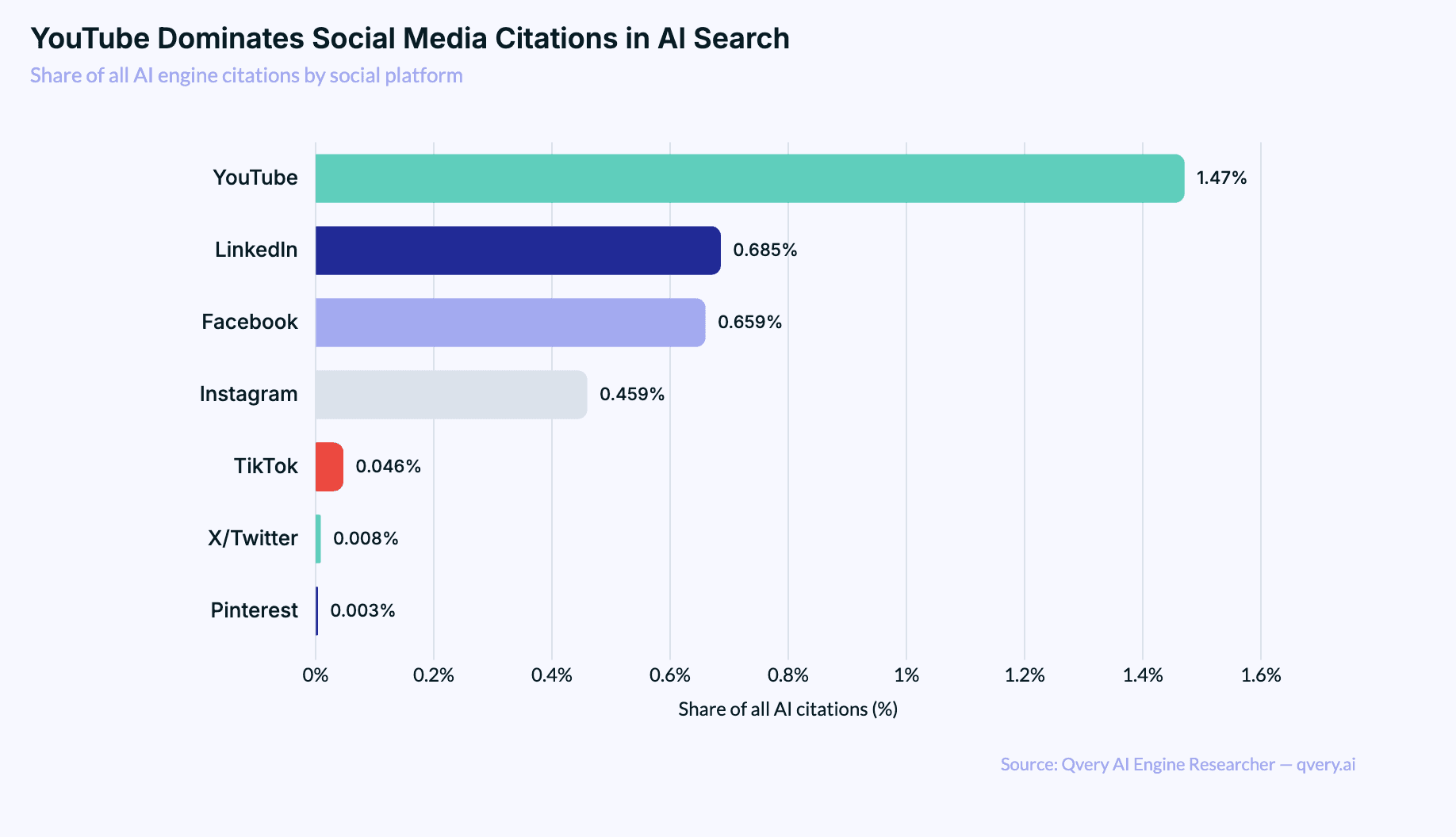
Before we get to the collapse, the baseline. Social media as an umbrella accounts for 3.33% of all AI engine citations across both engines.
That puts it ahead of UGC, ahead of multilingual TripAdvisor, ahead of Wikipedia, and behind only general brand and aggregator sites.
Within the social umbrella, the volume is concentrated in a small handful of platforms:
YouTube: dominates the social category. Roughly 44% of all social citations.
LinkedIn and Facebook: roughly tied for second, each carrying about a fifth of the total.
Instagram: about 14%.
TikTok, X/Twitter, and Pinterest: the long tail, collectively under 2% of social citations.
The "social media is dead in AI search" narrative ignores what's at the top of this list. YouTube alone is bigger than LinkedIn, Facebook, and Instagram combined. We've already written about YouTube's role as primarily a Google AI Mode citation source. The social category as a whole follows the same pattern, but the magnitude of the engine split is the new finding.
Google AI Mode Cites Social Media Several Times More Often Than ChatGPT
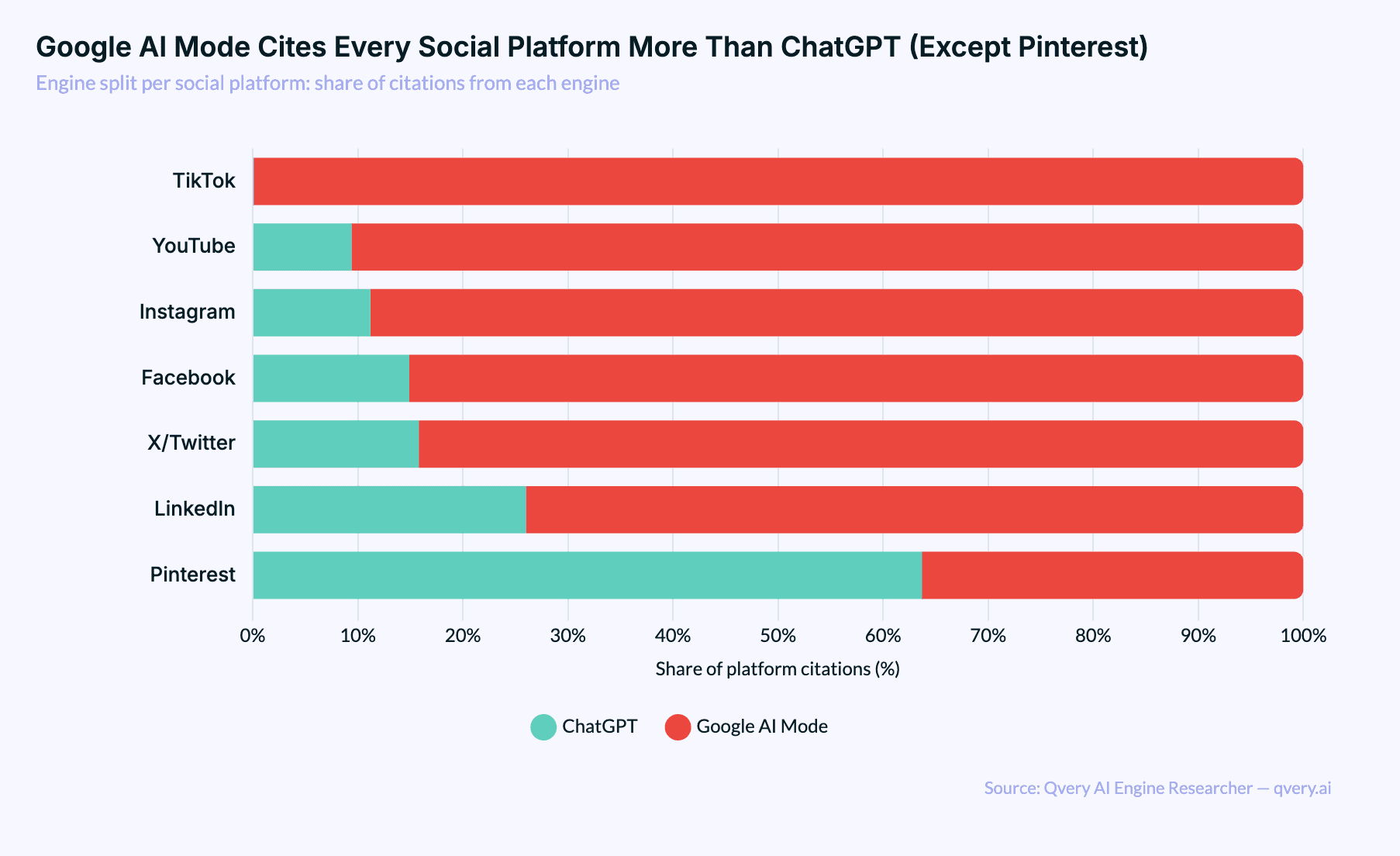
The headline gap was already extreme even before April. Across the social umbrella, Google AI Mode cites social platforms at 4.56% of its citations. ChatGPT cites them at 1.26%. That's a 3.6x difference by share. By raw volume, Google AI produces more than six times as many social citations as ChatGPT.
Per platform, the engine split lines up like this:
TikTok: 99.9% Google AI Mode. The most extreme split outside of Quora's 100% Google AI exclusivity.
YouTube: 90.6% Google AI.
Instagram: 88.8% Google AI.
Facebook: 85.1% Google AI.
LinkedIn: 74.0% Google AI. The most balanced of the bunch.
Pinterest: 36.3% Google AI. The only social platform where ChatGPT cites at a higher rate. (And neither engine cites it much.)
ChatGPT's Social Media Citations Collapsed Between January and April 2026
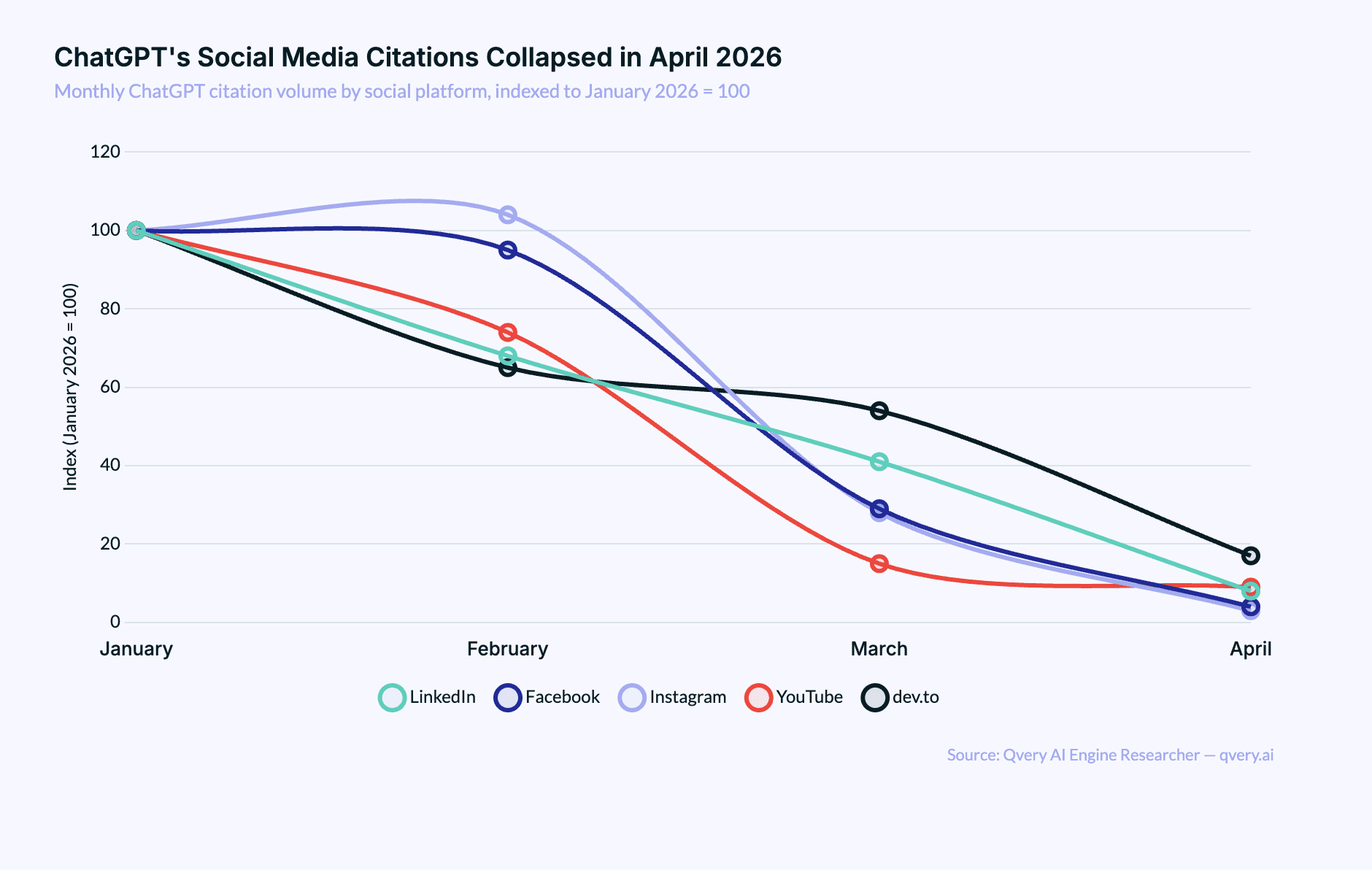
This is the finding that should change how you think about AI search. ChatGPT didn't reduce its citation volume across the board between January and April 2026. It consolidated. Reddit citations grew by 66%. Wikipedia held roughly stable. Everything else dropped.
Per platform, ChatGPT's social citation volume in April compared to January 2026:
Instagram: down 97%.
Facebook: down 96%.
LinkedIn: down 92%.
YouTube: down 91%.
dev.to: down 83%.
TripAdvisor: down 31%. Less dramatic, but still declining.
ChatGPT didn't stop citing websites in April 2026. It abandoned almost everything except Reddit and Wikipedia.
The shift isn't subtle. Two consecutive months of consistent data, March and April, show ChatGPT pulling back from every social platform we track. The early May 2026 data continues the trend. Whatever changed inside ChatGPT's source-trust scoring or RAG pipeline, it isn't bouncing back.
What caused it? We can describe what happened. We can't tell you why with certainty. The most plausible explanations: OpenAI changed ChatGPT's RAG scoring to deprioritize social platforms, OpenAI lost or didn't renew certain Meta API access, or ChatGPT's per-response citation density itself dropped sharply (we've documented that decline) and reference content like Wikipedia squeezed social citations out. All three are consistent with the data. We're not able to pick between them.
Google AI Mode's Social Citations Surged in the Same Period
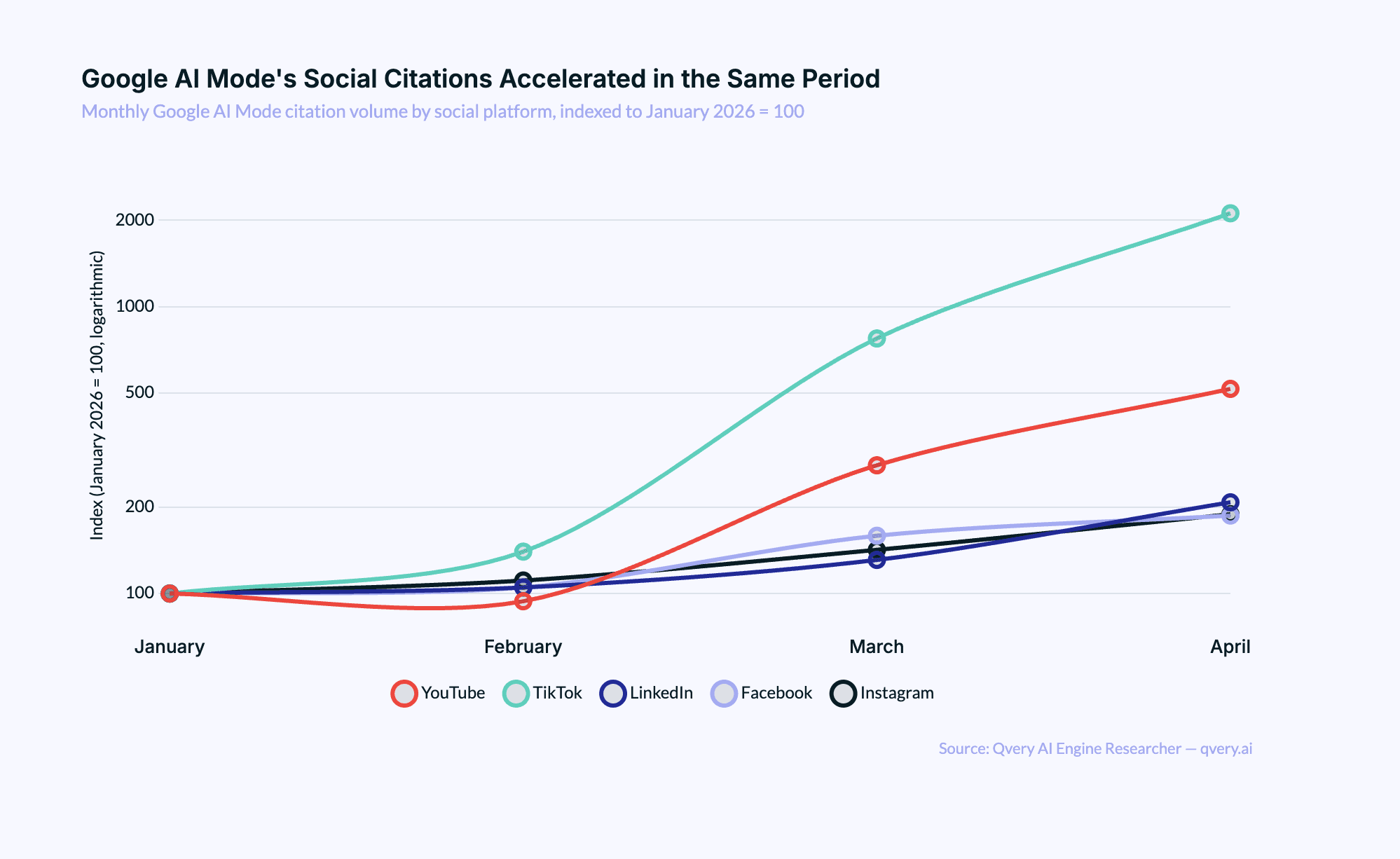
The mirror image is happening on Google AI Mode. While ChatGPT was retreating, Google AI was accelerating, especially on visual platforms.
April vs January 2026, Google AI Mode citation volume:
YouTube: grew 5.2 times. The biggest single platform shift in our dataset.
TikTok: grew 21 times. Off a small base, but the trajectory is the headline.
LinkedIn: grew 2.1 times.
Facebook: grew 1.9 times.
Instagram: grew 1.9 times.
The strongest acceleration is on visual and video platforms. That's consistent with what we already know about Google AI Mode's architecture: it does passage-level retrieval on transcripts, has direct access to YouTube's structured content via Google's existing graph, and can extract specific moments inside videos. Visual content is the format Google AI Mode is structurally best at handling.
YouTube and LinkedIn Are the Only Social Platforms That Get Top-10 Rank Treatment
Volume is one thing. Rank is another. When social citations actually appear in an AI response, where do they land?
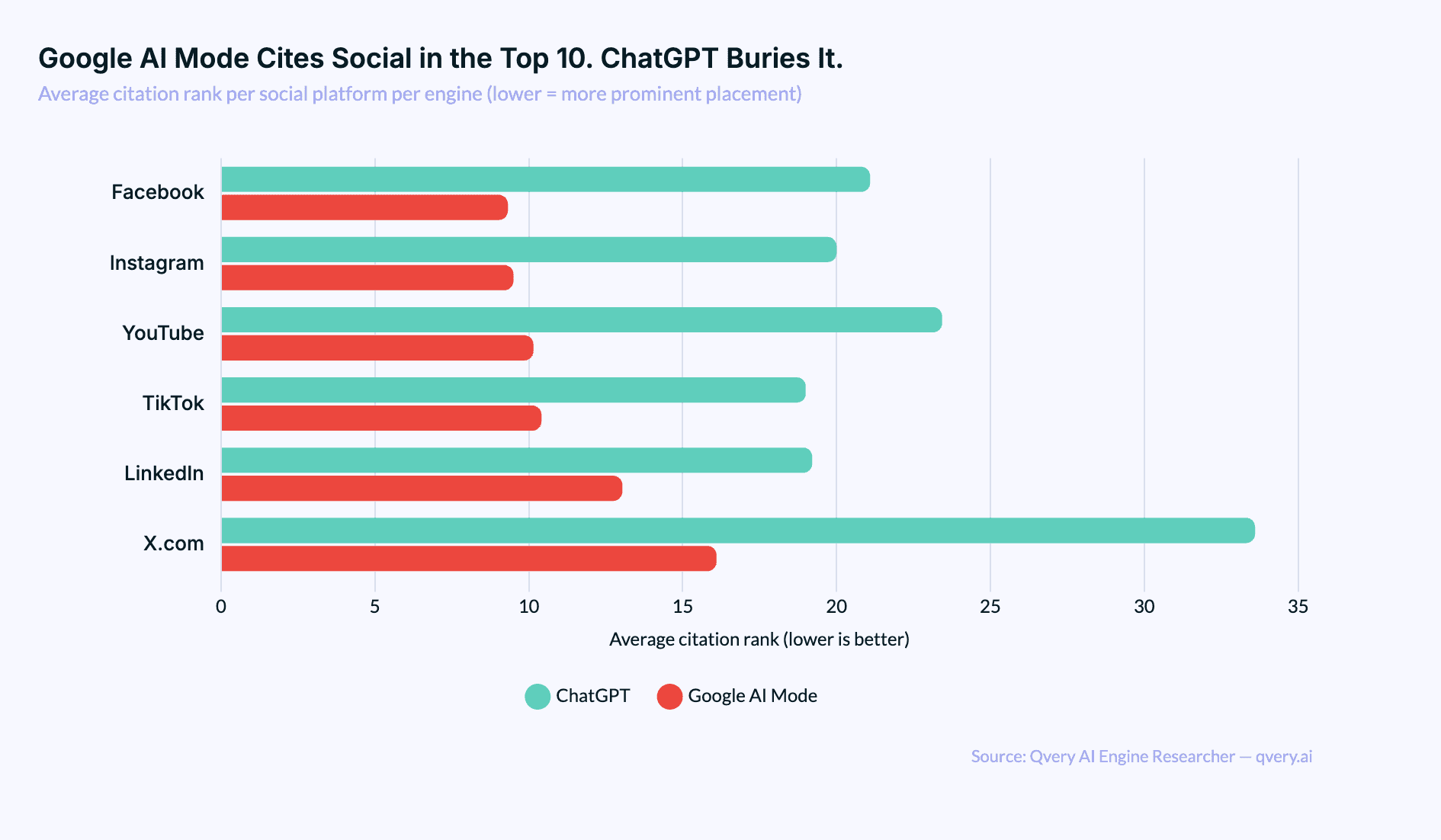
On Google AI Mode, the answer is mostly: in the top 10. Average ranks across platforms:
Facebook on Google AI: average rank 9.32.
Instagram on Google AI: average rank 9.50.
YouTube on Google AI: average rank 10.15.
TikTok on Google AI: average rank 10.41.
LinkedIn on Google AI: average rank 13.04.
On ChatGPT, the same platforms are buried much deeper. YouTube on ChatGPT averages rank 23.43. X.com on ChatGPT averages 33.60. Twitter (the legacy domain) averages 44. ChatGPT cites social occasionally, but never with prominence.
YouTube generates more rank-1 placements than any other social platform. Google AI gives YouTube the top citation slot more than 4,000 times in our dataset, with a tiny ChatGPT contribution to round it out. Facebook is second. Instagram is third. ChatGPT contributed fewer than 300 rank-1 social citations across all seven platforms combined.
TikTok Is No Longer Invisible. X and Pinterest Still Are.
The "TikTok, X, and Pinterest are functionally invisible" framing was true in March. By April, only two of those three are still true.
X and Twitter combined account for 438 citations across our entire dataset. Pinterest accounts for 157. Both remain functionally invisible. Citations to either platform happen, but at rates that don't justify any AI visibility investment.
TikTok is different now. It started 2026 with negligible citation volume on Google AI Mode. By April, Google AI was citing TikTok at a rate 21 times higher than in January. The absolute volume is still small relative to YouTube or Facebook, but the trajectory is the story.
If the current growth rate continues, TikTok will be a meaningful Google AI Mode citation source by the end of 2026. Brands in visual or short-form-content categories should already be paying attention.
What This Means for Each Platform
Per-platform recommendations, working from the data above. Both engines matter for your audience. The point isn't which engine to pick. The point is which tactic works on which engine, and where to invest accordingly.
YouTube: The largest social citation source by volume. Now overwhelmingly Google AI Mode. Optimize transcripts, chapter markers, and structured descriptions. Treat YouTube as a Google AI play, not a ChatGPT one.
LinkedIn: The most engine-balanced social platform, with ChatGPT still contributing about a quarter of its citations. AI engines cite LinkedIn company pages and Pulse articles, not feed posts. Both engines agree on that. Keep your company page complete and write substantive Pulse articles.
Facebook and Instagram: Both heavily Google AI Mode. ChatGPT essentially abandoned both in April. The work you do here lands almost entirely on Google AI Mode, so tune content and structured data for that engine's retrieval patterns while building your ChatGPT visibility through other sources.
TikTok: Emerging on Google AI Mode. Worth watching. Not yet worth a large strategic bet, but the trajectory is real.
X/Twitter and Pinterest: Functionally invisible to AI engines. Whatever value either platform delivers, AI search citation isn't it. Don't allocate AI visibility budget here.
Reddit: Separate strategy entirely. Reddit is the only social-adjacent source where ChatGPT grew in April. We've already covered it in depth. The short version: Reddit is the rare platform both engines treat as authoritative.
Audit Your Social Media AI Visibility With Qvery Assistant
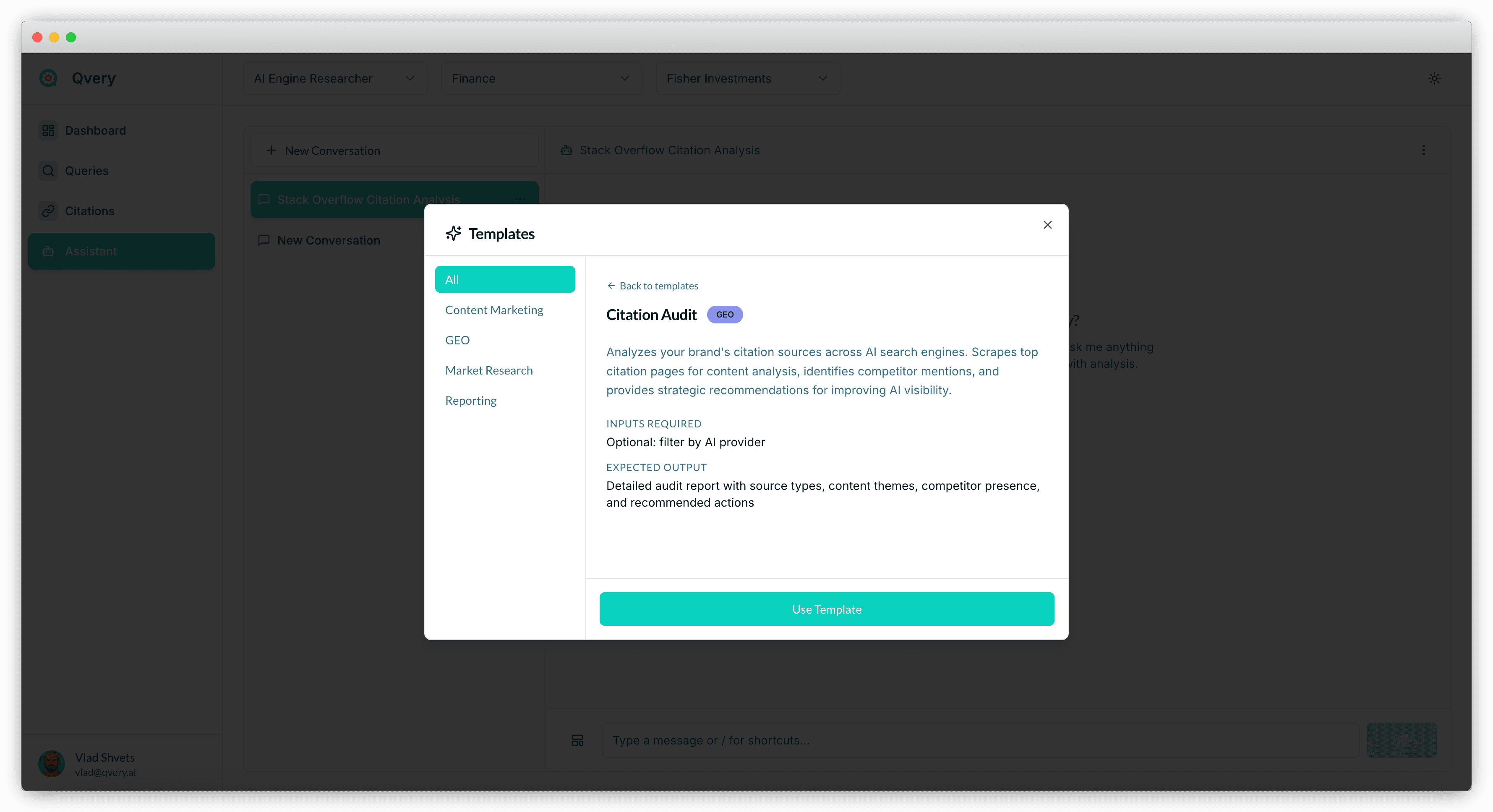
The April collapse hit every brand we track on ChatGPT. The magnitude for your specific brand is what you need to know, and that's what Qvery Assistant is built to surface. It's the AI agent inside your Qvery account, and it has every social citation we've ever recorded for you and your competitors.
Open it, type "what happened to my ChatGPT citations on LinkedIn between January and April?" and you'll have the answer in seconds. Drop a competitor name in to compare. Run a Citation Gap Analysis to see which YouTube videos and LinkedIn pages they're winning that you're missing. The footprint you actually have is in there waiting.
If you aren't on Qvery yet, start your free 7-day trial now and start growing your AI engine visibility.
The single most striking pattern in our entire AI citation dataset isn't about Reddit, Wikipedia, or any of the other sources we usually focus on. It's about social media. Specifically, it's about what happened to social media on ChatGPT between January and April 2026.
ChatGPT's citation rate to LinkedIn, Facebook, Instagram, and YouTube collapsed by 70 to 97% in three months. Facebook fell 96%. Instagram fell 97%. LinkedIn fell 92%. YouTube fell 91%.
While that was happening, Google AI Mode was doing the opposite. Google AI's social citations grew 5 times on YouTube, 21 times on TikTok, and roughly doubled on LinkedIn and Facebook.
One AI engine walked away from social media. The other doubled down. The marketers who treat AI search as a single thing missed the entire story. We've been tracking this through Qvery's AI Engine Researcher, and the pattern is the most consequential finding in months. (If your team built a strategy in March based on ChatGPT social citations, your strategy is now wrong.)
Social Is the Largest Source Category After Brand Sites
Before we get to the collapse, the baseline. Social media as an umbrella accounts for 3.33% of all AI engine citations across both engines.
That puts it ahead of UGC, ahead of multilingual TripAdvisor, ahead of Wikipedia, and behind only general brand and aggregator sites.
Within the social umbrella, the volume is concentrated in a small handful of platforms:
YouTube: dominates the social category. Roughly 44% of all social citations.
LinkedIn and Facebook: roughly tied for second, each carrying about a fifth of the total.
Instagram: about 14%.
TikTok, X/Twitter, and Pinterest: the long tail, collectively under 2% of social citations.
The "social media is dead in AI search" narrative ignores what's at the top of this list. YouTube alone is bigger than LinkedIn, Facebook, and Instagram combined. We've already written about YouTube's role as primarily a Google AI Mode citation source. The social category as a whole follows the same pattern, but the magnitude of the engine split is the new finding.
Google AI Mode Cites Social Media Several Times More Often Than ChatGPT
The headline gap was already extreme even before April. Across the social umbrella, Google AI Mode cites social platforms at 4.56% of its citations. ChatGPT cites them at 1.26%. That's a 3.6x difference by share. By raw volume, Google AI produces more than six times as many social citations as ChatGPT.
Per platform, the engine split lines up like this:
TikTok: 99.9% Google AI Mode. The most extreme split outside of Quora's 100% Google AI exclusivity.
YouTube: 90.6% Google AI.
Instagram: 88.8% Google AI.
Facebook: 85.1% Google AI.
LinkedIn: 74.0% Google AI. The most balanced of the bunch.
Pinterest: 36.3% Google AI. The only social platform where ChatGPT cites at a higher rate. (And neither engine cites it much.)
ChatGPT's Social Media Citations Collapsed Between January and April 2026
This is the finding that should change how you think about AI search. ChatGPT didn't reduce its citation volume across the board between January and April 2026. It consolidated. Reddit citations grew by 66%. Wikipedia held roughly stable. Everything else dropped.
Per platform, ChatGPT's social citation volume in April compared to January 2026:
Instagram: down 97%.
Facebook: down 96%.
LinkedIn: down 92%.
YouTube: down 91%.
dev.to: down 83%.
TripAdvisor: down 31%. Less dramatic, but still declining.
ChatGPT didn't stop citing websites in April 2026. It abandoned almost everything except Reddit and Wikipedia.
The shift isn't subtle. Two consecutive months of consistent data, March and April, show ChatGPT pulling back from every social platform we track. The early May 2026 data continues the trend. Whatever changed inside ChatGPT's source-trust scoring or RAG pipeline, it isn't bouncing back.
What caused it? We can describe what happened. We can't tell you why with certainty. The most plausible explanations: OpenAI changed ChatGPT's RAG scoring to deprioritize social platforms, OpenAI lost or didn't renew certain Meta API access, or ChatGPT's per-response citation density itself dropped sharply (we've documented that decline) and reference content like Wikipedia squeezed social citations out. All three are consistent with the data. We're not able to pick between them.
Google AI Mode's Social Citations Surged in the Same Period
The mirror image is happening on Google AI Mode. While ChatGPT was retreating, Google AI was accelerating, especially on visual platforms.
April vs January 2026, Google AI Mode citation volume:
YouTube: grew 5.2 times. The biggest single platform shift in our dataset.
TikTok: grew 21 times. Off a small base, but the trajectory is the headline.
LinkedIn: grew 2.1 times.
Facebook: grew 1.9 times.
Instagram: grew 1.9 times.
The strongest acceleration is on visual and video platforms. That's consistent with what we already know about Google AI Mode's architecture: it does passage-level retrieval on transcripts, has direct access to YouTube's structured content via Google's existing graph, and can extract specific moments inside videos. Visual content is the format Google AI Mode is structurally best at handling.
YouTube and LinkedIn Are the Only Social Platforms That Get Top-10 Rank Treatment
Volume is one thing. Rank is another. When social citations actually appear in an AI response, where do they land?
On Google AI Mode, the answer is mostly: in the top 10. Average ranks across platforms:
Facebook on Google AI: average rank 9.32.
Instagram on Google AI: average rank 9.50.
YouTube on Google AI: average rank 10.15.
TikTok on Google AI: average rank 10.41.
LinkedIn on Google AI: average rank 13.04.
On ChatGPT, the same platforms are buried much deeper. YouTube on ChatGPT averages rank 23.43. X.com on ChatGPT averages 33.60. Twitter (the legacy domain) averages 44. ChatGPT cites social occasionally, but never with prominence.
YouTube generates more rank-1 placements than any other social platform. Google AI gives YouTube the top citation slot more than 4,000 times in our dataset, with a tiny ChatGPT contribution to round it out. Facebook is second. Instagram is third. ChatGPT contributed fewer than 300 rank-1 social citations across all seven platforms combined.
TikTok Is No Longer Invisible. X and Pinterest Still Are.
The "TikTok, X, and Pinterest are functionally invisible" framing was true in March. By April, only two of those three are still true.
X and Twitter combined account for 438 citations across our entire dataset. Pinterest accounts for 157. Both remain functionally invisible. Citations to either platform happen, but at rates that don't justify any AI visibility investment.
TikTok is different now. It started 2026 with negligible citation volume on Google AI Mode. By April, Google AI was citing TikTok at a rate 21 times higher than in January. The absolute volume is still small relative to YouTube or Facebook, but the trajectory is the story.
If the current growth rate continues, TikTok will be a meaningful Google AI Mode citation source by the end of 2026. Brands in visual or short-form-content categories should already be paying attention.
What This Means for Each Platform
Per-platform recommendations, working from the data above. Both engines matter for your audience. The point isn't which engine to pick. The point is which tactic works on which engine, and where to invest accordingly.
YouTube: The largest social citation source by volume. Now overwhelmingly Google AI Mode. Optimize transcripts, chapter markers, and structured descriptions. Treat YouTube as a Google AI play, not a ChatGPT one.
LinkedIn: The most engine-balanced social platform, with ChatGPT still contributing about a quarter of its citations. AI engines cite LinkedIn company pages and Pulse articles, not feed posts. Both engines agree on that. Keep your company page complete and write substantive Pulse articles.
Facebook and Instagram: Both heavily Google AI Mode. ChatGPT essentially abandoned both in April. The work you do here lands almost entirely on Google AI Mode, so tune content and structured data for that engine's retrieval patterns while building your ChatGPT visibility through other sources.
TikTok: Emerging on Google AI Mode. Worth watching. Not yet worth a large strategic bet, but the trajectory is real.
X/Twitter and Pinterest: Functionally invisible to AI engines. Whatever value either platform delivers, AI search citation isn't it. Don't allocate AI visibility budget here.
Reddit: Separate strategy entirely. Reddit is the only social-adjacent source where ChatGPT grew in April. We've already covered it in depth. The short version: Reddit is the rare platform both engines treat as authoritative.
Audit Your Social Media AI Visibility With Qvery Assistant
The April collapse hit every brand we track on ChatGPT. The magnitude for your specific brand is what you need to know, and that's what Qvery Assistant is built to surface. It's the AI agent inside your Qvery account, and it has every social citation we've ever recorded for you and your competitors.
Open it, type "what happened to my ChatGPT citations on LinkedIn between January and April?" and you'll have the answer in seconds. Drop a competitor name in to compare. Run a Citation Gap Analysis to see which YouTube videos and LinkedIn pages they're winning that you're missing. The footprint you actually have is in there waiting.
If you aren't on Qvery yet, start your free 7-day trial now and start growing your AI engine visibility.
The single most striking pattern in our entire AI citation dataset isn't about Reddit, Wikipedia, or any of the other sources we usually focus on. It's about social media. Specifically, it's about what happened to social media on ChatGPT between January and April 2026.
ChatGPT's citation rate to LinkedIn, Facebook, Instagram, and YouTube collapsed by 70 to 97% in three months. Facebook fell 96%. Instagram fell 97%. LinkedIn fell 92%. YouTube fell 91%.
While that was happening, Google AI Mode was doing the opposite. Google AI's social citations grew 5 times on YouTube, 21 times on TikTok, and roughly doubled on LinkedIn and Facebook.
One AI engine walked away from social media. The other doubled down. The marketers who treat AI search as a single thing missed the entire story. We've been tracking this through Qvery's AI Engine Researcher, and the pattern is the most consequential finding in months. (If your team built a strategy in March based on ChatGPT social citations, your strategy is now wrong.)
Social Is the Largest Source Category After Brand Sites
Before we get to the collapse, the baseline. Social media as an umbrella accounts for 3.33% of all AI engine citations across both engines.
That puts it ahead of UGC, ahead of multilingual TripAdvisor, ahead of Wikipedia, and behind only general brand and aggregator sites.
Within the social umbrella, the volume is concentrated in a small handful of platforms:
YouTube: dominates the social category. Roughly 44% of all social citations.
LinkedIn and Facebook: roughly tied for second, each carrying about a fifth of the total.
Instagram: about 14%.
TikTok, X/Twitter, and Pinterest: the long tail, collectively under 2% of social citations.
The "social media is dead in AI search" narrative ignores what's at the top of this list. YouTube alone is bigger than LinkedIn, Facebook, and Instagram combined. We've already written about YouTube's role as primarily a Google AI Mode citation source. The social category as a whole follows the same pattern, but the magnitude of the engine split is the new finding.
Google AI Mode Cites Social Media Several Times More Often Than ChatGPT
The headline gap was already extreme even before April. Across the social umbrella, Google AI Mode cites social platforms at 4.56% of its citations. ChatGPT cites them at 1.26%. That's a 3.6x difference by share. By raw volume, Google AI produces more than six times as many social citations as ChatGPT.
Per platform, the engine split lines up like this:
TikTok: 99.9% Google AI Mode. The most extreme split outside of Quora's 100% Google AI exclusivity.
YouTube: 90.6% Google AI.
Instagram: 88.8% Google AI.
Facebook: 85.1% Google AI.
LinkedIn: 74.0% Google AI. The most balanced of the bunch.
Pinterest: 36.3% Google AI. The only social platform where ChatGPT cites at a higher rate. (And neither engine cites it much.)
ChatGPT's Social Media Citations Collapsed Between January and April 2026
This is the finding that should change how you think about AI search. ChatGPT didn't reduce its citation volume across the board between January and April 2026. It consolidated. Reddit citations grew by 66%. Wikipedia held roughly stable. Everything else dropped.
Per platform, ChatGPT's social citation volume in April compared to January 2026:
Instagram: down 97%.
Facebook: down 96%.
LinkedIn: down 92%.
YouTube: down 91%.
dev.to: down 83%.
TripAdvisor: down 31%. Less dramatic, but still declining.
ChatGPT didn't stop citing websites in April 2026. It abandoned almost everything except Reddit and Wikipedia.
The shift isn't subtle. Two consecutive months of consistent data, March and April, show ChatGPT pulling back from every social platform we track. The early May 2026 data continues the trend. Whatever changed inside ChatGPT's source-trust scoring or RAG pipeline, it isn't bouncing back.
What caused it? We can describe what happened. We can't tell you why with certainty. The most plausible explanations: OpenAI changed ChatGPT's RAG scoring to deprioritize social platforms, OpenAI lost or didn't renew certain Meta API access, or ChatGPT's per-response citation density itself dropped sharply (we've documented that decline) and reference content like Wikipedia squeezed social citations out. All three are consistent with the data. We're not able to pick between them.
Google AI Mode's Social Citations Surged in the Same Period
The mirror image is happening on Google AI Mode. While ChatGPT was retreating, Google AI was accelerating, especially on visual platforms.
April vs January 2026, Google AI Mode citation volume:
YouTube: grew 5.2 times. The biggest single platform shift in our dataset.
TikTok: grew 21 times. Off a small base, but the trajectory is the headline.
LinkedIn: grew 2.1 times.
Facebook: grew 1.9 times.
Instagram: grew 1.9 times.
The strongest acceleration is on visual and video platforms. That's consistent with what we already know about Google AI Mode's architecture: it does passage-level retrieval on transcripts, has direct access to YouTube's structured content via Google's existing graph, and can extract specific moments inside videos. Visual content is the format Google AI Mode is structurally best at handling.
YouTube and LinkedIn Are the Only Social Platforms That Get Top-10 Rank Treatment
Volume is one thing. Rank is another. When social citations actually appear in an AI response, where do they land?
On Google AI Mode, the answer is mostly: in the top 10. Average ranks across platforms:
Facebook on Google AI: average rank 9.32.
Instagram on Google AI: average rank 9.50.
YouTube on Google AI: average rank 10.15.
TikTok on Google AI: average rank 10.41.
LinkedIn on Google AI: average rank 13.04.
On ChatGPT, the same platforms are buried much deeper. YouTube on ChatGPT averages rank 23.43. X.com on ChatGPT averages 33.60. Twitter (the legacy domain) averages 44. ChatGPT cites social occasionally, but never with prominence.
YouTube generates more rank-1 placements than any other social platform. Google AI gives YouTube the top citation slot more than 4,000 times in our dataset, with a tiny ChatGPT contribution to round it out. Facebook is second. Instagram is third. ChatGPT contributed fewer than 300 rank-1 social citations across all seven platforms combined.
TikTok Is No Longer Invisible. X and Pinterest Still Are.
The "TikTok, X, and Pinterest are functionally invisible" framing was true in March. By April, only two of those three are still true.
X and Twitter combined account for 438 citations across our entire dataset. Pinterest accounts for 157. Both remain functionally invisible. Citations to either platform happen, but at rates that don't justify any AI visibility investment.
TikTok is different now. It started 2026 with negligible citation volume on Google AI Mode. By April, Google AI was citing TikTok at a rate 21 times higher than in January. The absolute volume is still small relative to YouTube or Facebook, but the trajectory is the story.
If the current growth rate continues, TikTok will be a meaningful Google AI Mode citation source by the end of 2026. Brands in visual or short-form-content categories should already be paying attention.
What This Means for Each Platform
Per-platform recommendations, working from the data above. Both engines matter for your audience. The point isn't which engine to pick. The point is which tactic works on which engine, and where to invest accordingly.
YouTube: The largest social citation source by volume. Now overwhelmingly Google AI Mode. Optimize transcripts, chapter markers, and structured descriptions. Treat YouTube as a Google AI play, not a ChatGPT one.
LinkedIn: The most engine-balanced social platform, with ChatGPT still contributing about a quarter of its citations. AI engines cite LinkedIn company pages and Pulse articles, not feed posts. Both engines agree on that. Keep your company page complete and write substantive Pulse articles.
Facebook and Instagram: Both heavily Google AI Mode. ChatGPT essentially abandoned both in April. The work you do here lands almost entirely on Google AI Mode, so tune content and structured data for that engine's retrieval patterns while building your ChatGPT visibility through other sources.
TikTok: Emerging on Google AI Mode. Worth watching. Not yet worth a large strategic bet, but the trajectory is real.
X/Twitter and Pinterest: Functionally invisible to AI engines. Whatever value either platform delivers, AI search citation isn't it. Don't allocate AI visibility budget here.
Reddit: Separate strategy entirely. Reddit is the only social-adjacent source where ChatGPT grew in April. We've already covered it in depth. The short version: Reddit is the rare platform both engines treat as authoritative.
Audit Your Social Media AI Visibility With Qvery Assistant
The April collapse hit every brand we track on ChatGPT. The magnitude for your specific brand is what you need to know, and that's what Qvery Assistant is built to surface. It's the AI agent inside your Qvery account, and it has every social citation we've ever recorded for you and your competitors.
Open it, type "what happened to my ChatGPT citations on LinkedIn between January and April?" and you'll have the answer in seconds. Drop a competitor name in to compare. Run a Citation Gap Analysis to see which YouTube videos and LinkedIn pages they're winning that you're missing. The footprint you actually have is in there waiting.
If you aren't on Qvery yet, start your free 7-day trial now and start growing your AI engine visibility.
The single most striking pattern in our entire AI citation dataset isn't about Reddit, Wikipedia, or any of the other sources we usually focus on. It's about social media. Specifically, it's about what happened to social media on ChatGPT between January and April 2026.
ChatGPT's citation rate to LinkedIn, Facebook, Instagram, and YouTube collapsed by 70 to 97% in three months. Facebook fell 96%. Instagram fell 97%. LinkedIn fell 92%. YouTube fell 91%.
While that was happening, Google AI Mode was doing the opposite. Google AI's social citations grew 5 times on YouTube, 21 times on TikTok, and roughly doubled on LinkedIn and Facebook.
One AI engine walked away from social media. The other doubled down. The marketers who treat AI search as a single thing missed the entire story. We've been tracking this through Qvery's AI Engine Researcher, and the pattern is the most consequential finding in months. (If your team built a strategy in March based on ChatGPT social citations, your strategy is now wrong.)
Social Is the Largest Source Category After Brand Sites
Before we get to the collapse, the baseline. Social media as an umbrella accounts for 3.33% of all AI engine citations across both engines.
That puts it ahead of UGC, ahead of multilingual TripAdvisor, ahead of Wikipedia, and behind only general brand and aggregator sites.
Within the social umbrella, the volume is concentrated in a small handful of platforms:
YouTube: dominates the social category. Roughly 44% of all social citations.
LinkedIn and Facebook: roughly tied for second, each carrying about a fifth of the total.
Instagram: about 14%.
TikTok, X/Twitter, and Pinterest: the long tail, collectively under 2% of social citations.
The "social media is dead in AI search" narrative ignores what's at the top of this list. YouTube alone is bigger than LinkedIn, Facebook, and Instagram combined. We've already written about YouTube's role as primarily a Google AI Mode citation source. The social category as a whole follows the same pattern, but the magnitude of the engine split is the new finding.
Google AI Mode Cites Social Media Several Times More Often Than ChatGPT
The headline gap was already extreme even before April. Across the social umbrella, Google AI Mode cites social platforms at 4.56% of its citations. ChatGPT cites them at 1.26%. That's a 3.6x difference by share. By raw volume, Google AI produces more than six times as many social citations as ChatGPT.
Per platform, the engine split lines up like this:
TikTok: 99.9% Google AI Mode. The most extreme split outside of Quora's 100% Google AI exclusivity.
YouTube: 90.6% Google AI.
Instagram: 88.8% Google AI.
Facebook: 85.1% Google AI.
LinkedIn: 74.0% Google AI. The most balanced of the bunch.
Pinterest: 36.3% Google AI. The only social platform where ChatGPT cites at a higher rate. (And neither engine cites it much.)
ChatGPT's Social Media Citations Collapsed Between January and April 2026
This is the finding that should change how you think about AI search. ChatGPT didn't reduce its citation volume across the board between January and April 2026. It consolidated. Reddit citations grew by 66%. Wikipedia held roughly stable. Everything else dropped.
Per platform, ChatGPT's social citation volume in April compared to January 2026:
Instagram: down 97%.
Facebook: down 96%.
LinkedIn: down 92%.
YouTube: down 91%.
dev.to: down 83%.
TripAdvisor: down 31%. Less dramatic, but still declining.
ChatGPT didn't stop citing websites in April 2026. It abandoned almost everything except Reddit and Wikipedia.
The shift isn't subtle. Two consecutive months of consistent data, March and April, show ChatGPT pulling back from every social platform we track. The early May 2026 data continues the trend. Whatever changed inside ChatGPT's source-trust scoring or RAG pipeline, it isn't bouncing back.
What caused it? We can describe what happened. We can't tell you why with certainty. The most plausible explanations: OpenAI changed ChatGPT's RAG scoring to deprioritize social platforms, OpenAI lost or didn't renew certain Meta API access, or ChatGPT's per-response citation density itself dropped sharply (we've documented that decline) and reference content like Wikipedia squeezed social citations out. All three are consistent with the data. We're not able to pick between them.
Google AI Mode's Social Citations Surged in the Same Period
The mirror image is happening on Google AI Mode. While ChatGPT was retreating, Google AI was accelerating, especially on visual platforms.
April vs January 2026, Google AI Mode citation volume:
YouTube: grew 5.2 times. The biggest single platform shift in our dataset.
TikTok: grew 21 times. Off a small base, but the trajectory is the headline.
LinkedIn: grew 2.1 times.
Facebook: grew 1.9 times.
Instagram: grew 1.9 times.
The strongest acceleration is on visual and video platforms. That's consistent with what we already know about Google AI Mode's architecture: it does passage-level retrieval on transcripts, has direct access to YouTube's structured content via Google's existing graph, and can extract specific moments inside videos. Visual content is the format Google AI Mode is structurally best at handling.
YouTube and LinkedIn Are the Only Social Platforms That Get Top-10 Rank Treatment
Volume is one thing. Rank is another. When social citations actually appear in an AI response, where do they land?
On Google AI Mode, the answer is mostly: in the top 10. Average ranks across platforms:
Facebook on Google AI: average rank 9.32.
Instagram on Google AI: average rank 9.50.
YouTube on Google AI: average rank 10.15.
TikTok on Google AI: average rank 10.41.
LinkedIn on Google AI: average rank 13.04.
On ChatGPT, the same platforms are buried much deeper. YouTube on ChatGPT averages rank 23.43. X.com on ChatGPT averages 33.60. Twitter (the legacy domain) averages 44. ChatGPT cites social occasionally, but never with prominence.
YouTube generates more rank-1 placements than any other social platform. Google AI gives YouTube the top citation slot more than 4,000 times in our dataset, with a tiny ChatGPT contribution to round it out. Facebook is second. Instagram is third. ChatGPT contributed fewer than 300 rank-1 social citations across all seven platforms combined.
TikTok Is No Longer Invisible. X and Pinterest Still Are.
The "TikTok, X, and Pinterest are functionally invisible" framing was true in March. By April, only two of those three are still true.
X and Twitter combined account for 438 citations across our entire dataset. Pinterest accounts for 157. Both remain functionally invisible. Citations to either platform happen, but at rates that don't justify any AI visibility investment.
TikTok is different now. It started 2026 with negligible citation volume on Google AI Mode. By April, Google AI was citing TikTok at a rate 21 times higher than in January. The absolute volume is still small relative to YouTube or Facebook, but the trajectory is the story.
If the current growth rate continues, TikTok will be a meaningful Google AI Mode citation source by the end of 2026. Brands in visual or short-form-content categories should already be paying attention.
What This Means for Each Platform
Per-platform recommendations, working from the data above. Both engines matter for your audience. The point isn't which engine to pick. The point is which tactic works on which engine, and where to invest accordingly.
YouTube: The largest social citation source by volume. Now overwhelmingly Google AI Mode. Optimize transcripts, chapter markers, and structured descriptions. Treat YouTube as a Google AI play, not a ChatGPT one.
LinkedIn: The most engine-balanced social platform, with ChatGPT still contributing about a quarter of its citations. AI engines cite LinkedIn company pages and Pulse articles, not feed posts. Both engines agree on that. Keep your company page complete and write substantive Pulse articles.
Facebook and Instagram: Both heavily Google AI Mode. ChatGPT essentially abandoned both in April. The work you do here lands almost entirely on Google AI Mode, so tune content and structured data for that engine's retrieval patterns while building your ChatGPT visibility through other sources.
TikTok: Emerging on Google AI Mode. Worth watching. Not yet worth a large strategic bet, but the trajectory is real.
X/Twitter and Pinterest: Functionally invisible to AI engines. Whatever value either platform delivers, AI search citation isn't it. Don't allocate AI visibility budget here.
Reddit: Separate strategy entirely. Reddit is the only social-adjacent source where ChatGPT grew in April. We've already covered it in depth. The short version: Reddit is the rare platform both engines treat as authoritative.
Audit Your Social Media AI Visibility With Qvery Assistant
The April collapse hit every brand we track on ChatGPT. The magnitude for your specific brand is what you need to know, and that's what Qvery Assistant is built to surface. It's the AI agent inside your Qvery account, and it has every social citation we've ever recorded for you and your competitors.
Open it, type "what happened to my ChatGPT citations on LinkedIn between January and April?" and you'll have the answer in seconds. Drop a competitor name in to compare. Run a Citation Gap Analysis to see which YouTube videos and LinkedIn pages they're winning that you're missing. The footprint you actually have is in there waiting.
If you aren't on Qvery yet, start your free 7-day trial now and start growing your AI engine visibility.

© 2026 Qvery AI OÜ