By
Vlad Shvets
What AI Engines See on LinkedIn (And What They Completely Ignore)
LinkedIn is the most-cited social platform in AI search and top 10 among 124,000+ domains. But AI engines only see company pages and articles. Your feed posts don't exist in their world.
LinkedIn is the most-cited social platform in AI search and top 10 among 124,000+ domains. But AI engines only see company pages and articles. Your feed posts don't exist in their world.
LinkedIn is the most-cited social platform in AI search and top 10 among 124,000+ domains. But AI engines only see company pages and articles. Your feed posts don't exist in their world.
Every marketer I talk to assumes their LinkedIn presence helps with AI search visibility. They're posting three times a week, running engagement pods, building carousels about morning routines. None of that shows up in our data. Not a trace.
What does show up: LinkedIn company pages and LinkedIn articles. That's it.
AI engines treat LinkedIn as a professional directory and an article platform. The social feed might as well not exist. (That drawer in your kitchen you forget exists? Your LinkedIn feed is in there.)
We ran the numbers across our proprietary citation dataset at Qvery, covering January through March 2026 across both ChatGPT and Google AI Mode.
LinkedIn is the most-cited social media platform in AI search and sits in the top 10 well-known domains out of 124,000+ in our dataset. That puts it in the top 0.005%. This is not a platform that doesn't matter. This is a platform that matters in a completely different way than most marketers think.
The Feed Is Invisible. Company Pages and Articles Aren't.
This is the finding that should reshape how you think about LinkedIn and AI search.
AI engines cite two types of LinkedIn content:
Company profile pages (linkedin.com/company/x) used for entity verification. When an AI engine needs to confirm who a company is, what they do, or where they're headquartered, it links to the LinkedIn company page. This is LinkedIn functioning as a professional directory.
LinkedIn articles (linkedin.com/pulse/x) used for thought leadership and expert perspectives. These get cited the same way blog posts do. They carry weight because they're tied to named professionals with verifiable credentials.
Regular LinkedIn posts, comments, carousels, polls, and engagement-bait content don't appear in our citation data in any meaningful way. Your viral post about "why I fired my best employee" with 47,000 likes? Invisible to ChatGPT and Google AI Mode. The algorithm that makes it go viral on LinkedIn is completely separate from the retrieval system that AI engines use to find sources.
AI engines treat LinkedIn as a professional directory and an article platform. The social feed doesn't exist in their world.
This changes the conversation entirely. "Should I invest more in LinkedIn for AI visibility?" is the wrong question. The right question is: "Is my LinkedIn company page complete, and am I publishing substantive articles there?"
LinkedIn Is Elite Among 124,000+ Domains
Among social media platforms, LinkedIn and Facebook are in a dead heat at the top:
1. Facebook: 0.64% of all citations
2. LinkedIn: 0.63% of all citations
3. Instagram: 0.44%
4. TikTok: 0.017%
5. X/Twitter: 0.005%
6. Pinterest: 0.003%
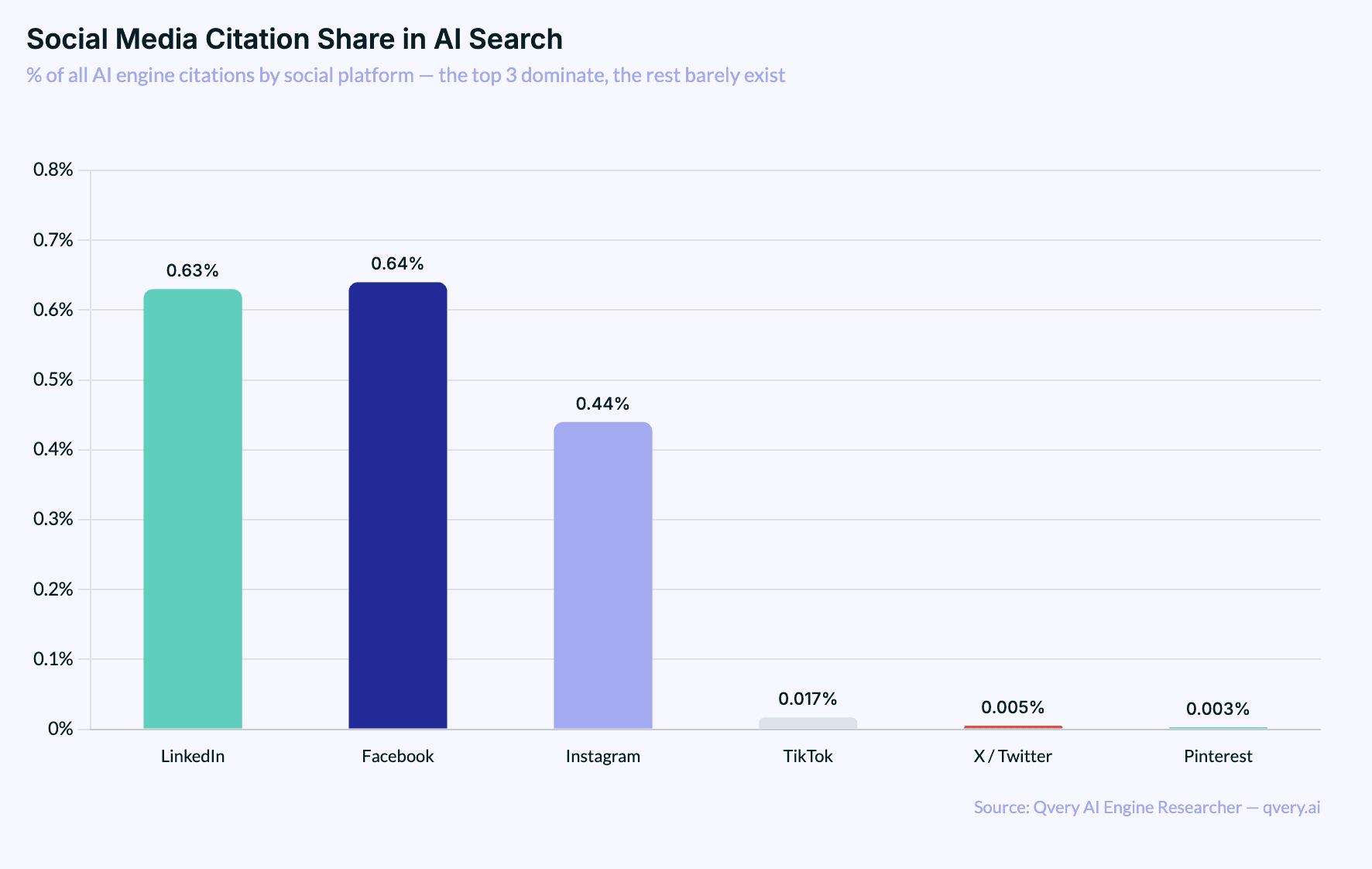
All six social platforms together account for 1.74% of all AI citations. For comparison, Reddit alone gets 1.13%.
Social media as a category isn't where AI engines go first. But LinkedIn's position at the top of that category is real, and being in the top 10 well-known domains out of 124,000+ means LinkedIn appears in AI responses more frequently than 99.99% of all websites on the internet.
The bottom three platforms (TikTok, X/Twitter, Pinterest) combine for 0.025%. The gap between the top of the social leaderboard and the bottom is massive. Being the most-cited social platform isn't a participation trophy.
Google AI Mode Values LinkedIn More Than ChatGPT Does
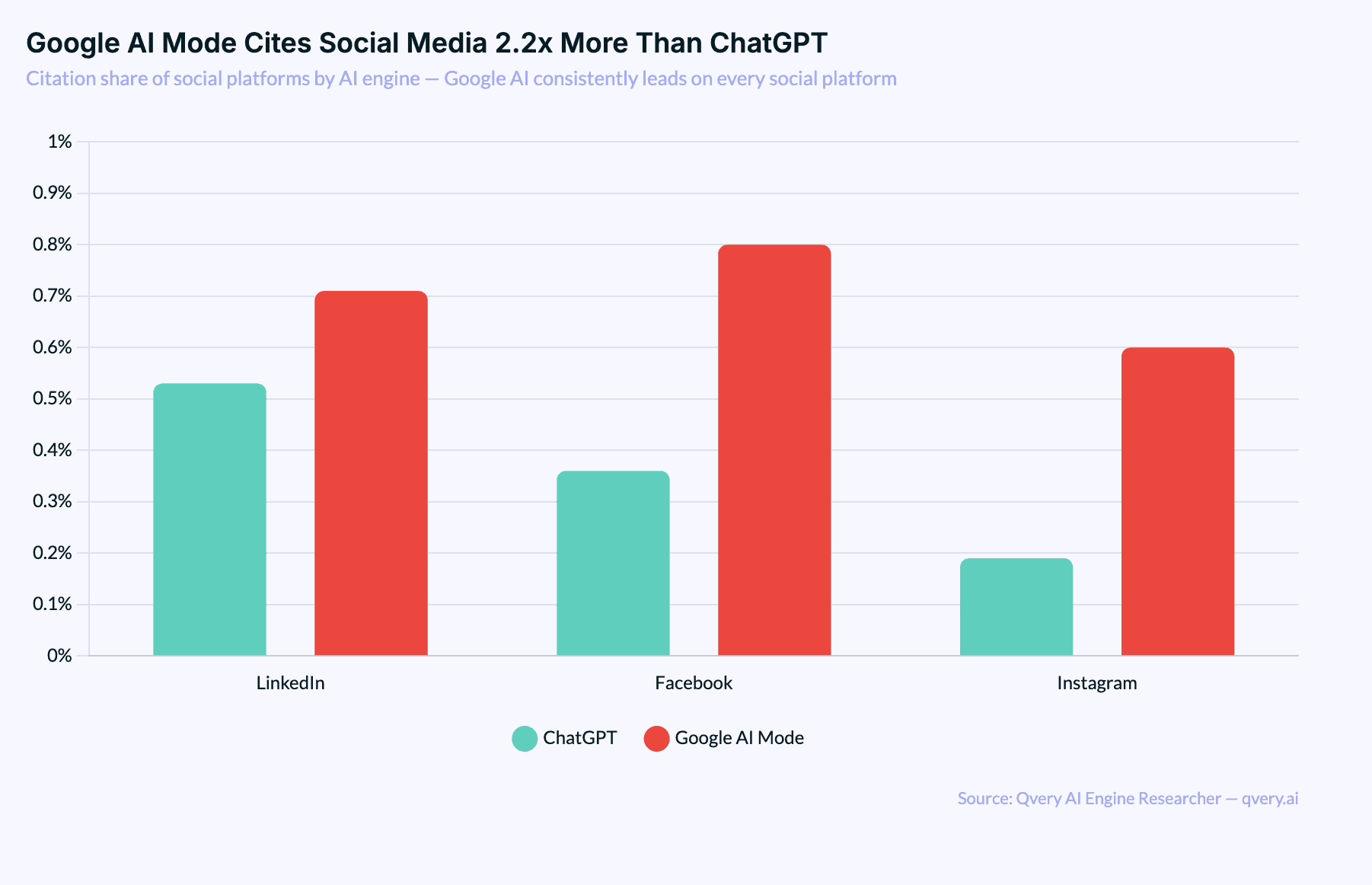
Google AI Mode cites LinkedIn 34% more than ChatGPT. LinkedIn accounts for 0.71% of Google AI's citations versus 0.53% of ChatGPT's. Google AI produces 61% of all LinkedIn citations.
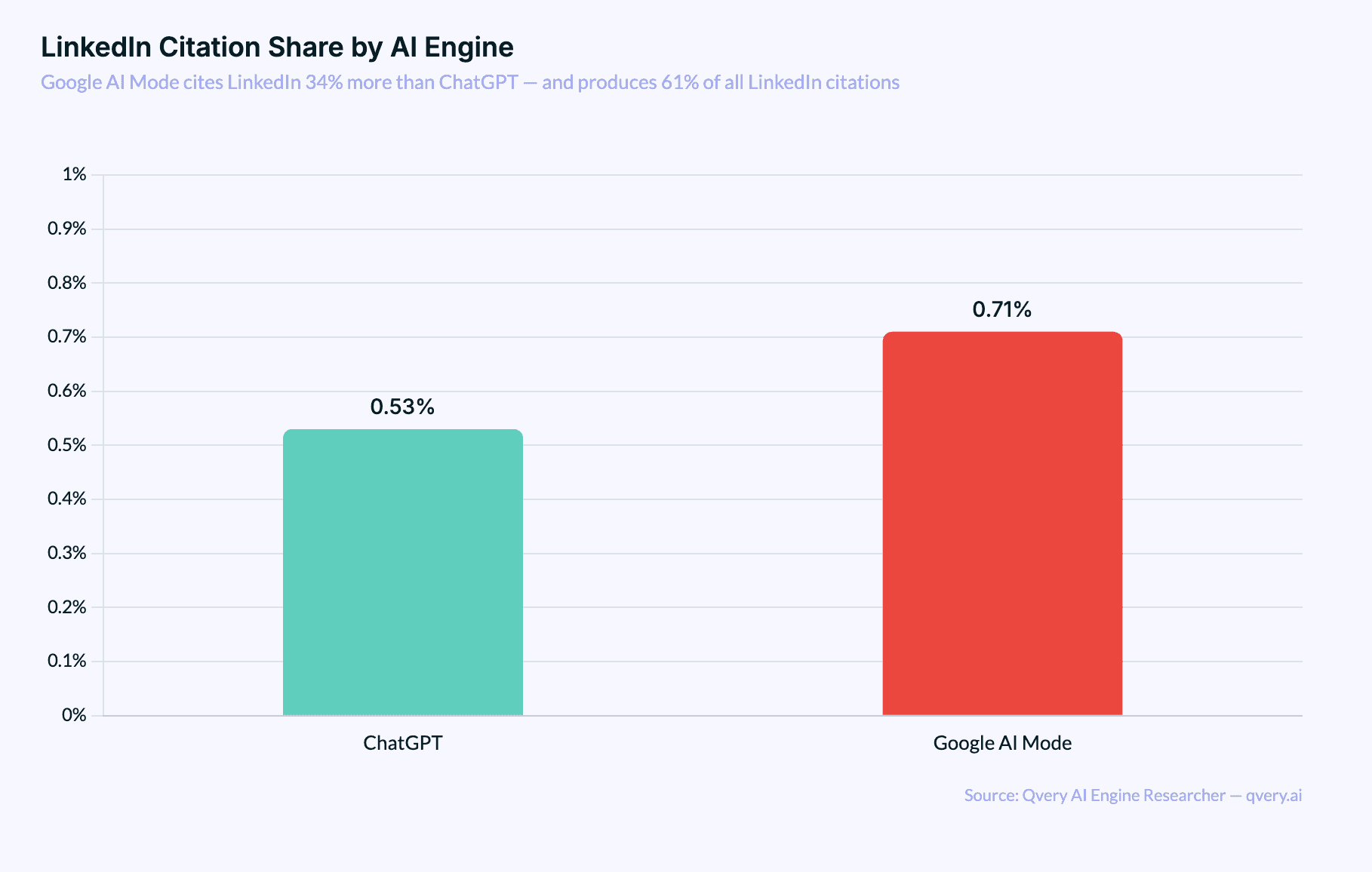
This extends across all social platforms. Google AI Mode cites social media at 2.26% overall, compared to ChatGPT's 1.05%. A 2.2x difference.
Google has been indexing LinkedIn company pages, articles, and profiles for two decades. That deep indexing relationship gives Google AI Mode richer access to LinkedIn's professional content than ChatGPT has. On ChatGPT, LinkedIn still holds its position better than most social platforms, which says something about the quality signal professional content carries even when the engine has less access to it.
What Matters Is Whether You Appear, Not Where in the List
When LinkedIn is cited, it tends to appear at position 15-16 on average, which is further down the list than Wikipedia (5.65) or Reddit (11.56). But citation rank is a secondary metric. The primary question is whether AI engines cite your LinkedIn presence at all.
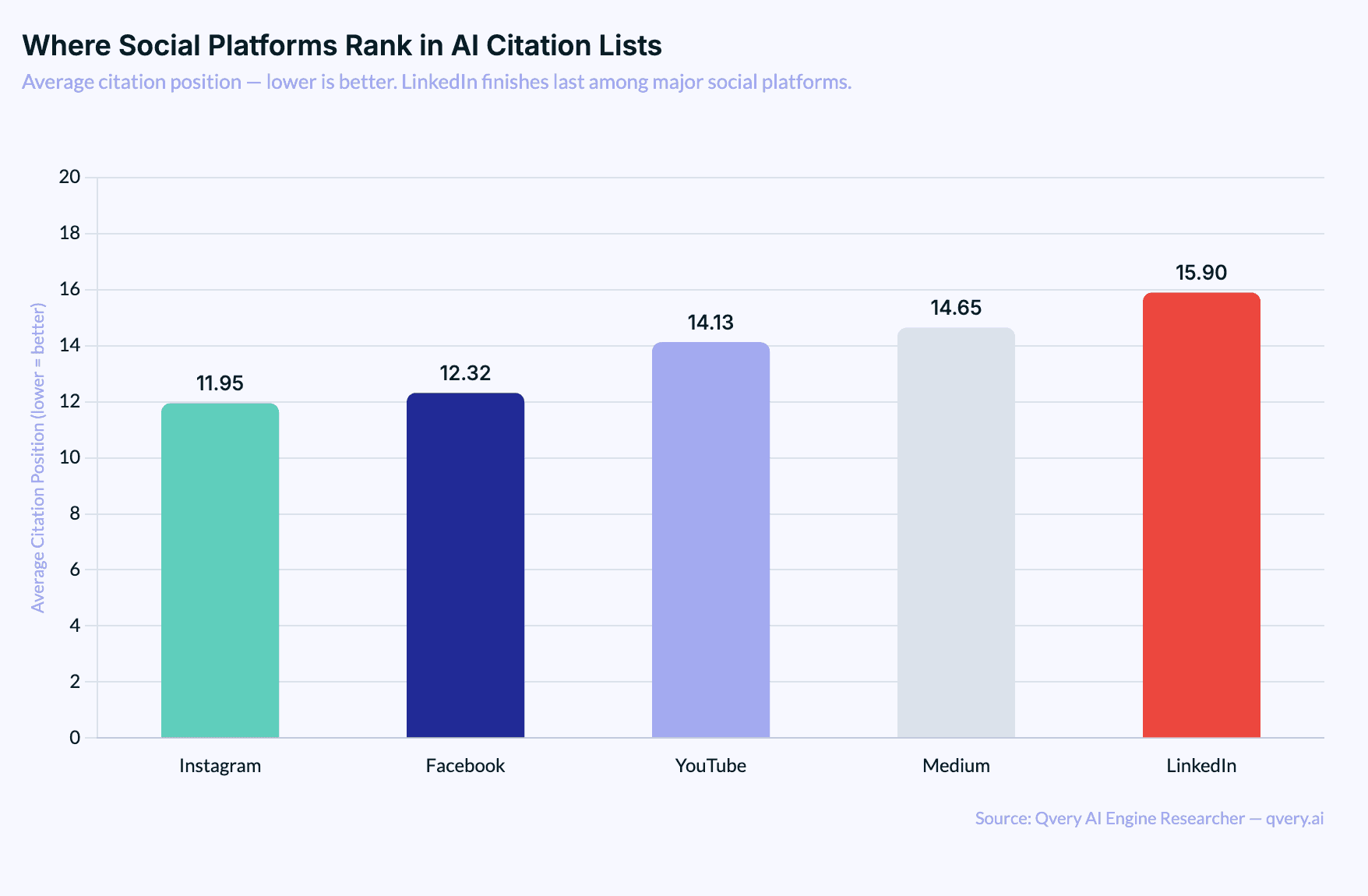
Think about what gets cited. Company pages are verification sources. AI engines use them to confirm entity information: this company exists, here's what they do, here's where they're based. That type of citation naturally appears as a supporting reference, not as the lead recommendation. LinkedIn articles appear further down too, because they supplement the AI engine's primary answer rather than replace it.
The Decline Is Worth Watching
LinkedIn's citation share is trending down on both engines.
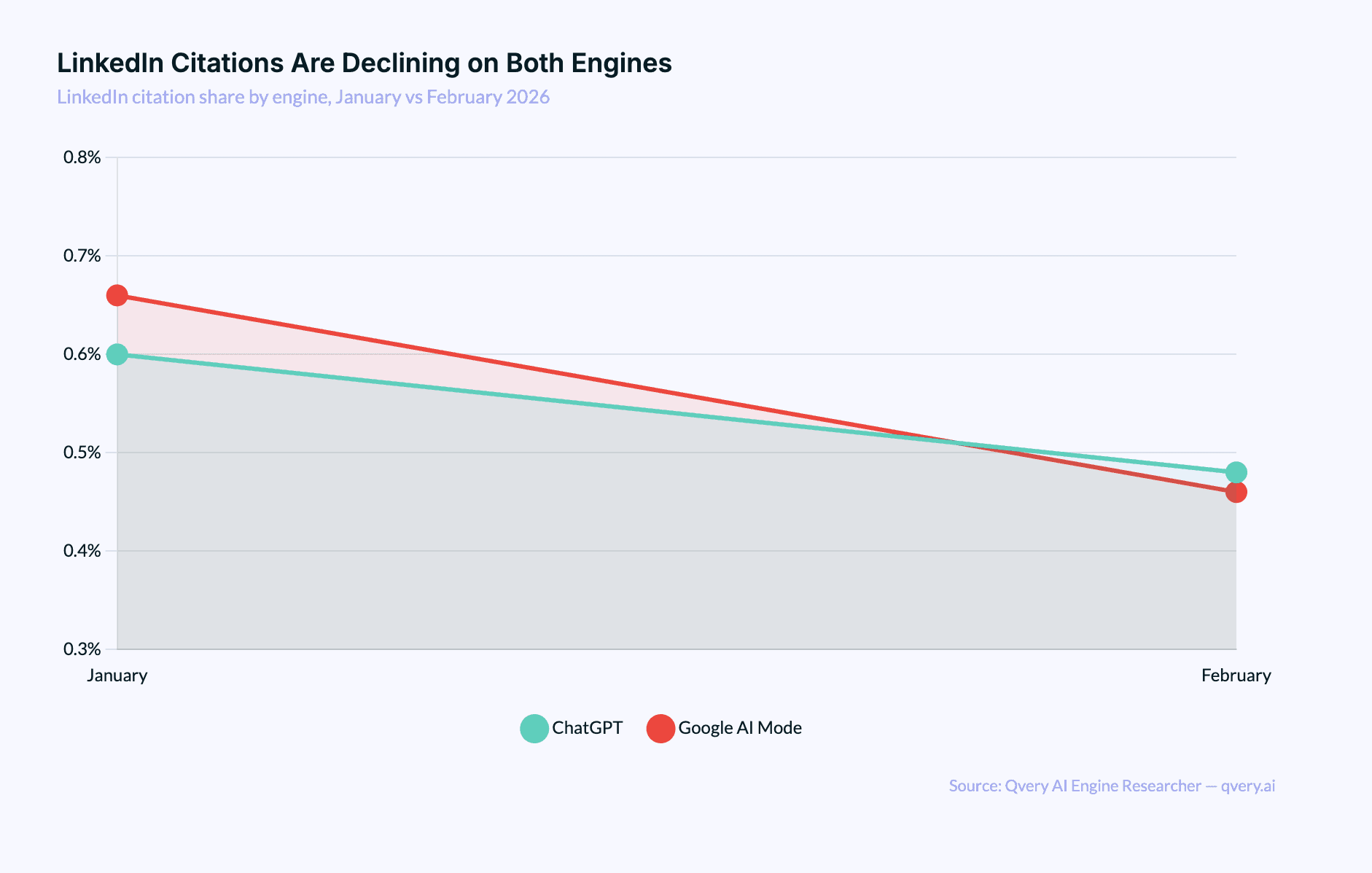
On ChatGPT, LinkedIn dropped from 0.60% in January to 0.48% in February. A 20% relative decline in one month. On Google AI Mode, the drop went from 0.66% to 0.46%.
A few possible explanations:
AI engines are getting better at finding primary sources. Instead of citing a LinkedIn article that references a report, they cite the report directly. The middleman loses.
LinkedIn's content quality signal is getting noisier. The platform is flooded with AI-generated posts, engagement bait, and repackaged content. AI engines are learning to be more selective about which LinkedIn content they trust.
Company pages have limited depth. A LinkedIn company page describes what a company does in two sentences. A well-built website page does it in 2,000 words with structured data. When both exist, AI engines prefer the richer source.
This doesn't mean LinkedIn is losing relevance. It means the bar for which LinkedIn content gets cited is rising. Generic company pages and low-effort articles are losing ground. Substantive, expert-driven content is holding.
LinkedIn Carries a Signal That Traditional Search Doesn't
When AI engines cite LinkedIn, there's only a 30.7% chance that LinkedIn also appears in Google's organic top 10 for the same query. Compare that to Reddit at 78.5% or TripAdvisor at 75.5%.
That low overlap means something interesting: AI engines are finding value in LinkedIn content that Google's organic algorithm doesn't surface. The professional authority signal that LinkedIn carries, real people with real titles at real companies, is something AI engines weigh differently than traditional search. LinkedIn gives you a citation pathway that your organic SEO strategy can't reach.
What This Means for Your LinkedIn Strategy
LinkedIn matters for AI visibility. The data is clear on that. Top 10 among 124,000+ domains. Most-cited social platform. Valued by both engines.
But it matters in a very specific way:
Your company page is your LinkedIn foundation for AI. Keep it complete, current, and detailed. This is what AI engines cite most often. Think of it as your LinkedIn homepage for machines.
Long-form articles carry citation weight. LinkedIn Pulse articles get cited like blog posts. Make them substantive and expert-driven, not repurposed feed content. Though you should also consider whether that same article would perform better on your own domain, where you control the structured data and the long-term AEO value.
Feed posts have zero AI visibility impact. Post them for your human audience, for networking, for brand building. They serve real business purposes. Just don't count them as part of your AI visibility strategy.
The bar is rising. Citation share is declining on both engines. The LinkedIn content that survives is substantive, expert-driven, and tied to verifiable professional authority.
Your own website still does the heavy lifting. That's where 87.75% of all citations go. LinkedIn supplements that. It's the professional authority signal that confirms you're real, credible, and worth citing.
AI engines respect LinkedIn as a professional authority source. They just don't read the feed. Neither should your AI visibility strategy.
How Qvery Tracks LinkedIn (And Every Citation Source)
Every number in this post comes from Qvery's AI Engine Researcher. It tracks your brand's AI visibility daily across ChatGPT and Google AI Mode, capturing every citation, its source domain, and monthly trend.
If you want to see whether your brand's LinkedIn company page is getting cited, or whether your competitors' pages are outperforming yours, that's a 30-second lookup.
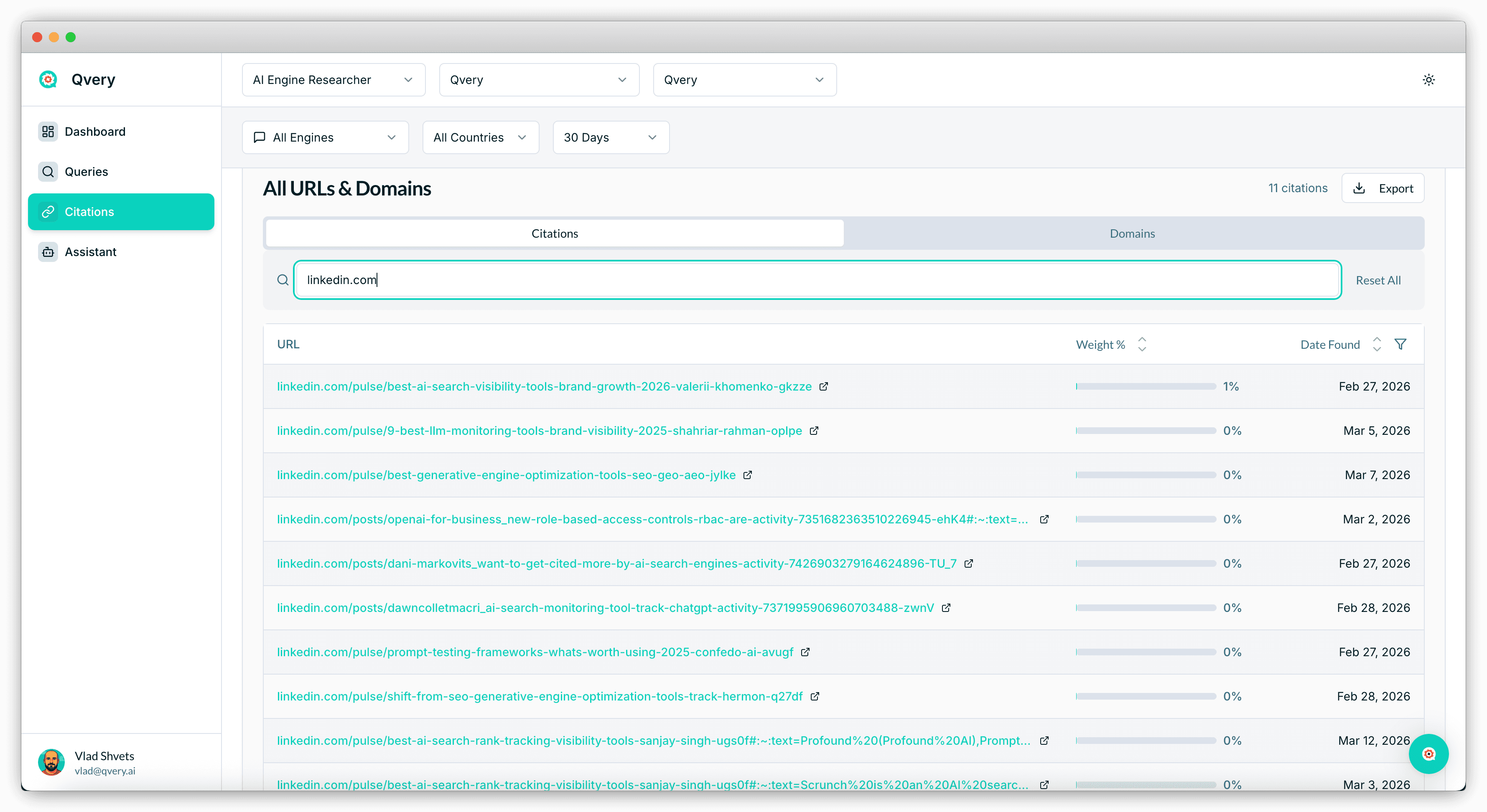
Knowing where LinkedIn fits in your citation mix tells you whether your LinkedIn investment is moving the metric that matters.
Check where your brand's AI citations come from. Start a free trial of Qvery.
Every marketer I talk to assumes their LinkedIn presence helps with AI search visibility. They're posting three times a week, running engagement pods, building carousels about morning routines. None of that shows up in our data. Not a trace.
What does show up: LinkedIn company pages and LinkedIn articles. That's it.
AI engines treat LinkedIn as a professional directory and an article platform. The social feed might as well not exist. (That drawer in your kitchen you forget exists? Your LinkedIn feed is in there.)
We ran the numbers across our proprietary citation dataset at Qvery, covering January through March 2026 across both ChatGPT and Google AI Mode.
LinkedIn is the most-cited social media platform in AI search and sits in the top 10 well-known domains out of 124,000+ in our dataset. That puts it in the top 0.005%. This is not a platform that doesn't matter. This is a platform that matters in a completely different way than most marketers think.
The Feed Is Invisible. Company Pages and Articles Aren't.
This is the finding that should reshape how you think about LinkedIn and AI search.
AI engines cite two types of LinkedIn content:
Company profile pages (linkedin.com/company/x) used for entity verification. When an AI engine needs to confirm who a company is, what they do, or where they're headquartered, it links to the LinkedIn company page. This is LinkedIn functioning as a professional directory.
LinkedIn articles (linkedin.com/pulse/x) used for thought leadership and expert perspectives. These get cited the same way blog posts do. They carry weight because they're tied to named professionals with verifiable credentials.
Regular LinkedIn posts, comments, carousels, polls, and engagement-bait content don't appear in our citation data in any meaningful way. Your viral post about "why I fired my best employee" with 47,000 likes? Invisible to ChatGPT and Google AI Mode. The algorithm that makes it go viral on LinkedIn is completely separate from the retrieval system that AI engines use to find sources.
AI engines treat LinkedIn as a professional directory and an article platform. The social feed doesn't exist in their world.
This changes the conversation entirely. "Should I invest more in LinkedIn for AI visibility?" is the wrong question. The right question is: "Is my LinkedIn company page complete, and am I publishing substantive articles there?"
LinkedIn Is Elite Among 124,000+ Domains
Among social media platforms, LinkedIn and Facebook are in a dead heat at the top:
1. Facebook: 0.64% of all citations
2. LinkedIn: 0.63% of all citations
3. Instagram: 0.44%
4. TikTok: 0.017%
5. X/Twitter: 0.005%
6. Pinterest: 0.003%
All six social platforms together account for 1.74% of all AI citations. For comparison, Reddit alone gets 1.13%.
Social media as a category isn't where AI engines go first. But LinkedIn's position at the top of that category is real, and being in the top 10 well-known domains out of 124,000+ means LinkedIn appears in AI responses more frequently than 99.99% of all websites on the internet.
The bottom three platforms (TikTok, X/Twitter, Pinterest) combine for 0.025%. The gap between the top of the social leaderboard and the bottom is massive. Being the most-cited social platform isn't a participation trophy.
Google AI Mode Values LinkedIn More Than ChatGPT Does
Google AI Mode cites LinkedIn 34% more than ChatGPT. LinkedIn accounts for 0.71% of Google AI's citations versus 0.53% of ChatGPT's. Google AI produces 61% of all LinkedIn citations.
This extends across all social platforms. Google AI Mode cites social media at 2.26% overall, compared to ChatGPT's 1.05%. A 2.2x difference.
Google has been indexing LinkedIn company pages, articles, and profiles for two decades. That deep indexing relationship gives Google AI Mode richer access to LinkedIn's professional content than ChatGPT has. On ChatGPT, LinkedIn still holds its position better than most social platforms, which says something about the quality signal professional content carries even when the engine has less access to it.
What Matters Is Whether You Appear, Not Where in the List
When LinkedIn is cited, it tends to appear at position 15-16 on average, which is further down the list than Wikipedia (5.65) or Reddit (11.56). But citation rank is a secondary metric. The primary question is whether AI engines cite your LinkedIn presence at all.
Think about what gets cited. Company pages are verification sources. AI engines use them to confirm entity information: this company exists, here's what they do, here's where they're based. That type of citation naturally appears as a supporting reference, not as the lead recommendation. LinkedIn articles appear further down too, because they supplement the AI engine's primary answer rather than replace it.
The Decline Is Worth Watching
LinkedIn's citation share is trending down on both engines.
On ChatGPT, LinkedIn dropped from 0.60% in January to 0.48% in February. A 20% relative decline in one month. On Google AI Mode, the drop went from 0.66% to 0.46%.
A few possible explanations:
AI engines are getting better at finding primary sources. Instead of citing a LinkedIn article that references a report, they cite the report directly. The middleman loses.
LinkedIn's content quality signal is getting noisier. The platform is flooded with AI-generated posts, engagement bait, and repackaged content. AI engines are learning to be more selective about which LinkedIn content they trust.
Company pages have limited depth. A LinkedIn company page describes what a company does in two sentences. A well-built website page does it in 2,000 words with structured data. When both exist, AI engines prefer the richer source.
This doesn't mean LinkedIn is losing relevance. It means the bar for which LinkedIn content gets cited is rising. Generic company pages and low-effort articles are losing ground. Substantive, expert-driven content is holding.
LinkedIn Carries a Signal That Traditional Search Doesn't
When AI engines cite LinkedIn, there's only a 30.7% chance that LinkedIn also appears in Google's organic top 10 for the same query. Compare that to Reddit at 78.5% or TripAdvisor at 75.5%.
That low overlap means something interesting: AI engines are finding value in LinkedIn content that Google's organic algorithm doesn't surface. The professional authority signal that LinkedIn carries, real people with real titles at real companies, is something AI engines weigh differently than traditional search. LinkedIn gives you a citation pathway that your organic SEO strategy can't reach.
What This Means for Your LinkedIn Strategy
LinkedIn matters for AI visibility. The data is clear on that. Top 10 among 124,000+ domains. Most-cited social platform. Valued by both engines.
But it matters in a very specific way:
Your company page is your LinkedIn foundation for AI. Keep it complete, current, and detailed. This is what AI engines cite most often. Think of it as your LinkedIn homepage for machines.
Long-form articles carry citation weight. LinkedIn Pulse articles get cited like blog posts. Make them substantive and expert-driven, not repurposed feed content. Though you should also consider whether that same article would perform better on your own domain, where you control the structured data and the long-term AEO value.
Feed posts have zero AI visibility impact. Post them for your human audience, for networking, for brand building. They serve real business purposes. Just don't count them as part of your AI visibility strategy.
The bar is rising. Citation share is declining on both engines. The LinkedIn content that survives is substantive, expert-driven, and tied to verifiable professional authority.
Your own website still does the heavy lifting. That's where 87.75% of all citations go. LinkedIn supplements that. It's the professional authority signal that confirms you're real, credible, and worth citing.
AI engines respect LinkedIn as a professional authority source. They just don't read the feed. Neither should your AI visibility strategy.
How Qvery Tracks LinkedIn (And Every Citation Source)
Every number in this post comes from Qvery's AI Engine Researcher. It tracks your brand's AI visibility daily across ChatGPT and Google AI Mode, capturing every citation, its source domain, and monthly trend.
If you want to see whether your brand's LinkedIn company page is getting cited, or whether your competitors' pages are outperforming yours, that's a 30-second lookup.
Knowing where LinkedIn fits in your citation mix tells you whether your LinkedIn investment is moving the metric that matters.
Check where your brand's AI citations come from. Start a free trial of Qvery.
Every marketer I talk to assumes their LinkedIn presence helps with AI search visibility. They're posting three times a week, running engagement pods, building carousels about morning routines. None of that shows up in our data. Not a trace.
What does show up: LinkedIn company pages and LinkedIn articles. That's it.
AI engines treat LinkedIn as a professional directory and an article platform. The social feed might as well not exist. (That drawer in your kitchen you forget exists? Your LinkedIn feed is in there.)
We ran the numbers across our proprietary citation dataset at Qvery, covering January through March 2026 across both ChatGPT and Google AI Mode.
LinkedIn is the most-cited social media platform in AI search and sits in the top 10 well-known domains out of 124,000+ in our dataset. That puts it in the top 0.005%. This is not a platform that doesn't matter. This is a platform that matters in a completely different way than most marketers think.
The Feed Is Invisible. Company Pages and Articles Aren't.
This is the finding that should reshape how you think about LinkedIn and AI search.
AI engines cite two types of LinkedIn content:
Company profile pages (linkedin.com/company/x) used for entity verification. When an AI engine needs to confirm who a company is, what they do, or where they're headquartered, it links to the LinkedIn company page. This is LinkedIn functioning as a professional directory.
LinkedIn articles (linkedin.com/pulse/x) used for thought leadership and expert perspectives. These get cited the same way blog posts do. They carry weight because they're tied to named professionals with verifiable credentials.
Regular LinkedIn posts, comments, carousels, polls, and engagement-bait content don't appear in our citation data in any meaningful way. Your viral post about "why I fired my best employee" with 47,000 likes? Invisible to ChatGPT and Google AI Mode. The algorithm that makes it go viral on LinkedIn is completely separate from the retrieval system that AI engines use to find sources.
AI engines treat LinkedIn as a professional directory and an article platform. The social feed doesn't exist in their world.
This changes the conversation entirely. "Should I invest more in LinkedIn for AI visibility?" is the wrong question. The right question is: "Is my LinkedIn company page complete, and am I publishing substantive articles there?"
LinkedIn Is Elite Among 124,000+ Domains
Among social media platforms, LinkedIn and Facebook are in a dead heat at the top:
1. Facebook: 0.64% of all citations
2. LinkedIn: 0.63% of all citations
3. Instagram: 0.44%
4. TikTok: 0.017%
5. X/Twitter: 0.005%
6. Pinterest: 0.003%
All six social platforms together account for 1.74% of all AI citations. For comparison, Reddit alone gets 1.13%.
Social media as a category isn't where AI engines go first. But LinkedIn's position at the top of that category is real, and being in the top 10 well-known domains out of 124,000+ means LinkedIn appears in AI responses more frequently than 99.99% of all websites on the internet.
The bottom three platforms (TikTok, X/Twitter, Pinterest) combine for 0.025%. The gap between the top of the social leaderboard and the bottom is massive. Being the most-cited social platform isn't a participation trophy.
Google AI Mode Values LinkedIn More Than ChatGPT Does
Google AI Mode cites LinkedIn 34% more than ChatGPT. LinkedIn accounts for 0.71% of Google AI's citations versus 0.53% of ChatGPT's. Google AI produces 61% of all LinkedIn citations.
This extends across all social platforms. Google AI Mode cites social media at 2.26% overall, compared to ChatGPT's 1.05%. A 2.2x difference.
Google has been indexing LinkedIn company pages, articles, and profiles for two decades. That deep indexing relationship gives Google AI Mode richer access to LinkedIn's professional content than ChatGPT has. On ChatGPT, LinkedIn still holds its position better than most social platforms, which says something about the quality signal professional content carries even when the engine has less access to it.
What Matters Is Whether You Appear, Not Where in the List
When LinkedIn is cited, it tends to appear at position 15-16 on average, which is further down the list than Wikipedia (5.65) or Reddit (11.56). But citation rank is a secondary metric. The primary question is whether AI engines cite your LinkedIn presence at all.
Think about what gets cited. Company pages are verification sources. AI engines use them to confirm entity information: this company exists, here's what they do, here's where they're based. That type of citation naturally appears as a supporting reference, not as the lead recommendation. LinkedIn articles appear further down too, because they supplement the AI engine's primary answer rather than replace it.
The Decline Is Worth Watching
LinkedIn's citation share is trending down on both engines.
On ChatGPT, LinkedIn dropped from 0.60% in January to 0.48% in February. A 20% relative decline in one month. On Google AI Mode, the drop went from 0.66% to 0.46%.
A few possible explanations:
AI engines are getting better at finding primary sources. Instead of citing a LinkedIn article that references a report, they cite the report directly. The middleman loses.
LinkedIn's content quality signal is getting noisier. The platform is flooded with AI-generated posts, engagement bait, and repackaged content. AI engines are learning to be more selective about which LinkedIn content they trust.
Company pages have limited depth. A LinkedIn company page describes what a company does in two sentences. A well-built website page does it in 2,000 words with structured data. When both exist, AI engines prefer the richer source.
This doesn't mean LinkedIn is losing relevance. It means the bar for which LinkedIn content gets cited is rising. Generic company pages and low-effort articles are losing ground. Substantive, expert-driven content is holding.
LinkedIn Carries a Signal That Traditional Search Doesn't
When AI engines cite LinkedIn, there's only a 30.7% chance that LinkedIn also appears in Google's organic top 10 for the same query. Compare that to Reddit at 78.5% or TripAdvisor at 75.5%.
That low overlap means something interesting: AI engines are finding value in LinkedIn content that Google's organic algorithm doesn't surface. The professional authority signal that LinkedIn carries, real people with real titles at real companies, is something AI engines weigh differently than traditional search. LinkedIn gives you a citation pathway that your organic SEO strategy can't reach.
What This Means for Your LinkedIn Strategy
LinkedIn matters for AI visibility. The data is clear on that. Top 10 among 124,000+ domains. Most-cited social platform. Valued by both engines.
But it matters in a very specific way:
Your company page is your LinkedIn foundation for AI. Keep it complete, current, and detailed. This is what AI engines cite most often. Think of it as your LinkedIn homepage for machines.
Long-form articles carry citation weight. LinkedIn Pulse articles get cited like blog posts. Make them substantive and expert-driven, not repurposed feed content. Though you should also consider whether that same article would perform better on your own domain, where you control the structured data and the long-term AEO value.
Feed posts have zero AI visibility impact. Post them for your human audience, for networking, for brand building. They serve real business purposes. Just don't count them as part of your AI visibility strategy.
The bar is rising. Citation share is declining on both engines. The LinkedIn content that survives is substantive, expert-driven, and tied to verifiable professional authority.
Your own website still does the heavy lifting. That's where 87.75% of all citations go. LinkedIn supplements that. It's the professional authority signal that confirms you're real, credible, and worth citing.
AI engines respect LinkedIn as a professional authority source. They just don't read the feed. Neither should your AI visibility strategy.
How Qvery Tracks LinkedIn (And Every Citation Source)
Every number in this post comes from Qvery's AI Engine Researcher. It tracks your brand's AI visibility daily across ChatGPT and Google AI Mode, capturing every citation, its source domain, and monthly trend.
If you want to see whether your brand's LinkedIn company page is getting cited, or whether your competitors' pages are outperforming yours, that's a 30-second lookup.
Knowing where LinkedIn fits in your citation mix tells you whether your LinkedIn investment is moving the metric that matters.
Check where your brand's AI citations come from. Start a free trial of Qvery.
Every marketer I talk to assumes their LinkedIn presence helps with AI search visibility. They're posting three times a week, running engagement pods, building carousels about morning routines. None of that shows up in our data. Not a trace.
What does show up: LinkedIn company pages and LinkedIn articles. That's it.
AI engines treat LinkedIn as a professional directory and an article platform. The social feed might as well not exist. (That drawer in your kitchen you forget exists? Your LinkedIn feed is in there.)
We ran the numbers across our proprietary citation dataset at Qvery, covering January through March 2026 across both ChatGPT and Google AI Mode.
LinkedIn is the most-cited social media platform in AI search and sits in the top 10 well-known domains out of 124,000+ in our dataset. That puts it in the top 0.005%. This is not a platform that doesn't matter. This is a platform that matters in a completely different way than most marketers think.
The Feed Is Invisible. Company Pages and Articles Aren't.
This is the finding that should reshape how you think about LinkedIn and AI search.
AI engines cite two types of LinkedIn content:
Company profile pages (linkedin.com/company/x) used for entity verification. When an AI engine needs to confirm who a company is, what they do, or where they're headquartered, it links to the LinkedIn company page. This is LinkedIn functioning as a professional directory.
LinkedIn articles (linkedin.com/pulse/x) used for thought leadership and expert perspectives. These get cited the same way blog posts do. They carry weight because they're tied to named professionals with verifiable credentials.
Regular LinkedIn posts, comments, carousels, polls, and engagement-bait content don't appear in our citation data in any meaningful way. Your viral post about "why I fired my best employee" with 47,000 likes? Invisible to ChatGPT and Google AI Mode. The algorithm that makes it go viral on LinkedIn is completely separate from the retrieval system that AI engines use to find sources.
AI engines treat LinkedIn as a professional directory and an article platform. The social feed doesn't exist in their world.
This changes the conversation entirely. "Should I invest more in LinkedIn for AI visibility?" is the wrong question. The right question is: "Is my LinkedIn company page complete, and am I publishing substantive articles there?"
LinkedIn Is Elite Among 124,000+ Domains
Among social media platforms, LinkedIn and Facebook are in a dead heat at the top:
1. Facebook: 0.64% of all citations
2. LinkedIn: 0.63% of all citations
3. Instagram: 0.44%
4. TikTok: 0.017%
5. X/Twitter: 0.005%
6. Pinterest: 0.003%
All six social platforms together account for 1.74% of all AI citations. For comparison, Reddit alone gets 1.13%.
Social media as a category isn't where AI engines go first. But LinkedIn's position at the top of that category is real, and being in the top 10 well-known domains out of 124,000+ means LinkedIn appears in AI responses more frequently than 99.99% of all websites on the internet.
The bottom three platforms (TikTok, X/Twitter, Pinterest) combine for 0.025%. The gap between the top of the social leaderboard and the bottom is massive. Being the most-cited social platform isn't a participation trophy.
Google AI Mode Values LinkedIn More Than ChatGPT Does
Google AI Mode cites LinkedIn 34% more than ChatGPT. LinkedIn accounts for 0.71% of Google AI's citations versus 0.53% of ChatGPT's. Google AI produces 61% of all LinkedIn citations.
This extends across all social platforms. Google AI Mode cites social media at 2.26% overall, compared to ChatGPT's 1.05%. A 2.2x difference.
Google has been indexing LinkedIn company pages, articles, and profiles for two decades. That deep indexing relationship gives Google AI Mode richer access to LinkedIn's professional content than ChatGPT has. On ChatGPT, LinkedIn still holds its position better than most social platforms, which says something about the quality signal professional content carries even when the engine has less access to it.
What Matters Is Whether You Appear, Not Where in the List
When LinkedIn is cited, it tends to appear at position 15-16 on average, which is further down the list than Wikipedia (5.65) or Reddit (11.56). But citation rank is a secondary metric. The primary question is whether AI engines cite your LinkedIn presence at all.
Think about what gets cited. Company pages are verification sources. AI engines use them to confirm entity information: this company exists, here's what they do, here's where they're based. That type of citation naturally appears as a supporting reference, not as the lead recommendation. LinkedIn articles appear further down too, because they supplement the AI engine's primary answer rather than replace it.
The Decline Is Worth Watching
LinkedIn's citation share is trending down on both engines.
On ChatGPT, LinkedIn dropped from 0.60% in January to 0.48% in February. A 20% relative decline in one month. On Google AI Mode, the drop went from 0.66% to 0.46%.
A few possible explanations:
AI engines are getting better at finding primary sources. Instead of citing a LinkedIn article that references a report, they cite the report directly. The middleman loses.
LinkedIn's content quality signal is getting noisier. The platform is flooded with AI-generated posts, engagement bait, and repackaged content. AI engines are learning to be more selective about which LinkedIn content they trust.
Company pages have limited depth. A LinkedIn company page describes what a company does in two sentences. A well-built website page does it in 2,000 words with structured data. When both exist, AI engines prefer the richer source.
This doesn't mean LinkedIn is losing relevance. It means the bar for which LinkedIn content gets cited is rising. Generic company pages and low-effort articles are losing ground. Substantive, expert-driven content is holding.
LinkedIn Carries a Signal That Traditional Search Doesn't
When AI engines cite LinkedIn, there's only a 30.7% chance that LinkedIn also appears in Google's organic top 10 for the same query. Compare that to Reddit at 78.5% or TripAdvisor at 75.5%.
That low overlap means something interesting: AI engines are finding value in LinkedIn content that Google's organic algorithm doesn't surface. The professional authority signal that LinkedIn carries, real people with real titles at real companies, is something AI engines weigh differently than traditional search. LinkedIn gives you a citation pathway that your organic SEO strategy can't reach.
What This Means for Your LinkedIn Strategy
LinkedIn matters for AI visibility. The data is clear on that. Top 10 among 124,000+ domains. Most-cited social platform. Valued by both engines.
But it matters in a very specific way:
Your company page is your LinkedIn foundation for AI. Keep it complete, current, and detailed. This is what AI engines cite most often. Think of it as your LinkedIn homepage for machines.
Long-form articles carry citation weight. LinkedIn Pulse articles get cited like blog posts. Make them substantive and expert-driven, not repurposed feed content. Though you should also consider whether that same article would perform better on your own domain, where you control the structured data and the long-term AEO value.
Feed posts have zero AI visibility impact. Post them for your human audience, for networking, for brand building. They serve real business purposes. Just don't count them as part of your AI visibility strategy.
The bar is rising. Citation share is declining on both engines. The LinkedIn content that survives is substantive, expert-driven, and tied to verifiable professional authority.
Your own website still does the heavy lifting. That's where 87.75% of all citations go. LinkedIn supplements that. It's the professional authority signal that confirms you're real, credible, and worth citing.
AI engines respect LinkedIn as a professional authority source. They just don't read the feed. Neither should your AI visibility strategy.
How Qvery Tracks LinkedIn (And Every Citation Source)
Every number in this post comes from Qvery's AI Engine Researcher. It tracks your brand's AI visibility daily across ChatGPT and Google AI Mode, capturing every citation, its source domain, and monthly trend.
If you want to see whether your brand's LinkedIn company page is getting cited, or whether your competitors' pages are outperforming yours, that's a 30-second lookup.
Knowing where LinkedIn fits in your citation mix tells you whether your LinkedIn investment is moving the metric that matters.
Check where your brand's AI citations come from. Start a free trial of Qvery.

© 2026 Qvery AI OÜ