By
Vlad Shvets
How To Get Your SaaS Into The Tech Media Roundups AI Engines Cite
Which tech media roundup pages ChatGPT and Google AI Mode cited for broad and constrained SaaS questions, two things to check on each page before you pitch it, and why the two question types need separate lists.
Which tech media roundup pages ChatGPT and Google AI Mode cited for broad and constrained SaaS questions, two things to check on each page before you pitch it, and why the two question types need separate lists.
Which tech media roundup pages ChatGPT and Google AI Mode cited for broad and constrained SaaS questions, two things to check on each page before you pitch it, and why the two question types need separate lists.
If you market a SaaS product, the best-tools roundups on tech media sites are an obvious target: AI answers cite them, and a place on the right one puts your name beside the category leaders. The hard part is picking which roundups to pitch.
That choice comes with a second one. Buyers ask broad questions, like the best time tracking software, and constrained ones, like time tracking software that works with their accounting tool. You can build one pitch list for both, a shared core with separate tails, or two lists.
So we asked ChatGPT and Google AI Mode the same SaaS needs in September 2026, each once as a broad category question and once with a single constraint added, and recorded which tech media roundup pages the answers cited.
Roundup pages recurred too little to settle that decision. Plenty of roundups were cited, but few came up in more than one answer, so there weren't enough recurring pages on either side to test one list against two. Had there been, the test would have picked among the three setups.
What you get instead: the recurring pages for each kind of question, two things to read off each page before you pitch it, and the domain-level reason to audit the two question types separately. This measures which pages were cited, not what a placement does.
Broad and Constrained SaaS Questions Cite Different Domains
Start one level up, with every domain the answers cited. For each kind of question, we took the smallest set of domains that together appeared in 80% of the answers that cited any source, then applied it to the other kind.
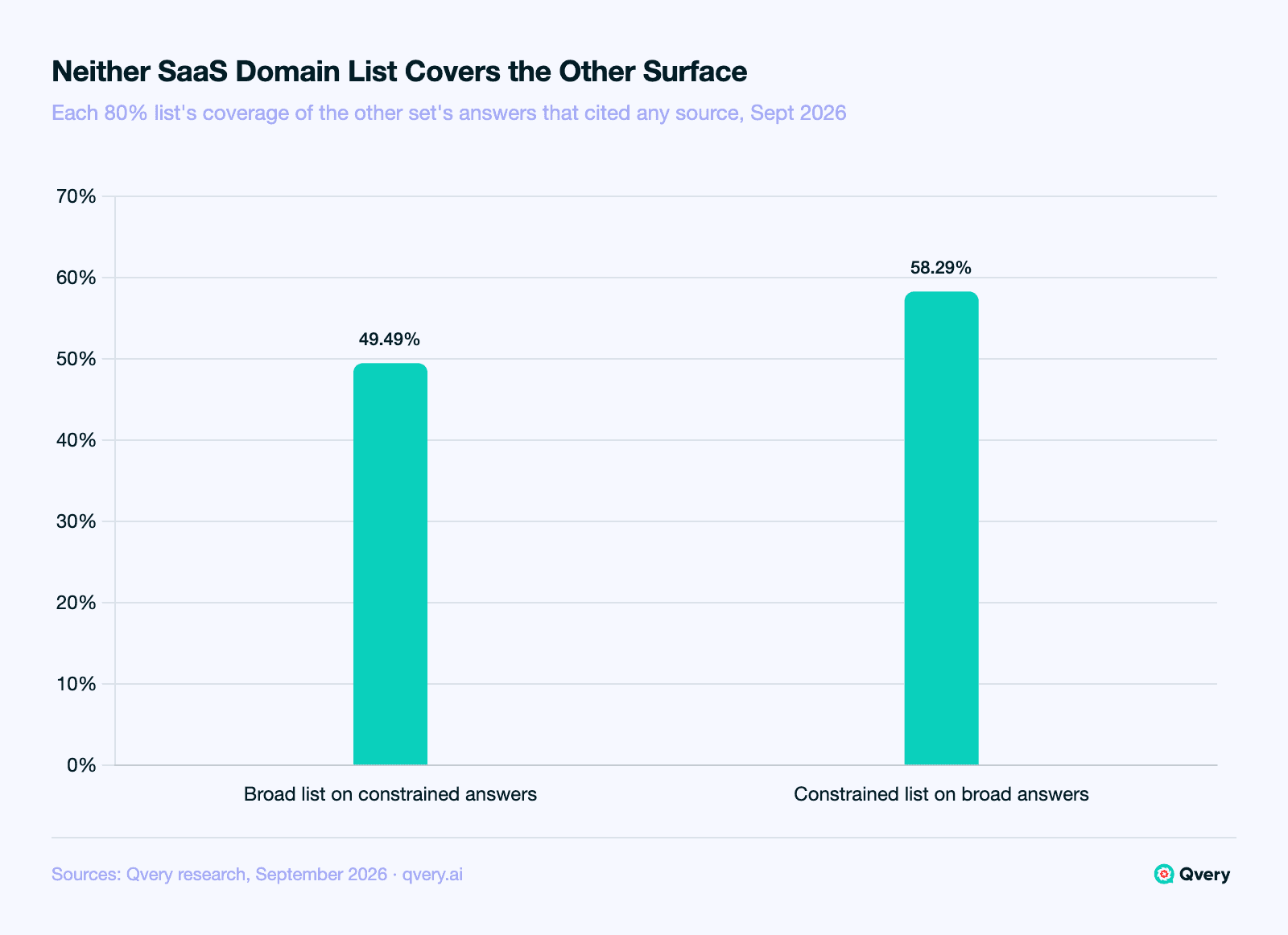
The broad list covered 49.49% of the constrained answers that cited any source. The constrained list covered 58.29% of the broad answers that cited any source. Both sit below the line where one list could serve both, so at the domain level each needs its own audit list.
The two lists share ten domains: 1password.com, adobe.com, chargebee.com, demio.com, reddit.com, shopify.com, uptimerobot.com, youtube.com, zapier.com, and zoho.com. That's 35.7% of the smaller, 28-domain broad list; the constrained list holds 34.
Only four of those domains are tech media publishers from our hand-checked set: stackbriefly.com and aiquill.app on the broad list, guides.reviews and techradar.com on the constrained one.
A domain list isn't a roundup list, so the next section works page by page.
Two phrasings of one need drawing on different sources is familiar from generating LLM tracking queries.
PromptRush argues that "AI engines build those shortlists from review sites like G2 and Capterra, comparison articles, Reddit threads and your own product pages, so a strong Google ranking doesn't guarantee a mention."
The lists here hold domains of those kinds: capterra.com and gartner.com, reddit.com, vendor sites like zapier.com, and the tech media publishers above. So the mix it describes fits what was cited.
But this data shows which domains were cited, not how an engine builds a shortlist, whether a brand was mentioned, or anything about Google rankings.
The Roundup Pages That Came Up More Than Once
A page counts here when more than one answer to that kind of question cited it. Build your own list the same way, from pages cited on more than one run of your own questions, never from a single answer.
We also tried to measure how concentrated the cited roundups are, how recently they were updated, how many vendors they list, and whether ChatGPT and Google AI Mode cite different ones. Every one of those tests fell short of the pages it needed, so what follows is membership and each page's status, never a rate.
For broad questions, the most-cited pages first:
AIQuill: cold outreach tools: recent update date, fewer than ten vendors.
CMO Magazine: marketing automation platforms compared: no readable update date, fewer than ten vendors.
iTechGuides: e-commerce website builders: no readable update date, vendor count unreadable.
iTechGuides: video chat apps: no readable update date, fewer than ten vendors.
StackBriefly: file sharing software: no readable update date, fewer than ten vendors.
StackBriefly: time tracking software: no readable update date, fewer than ten vendors.
TechYorker: secure video chat apps: no readable update date, vendor count unreadable.
Toolradar: marketing automation platforms: recent update date, fewer than ten vendors.
Then the rest of the broad list:
NoCodeStackPro: no-code tools for internal tools: no readable update date, fewer than ten vendors.
PCMag: cloud storage and file sharing and IT help desk software: not fetched.
PCMag Australia: Android video chat apps: older update date, fewer than ten vendors.
PCMag UK: work management software: recent update date, fewer than ten vendors.
Security.org: business password managers: recent update date, fewer than ten vendors.
ShoutMeLoud: rank tracking tools: no readable update date, fewer than ten vendors.
SmashingApps: free email marketing tools: recent update date, fewer than ten vendors.
StackFYI: marketing automation tools and Glide vs AppSheet vs Softr: no readable update date, fewer than ten vendors.
Startups.co.uk: free accounting software and website builders: recent update date, fewer than ten vendors.
TechnologyAdvice: ecommerce platforms: no readable update date, vendor count unreadable.
TechnologyAdvice: SEO tools: no readable update date, fewer than ten vendors.
ToolBistro: email marketing software: no readable update date, vendor count unreadable.
The publishers whose recurring pages were cited most often on broad questions were pcmag.com, itechguides.com, and stackbriefly.com, in that order.
For constrained questions, the most-cited page was TechRadar: small business website builders, with an older update date and a vendor count we couldn't read. The rest:
Guides.reviews: live chat software and time tracking for freelancers: recent update date, fewer than ten vendors.
InterObservers: live chat software: recent update date, fewer than ten vendors.
iTechGuides: online learning platforms: no readable update date, fewer than ten vendors.
LaunchAdvisor: Wix vs Squarespace vs GoDaddy: older update date, fewer than ten vendors.
Retailpresso: loyalty program software: recent update date, fewer than ten vendors.
Security.org: business password managers: recent update date, fewer than ten vendors.
StackBriefly: API management platforms: no readable update date, fewer than ten vendors.
Startups.co.uk: easy website builders: recent update date, fewer than ten vendors.
TechnologyAdvice: retail POS systems: no readable update date, vendor count unreadable.
TechRepublic: password managers for teams: no readable update date, fewer than ten vendors.
TechSifted: website builders for small business: recent update date, fewer than ten vendors.
No publisher's recurring pages were cited often enough on constrained questions to rank. How constraints thin out the roundup shelf is covered in what AI engines cite on SaaS landing pages, and the same recurrence approach in fintech in the roundups AI engines cite for fintech.
Security.org's page sits on both lists. That's membership, not evidence that one list serves both kinds of question.
Some cited roundups were recorded only as a publisher's homepage, so the page can't be identified.
Their titles include Forbes Advisor's POS roundup, U.S. News's payroll roundup, NerdWallet's POS roundup, PCMag's business password managers, Solutions Review's marketing-automation list, and TechRadar's secure file-sharing roundup. Head-to-head pages comparing only two vendors were left out as comparisons, not roundups.
Vendor-published roundups, zapier.com's blog among them, sit outside the tech media set by design, because a vendor ranking its own category is a different kind of page.
Read Two Things Off a Roundup Page Before You Pitch It
Two fields are visible on the page itself, so you can screen a roundup before you spend a pitch on it.
The update date. Look for the page's own labelled update: "Updated", "Last updated", "Last reviewed", or "Modified". We counted it as recent on or after March 26, 2026, 180 days before we read the pages. A publish-only date, an unlabelled byline date, or a year alone isn't a readable update date, and that's not the same as an old one.
The displayed vendor count. Count the tools the page selects, once each. A number in the title isn't a count, and a list that's cut off or blocked can't be counted.
On the broad pages, seven showed a recent update date, one an older date, 13 had no readable update date, and two couldn't be fetched. None of the 17 broad pages with a readable count listed ten or more vendors; six couldn't be counted.
On the constrained pages, seven showed a recent update date, two an older date, and four no readable update date. None of the 11 with a readable count listed ten or more vendors; two couldn't be counted.
In our judgment, a page with a recent update date and a short list is the easier first pitch: someone maintains it, and there's room on it. That's editorial judgment, not a finding about why pages get cited.
Several homepage-only citations carry titles announcing ten or more picks, so longer lists weren't absent from the answers; they just couldn't be tied to a page.
We also built a test of whether ChatGPT and Google AI Mode cite different roundups. Google AI Mode cited too few of these pages for it to run, so no engine difference is claimed either way.
On the lists above, the PCMag, Security.org, ShoutMeLoud, and Startups.co.uk pages were cited by Google AI Mode, TechRepublic's by both engines, and the rest by ChatGPT.
Nathan Ojaokomo writes that "Different AI platforms pull from different sources." This data built the test for that and couldn't run it at the volume it needed, so it neither confirms nor contradicts it.
For how to pitch a standing roundup page once you've picked it, see getting a product into the listicles AI engines cite.
Run the Paired Audit on Your Own Category in Qvery
Add your category's needs to Qvery as paired queries, each asked broadly and with one constraint. Qvery tracks them daily on ChatGPT and Google AI Mode, in any of 200+ countries, and reports your visibility, share of voice, and average rank.
Every citation is tied to the query and the engine that produced it, so you can see which roundup pages your own questions cite, run after run, and spot the ones that recur. Ask Qvery Assistant which roundup pages your constrained questions cited this week and it answers from your own data.
Reading each page's update date and vendor count is your step; the recurrence rule and the page checks were this article's research, not product features. Start a free 7-day trial, no credit card required, and set up your first ten pairs.
What This Can't Tell You
This is cited-page and cited-domain co-occurrence in one September 2026 set of SaaS needs, asked broadly and with a constraint. It measures no brand naming or recommendation, no cause, and nothing about how engines treat updated, long, or short lists.
The page-level comparison between the two kinds of question was computed but fell short of the pages it needed, so no pitch-list setup is established. The date, vendor-count, and engine tests fell short too, so they publish membership and statuses only.
Homepage-only citations stay unresolved. A page's answers can be repeat asks of one question, and the update-date status reads only the page's own labelled update.
The lists count every answer once, and ChatGPT answered more of the questions than Google AI Mode, so they lean toward ChatGPT. The tech media set is hand-checked and leaves out vendor-published roundups. Nothing is compared with an earlier period.
Build Two Lists and Screen Every Page
Audit broad category questions and their constrained versions as two surfaces.
Build each surface's roundup list from pages cited on more than one run of your own questions, and read each page's own update date and displayed vendor count before pitching it. Hold off on merging or splitting the pitch lists until your own page-level data is large enough to test it.
If you market a SaaS product, the best-tools roundups on tech media sites are an obvious target: AI answers cite them, and a place on the right one puts your name beside the category leaders. The hard part is picking which roundups to pitch.
That choice comes with a second one. Buyers ask broad questions, like the best time tracking software, and constrained ones, like time tracking software that works with their accounting tool. You can build one pitch list for both, a shared core with separate tails, or two lists.
So we asked ChatGPT and Google AI Mode the same SaaS needs in September 2026, each once as a broad category question and once with a single constraint added, and recorded which tech media roundup pages the answers cited.
Roundup pages recurred too little to settle that decision. Plenty of roundups were cited, but few came up in more than one answer, so there weren't enough recurring pages on either side to test one list against two. Had there been, the test would have picked among the three setups.
What you get instead: the recurring pages for each kind of question, two things to read off each page before you pitch it, and the domain-level reason to audit the two question types separately. This measures which pages were cited, not what a placement does.
Broad and Constrained SaaS Questions Cite Different Domains
Start one level up, with every domain the answers cited. For each kind of question, we took the smallest set of domains that together appeared in 80% of the answers that cited any source, then applied it to the other kind.
The broad list covered 49.49% of the constrained answers that cited any source. The constrained list covered 58.29% of the broad answers that cited any source. Both sit below the line where one list could serve both, so at the domain level each needs its own audit list.
The two lists share ten domains: 1password.com, adobe.com, chargebee.com, demio.com, reddit.com, shopify.com, uptimerobot.com, youtube.com, zapier.com, and zoho.com. That's 35.7% of the smaller, 28-domain broad list; the constrained list holds 34.
Only four of those domains are tech media publishers from our hand-checked set: stackbriefly.com and aiquill.app on the broad list, guides.reviews and techradar.com on the constrained one.
A domain list isn't a roundup list, so the next section works page by page.
Two phrasings of one need drawing on different sources is familiar from generating LLM tracking queries.
PromptRush argues that "AI engines build those shortlists from review sites like G2 and Capterra, comparison articles, Reddit threads and your own product pages, so a strong Google ranking doesn't guarantee a mention."
The lists here hold domains of those kinds: capterra.com and gartner.com, reddit.com, vendor sites like zapier.com, and the tech media publishers above. So the mix it describes fits what was cited.
But this data shows which domains were cited, not how an engine builds a shortlist, whether a brand was mentioned, or anything about Google rankings.
The Roundup Pages That Came Up More Than Once
A page counts here when more than one answer to that kind of question cited it. Build your own list the same way, from pages cited on more than one run of your own questions, never from a single answer.
We also tried to measure how concentrated the cited roundups are, how recently they were updated, how many vendors they list, and whether ChatGPT and Google AI Mode cite different ones. Every one of those tests fell short of the pages it needed, so what follows is membership and each page's status, never a rate.
For broad questions, the most-cited pages first:
AIQuill: cold outreach tools: recent update date, fewer than ten vendors.
CMO Magazine: marketing automation platforms compared: no readable update date, fewer than ten vendors.
iTechGuides: e-commerce website builders: no readable update date, vendor count unreadable.
iTechGuides: video chat apps: no readable update date, fewer than ten vendors.
StackBriefly: file sharing software: no readable update date, fewer than ten vendors.
StackBriefly: time tracking software: no readable update date, fewer than ten vendors.
TechYorker: secure video chat apps: no readable update date, vendor count unreadable.
Toolradar: marketing automation platforms: recent update date, fewer than ten vendors.
Then the rest of the broad list:
NoCodeStackPro: no-code tools for internal tools: no readable update date, fewer than ten vendors.
PCMag: cloud storage and file sharing and IT help desk software: not fetched.
PCMag Australia: Android video chat apps: older update date, fewer than ten vendors.
PCMag UK: work management software: recent update date, fewer than ten vendors.
Security.org: business password managers: recent update date, fewer than ten vendors.
ShoutMeLoud: rank tracking tools: no readable update date, fewer than ten vendors.
SmashingApps: free email marketing tools: recent update date, fewer than ten vendors.
StackFYI: marketing automation tools and Glide vs AppSheet vs Softr: no readable update date, fewer than ten vendors.
Startups.co.uk: free accounting software and website builders: recent update date, fewer than ten vendors.
TechnologyAdvice: ecommerce platforms: no readable update date, vendor count unreadable.
TechnologyAdvice: SEO tools: no readable update date, fewer than ten vendors.
ToolBistro: email marketing software: no readable update date, vendor count unreadable.
The publishers whose recurring pages were cited most often on broad questions were pcmag.com, itechguides.com, and stackbriefly.com, in that order.
For constrained questions, the most-cited page was TechRadar: small business website builders, with an older update date and a vendor count we couldn't read. The rest:
Guides.reviews: live chat software and time tracking for freelancers: recent update date, fewer than ten vendors.
InterObservers: live chat software: recent update date, fewer than ten vendors.
iTechGuides: online learning platforms: no readable update date, fewer than ten vendors.
LaunchAdvisor: Wix vs Squarespace vs GoDaddy: older update date, fewer than ten vendors.
Retailpresso: loyalty program software: recent update date, fewer than ten vendors.
Security.org: business password managers: recent update date, fewer than ten vendors.
StackBriefly: API management platforms: no readable update date, fewer than ten vendors.
Startups.co.uk: easy website builders: recent update date, fewer than ten vendors.
TechnologyAdvice: retail POS systems: no readable update date, vendor count unreadable.
TechRepublic: password managers for teams: no readable update date, fewer than ten vendors.
TechSifted: website builders for small business: recent update date, fewer than ten vendors.
No publisher's recurring pages were cited often enough on constrained questions to rank. How constraints thin out the roundup shelf is covered in what AI engines cite on SaaS landing pages, and the same recurrence approach in fintech in the roundups AI engines cite for fintech.
Security.org's page sits on both lists. That's membership, not evidence that one list serves both kinds of question.
Some cited roundups were recorded only as a publisher's homepage, so the page can't be identified.
Their titles include Forbes Advisor's POS roundup, U.S. News's payroll roundup, NerdWallet's POS roundup, PCMag's business password managers, Solutions Review's marketing-automation list, and TechRadar's secure file-sharing roundup. Head-to-head pages comparing only two vendors were left out as comparisons, not roundups.
Vendor-published roundups, zapier.com's blog among them, sit outside the tech media set by design, because a vendor ranking its own category is a different kind of page.
Read Two Things Off a Roundup Page Before You Pitch It
Two fields are visible on the page itself, so you can screen a roundup before you spend a pitch on it.
The update date. Look for the page's own labelled update: "Updated", "Last updated", "Last reviewed", or "Modified". We counted it as recent on or after March 26, 2026, 180 days before we read the pages. A publish-only date, an unlabelled byline date, or a year alone isn't a readable update date, and that's not the same as an old one.
The displayed vendor count. Count the tools the page selects, once each. A number in the title isn't a count, and a list that's cut off or blocked can't be counted.
On the broad pages, seven showed a recent update date, one an older date, 13 had no readable update date, and two couldn't be fetched. None of the 17 broad pages with a readable count listed ten or more vendors; six couldn't be counted.
On the constrained pages, seven showed a recent update date, two an older date, and four no readable update date. None of the 11 with a readable count listed ten or more vendors; two couldn't be counted.
In our judgment, a page with a recent update date and a short list is the easier first pitch: someone maintains it, and there's room on it. That's editorial judgment, not a finding about why pages get cited.
Several homepage-only citations carry titles announcing ten or more picks, so longer lists weren't absent from the answers; they just couldn't be tied to a page.
We also built a test of whether ChatGPT and Google AI Mode cite different roundups. Google AI Mode cited too few of these pages for it to run, so no engine difference is claimed either way.
On the lists above, the PCMag, Security.org, ShoutMeLoud, and Startups.co.uk pages were cited by Google AI Mode, TechRepublic's by both engines, and the rest by ChatGPT.
Nathan Ojaokomo writes that "Different AI platforms pull from different sources." This data built the test for that and couldn't run it at the volume it needed, so it neither confirms nor contradicts it.
For how to pitch a standing roundup page once you've picked it, see getting a product into the listicles AI engines cite.
Run the Paired Audit on Your Own Category in Qvery
Add your category's needs to Qvery as paired queries, each asked broadly and with one constraint. Qvery tracks them daily on ChatGPT and Google AI Mode, in any of 200+ countries, and reports your visibility, share of voice, and average rank.
Every citation is tied to the query and the engine that produced it, so you can see which roundup pages your own questions cite, run after run, and spot the ones that recur. Ask Qvery Assistant which roundup pages your constrained questions cited this week and it answers from your own data.
Reading each page's update date and vendor count is your step; the recurrence rule and the page checks were this article's research, not product features. Start a free 7-day trial, no credit card required, and set up your first ten pairs.
What This Can't Tell You
This is cited-page and cited-domain co-occurrence in one September 2026 set of SaaS needs, asked broadly and with a constraint. It measures no brand naming or recommendation, no cause, and nothing about how engines treat updated, long, or short lists.
The page-level comparison between the two kinds of question was computed but fell short of the pages it needed, so no pitch-list setup is established. The date, vendor-count, and engine tests fell short too, so they publish membership and statuses only.
Homepage-only citations stay unresolved. A page's answers can be repeat asks of one question, and the update-date status reads only the page's own labelled update.
The lists count every answer once, and ChatGPT answered more of the questions than Google AI Mode, so they lean toward ChatGPT. The tech media set is hand-checked and leaves out vendor-published roundups. Nothing is compared with an earlier period.
Build Two Lists and Screen Every Page
Audit broad category questions and their constrained versions as two surfaces.
Build each surface's roundup list from pages cited on more than one run of your own questions, and read each page's own update date and displayed vendor count before pitching it. Hold off on merging or splitting the pitch lists until your own page-level data is large enough to test it.
If you market a SaaS product, the best-tools roundups on tech media sites are an obvious target: AI answers cite them, and a place on the right one puts your name beside the category leaders. The hard part is picking which roundups to pitch.
That choice comes with a second one. Buyers ask broad questions, like the best time tracking software, and constrained ones, like time tracking software that works with their accounting tool. You can build one pitch list for both, a shared core with separate tails, or two lists.
So we asked ChatGPT and Google AI Mode the same SaaS needs in September 2026, each once as a broad category question and once with a single constraint added, and recorded which tech media roundup pages the answers cited.
Roundup pages recurred too little to settle that decision. Plenty of roundups were cited, but few came up in more than one answer, so there weren't enough recurring pages on either side to test one list against two. Had there been, the test would have picked among the three setups.
What you get instead: the recurring pages for each kind of question, two things to read off each page before you pitch it, and the domain-level reason to audit the two question types separately. This measures which pages were cited, not what a placement does.
Broad and Constrained SaaS Questions Cite Different Domains
Start one level up, with every domain the answers cited. For each kind of question, we took the smallest set of domains that together appeared in 80% of the answers that cited any source, then applied it to the other kind.
The broad list covered 49.49% of the constrained answers that cited any source. The constrained list covered 58.29% of the broad answers that cited any source. Both sit below the line where one list could serve both, so at the domain level each needs its own audit list.
The two lists share ten domains: 1password.com, adobe.com, chargebee.com, demio.com, reddit.com, shopify.com, uptimerobot.com, youtube.com, zapier.com, and zoho.com. That's 35.7% of the smaller, 28-domain broad list; the constrained list holds 34.
Only four of those domains are tech media publishers from our hand-checked set: stackbriefly.com and aiquill.app on the broad list, guides.reviews and techradar.com on the constrained one.
A domain list isn't a roundup list, so the next section works page by page.
Two phrasings of one need drawing on different sources is familiar from generating LLM tracking queries.
PromptRush argues that "AI engines build those shortlists from review sites like G2 and Capterra, comparison articles, Reddit threads and your own product pages, so a strong Google ranking doesn't guarantee a mention."
The lists here hold domains of those kinds: capterra.com and gartner.com, reddit.com, vendor sites like zapier.com, and the tech media publishers above. So the mix it describes fits what was cited.
But this data shows which domains were cited, not how an engine builds a shortlist, whether a brand was mentioned, or anything about Google rankings.
The Roundup Pages That Came Up More Than Once
A page counts here when more than one answer to that kind of question cited it. Build your own list the same way, from pages cited on more than one run of your own questions, never from a single answer.
We also tried to measure how concentrated the cited roundups are, how recently they were updated, how many vendors they list, and whether ChatGPT and Google AI Mode cite different ones. Every one of those tests fell short of the pages it needed, so what follows is membership and each page's status, never a rate.
For broad questions, the most-cited pages first:
AIQuill: cold outreach tools: recent update date, fewer than ten vendors.
CMO Magazine: marketing automation platforms compared: no readable update date, fewer than ten vendors.
iTechGuides: e-commerce website builders: no readable update date, vendor count unreadable.
iTechGuides: video chat apps: no readable update date, fewer than ten vendors.
StackBriefly: file sharing software: no readable update date, fewer than ten vendors.
StackBriefly: time tracking software: no readable update date, fewer than ten vendors.
TechYorker: secure video chat apps: no readable update date, vendor count unreadable.
Toolradar: marketing automation platforms: recent update date, fewer than ten vendors.
Then the rest of the broad list:
NoCodeStackPro: no-code tools for internal tools: no readable update date, fewer than ten vendors.
PCMag: cloud storage and file sharing and IT help desk software: not fetched.
PCMag Australia: Android video chat apps: older update date, fewer than ten vendors.
PCMag UK: work management software: recent update date, fewer than ten vendors.
Security.org: business password managers: recent update date, fewer than ten vendors.
ShoutMeLoud: rank tracking tools: no readable update date, fewer than ten vendors.
SmashingApps: free email marketing tools: recent update date, fewer than ten vendors.
StackFYI: marketing automation tools and Glide vs AppSheet vs Softr: no readable update date, fewer than ten vendors.
Startups.co.uk: free accounting software and website builders: recent update date, fewer than ten vendors.
TechnologyAdvice: ecommerce platforms: no readable update date, vendor count unreadable.
TechnologyAdvice: SEO tools: no readable update date, fewer than ten vendors.
ToolBistro: email marketing software: no readable update date, vendor count unreadable.
The publishers whose recurring pages were cited most often on broad questions were pcmag.com, itechguides.com, and stackbriefly.com, in that order.
For constrained questions, the most-cited page was TechRadar: small business website builders, with an older update date and a vendor count we couldn't read. The rest:
Guides.reviews: live chat software and time tracking for freelancers: recent update date, fewer than ten vendors.
InterObservers: live chat software: recent update date, fewer than ten vendors.
iTechGuides: online learning platforms: no readable update date, fewer than ten vendors.
LaunchAdvisor: Wix vs Squarespace vs GoDaddy: older update date, fewer than ten vendors.
Retailpresso: loyalty program software: recent update date, fewer than ten vendors.
Security.org: business password managers: recent update date, fewer than ten vendors.
StackBriefly: API management platforms: no readable update date, fewer than ten vendors.
Startups.co.uk: easy website builders: recent update date, fewer than ten vendors.
TechnologyAdvice: retail POS systems: no readable update date, vendor count unreadable.
TechRepublic: password managers for teams: no readable update date, fewer than ten vendors.
TechSifted: website builders for small business: recent update date, fewer than ten vendors.
No publisher's recurring pages were cited often enough on constrained questions to rank. How constraints thin out the roundup shelf is covered in what AI engines cite on SaaS landing pages, and the same recurrence approach in fintech in the roundups AI engines cite for fintech.
Security.org's page sits on both lists. That's membership, not evidence that one list serves both kinds of question.
Some cited roundups were recorded only as a publisher's homepage, so the page can't be identified.
Their titles include Forbes Advisor's POS roundup, U.S. News's payroll roundup, NerdWallet's POS roundup, PCMag's business password managers, Solutions Review's marketing-automation list, and TechRadar's secure file-sharing roundup. Head-to-head pages comparing only two vendors were left out as comparisons, not roundups.
Vendor-published roundups, zapier.com's blog among them, sit outside the tech media set by design, because a vendor ranking its own category is a different kind of page.
Read Two Things Off a Roundup Page Before You Pitch It
Two fields are visible on the page itself, so you can screen a roundup before you spend a pitch on it.
The update date. Look for the page's own labelled update: "Updated", "Last updated", "Last reviewed", or "Modified". We counted it as recent on or after March 26, 2026, 180 days before we read the pages. A publish-only date, an unlabelled byline date, or a year alone isn't a readable update date, and that's not the same as an old one.
The displayed vendor count. Count the tools the page selects, once each. A number in the title isn't a count, and a list that's cut off or blocked can't be counted.
On the broad pages, seven showed a recent update date, one an older date, 13 had no readable update date, and two couldn't be fetched. None of the 17 broad pages with a readable count listed ten or more vendors; six couldn't be counted.
On the constrained pages, seven showed a recent update date, two an older date, and four no readable update date. None of the 11 with a readable count listed ten or more vendors; two couldn't be counted.
In our judgment, a page with a recent update date and a short list is the easier first pitch: someone maintains it, and there's room on it. That's editorial judgment, not a finding about why pages get cited.
Several homepage-only citations carry titles announcing ten or more picks, so longer lists weren't absent from the answers; they just couldn't be tied to a page.
We also built a test of whether ChatGPT and Google AI Mode cite different roundups. Google AI Mode cited too few of these pages for it to run, so no engine difference is claimed either way.
On the lists above, the PCMag, Security.org, ShoutMeLoud, and Startups.co.uk pages were cited by Google AI Mode, TechRepublic's by both engines, and the rest by ChatGPT.
Nathan Ojaokomo writes that "Different AI platforms pull from different sources." This data built the test for that and couldn't run it at the volume it needed, so it neither confirms nor contradicts it.
For how to pitch a standing roundup page once you've picked it, see getting a product into the listicles AI engines cite.
Run the Paired Audit on Your Own Category in Qvery
Add your category's needs to Qvery as paired queries, each asked broadly and with one constraint. Qvery tracks them daily on ChatGPT and Google AI Mode, in any of 200+ countries, and reports your visibility, share of voice, and average rank.
Every citation is tied to the query and the engine that produced it, so you can see which roundup pages your own questions cite, run after run, and spot the ones that recur. Ask Qvery Assistant which roundup pages your constrained questions cited this week and it answers from your own data.
Reading each page's update date and vendor count is your step; the recurrence rule and the page checks were this article's research, not product features. Start a free 7-day trial, no credit card required, and set up your first ten pairs.
What This Can't Tell You
This is cited-page and cited-domain co-occurrence in one September 2026 set of SaaS needs, asked broadly and with a constraint. It measures no brand naming or recommendation, no cause, and nothing about how engines treat updated, long, or short lists.
The page-level comparison between the two kinds of question was computed but fell short of the pages it needed, so no pitch-list setup is established. The date, vendor-count, and engine tests fell short too, so they publish membership and statuses only.
Homepage-only citations stay unresolved. A page's answers can be repeat asks of one question, and the update-date status reads only the page's own labelled update.
The lists count every answer once, and ChatGPT answered more of the questions than Google AI Mode, so they lean toward ChatGPT. The tech media set is hand-checked and leaves out vendor-published roundups. Nothing is compared with an earlier period.
Build Two Lists and Screen Every Page
Audit broad category questions and their constrained versions as two surfaces.
Build each surface's roundup list from pages cited on more than one run of your own questions, and read each page's own update date and displayed vendor count before pitching it. Hold off on merging or splitting the pitch lists until your own page-level data is large enough to test it.
If you market a SaaS product, the best-tools roundups on tech media sites are an obvious target: AI answers cite them, and a place on the right one puts your name beside the category leaders. The hard part is picking which roundups to pitch.
That choice comes with a second one. Buyers ask broad questions, like the best time tracking software, and constrained ones, like time tracking software that works with their accounting tool. You can build one pitch list for both, a shared core with separate tails, or two lists.
So we asked ChatGPT and Google AI Mode the same SaaS needs in September 2026, each once as a broad category question and once with a single constraint added, and recorded which tech media roundup pages the answers cited.
Roundup pages recurred too little to settle that decision. Plenty of roundups were cited, but few came up in more than one answer, so there weren't enough recurring pages on either side to test one list against two. Had there been, the test would have picked among the three setups.
What you get instead: the recurring pages for each kind of question, two things to read off each page before you pitch it, and the domain-level reason to audit the two question types separately. This measures which pages were cited, not what a placement does.
Broad and Constrained SaaS Questions Cite Different Domains
Start one level up, with every domain the answers cited. For each kind of question, we took the smallest set of domains that together appeared in 80% of the answers that cited any source, then applied it to the other kind.
The broad list covered 49.49% of the constrained answers that cited any source. The constrained list covered 58.29% of the broad answers that cited any source. Both sit below the line where one list could serve both, so at the domain level each needs its own audit list.
The two lists share ten domains: 1password.com, adobe.com, chargebee.com, demio.com, reddit.com, shopify.com, uptimerobot.com, youtube.com, zapier.com, and zoho.com. That's 35.7% of the smaller, 28-domain broad list; the constrained list holds 34.
Only four of those domains are tech media publishers from our hand-checked set: stackbriefly.com and aiquill.app on the broad list, guides.reviews and techradar.com on the constrained one.
A domain list isn't a roundup list, so the next section works page by page.
Two phrasings of one need drawing on different sources is familiar from generating LLM tracking queries.
PromptRush argues that "AI engines build those shortlists from review sites like G2 and Capterra, comparison articles, Reddit threads and your own product pages, so a strong Google ranking doesn't guarantee a mention."
The lists here hold domains of those kinds: capterra.com and gartner.com, reddit.com, vendor sites like zapier.com, and the tech media publishers above. So the mix it describes fits what was cited.
But this data shows which domains were cited, not how an engine builds a shortlist, whether a brand was mentioned, or anything about Google rankings.
The Roundup Pages That Came Up More Than Once
A page counts here when more than one answer to that kind of question cited it. Build your own list the same way, from pages cited on more than one run of your own questions, never from a single answer.
We also tried to measure how concentrated the cited roundups are, how recently they were updated, how many vendors they list, and whether ChatGPT and Google AI Mode cite different ones. Every one of those tests fell short of the pages it needed, so what follows is membership and each page's status, never a rate.
For broad questions, the most-cited pages first:
AIQuill: cold outreach tools: recent update date, fewer than ten vendors.
CMO Magazine: marketing automation platforms compared: no readable update date, fewer than ten vendors.
iTechGuides: e-commerce website builders: no readable update date, vendor count unreadable.
iTechGuides: video chat apps: no readable update date, fewer than ten vendors.
StackBriefly: file sharing software: no readable update date, fewer than ten vendors.
StackBriefly: time tracking software: no readable update date, fewer than ten vendors.
TechYorker: secure video chat apps: no readable update date, vendor count unreadable.
Toolradar: marketing automation platforms: recent update date, fewer than ten vendors.
Then the rest of the broad list:
NoCodeStackPro: no-code tools for internal tools: no readable update date, fewer than ten vendors.
PCMag: cloud storage and file sharing and IT help desk software: not fetched.
PCMag Australia: Android video chat apps: older update date, fewer than ten vendors.
PCMag UK: work management software: recent update date, fewer than ten vendors.
Security.org: business password managers: recent update date, fewer than ten vendors.
ShoutMeLoud: rank tracking tools: no readable update date, fewer than ten vendors.
SmashingApps: free email marketing tools: recent update date, fewer than ten vendors.
StackFYI: marketing automation tools and Glide vs AppSheet vs Softr: no readable update date, fewer than ten vendors.
Startups.co.uk: free accounting software and website builders: recent update date, fewer than ten vendors.
TechnologyAdvice: ecommerce platforms: no readable update date, vendor count unreadable.
TechnologyAdvice: SEO tools: no readable update date, fewer than ten vendors.
ToolBistro: email marketing software: no readable update date, vendor count unreadable.
The publishers whose recurring pages were cited most often on broad questions were pcmag.com, itechguides.com, and stackbriefly.com, in that order.
For constrained questions, the most-cited page was TechRadar: small business website builders, with an older update date and a vendor count we couldn't read. The rest:
Guides.reviews: live chat software and time tracking for freelancers: recent update date, fewer than ten vendors.
InterObservers: live chat software: recent update date, fewer than ten vendors.
iTechGuides: online learning platforms: no readable update date, fewer than ten vendors.
LaunchAdvisor: Wix vs Squarespace vs GoDaddy: older update date, fewer than ten vendors.
Retailpresso: loyalty program software: recent update date, fewer than ten vendors.
Security.org: business password managers: recent update date, fewer than ten vendors.
StackBriefly: API management platforms: no readable update date, fewer than ten vendors.
Startups.co.uk: easy website builders: recent update date, fewer than ten vendors.
TechnologyAdvice: retail POS systems: no readable update date, vendor count unreadable.
TechRepublic: password managers for teams: no readable update date, fewer than ten vendors.
TechSifted: website builders for small business: recent update date, fewer than ten vendors.
No publisher's recurring pages were cited often enough on constrained questions to rank. How constraints thin out the roundup shelf is covered in what AI engines cite on SaaS landing pages, and the same recurrence approach in fintech in the roundups AI engines cite for fintech.
Security.org's page sits on both lists. That's membership, not evidence that one list serves both kinds of question.
Some cited roundups were recorded only as a publisher's homepage, so the page can't be identified.
Their titles include Forbes Advisor's POS roundup, U.S. News's payroll roundup, NerdWallet's POS roundup, PCMag's business password managers, Solutions Review's marketing-automation list, and TechRadar's secure file-sharing roundup. Head-to-head pages comparing only two vendors were left out as comparisons, not roundups.
Vendor-published roundups, zapier.com's blog among them, sit outside the tech media set by design, because a vendor ranking its own category is a different kind of page.
Read Two Things Off a Roundup Page Before You Pitch It
Two fields are visible on the page itself, so you can screen a roundup before you spend a pitch on it.
The update date. Look for the page's own labelled update: "Updated", "Last updated", "Last reviewed", or "Modified". We counted it as recent on or after March 26, 2026, 180 days before we read the pages. A publish-only date, an unlabelled byline date, or a year alone isn't a readable update date, and that's not the same as an old one.
The displayed vendor count. Count the tools the page selects, once each. A number in the title isn't a count, and a list that's cut off or blocked can't be counted.
On the broad pages, seven showed a recent update date, one an older date, 13 had no readable update date, and two couldn't be fetched. None of the 17 broad pages with a readable count listed ten or more vendors; six couldn't be counted.
On the constrained pages, seven showed a recent update date, two an older date, and four no readable update date. None of the 11 with a readable count listed ten or more vendors; two couldn't be counted.
In our judgment, a page with a recent update date and a short list is the easier first pitch: someone maintains it, and there's room on it. That's editorial judgment, not a finding about why pages get cited.
Several homepage-only citations carry titles announcing ten or more picks, so longer lists weren't absent from the answers; they just couldn't be tied to a page.
We also built a test of whether ChatGPT and Google AI Mode cite different roundups. Google AI Mode cited too few of these pages for it to run, so no engine difference is claimed either way.
On the lists above, the PCMag, Security.org, ShoutMeLoud, and Startups.co.uk pages were cited by Google AI Mode, TechRepublic's by both engines, and the rest by ChatGPT.
Nathan Ojaokomo writes that "Different AI platforms pull from different sources." This data built the test for that and couldn't run it at the volume it needed, so it neither confirms nor contradicts it.
For how to pitch a standing roundup page once you've picked it, see getting a product into the listicles AI engines cite.
Run the Paired Audit on Your Own Category in Qvery
Add your category's needs to Qvery as paired queries, each asked broadly and with one constraint. Qvery tracks them daily on ChatGPT and Google AI Mode, in any of 200+ countries, and reports your visibility, share of voice, and average rank.
Every citation is tied to the query and the engine that produced it, so you can see which roundup pages your own questions cite, run after run, and spot the ones that recur. Ask Qvery Assistant which roundup pages your constrained questions cited this week and it answers from your own data.
Reading each page's update date and vendor count is your step; the recurrence rule and the page checks were this article's research, not product features. Start a free 7-day trial, no credit card required, and set up your first ten pairs.
What This Can't Tell You
This is cited-page and cited-domain co-occurrence in one September 2026 set of SaaS needs, asked broadly and with a constraint. It measures no brand naming or recommendation, no cause, and nothing about how engines treat updated, long, or short lists.
The page-level comparison between the two kinds of question was computed but fell short of the pages it needed, so no pitch-list setup is established. The date, vendor-count, and engine tests fell short too, so they publish membership and statuses only.
Homepage-only citations stay unresolved. A page's answers can be repeat asks of one question, and the update-date status reads only the page's own labelled update.
The lists count every answer once, and ChatGPT answered more of the questions than Google AI Mode, so they lean toward ChatGPT. The tech media set is hand-checked and leaves out vendor-published roundups. Nothing is compared with an earlier period.
Build Two Lists and Screen Every Page
Audit broad category questions and their constrained versions as two surfaces.
Build each surface's roundup list from pages cited on more than one run of your own questions, and read each page's own update date and displayed vendor count before pitching it. Hold off on merging or splitting the pitch lists until your own page-level data is large enough to test it.

© 2026 Qvery AI OÜ