By
Vlad Shvets
What City-Anchored AI Answers Cite When Buyers Look for a Real Estate Agent
We ran the city-anchored questions buyers ask when choosing an agent. The portals show up in one answer in five, your website less, and the layer that carries the question is one most agents have never optimized: the matching services.
We ran the city-anchored questions buyers ask when choosing an agent. The portals show up in one answer in five, your website less, and the layer that carries the question is one most agents have never optimized: the matching services.
We ran the city-anchored questions buyers ask when choosing an agent. The portals show up in one answer in five, your website less, and the layer that carries the question is one most agents have never optimized: the matching services.
Every agent and broker has heard the same two commandments: complete your Zillow profile, and treat your website as your storefront. Whole marketing budgets are built on them. Teams pay for headshots and listing photography, buy the IDX plugin, rewrite the About page, and check the Zillow reviews weekly, because that is where the next client supposedly finds you.
So we ran the city-anchored questions buyers type when they are choosing an agent, on ChatGPT and Google AI Mode, and read what the answers were built from.
The short version: the portals show up in those answers far less than the advice implies, your own website less than that, and the question is carried by a layer most agents never think about: the agent-matching and rating services. The portals dominate a different question, the one about homes rather than people.
A caveat before the numbers: this is one month's reading, and the direction is not subtle.
The Agent Question Belongs to the Matching Services
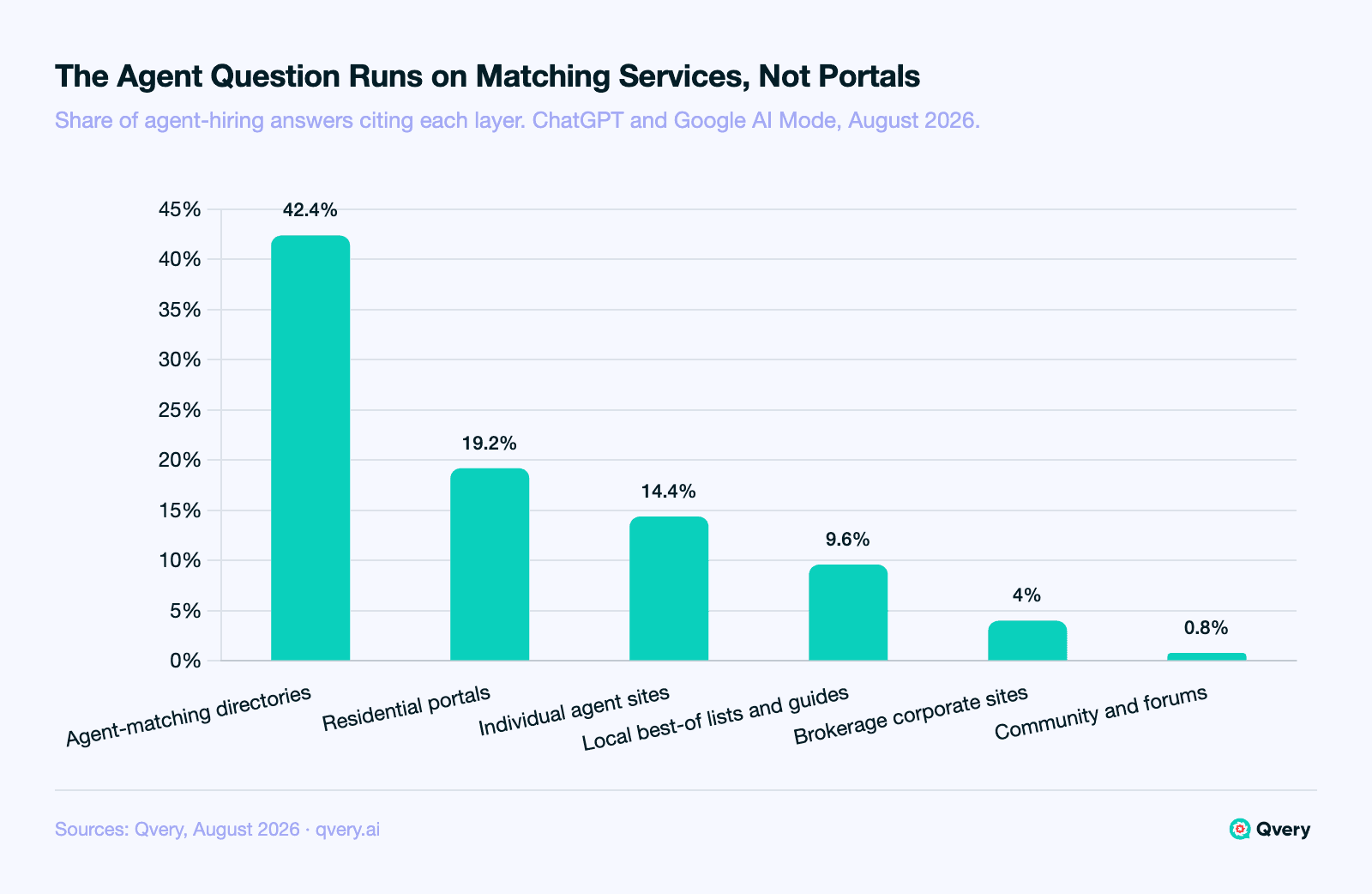
Across a targeted set of city-anchored real estate questions we ran on ChatGPT and Google AI Mode in August 2026 (mostly US metros, with a smaller UK, Canadian, and Australian mix), an agent-matching or rating service was in 42.40% of the answers to agent-hiring questions: HomeLight, FastExpert, UpNest, rate-my-agent.com, GetAgent in the UK, OpenAgent in Australia, and a long tail of smaller peers.
A major residential portal, the Zillow and Realtor.com layer, was in 19.20%.
The layer most agents treat as the front door shows up in about one answer in five. The layer almost nobody optimizes shows up in more than two in five.
The mechanics are unglamorous. A matching service's city page is already the answer to "who are the good agents in Denver": a ranked shortlist with review counts, sales numbers, and service areas, all machine-legible.
The engine does not have to assemble a shortlist from a dozen agent websites when HomeLight has already published one.
These services were built as lead brokers for the pre-AI web, and that turns out to be exactly the format an AI engine wants to quote. The travel version of this pattern is the aggregator layer that carries travel answers; the software version is the review directories. Real estate has its own intermediary layer. This is it.
None of this means a matching-service profile causes a recommendation. What the data says is that the answers that name agents keep being built alongside these services. Being absent from the layer the answers lean on is a bad bet, whatever the causal arrow.
The Portals Own the Listings Question Instead
We also ran a second kind of city question: where to search, which listing site to trust, what the market is doing. This is a second read of the same answers rather than a planned contrast, so treat it as direction, but it is stark: a residential portal was in 55.20% of the listing-search answers, against 19.20% of the agent-hiring answers.
The matching layer mirrors it in reverse: 42.40% on the agent question, 0.80% on the listings one.
Zillow is in the answer when the question is about homes. When the question is about the person who will sell yours, the answer is built somewhere else.
And when the listing-search answers do cite the portals, they mostly cite them as products, not as sources: homepages, app pages, help articles, and portal-versus-portal comparison guides, because the engine is answering "should I browse Zillow or Redfin" rather than pulling a fact out of either.
That is real visibility for the portals and close to worthless for an agent, since a homepage citation names no one.
So the received advice is not wrong so much as aimed at the wrong question. Your Zillow presence is competing inside the 19.20%, not the 55.20%.
Your Website Shows Up More Than the Advice Says, and Still Loses
The question this piece set out to test was whether a portal profile beats your own website as AI-search real estate. Measured on the agent-hiring answers: yes, but it is closer than the folklore suggests, and both trail the matchers.
An individual agent's or team's own site was in 14.40% of answers, ahead of brokerage corporate domains at 4.00%, behind the portals at 19.20%, and a long way behind the matching layer at 42.40%.
Two things are worth sitting with in that row. First, the agent sites that do appear are almost never cited as storefronts. They get cited for content: a commission-fee explainer for that city, a neighborhood buying guide, a "best home search sites" post written by a working realtor. The site earns its way in as a local publisher, not as a brochure.
Second, the near-zero that surprised us: community sources, Reddit included, were in 0.80% of agent-hiring answers. In automotive and travel answers, Reddit is the most-cited domain in our data, and it is not close.
Choosing a stranger to sell your house turns out to be the rare consumer decision where the engines do not reach for strangers on the internet.
At least in the questions we ran this August. If your plan for AI visibility in this vertical was a Reddit play, the answers are not currently listening there.
Inside a Portal, the People Pages Are What the Answers Use
We also read which pages inside the portals the answers cited. Too few of the agent-hiring answers cited a portal at all for a clean statistical split, so take this as direction only.
When an agent-hiring answer reached into a portal, it landed on the people pages, agent profiles and the city agent directories, essentially never on listings. On the listing-search question, agent profile pages vanish from the citations entirely.
Which is roughly how it should work, and it carries a practical point: portal profile completeness is not wasted work, it is just not the first lever.
When the portal layer does get read for the agent question, your profile, your reviews, and your sales history are the pages doing the representing. A thin profile in a cited directory is the one place this data says you are visibly worse than the competitor above you on the same page.
The Play, in the Order the Answers Suggest
The pattern does not prove causation, and we will not pretend it does. But if a source keeps appearing in the answers that name your competitors, absence from it is the expensive option. In the order the presence numbers suggest:
Get onto the matching and rating services that answer your metro. Find which of HomeLight, FastExpert, UpNest, rate-my-agent.com, and their local equivalents show up for your city, then treat those profiles the way you currently treat Zillow: complete, current, review-rich. Most of your competitors have never looked at them.
Finish the portal profiles those answers occasionally reach into. Reviews, transaction history, service areas, the geography fields agents skip. This is the 19.20% layer, and inside it the people pages are what get read.
Mind the local list-makers. Local best-of lists and portal-comparison guides, often from sites you have never heard of, were in 9.60% of agent-hiring answers and 10.40% of listing-search ones. A polite pitch to a "best agents in Charlotte" page is a small, earnable placement in the same most-cited content type in AI search.
Keep the website for conversion and local publishing. The 14.40% says your site can reach the answers, but it gets there on useful city-specific content, not on the storefront pages the advice tells you to polish.
See Which Layer Answers for Your City in Qvery
The numbers above are one August read across many metros. What you need is the same read for your city, on the questions your buyers ask, refreshed as the engines shift.
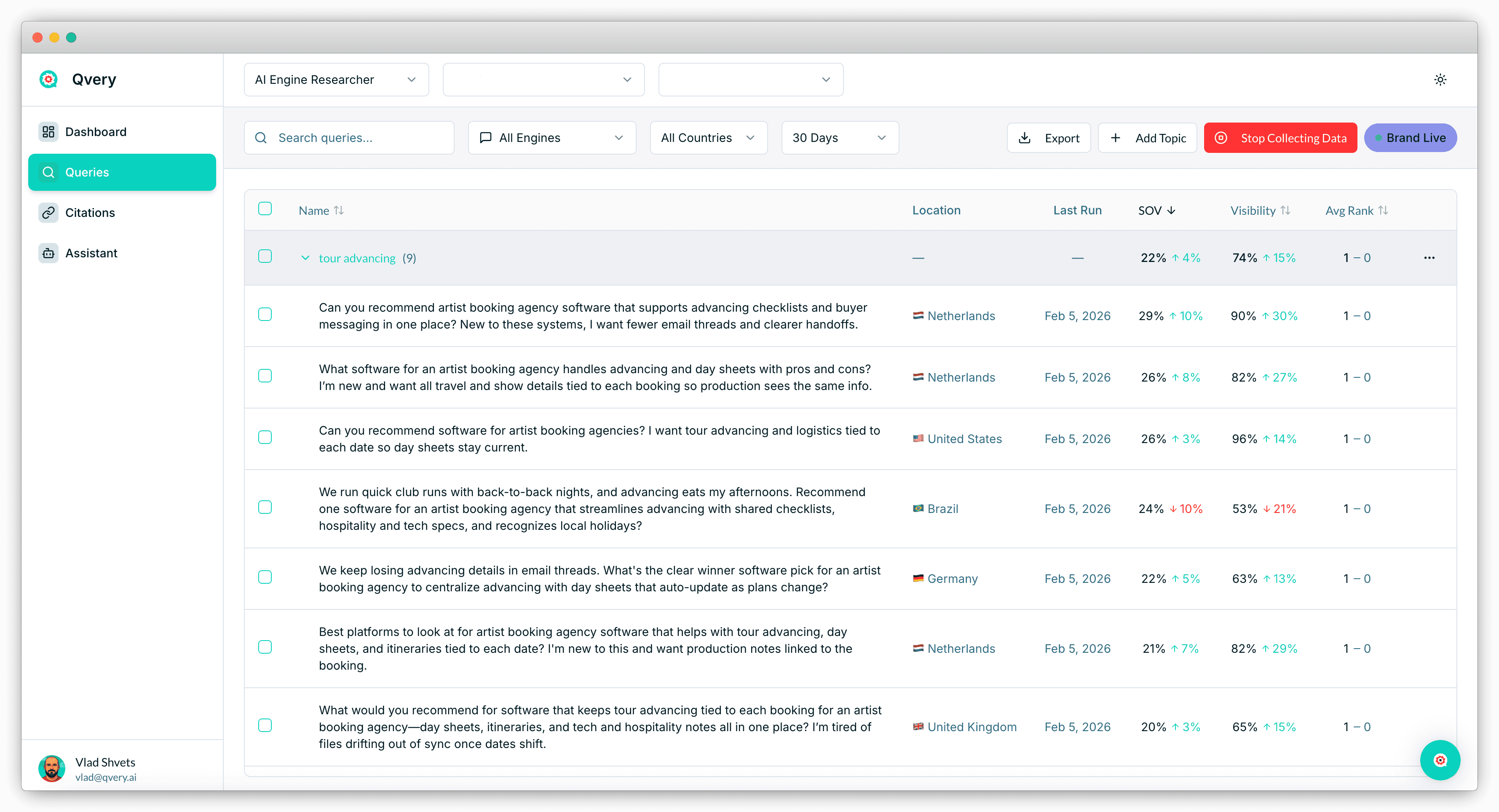
In Qvery, add the agent-hiring questions a buyer in your market would type ("best listing agents in Plano for a fast sale", "good buyer's agent for first-time buyers in Tacoma") as tracked queries. Qvery runs them daily on ChatGPT and Google AI Mode and captures every citation, tied to the query and engine that produced it, alongside your visibility and share of voice per query.
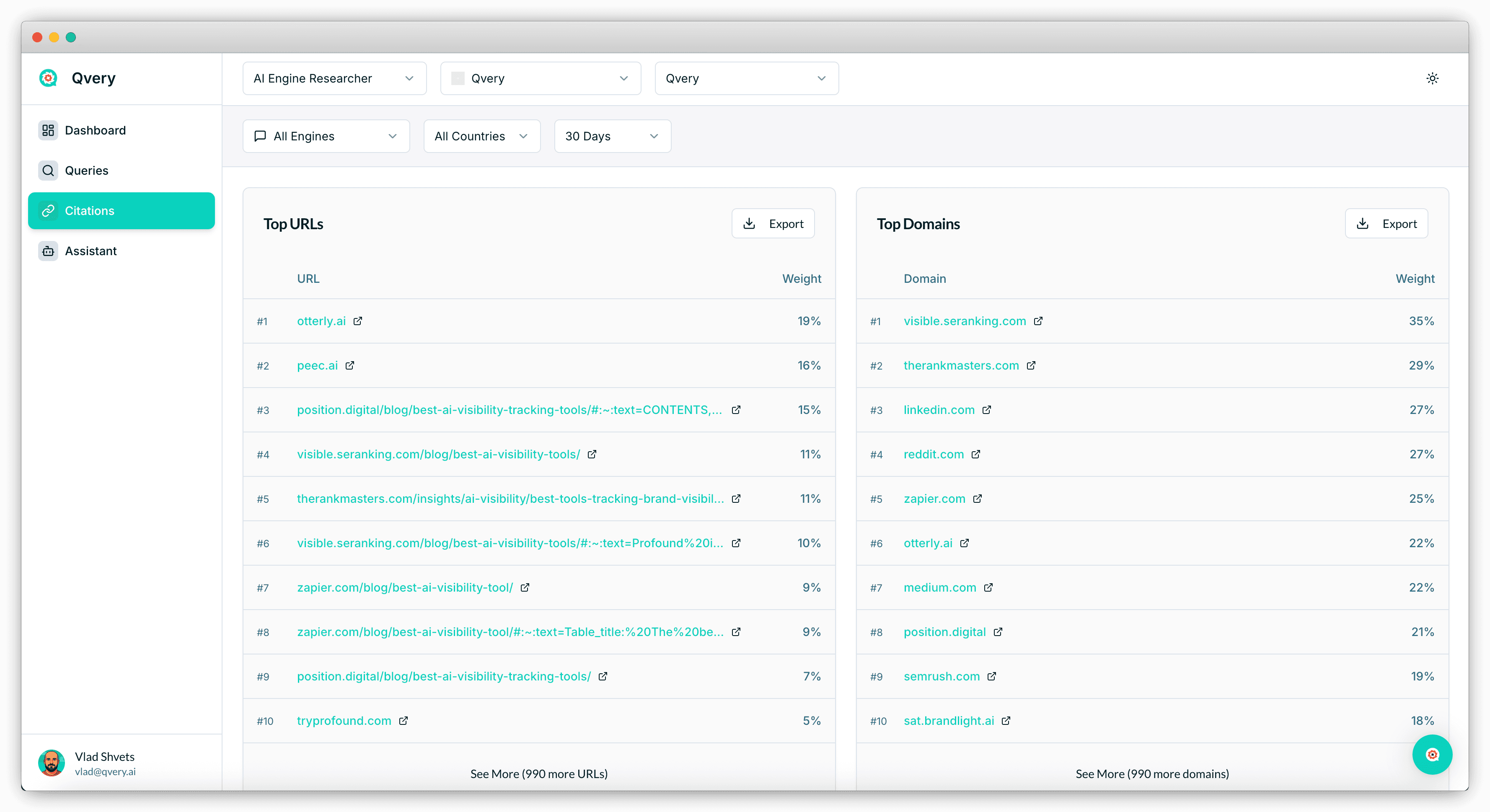
Then open Citations and read the Top Domains list against the layers in this piece: which matching services, which portals, which local list-makers carry your market, and whether you or a competitor is the name inside those answers. The layer labels are your own read of the list, and it takes a few minutes to see where your city's answers come from.
When the visibility number moves after you fill in a matching-service profile, you will know, per query, whether the layer you worked is the layer that answered. Sign up for Qvery, start the free 7-day trial, and run your own metro's questions before you spend another quarter polishing the storefront.
One limit worth naming: Qvery will not tell you which HomeLight rank you hold or what your Zillow reviews say. It tells you whether your market's answers are built from those sources and whether your name is in them, which is what the rest of the plan hangs on.
Start with one list this week: pull the matching services that show up for your metro and read your own presence there the way the engine reads it, ranked, scored, and next to a competitor with more reviews than you. That page is what the answer is being built from while your website waits for a visit that is not coming.
Every agent and broker has heard the same two commandments: complete your Zillow profile, and treat your website as your storefront. Whole marketing budgets are built on them. Teams pay for headshots and listing photography, buy the IDX plugin, rewrite the About page, and check the Zillow reviews weekly, because that is where the next client supposedly finds you.
So we ran the city-anchored questions buyers type when they are choosing an agent, on ChatGPT and Google AI Mode, and read what the answers were built from.
The short version: the portals show up in those answers far less than the advice implies, your own website less than that, and the question is carried by a layer most agents never think about: the agent-matching and rating services. The portals dominate a different question, the one about homes rather than people.
A caveat before the numbers: this is one month's reading, and the direction is not subtle.
The Agent Question Belongs to the Matching Services
Across a targeted set of city-anchored real estate questions we ran on ChatGPT and Google AI Mode in August 2026 (mostly US metros, with a smaller UK, Canadian, and Australian mix), an agent-matching or rating service was in 42.40% of the answers to agent-hiring questions: HomeLight, FastExpert, UpNest, rate-my-agent.com, GetAgent in the UK, OpenAgent in Australia, and a long tail of smaller peers.
A major residential portal, the Zillow and Realtor.com layer, was in 19.20%.
The layer most agents treat as the front door shows up in about one answer in five. The layer almost nobody optimizes shows up in more than two in five.
The mechanics are unglamorous. A matching service's city page is already the answer to "who are the good agents in Denver": a ranked shortlist with review counts, sales numbers, and service areas, all machine-legible.
The engine does not have to assemble a shortlist from a dozen agent websites when HomeLight has already published one.
These services were built as lead brokers for the pre-AI web, and that turns out to be exactly the format an AI engine wants to quote. The travel version of this pattern is the aggregator layer that carries travel answers; the software version is the review directories. Real estate has its own intermediary layer. This is it.
None of this means a matching-service profile causes a recommendation. What the data says is that the answers that name agents keep being built alongside these services. Being absent from the layer the answers lean on is a bad bet, whatever the causal arrow.
The Portals Own the Listings Question Instead
We also ran a second kind of city question: where to search, which listing site to trust, what the market is doing. This is a second read of the same answers rather than a planned contrast, so treat it as direction, but it is stark: a residential portal was in 55.20% of the listing-search answers, against 19.20% of the agent-hiring answers.
The matching layer mirrors it in reverse: 42.40% on the agent question, 0.80% on the listings one.
Zillow is in the answer when the question is about homes. When the question is about the person who will sell yours, the answer is built somewhere else.
And when the listing-search answers do cite the portals, they mostly cite them as products, not as sources: homepages, app pages, help articles, and portal-versus-portal comparison guides, because the engine is answering "should I browse Zillow or Redfin" rather than pulling a fact out of either.
That is real visibility for the portals and close to worthless for an agent, since a homepage citation names no one.
So the received advice is not wrong so much as aimed at the wrong question. Your Zillow presence is competing inside the 19.20%, not the 55.20%.
Your Website Shows Up More Than the Advice Says, and Still Loses
The question this piece set out to test was whether a portal profile beats your own website as AI-search real estate. Measured on the agent-hiring answers: yes, but it is closer than the folklore suggests, and both trail the matchers.
An individual agent's or team's own site was in 14.40% of answers, ahead of brokerage corporate domains at 4.00%, behind the portals at 19.20%, and a long way behind the matching layer at 42.40%.
Two things are worth sitting with in that row. First, the agent sites that do appear are almost never cited as storefronts. They get cited for content: a commission-fee explainer for that city, a neighborhood buying guide, a "best home search sites" post written by a working realtor. The site earns its way in as a local publisher, not as a brochure.
Second, the near-zero that surprised us: community sources, Reddit included, were in 0.80% of agent-hiring answers. In automotive and travel answers, Reddit is the most-cited domain in our data, and it is not close.
Choosing a stranger to sell your house turns out to be the rare consumer decision where the engines do not reach for strangers on the internet.
At least in the questions we ran this August. If your plan for AI visibility in this vertical was a Reddit play, the answers are not currently listening there.
Inside a Portal, the People Pages Are What the Answers Use
We also read which pages inside the portals the answers cited. Too few of the agent-hiring answers cited a portal at all for a clean statistical split, so take this as direction only.
When an agent-hiring answer reached into a portal, it landed on the people pages, agent profiles and the city agent directories, essentially never on listings. On the listing-search question, agent profile pages vanish from the citations entirely.
Which is roughly how it should work, and it carries a practical point: portal profile completeness is not wasted work, it is just not the first lever.
When the portal layer does get read for the agent question, your profile, your reviews, and your sales history are the pages doing the representing. A thin profile in a cited directory is the one place this data says you are visibly worse than the competitor above you on the same page.
The Play, in the Order the Answers Suggest
The pattern does not prove causation, and we will not pretend it does. But if a source keeps appearing in the answers that name your competitors, absence from it is the expensive option. In the order the presence numbers suggest:
Get onto the matching and rating services that answer your metro. Find which of HomeLight, FastExpert, UpNest, rate-my-agent.com, and their local equivalents show up for your city, then treat those profiles the way you currently treat Zillow: complete, current, review-rich. Most of your competitors have never looked at them.
Finish the portal profiles those answers occasionally reach into. Reviews, transaction history, service areas, the geography fields agents skip. This is the 19.20% layer, and inside it the people pages are what get read.
Mind the local list-makers. Local best-of lists and portal-comparison guides, often from sites you have never heard of, were in 9.60% of agent-hiring answers and 10.40% of listing-search ones. A polite pitch to a "best agents in Charlotte" page is a small, earnable placement in the same most-cited content type in AI search.
Keep the website for conversion and local publishing. The 14.40% says your site can reach the answers, but it gets there on useful city-specific content, not on the storefront pages the advice tells you to polish.
See Which Layer Answers for Your City in Qvery
The numbers above are one August read across many metros. What you need is the same read for your city, on the questions your buyers ask, refreshed as the engines shift.
In Qvery, add the agent-hiring questions a buyer in your market would type ("best listing agents in Plano for a fast sale", "good buyer's agent for first-time buyers in Tacoma") as tracked queries. Qvery runs them daily on ChatGPT and Google AI Mode and captures every citation, tied to the query and engine that produced it, alongside your visibility and share of voice per query.
Then open Citations and read the Top Domains list against the layers in this piece: which matching services, which portals, which local list-makers carry your market, and whether you or a competitor is the name inside those answers. The layer labels are your own read of the list, and it takes a few minutes to see where your city's answers come from.
When the visibility number moves after you fill in a matching-service profile, you will know, per query, whether the layer you worked is the layer that answered. Sign up for Qvery, start the free 7-day trial, and run your own metro's questions before you spend another quarter polishing the storefront.
One limit worth naming: Qvery will not tell you which HomeLight rank you hold or what your Zillow reviews say. It tells you whether your market's answers are built from those sources and whether your name is in them, which is what the rest of the plan hangs on.
Start with one list this week: pull the matching services that show up for your metro and read your own presence there the way the engine reads it, ranked, scored, and next to a competitor with more reviews than you. That page is what the answer is being built from while your website waits for a visit that is not coming.
Every agent and broker has heard the same two commandments: complete your Zillow profile, and treat your website as your storefront. Whole marketing budgets are built on them. Teams pay for headshots and listing photography, buy the IDX plugin, rewrite the About page, and check the Zillow reviews weekly, because that is where the next client supposedly finds you.
So we ran the city-anchored questions buyers type when they are choosing an agent, on ChatGPT and Google AI Mode, and read what the answers were built from.
The short version: the portals show up in those answers far less than the advice implies, your own website less than that, and the question is carried by a layer most agents never think about: the agent-matching and rating services. The portals dominate a different question, the one about homes rather than people.
A caveat before the numbers: this is one month's reading, and the direction is not subtle.
The Agent Question Belongs to the Matching Services
Across a targeted set of city-anchored real estate questions we ran on ChatGPT and Google AI Mode in August 2026 (mostly US metros, with a smaller UK, Canadian, and Australian mix), an agent-matching or rating service was in 42.40% of the answers to agent-hiring questions: HomeLight, FastExpert, UpNest, rate-my-agent.com, GetAgent in the UK, OpenAgent in Australia, and a long tail of smaller peers.
A major residential portal, the Zillow and Realtor.com layer, was in 19.20%.
The layer most agents treat as the front door shows up in about one answer in five. The layer almost nobody optimizes shows up in more than two in five.
The mechanics are unglamorous. A matching service's city page is already the answer to "who are the good agents in Denver": a ranked shortlist with review counts, sales numbers, and service areas, all machine-legible.
The engine does not have to assemble a shortlist from a dozen agent websites when HomeLight has already published one.
These services were built as lead brokers for the pre-AI web, and that turns out to be exactly the format an AI engine wants to quote. The travel version of this pattern is the aggregator layer that carries travel answers; the software version is the review directories. Real estate has its own intermediary layer. This is it.
None of this means a matching-service profile causes a recommendation. What the data says is that the answers that name agents keep being built alongside these services. Being absent from the layer the answers lean on is a bad bet, whatever the causal arrow.
The Portals Own the Listings Question Instead
We also ran a second kind of city question: where to search, which listing site to trust, what the market is doing. This is a second read of the same answers rather than a planned contrast, so treat it as direction, but it is stark: a residential portal was in 55.20% of the listing-search answers, against 19.20% of the agent-hiring answers.
The matching layer mirrors it in reverse: 42.40% on the agent question, 0.80% on the listings one.
Zillow is in the answer when the question is about homes. When the question is about the person who will sell yours, the answer is built somewhere else.
And when the listing-search answers do cite the portals, they mostly cite them as products, not as sources: homepages, app pages, help articles, and portal-versus-portal comparison guides, because the engine is answering "should I browse Zillow or Redfin" rather than pulling a fact out of either.
That is real visibility for the portals and close to worthless for an agent, since a homepage citation names no one.
So the received advice is not wrong so much as aimed at the wrong question. Your Zillow presence is competing inside the 19.20%, not the 55.20%.
Your Website Shows Up More Than the Advice Says, and Still Loses
The question this piece set out to test was whether a portal profile beats your own website as AI-search real estate. Measured on the agent-hiring answers: yes, but it is closer than the folklore suggests, and both trail the matchers.
An individual agent's or team's own site was in 14.40% of answers, ahead of brokerage corporate domains at 4.00%, behind the portals at 19.20%, and a long way behind the matching layer at 42.40%.
Two things are worth sitting with in that row. First, the agent sites that do appear are almost never cited as storefronts. They get cited for content: a commission-fee explainer for that city, a neighborhood buying guide, a "best home search sites" post written by a working realtor. The site earns its way in as a local publisher, not as a brochure.
Second, the near-zero that surprised us: community sources, Reddit included, were in 0.80% of agent-hiring answers. In automotive and travel answers, Reddit is the most-cited domain in our data, and it is not close.
Choosing a stranger to sell your house turns out to be the rare consumer decision where the engines do not reach for strangers on the internet.
At least in the questions we ran this August. If your plan for AI visibility in this vertical was a Reddit play, the answers are not currently listening there.
Inside a Portal, the People Pages Are What the Answers Use
We also read which pages inside the portals the answers cited. Too few of the agent-hiring answers cited a portal at all for a clean statistical split, so take this as direction only.
When an agent-hiring answer reached into a portal, it landed on the people pages, agent profiles and the city agent directories, essentially never on listings. On the listing-search question, agent profile pages vanish from the citations entirely.
Which is roughly how it should work, and it carries a practical point: portal profile completeness is not wasted work, it is just not the first lever.
When the portal layer does get read for the agent question, your profile, your reviews, and your sales history are the pages doing the representing. A thin profile in a cited directory is the one place this data says you are visibly worse than the competitor above you on the same page.
The Play, in the Order the Answers Suggest
The pattern does not prove causation, and we will not pretend it does. But if a source keeps appearing in the answers that name your competitors, absence from it is the expensive option. In the order the presence numbers suggest:
Get onto the matching and rating services that answer your metro. Find which of HomeLight, FastExpert, UpNest, rate-my-agent.com, and their local equivalents show up for your city, then treat those profiles the way you currently treat Zillow: complete, current, review-rich. Most of your competitors have never looked at them.
Finish the portal profiles those answers occasionally reach into. Reviews, transaction history, service areas, the geography fields agents skip. This is the 19.20% layer, and inside it the people pages are what get read.
Mind the local list-makers. Local best-of lists and portal-comparison guides, often from sites you have never heard of, were in 9.60% of agent-hiring answers and 10.40% of listing-search ones. A polite pitch to a "best agents in Charlotte" page is a small, earnable placement in the same most-cited content type in AI search.
Keep the website for conversion and local publishing. The 14.40% says your site can reach the answers, but it gets there on useful city-specific content, not on the storefront pages the advice tells you to polish.
See Which Layer Answers for Your City in Qvery
The numbers above are one August read across many metros. What you need is the same read for your city, on the questions your buyers ask, refreshed as the engines shift.
In Qvery, add the agent-hiring questions a buyer in your market would type ("best listing agents in Plano for a fast sale", "good buyer's agent for first-time buyers in Tacoma") as tracked queries. Qvery runs them daily on ChatGPT and Google AI Mode and captures every citation, tied to the query and engine that produced it, alongside your visibility and share of voice per query.
Then open Citations and read the Top Domains list against the layers in this piece: which matching services, which portals, which local list-makers carry your market, and whether you or a competitor is the name inside those answers. The layer labels are your own read of the list, and it takes a few minutes to see where your city's answers come from.
When the visibility number moves after you fill in a matching-service profile, you will know, per query, whether the layer you worked is the layer that answered. Sign up for Qvery, start the free 7-day trial, and run your own metro's questions before you spend another quarter polishing the storefront.
One limit worth naming: Qvery will not tell you which HomeLight rank you hold or what your Zillow reviews say. It tells you whether your market's answers are built from those sources and whether your name is in them, which is what the rest of the plan hangs on.
Start with one list this week: pull the matching services that show up for your metro and read your own presence there the way the engine reads it, ranked, scored, and next to a competitor with more reviews than you. That page is what the answer is being built from while your website waits for a visit that is not coming.
Every agent and broker has heard the same two commandments: complete your Zillow profile, and treat your website as your storefront. Whole marketing budgets are built on them. Teams pay for headshots and listing photography, buy the IDX plugin, rewrite the About page, and check the Zillow reviews weekly, because that is where the next client supposedly finds you.
So we ran the city-anchored questions buyers type when they are choosing an agent, on ChatGPT and Google AI Mode, and read what the answers were built from.
The short version: the portals show up in those answers far less than the advice implies, your own website less than that, and the question is carried by a layer most agents never think about: the agent-matching and rating services. The portals dominate a different question, the one about homes rather than people.
A caveat before the numbers: this is one month's reading, and the direction is not subtle.
The Agent Question Belongs to the Matching Services
Across a targeted set of city-anchored real estate questions we ran on ChatGPT and Google AI Mode in August 2026 (mostly US metros, with a smaller UK, Canadian, and Australian mix), an agent-matching or rating service was in 42.40% of the answers to agent-hiring questions: HomeLight, FastExpert, UpNest, rate-my-agent.com, GetAgent in the UK, OpenAgent in Australia, and a long tail of smaller peers.
A major residential portal, the Zillow and Realtor.com layer, was in 19.20%.
The layer most agents treat as the front door shows up in about one answer in five. The layer almost nobody optimizes shows up in more than two in five.
The mechanics are unglamorous. A matching service's city page is already the answer to "who are the good agents in Denver": a ranked shortlist with review counts, sales numbers, and service areas, all machine-legible.
The engine does not have to assemble a shortlist from a dozen agent websites when HomeLight has already published one.
These services were built as lead brokers for the pre-AI web, and that turns out to be exactly the format an AI engine wants to quote. The travel version of this pattern is the aggregator layer that carries travel answers; the software version is the review directories. Real estate has its own intermediary layer. This is it.
None of this means a matching-service profile causes a recommendation. What the data says is that the answers that name agents keep being built alongside these services. Being absent from the layer the answers lean on is a bad bet, whatever the causal arrow.
The Portals Own the Listings Question Instead
We also ran a second kind of city question: where to search, which listing site to trust, what the market is doing. This is a second read of the same answers rather than a planned contrast, so treat it as direction, but it is stark: a residential portal was in 55.20% of the listing-search answers, against 19.20% of the agent-hiring answers.
The matching layer mirrors it in reverse: 42.40% on the agent question, 0.80% on the listings one.
Zillow is in the answer when the question is about homes. When the question is about the person who will sell yours, the answer is built somewhere else.
And when the listing-search answers do cite the portals, they mostly cite them as products, not as sources: homepages, app pages, help articles, and portal-versus-portal comparison guides, because the engine is answering "should I browse Zillow or Redfin" rather than pulling a fact out of either.
That is real visibility for the portals and close to worthless for an agent, since a homepage citation names no one.
So the received advice is not wrong so much as aimed at the wrong question. Your Zillow presence is competing inside the 19.20%, not the 55.20%.
Your Website Shows Up More Than the Advice Says, and Still Loses
The question this piece set out to test was whether a portal profile beats your own website as AI-search real estate. Measured on the agent-hiring answers: yes, but it is closer than the folklore suggests, and both trail the matchers.
An individual agent's or team's own site was in 14.40% of answers, ahead of brokerage corporate domains at 4.00%, behind the portals at 19.20%, and a long way behind the matching layer at 42.40%.
Two things are worth sitting with in that row. First, the agent sites that do appear are almost never cited as storefronts. They get cited for content: a commission-fee explainer for that city, a neighborhood buying guide, a "best home search sites" post written by a working realtor. The site earns its way in as a local publisher, not as a brochure.
Second, the near-zero that surprised us: community sources, Reddit included, were in 0.80% of agent-hiring answers. In automotive and travel answers, Reddit is the most-cited domain in our data, and it is not close.
Choosing a stranger to sell your house turns out to be the rare consumer decision where the engines do not reach for strangers on the internet.
At least in the questions we ran this August. If your plan for AI visibility in this vertical was a Reddit play, the answers are not currently listening there.
Inside a Portal, the People Pages Are What the Answers Use
We also read which pages inside the portals the answers cited. Too few of the agent-hiring answers cited a portal at all for a clean statistical split, so take this as direction only.
When an agent-hiring answer reached into a portal, it landed on the people pages, agent profiles and the city agent directories, essentially never on listings. On the listing-search question, agent profile pages vanish from the citations entirely.
Which is roughly how it should work, and it carries a practical point: portal profile completeness is not wasted work, it is just not the first lever.
When the portal layer does get read for the agent question, your profile, your reviews, and your sales history are the pages doing the representing. A thin profile in a cited directory is the one place this data says you are visibly worse than the competitor above you on the same page.
The Play, in the Order the Answers Suggest
The pattern does not prove causation, and we will not pretend it does. But if a source keeps appearing in the answers that name your competitors, absence from it is the expensive option. In the order the presence numbers suggest:
Get onto the matching and rating services that answer your metro. Find which of HomeLight, FastExpert, UpNest, rate-my-agent.com, and their local equivalents show up for your city, then treat those profiles the way you currently treat Zillow: complete, current, review-rich. Most of your competitors have never looked at them.
Finish the portal profiles those answers occasionally reach into. Reviews, transaction history, service areas, the geography fields agents skip. This is the 19.20% layer, and inside it the people pages are what get read.
Mind the local list-makers. Local best-of lists and portal-comparison guides, often from sites you have never heard of, were in 9.60% of agent-hiring answers and 10.40% of listing-search ones. A polite pitch to a "best agents in Charlotte" page is a small, earnable placement in the same most-cited content type in AI search.
Keep the website for conversion and local publishing. The 14.40% says your site can reach the answers, but it gets there on useful city-specific content, not on the storefront pages the advice tells you to polish.
See Which Layer Answers for Your City in Qvery
The numbers above are one August read across many metros. What you need is the same read for your city, on the questions your buyers ask, refreshed as the engines shift.
In Qvery, add the agent-hiring questions a buyer in your market would type ("best listing agents in Plano for a fast sale", "good buyer's agent for first-time buyers in Tacoma") as tracked queries. Qvery runs them daily on ChatGPT and Google AI Mode and captures every citation, tied to the query and engine that produced it, alongside your visibility and share of voice per query.
Then open Citations and read the Top Domains list against the layers in this piece: which matching services, which portals, which local list-makers carry your market, and whether you or a competitor is the name inside those answers. The layer labels are your own read of the list, and it takes a few minutes to see where your city's answers come from.
When the visibility number moves after you fill in a matching-service profile, you will know, per query, whether the layer you worked is the layer that answered. Sign up for Qvery, start the free 7-day trial, and run your own metro's questions before you spend another quarter polishing the storefront.
One limit worth naming: Qvery will not tell you which HomeLight rank you hold or what your Zillow reviews say. It tells you whether your market's answers are built from those sources and whether your name is in them, which is what the rest of the plan hangs on.
Start with one list this week: pull the matching services that show up for your metro and read your own presence there the way the engine reads it, ranked, scored, and next to a competitor with more reviews than you. That page is what the answer is being built from while your website waits for a visit that is not coming.

© 2026 Qvery AI OÜ