By
Vlad Shvets
Online Education AI Search Statistics 2026: What Course Answers Cite, Plus 10 Numbers on Learners Using AI
How ChatGPT and Google AI Mode answer course and program questions: platform, community and brand-owned sources by question type, the domains to audit, and 10 numbers on learners using AI.
How ChatGPT and Google AI Mode answer course and program questions: platform, community and brand-owned sources by question type, the domains to audit, and 10 numbers on learners using AI.
How ChatGPT and Google AI Mode answer course and program questions: platform, community and brand-owned sources by question type, the domains to audit, and 10 numbers on learners using AI.
When someone asks ChatGPT or Google AI Mode which course or program to take, a platform or community source is cited in 42.36% of the answers (305 of 720 valid recommendation answers). When they ask how something in education works, the share drops to 12.37% (35 of 283 valid informational answers), both engines with runs pooled.
That gap raises one question for anyone marketing a course or program: can recommendation and informational course questions be tracked as one set, or do they need two?
What Was Measured
We ran a frozen set of course- and program-selection questions in September 2026, split into recommendation questions and informational ones. That gave 720 valid recommendation answers (540 ChatGPT, 180 Google AI Mode) and 283 valid informational answers (213 ChatGPT, 70 Google AI Mode).
Of those, 709 and 234 cited at least one source, and no answer was left unresolved.
Two denominators appear below. Layer rates are shares of all valid answers in the intent. Domain lists and their coverage are of answers that cited any source in the named slice.
Platforms and Communities Appear Far More in Course Recommendations
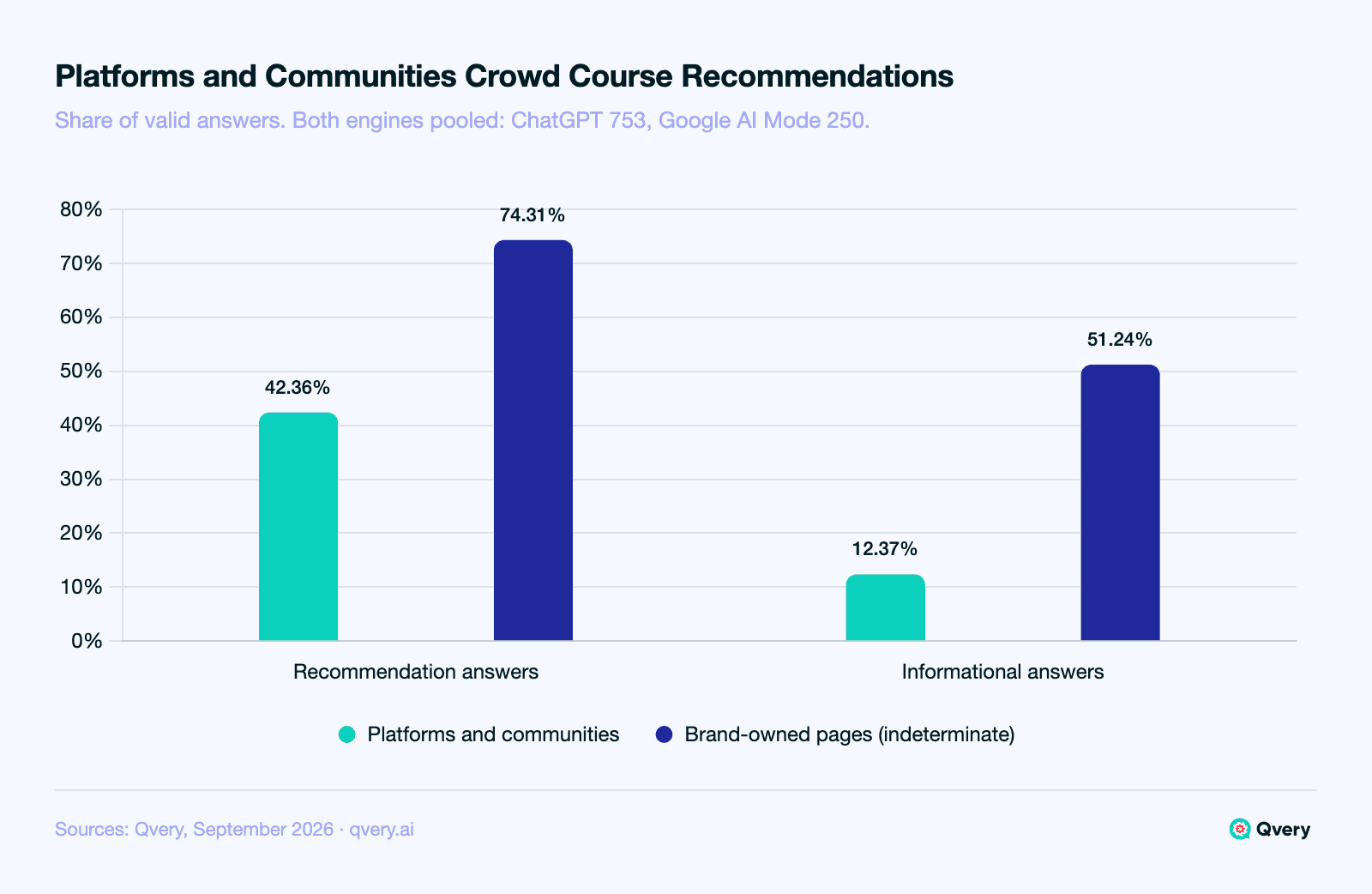
Platform and community sources appear alongside 305 of 720 valid recommendation answers (42.36%) and 35 of 283 valid informational answers (12.37%). The informational-to-recommendation ratio is 0.29, well inside the recommendation direction.
Before the runs we expected the opposite, more platform and community citations in informational answers. The data went the other way.
These are counts of what appeared alongside an answer.
They do not say a platform citation turns an answer into a recommendation.
One engine detail for context: of Google AI Mode's 180 valid recommendation answers, platform and community sources appear in 117 (65.00%) and brand-owned pages in 116 (64.44%), about as often. Our guide to getting AI search engines to recommend your online course covers what to do about it.
Brand-Owned Pages Appear Often in Both Kinds of Question
Brand-owned pages appear in 535 of 720 valid recommendation answers (74.31%) and 145 of 283 valid informational answers (51.24%). The recommendation-to-informational ratio is 1.45, which sits in the indeterminate band: common in both, with no direction the registered test can confirm.
Carnegie advises institutions to prepare by "publishing detailed program pages, including FAQs that answer common student questions". The corpus confirms brand-owned pages are cited in both kinds of answer.
It cannot show which page features earn a citation.
UPCEA describes a program page as "the foundation, supported by signals from your course catalog, faculty profiles, PDFs, social presence, third-party ranking sites, and news mentions."
Recommendation answers here carry both brand-owned and platform or community sources. Which asset types an engine picked, and why, is outside what this corpus can see.
Brand-owned pages sit in about three of every four course recommendations, and platforms and communities in about two of every five.
Which Domains to Audit for Each Kind of Course Question
Half of the recommendation answers that cited any source are covered by eight domains; half of the informational ones by six.
Recommendation 50% head (of the 709 recommendation answers that cited any source): coursera.org, reddit.com, coursereport.com, khanacademy.org, babbel.com, skillshare.com, youtube.com, wyzant.com.
Informational 50% head (of the 234 informational answers that cited any source): nih.gov, ed.gov, bls.gov, coursera.org, cirr.org, dol.gov.
Recommendation 80% list: the eight above plus launchpadcareer.com, asu.edu, ed.gov, techsifted.com, lsac.org, magoosh.com, springboard.com, classcentral.com, edu.au, cloudspress.com, pmi.org, tripleten.com, archerreview.com, prnewswire.com, apple.com, princetonreview.com, bestcolleges.com, duolingo.com, gc.ca, lingostar.ai.
Informational 80% list: the six above plus edu.au, reddit.com, ucsd.edu, ftc.gov, naceweb.org, pmi.org, sciencedirect.com, cfainstitute.org, gov.uk, microsoft.com, ankiweb.net, apa.org, coursereport.com, exampractice.org, wiley.com.
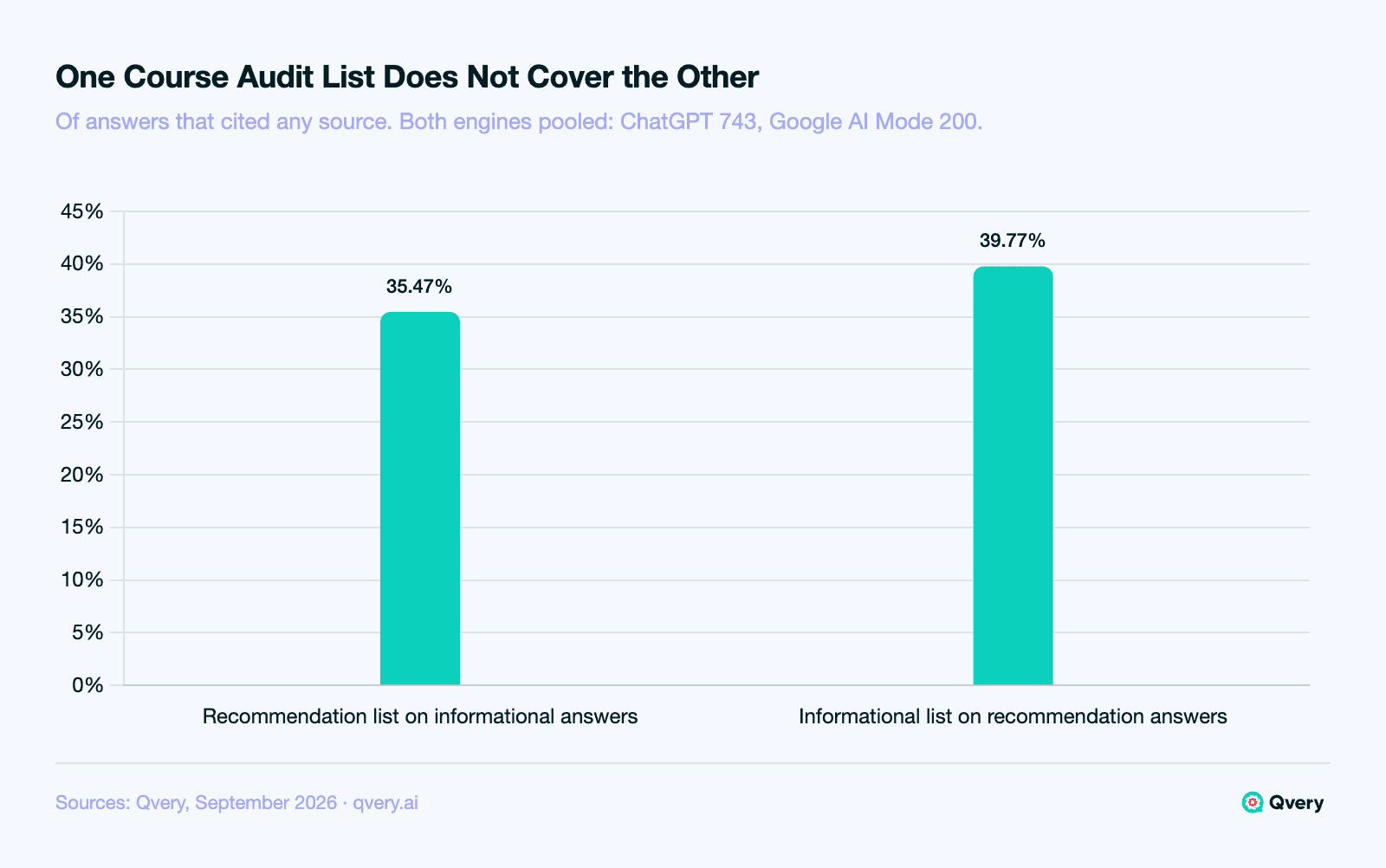
The recommendation list covers 35.47% of informational answers that cited any source, and the informational list covers 39.77% of recommendation answers that cited any source. The smaller, 0.3547, is below the 0.60 bar, so each kind of question needs its own list.
Aleyda Solis makes the case for separating prompt types: "Non-branded prompts show whether your brand appears during discovery and selection." For the two intents measured here, the lists bear that out.
EAB puts the wider point plainly: "visibility varies by prompt, platform, version, and timing." This corpus confirms the prompt part for these two intents; it makes no claim about platforms one by one.
For the audit method itself, our guide to measuring an education brand's AI visibility splits by education market rather than by question type, so read it for the method.
Are Prospective Students Asking AI While They Choose Where to Study?
These are external surveys, each with its own population and date.
EAB's survey of more than 5,000 high-school students, published in February 2026, found 46 percent use AI tools such as ChatGPT during their college search.
In the same survey, 18 percent had removed a college from consideration based on information surfaced through AI-generated search results.
How Many of the Learners You Recruit Already Use AI Tools?
U.S. teens: Pew Research Center found 26% of teens ages 13 to 17 used ChatGPT for schoolwork in its January 2025 report, up from 13% in 2023, and 31% of 11th and 12th graders did.
UK undergraduates: the Higher Education Policy Institute found 92% used an AI tool in its 2025 survey, up from 66% the year before, and 95% reported using AI in at least one way in 2026.
Prospective U.S. college students: Ruffalo Noel Levitz found 68% of students in grades 9 to 12 have used AI-powered chatbots, in a study published in June 2025.
Learners surveyed by Jobs for the Future: in its 2025 survey of workers and learners, 70% of learners used AI for their education at least weekly.
These surveys measure AI use, general in some and educational in others.
Each counts a different population.
Track Both Kinds of Course Question in Qvery
Qvery tracks visibility, share of voice and average rank across ChatGPT and Google AI Mode daily, in 200+ countries, and ties every citation to the query and engine that produced it. You add and edit your own topics and queries, so recommendation and informational course questions can run as two separate topics.
Qvery Assistant sits in the app and answers plain-language questions about your own data. For the wider picture of how institutions show up, see our look at education institutions' AI visibility.
Start your free trial: 7 days free on the paid plans, self-serve checkout, and no credit card required.
What These Numbers Do Not Say
The corpus is the frozen September education question set, recommendation and informational questions only, ChatGPT and Google AI Mode runs pooled. It says nothing about how students behave, why an engine selects a source, what content investment pays off, or how the two engines differ. June is not compared, because the instruments differ.
Clicks after an AI summary were not measured here; our AI media statistics cover them. The external surveys are context, never a corpus finding.
What to Do With This
Track recommendation and informational course questions as two separate sets, each with its own baseline: platform and community sources sit in 42.36% of recommendation answers and 12.37% of informational ones, and brand-owned pages are common in both.
Then build each set's domain list with the method in our education measurement guide, starting from the heads above.
When someone asks ChatGPT or Google AI Mode which course or program to take, a platform or community source is cited in 42.36% of the answers (305 of 720 valid recommendation answers). When they ask how something in education works, the share drops to 12.37% (35 of 283 valid informational answers), both engines with runs pooled.
That gap raises one question for anyone marketing a course or program: can recommendation and informational course questions be tracked as one set, or do they need two?
What Was Measured
We ran a frozen set of course- and program-selection questions in September 2026, split into recommendation questions and informational ones. That gave 720 valid recommendation answers (540 ChatGPT, 180 Google AI Mode) and 283 valid informational answers (213 ChatGPT, 70 Google AI Mode).
Of those, 709 and 234 cited at least one source, and no answer was left unresolved.
Two denominators appear below. Layer rates are shares of all valid answers in the intent. Domain lists and their coverage are of answers that cited any source in the named slice.
Platforms and Communities Appear Far More in Course Recommendations
Platform and community sources appear alongside 305 of 720 valid recommendation answers (42.36%) and 35 of 283 valid informational answers (12.37%). The informational-to-recommendation ratio is 0.29, well inside the recommendation direction.
Before the runs we expected the opposite, more platform and community citations in informational answers. The data went the other way.
These are counts of what appeared alongside an answer.
They do not say a platform citation turns an answer into a recommendation.
One engine detail for context: of Google AI Mode's 180 valid recommendation answers, platform and community sources appear in 117 (65.00%) and brand-owned pages in 116 (64.44%), about as often. Our guide to getting AI search engines to recommend your online course covers what to do about it.
Brand-Owned Pages Appear Often in Both Kinds of Question
Brand-owned pages appear in 535 of 720 valid recommendation answers (74.31%) and 145 of 283 valid informational answers (51.24%). The recommendation-to-informational ratio is 1.45, which sits in the indeterminate band: common in both, with no direction the registered test can confirm.
Carnegie advises institutions to prepare by "publishing detailed program pages, including FAQs that answer common student questions". The corpus confirms brand-owned pages are cited in both kinds of answer.
It cannot show which page features earn a citation.
UPCEA describes a program page as "the foundation, supported by signals from your course catalog, faculty profiles, PDFs, social presence, third-party ranking sites, and news mentions."
Recommendation answers here carry both brand-owned and platform or community sources. Which asset types an engine picked, and why, is outside what this corpus can see.
Brand-owned pages sit in about three of every four course recommendations, and platforms and communities in about two of every five.
Which Domains to Audit for Each Kind of Course Question
Half of the recommendation answers that cited any source are covered by eight domains; half of the informational ones by six.
Recommendation 50% head (of the 709 recommendation answers that cited any source): coursera.org, reddit.com, coursereport.com, khanacademy.org, babbel.com, skillshare.com, youtube.com, wyzant.com.
Informational 50% head (of the 234 informational answers that cited any source): nih.gov, ed.gov, bls.gov, coursera.org, cirr.org, dol.gov.
Recommendation 80% list: the eight above plus launchpadcareer.com, asu.edu, ed.gov, techsifted.com, lsac.org, magoosh.com, springboard.com, classcentral.com, edu.au, cloudspress.com, pmi.org, tripleten.com, archerreview.com, prnewswire.com, apple.com, princetonreview.com, bestcolleges.com, duolingo.com, gc.ca, lingostar.ai.
Informational 80% list: the six above plus edu.au, reddit.com, ucsd.edu, ftc.gov, naceweb.org, pmi.org, sciencedirect.com, cfainstitute.org, gov.uk, microsoft.com, ankiweb.net, apa.org, coursereport.com, exampractice.org, wiley.com.
The recommendation list covers 35.47% of informational answers that cited any source, and the informational list covers 39.77% of recommendation answers that cited any source. The smaller, 0.3547, is below the 0.60 bar, so each kind of question needs its own list.
Aleyda Solis makes the case for separating prompt types: "Non-branded prompts show whether your brand appears during discovery and selection." For the two intents measured here, the lists bear that out.
EAB puts the wider point plainly: "visibility varies by prompt, platform, version, and timing." This corpus confirms the prompt part for these two intents; it makes no claim about platforms one by one.
For the audit method itself, our guide to measuring an education brand's AI visibility splits by education market rather than by question type, so read it for the method.
Are Prospective Students Asking AI While They Choose Where to Study?
These are external surveys, each with its own population and date.
EAB's survey of more than 5,000 high-school students, published in February 2026, found 46 percent use AI tools such as ChatGPT during their college search.
In the same survey, 18 percent had removed a college from consideration based on information surfaced through AI-generated search results.
How Many of the Learners You Recruit Already Use AI Tools?
U.S. teens: Pew Research Center found 26% of teens ages 13 to 17 used ChatGPT for schoolwork in its January 2025 report, up from 13% in 2023, and 31% of 11th and 12th graders did.
UK undergraduates: the Higher Education Policy Institute found 92% used an AI tool in its 2025 survey, up from 66% the year before, and 95% reported using AI in at least one way in 2026.
Prospective U.S. college students: Ruffalo Noel Levitz found 68% of students in grades 9 to 12 have used AI-powered chatbots, in a study published in June 2025.
Learners surveyed by Jobs for the Future: in its 2025 survey of workers and learners, 70% of learners used AI for their education at least weekly.
These surveys measure AI use, general in some and educational in others.
Each counts a different population.
Track Both Kinds of Course Question in Qvery
Qvery tracks visibility, share of voice and average rank across ChatGPT and Google AI Mode daily, in 200+ countries, and ties every citation to the query and engine that produced it. You add and edit your own topics and queries, so recommendation and informational course questions can run as two separate topics.
Qvery Assistant sits in the app and answers plain-language questions about your own data. For the wider picture of how institutions show up, see our look at education institutions' AI visibility.
Start your free trial: 7 days free on the paid plans, self-serve checkout, and no credit card required.
What These Numbers Do Not Say
The corpus is the frozen September education question set, recommendation and informational questions only, ChatGPT and Google AI Mode runs pooled. It says nothing about how students behave, why an engine selects a source, what content investment pays off, or how the two engines differ. June is not compared, because the instruments differ.
Clicks after an AI summary were not measured here; our AI media statistics cover them. The external surveys are context, never a corpus finding.
What to Do With This
Track recommendation and informational course questions as two separate sets, each with its own baseline: platform and community sources sit in 42.36% of recommendation answers and 12.37% of informational ones, and brand-owned pages are common in both.
Then build each set's domain list with the method in our education measurement guide, starting from the heads above.
When someone asks ChatGPT or Google AI Mode which course or program to take, a platform or community source is cited in 42.36% of the answers (305 of 720 valid recommendation answers). When they ask how something in education works, the share drops to 12.37% (35 of 283 valid informational answers), both engines with runs pooled.
That gap raises one question for anyone marketing a course or program: can recommendation and informational course questions be tracked as one set, or do they need two?
What Was Measured
We ran a frozen set of course- and program-selection questions in September 2026, split into recommendation questions and informational ones. That gave 720 valid recommendation answers (540 ChatGPT, 180 Google AI Mode) and 283 valid informational answers (213 ChatGPT, 70 Google AI Mode).
Of those, 709 and 234 cited at least one source, and no answer was left unresolved.
Two denominators appear below. Layer rates are shares of all valid answers in the intent. Domain lists and their coverage are of answers that cited any source in the named slice.
Platforms and Communities Appear Far More in Course Recommendations
Platform and community sources appear alongside 305 of 720 valid recommendation answers (42.36%) and 35 of 283 valid informational answers (12.37%). The informational-to-recommendation ratio is 0.29, well inside the recommendation direction.
Before the runs we expected the opposite, more platform and community citations in informational answers. The data went the other way.
These are counts of what appeared alongside an answer.
They do not say a platform citation turns an answer into a recommendation.
One engine detail for context: of Google AI Mode's 180 valid recommendation answers, platform and community sources appear in 117 (65.00%) and brand-owned pages in 116 (64.44%), about as often. Our guide to getting AI search engines to recommend your online course covers what to do about it.
Brand-Owned Pages Appear Often in Both Kinds of Question
Brand-owned pages appear in 535 of 720 valid recommendation answers (74.31%) and 145 of 283 valid informational answers (51.24%). The recommendation-to-informational ratio is 1.45, which sits in the indeterminate band: common in both, with no direction the registered test can confirm.
Carnegie advises institutions to prepare by "publishing detailed program pages, including FAQs that answer common student questions". The corpus confirms brand-owned pages are cited in both kinds of answer.
It cannot show which page features earn a citation.
UPCEA describes a program page as "the foundation, supported by signals from your course catalog, faculty profiles, PDFs, social presence, third-party ranking sites, and news mentions."
Recommendation answers here carry both brand-owned and platform or community sources. Which asset types an engine picked, and why, is outside what this corpus can see.
Brand-owned pages sit in about three of every four course recommendations, and platforms and communities in about two of every five.
Which Domains to Audit for Each Kind of Course Question
Half of the recommendation answers that cited any source are covered by eight domains; half of the informational ones by six.
Recommendation 50% head (of the 709 recommendation answers that cited any source): coursera.org, reddit.com, coursereport.com, khanacademy.org, babbel.com, skillshare.com, youtube.com, wyzant.com.
Informational 50% head (of the 234 informational answers that cited any source): nih.gov, ed.gov, bls.gov, coursera.org, cirr.org, dol.gov.
Recommendation 80% list: the eight above plus launchpadcareer.com, asu.edu, ed.gov, techsifted.com, lsac.org, magoosh.com, springboard.com, classcentral.com, edu.au, cloudspress.com, pmi.org, tripleten.com, archerreview.com, prnewswire.com, apple.com, princetonreview.com, bestcolleges.com, duolingo.com, gc.ca, lingostar.ai.
Informational 80% list: the six above plus edu.au, reddit.com, ucsd.edu, ftc.gov, naceweb.org, pmi.org, sciencedirect.com, cfainstitute.org, gov.uk, microsoft.com, ankiweb.net, apa.org, coursereport.com, exampractice.org, wiley.com.
The recommendation list covers 35.47% of informational answers that cited any source, and the informational list covers 39.77% of recommendation answers that cited any source. The smaller, 0.3547, is below the 0.60 bar, so each kind of question needs its own list.
Aleyda Solis makes the case for separating prompt types: "Non-branded prompts show whether your brand appears during discovery and selection." For the two intents measured here, the lists bear that out.
EAB puts the wider point plainly: "visibility varies by prompt, platform, version, and timing." This corpus confirms the prompt part for these two intents; it makes no claim about platforms one by one.
For the audit method itself, our guide to measuring an education brand's AI visibility splits by education market rather than by question type, so read it for the method.
Are Prospective Students Asking AI While They Choose Where to Study?
These are external surveys, each with its own population and date.
EAB's survey of more than 5,000 high-school students, published in February 2026, found 46 percent use AI tools such as ChatGPT during their college search.
In the same survey, 18 percent had removed a college from consideration based on information surfaced through AI-generated search results.
How Many of the Learners You Recruit Already Use AI Tools?
U.S. teens: Pew Research Center found 26% of teens ages 13 to 17 used ChatGPT for schoolwork in its January 2025 report, up from 13% in 2023, and 31% of 11th and 12th graders did.
UK undergraduates: the Higher Education Policy Institute found 92% used an AI tool in its 2025 survey, up from 66% the year before, and 95% reported using AI in at least one way in 2026.
Prospective U.S. college students: Ruffalo Noel Levitz found 68% of students in grades 9 to 12 have used AI-powered chatbots, in a study published in June 2025.
Learners surveyed by Jobs for the Future: in its 2025 survey of workers and learners, 70% of learners used AI for their education at least weekly.
These surveys measure AI use, general in some and educational in others.
Each counts a different population.
Track Both Kinds of Course Question in Qvery
Qvery tracks visibility, share of voice and average rank across ChatGPT and Google AI Mode daily, in 200+ countries, and ties every citation to the query and engine that produced it. You add and edit your own topics and queries, so recommendation and informational course questions can run as two separate topics.
Qvery Assistant sits in the app and answers plain-language questions about your own data. For the wider picture of how institutions show up, see our look at education institutions' AI visibility.
Start your free trial: 7 days free on the paid plans, self-serve checkout, and no credit card required.
What These Numbers Do Not Say
The corpus is the frozen September education question set, recommendation and informational questions only, ChatGPT and Google AI Mode runs pooled. It says nothing about how students behave, why an engine selects a source, what content investment pays off, or how the two engines differ. June is not compared, because the instruments differ.
Clicks after an AI summary were not measured here; our AI media statistics cover them. The external surveys are context, never a corpus finding.
What to Do With This
Track recommendation and informational course questions as two separate sets, each with its own baseline: platform and community sources sit in 42.36% of recommendation answers and 12.37% of informational ones, and brand-owned pages are common in both.
Then build each set's domain list with the method in our education measurement guide, starting from the heads above.
When someone asks ChatGPT or Google AI Mode which course or program to take, a platform or community source is cited in 42.36% of the answers (305 of 720 valid recommendation answers). When they ask how something in education works, the share drops to 12.37% (35 of 283 valid informational answers), both engines with runs pooled.
That gap raises one question for anyone marketing a course or program: can recommendation and informational course questions be tracked as one set, or do they need two?
What Was Measured
We ran a frozen set of course- and program-selection questions in September 2026, split into recommendation questions and informational ones. That gave 720 valid recommendation answers (540 ChatGPT, 180 Google AI Mode) and 283 valid informational answers (213 ChatGPT, 70 Google AI Mode).
Of those, 709 and 234 cited at least one source, and no answer was left unresolved.
Two denominators appear below. Layer rates are shares of all valid answers in the intent. Domain lists and their coverage are of answers that cited any source in the named slice.
Platforms and Communities Appear Far More in Course Recommendations
Platform and community sources appear alongside 305 of 720 valid recommendation answers (42.36%) and 35 of 283 valid informational answers (12.37%). The informational-to-recommendation ratio is 0.29, well inside the recommendation direction.
Before the runs we expected the opposite, more platform and community citations in informational answers. The data went the other way.
These are counts of what appeared alongside an answer.
They do not say a platform citation turns an answer into a recommendation.
One engine detail for context: of Google AI Mode's 180 valid recommendation answers, platform and community sources appear in 117 (65.00%) and brand-owned pages in 116 (64.44%), about as often. Our guide to getting AI search engines to recommend your online course covers what to do about it.
Brand-Owned Pages Appear Often in Both Kinds of Question
Brand-owned pages appear in 535 of 720 valid recommendation answers (74.31%) and 145 of 283 valid informational answers (51.24%). The recommendation-to-informational ratio is 1.45, which sits in the indeterminate band: common in both, with no direction the registered test can confirm.
Carnegie advises institutions to prepare by "publishing detailed program pages, including FAQs that answer common student questions". The corpus confirms brand-owned pages are cited in both kinds of answer.
It cannot show which page features earn a citation.
UPCEA describes a program page as "the foundation, supported by signals from your course catalog, faculty profiles, PDFs, social presence, third-party ranking sites, and news mentions."
Recommendation answers here carry both brand-owned and platform or community sources. Which asset types an engine picked, and why, is outside what this corpus can see.
Brand-owned pages sit in about three of every four course recommendations, and platforms and communities in about two of every five.
Which Domains to Audit for Each Kind of Course Question
Half of the recommendation answers that cited any source are covered by eight domains; half of the informational ones by six.
Recommendation 50% head (of the 709 recommendation answers that cited any source): coursera.org, reddit.com, coursereport.com, khanacademy.org, babbel.com, skillshare.com, youtube.com, wyzant.com.
Informational 50% head (of the 234 informational answers that cited any source): nih.gov, ed.gov, bls.gov, coursera.org, cirr.org, dol.gov.
Recommendation 80% list: the eight above plus launchpadcareer.com, asu.edu, ed.gov, techsifted.com, lsac.org, magoosh.com, springboard.com, classcentral.com, edu.au, cloudspress.com, pmi.org, tripleten.com, archerreview.com, prnewswire.com, apple.com, princetonreview.com, bestcolleges.com, duolingo.com, gc.ca, lingostar.ai.
Informational 80% list: the six above plus edu.au, reddit.com, ucsd.edu, ftc.gov, naceweb.org, pmi.org, sciencedirect.com, cfainstitute.org, gov.uk, microsoft.com, ankiweb.net, apa.org, coursereport.com, exampractice.org, wiley.com.
The recommendation list covers 35.47% of informational answers that cited any source, and the informational list covers 39.77% of recommendation answers that cited any source. The smaller, 0.3547, is below the 0.60 bar, so each kind of question needs its own list.
Aleyda Solis makes the case for separating prompt types: "Non-branded prompts show whether your brand appears during discovery and selection." For the two intents measured here, the lists bear that out.
EAB puts the wider point plainly: "visibility varies by prompt, platform, version, and timing." This corpus confirms the prompt part for these two intents; it makes no claim about platforms one by one.
For the audit method itself, our guide to measuring an education brand's AI visibility splits by education market rather than by question type, so read it for the method.
Are Prospective Students Asking AI While They Choose Where to Study?
These are external surveys, each with its own population and date.
EAB's survey of more than 5,000 high-school students, published in February 2026, found 46 percent use AI tools such as ChatGPT during their college search.
In the same survey, 18 percent had removed a college from consideration based on information surfaced through AI-generated search results.
How Many of the Learners You Recruit Already Use AI Tools?
U.S. teens: Pew Research Center found 26% of teens ages 13 to 17 used ChatGPT for schoolwork in its January 2025 report, up from 13% in 2023, and 31% of 11th and 12th graders did.
UK undergraduates: the Higher Education Policy Institute found 92% used an AI tool in its 2025 survey, up from 66% the year before, and 95% reported using AI in at least one way in 2026.
Prospective U.S. college students: Ruffalo Noel Levitz found 68% of students in grades 9 to 12 have used AI-powered chatbots, in a study published in June 2025.
Learners surveyed by Jobs for the Future: in its 2025 survey of workers and learners, 70% of learners used AI for their education at least weekly.
These surveys measure AI use, general in some and educational in others.
Each counts a different population.
Track Both Kinds of Course Question in Qvery
Qvery tracks visibility, share of voice and average rank across ChatGPT and Google AI Mode daily, in 200+ countries, and ties every citation to the query and engine that produced it. You add and edit your own topics and queries, so recommendation and informational course questions can run as two separate topics.
Qvery Assistant sits in the app and answers plain-language questions about your own data. For the wider picture of how institutions show up, see our look at education institutions' AI visibility.
Start your free trial: 7 days free on the paid plans, self-serve checkout, and no credit card required.
What These Numbers Do Not Say
The corpus is the frozen September education question set, recommendation and informational questions only, ChatGPT and Google AI Mode runs pooled. It says nothing about how students behave, why an engine selects a source, what content investment pays off, or how the two engines differ. June is not compared, because the instruments differ.
Clicks after an AI summary were not measured here; our AI media statistics cover them. The external surveys are context, never a corpus finding.
What to Do With This
Track recommendation and informational course questions as two separate sets, each with its own baseline: platform and community sources sit in 42.36% of recommendation answers and 12.37% of informational ones, and brand-owned pages are common in both.
Then build each set's domain list with the method in our education measurement guide, starting from the heads above.

© 2026 Qvery AI OÜ