By
Vlad Shvets
AI and Media Statistics 2026: 45+ Numbers on the News Industry Under AI
For twenty years, Google sent publishers the clicks that paid for journalism. AI quietly cancelled that deal. Here are 45+ verified statistics on the traffic collapse, the crawl-to-referral gap, the licensing scramble, and why news is the content AI cites least.
For twenty years, Google sent publishers the clicks that paid for journalism. AI quietly cancelled that deal. Here are 45+ verified statistics on the traffic collapse, the crawl-to-referral gap, the licensing scramble, and why news is the content AI cites least.
For twenty years, Google sent publishers the clicks that paid for journalism. AI quietly cancelled that deal. Here are 45+ verified statistics on the traffic collapse, the crawl-to-referral gap, the licensing scramble, and why news is the content AI cites least.
For about twenty years, the deal between publishers and search was simple enough. You let Google crawl your site, Google sent readers back, and everyone quietly agreed not to stare too hard at how lopsided the trade was getting. AI has now torn that contract up, and it didn't leave a new one on the table.
The numbers below come from network-level crawl data, publisher analytics panels, behavioral clickstream studies, and the largest audits ever run on how AI assistants handle the news.
Read together, they tell one story: the traffic that funded journalism is draining out, the AI answers replacing it rarely send anyone back, and when those answers do quote the news, they get it wrong at a rate that would get a junior reporter fired.
Here are 45+ verified statistics on what AI is doing to the media business, and why news brands are losing the one game left to play: being the source the machine cites.
Highlights
Nearly 71,000 to 1. The most aggressive AI crawler scraped almost 71,000 pages for every single visitor it referred back, versus the one-or-two-to-one exchange of classic search. The old bargain is gone.
Google referrals to publishers fell about a third in 2025. Down 33% globally, 38% in the US, across 2,500-plus news sites. This is the revenue base, not a side channel.
News queries now end without a click 69% of the time. Up from 56% in the year after AI Overviews launched.
AI referrals are 0.02% of publisher traffic. After all the hype, that is what ChatGPT sends back. The rescue arrived with an eyedropper.
45% of AI answers about news carry a significant issue. That is the largest study to date, and 13% of quotes attributed to the BBC were altered or invented.
News is 0.11% of what AI engines cite. The rarest content type there is, out-cited 50 to 1 by the humble listicle. Reddit alone owns 58.9% of the user-generated citations AI hands out.
The Exchange That Built the Web Just Broke
Every publisher business model of the last two decades rested on one quiet assumption: search engines crawl your pages in order to send you readers. It was never a charity, but it was close to a trade. Legacy search crawlers scanned a site's content roughly once or twice for every visitor they referred, and that rough parity is what made letting the bots in worth it.¹
AI crawlers didn't inherit those manners. For the week of June 19 to 26, 2025, the most aggressive AI crawler on the web made nearly 71,000 page requests for every one referral it sent back, a 70,900 to 1 ratio measured directly at the network layer.¹ That's less "search engine" and more "someone photographs every page of your book in the store, tells one friend the ending, and calls it exposure." OpenAI's crawler, attached to the biggest AI referral source publishers have, still ran about 1,091 to 1 by July 2025.²
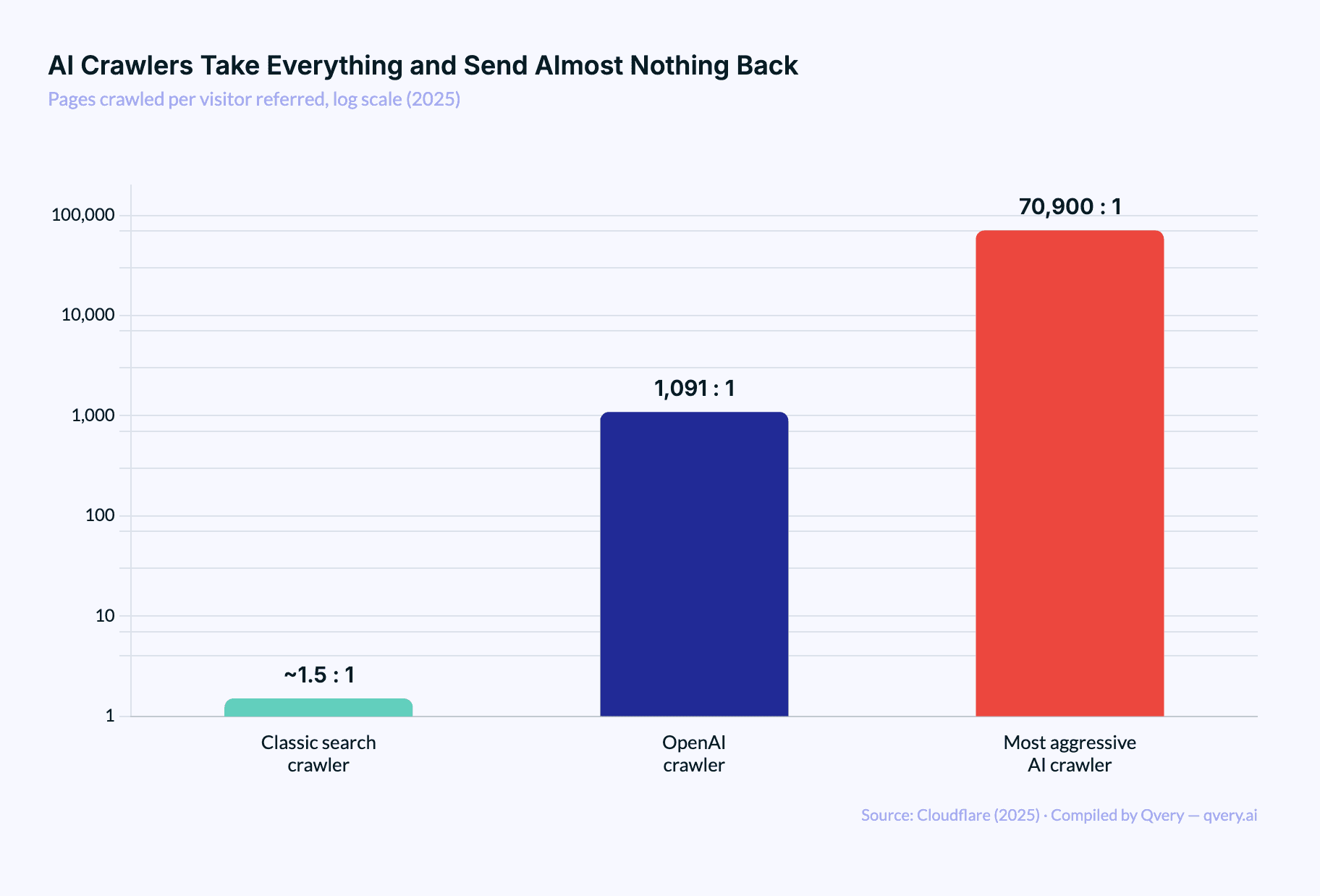
There is a sliver of good news buried in the data, and it is worth being honest about it. The worst offender improved sharply across 2025, from a scarcely believable 286,930 to 1 in January down to about 38,000 to 1 by July, as it started adding clickable citations to its answers.² The direction is right. The magnitude is still absurd. And the structural reason it stays absurd is simple: training, not real-time answering, now drives nearly 80% of AI bot activity, up from 72% a year earlier.²
Most of the scraping exists to build the model, and a model in training never sends a click. My read: waiting for these ratios to "normalize" is a bad plan, because the economics that produced them are the point, not a bug someone will patch.
Google Stopped Sending the Traffic
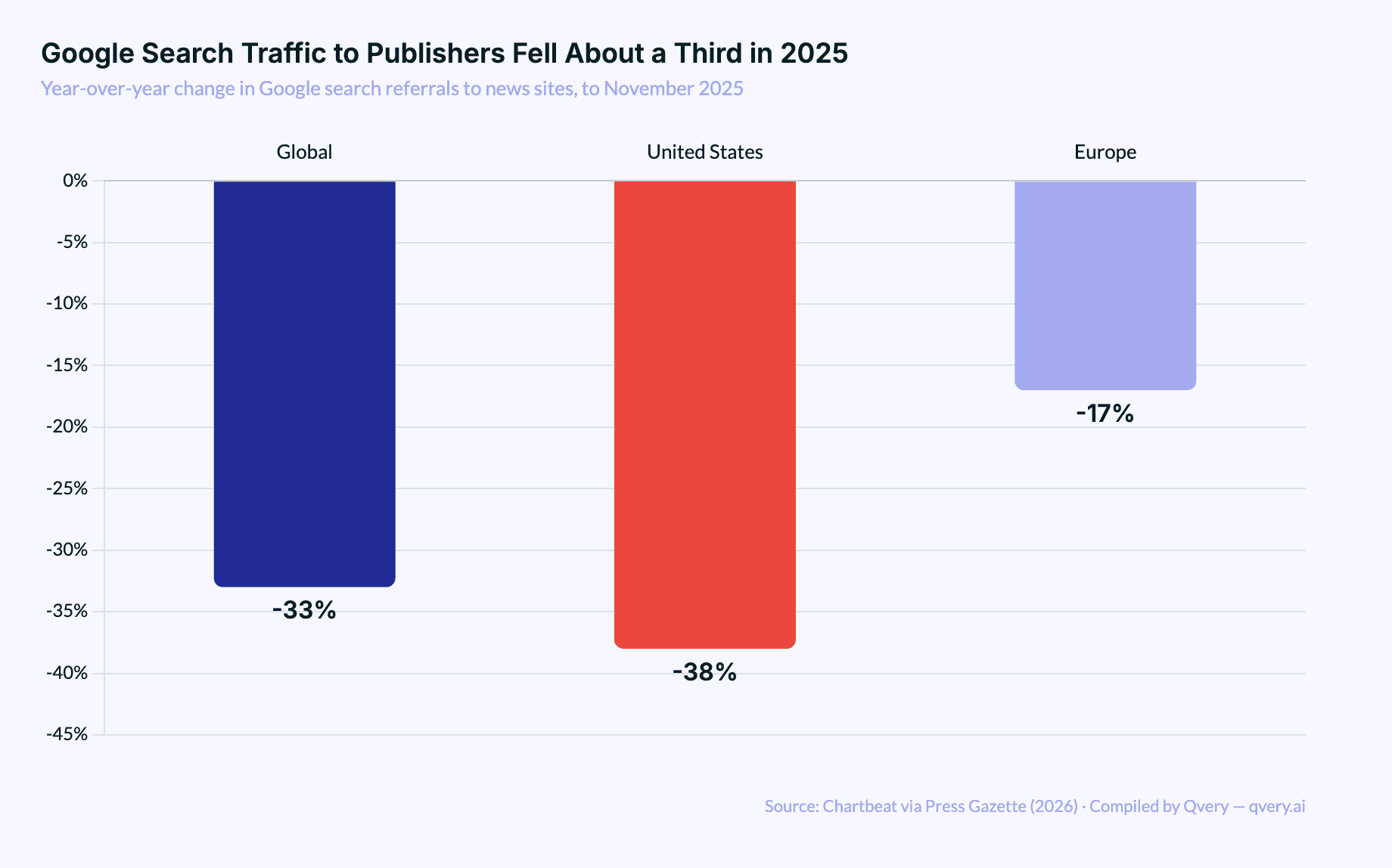
The crawl ratios explain the mechanism. The referral numbers show the damage, and they are worse than most newsroom budgets have priced in. Across Chartbeat's panel of more than 2,500 publisher sites, Google search traffic to publishers fell by roughly a third globally in the year to November 2025, down 38% in the US and 17% in Europe.³ Stretch the window back to May 2023 and Google search referrals are down 21%, with all external referrals down 24%.³ That isn't a dip in the chart. The floor is dropping out.
The cause isn't subtle. Since AI Overviews launched in the US in May 2024, the share of news searches that end with no click through to a news site climbed from 56% to nearly 69% within a year.⁴ AI Overviews now surface on roughly a fifth of US desktop searches, up from about 6% at the start of 2025.⁴ Where they appear, publishers feel it immediately: an industry study submitted to the UK competition regulator found news sites lose 47.5% of their clickthrough rate on desktop and 37.7% on mobile when an AI Overview sits above the results.⁵
The individual-publisher numbers are the ones that sting. For CBS News, 75% of its top-100 search terms that triggered an AI Overview produced no click, versus 54% zero-click across its top terms overall, a 21-point penalty attributable to the summary box alone.⁴
The point of view here is uncomfortable but earned by the data: the single largest distribution channel journalism ever had is being converted, in real time, into a channel that answers the reader's question and keeps them on Google's page. Publishers aren't losing a slice of traffic; they're losing the referral itself.
AI Summaries End the Session, They Do Not Pass the Click
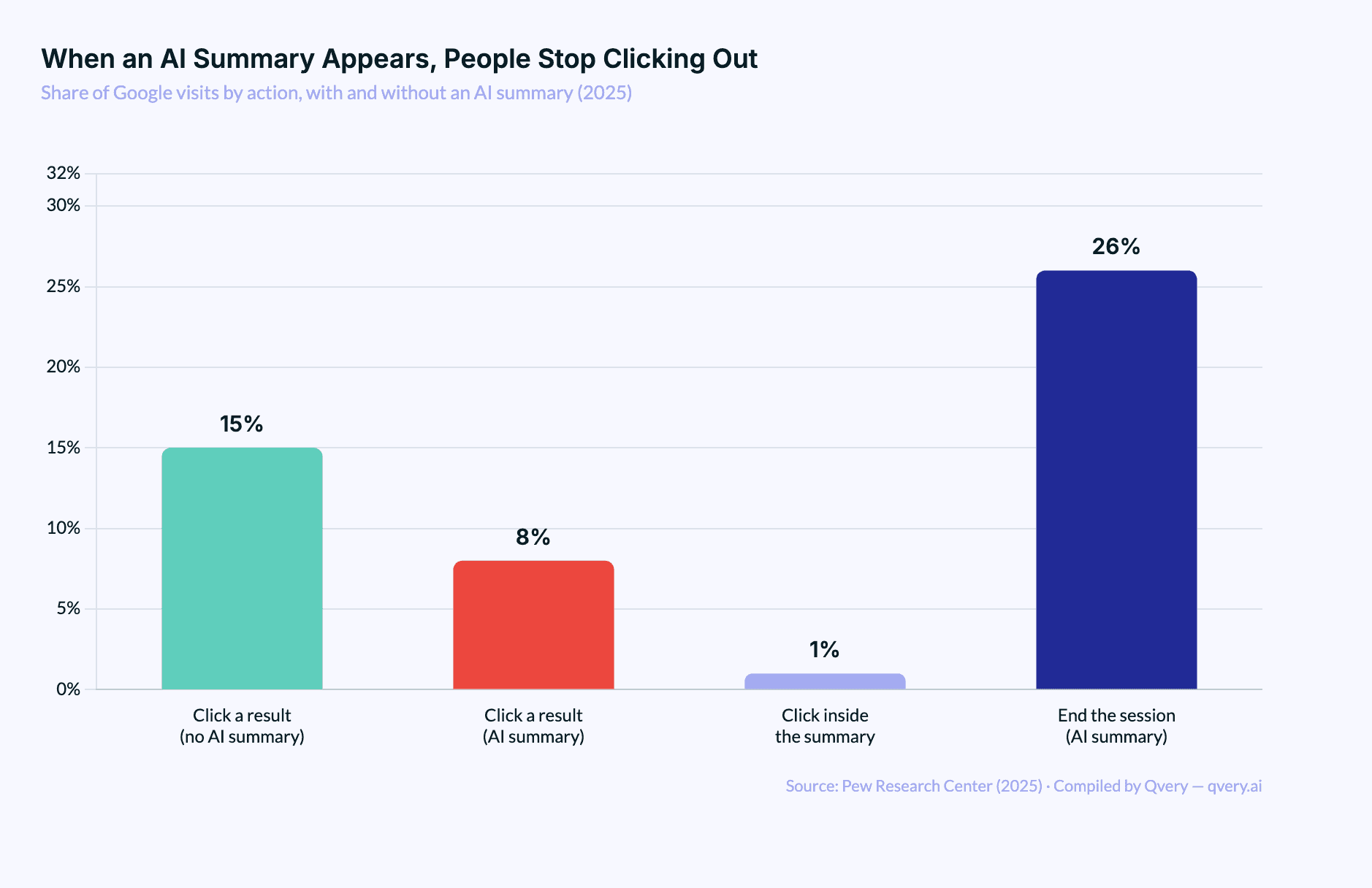
The most convincing evidence is behavioral, not modeled, because it watches what people do. In a March 2025 study of real browsing by 900 US adults, users who saw an AI summary clicked a traditional search result on just 8% of visits, versus 15% when no summary appeared, close to half the click rate.⁶ By that point AI summaries were already mainstream: 58% of those adults hit at least one in a single month of ordinary searching.⁶
The consolation prize was always supposed to be the citation. If AI keeps the click, at least it names you, and surely people tap through to the source. They don't. When a Google AI summary appeared, users clicked a link inside the summary itself on 1% of visits, which is a generous rounding away from never, and they were noticeably more likely to end their browsing session entirely, 26% versus 16%.⁶ The AI answer doesn't open the door to the article. It closes it.
Widen the lens and this is the decade's defining pattern, now supercharged. By 2026, 68% of all Google searches end without a click to any website.⁷ Zero-click used to be a slow structural drift, driven by weather boxes and sports scores. AI turned the drift into a slope. My take: any publisher strategy still built on "rank, get the click, monetize the pageview" is optimizing a funnel whose top just got sealed.
The AI Referral Rescue Is a Rounding Error
This is the point where the optimists usually step in. AI usage is exploding, they say, and those assistants send traffic too, so the search losses will get backfilled. The traffic math says otherwise, and it's not close. Through the second half of 2025, visits to AI answer engines grew 76% year over year worldwide, yet the referral traffic those engines pushed back to publishers flatlined.⁷ Usage up 76%, referrals plateaued. That gap is the entire trap in one line.
What AI really sends publishers: despite a genuine surge since mid-2024, ChatGPT still accounts for about 0.02% of total referral traffic to publisher sites, and every other AI assistant is smaller still.³
The scale mismatch: AI referral traffic to news and media sites from non-Google engines grew from 35.3 million global visits in May 2025 to 35.9 million in June.⁴ Real growth, real people. It is also being asked to offset hundreds of millions of lost search visits. The eyedropper isn't empty. It's just an eyedropper pointed at a fire.
The subjective read: "AI will send the traffic back" is the comforting story, and the data has quietly stopped supporting it. Referrals are flat while the AI engines behind them balloon, which means every new user AI adds makes the ratio of value-taken to value-returned worse, not better. Publishers waiting for the rebound are waiting for a bus that changed routes.
So Publishers Are Signing Deals and Cutting Staff
Faced with a traffic model coming apart, the industry is doing two things at once: licensing its archives to the same AI companies eating its referrals, and shrinking to survive the gap. The licensing market is real and, at the top, sizable.
OpenAI's five-year deal with News Corp, owner of The Wall Street Journal, is reported at more than $250 million, the largest publisher AI deal disclosed to date.⁸ Amazon's licensing arrangement with The New York Times runs $20 million to $25 million a year, roughly 1% of the Times' annual revenue.⁸ The deal that started the wave, OpenAI and Axel Springer back in December 2023, was worth tens of millions of euros over three years.⁹
Read the sentiment, though, and the enthusiasm is thin. In a late-2025 survey of media leaders, 69% expected AI licensing to deliver at least some revenue within three years, but most called it a minor line item, and a fifth expected to get nothing.³ A 1%-of-revenue check doesn't replace a third of your traffic. It's a settlement, not a business model.
The other lever is subtraction, and it has a human cost. Business Insider laid off about 21% of its staff in May 2025, with its CEO writing that the company had to be built to "endure extreme traffic drops outside of our control."¹⁰
Step back to the mood of the field and it tracks: confidence among media leaders in journalism's prospects for the year ahead has fallen to 38%, down from 60% in 2022, and the same leaders expect their search traffic to drop a further 43% on average over the next three years.³
Some publishers stopped waiting to be scraped and slammed the door: by the end of 2023, 48% of the most-used news sites across ten countries were already blocking OpenAI's crawler, a figure that hit 79% in the US.¹¹ My view: blocking buys bargaining power in a licensing negotiation, but it can't manufacture demand for your content inside an answer engine that has decided news is optional.
And When AI Uses the News, It Mangles It
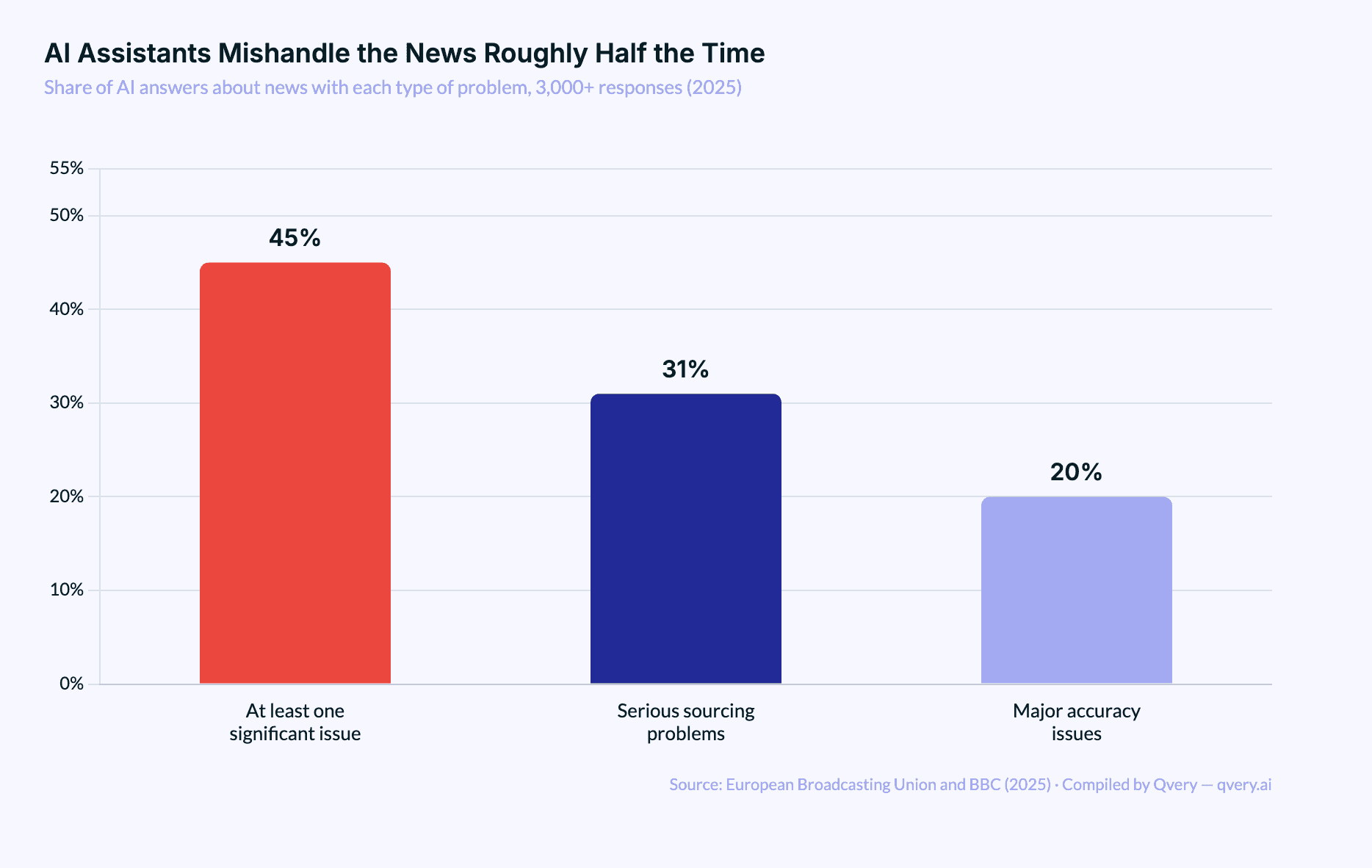
There is a bitter irony threaded through all of this. The AI answers displacing journalism are frequently wrong about the journalism they displace. The largest study of its kind, run by 22 public-service broadcasters across 18 countries and 14 languages and evaluating more than 3,000 responses, found that 45% of AI answers about the news carried at least one significant issue.¹²
Sourcing was the single biggest failure: 31% of responses had serious sourcing problems, meaning missing, misleading, or incorrect attribution, which is precisely the layer that decides whether a news brand gets credit at all.¹²
The foundational BBC audit that kicked off this debate was, if anything, harsher: across 100 news questions, 51% of AI answers had significant issues and 91% had at least some issue.¹³ The specifics are where it stops being abstract. 19% of answers that cited BBC content introduced factual errors, wrong numbers, wrong dates, wrong statements.¹³
And 13% of the quotes the assistants attributed to BBC articles were either altered from the original or never appeared in the cited piece at all.¹³ Getting misquoted by a robot, in your own byline's name, is a genuinely new and specific insult. To be fair to one engine, ChatGPT was the most reliable of the assistants tested, with the fewest sourcing problems.¹³ "Least likely to invent your quotes" is not a tagline anyone wants, but in this field it counts.
The take here isn't "AI is dumb." It's strategic: an answer engine that misattributes a third of the time is an engine that will happily strip your brand off your own reporting and hand the credibility to no one. For a news organization, accuracy failures are more than a trust problem. They are a citation problem, which in AI search means a visibility problem, which means a revenue problem.
News Is Nearly Invisible as an AI Source
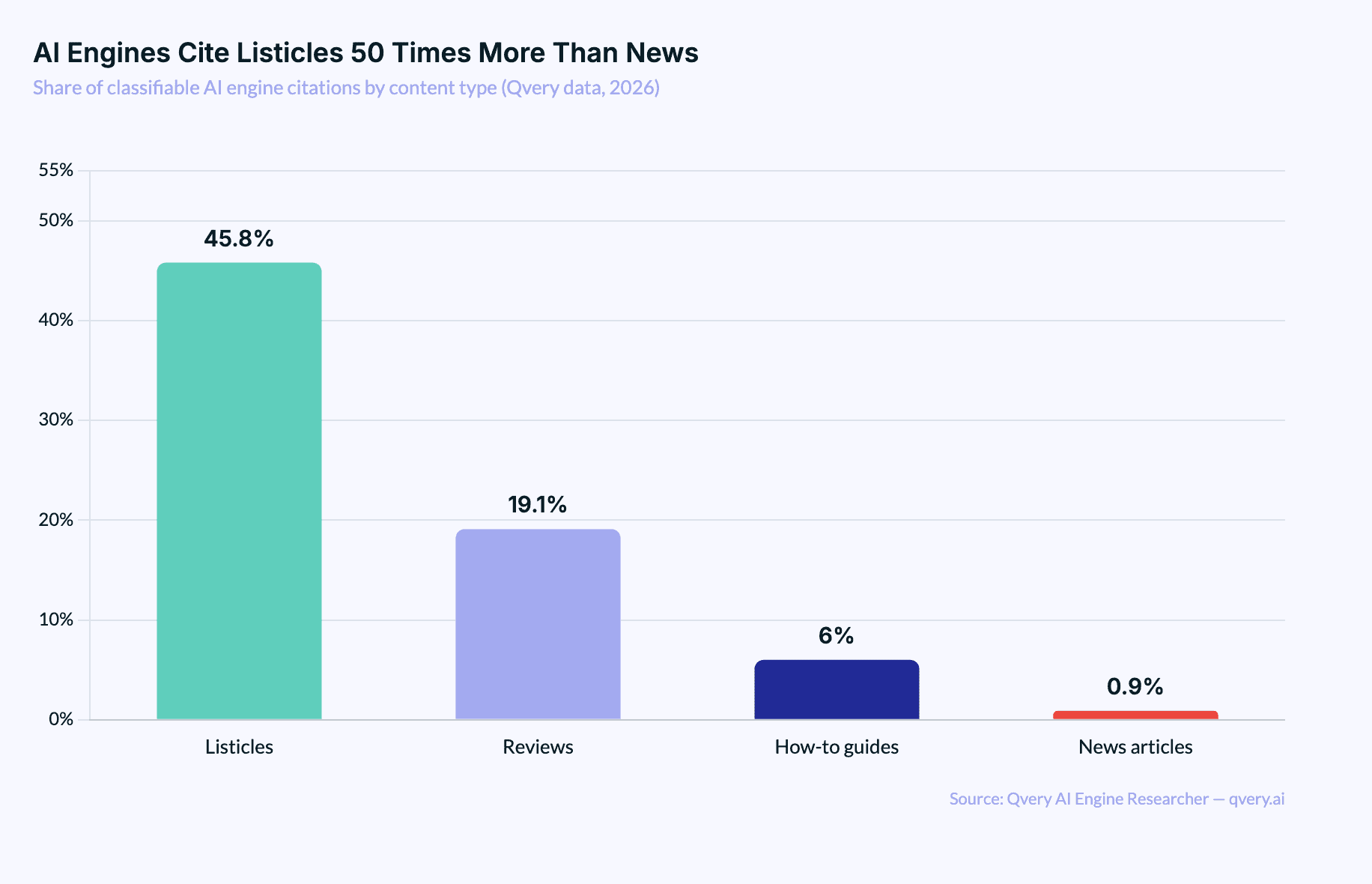
Which brings us to the number every media brand should have taped to the wall. In our own dataset of citations across ChatGPT and Google AI Mode, news is the rarest classifiable content type there is: 0.9% of classifiable citations and just 0.11% of all citations.¹⁴
Breaking news, the thing newsrooms are built to produce fastest, is basically invisible to AI engines, which overwhelmingly prefer evergreen content. The comparison is almost rude: listicles are cited about 50 times more often than news articles.¹⁴ Somewhere a post titled "17 Facts About Rounding Errors" is being cited right now while a breaking story is not.
Independent data agrees from a different angle. Pew found news sites make up just 5% of the sources linked inside Google AI summaries, the same thin 5% share they hold in standard results.⁶ Meanwhile the surfaces AI leans on are the ones newsrooms have historically dismissed.
Reddit alone accounts for 58.9% of all user-generated-content citations across both AI engines, more than the next five UGC sources combined, and ranks as the third most-cited well-known domain there is.¹⁵ Wikipedia posts the best average citation rank of any major domain, 5.65, meaning when it gets cited it lands near the top of the answer.¹⁶ Reference pages and forums sit at the top of the AI citation stack. Journalism sits at the bottom.
The audience is drifting the same way the citations point. Weekly use of AI assistants for news reached 10% globally in 2026, three times higher among under-25s at 17%, and once people are inside a chatbot they mostly stay there: just 4% say they often click through to the original source, versus 19% from search and 17% from social.¹⁷
So here's the honest strategic conclusion. You can't win back the click, because the click is structurally gone. The only game left is being the source the answer gets built from, which means evergreen, reference-grade, genuinely citable content, not another news wire nobody's model reaches for. Media brands spent twenty years optimizing to be found. The next twenty are about being quoted.
Stop Guessing Whether AI Engines Cite You
If the click is gone and the citation is the new currency, the first question any media brand or marketer has to answer is a measurement question: when someone asks ChatGPT or Google AI Mode about your space, are you in the answer, and who is getting cited instead of you? Most teams are flying blind on that, because their analytics were built to count visits, and the visits are exactly what AI removed.
That is the gap Qvery closes. Our AI Engine Researcher tracks your brand's visibility and share of voice across ChatGPT and Google AI Mode, in 200-plus countries, and captures every citation an answer is built from, so you can see which sources AI trusts in your category and where you are missing.
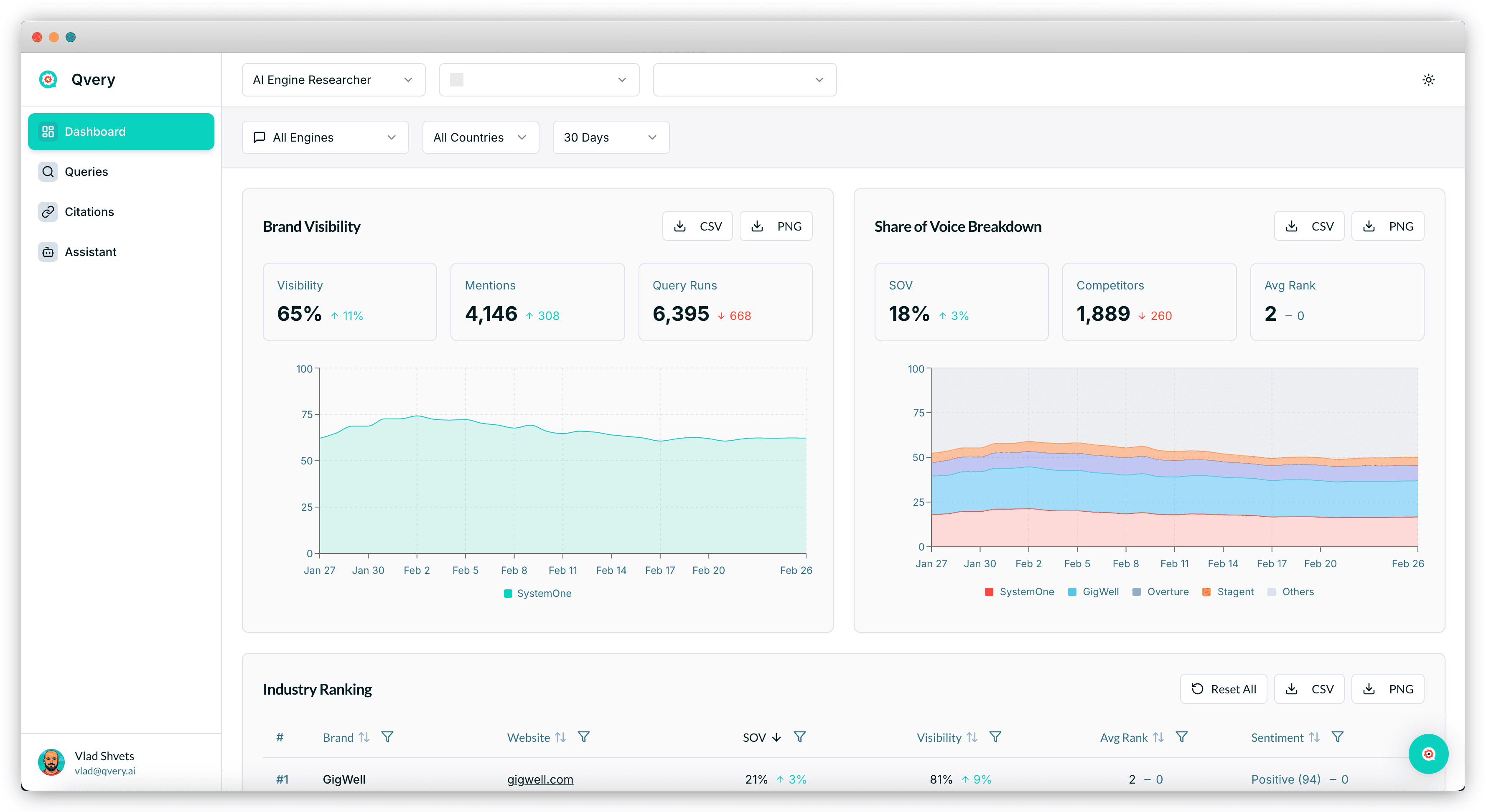
Inside the app, the Qvery Assistant answers questions about your own visibility, share of voice, citation, and query data, and runs first-party actions like adding or editing the queries you track, triggering a fresh data run, or exporting a report. You start in minutes and see where you stand today. When the answer engine is the audience, you should know exactly what it's saying about you.
Frequently Asked Questions
What are the most important AI and media statistics for 2026?
The load-bearing ones: Google referral traffic to publishers fell about a third in 2025, news queries now end without a click 69% of the time, ChatGPT sends roughly 0.02% of publisher referral traffic, AI answers about news carry a significant issue 45% of the time, and news is just 0.11% of all AI engine citations.
How much traffic have publishers lost to AI search?
Across more than 2,500 publisher sites, Google search referrals dropped roughly 33% globally in the year to November 2025, 38% in the US and 17% in Europe. Since May 2023, all external referrals to publishers are down about 24%.
What is a crawl-to-referral ratio, and why does it matter?
It is how many pages an AI company scrapes for each visitor it sends back. Classic search ran near one or two to one, a rough trade. The most aggressive AI crawler hit almost 71,000 to 1 in mid-2025, meaning it took enormous amounts of content and returned almost no traffic.
Do AI Overviews reduce clicks to news sites?
Yes, and it is measured behaviorally. Users who saw a Google AI summary clicked a search result on 8% of visits versus 15% without one. For news specifically, the share of searches ending in no click rose from 56% to nearly 69% after AI Overviews launched.
Does AI referral traffic make up for lost search traffic?
No. AI answer engine usage grew 76% year over year in late 2025 while referrals to publishers stayed flat. ChatGPT accounts for about 0.02% of publisher referral traffic, far too little to offset hundreds of millions of lost search visits.
How big are AI licensing deals with publishers?
At the top, sizable: OpenAI's deal with News Corp is reported above $250 million over five years, and Amazon's deal with The New York Times runs $20 to $25 million a year. But 69% of media leaders expect licensing to provide at least some revenue, most seeing it as only a minor source, and a fifth expect nothing.
How often does AI get the news wrong?
Frequently. The largest study to date found 45% of AI answers about news had a significant issue, with 31% showing serious sourcing problems. An earlier BBC audit found 51% of answers had significant issues and 13% of quotes attributed to the BBC were altered or invented.
Which AI assistant handles the news most reliably?
In the BBC's audit, ChatGPT had the fewest sourcing problems of the assistants tested, though even it misrepresented cited content in 15% of responses. Accuracy is not uniform across engines, and none of them are close to error-free.
Why does AI rarely cite news articles?
AI engines strongly prefer evergreen, reference-grade content over time-sensitive reporting. In Qvery's data, news is 0.9% of classifiable citations and 0.11% of all citations, the rarest content type, and it is out-cited by listicles roughly 50 to 1.
What content does AI cite instead of news?
Reference pages, forums, and structured lists. Reddit alone owns 58.9% of user-generated citations and is the third most-cited well-known domain. Wikipedia has the best average citation rank of any major domain at 5.65. News sits near the bottom of the stack.
How many people get their news from AI chatbots?
About 10% of people globally used an AI assistant for news weekly in 2026, up from 7% a year earlier. It skews young, reaching 17% among under-25s, but only 1% say AI is their main source of news, so it is still complementary for most.
Do people click through to news sources from AI answers?
Rarely. Only 4% of people say they often click through to the original source from an AI assistant, compared with 19% from search and 17% from social media. Visibility inside the answer matters more than the outbound link.
How much do people trust news from AI?
Not much. Trust in news from AI chatbots is about 20% globally, below the 37% who trust news generally. Notably, trust more than doubles among people who use the tools, which is how adoption tends to normalize over time.
Are newsrooms using AI themselves?
Widely. Nearly three-quarters of news practitioners said they or their organization had already used generative AI, mostly for back-end tasks like transcription and copyediting, with newsgathering and product work rising fast.
Are publishers blocking AI crawlers?
Many are. By the end of 2023, 48% of the most-used news sites across ten countries blocked OpenAI's crawler, rising to 79% in the US. Blocking creates bargaining power but does not create demand for your content inside AI answers.
Has AI caused newsroom layoffs?
It is a contributing factor. Business Insider cut about 21% of staff in 2025, with its CEO citing extreme, uncontrollable traffic drops. Confidence among media leaders in journalism's prospects has fallen from 60% in 2022 to 38%.
What is zero-click search?
A search that ends without the user clicking through to any website, because the answer appears directly on the results page. By 2026, 68% of all Google searches were zero-click, and AI Overviews accelerated the trend sharply.
Is breaking news valuable for AI visibility?
Barely, in citation terms. AI engines rarely cite breaking news because they favor evergreen content. For AI visibility, a durable reference page or well-structured explainer will typically outperform a time-stamped news story by a wide margin.
What should media brands do to stay visible in AI search?
Shift from chasing clicks to earning citations. That means investing in evergreen, reference-grade, genuinely quotable content, getting represented on the high-citation surfaces AI trusts, and measuring your share of voice inside answer engines rather than only counting pageviews.
How can a publisher measure its AI search visibility?
You need a tool built to watch the answer, not the visit. Qvery's AI Engine Researcher tracks your visibility, share of voice, and every citation across ChatGPT and Google AI Mode, so you can see whether AI cites you and which sources it favors in your category.
Sources
Cloudflare: The Crawl-to-Click Gap, Cloudflare Data on AI Bots, Training, and Referrals (2025)
Press Gazette: Global Publisher Google Traffic Dropped by a Third in 2025 (2026)
Digiday: AI Platforms Are Driving More Traffic, but Not Enough to Offset Zero-Click Search (2025)
Press Gazette: Publishers Lose 50% of Clickthrough Rate Due to AI Overviews (2025)
Engadget: The New York Times and Amazon's AI Licensing Deal (2025)
Engadget: OpenAI Will Pay to Train Its Models on Business Insider and Politico Articles (2023)
Nieman Journalism Lab: Business Insider Will Lay Off 21% of Staff Amid AI Disruption (2025)
Reuters Institute: How Many News Websites Block AI Crawlers? (2024)
European Broadcasting Union and BBC: News Integrity in AI Assistants (2025)
BBC: Representation of BBC News Content in AI Assistants (2025)
Qvery: Listicles Are the Most Cited Content Type in AI Search (2026)
Qvery: Reddit Is the Most Important Website for AI Search Visibility (2026)
Qvery: Wikipedia AI Citations, ChatGPT's Favorite Source That Google AI Ignores (2026)
Reuters Institute: Emerging Uses of AI Chatbots for News, Digital News Report 2026 (2026)
For about twenty years, the deal between publishers and search was simple enough. You let Google crawl your site, Google sent readers back, and everyone quietly agreed not to stare too hard at how lopsided the trade was getting. AI has now torn that contract up, and it didn't leave a new one on the table.
The numbers below come from network-level crawl data, publisher analytics panels, behavioral clickstream studies, and the largest audits ever run on how AI assistants handle the news.
Read together, they tell one story: the traffic that funded journalism is draining out, the AI answers replacing it rarely send anyone back, and when those answers do quote the news, they get it wrong at a rate that would get a junior reporter fired.
Here are 45+ verified statistics on what AI is doing to the media business, and why news brands are losing the one game left to play: being the source the machine cites.
Highlights
Nearly 71,000 to 1. The most aggressive AI crawler scraped almost 71,000 pages for every single visitor it referred back, versus the one-or-two-to-one exchange of classic search. The old bargain is gone.
Google referrals to publishers fell about a third in 2025. Down 33% globally, 38% in the US, across 2,500-plus news sites. This is the revenue base, not a side channel.
News queries now end without a click 69% of the time. Up from 56% in the year after AI Overviews launched.
AI referrals are 0.02% of publisher traffic. After all the hype, that is what ChatGPT sends back. The rescue arrived with an eyedropper.
45% of AI answers about news carry a significant issue. That is the largest study to date, and 13% of quotes attributed to the BBC were altered or invented.
News is 0.11% of what AI engines cite. The rarest content type there is, out-cited 50 to 1 by the humble listicle. Reddit alone owns 58.9% of the user-generated citations AI hands out.
The Exchange That Built the Web Just Broke
Every publisher business model of the last two decades rested on one quiet assumption: search engines crawl your pages in order to send you readers. It was never a charity, but it was close to a trade. Legacy search crawlers scanned a site's content roughly once or twice for every visitor they referred, and that rough parity is what made letting the bots in worth it.¹
AI crawlers didn't inherit those manners. For the week of June 19 to 26, 2025, the most aggressive AI crawler on the web made nearly 71,000 page requests for every one referral it sent back, a 70,900 to 1 ratio measured directly at the network layer.¹ That's less "search engine" and more "someone photographs every page of your book in the store, tells one friend the ending, and calls it exposure." OpenAI's crawler, attached to the biggest AI referral source publishers have, still ran about 1,091 to 1 by July 2025.²
There is a sliver of good news buried in the data, and it is worth being honest about it. The worst offender improved sharply across 2025, from a scarcely believable 286,930 to 1 in January down to about 38,000 to 1 by July, as it started adding clickable citations to its answers.² The direction is right. The magnitude is still absurd. And the structural reason it stays absurd is simple: training, not real-time answering, now drives nearly 80% of AI bot activity, up from 72% a year earlier.²
Most of the scraping exists to build the model, and a model in training never sends a click. My read: waiting for these ratios to "normalize" is a bad plan, because the economics that produced them are the point, not a bug someone will patch.
Google Stopped Sending the Traffic
The crawl ratios explain the mechanism. The referral numbers show the damage, and they are worse than most newsroom budgets have priced in. Across Chartbeat's panel of more than 2,500 publisher sites, Google search traffic to publishers fell by roughly a third globally in the year to November 2025, down 38% in the US and 17% in Europe.³ Stretch the window back to May 2023 and Google search referrals are down 21%, with all external referrals down 24%.³ That isn't a dip in the chart. The floor is dropping out.
The cause isn't subtle. Since AI Overviews launched in the US in May 2024, the share of news searches that end with no click through to a news site climbed from 56% to nearly 69% within a year.⁴ AI Overviews now surface on roughly a fifth of US desktop searches, up from about 6% at the start of 2025.⁴ Where they appear, publishers feel it immediately: an industry study submitted to the UK competition regulator found news sites lose 47.5% of their clickthrough rate on desktop and 37.7% on mobile when an AI Overview sits above the results.⁵
The individual-publisher numbers are the ones that sting. For CBS News, 75% of its top-100 search terms that triggered an AI Overview produced no click, versus 54% zero-click across its top terms overall, a 21-point penalty attributable to the summary box alone.⁴
The point of view here is uncomfortable but earned by the data: the single largest distribution channel journalism ever had is being converted, in real time, into a channel that answers the reader's question and keeps them on Google's page. Publishers aren't losing a slice of traffic; they're losing the referral itself.
AI Summaries End the Session, They Do Not Pass the Click
The most convincing evidence is behavioral, not modeled, because it watches what people do. In a March 2025 study of real browsing by 900 US adults, users who saw an AI summary clicked a traditional search result on just 8% of visits, versus 15% when no summary appeared, close to half the click rate.⁶ By that point AI summaries were already mainstream: 58% of those adults hit at least one in a single month of ordinary searching.⁶
The consolation prize was always supposed to be the citation. If AI keeps the click, at least it names you, and surely people tap through to the source. They don't. When a Google AI summary appeared, users clicked a link inside the summary itself on 1% of visits, which is a generous rounding away from never, and they were noticeably more likely to end their browsing session entirely, 26% versus 16%.⁶ The AI answer doesn't open the door to the article. It closes it.
Widen the lens and this is the decade's defining pattern, now supercharged. By 2026, 68% of all Google searches end without a click to any website.⁷ Zero-click used to be a slow structural drift, driven by weather boxes and sports scores. AI turned the drift into a slope. My take: any publisher strategy still built on "rank, get the click, monetize the pageview" is optimizing a funnel whose top just got sealed.
The AI Referral Rescue Is a Rounding Error
This is the point where the optimists usually step in. AI usage is exploding, they say, and those assistants send traffic too, so the search losses will get backfilled. The traffic math says otherwise, and it's not close. Through the second half of 2025, visits to AI answer engines grew 76% year over year worldwide, yet the referral traffic those engines pushed back to publishers flatlined.⁷ Usage up 76%, referrals plateaued. That gap is the entire trap in one line.
What AI really sends publishers: despite a genuine surge since mid-2024, ChatGPT still accounts for about 0.02% of total referral traffic to publisher sites, and every other AI assistant is smaller still.³
The scale mismatch: AI referral traffic to news and media sites from non-Google engines grew from 35.3 million global visits in May 2025 to 35.9 million in June.⁴ Real growth, real people. It is also being asked to offset hundreds of millions of lost search visits. The eyedropper isn't empty. It's just an eyedropper pointed at a fire.
The subjective read: "AI will send the traffic back" is the comforting story, and the data has quietly stopped supporting it. Referrals are flat while the AI engines behind them balloon, which means every new user AI adds makes the ratio of value-taken to value-returned worse, not better. Publishers waiting for the rebound are waiting for a bus that changed routes.
So Publishers Are Signing Deals and Cutting Staff
Faced with a traffic model coming apart, the industry is doing two things at once: licensing its archives to the same AI companies eating its referrals, and shrinking to survive the gap. The licensing market is real and, at the top, sizable.
OpenAI's five-year deal with News Corp, owner of The Wall Street Journal, is reported at more than $250 million, the largest publisher AI deal disclosed to date.⁸ Amazon's licensing arrangement with The New York Times runs $20 million to $25 million a year, roughly 1% of the Times' annual revenue.⁸ The deal that started the wave, OpenAI and Axel Springer back in December 2023, was worth tens of millions of euros over three years.⁹
Read the sentiment, though, and the enthusiasm is thin. In a late-2025 survey of media leaders, 69% expected AI licensing to deliver at least some revenue within three years, but most called it a minor line item, and a fifth expected to get nothing.³ A 1%-of-revenue check doesn't replace a third of your traffic. It's a settlement, not a business model.
The other lever is subtraction, and it has a human cost. Business Insider laid off about 21% of its staff in May 2025, with its CEO writing that the company had to be built to "endure extreme traffic drops outside of our control."¹⁰
Step back to the mood of the field and it tracks: confidence among media leaders in journalism's prospects for the year ahead has fallen to 38%, down from 60% in 2022, and the same leaders expect their search traffic to drop a further 43% on average over the next three years.³
Some publishers stopped waiting to be scraped and slammed the door: by the end of 2023, 48% of the most-used news sites across ten countries were already blocking OpenAI's crawler, a figure that hit 79% in the US.¹¹ My view: blocking buys bargaining power in a licensing negotiation, but it can't manufacture demand for your content inside an answer engine that has decided news is optional.
And When AI Uses the News, It Mangles It
There is a bitter irony threaded through all of this. The AI answers displacing journalism are frequently wrong about the journalism they displace. The largest study of its kind, run by 22 public-service broadcasters across 18 countries and 14 languages and evaluating more than 3,000 responses, found that 45% of AI answers about the news carried at least one significant issue.¹²
Sourcing was the single biggest failure: 31% of responses had serious sourcing problems, meaning missing, misleading, or incorrect attribution, which is precisely the layer that decides whether a news brand gets credit at all.¹²
The foundational BBC audit that kicked off this debate was, if anything, harsher: across 100 news questions, 51% of AI answers had significant issues and 91% had at least some issue.¹³ The specifics are where it stops being abstract. 19% of answers that cited BBC content introduced factual errors, wrong numbers, wrong dates, wrong statements.¹³
And 13% of the quotes the assistants attributed to BBC articles were either altered from the original or never appeared in the cited piece at all.¹³ Getting misquoted by a robot, in your own byline's name, is a genuinely new and specific insult. To be fair to one engine, ChatGPT was the most reliable of the assistants tested, with the fewest sourcing problems.¹³ "Least likely to invent your quotes" is not a tagline anyone wants, but in this field it counts.
The take here isn't "AI is dumb." It's strategic: an answer engine that misattributes a third of the time is an engine that will happily strip your brand off your own reporting and hand the credibility to no one. For a news organization, accuracy failures are more than a trust problem. They are a citation problem, which in AI search means a visibility problem, which means a revenue problem.
News Is Nearly Invisible as an AI Source
Which brings us to the number every media brand should have taped to the wall. In our own dataset of citations across ChatGPT and Google AI Mode, news is the rarest classifiable content type there is: 0.9% of classifiable citations and just 0.11% of all citations.¹⁴
Breaking news, the thing newsrooms are built to produce fastest, is basically invisible to AI engines, which overwhelmingly prefer evergreen content. The comparison is almost rude: listicles are cited about 50 times more often than news articles.¹⁴ Somewhere a post titled "17 Facts About Rounding Errors" is being cited right now while a breaking story is not.
Independent data agrees from a different angle. Pew found news sites make up just 5% of the sources linked inside Google AI summaries, the same thin 5% share they hold in standard results.⁶ Meanwhile the surfaces AI leans on are the ones newsrooms have historically dismissed.
Reddit alone accounts for 58.9% of all user-generated-content citations across both AI engines, more than the next five UGC sources combined, and ranks as the third most-cited well-known domain there is.¹⁵ Wikipedia posts the best average citation rank of any major domain, 5.65, meaning when it gets cited it lands near the top of the answer.¹⁶ Reference pages and forums sit at the top of the AI citation stack. Journalism sits at the bottom.
The audience is drifting the same way the citations point. Weekly use of AI assistants for news reached 10% globally in 2026, three times higher among under-25s at 17%, and once people are inside a chatbot they mostly stay there: just 4% say they often click through to the original source, versus 19% from search and 17% from social.¹⁷
So here's the honest strategic conclusion. You can't win back the click, because the click is structurally gone. The only game left is being the source the answer gets built from, which means evergreen, reference-grade, genuinely citable content, not another news wire nobody's model reaches for. Media brands spent twenty years optimizing to be found. The next twenty are about being quoted.
Stop Guessing Whether AI Engines Cite You
If the click is gone and the citation is the new currency, the first question any media brand or marketer has to answer is a measurement question: when someone asks ChatGPT or Google AI Mode about your space, are you in the answer, and who is getting cited instead of you? Most teams are flying blind on that, because their analytics were built to count visits, and the visits are exactly what AI removed.
That is the gap Qvery closes. Our AI Engine Researcher tracks your brand's visibility and share of voice across ChatGPT and Google AI Mode, in 200-plus countries, and captures every citation an answer is built from, so you can see which sources AI trusts in your category and where you are missing.
Inside the app, the Qvery Assistant answers questions about your own visibility, share of voice, citation, and query data, and runs first-party actions like adding or editing the queries you track, triggering a fresh data run, or exporting a report. You start in minutes and see where you stand today. When the answer engine is the audience, you should know exactly what it's saying about you.
Frequently Asked Questions
What are the most important AI and media statistics for 2026?
The load-bearing ones: Google referral traffic to publishers fell about a third in 2025, news queries now end without a click 69% of the time, ChatGPT sends roughly 0.02% of publisher referral traffic, AI answers about news carry a significant issue 45% of the time, and news is just 0.11% of all AI engine citations.
How much traffic have publishers lost to AI search?
Across more than 2,500 publisher sites, Google search referrals dropped roughly 33% globally in the year to November 2025, 38% in the US and 17% in Europe. Since May 2023, all external referrals to publishers are down about 24%.
What is a crawl-to-referral ratio, and why does it matter?
It is how many pages an AI company scrapes for each visitor it sends back. Classic search ran near one or two to one, a rough trade. The most aggressive AI crawler hit almost 71,000 to 1 in mid-2025, meaning it took enormous amounts of content and returned almost no traffic.
Do AI Overviews reduce clicks to news sites?
Yes, and it is measured behaviorally. Users who saw a Google AI summary clicked a search result on 8% of visits versus 15% without one. For news specifically, the share of searches ending in no click rose from 56% to nearly 69% after AI Overviews launched.
Does AI referral traffic make up for lost search traffic?
No. AI answer engine usage grew 76% year over year in late 2025 while referrals to publishers stayed flat. ChatGPT accounts for about 0.02% of publisher referral traffic, far too little to offset hundreds of millions of lost search visits.
How big are AI licensing deals with publishers?
At the top, sizable: OpenAI's deal with News Corp is reported above $250 million over five years, and Amazon's deal with The New York Times runs $20 to $25 million a year. But 69% of media leaders expect licensing to provide at least some revenue, most seeing it as only a minor source, and a fifth expect nothing.
How often does AI get the news wrong?
Frequently. The largest study to date found 45% of AI answers about news had a significant issue, with 31% showing serious sourcing problems. An earlier BBC audit found 51% of answers had significant issues and 13% of quotes attributed to the BBC were altered or invented.
Which AI assistant handles the news most reliably?
In the BBC's audit, ChatGPT had the fewest sourcing problems of the assistants tested, though even it misrepresented cited content in 15% of responses. Accuracy is not uniform across engines, and none of them are close to error-free.
Why does AI rarely cite news articles?
AI engines strongly prefer evergreen, reference-grade content over time-sensitive reporting. In Qvery's data, news is 0.9% of classifiable citations and 0.11% of all citations, the rarest content type, and it is out-cited by listicles roughly 50 to 1.
What content does AI cite instead of news?
Reference pages, forums, and structured lists. Reddit alone owns 58.9% of user-generated citations and is the third most-cited well-known domain. Wikipedia has the best average citation rank of any major domain at 5.65. News sits near the bottom of the stack.
How many people get their news from AI chatbots?
About 10% of people globally used an AI assistant for news weekly in 2026, up from 7% a year earlier. It skews young, reaching 17% among under-25s, but only 1% say AI is their main source of news, so it is still complementary for most.
Do people click through to news sources from AI answers?
Rarely. Only 4% of people say they often click through to the original source from an AI assistant, compared with 19% from search and 17% from social media. Visibility inside the answer matters more than the outbound link.
How much do people trust news from AI?
Not much. Trust in news from AI chatbots is about 20% globally, below the 37% who trust news generally. Notably, trust more than doubles among people who use the tools, which is how adoption tends to normalize over time.
Are newsrooms using AI themselves?
Widely. Nearly three-quarters of news practitioners said they or their organization had already used generative AI, mostly for back-end tasks like transcription and copyediting, with newsgathering and product work rising fast.
Are publishers blocking AI crawlers?
Many are. By the end of 2023, 48% of the most-used news sites across ten countries blocked OpenAI's crawler, rising to 79% in the US. Blocking creates bargaining power but does not create demand for your content inside AI answers.
Has AI caused newsroom layoffs?
It is a contributing factor. Business Insider cut about 21% of staff in 2025, with its CEO citing extreme, uncontrollable traffic drops. Confidence among media leaders in journalism's prospects has fallen from 60% in 2022 to 38%.
What is zero-click search?
A search that ends without the user clicking through to any website, because the answer appears directly on the results page. By 2026, 68% of all Google searches were zero-click, and AI Overviews accelerated the trend sharply.
Is breaking news valuable for AI visibility?
Barely, in citation terms. AI engines rarely cite breaking news because they favor evergreen content. For AI visibility, a durable reference page or well-structured explainer will typically outperform a time-stamped news story by a wide margin.
What should media brands do to stay visible in AI search?
Shift from chasing clicks to earning citations. That means investing in evergreen, reference-grade, genuinely quotable content, getting represented on the high-citation surfaces AI trusts, and measuring your share of voice inside answer engines rather than only counting pageviews.
How can a publisher measure its AI search visibility?
You need a tool built to watch the answer, not the visit. Qvery's AI Engine Researcher tracks your visibility, share of voice, and every citation across ChatGPT and Google AI Mode, so you can see whether AI cites you and which sources it favors in your category.
Sources
Cloudflare: The Crawl-to-Click Gap, Cloudflare Data on AI Bots, Training, and Referrals (2025)
Press Gazette: Global Publisher Google Traffic Dropped by a Third in 2025 (2026)
Digiday: AI Platforms Are Driving More Traffic, but Not Enough to Offset Zero-Click Search (2025)
Press Gazette: Publishers Lose 50% of Clickthrough Rate Due to AI Overviews (2025)
Engadget: The New York Times and Amazon's AI Licensing Deal (2025)
Engadget: OpenAI Will Pay to Train Its Models on Business Insider and Politico Articles (2023)
Nieman Journalism Lab: Business Insider Will Lay Off 21% of Staff Amid AI Disruption (2025)
Reuters Institute: How Many News Websites Block AI Crawlers? (2024)
European Broadcasting Union and BBC: News Integrity in AI Assistants (2025)
BBC: Representation of BBC News Content in AI Assistants (2025)
Qvery: Listicles Are the Most Cited Content Type in AI Search (2026)
Qvery: Reddit Is the Most Important Website for AI Search Visibility (2026)
Qvery: Wikipedia AI Citations, ChatGPT's Favorite Source That Google AI Ignores (2026)
Reuters Institute: Emerging Uses of AI Chatbots for News, Digital News Report 2026 (2026)
For about twenty years, the deal between publishers and search was simple enough. You let Google crawl your site, Google sent readers back, and everyone quietly agreed not to stare too hard at how lopsided the trade was getting. AI has now torn that contract up, and it didn't leave a new one on the table.
The numbers below come from network-level crawl data, publisher analytics panels, behavioral clickstream studies, and the largest audits ever run on how AI assistants handle the news.
Read together, they tell one story: the traffic that funded journalism is draining out, the AI answers replacing it rarely send anyone back, and when those answers do quote the news, they get it wrong at a rate that would get a junior reporter fired.
Here are 45+ verified statistics on what AI is doing to the media business, and why news brands are losing the one game left to play: being the source the machine cites.
Highlights
Nearly 71,000 to 1. The most aggressive AI crawler scraped almost 71,000 pages for every single visitor it referred back, versus the one-or-two-to-one exchange of classic search. The old bargain is gone.
Google referrals to publishers fell about a third in 2025. Down 33% globally, 38% in the US, across 2,500-plus news sites. This is the revenue base, not a side channel.
News queries now end without a click 69% of the time. Up from 56% in the year after AI Overviews launched.
AI referrals are 0.02% of publisher traffic. After all the hype, that is what ChatGPT sends back. The rescue arrived with an eyedropper.
45% of AI answers about news carry a significant issue. That is the largest study to date, and 13% of quotes attributed to the BBC were altered or invented.
News is 0.11% of what AI engines cite. The rarest content type there is, out-cited 50 to 1 by the humble listicle. Reddit alone owns 58.9% of the user-generated citations AI hands out.
The Exchange That Built the Web Just Broke
Every publisher business model of the last two decades rested on one quiet assumption: search engines crawl your pages in order to send you readers. It was never a charity, but it was close to a trade. Legacy search crawlers scanned a site's content roughly once or twice for every visitor they referred, and that rough parity is what made letting the bots in worth it.¹
AI crawlers didn't inherit those manners. For the week of June 19 to 26, 2025, the most aggressive AI crawler on the web made nearly 71,000 page requests for every one referral it sent back, a 70,900 to 1 ratio measured directly at the network layer.¹ That's less "search engine" and more "someone photographs every page of your book in the store, tells one friend the ending, and calls it exposure." OpenAI's crawler, attached to the biggest AI referral source publishers have, still ran about 1,091 to 1 by July 2025.²
There is a sliver of good news buried in the data, and it is worth being honest about it. The worst offender improved sharply across 2025, from a scarcely believable 286,930 to 1 in January down to about 38,000 to 1 by July, as it started adding clickable citations to its answers.² The direction is right. The magnitude is still absurd. And the structural reason it stays absurd is simple: training, not real-time answering, now drives nearly 80% of AI bot activity, up from 72% a year earlier.²
Most of the scraping exists to build the model, and a model in training never sends a click. My read: waiting for these ratios to "normalize" is a bad plan, because the economics that produced them are the point, not a bug someone will patch.
Google Stopped Sending the Traffic
The crawl ratios explain the mechanism. The referral numbers show the damage, and they are worse than most newsroom budgets have priced in. Across Chartbeat's panel of more than 2,500 publisher sites, Google search traffic to publishers fell by roughly a third globally in the year to November 2025, down 38% in the US and 17% in Europe.³ Stretch the window back to May 2023 and Google search referrals are down 21%, with all external referrals down 24%.³ That isn't a dip in the chart. The floor is dropping out.
The cause isn't subtle. Since AI Overviews launched in the US in May 2024, the share of news searches that end with no click through to a news site climbed from 56% to nearly 69% within a year.⁴ AI Overviews now surface on roughly a fifth of US desktop searches, up from about 6% at the start of 2025.⁴ Where they appear, publishers feel it immediately: an industry study submitted to the UK competition regulator found news sites lose 47.5% of their clickthrough rate on desktop and 37.7% on mobile when an AI Overview sits above the results.⁵
The individual-publisher numbers are the ones that sting. For CBS News, 75% of its top-100 search terms that triggered an AI Overview produced no click, versus 54% zero-click across its top terms overall, a 21-point penalty attributable to the summary box alone.⁴
The point of view here is uncomfortable but earned by the data: the single largest distribution channel journalism ever had is being converted, in real time, into a channel that answers the reader's question and keeps them on Google's page. Publishers aren't losing a slice of traffic; they're losing the referral itself.
AI Summaries End the Session, They Do Not Pass the Click
The most convincing evidence is behavioral, not modeled, because it watches what people do. In a March 2025 study of real browsing by 900 US adults, users who saw an AI summary clicked a traditional search result on just 8% of visits, versus 15% when no summary appeared, close to half the click rate.⁶ By that point AI summaries were already mainstream: 58% of those adults hit at least one in a single month of ordinary searching.⁶
The consolation prize was always supposed to be the citation. If AI keeps the click, at least it names you, and surely people tap through to the source. They don't. When a Google AI summary appeared, users clicked a link inside the summary itself on 1% of visits, which is a generous rounding away from never, and they were noticeably more likely to end their browsing session entirely, 26% versus 16%.⁶ The AI answer doesn't open the door to the article. It closes it.
Widen the lens and this is the decade's defining pattern, now supercharged. By 2026, 68% of all Google searches end without a click to any website.⁷ Zero-click used to be a slow structural drift, driven by weather boxes and sports scores. AI turned the drift into a slope. My take: any publisher strategy still built on "rank, get the click, monetize the pageview" is optimizing a funnel whose top just got sealed.
The AI Referral Rescue Is a Rounding Error
This is the point where the optimists usually step in. AI usage is exploding, they say, and those assistants send traffic too, so the search losses will get backfilled. The traffic math says otherwise, and it's not close. Through the second half of 2025, visits to AI answer engines grew 76% year over year worldwide, yet the referral traffic those engines pushed back to publishers flatlined.⁷ Usage up 76%, referrals plateaued. That gap is the entire trap in one line.
What AI really sends publishers: despite a genuine surge since mid-2024, ChatGPT still accounts for about 0.02% of total referral traffic to publisher sites, and every other AI assistant is smaller still.³
The scale mismatch: AI referral traffic to news and media sites from non-Google engines grew from 35.3 million global visits in May 2025 to 35.9 million in June.⁴ Real growth, real people. It is also being asked to offset hundreds of millions of lost search visits. The eyedropper isn't empty. It's just an eyedropper pointed at a fire.
The subjective read: "AI will send the traffic back" is the comforting story, and the data has quietly stopped supporting it. Referrals are flat while the AI engines behind them balloon, which means every new user AI adds makes the ratio of value-taken to value-returned worse, not better. Publishers waiting for the rebound are waiting for a bus that changed routes.
So Publishers Are Signing Deals and Cutting Staff
Faced with a traffic model coming apart, the industry is doing two things at once: licensing its archives to the same AI companies eating its referrals, and shrinking to survive the gap. The licensing market is real and, at the top, sizable.
OpenAI's five-year deal with News Corp, owner of The Wall Street Journal, is reported at more than $250 million, the largest publisher AI deal disclosed to date.⁸ Amazon's licensing arrangement with The New York Times runs $20 million to $25 million a year, roughly 1% of the Times' annual revenue.⁸ The deal that started the wave, OpenAI and Axel Springer back in December 2023, was worth tens of millions of euros over three years.⁹
Read the sentiment, though, and the enthusiasm is thin. In a late-2025 survey of media leaders, 69% expected AI licensing to deliver at least some revenue within three years, but most called it a minor line item, and a fifth expected to get nothing.³ A 1%-of-revenue check doesn't replace a third of your traffic. It's a settlement, not a business model.
The other lever is subtraction, and it has a human cost. Business Insider laid off about 21% of its staff in May 2025, with its CEO writing that the company had to be built to "endure extreme traffic drops outside of our control."¹⁰
Step back to the mood of the field and it tracks: confidence among media leaders in journalism's prospects for the year ahead has fallen to 38%, down from 60% in 2022, and the same leaders expect their search traffic to drop a further 43% on average over the next three years.³
Some publishers stopped waiting to be scraped and slammed the door: by the end of 2023, 48% of the most-used news sites across ten countries were already blocking OpenAI's crawler, a figure that hit 79% in the US.¹¹ My view: blocking buys bargaining power in a licensing negotiation, but it can't manufacture demand for your content inside an answer engine that has decided news is optional.
And When AI Uses the News, It Mangles It
There is a bitter irony threaded through all of this. The AI answers displacing journalism are frequently wrong about the journalism they displace. The largest study of its kind, run by 22 public-service broadcasters across 18 countries and 14 languages and evaluating more than 3,000 responses, found that 45% of AI answers about the news carried at least one significant issue.¹²
Sourcing was the single biggest failure: 31% of responses had serious sourcing problems, meaning missing, misleading, or incorrect attribution, which is precisely the layer that decides whether a news brand gets credit at all.¹²
The foundational BBC audit that kicked off this debate was, if anything, harsher: across 100 news questions, 51% of AI answers had significant issues and 91% had at least some issue.¹³ The specifics are where it stops being abstract. 19% of answers that cited BBC content introduced factual errors, wrong numbers, wrong dates, wrong statements.¹³
And 13% of the quotes the assistants attributed to BBC articles were either altered from the original or never appeared in the cited piece at all.¹³ Getting misquoted by a robot, in your own byline's name, is a genuinely new and specific insult. To be fair to one engine, ChatGPT was the most reliable of the assistants tested, with the fewest sourcing problems.¹³ "Least likely to invent your quotes" is not a tagline anyone wants, but in this field it counts.
The take here isn't "AI is dumb." It's strategic: an answer engine that misattributes a third of the time is an engine that will happily strip your brand off your own reporting and hand the credibility to no one. For a news organization, accuracy failures are more than a trust problem. They are a citation problem, which in AI search means a visibility problem, which means a revenue problem.
News Is Nearly Invisible as an AI Source
Which brings us to the number every media brand should have taped to the wall. In our own dataset of citations across ChatGPT and Google AI Mode, news is the rarest classifiable content type there is: 0.9% of classifiable citations and just 0.11% of all citations.¹⁴
Breaking news, the thing newsrooms are built to produce fastest, is basically invisible to AI engines, which overwhelmingly prefer evergreen content. The comparison is almost rude: listicles are cited about 50 times more often than news articles.¹⁴ Somewhere a post titled "17 Facts About Rounding Errors" is being cited right now while a breaking story is not.
Independent data agrees from a different angle. Pew found news sites make up just 5% of the sources linked inside Google AI summaries, the same thin 5% share they hold in standard results.⁶ Meanwhile the surfaces AI leans on are the ones newsrooms have historically dismissed.
Reddit alone accounts for 58.9% of all user-generated-content citations across both AI engines, more than the next five UGC sources combined, and ranks as the third most-cited well-known domain there is.¹⁵ Wikipedia posts the best average citation rank of any major domain, 5.65, meaning when it gets cited it lands near the top of the answer.¹⁶ Reference pages and forums sit at the top of the AI citation stack. Journalism sits at the bottom.
The audience is drifting the same way the citations point. Weekly use of AI assistants for news reached 10% globally in 2026, three times higher among under-25s at 17%, and once people are inside a chatbot they mostly stay there: just 4% say they often click through to the original source, versus 19% from search and 17% from social.¹⁷
So here's the honest strategic conclusion. You can't win back the click, because the click is structurally gone. The only game left is being the source the answer gets built from, which means evergreen, reference-grade, genuinely citable content, not another news wire nobody's model reaches for. Media brands spent twenty years optimizing to be found. The next twenty are about being quoted.
Stop Guessing Whether AI Engines Cite You
If the click is gone and the citation is the new currency, the first question any media brand or marketer has to answer is a measurement question: when someone asks ChatGPT or Google AI Mode about your space, are you in the answer, and who is getting cited instead of you? Most teams are flying blind on that, because their analytics were built to count visits, and the visits are exactly what AI removed.
That is the gap Qvery closes. Our AI Engine Researcher tracks your brand's visibility and share of voice across ChatGPT and Google AI Mode, in 200-plus countries, and captures every citation an answer is built from, so you can see which sources AI trusts in your category and where you are missing.
Inside the app, the Qvery Assistant answers questions about your own visibility, share of voice, citation, and query data, and runs first-party actions like adding or editing the queries you track, triggering a fresh data run, or exporting a report. You start in minutes and see where you stand today. When the answer engine is the audience, you should know exactly what it's saying about you.
Frequently Asked Questions
What are the most important AI and media statistics for 2026?
The load-bearing ones: Google referral traffic to publishers fell about a third in 2025, news queries now end without a click 69% of the time, ChatGPT sends roughly 0.02% of publisher referral traffic, AI answers about news carry a significant issue 45% of the time, and news is just 0.11% of all AI engine citations.
How much traffic have publishers lost to AI search?
Across more than 2,500 publisher sites, Google search referrals dropped roughly 33% globally in the year to November 2025, 38% in the US and 17% in Europe. Since May 2023, all external referrals to publishers are down about 24%.
What is a crawl-to-referral ratio, and why does it matter?
It is how many pages an AI company scrapes for each visitor it sends back. Classic search ran near one or two to one, a rough trade. The most aggressive AI crawler hit almost 71,000 to 1 in mid-2025, meaning it took enormous amounts of content and returned almost no traffic.
Do AI Overviews reduce clicks to news sites?
Yes, and it is measured behaviorally. Users who saw a Google AI summary clicked a search result on 8% of visits versus 15% without one. For news specifically, the share of searches ending in no click rose from 56% to nearly 69% after AI Overviews launched.
Does AI referral traffic make up for lost search traffic?
No. AI answer engine usage grew 76% year over year in late 2025 while referrals to publishers stayed flat. ChatGPT accounts for about 0.02% of publisher referral traffic, far too little to offset hundreds of millions of lost search visits.
How big are AI licensing deals with publishers?
At the top, sizable: OpenAI's deal with News Corp is reported above $250 million over five years, and Amazon's deal with The New York Times runs $20 to $25 million a year. But 69% of media leaders expect licensing to provide at least some revenue, most seeing it as only a minor source, and a fifth expect nothing.
How often does AI get the news wrong?
Frequently. The largest study to date found 45% of AI answers about news had a significant issue, with 31% showing serious sourcing problems. An earlier BBC audit found 51% of answers had significant issues and 13% of quotes attributed to the BBC were altered or invented.
Which AI assistant handles the news most reliably?
In the BBC's audit, ChatGPT had the fewest sourcing problems of the assistants tested, though even it misrepresented cited content in 15% of responses. Accuracy is not uniform across engines, and none of them are close to error-free.
Why does AI rarely cite news articles?
AI engines strongly prefer evergreen, reference-grade content over time-sensitive reporting. In Qvery's data, news is 0.9% of classifiable citations and 0.11% of all citations, the rarest content type, and it is out-cited by listicles roughly 50 to 1.
What content does AI cite instead of news?
Reference pages, forums, and structured lists. Reddit alone owns 58.9% of user-generated citations and is the third most-cited well-known domain. Wikipedia has the best average citation rank of any major domain at 5.65. News sits near the bottom of the stack.
How many people get their news from AI chatbots?
About 10% of people globally used an AI assistant for news weekly in 2026, up from 7% a year earlier. It skews young, reaching 17% among under-25s, but only 1% say AI is their main source of news, so it is still complementary for most.
Do people click through to news sources from AI answers?
Rarely. Only 4% of people say they often click through to the original source from an AI assistant, compared with 19% from search and 17% from social media. Visibility inside the answer matters more than the outbound link.
How much do people trust news from AI?
Not much. Trust in news from AI chatbots is about 20% globally, below the 37% who trust news generally. Notably, trust more than doubles among people who use the tools, which is how adoption tends to normalize over time.
Are newsrooms using AI themselves?
Widely. Nearly three-quarters of news practitioners said they or their organization had already used generative AI, mostly for back-end tasks like transcription and copyediting, with newsgathering and product work rising fast.
Are publishers blocking AI crawlers?
Many are. By the end of 2023, 48% of the most-used news sites across ten countries blocked OpenAI's crawler, rising to 79% in the US. Blocking creates bargaining power but does not create demand for your content inside AI answers.
Has AI caused newsroom layoffs?
It is a contributing factor. Business Insider cut about 21% of staff in 2025, with its CEO citing extreme, uncontrollable traffic drops. Confidence among media leaders in journalism's prospects has fallen from 60% in 2022 to 38%.
What is zero-click search?
A search that ends without the user clicking through to any website, because the answer appears directly on the results page. By 2026, 68% of all Google searches were zero-click, and AI Overviews accelerated the trend sharply.
Is breaking news valuable for AI visibility?
Barely, in citation terms. AI engines rarely cite breaking news because they favor evergreen content. For AI visibility, a durable reference page or well-structured explainer will typically outperform a time-stamped news story by a wide margin.
What should media brands do to stay visible in AI search?
Shift from chasing clicks to earning citations. That means investing in evergreen, reference-grade, genuinely quotable content, getting represented on the high-citation surfaces AI trusts, and measuring your share of voice inside answer engines rather than only counting pageviews.
How can a publisher measure its AI search visibility?
You need a tool built to watch the answer, not the visit. Qvery's AI Engine Researcher tracks your visibility, share of voice, and every citation across ChatGPT and Google AI Mode, so you can see whether AI cites you and which sources it favors in your category.
Sources
Cloudflare: The Crawl-to-Click Gap, Cloudflare Data on AI Bots, Training, and Referrals (2025)
Press Gazette: Global Publisher Google Traffic Dropped by a Third in 2025 (2026)
Digiday: AI Platforms Are Driving More Traffic, but Not Enough to Offset Zero-Click Search (2025)
Press Gazette: Publishers Lose 50% of Clickthrough Rate Due to AI Overviews (2025)
Engadget: The New York Times and Amazon's AI Licensing Deal (2025)
Engadget: OpenAI Will Pay to Train Its Models on Business Insider and Politico Articles (2023)
Nieman Journalism Lab: Business Insider Will Lay Off 21% of Staff Amid AI Disruption (2025)
Reuters Institute: How Many News Websites Block AI Crawlers? (2024)
European Broadcasting Union and BBC: News Integrity in AI Assistants (2025)
BBC: Representation of BBC News Content in AI Assistants (2025)
Qvery: Listicles Are the Most Cited Content Type in AI Search (2026)
Qvery: Reddit Is the Most Important Website for AI Search Visibility (2026)
Qvery: Wikipedia AI Citations, ChatGPT's Favorite Source That Google AI Ignores (2026)
Reuters Institute: Emerging Uses of AI Chatbots for News, Digital News Report 2026 (2026)
For about twenty years, the deal between publishers and search was simple enough. You let Google crawl your site, Google sent readers back, and everyone quietly agreed not to stare too hard at how lopsided the trade was getting. AI has now torn that contract up, and it didn't leave a new one on the table.
The numbers below come from network-level crawl data, publisher analytics panels, behavioral clickstream studies, and the largest audits ever run on how AI assistants handle the news.
Read together, they tell one story: the traffic that funded journalism is draining out, the AI answers replacing it rarely send anyone back, and when those answers do quote the news, they get it wrong at a rate that would get a junior reporter fired.
Here are 45+ verified statistics on what AI is doing to the media business, and why news brands are losing the one game left to play: being the source the machine cites.
Highlights
Nearly 71,000 to 1. The most aggressive AI crawler scraped almost 71,000 pages for every single visitor it referred back, versus the one-or-two-to-one exchange of classic search. The old bargain is gone.
Google referrals to publishers fell about a third in 2025. Down 33% globally, 38% in the US, across 2,500-plus news sites. This is the revenue base, not a side channel.
News queries now end without a click 69% of the time. Up from 56% in the year after AI Overviews launched.
AI referrals are 0.02% of publisher traffic. After all the hype, that is what ChatGPT sends back. The rescue arrived with an eyedropper.
45% of AI answers about news carry a significant issue. That is the largest study to date, and 13% of quotes attributed to the BBC were altered or invented.
News is 0.11% of what AI engines cite. The rarest content type there is, out-cited 50 to 1 by the humble listicle. Reddit alone owns 58.9% of the user-generated citations AI hands out.
The Exchange That Built the Web Just Broke
Every publisher business model of the last two decades rested on one quiet assumption: search engines crawl your pages in order to send you readers. It was never a charity, but it was close to a trade. Legacy search crawlers scanned a site's content roughly once or twice for every visitor they referred, and that rough parity is what made letting the bots in worth it.¹
AI crawlers didn't inherit those manners. For the week of June 19 to 26, 2025, the most aggressive AI crawler on the web made nearly 71,000 page requests for every one referral it sent back, a 70,900 to 1 ratio measured directly at the network layer.¹ That's less "search engine" and more "someone photographs every page of your book in the store, tells one friend the ending, and calls it exposure." OpenAI's crawler, attached to the biggest AI referral source publishers have, still ran about 1,091 to 1 by July 2025.²
There is a sliver of good news buried in the data, and it is worth being honest about it. The worst offender improved sharply across 2025, from a scarcely believable 286,930 to 1 in January down to about 38,000 to 1 by July, as it started adding clickable citations to its answers.² The direction is right. The magnitude is still absurd. And the structural reason it stays absurd is simple: training, not real-time answering, now drives nearly 80% of AI bot activity, up from 72% a year earlier.²
Most of the scraping exists to build the model, and a model in training never sends a click. My read: waiting for these ratios to "normalize" is a bad plan, because the economics that produced them are the point, not a bug someone will patch.
Google Stopped Sending the Traffic
The crawl ratios explain the mechanism. The referral numbers show the damage, and they are worse than most newsroom budgets have priced in. Across Chartbeat's panel of more than 2,500 publisher sites, Google search traffic to publishers fell by roughly a third globally in the year to November 2025, down 38% in the US and 17% in Europe.³ Stretch the window back to May 2023 and Google search referrals are down 21%, with all external referrals down 24%.³ That isn't a dip in the chart. The floor is dropping out.
The cause isn't subtle. Since AI Overviews launched in the US in May 2024, the share of news searches that end with no click through to a news site climbed from 56% to nearly 69% within a year.⁴ AI Overviews now surface on roughly a fifth of US desktop searches, up from about 6% at the start of 2025.⁴ Where they appear, publishers feel it immediately: an industry study submitted to the UK competition regulator found news sites lose 47.5% of their clickthrough rate on desktop and 37.7% on mobile when an AI Overview sits above the results.⁵
The individual-publisher numbers are the ones that sting. For CBS News, 75% of its top-100 search terms that triggered an AI Overview produced no click, versus 54% zero-click across its top terms overall, a 21-point penalty attributable to the summary box alone.⁴
The point of view here is uncomfortable but earned by the data: the single largest distribution channel journalism ever had is being converted, in real time, into a channel that answers the reader's question and keeps them on Google's page. Publishers aren't losing a slice of traffic; they're losing the referral itself.
AI Summaries End the Session, They Do Not Pass the Click
The most convincing evidence is behavioral, not modeled, because it watches what people do. In a March 2025 study of real browsing by 900 US adults, users who saw an AI summary clicked a traditional search result on just 8% of visits, versus 15% when no summary appeared, close to half the click rate.⁶ By that point AI summaries were already mainstream: 58% of those adults hit at least one in a single month of ordinary searching.⁶
The consolation prize was always supposed to be the citation. If AI keeps the click, at least it names you, and surely people tap through to the source. They don't. When a Google AI summary appeared, users clicked a link inside the summary itself on 1% of visits, which is a generous rounding away from never, and they were noticeably more likely to end their browsing session entirely, 26% versus 16%.⁶ The AI answer doesn't open the door to the article. It closes it.
Widen the lens and this is the decade's defining pattern, now supercharged. By 2026, 68% of all Google searches end without a click to any website.⁷ Zero-click used to be a slow structural drift, driven by weather boxes and sports scores. AI turned the drift into a slope. My take: any publisher strategy still built on "rank, get the click, monetize the pageview" is optimizing a funnel whose top just got sealed.
The AI Referral Rescue Is a Rounding Error
This is the point where the optimists usually step in. AI usage is exploding, they say, and those assistants send traffic too, so the search losses will get backfilled. The traffic math says otherwise, and it's not close. Through the second half of 2025, visits to AI answer engines grew 76% year over year worldwide, yet the referral traffic those engines pushed back to publishers flatlined.⁷ Usage up 76%, referrals plateaued. That gap is the entire trap in one line.
What AI really sends publishers: despite a genuine surge since mid-2024, ChatGPT still accounts for about 0.02% of total referral traffic to publisher sites, and every other AI assistant is smaller still.³
The scale mismatch: AI referral traffic to news and media sites from non-Google engines grew from 35.3 million global visits in May 2025 to 35.9 million in June.⁴ Real growth, real people. It is also being asked to offset hundreds of millions of lost search visits. The eyedropper isn't empty. It's just an eyedropper pointed at a fire.
The subjective read: "AI will send the traffic back" is the comforting story, and the data has quietly stopped supporting it. Referrals are flat while the AI engines behind them balloon, which means every new user AI adds makes the ratio of value-taken to value-returned worse, not better. Publishers waiting for the rebound are waiting for a bus that changed routes.
So Publishers Are Signing Deals and Cutting Staff
Faced with a traffic model coming apart, the industry is doing two things at once: licensing its archives to the same AI companies eating its referrals, and shrinking to survive the gap. The licensing market is real and, at the top, sizable.
OpenAI's five-year deal with News Corp, owner of The Wall Street Journal, is reported at more than $250 million, the largest publisher AI deal disclosed to date.⁸ Amazon's licensing arrangement with The New York Times runs $20 million to $25 million a year, roughly 1% of the Times' annual revenue.⁸ The deal that started the wave, OpenAI and Axel Springer back in December 2023, was worth tens of millions of euros over three years.⁹
Read the sentiment, though, and the enthusiasm is thin. In a late-2025 survey of media leaders, 69% expected AI licensing to deliver at least some revenue within three years, but most called it a minor line item, and a fifth expected to get nothing.³ A 1%-of-revenue check doesn't replace a third of your traffic. It's a settlement, not a business model.
The other lever is subtraction, and it has a human cost. Business Insider laid off about 21% of its staff in May 2025, with its CEO writing that the company had to be built to "endure extreme traffic drops outside of our control."¹⁰
Step back to the mood of the field and it tracks: confidence among media leaders in journalism's prospects for the year ahead has fallen to 38%, down from 60% in 2022, and the same leaders expect their search traffic to drop a further 43% on average over the next three years.³
Some publishers stopped waiting to be scraped and slammed the door: by the end of 2023, 48% of the most-used news sites across ten countries were already blocking OpenAI's crawler, a figure that hit 79% in the US.¹¹ My view: blocking buys bargaining power in a licensing negotiation, but it can't manufacture demand for your content inside an answer engine that has decided news is optional.
And When AI Uses the News, It Mangles It
There is a bitter irony threaded through all of this. The AI answers displacing journalism are frequently wrong about the journalism they displace. The largest study of its kind, run by 22 public-service broadcasters across 18 countries and 14 languages and evaluating more than 3,000 responses, found that 45% of AI answers about the news carried at least one significant issue.¹²
Sourcing was the single biggest failure: 31% of responses had serious sourcing problems, meaning missing, misleading, or incorrect attribution, which is precisely the layer that decides whether a news brand gets credit at all.¹²
The foundational BBC audit that kicked off this debate was, if anything, harsher: across 100 news questions, 51% of AI answers had significant issues and 91% had at least some issue.¹³ The specifics are where it stops being abstract. 19% of answers that cited BBC content introduced factual errors, wrong numbers, wrong dates, wrong statements.¹³
And 13% of the quotes the assistants attributed to BBC articles were either altered from the original or never appeared in the cited piece at all.¹³ Getting misquoted by a robot, in your own byline's name, is a genuinely new and specific insult. To be fair to one engine, ChatGPT was the most reliable of the assistants tested, with the fewest sourcing problems.¹³ "Least likely to invent your quotes" is not a tagline anyone wants, but in this field it counts.
The take here isn't "AI is dumb." It's strategic: an answer engine that misattributes a third of the time is an engine that will happily strip your brand off your own reporting and hand the credibility to no one. For a news organization, accuracy failures are more than a trust problem. They are a citation problem, which in AI search means a visibility problem, which means a revenue problem.
News Is Nearly Invisible as an AI Source
Which brings us to the number every media brand should have taped to the wall. In our own dataset of citations across ChatGPT and Google AI Mode, news is the rarest classifiable content type there is: 0.9% of classifiable citations and just 0.11% of all citations.¹⁴
Breaking news, the thing newsrooms are built to produce fastest, is basically invisible to AI engines, which overwhelmingly prefer evergreen content. The comparison is almost rude: listicles are cited about 50 times more often than news articles.¹⁴ Somewhere a post titled "17 Facts About Rounding Errors" is being cited right now while a breaking story is not.
Independent data agrees from a different angle. Pew found news sites make up just 5% of the sources linked inside Google AI summaries, the same thin 5% share they hold in standard results.⁶ Meanwhile the surfaces AI leans on are the ones newsrooms have historically dismissed.
Reddit alone accounts for 58.9% of all user-generated-content citations across both AI engines, more than the next five UGC sources combined, and ranks as the third most-cited well-known domain there is.¹⁵ Wikipedia posts the best average citation rank of any major domain, 5.65, meaning when it gets cited it lands near the top of the answer.¹⁶ Reference pages and forums sit at the top of the AI citation stack. Journalism sits at the bottom.
The audience is drifting the same way the citations point. Weekly use of AI assistants for news reached 10% globally in 2026, three times higher among under-25s at 17%, and once people are inside a chatbot they mostly stay there: just 4% say they often click through to the original source, versus 19% from search and 17% from social.¹⁷
So here's the honest strategic conclusion. You can't win back the click, because the click is structurally gone. The only game left is being the source the answer gets built from, which means evergreen, reference-grade, genuinely citable content, not another news wire nobody's model reaches for. Media brands spent twenty years optimizing to be found. The next twenty are about being quoted.
Stop Guessing Whether AI Engines Cite You
If the click is gone and the citation is the new currency, the first question any media brand or marketer has to answer is a measurement question: when someone asks ChatGPT or Google AI Mode about your space, are you in the answer, and who is getting cited instead of you? Most teams are flying blind on that, because their analytics were built to count visits, and the visits are exactly what AI removed.
That is the gap Qvery closes. Our AI Engine Researcher tracks your brand's visibility and share of voice across ChatGPT and Google AI Mode, in 200-plus countries, and captures every citation an answer is built from, so you can see which sources AI trusts in your category and where you are missing.
Inside the app, the Qvery Assistant answers questions about your own visibility, share of voice, citation, and query data, and runs first-party actions like adding or editing the queries you track, triggering a fresh data run, or exporting a report. You start in minutes and see where you stand today. When the answer engine is the audience, you should know exactly what it's saying about you.
Frequently Asked Questions
What are the most important AI and media statistics for 2026?
The load-bearing ones: Google referral traffic to publishers fell about a third in 2025, news queries now end without a click 69% of the time, ChatGPT sends roughly 0.02% of publisher referral traffic, AI answers about news carry a significant issue 45% of the time, and news is just 0.11% of all AI engine citations.
How much traffic have publishers lost to AI search?
Across more than 2,500 publisher sites, Google search referrals dropped roughly 33% globally in the year to November 2025, 38% in the US and 17% in Europe. Since May 2023, all external referrals to publishers are down about 24%.
What is a crawl-to-referral ratio, and why does it matter?
It is how many pages an AI company scrapes for each visitor it sends back. Classic search ran near one or two to one, a rough trade. The most aggressive AI crawler hit almost 71,000 to 1 in mid-2025, meaning it took enormous amounts of content and returned almost no traffic.
Do AI Overviews reduce clicks to news sites?
Yes, and it is measured behaviorally. Users who saw a Google AI summary clicked a search result on 8% of visits versus 15% without one. For news specifically, the share of searches ending in no click rose from 56% to nearly 69% after AI Overviews launched.
Does AI referral traffic make up for lost search traffic?
No. AI answer engine usage grew 76% year over year in late 2025 while referrals to publishers stayed flat. ChatGPT accounts for about 0.02% of publisher referral traffic, far too little to offset hundreds of millions of lost search visits.
How big are AI licensing deals with publishers?
At the top, sizable: OpenAI's deal with News Corp is reported above $250 million over five years, and Amazon's deal with The New York Times runs $20 to $25 million a year. But 69% of media leaders expect licensing to provide at least some revenue, most seeing it as only a minor source, and a fifth expect nothing.
How often does AI get the news wrong?
Frequently. The largest study to date found 45% of AI answers about news had a significant issue, with 31% showing serious sourcing problems. An earlier BBC audit found 51% of answers had significant issues and 13% of quotes attributed to the BBC were altered or invented.
Which AI assistant handles the news most reliably?
In the BBC's audit, ChatGPT had the fewest sourcing problems of the assistants tested, though even it misrepresented cited content in 15% of responses. Accuracy is not uniform across engines, and none of them are close to error-free.
Why does AI rarely cite news articles?
AI engines strongly prefer evergreen, reference-grade content over time-sensitive reporting. In Qvery's data, news is 0.9% of classifiable citations and 0.11% of all citations, the rarest content type, and it is out-cited by listicles roughly 50 to 1.
What content does AI cite instead of news?
Reference pages, forums, and structured lists. Reddit alone owns 58.9% of user-generated citations and is the third most-cited well-known domain. Wikipedia has the best average citation rank of any major domain at 5.65. News sits near the bottom of the stack.
How many people get their news from AI chatbots?
About 10% of people globally used an AI assistant for news weekly in 2026, up from 7% a year earlier. It skews young, reaching 17% among under-25s, but only 1% say AI is their main source of news, so it is still complementary for most.
Do people click through to news sources from AI answers?
Rarely. Only 4% of people say they often click through to the original source from an AI assistant, compared with 19% from search and 17% from social media. Visibility inside the answer matters more than the outbound link.
How much do people trust news from AI?
Not much. Trust in news from AI chatbots is about 20% globally, below the 37% who trust news generally. Notably, trust more than doubles among people who use the tools, which is how adoption tends to normalize over time.
Are newsrooms using AI themselves?
Widely. Nearly three-quarters of news practitioners said they or their organization had already used generative AI, mostly for back-end tasks like transcription and copyediting, with newsgathering and product work rising fast.
Are publishers blocking AI crawlers?
Many are. By the end of 2023, 48% of the most-used news sites across ten countries blocked OpenAI's crawler, rising to 79% in the US. Blocking creates bargaining power but does not create demand for your content inside AI answers.
Has AI caused newsroom layoffs?
It is a contributing factor. Business Insider cut about 21% of staff in 2025, with its CEO citing extreme, uncontrollable traffic drops. Confidence among media leaders in journalism's prospects has fallen from 60% in 2022 to 38%.
What is zero-click search?
A search that ends without the user clicking through to any website, because the answer appears directly on the results page. By 2026, 68% of all Google searches were zero-click, and AI Overviews accelerated the trend sharply.
Is breaking news valuable for AI visibility?
Barely, in citation terms. AI engines rarely cite breaking news because they favor evergreen content. For AI visibility, a durable reference page or well-structured explainer will typically outperform a time-stamped news story by a wide margin.
What should media brands do to stay visible in AI search?
Shift from chasing clicks to earning citations. That means investing in evergreen, reference-grade, genuinely quotable content, getting represented on the high-citation surfaces AI trusts, and measuring your share of voice inside answer engines rather than only counting pageviews.
How can a publisher measure its AI search visibility?
You need a tool built to watch the answer, not the visit. Qvery's AI Engine Researcher tracks your visibility, share of voice, and every citation across ChatGPT and Google AI Mode, so you can see whether AI cites you and which sources it favors in your category.
Sources
Cloudflare: The Crawl-to-Click Gap, Cloudflare Data on AI Bots, Training, and Referrals (2025)
Press Gazette: Global Publisher Google Traffic Dropped by a Third in 2025 (2026)
Digiday: AI Platforms Are Driving More Traffic, but Not Enough to Offset Zero-Click Search (2025)
Press Gazette: Publishers Lose 50% of Clickthrough Rate Due to AI Overviews (2025)
Engadget: The New York Times and Amazon's AI Licensing Deal (2025)
Engadget: OpenAI Will Pay to Train Its Models on Business Insider and Politico Articles (2023)
Nieman Journalism Lab: Business Insider Will Lay Off 21% of Staff Amid AI Disruption (2025)
Reuters Institute: How Many News Websites Block AI Crawlers? (2024)
European Broadcasting Union and BBC: News Integrity in AI Assistants (2025)
BBC: Representation of BBC News Content in AI Assistants (2025)
Qvery: Listicles Are the Most Cited Content Type in AI Search (2026)
Qvery: Reddit Is the Most Important Website for AI Search Visibility (2026)
Qvery: Wikipedia AI Citations, ChatGPT's Favorite Source That Google AI Ignores (2026)
Reuters Institute: Emerging Uses of AI Chatbots for News, Digital News Report 2026 (2026)

© 2026 Qvery AI OÜ