By
Vlad Shvets
How To Measure Education AI Visibility, Market By Market
Institution questions and learning-product questions share four rows and diverge after them. One benchmark set runs to twenty-two domains, the other to twelve.
Institution questions and learning-product questions share four rows and diverge after them. One benchmark set runs to twenty-two domains, the other to twelve.
Institution questions and learning-product questions share four rows and diverge after them. One benchmark set runs to twenty-two domains, the other to twelve.
Two education marketers, same week, same problem, opposite answers.
One runs marketing for a university and wants to know whether ChatGPT suggests the school when someone asks where to study data science in Canada. The other runs a language app and wants to know whether the same engines suggest the app when someone asks how to get conversational in Spanish before a trip.
They both call it AI visibility. The domains cited in those two sets of answers share a small core and diverge after it, so neither marketer can lift the other's benchmark set wholesale.
This piece is about building the right set. It does not say who is winning.
Which Education Market Are You In
Institution choice is a question about a place you enrol in. Best universities for computer science in Ontario, which business school for a career change, is a community college enough for this trade.
Learning-product choice is a question about a thing you use. Best app for learning Japanese, which platform for a project management certificate, cheapest way to learn to code at home.
The distinction sorts your competitors, your benchmark set and the layer of the web you have to earn your way into.
A bootcamp sits on the product side even though it feels like a school. A university's continuing-education arm has a foot on each side, and tracking those two as one market is what produces a number neither side recognises.
Pick your side. Then write the ten questions a student types before they know your name.
Build The Benchmark Set And Count Its Rows
Before share of voice, before rankings, count. Take one side's questions, find the smallest set of domains covering half of the answers that cited any source, then the set covering four fifths. Repeat for the other side.
Across a targeted set of student questions we ran on ChatGPT and Google AI Mode in September 2026, the two sides came out at different sizes. Directional, not a census.
Institution questions: nine domains cover half of the answers that cited any source. Twenty-two cover four fifths of them.
Learning-product questions: three cover half of the answers that cited any source. Twelve cover four fifths.
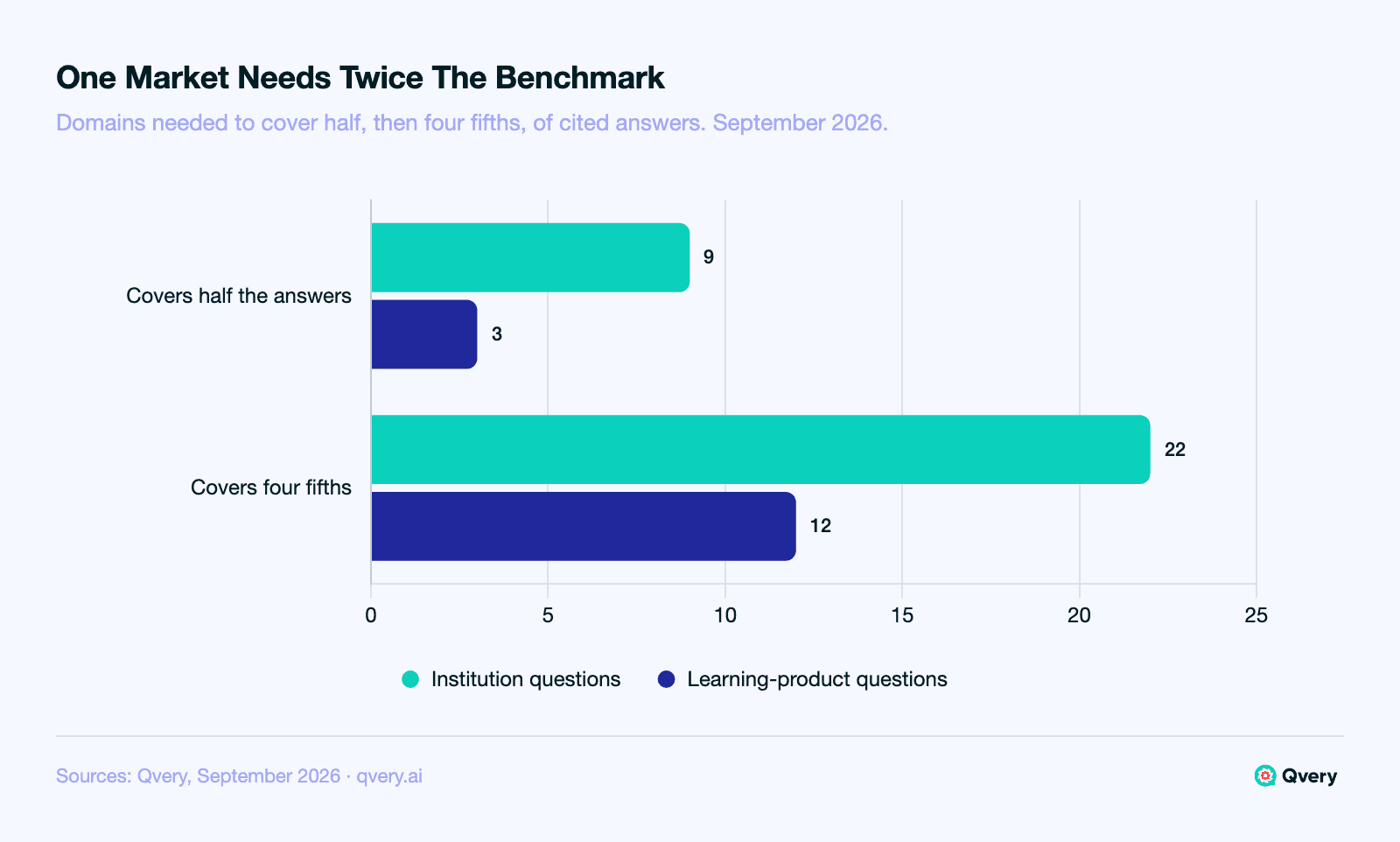
Three domains covering half of the product-side answers that cited any source is a concentrated market. Nine covering half of the institution ones is a crowded market. Same industry, different jobs.
The two lists share four rows: YouTube, Coursera, Canada's federal site and a US military education portal. Four out of the smaller list's twelve, a shared fraction of 0.33, which is a shared core with a tail on each side that is its own.
The institution tail is the ranking industry plus national and regional education bodies: QS Top Universities, UCAS, Poets and Quants, BestColleges, Research.com, gov.uk, ed.gov, TAFE NSW, the Open University. The product tail is platforms and apps: FutureLearn, Babbel, Khan Academy, Wharton executive education, plus a run of small tutoring sites.
So an education group that sells on both sides runs one benchmark set in three parts: the four shared rows, the institution tail, and the product tail. What it cannot run is a single flat list.
Four shared rows is a maintenance list, not a strategy. The work that moves anything sits in the tail that belongs to your side only.
What Answers Each Side
Classify each cited domain by what kind of site it is and the two tails stop being a surprise.
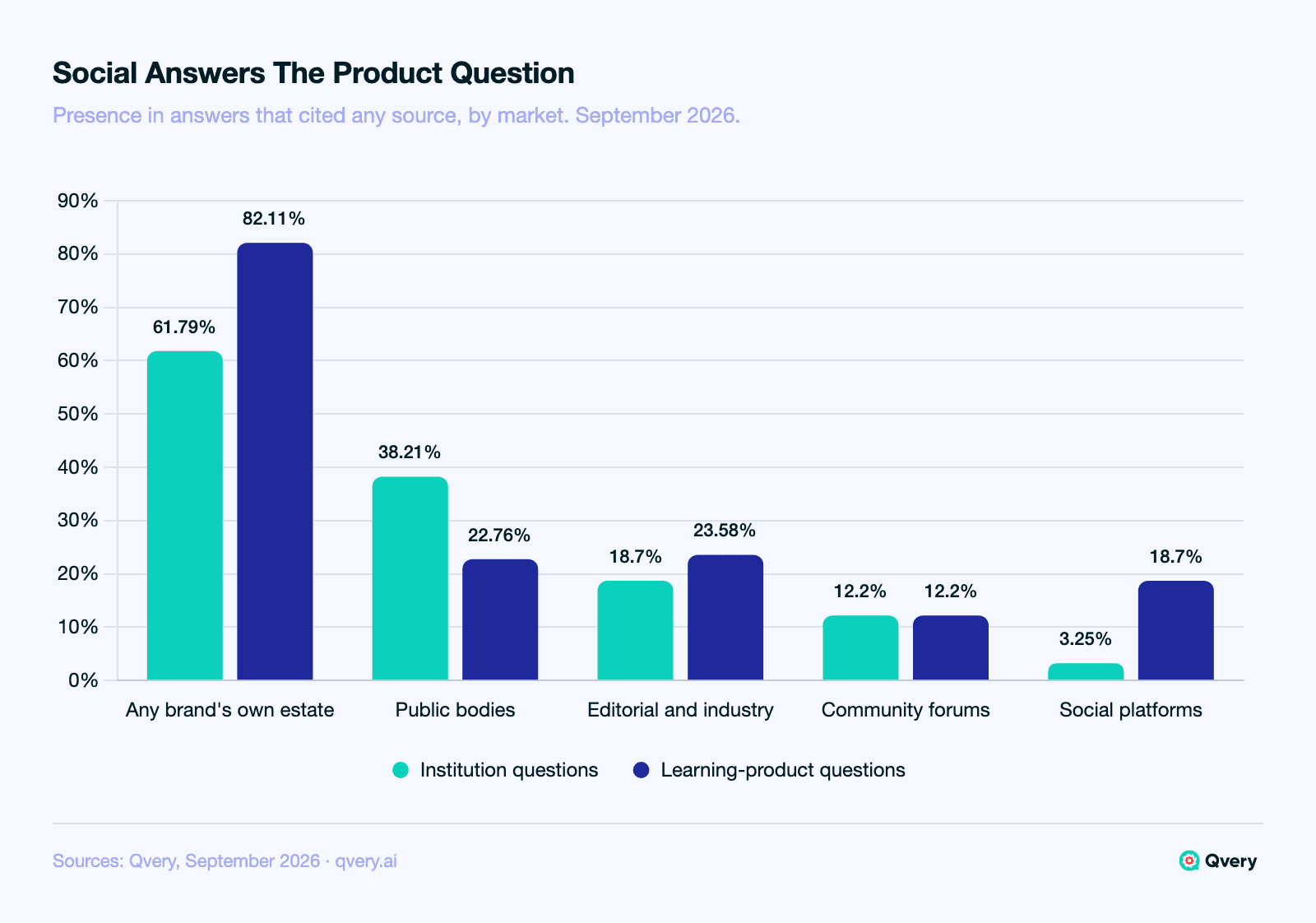
Ranking and directory sites were present in 52.85% of answers that cited any source on the institution side and 15.45% on the product side. We have written about the ranking layer's grip on institution answers before, in which sources get cited when someone asks about universities.
The other direction runs harder. Learning-product companies' own domains were present in 72.36% of answers that cited any source on the product side and 13.01% on the institution side.
Three more layers, each with a planning consequence.
Public bodies were present in 38.21% of answers that cited any source on the institution side and 22.76% on the product side. In the questions we ran, a ministry, an agency or a public education portal turned up alongside the commercial sources often enough to plan around.
Social platforms were present in 18.7% of answers that cited any source on the product side and 3.25% on the institution side, one of the sharpest splits in the study and one that runs the opposite way to the rankings layer.
Community forums were present in 12.2% of the answers that cited any source on both sides. Identical. Whatever else separates these two markets, community-forum citation does not.
Your own estate is in the answers on both sides, in 61.79% of answers that cited any source on the institution side and 82.11% on the product side. That ratio was registered in advance as indeterminate, so we report it and call nothing.
Boundaries, said once. We counted the sources answers cited. We did not read what the answers said about any school or app, did not measure why one ranking site was cited over another, and cannot tell you whether a citation changed an enrolment.
What A First Week Of Data Can And Cannot Tell You
Judgment here, not findings. A first run tells you where you stand today: whether you appear, and which domains were cited alongside you. What it cannot give you is a trend. Everything that sounds like movement needs a window.
Appearance is binary and fast. If you are absent from every question on your side, you learned that on day one and you can start work on day two.
Share of voice needs a written competitor set. Otherwise you are measuring against whoever the engine felt like naming, which changes.
Position needs a season. Education demand moves with application cycles. A fortnight either side of a deadline is not a trend.
Some questions are not yours to win. Where the cited sources are public bodies end to end, the query is telling you about the layer rather than about your brand. Mark those and stop scoring yourself on them.
Write those four down, plus the two engines you are tracking and how far a number has to move before you call it a move. That is your baseline definition, and it belongs on paper before anyone reports against it.
Set Up Your Side In Qvery
One topic per programme line, all of them inside the market you sell into. Put the student questions under each as queries. Qvery generates a starting set at onboarding and you edit it in plain language.
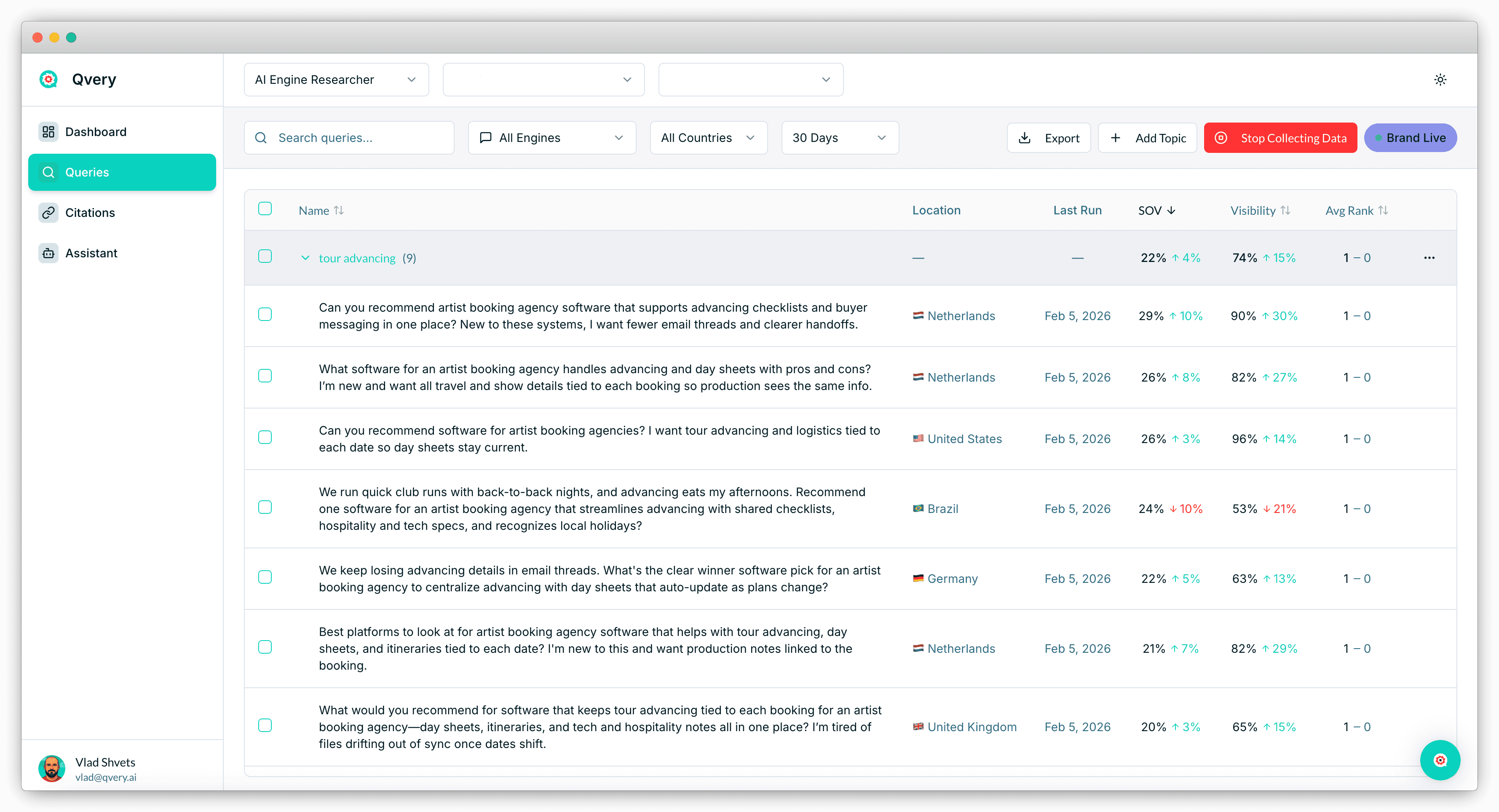
Every answer keeps the sources cited in it, tied to the query and the engine that produced it. The Citations view ranks the URLs and domains behind those answers, each with a weight, filterable by engine and country, and the ranking exports. That is how you build your own benchmark set:
Open the Citations view for one programme topic and read the Top Domains ranking.
Take rows from the top until another row stops changing what you would do. That is your working set.
If you sell on both sides, do it again for the other market.
Mark every row present, absent or stale for your brand, and mark the rows that sit on both lists.
A note on method. Our counts used a stricter definition than a top-ranked cut.
We took the smallest set of domains that together cover four fifths of the answers that cited any source, choosing them one at a time by how many still-uncovered answers each one adds. A ranked list read from the top is a close and usable version of the same thing.
Then look at the layer each row belongs to. If ranking sites fill your set, your work is placement. If your own pages fill it, your work is on pages you already control.
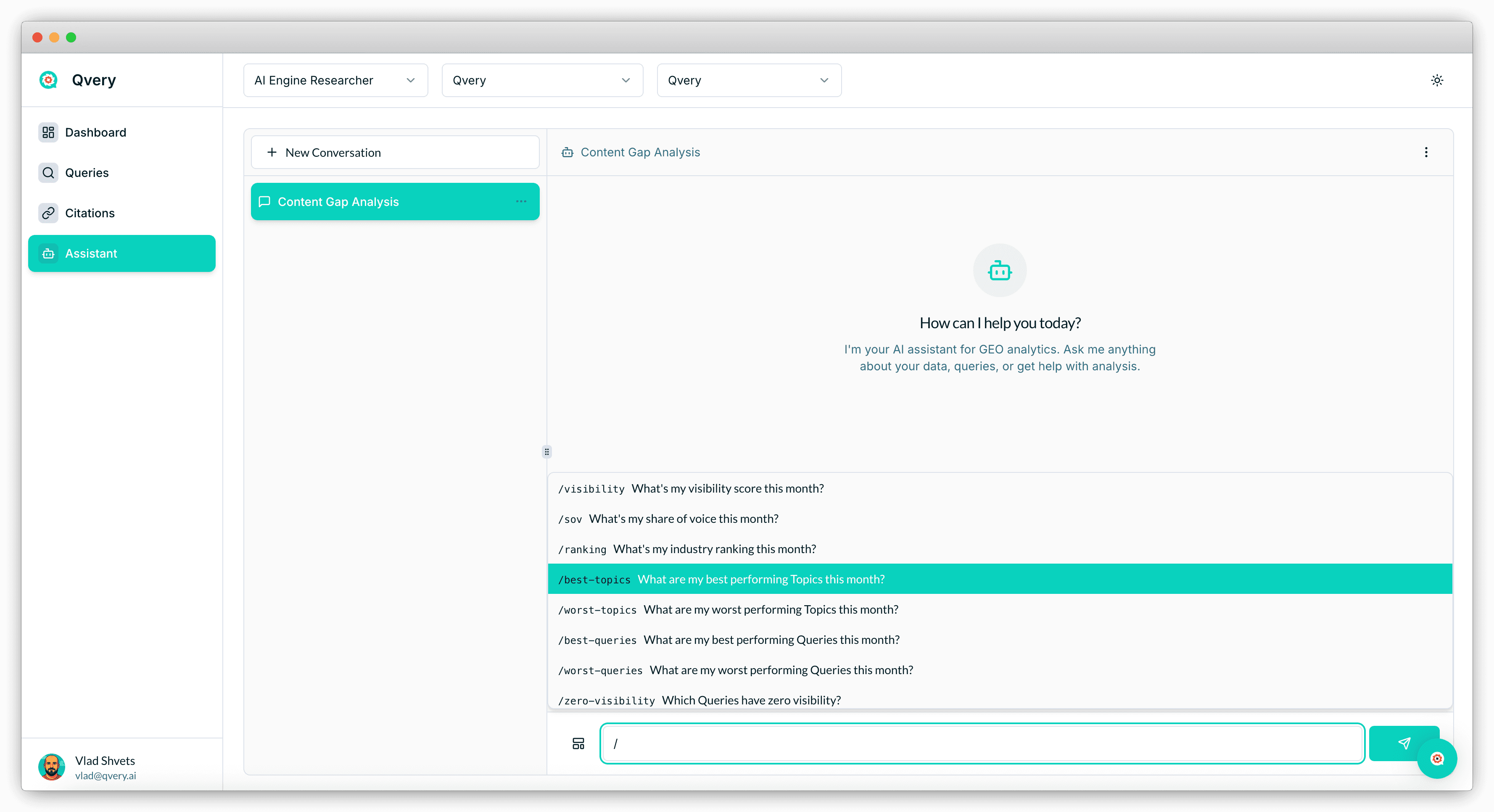
Start with the question about queries where your visibility is zero. Then read that list by hand and sort it yourself into questions you could compete for this term and questions that go to a public body whatever you do.
The Citations view records and ranks which sources an answer cited. It does not sort them into rankings, platforms and public bodies for you, and it does not report which schools an answer named in its text. Do both reads once, by hand, when you first build the set.
Start a Qvery trial and load your side of the market. Seven days free, no credit card, which is time to get the set configured and the first days of data in.
Run the zero-visibility list this week. It is the shortest document in this whole exercise and the only one that comes with its own to-do.
Two education marketers, same week, same problem, opposite answers.
One runs marketing for a university and wants to know whether ChatGPT suggests the school when someone asks where to study data science in Canada. The other runs a language app and wants to know whether the same engines suggest the app when someone asks how to get conversational in Spanish before a trip.
They both call it AI visibility. The domains cited in those two sets of answers share a small core and diverge after it, so neither marketer can lift the other's benchmark set wholesale.
This piece is about building the right set. It does not say who is winning.
Which Education Market Are You In
Institution choice is a question about a place you enrol in. Best universities for computer science in Ontario, which business school for a career change, is a community college enough for this trade.
Learning-product choice is a question about a thing you use. Best app for learning Japanese, which platform for a project management certificate, cheapest way to learn to code at home.
The distinction sorts your competitors, your benchmark set and the layer of the web you have to earn your way into.
A bootcamp sits on the product side even though it feels like a school. A university's continuing-education arm has a foot on each side, and tracking those two as one market is what produces a number neither side recognises.
Pick your side. Then write the ten questions a student types before they know your name.
Build The Benchmark Set And Count Its Rows
Before share of voice, before rankings, count. Take one side's questions, find the smallest set of domains covering half of the answers that cited any source, then the set covering four fifths. Repeat for the other side.
Across a targeted set of student questions we ran on ChatGPT and Google AI Mode in September 2026, the two sides came out at different sizes. Directional, not a census.
Institution questions: nine domains cover half of the answers that cited any source. Twenty-two cover four fifths of them.
Learning-product questions: three cover half of the answers that cited any source. Twelve cover four fifths.
Three domains covering half of the product-side answers that cited any source is a concentrated market. Nine covering half of the institution ones is a crowded market. Same industry, different jobs.
The two lists share four rows: YouTube, Coursera, Canada's federal site and a US military education portal. Four out of the smaller list's twelve, a shared fraction of 0.33, which is a shared core with a tail on each side that is its own.
The institution tail is the ranking industry plus national and regional education bodies: QS Top Universities, UCAS, Poets and Quants, BestColleges, Research.com, gov.uk, ed.gov, TAFE NSW, the Open University. The product tail is platforms and apps: FutureLearn, Babbel, Khan Academy, Wharton executive education, plus a run of small tutoring sites.
So an education group that sells on both sides runs one benchmark set in three parts: the four shared rows, the institution tail, and the product tail. What it cannot run is a single flat list.
Four shared rows is a maintenance list, not a strategy. The work that moves anything sits in the tail that belongs to your side only.
What Answers Each Side
Classify each cited domain by what kind of site it is and the two tails stop being a surprise.
Ranking and directory sites were present in 52.85% of answers that cited any source on the institution side and 15.45% on the product side. We have written about the ranking layer's grip on institution answers before, in which sources get cited when someone asks about universities.
The other direction runs harder. Learning-product companies' own domains were present in 72.36% of answers that cited any source on the product side and 13.01% on the institution side.
Three more layers, each with a planning consequence.
Public bodies were present in 38.21% of answers that cited any source on the institution side and 22.76% on the product side. In the questions we ran, a ministry, an agency or a public education portal turned up alongside the commercial sources often enough to plan around.
Social platforms were present in 18.7% of answers that cited any source on the product side and 3.25% on the institution side, one of the sharpest splits in the study and one that runs the opposite way to the rankings layer.
Community forums were present in 12.2% of the answers that cited any source on both sides. Identical. Whatever else separates these two markets, community-forum citation does not.
Your own estate is in the answers on both sides, in 61.79% of answers that cited any source on the institution side and 82.11% on the product side. That ratio was registered in advance as indeterminate, so we report it and call nothing.
Boundaries, said once. We counted the sources answers cited. We did not read what the answers said about any school or app, did not measure why one ranking site was cited over another, and cannot tell you whether a citation changed an enrolment.
What A First Week Of Data Can And Cannot Tell You
Judgment here, not findings. A first run tells you where you stand today: whether you appear, and which domains were cited alongside you. What it cannot give you is a trend. Everything that sounds like movement needs a window.
Appearance is binary and fast. If you are absent from every question on your side, you learned that on day one and you can start work on day two.
Share of voice needs a written competitor set. Otherwise you are measuring against whoever the engine felt like naming, which changes.
Position needs a season. Education demand moves with application cycles. A fortnight either side of a deadline is not a trend.
Some questions are not yours to win. Where the cited sources are public bodies end to end, the query is telling you about the layer rather than about your brand. Mark those and stop scoring yourself on them.
Write those four down, plus the two engines you are tracking and how far a number has to move before you call it a move. That is your baseline definition, and it belongs on paper before anyone reports against it.
Set Up Your Side In Qvery
One topic per programme line, all of them inside the market you sell into. Put the student questions under each as queries. Qvery generates a starting set at onboarding and you edit it in plain language.
Every answer keeps the sources cited in it, tied to the query and the engine that produced it. The Citations view ranks the URLs and domains behind those answers, each with a weight, filterable by engine and country, and the ranking exports. That is how you build your own benchmark set:
Open the Citations view for one programme topic and read the Top Domains ranking.
Take rows from the top until another row stops changing what you would do. That is your working set.
If you sell on both sides, do it again for the other market.
Mark every row present, absent or stale for your brand, and mark the rows that sit on both lists.
A note on method. Our counts used a stricter definition than a top-ranked cut.
We took the smallest set of domains that together cover four fifths of the answers that cited any source, choosing them one at a time by how many still-uncovered answers each one adds. A ranked list read from the top is a close and usable version of the same thing.
Then look at the layer each row belongs to. If ranking sites fill your set, your work is placement. If your own pages fill it, your work is on pages you already control.
Start with the question about queries where your visibility is zero. Then read that list by hand and sort it yourself into questions you could compete for this term and questions that go to a public body whatever you do.
The Citations view records and ranks which sources an answer cited. It does not sort them into rankings, platforms and public bodies for you, and it does not report which schools an answer named in its text. Do both reads once, by hand, when you first build the set.
Start a Qvery trial and load your side of the market. Seven days free, no credit card, which is time to get the set configured and the first days of data in.
Run the zero-visibility list this week. It is the shortest document in this whole exercise and the only one that comes with its own to-do.
Two education marketers, same week, same problem, opposite answers.
One runs marketing for a university and wants to know whether ChatGPT suggests the school when someone asks where to study data science in Canada. The other runs a language app and wants to know whether the same engines suggest the app when someone asks how to get conversational in Spanish before a trip.
They both call it AI visibility. The domains cited in those two sets of answers share a small core and diverge after it, so neither marketer can lift the other's benchmark set wholesale.
This piece is about building the right set. It does not say who is winning.
Which Education Market Are You In
Institution choice is a question about a place you enrol in. Best universities for computer science in Ontario, which business school for a career change, is a community college enough for this trade.
Learning-product choice is a question about a thing you use. Best app for learning Japanese, which platform for a project management certificate, cheapest way to learn to code at home.
The distinction sorts your competitors, your benchmark set and the layer of the web you have to earn your way into.
A bootcamp sits on the product side even though it feels like a school. A university's continuing-education arm has a foot on each side, and tracking those two as one market is what produces a number neither side recognises.
Pick your side. Then write the ten questions a student types before they know your name.
Build The Benchmark Set And Count Its Rows
Before share of voice, before rankings, count. Take one side's questions, find the smallest set of domains covering half of the answers that cited any source, then the set covering four fifths. Repeat for the other side.
Across a targeted set of student questions we ran on ChatGPT and Google AI Mode in September 2026, the two sides came out at different sizes. Directional, not a census.
Institution questions: nine domains cover half of the answers that cited any source. Twenty-two cover four fifths of them.
Learning-product questions: three cover half of the answers that cited any source. Twelve cover four fifths.
Three domains covering half of the product-side answers that cited any source is a concentrated market. Nine covering half of the institution ones is a crowded market. Same industry, different jobs.
The two lists share four rows: YouTube, Coursera, Canada's federal site and a US military education portal. Four out of the smaller list's twelve, a shared fraction of 0.33, which is a shared core with a tail on each side that is its own.
The institution tail is the ranking industry plus national and regional education bodies: QS Top Universities, UCAS, Poets and Quants, BestColleges, Research.com, gov.uk, ed.gov, TAFE NSW, the Open University. The product tail is platforms and apps: FutureLearn, Babbel, Khan Academy, Wharton executive education, plus a run of small tutoring sites.
So an education group that sells on both sides runs one benchmark set in three parts: the four shared rows, the institution tail, and the product tail. What it cannot run is a single flat list.
Four shared rows is a maintenance list, not a strategy. The work that moves anything sits in the tail that belongs to your side only.
What Answers Each Side
Classify each cited domain by what kind of site it is and the two tails stop being a surprise.
Ranking and directory sites were present in 52.85% of answers that cited any source on the institution side and 15.45% on the product side. We have written about the ranking layer's grip on institution answers before, in which sources get cited when someone asks about universities.
The other direction runs harder. Learning-product companies' own domains were present in 72.36% of answers that cited any source on the product side and 13.01% on the institution side.
Three more layers, each with a planning consequence.
Public bodies were present in 38.21% of answers that cited any source on the institution side and 22.76% on the product side. In the questions we ran, a ministry, an agency or a public education portal turned up alongside the commercial sources often enough to plan around.
Social platforms were present in 18.7% of answers that cited any source on the product side and 3.25% on the institution side, one of the sharpest splits in the study and one that runs the opposite way to the rankings layer.
Community forums were present in 12.2% of the answers that cited any source on both sides. Identical. Whatever else separates these two markets, community-forum citation does not.
Your own estate is in the answers on both sides, in 61.79% of answers that cited any source on the institution side and 82.11% on the product side. That ratio was registered in advance as indeterminate, so we report it and call nothing.
Boundaries, said once. We counted the sources answers cited. We did not read what the answers said about any school or app, did not measure why one ranking site was cited over another, and cannot tell you whether a citation changed an enrolment.
What A First Week Of Data Can And Cannot Tell You
Judgment here, not findings. A first run tells you where you stand today: whether you appear, and which domains were cited alongside you. What it cannot give you is a trend. Everything that sounds like movement needs a window.
Appearance is binary and fast. If you are absent from every question on your side, you learned that on day one and you can start work on day two.
Share of voice needs a written competitor set. Otherwise you are measuring against whoever the engine felt like naming, which changes.
Position needs a season. Education demand moves with application cycles. A fortnight either side of a deadline is not a trend.
Some questions are not yours to win. Where the cited sources are public bodies end to end, the query is telling you about the layer rather than about your brand. Mark those and stop scoring yourself on them.
Write those four down, plus the two engines you are tracking and how far a number has to move before you call it a move. That is your baseline definition, and it belongs on paper before anyone reports against it.
Set Up Your Side In Qvery
One topic per programme line, all of them inside the market you sell into. Put the student questions under each as queries. Qvery generates a starting set at onboarding and you edit it in plain language.
Every answer keeps the sources cited in it, tied to the query and the engine that produced it. The Citations view ranks the URLs and domains behind those answers, each with a weight, filterable by engine and country, and the ranking exports. That is how you build your own benchmark set:
Open the Citations view for one programme topic and read the Top Domains ranking.
Take rows from the top until another row stops changing what you would do. That is your working set.
If you sell on both sides, do it again for the other market.
Mark every row present, absent or stale for your brand, and mark the rows that sit on both lists.
A note on method. Our counts used a stricter definition than a top-ranked cut.
We took the smallest set of domains that together cover four fifths of the answers that cited any source, choosing them one at a time by how many still-uncovered answers each one adds. A ranked list read from the top is a close and usable version of the same thing.
Then look at the layer each row belongs to. If ranking sites fill your set, your work is placement. If your own pages fill it, your work is on pages you already control.
Start with the question about queries where your visibility is zero. Then read that list by hand and sort it yourself into questions you could compete for this term and questions that go to a public body whatever you do.
The Citations view records and ranks which sources an answer cited. It does not sort them into rankings, platforms and public bodies for you, and it does not report which schools an answer named in its text. Do both reads once, by hand, when you first build the set.
Start a Qvery trial and load your side of the market. Seven days free, no credit card, which is time to get the set configured and the first days of data in.
Run the zero-visibility list this week. It is the shortest document in this whole exercise and the only one that comes with its own to-do.
Two education marketers, same week, same problem, opposite answers.
One runs marketing for a university and wants to know whether ChatGPT suggests the school when someone asks where to study data science in Canada. The other runs a language app and wants to know whether the same engines suggest the app when someone asks how to get conversational in Spanish before a trip.
They both call it AI visibility. The domains cited in those two sets of answers share a small core and diverge after it, so neither marketer can lift the other's benchmark set wholesale.
This piece is about building the right set. It does not say who is winning.
Which Education Market Are You In
Institution choice is a question about a place you enrol in. Best universities for computer science in Ontario, which business school for a career change, is a community college enough for this trade.
Learning-product choice is a question about a thing you use. Best app for learning Japanese, which platform for a project management certificate, cheapest way to learn to code at home.
The distinction sorts your competitors, your benchmark set and the layer of the web you have to earn your way into.
A bootcamp sits on the product side even though it feels like a school. A university's continuing-education arm has a foot on each side, and tracking those two as one market is what produces a number neither side recognises.
Pick your side. Then write the ten questions a student types before they know your name.
Build The Benchmark Set And Count Its Rows
Before share of voice, before rankings, count. Take one side's questions, find the smallest set of domains covering half of the answers that cited any source, then the set covering four fifths. Repeat for the other side.
Across a targeted set of student questions we ran on ChatGPT and Google AI Mode in September 2026, the two sides came out at different sizes. Directional, not a census.
Institution questions: nine domains cover half of the answers that cited any source. Twenty-two cover four fifths of them.
Learning-product questions: three cover half of the answers that cited any source. Twelve cover four fifths.
Three domains covering half of the product-side answers that cited any source is a concentrated market. Nine covering half of the institution ones is a crowded market. Same industry, different jobs.
The two lists share four rows: YouTube, Coursera, Canada's federal site and a US military education portal. Four out of the smaller list's twelve, a shared fraction of 0.33, which is a shared core with a tail on each side that is its own.
The institution tail is the ranking industry plus national and regional education bodies: QS Top Universities, UCAS, Poets and Quants, BestColleges, Research.com, gov.uk, ed.gov, TAFE NSW, the Open University. The product tail is platforms and apps: FutureLearn, Babbel, Khan Academy, Wharton executive education, plus a run of small tutoring sites.
So an education group that sells on both sides runs one benchmark set in three parts: the four shared rows, the institution tail, and the product tail. What it cannot run is a single flat list.
Four shared rows is a maintenance list, not a strategy. The work that moves anything sits in the tail that belongs to your side only.
What Answers Each Side
Classify each cited domain by what kind of site it is and the two tails stop being a surprise.
Ranking and directory sites were present in 52.85% of answers that cited any source on the institution side and 15.45% on the product side. We have written about the ranking layer's grip on institution answers before, in which sources get cited when someone asks about universities.
The other direction runs harder. Learning-product companies' own domains were present in 72.36% of answers that cited any source on the product side and 13.01% on the institution side.
Three more layers, each with a planning consequence.
Public bodies were present in 38.21% of answers that cited any source on the institution side and 22.76% on the product side. In the questions we ran, a ministry, an agency or a public education portal turned up alongside the commercial sources often enough to plan around.
Social platforms were present in 18.7% of answers that cited any source on the product side and 3.25% on the institution side, one of the sharpest splits in the study and one that runs the opposite way to the rankings layer.
Community forums were present in 12.2% of the answers that cited any source on both sides. Identical. Whatever else separates these two markets, community-forum citation does not.
Your own estate is in the answers on both sides, in 61.79% of answers that cited any source on the institution side and 82.11% on the product side. That ratio was registered in advance as indeterminate, so we report it and call nothing.
Boundaries, said once. We counted the sources answers cited. We did not read what the answers said about any school or app, did not measure why one ranking site was cited over another, and cannot tell you whether a citation changed an enrolment.
What A First Week Of Data Can And Cannot Tell You
Judgment here, not findings. A first run tells you where you stand today: whether you appear, and which domains were cited alongside you. What it cannot give you is a trend. Everything that sounds like movement needs a window.
Appearance is binary and fast. If you are absent from every question on your side, you learned that on day one and you can start work on day two.
Share of voice needs a written competitor set. Otherwise you are measuring against whoever the engine felt like naming, which changes.
Position needs a season. Education demand moves with application cycles. A fortnight either side of a deadline is not a trend.
Some questions are not yours to win. Where the cited sources are public bodies end to end, the query is telling you about the layer rather than about your brand. Mark those and stop scoring yourself on them.
Write those four down, plus the two engines you are tracking and how far a number has to move before you call it a move. That is your baseline definition, and it belongs on paper before anyone reports against it.
Set Up Your Side In Qvery
One topic per programme line, all of them inside the market you sell into. Put the student questions under each as queries. Qvery generates a starting set at onboarding and you edit it in plain language.
Every answer keeps the sources cited in it, tied to the query and the engine that produced it. The Citations view ranks the URLs and domains behind those answers, each with a weight, filterable by engine and country, and the ranking exports. That is how you build your own benchmark set:
Open the Citations view for one programme topic and read the Top Domains ranking.
Take rows from the top until another row stops changing what you would do. That is your working set.
If you sell on both sides, do it again for the other market.
Mark every row present, absent or stale for your brand, and mark the rows that sit on both lists.
A note on method. Our counts used a stricter definition than a top-ranked cut.
We took the smallest set of domains that together cover four fifths of the answers that cited any source, choosing them one at a time by how many still-uncovered answers each one adds. A ranked list read from the top is a close and usable version of the same thing.
Then look at the layer each row belongs to. If ranking sites fill your set, your work is placement. If your own pages fill it, your work is on pages you already control.
Start with the question about queries where your visibility is zero. Then read that list by hand and sort it yourself into questions you could compete for this term and questions that go to a public body whatever you do.
The Citations view records and ranks which sources an answer cited. It does not sort them into rankings, platforms and public bodies for you, and it does not report which schools an answer named in its text. Do both reads once, by hand, when you first build the set.
Start a Qvery trial and load your side of the market. Seven days free, no credit card, which is time to get the set configured and the first days of data in.
Run the zero-visibility list this week. It is the shortest document in this whole exercise and the only one that comes with its own to-do.

© 2026 Qvery AI OÜ