By
Vlad Shvets
Do AI Engines Cite Fintech Brands' Own Websites? Yes, And These Are The Pages
Fintech providers' own sites were cited in 73.00% of AI answers to product-selection questions and 76.50% of direct requests. Which owned pages the answers cited, and how to audit yours.
Fintech providers' own sites were cited in 73.00% of AI answers to product-selection questions and 76.50% of direct requests. Which owned pages the answers cited, and how to audit yours.
Fintech providers' own sites were cited in 73.00% of AI answers to product-selection questions and 76.50% of direct requests. Which owned pages the answers cited, and how to audit yours.
If you market a fintech product, your AI visibility audit has to answer a basic question early: does your own website belong in it? Your buyers ask in two ways. Some want help choosing between providers. Others just ask for an app that does the job.
So we asked ChatGPT and Google AI Mode the same consumer-finance needs both ways in September 2026, once as a choice between providers and once as a direct request, and recorded which answers cited a fintech provider's own site.
At least one provider's own site was cited in 73.00% of the choosing answers and 76.50% of the direct requests, a difference we registered as equivalent. Had owned sites turned up in one framing and not the other, the audit would start there; since they turned up alike, it covers both.
The owned pages that at least five answers cited were product pages, pricing and fee pages, an account sign-up page, help and FAQ articles, and the providers' own guides, alongside citations to bare homepages whose page we couldn't resolve.
Both engines' answers cited owned sites. This measures where owned sites were cited, not what website work does for them.
Fintech Brands' Own Sites Are Cited Alike Whether Buyers Compare or Ask
Across both engines, at least one fintech provider's own site appeared in 73.00% of answers to product-selection questions and 76.50% of answers to direct requests for a provider or app, each a share of all answers of that kind.
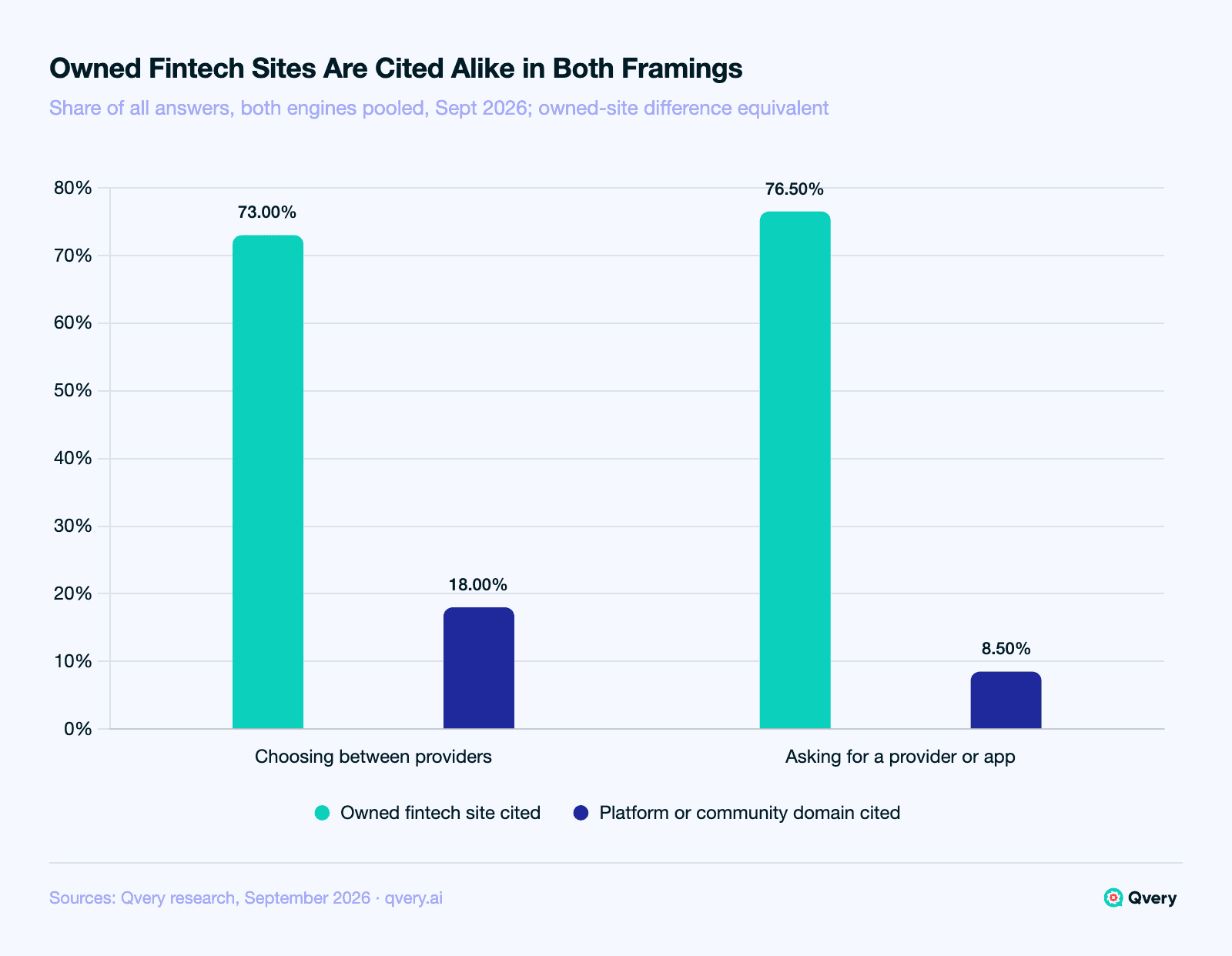
The two framings are answered alike on this measure. For your audit, that means your own site isn't a one-framing play: check it on choosing questions and on direct requests.
The chart's second line is platform and community domains, reddit.com and youtube.com among them. They appeared in 18.00% of product-selection answers and 8.50% of direct requests. That line is descriptive only; we registered no test on it.
App Store listings sit outside the owned set, because every cited apps.apple.com page was another company's app, not an Apple financial product.
Both engines cited owned sites. Across every answer, at least one owned fintech site appeared in 80.83% of ChatGPT's answers and 65.62% of Google AI Mode's.
We draw no contrast between those two numbers here; how the engines split fintech sources is covered in fintech trust signals in AI engines, and what ChatGPT does with money questions in ChatGPT's money queries.
Wellows argues that "AI systems need a clean, verifiable understanding of what the fintech brand does, who it serves, and how its product works, so brand identity, schema, and claims have to match across the site, product pages, listings, and trusted profiles."
This data shows owned sites cited in both framings. It didn't check whether a brand's claims match across its site, listings, and profiles, so it can't say what a mismatch costs.
The Cited Owned Pages Run From Product Pages to Help Articles
To see which owned pages the answers cite, we took every URL on a fintech provider's own site that at least five answers cited, fixed that list before fetching anything, and read each page. Two readers coded every page type blind to each other, and a third reading settled the few they disagreed on.
Here is the full list, grouped by page type:
Product or service pages: Capital One's 360 Checking page, Starling Bank's business account page, schwab.com/checking, Capital One's MONEY Teen Checking page, and acorns.com/round-ups.
Pricing or fee pages: Capital One's help article on international ATM fees, wise.com's Australian send-money pricing page, wise.com/gb/pricing, Rocket Money's "How much does Rocket Money cost?" article, and myfico.com's FICO score plans page.
Account or eligibility pages: Monzo's business account sign-up page.
Help or policy pages: rocketmoney.com/faq, Rocket Money's help articles on managing bills and on cancelling a subscription, Splitwise's "How do I use Splitwise?", YNAB's help article on variable income, Wise's help article on fees for sending money, schwab.com/checking/faqs, and step.com/faq.
Editorial or resource pages: useorigin.com's "10 Best Bill Management Apps & Tools in 2026 (U.S. Guide)", transfcu.org's "6 Best Apps for Bill Management", Greenlight's "Capital One Teen Checking vs. Greenlight", and ynab.com/guide/irregular-income.
Couldn't be coded: Stockspot's robo-advice page and Remitly's US money-transfer page (the stored fetch ended before the main content), and Revolut's help article on bank transfer fees (not fetched).
That's five product pages, five pricing or fee pages, one account page, eight help or policy pages, and four editorial pages. No trust or security page is documented among the 23 resolved pages.
Fifteen of the 38 listed URLs are unresolved, counting the bare domains below, which is enough to reorder any count, so none of these groups is ranked above another.
The other twelve entries are bare domains, cited without a deeper page: rocketmoney.com, splitwise.com, ynab.com, experian.com, monarch.com, annualcreditreport.com, creditkarma.com, myfico.com, stockspot.com.au, wise.com, monarchmoney.com, and schwab.com.
A citation to your bare domain is not a homepage citation. The same root can stand for different deeper pages, so resolve it to the page the answer used before you count it.
A LinkedIn article puts the case for page quality this way: "AI engines select citations based on entity clarity, answer-first structure, schema density, and off-site signals that confirm the brand is a credible source on the specific topic."
The list above records what kind of owned page was cited. It measured none of the four things that line names, so it neither confirms nor refutes them. For what the engines read on a software vendor's own site, a different vertical, see what AI engines cite on SaaS landing pages.
Check Your Own Domain Against Both Source Lists
The owned rate is alike across the two framings, but that doesn't mean the same domains are cited in both. For each framing, we took the smallest set of domains that together appeared in 80% of the answers that cited any source.
The product-selection list covered 65.98% of the direct-request answers that cited any source. The direct-request list covered 77.39% of the product-selection answers that cited any source. That's a shared core with a different tail on each side.
In both lists (11): acorns.com, apps.apple.com, cnbc.com, experian.com, help.rocketmoney.com, kb.splitwise.com, moneysavingexpert.com, nerdwallet.com, reddit.com, schwab.com, and wise.com.
Product-selection only (6): finder.com, finder.com.au, greenlight.com, irs.gov, starlingbank.com, and ynab.com.
Direct-request only (13): canstar.com.au, capitalone.com, consumer.ftc.gov, consumerfinance.gov, flowtrip.app, help.venmo.com, money.usnews.com, moneyhelper.org.uk, monzo.com, personalfinancepilot.com, quicken.com, stockspot.com.au, and transfcu.org.
So check where your own domain sits in each framing, not once.
Equal owned rates across two framings can sit on different domains. The rate tells you your site belongs in both audits; only the lists tell you whether it's in either.
The shared-layer decision for fintech audits is laid out in how to measure fintech AI visibility.
Audit Your Own Site's Citations on Paired Questions in Qvery
Add your fintech needs to Qvery as queries, each written twice: as a choice between providers and as a direct request for an app. Qvery tracks them daily on ChatGPT and Google AI Mode, in any of 200+ countries, and reports your visibility, share of voice, and average rank.
Every citation is tied to the query and the engine that produced it, so you can see on which questions, and in which engine, your own domain is cited, and which of your URLs. To pull that out quickly, ask Qvery Assistant which of your pages were cited this week.
Coding each cited URL by page type is your step, using the groups above, and resolving any bare-domain citation to the page it stood for. For building the paired question set, how to measure fintech AI visibility covers it.
The audit shows where your site is cited, not what a citation returns. Start a free 7-day trial, no credit card required, and load your first ten paired needs.
Where These Numbers Stop
This counts cited domains and URLs in one September 2026 set of consumer-finance questions. It doesn't measure whether a brand was named or recommended, traffic, conversion, or cause.
The owned set is a hand-checked list of fintech provider domains, counted by domain. Business-only providers such as stripe.com and payoneer.com sit outside it, and so do App Store listings.
The engine figures cover every answer and are context only: no ratio, no difference claim, and no engine figure for each framing. The pooled rates count every answer once, and ChatGPT answered more of the questions than Google AI Mode, so they lean toward ChatGPT.
The page list only includes URLs cited by at least five answers, so owned domains cited across many different pages, none reaching five, aren't in it; fidelity.com, chase.com, and quicken.com are examples. A URL's answers can be repeat asks of one question. No page-type rate or comparison between the framings is published.
Nothing here is compared with an earlier period.
Keep Your Own Site in Both Audits
Keep your own site in the AI visibility audit for both ways buyers ask, choosing between providers and asking for one, in both engines. Inventory which of your URLs the answers cite, code each page by type, and resolve any bare-domain citation to the page it stood for before you count it.
If you market a fintech product, your AI visibility audit has to answer a basic question early: does your own website belong in it? Your buyers ask in two ways. Some want help choosing between providers. Others just ask for an app that does the job.
So we asked ChatGPT and Google AI Mode the same consumer-finance needs both ways in September 2026, once as a choice between providers and once as a direct request, and recorded which answers cited a fintech provider's own site.
At least one provider's own site was cited in 73.00% of the choosing answers and 76.50% of the direct requests, a difference we registered as equivalent. Had owned sites turned up in one framing and not the other, the audit would start there; since they turned up alike, it covers both.
The owned pages that at least five answers cited were product pages, pricing and fee pages, an account sign-up page, help and FAQ articles, and the providers' own guides, alongside citations to bare homepages whose page we couldn't resolve.
Both engines' answers cited owned sites. This measures where owned sites were cited, not what website work does for them.
Fintech Brands' Own Sites Are Cited Alike Whether Buyers Compare or Ask
Across both engines, at least one fintech provider's own site appeared in 73.00% of answers to product-selection questions and 76.50% of answers to direct requests for a provider or app, each a share of all answers of that kind.
The two framings are answered alike on this measure. For your audit, that means your own site isn't a one-framing play: check it on choosing questions and on direct requests.
The chart's second line is platform and community domains, reddit.com and youtube.com among them. They appeared in 18.00% of product-selection answers and 8.50% of direct requests. That line is descriptive only; we registered no test on it.
App Store listings sit outside the owned set, because every cited apps.apple.com page was another company's app, not an Apple financial product.
Both engines cited owned sites. Across every answer, at least one owned fintech site appeared in 80.83% of ChatGPT's answers and 65.62% of Google AI Mode's.
We draw no contrast between those two numbers here; how the engines split fintech sources is covered in fintech trust signals in AI engines, and what ChatGPT does with money questions in ChatGPT's money queries.
Wellows argues that "AI systems need a clean, verifiable understanding of what the fintech brand does, who it serves, and how its product works, so brand identity, schema, and claims have to match across the site, product pages, listings, and trusted profiles."
This data shows owned sites cited in both framings. It didn't check whether a brand's claims match across its site, listings, and profiles, so it can't say what a mismatch costs.
The Cited Owned Pages Run From Product Pages to Help Articles
To see which owned pages the answers cite, we took every URL on a fintech provider's own site that at least five answers cited, fixed that list before fetching anything, and read each page. Two readers coded every page type blind to each other, and a third reading settled the few they disagreed on.
Here is the full list, grouped by page type:
Product or service pages: Capital One's 360 Checking page, Starling Bank's business account page, schwab.com/checking, Capital One's MONEY Teen Checking page, and acorns.com/round-ups.
Pricing or fee pages: Capital One's help article on international ATM fees, wise.com's Australian send-money pricing page, wise.com/gb/pricing, Rocket Money's "How much does Rocket Money cost?" article, and myfico.com's FICO score plans page.
Account or eligibility pages: Monzo's business account sign-up page.
Help or policy pages: rocketmoney.com/faq, Rocket Money's help articles on managing bills and on cancelling a subscription, Splitwise's "How do I use Splitwise?", YNAB's help article on variable income, Wise's help article on fees for sending money, schwab.com/checking/faqs, and step.com/faq.
Editorial or resource pages: useorigin.com's "10 Best Bill Management Apps & Tools in 2026 (U.S. Guide)", transfcu.org's "6 Best Apps for Bill Management", Greenlight's "Capital One Teen Checking vs. Greenlight", and ynab.com/guide/irregular-income.
Couldn't be coded: Stockspot's robo-advice page and Remitly's US money-transfer page (the stored fetch ended before the main content), and Revolut's help article on bank transfer fees (not fetched).
That's five product pages, five pricing or fee pages, one account page, eight help or policy pages, and four editorial pages. No trust or security page is documented among the 23 resolved pages.
Fifteen of the 38 listed URLs are unresolved, counting the bare domains below, which is enough to reorder any count, so none of these groups is ranked above another.
The other twelve entries are bare domains, cited without a deeper page: rocketmoney.com, splitwise.com, ynab.com, experian.com, monarch.com, annualcreditreport.com, creditkarma.com, myfico.com, stockspot.com.au, wise.com, monarchmoney.com, and schwab.com.
A citation to your bare domain is not a homepage citation. The same root can stand for different deeper pages, so resolve it to the page the answer used before you count it.
A LinkedIn article puts the case for page quality this way: "AI engines select citations based on entity clarity, answer-first structure, schema density, and off-site signals that confirm the brand is a credible source on the specific topic."
The list above records what kind of owned page was cited. It measured none of the four things that line names, so it neither confirms nor refutes them. For what the engines read on a software vendor's own site, a different vertical, see what AI engines cite on SaaS landing pages.
Check Your Own Domain Against Both Source Lists
The owned rate is alike across the two framings, but that doesn't mean the same domains are cited in both. For each framing, we took the smallest set of domains that together appeared in 80% of the answers that cited any source.
The product-selection list covered 65.98% of the direct-request answers that cited any source. The direct-request list covered 77.39% of the product-selection answers that cited any source. That's a shared core with a different tail on each side.
In both lists (11): acorns.com, apps.apple.com, cnbc.com, experian.com, help.rocketmoney.com, kb.splitwise.com, moneysavingexpert.com, nerdwallet.com, reddit.com, schwab.com, and wise.com.
Product-selection only (6): finder.com, finder.com.au, greenlight.com, irs.gov, starlingbank.com, and ynab.com.
Direct-request only (13): canstar.com.au, capitalone.com, consumer.ftc.gov, consumerfinance.gov, flowtrip.app, help.venmo.com, money.usnews.com, moneyhelper.org.uk, monzo.com, personalfinancepilot.com, quicken.com, stockspot.com.au, and transfcu.org.
So check where your own domain sits in each framing, not once.
Equal owned rates across two framings can sit on different domains. The rate tells you your site belongs in both audits; only the lists tell you whether it's in either.
The shared-layer decision for fintech audits is laid out in how to measure fintech AI visibility.
Audit Your Own Site's Citations on Paired Questions in Qvery
Add your fintech needs to Qvery as queries, each written twice: as a choice between providers and as a direct request for an app. Qvery tracks them daily on ChatGPT and Google AI Mode, in any of 200+ countries, and reports your visibility, share of voice, and average rank.
Every citation is tied to the query and the engine that produced it, so you can see on which questions, and in which engine, your own domain is cited, and which of your URLs. To pull that out quickly, ask Qvery Assistant which of your pages were cited this week.
Coding each cited URL by page type is your step, using the groups above, and resolving any bare-domain citation to the page it stood for. For building the paired question set, how to measure fintech AI visibility covers it.
The audit shows where your site is cited, not what a citation returns. Start a free 7-day trial, no credit card required, and load your first ten paired needs.
Where These Numbers Stop
This counts cited domains and URLs in one September 2026 set of consumer-finance questions. It doesn't measure whether a brand was named or recommended, traffic, conversion, or cause.
The owned set is a hand-checked list of fintech provider domains, counted by domain. Business-only providers such as stripe.com and payoneer.com sit outside it, and so do App Store listings.
The engine figures cover every answer and are context only: no ratio, no difference claim, and no engine figure for each framing. The pooled rates count every answer once, and ChatGPT answered more of the questions than Google AI Mode, so they lean toward ChatGPT.
The page list only includes URLs cited by at least five answers, so owned domains cited across many different pages, none reaching five, aren't in it; fidelity.com, chase.com, and quicken.com are examples. A URL's answers can be repeat asks of one question. No page-type rate or comparison between the framings is published.
Nothing here is compared with an earlier period.
Keep Your Own Site in Both Audits
Keep your own site in the AI visibility audit for both ways buyers ask, choosing between providers and asking for one, in both engines. Inventory which of your URLs the answers cite, code each page by type, and resolve any bare-domain citation to the page it stood for before you count it.
If you market a fintech product, your AI visibility audit has to answer a basic question early: does your own website belong in it? Your buyers ask in two ways. Some want help choosing between providers. Others just ask for an app that does the job.
So we asked ChatGPT and Google AI Mode the same consumer-finance needs both ways in September 2026, once as a choice between providers and once as a direct request, and recorded which answers cited a fintech provider's own site.
At least one provider's own site was cited in 73.00% of the choosing answers and 76.50% of the direct requests, a difference we registered as equivalent. Had owned sites turned up in one framing and not the other, the audit would start there; since they turned up alike, it covers both.
The owned pages that at least five answers cited were product pages, pricing and fee pages, an account sign-up page, help and FAQ articles, and the providers' own guides, alongside citations to bare homepages whose page we couldn't resolve.
Both engines' answers cited owned sites. This measures where owned sites were cited, not what website work does for them.
Fintech Brands' Own Sites Are Cited Alike Whether Buyers Compare or Ask
Across both engines, at least one fintech provider's own site appeared in 73.00% of answers to product-selection questions and 76.50% of answers to direct requests for a provider or app, each a share of all answers of that kind.
The two framings are answered alike on this measure. For your audit, that means your own site isn't a one-framing play: check it on choosing questions and on direct requests.
The chart's second line is platform and community domains, reddit.com and youtube.com among them. They appeared in 18.00% of product-selection answers and 8.50% of direct requests. That line is descriptive only; we registered no test on it.
App Store listings sit outside the owned set, because every cited apps.apple.com page was another company's app, not an Apple financial product.
Both engines cited owned sites. Across every answer, at least one owned fintech site appeared in 80.83% of ChatGPT's answers and 65.62% of Google AI Mode's.
We draw no contrast between those two numbers here; how the engines split fintech sources is covered in fintech trust signals in AI engines, and what ChatGPT does with money questions in ChatGPT's money queries.
Wellows argues that "AI systems need a clean, verifiable understanding of what the fintech brand does, who it serves, and how its product works, so brand identity, schema, and claims have to match across the site, product pages, listings, and trusted profiles."
This data shows owned sites cited in both framings. It didn't check whether a brand's claims match across its site, listings, and profiles, so it can't say what a mismatch costs.
The Cited Owned Pages Run From Product Pages to Help Articles
To see which owned pages the answers cite, we took every URL on a fintech provider's own site that at least five answers cited, fixed that list before fetching anything, and read each page. Two readers coded every page type blind to each other, and a third reading settled the few they disagreed on.
Here is the full list, grouped by page type:
Product or service pages: Capital One's 360 Checking page, Starling Bank's business account page, schwab.com/checking, Capital One's MONEY Teen Checking page, and acorns.com/round-ups.
Pricing or fee pages: Capital One's help article on international ATM fees, wise.com's Australian send-money pricing page, wise.com/gb/pricing, Rocket Money's "How much does Rocket Money cost?" article, and myfico.com's FICO score plans page.
Account or eligibility pages: Monzo's business account sign-up page.
Help or policy pages: rocketmoney.com/faq, Rocket Money's help articles on managing bills and on cancelling a subscription, Splitwise's "How do I use Splitwise?", YNAB's help article on variable income, Wise's help article on fees for sending money, schwab.com/checking/faqs, and step.com/faq.
Editorial or resource pages: useorigin.com's "10 Best Bill Management Apps & Tools in 2026 (U.S. Guide)", transfcu.org's "6 Best Apps for Bill Management", Greenlight's "Capital One Teen Checking vs. Greenlight", and ynab.com/guide/irregular-income.
Couldn't be coded: Stockspot's robo-advice page and Remitly's US money-transfer page (the stored fetch ended before the main content), and Revolut's help article on bank transfer fees (not fetched).
That's five product pages, five pricing or fee pages, one account page, eight help or policy pages, and four editorial pages. No trust or security page is documented among the 23 resolved pages.
Fifteen of the 38 listed URLs are unresolved, counting the bare domains below, which is enough to reorder any count, so none of these groups is ranked above another.
The other twelve entries are bare domains, cited without a deeper page: rocketmoney.com, splitwise.com, ynab.com, experian.com, monarch.com, annualcreditreport.com, creditkarma.com, myfico.com, stockspot.com.au, wise.com, monarchmoney.com, and schwab.com.
A citation to your bare domain is not a homepage citation. The same root can stand for different deeper pages, so resolve it to the page the answer used before you count it.
A LinkedIn article puts the case for page quality this way: "AI engines select citations based on entity clarity, answer-first structure, schema density, and off-site signals that confirm the brand is a credible source on the specific topic."
The list above records what kind of owned page was cited. It measured none of the four things that line names, so it neither confirms nor refutes them. For what the engines read on a software vendor's own site, a different vertical, see what AI engines cite on SaaS landing pages.
Check Your Own Domain Against Both Source Lists
The owned rate is alike across the two framings, but that doesn't mean the same domains are cited in both. For each framing, we took the smallest set of domains that together appeared in 80% of the answers that cited any source.
The product-selection list covered 65.98% of the direct-request answers that cited any source. The direct-request list covered 77.39% of the product-selection answers that cited any source. That's a shared core with a different tail on each side.
In both lists (11): acorns.com, apps.apple.com, cnbc.com, experian.com, help.rocketmoney.com, kb.splitwise.com, moneysavingexpert.com, nerdwallet.com, reddit.com, schwab.com, and wise.com.
Product-selection only (6): finder.com, finder.com.au, greenlight.com, irs.gov, starlingbank.com, and ynab.com.
Direct-request only (13): canstar.com.au, capitalone.com, consumer.ftc.gov, consumerfinance.gov, flowtrip.app, help.venmo.com, money.usnews.com, moneyhelper.org.uk, monzo.com, personalfinancepilot.com, quicken.com, stockspot.com.au, and transfcu.org.
So check where your own domain sits in each framing, not once.
Equal owned rates across two framings can sit on different domains. The rate tells you your site belongs in both audits; only the lists tell you whether it's in either.
The shared-layer decision for fintech audits is laid out in how to measure fintech AI visibility.
Audit Your Own Site's Citations on Paired Questions in Qvery
Add your fintech needs to Qvery as queries, each written twice: as a choice between providers and as a direct request for an app. Qvery tracks them daily on ChatGPT and Google AI Mode, in any of 200+ countries, and reports your visibility, share of voice, and average rank.
Every citation is tied to the query and the engine that produced it, so you can see on which questions, and in which engine, your own domain is cited, and which of your URLs. To pull that out quickly, ask Qvery Assistant which of your pages were cited this week.
Coding each cited URL by page type is your step, using the groups above, and resolving any bare-domain citation to the page it stood for. For building the paired question set, how to measure fintech AI visibility covers it.
The audit shows where your site is cited, not what a citation returns. Start a free 7-day trial, no credit card required, and load your first ten paired needs.
Where These Numbers Stop
This counts cited domains and URLs in one September 2026 set of consumer-finance questions. It doesn't measure whether a brand was named or recommended, traffic, conversion, or cause.
The owned set is a hand-checked list of fintech provider domains, counted by domain. Business-only providers such as stripe.com and payoneer.com sit outside it, and so do App Store listings.
The engine figures cover every answer and are context only: no ratio, no difference claim, and no engine figure for each framing. The pooled rates count every answer once, and ChatGPT answered more of the questions than Google AI Mode, so they lean toward ChatGPT.
The page list only includes URLs cited by at least five answers, so owned domains cited across many different pages, none reaching five, aren't in it; fidelity.com, chase.com, and quicken.com are examples. A URL's answers can be repeat asks of one question. No page-type rate or comparison between the framings is published.
Nothing here is compared with an earlier period.
Keep Your Own Site in Both Audits
Keep your own site in the AI visibility audit for both ways buyers ask, choosing between providers and asking for one, in both engines. Inventory which of your URLs the answers cite, code each page by type, and resolve any bare-domain citation to the page it stood for before you count it.
If you market a fintech product, your AI visibility audit has to answer a basic question early: does your own website belong in it? Your buyers ask in two ways. Some want help choosing between providers. Others just ask for an app that does the job.
So we asked ChatGPT and Google AI Mode the same consumer-finance needs both ways in September 2026, once as a choice between providers and once as a direct request, and recorded which answers cited a fintech provider's own site.
At least one provider's own site was cited in 73.00% of the choosing answers and 76.50% of the direct requests, a difference we registered as equivalent. Had owned sites turned up in one framing and not the other, the audit would start there; since they turned up alike, it covers both.
The owned pages that at least five answers cited were product pages, pricing and fee pages, an account sign-up page, help and FAQ articles, and the providers' own guides, alongside citations to bare homepages whose page we couldn't resolve.
Both engines' answers cited owned sites. This measures where owned sites were cited, not what website work does for them.
Fintech Brands' Own Sites Are Cited Alike Whether Buyers Compare or Ask
Across both engines, at least one fintech provider's own site appeared in 73.00% of answers to product-selection questions and 76.50% of answers to direct requests for a provider or app, each a share of all answers of that kind.
The two framings are answered alike on this measure. For your audit, that means your own site isn't a one-framing play: check it on choosing questions and on direct requests.
The chart's second line is platform and community domains, reddit.com and youtube.com among them. They appeared in 18.00% of product-selection answers and 8.50% of direct requests. That line is descriptive only; we registered no test on it.
App Store listings sit outside the owned set, because every cited apps.apple.com page was another company's app, not an Apple financial product.
Both engines cited owned sites. Across every answer, at least one owned fintech site appeared in 80.83% of ChatGPT's answers and 65.62% of Google AI Mode's.
We draw no contrast between those two numbers here; how the engines split fintech sources is covered in fintech trust signals in AI engines, and what ChatGPT does with money questions in ChatGPT's money queries.
Wellows argues that "AI systems need a clean, verifiable understanding of what the fintech brand does, who it serves, and how its product works, so brand identity, schema, and claims have to match across the site, product pages, listings, and trusted profiles."
This data shows owned sites cited in both framings. It didn't check whether a brand's claims match across its site, listings, and profiles, so it can't say what a mismatch costs.
The Cited Owned Pages Run From Product Pages to Help Articles
To see which owned pages the answers cite, we took every URL on a fintech provider's own site that at least five answers cited, fixed that list before fetching anything, and read each page. Two readers coded every page type blind to each other, and a third reading settled the few they disagreed on.
Here is the full list, grouped by page type:
Product or service pages: Capital One's 360 Checking page, Starling Bank's business account page, schwab.com/checking, Capital One's MONEY Teen Checking page, and acorns.com/round-ups.
Pricing or fee pages: Capital One's help article on international ATM fees, wise.com's Australian send-money pricing page, wise.com/gb/pricing, Rocket Money's "How much does Rocket Money cost?" article, and myfico.com's FICO score plans page.
Account or eligibility pages: Monzo's business account sign-up page.
Help or policy pages: rocketmoney.com/faq, Rocket Money's help articles on managing bills and on cancelling a subscription, Splitwise's "How do I use Splitwise?", YNAB's help article on variable income, Wise's help article on fees for sending money, schwab.com/checking/faqs, and step.com/faq.
Editorial or resource pages: useorigin.com's "10 Best Bill Management Apps & Tools in 2026 (U.S. Guide)", transfcu.org's "6 Best Apps for Bill Management", Greenlight's "Capital One Teen Checking vs. Greenlight", and ynab.com/guide/irregular-income.
Couldn't be coded: Stockspot's robo-advice page and Remitly's US money-transfer page (the stored fetch ended before the main content), and Revolut's help article on bank transfer fees (not fetched).
That's five product pages, five pricing or fee pages, one account page, eight help or policy pages, and four editorial pages. No trust or security page is documented among the 23 resolved pages.
Fifteen of the 38 listed URLs are unresolved, counting the bare domains below, which is enough to reorder any count, so none of these groups is ranked above another.
The other twelve entries are bare domains, cited without a deeper page: rocketmoney.com, splitwise.com, ynab.com, experian.com, monarch.com, annualcreditreport.com, creditkarma.com, myfico.com, stockspot.com.au, wise.com, monarchmoney.com, and schwab.com.
A citation to your bare domain is not a homepage citation. The same root can stand for different deeper pages, so resolve it to the page the answer used before you count it.
A LinkedIn article puts the case for page quality this way: "AI engines select citations based on entity clarity, answer-first structure, schema density, and off-site signals that confirm the brand is a credible source on the specific topic."
The list above records what kind of owned page was cited. It measured none of the four things that line names, so it neither confirms nor refutes them. For what the engines read on a software vendor's own site, a different vertical, see what AI engines cite on SaaS landing pages.
Check Your Own Domain Against Both Source Lists
The owned rate is alike across the two framings, but that doesn't mean the same domains are cited in both. For each framing, we took the smallest set of domains that together appeared in 80% of the answers that cited any source.
The product-selection list covered 65.98% of the direct-request answers that cited any source. The direct-request list covered 77.39% of the product-selection answers that cited any source. That's a shared core with a different tail on each side.
In both lists (11): acorns.com, apps.apple.com, cnbc.com, experian.com, help.rocketmoney.com, kb.splitwise.com, moneysavingexpert.com, nerdwallet.com, reddit.com, schwab.com, and wise.com.
Product-selection only (6): finder.com, finder.com.au, greenlight.com, irs.gov, starlingbank.com, and ynab.com.
Direct-request only (13): canstar.com.au, capitalone.com, consumer.ftc.gov, consumerfinance.gov, flowtrip.app, help.venmo.com, money.usnews.com, moneyhelper.org.uk, monzo.com, personalfinancepilot.com, quicken.com, stockspot.com.au, and transfcu.org.
So check where your own domain sits in each framing, not once.
Equal owned rates across two framings can sit on different domains. The rate tells you your site belongs in both audits; only the lists tell you whether it's in either.
The shared-layer decision for fintech audits is laid out in how to measure fintech AI visibility.
Audit Your Own Site's Citations on Paired Questions in Qvery
Add your fintech needs to Qvery as queries, each written twice: as a choice between providers and as a direct request for an app. Qvery tracks them daily on ChatGPT and Google AI Mode, in any of 200+ countries, and reports your visibility, share of voice, and average rank.
Every citation is tied to the query and the engine that produced it, so you can see on which questions, and in which engine, your own domain is cited, and which of your URLs. To pull that out quickly, ask Qvery Assistant which of your pages were cited this week.
Coding each cited URL by page type is your step, using the groups above, and resolving any bare-domain citation to the page it stood for. For building the paired question set, how to measure fintech AI visibility covers it.
The audit shows where your site is cited, not what a citation returns. Start a free 7-day trial, no credit card required, and load your first ten paired needs.
Where These Numbers Stop
This counts cited domains and URLs in one September 2026 set of consumer-finance questions. It doesn't measure whether a brand was named or recommended, traffic, conversion, or cause.
The owned set is a hand-checked list of fintech provider domains, counted by domain. Business-only providers such as stripe.com and payoneer.com sit outside it, and so do App Store listings.
The engine figures cover every answer and are context only: no ratio, no difference claim, and no engine figure for each framing. The pooled rates count every answer once, and ChatGPT answered more of the questions than Google AI Mode, so they lean toward ChatGPT.
The page list only includes URLs cited by at least five answers, so owned domains cited across many different pages, none reaching five, aren't in it; fidelity.com, chase.com, and quicken.com are examples. A URL's answers can be repeat asks of one question. No page-type rate or comparison between the framings is published.
Nothing here is compared with an earlier period.
Keep Your Own Site in Both Audits
Keep your own site in the AI visibility audit for both ways buyers ask, choosing between providers and asking for one, in both engines. Inventory which of your URLs the answers cite, code each page by type, and resolve any bare-domain citation to the page it stood for before you count it.

© 2026 Qvery AI OÜ