By
Vlad Shvets
How Fintech Brands Earn Trust Signals in AI Search
Qvery data on 250 fintech queries: editorial comparison publishers and Reddit own the AI answer, the engines cite very different sources, and ChatGPT answers most money questions without searching.
Qvery data on 250 fintech queries: editorial comparison publishers and Reddit own the AI answer, the engines cite very different sources, and ChatGPT answers most money questions without searching.
Qvery data on 250 fintech queries: editorial comparison publishers and Reddit own the AI answer, the engines cite very different sources, and ChatGPT answers most money questions without searching.
Ask ChatGPT for the best high-yield savings account and it answers in about a second. Ask Google AI Mode the same thing and it goes off to read the web first.
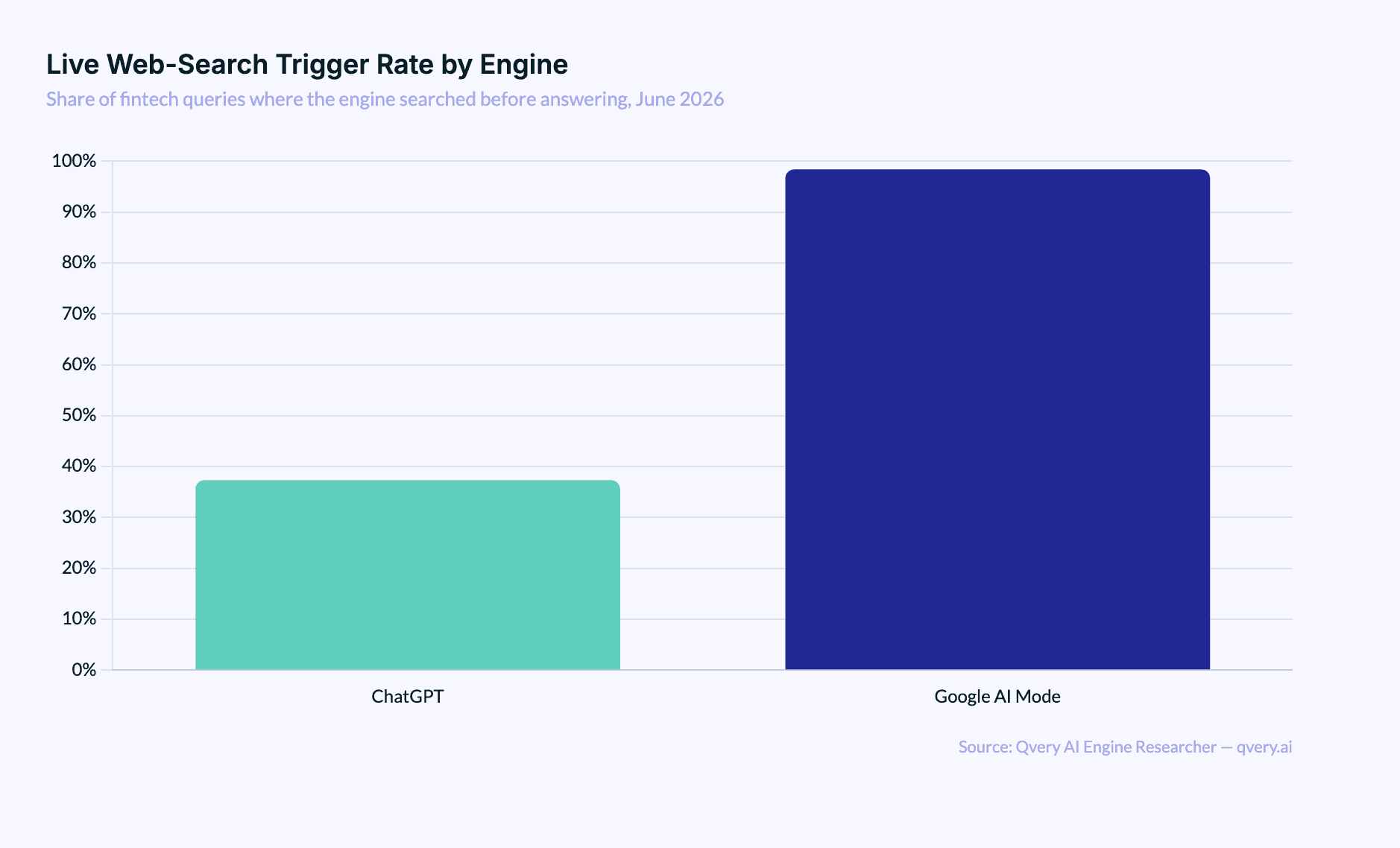
We watched both happen thousands of times, and the gap between them is the most useful thing I have learned about fintech visibility all year. ChatGPT triggered a live web search on only 37.3% of the money queries we ran. Google AI Mode triggered one on 98.4%. One engine is answering from memory while the other goes and does the homework first. If your brand only lives in the homework, half the audience never hears your name.
Finance content has a trap most operators miss. You can have a flawless blog and schema markup so clean it squeaks, and still be invisible the moment the model decides it already knows the answer. (The model is wrong sometimes, but it is confidently wrong, which is worse.) What the engines pull from when they decide who is trustworthy enough to name is a tight, recurring layer, and it is not the banks.
I ran about 250 fintech category and advice queries through our AI Engine Researcher across ChatGPT and Google AI Mode in June 2026. The shares below are directional, not gospel, but the shape held every time I re-ran it. And the shape is the whole story.
Editorial Comparison Publishers Own the Money Answer
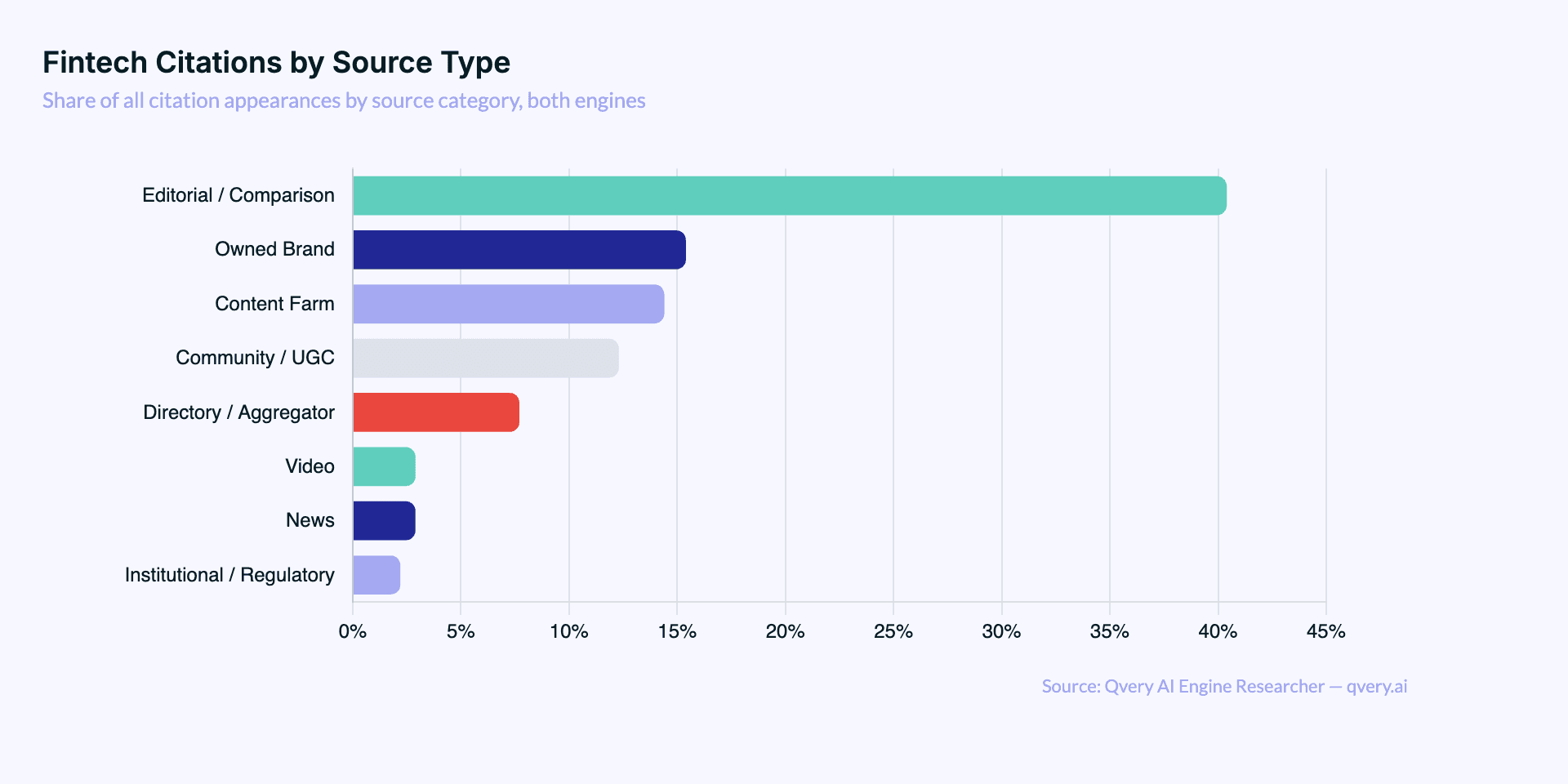
The single most important pattern in this vertical is that the brand almost never supplies the words. When we sorted every cited source into types, 40.4% of all the citations we logged were editorial review and comparison sources, the largest single category by a wide margin. Owned-brand sites, the banks and neobanks themselves, came in at 15.4%. The publishers describing you got cited more than two and a half times as often as your own carefully optimized site.
For a fintech operator, that ratio stings. NerdWallet showed up in roughly 43% of cited answers. Forbes in about 39%. These are the same names that have owned the money queries for a decade, except now they are not winning a results page you can scroll past. They are writing the one-line verdict the model repeats.
It is common to see a neobank sit at the top of Google for "best business checking" and never once surface in the ChatGPT answer, because the answer was assembled out of NerdWallet and a Reddit thread, not its own site. The brand won the search results page and lost the recommendation, and the reason only shows up when you look at the source list.
A favorable sentence inside a NerdWallet roundup does more for your AI visibility than your ten best blog posts combined, because the engine treats the roundup as evidence and treats your blog as advertising.
This is the institutional and reference archetype, what we call Archetype A across our verticals. Encyclopedic and editorial authorities lead, and comparison sites supply the shortlist. Community sources fill the gaps where lived experience is the question. It is the opposite of how travel or ecommerce behaves, where aggregator portals run the table. In money queries, the trust floor is editorial. The engines lean on the publishers they have decided are methodologically sound, and they do it because finance is Your Money or Your Life content, where a wrong answer has consequences and the verification bar is higher than anywhere else.
Reddit Is the One Place Your Own Words Still Count
In a category this institutional, the single most-cited domain was not NerdWallet or Forbes. It was Reddit, present in roughly 56% of cited answers, ahead of every editorial publisher in the set. I reran the numbers because I did not believe it. Money is about as Your Money or Your Life as a question gets, the category where you would expect anonymous forum posts to get suppressed hardest, and Reddit still finished first.
That tracks with what we see everywhere else. Reddit is consistently the single most important UGC source in AI search, and fintech does not break the pattern, it amplifies it. When a real person asks whether a neobank is safe or whether anyone has gotten their money out of a transfer service, the engine reaches for the thread where five strangers argued about exactly that. Editorial publishers tell the model what a product is. Reddit is where it learns what the product is like to use, which is the question that gates a recommendation.
A bad enough Reddit thread can knock you off a shortlist you already earned in the roundup, so the community layer can quietly remove you even after the editorial layer included you.
This is the one cited layer where your brand gets to speak in its own voice without the engine writing it off as marketing. Old threads stay retrievable for years, which is a gift when the consensus is accurate and a slow-motion problem when an outdated complaint is the top result. Both are worth your attention. Community presence is not a substitute for editorial placement, and editorial placement is not a substitute for community presence. In Archetype A they are two halves of the same trust signal.
The Engines Disagree About Who to Trust, and the Split Is Severe
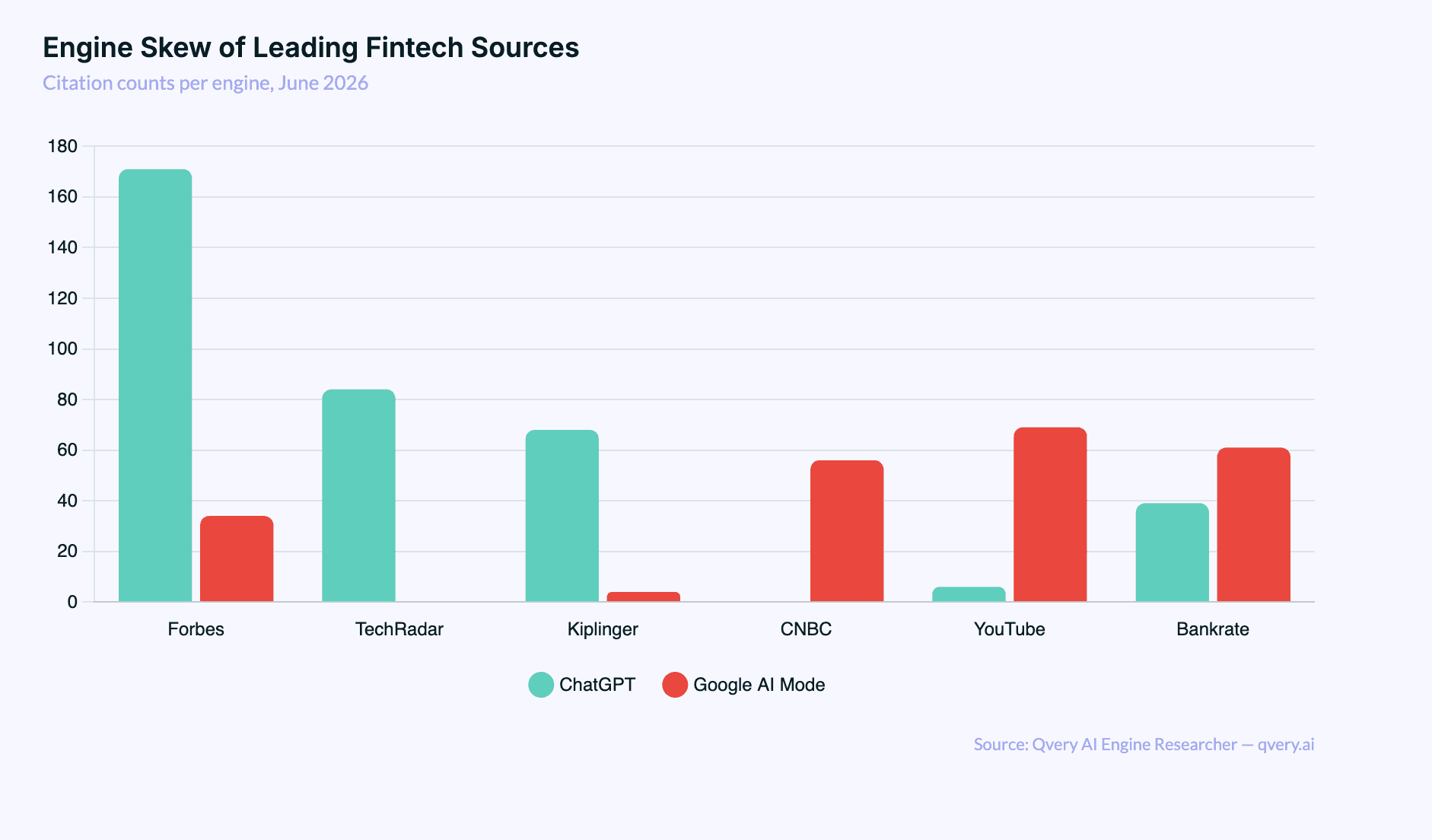
If you average ChatGPT and Google AI Mode together, you miss the most actionable thing in the data, which is that they cite almost entirely different sources. Forbes was cited roughly five times more often on ChatGPT than on Google AI Mode. TechRadar showed up in ChatGPT answers and never once on Google. CNBC flips it, appearing only on the Google AI Mode side and never on ChatGPT. YouTube barely registered on ChatGPT and dominated on Google, which lines up with the strong Google skew video carries everywhere we measure it.
That divergence is two retrieval systems with two different ideas of authority, and it changes how you read your own visibility. A glowing TechRadar feature might make you a fixture in ChatGPT answers and do nothing for Google AI Mode. A CNBC mention might be the reverse. The mistake is treating one engine's source list as the map of where to get covered. You need presence on both sides of the split, because the same person bounces between both engines depending on what is open at the moment.
Cover the source list of one engine perfectly and you are still missing the audience sitting in the other tab.
Recommendation Queries Pull Sources While Definition Queries Pull From Memory
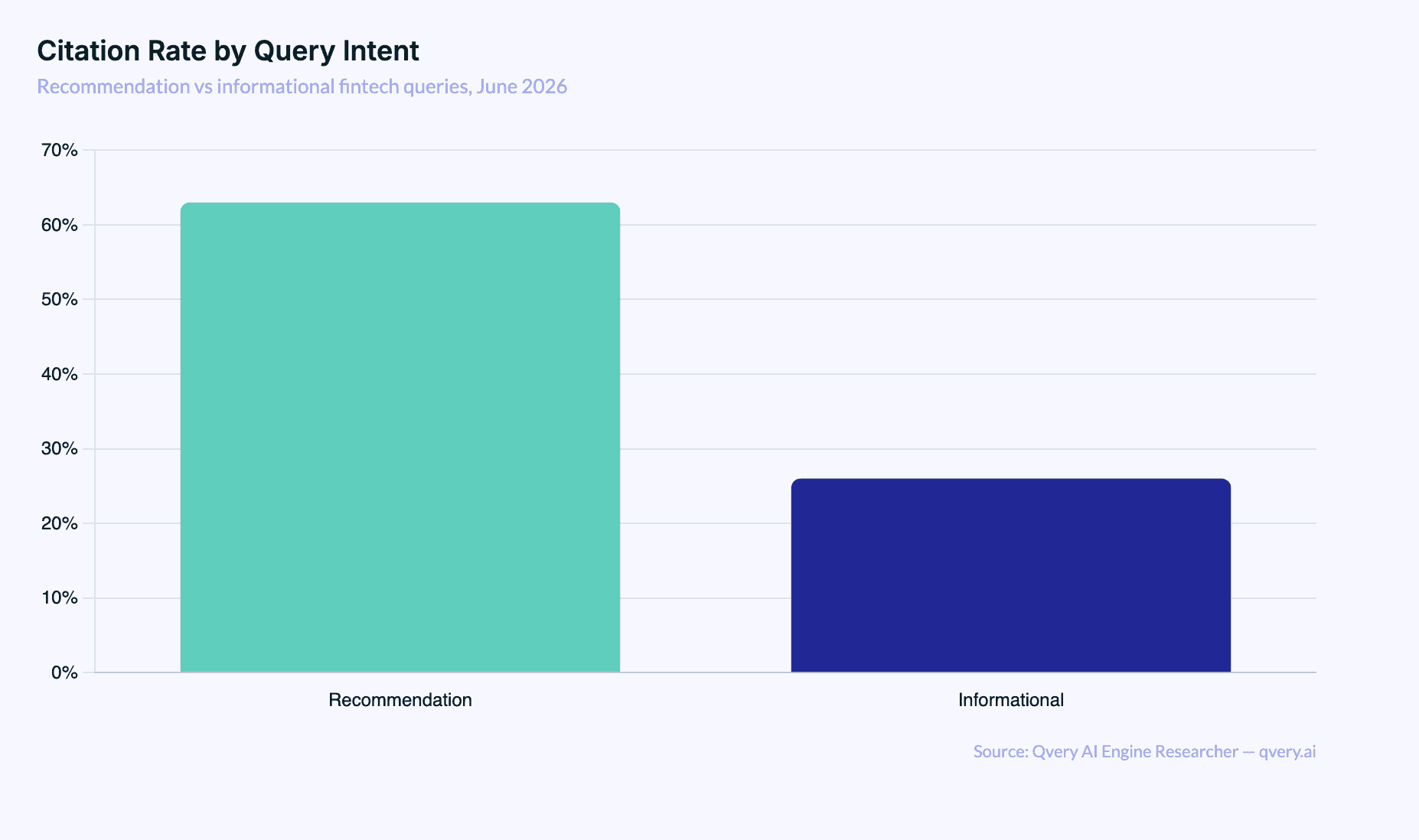
Not every money question behaves the same way, and the difference decides where your effort should go. When the query was a recommendation, the kind that wants a shortlist (best card, safest transfer service, top budgeting app), the engines cited an external source about 63% of the time. When the query was purely informational, the kind that wants a definition (what is APR, how does an IRA work), they cited a source only about 26% of the time.
Definitional answers come straight from the model's memory, which is why Investopedia and a handful of reference sources own that ground and why it is nearly impossible to muscle into it. Recommendation answers are where citations open up, where being in the comparison roundup or the Reddit thread puts you in the response. If you are a fintech brand deciding what content the world should write about you, you want to be living in the recommendation layer, the best-of pages and the lived-experience threads, not trying to out-explain Investopedia on what a savings account is.
This also connects to a pattern we have documented across every vertical: listicles are the most-cited content type in AI search, and finance is the cleanest example of why. The structured best-of format maps perfectly onto how a model builds a shortlist. It is pre-assembled answer scaffolding, and the engines reach for it first.
Being in the Training Layer Beats Being on the Web
The trigger rate reframes everything above. ChatGPT answered without a live web search 62.7% of the time, the flip side of that 37.3% trigger rate. When it does not search, it cannot cite your fresh NerdWallet placement, your new trust page, or last week's Reddit thread. It answers from what it already absorbed during training. That means a second, slower-moving trust layer matters enormously: the institutional and editorial sources that were dense and consistent enough to get baked into the model's memory in the first place.
Google AI Mode searches on nearly every query, so it rewards fresh, recent placement. ChatGPT often answers from training, so it rewards durable, repeated presence. You build for both, because there is no clean way to know which engine a given customer will reach for on a given day.
This is why the consensus game is not optional in finance. If five reputable publishers have described you the same way for two years, agreeing on your category and your fees, that description has a real chance of being inside the model before any search happens. If your story is thin or contradictory across the web, you are betting everything on the 37.3% of the time ChatGPT searches.
One quality caveat worth stating plainly. A chunk of the high-ranking sources we logged were thin content-farm sites that appeared almost exclusively on ChatGPT and almost never on Google AI Mode. They show up in the data, but they are not authorities, and the move is not to become one. ChatGPT pulls low-authority content farms that Google AI Mode filters out, which is itself a reason not to mistake raw citation frequency for credibility.
How to Read and Populate the Layer the Engines Already Trust
I don't fully trust any of this six months out. The fintech answer surface is moving every time we re-run the set. But the playbook for a fintech brand in Archetype A is clearer than it is in most verticals, because the trusted layer is small and named. You don't beat NerdWallet by out-publishing it. You win by being described accurately inside it. Here is the work that moves the cited layer.
Earn placement in the comparison layer. Audit what NerdWallet, Bankrate, Forbes Advisor, Kiplinger, and the rest currently say about you on their best-of and versus pages. Correct factual errors, supply publish-ready data, pursue inclusion where you are absent. This is the 40.4% category, and it is where recommendation answers come from.
Build a structured trust and regulatory hub. Follow the SoFi Trust and Security Center pattern. Name your partner banks, licenses, registration numbers, jurisdictions, and FDIC or protection disclosures in plain, retrievable language. This is the content that gets absorbed and answers the safety question that gates whether you get mentioned at all.
Work the communities accurately. Be present and correct in the subreddits the engine cites for your category, the way Fidelity's subreddit surfaces in Fidelity questions. Post simple corrections in outdated-but-cited threads. Reddit is your number one cited domain, so treat it like one.
Engineer consensus across the web. Synchronize PR, product, legal, and marketing so your category, pricing, fees, and protections read identically everywhere. Consistency is what survives into the training layer ChatGPT answers from when it does not search.
All of this rests on knowing your starting point, which is the same three pillars we use for every AI visibility problem: optimized owned content, third-party mentions, and UGC. Finance just weights the middle two harder than almost anywhere else.
You Cannot Populate a Trusted Layer You Cannot See
The first thing a fintech brand needs is a clear picture of which sources the engines are citing for its category, which of them already mention the brand, and where the brand is missing entirely.
That is what our AI Engine Researcher does. You enter your brand and your category, and it runs the real recommendation and advice queries your customers are typing across ChatGPT and Google AI Mode, then shows you the source list behind every answer. You see that NerdWallet and a specific Reddit thread are driving the response, whether you appear in them, and how your share of voice compares to the competitors who do. Because it runs continuously, you watch the picture move as your placements land instead of guessing.
Sign up, enter your brand, and you will see your fintech source map within minutes.
The thing I keep coming back to is that trigger rate. ChatGPT answers nearly two thirds of money questions without searching, which means the description it reaches for was settled long before anyone typed the query, baked into the model from the publishers that covered you consistently. The work that earns it happens on the open web, months ahead of the answer.
Ask ChatGPT for the best high-yield savings account and it answers in about a second. Ask Google AI Mode the same thing and it goes off to read the web first.
We watched both happen thousands of times, and the gap between them is the most useful thing I have learned about fintech visibility all year. ChatGPT triggered a live web search on only 37.3% of the money queries we ran. Google AI Mode triggered one on 98.4%. One engine is answering from memory while the other goes and does the homework first. If your brand only lives in the homework, half the audience never hears your name.
Finance content has a trap most operators miss. You can have a flawless blog and schema markup so clean it squeaks, and still be invisible the moment the model decides it already knows the answer. (The model is wrong sometimes, but it is confidently wrong, which is worse.) What the engines pull from when they decide who is trustworthy enough to name is a tight, recurring layer, and it is not the banks.
I ran about 250 fintech category and advice queries through our AI Engine Researcher across ChatGPT and Google AI Mode in June 2026. The shares below are directional, not gospel, but the shape held every time I re-ran it. And the shape is the whole story.
Editorial Comparison Publishers Own the Money Answer
The single most important pattern in this vertical is that the brand almost never supplies the words. When we sorted every cited source into types, 40.4% of all the citations we logged were editorial review and comparison sources, the largest single category by a wide margin. Owned-brand sites, the banks and neobanks themselves, came in at 15.4%. The publishers describing you got cited more than two and a half times as often as your own carefully optimized site.
For a fintech operator, that ratio stings. NerdWallet showed up in roughly 43% of cited answers. Forbes in about 39%. These are the same names that have owned the money queries for a decade, except now they are not winning a results page you can scroll past. They are writing the one-line verdict the model repeats.
It is common to see a neobank sit at the top of Google for "best business checking" and never once surface in the ChatGPT answer, because the answer was assembled out of NerdWallet and a Reddit thread, not its own site. The brand won the search results page and lost the recommendation, and the reason only shows up when you look at the source list.
A favorable sentence inside a NerdWallet roundup does more for your AI visibility than your ten best blog posts combined, because the engine treats the roundup as evidence and treats your blog as advertising.
This is the institutional and reference archetype, what we call Archetype A across our verticals. Encyclopedic and editorial authorities lead, and comparison sites supply the shortlist. Community sources fill the gaps where lived experience is the question. It is the opposite of how travel or ecommerce behaves, where aggregator portals run the table. In money queries, the trust floor is editorial. The engines lean on the publishers they have decided are methodologically sound, and they do it because finance is Your Money or Your Life content, where a wrong answer has consequences and the verification bar is higher than anywhere else.
Reddit Is the One Place Your Own Words Still Count
In a category this institutional, the single most-cited domain was not NerdWallet or Forbes. It was Reddit, present in roughly 56% of cited answers, ahead of every editorial publisher in the set. I reran the numbers because I did not believe it. Money is about as Your Money or Your Life as a question gets, the category where you would expect anonymous forum posts to get suppressed hardest, and Reddit still finished first.
That tracks with what we see everywhere else. Reddit is consistently the single most important UGC source in AI search, and fintech does not break the pattern, it amplifies it. When a real person asks whether a neobank is safe or whether anyone has gotten their money out of a transfer service, the engine reaches for the thread where five strangers argued about exactly that. Editorial publishers tell the model what a product is. Reddit is where it learns what the product is like to use, which is the question that gates a recommendation.
A bad enough Reddit thread can knock you off a shortlist you already earned in the roundup, so the community layer can quietly remove you even after the editorial layer included you.
This is the one cited layer where your brand gets to speak in its own voice without the engine writing it off as marketing. Old threads stay retrievable for years, which is a gift when the consensus is accurate and a slow-motion problem when an outdated complaint is the top result. Both are worth your attention. Community presence is not a substitute for editorial placement, and editorial placement is not a substitute for community presence. In Archetype A they are two halves of the same trust signal.
The Engines Disagree About Who to Trust, and the Split Is Severe
If you average ChatGPT and Google AI Mode together, you miss the most actionable thing in the data, which is that they cite almost entirely different sources. Forbes was cited roughly five times more often on ChatGPT than on Google AI Mode. TechRadar showed up in ChatGPT answers and never once on Google. CNBC flips it, appearing only on the Google AI Mode side and never on ChatGPT. YouTube barely registered on ChatGPT and dominated on Google, which lines up with the strong Google skew video carries everywhere we measure it.
That divergence is two retrieval systems with two different ideas of authority, and it changes how you read your own visibility. A glowing TechRadar feature might make you a fixture in ChatGPT answers and do nothing for Google AI Mode. A CNBC mention might be the reverse. The mistake is treating one engine's source list as the map of where to get covered. You need presence on both sides of the split, because the same person bounces between both engines depending on what is open at the moment.
Cover the source list of one engine perfectly and you are still missing the audience sitting in the other tab.
Recommendation Queries Pull Sources While Definition Queries Pull From Memory
Not every money question behaves the same way, and the difference decides where your effort should go. When the query was a recommendation, the kind that wants a shortlist (best card, safest transfer service, top budgeting app), the engines cited an external source about 63% of the time. When the query was purely informational, the kind that wants a definition (what is APR, how does an IRA work), they cited a source only about 26% of the time.
Definitional answers come straight from the model's memory, which is why Investopedia and a handful of reference sources own that ground and why it is nearly impossible to muscle into it. Recommendation answers are where citations open up, where being in the comparison roundup or the Reddit thread puts you in the response. If you are a fintech brand deciding what content the world should write about you, you want to be living in the recommendation layer, the best-of pages and the lived-experience threads, not trying to out-explain Investopedia on what a savings account is.
This also connects to a pattern we have documented across every vertical: listicles are the most-cited content type in AI search, and finance is the cleanest example of why. The structured best-of format maps perfectly onto how a model builds a shortlist. It is pre-assembled answer scaffolding, and the engines reach for it first.
Being in the Training Layer Beats Being on the Web
The trigger rate reframes everything above. ChatGPT answered without a live web search 62.7% of the time, the flip side of that 37.3% trigger rate. When it does not search, it cannot cite your fresh NerdWallet placement, your new trust page, or last week's Reddit thread. It answers from what it already absorbed during training. That means a second, slower-moving trust layer matters enormously: the institutional and editorial sources that were dense and consistent enough to get baked into the model's memory in the first place.
Google AI Mode searches on nearly every query, so it rewards fresh, recent placement. ChatGPT often answers from training, so it rewards durable, repeated presence. You build for both, because there is no clean way to know which engine a given customer will reach for on a given day.
This is why the consensus game is not optional in finance. If five reputable publishers have described you the same way for two years, agreeing on your category and your fees, that description has a real chance of being inside the model before any search happens. If your story is thin or contradictory across the web, you are betting everything on the 37.3% of the time ChatGPT searches.
One quality caveat worth stating plainly. A chunk of the high-ranking sources we logged were thin content-farm sites that appeared almost exclusively on ChatGPT and almost never on Google AI Mode. They show up in the data, but they are not authorities, and the move is not to become one. ChatGPT pulls low-authority content farms that Google AI Mode filters out, which is itself a reason not to mistake raw citation frequency for credibility.
How to Read and Populate the Layer the Engines Already Trust
I don't fully trust any of this six months out. The fintech answer surface is moving every time we re-run the set. But the playbook for a fintech brand in Archetype A is clearer than it is in most verticals, because the trusted layer is small and named. You don't beat NerdWallet by out-publishing it. You win by being described accurately inside it. Here is the work that moves the cited layer.
Earn placement in the comparison layer. Audit what NerdWallet, Bankrate, Forbes Advisor, Kiplinger, and the rest currently say about you on their best-of and versus pages. Correct factual errors, supply publish-ready data, pursue inclusion where you are absent. This is the 40.4% category, and it is where recommendation answers come from.
Build a structured trust and regulatory hub. Follow the SoFi Trust and Security Center pattern. Name your partner banks, licenses, registration numbers, jurisdictions, and FDIC or protection disclosures in plain, retrievable language. This is the content that gets absorbed and answers the safety question that gates whether you get mentioned at all.
Work the communities accurately. Be present and correct in the subreddits the engine cites for your category, the way Fidelity's subreddit surfaces in Fidelity questions. Post simple corrections in outdated-but-cited threads. Reddit is your number one cited domain, so treat it like one.
Engineer consensus across the web. Synchronize PR, product, legal, and marketing so your category, pricing, fees, and protections read identically everywhere. Consistency is what survives into the training layer ChatGPT answers from when it does not search.
All of this rests on knowing your starting point, which is the same three pillars we use for every AI visibility problem: optimized owned content, third-party mentions, and UGC. Finance just weights the middle two harder than almost anywhere else.
You Cannot Populate a Trusted Layer You Cannot See
The first thing a fintech brand needs is a clear picture of which sources the engines are citing for its category, which of them already mention the brand, and where the brand is missing entirely.
That is what our AI Engine Researcher does. You enter your brand and your category, and it runs the real recommendation and advice queries your customers are typing across ChatGPT and Google AI Mode, then shows you the source list behind every answer. You see that NerdWallet and a specific Reddit thread are driving the response, whether you appear in them, and how your share of voice compares to the competitors who do. Because it runs continuously, you watch the picture move as your placements land instead of guessing.
Sign up, enter your brand, and you will see your fintech source map within minutes.
The thing I keep coming back to is that trigger rate. ChatGPT answers nearly two thirds of money questions without searching, which means the description it reaches for was settled long before anyone typed the query, baked into the model from the publishers that covered you consistently. The work that earns it happens on the open web, months ahead of the answer.
Ask ChatGPT for the best high-yield savings account and it answers in about a second. Ask Google AI Mode the same thing and it goes off to read the web first.
We watched both happen thousands of times, and the gap between them is the most useful thing I have learned about fintech visibility all year. ChatGPT triggered a live web search on only 37.3% of the money queries we ran. Google AI Mode triggered one on 98.4%. One engine is answering from memory while the other goes and does the homework first. If your brand only lives in the homework, half the audience never hears your name.
Finance content has a trap most operators miss. You can have a flawless blog and schema markup so clean it squeaks, and still be invisible the moment the model decides it already knows the answer. (The model is wrong sometimes, but it is confidently wrong, which is worse.) What the engines pull from when they decide who is trustworthy enough to name is a tight, recurring layer, and it is not the banks.
I ran about 250 fintech category and advice queries through our AI Engine Researcher across ChatGPT and Google AI Mode in June 2026. The shares below are directional, not gospel, but the shape held every time I re-ran it. And the shape is the whole story.
Editorial Comparison Publishers Own the Money Answer
The single most important pattern in this vertical is that the brand almost never supplies the words. When we sorted every cited source into types, 40.4% of all the citations we logged were editorial review and comparison sources, the largest single category by a wide margin. Owned-brand sites, the banks and neobanks themselves, came in at 15.4%. The publishers describing you got cited more than two and a half times as often as your own carefully optimized site.
For a fintech operator, that ratio stings. NerdWallet showed up in roughly 43% of cited answers. Forbes in about 39%. These are the same names that have owned the money queries for a decade, except now they are not winning a results page you can scroll past. They are writing the one-line verdict the model repeats.
It is common to see a neobank sit at the top of Google for "best business checking" and never once surface in the ChatGPT answer, because the answer was assembled out of NerdWallet and a Reddit thread, not its own site. The brand won the search results page and lost the recommendation, and the reason only shows up when you look at the source list.
A favorable sentence inside a NerdWallet roundup does more for your AI visibility than your ten best blog posts combined, because the engine treats the roundup as evidence and treats your blog as advertising.
This is the institutional and reference archetype, what we call Archetype A across our verticals. Encyclopedic and editorial authorities lead, and comparison sites supply the shortlist. Community sources fill the gaps where lived experience is the question. It is the opposite of how travel or ecommerce behaves, where aggregator portals run the table. In money queries, the trust floor is editorial. The engines lean on the publishers they have decided are methodologically sound, and they do it because finance is Your Money or Your Life content, where a wrong answer has consequences and the verification bar is higher than anywhere else.
Reddit Is the One Place Your Own Words Still Count
In a category this institutional, the single most-cited domain was not NerdWallet or Forbes. It was Reddit, present in roughly 56% of cited answers, ahead of every editorial publisher in the set. I reran the numbers because I did not believe it. Money is about as Your Money or Your Life as a question gets, the category where you would expect anonymous forum posts to get suppressed hardest, and Reddit still finished first.
That tracks with what we see everywhere else. Reddit is consistently the single most important UGC source in AI search, and fintech does not break the pattern, it amplifies it. When a real person asks whether a neobank is safe or whether anyone has gotten their money out of a transfer service, the engine reaches for the thread where five strangers argued about exactly that. Editorial publishers tell the model what a product is. Reddit is where it learns what the product is like to use, which is the question that gates a recommendation.
A bad enough Reddit thread can knock you off a shortlist you already earned in the roundup, so the community layer can quietly remove you even after the editorial layer included you.
This is the one cited layer where your brand gets to speak in its own voice without the engine writing it off as marketing. Old threads stay retrievable for years, which is a gift when the consensus is accurate and a slow-motion problem when an outdated complaint is the top result. Both are worth your attention. Community presence is not a substitute for editorial placement, and editorial placement is not a substitute for community presence. In Archetype A they are two halves of the same trust signal.
The Engines Disagree About Who to Trust, and the Split Is Severe
If you average ChatGPT and Google AI Mode together, you miss the most actionable thing in the data, which is that they cite almost entirely different sources. Forbes was cited roughly five times more often on ChatGPT than on Google AI Mode. TechRadar showed up in ChatGPT answers and never once on Google. CNBC flips it, appearing only on the Google AI Mode side and never on ChatGPT. YouTube barely registered on ChatGPT and dominated on Google, which lines up with the strong Google skew video carries everywhere we measure it.
That divergence is two retrieval systems with two different ideas of authority, and it changes how you read your own visibility. A glowing TechRadar feature might make you a fixture in ChatGPT answers and do nothing for Google AI Mode. A CNBC mention might be the reverse. The mistake is treating one engine's source list as the map of where to get covered. You need presence on both sides of the split, because the same person bounces between both engines depending on what is open at the moment.
Cover the source list of one engine perfectly and you are still missing the audience sitting in the other tab.
Recommendation Queries Pull Sources While Definition Queries Pull From Memory
Not every money question behaves the same way, and the difference decides where your effort should go. When the query was a recommendation, the kind that wants a shortlist (best card, safest transfer service, top budgeting app), the engines cited an external source about 63% of the time. When the query was purely informational, the kind that wants a definition (what is APR, how does an IRA work), they cited a source only about 26% of the time.
Definitional answers come straight from the model's memory, which is why Investopedia and a handful of reference sources own that ground and why it is nearly impossible to muscle into it. Recommendation answers are where citations open up, where being in the comparison roundup or the Reddit thread puts you in the response. If you are a fintech brand deciding what content the world should write about you, you want to be living in the recommendation layer, the best-of pages and the lived-experience threads, not trying to out-explain Investopedia on what a savings account is.
This also connects to a pattern we have documented across every vertical: listicles are the most-cited content type in AI search, and finance is the cleanest example of why. The structured best-of format maps perfectly onto how a model builds a shortlist. It is pre-assembled answer scaffolding, and the engines reach for it first.
Being in the Training Layer Beats Being on the Web
The trigger rate reframes everything above. ChatGPT answered without a live web search 62.7% of the time, the flip side of that 37.3% trigger rate. When it does not search, it cannot cite your fresh NerdWallet placement, your new trust page, or last week's Reddit thread. It answers from what it already absorbed during training. That means a second, slower-moving trust layer matters enormously: the institutional and editorial sources that were dense and consistent enough to get baked into the model's memory in the first place.
Google AI Mode searches on nearly every query, so it rewards fresh, recent placement. ChatGPT often answers from training, so it rewards durable, repeated presence. You build for both, because there is no clean way to know which engine a given customer will reach for on a given day.
This is why the consensus game is not optional in finance. If five reputable publishers have described you the same way for two years, agreeing on your category and your fees, that description has a real chance of being inside the model before any search happens. If your story is thin or contradictory across the web, you are betting everything on the 37.3% of the time ChatGPT searches.
One quality caveat worth stating plainly. A chunk of the high-ranking sources we logged were thin content-farm sites that appeared almost exclusively on ChatGPT and almost never on Google AI Mode. They show up in the data, but they are not authorities, and the move is not to become one. ChatGPT pulls low-authority content farms that Google AI Mode filters out, which is itself a reason not to mistake raw citation frequency for credibility.
How to Read and Populate the Layer the Engines Already Trust
I don't fully trust any of this six months out. The fintech answer surface is moving every time we re-run the set. But the playbook for a fintech brand in Archetype A is clearer than it is in most verticals, because the trusted layer is small and named. You don't beat NerdWallet by out-publishing it. You win by being described accurately inside it. Here is the work that moves the cited layer.
Earn placement in the comparison layer. Audit what NerdWallet, Bankrate, Forbes Advisor, Kiplinger, and the rest currently say about you on their best-of and versus pages. Correct factual errors, supply publish-ready data, pursue inclusion where you are absent. This is the 40.4% category, and it is where recommendation answers come from.
Build a structured trust and regulatory hub. Follow the SoFi Trust and Security Center pattern. Name your partner banks, licenses, registration numbers, jurisdictions, and FDIC or protection disclosures in plain, retrievable language. This is the content that gets absorbed and answers the safety question that gates whether you get mentioned at all.
Work the communities accurately. Be present and correct in the subreddits the engine cites for your category, the way Fidelity's subreddit surfaces in Fidelity questions. Post simple corrections in outdated-but-cited threads. Reddit is your number one cited domain, so treat it like one.
Engineer consensus across the web. Synchronize PR, product, legal, and marketing so your category, pricing, fees, and protections read identically everywhere. Consistency is what survives into the training layer ChatGPT answers from when it does not search.
All of this rests on knowing your starting point, which is the same three pillars we use for every AI visibility problem: optimized owned content, third-party mentions, and UGC. Finance just weights the middle two harder than almost anywhere else.
You Cannot Populate a Trusted Layer You Cannot See
The first thing a fintech brand needs is a clear picture of which sources the engines are citing for its category, which of them already mention the brand, and where the brand is missing entirely.
That is what our AI Engine Researcher does. You enter your brand and your category, and it runs the real recommendation and advice queries your customers are typing across ChatGPT and Google AI Mode, then shows you the source list behind every answer. You see that NerdWallet and a specific Reddit thread are driving the response, whether you appear in them, and how your share of voice compares to the competitors who do. Because it runs continuously, you watch the picture move as your placements land instead of guessing.
Sign up, enter your brand, and you will see your fintech source map within minutes.
The thing I keep coming back to is that trigger rate. ChatGPT answers nearly two thirds of money questions without searching, which means the description it reaches for was settled long before anyone typed the query, baked into the model from the publishers that covered you consistently. The work that earns it happens on the open web, months ahead of the answer.
Ask ChatGPT for the best high-yield savings account and it answers in about a second. Ask Google AI Mode the same thing and it goes off to read the web first.
We watched both happen thousands of times, and the gap between them is the most useful thing I have learned about fintech visibility all year. ChatGPT triggered a live web search on only 37.3% of the money queries we ran. Google AI Mode triggered one on 98.4%. One engine is answering from memory while the other goes and does the homework first. If your brand only lives in the homework, half the audience never hears your name.
Finance content has a trap most operators miss. You can have a flawless blog and schema markup so clean it squeaks, and still be invisible the moment the model decides it already knows the answer. (The model is wrong sometimes, but it is confidently wrong, which is worse.) What the engines pull from when they decide who is trustworthy enough to name is a tight, recurring layer, and it is not the banks.
I ran about 250 fintech category and advice queries through our AI Engine Researcher across ChatGPT and Google AI Mode in June 2026. The shares below are directional, not gospel, but the shape held every time I re-ran it. And the shape is the whole story.
Editorial Comparison Publishers Own the Money Answer
The single most important pattern in this vertical is that the brand almost never supplies the words. When we sorted every cited source into types, 40.4% of all the citations we logged were editorial review and comparison sources, the largest single category by a wide margin. Owned-brand sites, the banks and neobanks themselves, came in at 15.4%. The publishers describing you got cited more than two and a half times as often as your own carefully optimized site.
For a fintech operator, that ratio stings. NerdWallet showed up in roughly 43% of cited answers. Forbes in about 39%. These are the same names that have owned the money queries for a decade, except now they are not winning a results page you can scroll past. They are writing the one-line verdict the model repeats.
It is common to see a neobank sit at the top of Google for "best business checking" and never once surface in the ChatGPT answer, because the answer was assembled out of NerdWallet and a Reddit thread, not its own site. The brand won the search results page and lost the recommendation, and the reason only shows up when you look at the source list.
A favorable sentence inside a NerdWallet roundup does more for your AI visibility than your ten best blog posts combined, because the engine treats the roundup as evidence and treats your blog as advertising.
This is the institutional and reference archetype, what we call Archetype A across our verticals. Encyclopedic and editorial authorities lead, and comparison sites supply the shortlist. Community sources fill the gaps where lived experience is the question. It is the opposite of how travel or ecommerce behaves, where aggregator portals run the table. In money queries, the trust floor is editorial. The engines lean on the publishers they have decided are methodologically sound, and they do it because finance is Your Money or Your Life content, where a wrong answer has consequences and the verification bar is higher than anywhere else.
Reddit Is the One Place Your Own Words Still Count
In a category this institutional, the single most-cited domain was not NerdWallet or Forbes. It was Reddit, present in roughly 56% of cited answers, ahead of every editorial publisher in the set. I reran the numbers because I did not believe it. Money is about as Your Money or Your Life as a question gets, the category where you would expect anonymous forum posts to get suppressed hardest, and Reddit still finished first.
That tracks with what we see everywhere else. Reddit is consistently the single most important UGC source in AI search, and fintech does not break the pattern, it amplifies it. When a real person asks whether a neobank is safe or whether anyone has gotten their money out of a transfer service, the engine reaches for the thread where five strangers argued about exactly that. Editorial publishers tell the model what a product is. Reddit is where it learns what the product is like to use, which is the question that gates a recommendation.
A bad enough Reddit thread can knock you off a shortlist you already earned in the roundup, so the community layer can quietly remove you even after the editorial layer included you.
This is the one cited layer where your brand gets to speak in its own voice without the engine writing it off as marketing. Old threads stay retrievable for years, which is a gift when the consensus is accurate and a slow-motion problem when an outdated complaint is the top result. Both are worth your attention. Community presence is not a substitute for editorial placement, and editorial placement is not a substitute for community presence. In Archetype A they are two halves of the same trust signal.
The Engines Disagree About Who to Trust, and the Split Is Severe
If you average ChatGPT and Google AI Mode together, you miss the most actionable thing in the data, which is that they cite almost entirely different sources. Forbes was cited roughly five times more often on ChatGPT than on Google AI Mode. TechRadar showed up in ChatGPT answers and never once on Google. CNBC flips it, appearing only on the Google AI Mode side and never on ChatGPT. YouTube barely registered on ChatGPT and dominated on Google, which lines up with the strong Google skew video carries everywhere we measure it.
That divergence is two retrieval systems with two different ideas of authority, and it changes how you read your own visibility. A glowing TechRadar feature might make you a fixture in ChatGPT answers and do nothing for Google AI Mode. A CNBC mention might be the reverse. The mistake is treating one engine's source list as the map of where to get covered. You need presence on both sides of the split, because the same person bounces between both engines depending on what is open at the moment.
Cover the source list of one engine perfectly and you are still missing the audience sitting in the other tab.
Recommendation Queries Pull Sources While Definition Queries Pull From Memory
Not every money question behaves the same way, and the difference decides where your effort should go. When the query was a recommendation, the kind that wants a shortlist (best card, safest transfer service, top budgeting app), the engines cited an external source about 63% of the time. When the query was purely informational, the kind that wants a definition (what is APR, how does an IRA work), they cited a source only about 26% of the time.
Definitional answers come straight from the model's memory, which is why Investopedia and a handful of reference sources own that ground and why it is nearly impossible to muscle into it. Recommendation answers are where citations open up, where being in the comparison roundup or the Reddit thread puts you in the response. If you are a fintech brand deciding what content the world should write about you, you want to be living in the recommendation layer, the best-of pages and the lived-experience threads, not trying to out-explain Investopedia on what a savings account is.
This also connects to a pattern we have documented across every vertical: listicles are the most-cited content type in AI search, and finance is the cleanest example of why. The structured best-of format maps perfectly onto how a model builds a shortlist. It is pre-assembled answer scaffolding, and the engines reach for it first.
Being in the Training Layer Beats Being on the Web
The trigger rate reframes everything above. ChatGPT answered without a live web search 62.7% of the time, the flip side of that 37.3% trigger rate. When it does not search, it cannot cite your fresh NerdWallet placement, your new trust page, or last week's Reddit thread. It answers from what it already absorbed during training. That means a second, slower-moving trust layer matters enormously: the institutional and editorial sources that were dense and consistent enough to get baked into the model's memory in the first place.
Google AI Mode searches on nearly every query, so it rewards fresh, recent placement. ChatGPT often answers from training, so it rewards durable, repeated presence. You build for both, because there is no clean way to know which engine a given customer will reach for on a given day.
This is why the consensus game is not optional in finance. If five reputable publishers have described you the same way for two years, agreeing on your category and your fees, that description has a real chance of being inside the model before any search happens. If your story is thin or contradictory across the web, you are betting everything on the 37.3% of the time ChatGPT searches.
One quality caveat worth stating plainly. A chunk of the high-ranking sources we logged were thin content-farm sites that appeared almost exclusively on ChatGPT and almost never on Google AI Mode. They show up in the data, but they are not authorities, and the move is not to become one. ChatGPT pulls low-authority content farms that Google AI Mode filters out, which is itself a reason not to mistake raw citation frequency for credibility.
How to Read and Populate the Layer the Engines Already Trust
I don't fully trust any of this six months out. The fintech answer surface is moving every time we re-run the set. But the playbook for a fintech brand in Archetype A is clearer than it is in most verticals, because the trusted layer is small and named. You don't beat NerdWallet by out-publishing it. You win by being described accurately inside it. Here is the work that moves the cited layer.
Earn placement in the comparison layer. Audit what NerdWallet, Bankrate, Forbes Advisor, Kiplinger, and the rest currently say about you on their best-of and versus pages. Correct factual errors, supply publish-ready data, pursue inclusion where you are absent. This is the 40.4% category, and it is where recommendation answers come from.
Build a structured trust and regulatory hub. Follow the SoFi Trust and Security Center pattern. Name your partner banks, licenses, registration numbers, jurisdictions, and FDIC or protection disclosures in plain, retrievable language. This is the content that gets absorbed and answers the safety question that gates whether you get mentioned at all.
Work the communities accurately. Be present and correct in the subreddits the engine cites for your category, the way Fidelity's subreddit surfaces in Fidelity questions. Post simple corrections in outdated-but-cited threads. Reddit is your number one cited domain, so treat it like one.
Engineer consensus across the web. Synchronize PR, product, legal, and marketing so your category, pricing, fees, and protections read identically everywhere. Consistency is what survives into the training layer ChatGPT answers from when it does not search.
All of this rests on knowing your starting point, which is the same three pillars we use for every AI visibility problem: optimized owned content, third-party mentions, and UGC. Finance just weights the middle two harder than almost anywhere else.
You Cannot Populate a Trusted Layer You Cannot See
The first thing a fintech brand needs is a clear picture of which sources the engines are citing for its category, which of them already mention the brand, and where the brand is missing entirely.
That is what our AI Engine Researcher does. You enter your brand and your category, and it runs the real recommendation and advice queries your customers are typing across ChatGPT and Google AI Mode, then shows you the source list behind every answer. You see that NerdWallet and a specific Reddit thread are driving the response, whether you appear in them, and how your share of voice compares to the competitors who do. Because it runs continuously, you watch the picture move as your placements land instead of guessing.
Sign up, enter your brand, and you will see your fintech source map within minutes.
The thing I keep coming back to is that trigger rate. ChatGPT answers nearly two thirds of money questions without searching, which means the description it reaches for was settled long before anyone typed the query, baked into the model from the publishers that covered you consistently. The work that earns it happens on the open web, months ahead of the answer.

© 2026 Qvery AI OÜ